
Acts 7:35

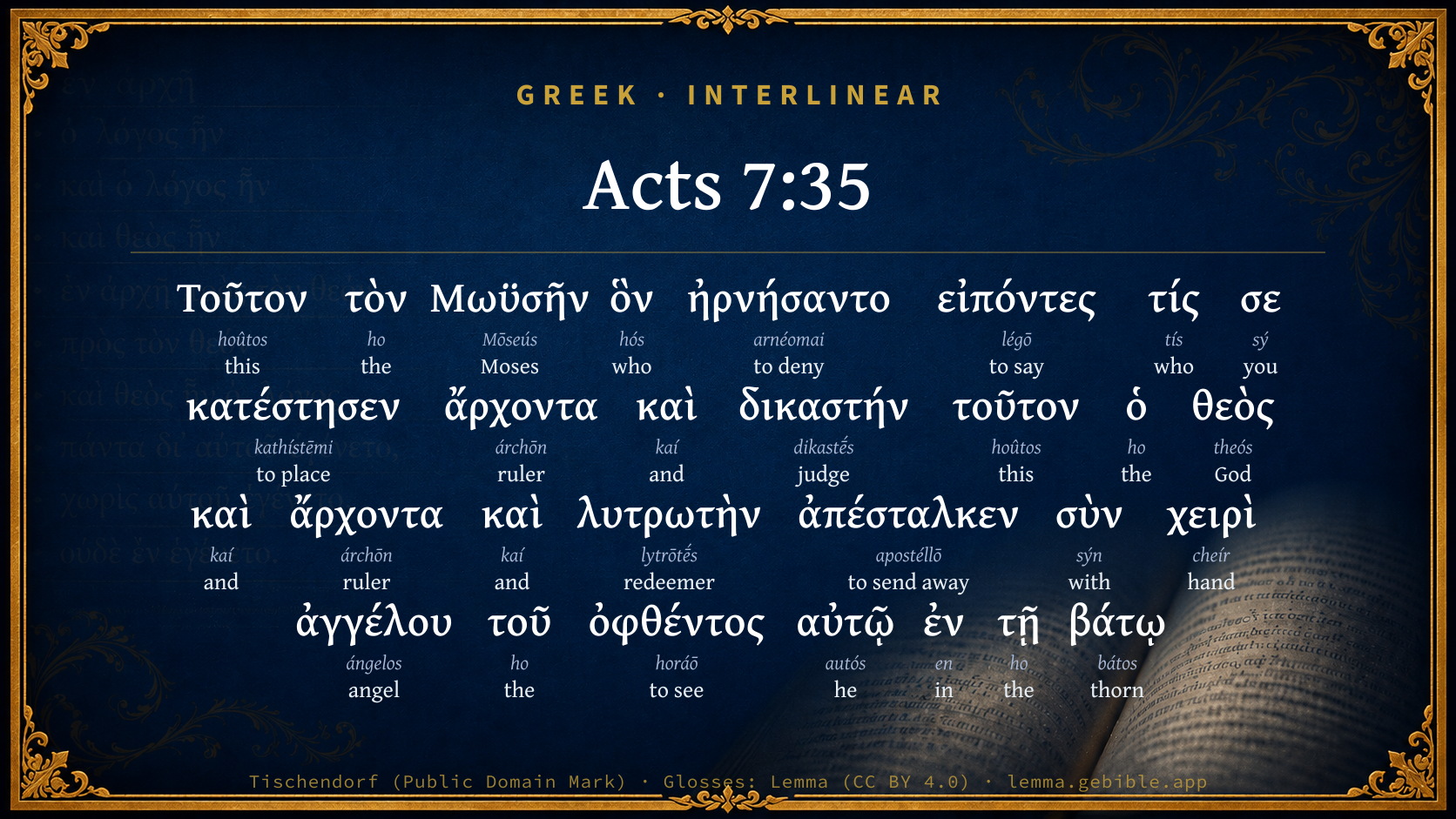
Greek (Tischendorf 8th ed.) Acts 7:35 appears in the Greek New Testament. The text above is from the Tischendorf 8th edition. Each word links to its Strong’s number and a concise gloss. Click any word for its full Thayer’s Greek Lexicon entry.
Download image
Cite this verse

Acts 7:35 (World English Bible). Public Domain. Lemma interlinear Bible study tool, https://lemma.gebible.app/v/acts/7/35.

Show BibTeX & RIS
BibTeX
RIS
English Translation
"This Moses, whom they refused, saying, 'Who made you a ruler and a judge?'--God has sent him as both a ruler and a deliverer by the hand of the angel who appeared to him in the bush.
World English Bible · Public Domain
Highlights
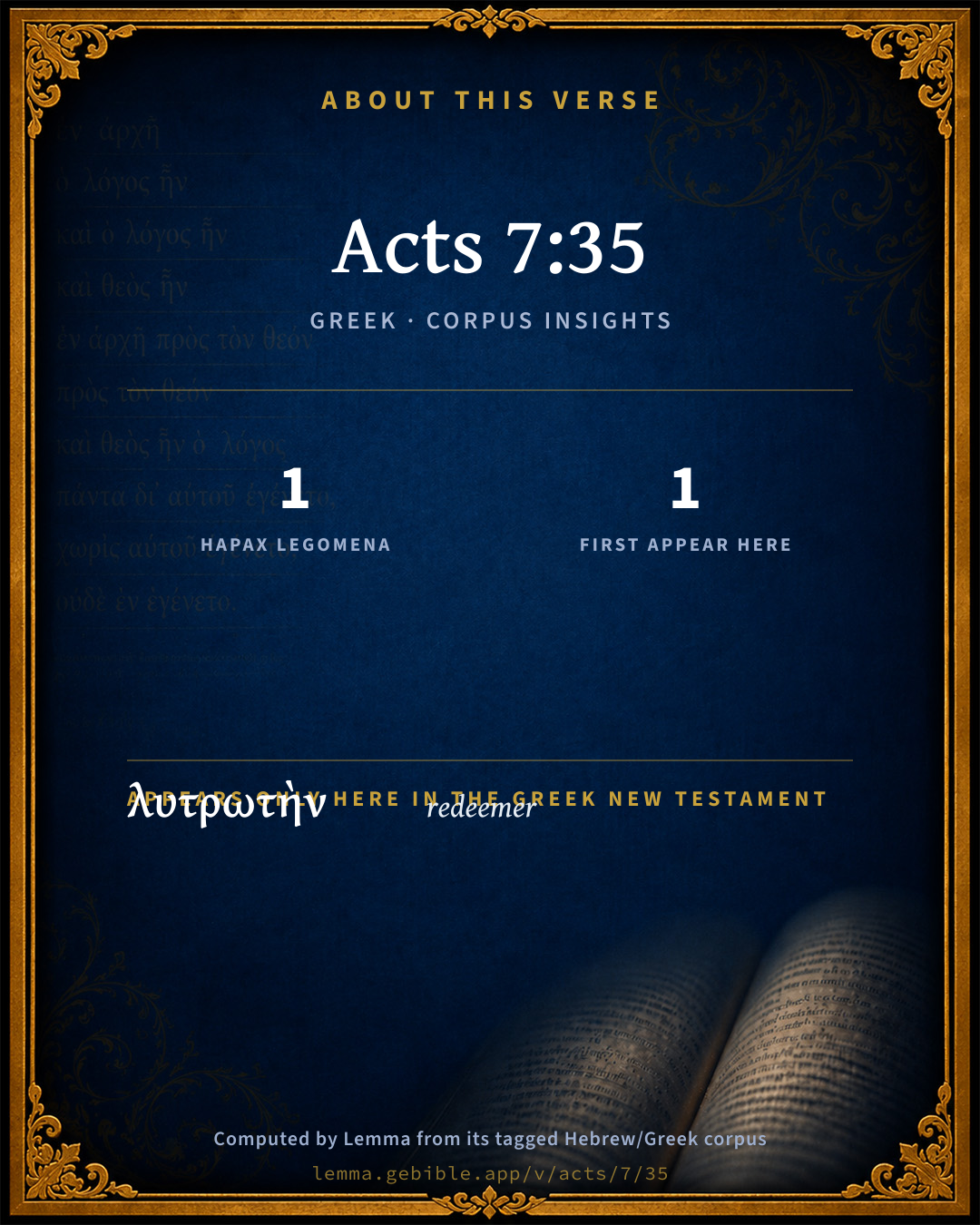
  • 1 hapax legomenon — only here in the Greek New Testament
  • 1 first appearance in the Greek New Testament
Full analysis ↓
Download a study sheet

One document with this verse’s original text, its word-by-word gloss line, the meaning frame, cross-references with their text, attributed commentary, and full source and license credits — printable, and it pastes into notes with its structure intact.

This verse Autodidact and up

Study sheet (.html) Plain text (.txt)

A passage Seminary Student

Up to 50 verses in one chapter. A passage sheet keeps up to 6 commentary sources and 12 cross-references per verse, in the order this page ranks them, and says so on the sheet whenever that leaves anything out. Ask for a single verse and you get the Autodidact verse sheet above.

Everything on this page stays free to read, with no account — the sheet is a download of what is already on screen, not access to it.

Want to remove ads? Support Godless Engineer
Compare translations 3

The same verse in 3 English versions, stacked beneath the original-language interlinear above. Click any original word for its lexicon entry.

Each is an independent rendering of the whole verse — the interlinear is not word-aligned to these translations.

Highlighted words mark where these versions differ — a whole-verse word diff, not a word-by-word alignment.

  • World English Bible Public Domain
    "This Moses, whom they refused, saying, 'Who made you a ruler and a judge?'--God has sent him as both a ruler and a deliverer by the hand of the angel who appeared to him in the bush.
  • King James Version Public Domain
    This Moses whom they refused, saying, Who made thee a ruler and a judge? the same did God send to be a ruler and a deliverer by the hand of the angel which appeared to him in the bush.
  • unfoldingWord Literal Text CC BY-SA 4.0
    This Moses, whom they rejected, saying, ‘Who appointed you a ruler and a judge?’—this one God sent as both a ruler and a redeemer with the hand of the angel who appeared to him in the bush.

unfoldingWord Literal Text — © unfoldingWord, licensed CC BY-SA 4.0. Word-aligned USFM3 via Door43 (git.door43.org/unfoldingWord/en_ult).

Versions to compare (up to 4)

3 of 4 selected

Show all 19 translations

Every available English version of this verse, each an independent rendering of the whole verse.

  • World English Bible Public Domain
    "This Moses, whom they refused, saying, 'Who made you a ruler and a judge?'--God has sent him as both a ruler and a deliverer by the hand of the angel who appeared to him in the bush.
  • Berean Standard Bible Public Domain
    This Moses, whom they had rejected with the words, ‘Who made you ruler and judge?’ is the one whom God sent to be their ruler and redeemer through the angel who appeared to him in the bush.
  • Majority Standard Bible Public Domain
    This Moses, whom they had rejected with the words, ‘Who made you ruler and judge?’ is the one whom God sent to be their ruler and redeemer through the angel who appeared to him in the bush.
  • King James Version Public Domain
    This Moses whom they refused, saying, Who made thee a ruler and a judge? the same did God send to be a ruler and a deliverer by the hand of the angel which appeared to him in the bush.
  • American Standard Version (1901) Public Domain
    This Moses whom they refused, saying, Who made thee a ruler and a judge? him hath God sent `to be' both a ruler and a deliverer with the hand of the angel that appeared to him in the bush.
  • Revised Version (1885) Public Domain
    This Moses whom they refused, saying, Who made thee a ruler and a judge? him hath God sent to be both a ruler and a deliverer with the hand of the angel which appeared to him in the bush.
  • Geneva Bible (1599) Public Domain
    This Moses whome they forsooke, saying, Who made thee a prince and a iudge? the same God sent for a prince, and a deliuerer by the hand of the Angel, which appeared to him in the bush.
  • Douay-Rheims (1899) Public Domain
    This Moses, whom they refused, saying: Who hath appointed thee prince and judge? him God sent to be prince and redeemer by the hand of the angel who appeared to him in the bush.
  • Young's Literal Translation Public Domain
    `This Moses, whom they did refuse, saying, Who did set thee a ruler and a judge? this one God a ruler and a redeemer did send, in the hand of a messenger who appeared to him in the bush;
  • Literal Standard Version CC BY-SA 4.0
    This Moses, whom they refused, saying, Who set you a ruler and a judge? This one God sent [as] a ruler and a redeemer, by the hand of [the] Messenger who appeared to him in the bush;
  • Unlocked Literal Bible CC BY-SA 4.0
    This Moses whom they rejected, when they said, 'Who made you a ruler and a judge?'—he was the one whom God sent as both a ruler and deliverer. God sent him by the hand of the angel who appeared to Moses in the bush.
  • unfoldingWord Literal Text CC BY-SA 4.0
    This Moses, whom they rejected, saying, ‘Who appointed you a ruler and a judge?’—this one God sent as both a ruler and a redeemer with the hand of the angel who appeared to him in the bush.
  • Darby Bible Public Domain
    This Moses, whom they refused, saying, Who made thee ruler and judge? him did God send [to be] a ruler and deliverer with the hand of the angel who appeared to him in the bush.
  • World Messianic Bible Public Domain
    “This Moses whom they refused, saying, ‘Who made you a ruler and a judge?’—God has sent him as both a ruler and a deliverer by the hand of the angel who appeared to him in the bush.
  • Webster's Bible Public Domain
    This Moses, whom they refused, saying, Who made thee a ruler and a judge? the same did God send to be a ruler and a deliverer by the hand of the angel who appeared to him in the bush.
  • Free Bible Version CC BY-SA 4.0
    This was the same Moses that the people had rejected when they said, ‘Who made you a ruler and judge over us?’ God sent him to be both a ruler and a liberator, by means of the angel who appeared to him in the bush.
  • Bible in Basic English Public Domain
    This Moses, whom they would not have, saying, Who made you a ruler and a judge? him God sent to be a ruler and a saviour, by the hand of the angel whom he saw in the thorn-tree.
  • Text-Critical English NT CC BY 4.0
    “This is the same Moses they had rejected, saying, ‘Who appointed yoʋ to be a ruler and judge?’ He is the one God sent as a ruler and redeemer by the hand of the angel who appeared to him in the bush.
  • Tyndale New Testament (1534) Public Domain
    This Moses whom they forsoke sayinge: who made the a ruelar and a iudge: the same God sent bothe a ruler and delyverer by the hondes of the angell which appered to him in the busshe.

Literal Standard Version (2020), Covenant Press — licensed CC BY-SA 4.0. Text via the HelloAO Bible API (eBible.org). Unlocked Literal Bible (unfoldingWord) — licensed CC BY-SA 4.0. Text via the HelloAO Bible API (eBible.org). unfoldingWord Literal Text — © unfoldingWord, licensed CC BY-SA 4.0. Word-aligned USFM3 via Door43 (git.door43.org/unfoldingWord/en_ult). Free Bible Version, Dr. Jonathan Gallagher — licensed CC BY-SA 4.0. Text via the HelloAO Bible API (eBible.org).

Word by word

More ways to search: Search by grammar → Find every occurrence → Compare this word →

Practice this passage: Drill this verse → Learn its vocabulary →

λυτρωτὴν
lytrōtḗs
G3086
“redeemer”
Noun, Accusative, Singular, Masculine
Part of Speech
Noun
Case
Accusative
Number
Singular
Gender
Masculine
Full Thayer's Definition

Origin: from G3084

TDNT: 09:51,5

1. redeemer 2. deliverer, liberator
  1. Τοῦτον hoûtos G3778 “this” Demonstrative pronoun, Accusative, Singular, Masculine
  2. τὸν ho G3588 “the” Article, Accusative, Singular, Masculine
  3. Μωϋσῆν Mōseús G3475 “Moses” Noun, Accusative, Singular, Masculine
  4. ὃν hós G3739 “who” Relative pronoun, Accusative, Singular, Masculine
  5. ἠρνήσαντο arnéomai G720 “to deny” Verb, Aorist, Middle deponent, Indicative, 3rd person, Plural
  6. εἰπόντες légō G3004 “to say” Verb, Aorist, Active, Participle, Nominative, Plural, Masculine
  7. τίς tís G5101 “who” Interrogative pronoun, Nominative, Singular, Masculine
  8. σε sý G4771 “you” Personal pronoun, 2nd person, Accusative, Singular
  9. κατέστησεν kathístēmi G2525 “to place” Verb, Aorist, Active, Indicative, 3rd person, Singular
  10. ἄρχοντα árchōn G758 “ruler” Noun, Accusative, Singular, Masculine
  11. καὶ kaí G2532 “and” Conjunction
  12. δικαστήν dikastḗs G1348 “judge” Noun, Accusative, Singular, Masculine
  13. τοῦτον hoûtos G3778 “this” Demonstrative pronoun, Accusative, Singular, Masculine
  14. ὁ ho G3588 “the” Article, Nominative, Singular, Masculine
  15. θεὸς theós G2316 “God” Noun, Nominative, Singular, Masculine
  16. καὶ kaí G2532 “and” Conjunction
  17. ἄρχοντα árchōn G758 “ruler” Noun, Accusative, Singular, Masculine
  18. καὶ kaí G2532 “and” Conjunction
  19. ἀπέσταλκεν apostéllō G649 “to send away” Verb, Perfect, Active, Indicative, 3rd person, Singular
  20. σὺν sýn G4862 “with” Preposition
  21. χειρὶ cheír G5495 “hand” Noun, Dative, Singular, Feminine
  22. ἀγγέλου ángelos G32 “angel” Noun, Genitive, Singular, Masculine
  23. τοῦ ho G3588 “the” Article, Genitive, Singular, Masculine
  24. ὀφθέντος horáō G3708 “to see” Verb, Aorist, Passive, Participle, Genitive, Singular, Masculine
  25. αὐτῷ autós G846 “he” Personal pronoun, Dative, Singular, Masculine
  26. ἐν en G1722 “in” Preposition
  27. τῇ ho G3588 “the” Article, Dative, Singular, Feminine
  28. βάτῳ bátos G942 “thorn” Noun, Dative, Singular, Feminine

About this verse

These counts appear in no published source. They are computed here, from the morphology-tagged text and Lemma’s own curated glosses. What Lemma adds →

29
words
22
distinct lemmas
Acts
section

Notable vocabulary

1 hapax legomenon — a word that appears only here in the entire Greek New Testament:

  • λυτρωτὴν redeemer G3086

First appearance in Scripture

This word makes its first canonical appearance in the Greek New Testament here:

  • λυτρωτὴν redeemer G3086

Shared distinctive vocabulary

δικαστήν judge G1348 occurs in 2 verses of the Greek New Testament. Also found in:
Repetition

Words recur within this verse:

  • ἄρχοντα ruler G758 ×2
  • τὸν the G3588 ×4
  • καὶ and G2532 ×3
  • Τοῦτον this G3778 ×2

Cross-references

30

Topical passages linked to Acts 7:35 in the Treasury of Scripture Knowledge — connected by theme and wording, ordered by reader-vote popularity; previews shown in the World English Bible.

  • Psalms 118:22–23 The stone which the builders rejected has become the head of the corner.
  • Luke 19:14 But his citizens hated him, and sent an envoy after him, saying, 'We don't want this man to reign over us.'
  • Numbers 20:16 and when we cried to Yahweh, he heard our voice, and sent an angel, and brought us forth out of Egypt: and, behold, we are in Kadesh, a city in the uttermost of your border.
  • Psalms 75:7 But God is the judge. He puts down one, and lifts up another.
  • Psalms 113:7–8 He raises up the poor out of the dust. Lifts up the needy from the ash heap;
  • Exodus 14:19 The angel of God, who went before the camp of Israel, moved and went behind them; and the pillar of cloud moved from before them, and stood behind them.
  • Exodus 14:24 It happened in the morning watch, that Yahweh looked out on the host of the Egyptians through the pillar of fire and of cloud, and confused the Egyptian army.
  • Exodus 23:20–23 "Behold, I send an angel before you, to keep you by the way, and to bring you into the place which I have prepared.
  • Exodus 32:34 Now go, lead the people to the place of which I have spoken to you. Behold, my angel shall go before you. Nevertheless in the day when I punish, I will punish them for their sin."
  • Exodus 33:2 I will send an angel before you; and I will drive out the Canaanite, the Amorite, and the Hittite, and the Perizzite, the Hivite, and the Jebusite:
  • Exodus 33:12–15 Moses said to Yahweh, "Behold, you tell me, 'Bring up this people:' and you haven't let me know whom you will send with me. Yet you have said, 'I know you by name, and you have also found favor in my sight.'
  • 1 Samuel 8:7–8 Yahweh said to Samuel, Listen to the voice of the people in all that they tell you; for they have not rejected you, but they have rejected me, that I should not be king over them.
  • 1 Samuel 10:27 But certain worthless fellows said, How shall this man save us? They despised him, and brought him no present. But he held his peace.
  • 1 Samuel 12:8 When Jacob was come into Egypt, and your fathers cried to Yahweh, then Yahweh sent Moses and Aaron, who brought forth your fathers out of Egypt, and made them to dwell in this place.
  • Nehemiah 9:10–14 and shown signs and wonders on Pharaoh, and on all his servants, and on all the people of his land; for you knew that they dealt proudly against them, and did get you a name, as it is this day.
  • Psalms 77:20 You led your people like a flock, By the hand of Moses and Aaron.
  • Isaiah 63:9 In all their affliction he was afflicted, and the angel of his presence saved them: in his love and in his pity he redeemed them; and he bore them, and carried them all the days of old.
  • Isaiah 63:11–12 Then he remembered the days of old, Moses [and] his people, [saying], Where is he who brought them up out of the sea with the shepherds of his flock? where is he who put his holy Spirit in the midst of them?
  • John 18:40 Then they all shouted again, saying, "Not this man, but Barabbas!" Now Barabbas was a robber.
  • John 19:15 They cried out, "Away with him! Away with him! Crucify him!" Pilate said to them, "Shall I crucify your King?" The chief priests answered, "We have no king but Caesar!"
  • Acts 2:36 "Let all the house of Israel therefore know assuredly that God has made him both Lord and Christ, this Jesus whom you crucified."
  • Acts 3:22 For Moses indeed said to the fathers, 'The Lord God will raise up a prophet for you from among your brothers, like me. You shall listen to him in all things whatever he says to you.
  • Acts 5:31 God exalted him with his right hand to be a Prince and a Savior, to give repentance to Israel, and remission of sins.
  • Acts 7:9–15 "The patriarchs, moved with jealousy against Joseph, sold him into Egypt. God was with him,
  • Acts 7:30 "When forty years were fulfilled, an angel of the Lord appeared to him in the wilderness of Mount Sinai, in a flame of fire in a bush.
  • Acts 7:51 "You stiff-necked and uncircumcised in heart and ears, you always resist the Holy Spirit! As your fathers did, so you do.
  • Colossians 1:15 who is the image of the invisible God, the firstborn of all creation.
  • Hebrews 2:2 For if the word spoken through angels proved steadfast, and every transgression and disobedience received a just recompense;
  • Revelation 15:3 They sang the song of Moses, the servant of God, and the song of the Lamb, saying, "Great and marvelous are your works, Lord God, the Almighty; Righteous and true are your ways, you King of the nations.
  • Acts 7:27–28 But he who did his neighbor wrong pushed him away, saying, 'Who made you a ruler and a judge over us?

Cross-references courtesy of OpenBible.info (CC BY 4.0).

Commentary

Notes on Acts 7:35 from classic Christian and Jewish commentators (each source and its license shown beneath its notes). The classic Christian expositions comment on the surrounding passage and are grouped to its opening verse, so a note may address several verses; the Jewish commentaries on the Tanakh (Rashi and others) are per-verse, so they appear only where the commentator wrote on this verse.

Lemma curates 59 commentaries, every one of them public domain or Creative Commons licensed, each selected and text-cleaned for this edition rather than reprinted as found. About our sources →

Joseph Benson's Commentary

Act 7:35-36. This Moses, whom they refused — Namely, forty years before: probably not they, but their fathers did it, and God imputes it to them. So God frequently imputes the sins of parents to those of their children who are of the same spirit. The same did God send to be a ruler and deliverer — Which is much more than a judge. By the hand — That is, by the means; of the angel — See on Act 7:30. He brought them out — Though for a while he hesitated, he afterward complied, and at length led them forth in triumph, a willing people listed under his banner; after he had showed wonders and signs in the land of Egypt — Which were afterward continued for the completing their deliverance, according as the case called for it; in the Red sea, and in the wilderness, forty years — During which space they were every day miraculously fed with manna from heaven, and conducted by a pillar of fire and cloud, and had a variety of other astonishing miracles wrought in their behalf continually. Thus Stephen is so far from blaspheming Moses, that he extols him as a glorious instrument in the hand of God in the forming of the Old Testament Church. But it does not at all derogate from his just honour, to say that he was but an instrument, and was excelled by Jesus, whom he encourages these Jews yet to receive and obey; not fearing, if they did so, but that they should be accepted, and obtain salvation by him, as the people of Israel were delivered by Moses, though they had once refused him.

Joseph Benson's Commentary on the Old and New Testaments (1811–1818) — public domain. Text from a community e-Sword module.

Lange's Commentary on the Holy Scriptures

C.—The dealings of the people of Israel with moses, and with god

Act_7:35-43

35This Moses whom they refused [denied], saying, Who made thee a ruler and a judge? the same [this (one)] did God send25 to be [send as] a ruler and a deliverer [redeemer] by26 [with] the hand of the angel which [who] appeared to him in the bush. 36He [This (one)] brought them out, after that he had shewed [wrought] wonders and signs in the land of Egypt27, and in the Red Sea, and in the wilderness [during] forty years. 37This is that Moses, which [who] said unto the children of Israel, A Prophet shall the Lord your God28 [will God] raise up unto you of your brethren, like unto me29; him shall ye hear [om. him … hear].5 38This is he, that was in the church in the wilderness with the angel which [who] spake to him in [on] the mount Sina [Sinai], and with our fathers: who received the lively oracles [receivedliving words] to give unto us. 39To whom our fathers would not [were not willing to] obey, but thrust him from them, and in their hearts30 [with their heart] turned backagain into [turned to] Egypt, 40Saying unto Aaron, Make us gods to go before us: for as for [of] this Moses, which [who] brought us out of the land of Egypt, we wot [know] not what is become of [has happened to] him. 41And they made a calf in those days, and offered [brought] sacrifice unto the idol, and rejoiced in the works of their own hands. 42Then [But] God turned, and gave them up to worship the host of heaven; as it is written in the book of the prophets, O ye [Ye] house of Israel, have ye offered to me [.me] slain beasts and sacrifices [victims and offerings] by the space of [during] forty years in the wilderness? 43Yea, [And] ye took up the tabernacle of Moloch, and the star of your31 [of the] god Remphan32 [Rephan], [the, τοὺς] figures which ye made to worship them: and I will carry you away [remove you] beyond Babylon.

EXEGETICAL AND CRITICAL

Act_7:35-36. a. This Moses whom they refused.—The reader of the four verses, 35–38, at once notices that each begins with the demonstrative pronoun, and that, moreover, the second part of Act_7:35 is also introduced by it, while the relative is employed in a similar manner in Act_7:38-39. The repetition of this direct reference to the person of Moses, undeniably involves a rhetorical emphasis. It is primarily designed to exhibit the contrast between the divine call which Moses received, and the work assigned to him by God, on the one hand, and the treatment, on the other hand, which he received from his own people, who disowned and rejected him. Of this striking difference in the experience of Moses, with respect, first, to God, and, then, to the people, a twofold illustration is given: (a) Act_7:35-36, the original rejection of Moses by his countrymen, as compared with the subsequent divine mission which he received to be the saviour and deliverer of the people amid wonders and signs; (b) Act_7:37-39, the dignity conferred by God on Moses (consisting in his appointment to act, through the intercourse which he was permitted to have with the angel, as the mediator of God’s revelations to the people, and to become the predecessor of the promised Prophet), as compared with the disobedience of the Israelites, who turned away from him, and disowned him as a man whose absence was not satisfactorily explained, or who had passed away.

b. There is thus, a contrast between the sentiments originally entertained by the Israelites in reference to Moses, and his subsequent actual mission to them, or his miraculous work, when he led Israel out of Egypt and through the wilderness. But this contrast can be seen in the proper light only when, (in accordance with the example of Stephen), we apply the principle expressed by the term solidarity [joint responsibility] to the language of the Israelite mentioned in Exo_2:13-14. For the plural ἠρνήσαντο εἰπόντες, is here intended to imply that the language of one man expressed the real sentiments of many, or was even the index of the views which all entertained; unius hominis dicta et facta adscribuntur etiam illis, qui eodem sunt animo. (Bengel).

c. The contrast is, specially, formed by the following two propositions: (1) τίς σε κατέστησεν ἄρχοντα καὶ δικαστήν; (2) ὁ Θεὸς ἀπέσταλκεν αὐτὸν ἄρχοντα καὶ λυτρωτῄν. The former contains the human question (of unbelief and denial); the latter, the divine answer, as given by the divine act. But while God undoubtedly sent him as a ruler and leader, whose call as an ἄρχων had been denied, he did not send him merely as a δικαστής, which fact was not recognized, but in the still higher capacity of a λυτρωτής. Here a climax is presented. In the first instance, the authority of Moses to judge, or decide a dispute between two individuals, was questioned; but God afterwards sent him as the saviour of his whole nation, and the umpire and administrator, as it were, in the case of two nations.—Σὺν χειρὶ ἀγγέλου; literally, united with the hand, the helping power, of the angel; the phrase implies that the intercourse of Moses with the angel, and the power and operations of the latter, furnished the former with his credentials as the ambassador of God.

Act_7:37-39. a. This is that Moses.—The second contrast, which is analogous to the first, is presented in these verses; in this case, however, the divine procedure is first described, and the course adopted by the Israelites afterwards considered, while, in the former case, this order is reversed. God conferred the high dignity on Moses of being a prophet, a mediator of divine revelations; the Israelites would not [οὐκ ἠθέλησαν] obey, but turned away from him, and “turned again with the heart” to Egypt. The language in Act_7:37 is intended to give prominence to the rank of Moses and to the divine favor which he enjoyed, by introducing the circumstance that the Prophet promised by God, the Messiah, was to be a prophet as Moses (ὡς ἐμέ). [Deu_18:18, already quoted above in Act_3:22]. The position of Moses as a prophet is explained by a description of his mediatory agency at the time when the law was given. He was in the church (ἐκκλησία, the assembly of the people) with the angel, and with our fathers, that is to say, his call, his official duties, and his position, connected him, on the one hand, with the angel, but, on the other, with the people: from the former he received; to the latter he gave (ἐδέξατο—δοῦναι). Thus he stood between them, and was the mediator between God and the people.—The angel spake to him on mount Sinai. That which the book of Exodus ascribes directly to Jehovah, is conceived by Stephen (who concurs with the Alexandrian Jews, e. g., Philo) as having been accomplished through the mediation of angels.—Stephen describes the law itself as consisting of λόγια ζῶντα, that is, divine sayings, or oracles; they are not like a dead letter, but possess vital power and efficacy. (See below: Doctr. and Eth., No. 3). Stephen had been accused of speaking against the law, and of blaspheming Moses (Act_6:11; Act_6:13); here, he commends its high character, speaks of it with reverence, and exalts it.

b. But thrust him from them.—Although God had so highly honored Moses, and assigned such a lofty position to him, his own people had not the will to obey him, and to submit to his guidance (ὑπήκοοι γενέσθαι); on the contrary, they thrust him from them (ἀπώσαντο, like ἀπώσατο, in Act_7:27), and turned again to Egypt, with their heart, their wishes and longings. What was the object of their desires? It was usual among earlier interpreters, whom all those of more recent times imitate, to assume that this object could only have been the image-worship of Egypt. It is, however, remarkable that not a single word occurs in the present passage, when the golden calf is mentioned, which would imply that it was made as an imitation of an Egyptian idol; nor is there any distinct intimation found in the Old Testament, whether we consult the Pentateuch or the succeeding boots (not even excepting Eze_20:7-8), that this image of a calf in the desert of Arabia, was an Egyptian reminiscence. It was, doubtless, such essentially; still, a statement that such was the case, is not found either in the passage before us, or in any passage of the Old Testament. We have, consequently, little reason to maintain that the sentiments with which the Israelites looked back to Egypt referred mainly, and still less, that they referred exclusively, to the Egyptian worship of idols. We have much more reason to believe that this turning back of the Israelites unto Egypt refers to a feeling which was now aroused, and which afterwards repeatedly manifested itself, namely, a longing after Egypt and the enjoyments and whole mode of life to which they had there become accustomed; comp. Num_11:5.

Act_7:40. Make us gods to go before us.—If the former verse be so understood as to ascribe to the Israelites a longing to return to Egypt, proceeding from home-sickness, Meyer holds that, then, their present demand must necessarily refer to “gods” who should conduct them on their return. But such is not by any means the sense of Act_7:40. Stephen had, in the former verse, mentioned their longing desire after Egypt simply as an evidence that they were now alienated in feeling from Moses, and unwilling to be guided by him. But in Act_7:40, he simply repeats the terms occurring in the original narrative, Exo_32:1, which presents an additional and a striking proof that the sentiments of the people had become unfriendly to Moses. The Hebrew text does not furnish the slightest indication of a desire on the part of the people actually to return to Egypt, preceded by the idol which was to be made. Bengel has, in our judgment, inaccurately understood the word προπορεύσονται in such a sense.—The nominative absolute, ὁ γὰρ Μωϋσῆς οὖτος, etc., stands first in the order of the words, for the purpose of giving special prominence to the person named; we have not, however, any reason to suppose that οὖτος is intended to express a feeling of contempt [de Wette; the word is repeatedly used by Stephen with reverence; see note on Act_7:35 f. a. above.] The logical connection indicated by γάρ, is not, as Meyer supposes, the following: ‘We may unhesitatingly introduce an idolatrous worship, for Moses, that inflexible opponent of it, has now disappeared!’ (Meyer).—The connection is, rather, the following; ‘We do not know what has occurred to Moses, who brought us out, and was hitherto our leader; his place at the head of our host, must be occupied by a divine leader, and that shall be the God whom Aaron is to make.’ Here, too, Moses is evidently mentioned in a disparaging tone, and the people faithlessly disown their obligations to him.

Act_7:41. And they made a calf.—The actual making of the image of a calf, or, rather, a bull (which is here described by a verb, μοσχοποιεῖν, not found elsewhere, in the whole range of Greek literature), is mentioned by Stephen as the act of the people, whereas in Exo_32:4, Aaron is represented as exclusively the maker. But he very justly charges the former with the act, for Aaron was governed by their directions, and was, in a certain sense, only the obedient servant who executed the will of the sovereign people.—The image of the bull was, doubtless, a symbol borrowed from Egypt, and intended to represent either Apis, a living bull at Memphis in Upper Egypt, or Mnevis at Heliopolis in Lower Egypt; divine honor was paid to both animals. Earlier writers, e. g., Spencer and Selden, as well as others of a later period, e. g., Lengerke, refer the image to Apis; Ewald believes that it rather represents Mnevis. [See the art. Kalb in Win. Realw., and especially, in Herzog: Real-Encyk.].—Stephen terms the object εἴδωλον, an idol, although strictly speaking, it did not bear this character: it was, rather, in the view both of the people and of Aaron (Exo_32:4-5), merely a visible image of the true and living God, or of Jehovah, and was not intended to represent a false or imaginary god. Nevertheless, as from the nature of the case, the worship of God under any image made by man, imperceptibly conducts to a deification of the creature as the natural result, this image of Jehovah is pronounced to be an idol. Stephen designedly appends the words τῷ εἰδώλῳ to ἀνήγαγον θυσίαν, although the original text in Exo_32:6 merely says: וַיַעֲלוּ עֹלֹת. For he intends to convey the idea that the Israelites in reality brought sacrifices, not to God, but to the image. They rejoiced in the works of their own hands, i.e., they sinned against the Creator, by joyfully deifying the works of their own hands, namely, created objects.

Act_7:42-43. a. Then God turned, and gave them up.—Stephen now refers to the divine punishment, which followed the disobedience of the people, who apostatized from the worship of the living God.—God turned away from them; ἔστρεψε is here used in a middle and reflexive sense, like ἀναστρέφω in Act_15:16, and does not refer, in a transitive sense, to αὐτούς, as if it were equivalent to: convertit animos eorum (Heinrichs); neither is it used adverbially, like שׁוּב when followed by a second verb, as if it were equivalent to rursus tradidit (Morus). This latter interpretation, indeed, does not accord with the facts, at least in so far as the narrative does not exhibit any traces of an earlier idolatrous worship on the part of the Israelites, of which the present was only a repetition; the former (of Heinrichs), on the other hand, would give a tautological sense to παρέδωκεν αὐτούς. The word ἔστρεψε only denotes that God henceforth looked on his sinful people with merited displeasure.—The language: παρέδωκεν αὐτοὺς λατρ. does not simply express a divine permission, as Chrysostom [εἴασε] and recent interpreters understand it, but describes an act of God, which proceeded from his penal justice. That worship to which God gave up, or abandoned the Israelites was Star-worship [Sabæism], or the worship (λατρεύειν) of the sidereal world—a form of idolatry which prevailed as well in Egypt, as in Chaldea and Phœnicia.

b. Have ye offered to me slain beasts and sacrifices?—To prove that the Israelites had really been guilty of idolatry during their journey in the wilderness, Stephen appeals to Amo_5:25-27, which passage, while he in general adheres to the Alexandrian version, he nevertheless quotes with a certain degree of freedom. The question: Μὴ … Ἰσραήλ in Act_7:42 [the form of which requires a negative answer (Winer: Gram. § 61. 3. b.)—Tr.], means: “Ye certainly have offered me no sacrifices during forty years in the wilderness!” It conveys, without doubt, a reproach, in a rhetorical manner, and implies that even the sacrifices which were offered to Jehovah in the wilderness, had not been accepted, in consequence of the prevailing idolatry. There is, hence, no reason for supposing, as some have done, that the pronoun μοι is equivalent to the [more emphatic] phrase ἐμοὶ μόνῳ. The positive charge is made in Act_7:43 : Ye took up the tabernacle of Moloch.—The Greek here strictly follows the text of the Septuagint; the latter, without doubt, guided merely by conjecture, exhibits the words τοῦ Μολόχ, in place of the Hebrew מַלְכְּכֶם, which signifies “your king,” i.e., idol. The סִכּוּת was the portable tent of the idol, which was carried along by the Israelites during the march, constituting the opposite, or the rival, of the “tabernacle of witness” [Act_7:44]. The precise nature and character of Moloch are far from having been fully established by documentary accounts; there can be no doubt, however, that this name was given to a sidereal deity. With respect to the name Ῥεμφάν, the Septuagint, which Stephen here follows, departs still further from the original Hebrew. The word ἄστρον probably denotes an image of a star, the symbol of the star-god Remphan. This latter name, which the Septuagint substitutes for Chiun (כִּיּוּן), seems to have had an Egyptian origin, and to refer to Saturn. [For the results of the most recent investigations, see J. G. Müller’s two articles, Moloch, and Rephan, in Herzog: Real-Encyk.—Tr.].—When God threatens, and declares that he will expel the idolatrous people from the land, and cause them to be conducted to a distant country, the original Hebrew, which the Septuagint follows, simply specifies Damascus as the point beyond which they shall be carried. In view, however, of the well-known historical fulfilment of the divine words, Stephen substitutes the name of Babylon for that of the Syrian capital.

DOCTRINAL AND ETHICAL

1. Moses, a type of Jesus.—This thought is obviously involved in Stephen’s reference, in Act_7:37, to the prediction concerning “a prophet like unto me.” Moses, a man through whom God spoke to the fathers; Jesus, He in whom God has spoken at the last. Moses, a mediator between God and the people; Jesus Christ, the mediator between men and God. Moses, disowned and rejected by his people, who disobey, and refuse to yield to his guidance and authority; Jesus, denied, cast out, and crucified by his people, because they would not have such a Messiah to reign over them [Luk_19:14]. On the other hand, Moses, highly favoured by God (“mighty in words and in deeds,” Act_7:22; comp. Luk_24:19), attested by miracles; and sent as the ruler and deliverer of his people; Jesus, sent by God, and anointed, as the Redeemer, Messiah, and Saviour. It is also true that “the law was given by Moses, but grace and truth came by Jesus Christ.” [Joh_1:17].

2. Stephen is strictly consistent with himself when he represents the revelations of God as having been made to Moses through the mediation of an angel; this is true with respect to the call of Moses at Horeb, Act_7:30; Act_7:35, to the divine act of the giving of the law, Act_7:38 (and comp. Act_7:53), and to the whole intercourse of Moses with God. It is as undoubtedly true that God himself spoke with Moses through the angel, Act_7:31, and that He himself sent Moses, Act_7:35; it is, indeed, in consequence of these facts, that such a lofty position and such an exalted mission are claimed for Moses, as contradistinguished from the people. Still, the peculiar circumstance that God did not speak to Moses directly, but only through the intervention of an angel, assigns to this prophet a subordinate position, as compared with Jesus Christ. Stephen does not expressly state this point, it is true, but he intimates it, to the honor of the Messiah.

3. The commandments given by God to Moses, and delivered by the latter to the people, are λόγια ζῶντα. This term is not, as some interpreters allege, equivalent to ζωοποιοῦντα. For, that the law as a whole, or that any particular commandments of the Mosaic law, were capable of imparting or infusing life, where no life had previously been known, Stephen, certainly could not have intended to say, in opposition to all his convictions concerning Jesus. But he does ascribe life and efficient power to the law itself. He has not here explained his meaning, but we may conjecture that it was the following:—The law is a living power, in so far as it takes hold of the conscience, and gives it additional vitality, when it exclaims: “Thou shalt,” “Thou shalt not;” further, in so far as it does not permit the will to repose inactively, but either guides it in the path of duty, or else provokes it to resistance; and, lastly, in so far as all the promises and threatenings connected with it, are actually fulfilled.

4. An image of God, which is intended to receive worship in any form or degree, is at once converted into an idol. This result, whatever visible representation of God is contrived, follows so naturally and logically, that no preventives can be of any avail. The wisdom of God is revealed in the Decalogue, in which the making of any images of God whatsoever, out of any materials, or after the form of any created object, is strictly prohibited under all circumstances, Exo_20:4-5. Jesus Christ, the Son of God, and the Son of man, is alone the true image of God, in whom we see the Father. The Catholic church professedly distinguishes in theory between reverence (“debitum honorem et venerationem”) and adoration, but, in practice, the former always conducts to the latter, at least in the great mass of the congregations. It avoids the use of the term adoration, but tolerates and retains all that the term implies. And thus men are inevitably, even if unconsciously, brought to the point at which the deification of the creature, or idolatry begins; the worship of images terminates in idolatry.

5. God revealed his justice when he turned away from the Israelites, and gave them up to idolatry. As they had turned from him with their heart (ἐστράφησαν, Act_7:39), He himself justly turned away from them (ἔστρεψε, Act_7:42). As they had, in opposition to his commandment, converted a created object into an image of Him, he abandoned them to absolute idolatry or the adoration of the creature. Their sin was followed by an analogous retribution and punishment. “If thou departest from God, he will depart from thee!” It was in this manner that he punished the apostasy of the Gentiles, Rom_1:23-25. So, too, as an impartial judge, he punished the same sin, when Israel was guilty of it; and he adopts the same course in the case of apostasy within the pale of Christendom.

HOMILETICAL AND PRACTICAL

Act_7:17-43

Act_7:17. But when the time of the promise drew nigh.—What a faithful God we have! He always remembers his promise, and fulfils it, even though he who received it, may have died long ago. Remember this, thou desponding pastor! Thou mayest fall asleep with Abraham, without seeing the fruits of thy labor, but God will, nevertheless, fulfil his promise after thy death. (Starke).

Act_7:18. Which knew not Joseph.—Nothing is sooner forgotten than a benefit that has been received. (Starke).

Act_7:19. That they cast out their young children.—Such is the conduct of the persecutors of the church. They deal deceitfully with the devout, and seek the ruin of spiritual youths and children. (Starke).—These young children of the Israelites in Egypt—the little martyrs—belong to the company of the children afterwards murdered by Herod in Bethlehem. (Besser).

Act_7:21. Nourished him for her own son.—Pharaoh, who had issued the cruel command that Moses should be put to death, nevertheless educates him at his own court. God so protects his people, that even enemies become their servants.

Act_7:22. And Moses was learned in all the wisdom of the Egyptians.—By the appointment of God, to whom all the endowments and resources of the nations belong, the art and science of Egypt aided in accomplishing his design. (Starke).—It is a gracious act of God, when he enables an individual to acquire the treasures of human knowledge; they may be made available in his service. Human science, however, must be associated with divine grace, and human learning derive its life and power from the Spirit, through whom alone truly useful results can be produced. (Apost. Past.).

Act_7:22. To visit his brethren.—He is not a faithful Moses, whom the afflictions of the church of God do not move.

Act_7:24. And smote the Egyptian.—It does not seem probable, it is true, that a man-slayer should be a true believer. In this case, however, as in those of Phinehas (Numb. Acts 25) and of Elijah (1 Kings, Acts 18), the act was of an extraordinary character, and is not intended to serve as an example.—Besides, Moses did not intend to shed blood; he simply designed to defend an injured man, and was governed, not by personal considerations, but by love to his people.—But this act was, in accordance with the counsel of God, the prelude of all that he designed to accomplish through Moses, namely, the destruction of the Egyptians, and the deliverance of Israel. (From Starke and Apost. Past.).

Act_7:25. But they understood not.—Jesus, too, came unto his own, and his own received him not. [Joh_1:11]. (Quesnel).

Act_7:28. Wilt thou kill me?—It is sad, when the sick man disowns his physician, the subject his prince, the slave his deliverer; or, when man turns from his Saviour, and rejects his aid. So we deal with Christ; Mat_23:37. (Quesn.).

Act_7:29. Then fled Moses … and was a stranger.—This ingratitude of the Jews added forty years to the period of their bondage; for God could have delivered them even at this time through Moses. (Starke).—But, on the other hand, God devoted these forty years to the work of preparing Moses for his future calling. It is in solitude, or in tranquil scenes, that God trains his agents. Moses was already learned in all the wisdom of the Egyptians, and was mighty in words and in deeds. He was, besides, aware, Act_7:25, that God had appointed him to be the deliverer of Israel, and he doubtless supposed at this early day that he was already qualified to perform the work. But he is, on the contrary, compelled to be a fugitive, and to pass forty additional years in another country, where, doubtless, many a sad tale of the afflictions of his people reached his ears. The call is at length made on him; at an apparently late day. It is an unfavorable indication of character, when an individual obtrudes himself, as it were, on the sacred office, and cannot wait till God has opened the way. (Apost. Past.).—Periods of delay in the kingdom of God, viewed as seasons of ripening: I. When the ungodly ripen for judgment [Gen_15:16]; II. When believers are exercised in implicit submission to the divine will; III. When the agents of God are trained for his service.

Act_7:30. The burning bush, [סְנֶה a thorn-bush, bramble. Robinson: Lex.—Tr.] viewed as an emblem and type: I. Of the Israelites, who, when they were in Egypt, resembled a degenerate, wild thorn-bush—burning, but not consumed in the furnace of affliction, amid fiery trials: II. Of the Messiah, whose human lowliness (thorn-bush) was united with divine glory (the flame in the bush) in one undivided Person (the bush was not consumed); III. Of the Christian Church, which bears the shame of the cross, but amid all its trials, exhibits an indestructible vital power. “This bush has been burning nearly 2000 years, and still no one has seen its ashes.” (From Starke and other earlier writers.)

Act_7:32. Moses trembled, not from servile fear, but in devout humility. How well it is, when a pastor experiences this holy trembling on entering the pulpit, not only at the commencement of his ministry, but ever afterwards! Does not this child-like awe—this reverence in the presence of God—present a barrier to many idle words, to many vain gestures, to many a sinful act? Is it not a stimulus, always urging him to speak and to act as in the divine presence, by the direction of the Spirit, after the mind of God? (Ap. Past.).

Act_7:33. The words.: Put off thy shoes, etc., an admonition to put away all the pollutions of the world, and all pride, in the presence of the Lord: addressed, I. To pastors, whether in the study, or in the pulpit; II. To the hearers, whether they are approaching the house of God, or are engaged in the services.

Act_7:34. I have seen, etc. The deeper our distress is, the nearer is God: I. He sees the afflictions of his people; II. He hears the sighing of the believer; III. He comes with his aid at the proper moment; IV. He sends forth his servants.

Act_7:35 ff. This Moses. (See above, Doctr. and Eth., No. 1.).

Act_7:38. Who received the lively oracles.—The law of God, too, is a living word: it has a life of its own,—emanating from the living God; I. To man, in the state of innocence, it was a life-giving power, not weighing down nor destroying, but developing and guiding, his natural life. II. In the state of sin, man does find that the law is “the letter that killeth” (2Co_3:6), for it exposes his spiritual death, and threatens him with death eternal. Yet, even here it manifests its own life, else would it not burn like fire in the sinner’s heart, and pierce like a two-edged sword; yea, it imparts life, by awakening the conscience, and pointing to Him whose word gives life, Joh_6:63. III. (Lastly,) in the state of grace, the law is neither dead nor set aside; for, with respect to its own nature, it now receives additional vital power in Christ, who unfolds and fulfils it; and, with respect to the believer himself, it enters fully into his heart, acts in unison with his spiritual nature, inspires him with love, and enables him, through the Holy Spirit, to follow after holiness.

Act_7:39. Whom our fathers would not obey.—We are here furnished with a useful guide, when we encounter persons who attempt to justify their disobedience to evangelical truth, by appealing to the fathers, to the ancients. We are taught to reply, that we will cheerfully render all that is due to the memory of the fathers, but that in so far as they were disobedient to the Gospel, their conduct cannot serve as an example for us, since the infallible word of God alone, is, and always must continue to be, our rule of faith and practice. (Apost. Past.).—In their hearts turned, etc.—Behold this image of those ungrateful Christians who turn away from the Redeemer by whom they were delivered from sin, and, with their hearts, return to Egypt, the corrupt world. (Starke).—This is one of Satan’s snares. When a soul is touched and awakened, he seeks to regain control over it, by reminding it of the sensual enjoyments which it had formerly found in the service of sin.

Act_7:40. Saying unto Aaron.—How circumspectly this case should teach the servants of God to walk. No intellectual strength, nor any official rank or dignity, can protect us against the snares of the enemy, unless we perseveringly walk, by faith, with God. When we forsake his presence, we cannot successfully resist either specious promises or violent threats. (Apost. Past.).

Act_7:42. Then God turned, and gave them up.—God inflicts the most severe punishment, when he abandons men, and gives them up to their own perverted mind, so that one sin impels them to the commission of another. (Starke).—Have ye offered to me, etc.—God does not regard the sacrifices which the hand, but those which the heart and mind, offer to him. Psa_51:19; Isa_66:2. (Starke).

Act_7:43. I will carry you away.—There is a certain analogy between the guilt which man contracts, and the punishment which God inflicts. Idolatrous nations are his agents in punishing the idolatry of the Jews. (Starke).—God removes men to new habitations, sometimes in wrath (Act_7:43), sometimes in mercy, Act_7:4. (Starke).

ON THE WHOLE SECTION, Act_7:17-43.

Moses, viewed as the deliverer of his people, and Christ, as the Redeemer of the world: I. The resemblance between Moses and Christ; (a) both received the attestation of God: the miraculous deliverance in infancy (Pharaoh and Herod); the training for the great work, in retirement (Moses at the court of Pharaoh, and in the wilderness; Jesus in the abode of the carpenter, and in the wilderness near Jordan); the solemn call to assume office (Moses at Horeb; Jesus at his baptism); abundant gifts of the Spirit, and power (Moses, “mighty in words and in deeds,” Act_7:22; Jesus, “mighty in deed and word,” Luk_24:19); the deliverance wrought by each, and the judgment which, in each case, visited an ungrateful and disobedient people.

(b) both are disowned and rejected by the people: their divine mission was not recognized, Act_7:27, their holy sentiments were blasphemed, Act_7:28, the liberty which they offered, was scorned, Act_7:39, their memory was blotted out by an ungrateful generation, Act_7:40. II. Christ’s superiority to Moses. The latter delivers from temporal, Christ, from spiritual bondage; Moses delivers Israel, Christ, mankind; Moses was the agent of a temporal, Christ, the author of an eternal redemption [Heb_9:12]; Moses was a servant [Heb_3:5], Christ, is the Lord.

The early training of Hoses an illustration of God’s mode of preparing his chosen instruments: by means of, I. Great dangers, and divine protection, Act_7:21; II. Human learning, Act_7:22, and divine illumination, Act_7:30; III. Varied experience of the world, Act_7:22-24, and retired self-communion, Act_7:29; IV. Painful humiliations, Act_7:27-28, and rich exhibitions of divine grace, Act_7:32-34. (A similar view may be taken of the early history, and later experience of Joseph, David, Elijah, Paul, Luther, etc.).

God’s chosen instruments: I. The materials which he selects; II. The mode in which they are prepared; III. The tests to which they are subjected; IV. The work which he performs through them.

Moses, a model, as a true reformer: possessing, as he does, the indispensable qualifications of, I. Treasures of knowledge, and of religious experience; II. Clear views of the age in which he lived, and an ardent love for the people; III. An heroic spirit, in the presence of the world, and childlike humility in the presence of God and his word.

Moses, both a man of God, and also a man of the people: I. By birth, he belonged to the people; II. In spirit and character, he stood above the people; III. He labored in word and in deed for the people; IV. He acted against the people and their evil desires, in conformity to the law of God.

Moses among his people, or, The grace of God, and the ingratitude of men; I. The grace of God, Act_7:35-38; II. The ingratitude of men, Act_7:39-43. —[The flight of Moses from Egypt, Act_7:29 : I. The circumstances which occasioned it; II. The divine purpose in permitting it.; III. The results. —Or, viewed as illustrative, I. Of human character; II. Of the ways of Providence. —Tr.]

Footnotes:

[25]Act_7:35. a. The perfect tense ἀπέσταλκεν is supported by a far greater number of MSS. [A. B. D. E. and Cod. Sin.] than the aorist ἀπέστειλεν [of the text. rec. which follows C. H. The perf. is adopted by Lach., Tisch., and Alf.—Tr.]

[26]Act_7:35. b. σὺν χειρί is most fully sustained by the authorities [A. B. C. D. E.; Syr., Vulg.], while ἐν χ., which is obviously an easier reading, is found only in one MS. [H. but also in Cod. Sin.—Meyer and de Wette think that σὺν was substituted for the original ἐν.—σὺν in Lach., Tisch. and Alf.—Tr.]

[27]Act_7:36. γῇ Αἰγύπτῳ in A. E. H. [Cod. Sin.] and minuscule mss., as well as in the Greek church fathers, is, without doubt, the genuine reading, while τῇ Αἰγύπτῳ [adopted by Lach. from B. C.] and γῇ Αἰγύπτου may be traced to it as their original source. [Tisch. and Alf. read γῇ Αἰγύπτῳ.—Tr.]

[28]Act_7:37. a. Lachmann and Tischendorf [and Alf.], follow A. B. D., and prefer the shortest reading, i.e., ἀναστήσει ὁ Θεὸς ἐκ τ. ἀδ., so that both κύριος before ὸ Θεὸς [of text. rec. with C. E. H.], and ὑμῶν after the latter, are cancelled as interpolations. [Cod. Sin. omits both κύριος and ὑμῶν].——So, too, αὐτοῦ ἀκούσεσθε [in the same verse], although not without authorities of weight, [C. D (corrected). E. Vulg., etc.], is, nevertheless, to be regarded as a spurious reading, since it could have been more easily interpolated from the original Hebrew and the Septuagint, than have been omitted, if it had originally constituted a part of the text. [The two words are omitted by Cod. Sin.—Tr.]

[29]Act_7:37. b. [The margin of the Engl. Bible substitutes for: like unto me (Tynd.; Cranmer; Geneva) the more literal translation (Rheims): as myself.—Tr.]

[30]Act_7:39. The reading τῇ καρδίᾳ is found only in one MS. [H.] of the first class, but occurs in others of the second class, and also in various ancient oriental versions and Greek church fathers; internal evidence, however, decides in favor of it, rather than in that of ταῖς καρδίαις [of text. rec. with D. E.], or of ἐν ταῖς κ. [of A. B. C. and Cod. Sin., and adopted by Lach.]. It has, accordingly, been preferred by Tischendorf [and Alf.]

[31]Act_7:43. a. The correct reading is, doubtless, θε͂οῦ without ὑμῶν; the latter word [of text. rec.] is wanting, it is true, only in two MSS., B. and D., and some oriental versions, but was probably inserted from the Septuagint, Amo_5:26. [ὑμῶν, found in A. C. E. Cod. Sin., is omitted by Lach., Tisch. and Alf.—Tr.]

[32]Act_7:43. b. The orthography of Rephan varies in a surprising manner; nearly every one of the principal MSS. has a form of the word peculiar to itself. Lachmann and Tischendorf [and Alf.] have adopted Ῥεφάν [in accordance with C. E., etc.; other forms are: ῤαιφάν, A. and Sept.; ῥεμφάν of text. rec. in a few MSS.; ῥεμφάμ, D. and Vulg.; ῥομφᾶ, B. and Complut.; ῥεφᾶ or ῥεφφᾶ, H., etc.; ἁαφάν, ῥεφφάν, Syr., etc.—Cod. Sin. exhibits ρομφαν; a later hand (C) corrected thus: ραιφαν.—Tr.]

Lange's Commentary on the Holy Scriptures (Critical, Doctrinal, and Homiletical), ed. John Peter Lange, English translation edited by Philip Schaff (1864–1880) — public domain. Text from a community e-Sword module.

Bengel's Gnomon

Johann Albrecht Bengel

Act 7:35. Τοῦτον, this) So οὗτος is used thrice in the three following verses, by a grand Anaphora [See Append. The repetition of the same word in beginnings].—ἠρνήσαντο, they refused or denied) Forty years before, they had denied him. In the book of GOD there is accurate note made of what mortals speak against GOD; and the words and deeds of one man are ascribed also to those who are of the same mind: Rom 1:32. Something may be denied (it is possible in some cases to deny) even by the mere will or wish.—ἄρχοντα καὶ δικαστην, ἄρχηγον καὶ λυτρωτὴν) A gradation: ἄρχων, a prince; ἀρχηγὸς, a chief leader; δικαστὴς, a judge, one who delivers or rescues a private individual from a private individual; λυτρωτὴς, a redeemer or deliverer, who rescues a nation from a nation. So too GOD made Jesus, whom the Jews had denied, Lord.—ἐν χειρὶ) ביד is the expression in Hebrew.—ἀγγέλου, of the angel) viz. the Lord, the Son of God: see Act 7:30-31. See L. de Dieu on this passage.

Bengel's Gnomon of the New Testament — English translation (T&T Clark, Edinburgh, 1860) — public domain. Text from a community e-Sword module.

Meyer's Critical & Exegetical Commentary

Heinrich August Wilhelm Meyer

Act_7:35-37. The recurring τοῦτον is emphatic: this and none other. See Bornemann in the Sächs. Stud. 1842, p. 66. Also in the following Act_7:36-38, οὗτος … οὗτος … οὗτος are always emphatically prefixed.

ὃν ἠρνήσαντο] whom they (at that time, Act_7:27) denied, namely, as ἄρχοντα καὶ δικαστήν. The plural is purposely chosen, because there is meant the whole category of those thinking alike with that one (Act_7:27). This one is conceived collectively (Kühner, ad Xen. Anab. i. 4. 8). Comp. Roth, Exc. Agr. 3.

ἄρχ. κ. λυτρωτήν] observe the climax introduced by λυτρωτ. in relation to the preceding δικαστ. It is introduced because the obstinacy of the people against Moses is type of the antagonism to Christ and His work (Act_7:51); consequently, Moses in his work of deliverance is a type of Christ, who has effected the λύτρωσις of the people in the highest sense (Luk_1:64; Luk_2:38; Heb_9:12; Tit_2:14).

According to the reading σὺν χειρί (see the critical remarks), the meaning is to be taken as: standing in association with the hand, i.e. with the protecting and helping power, of the angel. Comp. the classical expression σὺν θεοῖς. This power of the angel was that of God Himself (Act_7:34), in virtue of which he wrought also the miracles, Act_7:36.

As to the gender of βάτος, see on Mar_12:26.

After the work of Moses (Act_7:36), Act_7:37 now brings into prominence his great Messianic prophecy, which designates himself as a type of the Messiah, Deu_18:15 (comp. above, Act_3:22); whereupon in Act_7:38 his exalted position as the receiver and giver of the law is described, in order that this light, in which he stands, may be followed up in Act_7:39 by the shadowthe contrast of disobedience towards him.

Meyer — Critical and Exegetical Commentary on the New Testament — English translation by Peter Christie, edited by Frederick Crombie (T&T Clark, 1880) — public domain. Text from a community e-Sword module.

Expositor's Greek Testament

ed. W. Robertson Nicoll

Act 7:35 . τοῦτον : followed by the triple οὗτος , a significant and oratorical repetition anaphora or repetition of the pronoun, cf. Act 2:23 , Act 5:31 (so Bengel, Blass, Viteau, see also Simcox, Language of the N. T. , pp. 65, 66). It plainly appears to be one of the purposes, although we cannot positively say the chief purpose, of the speech to place Moses in typical comparison to Jesus and the behaviour of the Jews towards Him, Act 7:25 . ( καὶ ) ἄρχοντα καὶ λυτρωτὴν : Moses was made by God a ruler and even more than a judge not δικαστής but λυτρωτής . But just as the denial of the Christ is compared with the denial of Moses, cf. ἠρνήσαντο and ἠρνήσασθε in Act 3:13 , so in the same way the λὑτρωσις wrought by Christ is compared with that wrought by Moses, cf. Luk 1:68 ; Luk 2:38 , Heb 9:12 , Tit 2:14 (so Wendt, in loco ) “omnia quæ negaverant Judæi Deus attribuit Moysi” (Blass). λυτρωτής in LXX and in Philo, but not in classical Greek. In the Sept. the word is used of God Himself, Psa 19:14 ; Psa 78:35 ( cf. Deu 13:5 , and Psalms of Solomon , Act 9:1 ). ἐν χειρὶ , cf. Act 11:21 , but σύν is closer to the classical σὺν θεοῖς with the helping and protecting hand, ἐν χειρὶ = בְּיָד , cf. Gal 3:19 . τῇ βάτῳ : ὁ Attic, ἡ Hellenistic, but in N.T. it varies, in Luk 20:37 feminine, in Mar 12:26 (and in LXX) masculine (W.H [207] ); Blass, Gram. , p. 26; Grimm-Thayer, sub v .

[207] Westcott and Hort’s The New Testament in Greek: Critical Text and Notes.

The Expositor's Greek Testament, edited by W. Robertson Nicoll (1897–1910) — public domain. Text from a community e-Sword module.

Geneva Bible (1599)

Geneva Bible translators

By the power.

Geneva Bible (1599) marginal notes — public domain. Text via Bolls.life.

Jamieson, Fausset & Brown

Robert Jamieson, A. R. Fausset & David Brown

This Moses whom they refused, saying, Who made thee a ruler and a judge, &c.--Here, again, "the stone which the builders refused is made the head of the corner" (Psa 118:22).

Jamieson, Fausset & Brown — Commentary Critical and Explanatory on the Whole Bible (1871) — public domain (CC PDM 1.0). Text via the HelloAO Bible API.

John Calvin's Commentaries

35. Stephen passeth over many things, because he maketh haste unto this stun, that the Jews may understand that the fathers were not delivered therefore, because they had deserved that with their godliness, but that this benefit was bestowed upon them, being altogether unworthy; and, secondly, that there is some more perfect thing to be hoped for of these beginnings. When Moses, being ordained of God to be their revenger and deliverer, was now in a readiness, they stopped the way before him; therefore God doth deliver them now, as it were against their will. That which is added touching miracles and wonders, serveth as well to the setting forth of the grace of God, as to make known the calling of Moses. It is surely a strange thing, that God doth vouchsafe to declare his power by divers wonders, for such an unthankful people’s sake. But in the mean season, he bringeth his servant in credit. Therefore, whereas the Jews set less by him afterward, whereas they essay sometimes to drive him away by railing, whereas they scold sometimes, sometimes murmur, sometimes set upon him outrageously, they bewray thereby both their wickedness, and also their contempt of the grace of God. Their unthankfulness and ungodliness was so increased always, that God must needs have striven with wonderful patience with such a froward and stubborn people.

A ruler and a deliverer. We must understand the contrarieties which augment the fault. They would have obeyed Moses if a tyrant had appointed him to be a judge, but they contemn him proudly, and refuse him disdainfully, being appointed of God, and that to be a deliverer. Therefore, in despising him, they were wicked; and in rejecting grace, unthankful. And whereas Moses hath such an honorable title given him, God doth not so give and resign unto man that honor which is due to himself, that he loseth any whit of his authority thereby. For doubtless Moses was not called a redeemer or deliverer in any other respect save only because he was the minister of God. And by this means the glory of the whole work remaineth in the power of God wholly. Therefore let us learn that so often as men have the titles which belong to God given them, God himself is not despoiled of his honor; but because the work is done by their hands, they are by this means commended. To this end tendeth that which Stephen saith, that this charge was committed to Moses in the hand of the angel. For by this means Moses is made subject to Christ, that under his conduct and direction he may obey God. For hand is taken in this place not for ministry, but for principality. Wherefore, God did so use the service of Moses, that the power of Christ did surpass him, as he is even at this day the chief governor, in accomplishing the salvation of the Church; yea, he useth the ministry of men in that sort, that the force and effect dependeth upon him alone.

John Calvin's Commentaries (1540-1563) — public domain. Text from the Calvin Translation Society English edition (1840s-50s) via the Christian Classics Ethereal Library (ccel.org). Calvin's coverage is partial (roughly two-thirds of the Bible); uncommented books and verses are honest gaps, never fabricated. The 19th-century editor's footnotes and remarks are omitted so the notes are faithfully Calvin's own voice.

Ellicott's Commentary for English Readers

(35) The same did God send to be a ruler and a deliverer.—Literally, a ruler and redeemer. The word is not found elsewhere in the New Testament, but is formed from the noun for “ransom” in Mat_20:28, Mar_10:45, and appears to have been chosen to emphasise the parallelism which the speech indicates between Moses and the Christ. In a yet higher sense than Moses, the latter also had been made “a ruler and a redeemer.”

A Bible Commentary for English Readers, edited by Charles John Ellicott (1878–1897) — public domain. Text from a community e-Sword module.

The Cambridge Bible for Schools and Colleges

gen. ed. J. J. S. Perowne

35. Stephen here begins to point out how in old time the people had rejected Moses, though he had the witness of God that his commission was Divine, that he may shew his hearers how they are acting in the same manner toward Jesus.

This Moses … the same did God send to be a ruler and a deliverer by the hand of the angel] The best MSS. read, him hath God sent … with the hand, &c. The verb is in the perfect tense in the original, and constitutes the form of Stephen’s appeal to history. God, says he, hath sent back the rejected Moses to be a ruler and deliverer, and he leaves them to draw the conclusion that what God had done in the case of Moses, he would also do in the case of the prophet whom Moses had foretold as to be like himself. Cp. Gal_4:23; 1Ti_2:14; Heb_7:6.

by the hand of the angel] i.e. with the power. Cp. Act_11:21, “The hand of the Lord was with them.” And of the angel it is said (Exo_3:4) “When the Lord saw that he turned aside to see, God called unto him,” so that the whole expression means, “with the power of God, who appeared to him,” &c.

The Cambridge Bible for Schools and Colleges (gen. ed. J. J. S. Perowne; Cambridge University Press, 1878–1918) — public domain. Text from a community e-Sword module.

John Gill's Exposition

This Moses, whom they refused,.... That is, the Israelites; the Ethiopic version reads, "his kinsmen denied"; those of his own nation, and even of his family: "saying, who made thee a ruler and a judge?" as Dathan, or whoever said the words in Act 7:27.

the same did God send to be a ruler and a deliverer; or "a redeemer"; so the Jews often call Moses, saying (z).

"as was the first redeemer, so shall be the last Redeemer.''

He was an eminent type of the Messiah; and the redemption of the people of Israel out of the Egyptian bondage, by him, was emblematical of redemption from the bondage of sin, Satan, and the law by Jesus Christ; and as Moses had his mission and commission from God, so had Jesus Christ, as Mediator; and as Moses was despised by his brethren, and yet made the ruler and deliverer of them, so, though Jesus was set at nought by the Jews, yet he was made both Lord and Christ, and exalted to be a Prince and a Saviour. Moses was sent "by the hands of the angel, which appeared to him in the bush"; and who was the second person in the Godhead; the Father sent him by the Son, not as an instrument, but as having the power and authority over him, to govern, direct, and assist him. The Alexandrian copy, and the Vulgate Latin version read, "with the hand of the angel"; he sent Moses along with him to be used by him as an instrument in his hand, to deliver the people of Israel; nor does this at all contradict what the Jews say (a) at the time of the passover:

"and the Lord hath brought us out of Egypt, , "not by the hands of an angel", nor by the hands of a seraph, nor by the hands of a messenger, but the holy blessed God, by his own glory, by himself;''

for he did not deliver them by a created angel, but by an uncreated one.

(z) Bemidbar Rabba, sect. 11. fol. 202. 2. Midrash Ruth, fol. 33. 2. & Midrash Kohelet, fol. 63. 2. (a) Haggada Shel Pesach. p. 13. Ed. Rittangel.

John Gill's Exposition of the Whole Bible (1746–1763) — public domain (CC PDM 1.0). Text via the HelloAO Bible API.

Trapp's Complete Commentary

John Trapp

35 This Moses whom they refused, saying, Who made thee a ruler and a judge? the same did God send to be a ruler and a deliverer by the hand of the angel which appeared to him in the bush.

Ver. 35. By the hands] That is, by the authority and conduct. Hands are not here taken for service, but ruledom; and Christ is set above Moses, as Heb 3:5.

John Trapp, A Commentary or Exposition upon All the Books of the Old and New Testament (1647–1656) — public domain. Text from a community e-Sword module.

Albert Barnes' Notes on the Bible

Whom they refused - That is, when he first presented himself to them, Exo 2:13-14. Stephen introduces and dwells upon this refusal in order, perhaps, to remind them that this had been the character of their nation, and to prepare the way for the charge which he intended to bring against those whom he addressed, as being stiff-necked and rebellious. See Act 7:51-52, etc.

A ruler - A military leader, or a governor in civil matters.

A deliverer - A Redeemer - λυτρωτὴν lutrōtēn. It properly means one who redeems a captive or a prisoner by paying a “price” or “ransom.” It is applied thus to the Lord Jesus, as having redeemed or purchased sinners by his blood as a price, Tit 2:14; 1Pe 1:18; Heb 9:12. It is used here, however, in a more “general” sense to denote “the deliverance,” without specifying the manner. Compare Exo 6:6; Luk 24:21; Luk 1:68; Luk 2:38.

By the hand of the angel - Under the direction and by the “help” of the angel, Num 20:16. See on Act 7:30.

Albert Barnes' Notes on the Bible (1834–1885) — public domain. Text from a community e-Sword/MySword module.

Haydock's Catholic Bible Commentary

Moses, whom they refused. Literally, denied. So have you rejected, and denied Jesus, of whom Moses prophesied, when he said that God would raise up to them a prophet like to himself, and commanded them to hear him. (Witham) --- Redeemer. In the Greek Lutroten; Protestant version, Deliverer; though the learned Polus, in his Synopsis Criticorum, on this place, says, "that no greater injury is done to God, by calling Moses a Redeemer, in this place, than by calling him a Mediator, in Galatians iii. 19. He is called a Redeemer, says this learned Protestant commentator, in as much as he led forth, and preserved the people of God safe by the blood of a lamb, and this exhibited a figure of the true redemption, through the blood of Christ." We all own that Jesus Christ, as having paid the ransom of our delivery with his own blood, is, strictly speaking, our only true Redeemer, and Advocate with his Father, who asks and obtains all things immediately by his own merit; but this does not exclude the prayers of the saints, both alive or dead. Did not the apostles pray for the people, and desire the people to pray for them? "Our Lord Jesus Christ still intercedes for us, and all the martyrs that are with him, pray for us: nor will their intercession cease, till we cease our groanings," says St. Augustine, in Ps. lxxxv. in fine.

George Leo Haydock (1774–1849), Haydock's Catholic Family Bible and Commentary, 1859 edition — public domain. Excludes Psalms (Douay-Rheims chapter numbering differs from Protestant) and Deuterocanonical books (Catholic canon only).

Matthew Poole's English Annotations

A deliverer; or, a redeemer; but only as a type of Christ, in whom alone we have redemption through his blood, Eph 1:7; as Moses by the blood of the paschal lamb brought forth and saved the people of Israel.

The hands of the angel; the power of the angel; it was not Moses, but God, that wrought so great salvation.

Matthew Poole's English Annotations on the Holy Bible (1683–1685) — public domain. Text from a community e-Sword/MySword module.

Whedon's Commentary on the Bible

Daniel D. Whedon

35. This Moses—This very Moses, miraculously born, divinely called, this is the man whom Israel slighted and rejected. What wonder, then, that they slight and reject a greater deliverer now? In this verse the contrast is between his first rejection by his brethren in Egypt and God’s selection of him as Israel’s redeemer.

Deliverer—Stephen here uses most significantly the Hebrew word goel, (Psa_19:14,) meaning redeemer, one who delivers a captive by paying for him a lutron or ransom.

35. Opened his mouth—As if to roll out a large discourse. (See note on Mat_5:2.) The passage, and the eunuch’s question, furnish large text for large sermon. The expositor expounds, and expands into a preacher.

Preached… Jesus—Unfolded the agreement of prophecy and history in him; showed how Jesus was the true Messiah of Israel’s expectation explained how to believe and be baptized in his name is the way of life.

Daniel D. Whedon (gen. ed.), Commentary on the Old and New Testaments (1874–1909) — public domain. Text from a community e-Sword module.

The Pulpit Commentary

Him hath God sent for the same did God send, A.V.; both a ruler for a ruler, A.V. and T.R.; with the hand for by the hand, A.V. and T.R. (sun for ejn), but giving no clear sense in English. The meaning seems to be that Moses was to rule and save with the strength given him by the angel But it is much simpler to take ejn ceiri as equivalent to the common Hebrew phrase dyb, meaning instrumentality, "by means of," "through," and to join it with "did send." The angel who spake to Moses in the bush in the Name of God was God"s instrument in sending Moses. When an angel gives a message from God, the words are always given as spoken by God himself. (see e.g. Jos_2:1-3) In this verse Stephen, having with great oratorical skill entranced their attention by his recital of God"s marvelous revelation of himself to Moses, now takes them off their guard, and shews how their fathers treated Moses just as they had treated Jesus Christ; and how God in the case of Moses had chosen and magnified the very man whom they had scornfully rejected; just as now he had exalted Jesus Christ to be a Prince and a Savior, whom they had crucified.

Vers. 35-43. Moses, and Israel"s bearing towards him: a figure of Christ.

I The REJECTED OF MEN WAS IN EACH CASE THE HONOURED OF GOD. The Israelites refused Moses as their ruler and judge; and God sent him as ruler and as emancipator to the people. Moses went into exile, and there was honored by a revelation of the glory of God; and with a special mission Jesus had been slain in Jerusalem, and in that very city had come back in the power of the Spirit, to clothe the disciples with fiery eloquence, to vibrate through their hearts with power, and to put forth mighty power to heal through their means thus being proved Leader and Savior of the people. Human blindness and folly only bring a new reaction of the power and mercy of God. So often with us all. We resist the leading thoughts of the day. We hate the new truth which brings change with it, the fresh revelation which calls us to larger freedom. We think to silence the new teacher by contempt. But lo! in some unexpected quarter power breaks forth to seal the teacher and his message, and we are silenced.

II THE CAREER OF MOSES AND THE CORRESPONDENCE IN THAT OF CHRIST. Grandly the figure of the desert lawgiver rises before us in the sketch of Stephen.

1. His mighty works. Those in Egypt, when he outdid the profound magicians, and established the supremacy of Jehovah over Pharaoh and all the gods of Egypt, were one of the originating causes of Israel"s freedom. The memory of those deeds lived in the heart, could never be forgotten. They laid the foundation stones of the great structure of their history. So did Jesus lay the foundation of his kingdom in works, the power of which and the purport of which he could appeal to as evidence of his Divine mission.

2. His prophetic forecast and its fulfillment. The memorable prophecy of the great Teacher to come, found in the Book of Deuteronomy, was one of Israel"s lights shining in a dark place. Though Stephen does not identify the prophet to come with Jesus in so many words, his meaning is evident to all the Sanhedrim. Was there a hint in that prediction which was wanting in the actual character of Jesus? And if the Sanhedrim had rejected him, how could they fail to incur the judgment threatened in that great passage of the Law? Some of the later parables of Jesus (as that of the wicked husbandmen) were also, perhaps, fresh in the recollection of many. Thus did the lines of ancient and recent evidence converge upon the present, and give to it a solemn significance.

3. The renewed contrast of the divinely accepted and the humanly rejected. (Vers. 38, 39.) Moses was the channel of ancient revelation. He received loving words to give to the people. And Jesus had said that the words he spake were not his, but the words of him that sent him. Yet Israel in the desert and Israel now were found alike unwilling to obey. The Divine presence was manifestly with Moses. In the desert the angel of God was ever at his side. So had it been with Jesus. Had not one of this very Sanhedrim confessed to Jesus that God must be with him, seeing the works that he did? Yet both Moses and Jesus had been rejected. And in both cases, when the voice of God said, "Forward!" the heart of Israel turned back. In the one case they longed for the comfort and the luxury of Egypt, in the other for the sensual joys of an earthly kingdom. Better to retain power and position than to go on the idle chase after the ideal and the spiritual; so the low mind, the carnal heart, argues in every age. It was the choice of the flesh and the denial of the Spirit that was in each case the cure of the sin, as it is everywhere and always.

4. The lapse into idolatry. The worship of a visible form is far easier than the lifting of the spirit to an invisible God. Idolatry is the making to one"s self a god; spiritual religion is the constant exertion to rise to him who cannot be reproduced in finite forms of the intelligence or of art. The element of self-denial or of self-pleasing predominates in each and every form of worship. An upward and a downward movement is always proceeding in the religious life of a people. Some are ever trying to bring God into the service of their passions and interests; while true religion tries to mould all life into conformity with God"s will. Idolatry brings penal consequences. Men are given up to their hearts" desire. The moral nerve decays. Spiritual energy being lost, they become weak in the presence of their enemies. Those touches of reminiscence from the past were enough to touch tender chords in the minds of Stephen"s hearers. Well they knew idolatry had been the curse of the nation. Defeat, slavery, exile, all came in its train. All might be traced back to the bitter root of disobedience, as that to unbelief in the living God. And what if now a similar vista of calamity were opening; if history were to repeat itself, and disobedience to the voice from heaven in Jesus should lead to a final downfall? Our history mirrors our sins and our mistakes. If we do not heed its warnings, nothing can avert our fate. No act of disobedience to conscience has passed unpunished in our lives. The worst of madness is deliberately to repeat old errors and stereotype our moral failures. If the ghosts of the past, as they appear in memory and reflection, do not deter us, what will or can? J.

The Pulpit Commentary (1880–1919), ed. H.D.M. Spence-Jones & Joseph S. Exell — public domain. Text from a community e-Sword module.

John Wesley's Explanatory Notes

This Moses whom they refused - Namely, forty years before. Probably, not they, but their fathers did it, and God imputes it to them. So God frequently imputes the sins of the fathers to those of their children who are of the same spirit. Him did God send to be a deliverer - Which is much more than a judge; by the hand of - That is, by means of the angel - This angel who spoke to Moses on Mount Sinai expressly called himself Jehovah, a name which cannot, without the highest presumption, be assumed by any created angel, since he whose name alone is Jehovah, is the Most High over all the earth, Psalm lxxxiii, 18. Psalm lxxxiii, 18. It was therefore the Son of God who delivered the law to Moses, under the character of Jehovah, and who is here spoken of as the angel of the covenant, in respect of his mediatorial office.

John Wesley, Explanatory Notes Upon the Whole Bible (1754–1765) — public domain. Text via the GEBible commentary corpus.

Scofield Reference Notes

C. I. Scofield

angel

(See Scofield "Heb 1:4").

The Scofield Reference Bible (1917 edition), notes by C. I. Scofield — public domain. Text from a community e-Sword module.

Kretzmann's Popular Commentary

Paul E. Kretzmann

Moses the deliverer:

v. 35. This Moses whom they refused, saying, Who made thee a ruler and a judge? the same did God send to be a ruler and a deliverer by the hand of the angel which appeared to him in the bush.

v. 36. He brought them out after that he had showed wonders and signs in the land of Egypt and in the Red Sea and in the wilderness forty years.

For the sake of characterizing the Jews and emphasizing his point that they had always been a disobedient and obstinate people, Stephen here represents the whole nation as being involved in the first rejection of Moses. They had denied, had refused to acknowledge him as much as a ruler and a judge; but God, in taking the matter in hand, had made him not only the leader, or ruler, but in addition had given him more than the functions of a mere judge: He had sent him as their deliverer, with the helping and protecting hand of that Angel to assist him that had appeared to him in the bush. And Moses had performed his work as deliverer well. He had led the Israelites forth out of Egypt, after having performed wonders and signs in Egypt, as a judgment upon Pharaoh, just as he continued performing them at the Red Sea and during the entire journey through the wilderness which lasted forty years. The very person whom the Israelites had rejected and practically delivered up into the hands of Pharaoh to be slain was the one person by whom they were redeemed from their Egyptian bondage. The application to the parallel case of Jesus, which Stephen probably had in mind, may readily be made.

Paul E. Kretzmann, Popular Commentary of the Bible (1921–1924) — public domain. Text from a community e-Sword module.

McGarvey & Pendleton's Commentaries

J. W. McGarvey

See notes on verse 30

J. W. McGarvey (with Philip Y. Pendleton), Commentaries on the New Testament (The Fourfold Gospel, 1914; Acts; and the epistles) — public domain. Text from a community e-Sword/MySword module.

The People's New Testament

B. W. Johnson

35, 36. This Moses whom they refused. With great force Stephen makes his application. This Moses they refused, but God sent him as their ruler and deliverer. If his hearers failed to see the point, the next verse makes it clear.

B. W. Johnson's The People's New Testament with Notes (1889–1891) — public domain. Electronic text from the Christian Classics Ethereal Library (CCEL) ThML edition.

unfoldingWord translationNotes

Door43 World Missions Community

General Information:

Verses 35-38 contains a series of connected phrases referring to Moses. Each phrase begins with statements such as "This Moses" or "This same Moses" or "This is the man" or "It is the same Moses." If possible, use similar statements to emphasize Moses.

General Information:

After the Israelites left Egypt, they spent 40 years wandering around the wilderness before God led them into the land he had promised them.

This Moses whom they rejected

This refers back to the events recorded in Acts 7:27-28.

Who made you a ruler and a judge?

This question was used to rebuke Moses. See how you translated this rhetorical question in Acts 7:27. AT: "You have no authority over us!" (See: Rhetorical Question)

deliverer

rescuer

by the hand of the angel ... bush

The hand is a metonym for the action performed by the person. In this case, the angel had commanded Moses to return to Egypt. Stephen speaks as if the angel had a physical hand. You may need to make explicit what action the angel did. AT: "by the action of the angel" or "by having the angel ... bush command him to return to Egypt" (See: Metonymy)

during forty years

Stephen's audience knew about the forty years the Israelites spent in the wilderness. AT: "during the 40 years that the Israelite people lived in the wilderness" (See: Assumed Knowledge and Implicit Information)

raise up a prophet

"cause a man to be a prophet"

from among your brothers

"from among your own people"

translationWords

Moses

rule

judge, judges

deliver

Egypt

miracle

sign

Sea of Reeds

desert

Israel

prophet

brother

unfoldingWord translationNotes — © Distant Shores Media and the Door43 World Missions Community, licensed CC BY-SA 4.0. Source: git.door43.org/Door43/en_tn.

Cambridge Greek Testament for Schools and Colleges

35. ἀπέσταλκεν σὺν χειρὶ with אABDE. Vulg. ‘misit cum manu.’

35. Stephen now addresses himself to another point and shews how in old time the people had rejected Moses, though he had the witness of God that his commission was divine. He wishes to teach his hearers that they are now acting in like manner towards Jesus.

τοῦτον ὁ θεὸς … ἀπέσταλκεν σὺν χειρί, him God sent with the hand. Here Stephen appeals to history. God, he says, sent back the rejected Moses to be a ruler and deliverer, and he leaves them to draw the conclusion that what God had done in the case of Moses, he would also do in the case of the prophet whom Moses had foretold as one who was to be like himself. Cp. Gal 4:23; 1Ti 2:14; Heb 7:6.

σὺν χειρί implies with the power. Cf. Act 11:21, ‘the hand of the Lord was with them.’

ἀγγέλου. That this angel was Jehovah Himself, is seen from Exo 3:4, ‘when the Lord saw that he turned aside to see, God called unto him.’ So that the whole phrase = ‘with the power of God.’

Cambridge Greek Testament for Schools and Colleges (Cambridge University Press, 1896; 21 vols, various authors incl. Carr, Maclear, Plummer, Farrar, Lumby, Moule, M. R. James, Simcox) — public domain. Text from a community e-Sword module.

Alford’s Greek Testament

Henry Alford

35.] The second τοῦτον is repeated emphatically. So οὗτος again, vv. 36, 37, 38 [to impress on them God’s choice of one whom they rejected].

ἠρνήσαντο, ver. 27. The rejecter of Moses there is regarded as the representative of the nation: see note on αὐτοῖς, ver. 26. In this express mention of the rejection of Moses by the Jews and his election and mission by God, the parallel of Jesus Christ is no doubt in Stephen’s mind, and the inference intended to be drawn, that it does not follow that God rejects those whom THEY REJECTED.

The difficulty of ἀπέσταλκεν has caused it to be altered into the historic tense, ἀπέστειλεν. But the perf. sets forth not only the fact of God’s sending Moses then, but the endurance of his mission till now—him hath God sent: with a closer reference than before, to Him whom God had now exalted as the true ἄρχοντα κ. λυτρωτήν. See ch. 5:31.

Henry Alford, The Greek Testament (1849–1861) — public domain. Text from a community e-Sword module.

Vincent's Word Studies in the New Testament

Marvin R. Vincent

Deliverer [λυτρωτη, ν] . Strictly, a ransomer or redeemer. Only here in New Testament, See on ransom, Mt 20:28; and redeemed, 1Pe 1:18.

By the hand [εν χειρι] The best texts read sun ceiri, "with the hand;" i e., in association with the protecting and helping power of the angel.

Marvin R. Vincent, Word Studies in the New Testament (1887–1900) — public domain. Text from a community e-Sword/MySword module.

Lesson kit

Teaching starters — assembled from the data on this page, not authored interpretation. Every prompt links to the verse data it draws on. Edit before teaching.

Acts, in the Acts, opens this verse with 29 words (22 distinct Greek lemmas). Its most distinctive word is lytrōtḗs (“redeemer”). A historical commentator’s framing appears above. Read the whole chapter for the surrounding context.

Discussion questions

  1. How does “redeemer” (lytrōtḗs) shape what this verse is saying?
  2. This verse holds 1 word here found nowhere else in the Greek New Testament. What might the rare word draw attention to?
  3. The word “redeemer” first appears here in Scripture. What is being introduced at this debut?
  4. Acts 7:27 shares the word «judge» with this verse. How do the two illuminate each other?
  5. “ruler” occurs 2× in this one verse. What is the effect of the repetition?
  6. These translations render this verse differently. What is at stake in choosing one wording over another?
  7. Reading how Joseph Benson's Commentary and Lange's Commentary on the Holy Scriptures read this verse, where do the two commentators agree and where do they part?

Things to notice

  • 1 word in this verse appears nowhere else in the Greek New Testament.
  • 1 word makes its first canonical appearance in Scripture here.
  • These translations choose different wording for 19 words in this verse.
  • “ruler” occurs 2× in this single verse.
  • 22 distinct Greek lemmas span 29 words in this verse.

Reading settings

Reading text

Shown beneath each verse's original-language words.

Old Testament
Old Testament edition

Read the OT as the Masoretic Hebrew (MT) or the Greek Septuagint (LXX).

English shown for the Greek Septuagint (in the Hebrew ↔ Greek comparison).

Comparing translations? Open the Compare panel on any verse page to stack up to four side by side.