
John 16:19

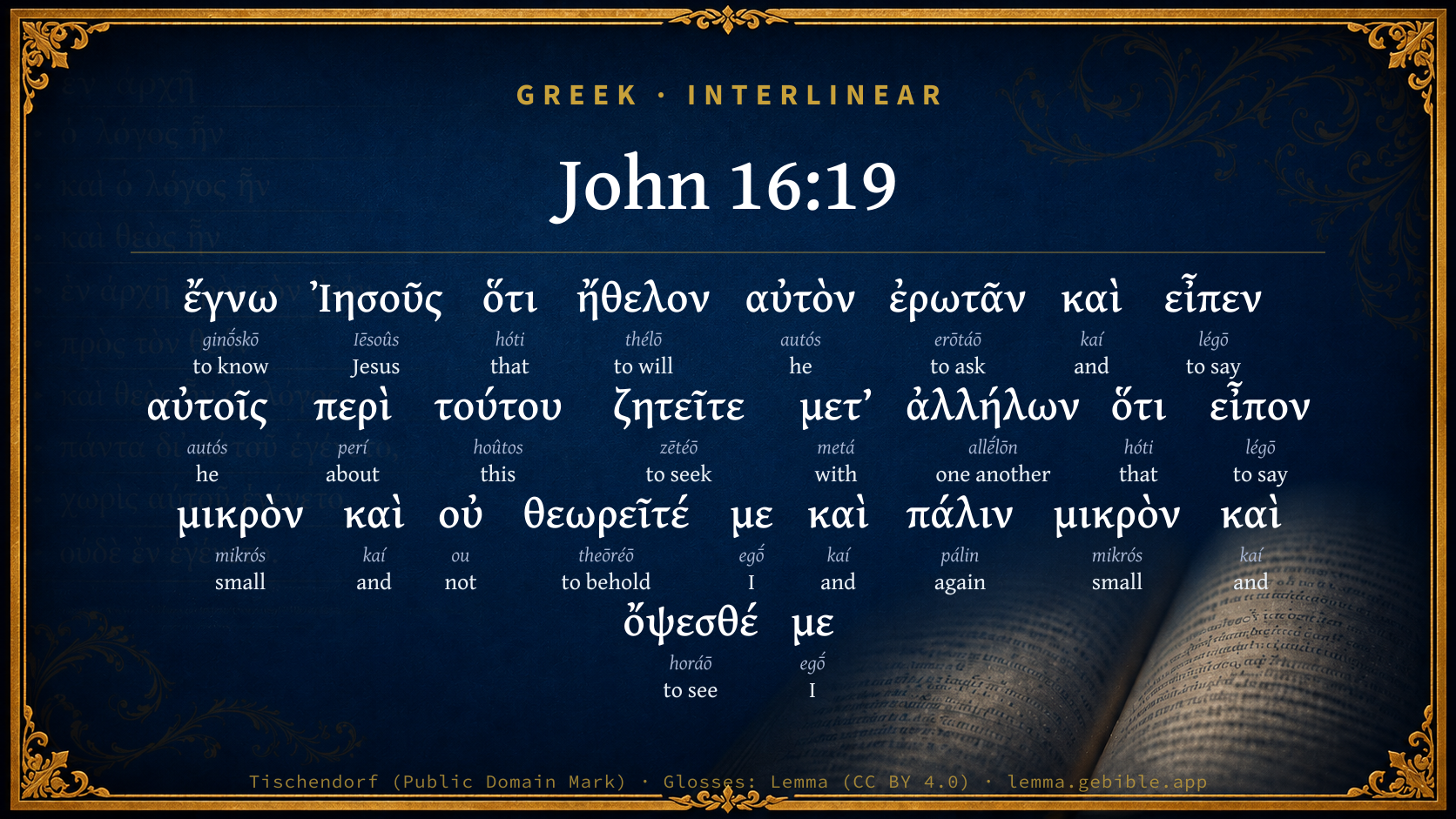
Greek (Tischendorf 8th ed.) John 16:19 appears in the Greek New Testament. The text above is from the Tischendorf 8th edition. Each word links to its Strong’s number and a concise gloss. Click any word for its full Thayer’s Greek Lexicon entry.
Download image
Cite this verse

John 16:19 (World English Bible). Public Domain. Lemma interlinear Bible study tool, https://lemma.gebible.app/v/john/16/19.

Show BibTeX & RIS
BibTeX
RIS
English Translation
Therefore Jesus perceived that they wanted to ask him, and he said to them, "Do you inquire among yourselves concerning this, that I said, 'A little while, and you won't see me, and again a little while, and you will see me?'
World English Bible · Public Domain
Download a study sheet

One document with this verse’s original text, its word-by-word gloss line, the meaning frame, cross-references with their text, attributed commentary, and full source and license credits — printable, and it pastes into notes with its structure intact.

This verse Autodidact and up

Study sheet (.html) Plain text (.txt)

A passage Seminary Student

Up to 50 verses in one chapter. A passage sheet keeps up to 6 commentary sources and 12 cross-references per verse, in the order this page ranks them, and says so on the sheet whenever that leaves anything out. Ask for a single verse and you get the Autodidact verse sheet above.

Everything on this page stays free to read, with no account — the sheet is a download of what is already on screen, not access to it.

Want to remove ads? Support Godless Engineer
Compare translations 3

The same verse in 3 English versions, stacked beneath the original-language interlinear above. Click any original word for its lexicon entry.

Each is an independent rendering of the whole verse — the interlinear is not word-aligned to these translations.

Highlighted words mark where these versions differ — a whole-verse word diff, not a word-by-word alignment.

  • World English Bible Public Domain
    Therefore Jesus perceived that they wanted to ask him, and he said to them, "Do you inquire among yourselves concerning this, that I said, 'A little while, and you won't see me, and again a little while, and you will see me?'
  • King James Version Public Domain
    Now Jesus knew that they were desirous to ask him, and said unto them, Do ye enquire among yourselves of that I said, A little while, and ye shall not see me: and again, a little while, and ye shall see me?
  • unfoldingWord Literal Text CC BY-SA 4.0
    Jesus knew that they wanted to question him, and he said to them, “Are you seeking among yourselves concerning this, that I said, ‘A little and you do not see me, and again a little and you will see me’?

unfoldingWord Literal Text — © unfoldingWord, licensed CC BY-SA 4.0. Word-aligned USFM3 via Door43 (git.door43.org/unfoldingWord/en_ult).

Versions to compare (up to 4)

3 of 4 selected

Show all 19 translations

Every available English version of this verse, each an independent rendering of the whole verse.

  • World English Bible Public Domain
    Therefore Jesus perceived that they wanted to ask him, and he said to them, "Do you inquire among yourselves concerning this, that I said, 'A little while, and you won't see me, and again a little while, and you will see me?'
  • Berean Standard Bible Public Domain
    Aware that they wanted to question Him, Jesus said to them, “Are you asking one another why I said, ‘In a little while you will not see Me, and then after a little while you will see Me’?
  • Majority Standard Bible Public Domain
    Aware that they wanted to question Him, Jesus said to them, “Are you asking one another why I said, ‘In a little while you will not see Me, and then after a little while you will see Me’?
  • King James Version Public Domain
    Now Jesus knew that they were desirous to ask him, and said unto them, Do ye enquire among yourselves of that I said, A little while, and ye shall not see me: and again, a little while, and ye shall see me?
  • American Standard Version (1901) Public Domain
    Jesus perceived that they were desirous to ask him, and he said unto them, Do ye inquire among yourselves concerning this, that I said, A little while, and ye behold me not, and again a little while, and ye shall see me?
  • Revised Version (1885) Public Domain
    Jesus perceived that they were desirous to ask him, and he said unto them, Do ye inquire among yourselves concerning this, that I said, A little while, and ye behold me not, and again a little while, and ye shall see me?
  • Geneva Bible (1599) Public Domain
    Now Iesus knew that they would aske him, and said vnto them, Doe ye enquire among your selues, of that I said, A litle while, and ye shall not see me: and againe, a litle while, and yee shall see me?
  • Douay-Rheims (1899) Public Domain
    And Jesus knew that they had a mind to ask him; and he said to them: Of this do you inquire among yourselves, because I said: A little while, and you shall not see me; and again a little while, and you shall see me
  • Young's Literal Translation Public Domain
    Jesus, therefore, knew that they were wishing to ask him, and he said to them, `Concerning this do ye seek one with another, because I said, A little while, and you do not behold me, and again a little while, and ye shall see me?
  • Literal Standard Version CC BY-SA 4.0
    Jesus, therefore, knew that they were wishing to ask Him, and He said to them, “Concerning this do you seek with one another, because I said, A little while, and you do not behold Me, and again a little while, and you will see Me?
  • Unlocked Literal Bible CC BY-SA 4.0
    Jesus saw that they wanted to ask him, and he said to them, “Is this what you are asking yourselves, what I meant by saying, 'A little while and you will no longer see me, and again a little while and you will see me'?
  • unfoldingWord Literal Text CC BY-SA 4.0
    Jesus knew that they wanted to question him, and he said to them, “Are you seeking among yourselves concerning this, that I said, ‘A little and you do not see me, and again a little and you will see me’?
  • Darby Bible Public Domain
    Jesus knew therefore that they desired to demand of him, and said to them, Do ye inquire of this among yourselves that I said, A little while and ye do not behold me; and again a little while and ye shall see me?
  • World Messianic Bible Public Domain
    Therefore Yeshua perceived that they wanted to ask him, and he said to them, “Do you inquire among yourselves concerning this, that I said, ‘A little while, and you won’t see me, and again a little while, and you will see me’?
  • Webster's Bible Public Domain
    Now Jesus knew that they were desirous to ask him, and said to them, Do ye inquire among yourselves of that which I said, A little while, and ye shall not see me: and again, a little while, and ye shall see me?
  • Free Bible Version CC BY-SA 4.0
    Jesus realized that they wanted to ask him about this. So he asked them, “Are you wondering about my comment, ‘In a little while you won't see me, but a little while after that you will see me’?
  • Bible in Basic English Public Domain
    Jesus saw that they had a desire to put the question to him, so he said to them, Is this what you are questioning one with another, why I said, After a little time, you will see me no longer; and then again, after a little time, you will see me?
  • Text-Critical English NT CC BY 4.0
    Jesus knew that they wanted to ask him about this, so he said to them, “Are you asking one another what I meant when I said, ‘In a little while, you will not see me; and again after a little while, you will see me’?
  • Tyndale New Testament (1534) Public Domain
    Iesus perceaved that they wolde axe him and sayd vnto them: This is it that ye enquyre of bitwene youre selves that I sayd after a whyle ye shall not se me and agayne after a whyle ye shall se me.

Literal Standard Version (2020), Covenant Press — licensed CC BY-SA 4.0. Text via the HelloAO Bible API (eBible.org). Unlocked Literal Bible (unfoldingWord) — licensed CC BY-SA 4.0. Text via the HelloAO Bible API (eBible.org). unfoldingWord Literal Text — © unfoldingWord, licensed CC BY-SA 4.0. Word-aligned USFM3 via Door43 (git.door43.org/unfoldingWord/en_ult). Free Bible Version, Dr. Jonathan Gallagher — licensed CC BY-SA 4.0. Text via the HelloAO Bible API (eBible.org).

Word by word

More ways to search: Search by grammar → Find every occurrence → Compare this word →

Practice this passage: Drill this verse → Learn its vocabulary →

μικρὸν
mikrós
G3398
“small”
Adjective, Accusative, Singular, Neuter
Part of Speech
Adjective
Case
Accusative
Number
Singular
Gender
Neuter
Full Thayer's Definition

Origin: apparently a primary word

TDNT: 14:48,6

1. small, little a. of size: hence of stature, of length b. of space c. of age: less by birth, younger d. of time: short, brief, a little while, how little! e. of quantity: i.e. number, amount f. of rank or influence
  1. ἔγνω ginṓskō G1097 “to know” Verb, Aorist, Active, Indicative, 3rd person, Singular
  2. Ἰησοῦς Iēsoûs G2424 “Jesus” Noun, Nominative, Singular, Masculine
  3. ὅτι hóti G3754 “that” Conjunction
  4. ἤθελον thélō G2309 “to will” Verb, Imperfect, Active, Indicative, 3rd person, Plural
  5. αὐτὸν autós G846 “he” Personal pronoun, Accusative, Singular, Masculine
  6. ἐρωτᾶν erōtáō G2065 “to ask” Verb, Present, Active, Infinitive
  7. καὶ kaí G2532 “and” Conjunction
  8. εἶπεν légō G3004 “to say” Verb, Aorist, Active, Indicative, 3rd person, Singular
  9. αὐτοῖς autós G846 “he” Personal pronoun, Dative, Plural, Masculine
  10. περὶ perí G4012 “about” Preposition
  11. τούτου hoûtos G3778 “this” Demonstrative pronoun, Genitive, Singular, Masculine
  12. ζητεῖτε zētéō G2212 “to seek” Verb, Present, Active, Indicative, 2nd person, Plural
  13. μετ’ metá G3326 “with” Preposition
  14. ἀλλήλων allḗlōn G240 “one another” Reciprocal pronoun, Genitive, Plural, Masculine
  15. ὅτι hóti G3754 “that” Conjunction
  16. εἶπον légō G3004 “to say” Verb, Aorist, Active, Indicative, 1st person, Singular
  17. καὶ kaí G2532 “and” Conjunction
  18. οὐ ou G3756 “not” Particle, Negative
  19. θεωρεῖτέ theōréō G2334 “to behold” Verb, Present, Active, Indicative, 2nd person, Plural
  20. με egṓ G1473 “I” Personal pronoun, 1st person, Accusative, Singular
  21. καὶ kaí G2532 “and” Conjunction
  22. πάλιν pálin G3825 “again” Adverb
  23. μικρὸν mikrós G3398 “small” Adjective, Accusative, Singular, Neuter
  24. καὶ kaí G2532 “and” Conjunction
  25. ὄψεσθέ horáō G3708 “to see” Verb, Future, Middle deponent, Indicative, 2nd person, Plural
  26. με egṓ G1473 “I” Personal pronoun, 1st person, Accusative, Singular

About this verse

These counts appear in no published source. They are computed here, from the morphology-tagged text and Lemma’s own curated glosses. What Lemma adds →

27
words
19
distinct lemmas
Gospels
section

Shared distinctive vocabulary

μικρὸν small G3398 occurs in 39 verses of the Greek New Testament. Also found in:
Repetition

Words recur within this verse:

  • εἶπεν to say G3004 ×2
  • μικρὸν small G3398 ×2
  • καὶ and G2532 ×4
  • ὅτι that G3754 ×2
  • αὐτὸν he G846 ×2
  • με I G1473 ×2

Cross-references

13

Topical passages linked to John 16:19 in the Treasury of Scripture Knowledge — connected by theme and wording, ordered by reader-vote popularity; previews shown in the World English Bible.

  • John 14:19 Yet a little while, and the world will see me no more; but you will see me. Because I live, you will live also.
  • John 16:16 A little while, and you will not see me. Again a little while, and you will see me."
  • John 16:30 Now we know that you know all things, and don't need for anyone to question you. By this we believe that you came forth from God."
  • John 2:24–25 But Jesus didn't trust himself to them, because he knew everyone,
  • John 7:33 Then Jesus said, "I will be with you a little while longer, then I go to him who sent me.
  • John 13:33 Little children, I will be with you a little while longer. You will seek me, and as I said to the Jews, 'Where I am going, you can't come,' so now I tell you.
  • Psalms 139:1–4 Yahweh, you have searched me, And you know me.
  • Matthew 6:8 Therefore don't be like them, for your Father knows what things you need, before you ask him.
  • Matthew 9:4 Jesus, knowing their thoughts, said, "Why do you think evil in your hearts?
  • Mark 9:33–34 He came to Capernaum, and when he was in the house he asked them, "What were you arguing among yourselves on the way?"
  • John 21:17 He said to him the third time, "Simon, son of Jonah, do you have affection for me?" Peter was grieved because he asked him the third time, "Do you have affection for me?" He said to him, "Lord, you know everything. You know that I have affection for you." Jesus said to him, "Feed my sheep.
  • Hebrews 4:13 There is no creature that is hidden from his sight, but all things are naked and laid open before the eyes of him with whom we have to do.
  • Revelation 2:23 I will kill her children with Death, and all the assemblies will know that I am he who searches the minds and hearts. I will give to each one of you according to your deeds.

Cross-references courtesy of OpenBible.info (CC BY 4.0).

Where the printed editions differ

1 variant

Places in this verse where the major printed Greek editions disagree on the wording in a way that affects the translation — a comparison of editions, not a manuscript-by-manuscript collation. The editions are the modern critical texts (Nestlé-Aland 28/27, SBL, Westcott-Hort, Tregelles, Tyndale House) and the traditional texts behind the KJV (the Textus Receptus and the Byzantine/Majority text). It is not a claim about which reading is original.

  1. Extra text
    οὖν

    “therefore”

    In TRByz Not in NA28NA27TynSBLWHTreg

    οὖν (oun) 'therefore' is only in traditional manuscripts (TR+Byz)

Textual data: Translators Amalgamated Greek New Testament (STEPBible TAGNT) · CC BY 4.0.

Commentary

Notes on John 16:19 from classic Christian and Jewish commentators (each source and its license shown beneath its notes). The classic Christian expositions comment on the surrounding passage and are grouped to its opening verse, so a note may address several verses; the Jewish commentaries on the Tanakh (Rashi and others) are per-verse, so they appear only where the commentator wrote on this verse.

Lemma curates 59 commentaries, every one of them public domain or Creative Commons licensed, each selected and text-cleaned for this edition rather than reprinted as found. About our sources →

The Biblical Illustrator

Joseph S. Exell

Joh_16:19

Now Jesus knew that they were desirous to ask Him

Christs knowledge of our thoughts

I.

CHRIST PERFECTLY KNOWS OUR THOUGHTS. He knew, and knows, what is in man.

1. All the evil thoughts of His adversaries. When He forgave the man sick of the palsy He heard the whisper within themselves, this man blasphemeth. Beneath every specious pretext and subtle question He detected the hatred that was aiming at His destruction. Was He not the express image of the Father who is kind to the unthankful and the evil. Well may Paul ask, Despisest thou the riches of His goodness, &c.

2. He knew all the sorrowful thoughts of sinners about themselves. No one but Jesus knew that the paralytic was more troubled about sin than about sickness. So when the sinful woman fell at His feet, His eye scanned her past history. Hence we may encourage those who have much more consciousness of guilt than they can express, to believe that He knows the worst of them.

3. He knew the half-formed purposes of His disciples. He foresaw that Judas would betray Him, that Peter would deny Him, before either supposed that He would do so. He knew the secret strivings of the brethren as to which should be greatest. But He bore with their imperfections, talked with them as familiarly, and trusted them as completely, as if they could never be disloyal. If we knew all the secret thoughts of our professed friends, and foresaw how they would fail us, how far our feeling would be from Christs.

II. THAT CHRIST LOVINGLY SYMPATHIZES WITH OUR QUESTIONINGS. The disciples were entertaining a question they hesitated to ask; but He expressed it for them, and met it not with rebuke, but with teaching. They might have known that He would do this, for when they asked Him, Why could we not cast him out? or Lord, declare unto us this parable, He had always met their difficulties. Nor was it otherwise during His resurrection life. He reasoned with the two going to Emmaus, and gave evidence to Thomas. His own knowledge was absolute, but He recognized that finite minds could only know in part, and was satisfied if they were humble and loyal. How unjustifiable, then, for us, with our fallibility, to judge those who do not exactly see with us. This has had disastrous effects on thoughtful inquirers. There are still Thomass as well as Johns in the world--and how many of the former may be brought to say My Lord and my God by Christly treatment?

III. THAT CHRIST WISELY ORDAINS THE INCOMPLETENESS OF OUR PRESENT KNOWLEDGE. He did not answer the question of the disciples so completely as to clear up all their difficulties. They were left to the twilight till the dawn of the resurrection morning. On all sides now we hear cries for certainty which positivism has harmonized into a song. But these demands are the outcome of the impatience which will not wait, of the self-confidence which would make us gods. We have but faith, we cannot know. For knowledge is of things we see, &c. It is well for us this is so. We have a more heroic temper when we have fought our doubts and gathered strength: Scripture becomes dearer as we search it to discover the mysteries it alone reveals; and in the growing consciousness that spiritual things can only be spiritually discerned, we are brought to Jesus feet to listen to Him and leave much to Him, concerning which He says, I have many things, &c. When He refuses to reveal, He only acts as any wise father would do. If your child asks you a question which you cannot answer for his good, you say, I will tell you some day--trust me to tell you at the right time. (A. Rowland, LL. B.)

The Biblical Illustrator, edited by Joseph S. Exell (c. 1880s–1900s) — public domain. Text from a community e-Sword module.

Bengel's Gnomon

Johann Albrecht Bengel

Joh 16:19. Ὅτι ἤθελον, that they were wishing) with a praiseworthy wish. The good Saviour anticipated their questioning Him.—μικρὸν, a little while) Not without reason this is so often repeated.

Bengel's Gnomon of the New Testament — English translation (T&T Clark, Edinburgh, 1860) — public domain. Text from a community e-Sword module.

Meyer's Critical & Exegetical Commentary

Heinrich August Wilhelm Meyer

Joh_16:19. Jesus observes what they would ask (comp. Joh_6:6), and extracts from them (as one who knows the heart, Joh_2:25; see subsequently Joh_16:30) the inquiry, not, however, setting aside the point, which they had also introduced from His earlier discourse (ὑπάγω πρ. τ. π.), but deferring it till the solemn conclusion of His instruction, Joh_16:28.

Meyer — Critical and Exegetical Commentary on the New Testament — English translation by Peter Christie, edited by Frederick Crombie (T&T Clark, 1880) — public domain. Text from a community e-Sword module.

Expositor's Greek Testament

ed. W. Robertson Nicoll

Joh 16:19 . Jesus, perceiving their embarrassment, and that they wished to interrogate Him ὅτι ἤθελον αὐτὸν ἐρωτᾷν said to them: Περὶ τούτου … “Are you inquiring among yourselves?” μετʼ ἀλλήλων , not as in Joh 16:17 , πρὸς ἀλλήλους , “about this that I said,” etc.?

The Expositor's Greek Testament, edited by W. Robertson Nicoll (1897–1910) — public domain. Text from a community e-Sword module.

John Calvin's Commentaries

19. Jesus, therefore, knew that they wished to ask him. Though sometimes the Lord appears to speak to the deaf, he, at length, cures the ignorance of his disciples, that his instruction may not be useless. Our duty is to endeavor that our slowness of apprehension may not be accompanied by either pride or indolence, but that, on the contrary, we show ourselves to be humble and desirous to learn.

John Calvin's Commentaries (1540-1563) — public domain. Text from the Calvin Translation Society English edition (1840s-50s) via the Christian Classics Ethereal Library (ccel.org). Calvin's coverage is partial (roughly two-thirds of the Bible); uncommented books and verses are honest gaps, never fabricated. The 19th-century editor's footnotes and remarks are omitted so the notes are faithfully Calvin's own voice.

Ellicott's Commentary for English Readers

(19) Now Jesus knew they were desirous to ask him.—The purpose of His enigmatic saying (Joh_16:29) has been accomplished. Their attention has been excited, and they have taken the first step towards knowledge. They inquire among themselves, and this spirit of inquiry which He reads in their hearts (comp. Joh_2:25; Joh_6:6) He proceeds to answer. The first part of His answer is concerned with their difficulty about the “little while.” In Joh_16:28. He answers their thought about His going to the Father.

A Bible Commentary for English Readers, edited by Charles John Ellicott (1878–1897) — public domain. Text from a community e-Sword module.

The Cambridge Bible for Schools and Colleges

gen. ed. J. J. S. Perowne

19. Now Jesus knew] More literally, Jesus recognized or perceived (see on Joh_8:55). We have here an indication that His supernatural power of reading the thoughts did not supersede His natural powers of observation, and perhaps was not used when the latter were sufficient: comp. Joh_5:6, Joh_6:15. A different verb is used for His supernatural knowledge (Joh_6:61; Joh_6:64, Joh_13:1; Joh_13:3; Joh_13:11; Joh_13:18, Joh_18:4, Joh_19:28). But this distinction between ginôskein and eidenai is not always observed: comp. Joh_2:24-25, where ginôskein is used of supernatural knowledge. Omit ‘now’ at the beginning of the verse.

among yourselves] Or, with one another. This is a third expression, differing from ‘among yourselves’ (Joh_12:19) and from ‘one to another (Joh_4:33). See on Joh_16:17. The whole should run, Concerning this do ye enquire with one another, that I said.

ye shall not see me] As in Joh_16:16-17, ye behold Me not.

The Cambridge Bible for Schools and Colleges (gen. ed. J. J. S. Perowne; Cambridge University Press, 1878–1918) — public domain. Text from a community e-Sword module.

John Gill's Exposition

A woman when she is in travail hath sorrow,.... As was said she should have, Gen 3:16; This is God's ordination and appointment for sin:

because her hour is come; is at hand; the fixed time in nature is up, and there is no avoiding it:

but as soon as she is delivered of the child; for though the sorrow is great, yet there is a deliverance, and she is saved in child bearing: when

she remembereth no more the anguish; the sharp pains she has endured in her travail;

for joy that a man is born into the world. Much such a way of speaking is used by the Jews (z), who observe,

"if a woman brings forth a male child, all is forgot, and she repents (i.e. of her impatience, or any unbecoming expression in the time of labour), , "for the joy of a man child".''

And our Lord seems to have respect to a prevailing notion among them, as well as many others, of the felicity of male children: it is a common saying with them (a),

"blessed is he whose children are males, and woe to him whose children are females:''

for they say (b),

"when , "that a man child comes into the world", peace comes into the world.''

Now our Lord, by this instance, illustrates the sorrow his disciples should have by his departure, and the joy that they should be possessed of upon his return to them; that as the pains of a woman in travail are very sharp and severe, and the distress of her mind, about the issue of things respecting herself and offspring, is very great, so would be the grief and trouble of the disciples on account of the death of their Lord and master: but as when a woman is safely delivered of a man child, she is so filled with joy, that her sorrow is remembered no more so should it be with them, when Christ should appear to them; all their trouble, concern, anxiety of mind, and fears, that attended them, would all vanish away, and they be distressed with them no more.

(z) Tzeror Hammor, fol. 98. 2. (a) T. Bab. Pesachim, fol. 65. 1. Kiddushin, fol. 82. 2. Bava Bathra, fol. 16. 2. Sanhedrin, fol. 100. 2. (b) T. Bab. Nidda, fol. 31. 2.

John Gill's Exposition of the Whole Bible (1746–1763) — public domain (CC PDM 1.0). Text via the HelloAO Bible API.

Trapp's Complete Commentary

John Trapp

19 Now Jesus knew that they were desirous to ask him, and said unto them, Do ye enquire among yourselves of that I said, A little while, and ye shall not see me: and again, a little while, and ye shall see me?

Ver. 19. Now Jesus knew that they were, &c.] He graciously prevents their requests, so he doth ours often; and usually in Scripture the answer is given, the question concealed. God thereby providing for men’s infirmity, who are ready to ask such odd questions, as the disciples here do, to the discovery of their own dullness.

John Trapp, A Commentary or Exposition upon All the Books of the Old and New Testament (1647–1656) — public domain. Text from a community e-Sword module.

Matthew Poole's English Annotations

In the terms of this verse there is nothing difficult, but in the matter of it there is much instructive. We learn from hence:

1. That though good men may as to some points be ignorant as to the mind and will of God, yet they will be desirous of further instruction in it. To be willingly and contentedly ignorant, is not consistent with a root of saving grace.

2. Christ knows the desires of our hearts, before they are made known to him by the words of our lips; but yet it will not follow, that we may satisfy ourselves with inward, secret desires, without making them known by our lips; for God requireth the calves of our lips, as well as the desires and groans of our inward man.

3. Christ is very ready to teach those whose hearts he seeth desirous to learn; therefore he saith,

Do ye inquire among yourselves? &c. Are you inquisitive? I am ready to teach and to instruct you.

Matthew Poole's English Annotations on the Holy Bible (1683–1685) — public domain. Text from a community e-Sword/MySword module.

The Pulpit Commentary

Now Jesus knew (perceived by his Divine penetration of human thought here quickened by their anxious look and hurried whisperings) that they were wishing to question him, and he said to them, Are you inquiring among yourselves concerning this that I said,

A little while, etc.? In his repetition he does not quote the clause which they had addedi.e. added if the clause, Ver. 16, is not genuine. He proceeded to meet their difficulties.

The Pulpit Commentary (1880–1919), ed. H.D.M. Spence-Jones & Joseph S. Exell — public domain. Text from a community e-Sword module.

John Wesley's Explanatory Notes

Jesus said to them - Preventing their question.

John Wesley, Explanatory Notes Upon the Whole Bible (1754–1765) — public domain. Text via the GEBible commentary corpus.

Kretzmann's Popular Commentary

Paul E. Kretzmann

The consoling assurance of Jesus:

v. 19. Now Jesus knew that they were desirous to ask Him, and said unto them, Do ye enquire among yourselves of that I said, A little while, and ye shall not see Me; and again a little while, and ye shall see Me?

v. 20. Verily, verily, I say unto you, That ye shall weep and lament, but the world shall rejoice; and ye shall be sorrowful, but your sorrow shall be turned into joy.

v. 21. A woman, when she is in travail, hath sorrow, because her hour is come; but as soon as she is delivered of the child, she remembereth no more the anguish, for joy that a man is born into the world.

v. 22. And ye now therefore have sorrow; but I will see you again, and your heart shall rejoice, and your joy no man taketh from you.

Jesus was fully aware of the anxious bewilderment and embarrassment of the disciples, and that they were ashamed to ask for an explanation. In His usual kind manner, therefore, He comes to their assistance by stating the difficulty which was agitating their minds. They could not quite become reconciled to the idea of His leaving them and going to the Father, nor did they fully comprehend what was included in these statements, as well as in the others that He should be removed from their sight for a little while and in just as short a space of time be seen of them once more. "We have now often heard what it means ’to go to the Father’; which indeed is not a common expression, such as men usually employ and as they generally understand it, but is the language of the Lord Christ and His Christians. That Christ went forth from, or was sent by, the Father means nothing else than that He, the true Son of God from eternity, became a true man, and revealed Himself on earth in human nature, essence, and form, permitted Himself to be seen, heard, and felt, ate, drank, slept, worked, suffered, and died, like any other person. Again, that He goes to the Father, that means that He will be glorified by His resurrection from the dead, that He sits at the right hand of God and reigns with Him in eternity, as eternal, almighty God. For by His coming down or going from the Father He revealed and proved Himself a true, natural man; but by His return to the Father He declares Himself to be true, eternal God, out of God the Father, and thus remains in one person both God and man, and should be thus known and believed. " Very impressively Jesus tells the disciples the natural result of His removal from them, especially under such conditions as would soon be evident. They would weep and lament at the bitterness of His Passion, His crucifixion, and His death, while the world, represented by the unbelieving Jews, especially the leaders of the Church, would be filled with joy. But their sorrow-stricken souls would very quickly find wonderful consolation, which would turn their grief into rejoicing. The Lord adds an illustration to show in what way the acuteness and intensity of an overwhelming sorrow will be converted into joyful delight. At the time when the sorrow and pains of the mother are greatest and death itself seems imminent, the crisis is practically past; and with the birth of the child there comes the joy over the safe delivery and over the babe itself, causing the remembrance of the great sorrow to vanish. So the sorrow and pain of the disciples would be very acute and harsh, but with the return of their Master their joy would be all the greater; it would be such a joy as would surpass all human happiness, such a joy as could never be taken from them. Since the time of Pentecost with its wonderful revelation all believers may become partakers of this joy. Sorrow over the death of Christ can no longer affect us; Jesus now comes to us in a spiritual manner, with His Holy Spirit; He revivals all the glories of His salvation to our hearts. The Christians see and know Jesus by faith as the Son of God and their Savior, and are filled with a joy which will continue as long as His presence continues, to the end of time.

Paul E. Kretzmann, Popular Commentary of the Bible (1921–1924) — public domain. Text from a community e-Sword module.

unfoldingWord translationNotes

Door43 World Missions Community

Connecting Statement:

Jesus continues speaking to his disciples.

Is this what you are asking yourselves, what I meant by saying, ... see me'?

Jesus uses this question so his disciples will focus on what he has just told them, so he can explain further. AT: "You are asking yourselves what I meant when I said, ... see me.'" (See: Rhetorical Question)

Truly, truly, I say to you

Translate this the way your language emphasizes that what follows is important and true. See how you translated this in John 1:51.

but the world will be glad

Here the "world" is a metonym for the people who oppose God. AT: "but the people who oppose God will be glad" (See: Metonymy)

but your sorrow will be turned into joy

You can translate this in an active form. AT: "but your sadness will become joy" or "but afterwards instead of being sad you will be very happy" (See: Active or Passive)

translationWords

Jesus

amen

lament

world

joy

unfoldingWord translationNotes — © Distant Shores Media and the Door43 World Missions Community, licensed CC BY-SA 4.0. Source: git.door43.org/Door43/en_tn.

Cambridge Greek Testament for Schools and Colleges

19. ἔγνω. Perceived or recognised: see on Joh 2:25. We are perhaps to understand from γινώσκειν being used rather than εἰδεναι that it was by His natural powers of observation that He perceived this. Where these sufficed we may believe that His supernatural power of reading men’s thoughts was not used: comp. Joh 5:6, Joh 6:15. In translation mark the difference between μετ’ ἀλλήλων, one with another, πρὸς ἀλλήλους (Joh 16:17, Joh 4:33), one to another, and πρὸς ἑαυτούς (Joh 7:35, Joh 12:19), among themselves: Concerning this do ye enquire one with another.

Cambridge Greek Testament for Schools and Colleges (Cambridge University Press, 1896; 21 vols, various authors incl. Carr, Maclear, Plummer, Farrar, Lumby, Moule, M. R. James, Simcox) — public domain. Text from a community e-Sword module.

Alford’s Greek Testament

Henry Alford

19.] The real difficulty being in μικρόν, our Lord applies himself only to this, not noticing the other part of the question: which confirms the view of the connexion taken above.

Henry Alford, The Greek Testament (1849–1861) — public domain. Text from a community e-Sword module.

International Critical Commentary

19. ἔγνω Ἰησοῦς ὅτι κτλ. He recognised that the disciples wished to interrogate Him (see below on v. 23 for ἐρωτᾶν). Cf. 2:24.

The rec. adds οὖν after ἔγνω, with AΔN; but om. אBDLW. For οὖν, Θ has δέ. Also the rec. has ὁ before Ἰησοῦς, with אADNΘ; but om. BLW and Pap. Oxy. 1781. See on 1:29; and cf. 6:15.

The repetition of phrases in vv. 16-19 is quite in the Oriental manner of narrative. The crucial word μικρόν is repeated 7 times; and “A little while, and ye behold me not, and again, a little while, and ye shall see me,” is said 3 times over. Although the Fourth Gospel is thoroughly Greek, the Semitic undertone is often present.

Words of Comfort and Hope (vv. 20-24)

International Critical Commentary — older volumes (1896–1929), various authors — public domain. Text from a community e-Sword module.

Vincent's Word Studies in the New Testament

Marvin R. Vincent

Knew [εγνω] . Better, Rev., perceived. See on 2 24.

Marvin R. Vincent, Word Studies in the New Testament (1887–1900) — public domain. Text from a community e-Sword/MySword module.

Godet's Commentaries

Frédéric Louis Godet

Vv. 19, 20. “Now Jesus knew that they desired to ask him, and he said to them: Do you inquire among yourselves concerning this that I said: In a little while you will not see me, and again in a little while you will see me. 20. Verily, verily, I say to you that you will weep and lament, but the world will rejoice; you will be sorrowful, but your sorrow will be turned into joy.”

Jesus anticipates their question, and gives them a last proof of His higher knowledge, not only by showing them that He knew of Himself the questions which occupy their thoughts, but also by solving, as far as possible at this moment, all these enigmas. Only, instead of explaining to them the supreme facts which are about to succeed each other so rapidly—an explanation which they could not understand

He limits Himself to describing to them the opposite feelings through which they will themselves suddenly pass, and which will be the consequences of these facts: the greatest joy will suddenly succeed to the greatest grief; and all this will be brief, like the hour of childbirth for a woman; there would only be needed for Jesus time for going to His Father and returning. It is a terrible hour for them to pass through; but He cannot give them escape from it; and after this, their joy will be unmingled and their power without limits. Such are the contents of Joh 16:20-24.

The tears and lamentations of Joh 16:20 find their explanation in ch. 20, in the tears of Mary Magdalene and in the entire condition of the disciples after the death of Jesus. The appearances of the Risen One only half healed this wound; the perfect and enduring joy was only given on the day of Pentecost (Joh 16:22). The words: But the world shall rejoice, as far as: sorrowful, are not the real antithesis of the first clause. They form only a secondary contrast. The real antithesis of the first clause is in the last words of the verse: But your sorrow shall be turned into joy. The ἀλλά, but, expresses this opposition strongly, while marking the contrast with the clause which immediately precedes.

Frédéric Louis Godet — Commentaries on Luke, John, Romans, and 1 Corinthians — English translation (T&T Clark, Edinburgh, 1870s–1890s) — public domain. Text from a community e-Sword module.

Lesson kit

Teaching starters — assembled from the data on this page, not authored interpretation. Every prompt links to the verse data it draws on. Edit before teaching.

John, in the Gospels, opens this verse with 27 words (19 distinct Greek lemmas). Its most distinctive word is mikrós (“small”). A historical commentator’s framing appears above. Read the whole chapter for the surrounding context.

Discussion questions

  1. How does “small” (mikrós) shape what this verse is saying?
  2. Matthew 10:42 shares the word «small» with this verse. How do the two illuminate each other?
  3. “to say” occurs 2× in this one verse. What is the effect of the repetition?
  4. These translations render this verse differently. What is at stake in choosing one wording over another?
  5. Reading how The Biblical Illustrator and Bengel's Gnomon read this verse, where do the two commentators agree and where do they part?

Things to notice

Reading settings

Reading text

Shown beneath each verse's original-language words.

Old Testament
Old Testament edition

Read the OT as the Masoretic Hebrew (MT) or the Greek Septuagint (LXX).

English shown for the Greek Septuagint (in the Hebrew ↔ Greek comparison).

Comparing translations? Open the Compare panel on any verse page to stack up to four side by side.