John 11:4

Greek (Tischendorf 8th ed.) John 11:4 appears in the Greek New Testament. The text above is from the Tischendorf 8th edition. Each word links to its Strong’s number and a concise gloss. Click any word for its full Thayer’s Greek Lexicon entry.
Download image
Cite this verse

John 11:4 (World English Bible). Public Domain. Lemma interlinear Bible study tool, https://lemma.gebible.app/v/john/11/4.

Show BibTeX & RIS
BibTeX
RIS
English Translation
But when Jesus heard it, he said, "This sickness is not to death, but for the glory of God, that God's Son may be glorified by it."
World English Bible · Public Domain
Download a study sheet

One document with this verse’s original text, its word-by-word gloss line, the meaning frame, cross-references with their text, attributed commentary, and full source and license credits — printable, and it pastes into notes with its structure intact.

This verse Autodidact and up

Study sheet (.html) Plain text (.txt)

A passage Seminary Student

Up to 50 verses in one chapter. A passage sheet keeps up to 6 commentary sources and 12 cross-references per verse, in the order this page ranks them, and says so on the sheet whenever that leaves anything out. Ask for a single verse and you get the Autodidact verse sheet above.

Everything on this page stays free to read, with no account — the sheet is a download of what is already on screen, not access to it.

Want to remove ads? Support Godless Engineer
Compare translations 3

The same verse in 3 English versions, stacked beneath the original-language interlinear above. Click any original word for its lexicon entry.

Each is an independent rendering of the whole verse — the interlinear is not word-aligned to these translations.

Highlighted words mark where these versions differ — a whole-verse word diff, not a word-by-word alignment.

  • World English Bible Public Domain
    But when Jesus heard it, he said, "This sickness is not to death, but for the glory of God, that God's Son may be glorified by it."
  • King James Version Public Domain
    When Jesus heard that, he said, This sickness is not unto death, but for the glory of God, that the Son of God might be glorified thereby.
  • unfoldingWord Literal Text CC BY-SA 4.0
    But having heard, Jesus said, “This sickness is not to death but for the glory of God so that the Son of God may be glorified by it.”

unfoldingWord Literal Text — © unfoldingWord, licensed CC BY-SA 4.0. Word-aligned USFM3 via Door43 (git.door43.org/unfoldingWord/en_ult).

Versions to compare (up to 4)

3 of 4 selected

Show all 19 translations

Every available English version of this verse, each an independent rendering of the whole verse.

  • World English Bible Public Domain
    But when Jesus heard it, he said, "This sickness is not to death, but for the glory of God, that God's Son may be glorified by it."
  • Berean Standard Bible Public Domain
    When Jesus heard this, He said, “This sickness will not end in death. No, it is for the glory of God, so that the Son of God may be glorified through it.”
  • Majority Standard Bible Public Domain
    When Jesus heard this, He said, “This sickness will not end in death. No, it is for the glory of God, so that the Son of God may be glorified through it.”
  • King James Version Public Domain
    When Jesus heard that, he said, This sickness is not unto death, but for the glory of God, that the Son of God might be glorified thereby.
  • American Standard Version (1901) Public Domain
    But when Jesus heard it, he said, This sickness is not unto death, but for the glory of God, that the Son of God may be glorified thereby.
  • Revised Version (1885) Public Domain
    But when Jesus heard it, he said, This sickness is not unto death, but for the glory of God, that the Son of God may be glorified thereby.
  • Geneva Bible (1599) Public Domain
    When Iesus heard it, he saide, This sickenes is not vnto death, but for the glorie of God, that the Sonne of God might be glorified thereby.
  • Douay-Rheims (1899) Public Domain
    And Jesus hearing it, said to them: This sickness is not unto death, but for the glory of God: that the Son of God may be glorified by it.
  • Young's Literal Translation Public Domain
    and Jesus having heard, said, `This ailment is not unto death, but for the glory of God, that the Son of God may be glorified through it.'
  • Literal Standard Version CC BY-SA 4.0
    and Jesus having heard, said, “This ailment is not to death, but for the glory of God, that the Son of God may be glorified through it.”
  • Unlocked Literal Bible CC BY-SA 4.0
    When Jesus heard it, he said, “This sickness is not to death, but instead it is for the glory of God so that the Son of God may be glorified by it.”
  • unfoldingWord Literal Text CC BY-SA 4.0
    But having heard, Jesus said, “This sickness is not to death but for the glory of God so that the Son of God may be glorified by it.”
  • Darby Bible Public Domain
    But when Jesus heard [it], he said, This sickness is not unto death, but for the glory of God, that the Son of God may be glorified by it.
  • World Messianic Bible Public Domain
    But when Yeshua heard it, he said, “This sickness is not to death, but for the glory of God, that God’s Son may be glorified by it.”
  • Webster's Bible Public Domain
    When Jesus heard that, he said, This sickness is not to death, but for the glory of God, that the Son of God may be glorified by it.
  • Free Bible Version CC BY-SA 4.0
    When Jesus heard the news he said, “The end result of this sickness will not be death. Through this God's glory will be revealed so that the Son of God may be glorified.”
  • Bible in Basic English Public Domain
    When this came to his ears, Jesus said, The end of this disease is not death, but the glory of God, so that the Son of God may have glory because of it.
  • Text-Critical English NT CC BY 4.0
    But when Jesus heard this, he said, “This sickness will not end in death but is for the glory of God, so that the Son of God may be glorified through it.”
  • Tyndale New Testament (1534) Public Domain
    When Iesus hearde that he sayd: this infirmite is not vnto deth but for the laude of God that the sonne of God myght be praysed by the reason of it.

Literal Standard Version (2020), Covenant Press — licensed CC BY-SA 4.0. Text via the HelloAO Bible API (eBible.org). Unlocked Literal Bible (unfoldingWord) — licensed CC BY-SA 4.0. Text via the HelloAO Bible API (eBible.org). unfoldingWord Literal Text — © unfoldingWord, licensed CC BY-SA 4.0. Word-aligned USFM3 via Door43 (git.door43.org/unfoldingWord/en_ult). Free Bible Version, Dr. Jonathan Gallagher — licensed CC BY-SA 4.0. Text via the HelloAO Bible API (eBible.org).

Word by word

More ways to search: Search by grammar → Find every occurrence → Compare this word →

Practice this passage: Drill this verse → Learn its vocabulary →

ἀσθένεια
asthéneia
G769
“weakness”
Noun, Nominative, Singular, Feminine
Part of Speech
Noun
Case
Nominative
Number
Singular
Gender
Feminine
Full Thayer's Definition

Origin: from G772

TDNT: 09:10,8

1. want of strength, weakness, infirmity a. of the body 1. its native weakness and frailty 2. feebleness of health or sickness b. of the soul 1. want of strength and capacity requisite 1b c. to understand a thing 1b d. to do things great and glorious 1b e. to restrain corrupt desires 1b f. to bear trials and troubles
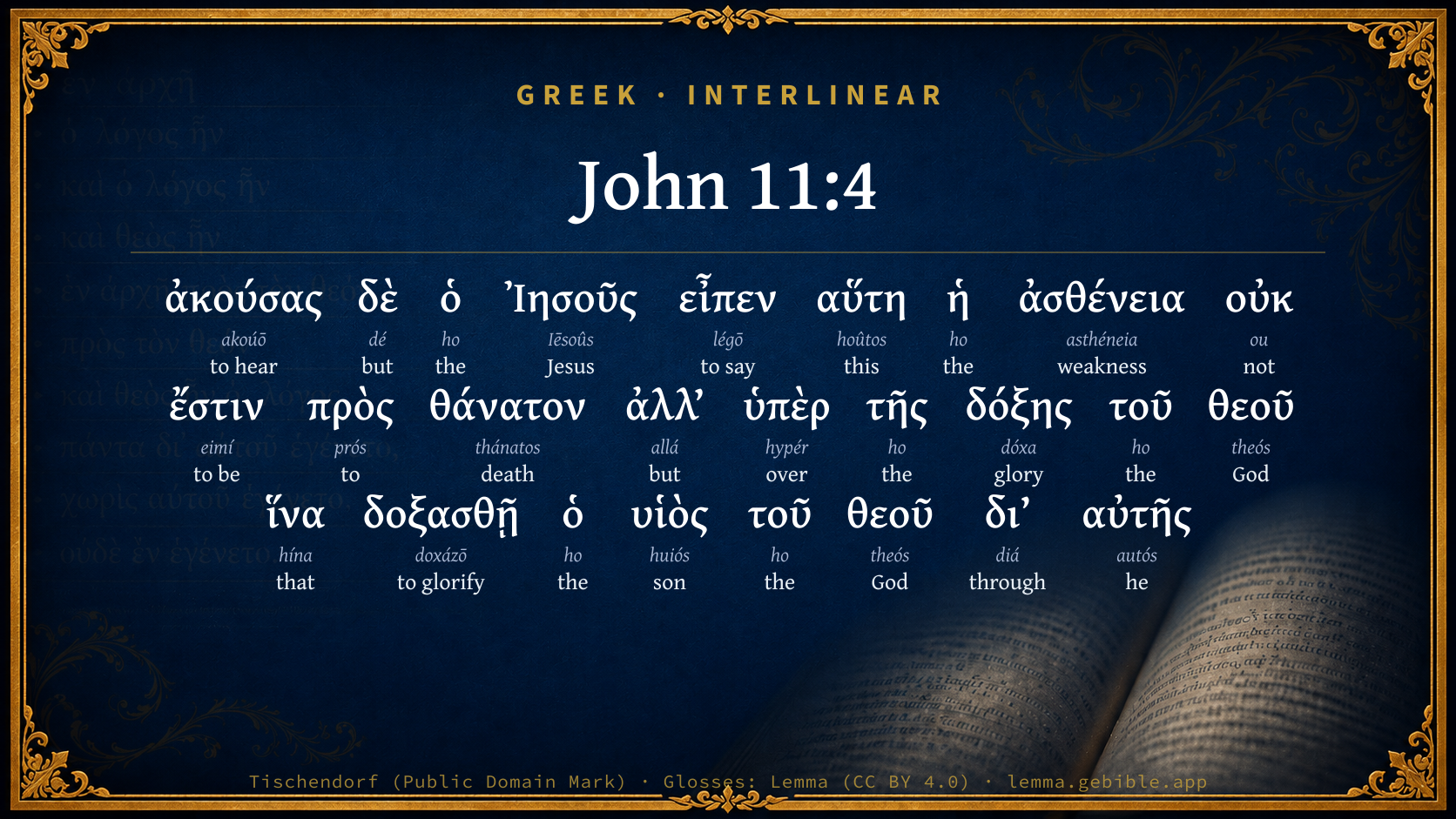
  1. ἀκούσας akoúō G191 “to hear” Verb, Aorist, Active, Participle, Nominative, Singular, Masculine
  2. δὲ dé G1161 “but” Conjunction
  3. ὁ ho G3588 “the” Article, Nominative, Singular, Masculine
  4. Ἰησοῦς Iēsoûs G2424 “Jesus” Noun, Nominative, Singular, Masculine
  5. εἶπεν légō G3004 “to say” Verb, Aorist, Active, Indicative, 3rd person, Singular
  6. αὕτη hoûtos G3778 “this” Demonstrative pronoun, Nominative, Singular, Feminine
  7. ἡ ho G3588 “the” Article, Nominative, Singular, Feminine
  8. οὐκ ou G3756 “not” Particle, Negative
  9. ἔστιν eimí G1510 “to be” Verb, Present, Active, Indicative, 3rd person, Singular
  10. πρὸς prós G4314 “to” Preposition
  11. θάνατον thánatos G2288 “death” Noun, Accusative, Singular, Masculine
  12. ἀλλ’ allá G235 “but” Conjunction
  13. ὑπὲρ hypér G5228 “over” Preposition
  14. τῆς ho G3588 “the” Article, Genitive, Singular, Feminine
  15. δόξης dóxa G1391 “glory” Noun, Genitive, Singular, Feminine
  16. τοῦ ho G3588 “the” Article, Genitive, Singular, Masculine
  17. θεοῦ theós G2316 “God” Noun, Genitive, Singular, Masculine
  18. ἵνα hína G2443 “that” Conjunction
  19. δοξασθῇ doxázō G1392 “to glorify” Verb, Aorist, Passive, Subjunctive, 3rd person, Singular
  20. ὁ ho G3588 “the” Article, Nominative, Singular, Masculine
  21. υἱὸς huiós G5207 “son” Noun, Nominative, Singular, Masculine
  22. τοῦ ho G3588 “the” Article, Genitive, Singular, Masculine
  23. θεοῦ theós G2316 “God” Noun, Genitive, Singular, Masculine
  24. δι’ diá G1223 “through” Preposition
  25. αὐτῆς autós G846 “he” Personal pronoun, Genitive, Singular, Feminine

About this verse

These counts appear in no published source. They are computed here, from the morphology-tagged text and Lemma’s own curated glosses. What Lemma adds →

26
words
20
distinct lemmas
Gospels
section

Notable vocabulary

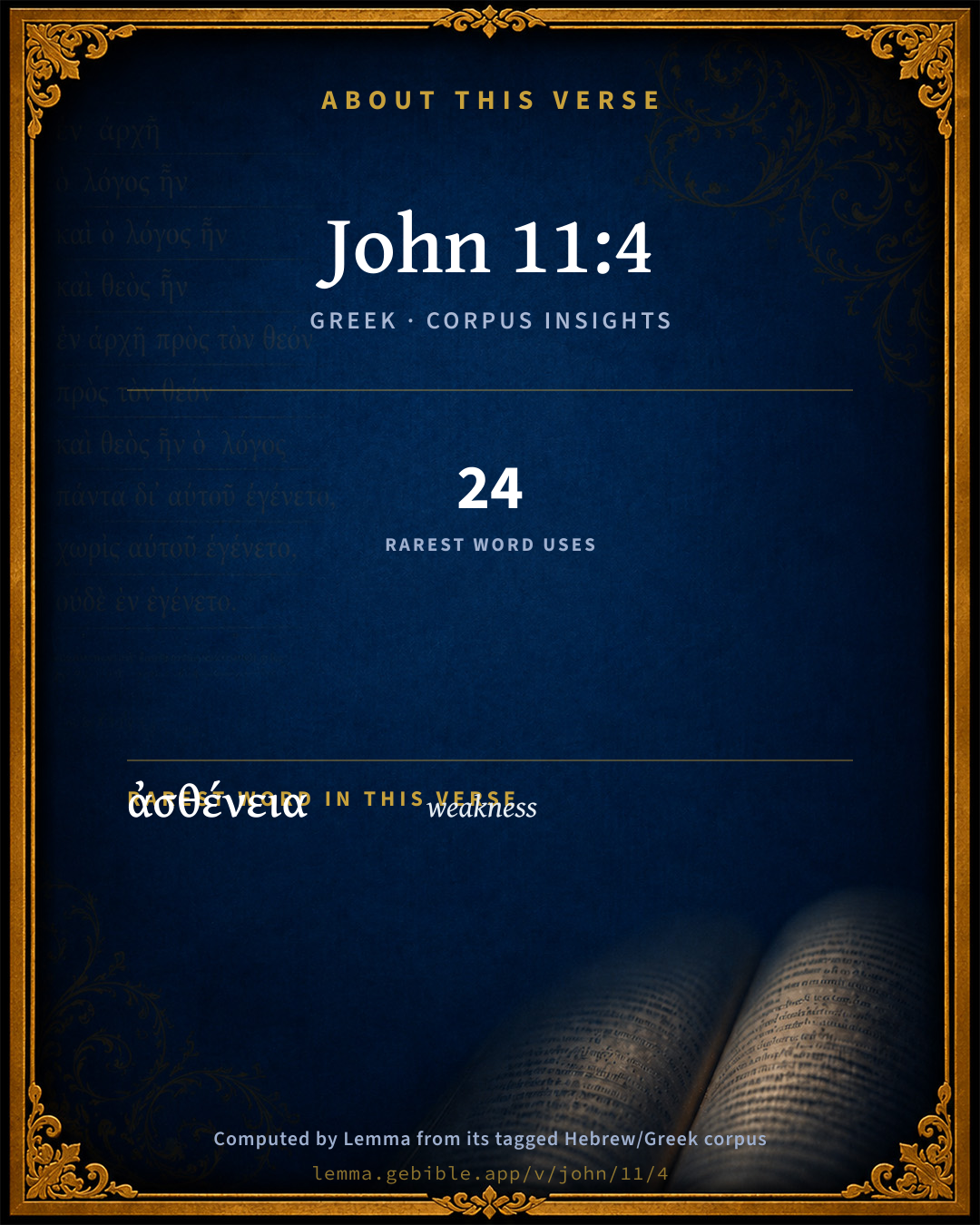
The rarest word here is ἀσθένεια weakness G769 — appearing just 24 times in the whole Greek New Testament.

Shared distinctive vocabulary

ἀσθένεια weakness G769 occurs in 23 verses of the Greek New Testament. Also found in:

Repetition

Words recur within this verse:

Cross-references

18

Topical passages linked to John 11:4 in the Treasury of Scripture Knowledge — connected by theme and wording, ordered by reader-vote popularity; previews shown in the World English Bible.

  • John 11:40 Jesus said to her, "Didn't I tell you that if you believed, you would see God's glory?"
  • John 9:3 Jesus answered, "Neither did this man sin, nor his parents; but, that the works of God might be revealed in him.
  • 1 Peter 4:14 If you are insulted for the name of Christ, blessed are you; because the Spirit of glory and of God rests on you. On their part he is blasphemed, but on your part he is glorified.
  • John 5:23 that all may honor the Son, even as they honor the Father. He who doesn't honor the Son doesn't honor the Father who sent him.
  • Mark 5:39–42 When he had entered in, he said to them, "Why do you make an uproar and weep? The child is not dead, but is asleep."
  • John 13:31–32 When he had gone out, Jesus said, "Now the Son of Man has been glorified, and God has been glorified in him.
  • John 17:5 Now, Father, glorify me with your own self with the glory which I had with you before the world existed.
  • 1 Peter 4:11 If any man speaks, let it be as it were oracles of God. If any man serves, let it be as of the strength which God supplies, that in all things God may be glorified through Jesus Christ, to whom belong the glory and the dominion forever and ever. Amen.
  • John 2:11 This beginning of his signs Jesus did in Cana of Galilee, and revealed his glory; and his disciples believed in him.
  • Philippians 1:20 according to my earnest expectation and hope, that I will in no way be disappointed, but with all boldness, as always, now also Christ will be magnified in my body, whether by life, or by death.
  • John 8:54 Jesus answered, "If I glorify myself, my glory is nothing. It is my Father who glorifies me, of whom you say that he is our God.
  • John 9:24 So they called the man who was blind a second time, and said to him, "Give glory to God. We know that this man is a sinner."
  • John 17:1 Jesus said these things, and lifting up his eyes to heaven, he said, "Father, the time has come. Glorify your Son, that your Son may also glorify you;
  • John 12:28 Father, glorify your name!" Then there came a voice out of the sky, saying, "I have both glorified it, and will glorify it again."
  • John 17:10 All things that are mine are yours, and yours are mine, and I am glorified in them.
  • Romans 11:11 I ask then, did they stumble that they might fall? May it never be! But by their fall salvation has come to the Gentiles, to provoke them to jealousy.
  • Philippians 1:11 being filled with the fruits of righteousness, which are through Jesus Christ, to the glory and praise of God.
  • 1 Peter 1:21 who through him are believers in God, who raised him from the dead, and gave him glory; so that your faith and hope might be in God.

Cross-references courtesy of OpenBible.info (CC BY 4.0).

Commentary

Notes on John 11:4 from classic Christian and Jewish commentators (each source and its license shown beneath its notes). The classic Christian expositions comment on the surrounding passage and are grouped to its opening verse, so a note may address several verses; the Jewish commentaries on the Tanakh (Rashi and others) are per-verse, so they appear only where the commentator wrote on this verse.

Lemma curates 59 commentaries, every one of them public domain or Creative Commons licensed, each selected and text-cleaned for this edition rather than reprinted as found. About our sources →

The Cambridge Bible for Schools and Colleges

gen. ed. J. J. S. Perowne

4. is not unto death] i.e. is not to have death as its final result. Christ foresaw both the death and the resurrection, and (as so often) uttered words which His disciples did not understand at the time, but recognised in their proper meaning after what He indicated had taken place. Comp. Joh_2:22, Joh_12:16, Joh_21:23.

might be glorified] In two ways; because the miracle (1) would lead many to believe that He was the Messiah; (2) would bring about His death. ‘Being glorified’ is a frequent expression in this Gospel for Christ’s Death regarded as the mode of His return to glory (Joh_7:39, Joh_12:16; Joh_12:23, Joh_13:31-32); and this glorification of the Son involves the glory of the Father (Joh_5:23, Joh_10:30; Joh_10:38). Comp. Joh_9:3; in the Divine counsels the purpose of the man’s blindness and of Lazarus’ sickness is the glory of God.

We ought perhaps to connect the special meaning of ‘glorified’ with the first clause: ‘This sickness is to have for its final issue, not the temporal death of an individual, but the eternal life of all mankind.’

It is worth noting that both the first and the last of the seven miracles of the ministry recorded by S. John are declared to be manifestations of glory (Joh_2:11, Joh_11:4; Joh_11:40) and confirmations of faith (Joh_2:11, Joh_11:15).

thereby] Both in the English and in the Greek this is ambiguous: it may refer either to the sickness or the glory. The former is correct.

The Cambridge Bible for Schools and Colleges (gen. ed. J. J. S. Perowne; Cambridge University Press, 1878–1918) — public domain. Text from a community e-Sword module.

Tyndale Open Study Notes

Tyndale Open Resources

11:4 Jesus’ response paralleled his words about the man born blind (9:1-5). Jesus already knew that Lazarus was dead (11:14); he was talking about Lazarus’ resurrection (11:43), which would bring glory to God.

Tyndale Open Study Notes — © Tyndale Open Resources, licensed CC BY-SA 4.0. Text via the HelloAO Bible API.

Bengel's Gnomon

Johann Albrecht Bengel

Joh 11:4. Εἶπεν, He said) It is worthy of being observed, by what method Jesus prepared His disciples, and the sisters of Lazarus and the people, for beholding with profit the greatest of miracles.—αὐτή, this) i.e. This sickness is consonant with love.—πρὸς θάνατον, unto death) whereby [not unto death, in the sense that thereby] the sisters should lose their brother. So the Septuag. εἰς θάνατον, 2Ki 20:1 [i.e. Βασιλ. Δ. Joh 20:1, Hezekiah was sick εἰς θάνατον].—ὑπέρ, for) The glory of God and the glory of the Son of God is one and the same glory.—ἵνα δοξασθῇ, that He may be glorified) The result was truly so. The raising again of Lazarus is so powerful an argument for the truth of Christianity, that Spinoza said, that, if he could believe it, he would cast away his whole system. And yet the following considerations demonstrate the reality of the death and of the resurrection of Lazarus: 1) The deliberate delay of Jesus, who was then at a distance away; 2) His informing His disciples of the death, and foretelling as to the resurrection; 3) The variety and multitude of the witnesses who were present; 4) The faith that followed in consequence, on the part of very many Jews, who were by no means credulous, and the perversity of the rest; Joh 11:46, etc., “They went their ways to the Pharisees, and told them what things Jesus had done;” [Joh 11:53] “They took counsel together to put Him to death.”—διʼ αὐτῆς, by it) by this sickness Jesus was glorified, inasmuch as many forthwith acknowledged Him as the Son of God; Joh 11:45, “Many which had seen the things which Jesus did, believed on Him;” and the rest of the Jews determined to kill Him, Joh 11:46, etc.; and it was thereby He was about to enter into glory.

Bengel's Gnomon of the New Testament — English translation (T&T Clark, Edinburgh, 1860) — public domain. Text from a community e-Sword module.

Expositor's Greek Testament

ed. W. Robertson Nicoll

Joh 11:4 . Ἀκούσας δὲ ὁ Ἰησοῦς εἶπεν . “And Jesus when He heard said,” i.e. , to His disciples. It was not the reply sent to the sisters. “This illness is not to death,” πρὸς θάνατον , death is not the end towards which it is making. But that Jesus knew that death had already taken place (Joh 11:6 and Joh 11:17 ) or was imminent is evident from the following clause, but He knew what He would do (Joh 6:6 ) and that death was not to be the final result of this illness. The illness and death were ὑπὲρ τῆς δόξης τοῦ Θεοῦ , for the sake of glorifying God ( cf. Joh 9:3 ), “gloriae divinae illustrandae causa,” Winer, p. 479. This is further explained in the clause “that the Son of God may be glorified by means of it,” i.e. , by means of this illness; cf. Joh 13:31 . “In two ways; because the miracle (1) would lead many to believe that He was the Messiah; (2) would bring about His death. Δοξάζεσθαι is a frequent expression of this Gospel for Christ’s death regarded as the mode of His return to glory (Joh 7:39 , Joh 12:16 , Joh 13:31 ), and this glorification of the Son involves the glory of the Father (Joh 5:23 , Joh 10:30-38 ).” Plummer, Bengel.

The Expositor's Greek Testament, edited by W. Robertson Nicoll (1897–1910) — public domain. Text from a community e-Sword module.

Cambridge Greek Testament for Schools and Colleges

4. εἶπεν. Not ἀπεκρίθη: His words are not a mere answer to the message, but a lesson to the Apostles also.

οὐκ ἔστιν πρὸς θ. Is not to have death as its final result: for ‘He Himself knew what He would do’ (Joh 6:6). Christ foresaw both the death and the resurrection, and (as so often) uttered words which His disciples did not understand at the time, but recognised in their proper meaning after what He indicated had taken place. Comp. Joh 2:22, Joh 12:16, Joh 21:23.

ἵνα δοξασθῇ. In two ways; because the miracle (1) would lead many to believe that He was the Messiah; (2) would bring about His death. Δοξάζεσθαι is a frequent expression of this Gospel for Christ’s Death regarded as the mode of His return to glory (Joh 7:39, Joh 12:16; Joh 12:23, Joh 13:31-32); and this glorification of the Son involves the glory of the Father (Joh 5:23, Joh 10:30; Joh 10:38). Comp. Joh 9:3; in the Divine counsels the purpose of the man’s blindness and of Lazarus’ sickness is the glory of God.

We ought perhaps to connect the special meaning of ‘glorified’ with the first clause: ‘This sickness is to have for its final issue, not the temporal death of an individual, but the eternal life of all mankind.’

It is worth noting that both the first and the last of the seven miracles of the ministry recorded by S. John are declared to be manifestations of glory (Joh 2:11, Joh 11:4; Joh 11:40) and confirmations of faith (Joh 2:11, Joh 11:15).

δι’ αὐτῆς, i.e. διὰ τ. ἀσθενείας, not διὰ τ. δόξης τ. Θεοῦ.

Cambridge Greek Testament for Schools and Colleges (Cambridge University Press, 1896; 21 vols, various authors incl. Carr, Maclear, Plummer, Farrar, Lumby, Moule, M. R. James, Simcox) — public domain. Text from a community e-Sword module.

International Critical Commentary

4. αὕτη ἡ ἀσθένεια οὐκ ἔστιν πρὸς θάνατον. This was the comment of Jesus when the tidings of Lazarus’ illness reached Him. It was not a direct reply to the sisters’ message, and we do not know if it was reported to them (v. 40).

The constr. πρὸς θάνατον is unusual, occurring again in the N.T. only at 1Jn 5:16 ἁμαρτία πρὸς θάνατον, and in the LXX at 4 Macc. 14:4, 17:1, while εἰς θάνατον is common (cf. 2Ki 20:1, where it is said of Hezekiah that he was sick εἰς θάνατον). If a distinction is to be drawn between the two constructions, perhaps “this sickness is not πρὸς θάνατον” is more reassuring than “this sickness is not εἰς θάνατον.” The latter would mean that the sickness would not have death as its final issue; the former ought to mean that the sick person is not in danger at all, that his sickness is not “dangerous,” as we would put it. Consequently the meaning that the disciples inevitably took from the words of Jesus was that Lazarus was not dead at the time of speaking, and further that Jesus was convinced he would recover. No doubt, the evangelist means his readers to understand that this was not the real meaning of Jesus’ words (see v. 11). But it is strange that he should translate them by using πρός instead of εἰς; for, in fact, Lazarus’ sickness was πρὸς θάνατον, although it might plausibly be argued that it was not εἰς θάνατον, as death was not the final issue.

Jesus adds that this illness had come upon Lazarus ὑπὲρ τῆς δόξης τοῦ θεοῦ, “on behalf of God’s glory,” i.e. in order that the glory and power of God might be revealed. The attempt to give ὑπέρ a semi-sacrificial sense here, as if the sickness were a voluntary offering by Lazarus, is fanciful ὑπέρ is used exactly as in 1:30, 10:11, “on behalf of.” The issue of the sickness and death of Lazarus was the revelation of the glory of God, as exhibited in his miraculous resuscitation. The miracle was more than a “wonder”; it was a “sign” of ἡ δόξα τοῦ θεοῦ. And so Martha was reminded, when it was over, that she had been told that she would see this glory (v. 40).

The glory of God was exhibited through the person and works of Jesus; this sickness, with its issue, had for its purpose ἵνα δοξασθῇ ὁ υἱὸς τοῦ θεοῦ, that He might be honoured by this revelation of His Father (cf. 8:54 ἔστιν ὁ πατήρ μου ὁ δοξάζων με). We have seen (on 7:39) that the supreme “glorification” of Jesus is identified by Jn. with the Passion and its sequel, and it has been thought by some that this too is the reference in the present passage. If so, ἵνα δοξασθῇ ὁ υἱὸς τοῦ θεοῦ would mean here that the final cause of Lazarus’ sickness was that it might lead up to the Passion by making public the power of Jesus and thereby bringing the hostility of his enemies to a crisis (Westcott). But this is over subtle. The true parallel to 11:4b is 8:54. This revelation of “the glory of God” was that the Son might be honoured or “glorified” by so signal a mark of His Father’s favour as the power to raise a dead man would exhibit. As in the O.T., “the glory of God” is the visible manifestation of His presence. See also on 9:3, 10:25, 14:13; and cf. 17:1.

For the title “the Son of God,” see on 1:34 and 5:25. Only here and at 5:25, 10:36 is Jesus said to have used this title as descriptive of Himself.

International Critical Commentary — older volumes (1896–1929), various authors — public domain. Text from a community e-Sword module.

Geneva Bible (1599)

Geneva Bible translators

That is to say, sent for the purpose to kill him.

Geneva Bible (1599) marginal notes — public domain. Text via Bolls.life.

Jamieson, Fausset & Brown

Robert Jamieson, A. R. Fausset & David Brown

When Jesus heard that, he said, This sickness is not unto death--to result in death.

but for the glory of God, that the Son of God may be glorified thereby--that is, by this glory of God. (See Greek.) Remarkable language this, which from creature lips would have been intolerable. It means that the glory of GOD manifested in the resurrection of dead Lazarus would be shown to be the glory, personally and immediately, of THE SON.

Jamieson, Fausset & Brown — Commentary Critical and Explanatory on the Whole Bible (1871) — public domain (CC PDM 1.0). Text via the HelloAO Bible API.

Adam Clarke's Commentary

Verse 4. This sickness is not unto death] Not to final privation of life at this time; but a temporary death shall be now permitted, that the glory of God may appear in the miracle of his resurrection. It is very likely that this verse contains the message which Christ sent back, by the person whom the afflicted sisters had sent to him; and this, no doubt, served much to strengthen their confidence, though their faith must have been greatly exercised by the death of their brother: for when this took place, though they buried him, yet they believed, even then, probably on the ground of this message, that Jesus might raise him from the dead. See Joh 11:22.

Adam Clarke's Commentary on the Bible (1810–1826) — public domain. Text from a community e-Sword/MySword module.

John Calvin's Commentaries

4. Now Jesus, having heard this, said, This sickness is not to death. He intended by this reply to free his disciples from anxiety, that they might not take it amiss, when they saw him giving himself so little concern about the danger of his friend. That they might not be alarmed, therefore, about the life of Lazarus, he declares that the disease is not deadly, and even promises that it will be an additional occasion of promoting his own glory. Though Lazarus died, yet as Christ soon afterwards restored him to life, he now declares, looking to this result, that the disease is not to death

But for the glory of God. This clause is not contrasted with death, as if it were an argument that would always hold; for we know that, even though the reprobate die, the glory of God is not less strikingly displayed in their destruction than in the salvation of believers. But Christ strictly meant, in this passage, the glory of God, which was connected with his office. The power of God, which was displayed in the miracles of Christ, was not fitted to strike terror, but was kind and gentle. When he says that there is no danger of death, because he intends to display in it his own glory and the glory of his Father, we ought to inquire for what purpose, and with what intention, he was sent by the Father; which was, to save, and not to destroy.

For the glory, of God, that the Son of God may be glorified. This expression is highly emphatic; for we learn from it that God wishes to be acknowledged in the person of his Son in such a manner, that all the reverence which he requires to be given to his own majesty may be ascribed to the Son. Hence we were told formerly,

He who doth not honor the Son doth not honor the Father, (John 5:23.)

It is in vain for Mahometans and Jews, therefore, to pretend to worship God; for they blaspheme against Christ, and even endeavor, in this manner, to rob God of himself.

John Calvin's Commentaries (1540-1563) — public domain. Text from the Calvin Translation Society English edition (1840s-50s) via the Christian Classics Ethereal Library (ccel.org). Calvin's coverage is partial (roughly two-thirds of the Bible); uncommented books and verses are honest gaps, never fabricated. The 19th-century editor's footnotes and remarks are omitted so the notes are faithfully Calvin's own voice.

Ellicott's Commentary for English Readers

(4) When Jesus heard that, he said.—These words are not simply an answer sent to the sisters, but the uttered thought which arose in our Lord’s mind as He heard that Lazarus was ill, and were spoken in the presence of the disciples who were with Him, and doubtless in that of the messengers also.

This sickness is not unto death—i.e., “will not issue in death: will not have death as its final result.” (Comp. Joh_11:11; Joh_11:14. and Joh_8:51.)

But for the glory of God—i.e., “the furtherance and accomplishment of the glory of God.”

That the Son of God might be glorified thereby.—This furtherance of the glory of God with the purpose of glorifying the Son carries us back, as all the expositors note, to the oneness of the work of the Father and Son which has been made prominent in our Lord’s words. (Comp. Joh_10:38, and references in Note there.) But the words seem to carry us forwards as well as backwards. In the next chapter (Joh_11:23) our Lord says. “The hour is come that the Son of Man should be glorified,” and the reference is to His death. Is that thought absent from the words here? The sickness of Lazarus would not indeed issue in death, though it would end in what men call death, and would be the immediate cause leading to the death of the Son of Man. The one would be as a sleep from which he would awake, the other should be the glorifying the Son of God, which would issue in the life of the world.

“Thereby” is probably to be interpreted “by means of the illness,” not “by means of the glory.”

This verse should be compared with Joh_9:3. Here, as there, part of the meaning is that the glory of God would be effected in the person of him upon whom the miracle would be wrought. It was a spiritual crisis in the case of the man born blind. It cannot have been otherwise in the case of Lazarus.

A Bible Commentary for English Readers, edited by Charles John Ellicott (1878–1897) — public domain. Text from a community e-Sword module.

John Gill's Exposition

When Jesus heard that,.... That his friend Lazarus was sick,

he said; either to his disciples, or to the messenger or messengers that brought the account to him, and that on purpose to yield some relief to the afflicted family when it should be reported to them:

this sickness is not unto death; it was to issue in death, but not in death which was to continue, or under which Lazarus was to continue till the general resurrection; for though he should die, yet he should be so quickly restored again to life, that it scarcely deserved the name of death. The Jews distinguish between sickness and sickness; there are some that are sick, the greater part of whom are, "for life"; and there are others that are "sick", the greater part of whom are, "for death" (z), or are sick unto death, whose sickness issues in death; but this of Lazarus's was not to be unto death, at least not finally:

but for the glory of God; of his power and goodness in raising him again:

that the Son of God might be glorified thereby; that is, that his glory, as the Son of God, might be made manifest in the resurrection of him from the dead; see Joh 2:11.

(z) T. Bab. Kiddushin, fol. 71. 2.

John Gill's Exposition of the Whole Bible (1746–1763) — public domain (CC PDM 1.0). Text via the HelloAO Bible API.

Trapp's Complete Commentary

John Trapp

4 When Jesus heard that, he said, This sickness is not unto death, but for the glory of God, that the Son of God might be glorified thereby.

Ver. 4. But for the glory of God] Happy Lazarus, though sick and dead, to be an instrument of glory, to be given to God. St Paul stood on tip toes (αποκαραδοκια), as it were, to see which way Christ might be most magnified in his body, whether by life or by death, Php 1:20.

John Trapp, A Commentary or Exposition upon All the Books of the Old and New Testament (1647–1656) — public domain. Text from a community e-Sword module.

Albert Barnes' Notes on the Bible

This sickness is not unto death - The word “death” here is equivalent to remaining under death, Rom 6:23. “The wages of sin is death” - permanent or unchanging death, opposed to eternal life. Jesus evidently did not intend to deny that he would die. The words which he immediately adds show that he would expire, and that he would raise him up to show forth the power and glory of God. Compare Joh 11:11. Those words cannot be understood on any other supposition than that he expected to raise him up. The Saviour often used expressions similar to this to fix the attention on what he was about to say in explanation. The sense may be thus expressed: “His sickness is not fatal. It is not designed for his death, but to furnish an opportunity for a signal display of the glory of God, and to furnish a standing proof of the truth of religion. It is intended to exhibit the power of the Son of God, and to be a proof at once of the truth of his mission; of his friendship for this family; of his mild, tender, special love as a man; of his power and glory as the Messiah; and of the great doctrine that the dead will rise.

For the glory of God - That God may be honored. See Joh 9:3.

That the Son of God ... - The glory of God and of his Son is the same. That which promotes the one promotes also the other. Few things could do it more than the miracle which follows, evincing at once the lovely and tender character of Jesus as a man and a friend, and his power as the equal with God.

Albert Barnes' Notes on the Bible (1834–1885) — public domain. Text from a community e-Sword/MySword module.

Haydock's Catholic Bible Commentary

This sickness is not unto death. This is, though he truly die, it is not designed that he remain dead. (Witham) --- This sickness is not unto death; because his death itself was not unto death, but rather to the working of a great miracle, by which men were brought to the true faith, and thus avoided an eternal death. (St. Augustine, tract. 49. in Joan.) --- Lazarus indeed died of this sickness, but he did not die as other men, to continue dead; for Jesus raised him again to the glory of God. (Sts. Cyril, Chrysostom, &c.)

George Leo Haydock (1774–1849), Haydock's Catholic Family Bible and Commentary, 1859 edition — public domain. Excludes Psalms (Douay-Rheims chapter numbering differs from Protestant) and Deuterocanonical books (Catholic canon only).

Matthew Poole's English Annotations

God hath not sent this sickness upon Lazarus to determine his being upon the earth; or such a separation of the soul of Lazarus from his body, as there shall be no reunion of it before the general resurrection (which is our ordinary notion of death); God hath not sent this sickness for that purpose, but that he might be glorified by his Son raising him from the dead. God is glorified when his Son is glorified; and Christ is glorified when his Divine power is manifested, so as men acknowledge him to be what indeed he is.

Matthew Poole's English Annotations on the Holy Bible (1683–1685) — public domain. Text from a community e-Sword/MySword module.

Whedon's Commentary on the Bible

Daniel D. Whedon

4. Not unto death—For even though he died, it was not finally unto death but life. Our Lord really states an antithesis between two final ends; namely, the glory of God and Lazarus’s death. The final end should not be the latter, but the former.

The glory of God—The manifested honour to Jehovah from the miracle.

Daniel D. Whedon (gen. ed.), Commentary on the Old and New Testaments (1874–1909) — public domain. Text from a community e-Sword module.

The Pulpit Commentary

When Jesus heard (it), he said, This sickness is not unto death, but for the glory of God, that the Son of God may be glorified thereby. What message Jesus gave to these who brought him these tidings we know not; the evangelist records what he said to the bystanders. Our Lord did not mean to say that the sickness would not terminate in what men ordinarily call "death," nor that it was not a deadly disease, but that it was not pronaton . "He shall not fall a prey to death" (Meyer), The sickness is so timed that it shall conduce to the (doxa Yeou) glory of God, i.e. to the majestic appreciation of the sublime perfections of God, and that by or in it the Son of God may be glorified. Upe elsewhere in the Gospel means "sacrifice on behalf of;" so here the very suffering of Lazarus and of the sisters, and the tears of Jesus over the grave, are part of the sacrificial ministry by which the glory of God or of the Sun of God may be advanced.

The Pulpit Commentary (1880–1919), ed. H.D.M. Spence-Jones & Joseph S. Exell — public domain. Text from a community e-Sword module.

John Wesley's Explanatory Notes

This sickness is not to death, but for the glory of God - The event of this sickness will not be death, in the usual sense of the word, a final separation of his soul and body; but a manifestation of the glorious power of God.

John Wesley, Explanatory Notes Upon the Whole Bible (1754–1765) — public domain. Text via the GEBible commentary corpus.

The People's New Testament

B. W. Johnson

4. This sickness is not unto death. That is, death shall not prevail, but God shall be glorified by his rescue from death.

B. W. Johnson's The People's New Testament with Notes (1889–1891) — public domain. Electronic text from the Christian Classics Ethereal Library (CCEL) ThML edition.

Alford’s Greek Testament

Henry Alford

4.] The only right understanding of this answer, and our Lord’s whole proceeding here is,—that He knew and foresaw all from the first,—as well the termination of Lazarus’s sickness and his being raised again, as the part which this miracle would bear in bringing about the close of His own ministry.

αὕτη ἡ ἀσθ.] “Ostendit Christus, notum sibi, quod tanquam nescienti indicabatur.” Grot. οὐκ ἔστ. πρὸς θάν.] Its result as regards Lazarus will not be death (see Mat 9:24 , and notes):—but (see ch. 2:11; 9:3) it has a higher purpose,—the glory of God;—the glorification, by its means, of the Son of God. And this δοξασθῇ—how was it accomplished? By this miracle leading to his death,—which in John’s diction is so frequently implied in that word. (It need hardly be remarked, with Olsh. and Trench, that the glorifying of the Son of God in Lazarus himself is subordinately implied. Men are not mere tools, but temples, of God.)

It is doubtful whether these words were the answer sent back to the sisters, or were said to the disciples. In either case, they evidently carried a double meaning, as again those in ver. 11.

Ver. 5 explains ὃν φιλεῖς. Observe ἠγάπα here; while we have ὃν φιλεῖς in ver. 3, where there was no possibility of misunderstanding the import: cf. note on Mat 5:46, and Trench, New Test. Synonyms, p. 45.

Henry Alford, The Greek Testament (1849–1861) — public domain. Text from a community e-Sword module.

Vincent's Word Studies in the New Testament

Marvin R. Vincent

Unto death. Not to have death as its final issue.

For the glory [υπερ] . Here, as elsewhere in John, in behalf of. Canon Westcott remarks : "The sickness is regarded in a triple relation; unto, in respect of the actual result; in behalf of, in respect of the suffering born; in order that, in respect of the divine purpose."

Marvin R. Vincent, Word Studies in the New Testament (1887–1900) — public domain. Text from a community e-Sword/MySword module.

Lesson kit

Teaching starters — assembled from the data on this page, not authored interpretation. Every prompt links to the verse data it draws on. Edit before teaching.

John, in the Gospels, opens this verse with 26 words (20 distinct Greek lemmas). Its most distinctive word is asthéneia (“weakness”). A historical commentator’s framing appears above. Read the whole chapter for the surrounding context.

Discussion questions

  1. What does “weakness” (asthéneia) contribute to the verse as a whole?
  2. How does Matthew 8:17, which shares the word «weakness», read alongside this verse?
  3. What does the repetition of “God” (2× in this one verse) do in this verse?
  4. These translations render this verse differently. What is at stake in choosing one wording over another?
  5. Compare how The Cambridge Bible for Schools and Colleges and Tyndale Open Study Notes read this verse. Where do they agree or differ?

Things to notice

Reading settings

Reading text

Shown beneath each verse's original-language words.

Old Testament
Old Testament edition

Read the OT as the Masoretic Hebrew (MT) or the Greek Septuagint (LXX).

English shown for the Greek Septuagint (in the Hebrew ↔ Greek comparison).

Comparing translations? Open the Compare panel on any verse page to stack up to four side by side.