

Jude 1:12
Greek (Tischendorf 8th ed.) Jude 1:12 appears in the Greek New Testament. The text above is from the Tischendorf 8th edition. Each word links to its Strong’s number and a concise gloss. Click any word for its full Thayer’s Greek Lexicon entry.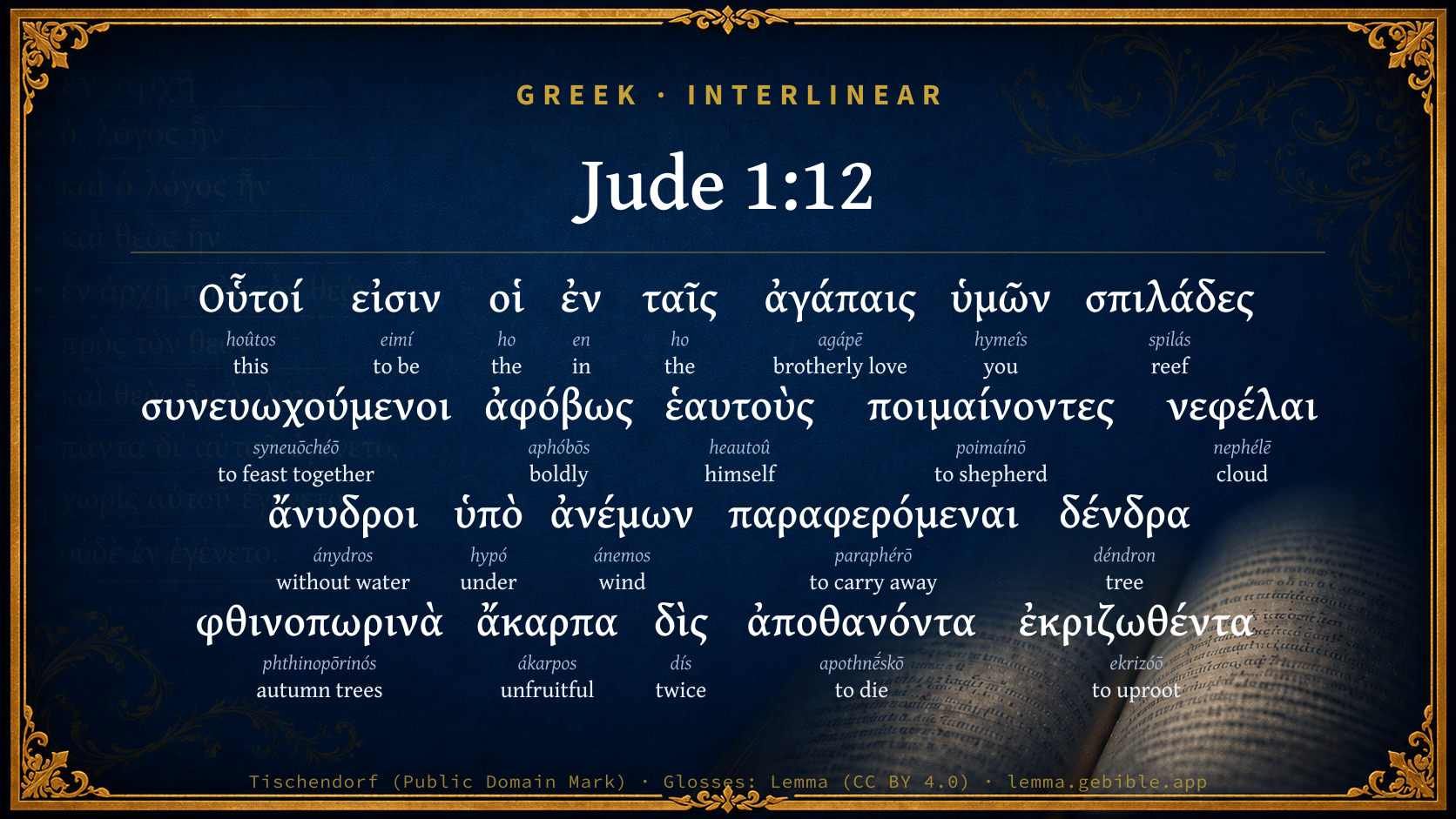
These are hidden rocky reefs in your love feasts when they feast with you, shepherds who without fear feed themselves; clouds without water, carried along by winds; autumn leaves without fruit, twice dead, plucked up by the roots;
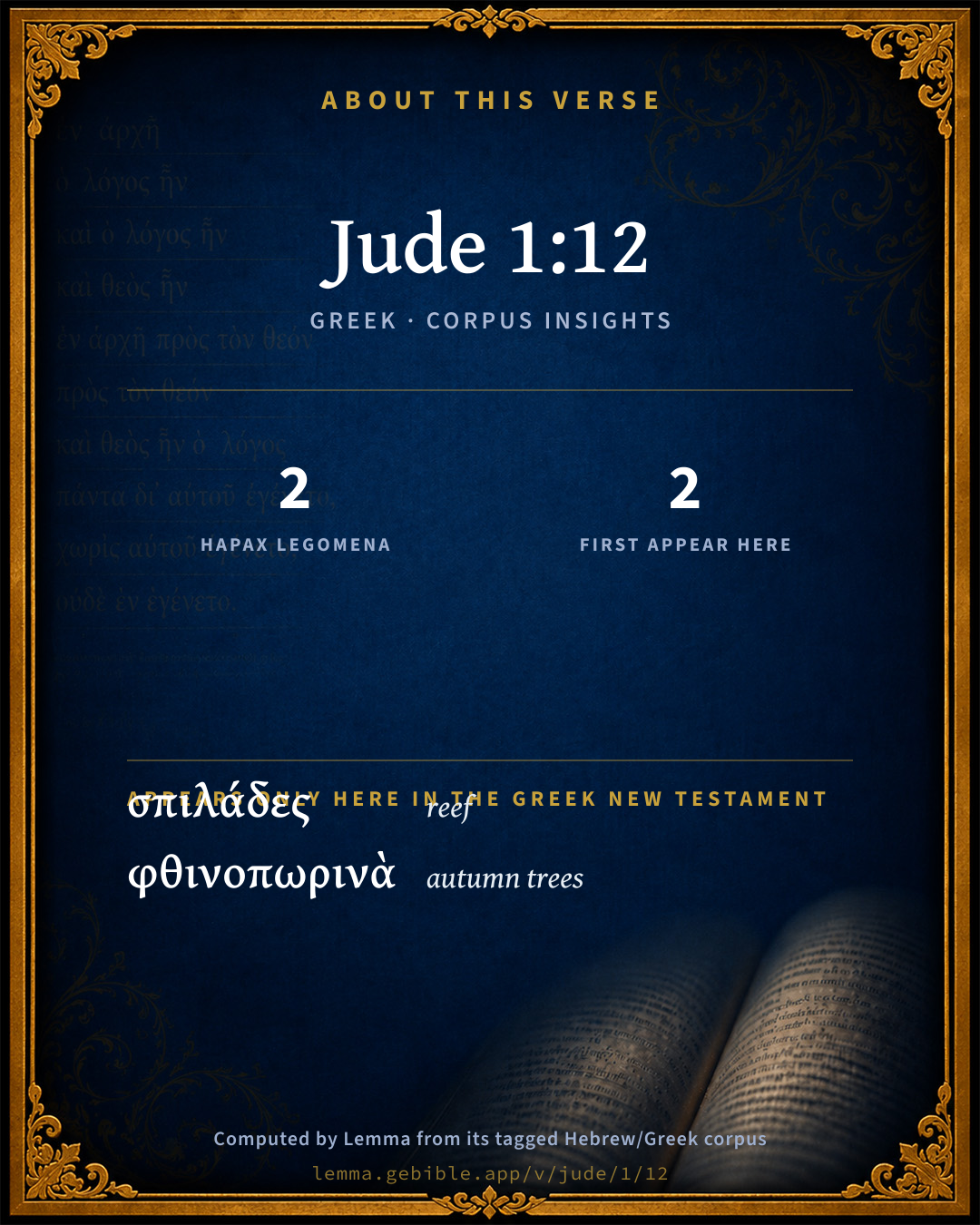
- 2 hapax legomena — only here in the Greek New Testament
- 2 first appearances in the Greek New Testament
Download a study sheet
One document with this verse’s original text, its word-by-word gloss line, the meaning frame, cross-references with their text, attributed commentary, and full source and license credits — printable, and it pastes into notes with its structure intact.
This verse Autodidact and up
A passage Seminary Student
Up to 50 verses in one chapter. A passage sheet keeps up to 6 commentary sources and 12 cross-references per verse, in the order this page ranks them, and says so on the sheet whenever that leaves anything out. Ask for a single verse and you get the Autodidact verse sheet above.
Everything on this page stays free to read, with no account — the sheet is a download of what is already on screen, not access to it.
Compare translations 3
The same verse in 3 English versions, stacked beneath the original-language interlinear above. Click any original word for its lexicon entry.
Each is an independent rendering of the whole verse — the interlinear is not word-aligned to these translations.
Highlighted words mark where these versions differ — a whole-verse word diff, not a word-by-word alignment.
-
World English Bible Public Domain
These are hidden rocky reefs in your love feasts when they feast with you, shepherds who without fear feed themselves; clouds without water, carried along by winds; autumn leaves without fruit, twice dead, plucked up by the roots;
-
King James Version Public Domain
These are spots in your feasts of charity, when they feast with you, feeding themselves without fear: clouds they are without water, carried about of winds; trees whose fruit withereth, without fruit, twice dead, plucked up by the roots;
-
unfoldingWord Literal Text CC BY-SA 4.0
These ones are the ones in your love feasts—hidden reefs—fearlessly feasting with, shepherding themselves; waterless clouds, carried along by winds; fruitless autumn trees—having died twice, having been uprooted,
unfoldingWord Literal Text — © unfoldingWord, licensed CC BY-SA 4.0. Word-aligned USFM3 via Door43 (git.door43.org/unfoldingWord/en_ult).
Show all 19 translations
Every available English version of this verse, each an independent rendering of the whole verse.
-
World English Bible Public Domain
These are hidden rocky reefs in your love feasts when they feast with you, shepherds who without fear feed themselves; clouds without water, carried along by winds; autumn leaves without fruit, twice dead, plucked up by the roots;
-
Berean Standard Bible Public Domain
These men are hidden reefs in your love feasts, shamelessly feasting with you but shepherding only themselves. They are clouds without water, carried along by the wind; fruitless trees in autumn, twice dead after being uprooted.
-
Majority Standard Bible Public Domain
These men are hidden reefs in your love feasts, shamelessly feasting with you but shepherding only themselves. They are clouds without water, carried along by the wind; fruitless trees in autumn, twice dead after being uprooted.
-
King James Version Public Domain
These are spots in your feasts of charity, when they feast with you, feeding themselves without fear: clouds they are without water, carried about of winds; trees whose fruit withereth, without fruit, twice dead, plucked up by the roots;
-
American Standard Version (1901) Public Domain
These are they who are hidden rocks in your love-feasts when they feast with you, shepherds that without fear feed themselves; clouds without water, carried along by winds; autumn leaves without fruit, twice dead, plucked up by the roots;
-
Revised Version (1885) Public Domain
These are they who are hidden rocks in your love-feasts when they feast with you, shepherds that without fear feed themselves; clouds without water, carried along by winds; autumn trees without fruit, twice dead, plucked up by the roots;
-
Geneva Bible (1599) Public Domain
These are rockes in your feasts of charitie when they feast with you, without al feare, feeding themselues: cloudes they are without water, caried about of windes, corrupt trees and without fruit, twise dead, and plucked vp by ye rootes.
-
Douay-Rheims (1899) Public Domain
These are spots in their banquets, feasting together without fear, feeding themselves, clouds without water, which are carried about by winds, trees of the autumn, unfruitful, twice dead, plucked up by the roots,
-
Young's Literal Translation Public Domain
These are in your love-feasts craggy rocks; feasting together with you, without fear shepherding themselves; clouds without water, by winds carried about; trees autumnal, without fruit, twice dead, rooted up;
-
Literal Standard Version CC BY-SA 4.0
These are stains at your love-feasts, feasting together with you without fear, shepherding themselves; waterless clouds, being carried away by winds; autumnal trees without fruit, having died twice, having been uprooted;
-
Unlocked Literal Bible CC BY-SA 4.0
These are the ones who are hidden reefs in your love feasts, when they feast with you shamelessly—shepherds who only feed themselves. They are clouds without rain, carried along by winds. They are autumn trees without fruit—twice dead, torn up by the roots.
-
unfoldingWord Literal Text CC BY-SA 4.0
These ones are the ones in your love feasts—hidden reefs—fearlessly feasting with, shepherding themselves; waterless clouds, carried along by winds; fruitless autumn trees—having died twice, having been uprooted,
-
Darby Bible Public Domain
These are spots in your love-feasts, feasting together [with you] without fear, pasturing themselves; clouds without water, carried along by [the] winds; autumnal trees, without fruit, twice dead, rooted up;
-
World Messianic Bible Public Domain
These are hidden rocky reefs in your love feasts when they feast with you, shepherds who without fear feed themselves; clouds without water, carried along by winds; autumn trees without fruit, twice dead, plucked up by the roots;
-
Webster's Bible Public Domain
These are spots in your feasts of charity, when they feast with you, feeding themselves without fear: clouds they are without water, carried about by winds; withered autumnal trees, without fruit, twice dead, plucked out by the roots;
-
Free Bible Version CC BY-SA 4.0
These people spoil your fellowship meals, for they are selfish shepherds that don't have the slightest sense of shame—they only take care of themselves. They're clouds blown along by the wind that bring no rain. They're bare trees without fruit—twice dead, pulled out by the roots.
-
Bible in Basic English Public Domain
These men are unseen rocks at your love-feasts, when they take part in them with you, keepers of sheep who without fear take the food of the sheep; clouds without water rushing before the wind, wasted trees without fruit, twice dead, pulled up by the roots,
-
Text-Critical English NT CC BY 4.0
These men are hidden reefs at your love feasts, feeding themselves as they feast among you without fear. They are clouds without water, carried along by winds; fruitless trees in late autumn, twice dead, pulled up by the roots.
-
Tyndale New Testament (1534) Public Domain
These are spottes which of youre kindnes feast to gedder with out feare fedynge them selves. Cloudes they are with outen water caried about of wyndes and trees with out frute at gadringe tyme twyse deed and plucked vp by the rotes.
Literal Standard Version (2020), Covenant Press — licensed CC BY-SA 4.0. Text via the HelloAO Bible API (eBible.org). Unlocked Literal Bible (unfoldingWord) — licensed CC BY-SA 4.0. Text via the HelloAO Bible API (eBible.org). unfoldingWord Literal Text — © unfoldingWord, licensed CC BY-SA 4.0. Word-aligned USFM3 via Door43 (git.door43.org/unfoldingWord/en_ult). Free Bible Version, Dr. Jonathan Gallagher — licensed CC BY-SA 4.0. Text via the HelloAO Bible API (eBible.org).
Word by word
More ways to search: Search by grammar → Find every occurrence → Compare this word →
Practice this passage: Drill this verse → Learn its vocabulary →
- Appears 1× in the Greek New Testament
- First appears here
- Part of Speech
- Noun
- Case
- Nominative
- Number
- Plural
- Gender
- Feminine
Full Thayer's Definition
- Οὗτοί hoûtos G3778 “this” Demonstrative pronoun, Nominative, Plural, Masculine
- εἰσιν eimí G1510 “to be” Verb, Present, Active, Indicative, 3rd person, Plural
- οἱ ho G3588 “the” Article, Nominative, Plural, Masculine
- ἐν en G1722 “in” Preposition
- ταῖς ho G3588 “the” Article, Dative, Plural, Feminine
- ἀγάπαις agápē G26 “brotherly love” Noun, Dative, Plural, Feminine
- ὑμῶν hymeîs G5210 “you” Personal pronoun, 2nd person, Genitive, Plural
- σπιλάδες spilás G4694 “reef” Noun, Nominative, Plural, Feminine
- συνευωχούμενοι syneuōchéō G4910 “to feast together” Verb, Present, Middle or Passive deponent, Participle, Nominative, Plural, Masculine
- ἀφόβως aphóbōs G870 “boldly” Adverb
- ἑαυτοὺς heautoû G1438 “himself” Reflexive pronoun, 3rd person, Accusative, Plural, Masculine
- ποιμαίνοντες poimaínō G4165 “to shepherd” Verb, Present, Active, Participle, Nominative, Plural, Masculine
- νεφέλαι nephélē G3507 “cloud” Noun, Nominative, Plural, Feminine
- ἄνυδροι ánydros G504 “without water” Adjective, Nominative, Plural, Feminine
- ὑπὸ hypó G5259 “under” Preposition
- ἀνέμων ánemos G417 “wind” Noun, Genitive, Plural, Masculine
- παραφερόμεναι paraphérō G3911 “to carry away” Verb, Present, Passive, Participle, Nominative, Plural, Feminine
- δένδρα déndron G1186 “tree” Noun, Nominative, Plural, Neuter
- φθινοπωρινὰ phthinopōrinós G5352 “autumn trees” Adjective, Nominative, Plural, Neuter
- ἄκαρπα ákarpos G175 “unfruitful” Adjective, Nominative, Plural, Neuter
- δὶς dís G1364 “twice” Adverb
- ἀποθανόντα apothnḗskō G599 “to die” Verb, Aorist, Active, Participle, Nominative, Plural, Neuter
- ἐκριζωθέντα ekrizóō G1610 “to uproot” Verb, Aorist, Passive, Participle, Nominative, Plural, Neuter
About this verse
These counts appear in no published source. They are computed here, from the morphology-tagged text and Lemma’s own curated glosses. What Lemma adds →
- 23
- words
- 22
- distinct lemmas
- General Epistles
- section
Notable vocabulary
2 hapax legomena — words that appear only here in the entire Greek New Testament:
First appearance in Scripture
These words make their first canonical appearance in the Greek New Testament here:
Shared distinctive vocabulary
συνευωχούμενοι to feast together G4910 occurs in 2 verses of the Greek New Testament. Also found in:
Repetition
A word recurs within this verse:
- οἱ the G3588 ×2
Cross-references
32Topical passages linked to Jude 1:12 in the Treasury of Scripture Knowledge — connected by theme and wording, ordered by reader-vote popularity; previews shown in the World English Bible.
- Matthew 15:13 But he answered, "Every plant which my heavenly Father didn't plant will be uprooted.
- 2 Peter 2:17–20 These are wells without water, clouds driven by a storm; for whom the blackness of darkness has been reserved forever.
- Ezekiel 34:8 As I live, says the Lord Yahweh, surely because my sheep became a prey, and my sheep became food to all the animals of the field, because there was no shepherd, neither did my shepherds search for my sheep, but the shepherds fed themselves, and didn't feed my sheep;
- Proverbs 25:14 As clouds and wind without rain, So is he who boasts of gifts deceptively.
- Ephesians 4:14 that we may no longer be children, tossed back and forth and carried about with every wind of doctrine, by the trickery of men, in craftiness, after the wiles of error;
- Philippians 3:19 whose end is destruction, whose god is the belly, and whose glory is in their shame, who think about earthly things.
- Luke 21:34 "So be careful, or your hearts will be loaded down with carousing, drunkenness, and cares of this life, and that day will come on you suddenly.
- John 15:4–6 Remain in me, and I in you. As the branch can't bear fruit by itself, unless it remains in the vine, so neither can you, unless you remain in me.
- 1 Corinthians 11:20–22 When therefore you assemble yourselves together, it is not possible to eat the Lord's supper.
- 2 Peter 2:13–14 receiving the wages of unrighteousness; people who count it pleasure to revel in the day-time, spots and blemishes, reveling in their deceit while they feast with you;
- Isaiah 56:10–12 His watchmen are blind, they are all without knowledge; they are all mute dogs, they can't bark; dreaming, lying down, loving to slumber.
- Ezekiel 34:2 Son of man, prophesy against the shepherds of Israel, prophesy, and tell them, even to the shepherds, Thus says the Lord Yahweh: Woe to the shepherds of Israel who feed themselves! Shouldn't the shepherds feed the sheep?
- Ezekiel 34:10 Thus says the Lord Yahweh: Behold, I am against the shepherds; and I will require my sheep at their hand, and cause them to cease from feeding the sheep; neither shall the shepherds feed themselves any more; and I will deliver my sheep from their mouth, that they may not be food for them.
- Luke 8:6 Other seed fell on the rock, and as soon as it grew, it withered away, because it had no moisture.
- Psalms 1:3 He will be like a tree planted by the streams of water, That brings forth its fruit in its season, Whose leaf also does not wither. Whatever he does shall prosper.
- Hosea 6:4 "Ephraim, what shall I do to you? Judah, what shall I do to you? For your love is like a morning cloud, And like the dew that disappears early.
- Matthew 13:6 When the sun had risen, they were scorched. Because they had no root, they withered away.
- Matthew 21:19–20 Seeing a fig tree by the road, he came to it, and found nothing on it but leaves. He said to it, "Let there be no fruit from you forever!" Immediately the fig tree withered away.
- Mark 4:6 When the sun had risen, it was scorched; and because it had no root, it withered away.
- Mark 11:20–21 As they passed by in the morning, they saw the fig tree withered away from the roots.
- Luke 12:45 But if that servant says in his heart, 'My lord delays his coming,' and begins to beat the menservants and the maidservants, and to eat and drink, and to be drunken,
- 1 Thessalonians 5:6–7 so then let's not sleep, as the rest do, but let's watch and be sober.
- 1 Timothy 5:6 But she who gives herself to pleasure is dead while she lives.
- Hebrews 6:4–8 For concerning those who were once enlightened and tasted of the heavenly gift, and were made partakers of the Holy Spirit,
- James 5:5 You have lived delicately on the earth, and taken your pleasure. You have nourished your hearts as in a day of slaughter.
- 2 Chronicles 7:20 then will I pluck them up by the roots out of my land which I have given them; and this house, which I have made holy for my name, will I cast out of my sight, and I will make it a proverb and a byword among all peoples.
- Psalms 78:29–31 So they ate, and were well filled. He gave them their own desire.
- Ezekiel 17:9 Say you, Thus says the Lord Yahweh: Shall it prosper? shall he not pull up the roots of it, and cut off the fruit of it, that it may wither; that all its fresh springing leaves may wither? and not by a strong arm or much people can it be raised from the roots of it.
- Ezekiel 34:18 Seems it a small thing to you to have fed on the good pasture, but you must tread down with your feet the residue of your pasture? and to have drunk of the clear waters, but you must foul the residue with your feet?
- Luke 12:19–20 I will tell my soul, "Soul, you have many goods laid up for many years. Take your ease, eat, drink, be merry."'
- Luke 16:19 "Now there was a certain rich man, and he was clothed in purple and fine linen, living in luxury every day.
- Psalms 37:2 For they shall soon be cut down like the grass, And wither like the green herb.
Cross-references courtesy of OpenBible.info (CC BY 4.0).
Lesson kit
Teaching starters — assembled from the data on this page, not authored interpretation. Every prompt links to the verse data it draws on. Edit before teaching.
Jude, in the General Epistles, opens this verse with 23 words (22 distinct Greek lemmas). Its most distinctive word is spilás (“reef”). A historical commentator’s framing appears above. Read the whole chapter for the surrounding context.
Discussion questions
- What does “reef” (spilás) contribute to the verse as a whole?
- This verse holds 2 words here found nowhere else in the Greek New Testament. What might the rare words draw attention to?
- 2 words here appear for the first time in Scripture. What is being introduced at this debut?
- 2 Peter 2:13 shares the word «to feast together» with this verse. How do the two illuminate each other?
- “the” occurs 2× in this one verse. What is the effect of the repetition?
- These translations render this verse differently; the difference is in the English rendering, not the original. What questions does that raise?
- Reading how Ellicott's Commentary for English Readers and The Biblical Illustrator read this verse, where do the two commentators agree and where do they part?
Things to notice
- 2 words in this verse appear nowhere else in the Greek New Testament.
- 2 words make their first canonical appearance in Scripture here.
- These translations choose different wording for 41 words in this verse.
- “the” occurs 2× in this single verse.
- 22 distinct Greek lemmas span 23 words in this verse.
Commentary
Notes on Jude 1:12 from classic Christian and Jewish commentators (each source and its license shown beneath its notes). The classic Christian expositions comment on the surrounding passage and are grouped to its opening verse, so a note may address several verses; the Jewish commentaries on the Tanakh (Rashi and others) are per-verse, so they appear only where the commentator wrote on this verse.
Lemma curates 59 commentaries, every one of them public domain or Creative Commons licensed, each selected and text-cleaned for this edition rather than reprinted as found. About our sources →
Ellicott's Commentary for English Readers
A Bible Commentary for English Readers, edited by Charles John Ellicott (1878–1897) — public domain. Text from a community e-Sword module.
The Biblical Illustrator
Joseph S. Exell
The Biblical Illustrator, edited by Joseph S. Exell (c. 1880s–1900s) — public domain. Text from a community e-Sword module.
Joseph Benson's Commentary
Joseph Benson's Commentary on the Old and New Testaments (1811–1818) — public domain. Text from a community e-Sword module.
The Preacher's Complete Homiletical Commentary
Joseph S. Exell (gen. ed.)
The Preacher's Complete Homiletical Commentary (gen. ed. Joseph S. Exell; Funk & Wagnalls, c. 1892) — public domain (pre-1929). A full-Bible homiletical/sermon-outline anthology covering 65 of 66 books (2 John is absent from the source module). Text from a community e-Sword module.
The Expositor's Bible
William Robertson Nicoll, ed., The Expositor's Bible (London: Hodder & Stoughton, 1887–1910) — public domain. 65 of 66 books (1 Corinthians is not separately keyed, as that volume carries no machine-parseable verse references); section-level commentary keyed to the opening verse. Introductory and overview sections not keyed to a specific passage are excluded.
Tyndale Open Study Notes
Tyndale Open Resources
Tyndale Open Study Notes — © Tyndale Open Resources, licensed CC BY-SA 4.0. Text via the HelloAO Bible API.
Bengel's Gnomon
Johann Albrecht Bengel
Bengel's Gnomon of the New Testament — English translation (T&T Clark, Edinburgh, 1860) — public domain. Text from a community e-Sword module.
Meyer's Critical & Exegetical Commentary
Heinrich August Wilhelm Meyer
Meyer — Critical and Exegetical Commentary on the New Testament — English translation by Peter Christie, edited by Frederick Crombie (T&T Clark, 1880) — public domain. Text from a community e-Sword module.
Expositor's Greek Testament
ed. W. Robertson Nicoll
The Expositor's Greek Testament, edited by W. Robertson Nicoll (1897–1910) — public domain. Text from a community e-Sword module.
Cambridge Greek Testament for Schools and Colleges
Cambridge Greek Testament for Schools and Colleges (Cambridge University Press, 1896; 21 vols, various authors incl. Carr, Maclear, Plummer, Farrar, Lumby, Moule, M. R. James, Simcox) — public domain. Text from a community e-Sword module.
Geneva Bible (1599)
Geneva Bible translators
Geneva Bible (1599) marginal notes — public domain. Text via Bolls.life.
Jamieson, Fausset & Brown
Robert Jamieson, A. R. Fausset & David Brown
Jamieson, Fausset & Brown — Commentary Critical and Explanatory on the Whole Bible (1871) — public domain (CC PDM 1.0). Text via the HelloAO Bible API.
Adam Clarke's Commentary
Adam Clarke's Commentary on the Bible (1810–1826) — public domain. Text from a community e-Sword/MySword module.
John Calvin's Commentaries
John Calvin's Commentaries (1540-1563) — public domain. Text from the Calvin Translation Society English edition (1840s-50s) via the Christian Classics Ethereal Library (ccel.org). Calvin's coverage is partial (roughly two-thirds of the Bible); uncommented books and verses are honest gaps, never fabricated. The 19th-century editor's footnotes and remarks are omitted so the notes are faithfully Calvin's own voice.
The Cambridge Bible for Schools and Colleges
gen. ed. J. J. S. Perowne
The Cambridge Bible for Schools and Colleges (gen. ed. J. J. S. Perowne; Cambridge University Press, 1878–1918) — public domain. Text from a community e-Sword module.
John Gill's Exposition
John Gill's Exposition of the Whole Bible (1746–1763) — public domain (CC PDM 1.0). Text via the HelloAO Bible API.
Albert Barnes' Notes on the Bible
Albert Barnes' Notes on the Bible (1834–1885) — public domain. Text from a community e-Sword/MySword module.
Haydock's Catholic Bible Commentary
George Leo Haydock (1774–1849), Haydock's Catholic Family Bible and Commentary, 1859 edition — public domain. Excludes Psalms (Douay-Rheims chapter numbering differs from Protestant) and Deuterocanonical books (Catholic canon only).
Matthew Poole's English Annotations
Matthew Poole's English Annotations on the Holy Bible (1683–1685) — public domain. Text from a community e-Sword/MySword module.
Whedon's Commentary on the Bible
Daniel D. Whedon
Daniel D. Whedon (gen. ed.), Commentary on the Old and New Testaments (1874–1909) — public domain. Text from a community e-Sword module.
The Pulpit Commentary
The Pulpit Commentary (1880–1919), ed. H.D.M. Spence-Jones & Joseph S. Exell — public domain. Text from a community e-Sword module.
John Wesley's Explanatory Notes
John Wesley, Explanatory Notes Upon the Whole Bible (1754–1765) — public domain. Text via the GEBible commentary corpus.
Burkitt's Expository Notes on the New Testament
William Burkitt
William Burkitt's Expository Notes on the New Testament (1700–1703) — public domain. Text from a community e-Sword module.
Godbey's Commentary on the New Testament
William B. Godbey
William B. Godbey, Commentary on the New Testament (1896–1900) — public domain. Text from a community e-Sword module.
The People's New Testament
B. W. Johnson
B. W. Johnson's The People's New Testament with Notes (1889–1891) — public domain. Electronic text from the Christian Classics Ethereal Library (CCEL) ThML edition.
unfoldingWord translationNotes
Door43 World Missions Community
unfoldingWord translationNotes — © Distant Shores Media and the Door43 World Missions Community, licensed CC BY-SA 4.0. Source: git.door43.org/Door43/en_tn.
International Critical Commentary
International Critical Commentary — older volumes (1896–1929), various authors — public domain. Text from a community e-Sword module.
Vincent's Word Studies in the New Testament
Marvin R. Vincent
Marvin R. Vincent, Word Studies in the New Testament (1887–1900) — public domain. Text from a community e-Sword/MySword module.