John 12:30

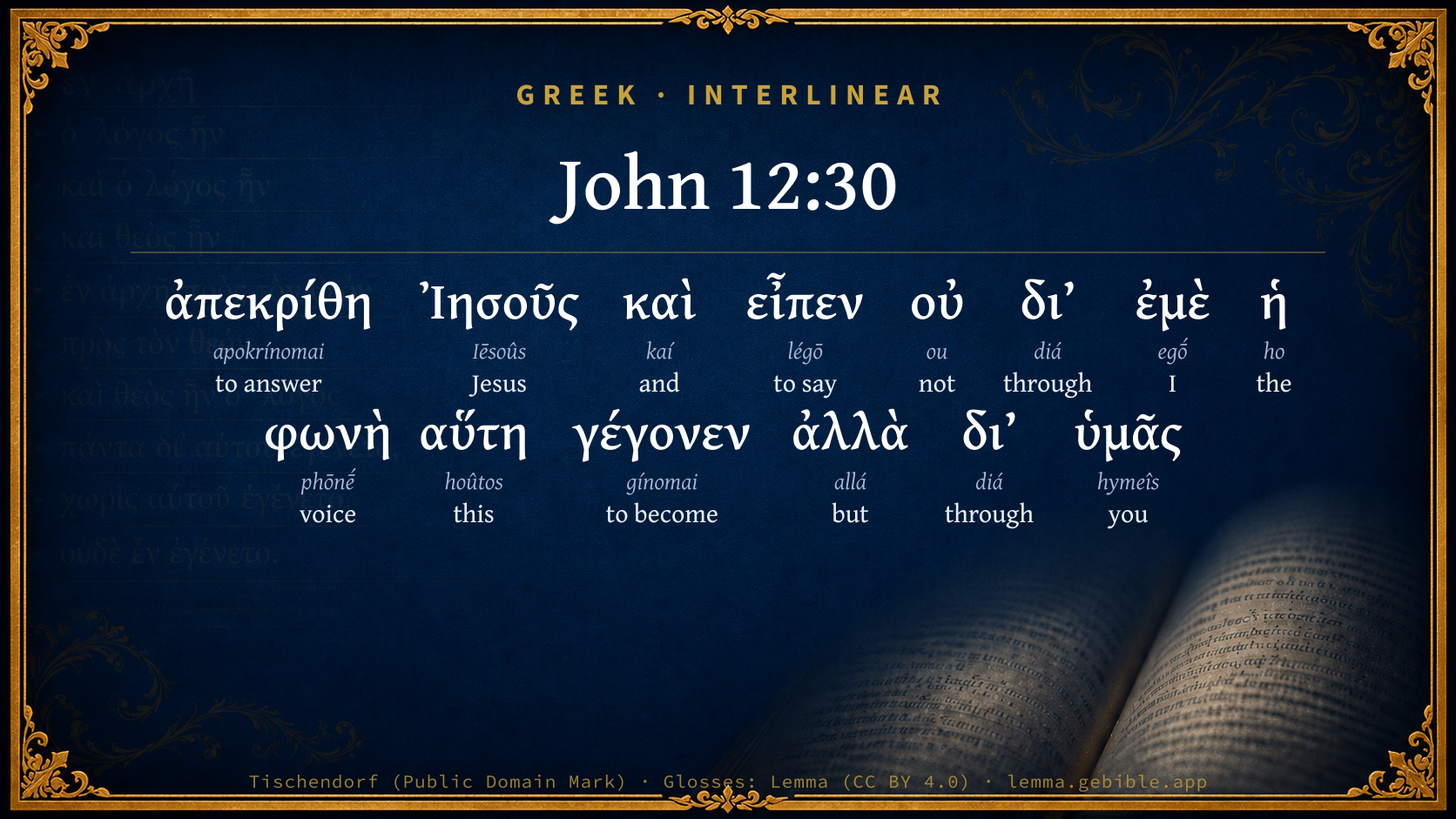
Greek (Tischendorf 8th ed.) John 12:30 appears in the Greek New Testament. The text above is from the Tischendorf 8th edition. Each word links to its Strong’s number and a concise gloss. Click any word for its full Thayer’s Greek Lexicon entry.
Download image
Cite this verse

John 12:30 (World English Bible). Public Domain. Lemma interlinear Bible study tool, https://lemma.gebible.app/v/john/12/30.

Show BibTeX & RIS
BibTeX
RIS
English Translation
Jesus answered, "This voice hasn't come for my sake, but for your sakes.
World English Bible · Public Domain
Download a study sheet

One document with this verse’s original text, its word-by-word gloss line, the meaning frame, cross-references with their text, attributed commentary, and full source and license credits — printable, and it pastes into notes with its structure intact.

This verse Autodidact and up

Study sheet (.html) Plain text (.txt)

A passage Seminary Student

Up to 50 verses in one chapter. A passage sheet keeps up to 6 commentary sources and 12 cross-references per verse, in the order this page ranks them, and says so on the sheet whenever that leaves anything out. Ask for a single verse and you get the Autodidact verse sheet above.

Everything on this page stays free to read, with no account — the sheet is a download of what is already on screen, not access to it.

Want to remove ads? Support Godless Engineer
Compare translations 3

The same verse in 3 English versions, stacked beneath the original-language interlinear above. Click any original word for its lexicon entry.

Each is an independent rendering of the whole verse — the interlinear is not word-aligned to these translations.

Highlighted words mark where these versions differ — a whole-verse word diff, not a word-by-word alignment.

  • World English Bible Public Domain
    Jesus answered, "This voice hasn't come for my sake, but for your sakes.
  • King James Version Public Domain
    Jesus answered and said, This voice came not because of me, but for your sakes.
  • unfoldingWord Literal Text CC BY-SA 4.0
    Jesus answered and said, “This voice did not come for me, but for you.

unfoldingWord Literal Text — © unfoldingWord, licensed CC BY-SA 4.0. Word-aligned USFM3 via Door43 (git.door43.org/unfoldingWord/en_ult).

Versions to compare (up to 4)

3 of 4 selected

Show all 19 translations

Every available English version of this verse, each an independent rendering of the whole verse.

  • World English Bible Public Domain
    Jesus answered, "This voice hasn't come for my sake, but for your sakes.
  • Berean Standard Bible Public Domain
    In response, Jesus said, “This voice was not for My benefit, but yours.
  • Majority Standard Bible Public Domain
    In response, Jesus said, “This voice was not for My benefit, but yours.
  • King James Version Public Domain
    Jesus answered and said, This voice came not because of me, but for your sakes.
  • American Standard Version (1901) Public Domain
    Jesus answered and said, This voice hath not come for my sake, but for your sakes.
  • Revised Version (1885) Public Domain
    Jesus answered and said, This voice hath not come for my sake, but for your sakes.
  • Geneva Bible (1599) Public Domain
    Iesus answered, and said, This voyce came not because of me, but for your sakes.
  • Douay-Rheims (1899) Public Domain
    Jesus answered, and said: This voice came not because of me, but for your sakes.
  • Young's Literal Translation Public Domain
    Jesus answered and said, `Not because of me hath this voice come, but because of you;
  • Literal Standard Version CC BY-SA 4.0
    Jesus answered and said, “This voice has not come because of Me, but because of you;
  • Unlocked Literal Bible CC BY-SA 4.0
    Jesus answered and said, “This voice did not come for me, but for you.
  • unfoldingWord Literal Text CC BY-SA 4.0
    Jesus answered and said, “This voice did not come for me, but for you.
  • Darby Bible Public Domain
    Jesus answered and said, Not on my account has this voice come, but on yours.
  • World Messianic Bible Public Domain
    Yeshua answered, “This voice hasn’t come for my sake, but for your sakes.
  • Webster's Bible Public Domain
    Jesus answered and said, This voice came not because of me, but for your sakes.
  • Free Bible Version CC BY-SA 4.0
    Jesus told them, “This voice spoke not for my sake, but for yours.
  • Bible in Basic English Public Domain
    Jesus said in answer, This voice came not for me but for you.
  • Text-Critical English NT CC BY 4.0
    Jesus responded, “This voice has come not for my sake, but for your sake.
  • Tyndale New Testament (1534) Public Domain
    Iesus answered and sayde: this voyce cam not because of me but for youre sakes.

Literal Standard Version (2020), Covenant Press — licensed CC BY-SA 4.0. Text via the HelloAO Bible API (eBible.org). Unlocked Literal Bible (unfoldingWord) — licensed CC BY-SA 4.0. Text via the HelloAO Bible API (eBible.org). unfoldingWord Literal Text — © unfoldingWord, licensed CC BY-SA 4.0. Word-aligned USFM3 via Door43 (git.door43.org/unfoldingWord/en_ult). Free Bible Version, Dr. Jonathan Gallagher — licensed CC BY-SA 4.0. Text via the HelloAO Bible API (eBible.org).

Word by word

More ways to search: Search by grammar → Find every occurrence → Compare this word →

Practice this passage: Drill this verse → Learn its vocabulary →

φωνὴ
phōnḗ
G5456
“voice”
Noun, Nominative, Singular, Feminine
Part of Speech
Noun
Case
Nominative
Number
Singular
Gender
Feminine
Full Thayer's Definition

Origin: probably akin to G5316 through the idea of disclosure

TDNT: 13:38,1

1. a sound, a tone a. of inanimate things, as musical instruments 2. a voice a. of the sound of uttered words 3. speech a. of a language, tongue
  1. ἀπεκρίθη apokrínomai G611 “to answer” Verb, Aorist, Middle deponent, Indicative, 3rd person, Singular
  2. Ἰησοῦς Iēsoûs G2424 “Jesus” Noun, Nominative, Singular, Masculine
  3. καὶ kaí G2532 “and” Conjunction
  4. εἶπεν légō G3004 “to say” Verb, Aorist, Active, Indicative, 3rd person, Singular
  5. οὐ ou G3756 “not” Particle, Negative
  6. δι’ diá G1223 “through” Preposition
  7. ἐμὲ egṓ G1473 “I” Personal pronoun, 1st person, Accusative, Singular
  8. ἡ ho G3588 “the” Article, Nominative, Singular, Feminine
  9. αὕτη hoûtos G3778 “this” Demonstrative pronoun, Nominative, Singular, Feminine
  10. γέγονεν gínomai G1096 “to become” Verb, Perfect, Active, Indicative, 3rd person, Singular
  11. ἀλλὰ allá G235 “but” Conjunction
  12. δι’ diá G1223 “through” Preposition
  13. ὑμᾶς hymeîs G5210 “you” Personal pronoun, 2nd person, Accusative, Plural

About this verse

These counts appear in no published source. They are computed here, from the morphology-tagged text and Lemma’s own curated glosses. What Lemma adds →

14
words
13
distinct lemmas
Gospels
section

Repetition

A word recurs within this verse:

  • δι’ through G1223 ×2

Cross-references

4

Topical passages linked to John 12:30 in the Treasury of Scripture Knowledge — connected by theme and wording, ordered by reader-vote popularity; previews shown in the World English Bible.

  • John 11:42 I know that you always listen to me, but because of the multitude that stands around I said this, that they may believe that you sent me."
  • John 11:15 I am glad for your sakes that I was not there, so that you may believe. Nevertheless, let's go to him."
  • 2 Corinthians 8:9 For you know the grace of our Lord Jesus Christ, that, though he was rich, yet for your sakes he became poor, that you through his poverty might become rich.
  • John 5:34 But the testimony which I receive is not from man. However, I say these things that you may be saved.

Cross-references courtesy of OpenBible.info (CC BY 4.0).

Commentary

Notes on John 12:30 from classic Christian and Jewish commentators (each source and its license shown beneath its notes). The classic Christian expositions comment on the surrounding passage and are grouped to its opening verse, so a note may address several verses; the Jewish commentaries on the Tanakh (Rashi and others) are per-verse, so they appear only where the commentator wrote on this verse.

Lemma curates 59 commentaries, every one of them public domain or Creative Commons licensed, each selected and text-cleaned for this edition rather than reprinted as found. About our sources →

Bengel's Gnomon

Johann Albrecht Bengel

Joh 12:30. Οὐ δἰ ἐμέ, not on account of Me) Himself and the Father are one; wherefore He needs not external testimonies whereby His Divine mission may be confirmed. It is probable that, at the time of Jesus’ retirements, there were no miracles wrought in secrecy. So also, in the case of bright examples of a happy departure from life, the incidents which occur do not occur for the sake of the departing, but for the sake of the survivors,—δἰ ὑμᾶς, for your sakes) ch. Joh 11:15, “I am glad for your sakes that I was not there (with Lazarus at Bethany), to the intent ye may believe,” 42, “I knew that Thou nearest me always; but because of the people which stand by, I said it, that they may believe that Thou hast sent Me.” [This was truly a remarkable testimony, not inferior to those which were perceived (heard) at Jordan and on the holy mount (of transfiguration).—V. g.]

Bengel's Gnomon of the New Testament — English translation (T&T Clark, Edinburgh, 1860) — public domain. Text from a community e-Sword module.

Meyer's Critical & Exegetical Commentary

Heinrich August Wilhelm Meyer

Joh_12:30-31. Ἀπεκρίθη] not to the disciples (Tholuck), but, according to Joh_12:29, with reference to these two expressions of opinion from the people. He lets their opinions, as to what and whose the voice was, alone, but recognises in their hearts the more dangerous error, that they do not put the voice (this thunder or this angelic speech, according to their supposition) in any relation to themselves.

διʼ ἐμέ] to assure me that my prayer has been heard; novi patris animum in me, Erasmus.

διʼ ὑμᾶς] in relation to you to overcome unbelief, and to strengthen faith. Comp. Joh_11:42.

νῦν κρίσις, κ.τ.λ.] Not an interpretation of the voice (Hengstenberg), but also not without reference to διʼ ὑμᾶς (Engelhardt), which is too weighty an element. Rather: how the crisis of this time presses for the use of that διʼ ὑμᾶς!

νῦν … νῦν] with triumphant certainty of victory, treating the near future as present; now, now, is it gone so far! He speaks quasi certamine defunctus, Calvin.

κρίσις] Now is judgment, i.e. judicial (according to the context: condemnatory) decision passed upon this world, i.e. on the men of the αἰὼν οὗτος who reject faith. This judgment is an actual one; for in the victory of the Messianic work of salvation, which was to be brought about by the death of Jesus, and His exaltation to the heavenly glory connected therewith,[112] the κόσμος was to be set forth in the entire sinfulness and weakness of its hostility towards Christ, and thereby in fact judged.[113] Comp. Joh_16:9-10; Joh_16:33. This victory the ruler of this world in particular (τ. κόσμ. τ. solemnly repeated), the devil, was to submit to;[114] his dominion must have an end, because the death of Jesus effected the reconciliation of humanity, by which reconciliation all were to be drawn away from the devil by becoming believers, and were to be placed under the spiritual power of the Christ exalted to glory, Joh_12:32, Rom_5:12 ff.; Php_2:9-11. He is called the ἄρχων τοῦ κόσμου τούτου, as the ruler of the unbelieving, Christ- opposing humanity (comp. 2Co_4:4; Eph_2:2; Eph_6:12), as in the writings of Rabbins, he, as ruler of the Gentiles, in opposition to God and His people, bears this as a standing name (שר העולם). See Lightfoot and Schoettgen, also in Eisenmenger, Entdeckt. Judenthum, I. p. 647 ff. Here he is so called, because the very ΚΡΊΣΙς of his dominium, the κόσμος, was declared.

ἐκβληθήσεται ἔξω] The necessarily approaching removal of the power of the devil through the death and the exaltation of Jesus is vividly represented as a casting out from his empire, namely from the ΚΌΣΜΟς ΟὟΤΟς. Only this supplement is yielded by the context, not Τῆς ἈΡΧῆς (Euth. Zigabenus, Beza), nor ΤΟῦ ΔΙΚΑΣΤΗΡΊΟΥ (Theophylact), nor out of the kingdom of God (Ewald), and least of all ΤΟῦ ΟὐΡΑΝΟῦ (Luk_10:18; Rev_12:8, so Olshausen; hence the reading ΚΆΤΩ). The indefinite rendering: he is repulsed (De Wette; comp. Plat. Menex. p. 243 B; Soph. Oed. R. 386), or to be removed from the presence of the judge (Hofmann, Schriftbew. I. p. 449), is not sufficient, on account of the appended ἔξω.

Note further, that the victory here announced over this world and over the reign of the devil was indeed decided, and commenced with the death and the exaltation of Christ, but is in a state of continuous development onwards to its consummation at the last day (comp. Rev_20:10); hence the passages of the N. T. on the continuing power and influence of the devil (2Co_4:4; Eph_2:2; Eph_6:12; Rom_16:20; 1Pe_5:8, and many others) do not stand in contradiction to the present passage. Comp. Col_2:15.

[112] There lies in it, accordingly, no opposition to the belief in the last judgment (against Hilgenfeld, Lehrbegr. p. 274), as has been supposed from a misinterpretation also of Joh_3:19-20, in spite of the repeated mention of the last day, and in spite of v. 27, against which here the very absence of the article should have been a warning. Again, what is subsequently said of the devil (as also the passages Joh_14:30-31, Joh_16:11) is not to be explained from the Gnostic idea, that the devil, through his having contrived the death of Christ, but having after His death recognised Him as the Son of God, had been cheated, and so forfeited his right (Hilgenfeld). Of such Gnostic fancies the N. T. knows nothing. The conquest of the devil is necessarily granted along with the atoning effect of the death of Jesus, and through the operation of the Spirit of the exalted one it is in process of completion until the Parousia.

[113] As hereafter the devil is the subject which is cast out, so here the κόσμος is the subject which is judged. This in answer to Bengel: judicium de mundo, quis posthac jure sit obtenturus mundum. Grotius explains κρίσις simply of the vindicatio in libertatem; humanity is to be freed from its unjust possessor; consequently as regards the material contents, substantially as Bengel, comp. also Beza.

[114] Schleiermacher, indeed (L. J. p. 343), interprets the ἄρχ. τ. κ. τ. of open force in its conflict against the activity of Jesus. In reference to the declarations of Jesus regarding the devil, it is most markedly apparent with what difficulty Schleiermacher subordinated himself to exegetical tests.

Meyer — Critical and Exegetical Commentary on the New Testament — English translation by Peter Christie, edited by Frederick Crombie (T&T Clark, 1880) — public domain. Text from a community e-Sword module.

Expositor's Greek Testament

ed. W. Robertson Nicoll

Joh 12:30 . Ἀπεκρίθη ὁ Ἰησοῦς . Jesus, hearing these conjectures, explained to them that not on His account but on theirs this voice had been uttered. It was of immense importance that the disciples, and the people generally, should understand that the sudden transition from the throne offered by the triumphal acclamation of the previous day to the cross, was not a defeat but a fulfilment of the Divine purpose. The voice furnished them against the coming trial.

The Expositor's Greek Testament, edited by W. Robertson Nicoll (1897–1910) — public domain. Text from a community e-Sword module.

Geneva Bible (1599)

Geneva Bible translators

Christ foretelleth to the deaf, the manner of his death, the overcoming of the devil and the world, and in conclusion his triumph.

Geneva Bible (1599) marginal notes — public domain. Text via Bolls.life.

Jamieson, Fausset & Brown

Robert Jamieson, A. R. Fausset & David Brown

Jesus . . . said, This voice came not because of me, but for your sakes--that is, probably, to correct the unfavorable impressions which His momentary agitation and mysterious prayer for deliverance may have produced on the by-standers.

Jamieson, Fausset & Brown — Commentary Critical and Explanatory on the Whole Bible (1871) — public domain (CC PDM 1.0). Text via the HelloAO Bible API.

Adam Clarke's Commentary

Verse 30. This voice came not because of me, but for your sakes.] Probably meaning those Greeks who had been brought to him by Philip and Andrew. The Jews had frequent opportunities of seeing his miracles, and of being convinced that he was the Messiah; but these Greeks, who were to be a first fruits of the Gentiles, had never any such opportunity. For their sakes, therefore, to confirm them in the faith, this miraculous voice appears to have come from heaven.

Adam Clarke's Commentary on the Bible (1810–1826) — public domain. Text from a community e-Sword/MySword module.

John Calvin's Commentaries

30. This voice came not for my sake. Had Christ no need of being strengthened, or did the Father care less for him than for us? But we must attend to this principle. As it was on our account that Christ clothed himself with flesh, so all the blessings which he received from the Father were bestowed on our account. Again, it is also true, that the voice came from heaven for the sake of the people; for he had no need of an outward miracle. Besides, there is here an indirect reproof, that the Jews are deaf like stones to the voice of God; for since God speaks for their sake, there can be no excuse for their ingratitude, when they do not lend their ears.

John Calvin's Commentaries (1540-1563) — public domain. Text from the Calvin Translation Society English edition (1840s-50s) via the Christian Classics Ethereal Library (ccel.org). Calvin's coverage is partial (roughly two-thirds of the Bible); uncommented books and verses are honest gaps, never fabricated. The 19th-century editor's footnotes and remarks are omitted so the notes are faithfully Calvin's own voice.

Ellicott's Commentary for English Readers

(30) This voice came not because of me, but for your sakes.—More exactly, not for My sake did this voice come, but for your sakes. These words are an answer to the thoughts, spoken and unspoken, of the multitude. Jesus Himself knew that the Father heareth Him always, but this answer is a sign to others. (Comp. Joh_11:41-42.) He calls it a voice in answer to those who said it thundered, or that an angel had spoken. There was that, then, which seemed to them but the thunder’s sound or an angel’s word, which, coming in answer to His prayer and after His teaching. should have been, to ears ready to hear and minds willing to receive, the voice of God witnessing to the mission of His Son.

A Bible Commentary for English Readers, edited by Charles John Ellicott (1878–1897) — public domain. Text from a community e-Sword module.

The Cambridge Bible for Schools and Colleges

gen. ed. J. J. S. Perowne

30. Jesus answered] He answered their discussions about the sound, and by calling it a voice He decides conclusively against those who supposed it to be thunder. But those who recognised that it was a voice were scarcely less seriously mistaken; their error consisted in not recognising that the voice had a meaning for them. Not for My sake hath this voice come, but for your sakes, i.e. that ye might believe. Comp. Joh_11:42.

The Cambridge Bible for Schools and Colleges (gen. ed. J. J. S. Perowne; Cambridge University Press, 1878–1918) — public domain. Text from a community e-Sword module.

John Gill's Exposition

Now is the judgment of this world,.... That is, in a very short time will be the judgment either of the Jewish world, when that shall be reproved, convinced, and condemned for their sin of rejecting Christ, and crucifying him, by the Spirit, in the ministration of the Gospel; and they still continuing in their impenitence and unbelief, in process of time wrath will come upon them, upon their nation, city, and temple, to the uttermost; or of the Gentile world, when there shall be a discrimination, and separation made in it, of the chosen of God, who shall be called by special grace, and with the converted and believing Jews, shall form a Gospel church state, separate from the world of the ungodly; or of the world of God's elect among Jews and Gentiles, whose cause, being undertook by Christ, he will now vindicate it, and redeem them from sin and Satan, who have usurped a power and dominion over them: hence it follows,

now shall the prince of this world be cast out. The phrase, , "the prince of the world", is much used by Jewish writers (d), by whom an angel is meant; and they seem to design the angel of death, which is the devil: and it is certain, that he is here intended, and is so called, not because he has any legal power and authority over the world; but because he has usurped a dominion over it, and has great power and efficacy in the hearts of the children of disobedience, who yield a voluntary subjection to him, as if he was their proper lord and sovereign: now the time was at hand, when he should be cast out of the empire of the world he had assumed, and out of the temples of the Gentiles, and out of the hearts of God's elect among them.

(d) T. Bab. Yebamot, fol. 16. 2. & Sanhedrin, fol. 94. 1. & Cholin, fol. 60. 1.

John Gill's Exposition of the Whole Bible (1746–1763) — public domain (CC PDM 1.0). Text via the HelloAO Bible API.

Trapp's Complete Commentary

John Trapp

30 Jesus answered and said, This voice came not because of me, but for your sakes.

Ver. 30. But for your sakes] That ye might believe; which if ye do not, how shall ye escape that neglect so great salvation, such a heavenly preacher? See then that ye refuse not, that ye shift not off, him that speaks from heaven; see that ye turn not from him, whose voice once shook the earth, but now heaven too, παραιτησησθε, Heb 12:25-26.

John Trapp, A Commentary or Exposition upon All the Books of the Old and New Testament (1647–1656) — public domain. Text from a community e-Sword module.

Albert Barnes' Notes on the Bible

Came not because of me - Not to strengthen or confirm me; not that I had any doubts about my course, or any apprehension that God would not approve me and glorify his name.

For your sakes - To give you a striking and indubitable proof that I am the Messiah; that you may remember it when I am departed, and be yourselves comforted, supported, and saved.

Albert Barnes' Notes on the Bible (1834–1885) — public domain. Text from a community e-Sword/MySword module.

Haydock's Catholic Bible Commentary

As the soul of Christ was troubled, not on his own account, but for the sake of the people; so this voice came from heaven, not for his sake, but for that of the people. What it announced was already known to him; the advantage and instruction of the Jews was its end, object, and motive. (St. Augustine, 52. tract. in Joan.)

George Leo Haydock (1774–1849), Haydock's Catholic Family Bible and Commentary, 1859 edition — public domain. Excludes Psalms (Douay-Rheims chapter numbering differs from Protestant) and Deuterocanonical books (Catholic canon only).

Matthew Poole's English Annotations

This voice came not to instruct me, I very well knew, before it came, that my Father had glorified his own name, and would do it again; it came not principally nor solely for me, but chiefly to confirm you in this great truth, that I am the Son of God, and he whom he hath sent into the world, by and in whom he designs to glorify his own great name.

Matthew Poole's English Annotations on the Holy Bible (1683–1685) — public domain. Text from a community e-Sword/MySword module.

Whedon's Commentary on the Bible

Daniel D. Whedon

30-33. Jesus announces that this voice is an omen, not for his sake, who well knew the future, but for their sakes; as a proclamation that he was authenticated, as Son of God, to triumph over the prince of this world. To their cavils, therefore, in Joh_12:34, he furnishes no further confirmation of his mission, but warns them to beware (35, 36) how they rejected the light while the light was in their midst.

30. Not because of me—It was an authentication of me, but not for my sake, who well knew my Sonship of the Father.

For your sakes—It was for their sakes, that they might believe in his humiliation and share in his glory.

Daniel D. Whedon (gen. ed.), Commentary on the Old and New Testaments (1874–1909) — public domain. Text from a community e-Sword module.

The Pulpit Commentary

Jesus answered to the confused murmur of remark, and said, This voice hath not come for my sake, but for your sakes. This surely establishes, on the authority of Jesus, the objective character of the revelation. "It was necessary that you should hear and know and feel who and what I am." Ever thinking of others, living in them, he thinks of their spiritual advantage now. Thoma says that whereas the whole scene corresponds with the synoptic account of Gethsemane, it is idealized on the basis of the Johannine idea of the Divine Lamb and the Loges in flesh, and that Jesus here shows that he needed no strengthening, as the objective revelation was entirely for the sake of others, and not for his own consolation. This ingenious criticism of Thoma rests on the unjustifiable hypothesis that the scene before us did not precede the agony of the garden, but was a bare invention of the evangelist, because the latter ruled that Gethsemane needed "idealization." Why should not the two scenes be equally true, revealing the fundamental identity of character and personality, the one, moreover, preparing for the other? (See notes on Joh 19)

The Pulpit Commentary (1880–1919), ed. H.D.M. Spence-Jones & Joseph S. Exell — public domain. Text from a community e-Sword module.

The People's New Testament

B. W. Johnson

30. This voice came not because of me. He had already won the victory before the voice came. It was rather to confirm the faith of his disciples, who still stumbled over the prospect of his death.

B. W. Johnson's The People's New Testament with Notes (1889–1891) — public domain. Electronic text from the Christian Classics Ethereal Library (CCEL) ThML edition.

unfoldingWord translationNotes

Door43 World Missions Community

General Information:

Jesus explains why the voice spoke from heaven.

Now is the judgment of this world

Here "this world" is a metonym that refers to all the people in the world. AT: "Now is the time for God to judge all of the people" (See: Metonymy)

Now will the ruler of this world be thrown out

Here "ruler" refers to Satan. You can translate this in an active form. AT: "Now is the time when I will destroy the power of Satan who rules this world" (See: Active or Passive)

translationWords

Jesus

voice

judge

world

rule

cast out

unfoldingWord translationNotes — © Distant Shores Media and the Door43 World Missions Community, licensed CC BY-SA 4.0. Source: git.door43.org/Door43/en_tn.

Cambridge Greek Testament for Schools and Colleges

30. ἀπεκρίθη. He answered their discussions about the sound, and by calling it a voice He decides conclusively against those who supposed it to be thunder. But those who recognised that it was a voice were scarcely less seriously mistaken; their error consisted in not recognising that the voice had a meaning for them. Not for My sake hath this voice come, but for your sakes, i. e. that ye might believe. Comp. Joh 11:42.

Cambridge Greek Testament for Schools and Colleges (Cambridge University Press, 1896; 21 vols, various authors incl. Carr, Maclear, Plummer, Farrar, Lumby, Moule, M. R. James, Simcox) — public domain. Text from a community e-Sword module.

Alford’s Greek Testament

Henry Alford

30.] The voice had been heard by those, who did not apprehend its meaning, as thunder. But αὕτη ἡ φωνή could not by any possibility have been said to them, if it had only thundered.

Our Lord does not say that the assurance was not made for His sake;—He had prayed, and His prayer had been answered:—but that it had not been thus outwardly expressed for His, but for their sake. This is likewise true in the case of all testimonies to Him; and especially those two other voices from heaven,—at His Baptism and His Transfiguration.

ὑμᾶς is the whole multitude, not merely the disciples. All heard, and all might have understood the voice: see ch. 11:42.

Henry Alford, The Greek Testament (1849–1861) — public domain. Text from a community e-Sword module.

International Critical Commentary

30. ἀπεκρίθη Ἰησοῦς καὶ εἶπεν. See on 1:49, 50.

οὐ διʼ ἐμὲ ἡ φωνὴ αὕτη (this is the order of אABDLWΘ) γέγονεν ἀλλὰ διʼ ὑμᾶς, “this voice has not happened for my sake but for yours.” (For γέγονεν D has ἦλθεν, and Θ has ἐλήλυθεν.)

This statement presents difficulties similar to those which the traditional text offers at 11:42; for it represents the Voice from heaven as without any significance for Jesus Himself, and as intended only to impress the crowd. No doubt, it might be said that the sound, whatever it was, suggested to the crowd that they would do well to mark what was happening, for it seemed to be a heavenly signal in answer to the prayer of Jesus. It was the signal for the judgment of the world (v. 31), now beginning. But we cannot attach any meaning to the words καὶ ἐδόξασα καὶ πάλιν δοξάσω (v. 28), which the crowd were not able to catch (v. 29), if they had no significance for Jesus. It was to Him that the heavenly Voice seemed to come, and in coming to give assurance to His spirit, that His impending Death was to the greater glory of God. It is not impossible that v. 30 has been added by the evangelist, in order to emphasise the voluntariness of Christ’s surrender of Himself, as a superhuman Person who needed no support for His soul even in this dark hour. But v. 31, for all that, follows v. 30 in a true sequence: “The Voice was on your account. For now is the world of men like you being judged.”

International Critical Commentary — older volumes (1896–1929), various authors — public domain. Text from a community e-Sword module.

Vincent's Word Studies in the New Testament

Marvin R. Vincent

For my sake. Emphatic in the Greek order. It is not for my sake that this voice hath come.

Marvin R. Vincent, Word Studies in the New Testament (1887–1900) — public domain. Text from a community e-Sword/MySword module.

Godet's Commentaries

Frédéric Louis Godet

Vv. 30-32. “Jesus answered and said: Not for my sake has this voice made itself heard, but for your sakes. 31. Now is the judgment of this world;now shall the prince of this world be cast out. 32. And I, when I shall have been lifted up from the earth, will draw all men unto me.”

In declaring that this voice does not make itself heard for His sake, Jesus does not mean to say that He has no need to be strengthened; but only that He had not needed to be strengthened in this way, that is, by a sensible manifestation. What the procedure of the Greeks has been for Him, in awakening vividly within Him the feeling of the gravity of the present hour, this heavenly phenomenon should be for them, by revealing to them the decisive importance of the crisis which is accomplished in this moment. And first, as to the world, this hour is that of the most radical revolution (Joh 12:31-32). It is that of its judgment (Joh 12:31 a), of the expulsion of its former master (Joh 12:31 b), and of the advent of its new monarch (Joh 12:32). The word νῦν, now, at the beginning of the first two clauses, sets forth expressly this decisive character of the present moment for humanity.

To judge is to declare the moral state, not only as evil but also as good. I cannot accept, therefore, the meaning which Weiss gives here to the word κρίσις, judgment, in applying it only to the condemnation of the world as the consequence of the rejection and the death of Christ. No doubt, the cross is the basis of the condemnation of the world, as it reveals completely the moral state of natural humanity. This throne, erected for Jesus by man, shows the depth of hostility to God which is in his heart. But this is not the only side of the judgment of the world by the work of Christ; comp. Joh 3:21 following Joh 3:18-20. Passing before the cross, one part of mankind find in it their salvation through faith, while the other part through unbelief complete their condemnation. Here is the judgment of the world which is the consequence of Holy Friday. It will begin inwardly on this very day. Its first great outward manifestation will be Pentecost; the second will be the fall of Jerusalem. The final universal judgment will be the solemn ratification of it (Joh 12:48).

But, at the same time that the cross will manifest the moral state of the world, it will exhaust the measure of toleration accorded to its prince. The crucifixion of the Son of God is the most odious, the most unpardonable crime of Satan: this crime puts an end to the long-suffering of God towards him, and, consequently, to his dominion over mankind. The Rabbis habitually designate Satan as the prince of the worl (Sar haholam). But they place the Jews outside of his empire, which includes only the Gentiles. Jesus, on the contrary, counts this rebellious people as belonging to it (chap. 8), which He even especially calls the world (Joh 15:18). Out signifies not only; out of his office and power, but above all: out of his former domain, the world, mankind in the natural state. This meaning appears from the relation of these words to those which precede. “With the consummation of the redemptive work,” says Weiss, “the expulsion of the devil begins.” One soul after another is taken away from him, and the progress goes on advancing even to the final day. Thus this saying does not contradict those which still ascribe to Satan an activity in the world.

To the deposition of the former ruler answers the advent of the new sovereign. Jesus expressly designates Himself as the one who is called to fill this office: κἀγώ, and I. But, a strange fact, as He substitutes Himself for Satan, it is not on the earth, from which Satan is driven out, that He establishes His kingdom. The Jews imagined that the Messiah would become here on earth the successor of His adversary, that He would be another prince of this world. But no, He will leave the world, as does also His rival; He will be obliged to leave it that He may be elevated above it, and it is from this higher sphere that He will draw His subjects to Him, and will realize His kingdom. However little familiar we may be with the language of Jesus, we may understand that the expression be lifted up must be taken here in the same amphibological sense as in Joh 3:14 and Joh 8:28. His suspension on the cross is identified with the elevation to the throne to which it is for Him the way. Meyer objects against this double sense of the word be lifted up the limiting phrase ἐκ τῆς γῆς, out of the earth, which proves, according to him, that Jesus is thinking not of His death, but of the ascension. It is no doubt very evident that the expression out of the earth does not refer only to the small distance of two or three cubits between the ground and the feet of the crucified one. But it is this very expression: out of the earth, which forces us to see in the word be lifted up, an allusion to the punishment of the cross. If Jesus had thought only of the ascension, the natural limiting phrase would have been into heaven or to the Father. By sayingfrom the earth, He indicates the violent manner in which He will be expelled from this domain over which He is to reign. There will be made for a time an abyss between the earth and Himself. This will render necessary for a time the heavenly and invisible form of His kingdom. Now it is to the cross that this temporary separation between the earth and Him will be due; comp. Gal 6:14.

The cross and the ascension taken together therefore freed Jesus from all earthly bonds and especially from all His national obligations towards Israel. They thus put Him in a position to extend His activity over the whole world, to become the Lord of all (Rom 10:12). This is what enables Him to say “I will draw them all unto me;” all, not only the Jews, but all men, and consequently the Greeks. From this word all and from this future I will draw, His response to the request which had called forth this discourse clearly appears. The hour of the call of the Greeks draws near; but, before it strikes, another hour is to strike! Some limit the all to the elect; others give it this sense: men of every nation; Meyer seems to find in it the idea of final universal salvation. But ἑλκύειν, to draw, does not necessarily denote an effectual drawing. This word may refer only to the preaching of the cross throughout the whole world and the action of the Holy Spirit which accompanies it. This heavenly drawing is not irresistible. The last word: to me, literally, to myself, makes prominent the personal position of Jesus as the supra-terrestrial centre of the kingdom of God. Once exalted to heaven, He becomes at the same time the author and the end of the divine drawing, and gathers around Himself His new people, heavenly like Himself.

These two verses sum up the whole history of the Church; both from a negative and polemical point of view: the gradual destruction of the kingdom of Satan, and from a positive point of view: the progressive establishment of the kingdom of God.

Frédéric Louis Godet — Commentaries on Luke, John, Romans, and 1 Corinthians — English translation (T&T Clark, Edinburgh, 1870s–1890s) — public domain. Text from a community e-Sword module.

Lesson kit

Teaching starters — assembled from the data on this page, not authored interpretation. Every prompt links to the verse data it draws on. Edit before teaching.

John, in the Gospels, opens this verse with 14 words (13 distinct Greek lemmas). Its most distinctive word is phōnḗ (“voice”). A historical commentator’s framing appears above. Read the whole chapter for the surrounding context.

Discussion questions

  1. How does “voice” (phōnḗ) shape what this verse is saying?
  2. How does John 11:42, which shares this passage’s theme, read alongside this verse?
  3. What does the repetition of “through” (2× in this one verse) do in this verse?
  4. These translations render this verse differently. What is at stake in choosing one wording over another?
  5. Compare how Bengel's Gnomon and Meyer's Critical & Exegetical Commentary read this verse. Where do they agree or differ?

Things to notice

Reading settings

Reading text

Shown beneath each verse's original-language words.

Old Testament
Old Testament edition

Read the OT as the Masoretic Hebrew (MT) or the Greek Septuagint (LXX).

English shown for the Greek Septuagint (in the Hebrew ↔ Greek comparison).

Comparing translations? Open the Compare panel on any verse page to stack up to four side by side.