John 9:23

Greek (Tischendorf 8th ed.) John 9:23 appears in the Greek New Testament. The text above is from the Tischendorf 8th edition. Each word links to its Strong’s number and a concise gloss. Click any word for its full Thayer’s Greek Lexicon entry.
Download image
Cite this verse

John 9:23 (World English Bible). Public Domain. Lemma interlinear Bible study tool, https://lemma.gebible.app/v/john/9/23.

Show BibTeX & RIS
BibTeX
RIS
English Translation
Therefore his parents said, "He is of age. Ask him."
World English Bible · Public Domain
Download a study sheet

One document with this verse’s original text, its word-by-word gloss line, the meaning frame, cross-references with their text, attributed commentary, and full source and license credits — printable, and it pastes into notes with its structure intact.

This verse Autodidact and up

Study sheet (.html) Plain text (.txt)

A passage Seminary Student

Up to 50 verses in one chapter. A passage sheet keeps up to 6 commentary sources and 12 cross-references per verse, in the order this page ranks them, and says so on the sheet whenever that leaves anything out. Ask for a single verse and you get the Autodidact verse sheet above.

Everything on this page stays free to read, with no account — the sheet is a download of what is already on screen, not access to it.

Want to remove ads? Support Godless Engineer
Compare translations 3

The same verse in 3 English versions, stacked beneath the original-language interlinear above. Click any original word for its lexicon entry.

Each is an independent rendering of the whole verse — the interlinear is not word-aligned to these translations.

Highlighted words mark where these versions differ — a whole-verse word diff, not a word-by-word alignment.

  • World English Bible Public Domain
    Therefore his parents said, "He is of age. Ask him."
  • King James Version Public Domain
    Therefore said his parents, He is of age; ask him.
  • unfoldingWord Literal Text CC BY-SA 4.0
    Because of this, his parents said, “He has full maturity; ask him.”

unfoldingWord Literal Text — © unfoldingWord, licensed CC BY-SA 4.0. Word-aligned USFM3 via Door43 (git.door43.org/unfoldingWord/en_ult).

Versions to compare (up to 4)

3 of 4 selected

Show all 19 translations

Every available English version of this verse, each an independent rendering of the whole verse.

  • World English Bible Public Domain
    Therefore his parents said, "He is of age. Ask him."
  • Berean Standard Bible Public Domain
    That was why his parents said, “He is old enough. Ask him.”
  • Majority Standard Bible Public Domain
    That was why his parents said, “He is old enough. Ask him.”
  • King James Version Public Domain
    Therefore said his parents, He is of age; ask him.
  • American Standard Version (1901) Public Domain
    Therefore said his parents, He is of age; ask him.
  • Revised Version (1885) Public Domain
    Therefore said his parents, He is of age; ask him.
  • Geneva Bible (1599) Public Domain
    Therefore sayde his parents, Hee is olde ynough: aske him.
  • Douay-Rheims (1899) Public Domain
    Therefore did his parents say: He is of age, ask himself.
  • Young's Literal Translation Public Domain
    because of this his parents said -- `He is of age, ask him.'
  • Literal Standard Version CC BY-SA 4.0
    because of this his parents said, “He is of age, ask him.”
  • Unlocked Literal Bible CC BY-SA 4.0
    Because of this, his parents said, “He is an adult, ask him.”
  • unfoldingWord Literal Text CC BY-SA 4.0
    Because of this, his parents said, “He has full maturity; ask him.”
  • Darby Bible Public Domain
    On this account his parents said, He is of age: ask *him*.
  • World Messianic Bible Public Domain
    Therefore his parents said, “He is of age. Ask him.”
  • Webster's Bible Public Domain
    Therefore said his parents, He is of age; ask him.
  • Free Bible Version CC BY-SA 4.0
    That was why his parents said, “Ask him, he's old enough.”
  • Bible in Basic English Public Domain
    That was the reason why they said, He is old enough; put the question to him.
  • Text-Critical English NT CC BY 4.0
    That is why his parents said, “He is of age; ask him.”)
  • Tyndale New Testament (1534) Public Domain
    Therfore sayde his father and mother: he is olde ynough axe him.

Literal Standard Version (2020), Covenant Press — licensed CC BY-SA 4.0. Text via the HelloAO Bible API (eBible.org). Unlocked Literal Bible (unfoldingWord) — licensed CC BY-SA 4.0. Text via the HelloAO Bible API (eBible.org). unfoldingWord Literal Text — © unfoldingWord, licensed CC BY-SA 4.0. Word-aligned USFM3 via Door43 (git.door43.org/unfoldingWord/en_ult). Free Bible Version, Dr. Jonathan Gallagher — licensed CC BY-SA 4.0. Text via the HelloAO Bible API (eBible.org).

Word by word

More ways to search: Search by grammar → Find every occurrence → Compare this word →

Practice this passage: Drill this verse → Learn its vocabulary →

ἡλικίαν
hēlikía
G2244
“age”
Noun, Accusative, Singular, Feminine
Part of Speech
Noun
Case
Accusative
Number
Singular
Gender
Feminine
Full Thayer's Definition

Origin: from the same as G2245

TDNT: 17:41,3

1. age, time of life a. age, term or length of life b. adult age, maturity c. suitable age for anything d. metaph. of an attained state fit for a thing 2. stature, i.e in height and comeliness of stature
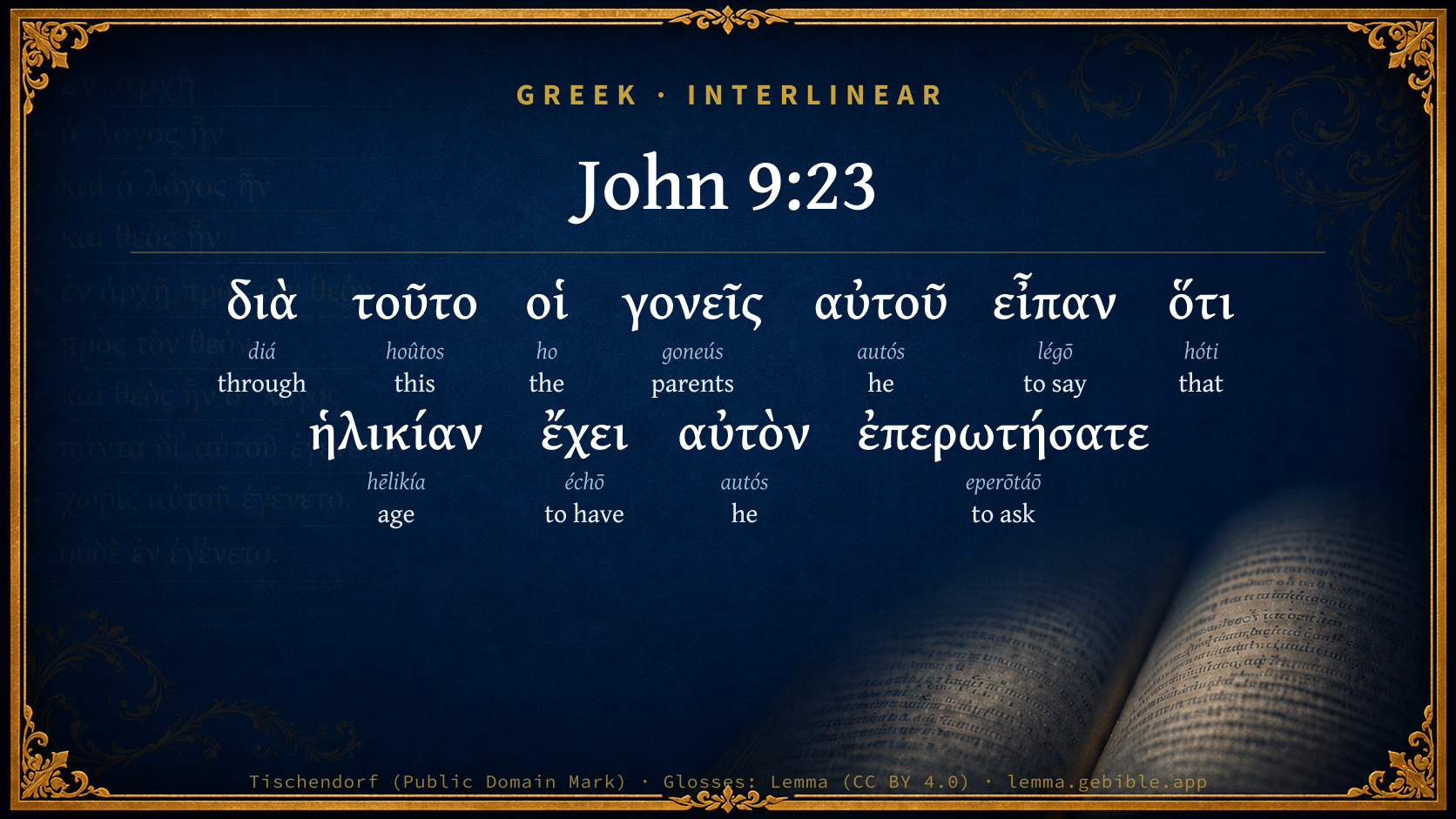
  1. διὰ diá G1223 “through” Preposition
  2. τοῦτο hoûtos G3778 “this” Demonstrative pronoun, Accusative, Singular, Neuter
  3. οἱ ho G3588 “the” Article, Nominative, Plural, Masculine
  4. γονεῖς goneús G1118 “parents” Noun, Nominative, Plural, Masculine
  5. αὐτοῦ autós G846 “he” Personal pronoun, Genitive, Singular, Masculine
  6. εἶπαν légō G3004 “to say” Verb, Aorist, Active, Indicative, 3rd person, Plural
  7. ὅτι hóti G3754 “that” Conjunction
  8. ἔχει échō G2192 “to have” Verb, Present, Active, Indicative, 3rd person, Singular
  9. αὐτὸν autós G846 “he” Personal pronoun, Accusative, Singular, Masculine
  10. ἐπερωτήσατε eperōtáō G1905 “to ask” Verb, Aorist, Active, Imperative, 2nd person, Plural

About this verse

These counts appear in no published source. They are computed here, from the morphology-tagged text and Lemma’s own curated glosses. What Lemma adds →

11
words
10
distinct lemmas
Gospels
section

Notable vocabulary

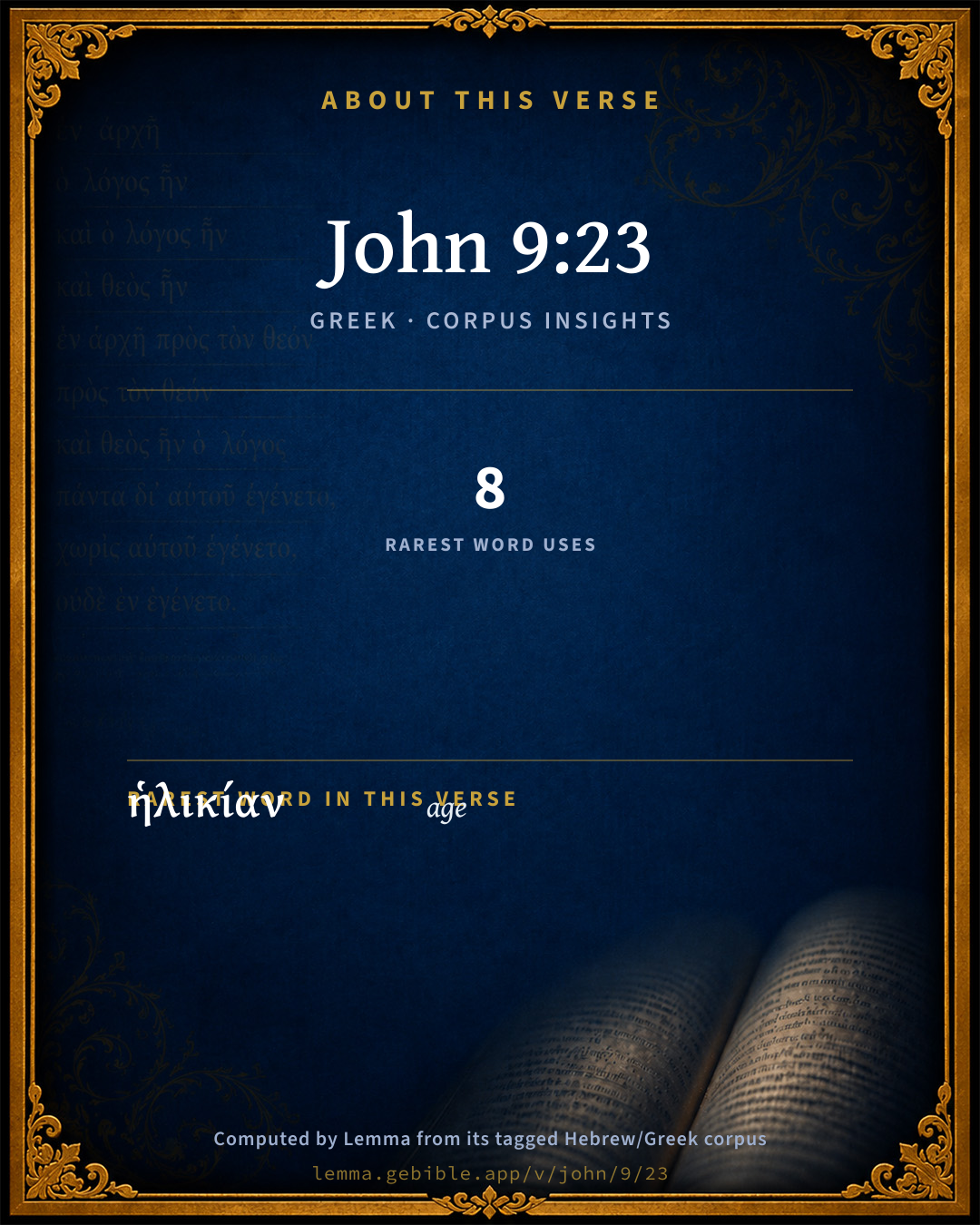
The rarest word here is ἡλικίαν age G2244 — appearing just 8 times in the whole Greek New Testament.

Shared distinctive vocabulary

ἡλικίαν age G2244 occurs in 8 verses of the Greek New Testament. Also found in:

Repetition

A word recurs within this verse:

  • αὐτοῦ he G846 ×2

Cross-references

1

Topical passages linked to John 9:23 in the Treasury of Scripture Knowledge — connected by theme and wording, ordered by reader-vote popularity; previews shown in the World English Bible.

  • John 9:21 but how he now sees, we don't know; or who opened his eyes, we don't know. He is of age. Ask him. He will speak for himself."

Cross-references courtesy of OpenBible.info (CC BY 4.0).

Commentary

Notes on John 9:23 from classic Christian and Jewish commentators (each source and its license shown beneath its notes). The classic Christian expositions comment on the surrounding passage and are grouped to its opening verse, so a note may address several verses; the Jewish commentaries on the Tanakh (Rashi and others) are per-verse, so they appear only where the commentator wrote on this verse.

Lemma curates 59 commentaries, every one of them public domain or Creative Commons licensed, each selected and text-cleaned for this edition rather than reprinted as found. About our sources →

Godbey's Commentary on the New Testament

William B. Godbey

ADROITNESS OF THIS MAN UNDER PROSECUTION

Joh 9:23-38. “Therefore his parents said, He is of age; ask him. Then they called the man the second time who was blind, and said to him, Give glory to God; we know that this Man is a sinner. Then he responded, If He is a sinner, I know not; one thing I know, that being blind, I now see. Then they said to him, What did He unto thee? How did He open thine eyes? He responded to them, I told you already, and you did not hearken; why do you wish again to hear? Whether do you wish to be His disciples? They railed on him, and said, Thou art His disciple, but we are the disciples of Moses. We know that God spoke to Moses; but we do not know this One whence He is. The man responded, and said to them, For in this it is astonishing that you do not know whence He is, when He opened mine eyes. We know that God heareth not sinners; but if any one may be a worshiper of God, and do His will, him He heareth.” This passage has very shrewdly, and even diabolically, been used by modern heretics in the pulpit, assuming the hypothesis theft a sinner has no right to pray, and should come prayerless, with all his sins, join the Church, and get remission in water baptism. I have heard them, over and over, use this Scripture to justify their foolish, wicked, fanatical dogma, which would deny the sinner access to God on his knees for pardon and salvation, and turn him over to the preacher and to water baptism. Certainly this is one of the most unapologizable heresies ever hatched in the bottomless pit, and, worst of all, they blame the Savior with it. The truth of it is, the penitent, praying sinner is a “worshiper of God,” and according to this very Scripture, God hears and saves him, independently of human instrumentality, or priestly absolution and Church rites. The meaning of the passage is that God will not hear a sinner if he undertake to work a miracle, but that He will hear him if he falls down with a broken heart, and impleads His pardoning mercy. “It was never heard of that any one opened the eyes of one who had been born blind. Unless he was with God , He would not be able to do anything. They responded, and said to him, Thou wast born altogether in sins, and dost thou teach us? And they cast him out;” i. e., they excommunicated him from the synagogue, turned him out of the Church. This poor, uneducated beggar, who had never seen the light of day, and of course enjoyed no educational opportunities, proved more than a match for the quirky, astute, and quizzical priests and theologians, who, like unprincipled, tricky lawyers, did their utmost to puzzle, complicate, and confuse this man, whom they regarded as a very ignoramus. In all their stratagems to entangle him, they signally failed. He had good, common sense, and the light of the Holy Spirit, and God helped him to triumph gloriously over the combination of his enemies. You have frequently seen a witness in court, so confused, befogged, and entangled by the chicanery of the attorneys as to become utterly bewildered and self-contradictory, thus invalidating his own testimony. A similar effort is made by these Pharisees, scribes, and high priests; but all in vain. The uncouth rustic sticks to the pith of the matter, and never flickers nor cowers. Consequently they do the only thing left in their power, and that is, arbitrarily and illegally turn him out of the Church. How wonderfully, in our day, does the history of the Bible times repeat itself!

“Jesus heard that they cast him out, and finding him, said, Dost thou believe on the Son of man?” This was a favorite cognomen with Jesus, conveying a deeper significance than many apprehend. Jesus is the only Son of man, because He is the only Son of unfallen humanity, having taken our nature, sin excepted; whereas Adam and Eve had no posterity till after they sinned, the posterity of fallen humanity having received the Satanic nature through the beguilement of the serpent, or the spiritual children of the devil. (Joh 8:44.) Therefore, Jesus is really and truly the Son of man, and the only one, all of Adam’s posterity having forfeited sonship ill the fall; our only possible hope of heaven consisting in the transference from Adam the First to Adam the Second, by the internal infusion of the Divine life in regeneration, and elimination of the Satanic virus in sanctification. “He responded and said, Who is He, Lord, that I may believe on Him? Jesus said to him, And you have seen Him, and the One speaking with you is He. And he said, I believe, Lord; and he worshipped Him.” Jerusalem, like other Oriental cities, swarms with beggars, and, of course, many of them are blind. As a rule, every beggar has his place, and in the case of this man it was pre-eminently so, because, being stone blind, it was not convenient for him to travel about. N.B. Jesus at this time had been in Jerusalem but a few weeks, having spent the entire period of His ministry in Northern Palestine, except two brief periods, when he attended the first and second Passover at Jerusalem. The presumption is, this man had never met Him before. The very fact of His stupendous miracle convinced him that He was a prophet, sent and empowered from heaven. Elijah and Elisha had wrought great miracles, even raising the dead, yet neither of them being the Christ. Consequently, while the opening of his eyes perfectly assured him of His Divine commission, it did not satisfy him as to His Messiahship; but feeling fully assured that He was a godly man in a very pre-eminent sense, when He declared to him His Christhood, he believed unhesitatingly, confirming his faith by falling down before Him and worshipping Him as God.

William B. Godbey, Commentary on the New Testament (1896–1900) — public domain. Text from a community e-Sword module.

Ellicott's Commentary for English Readers

(23) See Note on Joh_9:21.

A Bible Commentary for English Readers, edited by Charles John Ellicott (1878–1897) — public domain. Text from a community e-Sword module.

The Cambridge Bible for Schools and Colleges

gen. ed. J. J. S. Perowne

23. Therefore] Better, For this cause (Joh_12:18; Joh_12:27): comp. Joh_1:31, Joh_5:16; Joh_5:18, Joh_6:65, Joh_8:47.

He is of age; ask him] Or, He is of full age; ask him himself. This is the right order of the clauses here, and they have been altered in the Received Text of Joh_9:21 to match this verse.

The Cambridge Bible for Schools and Colleges (gen. ed. J. J. S. Perowne; Cambridge University Press, 1878–1918) — public domain. Text from a community e-Sword module.

John Gill's Exposition

Therefore said his parents, he is of age,.... See Gill on Joh 9:21.

.

John 9:24

joh 9:24

joh 9:24

joh 9:24Then again called they the man that was blind,.... That had been blind. After they had examined his parents, and could get nothing from them for their purpose, they try a second time what they could do with the son:

and said unto him, give God the praise; a phrase used when confession of sin was required; see Jos 7:19; and this may be the meaning of it here; confess this fraud and imposture before the omniscient God, the searcher of hearts, and in so doing glorify that perfection of his. One and the same word, signifies both to confess the truth of anything, as a sinful action, Pro 28:13, and to give thanks and praise to God for any mercy and blessing, Psa 45:17. Some take this to be the form of an oath, and that the Pharisees adjured the than by the living God, that he would tell the truth, and discover the cheat and collusion used in this affair of receiving his sight; and thought hereby to have deterred him from speaking of this benefit he had received from Christ, especially in such a manner as to reflect any honour upon the author of it. Or the sense may be, if this really is matter of fact, that thou wast born blind, and hast received thy sight by the means of this man, give all the glory of it to God, to whom alone it is due, and not to him. God sometimes works by wicked instruments, when the glory of what is done ought not to be ascribed to them, but to him.

We know that this man is a sinner; this they concluded from his breaking the sabbath, as they supposed; though they also aspersed his character, and accused him of other things, yet falsely; see Mat 11:19; nor could they prove one single instance of sin in him, though they express themselves here with so much assurance.

John Gill's Exposition of the Whole Bible (1746–1763) — public domain (CC PDM 1.0). Text via the HelloAO Bible API.

Trapp's Complete Commentary

John Trapp

23 Therefore said his parents, He is of age; ask him.

Ver. 23. He is of age] See Joh 9:21-22.

John Trapp, A Commentary or Exposition upon All the Books of the Old and New Testament (1647–1656) — public domain. Text from a community e-Sword module.

Matthew Poole's English Annotations

They were not able to obtain their design from the parents of this poor man; now they again call him, and advise him to give glory to God. Thus far they spake well, if they had been hearty and serious in what they said; for the man indeed had great reason to give God the glory, by whose power alone, exerted by his Son Christ Jesus, he had received his sight: but moral actions are made good or bad by their ends; and if we consider the end of these wretched men in this action of theirs, wherein they persuaded the poor man to his duty, the words will appear to have been spoken from hearts minding nothing less than the glory of God, and out of a design to vilify and depreciate his Son; whereas God hath set up his rest in his Son, and cannot be glorified but with, in, and through him; whom in the next words they maliciously defame, not only speaking of him contemptuously, calling him

this man, but affirm him αμαρτωλος, not

a sinner only, but a notorious, scandalous sinner, as that word imports.

Matthew Poole's English Annotations on the Holy Bible (1683–1685) — public domain. Text from a community e-Sword/MySword module.

The Pulpit Commentary

Therefore said his parents, He is of full age; ask him. They would not incur responsibility for the opinions of their son about his Healer. They knew perfectly well that it was the Jesus who was said to be the Christ of the nation, and they would not implicate themselves in giving any judgment on his claims.

The Pulpit Commentary (1880–1919), ed. H.D.M. Spence-Jones & Joseph S. Exell — public domain. Text from a community e-Sword module.

Cambridge Greek Testament for Schools and Colleges

23. διὰ τοῦτο. For this cause: Joh 1:31, Joh 5:16; Joh 5:18, Joh 6:65, Joh 8:47, &c.

ἡλικ. ἔχ. αὐ. ἐ. This is the right order here: in T.R. the clauses have been transposed in Joh 9:21 to match this verse.

Cambridge Greek Testament for Schools and Colleges (Cambridge University Press, 1896; 21 vols, various authors incl. Carr, Maclear, Plummer, Farrar, Lumby, Moule, M. R. James, Simcox) — public domain. Text from a community e-Sword module.

International Critical Commentary

23. διὰ τοῦτο, “wherefore,” referring (as generally in Greek) to what precedes; cf. 13:11, 15:19, 16:15, 19:11, 1Jn 4:5. For διὰ τοῦτο as referring to what follows, see on 5:16.

ὅτι Ἡλικίαν ἔχει, αὐτὸν ἐπερωτήσατε (so אBW). ὅτι is recitantis, purporting to introduce the actual words spoken. Note that the order of the words has been changed, for in v. 21 we have αὐτὸν ἐρωτήσατε, ἡλίκιαν ἔχει. Jn. is not punctilious in his narrative about reproducing the exact words or the order of words (see on 3:16).

International Critical Commentary — older volumes (1896–1929), various authors — public domain. Text from a community e-Sword module.

Lesson kit

Teaching starters — assembled from the data on this page, not authored interpretation. Every prompt links to the verse data it draws on. Edit before teaching.

John, in the Gospels, opens this verse with 11 words (10 distinct Greek lemmas). Its most distinctive word is hēlikía (“age”). A historical commentator’s framing appears above. Read the whole chapter for the surrounding context.

Discussion questions

  1. What does “age” (hēlikía) contribute to the verse as a whole?
  2. How does Matthew 6:27, which shares the word «age», read alongside this verse?
  3. What does the repetition of “he” (2× in this one verse) do in this verse?
  4. These translations render this verse differently; the difference is in the English rendering, not the original. What questions does that raise?
  5. Compare how Godbey's Commentary on the New Testament and Ellicott's Commentary for English Readers read this verse. Where do they agree or differ?

Things to notice

Reading settings

Reading text

Shown beneath each verse's original-language words.

Old Testament
Old Testament edition

Read the OT as the Masoretic Hebrew (MT) or the Greek Septuagint (LXX).

English shown for the Greek Septuagint (in the Hebrew ↔ Greek comparison).

Comparing translations? Open the Compare panel on any verse page to stack up to four side by side.