
John 15:13

Greek (Tischendorf 8th ed.) John 15:13 appears in the Greek New Testament. The text above is from the Tischendorf 8th edition. Each word links to its Strong’s number and a concise gloss. Click any word for its full Thayer’s Greek Lexicon entry.
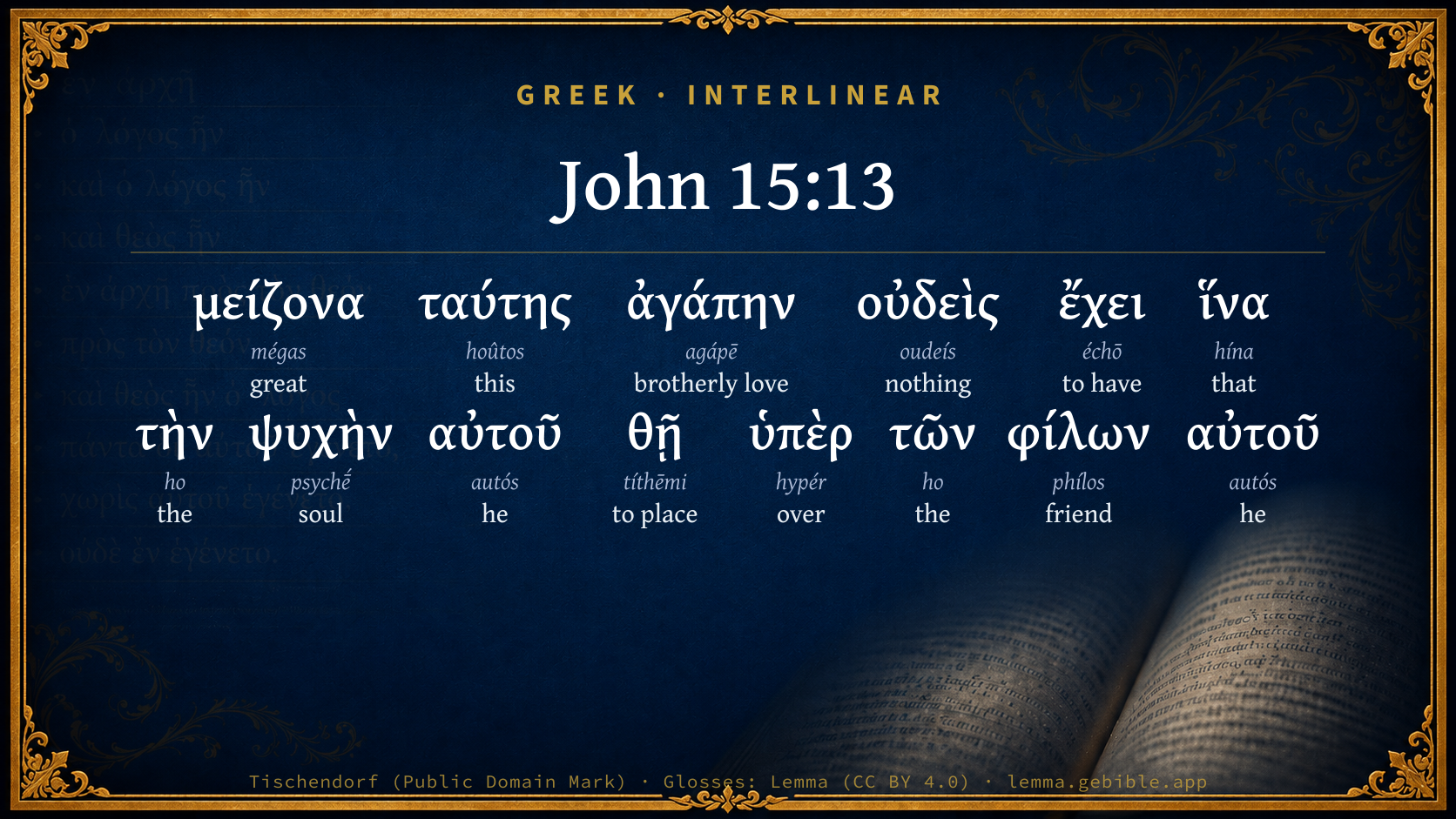
Download image
Cite this verse

John 15:13 (World English Bible). Public Domain. Lemma interlinear Bible study tool, https://lemma.gebible.app/v/john/15/13.

Show BibTeX & RIS
BibTeX
RIS
English Translation
Greater love has no one than this, that someone lay down his life for his friends.
World English Bible · Public Domain
Download a study sheet

One document with this verse’s original text, its word-by-word gloss line, the meaning frame, cross-references with their text, attributed commentary, and full source and license credits — printable, and it pastes into notes with its structure intact.

This verse Autodidact and up

Study sheet (.html) Plain text (.txt)

A passage Seminary Student

Up to 50 verses in one chapter. A passage sheet keeps up to 6 commentary sources and 12 cross-references per verse, in the order this page ranks them, and says so on the sheet whenever that leaves anything out. Ask for a single verse and you get the Autodidact verse sheet above.

Everything on this page stays free to read, with no account — the sheet is a download of what is already on screen, not access to it.

Want to remove ads? Support Godless Engineer
Compare translations 3

The same verse in 3 English versions, stacked beneath the original-language interlinear above. Click any original word for its lexicon entry.

Each is an independent rendering of the whole verse — the interlinear is not word-aligned to these translations.

Highlighted words mark where these versions differ — a whole-verse word diff, not a word-by-word alignment.

  • World English Bible Public Domain
    Greater love has no one than this, that someone lay down his life for his friends.
  • King James Version Public Domain
    Greater love hath no man than this, that a man lay down his life for his friends.
  • unfoldingWord Literal Text CC BY-SA 4.0
    No one has greater love than this—that he would lay down his life for his friends.

unfoldingWord Literal Text — © unfoldingWord, licensed CC BY-SA 4.0. Word-aligned USFM3 via Door43 (git.door43.org/unfoldingWord/en_ult).

Versions to compare (up to 4)

3 of 4 selected

Show all 19 translations

Every available English version of this verse, each an independent rendering of the whole verse.

  • World English Bible Public Domain
    Greater love has no one than this, that someone lay down his life for his friends.
  • Berean Standard Bible Public Domain
    Greater love has no one than this, that he lay down his life for his friends.
  • Majority Standard Bible Public Domain
    Greater love has no one than this, that he lay down his life for his friends.
  • King James Version Public Domain
    Greater love hath no man than this, that a man lay down his life for his friends.
  • American Standard Version (1901) Public Domain
    Greater love hath no man than this, that a man lay down his life for his friends.
  • Revised Version (1885) Public Domain
    Greater love hath no man than this, that a man lay down his life for his friends.
  • Geneva Bible (1599) Public Domain
    Greater loue then this hath no man, when any man bestoweth his life for his friendes.
  • Douay-Rheims (1899) Public Domain
    Greater love than this no man hath, that a man lay down his life for his friends.
  • Young's Literal Translation Public Domain
    greater love than this hath no one, that any one his life may lay down for his friends;
  • Literal Standard Version CC BY-SA 4.0
    greater love has no one than this, that anyone may lay down his life for his friends;
  • Unlocked Literal Bible CC BY-SA 4.0
    No one has greater love than this—that he lay down his life for his friends.
  • unfoldingWord Literal Text CC BY-SA 4.0
    No one has greater love than this—that he would lay down his life for his friends.
  • Darby Bible Public Domain
    No one has greater love than this, that one should lay down his life for his friends.
  • World Messianic Bible Public Domain
    Greater love has no one than this, that someone lay down his life for his friends.
  • Webster's Bible Public Domain
    Greater love hath no man than this, that a man lay down his life for his friends.
  • Free Bible Version CC BY-SA 4.0
    There is no greater love than to give your life for your friends.
  • Bible in Basic English Public Domain
    Greater love has no man than this, that a man gives up his life for his friends.
  • Text-Critical English NT CC BY 4.0
    No one has greater love than this, that he lay down his life for his friends.
  • Tyndale New Testament (1534) Public Domain
    Gretter love then this hath no man then that a man bestowe his lyfe for his frendes.

Literal Standard Version (2020), Covenant Press — licensed CC BY-SA 4.0. Text via the HelloAO Bible API (eBible.org). Unlocked Literal Bible (unfoldingWord) — licensed CC BY-SA 4.0. Text via the HelloAO Bible API (eBible.org). unfoldingWord Literal Text — © unfoldingWord, licensed CC BY-SA 4.0. Word-aligned USFM3 via Door43 (git.door43.org/unfoldingWord/en_ult). Free Bible Version, Dr. Jonathan Gallagher — licensed CC BY-SA 4.0. Text via the HelloAO Bible API (eBible.org).

Word by word

More ways to search: Search by grammar → Find every occurrence → Compare this word →

Practice this passage: Drill this verse → Learn its vocabulary →

φίλων
phílos
G5384
“friend”
Adjective, Genitive, Plural, Masculine
Part of Speech
Adjective
Case
Genitive
Number
Plural
Gender
Masculine
Full Thayer's Definition

Origin: a primitive word

TDNT: 11:26,1

1. friend, to be friendly to one, wish him well a. a friend b. an associate c. he who associates familiarly with one, a companion d. one of the bridegroom's friends who on his behalf asked the hand of the bride and rendered him various services in closing the marriage and celebrating the nuptials
  1. μείζονα mégas G3173 “great” Adjective, Accusative, Singular, Feminine, Comparative
  2. ταύτης hoûtos G3778 “this” Demonstrative pronoun, Genitive, Singular, Feminine
  3. ἀγάπην agápē G26 “brotherly love” Noun, Accusative, Singular, Feminine
  4. οὐδεὶς oudeís G3762 “nothing” Adjective, Nominative, Singular, Masculine, Negative
  5. ἔχει échō G2192 “to have” Verb, Present, Active, Indicative, 3rd person, Singular
  6. ἵνα hína G2443 “that” Conjunction
  7. τὴν ho G3588 “the” Article, Accusative, Singular, Feminine
  8. ψυχὴν psychḗ G5590 “soul” Noun, Accusative, Singular, Feminine
  9. αὐτοῦ autós G846 “he” Personal pronoun, Genitive, Singular, Masculine
  10. θῇ títhēmi G5087 “to place” Verb, Aorist, Active, Subjunctive, 3rd person, Singular
  11. ὑπὲρ hypér G5228 “over” Preposition
  12. τῶν ho G3588 “the” Article, Genitive, Plural, Masculine
  13. αὐτοῦ autós G846 “he” Personal pronoun, Genitive, Singular, Masculine

About this verse

These counts appear in no published source. They are computed here, from the morphology-tagged text and Lemma’s own curated glosses. What Lemma adds →

14
words
12
distinct lemmas
Gospels
section

Shared distinctive vocabulary

φίλων friend G5384 occurs in 27 verses of the Greek New Testament. Also found in:
Repetition

Words recur within this verse:

  • τὴν the G3588 ×2
  • αὐτοῦ he G846 ×2

Cross-references

5

Topical passages linked to John 15:13 in the Treasury of Scripture Knowledge — connected by theme and wording, ordered by reader-vote popularity; previews shown in the World English Bible.

  • John 10:11 I am the good shepherd. The good shepherd lays down his life for the sheep.
  • Ephesians 5:2 Walk in love, even as Christ also loved you, and gave himself up for us, an offering and a sacrifice to God for a sweet-smelling fragrance.
  • Romans 5:6–8 For while we were yet weak, at the right time Christ died for the ungodly.
  • John 10:15 even as the Father knows me, and I know the Father. I lay down my life for the sheep.
  • 1 John 4:7–11 Beloved, let us love one another, for love is of God; and everyone who loves is born of God, and knows God.

Cross-references courtesy of OpenBible.info (CC BY 4.0).

Commentary

Notes on John 15:13 from classic Christian and Jewish commentators (each source and its license shown beneath its notes). The classic Christian expositions comment on the surrounding passage and are grouped to its opening verse, so a note may address several verses; the Jewish commentaries on the Tanakh (Rashi and others) are per-verse, so they appear only where the commentator wrote on this verse.

Lemma curates 59 commentaries, every one of them public domain or Creative Commons licensed, each selected and text-cleaned for this edition rather than reprinted as found. About our sources →

The Biblical Illustrator

Joseph S. Exell

Joh_15:13

Greater love hath no man than this.

Let us consider the unparalleled greatness of Christs love.

I. IN THE OBJECTS OF HIS REGARD.

1. In the vastness of their number. He, indeed, knows their number, but it is beyond all human calculation. We admire local charity and extended philanthropy; but the widest range of human benevolence falls far short of the love of Christ, which flows through all nature, worlds, and generations. We are apt to limit the range of this love; but the love of the Redeemer could not be satisfied with a less number than that which no man could number.

2. In the depth of their degradation. If we could fathom the bottomless pit, we might tell the depth of human depravity and degradation. In such objects there was nothing attractive, but everything repulsive. Their moral pollution was contracted by acts of aggression against this Redeemer.

3. In their utter helplessness. No human power could have subdued their depravity. No human mercy could have removed their guilt. No human arm could have rescued them from their degradation.

II. IN THE MAGNITUDE OF HIS SACRIFICES.

1. That which He relinquished. Being in the form of God He made Himself of no reputation. He threw aside His original glory. Human conception is inadequate to the greatness of this sacrifice.

2. What He assumed. He condescended to be made one of us. If a man, having the power, were to assume the nature and form of a beast to deliver the brute creation from the groaning to which they are subject by reason of mans sin, that would be an admirable sacrifice; but there would be no parallel between it and the love of Christ in this respect.

3. That which He sustained. Our sorrows, infirmities, sins.

III. IN THE ACTIVITY OF HIS SOLICITUDES. He was not idle--He went about doing good. Mark

1. The intensity of His designs. He sought the salvation of strangers, aliens, enemies.

2. In the fervour of His zeal. In a thousand instances the spark of our desire is never fanned into the flame of zeal. It was not so with the Redeemer.

3. In the constancy of His exertions. He shrunk not back in the day of battle. Once, and once only, for a moment, His nature seemed to shrink from the violence of the storm, when He said, Father, if it be possible, let this cup pass from Me! But when His time was come, impelled by love, He steadfastly set Himself to go to Jerusalem; nay, He was straitened till His work was accomplished.

IV. IN THE DEPTH OF HIS HUMILIATION.

1. He stooped to the lowest grade of human society.

2. To be charged with the lowest crimes of human delinquency, thus bearing the reproach of His people.

3. To endure the vilest and most painful death that ever was inflicted on the lowest criminal. But though He died, He lives again: His love was stronger than death. He lives to execise it still; and we see its unparalleled greatness.

V. IN THE AMPLITUDE OF ITS BESTOWMENTS.

1. Upon the guilty unlimited pardon.

2. Upon the necessitous unlimited supplies.

3. Upon the redeemed unlimited glory.

VI. IN THE RICHES OF ITS ANTICIPATIONS. We anticipate

1. The absolute perfection of our intellectual and moral nature.

2. The uninterrupted enjoyment of the Redeemers presence.

3. The everlasting beatitudes of God himself.

Improvement:

1. What a ground of encouragement to the true penitent!

2. What a stimulus to the accepted believer!

3. What an aggravation of guilt is incurred by those who obstinately persist in sin! (J. Hunt.)

Loves crowning deed

I. LOVES CROWNING DEED. There is a climax to everything, and the climax of love is to die for the beloved one. This is the ultima rule of love; its sails can find no further shore.

1. This is clear if we consider, that when a man dies for his friends, it proves

(1) His deep sincerity. Lip love is a thing to be questioned; too often is it a counterfeit. All are not hunters that blow the horn, all are not friends who cry up friendship; all is not gold that glitters, so it is not all love that feigneth affection. But we are sure he loves who dies for love.

(2) The intensity of his affection. A man may make us feel that he is intensely in earnest when he speaks with burning words, and he may perform many actions which may all appear to show how intense he is, and yet for all that he may but be a skilful player, but when a man dies for the cause he has espoused, you know that he is no superficial passion.

(3) The thorough self-abnegation of the heart. If I profess to love a certain person, and yet in no way deny myself for his sake, such love is contemptible. After all, the value of a thing in the market is what a man will give for it, and you must estimate the value of a mans love by that which he is willing to give up for it. Greater love for friends hath no man than this, that he lay down his life for them. Hereby perceive we the love of God, because He laid down His life for us.

2. Death for its object is the crowning deed of love because

(1) It excels all other deeds. Jesus Christ had proved His love by dwelling among His people as their Brother, by participating in their poverty as their friend, by telling them all He knew of the Father, by the patience with which He bore with their faults, by the miracles He wrought on their behalf, and the honour which He put upon them by using them in His service; but none of these can for a moment endure comparison with His dying for them. These life actions of His love are bright as stars, but yet they are only stars compared with this sun of infinite love.

(2) It comprehends all other acts, for when a man lays down his life for his friend he has laid down everything else. Give up life, and you have given up wealth, position, enjoyment. Hence the force of that reasoning, He that spared not His own Son, etc.

(3) After a man has died for another, there can be no question raised about his love. Unbelief would be insane if it should venture to intrude itself at the cross foot, though, alas! it has been there, and has there proved its utter unreasonableness. Shame on any of Gods children that they should ever raise questions on a matter so conclusively proven!

II. THE SEVEN CROWNS OF JESUS DYING LOW. Mens dying for their friends--this is superlative--but Christs dying for us is as much above mans superlative as that could be above mere commonplace.

1. Jesus was immortal, hence the special character of His death. Damon is willing to die for Pythias; But suppose Damon dies, he is only antedating what must occur, for they must both die eventually. A substitutionary death for loves sake in ordinary cases would be but a slightly premature payment of that debt of nature which must be paid by all. Jesus needed not die at all. Up there in the glory was the Christ of God forever with the Father everlasting. He came to earth and assumed our nature that He might be capable of death, yet His body need not have died; as it was it never saw corruption, because there was not in it the element of sin which necessitated death and decay. No man taketh My life from Me, but I lay it down of Myself, etc.

2. In the cases of persons who have yielded up their lives for others they may have entertained the prospect that the supreme penalty would not have been exacted. Damon stood before Dionysius, willing to be slain instead of Pythias; but the tyrant was so struck with the devotion of the two friends that he did not put either of them to death. A pious miner was in the pit with an ungodly man at work. They were about to blast a piece of rock, and it was necessary that they should both leave the mine before the powder exploded; they both got into the bucket, but the hand above was not strong enough to draw the two together, and the pious miner, leaping from the bucket, said to his friend, You are an unconverted man, and if you die your soul will be lost. Get up in the bucket as quickly as you can; as for me, if I die I am saved. This lover of his neighbours soul was soared, for he was found in perfect safety arched over by the fragments which had been blown from the rock. But, such a thing could not occur in the case of our Redeemer. Die He or His people must, there was no other alternative.

3. He could have had no motive in that death but one of pure, unmingled love. You remember when the Russian nobleman was crossing the steppes in the snow, the wolves followed the sledge. The horses needed not the lash, for they fled for their lives from their howling pursuers. Whatever could stay the eager wolves for a time was thrown to them in vain. A horse was loosed: they pursued it, rent it to pieces, and still followed, like grim death. At last a devoted servant, who had long lived with his masters family, said, There remains but one hope for you; I will throw myself to the wolves, and then you will have time to escape. There was great love in this, but doubtless it was mingled with a habit of obedience, a sense of reverence, and emotions of gratitude for many obligations. If I had seen the nobleman surrender himself to the wolves to save his servant, and if that servant had in former days sought his life, I could see some parallel, but as the case stands there is a wide distinction.

4. In our Saviours case it was not precisely, though it was, in a sense, death for His friends. Though He called us friends, the friendship was all on His side at the first. Our hearts called Him enemy, for we were opposed to Him. God commendeth His love to us in that while we were yet sinners in due time Christ died for the ungodly.

5. We had ourselves been the cause of the difficulty which required a death. There were two brothers on board a raft once, upon which they had escaped from a foundering ship. There was not enough of food, and it was proposed to reduce the number, that some at least might be able to live. They cast lots for life and death. One of the brothers was drawn, and was doomed to be thrown into the sea. His brother interposed and said, You have a wife and children at home; I am single, and therefore can be better spared, I will die instead of you. Nay, said the brother, not so, and they struggled in mutual arguments of love, till at last the substitute was thrown into the sea. Now, there was no ground of difference between those two brothers whatever. But in our case there would never have been a need for anyone to die if we had not been the wilful offenders; and the offended one, whose injured honour required the death, was the Christ that died.

6. There have been men who died for others, but they have never borne the sins of others; they were willing to take the punishment, but not the guilt. Those cases which I have already mentioned did not involve character. But here, ere Christ must die, it must be written--He made Him to be sin for us who knew no sin, etc.

7. The death of Christ was a proof of love superlative, because in His case He was denied all the helps and alleviations which in other cases make death to be less than death. I marvel not that a saint can die joyously; for he sees his heavenly Father gazing down upon him, and glory waiting him. But ah, to die upon a cross without a pitying eye, surrounded by a scoffing multitude, and to die with this as your requiem, My God, My God, why hast Thou forsaken Me!

III. MANY ROYAL THINGS OUGHT TO BE SUGGESTED TO US BY THIS ROYAL LOVE. How this thought of Christs proving His love by His death

1. Ennobles self-denial.

2. Prompts us to heroism. When you get to the cross you have left the realm of little men: you have reached the nursery of true chivalry. Does Christ die?--then we feel we could die too. But mark how the heroic in this case is sweetly tinctured and flavoured with gentleness. The chivalry of the olden times was cruel. We want that blessed chivalry of love in which a man feels, I would suffer any insult from that man if I could do him good for Christs sake.

3. There seems to come from the cross, a gentle voice that saith, Guilty sinner, I did all this for thee, what hast thou done for Me? and yet another which saith, Look unto Me and be ye saved, all ye ends of the earth. (C. H.Spurgeon.)

Self-sacrificing love

A little child six years old, went out one autumn afternoon to play with a companion younger than himself, Johnnie Carr, the little hero whose name deserves to be written in gold, rambled about with his smaller playmate till the houses were left behind, and they were in the country. Presently they found that they had lost their way, and the night was coming on, cold and stormy. The younger child, chill and hungry, began to cry, and his brave companion cheered him on, now carrying him for a few steps, now anxiously searching for the way home. At last the night fell dark and cold, the children were lost, and lay down for shelter in a field. But the ground was wet and chilly, and the younger cried for home and his mother. Then Johnnie Carr, who was only six years old, remember, could not bear to see his playmate crying with the cold, and he stripped off his own jacket and made a bed for his companion, and placed the rest of his clothes to cover the child. Then, with only his shirt and socks, the little hero lay down beside him. Their childish prayers were said, and Johnnie Carr knew not that in his sublime act of self-sacrifice he had taken part in the mightier sacrifice of Jesus. When the morning came, the anxious friends, who had been searching through the night, found the children lying. The younger was soon restored to health and strength, but no care could save the life of the child-hero who had given himself for his friend. (H. J. W. Buxton)

.

The death of Christ our only stay

If the thought of sin, death, and judgment be so terrible, as in truth they are to every soul of man, on what shall we stay ourselves when our time is at hand?

I. UPON THE LOVE OF GOD, IN GIVING HIS SON TO DIE FOR US (John 1Jn_4:10; Rom_5:8). Whatever be doubtful, this is sure. Light does not pour forth from the sun, with a fuller and directer ray than does perfect and eternal love overflow from the bosom of God upon all the works that He has made. The love of God is the sphere in which the world is sustained, every living soul is encompassed by that love, as stars by the firmament of heaven. And from this blessed truth flows all manner of consolation. Not only does God hate sin, but He hates death; not only does He abhor evil, but the peril and perdition of so much as one living soul--of one, even the least of all things He has made. The Lord hath sworn by Himself, saying (Eze_18:32). What do we further need to assure us that He desires our salvation? Does a child bind his father by promises to give him bread, or a mother to foster him in sickness? Surely the character of God is enough. God is love. What more do we ask! What more would we receive? He cannot deny Himself. And therefore when He was willing more abundantly to show unto the heirs of promise the immutability of His counsel, He confirmed it by an oath. But for us God has done still more: He has, beside His promise, found a pledge to give us. He has given us His only begotten Son. He most abhors; and He gave Him to be ours in so full a right, that we might offer Him as our own in sacrifice for our sins.

II. THE LOVE OF THE SON IS GIVING HIMSELF FOR US. When we remember who He is that gave Himself, and for whom, and to die what death, we cannot find capacity of heart to receive it. If He had saved us by a new exertion of His creative will, it would have been a miracle of lovingkindness. If He had spoken once more the first words of power, and creating us again in light, it would have been a mystery of sovereign grace. If He had redeemed us by the lowliness of the Incarnation, still revealing Himself in majesty, though as a man, and lightening the earth with His glory, as Saviour, God, and King, it would have seemed to us a perfect exhibition of the Divine compassion to a sinful world. How much more when He came to suffer shame and sorrow, all that flesh and blood can endure, to sink, as it were, into the lowest depths of creation, that He might uplift it from its farthest fall? If He so loved us as to die for us, what will He not grant or do? If He gave His whole self, will He keep back any partial gift? Will He not save us, who Himself died for us? If He loved us when we loved Him not, will He not love us now that we desire to love Him again?

III. Christs death upon the cross is not only a revelation of Divine love to us; it is also a DIVINE ATONEMENT FOR OUR SIN. How it is so, we may not eagerly search to know. That by death He has destroyed Him that had the power of death, and taken away the sin of the world, is enough. In that death were united the oblation of a Divine person and the sanctity of a sinless man; the perfection of a holy will and the fulfilment of a spotless life; the willing sacrifice of the sinless for the sinful, of the shepherd for the sheep that was lost, of life for the dead. How this wrought atonement for the sin of the world we cannot say further than is revealed. God made Him to be sin for us. He bore our sins in His own body on the tree. By His stripes we are healed. He hath tasted death for every man. There is now no condemnation to them that are in Christ Jesus. (Archdeacon Manning.)

Demonstration of friendship, Divine and human

I. CHRIST DEMONSTRATES HIS LOVE TO MAN BY DYING. Here He states

1. The utmost limit of human love. Nothing is felt by man to be more precious than his life. Everything he has he will sacrifice for this. A love that will lead to the sacrifice of this is love in its highest human measure.

2. Christs love transcended this limit, He laid down His life for His enemies. There is nothing in history approaching this. This transcendent love is

(1) The love of compassion. There could be neither gratitude nor esteem in it, for the subjects are all wicked.

(2) The love of disinterestedness. He had nothing to gain by it; for His glory and happiness admitted of no entrancement.

II. MAN DEMONSTRATES HIS LOVE BY OBEYING. Surely all men ought to love Christ, and when they do they will obey. This obedience will be marked by

1. Heartiness.

2. Cheerfulness. When this love is obedience to Christ is the highest gratification of the soul. When the heart is enlarged it runs in the way of Christs commandments.

3. Entireness. Love does not sort duties, or weigh or measure them. Whatever the object wishes shall be done, even unto death. Conclusion: The subject

(1) Supplies the test of Christian piety. Christian piety is not ritualism, however becoming; not a theology, however Scriptural; it is obedient love to Christ.

2. Indicates the true method of preaching--to so exhibit Christs love as to awaken the love of human souls. (Swain.)

A friends love

During the Civil war in America, a farmer was drawn to be a soldier. He was much grieved about it, not because he was a coward, but on account of his motherless family, who would have no breadwinner or caretaker in his absence. The day before he had to march to the town where the conscripts names were called over, and their clothing and weapons given them for the campaign, young Mr. Durham, a neighbour, came, saying, Farmer Blake, I will go instead of you. The farmer was astonished so much so as to be unable to reply for some time. He stood leaning one hand on his spade and wiping the sweat from his brow with the other. It seemed too good to be true! At length he took in the deliverance, as if it were an angel of light in a dark dungeon, and he grasped the hand of young Durham and praised God. The young fellow went, feeling that he was doing a noble thing, and all the village came out and bid him God speed. It may be that he had glory before him--the sash of a general, the chair of the President. Whatever his ideas, he nobly took the place of his fellow man; but alas! in the first battle he was shot and killed! When the farmer saw in the newspaper the name of Charles Durham in the list of missing, he at once saddled his old horse and went off to the battlefield, and after searching for some time, found the body of his friend. He brought it to his village, to the little churchyard in which they had so often walked together to the house of God; and from the quarry up on the hill he cut out a plain marble tablet, on which he carved an inscription with his own hand. It was roughly done, but with every blow there fell a tear from his eyes. There, in the little churchyard, he placed the body of his devoted friend and substitute, and covered the grave with grass sods from his garden. Then, while his tears dropped, he put the marble tablet on the grave, and when the villagers stooped to see the little monument they also wept. It did not say much, but it really touched them; it said, C.D. He died for me. (New Testament Anecdotes.)

The Biblical Illustrator, edited by Joseph S. Exell (c. 1880s–1900s) — public domain. Text from a community e-Sword module.

Joseph Benson's Commentary

Joh 15:13-16. Greater love — To his friends, (of whom here he only speaks,) hath no man than this — That is, a greater degree of love than this never existed in the world; that a man lay down his life for his friends — That a man should be willing, not only on some sudden alarm, or in some extraordinary and unexpected danger, to hazard his life on their account; but on the coolest deliberation, to submit to lay it down for their preservation and happiness. Ye are my friends — Ye are the friends for whom I will lay down my life, and who shall certainly share in the blessings which I shall thereby procure for my disciples; if ye do whatsoever I command you — If you practically acknowledge my authority, and are so influenced by my love, as to make conscience of obeying all my commands. On this condition, and not otherwise, shall we be acknowledged by Christ as his friends. Who then dares assert that God’s love does not at all depend on man’s obedience? Henceforth I call you not servants — Though the distance that is between you and me, and your obligations to obey me, might have warranted me to treat you as servants, and particularly to conceal from you my counsels and designs, I have not acted toward you in that manner; but I have called you friends — I have treated you as friends are wont to be treated; for all things that I have heard of my Father I have made known unto you — I have all along communicated to you the most important of those gracious counsels which my Father, as the expression of his friendship, imparted unto me; nay, I have commissioned you to reveal them to the world, and have made you not only my friends, but my assistants, in the great work of saving the world. Ye have not chosen me — You have not, as principals in this affair, adopted me your associate, but I, the great author of the gospel, have adopted you my associates; and ordained — Greek, και εθηκα, appointed you; that ye should go and bring forth fruit — That ye may go and convert sinners; and that your fruit should remain — Even to the remotest generations; that whatsoever ye shall ask, &c. — The consequence of your going and bearing fruit will be that all your prayers will be heard and answered.

Joseph Benson's Commentary on the Old and New Testaments (1811–1818) — public domain. Text from a community e-Sword module.

Bengel's Gnomon

Johann Albrecht Bengel

Joh 15:13. Ἀγαπὴν, love) towards friends. He does not in this place speak of His love to enemies.—ἵνα, that) This again depends on ταύτης, this.

Bengel's Gnomon of the New Testament — English translation (T&T Clark, Edinburgh, 1860) — public domain. Text from a community e-Sword module.

Expositor's Greek Testament

ed. W. Robertson Nicoll

Joh 15:13 . And that they might not underrate the measure of this exemplary love, He says, μείζονα ταύτης ἀγάπην … αὐτοῦ . Ταύτης is explained by ἵνα … αὐτοῦ as in Joh 15:8 ; and does not directly mean “than this which I have shown and still show,” as understood by Westcott and Whitelaw. It is a general statement, the application of which is suggested in Joh 15:14 . Self-sacrifice is the high water mark of love. Friends can demand nothing more: there is no more that love can do to exhibit devotedness to friends, cf. Rom 5:6 ; Rom 5:8 ; Rom 5:10 .

The Expositor's Greek Testament, edited by W. Robertson Nicoll (1897–1910) — public domain. Text from a community e-Sword module.

Jamieson, Fausset & Brown

Robert Jamieson, A. R. Fausset & David Brown

Greater love hath no man than this, that a man lay down his life for his friends--The emphasis lies not on "friends," but on "laying down his life" for them; that is, "One can show no greater regard for those dear to him than to give his life for them, and this is the love ye shall find in Me."

Jamieson, Fausset & Brown — Commentary Critical and Explanatory on the Whole Bible (1871) — public domain (CC PDM 1.0). Text via the HelloAO Bible API.

Adam Clarke's Commentary

Verse 13. That a man lay down his life for his friends.] No man can carry his love for his friend farther than this: for, when he gives up his life, he gives up all that he has. This proof of my love for you I shall give in a few hours; and the doctrine which I recommend to you I am just going to exemplify myself. There are several remarkable cases, in heathen antiquity, where one friend offered his life for another. The two following will not stand dishonourably even in the book of God; became every thing loving and pure, in heathen, Jew, or Christian, must come from the God of love and purity.

When Cyrus had made war on the king of Armenia, and had taken him, his wife, and children, with Tigranes his son, and his wife, prisoners; treating with the old king concerning his ransom, he said, How much money wilt thou give me to have thy wife again? All that I have, replied the king. And how much wilt thou advance to enjoy thy children again? All that I can produce, answered the king. By reckoning thus, said Cyrus, you prize these at twice as much as you possess. Then, turning to Tigranes, he said, How much wilt thou give as a ransom, that thou mayest have thy wife? (Now Tigranes had been but lately married, και ὑπερφιλων την γυναικα, and loved his wife exceedingly.) He answered, I will indeed, O Cyrus, και της ψυχης πριαιμην, ransom her even with MY LIFE, that she may be no longer in thraldom. See XENOPH. Cyrop. lib. iii. c. 2.

The second example, which is too long to be inserted, is that affecting account of the friendship of Nisus and Euryalus, given by Virgil, in the ninth book of the AEneis. These two friends, leagued together, had slain many of the Rutulians in a night attack: at last Euryalus was taken prisoner. Nisus, concealed in a thicket, slew several of the enemy's chiefs with his javelins: Volscens, their general, not seeing the hand by which his officers were slain, determines to wreak his vengeance upon his prisoner. Nisus, seeing his friend about to be transfixed with the sword, rushing out of the wood where he lay hidden, suddenly cries: -

ME! ME! adsum qui FECI! in ME convertite ferrum,

O Rutuli! MEA fraus omnis:-nihil ISTE-nec ausus,

Nec potuit-Caelum hoc, et conscia sidera testor!

TANTUM infelicem NIMIUM DILEXIT AMICUM.

AEN. lib. ix. l. 427, c.

"ME! ME! he cried, turn all your swords alone

On ME!-the fact confess'd, the fault my own.

HE neither could, nor durst, the guiltless youth

Ye moon and stars, bear witness to the truth!

His only crime (if friendship can offend)

Is too much love to his unhappy friend."

DRYDEN.

Those who understand the beautiful original will at once perceive that the earnestness, confusion, disorder, impatience, and burning love of the FRIEND, are poorly imitated in the above tame translation.

The friendship of David and Jonathan is well known: the latter cheerfully gave up his crown to his friend, though himself was every way worthy to wear it. But when all these instances of rare friendship and affection are seen, read, and admired, let the affected reader turn his astonished eyes to Jesus, pouring out his blood, not for his friends, but for his ENEMIES; and, in the agonies of death, making supplication for his murderers, with, Father, forgive them, for they know not what they do!-and then let him help exclaiming, if he can,

"O Lamb of God, was ever pain,

Was ever LOVE like THINE!"

Adam Clarke's Commentary on the Bible (1810–1826) — public domain. Text from a community e-Sword/MySword module.

John Calvin's Commentaries

13. Greater love hath no one than this. Christ sometimes proclaims the greatness of his love to us, that he may more fully confirm our confidence in our salvation; but now he proceeds further, in order to inflame us, by his example, to love the brethren. Yet he joins both together; for he means that we should taste by faith how inestimably delightful his goodness is, and next he allures us, in this way, to cultivate brotherly love. Thus Paul writes:

Walk in love, as Christ also hath loved us, and hath given himself for us an offering and sacrifice to God of a sweet-smelling savor, (Ephesians 5:2.)

God might have redeemed us by a single word, or by a mere act of his will, if he had not thought it better to do otherwise for our own benefit, that, by not sparing his own well-beloved Son, he might testify in his person how much he cares for our salvation. But now our hearts, if they are not softened by the inestimable sweetness of Divine love, must be harder than stone or iron.

But a question is put. How did Christ die for friends, since

we were enemies, before he reconciled us, (Romans 5:10;)

for, by expiating our sins through the sacrifice of his death, he destroyed the enmity that was between God and us? The answer to this question will be found under the third chapter, where we said that, in reference to us, there is a state of variance between us and God, till our sins are blotted out by the death of Christ; but that the cause of this grace, which has been manifested in Christ, was the In this way, too, Christ laid down his life for those who were strangers, but whom, even while they were strangers, he loved, otherwise he would not have died for them.

John Calvin's Commentaries (1540-1563) — public domain. Text from the Calvin Translation Society English edition (1840s-50s) via the Christian Classics Ethereal Library (ccel.org). Calvin's coverage is partial (roughly two-thirds of the Bible); uncommented books and verses are honest gaps, never fabricated. The 19th-century editor's footnotes and remarks are omitted so the notes are faithfully Calvin's own voice.

Ellicott's Commentary for English Readers

(13) Greater love hath no man than this.—Better, . . . hath no one than this. (Comp. Note on Joh_10:18; Joh_10:29.) Nothing greater is conceivable in the thought of love. He has spoken of His own love for them as the measure of their love for each other. The thought of this verse dwells upon what His love really was and what theirs should also be. (Comp. especially Note on 1Jn_3:16.)

That a man lay down his life for his friends.—Better, that any one . . . For the phrase “lay down his life,” comp. Joh_10:11. The term “friends” is here used because those whom He is addressing were His friends. There is no opposition between this passage and Rom_5:6 et seq. The point dwelt upon is the greatness of the love, and the highest reach of love is the self-sacrifice which spares not life itself.

A Bible Commentary for English Readers, edited by Charles John Ellicott (1878–1897) — public domain. Text from a community e-Sword module.

The Cambridge Bible for Schools and Colleges

gen. ed. J. J. S. Perowne

13. that a man lay down] Literally, in order that a man lay down: the greatest love is that of which the purpose is dying for those loved. On ‘lay down his life’ see note on Joh_10:11.

for his friends] Needless difficulty has been made about this, as if it were at variance with Rom_5:6-8. Christ here says that the greatest love that any one can shew towards his friends is to die for them. S. Paul says that such cases of self-sacrifice for good men occur; but they are very rare. Christ, however, surpassed them, for He died not only for His friends but for His enemies, not only for the good but for sinners. There is no contradiction. Nor is there any emphasis on ‘friends;’ as if to suffer for friends were higher than to suffer for strangers or enemies. The order of the Greek words throws the emphasis on ‘life:’ it is the unique character of the thing sacrificed that proves the love. Christ says ‘for His friends’ because He is addressing His friends.

The Cambridge Bible for Schools and Colleges (gen. ed. J. J. S. Perowne; Cambridge University Press, 1878–1918) — public domain. Text from a community e-Sword module.

John Gill's Exposition

Ye are my friends,.... This is an application of the foregoing passage, and more, clearly explains it. The character of "friends", is applied to the disciples of Christ; and belongs, not only to his apostles, but to all that love him, believe in him, and obey him; to whom he has showed himself friendly, by laying down his life for them: for this clearly shows, that Christ had respect in the former words, to his own laying down his life for his people, in consequence of his great love to them; whereby he has made them friends, and who appear to be so by their cheerful obedience to him:

if ye do whatsoever I command you; not that their doing of the commandments of Christ interested them in his favour; or made them his friends; or was the reason and motive of his laying down his life for them, and showing himself in such a friendly manner to them: but the sense is, that by observing his commands from a principle of love, they would make it appear that they were his friends, being influenced by his grace, and constrained by a sense of his love in dying for them, to act such a part.

John Gill's Exposition of the Whole Bible (1746–1763) — public domain (CC PDM 1.0). Text via the HelloAO Bible API.

Trapp's Complete Commentary

John Trapp

13 Greater love hath no man than this, that a man lay down his life for his friends.

Ver. 13. Greater love than this, &c.] Of any such love, but in Christ, we shall hardly read. David in a passion may wish, "Would God I had died for thee;" but in cold blood I doubt whether he would have done it. A certain citizen of Toledo, being condemned to die, his son ceased not by prayers and tears to entreat that he might die. for his father; which accordingly he did. (B. Fulg. i.) But this is rare, for life is sweet, and love is cold in this case. Every man is his own next neighbour.

John Trapp, A Commentary or Exposition upon All the Books of the Old and New Testament (1647–1656) — public domain. Text from a community e-Sword module.

Albert Barnes' Notes on the Bible

Greater love hath ... - No higher expression of love could be given. Life is the most valuable object we possess; and when a man is willing to lay that down for his friends or his country, it shows the utmost extent of love. Even this love for friends has been rarely witnessed. A very few cases like that of Damon and Pythias have occurred where a man was willing to save the life of his friend by giving his own. It greatly enhances the love of Christ, that while the instances of those who have been willing to die for friends have been so rare, he was willing to die for enemies - bitter foes, who rejected his reign, persecuted him, reviled him, scorned him, and sought his life, 1Jo 4:10; Rom 5:6, Rom 5:10. It also shows us the extent of his love that he gave himself up, not to common sufferings, but to the most bitter, painful, and protracted sorrows, not for himself, not for friends, but for a thoughtless and unbelieving world. “O Lamb of God, was ever pain was ever love like thine!”

Albert Barnes' Notes on the Bible (1834–1885) — public domain. Text from a community e-Sword/MySword module.

Matthew Poole's English Annotations

The reason of this is because life is the greatest earthly good to men under ordinary circumstances: Skin for skin, yea, all that a man hath will he give for his life, Job 2:4. Now it is impossible that a man should show a greater love to another, than by parting with the greatest good he is in possession of for his sake. Hence our Saviour proves, that he loved them with the greatest love, because he for their sake was about to part with what in the common judgment of men is the greatest good. The greatness of the love of Christ to us is from hence often commended to us in Scripture; and our mutual love to our brethren is pressed upon this argument, Eph 5:2; 1Jo 3:16. But how did Christ lay down his life for his friends, when the Scripture tells us, that the just died for the unjust, 1Pe 3:18, and that while we were enemies, we were reconciled unto God by the death of his Son, Rom 5:10?

Answer. Friends must not here be taken as a name of relation, but only as it signifieth the objects of love; persons we have set our love upon, whether they mutually love us or not; as the world was the object of that love in God, which moved him to send his only begotten Son, Joh 3:16. Though they for whom Christ died were enemies by their wicked works, yet by his death they were reconciled. But possibly the first answer is best; for by Christ’s death they were only meritoriously reconciled, and after this enemies to God, till they received the word of reconciliation, and believed in Christ.

Matthew Poole's English Annotations on the Holy Bible (1683–1685) — public domain. Text from a community e-Sword/MySword module.

Whedon's Commentary on the Bible

Daniel D. Whedon

13. For his friends—By laying down his life for them he demonstrated a love which no love could surpass. Others might faintly follow the example, but it is impossible that any should outdo it.

Friends—So called, as being loved by him, although they were originally, and before he died for them, enemies. So the apostle (Rom_5:9-10) is not contradicted. By so dying for them he raised them to the rank of friends. And in the case of all those who accept his atonement, he renders them, who formerly were not so, in reality his friends.

Daniel D. Whedon (gen. ed.), Commentary on the Old and New Testaments (1874–1909) — public domain. Text from a community e-Sword module.

The Pulpit Commentary

Greater love than this (love) no one hath, namely (ina), that one should lay down his life for his friends. Meyer and Lange endeavor to maintain even here the telic force of ina , "The love to you is of so consummate a character, that its object and purpose is seen in my laying down my life for my friends;" and Hengstenberg thinks so because probably a reference here is made to Isa_53:10, that our Lord was pointing to his atoning death to a death needed alike by enemies and friends. Such an interpretation supposes the lofty purpose of the greatest love. To me, however, it seems more probable that the translation given above places the argument upon a surer; because more common, human, experience. The disposition to die for ungodly and for enemies is exalted by St. Paul (Rom_5:8) above the self-sacrifice involved in dying for the good. Still, which may be shown, and has often been shown in self-sacrificing death for those who are beloved, whatever other and wider ends may be discerned afterwards and spoken of in other connections, he is here asserting that the love of friendship is quite strong and intense enough to secure such a sacrifice. And he adds

The Pulpit Commentary (1880–1919), ed. H.D.M. Spence-Jones & Joseph S. Exell — public domain. Text from a community e-Sword module.

John Wesley's Explanatory Notes

Greater love - To his friends. He here speaks of them only.

John Wesley, Explanatory Notes Upon the Whole Bible (1754–1765) — public domain. Text via the GEBible commentary corpus.

Burkitt's Expository Notes on the New Testament

William Burkitt

Here our Saviour gives his disciples an evidence of the greatness of his love unto them; namely, in his readiness to lay down his life for them, which is the highest expression of love to our dearest friends, because life is the greatest earthly blessing.

Learn hence, That Christ’s love, in laying down his life for his people, was a matchless love; for whilst they were enemies to him, he had a friendly respect for them; and never ceased till he had brought them into a covenant of friendship with himself.

William Burkitt's Expository Notes on the New Testament (1700–1703) — public domain. Text from a community e-Sword module.

The People's New Testament

B. W. Johnson

13, 14. Greater love hath no man than this, that a man lay down his life for his friends. The highest human exhibition of love that earth has ever seen was this. Christ was about to exhibit this highest type of human love by dying for his friends. He did even more, as Paul shows us in Rom. 5:6, he died for his enemies, something that man had never done.

B. W. Johnson's The People's New Testament with Notes (1889–1891) — public domain. Electronic text from the Christian Classics Ethereal Library (CCEL) ThML edition.

Cambridge Greek Testament for Schools and Colleges

13. This verse and the next three are an expansion of καθὼς ἠγάπησα ὑμᾶς. The standard of Christian love is the love of Christ for His disciples: that is the ideal to be aimed at. For τ. ψυχὴν αὐ. θῇ see on Joh 10:11. Needless difficulty has been made about ὑπὲρ τ. φίλωναὐ., as if it contradicted Rom 5:6-8. Christ here says that the greatest love that any one can shew towards his friends is to die for them. S. Paul says that such cases of self-sacrifice for good men occur; but they are very rare. Christ, however, surpassed them, for He died not only for His friends but for His enemies, not only for the good but for sinners. There is no contradiction. Nor is there any emphasis on ‘friends;’ as if to suffer for friends were higher than to suffer for strangers or enemies. The order of the Greek words throws the emphasis on ‘life:’ it is the unique character of the thing sacrificed that proves the love. Christ says ‘for His friends’ because He is addressing His friends.

Cambridge Greek Testament for Schools and Colleges (Cambridge University Press, 1896; 21 vols, various authors incl. Carr, Maclear, Plummer, Farrar, Lumby, Moule, M. R. James, Simcox) — public domain. Text from a community e-Sword module.

Alford’s Greek Testament

Henry Alford

13.] A difficulty has been unnecessarily found in this verse, because St. Paul, Rom 5:6 ff., cites it as a nobler instance of love, that Christ died for us when we were enemies. But manifestly here the example is from common life, in which if a man did lay down his life it would naturally be for his friends; and would be, and is cited as, the greatest example of love. Nor again is there any doctrinal difficulty: our Lord does not assert of himself, that He laid down his life only for his friends (as defined in the next verse), but puts forward this side of his Love as a great and a practical example for his followers. His own great Sacrifice of Himself lies in the background of this verse; but only in the background, and with but one side of it seen, viz. his Love to them. See 1Ti 4:10, and compare 1Jn 3:16.

ἵνα, as in ver. 8, depends on αὕτη, not on any will implied in ἀγάπη (De Wette), nor used ἐκβατικῶς (Olsh.),—and answers to ‘scilicet, ut:’ see on this use of ἵνα, note on 1Co 14:13.

Ver. 14 parallel to ver. 10,—and, like it, guarded, in vv. 15, 16, 17, from legal misinterpretation.

Ver. 15 proleptically spoken, of the state in which He would place them under the Spirit. Nor is there any discrepancy with ch. 13:13, 16, and ver. 20 here, which are also spoken of their future condition: for in that sense both relations subsist together. It is the lower sense of δοῦλος which is brought out in this verse. The proleptical character of the saying is clearly shewn in the οὐκ οἶδεν τί ποιεῖ ὁ κ., for this was precisely their present condition, but was after His Ascension changed into light and knowledge.

ἐγνώρισα ὑμ.] Here again the allusion must be (see ch. 16:12) to their future state under the dispensation of the Spirit: nay, even to the fulness and completion of it, as Aug. remarks, Tract. lxxxvi. 1, vol. iii. pt. ii.: compare the confession of one of the greatest Apostles, 1Co 13:10. “Sicut immortalitatem carnis et salutem animarum futuram exspectamus, quamvis jam pignore accepto salvi facti esse dicamur: ita omnium notitiam quæcumque Unigenitus audivit a Patre, futuram sperare debemus, quamvis hoc jam se fecisse dixerit Christus.” Aug. ut supra.

Henry Alford, The Greek Testament (1849–1861) — public domain. Text from a community e-Sword module.

International Critical Commentary

13. μείζονα ταύτης ἀγάπην κτλ. He reminds the disciples what was the measure of His love for them, having just told them that their love for each other must be of the same type. He was about to lay down His life for them, and this is the supreme sacrifice of love. A man can show no greater proof of his love for his friends than to die on their behalf. The love of God, indeed, has a wider range, as Paul reminds us: “While we were yet sinners, Christ died for us,” thus showing the all-embracing character of God’s love (Rom 5:7, Rom 5:8). But here something less is commended to the imitation of the Christian disciple, for the “new commandment” does not speak of universal brotherhood, but only of the obligations of Christian brethren to each other. The precept is reproduced, 1Jn 3:16: ἐν τούτῳ ἐγνώκαμεν τὴν ἀγάπην, ὅτι ἐκεῖνος ὑπὲρ ἡμῶν τὴν ψυχὴν αὐτοῦ ἔθηκεν· καὶ ἡμεῖς ὀφείλομεν ὑπὲρ τῶν ἀδελφῶν τὰς ψυχὰς θεῖναι. For the expression τὴν ψυχὴν τιθέναι, see on 10:11; and for the position of οὐδείς, see on 1:18.

ἵνα τις τὴν ψυχήν κτλ. This is in apposition to ταύτης: cf. 4:34 for a similar use of ἵνα. τις is omitted by א*D*Θ and some Latin vss., but אcABD2L have it.

International Critical Commentary — older volumes (1896–1929), various authors — public domain. Text from a community e-Sword module.

Vincent's Word Studies in the New Testament

Marvin R. Vincent

Greater love hath no man than this, that [ινα] . Some of the more subtle phases of John's thought cannot be apprehended without a careful study of this often - recurring conjunction. It is still claimed by some grammarians that it is used to mark, not only design and end, but also result. 50 But it may fairly be claimed that its predominant sense is intent, purpose, purport, or object. Hence that, as representing ina, is to be taken in the sense of to the end or intent that; in order that. Here the use of the word is very subtle and suggestive, as well as beautiful. No man hath greater love than this (love), which, in its original conception, was intended and designed to reach to the extent of sacrificing life for a friend. Christ, therefore, here gives us more than a mere abstract comparison and more than a merely human gauge of love. He measures love according to its divine, original, far - reaching intent.

Lay down his life. See on 10 11.

Marvin R. Vincent, Word Studies in the New Testament (1887–1900) — public domain. Text from a community e-Sword/MySword module.

Godet's Commentaries

Frédéric Louis Godet

Ver. 13. “No one has greater love than this, that a man lay down his life for his friends.”

In the relation tofriends, there is no greater proof of love than the sacrifice of one’s life on their behalf. There is undoubtedly a greater proof of love, absolutely speaking,—it is to sacrifice it for enemies, Rom 5:6-8. ῞Ινα keeps the idea of aim: “the highest point to which love, in this relation of friends, can aspire to raise itself.”

Frédéric Louis Godet — Commentaries on Luke, John, Romans, and 1 Corinthians — English translation (T&T Clark, Edinburgh, 1870s–1890s) — public domain. Text from a community e-Sword module.

Lesson kit

Teaching starters — assembled from the data on this page, not authored interpretation. Every prompt links to the verse data it draws on. Edit before teaching.

John, in the Gospels, opens this verse with 14 words (12 distinct Greek lemmas). Its most distinctive word is phílos (“friend”). A historical commentator’s framing appears above. Read the whole chapter for the surrounding context.

Discussion questions

  1. What does “friend” (phílos) contribute to the verse as a whole?
  2. How does Matthew 11:19, which shares the word «friend», read alongside this verse?
  3. What does the repetition of “the” (2× in this one verse) do in this verse?
  4. These translations render this verse differently; the difference is in the English rendering, not the original. What questions does that raise?
  5. Compare how The Biblical Illustrator and Joseph Benson's Commentary read this verse. Where do they agree or differ?

Things to notice

Reading settings

Reading text

Shown beneath each verse's original-language words.

Old Testament
Old Testament edition

Read the OT as the Masoretic Hebrew (MT) or the Greek Septuagint (LXX).

English shown for the Greek Septuagint (in the Hebrew ↔ Greek comparison).

Comparing translations? Open the Compare panel on any verse page to stack up to four side by side.