John 17:25

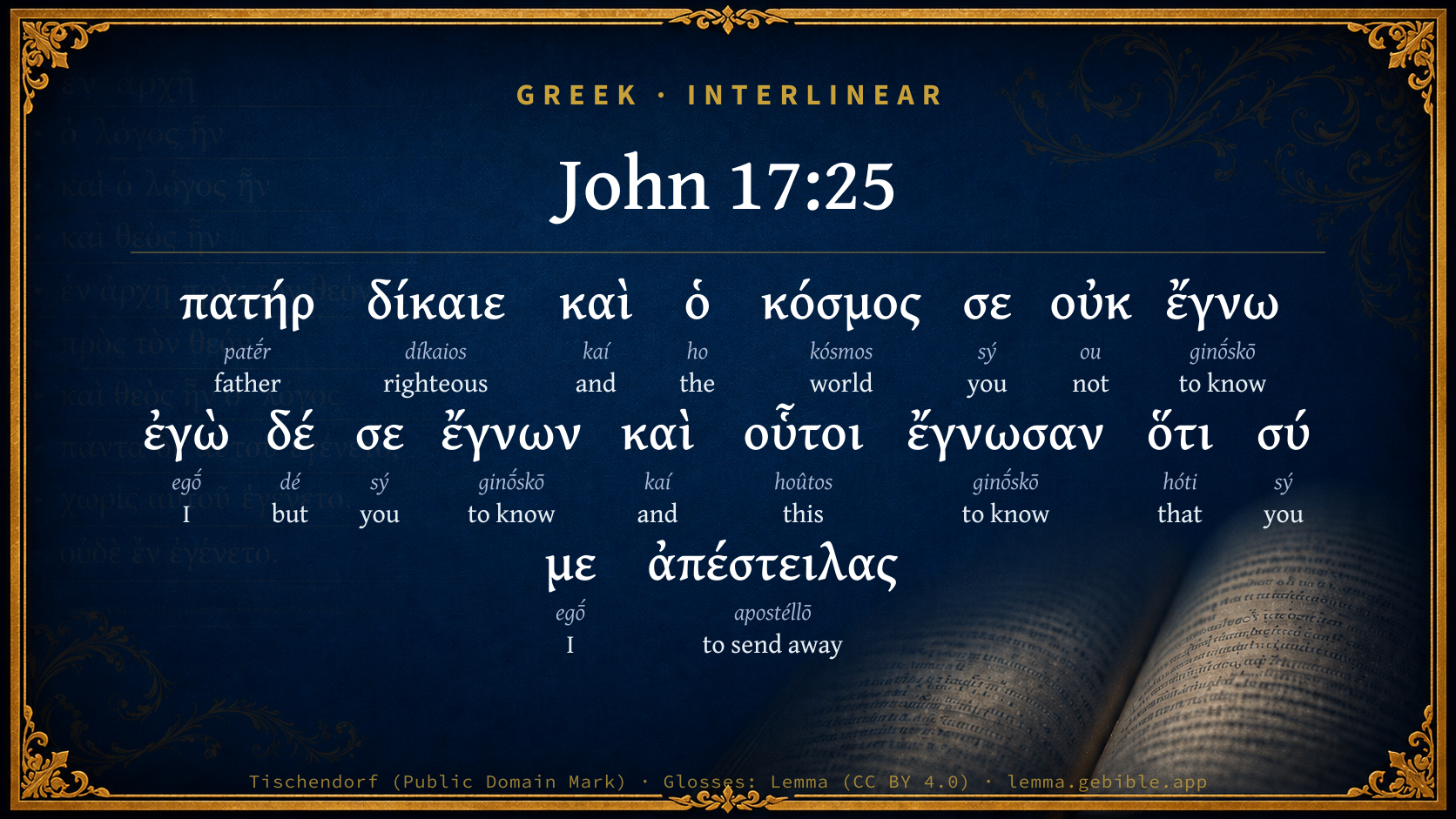
Greek (Tischendorf 8th ed.) John 17:25 appears in the Greek New Testament. The text above is from the Tischendorf 8th edition. Each word links to its Strong’s number and a concise gloss. Click any word for its full Thayer’s Greek Lexicon entry.
Download image
Cite this verse

John 17:25 (World English Bible). Public Domain. Lemma interlinear Bible study tool, https://lemma.gebible.app/v/john/17/25.

Show BibTeX & RIS
BibTeX
RIS
English Translation
Righteous Father, the world hasn't known you, but I knew you; and these knew that you sent me.
World English Bible · Public Domain
Download a study sheet

One document with this verse’s original text, its word-by-word gloss line, the meaning frame, cross-references with their text, attributed commentary, and full source and license credits — printable, and it pastes into notes with its structure intact.

This verse Autodidact and up

Study sheet (.html) Plain text (.txt)

A passage Seminary Student

Up to 50 verses in one chapter. A passage sheet keeps up to 6 commentary sources and 12 cross-references per verse, in the order this page ranks them, and says so on the sheet whenever that leaves anything out. Ask for a single verse and you get the Autodidact verse sheet above.

Everything on this page stays free to read, with no account — the sheet is a download of what is already on screen, not access to it.

Want to remove ads? Support Godless Engineer
Compare translations 3

The same verse in 3 English versions, stacked beneath the original-language interlinear above. Click any original word for its lexicon entry.

Each is an independent rendering of the whole verse — the interlinear is not word-aligned to these translations.

Highlighted words mark where these versions differ — a whole-verse word diff, not a word-by-word alignment.

  • World English Bible Public Domain
    Righteous Father, the world hasn't known you, but I knew you; and these knew that you sent me.
  • King James Version Public Domain
    O righteous Father, the world hath not known thee: but I have known thee, and these have known that thou hast sent me.
  • unfoldingWord Literal Text CC BY-SA 4.0
    Righteous Father, even the world did not know you, but I know you; and these know that you sent me.

unfoldingWord Literal Text — © unfoldingWord, licensed CC BY-SA 4.0. Word-aligned USFM3 via Door43 (git.door43.org/unfoldingWord/en_ult).

Versions to compare (up to 4)

3 of 4 selected

Show all 19 translations

Every available English version of this verse, each an independent rendering of the whole verse.

  • World English Bible Public Domain
    Righteous Father, the world hasn't known you, but I knew you; and these knew that you sent me.
  • Berean Standard Bible Public Domain
    Righteous Father, although the world has not known You, I know You, and they know that You sent Me.
  • Majority Standard Bible Public Domain
    Righteous Father, although the world has not known You, I know You, and they know that You sent Me.
  • King James Version Public Domain
    O righteous Father, the world hath not known thee: but I have known thee, and these have known that thou hast sent me.
  • American Standard Version (1901) Public Domain
    O righteous Father, the world knew thee not, but I knew thee; and these knew that thou didst send me;
  • Revised Version (1885) Public Domain
    O righteous Father, the world knew thee not, but I knew thee; and these knew that thou didst send me;
  • Geneva Bible (1599) Public Domain
    O righteous Father, the worlde also hath not knowen thee, but I haue knowen thee, and these haue knowen, that thou hast sent me.
  • Douay-Rheims (1899) Public Domain
    Just Father, the world hath not known thee; but I have known thee: and these have known that thou hast sent me.
  • Young's Literal Translation Public Domain
    `Righteous Father, also the world did not know Thee, and I knew Thee, and these have known that Thou didst send me,
  • Literal Standard Version CC BY-SA 4.0
    Righteous Father, also the world did not know You, and I knew You, and these have known that You sent Me,
  • Unlocked Literal Bible CC BY-SA 4.0
    Righteous Father, the world did not know you, but I know you; and these know that you sent me.
  • unfoldingWord Literal Text CC BY-SA 4.0
    Righteous Father, even the world did not know you, but I know you; and these know that you sent me.
  • Darby Bible Public Domain
    Righteous Father, -- and the world has not known thee, but I have known thee, and these have known that thou hast sent me.
  • World Messianic Bible Public Domain
    Righteous Father, the world hasn’t known you, but I knew you; and these knew that you sent me.
  • Webster's Bible Public Domain
    O righteous Father, the world hath not known thee: but I have known thee, and these have known that thou hast sent me.
  • Free Bible Version CC BY-SA 4.0
    Good Father, the world does not know you, but I know you, and these here with me know that you sent me.
  • Bible in Basic English Public Domain
    Father of righteousness, I have knowledge of you, though the world has not; and to these it is clear that you sent me;
  • Text-Critical English NT CC BY 4.0
    Righteous Father, though the world does not know yoʋ, I know yoʋ, and these men know that yoʋ have sent me.
  • Tyndale New Testament (1534) Public Domain
    O ryghteous father the very worlde hath not knowen the: but I have knowen the and these have knowen that thou hast sent me.

Literal Standard Version (2020), Covenant Press — licensed CC BY-SA 4.0. Text via the HelloAO Bible API (eBible.org). Unlocked Literal Bible (unfoldingWord) — licensed CC BY-SA 4.0. Text via the HelloAO Bible API (eBible.org). unfoldingWord Literal Text — © unfoldingWord, licensed CC BY-SA 4.0. Word-aligned USFM3 via Door43 (git.door43.org/unfoldingWord/en_ult). Free Bible Version, Dr. Jonathan Gallagher — licensed CC BY-SA 4.0. Text via the HelloAO Bible API (eBible.org).

Word by word

More ways to search: Search by grammar → Find every occurrence → Compare this word →

Practice this passage: Drill this verse → Learn its vocabulary →

δίκαιε
díkaios
G1342
“righteous”
Adjective, Vocative, Singular, Masculine
Part of Speech
Adjective
Case
Vocative
Number
Singular
Gender
Masculine
Full Thayer's Definition

Origin: from G1349

TDNT: 05:02,2

1. righteous, observing divine laws a. in a wide sense, upright, righteous, virtuous, keeping the commands of God 1. of those who seem to themselves to be righteous, who pride themselves to be righteous, who pride themselves in their virtues, whether real or imagined 2. innocent, faultless, guiltless 3. used of him whose way of thinking, feeling, and acting is wholly conformed to the will of God, and who therefore needs no rectification in the heart or life 1a b. only Christ truly 1. approved of or acceptable of God c. in a narrower sense, rendering to each his due and that in a judicial sense, passing just judgment on others, whether expressed in words or shown by the manner of dealing with them
  1. πατήρ patḗr G3962 “father” Noun, Nominative, Singular, Masculine
  2. καὶ kaí G2532 “and” Conjunction
  3. ὁ ho G3588 “the” Article, Nominative, Singular, Masculine
  4. κόσμος kósmos G2889 “world” Noun, Nominative, Singular, Masculine
  5. σε sý G4771 “you” Personal pronoun, 2nd person, Accusative, Singular
  6. οὐκ ou G3756 “not” Particle, Negative
  7. ἔγνω ginṓskō G1097 “to know” Verb, Aorist, Active, Indicative, 3rd person, Singular
  8. ἐγὼ egṓ G1473 “I” Personal pronoun, 1st person, Nominative, Singular
  9. δέ dé G1161 “but” Conjunction
  10. σε sý G4771 “you” Personal pronoun, 2nd person, Accusative, Singular
  11. ἔγνων ginṓskō G1097 “to know” Verb, Aorist, Active, Indicative, 1st person, Singular
  12. καὶ kaí G2532 “and” Conjunction
  13. οὗτοι hoûtos G3778 “this” Demonstrative pronoun, Nominative, Plural, Masculine
  14. ἔγνωσαν ginṓskō G1097 “to know” Verb, Aorist, Active, Indicative, 3rd person, Plural
  15. ὅτι hóti G3754 “that” Conjunction
  16. σύ sý G4771 “you” Personal pronoun, 2nd person, Nominative, Singular
  17. με egṓ G1473 “I” Personal pronoun, 1st person, Accusative, Singular
  18. ἀπέστειλας apostéllō G649 “to send away” Verb, Aorist, Active, Indicative, 2nd person, Singular

About this verse

These counts appear in no published source. They are computed here, from the morphology-tagged text and Lemma’s own curated glosses. What Lemma adds →

19
words
13
distinct lemmas
Gospels
section

Repetition

Words recur within this verse:

Cross-references

36

Topical passages linked to John 17:25 in the Treasury of Scripture Knowledge — connected by theme and wording, ordered by reader-vote popularity; previews shown in the World English Bible.

  • John 17:11 I am no more in the world, but these are in the world, and I am coming to you. Holy Father, keep them through your name which you have given me, that they may be one, even as we are.
  • John 7:29 I know him, because I am from him, and he sent me."
  • John 15:21 But all these things will they do to you for my name's sake, because they don't know him who sent me.
  • John 16:27 for the Father himself loves you, because you have loved me, and have believed that I came forth from God.
  • John 17:8 for the words which you have given me I have given to them, and they received them, and knew for sure that I came forth from you, and they have believed that you sent me.
  • Hebrews 8:11 They will not teach every man his fellow citizen, Every man his brother, saying, 'Know the Lord,' For all will know me, From the least of them to the greatest of them.
  • Luke 10:22 Turning to the disciples, he said, "All things have been delivered to me by my Father. No one knows who the Son is, except the Father, and who the Father is, except the Son, and he to whomever the Son desires to reveal him."
  • John 5:19–20 Jesus therefore answered them, "Most assuredly, I tell you, the Son can do nothing of himself, but what he sees the Father doing. For whatever things he does, these the Son also does likewise.
  • John 8:55 You have not known him, but I know him. If I said, 'I don't know him,' I would be like you, a liar. But I know him, and keep his word.
  • John 10:15 even as the Father knows me, and I know the Father. I lay down my life for the sheep.
  • 2 Corinthians 4:4 in whom the god of this world has blinded the minds of the unbelieving, that the light of the Gospel of the glory of Christ, who is the image of God, should not dawn on them.
  • Isaiah 45:21 Declare you, and bring [it] forth; yes, let them take counsel together: who has shown this from ancient time? who has declared it of old? Haven't I, Yahweh? and there is no God else besides me, a just God and a Savior; there is no one besides me.
  • Matthew 11:27 All things have been delivered to me by my Father. No one knows the Son, except the Father; neither does anyone know the Father, except the Son, and he to whom the Son desires to reveal him.
  • Matthew 16:16 Simon Peter answered, "You are the Christ, the Son of the living God."
  • John 1:18 No one has seen God at any time. The one and only Son, who is in the bosom of the Father, he has declared him.
  • John 3:17 For God didn't send his Son into the world to judge the world, but that the world should be saved through him.
  • John 6:19 When therefore they had rowed about twenty-five or thirty stadia, they saw Jesus walking on the sea, and drawing near to the boat; and they were afraid.
  • John 8:19 They said therefore to him, "Where is your Father?" Jesus answered, "You know neither me, nor my Father. If you knew me, you would know my Father also."
  • John 16:3 They will do these things because they have not known the Father, nor me.
  • John 16:30 Now we know that you know all things, and don't need for anyone to question you. By this we believe that you came forth from God."
  • John 17:3 This is eternal life, that they should know you, the only true God, and him whom you sent, Jesus Christ.
  • John 17:18 As you sent me into the world, even so I have sent them into the world.
  • John 17:21 that they may all be one; even as you, Father, are in me, and I in you, that they also may be one in us; that the world may believe that you sent me.
  • John 17:23 I in them, and you in me, that they may be perfected into one; that the world may know that you sent me, and loved them, even as you loved me.
  • Acts 17:23 For as I passed along, and observed the objects of your worship, I found also an altar with this inscription: 'TO AN UNKNOWN GOD.' What therefore you worship in ignorance, this I announce to you.
  • Acts 26:18 to open their eyes, that they may turn from darkness to light and from the power of Satan to God, that they may receive remission of sins and an inheritance among those who are sanctified by faith in me.'
  • Romans 1:28 Even as they refused to have God in their knowledge, God gave them up to a reprobate mind, to do those things which are not fitting;
  • Romans 3:11 There is no one who understands. There is no one who seeks after God.
  • Romans 3:26 to demonstrate his righteousness at this present time; that he might himself be just, and the justifier of him who has faith in Jesus.
  • 1 Corinthians 1:21 For seeing that in the wisdom of God, the world through its wisdom didn't know God, it was God's good pleasure through the foolishness of the preaching to save those who believe.
  • 1 Corinthians 15:34 Wake up righteously, and don't sin, for some have no knowledge of God. I say this to your shame.
  • Galatians 4:8–9 However at that time, not knowing God, you were in bondage to those who by nature are not gods.
  • 2 Thessalonians 1:8 giving vengeance to those who don't know God, and to those who don't obey the Gospel of our Lord Jesus,
  • 1 John 1:9 If we confess our sins, he is faithful and righteous to forgive us the sins, and to cleanse us from all unrighteousness.
  • 1 John 5:19–20 We know that we are of God, and the whole world lies in the power of the evil one.
  • Revelation 13:8 All who dwell on the earth will worship him, everyone whose name has not been written from the foundation of the world in the book of life of the Lamb who has been killed.

Cross-references courtesy of OpenBible.info (CC BY 4.0).

Commentary

Notes on John 17:25 from classic Christian and Jewish commentators (each source and its license shown beneath its notes). The classic Christian expositions comment on the surrounding passage and are grouped to its opening verse, so a note may address several verses; the Jewish commentaries on the Tanakh (Rashi and others) are per-verse, so they appear only where the commentator wrote on this verse.

Lemma curates 59 commentaries, every one of them public domain or Creative Commons licensed, each selected and text-cleaned for this edition rather than reprinted as found. About our sources →

The Biblical Illustrator

Joseph S. Exell

Joh_17:25-26

O righteous Father, the world hath not known Thee

The amen to the sublimest of all prayers

I.

GOD AND THE WORLD.

1. God.

(1) His relationship--Father. No relationship is more intelligible, attractive, morally assimilating. It means causation, affection, resemblance. Christs God was not a cold King upon the throne, but a loving Father whose heart yearns for His prodigal children.

(2) His character--righteous.

(a) His existence is the foundation of all right.

(b) His will is the standard of all right.

(c) His works and Word the revelation of all right.

(3) His character is not opposed to His relationship. Righteousness is love resisting all that will injure the moral universe: love uprooting weeds out of the paradise of virtue.

2. The world--unregenerate humanity. This ignorance is

(1) Most universal.

(a) The barbarian world hath not known Thee. It is sunk in idolatry, superstition, and sensuality.

(b) The civilized world. When this was said, Egypt, Greece and Rome had done their best; but even in Athens God was unknown.

(c) The conventionally Christian world. Its science denies; its literature, politics and commerce ignore; its creeds and Churches misrepresent God.

(2) Most inexcusable. Men may have just excuses for not being scholars, &c., but no excuse for this. Nature is made to reveal God and the soul. The blindness of the man who shuts his eyes to the sun is not more inexcusable than this.

(3) Most ruinous. The man ignorant of God is in moral midnight--the blackness of darkness.

II. CHRIST AND HIS SCHOOL,

1. Christ, I have known Thee. From any lips but His how presumptuous would this sound! Who among the worlds geniuses or sages could say it?

(1) No one had the opportunity of knowing God that Christ had. He was in the bosom of the Father. He knew the motive that prompted the creative act, and the plan on which the whole was organized.

(2) None the capacity. What is the greatest intellect to His.

(3) None the heart--the true organ of knowledge. Christ and His Father are one in heart, spirit and purpose.

2. Christs School they have known

(1) By the mighty works which Christ wrought.

(2) By the sublime doctrines He propounded.

(3) By the matchless purity of His character.

III. THE PREACHER AND HIS MISSION (Joh_17:26). What Christ did is the genuine work of every true preacher. What was it?

1. A persistent declaration of the Divine character. To declare self, or theories and speculations about God is what some do: but to declare His Name, His moral character, the essence of which is love, is Christs work.

2. A persistent declaration of the Divine character in order to transfuse Divine love into human souls. (D. Thomas, D. D.)

Gods Fatherhood

Our Lord first addresses God as Father, then as Holy Father, and lastly as Righteous Father. Note that holiness and righteousness flow from the Fatherhood of God. Note also that the manifestation of the Divine fatherhood is consummated in the manifestation of the Divine righteousness. (W. H. Van Doren, D. D.)

The righteous Father known and loved

The text speaks of

I. A KNOWLEDGE OF INFINITE VALUE AND ITS TEACHER.

1. What is that knowledge?

(1) Thy name. God has made man, and naturally man ought to know his Maker: the subject should know the name of his king; but men say, we desire not the knowledge of thy ways. Yet it is evident that a man can never be in a proper state till he knows his God. He cannot be happy, holy, or safe. Christ therefore, in coming to save us, makes it a part of His office to reveal the Father to us.

(2) A testing name is given to God, O righteous Father. If you know Him aright you know what is comprehended under those two words, so remarkable in combination. How can the Judge and the Father be found in one? There is but one answer, and that is found in the sacrifice of Jesus, which has joined the two in one.

(3) This knowledge is

(a) Peculiar--The world hath not known Thee. The heathen world knew nothing of a righteous Father. Their gods were generally monsters of iniquity. The Christian world does not know God as a righteous Father. Sceptics labelled as thinkers reject the evangelical idea of God, and the atonement which that idea involves. It knows an effeminate, indiscriminate fatherhood, but not the righteous Father. It will not bow before the majesty of His justice.

(2) Distinctive, for it reveals the condition of the mind which receives it. When we see in a man an unconditional submission to the justice of God, and yet a trustful hopefulness in His boundless love, we may be sure that he is a renewed man.

(3) Consolatory. For a man to know that God is his Father is delightful beyond measure, to feel that God forgives him as the father forgave the prodigal; but when we further learn that all this is done without the violation of justice, then are we full of wondering love.

(4) Causes its possessor to enjoy much fellowship with Jesus. I have known Thee. This grand character of God as righteous Father was so dear to our Lord, that He died to maintain it. Herein we have fellowship with Christ, for we know the righteous Father too in Christ, and love and bless Him, and wonder at Him every day more and more.

2. This knowledge comes to us by a Teacher. Christ declared the righteous Father

(1) In His life, for in His life He incarnated truth and grace.

(2) In His death, however, most gloriously illustrated this beyond everything else.

(3) By the work of His Holy Spirit.

II. THE OBJECT OF THE KNOWLEDGE IS THE INFUSION OF A LOVE UNRIVALLED IN VALUE.

1. This discovery of love is inward, may be in them, i.e., that they may know it, be persuaded of it, believe it and enjoy it; that they, through knowing the righteous name, may come to perceive the love of God towards them. When the Divine Father gives up His best Beloved for guilty man we may well say, Behold how He loved Him!

2. This love was of a most extraordinary kind. He loves you as He loves His best Beloved. It must be altogether boundless and unspeakable. Now, if you fully know the righteous fatherhood of God, as Christ would have you know it, you will learn that God loved you as He loved His Son. If He had not loved you as He loved the Son, He would have spared His Son.

3. It was a love of complacency and delight. Remember those words at Christs baptism and at two other occasions. Always draw a distinction between the love of benevolence with which God loves all His creatures and the love of complacency, which is reserved for His own. The Eternal Father views us in Christ, and in Him He takes delight in us as a father does in his children.

4. God the Father loves His Son infinitely. How could He do less? Without beginning has He loved Him, and without an end will He love Him, and also without change, without limit, and without degree: in the same way doth He love His people, whose hope is fixed in Him as the righteous Father.

5. This love wherever it reigns in the heart creates a return love to God.

6. This love comes through an indweller, and I in them.

(1) Through His Spirit.

(2) By faith.

(3) In a real, vital sense.

(4) Producing likeness to Christ. (C. H. Spurgeon.)

The Biblical Illustrator, edited by Joseph S. Exell (c. 1880s–1900s) — public domain. Text from a community e-Sword module.

Joseph Benson's Commentary

Joh 17:25-26. O righteous Father — Faithful and just, as well as merciful. When he prayed that believers might be sanctified, he called him holy Father: but now, praying that they might be glorified, he terms him righteous Father: for it is a crown of righteousness which the righteous Judge will give, and the admission of believers into the presence of God, through Christ, flows, not only from the mercy, but even from the justice of God. The world hath not known thee — The world, being ignorant of thy nature and perfections, and of thy gracious counsels for the salvation of mankind, has rejected me; yet I have known thee — Have been perfectly acquainted with thy counsels and designs, and have accordingly directed the whole of my ministrations to thy glory. And these have known that thou hast sent me — And therefore have believed in me as the Messiah, a truth which they will courageously assert at the expense of their lives; which is the reason I am so solicitous that they should behold the glory thou hast given me. And I have declared to them thy name — Have made them acquainted with thy nature, perfections, and counsels, and especially thy new best name of love; and I will declare it — Still more fully, both by my word and by my Spirit; that the love wherewith thou hast loved me may be in them — That their graces and services may be more eminent, as an evidence of thy unspeakable love to them; and that I also may take up my constant residence in them by my spiritual presence, when my bodily presence is removed, as it will quickly be.

Joseph Benson's Commentary on the Old and New Testaments (1811–1818) — public domain. Text from a community e-Sword module.

MacLaren's Expositions of Holy Scripture

Alexander MacLaren

John

THE HIGH PRIEST’S PRAYER

Joh 17:20 - Joh 17:26.

The remainder of this prayer reaches out to all generations of believers to the end. We may incidentally note that it shows that Jesus did not anticipate a speedy end of the history of the world or the Church; and also that it breathes but one desire, that for the Church’s unity, as though He saw what would be its greatest peril. Characteristic, too, of the idealism of this Gospel is it that there is no name for that future community. It is not called ‘church,’ or ‘congregation,’ or the like-it is ‘them also that believe on Me through their word,’ a great spiritual community, held together by common faith in Him whom the Apostles preached. Is not that still the best definition of Christians, and does not such a conception of it correspond better to its true nature than the formal abstraction, ‘the Church’?

We can but touch in the most inadequate fashion the profound words of this section of the prayer which would take volumes to expound fitly. We note that it contains four periods, in each of which something is asked or stated, and then a purpose to be attained by the petition or statement is set forth.

First comes the prayer for unity and what the answer to it will effect {Joh 17:21}. Now in this verse the unity of believers is principally regarded as resulting from the inclusion, if we may so say, of them all in the ineffable union of the Father and the Son. Jesus prays that ‘they may all be one,’ and also ‘that they also may be in us’ {Rev. Ver.}. And their unity is no mere matter of formal external organisation nor of unanimity of creed, or the like, but it is a deep, vital unity. The pattern of it is the unity of the Father and the Son, and the power that brings it about is the abiding of all believers ‘in us.’ The result of such a manifestation in the world of a multitude of men, in all of whom one life evidently moves, fusing their individualities while retaining their personalities, will be the world’s conviction of the divine mission of Jesus. The world was beginning to feel its convictions moving slowly in that direction, when it exclaimed: ‘Behold how these Christians love one another!’ The alienation of Christians has given barbs and feathers to its arrows of scorn. But it is ‘the unity of the Spirit,’ not that of a, great corporation, that Christ’s prayer desires.

The petitions for what would be given to believers passes for a moment into a statement of what Jesus had already given to them. He had begun the unifying gift, and that made a plea for its perfecting. The ‘glory’ which He had given to these poor bewildered Galilaeans was but in a rudimentary stage; but still, wherever there is faith in Him, there is some communication of His life and Spirit, and some of that veiled and yet radiant glory, ‘full of grace and truth,’ which shone through the covering when the Incarnate Word ‘became flesh.’ It is the Christ-given Christ-likeness in each which knits believers into one. It is Christ in us and we in Christ that fuses us into one, and thereby makes each perfect. And such flashing back of the light of Jesus from a million separate crystals, all glowing with one light and made one in the light, would flash on darkest eyes the lustre of the conviction that God sent Christ, and that God’s love enfolded those Christlike souls even as it enfolded Him.

Again {Joh 17:24} comes a petition with its result. And here there is no mention of the effect of the answer on the world. For the moment the thoughts of isolation in, and a message to, the world fade away. The partially-possessed ‘glory’ seems to have led on Christ’s thoughts to the calm home of perfection waiting for Him who was ‘not of the world’ and was sent into it, and for the humble ones who had taken Him for Lord. ‘I will that’-that is a strange tone for a prayer. What consciousness on Christ’s part does it involve? The disciples are not now called ‘them that should believe on Me,’ but ‘that which Thou hast given Me,’ the individuals melt into the great whole. They are Christ’s, not merely by their faith or man’s preaching, but by the Father’s gift. And the fact of that gift is used as a plea with Him, to ‘perfect that which concerneth’ them, and to complete the unity of believers with Jesus by bringing them to be ‘with Him’ in His triumphant session at the right hand. To ‘behold’ will be the same as to share His glory, not only that which we beheld when He tabernacled among us, but that which He had in the pouring out on Him of God’s love ‘before the foundation of the world.’ Our dim eyes cannot follow the happy souls as they are lost in the blaze, but we know that they walk in light and are like Him, for they ‘see Him as He is.’

The last statement {Joh 17:25 - Joh 17:26} is not petition but vow, and, to our ears, promise. The contrast of the world and believers appears for the last time. What made the world a ‘world’ was its not knowing God; what made believers isolated in, and having an errand to, the world, was that they ‘knew’ {not merely ‘believed,’ but knew by experience} that Jesus had been sent from God to make known His name. All our knowledge of God comes through Him; it is for us to recognise His divine mission, and then He will unveil, more and more, with blessed continuity of increasing knowledge, the Name, and with growing knowledge of it growing measures of God’s love will be in us, and Jesus Himself will ‘dwell in our hearts by faith’ more completely and more blessedly through an eternity of wider knowledge and more fervent love.

Alexander MacLaren, Expositions of Holy Scripture (1904–1910) — public domain. Text from a community e-Sword module.

Bengel's Gnomon

Johann Albrecht Bengel

Joh 17:25. Πάτερ δίκαιε, Righteous Father) It is from His righteousness that the admission of believers, as contrasted with the world, to God through Christ flows: καὶ, καὶ, both, and.

Bengel's Gnomon of the New Testament — English translation (T&T Clark, Edinburgh, 1860) — public domain. Text from a community e-Sword module.

Meyer's Critical & Exegetical Commentary

Heinrich August Wilhelm Meyer

Joh_17:25-26. Conclusion of the prayer: Appeal to the justice of God, for, after that which Jesus here states of Himself and of the disciples in opposition to the world, it becomes the righteous Father not to leave ungranted what Jesus has just declared, Joh_17:24, to be His will (θέλω, ἵνα, κ.τ.λ.). Otherwise the final recompense would fail to come, which the divine justice (1Jn_1:9) has to give to those who are so raised, as expressed in Joh_17:25, above the world; the work of divine holiness, Joh_17:11, would remain without its closing judicial consummation and revelation.

καὶ ὁ κόσμος, κ.τ.λ.] The apparent want of appropriateness of the καί, from which also its omission in D. Vulg. et al., is to be explained, is not removed by placing, with Grotius and Lachmann, only a comma after Joh_17:24, and allowing καὶ ὁ κόσμος σε οὐκ ἔγνω to run with what precedes, since this thought does not fit into this logical connection, and the address πάτερ δίκαιε, according to the analogy of Joh_17:11, leads us to recognise the introductory sentence of a prayer. According to Bengel and Ebrard, καὶ … καί, et … et, correspond to one another, which, however, does not allow either of the antithetic character of the conceptions, or of the manifest reference of the second καί to ἐγὼ δέ. Following Heumann, De Wette, Lücke, Tholuck make καί correspond to the following δέ, so that two relations occurring at the same time, but of opposite, kinds,[204] would be indicated: whilst the world knew Thee not, yet I knew Thee. Not to be justified on grammatical grounds; for τέ … δέ (Kühner, II. p. 418; Hartung, Partikell. I. p. 92 f.; Klotz, ad Devar. p. 741 f.), but never καί … δέ, is thus employed, and the passages of that kind adduced by Lücke from Plato, Menex. p. 235 E (where καὶ ἄλλους means also others), and Eryx. p. 393 E (where καὶ ἐλάχιστα is only even the least), are not in point; in other passages (as Soph. Ant. 428) καί is the simply connective and, without reference to the subsequent δέ. The καί in the present passage is rather the and serving to link on an antithetic relation (and notwithstanding), and is of very frequent occurrence, particularly in John, see on Joh_7:28. Had Jesus said: πάτερ, δίκαιος εἶ, καὶ ὁ κόσμος, κ.τ.λ., then καί would have been free from any difficulty. Nevertheless, the connection and its expression is the same. Christ is, in the address πάτερ δίκαιε, absorbed in the thought of the justice of God now invoked by Him, the thought, therefore, of this self-revelation of God, which was so easily to be recognised (Rom_1:18 ff.), in spite of which the world, in its blinded security, has not known Him (comp. Rom_1:28), and gives expression to this latter thought in painfully excited emotion (Chrysostom: δυσχεραίνων), immediately connecting it by καί with the address. After πάτ. δίκαιε we may suppose a pause, a break in the thought: Righteous Father(yea, such Thou art!) and (and yet) the world knew Thee not![205] Luthardt also, with Brückners concurrence, takes ΚΑΊ as and yet, but so that it stands in opposition to the revelation of God through Christ previously (see Joh_17:22) stated. Too indefinite, and leaving without reason the characteristic πάτερ δίκαιε out of reference.

ἜΓΝΩ] namely, from Thy proofs in my words and deeds; ἜΓΝΩΝ, on the other hand (Nonnus: ΣΎΜΦΥΤΟς ἜΓΝΩΝ), refers to the immediate knowledge which the Son had in His earthly life of the Father moving in Him, and revealing Himself through Him. Comp. Joh_8:54-55. Not without reason does Jesus introduce His ἘΓῺ ΔΈ ΣΕ ἜΓΝΩΝ between the ΚΌΣΜΟς and the disciples, because He wills that the disciples should be where He is (Joh_17:24), which, however, presupposes a relative relation of equality between Him and them, as over against the world.

ΟὟΤΟΙ] Glancing at the disciples.

ὍΤΙ ΣΎ ΜΕ ἈΠΈΣΤ]. The specific element, the central point of the knowledge of God, of which the discourse treats; ΔΕΊΚΝΥΣΙΝ ἘΝΤΑῦΘΑ, ΜΗΔΈΝΑ ΕἸΔΟΤΑ ΘΕῸΝ, ἈΛΛʼ Ἢ ΜΌΝΟΝ ΤΟῪς ΥἹῸΝ ἘΠΕΓΝΩΚΌΤΑς Chrysostom. Comp. Joh_17:8; Joh_17:23; Joh_16:27, et al.

Joh_17:26. Whereby this ἔγνωσαν has been effected (comp. Joh_17:7), and will be completely effected (ΓΝΩΡΊΣΩ, through the Paraclete: ΚΑῚ … ΚΑΊ, both … and also), that (purpose of the γνωρίσω) the love with which Thou hast loved me (comp. Joh_17:24) may be in them, i.e. may rule in their hearts,[206] and therewithfor Christ, communicating Himself through the Spirit, is the supporter of the divine life in believers (Joh_14:20 ff.; Rom_8:10; Gal_2:20; Eph_3:17),

I in them. On ἀγάπην ἀγαπᾶν, see on Eph_2:4. So rich in promise and elevating with the simply grand and I in them, resounds the word of prayer, and in the whole ministry and experience of the apostles was it fulfilled. As nothing could separate them from the love of God in Christ (Rom_8:39), Christ thus remained in them through the Spirit, and they have conquered far and wide through Him who loved them.

[204] Hence also the reading: εἰ καὶ ὁ κ. σ. οὐκ ἔγνω, ἀλλʼ ἐγὼ, κ.τ.λ., which is found not merely in Hippolytus, but also in the Constitt. Ap. 8. 1. 1.

[205] This interpretation is followed also by Hengstenberg. But Ewald places καὶ ὁ κόσμος to γνωρίσω, ver. 26, in a parenthesis, and then takes ἵνα ἡ ἀγάπη, κ.τ.λ., still as the contents of θέλε, ver. 24. How broken thus becomes the calm, clear flow of the prayer! According to Baeumlein, the parallel clauses would properly be καὶ ἐγὼ σὲ ἔγνων καὶ οὕτοι ἔγνωσαν; but there is interpolated before the first clause an opposite clause, which properly should have μέν, so that then the main thought follows with δέ. Alike arbitrary, but yet more contorted, is the arrangement of Godet.

[206] Comp. Rom_5:5. Bengel aptly remarks: ut cor ipsorum theatrum sit et palaestra hujus amoris, namely, διὰ πνεύματος ἁγίου, Rom. l.c. According to Hengstenberg (comp. also Weiss, p. 80), Jesus merely intends to say: that Thou mayest love them with the love with which Thou hast loved me. But this does not suit the expression ἐν αὐτοῖς ᾖ, neither in itself nor in the parallel relation to κἀγὼ ἐν αὐτοῖς. An inward efficacious presence must be thereby intended.

NOTE.

The originality of the high-priestly prayer stands upon the same footing with that of the longer discourses of Jesus generally in the Evangelist John. The substance of the contents is original, but the reproduction and vivid remodelling, such as could not come forth from the Johannean individuality, with which the recollection had grown up, otherwise than with quite a Johannean stamp. Along with this, however, in reference to contents and form, considering the peculiarly profound impression which the prayer of this solemn moment must necessarily have made upon the spirit and memory of that very disciple, a superior degree of fidelity of recollection and power of reddition must be assumed. How often may these last solemn words have stirred the soul of John! To this corresponds also the self-consciousness, as childlike as it is simple and clear in its elevation, the victorious rest and peace of this prayer, which is the noblest and purest pearl of devotion in the whole of the N. T. For so plainly and simply it sounds, so deep, rich, and wide it is, that none can fathom it, Luther. Spener never ventured to preach upon it, because he felt that its true understanding exceeded the ordinary measure of faith; but he caused it to be read to him three times on the evening before his death, see his Lebensbeschr. by Canstein, p. 145 ff. The contrary view, that it is a later idealizing fiction of a dogmatic and metaphysical kind (Bretschneider, Strauss, Weisse, Baur, Scholten), is indeed a necessary link in the chain of controversy on the originality of the Johannean history generally, but all the more untenable, the more unattainable, the depth, tenderness, intensity, and loftiness, as is here sustained from beginning to end, must have been for a later inventor. But to deny the inward truth and splendour of the prayer (see especially Weisse, II. p. 294), is a matter evincing a critically corrupt taste and judgment. The conflict of soul in Gethsemane, so soon after this prayer which speaks of overcoming the world and of peace, is indeed, considering the pure humanity of Jesus (which was not forced into stoical indifference), psychologically too conceivable, not, indeed, as a voluntarily assumed representation of all the horrors of death from the sin of the world (Hengstenberg), but rather from the change of feelings and dispositions in the contemplation of death, and of such a death, to be made to pass as an historical contradiction to chap. 17 See on Matt., note after Mat_26:46. John himself relates nothing of the crisis of the conflict of soul; but this is connected with his peculiarity in the selection of the evangelical material in general, and he might be determined in this matter particularly by the account already given of the similar fact, Joh_12:23 ff., which he only adduces, whilst that conflict of soul was already a common property of Scriptural tradition (comp. also Heb_5:7), which he as little needed to repeat as the institution of the Lords Supper and many other things. That that conflict of soul had not for John the importance and historic reality which it had for the Synoptics, is considering the free selection which he has made out of the rich material of his recollection, a hasty conclusion (in answer to Baur, in the Theol. Jahrb. 1854, p. 224). The historic reality of the Gospel facts, if nothing essential is otherwise opposed to them, is not affected by the silence of John.

Meyer — Critical and Exegetical Commentary on the New Testament — English translation by Peter Christie, edited by Frederick Crombie (T&T Clark, 1880) — public domain. Text from a community e-Sword module.

Expositor's Greek Testament

ed. W. Robertson Nicoll

Joh 17:25 . Πάτερ δίκαιε , “Righteous Father”. The appeal is now to God’s justice; “ut tua bonitas me miserat servandsn si qua fieri potuisset, omnibus; ita tui, justitia non patietur ob quorundam iacredulitatem frustrari vota credentium”. Erasmus. The Father’s justice is appealed to, that the believing may not share the fate of the unbelieving world καὶ ὁ κόσμος Elsner translates “quamvis,” and Lampe says all difficulty thus disappears. But Elsner’s examples are irrelevant. Meyer renders “Righteous Father (yea, such Thou art!) and (and yet) the world knew Thee not.” Simcox suggests that the first καί is correlative not to the immediately following δέ , but to the second καί , the effect being something like: “While the world knew Thee not, though I knew Thee, these on their part knew”.… Similarly Westcott; “it serves to coordinate the two main clauses.… The force of it is as if we were to say: Two facts are equally true; it is true that the world knew Thee not; it is true that these knew that Thou didst send me.” May the καί not be intended to connect this clause with the preceding ὅτι … κόσμου , and to mark the contrast between the love that was in God before the foundation of the world and the world’s ignorance of Him, and especially of His love? But “I knew Thee and these knew,” etc. They did not know God directly as Christ did, but they knew they could accept Him as the Revealer of God. And to them who were willing to receive my message, because they knew I was sent by Thee, I made known Thy name and will make it known by my death (Weiss) and by sending the Spirit of truth (Westcott). The end in view in this manifestation by Christ was that the love with which the Father had loved the Son might rest on the disciples. ἵνα ἡ ἀγάπη ἣν ἠγάπησάς με . The construction is found in Eph 2:4 , and is frequent in the classics; ἡ κρίσις ἣν ἐκρίθη , Lysias; τῇ νίκῃ ἣν ἐνίκησε , Arrian. See Kypke. κἀγὼ ἐν αὐτοῖς . This is the end and crown of all. That He should desire this intimate communion with men, and should seek above all else to live in and through His disciples, is surprising proof of His love.

The Expositor's Greek Testament, edited by W. Robertson Nicoll (1897–1910) — public domain. Text from a community e-Sword module.

Godet's Commentaries

Frédéric Louis Godet

Vv. 25, 26 have as their aim to justify this last will of Jesus, not only from the standpoint of grace, but even from that of righteousness, precisely that one of the divine perfections which might seem opposed to the petition of Jesus in behalf of His own.

Vv. 25, 26. “Righteous Father, the world, it is true, has not known thee; but as for me, I have known thee; and these have known that thou hast sent me. 26. And I have made known to them thy name, and will make it known, that the love wherewith thou hast loved me may be in them, and that I may be in them.”

Jesus does not say, as He did in Joh 17:11 : “Holy Father.” And He certainly has His reasons for substituting here for the title holy the title righteous. What follows does not permit us to doubt that He takes this word in the sense of justice strictly so-called, retributive justice. Hengstenberg, Meyer, Weiss, Keil, Westcott, etc., have clearly seen this. In fact, Jesus opposes to the world, which has refused to know God and has thus rendered itself unworthy to be admitted to the contemplation of His glory, His own (οὗτοι, these), who have consented to know God and have thus become worthy of the privilege which He asks for them (Joh 17:24). Hence, as it appears to me, it follows that in the first words of Joh 17:25 the καί before οὗτοι and the καί before ὁ κόσμος are two καί of contrast, such as we have seen so many times in John (Joh 1:10, Joh 6:36, Joh 15:24), serving to bring together, by reason of their very opposition, the two contrary facts. But what has prevented interpreters from apprehending this relation is the fact that John intercalates between the two terms of the principal contrast a third term intended to introduce the second: “But as for me, I have known thee.” If the believers have arrived at the knowledge of God, it is not of themselves, but only by means of the knowledge which their Master had of God and which He has communicated to them. The δέ, but, indicates a first antithesis with reference to the καί, which precedes, relatively to the world,—a fact which makes the second καί, beforeοὗτοι, appear no longer other than the completing of the antithesis expressed by this δέ which accompanies the ἐγώ. We may compare Joh 16:20, as an example of an antithesis in some sort broken by a secondary antithesis intercalated between the two members of the principal contrast.

This explanation draws near to that of Baumlein, and is in the main accepted by Keil. Meyer also explains the first καί as indicating an opposition, but an opposition to the idea of righteousness expressed in the invocation Righteous Father! “And yet (although thou art righteous) the world has not known thee as such.” This non-recognition is, according to this view, that of which Paul speaks in Rom 1:19, which consisted in the blindness of men with reference to the revelation of God in the works of nature. But this idea has not the least connection with the context. Jesus has Himself said (in Joh 15:22; Joh 15:24) that all the sins previous to His coming would not have been imputed to the world, if it had not put the crowning point upon them by the rejection of Him. The terms to know and not to know God can refer here only to the acceptance or rejection of the revelation of the character of God in the appearance of Jesus.— Weiss sees in the first καί, not an opposition to the second, but a particle which connects this verse with that which precedes. But what logical connection is it possible to establish between the admission of believers to the spectacle of the glory of Christ (Joh 17:24) and the refusal of the world to know God! This, then, is the meaning of this prayer: “The world, it is true, is the just object of Thy rejection by reason of its refusal to know Thee; but these, in receiving me, who have brought to them the knowledge of Thee, are become worthy of the privilege which I now ask of Thee for them.”

Frédéric Louis Godet — Commentaries on Luke, John, Romans, and 1 Corinthians — English translation (T&T Clark, Edinburgh, 1870s–1890s) — public domain. Text from a community e-Sword module.

Jamieson, Fausset & Brown

Robert Jamieson, A. R. Fausset & David Brown

O righteous Father, the world hath not known thee--knew thee not.

but I have known thee--knew thee.

and these have known--knew.

that thou hast sent--sentest

me--As before He said "Holy Father," when desiring the display of that perfection on His disciples (Joh 17:11), so here He styles Him "Righteous Father," because He is appealing to His righteousness or justice, to make a distinction between those two diametrically opposite classes--"the world," on the one hand, which would not "know the Father, though brought so nigh to it in the Son of His love, and, on the other, Himself, who recognized and owned Him, and even His disciples, who owned His mission from the Father.

Jamieson, Fausset & Brown — Commentary Critical and Explanatory on the Whole Bible (1871) — public domain (CC PDM 1.0). Text via the HelloAO Bible API.

Adam Clarke's Commentary

Verse 25. The world hath not known thee] Has not acknowledged me. See on Joh 1:11-12.

And these have known] Here our Lord, returning to the disciples, speaks: 1st. Of their having received him as the Messiah; 2dly. Of his making the Father known unto them; 3dly. Of his purpose to continue to influence them by the Spirit of truth, that they might be perfectly united to God, by an indwelling Saviour for ever.

Adam Clarke's Commentary on the Bible (1810–1826) — public domain. Text from a community e-Sword/MySword module.

John Calvin's Commentaries

25. Righteous Father. He compares his disciples to the world, so as to describe more fully the approbation and favour which they had received from the Father; for it is proper that they who alone know God, whom the whole world rejects, should be distinguished above others, and most properly does Christ plead with peculiar warmth for those whom the unbelief of the world did not prevent from acknowledging God. By calling him Righteous Father, Christ defies the world and its malice; as if he had said, “However proudly the world may despise or reject God, still it takes nothing from him, and cannot hinder the honor of his righteousness from remaining unimpaired.” By these words he declares that the faith of the godly ought to be founded on God, in such a manner that, though the whole world should oppose, it would never fail; just as, in the present day, we must charge the Pope with injustice, in order that we may vindicate for God the praise which is due to him.

But I have known thee, and these have known that thou hast sent me. Christ does not merely say that God was known by the disciples, but mentions two steps; first, that he has known the Father; and, secondly, that the disciples have known that he was sent by the Father But as he adds immediately afterwards, that he has declared to them the name of the Father, he praises them, as I have said, for the knowledge of God, which separates them from the rest of the world. Yet we must attend to the order of faith, as it is here described. The Son came out of the bosom of the Father, and, properly speaking, he alone knows the Father; and, therefore, all who desire to approach God must betake themselves to Christ meeting them, and nmst devote themselves to him; and, after having been known by the disciples, he will, at length, raise them to God the Father.

John Calvin's Commentaries (1540-1563) — public domain. Text from the Calvin Translation Society English edition (1840s-50s) via the Christian Classics Ethereal Library (ccel.org). Calvin's coverage is partial (roughly two-thirds of the Bible); uncommented books and verses are honest gaps, never fabricated. The 19th-century editor's footnotes and remarks are omitted so the notes are faithfully Calvin's own voice.

Ellicott's Commentary for English Readers

(25) O righteous Father, the world hath not known thee.—Better, . . . the world indeed knew Thee not. In these closing words of His prayer, our Lord again solemnly appeals to the Father (comp. Notes on Joh_17:1; Joh_17:5; Joh_17:11), but now with the special thought of the Father’s righteousness. This thought follows upon the prayer that those whom the Father had given Him may be where He is, and behold the divine glory; and the connection seems to be in the thought that sinful humanity cannot see God and live. The world, indeed, knew not God (comp. Joh_15:21; Joh_16:3), but the Son knew God, and the disciples had recognised that He had been sent by God, and in their knowledge of Him had passed through a moral’ change, by which they were no longer of the world, but were sons of God (Joh_1:12).

A Bible Commentary for English Readers, edited by Charles John Ellicott (1878–1897) — public domain. Text from a community e-Sword module.

The Cambridge Bible for Schools and Colleges

gen. ed. J. J. S. Perowne

25, 26. Summary

25. righteous Father] The epithet (comp. Joh_17:11) harmonizes with the appeal to the justice of God which follows, which is based on a simple statement of the facts. The world knew not God; Christ knew Him; the disciples knew that Christ was sent by Him. ‘Shall not the Judge of all the earth do right?’

hath not known] Better, knew not. So also ‘have known’ should in both cases be knew, and ‘hast sent’ should be didst send. The verbs are all aorists. The conjunction kai before ‘the world’ may be rendered ‘indeed,’ meaning ‘it is true the world knew Thee not, but yet &c.’ Translate; the world Indeed knew Thee not, but I knew Thee.

The Cambridge Bible for Schools and Colleges (gen. ed. J. J. S. Perowne; Cambridge University Press, 1878–1918) — public domain. Text from a community e-Sword module.

John Gill's Exposition

And I have declared unto them thy name,.... Himself, his nature, his perfections, especially of grace and mercy, his mind and will, his Gospel; See Gill on Joh 17:6. A very fit person Christ was to make this declaration, since he was with him from all eternity, and was in his bosom; the Father did all in him, and his name is in him; and he is the faithful witness; nor is anything of God to be known savingly, but in and through Christ; the apostles are here particularly meant, though the same is true with respect to all that are given to Christ, who are his children and brethren, to whom he also declares the name of God:

and will declare it; more fully to them after his resurrection, during his forty days' stay with them, and upon his ascension, when he poured down his Spirit in such a plentiful and extraordinary manner upon them; and will declare it to others besides them in the Gentile world; and still more in the latter day glory, and to all believers more and more:

that the love wherewith thou hast loved me, may be in them; that is, that a sense of that love with which God loves his Son, as Mediator, might be in them and abide in them, and which is the rather mentioned because they are loved by the Father with the same love, and share all the blessed consequences of it, the knowledge and sense of which they come at, through Christ's declaring his Father's name unto them; and which they will have a greater sense of, and will be swallowed up in it in heaven to all eternity:

and I in them; dwelling in them, taking up his residence in them; not only by his Spirit and grace here, but by his glorious presence with them hereafter; when they shall be brought to his Father's house, behold his glory, and be for ever with him.

Next: John Chapter 18

John Gill's Exposition of the Whole Bible (1746–1763) — public domain (CC PDM 1.0). Text via the HelloAO Bible API.

Trapp's Complete Commentary

John Trapp

25 O righteous Father, the world hath not known thee: but I have known thee, and these have known that thou hast sent me.

Ver. 25. O righteous Father] God’s righteousness is either, 1. Of equity, to punish offences. Or, 2. Of fidelity, to make good his promises. In which respect it is no arrogance nor presumption (said Master Glover, martyr) to burden God, as it were, with his promises; and of duty to claim his aid, help, and assistance.

John Trapp, A Commentary or Exposition upon All the Books of the Old and New Testament (1647–1656) — public domain. Text from a community e-Sword module.

Albert Barnes' Notes on the Bible

Hath not known thee - See the notes at Joh 17:3.

Albert Barnes' Notes on the Bible (1834–1885) — public domain. Text from a community e-Sword/MySword module.

Matthew Poole's English Annotations

It is observed, that the servants of God, in holy writ, have used in their prayers to give unto God such compellations as have been suitable to the things which they have begged of God in their prayers, and proper to express their faith in God, for the hearing of such their prayers: Christ here calls his Father by the name of

righteous, with relation to the argument which he here useth, which is from his disciples knowledge of him; under which term (as very often before) is comprehended their acceptance of him, believing in him, love to him, &c. Father, saith he, thou art righteous; it is a piece of thy righteousness to render to every man according to his work, Job 34:11; Psa 62:12; Pro 24:12.

The world hath not known thee; the men of the world hate thee, are ignorant of thee, rebellious against thee;

but I have known thee; I have known thee, and have made thee known, and I have been obedient to thy will; and these my disciples have known me, and known, that is, received, embraced me, as one sent by thee, as the Messiah.

Matthew Poole's English Annotations on the Holy Bible (1683–1685) — public domain. Text from a community e-Sword/MySword module.

Whedon's Commentary on the Bible

Daniel D. Whedon

25. O righteous Father—He addresses his Father in his stern aspect of righteousness, and his subject is the world in its contrast with his disciples and himself. Yet is its tone the awfulness of reserve. He utters no condemnation, pronounces no sentence. Note that God is not a mere Father, but also a righteous Father. He has not only his parental, but his judicial and governmental aspect. He is not only living Father, but stern Judge and absolute Sovereign.

The world hath not known thee—This is his final brief word of appeal to the just God against a rejecting world. It is not passively and innocently and with no means of knowledge, that the world does not know thee. But, after all I have done to reveal thee, the guilty voluntary world has persistently ignored thee! I…

and these—I have, spite of and in contrast with this world, determinately known thee, and have made thee known to these. He has no more to say of the world; his heart and speech catch and fasten upon the brighter topic.

Daniel D. Whedon (gen. ed.), Commentary on the Old and New Testaments (1874–1909) — public domain. Text from a community e-Sword module.

The Pulpit Commentary

The prayer is thus over, and once more the great High Priest and Victim declares concerning himself some of the mysteries of his Person and of his relation with his disciples and with the world. O righteous Father (cf. Vers. 1, 5, Pater simply; Ver. 11, pater agie ; Ver. 24, Pater without any characterization). The righteousness of God is a more exalted perfection than his holiness, one that might seem more at variance with the exercise of his paternal compassion; yet this righteousness is conspicuously displayed in the redemptive love which Christ had thus manifested, and the beloved disciple (1Jn_1:9) declares that God is faithful and "righteous" in forgiving the repentant sinner. The blending of the idea of righteousness with Fatherhood is the sublime revelation made by the Lord Jesus, and he gathers the two ideas together into an indissoluble unity. Justice and mercy are seen by the whole work of the Son of God to have been the outflow and effulgence of the one all-comprehending and infinite love. The kai that here follows has created some difficulty, though some manuscripts emit it (D and Vulgate), probably in consequence of its inappropriateness; but it is received on strong ancient authority. Meyer and Hengstenberg take it thus: Righteous Father (yea, such thou art), and (yet) the world knew thee not. But would our Lord have hesitated, as it were, to express this truth, without justifying it against the unbelief of the world? Moulton tries to explain the simple adversative force of the kai and de by "both the world learned not to know thee, but I learned to know thee." Godet has expressed the kai more effectively by translating, The world, it is true, knew thee not, but I knew thee. The Revised Version has, with the Authorized Version, simply omitted the kai . It is one of the most solemn of the Lord"s condemnations of the kosmov . The Apostle Paul said, (1Co_1:21) "The world through its wisdom knew not God;" and in Rom_1:18-23 he shows that this ignorance was willful and practical and without excuse. The history of the struggling of the world after God has shown how dense the human darkness is. There have been signs that men groped after the idea of a Father who should be blind to their faults and indifferent to their follies, and utter a righteous Lord who has exalted righteousness and hated iniquity; but it was left for Christ to blend these apparently discordant beams into the radiance of a perfect glory. How many illustrations do the sad and shameless perversions of human intelligence supply! But I knew thee, because of the eternity of that ineffable love wherewith thou hast loved me, and because of the depth of that righteous love which thou hast manifested to the world in sending me upon my mission. And these knew came to know by personal intuitionthat thou didst send me (cf. Joh_16:27, and Vers. 8, 23) on the mission of redeeming the world. They have learned that I have come with all thy authority and in all thy power; that I have come out from thee; that I entered into the world; that I have glorified thee among men; that my thoughts are thy thoughts, and my "words" (rhmata) are thy (Loges) "Word;" that my works of love are the works of the Father; and that my promises are the manifestation of thy Name to the men whom thou hast given me.

Vers. 25, 26. An appeal to God"s righteousness.

Our Lord approaches the climax of his prayer.

I MARK THE MODE OF ADDRESS. "Righteous Father." Six times in this prayer has Christ addressed God as Father; but the name here used implies that Christ insists upon the reward of his service and. his sufferings. Justice pleads on behalf of the disciples. The thought of a "righteous Father" is:

1. Comforting to the righteous and the oppressed.

2. Terrible to the ungodly.

II MARK THE CONTRAST BETWEEN THE UNBELIEVING WORLD AND THE FAITHFUL SON AND SERVANT OF GOD.

1. Consider the worlds ignorance of God. "The world hath not known thee.

a. The heathen want the means of knowledge.

b. The world is unwilling to know God.

c. The world does not know him so as to delight in him, or to serve him, or to obey him.

2. Consider Christs knowledge of God. "But I have known thee, and these have believed that thou hast sent me.

a. He knows God immediately.

b. And he is the Source of all saving knowledge to believers.

3. Christ will make still fuller declarations of My Fathers Name to the worlds end. "And I have made known unto them thy Name, and I will make it known.

(1) This will be realized through

(a) his Word,

(b) his Spirit,

(c) and his ministers.

(2) The design of these fuller revelations. "That the love wherewith thou hast loved me may be in them, and I in them.

(a) God"s love ought to dwell in believers as a habitual experience.

(b) It is the safety and the glory of believers.

(c) It is the means of our growing conformity to God"s image.

(d) Wherever love is Christ is, "dwelling" in believers.

(e) They who have Christ in them have

(i) safety,

(ii) access to him at all times,

(iii) peace in their souls.

God unknown and known.

These, the last words uttered by our Lord before he proceeded to his betrayal and passion, are words worthy of the occasion and of the Speaker.

They are a prayer, or rather an address, to the Father. Yet they constitute a review of the past, a declaration of the present, a prediction of the future. They explain the reason and the purpose of his mediation and of his ministry to man.

I THE WORLD"S IGNORANCE OF GOD WAS THE OCCASION OF CHRIST"S MINISTRY. This ignorance is implicitly brought before us in the very language which the High Priest here employs: "O righteous Father, the world knew thee not.

1. The world had no conviction of God"s righteousness. No one who is acquainted with heathen religions can question this. Not that there were no upright natures that traced their own love of justice and equity to the eternal Power that rules the universe; but that the gods many and lords many who were honored, feared, or propitiated among the heathen were, for the most part, lacking in the highest moral qualities. A gleam of righteousness or of generosity did now and again break through, to reveal, as it were, the darkness of the firmament. Still, broadly speaking, gross darkness covered the people. The unenlightened heathen attributed to their deities partiality, factiousness, hatred, cruelty any quality but justice. In all this the lack of righteousness in men themselves was reflected upon their gods. The world by wisdom knew not God.

2. The world had no conviction of God"s Fatherhood. If there were those who worshipped a supposed deity whom they called "the father of gods and men," we must not be misled by such language into supposing that the scriptural idea of fatherhood was involved in their religion. This idea is distinctively that of revelation, of Christianity. The moral attributes which we attach to the conception of the Divine Fatherhood have not come to our apprehension through the ministrations of pagan priests or pagan philosophers. Apart from Christ, the race of mankind is conscious only of fatherlessness and fear.

II CHRIST"S KNOWLEDGE OF THE FATHER, GOD, WAS INTIMATE AND PERFECT. The expression Jesus here employs, "I knew thee," evidently suggests the natural and immediate knowledge which he had of the Father. He did not come to know God by a process of inquiry or reflection, or by the reception of lessons and revelations. His knowledge was direct. This we gather from his own assertions, and also from many intimations to be discerned in his words and in his conduct. There is no sign of uncertainty in any of Christ"s declarations with respect to the Supreme. On the contrary, he speaks simply, directly, and decisively in all he says. He claims the closest intimacy, as when he says that he is in the bosom" of the Father, i.e. in possession of the counsels and secrets of the eternal mind. He even goes further than this, claiming unity with the Father, as when he says, "I and my Father are one." Our Savior"s knowledge of God was not inferential, but intuitive; not acquired, but natural; not imperfect, but complete.

III CHRIST REVEALS GOD, AND THUS ENLIGHTENS MEN"S IGNORANCE.

1. The first step in this revelation is the conviction, which Christ awakens in his disciples" minds, that his mission is from God himself. The character of Christ, his discourses and conversations, his mighty works, all witnessed to his special authority and commission. They were constrained to ask, "Who is this?" "What manner of Man is this?" "Whence is he?" and When these questions were suggested, they could lead to only one answer which could satisfy the inquirers" minds. The conviction was produced, in some cases by a gradual process, in other cases as by a sudden flash of revelation, that this Being was from above, that he was the Son of" God.

2. The second step in this revelation is the declaration of the Divine "Name," by which we are to understand the character and the purposes of the Father. When the Lord Jesus had communicated to his disciples the fact that God is a Spirit, and the fact that he is the Father in heaven, he had in great measure made known the Divine Name; but it was a further and richer revelation that he made when he told of the Father"s purposes of compassion and mercy towards his children when he, in the Name of the Almighty and All-merciful, assured his faithful people of spiritual salvation and of eternal life.

3. But the glory of this assertion is not yet exhausted. Christ says that he will yet make known the Name of God. The reference may be to the approaching manifestation of the Divine heart in the sacrifice and the subsequent exaltation and victory of the Son. But it may, and probably does, include the whole future revelation of God through the Holy Spirit, and throughout the spiritual economy. There are those who consider revelation to have been continuous and progressive throughout this dispensation; there are others who consider that the objective revelation is complete in itself, but that the quickening influences of the Holy Spirit enable successive generations to discern ever new beauty, power, and preciousness in him who is "the Light of the world," and "the Life of men?

IV DIVINE LOVE AND FELLOWSHIP ARE THE GREAT END OF THE DIVINE REVELATION AND OF HUMAN KNOWLEDGE. Our acquaintance with God is a mysterious and glorious privilege, yet we may with reverence hold that it is the means to an end. We love only those whom in some measure we know; yet by loving we may learn to know them more. As Christ is formed in his people, and as his character and life are revealed by them, the Father cherishes and displays towards them the very affection with which he regards his well-beloved Son. It is thus that the incarnation and sacrifice of the Redeemer produce their precious and immortal results. Ignorance, sin, estrangement, stud hatred are, by this Divine provision, expelled; and in their place the new humanity, the spiritual kingdom, the Church of the living God, is penetrated by the Spirit of Christ, filled with the light of holy knowledge, and blessed with the enjoyment of imperishable love. T.

The Pulpit Commentary (1880–1919), ed. H.D.M. Spence-Jones & Joseph S. Exell — public domain. Text from a community e-Sword module.

John Wesley's Explanatory Notes

Righteous Father - The admission of believers to God through Christ, flows even from the justice of God.

John Wesley, Explanatory Notes Upon the Whole Bible (1754–1765) — public domain. Text via the GEBible commentary corpus.

Scofield Reference Notes

C. I. Scofield

world

kosmos = mankind. (See Scofield "Mat 4:8").

The Scofield Reference Bible (1917 edition), notes by C. I. Scofield — public domain. Text from a community e-Sword module.

Kretzmann's Popular Commentary

Paul E. Kretzmann

The conclusion of the prayer:

v. 25. O righteous Father, the world hath not known Thee; but I have known Thee, and these have known that Thou hast sent Me.

v. 26. And I have declared unto them Thy name, and will declare it, that the love wherewith Thou hast loved Me may be in them and I in them.

It is the righteous Father whom Christ is addressing, and therefore He who fulfilled all righteousness may well expect from Him the hearing of a prayer based upon the complete redemption of the world. The unbelieving world does not know the Father, and will not know the Father. But the fact that the Son knows Him will effect the granting of this petition, and the fact that the believers place their trust in the Son’s mission and atonement places them in a position which will insure the hearing of the prayer. Their faith and their understanding is of the right kind and results in the intimate relationship upon which they base their hope. The teaching of Christ by which He revealed the name, the Word, and the will of the Father has not been in vain. This work of Christ will continue also in the state of exaltation, through the preaching of His disciples, until the end of time. And wherever the name of God is preached, there His honor and glory will be exalted.. "And mark that He not only says: I have declared unto them Thy name, but also adds: And I will declare it, that is, I not only want to have a beginning and let it go at that, but I want to continue always, and do that same thing without ceasing, both through Word and: Spirit, that people seek nothing else or higher, but always have enough to do to grasp it better and more strongly. For therein lies the power that we learn to know the Father well through faith, in such a way that the heart full of consolation and with happy trust in all mercy will stand before Him, and fear no wrath. " In this way only will the final object of Christ’s salvation be realized, namely,. that the love of the Father in Christ dwells in the believers, and Christ Himself is united with them for all eternity. The entire prayer of Christ is a wonderful expression of His love.

Summary.Christ ,

in His sacerdotal prayer, prays first of all for His own glorification, then for His present disciples, and finally for the future believers, asking that the gracious power of God may be manifested for their union here on earth an d

in the final consummation of glory and bliss in heaven.

Paul E. Kretzmann, Popular Commentary of the Bible (1921–1924) — public domain. Text from a community e-Sword module.

Burkitt's Expository Notes on the New Testament

William Burkitt

Observe here, 1. The appellation given to God: O righteous Father. This is the sixth time that Christ in this prayer has called God, Father, it being so sweet a relation, and producing all love, delight, joy, and confidence in God, by him that practically reproves it.

But observe, that at verse 11, Joh 17:11, when Christ prayed for his people’s sanctification, he said, Holy Father, making use of that attribute which is the cause of all holiness in the creature; but now praying for their glorification, he says, O Righteous Father; righteous in making good thy promises both to me and them.

Observe, 2. What it is that our Saviour affirms concerning the wicked and unbelieving world, that they have not known God; The world hath not known thee; not as if the world hath not known him at all, but not known him aright; the unbelieving and unsanctified part of the world having no saving knowledge of God, not living answerably to what they know to be their duty.

Observe, 3. What Christ affirms concerning himself: But I have known thee, and these have known thee. Intimating thus much unto us, that Jesus Christ knows God immediately, and all others know him by the means of Christ; Christ is the original and fontal cause of all the saving knowledge that believers have of God. There is not the least ray of saving illumniation that doth not descend from Christ and the Spirit of Chirst: I have known thee, and these have known that thou didst send me.

William Burkitt's Expository Notes on the New Testament (1700–1703) — public domain. Text from a community e-Sword module.

unfoldingWord translationNotes

Door43 World Missions Community

Connecting Statement:

Jesus finishes his prayer.

Righteous Father

Here "Father" is an important title for God. (See: Translating Son and Father)

the world did not know you

The "world" is a metonym for the people who do not belong to God. AT: "those who do not belong to you do not know what you are like" (See: Metonymy)

I made your name known to them

The word "name" refers to God. AT: "I have revealed to them what you are like" (See: Metonymy)

love ... loved

This kind of love comes from God and focuses on the good of others, even when it does not benefit oneself. This kind of love cares for others, no matter what they do.

translationWords

righteous

world

love

unfoldingWord translationNotes — © Distant Shores Media and the Door43 World Missions Community, licensed CC BY-SA 4.0. Source: git.door43.org/Door43/en_tn.

Cambridge Greek Testament for Schools and Colleges

25, 26. SUMMARY

25. πατὴρ δίκαιε. The epithet (comp. Joh 17:11) harmonizes with the appeal to the justice of God which follows, which is based on a simple statement of the facts. The world knew not God; Christ knew Him; the disciples knew that Christ was sent by Him. ‘Shall not the Judge of all the earth do right?’ Καί before ὁ κόσμος may be rendered ‘indeed:’ ‘it is true the world knew Thee not, but yet, &c.’

Cambridge Greek Testament for Schools and Colleges (Cambridge University Press, 1896; 21 vols, various authors incl. Carr, Maclear, Plummer, Farrar, Lumby, Moule, M. R. James, Simcox) — public domain. Text from a community e-Sword module.

International Critical Commentary

25. Πάτερ δίκαιε. That God is righteous is fundamental in the Jewish religion (cf. Jer 12:1, Psa 116:5, Psa 119:137), and fundamental, too, in Christianity (Rom 3:26, Rom 3:16:5, 1Jn 1:9). The appeal at this point of the Prayer is to the justice of God, that He may distinguish between those who accept the Divine mission of Jesus, and the hostile world which rejects Him. For the former, Jesus has made the request that they may be with Him, hereafter (v. 24).

καί, before ὁ κόσμος, “is intended to keep the reader in suspense, aware that the meaning is incomplete” (Abbott, Diat. 2164). It is omitted by D

ὁ κόσμος σε οὐκ ἔγνω. See on 8:55.

ἐγὼ δέ σε ἔγνων. This is a parenthetical sentence, the real antithesis to “the world knew Thee not” being “but these knew,” which follows. Jesus, as Incarnate, habitually claims a unique knowledge of God (7:29, 8:55, 10:15).

καὶ οὗτοι ἔγνωσαν κτλ. “But these knew that Thou didst send me,” this being the important thing to be assured of, viz. that God had sent Jesus, this refrain occurring for the last time (see on v. 8). The thought of Jesus returns from the Church of the future to the disciples in whose company He offered a last prayer. Its final clauses have to do with them. οὗτοι, these, knew this much at least, that the mission of Jesus was divine.

The contrast with the failure of “the world” to recognise Him is brought up by καί, used here adversatively, as often in Jn. (see on 3:11): “but these knew.”

International Critical Commentary — older volumes (1896–1929), various authors — public domain. Text from a community e-Sword module.

Lesson kit

Teaching starters — assembled from the data on this page, not authored interpretation. Every prompt links to the verse data it draws on. Edit before teaching.

John, in the Gospels, opens this verse with 19 words (13 distinct Greek lemmas). Its most distinctive word is díkaios (“righteous”). A historical commentator’s framing appears above. Read the whole chapter for the surrounding context.

Discussion questions

  1. What does “righteous” (díkaios) contribute to the verse as a whole?
  2. John 17:11 shares this passage’s theme. How do the two illuminate each other?
  3. “to know” occurs 3× in this one verse. What is the effect of the repetition?
  4. These translations render this verse differently. What is at stake in choosing one wording over another?
  5. Reading how The Biblical Illustrator and Joseph Benson's Commentary read this verse, where do the two commentators agree and where do they part?

Things to notice

  • These translations choose different wording for 9 words in this verse.
  • “to know” occurs 3× in this single verse.
  • 13 distinct Greek lemmas span 19 words in this verse.

Reading settings

Reading text

Shown beneath each verse's original-language words.

Old Testament
Old Testament edition

Read the OT as the Masoretic Hebrew (MT) or the Greek Septuagint (LXX).

English shown for the Greek Septuagint (in the Hebrew ↔ Greek comparison).

Comparing translations? Open the Compare panel on any verse page to stack up to four side by side.