Luke 24:9

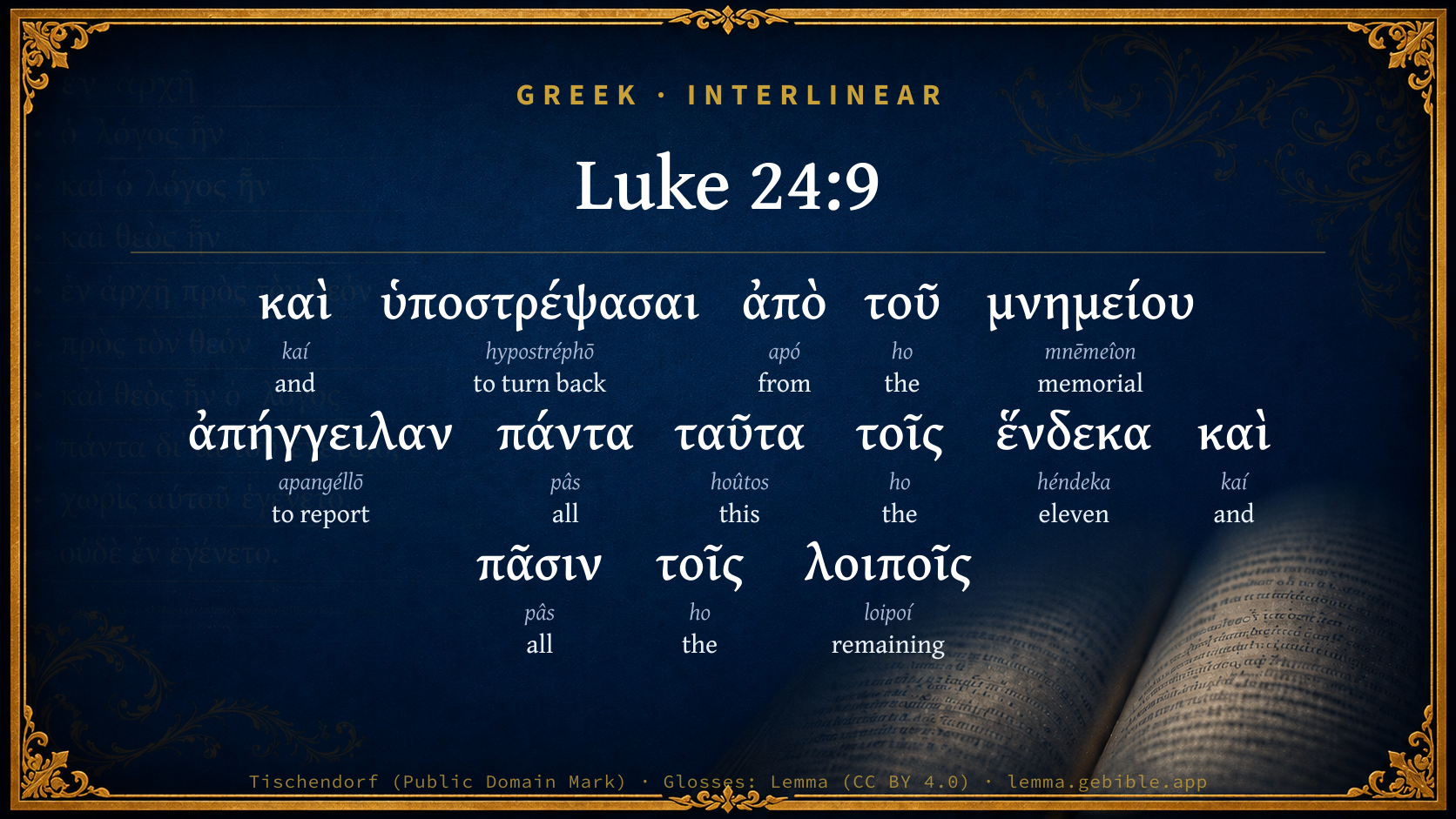
Greek (Tischendorf 8th ed.) Luke 24:9 appears in the Greek New Testament. The text above is from the Tischendorf 8th edition. Each word links to its Strong’s number and a concise gloss. Click any word for its full Thayer’s Greek Lexicon entry.
Download image
Cite this verse

Luke 24:9 (World English Bible). Public Domain. Lemma interlinear Bible study tool, https://lemma.gebible.app/v/luke/24/9.

Show BibTeX & RIS
BibTeX
RIS
English Translation
returned from the tomb, and told all these things to the eleven, and to all the rest.
World English Bible · Public Domain
Download a study sheet

One document with this verse’s original text, its word-by-word gloss line, the meaning frame, cross-references with their text, attributed commentary, and full source and license credits — printable, and it pastes into notes with its structure intact.

This verse Autodidact and up

Study sheet (.html) Plain text (.txt)

A passage Seminary Student

Up to 50 verses in one chapter. A passage sheet keeps up to 6 commentary sources and 12 cross-references per verse, in the order this page ranks them, and says so on the sheet whenever that leaves anything out. Ask for a single verse and you get the Autodidact verse sheet above.

Everything on this page stays free to read, with no account — the sheet is a download of what is already on screen, not access to it.

Want to remove ads? Support Godless Engineer
Compare translations 3

The same verse in 3 English versions, stacked beneath the original-language interlinear above. Click any original word for its lexicon entry.

Each is an independent rendering of the whole verse — the interlinear is not word-aligned to these translations.

Highlighted words mark where these versions differ — a whole-verse word diff, not a word-by-word alignment.

  • World English Bible Public Domain
    returned from the tomb, and told all these things to the eleven, and to all the rest.
  • King James Version Public Domain
    And returned from the sepulchre, and told all these things unto the eleven, and to all the rest.
  • unfoldingWord Literal Text CC BY-SA 4.0
    and having returned from the tomb, they reported all these things to the Eleven and to all the rest.

unfoldingWord Literal Text — © unfoldingWord, licensed CC BY-SA 4.0. Word-aligned USFM3 via Door43 (git.door43.org/unfoldingWord/en_ult).

Versions to compare (up to 4)

3 of 4 selected

Show all 19 translations

Every available English version of this verse, each an independent rendering of the whole verse.

  • World English Bible Public Domain
    returned from the tomb, and told all these things to the eleven, and to all the rest.
  • Berean Standard Bible Public Domain
    And when they returned from the tomb, they reported all these things to the Eleven and to all the others.
  • Majority Standard Bible Public Domain
    And when they returned from the tomb, they reported all these things to the Eleven and to all the others.
  • King James Version Public Domain
    And returned from the sepulchre, and told all these things unto the eleven, and to all the rest.
  • American Standard Version (1901) Public Domain
    and returned from the tomb, and told all these things to the eleven, and to all the rest.
  • Revised Version (1885) Public Domain
    and returned from the tomb, and told all these things to the eleven, and to all the rest.
  • Geneva Bible (1599) Public Domain
    And returned from the sepulchre, and tolde all these things vnto the eleuen, and to all the remnant.
  • Douay-Rheims (1899) Public Domain
    And going back from the sepulchre, they told all these things to the eleven, and to all the rest.
  • Young's Literal Translation Public Domain
    and having turned back from the tomb told all these things to the eleven, and to all the rest.
  • Literal Standard Version CC BY-SA 4.0
    and having turned back from the tomb, told all these things to the Eleven, and to all the rest.
  • Unlocked Literal Bible CC BY-SA 4.0
    and returned from the tomb, and told all these things to the eleven and all the rest.
  • unfoldingWord Literal Text CC BY-SA 4.0
    and having returned from the tomb, they reported all these things to the Eleven and to all the rest.
  • Darby Bible Public Domain
    and, returning from the sepulchre, related all these things to the eleven and to all the rest.
  • World Messianic Bible Public Domain
    returned from the tomb, and told all these things to the Eleven and to all the rest.
  • Webster's Bible Public Domain
    And returned from the sepulcher, and told all these things to the eleven, and to all the rest.
  • Free Bible Version CC BY-SA 4.0
    When they returned from the tomb they reported all that had happened to the eleven disciples and to all the others.
  • Bible in Basic English Public Domain
    And they went away from that place and gave an account of all these things to the eleven disciples and all the others.
  • Text-Critical English NT CC BY 4.0
    When they returned from the tomb, they told all these things to the eleven and to all the others.
  • Tyndale New Testament (1534) Public Domain
    and returned from the sepulcre and tolde all these thinges vnto the eleven and to all the remanaunt.

Literal Standard Version (2020), Covenant Press — licensed CC BY-SA 4.0. Text via the HelloAO Bible API (eBible.org). Unlocked Literal Bible (unfoldingWord) — licensed CC BY-SA 4.0. Text via the HelloAO Bible API (eBible.org). unfoldingWord Literal Text — © unfoldingWord, licensed CC BY-SA 4.0. Word-aligned USFM3 via Door43 (git.door43.org/unfoldingWord/en_ult). Free Bible Version, Dr. Jonathan Gallagher — licensed CC BY-SA 4.0. Text via the HelloAO Bible API (eBible.org).

Word by word

More ways to search: Search by grammar → Find every occurrence → Compare this word →

Practice this passage: Drill this verse → Learn its vocabulary →

ἕνδεκα
héndeka
G1733
“eleven”
Adjective, Numeral (indeclinable)
Part of Speech
Adjective · Numeral (indeclinable)
Full Thayer's Definition

Origin: from (the neuter of) G1520 and G1176

TDNT: None

1. eleven a. of the eleven disciples alive after the death of Judas
  1. καὶ kaí G2532 “and” Conjunction
  2. ὑποστρέψασαι hypostréphō G5290 “to turn back” Verb, Aorist, Active, Participle, Nominative, Plural, Feminine
  3. ἀπὸ apó G575 “from” Preposition
  4. τοῦ ho G3588 “the” Article, Genitive, Singular, Neuter
  5. μνημείου mnēmeîon G3419 “memorial” Noun, Genitive, Singular, Neuter
  6. ἀπήγγειλαν apangéllō G518 “to report” Verb, Aorist, Active, Indicative, 3rd person, Plural
  7. πάντα pâs G3956 “all” Adjective, Accusative, Plural, Neuter
  8. ταῦτα hoûtos G3778 “this” Demonstrative pronoun, Accusative, Plural, Neuter
  9. τοῖς ho G3588 “the” Article, Dative, Plural, Masculine
  10. καὶ kaí G2532 “and” Conjunction
  11. πᾶσιν pâs G3956 “all” Adjective, Dative, Plural, Masculine
  12. τοῖς ho G3588 “the” Article, Dative, Plural, Masculine
  13. λοιποῖς loipoí G3062 “remaining” Adjective, Dative, Plural, Masculine

About this verse

These counts appear in no published source. They are computed here, from the morphology-tagged text and Lemma’s own curated glosses. What Lemma adds →

14
words
10
distinct lemmas
Gospels
section

Notable vocabulary

The rarest word here is ἕνδεκα eleven G1733 — appearing just 6 times in the whole Greek New Testament.

Shared distinctive vocabulary

ἕνδεκα eleven G1733 occurs in 6 verses of the Greek New Testament. Also found in:

Repetition

Words recur within this verse:

Cross-references

4

Topical passages linked to Luke 24:9 in the Treasury of Scripture Knowledge — connected by theme and wording, ordered by reader-vote popularity; previews shown in the World English Bible.

  • Matthew 28:7–8 Go quickly and tell his disciples, 'He has risen from the dead, and behold, he goes before you into Galilee; there you will see him.' Behold, I have told you."
  • Mark 16:7–8 But go, tell his disciples and Peter, 'He goes before you into Galilee. There you will see him, as he said to you.'"
  • Luke 24:22–24 Also, certain women of our company amazed us, having arrived early at the tomb;
  • Mark 16:10 She went and told those who had been with him, as they mourned and wept.

Cross-references courtesy of OpenBible.info (CC BY 4.0).

Commentary

Notes on Luke 24:9 from classic Christian and Jewish commentators (each source and its license shown beneath its notes). The classic Christian expositions comment on the surrounding passage and are grouped to its opening verse, so a note may address several verses; the Jewish commentaries on the Tanakh (Rashi and others) are per-verse, so they appear only where the commentator wrote on this verse.

Lemma curates 59 commentaries, every one of them public domain or Creative Commons licensed, each selected and text-cleaned for this edition rather than reprinted as found. About our sources →

Joseph Benson's Commentary

Luk 24:9-12. They returned from the sepulchre — To Jerusalem; and told all these things to the eleven — Apostles, in the course, probably, of that morning, for it is not likely that they found them all collected together in one body; and to all the rest — Namely, at different times. And their words seemed to them as idle tales, &c. — Their Master’s crucifixion had given such a severe blow to their faith, that they had laid aside all the thoughts which they had entertained of his being the Messiah. And, therefore, they had not the least expectation of his resurrection, notwithstanding he had often predicted it to them: nay, they looked upon the story which the women told them about it as a mere chimera, the delusion of a disordered imagination. Then arose Peter, &c. — Or rather, But Peter, arising; ran to the sepulchre — That is, Peter was an exception: the tidings brought by Mary Magdalene, and the other women, did not seem as idle tales to him, nor to John, who now arose and went with him, and got to the sepulchre before him. See on Joh 20:1-10.

Joseph Benson's Commentary on the Old and New Testaments (1811–1818) — public domain. Text from a community e-Sword module.

Godbey's Commentary on the New Testament

William B. Godbey

RETURN OF THE WOMEN

Mat 28:8-10; Mar 16:8; Luk 24:9-11; Joh 20:2. “Then she runs, and comes to Simon Peter, and to the other disciple, whom Jesus loved, and says to them, They have taken away the Lord from the sepulcher, and we know not where they have placed Him.” This is spoken of Mary Magdalene, the most prominent of our Lord’s female disciples, and the only woman John mentions in this early visit to the sepulcher. This is not out of harmony with the other three, from the simple fact that she was the leader of the heroic sisterhood who lingered last at the cross, and hastened first to greet the risen Lord and look into the empty sepulcher.

I must here observe, in reference to Mark’s Gospel, that this eighth verse, which you see in the above reference, winds it up, the following twelve verses having been added by an unknown hand after Mark had laid down his pen. This fact of these last twelve verses not appearing in the old and authoritative manuscripts, does not necessarily invalidate their claims to inspiration, the author might have been inspired for ought we know, though we can have no idea as to his name. As it is believed that Peter dictated this Gospel to Mark, his faithful amanuensis and gospel helper, while in Rome, about A. D. 63, some suppose his martyrdom stopped the work, and consequently some one took it on himself to finish it out somewhat after the order of Matthew’s, which had been written A. D. 48. From the simple fact that in all of this writing I have used the Greek Testament by Tischendorf, on the basis of the Sinaitic manuscript which he discovered in the Convent of St. Catherine, on Mt. Sinai, A. D. 1859, and has thrown a flood of light on the New Testament, being the oldest manuscript and the only one entire, and as it closes Mark’s Gospel with this eighth verse of the sixteenth chapter, I shall neither quote nor expound the ensuing twelve verses; for, like Joh 8:1-11, and not a few other isolated passages, they are not in my book.

Matthew: “Having quickly come out from the sepulcher, with fear and great joy, they were running to tell His disciples.” You see how these women take the report of the angels, and run with all expedition to render obedience. “And while they were going to tell His disciples, behold, Jesus met them, saying, Hail! And they having come, embraced His feet, and worshipped Him. Then Jesus says to them, Fear not; go, tell My brethren, that they may depart into Galilee, and there they shall see Me.” Luke: “And returning from the sepulcher, they proclaimed these things to the eleven, and all the rest, And they were Mary Magdalene, Joanna, Mary the mother of James, and the other women along with them, who continued to tell these things to the apostles. And their words appeared unto them like a dream, and they believed them not.” Though Jesus had three different times distinctly prophesied to them His crucifixion and resurrection, they had never understood it; but were all settled in the common conviction that the Christ would never die, but abide and reign forever. Luke says that these prophecies were withheld from them, so they understood them not. That was all right. It was absolutely necessary that these most salient facts of redeeming mercy should be prominent in the prophetical curriculum, which, along with miracles, constitutes the basis of all faith in the Christhood.

Then why withhold it from their understanding until after it was all over? Good reason! If the disciples had understood it, they would have fought, bled, and died in His defense. Thousands would have helped them, and a bloody civil war broken out at the time of His arrest. Through fear of the people, His enemies were often restrained from laying hands on Him, finally attacking Him at midnight, doing their best to kill Him before day; and despite the tardiness of Pilate and Herod, actually had Him nailed to the cross at the early hour of 9 A.M., Pilate finally signing His death-warrant as a sheer peace measure, as he saw the crowd gathering rapidly, and knew they were going to fight for Him, and thus involve the whole country in a terrible civil war. In the good providence of God, the prophecies revealing His crucifixion and resurrection were withheld from the understanding of His disciples till after the momentous tragedy of the world’s redemption was consummated. When they saw Him expire on the cross, they gave up all hope of His Messiahship, settling down in the conclusion that He was the greatest prophet the world ever saw and no more, so that when those women came and told them that He was absent from the sepulcher, and the angels had said He was risen, and that they had actually seen Him, their words seemed like a dream — the news was too good to be believed.

William B. Godbey, Commentary on the New Testament (1896–1900) — public domain. Text from a community e-Sword module.

Tyndale Open Study Notes

Tyndale Open Resources

24:9 His eleven disciples were the Twelve minus Judas.

Tyndale Open Study Notes — © Tyndale Open Resources, licensed CC BY-SA 4.0. Text via the HelloAO Bible API.

Expositor's Greek Testament

ed. W. Robertson Nicoll

Luk 24:9 . ἀπήγγειλαν , etc.: cf. the statement in Mar 16:8 , according to which the women said nothing to any person.

The Expositor's Greek Testament, edited by W. Robertson Nicoll (1897–1910) — public domain. Text from a community e-Sword module.

Geneva Bible (1599)

Geneva Bible translators

The cowardly and dastardly minds of the disciples is upbraided by the stout courage of women, (so wrought by God’s great mercy) to show that the kingdom of God consisteth in an extraordinary power.

Geneva Bible (1599) marginal notes — public domain. Text via Bolls.life.

Ellicott's Commentary for English Readers

(9-11) To all the rest.—So Mat_28:8 as to “the disciples,” as a wider term than “Apostles.” We may naturally think of many at least of the Seventy as being among the “rest.”

A Bible Commentary for English Readers, edited by Charles John Ellicott (1878–1897) — public domain. Text from a community e-Sword module.

The Cambridge Bible for Schools and Colleges

gen. ed. J. J. S. Perowne

9. returned from the sepulchre] Comp. Mat_28:8. From Joh_20:2 we infer that Mary of Magdala had, in the first instance, run from the sepulchre to tell Peter and John of the removal of the stone, and had therefore not seen the first vision of angels. The apparent contradiction in Mar_16:8 obviously means that they ‘said not one word on the subject to any one’ except the Apostles to whom they were expressly told to announce it (Mat_28:7).

The Cambridge Bible for Schools and Colleges (gen. ed. J. J. S. Perowne; Cambridge University Press, 1878–1918) — public domain. Text from a community e-Sword module.

John Gill's Exposition

And their words seemed to them as idle tales,.... As fabulous things, as mere whims, and the fancies of their brains: "as a dream", according to the Persic version; or, "as a jest", as the Arabic version renders it. They looked upon them as mere deceptions and delusions, and not real things; the Vulgate Latin, Syriac, Arabic, and Ethiopic versions read, "these words"; what they related concerning what they saw, and heard, at the sepulchre:

and they believed them not: for they had no thought, nor expectation of Christ's rising from the dead; they did not know that he was to rise again, according to the Scriptures; nor did they understand him when he told them of his rising again; and had no faith in it, nor hope concerning it, and could give no credit to it, when it was told them; and the Arabic version reads, "they did not believe it"; the word or report which the women delivered to them.

John Gill's Exposition of the Whole Bible (1746–1763) — public domain (CC PDM 1.0). Text via the HelloAO Bible API.

Trapp's Complete Commentary

John Trapp

9 And returned from the sepulchre, and told all these things unto the eleven, and to all the rest.

Ver. 9. And told all these things] Per os mulieris mors ante processerat, per os mulieris vita reparatur, saith Ambrose. So, Luk 1:28-37, an angel of light communeth with a woman about man’s salvation, as an angel of darkness had done {Gen 3:1-7} about his fall and destruction.

And told all these things] For it was a day of good tidings, as those lepers said in another case, 2Ki 7:9, the sum of all the good news in the world.

John Trapp, A Commentary or Exposition upon All the Books of the Old and New Testament (1647–1656) — public domain. Text from a community e-Sword module.

Matthew Poole's English Annotations

See Poole on "Mat 28:8", and following verses to Mat 28:10, but more fully, See Poole on "Joh 20:2", and following verses to Joh 20:9, who repeateth this piece of history more largely than the rest. It is plain that scarce any of the disciples gave credit to the first relation of the women; but yet, it being near the city, Peter and John thought it worth the while to go and see. For though Peter alone be mentioned here, yet John is mentioned, Joh 20:3-5, under the notion of that other disciple; and he is said to have outrun Peter, and to have come first to the sepulchre. But concerning that part of the history relating to the resurrection, we shall reserve ourselves till we come to Joh 20:1-31. We now pass on to a piece of history relating to the evidencing of Christ’s resurrection, which is neither touched by Matthew nor by Luke. Mark toucheth it shortly, Mar 16:12,13, After that he appeared in another form to two of them, as they walked, and went into the country. And they went and told it unto the residue; neither believed they them. We shall now hear Luke giving us a more full and perfect account.

Matthew Poole's English Annotations on the Holy Bible (1683–1685) — public domain. Text from a community e-Sword/MySword module.

The Pulpit Commentary

And told all these things unto the eleven, and to all the rest. The account of the scenes at the sepulchre in St. Luke are the least vivid and detailed of the four evangelists. It must be remembered that Matthew, Mark (the amanuensis of Peter), and John relate their own memories here, as well as what they had heard from the holy women. Peter and John, we know, were present themselves at the sepulchre. St. Luke received his less detailed and more summarized account of that early morning, years after, most probably from the lips of one of the holy women who had formed part of one of the "two companies" who carried spices for the embalming.

The Pulpit Commentary (1880–1919), ed. H.D.M. Spence-Jones & Joseph S. Exell — public domain. Text from a community e-Sword module.

McGarvey & Pendleton's Commentaries

J. W. McGarvey

J. W. McGarvey's The Fourfold Gospel [CXXXV. First and Second Appearances].

CXXXV. FIRST AND SECOND APPEARANCES OF THE RISEN CHRIST. THE RESURRECTION REPORTED TO THE APOSTLES. (Jerusalem. Sunday morning.) aMATT. XXVIII. 9, 10; bMARK XVI. 9-11; cLUKE XXIV. 9-11; dJOHN XX. 11-18.

[The women, having received the message of the angels, and remembering that the message accorded with the words [742] of Jesus himself, made haste.] c9 and returned from the tomb, b9 Now when he was risen early on the first day of the week, he appeared first to Mary Magdalene, from whom he had cast out seven demons. [Mark here agrees with John that Mary separated from the other women. As to Mary Magdalene, see Luk_24:16), lest the shock of his sudden appearance might be too much for her, as it was for even his male disciples [743] ( Luk_24:37). Conversation with him assured her that he was not a disembodied spirit.] 15 Jesus saith unto her, Woman, why weepest thou? whom seekest thou? She, supposing him to be the gardener, saith unto him, Sir, if thou hast borne him hence, tell me where thou hast laid him, and I will take him away. [Christ's first question expressed kindly sympathy; the second suggested that he knew the cause of her grief, and might be able to help her find what she sought. Thus encouraged, Mary at once assumes that the gardener himself had removed the body, probably under instructions from Joseph, and hope lightens her heart. In her effort to remove the body, she doubtless counts upon the help of her fellow-disciples.] 16 Jesus saith unto her, Mary. [Her eyes and ears were no longer held; she knew him. It was the same way he used to speak, the same name by which he used to call her. The grave had glorified and exalted him, but had not changed his love.] She turneth herself, and saith unto him in Hebrew, Rabboni; which is to say, Teacher. [Seasons of greatest joy are marked by little speech. Jesus and Mary each expressed themselves in a single word.] 17 Jesus saith to her, Touch me not; for I am not yet ascended unto the Father: but go unto my brethren, and say to them, I ascend unto my Father and your Father, and my God and your God. [This passage is one of well-known difficulty, and Meyer or Ryle may be consulted by those wishing to see how various commentators have interpreted it. We would explain it by the following paraphrase: "Do not lay hold on me and detain yourself and me; I have not yet ascended; this is no brief, passing vision; I am yet in the world, and will be for some time, and there will be other opportunities to see me; the duty of the moment is to go and tell my sorrowing disciples that I have risen, and shall ascend to my Father." Jesus does not say "our Father." Our relation to God is not the same as his. While, however, our Lord's language recognizes the difference between his divine and our human relationship to the Father, his words are intended to [744] show us our exaltation. We have reason to believe that next to our Lord's title as Son our title as sons of God by adoption is as high in honor as any in the universe.] 18 Mary Magdalene cometh and telleth { bwent and told dthe disciples, bthem that had been with him, as they mourned and wept. [The poignancy of the disciples' grief, even after the intervention of the Sabbath day, explains why the Lord and his angels were so eager to bring them word of the resurrection.] dI have seen the Lord; and that he had said these things unto her. b11 And they, when they heard that he was alive, and had been seen of her, disbelieved. [It is likely that Mary brought the first word, for we shall see below that Luke places her first in the catalogue of witnesses. The narrative now turns back to take up the account of the other women.] a9 And behold, Jesus met them, saying, All hail. [This was a customary salutation. But the old formula took on new significance, for it means "rejoice."] And they came and took hold of his feet, and worshipped him. [This delay, permitted to them, and denied to Mary, probably explains why she became the first messenger, though the other women were first to leave the tomb.] 10 Then saith Jesus unto them, Fear not: go tell my brethren that they depart into Galilee, and there shall they see me. [The repetition may be due to the reticence of the women remarked by Mark in the last section by the key words "and they said nothing to any one." The women may have been hesitating whether they should tell the disciples. Thus Jesus reiterates the instruction already given by the angel. This is the first time the word "brethren" is applied by our Lord to his disciples.] cand [they] told all these things to the eleven, and to all the rest. 10 Now they were Mary Magdalene, and Joanna, and Mary the i mother of James: and the other women with them told these things unto the apostles. 11 And these words appeared in their sight as idle talk; and they disbelieved them. [Lamar well says that this very incredulity on the part of the apostles "enhances the value of their [745] testimony to the fact of the resurrection. They were not expecting it; they were no visionary enthusiasts, prepared to welcome and credit any story that might be told them; nor would they be satisfied with any proof short of palpable and ocular demonstrations."]

[FFG 742-746]

J. W. McGarvey (with Philip Y. Pendleton), Commentaries on the New Testament (The Fourfold Gospel, 1914; Acts; and the epistles) — public domain. Text from a community e-Sword/MySword module.

Cambridge Greek Testament for Schools and Colleges

9. ὑποστρέψασαι. Comp. Mat 28:8. From Joh 20:2 we infer that Mary of Magdala had, in the first instance, run from the sepulchre to tell Peter and John of the removal of the stone, and had therefore not seen the first vision of angels. The apparent contradiction in Mar 16:8 obviously means that they ‘said not one word on the subject to any one’ except the Apostles to whom they were expressly told to announce it (Mat 28:7).

9. To James, the Lord’s brother. 1Co 15:7.

Cambridge Greek Testament for Schools and Colleges (Cambridge University Press, 1896; 21 vols, various authors incl. Carr, Maclear, Plummer, Farrar, Lumby, Moule, M. R. James, Simcox) — public domain. Text from a community e-Sword module.

Alford’s Greek Testament

Henry Alford

9.] See note on Mark ver. 8.

Henry Alford, The Greek Testament (1849–1861) — public domain. Text from a community e-Sword module.

International Critical Commentary

9. ὑποστρέψασαι. Lk.’s favourite word: Mt. has ἀπελθοῦσαι and Mk. ἐξελθοῦσαι. Lk. omits the speed with which they returned in mingled fear and joy.

ἀπήγγειλαν. Mt. says the same (28:8), but Mk. says οὐδενὶ οὐδὲν εἶπαν, ἐφοβοῦντο γάρ. If we had the conclusion of Mk.’s Gospel we should know how this apparent contradiction is to be explained. Obviously they did not remain silent about it for the rest of their lives, but only so long as fear kept them silent. When the fear passed away, they told their tale to the disciples (not merely to the Apostles) in accordance with the angelic charge (Mat 28:7). But it is perhaps simpler to suppose that Mt. and Lk. here give, as Mt. and Mk. do in the case of the crucified robbers, the tradition which was generally current, and which attributed to all the women what was true of only one, viz. Mary Magdalen. She on her return told the Apostles, while the others kept silence through fear. A little later no doubt all told to all. Note the characteristic πάντα and πᾶσιν. Mt. has neither, and he sums up “the Eleven and all the rest” in τοῖς μαθηταῖς αὐτοῦ.

International Critical Commentary — older volumes (1896–1929), various authors — public domain. Text from a community e-Sword module.

Lesson kit

Teaching starters — assembled from the data on this page, not authored interpretation. Every prompt links to the verse data it draws on. Edit before teaching.

Luke, in the Gospels, opens this verse with 14 words (10 distinct Greek lemmas). Its most distinctive word is héndeka (“eleven”). A historical commentator’s framing appears above. Read the whole chapter for the surrounding context.

Discussion questions

  1. The word héndeka carries the sense “eleven.” How does it shape the verse?
  2. Matthew 28:16 shares the word «eleven» with this verse. How do the two illuminate each other?
  3. “all” occurs 2× in this one verse. What is the effect of the repetition?
  4. These translations render this verse differently. What is at stake in choosing one wording over another?
  5. Reading how Joseph Benson's Commentary and Godbey's Commentary on the New Testament read this verse, where do the two commentators agree and where do they part?

Things to notice

Reading settings

Reading text

Shown beneath each verse's original-language words.

Old Testament
Old Testament edition

Read the OT as the Masoretic Hebrew (MT) or the Greek Septuagint (LXX).

English shown for the Greek Septuagint (in the Hebrew ↔ Greek comparison).

Comparing translations? Open the Compare panel on any verse page to stack up to four side by side.