John 7:41

Greek (Tischendorf 8th ed.) John 7:41 appears in the Greek New Testament. The text above is from the Tischendorf 8th edition. Each word links to its Strong’s number and a concise gloss. Click any word for its full Thayer’s Greek Lexicon entry.
Download image
Cite this verse

John 7:41 (World English Bible). Public Domain. Lemma interlinear Bible study tool, https://lemma.gebible.app/v/john/7/41.

Show BibTeX & RIS
BibTeX
RIS
English Translation
Others said, "This is the Christ." But some said, "What, does the Christ come out of Galilee?
World English Bible · Public Domain
Download a study sheet

One document with this verse’s original text, its word-by-word gloss line, the meaning frame, cross-references with their text, attributed commentary, and full source and license credits — printable, and it pastes into notes with its structure intact.

This verse Autodidact and up

Study sheet (.html) Plain text (.txt)

A passage Seminary Student

Up to 50 verses in one chapter. A passage sheet keeps up to 6 commentary sources and 12 cross-references per verse, in the order this page ranks them, and says so on the sheet whenever that leaves anything out. Ask for a single verse and you get the Autodidact verse sheet above.

Everything on this page stays free to read, with no account — the sheet is a download of what is already on screen, not access to it.

Want to remove ads? Support Godless Engineer
Compare translations 3

The same verse in 3 English versions, stacked beneath the original-language interlinear above. Click any original word for its lexicon entry.

Each is an independent rendering of the whole verse — the interlinear is not word-aligned to these translations.

Highlighted words mark where these versions differ — a whole-verse word diff, not a word-by-word alignment.

  • World English Bible Public Domain
    Others said, "This is the Christ." But some said, "What, does the Christ come out of Galilee?
  • King James Version Public Domain
    Others said, This is the Christ. But some said, Shall Christ come out of Galilee?
  • unfoldingWord Literal Text CC BY-SA 4.0
    Others said, “This is the Christ.” But some said, “Indeed, the Christ does not come from Galilee, does he?

unfoldingWord Literal Text — © unfoldingWord, licensed CC BY-SA 4.0. Word-aligned USFM3 via Door43 (git.door43.org/unfoldingWord/en_ult).

Versions to compare (up to 4)

3 of 4 selected

Show all 19 translations

Every available English version of this verse, each an independent rendering of the whole verse.

  • World English Bible Public Domain
    Others said, "This is the Christ." But some said, "What, does the Christ come out of Galilee?
  • Berean Standard Bible Public Domain
    Others declared, “This is the Christ.” But still others asked, “How can the Christ come from Galilee?
  • Majority Standard Bible Public Domain
    Others declared, “This is the Christ.” But still others asked, “How can the Christ come from Galilee?
  • King James Version Public Domain
    Others said, This is the Christ. But some said, Shall Christ come out of Galilee?
  • American Standard Version (1901) Public Domain
    Others said, This is the Christ. But some said, What, doth the Christ come out of Galilee?
  • Revised Version (1885) Public Domain
    Others said, This is the Christ. But some said, What, doth the Christ come out of Galilee?
  • Geneva Bible (1599) Public Domain
    Other saide, This is that Christ: and some said, But shall that Christ come out of Galile?
  • Douay-Rheims (1899) Public Domain
    Others said: This is the Christ. But some said: Doth the Christ come out of Galilee?
  • Young's Literal Translation Public Domain
    others said, `This is the Christ;' and others said, `Why, out of Galilee doth the Christ come?
  • Literal Standard Version CC BY-SA 4.0
    others said, “This is the Christ”; and others said, “Why, does the Christ come out of Galilee?
  • Unlocked Literal Bible CC BY-SA 4.0
    Others said, “This is the Christ.” But some said, “Does the Christ come from Galilee?
  • unfoldingWord Literal Text CC BY-SA 4.0
    Others said, “This is the Christ.” But some said, “Indeed, the Christ does not come from Galilee, does he?
  • Darby Bible Public Domain
    Others said, This is the Christ. Others said, Does then the Christ come out of Galilee?
  • World Messianic Bible Public Domain
    Others said, “This is the Messiah.” But some said, “What, does the Messiah come out of Galilee?
  • Webster's Bible Public Domain
    Others said, This is the Christ. But some said, Will Christ come out of Galilee?
  • Free Bible Version CC BY-SA 4.0
    Others said, “He is the Messiah!” Still others said, “How can the Messiah come from Galilee?
  • Bible in Basic English Public Domain
    Others said, This is the Christ. But others said, Not so; will the Christ come from Galilee?
  • Text-Critical English NT CC BY 4.0
    Others were saying, “He is the Christ.” But others were saying, “No, for the Christ does not come from Galilee, does he?
  • Tyndale New Testament (1534) Public Domain
    Other sayde: this is Christ. Some sayde: shall Christ come out of Galile?

Literal Standard Version (2020), Covenant Press — licensed CC BY-SA 4.0. Text via the HelloAO Bible API (eBible.org). Unlocked Literal Bible (unfoldingWord) — licensed CC BY-SA 4.0. Text via the HelloAO Bible API (eBible.org). unfoldingWord Literal Text — © unfoldingWord, licensed CC BY-SA 4.0. Word-aligned USFM3 via Door43 (git.door43.org/unfoldingWord/en_ult). Free Bible Version, Dr. Jonathan Gallagher — licensed CC BY-SA 4.0. Text via the HelloAO Bible API (eBible.org).

Word by word

More ways to search: Search by grammar → Find every occurrence → Compare this word →

Practice this passage: Drill this verse → Learn its vocabulary →

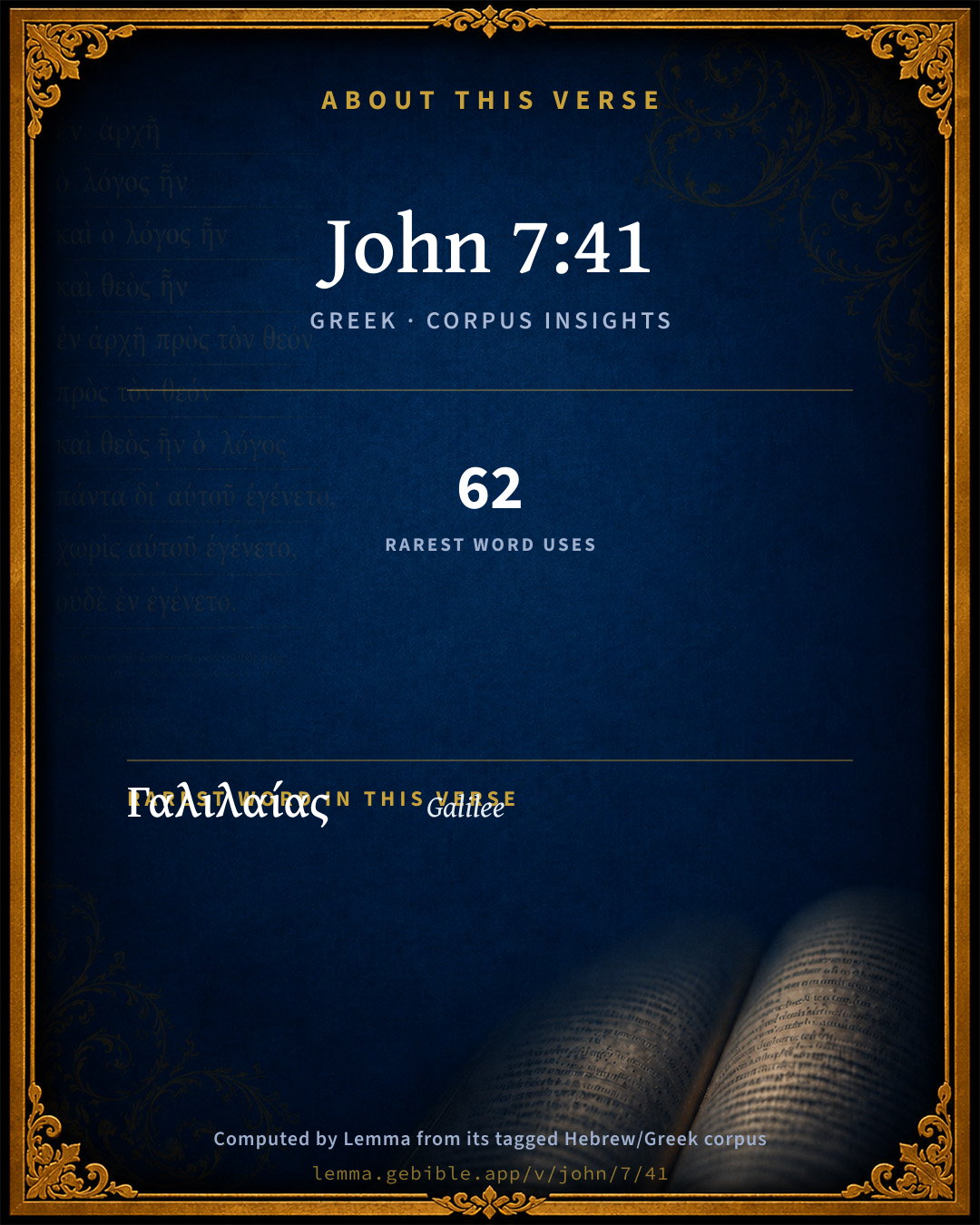
Γαλιλαίας
Galilaía
G1056
“Galilee”
Noun, Genitive, Singular, Feminine
Part of Speech
Noun
Case
Genitive
Number
Singular
Gender
Feminine
Full Thayer's Definition

Origin: of hebrew origin H1551

TDNT: None

Galilee = "Circuit"
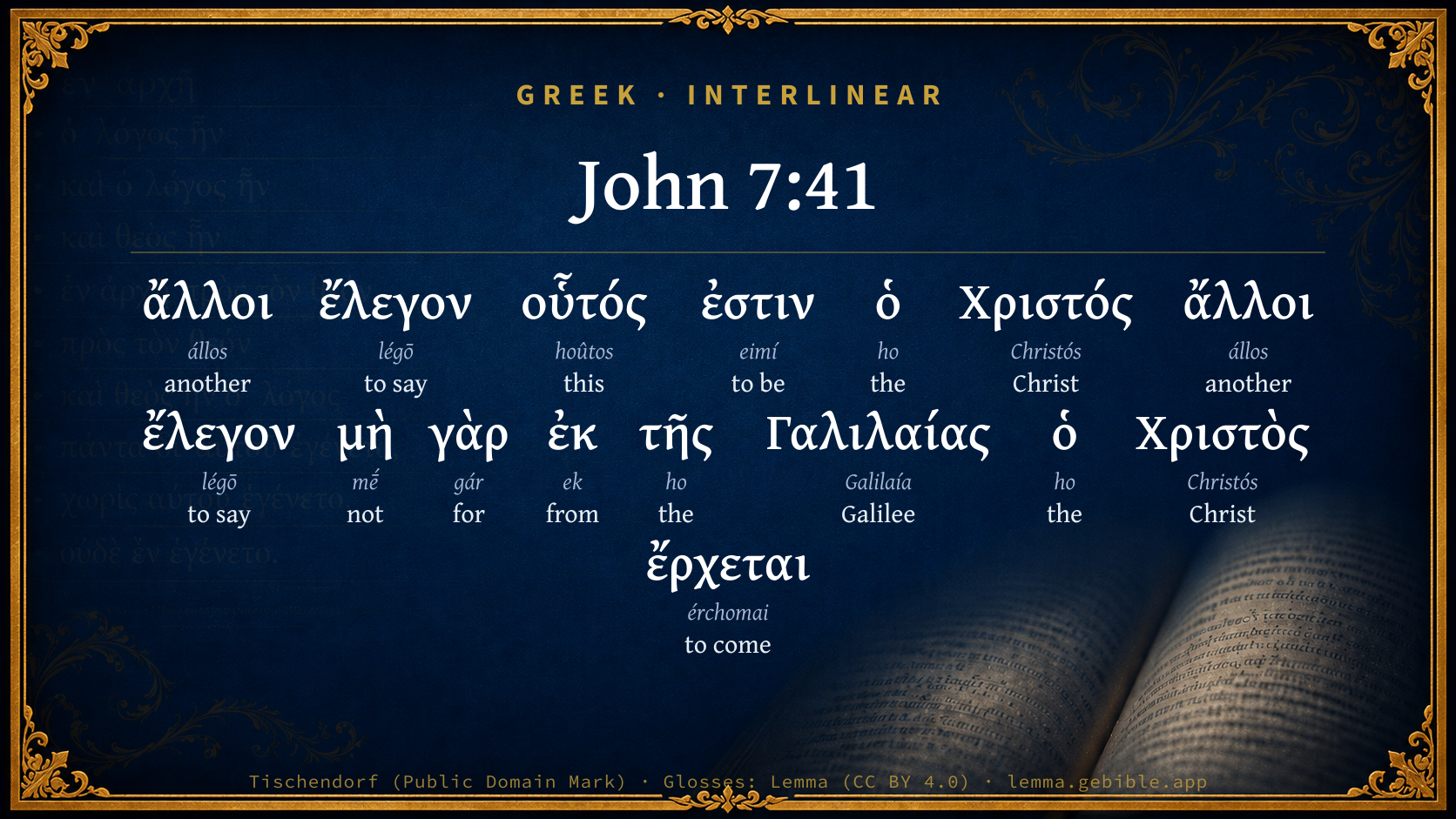
  1. ἄλλοι állos G243 “another” Adjective, Nominative, Plural, Masculine
  2. ἔλεγον légō G3004 “to say” Verb, Imperfect, Active, Indicative, 3rd person, Plural
  3. οὗτός hoûtos G3778 “this” Demonstrative pronoun, Nominative, Singular, Masculine
  4. ἐστιν eimí G1510 “to be” Verb, Present, Active, Indicative, 3rd person, Singular
  5. ὁ ho G3588 “the” Article, Nominative, Singular, Masculine
  6. Χριστός Christós G5547 “Christ” Noun, Nominative, Singular, Masculine
  7. ἄλλοι állos G243 “another” Adjective, Nominative, Plural, Masculine
  8. ἔλεγον légō G3004 “to say” Verb, Imperfect, Active, Indicative, 3rd person, Plural
  9. μὴ mḗ G3361 “not” Particle, Negative
  10. γὰρ gár G1063 “for” Conjunction
  11. ἐκ ek G1537 “from” Preposition
  12. τῆς ho G3588 “the” Article, Genitive, Singular, Feminine
  13. ὁ ho G3588 “the” Article, Nominative, Singular, Masculine
  14. Χριστὸς Christós G5547 “Christ” Noun, Nominative, Singular, Masculine
  15. ἔρχεται érchomai G2064 “to come” Verb, Present, Middle or Passive deponent, Indicative, 3rd person, Singular

About this verse

These counts appear in no published source. They are computed here, from the morphology-tagged text and Lemma’s own curated glosses. What Lemma adds →

16
words
11
distinct lemmas
Gospels
section

Repetition

Words recur within this verse:

  • ἄλλοι another G243 ×2
  • ἔλεγον to say G3004 ×2
  • Χριστός Christ G5547 ×2
  • ὁ the G3588 ×3

Cross-references

10

Topical passages linked to John 7:41 in the Treasury of Scripture Knowledge — connected by theme and wording, ordered by reader-vote popularity; previews shown in the World English Bible.

  • John 7:52 They answered him, "Are you also from Galilee? Search, and see that no prophet has arisen out of Galilee."
  • John 1:46 Nathanael said to him, "Can any good thing come out of Nazareth?" Philip said to him, "Come and see."
  • John 1:49 Nathanael answered him, "Rabbi, you are the Son of God! You are King of Israel!"
  • Matthew 16:14–16 They said, "Some say John the Baptizer, some, Elijah, and others, Jeremiah, or one of the prophets."
  • John 1:41 He first found his own brother, Simon, and said to him, "We have found the Messiah!" (which is, being interpreted, Christ).
  • John 4:25 The woman said to him, "I know that Messiah comes," (he who is called Christ). "When he has come, he will declare to us all things."
  • John 4:29 "Come, see a man who told me everything that I did. Can this be the Christ?"
  • John 4:42 They said to the woman, "Now we believe, not because of your speaking; for we have heard for ourselves, and know that this is indeed the Christ, the Savior of the world."
  • John 6:69 We have come to believe and know that you are the Christ, the Son of the living God."
  • John 7:31 But of the multitude, many believed in him. They said, "When the Christ comes, he won't do more signs than those which this man has done, will he?"

Cross-references courtesy of OpenBible.info (CC BY 4.0).

Commentary

Notes on John 7:41 from classic Christian and Jewish commentators (each source and its license shown beneath its notes). The classic Christian expositions comment on the surrounding passage and are grouped to its opening verse, so a note may address several verses; the Jewish commentaries on the Tanakh (Rashi and others) are per-verse, so they appear only where the commentator wrote on this verse.

Lemma curates 59 commentaries, every one of them public domain or Creative Commons licensed, each selected and text-cleaned for this edition rather than reprinted as found. About our sources →

Tyndale Open Study Notes

Tyndale Open Resources

7:41-42 These Jews, different from the crowd (7:25-27) who thought the Messiah would appear mysteriously, believed the prophecy that the Messiah would be from Bethlehem of Judea (see Mic 5:2). However, they stumbled over the fact that Jesus seemed to be from Galilee, where he grew up.

Tyndale Open Study Notes — © Tyndale Open Resources, licensed CC BY-SA 4.0. Text via the HelloAO Bible API.

Expositor's Greek Testament

ed. W. Robertson Nicoll

Joh 7:41 . But others, either honestly perplexed, or hostile to Christ, and glad to find Scripture on their side, objected, μὴ γὰρ ἐκ τῆς Γαλιλαίας ὁ Χριστὸς ἔρχεται ; “But does the Christ come out of Galilee?” [Hoogeveen explains the γάρ by resolving the sentence into a double statement: “Others said this is not the Christ: for Christ will not come out of Galilee”. The γάρ assigns the reason for the denial already hinted in the ἄλλοι δὲ introducing a contrary opinion to that already expressed.] They knew that Jesus was a Galilean, and this clashed with their idea that the Christ was to be born of the seed of David and in Bethlehem; an idea founded on Mic 5:2 ; Isa 11:1 ; Jer 23:5 . Bethlehem is here called the κώμη ὅπου ἦν Δαβίδ [or Δαυείδ , which gives the same pronunciation], because there David spent his youth; 1Sa 16:1 ; 1Sa 16:4 , etc.

The Expositor's Greek Testament, edited by W. Robertson Nicoll (1897–1910) — public domain. Text from a community e-Sword module.

Jamieson, Fausset & Brown

Robert Jamieson, A. R. Fausset & David Brown

Others said, This is the Christ--(See on Joh 1:21).

Shall Christ come out of Galilee?

Jamieson, Fausset & Brown — Commentary Critical and Explanatory on the Whole Bible (1871) — public domain (CC PDM 1.0). Text via the HelloAO Bible API.

Adam Clarke's Commentary

Verse 41. Shalt Christ come out of Galilee?] As the prophets had declared that the Messiah was to come from the tribe of Judah, and from the family of David, and should be born in the city of Bethlehem, these Jews, imagining that Christ had been born in Galilee, concluded that he could not be the Messiah. Had they examined the matter a little farther, they would have found that he had his birth exactly as the prophets had foretold; but, for want of this necessary examination, they continued in unbelief, and rejected the Lord that bought them. Many still lose their souls nearly in the same way. They suffer themselves to be led away by common report, and become prejudiced against the truth, refuse to give it a fair hearing, or to examine for themselves. It is on this ground that deign and irreligion have established themselves, and still maintain their posts.

Adam Clarke's Commentary on the Bible (1810–1826) — public domain. Text from a community e-Sword/MySword module.

John Calvin's Commentaries

41. Others said, He is the Christ. The second have a more correct opinion than the first; for they plainly acknowledge that he is the Christ; but the third rise up against them, and hence proceeds the debate. By this example we are warned that we ought not to think it strange in the present day, if men are divided among themselves by various controversies. We learn that Christ’s sermon produced a schism, and that not among Gentiles who were strangers to the faith, but in the midst of the Church of Christ, and even in the chief seat of the Church. Shall the doctrine of Christ be blamed on that account, as if it were the cause of disturbances? Nay rather, though the whole world were in commotion, the word of God is so precious, that we ought to wish that it were received, at least by a few. There is no reason, therefore, why our consciences should be distressed, when we see those who wish to be accounted the people of God fighting with each other by contrary opinions.

Yet it ought also to be observed that divisions do not properly draw their origin from the Gospel; for there can be no firm agreement among men except in undoubted truth. As to the peace maintained among those who know not God, it arises more from stupidity than from true agreement. In short, of all the differences which spring up, when the Gospel is preached, the cause and seed formerly lay concealed in men; but when they are awakened, as it were, out of sleep, they begin to move, just as vapours are produced by something else than the sun, although it is not till the sun arises that they make their appearance.

But will Christ come out of Galilee? That they may not be thought to reject Christ on insufficient grounds, they fortify themselves by the testimony of Scripture; and though they do violence to this passage, by turning it improperly against Christ, still they have some appearance of truth. In this point only they are in the wrong, that they make Christ a Galilean. But whence arises this ignorance but from contempt? For if they had taken the trouble to inquire, they would have seen that Christ was adorned with both titles; that he was born in Bethlehem, and that he was the son of David But such is our natural disposition; in matters of little consequence we are ashamed of being indolent, while, in the mysteries of the heavenly kingdom, we slumber without any concern. It is likewise of importance to observe, that those men are diligent and industrious in seeking an excuse for turning aside from Christ, but, at the same time, are astonishingly slow and dull in receiving sound doctrine. In this manner, out of the Scriptures themselves, which lead us by the hand to Christ, men frequently make obstacles for themselves, that they may not come to Christ.

John Calvin's Commentaries (1540-1563) — public domain. Text from the Calvin Translation Society English edition (1840s-50s) via the Christian Classics Ethereal Library (ccel.org). Calvin's coverage is partial (roughly two-thirds of the Bible); uncommented books and verses are honest gaps, never fabricated. The 19th-century editor's footnotes and remarks are omitted so the notes are faithfully Calvin's own voice.

Ellicott's Commentary for English Readers

(41) Others said this is the Christ.—The Messiah is distinguished from the Prophet in the words of the multitude there, as in the question of the legates of the Sanhedrin, Joh_1:20-21.

Shall Christ come out of Galilee?—The answer “No” is expected, and the tense is present—Surely the Messiah cometh not out of Galilee?

A Bible Commentary for English Readers, edited by Charles John Ellicott (1878–1897) — public domain. Text from a community e-Sword module.

The Cambridge Bible for Schools and Colleges

gen. ed. J. J. S. Perowne

41. Others said … some said] Both verbs, as in Joh_7:40, are imperfects of repeated action; kept saying, used to say.

Shall Christ come out of Galilee] We have here an instance how little attention our translators paid to the Greek article: in the same verse they translate the article in one place and ignore it in another. In the next verse they ignore it again. In all three places it should be ‘the Christ’ (see on Joh_1:20). Why, doth the Christ come out of Galilee? It is quite inadmissible to infer, because S. John does not correct this mistake of supposing that Jesus came from Galilee, that he is either ignorant of the truth or indifferent to it. He knew that his readers would be well aware of the facts. On the other hand, could a Greek of the second century invent these discussions of the Jewish multitude?

The Cambridge Bible for Schools and Colleges (gen. ed. J. J. S. Perowne; Cambridge University Press, 1878–1918) — public domain. Text from a community e-Sword module.

John Gill's Exposition

Hath not the Scripture said,.... These objectors were those who were accounted the more wise and knowing; who were conversant with the Scriptures, and pretended at least to a large knowledge of them:

that Christ cometh out of the seed of David; that he should be a rod out of the stem of Jesse, and a branch out of his roots; that he should be one out of David's loins, and of the fruit of his body, referring to Isa 11:1, which was very true, and what was commonly known, and expected among the Jews, that the Messiah should be David's son, as Jesus of Nazareth was, Act 13:23;

and out of the town of Bethlehem where David was? where his parents lived, and he was born; and, according to Jerom (k), he was buried here. The account he gives of this city, where he himself for some time lived,

"is Bethlehem, the city of David, in the lot of the tribe of Judah, in which our Lord and Saviour was born, is six miles from Aelia, (i.e. Jerusalem) to the south, by the way which leads to Hebron, where also is showed the sepulchre of Jesse and David.''

In which may be observed likewise the exact distance of this place from Jerusalem; which, according to Josephus (l), at least as he is generally understood, was but twenty furlongs: and, according to Justin (m), thirty five: but that this is the true distance, is clear from the old Jerusalem Itinerary (n), and which agrees with Jerom about the sepulchre of David; for not far from it is the monument of Ezekiel, Asaph, Job, Jesse, David, and Solomon: however, it is certain that David was born here, and therefore it is called his city; and from hence the Messiah was to come; and here Jesus, the true Messiah, was born, and which the Jews themselves own; See Gill on Mat 2:1, See Gill on Luk 2:4; and in vain it is for them to expect the Messiah from thence, where none of their nation live, nor have lived, for many hundreds of years; being particularly forbid by Adrian, after he had subdued them, living in or near Jerusalem, and also Bethlehem. Tertullian (o) refers to this when he thus argues with them, and very justly, and strongly;

"if he is not yet born, who, it is said, shall come forth a ruler out of Bethlehem, of the tribe of Judah, he must come (says he) out of the tribe of Judah and from Bethlehem; but we now observe, that no one of the stock of Israel remains in Bethlehem, because it is forbidden that anyone of the Jews should continue on the border of that country--how shall the governor be born in Judea, come forth from Bethlehem, as the divine books of the Prophets declare, when there is none of Israel left there at this day, of whose lineage Christ can be born?--how shall he come out of Bethlehem, when there is none in Bethlehem of the stock of Israel?''

And the passage they had in view, is Mic 5:2. Now these very things they object to Jesus being the Messiah, were what were fulfilled in him, and proved him to be the person; for his supposed father, and real mother Mary, were of the house and lineage of David; and though he was conceived at Nazareth, and brought up there, yet by a remarkable providence, which brought Joseph and Mary to Bethlehem, he was born there, Luk 2:4.

(k) De locis Hebraicis, fol. 89. E. (l) Antiqu. l. 7. c. 12. sect. 4. (m) Apolog. 2. p. 75. (n) In Reland. Palestina illustrata, l. 2. c. 4. p. 416. Vid. c. 9. p. 445. & l. 3. p. 645. (o) Adv. Judaeos, c. 13. p. 224, 225.

John Gill's Exposition of the Whole Bible (1746–1763) — public domain (CC PDM 1.0). Text via the HelloAO Bible API.

Trapp's Complete Commentary

John Trapp

41 Others said, This is the Christ. But some said, Shall Christ come out of Galilee?

Ver. 41. Shall Christ come out of Galilee?] Satan (that subtle sophister), though he confessed Christ to be the Holy One of God, Mar 1:24, yet he calleth him Jesus of Nazareth, to nourish the error of the multitude, that thought he was born there, and so not the Messias. Neither did his cunning deceive him, as here appeareth. Satan etsi semel videatur verax, millies est mendax, et semper fallax, saith Bucholcerus. Diabolus capite blanditur, ventre oblectat, et cauda ligat, saith Rupertus.

Others said, This is the Christ] Why, this was somewhat like; and if they held them to this, no man can say with the fiducial assent of his heart, "that Jesus is the Christ, but by the Holy Ghost," 1Co 12:3. He was Christ before he was Jesus, Joh 6:27. Jesus is nothing else but Christus protensus et effusus, Son 1:5. Christ shows him to be a sealed Saviour, anointed and appointed by the Father to that blessed office.

Shall Christ come out of Galilee?] Galilee of the Gentiles, whose manners likely they had learned by so near neighbourhood. Some countries have an ill name. Can any good come out of Nazareth? Hesiod complains of Ascre where he was born, that it was good for nothing (Ασκρη χειμα κακη, θερος αργαλεη, & c.) In mea patria, saith Jerome, Deus est venter, et in diem venitur, et sanctior est ille qui ditior. In my country they are neither temperate, nor provident, nor godly given. And Buchanan cries out that he was born, nec caelo, nec solo per saeculo erudite, where learning was not in fashion. But as little Hippo was better known by great Austin, who was bishop of it, than he by Hippo; so was Galilee by Christ, than he by Galilee. And as hardly as it was thought of, he is not ashamed to call himself Jesus of Nazareth, Act 22:8, which yet was commonly cast as a reproach upon him.

John Trapp, A Commentary or Exposition upon All the Books of the Old and New Testament (1647–1656) — public domain. Text from a community e-Sword module.

Albert Barnes' Notes on the Bible

See the notes at Mat 2:4-6.

Where David was - 1Sa 16:1-4.

Albert Barnes' Notes on the Bible (1834–1885) — public domain. Text from a community e-Sword/MySword module.

Haydock's Catholic Bible Commentary

A prophet does not come from Galilee, but the Lord of the prophets does. (St. Augustine, tract. 38. in Joan.) --- Without faith, without advantage, they again return to their habitations of infidelity and impiety. (Alcuin)

George Leo Haydock (1774–1849), Haydock's Catholic Family Bible and Commentary, 1859 edition — public domain. Excludes Psalms (Douay-Rheims chapter numbering differs from Protestant) and Deuterocanonical books (Catholic canon only).

Matthew Poole's English Annotations

The people were divided in their opinions about Christ. Some of them were very well inclined to believe that he was the promised Messiah; but they stumbled at the country where alone they took notice of him. For though he came not out of Galilee, but was born in Bethlehem, Luk 2:4, according to the prophecy of him, Mic 5:2, suitable to which was their tradition, Mat 2:5; yet they had seen nothing of this, though possibly they had heard some relation of it, it being two and thirty years since his birth: but he was ordinarily called Jesus of Nazareth, and of Galilee, there he had lived and been educated; so as they knew no better, probably, than that he came out of Galilee, which was contrary to the prophecy, Mic 5:2.

Matthew Poole's English Annotations on the Holy Bible (1683–1685) — public domain. Text from a community e-Sword/MySword module.

The Pulpit Commentary

Others said, This is the Christ. These must have pressed the argument further. The Lord must have seemed to them to combine the yet more explicit signs, not only of the Prophet that should come into the world, but of the anointed King and Priest the Christ of their current expectation. But somesaid, Both the Christ come out of Galilee? Here criticism was at once at work upon obvious appearances, but misunderstood facts. Was he not called "Jesus of Nazareth"? His life had been spent there, his ministry in the main restricted to the northern province. These questions give a vivid scene and portray a great emotion. The people are resting on the letter of prophecy, (Mic_5:2) where the Messiah, as understood by their own teachers, (see Mat_2:5) was to proceed from Bethlehem; but they overlook the remarkable prediction in Isa_9:1, where Galilee is spoken of as the scene of extraordinary illumination.

The Christ.

In order that the language recorded in this passage to have been used by the Jews may be properly understood, it must be borne in mind that "the Christ" was not a proper name, but an official designation. It is the Greek equivalent for the Hebrew "Messiah," and signifies literally, "the Anointed One." The Christ is, then, One divinely selected, consecrated, and authorized.

I IT WAS KNOWN BY THE JEWS THAT THE COMING OF THE CHRIST WAS FORETOLD IN THE OLD TESTAMENT SCRIPTURES. Although the name "Messiah" occurs once only, and that in the Book of Daniel, the observant reader of the Psalms and of the Prophets is well aware that the advent is foretold of a remarkable Being, who should in due time appear to fulfil the benevolent purposes of God towards men. Upon examination it is found that this person was predicted as Divine and yet human, as of royal lineage and authority, as the Bringer of blessings to Israel and to mankind, as a Sufferer and yet as a Conqueror, as One passing through death to victory and to dominion.

II THE COMING OF THE CHRIST WAS EXPECTED BY THE JEWS AND BY THEIR NEIGHBOURS.

1. This appears from the insight which the Gospels give us into the minds of certain persons who lived at the time of our Lord"s ministry and advent. Thus, Simeon was led to expect that he should see the Lord"s Christ; men reasoned in their hearts concerning John, whether he were the Christ; the Samaritan woman remarked to Jesus himself, "We know that Messiah cometh.

2. The same appears also from certain tests which the Jews proposed to apply to Jesus of Nazareth, in order to verify or discredit the claim to Messiahship advanced on his behalf. They looked that the Christ should be a descendant of David; that he should be born at Bethlehem; that he should be a Worker of miracles; that he should be the Restorer of the kingdom to Israel, over whom he should rule; that he should abide forever. So far as there was correspondence between the facts of Jesus" ministry and these circumstances, so far there was a disposition on the part of some to acknowledge his Messiahship.

III THERE WERE OBVIOUS AND POWERFUL HINDRANCES TO THE SPREAD OF THE BELIEF THAT JESUS WAS THE CHRIST.

1. The life of the Prophet of Nazareth in some respects contradicted popular expectations. He was lowly in station; poor and unfriended by the great; he put forward no assumptions of worldly power; he went about doing good. All this was very different from what the Jews expected in the Messiah.

2. Jesus himself discouraged his disciples and friends from noising abroad the tidings of his Messiahship.

3. The authorities of the synagogue, towards the close of our Lord"s ministry, threatened with excommunication any who should confess him to be the Christ. This step could not but be adverse to a general recognition of his rightful claims.

IV THAT JESUS WAS THE CHRIST WAS, HOWEVER, CORDIALLY BELIEVED BY HIS DISCIPLES. Collecting together the somewhat scattered evidence of this fact, the student of the Gospels cannot but be impressed by its abundance and conclusiveness. Andrew, in the very hour of his call to discipleship, acknowledged Jesus as Christ; Peter, at a later period, uttered a memorable confession to the same effect; the Samaritan woman and her neighbours came to the same conclusion; Martha of Bethany gave explicit testimony to her belief of this great fact; some of the Jews, as recorded in the text, did not hesitate to express their belief that Jesus was the Christ. It may be added that the very demons over whom he exercised authority are said to have known that he was the Divine Messiah.

V JESUS CLAIM TO BE THE CHRIST WAS ONE CHIEF GROUND OF THE HOSTILITY OF THE JEWISH RULERS, AND WAS THE OCCASION OF HIS CONDEMNATION TO DEATH. At our Lord"s trial before the high priest, one of the charges against him was that he affirmed himself to be the Christ; and it was upon this, and upon the further charge that he claimed to be the Son of God, that he was deemed by his enemies worthy of death. A rabbi, a prophet, he might have professed himself to be without giving offence. But for a lowly peasant teacher to claim Messiahship was to seal his own doom!

VI AS CHRIST, JESUS WAS RAISED FROM THE DEAD; AND AS CHRIST, HE WAS PREACHED TO THE WORLD. In the discourses which are recorded in the Book of the Acts, as having been delivered after the Ascension, Jesus is set forth as the Christ of God, evidently proved to be such by his resurrection. And the Gospels, as John expressly tells us, were written that their readers might know that Jesus is the Christ. Here, indeed, are the glad tidings to be proclaimed to all men; for it is because Jesus is the Christ of God that he is the Saviour of the world. T.

The Pulpit Commentary (1880–1919), ed. H.D.M. Spence-Jones & Joseph S. Exell — public domain. Text from a community e-Sword module.

The People's New Testament

B. W. Johnson

41–44. Others said, This is the Christ. Others asserted that he was the Christ. The opponents denied this, and based their opposition, not upon his character, or his teaching, but upon the fact that he came from Galilee. They did not know that he was born at Bethlehem, according to the prophecies (Micah 5:2).

The seed of David. See Isa. 11:1; Jer. 23:5; Psa. 89:36.

B. W. Johnson's The People's New Testament with Notes (1889–1891) — public domain. Electronic text from the Christian Classics Ethereal Library (CCEL) ThML edition.

Cambridge Greek Testament for Schools and Colleges

41. μὴ γὰρ … ὁ Χρ. ἐρ. We have here an instance how little attention our translators paid to the Greek article; in the same verse they translate the article in one place and ignore it in another. In the next verse they ignore it again. In all three places it should be ‘the Christ’ (see on Joh 1:20). What, doth the Christ come out of Galilee? Comp. Nathanael’s difficulty (Joh 1:46). It is quite inadmissible to infer, because S. John does not correct this mistake of supposing that Jesus came from Galilee, that he is either ignorant of the truth or indifferent to it. He knew that his readers would be well aware of the facts, and he leaves the error without comment to their pity or disdain; comp. Joh 1:45, Joh 6:42-43, Joh 7:20; Joh 7:52. On the other hand, could a Greek of the second century invent these discussions of the Jewish multitude?

Cambridge Greek Testament for Schools and Colleges (Cambridge University Press, 1896; 21 vols, various authors incl. Carr, Maclear, Plummer, Farrar, Lumby, Moule, M. R. James, Simcox) — public domain. Text from a community e-Sword module.

Alford’s Greek Testament

Henry Alford

41-43.] The mention of the question about Bethlehem seems to me rather to corroborate our belief that the Evangelist was well aware how the fact stood, than (De Wette) to imply that he was ignorant of it. That no more remarks are appended, is natural. John had one great design in writing his Gospel, and does not allow it to be interfered with by explanations of matters otherwise known. Besides, we may note that De Wette’s “probability, that John knew nothing of the birth at Bethlehem,” reaches much further than may appear at first. If John knew nothing of it, and yet the mother of the Lord lived with him, the inference must be that she knew nothing of it,—in other words, that it never happened.

σχίσμα implies a violent dissension,—some taking up His cause, some wishing to lay hands on Him.

Henry Alford, The Greek Testament (1849–1861) — public domain. Text from a community e-Sword module.

International Critical Commentary

41. ἄλλοι ἔλεγον κτλ. Others went further, and said He was the Messiah Himself (cf. vv. 26, 31; and see on 1:20). The imperfects ἔλεγον … ἔλεγον indicate that such was the common talk.

For οἱ δὲ ἔλεγον in the second clause (BLTNΘ), ἄλλοι ἔλεγον is given again by אDΓΔ, and this may be right; cf. ἄλλοι … ἅλλοι at 9:9.

μὴ γὰρ ἐκ τῆς Γαλιλαίας ὁ χριστὸς ἕρχεται; The introductory μὴ γάρ implies a negative answer.

41., 42. “Doth the Christ come out of Galilee?” They were incredulous, because the Scriptures had led them to believe that He would be “of the seed of David” (2Sa 7:12, 2Sa 7:13.Psa 132:11, Isa 11:1, Jer 23:5), and from Bethlehem (Mic 5:2), David’s village (1Sa 17:15); and they were surprised that One coming from Galilee should be regarded as fulfilling these conditions. It is characteristic of the “irony of St. John” (see on 1:45) that he does not stay his narrative to make any comment. His readers were, he was sure, well instructed in the Christian tradition that Jesus was born at Bethlehem, while His home was at Nazareth in Galilee. See on v. 52.

The suggestion (see on 1:44) that in Jn. the prepositions ἀπό and ἐκ may be distinguished in usage, the former applying to domicile and the latter to birthplace, will not apply here. Micah (5:2) said of Bethlehem ἐξ οὖ μοι ἐξελεύσεται, but this is changed to ἀπὸ Βηθλεέμ (v. 42); and not only so, but the preposition ἐκ is applied to Galilee, where ἀπό would be more appropriate, if the distinction could be sustained. See on 11:1.

International Critical Commentary — older volumes (1896–1929), various authors — public domain. Text from a community e-Sword module.

Vincent's Word Studies in the New Testament

Marvin R. Vincent

Shall Christ, etc. [μη γαρ ο χριστος] . The Rev. gives better the force of the interrogative particle with gar, for : What, doth the Christ come, etc. The idea in full is, "you cannot [μη] say that, for [γαρ] doth the Christ, etc."

Shall - come [ερχεται] . The present tense. Rev., rightly, doth - come.

Marvin R. Vincent, Word Studies in the New Testament (1887–1900) — public domain. Text from a community e-Sword/MySword module.

Lesson kit

Teaching starters — assembled from the data on this page, not authored interpretation. Every prompt links to the verse data it draws on. Edit before teaching.

John, in the Gospels, opens this verse with 16 words (11 distinct Greek lemmas). Its most distinctive word is Galilaía (“Galilee”). A historical commentator’s framing appears above. Read the whole chapter for the surrounding context.

Discussion questions

  1. The word Galilaía carries the sense “Galilee.” How does it shape the verse?
  2. How does John 7:52, which shares this passage’s theme, read alongside this verse?
  3. What does the repetition of “another” (2× in this one verse) do in this verse?
  4. The translations on this page render this verse differently — a whole-verse word diff, not a word-by-word alignment. What might account for the different wordings?
  5. Compare how Tyndale Open Study Notes and Expositor's Greek Testament read this verse. Where do they agree or differ?

Things to notice

  • These translations choose different wording for 5 words in this verse.
  • “another” occurs 2× in this single verse.
  • 11 distinct Greek lemmas span 16 words in this verse.

Reading settings

Reading text

Shown beneath each verse's original-language words.

Old Testament
Old Testament edition

Read the OT as the Masoretic Hebrew (MT) or the Greek Septuagint (LXX).

English shown for the Greek Septuagint (in the Hebrew ↔ Greek comparison).

Comparing translations? Open the Compare panel on any verse page to stack up to four side by side.