
Matthew 4:3

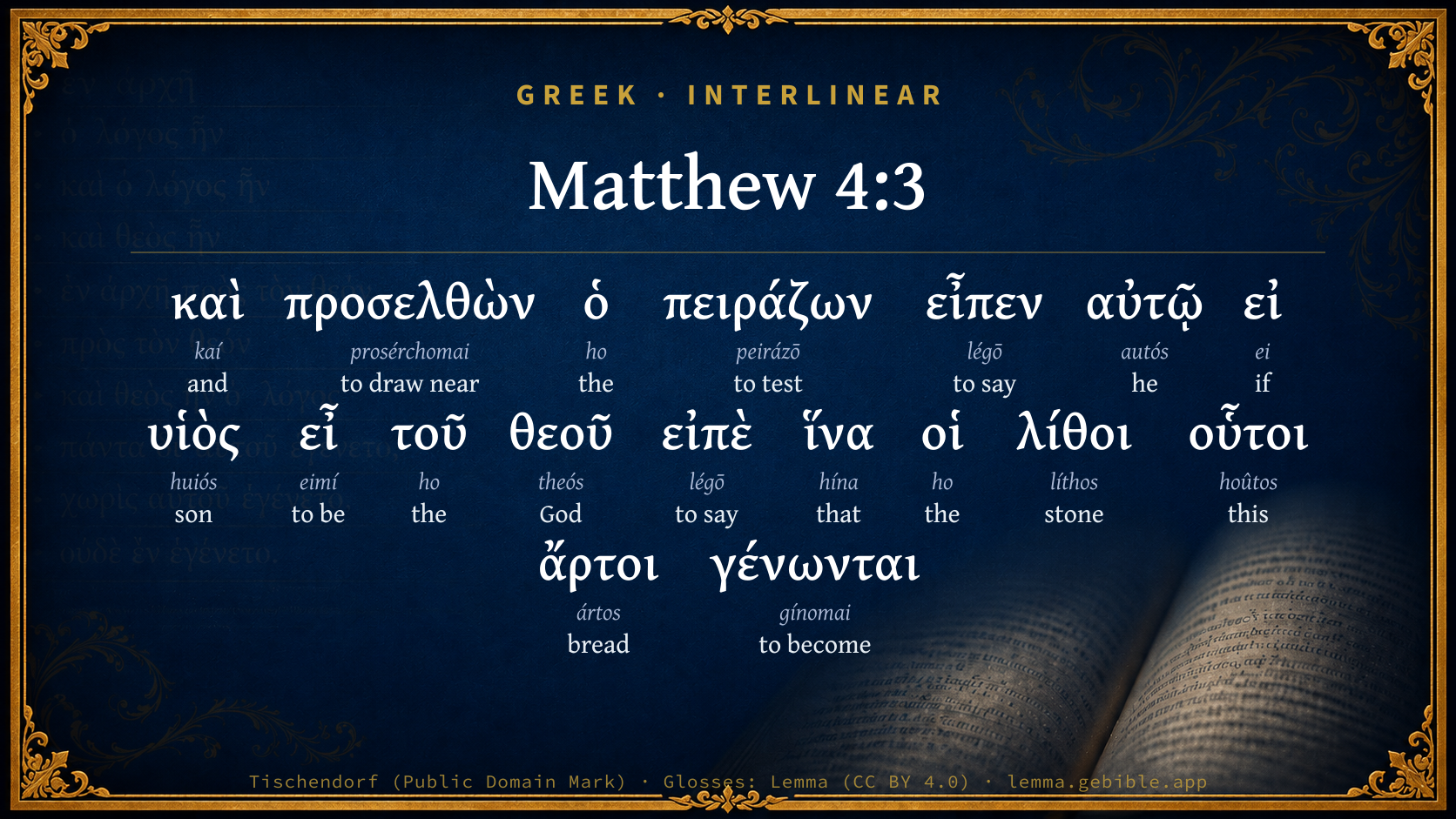
Greek (Tischendorf 8th ed.) Matthew 4:3 appears in the Greek New Testament. The text above is from the Tischendorf 8th edition. Each word links to its Strong’s number and a concise gloss. Click any word for its full Thayer’s Greek Lexicon entry.
Download image
Cite this verse

Matthew 4:3 (World English Bible). Public Domain. Lemma interlinear Bible study tool, https://lemma.gebible.app/v/matthew/4/3.

Show BibTeX & RIS
BibTeX
RIS
English Translation
The tempter came and said to him, "If you are the Son of God, command that these stones become bread."
World English Bible · Public Domain
Highlights
  • 3 first appearances in the Greek New Testament
Full analysis ↓
Download a study sheet

One document with this verse’s original text, its word-by-word gloss line, the meaning frame, cross-references with their text, attributed commentary, and full source and license credits — printable, and it pastes into notes with its structure intact.

This verse Autodidact and up

Study sheet (.html) Plain text (.txt)

A passage Seminary Student

Up to 50 verses in one chapter. A passage sheet keeps up to 6 commentary sources and 12 cross-references per verse, in the order this page ranks them, and says so on the sheet whenever that leaves anything out. Ask for a single verse and you get the Autodidact verse sheet above.

Everything on this page stays free to read, with no account — the sheet is a download of what is already on screen, not access to it.

Want to remove ads? Support Godless Engineer
Compare translations 3

The same verse in 3 English versions, stacked beneath the original-language interlinear above. Click any original word for its lexicon entry.

Each is an independent rendering of the whole verse — the interlinear is not word-aligned to these translations.

Highlighted words mark where these versions differ — a whole-verse word diff, not a word-by-word alignment.

  • World English Bible Public Domain
    The tempter came and said to him, "If you are the Son of God, command that these stones become bread."
  • King James Version Public Domain
    And when the tempter came to him, he said, If thou be the Son of God, command that these stones be made bread.
  • unfoldingWord Literal Text CC BY-SA 4.0
    And having approached, the one tempting said to him, “If you are the Son of God, speak so that these stones might become loaves.”

unfoldingWord Literal Text — © unfoldingWord, licensed CC BY-SA 4.0. Word-aligned USFM3 via Door43 (git.door43.org/unfoldingWord/en_ult).

Versions to compare (up to 4)

3 of 4 selected

Show all 19 translations

Every available English version of this verse, each an independent rendering of the whole verse.

  • World English Bible Public Domain
    The tempter came and said to him, "If you are the Son of God, command that these stones become bread."
  • Berean Standard Bible Public Domain
    The tempter came to Him and said, “If You are the Son of God, tell these stones to become bread.”
  • Majority Standard Bible Public Domain
    The tempter came to Him and said, “If You are the Son of God, tell these stones to become bread.”
  • King James Version Public Domain
    And when the tempter came to him, he said, If thou be the Son of God, command that these stones be made bread.
  • American Standard Version (1901) Public Domain
    And the tempter came and said unto him, If thou art the Son of God, command that these stones become bread.
  • Revised Version (1885) Public Domain
    And the tempter came and said unto him, If thou art the Son of God, command that these stones become bread.
  • Geneva Bible (1599) Public Domain
    Then came to him the tempter, and said, If thou be the Sonne of God, commande that these stones be made bread.
  • Douay-Rheims (1899) Public Domain
    And the tempter coming said to him: If thou be the Son of God, command that these stones be made bread.
  • Young's Literal Translation Public Domain
    And the Tempter having come to him said, `If Son thou art of God -- speak that these stones may become loaves.'
  • Literal Standard Version CC BY-SA 4.0
    And the tempting [one], having come to Him, said, “If You are the Son of God—speak that these stones may become loaves.”
  • Unlocked Literal Bible CC BY-SA 4.0
    The tempter came and said to him, “If you are the Son of God, command these stones to become bread.”
  • unfoldingWord Literal Text CC BY-SA 4.0
    And having approached, the one tempting said to him, “If you are the Son of God, speak so that these stones might become loaves.”
  • Darby Bible Public Domain
    And the tempter coming up to him said, If thou be Son of God, speak, that these stones may become loaves of bread.
  • World Messianic Bible Public Domain
    The tempter came and said to him, “If you are the Son of God, command that these stones become bread.”
  • Webster's Bible Public Domain
    And when the tempter came to him, he said, If thou art the son of God, command that these stones be made bread.
  • Free Bible Version CC BY-SA 4.0
    The tempter came and said to him, “If you really are the Son of God, order these stones to turn into bread.”
  • Bible in Basic English Public Domain
    And the Evil One came and said to him, If you are the Son of God, give the word for these stones to become bread.
  • Text-Critical English NT CC BY 4.0
    Then the tempter came up to him and said, “If yoʋ are the Son of God, command these stones to become bread.”
  • Tyndale New Testament (1534) Public Domain
    Then came to hym the tempter and sayde: yf thou be the sonne of God commaunde that these stones be made breed.

Literal Standard Version (2020), Covenant Press — licensed CC BY-SA 4.0. Text via the HelloAO Bible API (eBible.org). Unlocked Literal Bible (unfoldingWord) — licensed CC BY-SA 4.0. Text via the HelloAO Bible API (eBible.org). unfoldingWord Literal Text — © unfoldingWord, licensed CC BY-SA 4.0. Word-aligned USFM3 via Door43 (git.door43.org/unfoldingWord/en_ult). Free Bible Version, Dr. Jonathan Gallagher — licensed CC BY-SA 4.0. Text via the HelloAO Bible API (eBible.org).

Word by word

More ways to search: Search by grammar → Find every occurrence → Compare this word →

Practice this passage: Drill this verse → Learn its vocabulary →

πειράζων
peirázō
G3985
“to test”
Verb, Present, Active, Participle, Nominative, Singular, Masculine
Part of Speech
Verb
Tense
Present
Voice
Active
Mood
Participle
Case
Nominative
Number
Singular
Gender
Masculine
Full Thayer's Definition

Origin: from G3984

TDNT: 06:23,8

1. to try whether a thing can be done a. to attempt, endeavour 2. to try, make trial of, test: for the purpose of ascertaining his quantity, or what he thinks, or how he will behave himself a. in a good sense b. in a bad sense, to test one maliciously, craftily to put to the proof his feelings or judgments c. to try or test one's faith, virtue, character, by enticement to sin 1. to solicit to sin, to tempt 1c d. of the temptations of the devil e. after the OT usage 1. of God: to inflict evils upon one in order to prove his character and the steadfastness of his faith 2. men are said to tempt God by exhibitions of distrust, as though they wished to try whether he is not justly distrusted 3. by impious or wicked conduct to test God's justice and patience, and to challenge him, as it were to give proof of his perfections.
  1. καὶ kaí G2532 “and” Conjunction
  2. προσελθὼν prosérchomai G4334 “to draw near” Verb, Aorist, Active, Participle, Nominative, Singular, Masculine
  3. ὁ ho G3588 “the” Article, Nominative, Singular, Masculine
  4. εἶπεν légō G3004 “to say” Verb, Aorist, Active, Indicative, 3rd person, Singular
  5. αὐτῷ autós G846 “he” Personal pronoun, Dative, Singular, Masculine
  6. εἰ ei G1487 “if” Conditional
  7. υἱὸς huiós G5207 “son” Noun, Nominative, Singular, Masculine
  8. εἶ eimí G1510 “to be” Verb, Present, Active, Indicative, 2nd person, Singular
  9. τοῦ ho G3588 “the” Article, Genitive, Singular, Masculine
  10. θεοῦ theós G2316 “God” Noun, Genitive, Singular, Masculine
  11. εἰπὲ légō G3004 “to say” Verb, Aorist, Active, Imperative, 2nd person, Singular
  12. ἵνα hína G2443 “that” Conjunction
  13. οἱ ho G3588 “the” Article, Nominative, Plural, Masculine
  14. λίθοι líthos G3037 “stone” Noun, Nominative, Plural, Masculine
  15. οὗτοι hoûtos G3778 “this” Demonstrative pronoun, Nominative, Plural, Masculine
  16. ἄρτοι ártos G740 “bread” Noun, Nominative, Plural, Masculine
  17. γένωνται gínomai G1096 “to become” Verb, Aorist, Middle deponent, Subjunctive, 3rd person, Plural

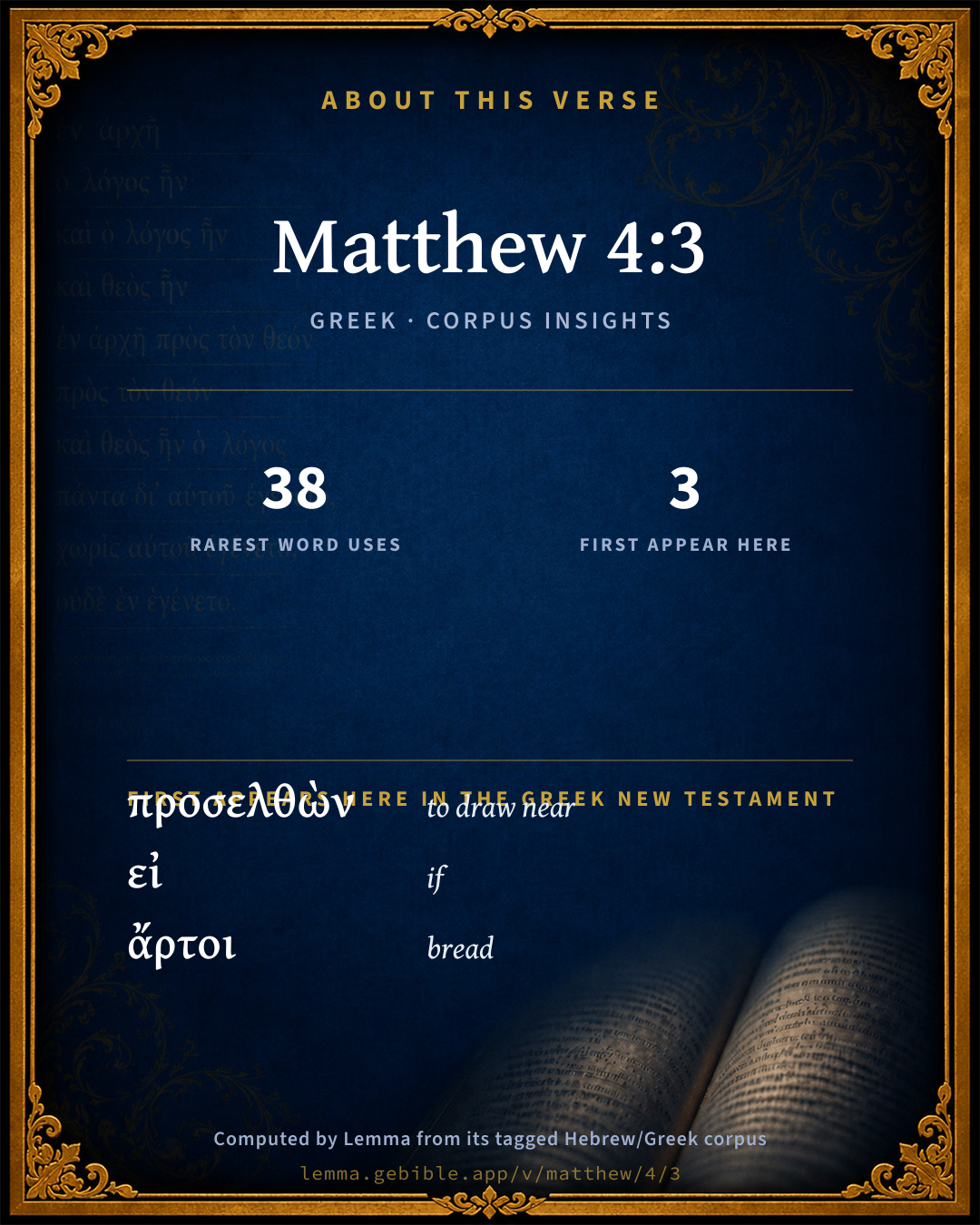
About this verse

These counts appear in no published source. They are computed here, from the morphology-tagged text and Lemma’s own curated glosses. What Lemma adds →

18
words
15
distinct lemmas
Gospels
section

First appearance in Scripture

These words make their first canonical appearance in the Greek New Testament here:

  • προσελθὼν to draw near G4334
  • εἰ if G1487
  • ἄρτοι bread G740

Shared distinctive vocabulary

πειράζων to test G3985 occurs in 34 verses of the Greek New Testament. Also found in:
Repetition

Words recur within this verse:

Cross-references

17

Topical passages linked to Matthew 4:3 in the Treasury of Scripture Knowledge — connected by theme and wording, ordered by reader-vote popularity; previews shown in the World English Bible.

  • Genesis 3:1–5 Now the serpent was more subtle than any animal of the field which Yahweh God had made. He said to the woman, "Yes, has God said, 'You shall not eat of any tree of the garden?'"
  • 1 Thessalonians 3:5 For this cause I also, when I couldn't stand it any longer, sent that I might know your faith, for fear that by any means the tempter had tempted you, and our labor would have been in vain.
  • Numbers 11:4–6 The mixed multitude that was among them lusted exceedingly: and the children of Israel also wept again, and said, Who shall give us flesh to eat?
  • Luke 22:31–32 The Lord said, "Simon, Simon, behold, Satan asked to have you, that he might sift you as wheat,
  • Revelation 2:10 Don't be afraid of the things which you are about to suffer. Behold, the devil is about to throw some of you into prison, that you may be tested; and you will have oppression for ten days. Be faithful to death, and I will give you the crown of life.
  • Psalms 78:17–20 Yet they still went on to sin against him, To rebel against the Most High in the desert.
  • Genesis 25:29–34 Jacob boiled stew. Esau came in from the field, and he was famished.
  • Job 1:9–12 Then Satan answered Yahweh, and said, "Does Job fear God for nothing?
  • Job 2:4–7 Satan answered Yahweh, and said, "Skin for skin. Yes, all that a man has will he give for his life.
  • Matthew 3:17 Behold, a voice out of the heavens said, "This is my beloved Son, with whom I am well pleased."
  • Revelation 12:9–11 The great dragon was thrown down, the old serpent, he who is called the devil and Satan, the deceiver of the whole world. He was thrown down to the earth, and his angels were thrown down with him.
  • Exodus 16:3 and the children of Israel said to them, "We wish that we had died by the hand of Yahweh in the land of Egypt, when we sat by the flesh-pots, when we ate our fill of bread, for you have brought us out into this wilderness, to kill this whole assembly with hunger."
  • Hebrews 12:16 lest there be any sexually immoral person, or profane person, as Esau, who sold his birthright for one meal.
  • Matthew 14:33 Those who were in the boat came and worshiped him, saying, "You are truly the Son of God!"
  • Luke 4:3 The devil said to him, "If you are the Son of God, command this stone to become bread."
  • Luke 4:9 He led him to Jerusalem, and set him on the pinnacle of the temple, and said to him, "If you are the Son of God, cast yourself down from here,
  • Acts 9:20 Immediately in the synagogues he proclaimed the Christ, that he is the Son of God.

Cross-references courtesy of OpenBible.info (CC BY 4.0).

Where the printed editions differ

1 variant

Places in this verse where the major printed Greek editions disagree on the wording in a way that affects the translation — a comparison of editions, not a manuscript-by-manuscript collation. The editions are the modern critical texts (Nestlé-Aland 28/27, SBL, Westcott-Hort, Tregelles, Tyndale House) and the traditional texts behind the KJV (the Textus Receptus and the Byzantine/Majority text). It is not a claim about which reading is original.

  1. Different wording
    εἰπὲ

    “do speak”

    In NA28NA27TynSBLTregTRByz Not in WH

    εἰπὸν (eipon) 'they said' occurs in a few manuscripts (WH) instead of εἰπὲ (eipe) 'do speak' in older manuscripts (NA28+NA27+Tyn+SBL+Treg+TR+Byz)

Textual data: Translators Amalgamated Greek New Testament (STEPBible TAGNT) · CC BY 4.0.

Commentary

Notes on Matthew 4:3 from classic Christian and Jewish commentators (each source and its license shown beneath its notes). The classic Christian expositions comment on the surrounding passage and are grouped to its opening verse, so a note may address several verses; the Jewish commentaries on the Tanakh (Rashi and others) are per-verse, so they appear only where the commentator wrote on this verse.

Lemma curates 59 commentaries, every one of them public domain or Creative Commons licensed, each selected and text-cleaned for this edition rather than reprinted as found. About our sources →

Jamieson, Fausset & Brown

Robert Jamieson, A. R. Fausset & David Brown

And when the tempter came to him--Evidently we have here a new scene.

he said, if thou be the Son of God, command that these stones be made bread--rather, "loaves," answering to "stones" in the plural; whereas Luke, having said, "Command this stone," in the singular, adds, "that it be made bread," in the singular (Luk 4:3). The sensation of hunger, unfelt during all the forty days, seems now to have come on in all its keenness--no doubt to open a door to the tempter, of which he is not slow to avail himself; "Thou still clingest to that vainglorious confidence that Thou art the Son of God, carried away by those illusory scenes at the Jordan. Thou wast born in a stable; but Thou art the Son of God! hurried off to Egypt for fear of Herod's wrath; but Thou art the Son of God! a carpenter's roof supplied Thee with a home, and in the obscurity of a despicable town of Galilee Thou hast spent thirty years, yet still Thou art the Son of God! and a voice from heaven, it seems, proclaimed it in Thine ears at the Jordan! Be it so; but after that, surely Thy days of obscurity and trial should have an end. Why linger for weeks in this desert, wandering among the wild beasts and craggy rocks, unhonored, unattended, unpitied, ready to starve for want of the necessaries of life? Is this befitting "the Son of God?" At the bidding of "the Son of God" surely those stones shall all be turned into loaves, and in a moment present an abundant repast."

Jamieson, Fausset & Brown — Commentary Critical and Explanatory on the Whole Bible (1871) — public domain (CC PDM 1.0). Text via the HelloAO Bible API.

Adam Clarke's Commentary

Verse 3. And when the tempter] This onset of Satan was made (speaking after the manner of men) judiciously: he came when Jesus, after having fasted forty days and forty nights, was hungry: now, as hunger naturally diminishes the strength of the body, the mind gets enfeebled, and becomes easily irritated; and if much watching and prayer be not employed, the uneasiness which is occasioned by a lack of food may soon produce impatience, and in this state of mind the tempter has great advantages. The following advice of an Arabian philosopher to his son is worthy of attention. "My son, never go out of the house in the morning, till thou hast eaten something: by so doing, thy mind will be more firm; and, shouldest thou be insulted by any person, thou wilt find thyself more disposed to suffer patiently: for hunger dries up and disorders the brain." Bibliot. Orient. Suppl. p. 449. The state of our bodily health and worldly circumstances may afford our adversary many opportunities of doing us immense mischief. In such cases, the sin to which we are tempted may be justly termed, as in Heb 12:1, την ευπεριστατον αμαρτιαν, the well circumstanced sin, because all the circumstances of time, place, and state of body and mind, are favourable to it.

If thou be the Son of God] Or, a son of God, υιος του Θεου. υιος is here, and in Lu 4:3, written without the article; and therefore should not be translated THE Son, as if it were ουιος, which is a phrase that is applicable to Christ as the Messiah: but it is certain, whatever Satan might suspect, he did not fully know that the person he tempted was the true Messiah. Perhaps one grand object of his temptation was to find this out.

Command that these stones] The meaning of this temptation is: "Distrust the Divine providence and support, and make use of illicit means to supply thy necessities."

Adam Clarke's Commentary on the Bible (1810–1826) — public domain. Text from a community e-Sword/MySword module.

Matthew Poole's English Annotations

And when the tempter, viz. Satan, the devil, as he is called, came unto him, probably in some visible shape, he, forming an audible voice of the air, said,

If thou be the Son of God, ( not that he doubted it, which showed his horrible impudence),

command that these stones, (this stone, saith Luke, Luk 4:3) be made bread. The temptation plainly was to the use of means which God did not allow him, to relieve him in his distress of hunger, to distrust the providence of God in supporting of him. A temptation common to those who are the members of Christ, and enough to instruct us, that we ought to look upon all thoughts and motions to the use of means not allowed by God, in order to a lawful end, as temptations vel a carne, vel hoste, either from our own flesh, for every man is tempted, when he is drawn away of his own lust and enticed, Jam 1:14, or from our grand adversary the devil. It is not much material for us to know from which, they being both what we ought to resist, though those from Satan are usually more violent and impetuous.

Matthew Poole's English Annotations on the Holy Bible (1683–1685) — public domain. Text from a community e-Sword/MySword module.

The Biblical Illustrator

Joseph S. Exell

Mat_4:3

If Thou be the Son of God.

-His object is to shake Christs confidence in the Fatherly character of God. (Dr. Macleod.)

Tempted to distrust the Divine Providence. (Dr. Macleod)

As the devil laboureth most against our faith, should we most labour in fortifying it

Policy teacheth men to plant the most strength at that fort or part of the wall where the enemy plants his greatest ordnance, and makes the strongest assault. And nature teacheth us to defend all our parts, but especially our head and heart, and such like vital parts. (Dr. Taylor.)

Faith determines victory

If Satan take away our root, how can our branch flourish? If he break our band, all that is bound up will shatter in pieces. If he cut off our anchor, our vessel will be driven upon the rocks. If he overcome our trust in God, he will subdue all unto himself, for this is the victory that over-cometh the world (1Jn_4:5).

Mat_4:3

Command that these stones.

Implying in these few words

1. That it is an easy thing-say the word.

2. That it is now fit; here is an object ready, here be stones, these stones.

3. That it is harmless, only a proof of the power of the Son of God.

4. That it is a necessary thing; is it not necessary for a man that is ready to starve to eat and procure bread?

5. That it is a glorious thing to command stones.

6. That it is a work of special use, not only for the use of Thyself in this want, but to satisfy me.

7. That it is not unreasonable; to command a few stones to be made bread will be no hurt to any man.

8. The Son of God should demean Himself as the Son of such a Father, therefore by this action manifest that which Thy estate doth not. (Dr. Taylor.)

An inducement to satisfy lawful needs and desires by unlawful means

What is the safeguard against this peril?

1. Not by denying the legitimacy of the desires of the bodily organization.

2. By showing that mans present life was not the gratification of a bodily need, but the satisfaction of the hunger of the spirit in God. (G. S. Barrett, B. A.)

Let us beware of acting the devils part by discouraging those whom God has afflicted. (L. H. Wiseman.)

Why would it have been improper had He turned a stone into a loaf

1. He would have by that act placed an impassable gulf between Himself and His brethren.

2. It was important that Christs miracles should be free from suspicion, that they were not for the gratification of His own wants.

3. The motive constitutes an action good or evil, the circumstances in this case would have determined it wrong.

4. It would have been inconsistent with the whole recorded life of Jesus. (L. H. Wiseman.)

The cunning of Satan in this temptation

1.He skilfully chooses his time.

2. He suggests nothing which appears to be a great sin.

3. He presents this to Christ as an act of necessity.

4. The plea he employs is one which Jesus could not reject.

5. In the proposal there was no appearance of pampering the body, but only of providing for absolute need.

Reply to the first temptation

1. In this answer Satan is left unsatisfied. Uneducated disciples are not bound to answer all Satans questions.

2. The snare was avoided.

3. Patience in enduring hunger till God send Him a supply.

4. When we have bread we must still live by the Word of the Lord.

5. When we appear to be without bread the Word of the Lord can sustain us. (L. H. Wiseman.)

The first temptation

`I. The visibility of the tempter. The Evangelists seem to imply that the tempter presented himself before the eyes of Christ. It is objected to this view:-

1. That while good angels are permitted to address men under visible forms, evil angels are not recorded to have done so.

2. That Satan by undisguised appearance would have no prospect of success. But he addressed our first parents under a visible form. The second objection assumes that the visible form of Satan is necessarily unsightly.

II. Satans knowledge of Christ. Satan was not certain about Christs Divine Sonship; hence he sought to find out if Christ could create or change substances.

III. The limits of the temptation.

1. It has been said that Christs temptation differs from ours in that His were only external, and ours internal also; that Christ had no susceptibility to temptation, but simply heard what Satan had to say without any inward excitement of desire. This takes from it its essence and removes it from us. We would not limit the temptation to an external trial.

2. We would not reduce it to the general idea of suffering, on account of contact with the tempter. We maintain that each temptation appealed to a desire in the heart of Christ, which His will restrained and refused to gratify.

The true limits of the mystery:-

1. Christ was absolutely sinless.

2. Christ was conceived by the Holy Ghost, no taint of the Fall was permitted to intermingle with the foundation of His human life. There was a certain impossibility of His sinning; but this must not be so explained as to destroy the faculty of free will, which is a constituent element of human nature. We must not so interpret impossibility to sin as not to permit susceptibility of temptation to co-exist with it. Upon the exercise of free will in Christ depends His merits, the reality of His temptation, the force of His example.

IV. The reality of the temptation. If we subject temptation to analysis we find five ingredients.

(1) Desire;

(2) Law;

(3) Opposition between desire and law;

(4) Suggestion;

(5) Free will.

Desire may be simply natural, the movement of pure nature; or when some morbid quality has been imported into it, which gives it a wrong direction. The former was in Christ; but not the latter. There are two kinds of laws-positive and moral-the natural desires may be restrained by the former, the corrupt desires by the latter. The craving, whatever it be, must come into collision with the law. In the case of a pure creature the clash must be with a positive law; with a corrupt creature it will be also with the moral law. Now in Christ the desire of the body was in opposition to the Divine will; the pure desire of nature was contrary to what He knew to be the Fathers will. In this sense His was inward and real temptation. Several truths must be taken into calculation in, comparing Christs temptation with ours.

1. That the desires which are original and form part of our nature are, in the long run, the more intense.

2. The finer sensibilities of His uncorrupt nature. (W. H. Hutchings, M. A.)

1. If every good Christian were satisfied at all times with temporal blessings we should appear to serve God for our profit.

2. God does net always give bread to him that is his son, that he may loathe this world and look for reward in heaven.

3. The good man shall fill his bosom with better fruits. (Hacket.)

Christ and the Christian alike in temptation

The struggle, as far as possible, was the same as in us. The lifeboat must brave the same storm, and plough through the same foaming billows, which threaten to engulph her, as the wrecked vessel to which she bears relief; and though so constructed as to be able to bear up against the fury of the waves, she needs the careful steerage, persevering efforts, ay, and courage, of those who venture forth to save the sinking ship. (W. H. Hutchings, M. A.)

The Biblical Illustrator, edited by Joseph S. Exell (c. 1880s–1900s) — public domain. Text from a community e-Sword module.

Joseph Benson's Commentary

Mat 4:3. And when the tempter came to him — In a visible shape and appearance, to tempt him outwardly, as he had done inwardly before. For it appears from the account which Mark and Luke have given us of this matter, that our Lord had been tempted by the devil invisibly during the whole of the above-mentioned forty days — but now, it seems, he came to him in a visible form, probably in the human, as one that desired to inquire further into the evidences of his mission. Accordingly he said, If thou be the Son of God — In such an extraordinary sense as thou hast been declared to be, and if thou art indeed the promised Messiah, expected under that character, command that these stones be made bread — To relieve thy hunger, for in such circumstances it will undoubtedly be done. Thus Satan took advantage of our Lord’s distress to tempt him to doubt his being the Son of God in the sense in which he had just been declared to be so; and it seems the object of this first temptation was, to excite in his mind a distrust of the care and kindness of his heavenly Father, and to induce him to use unwarranted means to relieve his hunger. But it is objected here, If Christ were God, why should he be tempted? Was it to show that God was able to overcome the temptations of the devil? Could there be any doubt of this? We answer, he was man, very man, as well as God, “of a reasonable soul, and human flesh subsisting,” and it was only as man that he was tempted. If it be replied, that seeing his human nature was personally united to the divine, it must still be superfluous to show that even his human nature, thus influenced, should be able to baffle the assaults of Satan: Irenæus, an eminent father of the second century, answering this very objection, then made by the Ebionites, (the elder brethren of the Photinians and Socinians,) observes that, as he was man, that he might be tempted, so he was the Word, that he might be glorified; the Word, (or Godhead,) being quiescent in his temptation, crucifixion, and death. These words being preserved and cited, says Dr. Whitby, by Theodoret, show that the latter fathers approved of this solution of this difficulty. Among the reasons assigned of our Lord’s temptation, one is, the consolation of his members conflicting with the adversary of their souls. For, in that he suffered, being tempted, he can sympathize with, and succour those that are tempted; affording them the same Spirit that was in him, that they may resist the devil with the same weapons, and overcome him with the same assistance, by which he, in his human nature, combated and conquered. Now this ground of comfort would be wholly taken from us, if Christ overcame Satan merely by virtue of that nature, by which he was απειραστος κακων, Jas 1:13, incapable of being overcome by temptation. But if, with Irenæus, we affirm that the divinity was then quiescent in him, and that he overcame Satan by virtue of the Spirit given to him, we, who have the same unction from the Holy One, may also hope to do it by his aid.

Joseph Benson's Commentary on the Old and New Testaments (1811–1818) — public domain. Text from a community e-Sword module.

Whedon's Commentary on the Bible

Daniel D. Whedon

THE FIRST TEMPTATION, Mat_4:3-4.

3. The tempter — The being who loves to lead man into sin. Came to him — In what form Satan came is not said. He tempted Eve as a serpent; perhaps he tempted our Lord as an angel of light or truth. At any rate, he was at first disguised; for our Saviour did not recognize him to be Satan until the deceiver claimed his worship.

If thou be the Son of God — The consciousness of his divine union with God, so far forth as he had yet received it, may now, perhaps, be supposed to be in a measure withheld. He is the pure-minded, guileless, guiltless Jewish youth, alone in the wilderness; worn and weak with the fasting and the excitement with which the fast had been sustained. Was it not a rare chance for Satanic counsels? “How know you that you are the Son of God? True, there are some prodigious narratives about your birth, but they may be fables; there were the dove and the voice dropped from the sky at your baptism; but that may have been an ocular illusion. It is a great thing for a quiet young man to imagine himself Messiah and Son of God.” Command — Nothing like experiment. Try to put forth miraculous power, and that will show whether or not you are divine. That these stones be made bread — You are hungry. Here is the material, and you have the power. Use your Messianic power to supply your bodily wants. So you will at once prove your divinity and satisfy your hunger.

In this first temptation Satan tempts our Lord, as he did Eve, by the bodily appetite. He appeals to the animal nature first. By this avenue he approaches and conquers the great majority of mankind. Beneath this temptation of bodily appetites all gluttons, drunkards, and debauchees have fallen and become the devil’s prey.

Daniel D. Whedon (gen. ed.), Commentary on the Old and New Testaments (1874–1909) — public domain. Text from a community e-Sword module.

The Pulpit Commentary

The tempter. (1Th_3:5 only; cf. 2Co_11:3) Came; came up to him (proselywn). The word expresses local nearness, and suggests, though we cannot affirm it as certain, that he appeared visibly. The thought of physical nearness is continued in "taketh him" (vers. 5, 8), and "the devil leaveth him" and "angels came near" (ver. 11; cf. ver. 5, note). On the other hand, such expressions may be parabolic, and intended to express the closeness of the spiritual combat. To him; not after "came," but after "said" (Revised Version, with manuscripts). If thou be; art (Revised Version) (ei ... ei) the "if" of assumption. (cf. Col_3:1) The devil does not attempt to throw doubt on the truth of the utterance in Mat_3:17. His words rather mean, "Thou knowest what was said, thou hast been gradually realizing that assurance of Sonship; use, then, that privilege which thou undoubtedly hast". (comp. Mat_27:40, where, in mockery, the same truth is assumed) Wetstein, following Origen and pseudo-Ignatius," Philipp.," says that the tempter did not know, or at least doubted, whether Jesus was really God, for otherwise he would never have tempted him. This is, surely, to miss the meaning of the temptation for our Lord himself; for he was tempted as Man. Satan might well haw known that he was God incarnate, and yet not have known whether as Man he might not yield. Weiss ("Life," 1:343) mistakenly thinks that the object of this first temptation was to insinuate doubt in the mind of Jesus as to his Messiahship. "Command that these stones become bread, and if thou canst not do so, then thou art not the Son of God." Command that; eipon (cf. Westcott and Hort, 2. App., p. 164) ina . (cf. Mat_20:21, and Winer, 44:8) These stones, i.e. lying about. Farrar (on Luk_4:3; and especially in "Life of Christ," illustrated edit., pp. 99, 100) suggests that there is a special reference to the "loaf-shaped fossils," septaria, which are found in Palestine as, indeed, in most other countries. But though these "flattened nodules of calcareous clay, ironstone, or other matter" (Page, "Handbook of Geolog. Terms," etc., 1859, p. 327) often assume fantastic shapes, perhaps even distantly resembling either an English loaf or a fiat Jewish cake (vide infra), it seems quite unnecessary to see any allusion to them here. (For the comparison of bread and a stone, cf. Mat_7:9) Be made; Revised Version, become; rightly, because there is no thought of the process of manufacture in genwntai , Bread; Revised Version margin, "Greek, loaves" (artoi). "The Israelites made bread in the form of an oblong or round cake, as thick as one"s thumb, and as large as a plate or Platter; hence it was not cut, but (e.g. Mat_14:19) broken" (Thayer). In Luke the devil points to one stone only, and tempts him to bid it become a loaf.

Temptation through physical conditions.

In this and two later homilies the several temptations are to be more precisely treated. The four homilies will be suggestive of a series of sermons on the "Lord"s temptation." The temptation must be closely associated with the baptism. The one thing necessary to the understanding of it is our apprehension of the fact, that Jesus had become suddenly conscious of the trust of miraculous powers; and he had to fix the principle on which alone he would use those powers. The first question to decide was Would he use them to supply his own necessities? Meeting the deepest sense of bodily hunger, a passionate craving for food after a prolonged fast, came the consciousness of possessing miraculous power. He heard, as if in the depths of his soul, a cry saying, "Why do you suffer? Make the stones bread. You can do it." The force of the temptation lay on one side in the cravings of bodily appetite, and on the other side in this new sense of power.

I HUMAN TEMPTATION THROUGH BODILY CRAVINGS. It is the first form that human temptation took. Eve saw that the fruit of the tree was pleasant, and good for food. It is the universal form of temptation, but it is the lowest; it belongs to man as an animal. Beneath the temptation of bodily appetite, the glutton, the drunkard, and the sensualist have fallen in all the ages. The first sphere of conflict for the spiritual being man is that animal nature in which he is set in order to sustain earthly relations. That bodily organization ought to be his servant; it is ever striving to be his master, and seeks to secure its end by subtleties of craving and allurement. Easily men have been led to think that the body itself is evil. But the wrong lies in the unbalanced will, which fails to restrain and control bodily appetite.

II THE LAW OF TRIUMPH OVER TEMPTATION COMING THROUGH BODILY CRAVINGS. The soul is of more value than the body. A man is not a body; all that is true is that he has a body. A man"s life is not the material thing, eating and drinking; that only sustains the animal nature. A man"s real life consists in obedience to the will of God, as he may come to know it; and if that means starving the body, the body must be starved. R.T.

The Pulpit Commentary (1880–1919), ed. H.D.M. Spence-Jones & Joseph S. Exell — public domain. Text from a community e-Sword module.

Tyndale Open Study Notes

Tyndale Open Resources

4:3-4 Jesus refused to use his supernatural power to obtain the food that he trusted God to provide. Unlike the people of Israel, who sorely tested God through complaint and unbelief (see Exod 16), Jesus refused to question God’s faithfulness. Instead, he trusted God to provide for his true need, the sustenance of every word that comes from the mouth of God.

Tyndale Open Study Notes — © Tyndale Open Resources, licensed CC BY-SA 4.0. Text via the HelloAO Bible API.

Bengel's Gnomon

Johann Albrecht Bengel

Mat 4:3. προδελθών Αὐτῷ, having come to Him) sc. in a visible form. The Tempter watched his time.[134]—ὁ πειράζων, the tempter) who did not wish it to be known that he was Satan: yet Christ at the conclusion of the interview, and not till then, calls him, in Mat 4:10, Satan, after that Satan had plainly betrayed his satanity, i.e., pride, his peculiar characteristic. Thus, by Divine skill, He defeated his infernal skill. The tempter seems to have appeared under the form of a γραμματύς, scribe, since our Lord thrice replies to him by the word, γέγραπται, “It is written.”—εἰ, if) Thus also, in Mat 4:6, Satan both doubts himself, and endeavours to produce doubt, to take away that which is true, to teach that which is false. He solicits our Lord, stating that hypothetically, which had been (Mat 3:17) declared categorically from heaven.—εἰπέ, κ.τ.λ., command, etc.) The tempter acknowledges that He who is the Son of God must be Almighty.—οἰ, κ.τ.λ., these, etc.) i.e., that some one of these stones become bread [or a loaf]: see Luk 4:3, [where it is, “Command this stone (sing.) that it be made bread.”]—λίθοι, stones) q. d., “You are in the wilderness, which has hard stones, but no bread.” Nay, on very different grounds shalt thou become convinced, O Tempter, that this is the Son of God. Soon will He commence the work of thy destruction. See Luk 4:34; Luk 4:41.

[134] Our Lord spent that season of the year in the wilderness, in which the nights are longer, the wild beasts more ravenous, the weather more inclement, and when there was no means of obtaining food either from trees or herbs.—See Harm. Evang. 149.

Bengel's Gnomon of the New Testament — English translation (T&T Clark, Edinburgh, 1860) — public domain. Text from a community e-Sword module.

Meyer's Critical & Exegetical Commentary

Heinrich August Wilhelm Meyer

Mat_4:3. Ὁ πειράζων Part, present taken substantively. See on Mat_2:20. Here: the devil. Comp. 1Th_3:5.

εἰ] does not indicate that Satan had doubts of Jesus being the Son of God (Origen, Wolf, Bengel), or was not aware of it (Ignat. Phil. interpol. 9), comp. Mat_28:20; but the problematical expression was to incite Jesus to enter upon the unreasonable demand, and to prove Himself the Son of God. Euth. Zigabenus: ᾤετο, ὅτι παρακνισθήσεται τῷ λόγῳ, καθάπερ ὀνειδισθεὶς ἐπὶ τῷ μὴ εἶναι υἱὸς θεοῦ.

υἱὸς τοῦ θεοῦ] See Mat_3:17. The devil makes use of this designation of the Messiah, not because he deemed Jesus to be only a man, who υἱοθετήθη τῷ θεῷ διὰ τὰς ἀρετὰς αὐτοῦ (Euth. Zigabenus), or because he had become doubtful, owing to the hungering of Jesus, of His divinity, which had been attested at His baptism (Chrysostom); but because Jesus supernatural relation to God is well known to him, whilst he himself, as the principle opposed to God, has to combat the manifestation and activity of the divine. Observe that by the position of the words the emphasis lies on υἱός: if Thou standest to God in the relation of Son.

εἰπὲ, ἵνα] ἵνα after verbs of commanding, entreaty, and desire, and the like, does not stand in the sense of the infinitive, as is commonly assumed (Winer, de Wette, Bleek), in opposition to the necessary conception of the words, but is, as it always is, an expression of the purpose, in order that, the mistaking of which proceeds from this, that it is not usual in the German language to express the object, of the command, and so on, in the form of a purpose. Here: speak (utter a command) in order that these stones, and so on. Comp. Mat_20:21. The oldest examples from Greek writers after ἐθέλειν, ὄφρα, in Hom. Il. i. 133 (see Nägelsbach thereon), occur in Herodotus and Demosthenes. See Schaefer, ad Dem. 279. 8 : ἀξιοῦν, ἵνα βοηθήσῃ; Kühner, II. 2, p. 519.

οἱ λίθοι οὗτοι] comp. Mat_3:9.

ἄρτος] Bread, in the proper sense; not, like לֶחֶם, food in general. Comp. Mat_7:9.

The Son of God must free Himself from the state of hunger, which is unbecoming His dignity, by an act similar to the divine creation, and thus employ His divine power for His own advantage. The tempter introduces his lever into the immediate situation of the moment.

Meyer — Critical and Exegetical Commentary on the New Testament — English translation by Peter Christie, edited by Frederick Crombie (T&T Clark, 1880) — public domain. Text from a community e-Sword module.

Expositor's Greek Testament

ed. W. Robertson Nicoll

Mat 4:3-4 . First temptation , through hunger.

Mat 4:3 . προσελθὼν , another of the evangelist’s favourite words, implies that the tempter is conceived by the narrator as approaching outwardly in visible form. εἰπὲ ἵνα : literally “speak in order that”. Some grammarians see in this use of ἵνα with the subjunctive a progress in the later Macedonian Greek onwards towards modern Greek, in which νά with subjunctive entirely supersedes the infinitive. Buttmann ( Gram. of the N. T. ) says that the chief deviation in the N. T. from classic usage is that ἵνα appears not only after complete predicates, as a statement of design, but after incomplete predicates, supplying their necessary complements ( cf. Mar 6:25 ; Mar 9:30 ). εἰπὲ here may be classed among verbs of commanding which take ἵνα after them. οἱ λίθοι οὗτοι , these stones lying about, hinting at the desert character of the scene. ἄρτοι γέν ., that the rude pieces of stone may be turned miraculously into loaves. Weiss (Meyer) disputes the usual view that the temptation of Jesus lay in the suggestion to use His miraculous power in His own behoof. He had no such power, and if He had, why should He not use it for His own benefit as well as other men’s? He could only call into play by faith the power of God, and the temptation lay in the suggestion that His Messianic vocation was doubtful it God did not come to His help at this time. This seems a refinement. Hunger represents human wants, and the question was: whether Sonship was to mean exemption from these, or loyal acceptance of them as part of Messiah’s experience. At bottom the issue raised was selfishness or self-sacrifice. Selfishness would have been shown either in the use of personal power or in the wish that God would use it.

The Expositor's Greek Testament, edited by W. Robertson Nicoll (1897–1910) — public domain. Text from a community e-Sword module.

Ellicott's Commentary for English Readers

(3) When the tempter came.—Nothing in the narrative suggests the idea of a bodily presence visible to the eye of sense, and all attempts so to realise it, whether as Milton has done in Paradise Regained, or as by rationalistic commentators, who held that the Tempter was, or assumed the shape of, a scribe or priest, are unauthorised, and diminish our sense of the reality and mystery of the Temptation. The narrative is not the less real and true because it lies altogether in the spiritual region of man’s life.

If thou be the Son of God, command that these stones be made bread.—“These stones,” as if in union with glance and gesture, pointing to the loaf-like flints of the Jordan desert. The nature of the temptation, so far as we can gauge its mysterious depth, was probably complex. Something there may have been, suggested from without, like that which uttered itself in Esau’s cry, “What profit shall this birthright do to me?” (Gen_25:32). Hungry, exhausted, as if life were ebbing away in the terrible loneliness of the desert, the “wild beasts” around him, as if waiting for their victim, what would it avail to have been marked out as the Son of God, the long-expected Christ? With this another thought was blended. If He were the Son of God, did not that name involve a lordship over nature? Could He not satisfy His hunger and sustain His life? Would He not in so exercising the power of which now, for the first time it may be, He was the conscious possessor, be establishing his status as the Christ in the eyes of others? That thought presented itself to His mind, but it was rejected as coming from the Enemy. It would have been an act of self-assertion and distrust, and therefore would have involved not the affirmation, but the denial of the Sonship which had so recently been attested.

A Bible Commentary for English Readers, edited by Charles John Ellicott (1878–1897) — public domain. Text from a community e-Sword module.

The Cambridge Bible for Schools and Colleges

gen. ed. J. J. S. Perowne

3. that these stones be made bread] The temptation is addressed to the appetite, Use thy divine power to satisfy the lusts of the flesh.

The Cambridge Bible for Schools and Colleges (gen. ed. J. J. S. Perowne; Cambridge University Press, 1878–1918) — public domain. Text from a community e-Sword module.

John Gill's Exposition

And when the tempter came to him..... By "the tempter", is meant the devil, see Th1 3:5 so called, because it is his principal work and business, in which he employs himself, to solicit men to sin; and tempt them either to deny, or call in question the being of God, arraign his perfections, murmur at his providences, and disbelieve his promises. When he is here said to come to Christ at the end of forty days and nights, we are not to suppose, that he now first began to tempt him; for the other Evangelists expressly say, that he was tempted of him forty days, Mar 1:13 but he now appeared openly, and in a visible shape: all the forty days and nights before, he had been tempting him secretly and inwardly; suggesting things suitable to, and taking the advantage of the solitary and desolate condition he was in. But finding these suggestions and temptations unsuccessful, and observing him to be an hungered, he puts on a visible form, and with an articulate, audible voice, he said,

if thou be the Son of God; either doubting of his divine sonship, calling it in question, and putting him upon doing so too; wherefore it is no wonder that the children of God should be assaulted with the like temptation: or else arguing from it, "if", or "seeing thou art the Son of God"; for he must know that he was, by the voice which came from heaven, and declared it: and certain it is, that the devils both knew, and were obliged to confess that Jesus was the Son of God, Luk 4:41 by which is meant, not a good, or righteous man, or one dear to God, and in an office; but a divine person, one possessed of almighty power; and therefore, as a proof and demonstration of it, be urges him to

command that these stones be made bread, pointing to some which lay hard by; "say" but the word, and it will be done. He did not doubt but he was able to do it, by a word speaking; but he would have had him to have done it at his motion, which would have been enough for his purpose; who wanted to have him obedient to him: and he might hope the rather to succeed in this temptation, because Christ was now an hungry; and because he had carried his point with our first parents, by tempting them to eat of the forbidden fruit.

John Gill's Exposition of the Whole Bible (1746–1763) — public domain (CC PDM 1.0). Text via the HelloAO Bible API.

Trapp's Complete Commentary

John Trapp

3 And when the tempter came to him, he said, If thou be the Son of God, command that these stones be made bread.

Ver. 3. Then came unto him the tempter] ο πειραζων. So called, because he politicly feels our pulses which way they beat, and accordingly fits us a penny worth. He sets a wedge of gold before covetous Achan, a courtesan Cozbi before a voluptuous Zimri, a fair preferment before an ambitious Absalom: and finds well that a fit object is half a victory. So dealt his agents with those ancient Christians, επρισθησαν, επειρασθησαν, they "were sawn asunder, they were tempted," saith the apostle, {Heb 11:37} to wit, with the proffers of preferment, would they but have renounced their religion and done sacrifice to an idol. So the Pope tempted Luther with wealth and honour. But all in vain; he turned him to God, Et valde protestatus sum, saith he, me nolle sic satiari ab eo, he said flat, that God should not put him off with these low things. (Melch. Adam.) Here was a man full of the spirit of Christ. The tempter came to Christ, but found nothing in him; that matter was not malleable. In vain shall the devil strike fire if we find not tinder; in vain shall he knock at the door if we look not out to him at the window. Let us but divorce the flesh from the world, and the devil can do us no hurt. Ita cave tibi, ut caveas teipsum. From that naughty man myself, good Lord, deliver me, said one.

If thou be the Son of God] As the devil quarrelled and questioned the law given in Paradise as nought, or naught; so doth he hear the voice from heaven as a mere imposture. And this he did out of deep and desperate malice; for he could not be ignorant nor doubtful. Neither is his dealing otherwise with us (many times), who are too ready (at his instigation) to doubt our spiritual sonship. We need not help the tempter, by holding it a duty to doubt; this is to light a candle before the devil, as we use to speak. Rather let us settle and secure this, that we are indeed the sons of God and heirs of heaven, by passing through the narrow womb of repentance, that we may be born again, and by getting an effectual faith, the property whereof is to adopt as well as to justify; viz. ratione obiecti, by means of Christ the object upon whom faith layeth hold, and into whom it engrafts the believer after an unspeakable manner. Now ye are all the children of God by faith in Christ Jesus, Gal 3:26; Joh 1:12, who hath both laid down the price of this greatest privilege, Heb 9:15; Gal 4:5, and sealed it up to us by his Spirit, crying, "Abba, Father," in our hearts, whatever Satan or our own misgiving hearts object to the contrary, Gal 4:6; Rom 8:15; Eph 1:13.

Command that these stones be made bread] And so distrust the providence of God for relieving thy body in this hunger; help thyself by working a preposterous miracle, in this point of God’s providence for this present life. Satan troubled David and Jeremiah, and so he doth many good souls at this day, who can sooner trust God with their souls than with their bodies; and for a crown than for a crust, as those disciples, Mat 16:8.

John Trapp, A Commentary or Exposition upon All the Books of the Old and New Testament (1647–1656) — public domain. Text from a community e-Sword module.

Albert Barnes' Notes on the Bible

The tempter - The devil, or Satan. See Mat 4:1.

If thou be the Son of God - If thou art God’s own Son, then thou hast power to work a miracle, and here is a suitable opportunity to try thy power, and show that thou art sent from God.

Command that these stones ... - The stones that were lying around him in the wilderness. No temptation could have been more plausible, or more likely to succeed, than this. He had just been declared to be the Son of God Mat 3:17, and here was an opportunity to show that he was really so. The circumstances were such as to make it appear plausible and proper to work this miracle. “Here you are,” was the language of Satan, “hungry, cast out, alone, needy, poor, and yet the Son of God! If you have this power, how easy could you satisfy your wants! How foolish is it, then, for the Son of God, having all power, to be starving in this manner, when by a word he could show his power and relieve his wants, and when in the thing itself there could be nothing wrong!”

Albert Barnes' Notes on the Bible (1834–1885) — public domain. Text from a community e-Sword/MySword module.

Haydock's Catholic Bible Commentary

"And the tempter coming," Greek: O peirazon, who looked upon this hunger as a favourable moment to tempt him, and to discover if he were truly the Son of God, as was declared at his baptism, desired Jesus to change by a miracle the stones into bread, to appease his hunger and to recover his strength. (Haydock) --- By this we are taught, that amidst our greatest austerities and fasts, we are never free from temptation. But if your fasts, says St. Gregory, do not free you entirely from temptations, they will at least give you strength not to be overcome by them. (St. Thomas Aquinas.) The tempter is supposed to have appeared in a human form, and the whole temptation to have been merely external, like that which took place with our first parents in Paradise. It would have been beneath the perfection of Christ, to have allowed the devil the power of suggesting wicked thoughts to his mind. (Jansenius. p. 107) Had Jesus Christ converted the stones into bread, the devil, according to St. Jerome, would have thence inferred that he was God. But it was Christ’s intention to overcome the proud fiend rather by humility than power. (St. Thomas Aquinas) Thus, if the first Adam fell from God by pride, the second Adam has effectually taught us how to overcome the devil by humility. (Haydock)

George Leo Haydock (1774–1849), Haydock's Catholic Family Bible and Commentary, 1859 edition — public domain. Excludes Psalms (Douay-Rheims chapter numbering differs from Protestant) and Deuterocanonical books (Catholic canon only).

John Wesley's Explanatory Notes

Coming to him - In a visible form; probably in a human shape, as one that desired to inquire further into the evidences of his being the Messiah.

John Wesley, Explanatory Notes Upon the Whole Bible (1754–1765) — public domain. Text via the GEBible commentary corpus.

Kretzmann's Popular Commentary

Paul E. Kretzmann

Of the many and various assaults which the devil employed during the forty days, Matthew and also Luke mention three incidents which took place at the end of this period. Note that the chronological sequence of the events here narrated is a minor consideration. The evangelist’s chief aim is to picture the cunning manner of the temptation:

v. 3. And when the tempter came to Him, he said, If Thou be the Son of God, command that these stones be made bread.

The word tempter applied to the devil fittingly describes his evil work, his constant occupation, his ceaseless attacks, Luk 22:31; 1Th 3:5. The time and the form of this temptation were chosen with crafty calculation. Hunger naturally diminishes the resistance of the body, both physically and mentally; it enfeebles and irritates the mind and interferes with sound judgment. The wily suggestion might therefore easily find a favorable reception. Even the phrasing of the devil’s insinuation should be noted in harmony with his character, couched in the form of a question, implying a doubt, both as to the divine sonship of the Savior and as to His ability to provide food for Himself by miraculous means. As though he were saying: "I cannot believe that Thou art the Son of God; give me some proof. Speak, in order that these stones lying about on the desert floor may be turned, by a miracle, into loaves. " To yield to the request would have meant giving up to the spirit of evil and darkness, lack of trust in the divine Providence and support, letting selfishness rule rather than practicing self-sacrifice.

Paul E. Kretzmann, Popular Commentary of the Bible (1921–1924) — public domain. Text from a community e-Sword module.

Burkitt's Expository Notes on the New Testament

William Burkitt

Observe here, 1. The occasion of the temptation.

2. The temptation itself.

The occasion was our Savior’s hunger and want of bread.

Learn thence, That when God suffers any of his dear children to fall into want, and to be straitened for outward things, Satan takes a mighty advantage thereupon, to tempt and assualt them.

But what doth he tempt our Savior to?

To the sin of distrust, to question his sonship; If thou be the Son of God; and next to distrust his Father’s providence and care. Command that these stones be made bread. As Satan had said, "How unlikely is it, that thou shouldst be highly favoured, and yet deserted? What! the Son of God; and yet ready to starve! Certainly if thou canst not supply thy necessities, thou art nothing akin to God.’

Learn hence, 1. That Satan’s grand design is, first to tempt the children of God to doubt of their adoption; and next, to distrust God’s fatherly care over them and provision for them; and last of all, to use unwarrantable means to help themselves.

Thus Satan dealt with Christ, and thus he deals with Christians: for for to work a miracle at Satan’s direction was not a lawful means of providing food for himself.

William Burkitt's Expository Notes on the New Testament (1700–1703) — public domain. Text from a community e-Sword module.

The People's New Testament

B. W. Johnson

3. The tempter came to him. The devil. He chose his time craftily, as he always does when he assails man. Whether he came in a personal form or as the whisper of the evil spirit is uncertain. If the Son of God. “If” suggests a doubt, and, perhaps, a taunt. It is a cunning appeal to Christ to work a miracle to satisfy his hunger and to display his power. It would seem an innocent thing for Christ to make bread when he was hungry, for himself, as he afterwards did for the five thousand. Why not? Because if he had availed himself of his Divine power to escape the discomforts and sufferings of humanity he would have failed to suffer as we do, to set us an example in all things, to be tempted in all points as we are; and besides, he “came to minister,” never to use his Divine power for their own benefit. To have so exerted it for selfish and vainglorious purposes would have been sinful, and a distrust of God. Christ came to save others, not himself. Self-denial was the law of his mission.

B. W. Johnson's The People's New Testament with Notes (1889–1891) — public domain. Electronic text from the Christian Classics Ethereal Library (CCEL) ThML edition.

Cambridge Greek Testament for Schools and Colleges

3. ἵνα οἱ λίθοι οὗτοι ἄρτοι γένωνται. The temptation is addressed to the appetite, Use thy divine power to satisfy the desire of the flesh. The very discipline by which He fortified his human soul against temptation is sought to be made an inlet to temptation—a frequent incident in religious experience.

3. But the synagogues were not churches alone. Like Turkish mosques they were also Courts of Law in which the sentence was not only pronounced but executed, ‘they shall scourge you in their synagogues.’ Further, the synagogues were Public Schools, ‘the boys that were scholars were wont to be instructed before their masters in the synagogue’ (Talmud). Lastly, the synagogues were the Divinity Schools or Theological Colleges among the Jews.

Cambridge Greek Testament for Schools and Colleges (Cambridge University Press, 1896; 21 vols, various authors incl. Carr, Maclear, Plummer, Farrar, Lumby, Moule, M. R. James, Simcox) — public domain. Text from a community e-Sword module.

Alford’s Greek Testament

Henry Alford

3. καὶ προσελθών] From the words of both St. Mark and St. Luke, it appears that our Lord was tempted also during the forty days. Whether the words of St. Mark, ἦν μετὰ τῶν θηρίων, allude to one kind of temptation, is uncertain: see note on Mar 1:13. The word προσελθ. need not be understood of the first approach, but the first recorded—‘at a certain time the tempter approaching, &c.’

ὁ πειράζων, ‘the tempter.’ Here first we find the N.T. meaning of πειράζειν, to solicit to sin, which does not occur in the LXX, nor in the classics. The use of the pres. part. with the art., as denoting employ, or office, is very common. See, among other places, Joh 4:36, Joh 4:37, and ch. 13:3; 26:46, 48. Cf. Winer, § 18. 3.

εἰ] νομίζων ὑποκλέπτειν αὐτὸν τοῖς ἐγκωμίοις, Chrys. Or, as Euthymius, ᾤετο ὅτι παρακνισθήσεται τῷ λόγῳ, καθάπερ ὀνειδισθεὶς ἐπὶ τῷ μὴ εἶναι υἱὸς θεοῦ. At all events, there is no doubt expressed, as Wolf and Bengel think.

υἱὸς τοῦ θεοῦ] In the N.T. are found three combinations of these two substantives and the article, and all with one and the same meaning, viz. The Son of God, in the highest and Messianic sense. (1) The expression in the text, of which our Lord says, Joh 10:36, ὃν ὁ Πατὴρ ἡγίασεν καὶ ἀπέστειλεν εἰς τὸν κόσμον ὑμεῖς λέγετε ὅτι βλασφημεῖς ὅτι εἶπον Υἱὸς τοῦ θεοῦ εἰμι; see also Mat 27:40. (2) ὁ υἱὸς τοῦ θ. In Joh 9:35, we read, σὺ πιστεύεις εἰς τὸυ υἱὸν τοῦ θεοῦ; … ὁ λαλῶν μετὰ σοῦ ἐκεῖνός ἐστιν. (3) υἱὸς θ. In Luk 1:35, τὸ γεννώμενον ἅγιον κληθήσεται υἱὸς θεοῦ. See also ch. 27:54 ( Mk.), and notes there and on Luk 23:47.

Henry Alford, The Greek Testament (1849–1861) — public domain. Text from a community e-Sword module.

International Critical Commentary

3. And the tempter came and said to Him, If thou art God’s Son, say that these stones become loaves.] Lk. has: “And the devil said to Him, If thou art God’s Son, say to this stone that it become a loaf.”—καὶ προσελθὼν—εἶπεν] Lk. has εἶπεν δέ. προσέρχεσθαι a favourite word in Mt. It occurs 52 times: in Mar_6, in Luk_10.—ὁ πειράζων] a reminiscence of Mk.’s παραζόμενος—υἱὸς θεοῦ] Cf. Dalm. Words, 274 ff.—οἱ λίθοι] Lk. has the singular. For Mt.’s predilection for plurals, see on 8:26.

(X)

International Critical Commentary — older volumes (1896–1929), various authors — public domain. Text from a community e-Sword module.

Lesson kit

Teaching starters — assembled from the data on this page, not authored interpretation. Every prompt links to the verse data it draws on. Edit before teaching.

Matthew, in the Gospels, opens this verse with 18 words (15 distinct Greek lemmas). Its most distinctive word is peirázō (“to test”). A historical commentator’s framing appears above. Read the whole chapter for the surrounding context.

Discussion questions

  1. How does “to test” (peirázō) shape what this verse is saying?
  2. 3 words make their first appearance in Scripture here. What does this debut establish?
  3. How does Matthew 4:1, which shares the word «to test», read alongside this verse?
  4. What does the repetition of “to say” (2× in this one verse) do in this verse?
  5. These translations render this verse differently; the difference is in the English rendering, not the original. What questions does that raise?
  6. Compare how Jamieson, Fausset & Brown and Adam Clarke's Commentary read this verse. Where do they agree or differ?

Things to notice

  • 3 words make their first canonical appearance in Scripture here.
  • These translations choose different wording for 15 words in this verse.
  • “to say” occurs 2× in this single verse.
  • 15 distinct Greek lemmas span 18 words in this verse.

Reading settings

Reading text

Shown beneath each verse's original-language words.

Old Testament
Old Testament edition

Read the OT as the Masoretic Hebrew (MT) or the Greek Septuagint (LXX).

English shown for the Greek Septuagint (in the Hebrew ↔ Greek comparison).

Comparing translations? Open the Compare panel on any verse page to stack up to four side by side.