
John 2:19

Greek (Tischendorf 8th ed.) John 2:19 appears in the Greek New Testament. The text above is from the Tischendorf 8th edition. Each word links to its Strong’s number and a concise gloss. Click any word for its full Thayer’s Greek Lexicon entry.
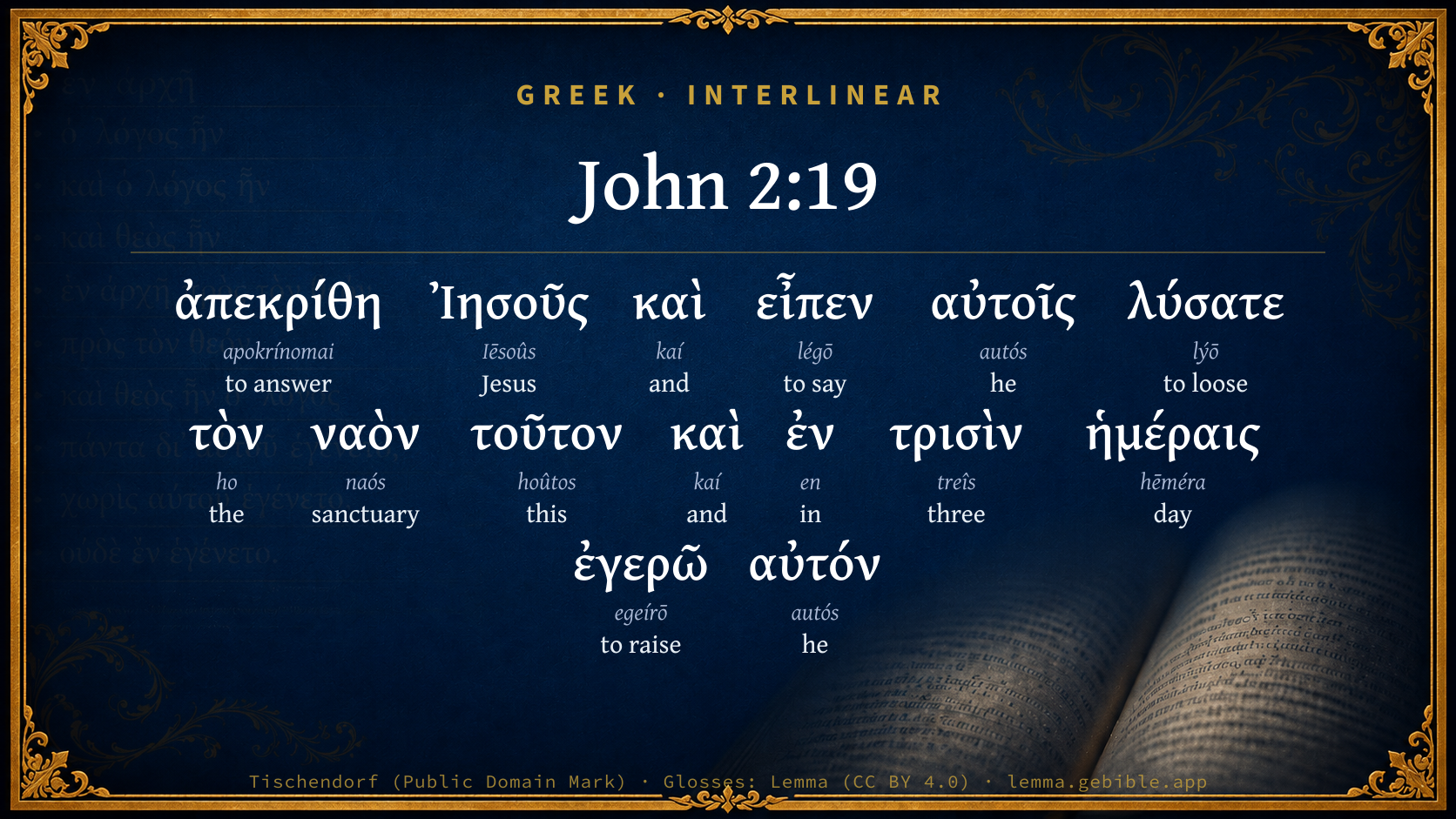
Download image
Cite this verse

John 2:19 (World English Bible). Public Domain. Lemma interlinear Bible study tool, https://lemma.gebible.app/v/john/2/19.

Show BibTeX & RIS
BibTeX
RIS
English Translation
Jesus answered them, "Destroy this temple, and in three days I will raise it up."
World English Bible · Public Domain
Download a study sheet

One document with this verse’s original text, its word-by-word gloss line, the meaning frame, cross-references with their text, attributed commentary, and full source and license credits — printable, and it pastes into notes with its structure intact.

This verse Autodidact and up

Study sheet (.html) Plain text (.txt)

A passage Seminary Student

Up to 50 verses in one chapter. A passage sheet keeps up to 6 commentary sources and 12 cross-references per verse, in the order this page ranks them, and says so on the sheet whenever that leaves anything out. Ask for a single verse and you get the Autodidact verse sheet above.

Everything on this page stays free to read, with no account — the sheet is a download of what is already on screen, not access to it.

Want to remove ads? Support Godless Engineer
Compare translations 3

The same verse in 3 English versions, stacked beneath the original-language interlinear above. Click any original word for its lexicon entry.

Each is an independent rendering of the whole verse — the interlinear is not word-aligned to these translations.

Highlighted words mark where these versions differ — a whole-verse word diff, not a word-by-word alignment.

  • World English Bible Public Domain
    Jesus answered them, "Destroy this temple, and in three days I will raise it up."
  • King James Version Public Domain
    Jesus answered and said unto them, Destroy this temple, and in three days I will raise it up.
  • unfoldingWord Literal Text CC BY-SA 4.0
    Jesus answered and said to them, “Destroy this temple, and in three days I will raise it up.”

unfoldingWord Literal Text — © unfoldingWord, licensed CC BY-SA 4.0. Word-aligned USFM3 via Door43 (git.door43.org/unfoldingWord/en_ult).

Versions to compare (up to 4)

3 of 4 selected

Show all 19 translations

Every available English version of this verse, each an independent rendering of the whole verse.

  • World English Bible Public Domain
    Jesus answered them, "Destroy this temple, and in three days I will raise it up."
  • Berean Standard Bible Public Domain
    Jesus answered, “Destroy this temple, and in three days I will raise it up again.”
  • Majority Standard Bible Public Domain
    Jesus answered, “Destroy this temple, and in three days I will raise it up again.”
  • King James Version Public Domain
    Jesus answered and said unto them, Destroy this temple, and in three days I will raise it up.
  • American Standard Version (1901) Public Domain
    Jesus answered and said unto them, Destroy this temple, and in three days I will raise it up.
  • Revised Version (1885) Public Domain
    Jesus answered and said unto them, Destroy this temple, and in three days I will raise it up.
  • Geneva Bible (1599) Public Domain
    Iesus answered, and said vnto them, Destroy this Temple, and in three daies I will raise it vp againe.
  • Douay-Rheims (1899) Public Domain
    Jesus answered, and said to them: Destroy this temple, and in three days I will raise it up.
  • Young's Literal Translation Public Domain
    Jesus answered and said to them, `Destroy this sanctuary, and in three days I will raise it up.'
  • Literal Standard Version CC BY-SA 4.0
    Jesus answered and said to them, “Destroy this temple, and in three days I will raise it up.”
  • Unlocked Literal Bible CC BY-SA 4.0
    Jesus replied, “Destroy this temple, and in three days I will raise it up.”
  • unfoldingWord Literal Text CC BY-SA 4.0
    Jesus answered and said to them, “Destroy this temple, and in three days I will raise it up.”
  • Darby Bible Public Domain
    Jesus answered and said to them, Destroy this temple, and in three days I will raise it up.
  • World Messianic Bible Public Domain
    Yeshua answered them, “Destroy this temple, and in three days I will raise it up.”
  • Webster's Bible Public Domain
    Jesus answered and said to them, Destroy this temple, and in three days I will raise it up.
  • Free Bible Version CC BY-SA 4.0
    Jesus replied, “Destroy this Temple, and in three days I'll raise it up!”
  • Bible in Basic English Public Domain
    And Jesus said to them, Send destruction on this Temple and I will put it up again in three days.
  • Text-Critical English NT CC BY 4.0
    Jesus answered them, “Destroy this temple, and in three days I will raise it up.”
  • Tyndale New Testament (1534) Public Domain
    Iesus answered and sayd vnto them: destroye this temple and in thre dayes I will reare it vp agayne.

Literal Standard Version (2020), Covenant Press — licensed CC BY-SA 4.0. Text via the HelloAO Bible API (eBible.org). Unlocked Literal Bible (unfoldingWord) — licensed CC BY-SA 4.0. Text via the HelloAO Bible API (eBible.org). unfoldingWord Literal Text — © unfoldingWord, licensed CC BY-SA 4.0. Word-aligned USFM3 via Door43 (git.door43.org/unfoldingWord/en_ult). Free Bible Version, Dr. Jonathan Gallagher — licensed CC BY-SA 4.0. Text via the HelloAO Bible API (eBible.org).

Word by word

More ways to search: Search by grammar → Find every occurrence → Compare this word →

Practice this passage: Drill this verse → Learn its vocabulary →

λύσατε
lýō
G3089
“to loose”
Verb, Aorist, Active, Imperative, 2nd person, Plural
Part of Speech
Verb
Tense
Aorist
Voice
Active
Mood
Imperative
Person
2nd person
Number
Plural
Full Thayer's Definition

Origin: a root word

TDNT: 2:60 & 4:328,543

1. to loose any person (or thing) tied or fastened a. bandages of the feet, the shoes, b. of a husband and wife joined together by the bond of matrimony c. of a single man, whether he has already had a wife or has not yet married 2. to loose one bound, i.e. to unbind, release from bonds, set free a. of one bound up (swathed in bandages) b. bound with chains (a prisoner), discharge from prison, let go 3. to loosen, undo, dissolve, anything bound, tied, or compacted together a. an assembly, i.e. to dismiss, break up b. laws, as having a binding force, are likened to bonds c. to annul, subvert d. to do away with, to deprive of authority, whether by precept or act e. to declare unlawful f. to loose what is compacted or built together, to break up, demolish, destroy g. to dissolve something coherent into parts, to destroy h. metaph., to overthrow, to do away with
  1. ἀπεκρίθη apokrínomai G611 “to answer” Verb, Aorist, Middle deponent, Indicative, 3rd person, Singular
  2. Ἰησοῦς Iēsoûs G2424 “Jesus” Noun, Nominative, Singular, Masculine
  3. καὶ kaí G2532 “and” Conjunction
  4. εἶπεν légō G3004 “to say” Verb, Aorist, Active, Indicative, 3rd person, Singular
  5. αὐτοῖς autós G846 “he” Personal pronoun, Dative, Plural, Masculine
  6. τὸν ho G3588 “the” Article, Accusative, Singular, Masculine
  7. ναὸν naós G3485 “sanctuary” Noun, Accusative, Singular, Masculine
  8. τοῦτον hoûtos G3778 “this” Demonstrative pronoun, Accusative, Singular, Masculine
  9. καὶ kaí G2532 “and” Conjunction
  10. ἐν en G1722 “in” Preposition
  11. τρισὶν treîs G5140 “three” Adjective, Dative, Plural, Feminine
  12. ἡμέραις hēméra G2250 “day” Noun, Dative, Plural, Feminine
  13. ἐγερῶ egeírō G1453 “to raise” Verb, Future, Active, Indicative, 1st person, Singular
  14. αὐτόν autós G846 “he” Personal pronoun, Accusative, Singular, Masculine

About this verse

These counts appear in no published source. They are computed here, from the morphology-tagged text and Lemma’s own curated glosses. What Lemma adds →

15
words
13
distinct lemmas
Gospels
section

Shared distinctive vocabulary

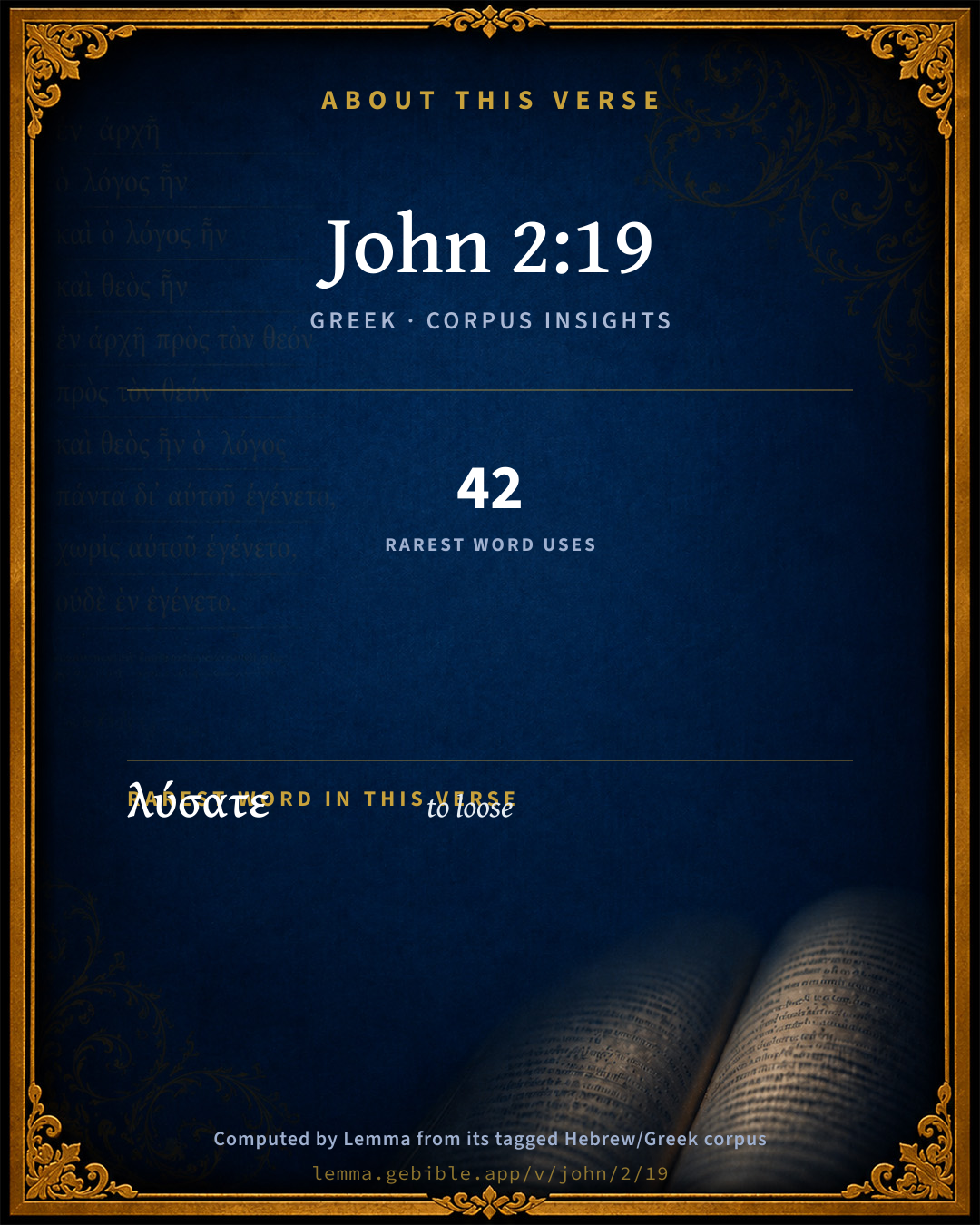
λύσατε to loose G3089 occurs in 39 verses of the Greek New Testament. Also found in:
Repetition

Words recur within this verse:

  • καὶ and G2532 ×2
  • αὐτοῖς he G846 ×2

Cross-references

21

Topical passages linked to John 2:19 in the Treasury of Scripture Knowledge — connected by theme and wording, ordered by reader-vote popularity; previews shown in the World English Bible.

  • Mark 14:58 "We heard him say, 'I will destroy this temple that is made with hands, and in three days I will build another made without hands.'"
  • Mark 15:29 Those who passed by blasphemed him, wagging their heads, and saying, "Ha! You who destroy the temple, and build it in three days,
  • Matthew 27:40 and saying, "You who destroy the temple, and build it in three days, save yourself! If you are the Son of God, come down from the cross!"
  • Matthew 26:60–61 and they found none. Even though many false witnesses came forward, they found none. But at last two false witnesses came forward,
  • Matthew 12:40 For as Jonah was three days and three nights in the belly of the whale, so will the Son of Man be three days and three nights in the heart of the earth.
  • Romans 8:11 But if the Spirit of him who raised up Jesus from the dead dwells in you, he who raised up Christ Jesus from the dead will also give life to your mortal bodies through his Spirit who dwells in you.
  • John 10:17–18 Therefore the Father loves me, because I lay down my life, that I may take it again.
  • Acts 2:32 This Jesus God raised up, to which we all are witnesses.
  • Acts 2:24 whom God raised up, having freed him from the agony of death, because it was not possible that he should be held by it.
  • Acts 3:15 and killed the Prince of life, whom God raised from the dead, to which we are witnesses.
  • 1 Peter 3:18 Because Christ also suffered for sins once, the righteous for the unrighteous, that he might bring you to God; being put to death in the flesh, but made alive in the spirit;
  • Mark 8:31 He began to teach them that the Son of Man must suffer many things, and be rejected by the elders, the chief priests, and the scribes, and be killed, and after three days rise again.
  • John 11:25 Jesus said to her, "I am the resurrection and the life. He who believes in me, though he die, yet will he live.
  • Romans 6:4 We were buried therefore with him through baptism to death, that just like Christ was raised from the dead through the glory of the Father, so we also might walk in newness of life.
  • 1 Corinthians 15:3–4 For I delivered to you first of all that which I also received: that Christ died for our sins according to the Scriptures,
  • Matthew 27:63 saying, "Sir, we remember what that deceiver said while he was still alive: 'After three days I will rise again.'
  • John 5:19 Jesus therefore answered them, "Most assuredly, I tell you, the Son can do nothing of himself, but what he sees the Father doing. For whatever things he does, these the Son also does likewise.
  • Acts 3:26 God, having raised up his servant, Jesus, sent him to you first, to bless you, in turning away everyone of you from your wickedness."
  • Romans 4:24 but for our sake also, to whom it will be accounted, who believe in him who raised Jesus, our Lord, from the dead,
  • 1 Corinthians 15:12 Now if Christ is preached, that he has been raised from the dead, how do some among you say that there is no resurrection of the dead?
  • Colossians 2:12 having been buried with him in baptism, in which you were also raised with him through faith in the working of God, who raised him from the dead.

Cross-references courtesy of OpenBible.info (CC BY 4.0).

Commentary

Notes on John 2:19 from classic Christian and Jewish commentators (each source and its license shown beneath its notes). The classic Christian expositions comment on the surrounding passage and are grouped to its opening verse, so a note may address several verses; the Jewish commentaries on the Tanakh (Rashi and others) are per-verse, so they appear only where the commentator wrote on this verse.

Lemma curates 59 commentaries, every one of them public domain or Creative Commons licensed, each selected and text-cleaned for this edition rather than reprinted as found. About our sources →

MacLaren's Expositions of Holy Scripture

Alexander MacLaren

John

THE DESTROYERS AND THE RESTORER

Joh 2:19.

This is our Lord’s answer to the Jewish request for a sign which should warrant His action in cleansing the Temple. There are two such cleansings recorded in the Gospels; this one His first public act, and another, omitted by John, but recorded in the other Gospels, which was almost His last public act.

It has been suggested that these are but two versions of one incident; and although there is no objection in principle to admitting the possibility of that explanation, yet in fact it appears to me insufficient and unnecessary. For each event is appropriate in its own place. In each there is a distinct difference in tone. The incident recorded in the present chapter has our Lord’s commentary, ‘Make not My Father’s house a house of merchandise’; in that recorded in the Synoptic Gospels the profanation is declared as greater, and the rebuke is more severe. The ‘house of merchandise’ has become, by their refusal to render to Him what was His, ‘a den of thieves.’ In the later incident there is a reference in our Lord’s quotation from the Old Testament to the entrance of the Gentiles into the Kingdom. There is no such reference here. In the other Gospels there is no record of this question which the Jews asked, nor of our Lord’s significant answer, whilst yet a caricatured and mistaken version of that answer was known to the other Evangelists, and is put by them into the mouths of the false witnesses at our Lord’s trial. They thus attest the accuracy of our narrative even while they seem not to have known of the incident.

All these things being taken into account, I think that we have to do with a double, of which there are several instances in the Gospels, the same event recurring under somewhat varied circumstances, and reflecting varied aspects of truth. But it is to our Lord’s words in vindication of His right to cleanse the Temple rather than to the incident on which they are based that I wish to turn your attention now: ‘Destroy this Temple,’ said our Lord, as His sufficient and only answer to the demand for a sign, ‘and in three days I will raise it up.’

Now these words, enigmatical as they are, seem to me to be very profound and significant; and I wish, on this Easter Sunday, to look at them as throwing a light upon the gladness of this day. They suggest to me three things: I find in them, first, an enigmatical forecast of our Lord’s own history; second, a prophetic warning of Israel’s; and last, a symbolical foreshadowing of His world-wide work as the Restorer of man’s destructions. ‘Destroy this Temple, and in three days I will raise it up.’

I. First then, I think, we see here an enigmatical forecast of our Lord’s own history.

Notice, first, that marvellous and unique consciousness of our Lord’s as to His own dignity and nature. ‘He spake of the temple of His body.’ Think that here is a man, apparently one of ourselves, walking amongst us, living the common life of humanity, who declares that in Him, in an altogether solitary and peculiar fashion, there abides the fulness of Deity. Think that there has been a Man who said, ‘In this place is One greater than the Temple.’ And people have believed Him, and do believe Him, and have found that the tremendous audacity of the words is simple verity, and that Christ is, in inmost reality, all which the Temple was but in the poorest symbol. In it there had dwelt, though there dwelt no longer at the time when He was speaking, a material and symbolical brightness, the expression of something which, for want of a better name, we call the ‘presence of God.’ But what was that flashing fire between the cherubim that brooded over the Mercy-seat, with a light that was lambent and lustrous as the light of love and of life-what was that to the glory, moulded in meekness and garbed in gentleness, the glory that shone, merciful and hospitable and inviting-a tempered flame on which the poorest, diseased, blind eyes could look, and not wince-from the face and from the character of Jesus Christ the Lord? He is greater than the Temple, for in Him, in no symbol but in reality, abode and abides the fulness of that unnameable Being whom we name Father and God. And not only does the fulness abide, but in Him that awful Remoteness becomes for us a merciful Presence; the infinite abyss and closed sea of the divine nature hath an outlet, and becomes a ‘river of water of life.’ And as the ancient name of that Temple was the ‘Tent of Meeting,’ the place where Israel and God, in symbolical and ceremonial form, met together, so, in inmost reality in Christ’s nature, Manhood and Divinity cohere and unite, and in Him all of us, the weak, the sinful, the alien, the rebellious, may meet our Father. ‘He that hath seen Me hath seen the Father.’ ‘In this place is One greater than the Temple.’

And so this Jewish Peasant, at the very beginning of His earthly career, stands up there, in the presence of the ancestral sanctities and immemorial ceremonials which had been consecrated by all these ages and commanded by God Himself, and with autocratic hand sweeps them all on one side, as one that should draw a curtain that the statue might be seen, and remains poised Himself in the vacant place, that all eyes may look upon Him, and on Him alone. ‘Destroy this Temple . . . . He spake of the temple of His body.’

Still further, notice how here we have, at the very beginning of our Lord’s career, His distinct prevision of how it was all going to end. People that are willing to honour Jesus Christ, and are not willing to recognise His death as the great purpose for which He came, tell us that, like as with other reformers and heroes and martyrs, His death was the result of the failure of His purpose. And some of them talk to us very glibly, in their so-called ‘Lives of Jesus Christ’ about the alteration in Christ’s plan which came when He saw that His message was not going to be received. I do not enter upon all the reasons why such a construction of Christ’s work cannot hold water, but here is one-for any one who believes this story before us-that at the very beginning, before He had gone half a dozen steps in His public career, when the issues of the experiment, if it was a man that was making the experiment, were all untried; when, if it were merely a martyr-enthusiast that was beginning his struggle, some flickering light of hope that He would be received of His brethren must have shone, or He would never have ventured upon the path-that then, with no mistake, with no illusion, with no expectation of a welcome and a Hosanna, but with the clearest certitude of what lay before Him, our Lord beheld and accepted His Cross. Its shadow fell upon His path from the beginning, because the Cross was the purpose for which He came. ‘To this end was I born, and for this cause came I into the world,’ said He-when the reality of it was almost within arm’s length of Him-’to bear witness to the Truth,’ and His bearing witness to the truth was perfected and accomplished on the Cross. Here, at the very commencement of His career, we have it distinctly set forth, ‘the Son of Man came to give His life a ransom for many.’

And, brethren, that fact is important, not only because it helps us to understand that His death is the centre of His work, but also because it helps us to a loving and tender thought of Him, how all His life long, with that issue distinctly before Him, He journeyed towards it of His own loving will; how every step that He took on earth’s flinty roads, taken with bleeding and pure feet, He took knowing whither He was going. This Isaac climbs the mountain to the place of sacrifice, with no illusions as to what He is going up the mountain for. He knows that He goes up to be the lamb of the offering, and knowing it, He goes. Therefore let us love Him with love as persistent as was His own, who discerning the end from the beginning, willed to be born and to live because He had resolved to die, for you and me and every man.

And then, further, we have here our Lord’s claim to be Himself the Agent of His own resurrection. ‘I will raise it up in three days.’ Of course, in Scripture, we more frequently find the Resurrection treated as being the result of the power of God the Father. We more ordinarily read that Christ was raised; but sometimes we read, as here, that Christ rises, and we have solemn words of His own, ‘I have power to lay it down, and I have power to take it again.’ Think of a man saying, ‘I am going to bring My own body from the dust of death,’ and think of the man who said that doing it. If that is true, if this prediction was uttered, and being uttered was fulfilled-what then? I do not need to answer the question. My brother, this day declares that Jesus Christ is the Son of God. ‘Destroy this Temple’-there is a challenge-’and in three days I will raise it up’; and He did it. And He is the Lord of the Temple as well as the Temple. Down on your knees before Him, with all your hearts and with all your confidence, and worship, and trust, and love for evermore ‘the Second Man,’ who ‘is the Lord from Heaven!’

II. Now let us turn to the other aspects of these words. I think we see here, in the next place, a prophetic warning of the history of the men to whom He was speaking.

There must be a connection between the interpretation of the words which our Evangelist assures us is the correct one, and the interpretation which would naturally have occurred to a listener, that by ‘this Temple’ our Lord really meant simply the literal building in which He spoke. There is such a connection, and though our Lord did not only mean the Temple, He did mean the Temple. To say so is not forcing double meanings in any fast and loose fashion upon Scripture, nor playing with ambiguities, nor indulging in any of the vices to which spiritualising interpretation of Scripture leads, but it is simply grasping the central idea of the words of my text. Rightly understood they lead us to this: ‘The death of Christ was the destruction of the Jewish Temple and polity, and the raising again of Christ from the dead on the third day was the raising again of that destroyed Theocracy and Temple in a new and nobler fashion.’ Let us then look for a moment, and it shall only be for a moment, at these two thoughts.

If any one had said to any of that howling mob that stood round Christ at the judgment-seat of the High Priest, and fancied themselves condemning Him to death, because He had blasphemed the Temple: ‘You, at this moment, are pulling down the holy and beautiful house in which your fathers praised; and what you are doing now is the destruction of your national worship and of yourselves,’ the words would have been received with incredulity; and yet they were simple truth. Christ’s death destroyed that outward Temple. The veil was ‘rent in twain from the top to the bottom’ at the moment He died; which was the declaration indeed that henceforward the Holiest of All was patent to the foot of every man, but was also the declaration that there was no more sanctity now within those courts, and that Temple, and priesthood, and sacrifice, and altar, and ceremonial and all, were antiquated. That ‘which was perfect having come,’ Christ’s death having realised all which Temple-worship symbolised, that which was the shadow was put away when the substance appeared.

And in another fashion, it is also true that the death of our Lord Jesus Christ, inflicted by Jewish hands, was the destruction of the Jewish worship, in the way of natural sequence and of divine chastisement. When the husbandmen rejected the Son who was sent ‘last of all,’ there was nothing more for it but that they should be ‘cast out of the vineyard,’ and the firebrand which the Roman soldier, forty years afterwards, tossed into the Holiest of All, and which burned the holy and beautiful house with fire, was lit on the day when Israel cried ‘Crucify Him! Crucify Him!’

Oh, brethren! What a lesson it is to us all of how blind even so-called religious zeal may be; how often it is true that men in their madness and their ignorance destroy the very institutions which they are trying to conserve! How it warns us to beware lest we, unknowing what we are about, and thinking that we are fighting for the honour of God, may really all the while be but serving ourselves and rejecting His message and His Messenger!

And then let me remind you that another thing is also true, that just as the Jewish rejection of Christ was their own rejection as the people of God, and their attempted destruction of Christ the destruction of the Jewish Temple, so the other side of the truth is also here, viz. that His rising again is the restoration of the destroyed Temple in nobler and fairer form. Of course the one real Temple is the body of Jesus Christ, as we have said, where sacrifice is offered, where God dwells, where men meet with God. But in a secondary and derivative sense, in the place of the Jewish Temple has come the Christian Church, which is, in a far deeper and more inward fashion, what that ancient system aspired to be.

Christ has builded up the Church on His Resurrection. On His Resurrection, I say, for there is nothing else on which it could rest. If men ask me what is the great evidence of Christ’s Resurrection, my answer is-the existence in the world of a Church. Where did it come from? How is it possible to conceive that without the Resurrection of Jesus Christ such a structure as the Christian society should have been built upon a dead man’s grave? It would have gone to pieces, as all similar associations would have gone. What had happened after that moment of depression which scattered them every man to his own, and led some of them to say, with pathetic use of the past tense to describe their vanished expectations, ‘We trusted that it had been He which should have redeemed Israel’? What was the force that instead of driving them asunder drew them together? What was the power that, instead of quenching their almost dead hopes, caused them to flame up with renewed vigour heaven-high? How came it that that band of cowardly, dispirited Jewish peasants, who scattered in selfish fear and heart-sick disappointment, were in a few days found bearding all antagonism, and convinced that their hopes had only erred by being too faint and dim? The only answer is in their own message, which explained it all: ‘Him hath God raised from the dead, whereof we are all witnesses.’

The destroyed Temple disappears, and out of the dust and smoke of the vanishing ruins there rises, beautiful and serene, though incomplete and fragmentary and defaced with many a stain, the fairer reality, the Church of the living Christ. ‘Destroy this Temple, and in three days I will raise it up.’

III. Lastly, we have here a foreshadowing of our Lord’s world-wide work as the Restorer of man’s destructions.

Man’s folly, godlessness, worldliness, lust, sin, are ever working to the destruction of all that is sacred in humanity and in life, and to the desecrating of every shrine. We ourselves, in regard to our own hearts, which are made to be the temples of the ‘living God,’ are ever, by our sins, shortcomings, and selfishness, bringing pollution into the holiest of all; ‘breaking down the carved work thereof with axes and hammers,’ and setting up the abomination of desolation in the holy places of our hearts. We pollute them all-conscience, imagination, memory, will, intellect. How many a man listening to me now has his nature like the facade of some of our cathedrals, with the empty niches and broken statues proclaiming that wanton desecration and destruction have been busy there?

My brother! what have you done with your heart? ‘Destroy this temple.’ Christ spoke to men who did not know what they were doing; and He speaks to you. It is the inmost meaning of the life of many of you. Hour by hour, day by day, action by action, you are devastating and profaning the sanctities of your nature, and the sacred places there where God ought to live.

Listen to His confident promise. He knows that in me He is able to restore to more than pristine beauty all which I, by my sin, have destroyed; to reconsecrate all which I, by my profanity, have polluted; to cast out the evil deities that desecrate and deform the shrine; and to make my poor heart, if only I will let Him come in to the ruined chamber, a fairer temple and dwelling-place of God.

‘In three days,’ does He do it? In one sense-Yes! Thank God! the power that hallows and restores the desecrated and cast-down temple in a man’s heart, was lodged in the world in those three days of death and resurrection. The fact that He ‘died for our sins,’ the fact that He was ‘raised again for our justification,’ are the plastic and architectonic powers which will build up any character into a temple of God.

And yet more than ‘forty and six years’ will that temple have to be ‘in building.’ It is a lifelong task till the top-stone be brought forth. Only let us remember this: Christ, who is Architect and Builder, Foundation and Top-stone; ay! and Deity indwelling in the temple, and building it by His indwelling-this Christ is not one of those who ‘begin to build and are not able to finish.’ He realises all His plans. There are no ruined edifices in ‘the City’; nor any half-finished fanes of worship within the walls of that great Jerusalem whose builder and maker is Christ.

If you will put yourselves in His hands, and trust yourselves to Him, He will take away all your incompleteness, and will make you body, soul, and spirit, temples of the Lord God; as far above the loftiest beauty and whitest sanctity of any Christian character here on earth as is the building of God, ‘the house not made with hands, eternal in the heavens,’ above ‘the earthly house of this tabernacle.’

He will perfect this restoring work at the last, when His Word to His servant Death, as He points him to us, shall be ‘Destroy this temple, and I will raise it up.’

Alexander MacLaren, Expositions of Holy Scripture (1904–1910) — public domain. Text from a community e-Sword module.

Tyndale Open Study Notes

Tyndale Open Resources

2:19-21 Destroy this temple: Herod the Great began reconstructing the Temple’s magnificent structure in 20 BC, and work on it continued until AD 64. This explains why Jesus’ audience was amazed when he claimed he could destroy and rebuild it in a few days. However, Jesus spoke figuratively of his own body as the temple where God was present (see 1:14, 51)—his body was destroyed and restored in three days through the resurrection, rendering the Jerusalem Temple and its services obsolete. Later, at his trial, Jesus’ symbolic reference to destroying the Temple was used as evidence of blasphemy (Mark 14:58).

Tyndale Open Study Notes — © Tyndale Open Resources, licensed CC BY-SA 4.0. Text via the HelloAO Bible API.

Bengel's Gnomon

Johann Albrecht Bengel

Joh 2:19. Λύσατε, destroy) On account of this very deed, namely, the cleansing of the temple, they afterwards destroyed the temple of His body. Mat 21:23 [see above], Mat 21:46, “They sought to lay hands on Him;” Mat 27:40, [They that passed by reviled, saying] “Thou that destroyest the temple and buildest it in three days, save Thyself;” Mat 26:61, [False witnesses said, in His trial before Caiaphas] “This fellow said, I am able to destroy the temple of God, and to build it in three days.” Destroy, i.e. if you destroy: or rather, you will destroy. A similar use of the Imperative [occurs] Sir 30:9; Sir 33:26, Soothe your little son, etc. [= you will soothe],—τὸν ναόν, the temple) The body of Jesus, about to be raised again, is the temple and dwelling-place of the Godhead. Therefore Jesus is the Lord of the temple at Jerusalem, which was the type of the body of Jesus.—τοῦτον, this) There is no doubt but that Jesus supplied that which the Evangelist adds, Joh 2:21, by the employment of a nod or gesture, unobserved by the Jews.—[47] ἐγερῶ, I will raise it up) A suitable word, [both] concerning the edifice of stone, and concerning the temple of His body. It recurs at verse 22. This is a grand declaration of His, I can do what I please with the temple of My body: ch. Joh 10:17-18, “No man taketh it from Me, but I lay it down of Myself. I have power to lay it down, and I have power to take it again;” and so also I can do what I please with this temple made of stone and wood. He puts off those demanding the sign: comp. ch. Joh 8:28, “When ye have lifted up the Son of man, then shall ye know that I am He, and that I do nothing of myself:” nor, however, even in the time then being did He perform no signs; Joh 2:23, “Many believed on His name, when they saw the miracles which He did.”

[47] ἐν τρισὶν ἡμέραις, in three days) From this very time, in which it first came into the Jews’ mind to destroy the temple of Christ’s body (Mar 14:58, We heard Him say, I will destroy this temple that is made with hands, and within three days I will build another made without hands), down to His resurrection, by which He Himself raised the temple, is accounted, even in that sense, a three days’ period, if you take one day, and that the Passover day, in this figurative language, as one year: to wit, by including in the numeration the years of the prophecy and of its completion (which years are Dion. 28 and 30).—Harm., p. 162.

Bengel's Gnomon of the New Testament — English translation (T&T Clark, Edinburgh, 1860) — public domain. Text from a community e-Sword module.

International Critical Commentary

19. λύσατε τὸν ναὸν τοῦτον κτλ. We must distinguish this saying of Jesus from the interpretation which the evangelist puts upon it in v. 21. That it is an authentic saying is plain from the fact that, perhaps in a distorted form, it was made a topic of accusation against Jesus at His trial before the high priest (Mar 14:58, Mat 26:61; cf. Mar 15:29, Act 6:14). That by the ναός which would be destroyed Jesus was understood to mean Herod’s Temple is certain from the retort of the Jews (see on v. 20). But the precise form of words is uncertain, nor were the witnesses at the trial agreed about this. According to Mk., the witnesses falsely reported the saying in the form, “I will destroy this temple made with hands, and in three days (διὰ τριῶν ἡμερῶν) I will build another made without hands” (Mar 14:58). This is softened down by Mt., according to whom the witnesses alleged that Jesus said, “I can destroy the temple of God and build it in three days” (Mat 26:61). According to Jn. in the present passage, Jesus only said that if the Jews destroyed the Temple, in three days He would raise it up. It is a question whether any of these reports precisely reproduces the words of Jesus at the Cleansing of the Temple. On another occasion He is reported by the Synoptists (Mar 13:2, Mat 24:2, Luk 21:6) to have predicted the downfall of the Temple, and this is undoubtedly authentic. But it is not probable that He should have declared that He would rebuild it or raise it up again.1 A rebuilding of the Temple would mean the restoration of the old Jewish system of ritual and sacrifice, and we know that this was not the purpose of Jesus (see above, pp. 87, 88). He told the Samaritan woman that He did not accept the principle which she attributed to Him, that Jerusalem was the special place where men ought to worship (4:20, 21). The worship of the future was to be of a spiritual sort, and not to be confined to any one centre. To the vision of the seer of the Apocalypse, there was no temple in the New Jerusalem (Rev 21:22). That Jesus should have said that He would rebuild the Temple at Jerusalem if it were destroyed, is not credible. The Temple was, indeed, the chief obstacle to the acceptance of His gospel by the Jews.

But the Marcan version of His words, or rather the Marcan version of the witnesses’ report of His words (Mar 14:58), has no such improbability. It lays stress on the contrast between the temple made with hands and the temple made without hands (cf. Act 7:48, Act 17:24, Heb 9:11), between the temple built by Herod, which was the centre of Jewish worship, and the “spiritual house” of Christian believers, which was to offer up “spiritual sacrifices” (1Pe 2:5; cf. 2Co 6:16). That Jesus foresaw the passing of the Temple, and its replacement by a less exclusive and less formal worship is certain, however we try to explain His prescience.

Next, we observe that it is common to all the reports of this saying of His that He asserted that the replacement of the old by the new would be “in three days.” Salmon suggested1 that Jesus may have had in His thoughts the words of the prophet about reconstruction after apparent destruction “After two days will He revive us: on the third day He will raise us up, and we shall live before Him” (Hos 6:2). The Synoptists, however, tell again and again that Jesus predicted that His Death would be followed by His Resurrection “on the third day” (Mar 8:31, Mat 16:21, Luk 9:22; Mar 9:31, Mat 17:23; Mar 10:34, Mat 20:19, Luk 18:33; cf. also Mat 27:63). It is more natural to bring the “three days” of Mar 14:58, Mat 26:61, Joh 2:19 into connexion with these passages than to presuppose a reminiscence of Hos 6:2—a prophetic text which, it is curious to note, is never quoted of the Resurrection in the Apostolic age.2

We conclude, then, that Jesus at the Cleansing of the Temple declared (1) that the Temple, the pride and glory of Jerusalem, would be destroyed at no distant date, and that the Temple worship would pass away; (2) that He would Himself replace it by a spiritual temple; and (3) that the transition from the old order to the new would occupy no more than “three days.” His hearers were at once indignant and incredulous, for they understood His words as a threat, and that the rebuilding of which He spoke was a literal rebuilding with stones and mortar.

The Epistle of Barnabas (§ 16) states explicitly that the spiritual temple then being built up was the company of Christian believers: “I will tell you concerning the temple how these wretched ones [i.e. the Jews] being led astray set their hope on the building, and not on their God that made them, as if it were the house of God.” He quotes Isa 49:17 and Enoch lxxxix. 56 as predictive of the destruction of the Temple, and proceeds, “Let us inquire whether there be any temple of God.” He concludes that there is, quoting words of Enoch (91:13), “When the week is being accomplished, the temple of God shall be built gloriously.” He goes on, “Before we believed in God, the abode of our heart was corrupt and weak, a temple truly built by hands”; but the temple of the Lord is now built gloriously, for “having received the remission of sins and having set our hope on the Name, we became new, being created again from the beginning, wherefore God truly dwelleth in our habitation within us. … This is a spiritual temple built for the Lord.” The allusion to “the temple made with hands” is reminiscent of Mar 14:58, and the whole passage shows that the antithesis between the Jewish temple of stone and the Christian temple of faithful hearts was familiar to the sub-Apostolic age. We have it again in Justin (Tryph. 86), who says that Jesus made His disciples to be “a house of prayer and worship” (οἶκος εὐχῆς καὶ προσκυνήσεως). The idea probably goes back to sayings of Jesus such as Mar 14:58 and the present passage, although it is not suggested here that Barnabas knew the Fourth Gospel.

“In three days I will raise it up.” The Agent of the revival is to be Jesus Himself. This suggests at once that it was not to His own bodily Resurrection that Jesus referred here. For by the N.T. writers God the Father is always designated as the Agent of Christ’s Resurrection (Act 2:24, Act 3:15, Act 4:10, Act 10:40, Act 13:30, Rom 4:24, Rom 4:8:11, Rom 4:10:9, 1Co 6:14, 1Co 6:15:15, 2Co 4:14, Gal 1:1, Eph 1:20, 1Th 1:10, Heb 13:20, 1Pe 1:21). Jesus is not represented as raising Himself. Hence we have a confirmation of the conclusion already reached, that it was not the resuscitation of the Body of Jesus from the tomb that was in His thought here, but rather the passing of the old (and material) temple and the beginning of the new (and spiritual) temple of Christian believers. See on v. 21, and note the passive ἠγέρθη at v. 22; but cf. also 10:18

International Critical Commentary — older volumes (1896–1929), various authors — public domain. Text from a community e-Sword module.

Godet's Commentaries

Frédéric Louis Godet

Ver. 19. “Jesus answered and said unto them: Destroy this temple, and in three days I will raise it up.” This answer of Jesus is sudden, like a flash of lightning. It springs from an immeasurable depth; it illuminates regions then completely unexplored by any other consciousness than His own. The words: Destroy this temple, characterize the present and future conduct of the Jews in its innermost significance, and the words: In three days I will raise it up, display all the grandeur of the person and of the future work of Jesus. This mysterious saying involves the following difficulty: on the one hand, the connection with what precedes prompts us to refer the words, this temple, to the temple properly so called, which Jesus had just purified; on the other, the evangelist’s interpretation (Joh 2:21) obliges us to apply them to the body of Jesus. Some, as Lucke and Reuss, cut the Gordian knot by declaring that there is a conflict which cannot be settled between scientific exegesis and the apostle’s explanation, and by determining that there is an advance of the first beyond the second. Baur administers a severe lecture to Lucke for irreverence towards the apostolic exegesis, of which this view gives evidence. In fact, according to Baur, this saying being partly the creation of the evangelist himself, he must know better than any one, better than Lucke, what is its true meaning!

The historical truth of this saying of Jesus is guaranteed: 1. By the declaration of the false witnesses (Mat 26:61; Mar 14:57-58), which proves that, although the recollection of the circumstances in which it was pronounced may have been effaced, the expression itself had remained deeply engraved on the memory, not only of the disciples, but of the Jews. 2. By Act 6:14, where Stephen’s accusers said: “We have heard him say that this Jesus of Nazareth shall destroy this place and shall change the customs which Moses gave to us.” Stephen could not have spoken thus except on the foundation of a positive declaration of Jesus. 3. By the originality, the conciseness, and even the obscurity of the saying.

The first clause cannot contain an invitation to the Jews directly to destroy the temple, not even in the hypothetical sense of de Wette: “If you should destroy.” This supposition would be absurd; no Israelite would have thought of laying his hand on the sacred edifice. The word destroy should, therefore, be taken in the indirect sense: to bring about, by continuing in the course which you are following, the destruction of the theocracy and that of the temple. But what is the offense by which Israel can provoke this final chastisement? Modern interpretation,—“scientific exegesis,” as Lucke says,—answers: By continually increasing moral profanations, such as that against which Jesus had just protested. This answer is insufficient. Simple sins of this kind could prepare, but not decide, this catastrophe. The Old Testament assigns a more positive cause for the final ruin of Israel; it is the rejection and murder of the Messiah. Zechariah announces this crime, when describing (Zec 12:10) the mourning of the Israel of the last days, lamenting the murderous sin against Jehovah whom they have pierced. Daniel, Daniel 9, says: “The Messiah shall be cut off....and the people of a prince who shall come shall destroy the city and the sanctuary;” a passage which Matthew (Mat 24:15-16) applies to the circumstances of his time. The means for Israel of destroying its temple, are, to the view of Jesus, to put the Messiah to death. The appearance of the Messiah is the purpose of the theocratic institution. The Messiah being once cut off, it is all over with Israel and consequently with the temple. The people and the priesthood may indeed still exist for a while after this; but all this is nothing more than the carcase over which the eagles of the divine judgment gather themselves (Mat 24:28). Why, at the moment when Jesus expires, is the veil of the temple rent? It is because, in reality, there is no longer a Most Holy place, no longer a Holy place, no longer courts, sacrifice, priesthood; the temple, as Jehovah’s temple, has ceased to exist.

When He says “Destroy this temple,” therefore, it is, indeed, of the temple properly so called, that Jesus speaks; but He knows that it will be in His own person, that this destruction, so far as it depends on the Jews, will be consummated. It is on His body that they will cause the blow to fall, which will destroy their sanctuary. The imperative λύσατε is not, then, merely concessive: “If it happens that you destroy.” It is of the same kind with that other imperative, “What thou hast to do, do quickly” (Joh 13:27). When the fruit of perversity, collective or individual, is ripe, it must fall. Comp. also the πληρώσατε, Mat 23:32.

The meaning of the second clause follows from that of the first. If the death of Jesus is the real destruction of the temple, the restoration of the latter can consist only in the resurrection of Jesus Himself. Jesus once said: “Here is more than the temple” (Mat 12:6). His body was the living and truly holy dwelling of Jehovah; the visible sanctuary was the anticipatory emblem of this real temple. It is, therefore, really, in Him, in His body, that this supreme crisis will be effected. The Messiah perishes; the temple falls. The Messiah lives again; the true temple rises again; in a new form, beyond doubt. For in the Kingdom of God, there is never a simple restoration of the past. He who speaks of rising anew speaks of progress, reappearance in a higher form. The word ἐγείρειν, to waken up, to raise up, is perfectly suitable here. For it may be applied at once to a resurrection and a construction (see Meyer). The expression: in three days, the authenticity of which is guaranteed in a very special way by the statement of the false witnesses (διὰ τριῶν ἡμερῶν, Mat 26:61; Mar 14:58), receives in our explanation its natural meaning; for, in an historical situation so solemn as this, it is impossible to see only a poetic or proverbial form for saying: “in a very short time,” as Hos 6:2, or Luk 13:31. A demonstrative miracle has been demanded of Jesus, as a sign of His competency. We know from the Synoptics that Jesus always rejected such demands, which renewed for Him the third temptation in the wilderness.

But there was a miracle, one only, which He could promise, without condemning Himself to the role of a wonder-worker, because this miracle entered as a necessary element into the very work of salvation: it was His resurrection. Thus it is to this sign that He in like manner appeals, in similar cases, in the Synoptics (Mat 12:38-40; Mat 16:4). We come also here upon one of those profound analogies which, beneath the difference of the forms, blend into one whole the representation of the Synoptics and that of John. It is by the reparative power which He will display, when the Kingdom of God shall have sunk down, in a sense, even to nothing, that Jesus will prove the competency for reformation which He has just arrogated to Himself at this hour. This explanation answers thus to the natural meaning of the expressions of the text, to the demands of the context, and finally to the evangelist’s interpretation.

The following is the meaning at which modern exegesis has arrived, by following, as Lucke says, “the laws of philological art.” It is best set forth, as it seems to us, by Ewald (Gesch. Christi, p. 230): “All your religion, resting upon this temple, is corrupted and perverted; but He is already present, who, when it shall have perished as it deserves, shall easily restore it in a more glorious form, and shall thus work, not one of those common miracles which you ask for, but the grandest of miracles.” In this explanation, the temple destroyed is Judaism; the temple raised up is Christianity; the act of raising it up is Pentecost, not the resurrection. We shall not say that this sense is absolutely false; it is so only so far as it is given as the exact expression of the thought of Jesus at this moment. What condemns it is: 1. That the transformation of the economy of the letter into that of the Spirit is not a sign, but the work itself. It is necessary that the event indicated by Jesus should have an external character, in order to be adapted to the demand which was addressed to Him; 2. It is impossible, from this point of view, to interpret naturally the words: in three days. The passages (Hos 6:2 and Luk 13:31) do not sufficiently justify the figurative sense which must, in that case, be given to them here; 3. The temple raised up would be entirely different from the temple destroyed; but the pronoun αὐτόν (it), demands that there should, at least, be a relation between the one and the other (the body of Jesus destroyed and raised again). Objection is made to the meaning which we have proposed, that the Jews could not have understood so mysterious a reply. Assuredly, they did not see in the temple, of which Jesus spoke, anything but the material edifice, and they represented to themselves the sign promised by Him as the magical appearance of a new and supernatural temple (Mar 14:58). But we shall see that, in dealing with evil-disposed persons, the method of Jesus is to throw out enigmas and to reveal the truth only while veiling it; comp. the explanation of Jesus respecting the use of parables (Mat 12:11-16). Here is a secret of the profoundest pedagogics.

Objection is also made, that Jesus could not, so long beforehand, know of His death and resurrection. But in the Synoptics, also, He very early announces the tragical end of His Messianic ministry. It is during the first days of His activity in Galilee, that He speaks of the time “when the bridegroom will be taken away, and when the disciples will fast” (Mar 2:19-20). Had Jesus, then, never read Isaiah 53, Daniel 9, Zechariah 12, etc.? Now, if He foresaw His death, He must have been assured also of His resurrection. He could not suppose that the bridegroom would be taken away, not to be restored.

Finally, it is objected, that, according to the Scriptures, it is not Jesus who raised Himself. But the receptivity of Jesus, in the act of His resurrection, was not that of passivity. He says Himself (Joh 10:17-18): “I give up my life, that I may take it again...I have the power to give it up, and I have the power to take it again.” He lays hold, as in all His miracles, of the divine omnipotence, and this becomes thereby active in Him.

Renan has seen in this utterance, so original and so profound, only a whim: “One day,” he says, “His ill-humor against the temple drew from Him an imprudent word.” He adds: “We do not know, indeed, what sense Jesus attached to this word, in which His disciples sought forced allegories” (Vie de Jesus, p. 367). Where Renan sees a proof of the ill-humor of Jesus against the temple, the immediate witnesses found one of the zeal for the house of God, which devoured their Master. Which has better understood Jesus? As for the explanation given by John (Joh 2:21), we shall hope that every serious reader will find in it something else than a “forced allegory.”

Weiss does not think it is possible to defend the complete authenticity of the expression of Jesus, as it has been preserved for us by John. If Jesus expressed Himself thus, he must, at the same time, have pointed to His body with His finger, and this gesture would have been sufficient to render the misapprehension of the Jews (Joh 2:20) impossible. Besides, the interpretation which Mark gives of the saying of Jesus (Mar 14:58), leads one to suppose that its real meaning was a little different from that which we find in John. To the demand of the Jews relative to His competency to purify the temple (Joh 2:18), Jesus is said to have answered, that for the outward temple He would substitute the habitation of God in the spirit. It was John, according to Weiss, who introduced afterwards into the quite simple answer of Jesus, the two ideas of His death and His resurrection. This hypothesis could be taken into consideration only if the difficulty presented by the saying of Jesus, as we have it, were insurmountable. But we believe that we have shown that it is not so. At the foundation, the true ground of this supposition is, that according to this author, Jesus must not have predicted beforehand His death and resurrection.

How did Jesus discover in this question, apparently so innocent: “What sign showest thou?” the prelude of the catastrophe which was to put an end to His own life, and, by that means, to the theocracy itself? We know from Joh 2:3-4, with what penetration Jesus seized upon the moral bearing of the words which were addressed to Him. We have also cited Luk 4:22, where it was enough for Jesus to hear the critical reflection on the part of the inhabitants of Nazareth: “Is not this the son of Joseph?” in order to His announcing to them His near rejection, not only on their part (Joh 2:23), but on the part of the whole people (Joh 2:24-25). In the most fugitive impression of His interlocutors, the perspicacious eye of Jesus discerned the principle of the great final decision. By this characteristic feature, also, we verify in the Jesus of the Synoptics and of John, one and the same Jesus.

Frédéric Louis Godet — Commentaries on Luke, John, Romans, and 1 Corinthians — English translation (T&T Clark, Edinburgh, 1870s–1890s) — public domain. Text from a community e-Sword module.

Jamieson, Fausset & Brown

Robert Jamieson, A. R. Fausset & David Brown

Destroy this temple, &c.--(See on Mar 14:58-59).

Jamieson, Fausset & Brown — Commentary Critical and Explanatory on the Whole Bible (1871) — public domain (CC PDM 1.0). Text via the HelloAO Bible API.

Adam Clarke's Commentary

Verse 19. Destroy this temple] τον ναον τουτον, This very temple; perhaps pointing to his body at the same time.

Adam Clarke's Commentary on the Bible (1810–1826) — public domain. Text from a community e-Sword/MySword module.

John Calvin's Commentaries

19. Destroy this temple. This is an allegorical mode of expression; and Christ intentionally spoke with that degree of obscurity, because he reckoned them unworthy of a direct reply; as he elsewhere declares that he speaks to them in parables, because they are unable to comprehend the mysteries of the heavenly kingdom, (Matthew 13:13.) But first he refuses to them the sign which they demanded, either because it would have been of no advantage, or because he knew that it was not the proper time. Some compliances he occasionally made even with their unreasonable requests, and there must have been a strong reason why he now refused. Yet that they may not seize on this as a pretense for excusing themselves, he declares that his power will be approved and confirmed by a sign of no ordinary value; for no greater approbation of the divine power in Christ could be desired than his resurrection from the dead. But he conveys this information figuratively, because he does not reckon them worthy of an explicit promise. In short, he treats unbelievers as they deserve, and at the same time protects himself against all contempt. It was not yet made evident, indeed, that they were obstinate, but Christ knew well what was the state of their feelings.

But it may be asked, since he performed so many miracles, and of various kinds, why does he now mention but one? I answer, he said nothing about all the other miracles, First, because his resurrection alone was sufficient to shut their mouth: Secondly, he was unwilling to expose the power of God to their ridicule; for even respecting the glory of his resurrection he spoke allegorically: Thirdly, I say that he produced what was appropriate to the case in hand; for, by these words, he shows that all authority over the Temple belongs to him, since his power is so great in building the true Temple of God.

This temple. Though he uses the word temple in accommodation to the present occurrence, yet the body of Christ is justly and appropriately called a temple. The body of each of us is called a tabernacle, (2 Corinthians 5:4; 2 Peter 1:13,) because the soul dwells in it; but the body of Christ was the abode of his Divinity. For we know that the Son of God clothed himself with our nature in such a manner that the eternal majesty of God dwelt in the flesh which he assumed, as in his sanctuary.

The argument of Nestorius, who abused this passage to prove that it is not one and the same Christ who is God and man, may be easily refuted. He reasoned thus: the Son of God dwelt in the flesh, as in a temple; therefore the natures are distinct, so that the same person was not God and man. But this argument might be applied to men; for it will follow that it is not one man whose soul dwells in the body as in a tabernacle; and, therefore, it is folly to torture this form of expression for the purpose of taking away the unity of Person in Christ. It ought to be observed, that our bodies also are called temples of God, (1 Corinthians 3:16, and 1 Corinthians 6:19; 2 Corinthians 6:16) but it is in a different sense, namely, because God dwells in us by the power and grace of his Spirit; but in Christ the fullness of the Godhead dwells bodily, so that he is truly God manifested in flesh, (1 Timothy 3:16.)

I will raise it up again. Here Christ claims for himself the glory of his resurrection, though, in many passages of Scripture, it is declared to be the work of God the Father. But these two statements perfectly agree with each other; for, in order to give us exalted conceptions of the power of God, Scripture expressly ascribes to the Father that he raised up his Son from the dead; but here, Christ in a special manner asserts his own Divinity. And Paul reconciles both.

If the Spirit of Him, that raised up Jesus from the dead dwell in you, he that raised up Christ from the dead shall also quicken your mortal bodies by his Spirit that dwelleth in you, (Romans 8:11.)

While he makes the Spirit the Author of the resurrection, he calls Him indiscriminately sometimes the Spirit of Christ, and sometimes the Spirit of the Father.

John Calvin's Commentaries (1540-1563) — public domain. Text from the Calvin Translation Society English edition (1840s-50s) via the Christian Classics Ethereal Library (ccel.org). Calvin's coverage is partial (roughly two-thirds of the Bible); uncommented books and verses are honest gaps, never fabricated. The 19th-century editor's footnotes and remarks are omitted so the notes are faithfully Calvin's own voice.

Ellicott's Commentary for English Readers

(19) Here, as in Mat_12:38, a sign is given referring to His resurrection. The sign is in its nature an enigma, meaningless to him who does not seek to understand it, but full of meaning for him who earnestly examines into the thing signified, and in such a form as impresses itself on the memory and educates the moral powers. We have had an example of this enigmatic teaching in Joh_1:15; Joh_1:27; Joh_1:30. We shall meet with others. (Comp. John 4, 6; Joh_16:25.) The enigma turns in the present case upon the double sense of the word “temple.” It meant the sacred shrine of the Deity, the Holy and Most Holy place, as distinct from the wider Temple area. But the true shrine of the Deity was the body of the Incarnate Word. The Temple of wood and stone was but the representative of the Divine Presence. That Presence was then actually in their midst. They had no reverence for the one; for, like its outer courts, it had become a house of merchandise, and was fast becoming a den of thieves. This very demand for an outward sign, while all around them feel a spiritual power, shows they have as little reverence for the other. They will destroy the real shrine; the shrine of wood and stone even will not be left to represent a Presence no longer among them. He will raise up the temple of His body the third day, and in that resurrection will be the foundation stone of the spiritual temple for the world. The use of the word “temple” by the Jews in this double sense is attested by their interpretation of the Old Testament. We have an example of the use of “tabernacle” in a parallel sense in Joh_1:14 (comp. 2Pe_1:13-14), and the full idea of a spiritual worship and presence in Joh_4:21-24. The sign may have been suggested by the double thought then present—the Jews destroying the sanctity of the material Temple, the disciples seeing in Him one consumed by zeal for it. (Comp. 1Co_3:16-17.)

A Bible Commentary for English Readers, edited by Charles John Ellicott (1878–1897) — public domain. Text from a community e-Sword module.

The Cambridge Bible for Schools and Colleges

gen. ed. J. J. S. Perowne

19. Destroy this temple] It is S. Matthew (Mat_26:61) and S. Mark (Mar_14:58, see notes) who tell us that this saying was twisted into a charge against Christ, but they do not record the saying. S. John, who does record the saying, does not mention the charge. Such coincidence can scarcely be designed, and is therefore evidence of the truth of both statements. See on Joh_18:11. The word used in these three verses for ‘temple’ means the central sacred building (naos), whereas that used in Joh_2:14 means the whole sacred enclosure (hieron). The latter is never used figuratively.

raise it up] In the charge His accusers turn this into build, a word not appropriate to raising a dead body. There is no contradiction between Christ’s declaration and the ordinary N.T. theology, that the Son was raised by the Father. The expression is figurative throughout; and ‘I and My Father are one.’ Comp. Joh_10:18. This throwing out seeds of thought for the future, which could not bear fruit at the time, is one of the characteristics of Christ’s teaching.

The Cambridge Bible for Schools and Colleges (gen. ed. J. J. S. Perowne; Cambridge University Press, 1878–1918) — public domain. Text from a community e-Sword module.

John Gill's Exposition

Jesus answered and said unto them,.... In a dark and enigmaticai way, though very properly and pertinently; since it was with respect to the temple, and his power over it, and right to purge it, that a sign was required of him:

destroy this temple; pointing, as it were, with his finger to his body; for of that he spake, as appears from Joh 2:21, the dissolution of which, by death he means, the separation of his soul from his body, though not of either from his divine person: and it is to be understood, not as a command, or a grant, or as an exhortation, and advice to them, to kill his body; but rather as a prophecy of what they would do; or as putting the case, that should they, as he knew they would, destroy his body, then says he, as a sign of having a power to do what I have done,

in three days I will raise it again; by which he would appear to be the Son of God, with power, that had power of laying down his life, and taking it up again; and is the very sign, namely, his resurrection from the dead on the third day, he gives the Jews, when they sought one of him at another time, and upon another occasion.

John Gill's Exposition of the Whole Bible (1746–1763) — public domain (CC PDM 1.0). Text via the HelloAO Bible API.

Trapp's Complete Commentary

John Trapp

19 Jesus answered and said unto them, Destroy this temple, and in three days I will raise it up.

Ver. 19. Destroy this temple] This was the same in effect with that sign of the prophet Jonah, Mat 12:39-40. His resurrection was a plain demonstration of his Deity, Superas evadere ad auras, hic labor, hoc opus est, befitting a God, Rom 1:4.

John Trapp, A Commentary or Exposition upon All the Books of the Old and New Testament (1647–1656) — public domain. Text from a community e-Sword module.

Albert Barnes' Notes on the Bible

Destroy this temple - The evangelist informs us Joh 2:21 that by “temple,” here, he meant his body. It is not improbable that he pointed with his finger to his body as he spoke. The word “destroy,” used here in the “imperative,” has rather the force of the “future.” Its meaning may thus be expressed: “You are now profaners of the temple of God. You have defiled the sanctuary; you have made it a place of traffic. You have also despised my authority, and been unmoved by the miracles which I have already performed. But your wickedness will not end here. You will oppose me more and more; you will reject and despise me, until in your wickedness you will take my life and ‘destroy’ my body.” Here was therefore a distinct prediction both of his death and the cause of it. The word “temple,” or “dwelling,” was not unfrequently used by the Jews to denote the “body” as being the residence of the spirit, 2Co 5:1. Christians are not unfrequently called the temple of God, as being those in whom the Holy Spirit dwells on earth, 1Co 3:16-17; 1Co 6:19; 2Co 6:16. Our Saviour called his body a temple in accordance with the common use of language, and more particularly because “in him the fulness of the Godhead dwelt bodily,” Col 2:9. The temple at Jerusalem was the appropriate dwelling-place of God. His visible presence was there especially manifested, 2Ch 36:15; Psa 76:2. As the Lord Jesus was divine - as the fulness of the Godhead dwelt in him so his body might be called a “temple.”

In three days I will raise it up - The Jews had asked a “miracle” of him in proof of his authority that is, a proof that he was the Messiah. He tells them that a full and decided proof of that would be his “resurrection from the dead.” Though they would not be satisfied by any other miracle, yet by this they ought to be convinced that he came from heaven, and was the long-expected Messiah. To the same evidence that he was the Christ he refers them on other occasions. See Mat 12:38-39. Thus early did he foretell his death and resurrection, for at the beginning of his work he had a clear foresight of all that was to take place. This knowledge shows clearly that he came from heaven, and it evinces, also, the extent of his love that he was “willing” to come to save us, knowing clearly what it would cost him. Had he come “without” such an expectation of suffering, his love might have been far less; but when he fully knew all that was before him, when he saw that it would involve him in contempt and death, it shows compassion “worthy of a God” that he was willing to endure the load of all our sorrows, and die to save us from death everlasting. When Jesus says, “‘I’ will raise it up,” it is proof, also, of divine power. A mere “man” could not say this. No deceased “man” can have such power over his body; and there must have been, therefore, in the person of Jesus a nature superior to human to which the term “I” could be applied, and which had power to raise the dead - that is, which was divine.

Albert Barnes' Notes on the Bible (1834–1885) — public domain. Text from a community e-Sword/MySword module.

Matthew Poole's English Annotations

Our Saviour refuseth to give them any sign, but that of his resurrection the third day from the dead. This was the sign to which he afterwards refers the Pharisees, Mat 12:39; Luk 11:29. Our Saviour’s words must not be understood as commanding or licensing them to destroy him, but as foretelling what they would do. It is in Scripture very ordinary to use the imperative mood for the future tense of the indicative; see Gen 42:18; Deu 32:50; Isa 8:9,10; 54:1; Joh 13:27.

Destroy, is as much as, I know you will destroy, or, If you do destroy this temple, I will build it up in three days. The resurrection of Christ from the dead is ordinarily in Scripture attributed to the Father; but here Christ saith he would do it; and the Spirit, by whom he is said to have been quickened, equally proceedeth both from the Father and the Son. Nor is this the only text where it is attributed to Christ; see Joh 20:17,18. It was the work of the Trinity, out of itself, and so the work of all the three Persons. These words were three years after this made a great charge against Christ, Mat 26:61; but they reported them thus, This fellow said, I am able to destroy the temple of God, and to build it in three days. He said only, this temple, meaning his body.

Matthew Poole's English Annotations on the Holy Bible (1683–1685) — public domain. Text from a community e-Sword/MySword module.

Whedon's Commentary on the Bible

Daniel D. Whedon

19. Destroy this temple—Our Lord gives them a sign, and at the same time a test. They are welcome to try the experiment. It was a suitable sign too; for as his mastery over the temple was the very point in question, he tells them he can rebuild the temple in a much shorter time than they can destroy it. Herein he asserts, as the eternal Son of God, his absolute omnipotence. It is this they understand; and they are so deeply impressed with the utterance that it meets him afterwards as a charge, namely, at his trial before their tribunal! That this was a true but not the only meaning will soon appear.

Daniel D. Whedon (gen. ed.), Commentary on the Old and New Testaments (1874–1909) — public domain. Text from a community e-Sword module.

John Wesley's Explanatory Notes

This temple - Doubtless pointing, while he spoke, to his body, the temple and habitation of the Godhead.

John Wesley, Explanatory Notes Upon the Whole Bible (1754–1765) — public domain. Text via the GEBible commentary corpus.

The People's New Testament

B. W. Johnson

19–22. Destroy this temple. His own body. The sign that he would give the Jewish nation was his Resurrection. The Jews did not understand him, nor his own disciples, until after he rose from the dead.

Forty and six years. It had been forty-six years since Herod the Great began the reconstruction of the temple, and it was not yet entirely completed. When Jesus was on trial before the Sanhedrim, these words were brought up as blasphemy.

B. W. Johnson's The People's New Testament with Notes (1889–1891) — public domain. Electronic text from the Christian Classics Ethereal Library (CCEL) ThML edition.

Cambridge Greek Testament for Schools and Colleges

19. λύσατε τ. ναὸν τ. The reply is “sudden as a flash of lightning;” (comp. [Joh 8:7]) and it leaves a lasting impression on all (Mat 26:61; Mat 27:40): but what it revealed was not comprehended until a fuller and more lasting light revealed it again. It is S. Matthew (Mat 26:61) and S. Mark (Mar 14:58) who tell us that this saying was twisted into a charge against Christ, but they do not record the saying. S. John, who records the saying, does not mention the charge. Such coincidence can scarcely be designed, and therefore is evidence of the truth of both statements. See on Joh 18:11, Joh 12:8. Note that in these three verses ναός is used, not ἱερόν; the latter is never used figuratively: Destroy this sanctuary (see on Joh 2:14).

ἐγερῶ. His accusers turn this into ‘build’ (οἰκοδομῆσαι), which is not appropriate to raising a dead body. There is no contradiction between Christ’s declaration and the ordinary N.T. theology, that the Son was raised by the Father. The expression is figurative throughout; and ‘I and My Father are one.’ Comp. Joh 10:18. This throwing out seeds of thought for the future, which could not bear fruit at the time, is one of the characteristics of Christ’s teaching.

Cambridge Greek Testament for Schools and Colleges (Cambridge University Press, 1896; 21 vols, various authors incl. Carr, Maclear, Plummer, Farrar, Lumby, Moule, M. R. James, Simcox) — public domain. Text from a community e-Sword module.

Alford’s Greek Testament

Henry Alford

19.] This answer of our Lord has been involved in needless difficulty. That [in uttering the words τὸν ναὸν τοῦτον] He pointed to His own Body, is inconceivable;—for thus both the Jews and His own disciples must have understood Him, which (see vv. 20, 22) neither of them did. That He implied [in saying Λύσατε τ. ν. τ.] that their lawless proceedings in the temple would at last bring it to an end, is equally inconceivable; both on account of the latter part of His declaration, which would thus have no meaning,—and because of the use of the word ναός,—which was the holy and the holiest place, the temple itself,—as distinguished from τὸ ἱερόν, the whole enceinte of the sacred buildings. Stier has well remarked (i. 48, 49, edn. 2) that our Lord in this saying comprehended in the reality,—His own Body, its type and symbol,—the temple then before them. That temple, with all its ordinances and holy places, was but the shadow of the Christian Church;—that, the type of the Body of the Lord, represented the Church, which is veritably His Body. And so the saying was fulfilled by the slaying of His actual Body, in which rejection of Him the destruction of the Jewish temple and city was involved,—and the raising of that Body after three days, in which resurrection we, all the members of His new glorified Body, are risen again. It is for want of keeping in mind this width and depth of the Lord’s sayings, that so many Commentators have fallen into error here and elsewhere in interpreting them. Most of the best German expositors, e.g. Lücke, Neander (L. J. 283), and even Olshausen, find insuperable difficulty in the exposition given by the Evangelist of these words, and even contend that it could not have been the right one. But surely those who believe the Apostles to have been under the special influence of the Holy Spirit in their work of witnessing to and bringing out the truth of the sayings and doings of the Lord, cannot take this ground. It is a wholly distinct matter from a chronological inaccuracy, or a report of the same occurrence varying in minor details; such things the Spirit may have, and has as matter of fact, for special reasons permitted in the Evangelists; but we have here,—assumed the genuineness of our Gospel, on which none of these writers have a doubt,—the positive declaration of an Apostle (and what an Apostle) of the meaning of the Lord’s saying;—which I do not think we are at liberty to question, on any, even the most moderate view, of the inspiration of the Scriptures. The difficulties attending the interpretation are,—besides the double meaning which I have treated above,—(1) the use of the imperative, as applied to the death of Christ. Olshausen contends that it must be mandatory, and cannot be hypothetical. But surely Mat 12:33 is an instance in point, as adduced by De Wette, for the hypothetical meaning: and usages exactly like that in our text are found in the reff. (v): see Winer, Gram. edn. 6, § 43. 2. (2) The words ἐγερῶ αὐτόν,—seeing that the resurrection of the Lord is ever spoken of as the work of the Father. Yes,—but by power committed to Christ Himself: see ch. 10:18, where this is distinctly asserted; and ch. 6:39, 40, 44, where it is implied, for He is the first fruits of them that sleep,—and (though the whole course of His working was after the will of the Father,—and in the Spirit, which wrought in Him) strictly and truly raised Himself from the dead in the sense here intended. (3) The utterance of such a prophecy at so early a period of His official life. But it was not a prophecy known and understood,—but a dark saying, from which no one could then draw an inference as to His death or resurrection. The disciples did not understand it; and I cannot agree with Stier that the Jews could have had any idea of such being His meaning. Chrys. (Hom. xxiii. in Joan. p. 134) says, πολλὰ τοιαῦτα φθέγγεται τοῖς μὲν τότε οὐκ ὄντα δῆλα, τοῖς δὲ μετὰ ταῦτα ἐσόμενα. τίνος δὲ εἵνεκεν τοῦτο ποιεῖ; ἵνα δειχθῇ προειδὼς ἄνωθεν τὰ μετὰ ταῦτα, ὅταν ἐξέλθῃ καὶ τῆς προῤῥήσεως τὸ τέλος, ὃ δὴ καὶ ἐπὶ τῆς προφητείας ταύτης γέγονεν. Lücke remarks, that the circumstance of the words being spoken so long before his trial by the Sanhedrim, would make it more easy for the false witnesses to distort them. This they did, but not so as to agree with one another. They reported it, ‘I can destroy,’ &c., which makes a wide difference, and represents our Lord as an enemy of the temple (Mat 26:61), and some added to τὸν ν. τ.,—τ. χειροποίητον, and that He would raise another ἀχειροποίητον (Mar 14:58).

Henry Alford, The Greek Testament (1849–1861) — public domain. Text from a community e-Sword module.

Lesson kit

Teaching starters — assembled from the data on this page, not authored interpretation. Every prompt links to the verse data it draws on. Edit before teaching.

John, in the Gospels, opens this verse with 15 words (13 distinct Greek lemmas). Its most distinctive word is lýō (“to loose”). A historical commentator’s framing appears above. Read the whole chapter for the surrounding context.

Discussion questions

  1. The word lýō carries the sense “to loose.” How does it shape the verse?
  2. How does Matthew 5:19, which shares the word «to loose», read alongside this verse?
  3. What does the repetition of “and” (2× in this one verse) do in this verse?
  4. These translations render this verse differently. What is at stake in choosing one wording over another?
  5. Compare how MacLaren's Expositions of Holy Scripture and Tyndale Open Study Notes read this verse. Where do they agree or differ?

Things to notice

  • These translations choose different wording for 1 word in this verse.
  • “and” occurs 2× in this single verse.
  • 13 distinct Greek lemmas span 15 words in this verse.

Reading settings

Reading text

Shown beneath each verse's original-language words.

Old Testament
Old Testament edition

Read the OT as the Masoretic Hebrew (MT) or the Greek Septuagint (LXX).

English shown for the Greek Septuagint (in the Hebrew ↔ Greek comparison).

Comparing translations? Open the Compare panel on any verse page to stack up to four side by side.