John 18:36

Greek (Tischendorf 8th ed.) John 18:36 appears in the Greek New Testament. The text above is from the Tischendorf 8th edition. Each word links to its Strong’s number and a concise gloss. Click any word for its full Thayer’s Greek Lexicon entry.
Download image
Cite this verse

John 18:36 (World English Bible). Public Domain. Lemma interlinear Bible study tool, https://lemma.gebible.app/v/john/18/36.

Show BibTeX & RIS
BibTeX
RIS
English Translation
Jesus answered, "My Kingdom is not of this world. If my Kingdom were of this world, then my servants would fight, that I wouldn't be delivered to the Jews. But now my Kingdom is not from here."
World English Bible · Public Domain
Download a study sheet

One document with this verse’s original text, its word-by-word gloss line, the meaning frame, cross-references with their text, attributed commentary, and full source and license credits — printable, and it pastes into notes with its structure intact.

This verse Autodidact and up

Study sheet (.html) Plain text (.txt)

A passage Seminary Student

Up to 50 verses in one chapter. A passage sheet keeps up to 6 commentary sources and 12 cross-references per verse, in the order this page ranks them, and says so on the sheet whenever that leaves anything out. Ask for a single verse and you get the Autodidact verse sheet above.

Everything on this page stays free to read, with no account — the sheet is a download of what is already on screen, not access to it.

Want to remove ads? Support Godless Engineer
Compare translations 3

The same verse in 3 English versions, stacked beneath the original-language interlinear above. Click any original word for its lexicon entry.

Each is an independent rendering of the whole verse — the interlinear is not word-aligned to these translations.

Highlighted words mark where these versions differ — a whole-verse word diff, not a word-by-word alignment.

  • World English Bible Public Domain
    Jesus answered, "My Kingdom is not of this world. If my Kingdom were of this world, then my servants would fight, that I wouldn't be delivered to the Jews. But now my Kingdom is not from here."
  • King James Version Public Domain
    Jesus answered, My kingdom is not of this world: if my kingdom were of this world, then would my servants fight, that I should not be delivered to the Jews: but now is my kingdom not from hence.
  • unfoldingWord Literal Text CC BY-SA 4.0
    Jesus answered, “My kingdom is not from this world. If my kingdom were from this world, my servants would fight so that I would not be handed over to the Jews. But now my kingdom is not from here.”

unfoldingWord Literal Text — © unfoldingWord, licensed CC BY-SA 4.0. Word-aligned USFM3 via Door43 (git.door43.org/unfoldingWord/en_ult).

Versions to compare (up to 4)

3 of 4 selected

Show all 19 translations

Every available English version of this verse, each an independent rendering of the whole verse.

  • World English Bible Public Domain
    Jesus answered, "My Kingdom is not of this world. If my Kingdom were of this world, then my servants would fight, that I wouldn't be delivered to the Jews. But now my Kingdom is not from here."
  • Berean Standard Bible Public Domain
    Jesus answered, “My kingdom is not of this world; if it were, My servants would fight to prevent My arrest by the Jews. But now My kingdom is not of this realm.”
  • Majority Standard Bible Public Domain
    Jesus answered, “My kingdom is not of this world; if it were, My servants would fight to prevent My arrest by the Jews. But now My kingdom is not of this realm.”
  • King James Version Public Domain
    Jesus answered, My kingdom is not of this world: if my kingdom were of this world, then would my servants fight, that I should not be delivered to the Jews: but now is my kingdom not from hence.
  • American Standard Version (1901) Public Domain
    Jesus answered, My kingdom is not of this world: if my kingdom were of this world, then would my servants fight, that I should not be delivered to the Jews: but now is my kingdom not from hence.
  • Revised Version (1885) Public Domain
    Jesus answered, My kingdom is not of this world: if my kingdom were of this world, then would my servants fight, that I should not be delivered to the Jews: but now is my kingdom not from hence.
  • Geneva Bible (1599) Public Domain
    Iesus answered, My kingdome is not of this worlde: if my kingdome were of this worlde, my seruants would surely fight, that I should not be deliuered to the Iewes: but nowe is my kingdome not from hence.
  • Douay-Rheims (1899) Public Domain
    Jesus answered: My kingdom is not of this world. If my kingdom were of this world, my servants would certainly strive that I should not be delivered to the Jews: but now my kingdom is not from hence.
  • Young's Literal Translation Public Domain
    Jesus answered, `My kingdom is not of this world; if my kingdom were of this world, my officers had struggled that I might not be delivered up to Jews; but now my kingdom is not from hence.'
  • Literal Standard Version CC BY-SA 4.0
    Jesus answered, “My kingdom is not of this world; if My kingdom were of this world, My officers had struggled that I might not be delivered up to Jews; but now My kingdom is not from here.”
  • Unlocked Literal Bible CC BY-SA 4.0
    Jesus answered, “My kingdom is not of this world. If my kingdom were part of this world, then my servants would fight so that I would not be given over to the Jews. But now my kingdom is not from here.”
  • unfoldingWord Literal Text CC BY-SA 4.0
    Jesus answered, “My kingdom is not from this world. If my kingdom were from this world, my servants would fight so that I would not be handed over to the Jews. But now my kingdom is not from here.”
  • Darby Bible Public Domain
    Jesus answered, My kingdom is not of this world; if my kingdom were of this world, my servants had fought that I might not be delivered up to the Jews; but now my kingdom is not from hence.
  • World Messianic Bible Public Domain
    Yeshua answered, “My Kingdom is not of this world. If my Kingdom were of this world, then my servants would fight, that I wouldn’t be delivered to the Judeans. But now my Kingdom is not from here.”
  • Webster's Bible Public Domain
    Jesus answered, My kingdom is not of this world: if my kingdom were of this world, then would my servants fight, that I should not be delivered to the Jews: but now is my kingdom not from hence.
  • Free Bible Version CC BY-SA 4.0
    Jesus answered, “My kingdom is not of this world. If it was of this world, my subjects would fight to keep me from being handed over to the Jews. But my kingdom is not from here.”
  • Bible in Basic English Public Domain
    Jesus said in answer, My kingdom is not of this world: if my kingdom was of this world, my disciples would have made a good fight to keep me out of the hands of the Jews: but my kingdom is not here.
  • Text-Critical English NT CC BY 4.0
    Jesus answered, “My kingdom is not of this world. If my kingdom were of this world, my servants would be fighting to keep me from being delivered up to the Jews. But as it is, my kingdom is not from here.”
  • Tyndale New Testament (1534) Public Domain
    Iesus answered: my kyngdome is not of this worlde. Yf my kyngdome were of this worlde then wolde my ministres suerly fight that I shuld not be delyvered to the Iewes but now is my kyngdome not from hence.

Literal Standard Version (2020), Covenant Press — licensed CC BY-SA 4.0. Text via the HelloAO Bible API (eBible.org). Unlocked Literal Bible (unfoldingWord) — licensed CC BY-SA 4.0. Text via the HelloAO Bible API (eBible.org). unfoldingWord Literal Text — © unfoldingWord, licensed CC BY-SA 4.0. Word-aligned USFM3 via Door43 (git.door43.org/unfoldingWord/en_ult). Free Bible Version, Dr. Jonathan Gallagher — licensed CC BY-SA 4.0. Text via the HelloAO Bible API (eBible.org).

Word by word

More ways to search: Search by grammar → Find every occurrence → Compare this word →

Practice this passage: Drill this verse → Learn its vocabulary →

ἠγωνίζοντο
agōnízomai
G75
“to strive”
Verb, Imperfect, Middle or Passive deponent, Indicative, 3rd person, Plural
Part of Speech
Verb
Tense
Imperfect
Voice
Middle or Passive deponent
Mood
Indicative
Person
3rd person
Number
Plural
Full Thayer's Definition

Origin: from G73

TDNT: 03:15,2

1. to enter a contest: contend in the gymnastic games 2. to contend with adversaries, fight 3. metaph. to contend, struggle, with difficulties and dangers 4. to endeavour with strenuous zeal, strive: to obtain something
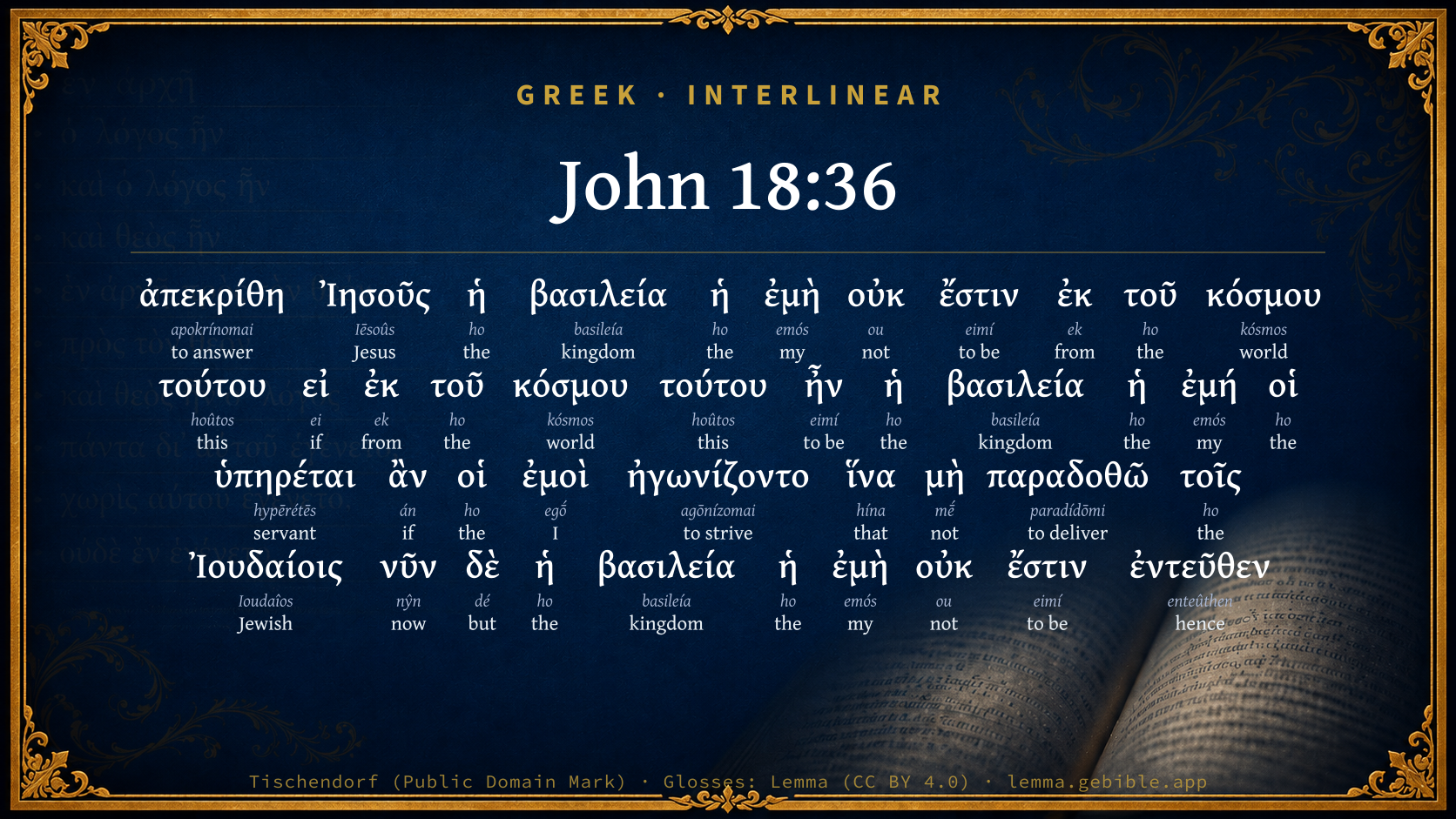
  1. ἀπεκρίθη apokrínomai G611 “to answer” Verb, Aorist, Middle deponent, Indicative, 3rd person, Singular
  2. Ἰησοῦς Iēsoûs G2424 “Jesus” Noun, Nominative, Singular, Masculine
  3. ἡ ho G3588 “the” Article, Nominative, Singular, Feminine
  4. βασιλεία basileía G932 “kingdom” Noun, Nominative, Singular, Feminine
  5. ἡ ho G3588 “the” Article, Nominative, Singular, Feminine
  6. ἐμὴ emós G1699 “my” Possessive pronoun, 1st person, Nominative, Singular, Feminine
  7. οὐκ ou G3756 “not” Particle, Negative
  8. ἔστιν eimí G1510 “to be” Verb, Present, Active, Indicative, 3rd person, Singular
  9. ἐκ ek G1537 “from” Preposition
  10. τοῦ ho G3588 “the” Article, Genitive, Singular, Masculine
  11. κόσμου kósmos G2889 “world” Noun, Genitive, Singular, Masculine
  12. τούτου hoûtos G3778 “this” Demonstrative pronoun, Genitive, Singular, Masculine
  13. εἰ ei G1487 “if” Conditional
  14. ἐκ ek G1537 “from” Preposition
  15. τοῦ ho G3588 “the” Article, Genitive, Singular, Masculine
  16. κόσμου kósmos G2889 “world” Noun, Genitive, Singular, Masculine
  17. τούτου hoûtos G3778 “this” Demonstrative pronoun, Genitive, Singular, Masculine
  18. ἦν eimí G1510 “to be” Verb, Imperfect, Active, Indicative, 3rd person, Singular
  19. ἡ ho G3588 “the” Article, Nominative, Singular, Feminine
  20. βασιλεία basileía G932 “kingdom” Noun, Nominative, Singular, Feminine
  21. ἡ ho G3588 “the” Article, Nominative, Singular, Feminine
  22. ἐμή emós G1699 “my” Possessive pronoun, 1st person, Nominative, Singular, Feminine
  23. οἱ ho G3588 “the” Article, Nominative, Plural, Masculine
  24. ὑπηρέται hypērétēs G5257 “servant” Noun, Nominative, Plural, Masculine
  25. ἂν án G302 “if” Particle
  26. οἱ ho G3588 “the” Article, Nominative, Plural, Masculine
  27. ἐμοὶ egṓ G1473 “I” Personal pronoun, 1st person, Dative, Singular
  28. ἵνα hína G2443 “that” Conjunction
  29. μὴ mḗ G3361 “not” Particle, Negative
  30. παραδοθῶ paradídōmi G3860 “to deliver” Verb, Aorist, Passive, Subjunctive, 1st person, Singular
  31. τοῖς ho G3588 “the” Article, Dative, Plural, Masculine
  32. Ἰουδαίοις Ioudaîos G2453 “Jewish” Adjective, Dative, Plural, Masculine
  33. νῦν nŷn G3568 “now” Adverb
  34. δὲ dé G1161 “but” Conjunction
  35. ἡ ho G3588 “the” Article, Nominative, Singular, Feminine
  36. βασιλεία basileía G932 “kingdom” Noun, Nominative, Singular, Feminine
  37. ἡ ho G3588 “the” Article, Nominative, Singular, Feminine
  38. ἐμὴ emós G1699 “my” Possessive pronoun, 1st person, Nominative, Singular, Feminine
  39. οὐκ ou G3756 “not” Particle, Negative
  40. ἔστιν eimí G1510 “to be” Verb, Present, Active, Indicative, 3rd person, Singular
  41. ἐντεῦθεν enteûthen G1782 “hence” Adverb

About this verse

These counts appear in no published source. They are computed here, from the morphology-tagged text and Lemma’s own curated glosses. What Lemma adds →

42
words
22
distinct lemmas
Gospels
section

Notable vocabulary

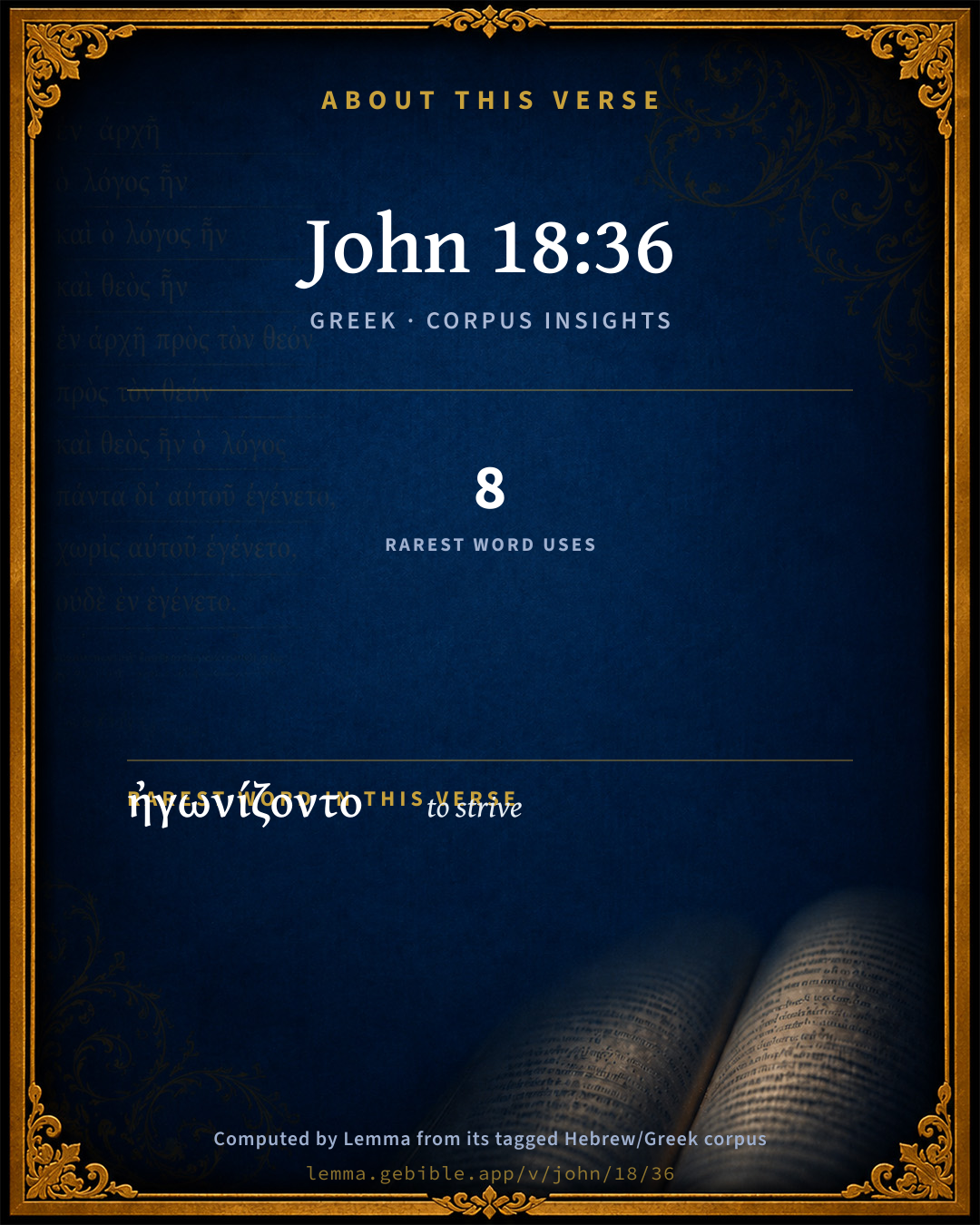
The rarest word here is ἠγωνίζοντο to strive G75 — appearing just 8 times in the whole Greek New Testament.

Shared distinctive vocabulary

ἠγωνίζοντο to strive G75 occurs in 8 verses of the Greek New Testament. Also found in:

Repetition

Words recur within this verse:

  • βασιλεία kingdom G932 ×3
  • ἔστιν to be G1510 ×3
  • κόσμου world G2889 ×2
  • ἡ the G3588 ×11
  • ἐμὴ my G1699 ×3
  • οὐκ not G3756 ×2
  • ἐκ from G1537 ×2
  • τούτου this G3778 ×2

Cross-references

13

Topical passages linked to John 18:36 in the Treasury of Scripture Knowledge — connected by theme and wording, ordered by reader-vote popularity; previews shown in the World English Bible.

  • Luke 17:20–21 Being asked by the Pharisees when the Kingdom of God would come, he answered them, "The Kingdom of God doesn't come with observation;
  • Colossians 1:12–14 giving thanks to the Father, who made us fit to be partakers of the inheritance of the saints in light;
  • John 6:15 Jesus therefore, perceiving that they were about to come and take him by force, to make him king, withdrew again to the mountain by himself.
  • Romans 14:17 for the Kingdom of God is not eating and drinking, but righteousness, peace, and joy in the Holy Spirit.
  • Daniel 2:44 In the days of those kings shall the God of heaven set up a kingdom which shall never be destroyed, nor shall the sovereignty of it be left to another people; but it shall break in pieces and consume all these kingdoms, and it shall stand forever.
  • Daniel 7:14 There was given him dominion, and glory, and a kingdom, that all the peoples, nations, and languages should serve him: his dominion is an everlasting dominion, which shall not pass away, and his kingdom that which shall not be destroyed.
  • 1 Timothy 6:13 I charge you before God, who gives life to all things, and before Christ Jesus, who before Pontius Pilate testified the good confession,
  • Zechariah 9:9 Rejoice greatly, daughter of Zion! Shout, daughter of Jerusalem! Behold, your king comes to you! He is righteous, and having salvation; Lowly, and riding on a donkey, Even on a colt, the foal of a donkey.
  • Matthew 26:53 Or do you think that I couldn't ask my Father, and he would even now send me more than twelve legions of angels?
  • Isaiah 9:6–7 For to us a child is born, to us a son is given; and the government shall be on his shoulder: and his name shall be called Wonderful, Counselor, Mighty God, Everlasting Father, Prince of Peace.
  • Luke 12:14 But he said to him, "Man, who made me a judge or an arbitrator over you?"
  • John 8:15 You judge according to the flesh. I judge no one.
  • Psalms 45:3–7 Gird your sword on your thigh, mighty one: Your splendor and your majesty.

Cross-references courtesy of OpenBible.info (CC BY 4.0).

Commentary

Notes on John 18:36 from classic Christian and Jewish commentators (each source and its license shown beneath its notes). The classic Christian expositions comment on the surrounding passage and are grouped to its opening verse, so a note may address several verses; the Jewish commentaries on the Tanakh (Rashi and others) are per-verse, so they appear only where the commentator wrote on this verse.

Lemma curates 59 commentaries, every one of them public domain or Creative Commons licensed, each selected and text-cleaned for this edition rather than reprinted as found. About our sources →

Tyndale Open Study Notes

Tyndale Open Resources

18:36-37 Jesus was willing to accept the title of king, but he made it clear that he did not govern an earthly kingdom that might rival Rome. Jesus’ kingship is not of this world. Rather than being a political ruler, he rules through the devotion and obedience of his followers.

Tyndale Open Study Notes — © Tyndale Open Resources, licensed CC BY-SA 4.0. Text via the HelloAO Bible API.

Bengel's Gnomon

Johann Albrecht Bengel

Joh 18:36. Βασιλεία, kingdom) Thrice Jesus names His kingdom.—οὐκ, not) Jesus merely says from whence His kingdom is not, namely, not of this world; but does not express whence it is, namely, from heaven. However He intimates it, when He says, that “He came into the world,” Joh 18:37.—ἐκ) The particle of or from is to be marked. See note on Rev 11:15, “The seventh angel sounded, and there were great voices in heaven, saying, The kingdoms of this world are become the kingdoms of our Lord and of His Christ, and He shall reign for ever and ever.” For ἐν and ἐκ differ: above, ch. Joh 17:11; Joh 17:14, “I am no longer in (ἐν) the world;” “I am not of (ἐκ) the world.” Ἐκ denotes precisely the origin, as presently after ἐντεῦθεν, from hence. [Comp. Erklär. Offenb. p. 553.—V. g.]—κόσμου τούτου, of this world) On this account Christ did not stay long in this life.—εἰ ἐκ, if of) Of this world is emphatically put in the beginning of the clause [not ἡ βασιλεία ἡ ἐμὴ ἦν ἐκ τοῦ κόσμου, but ἐκ τ. κοσμ. is put first]. The world defends its kingdoms by force of arms.—ὑπηρέται, My servants, ministers) who are not from or of this world.—ἠγωνίζοντο, would fight) Each kind of agent acts in its own sphere.—παραδοθῶ, that I should not be delivered) Pilate was already contemplating this, Joh 18:31.—νῦν, now, as it is) The particle is adversative, not a particle of time.

Bengel's Gnomon of the New Testament — English translation (T&T Clark, Edinburgh, 1860) — public domain. Text from a community e-Sword module.

Expositor's Greek Testament

ed. W. Robertson Nicoll

Joh 18:36 . But Jesus accepts the allegation of the Jews and proceeds to explain in what sense He is king: Ἡ βασιλεία ἡ ἐμὴ κ . τ . λ . My kingdom is not of a worldly nature, nor is it established by worldly means. Had it been so, my servants would have striven to prevent my being surrendered to the Jews. But as things are, νῦν , since it is indisputable that no armed resistance or rescue has been attempted, it is put beyond question that my kingdom is not from hence. “The substitution of ‘hence’ for ‘of this world’ in the last clause appears to define the idea of the world by an immediate reference to the representatives of it close at hand.” Westcott. Perhaps this rather limits the reference. Jesus uses ἐντεῦθεν as one who has other worlds than this in view.

The Expositor's Greek Testament, edited by W. Robertson Nicoll (1897–1910) — public domain. Text from a community e-Sword module.

Geneva Bible (1599)

Geneva Bible translators

Christ avoucheth his spiritual kingdom, but rejecteth a worldly.

Geneva Bible (1599) marginal notes — public domain. Text via Bolls.life.

Jamieson, Fausset & Brown

Robert Jamieson, A. R. Fausset & David Brown

Jesus answered, My kingdom is not of this world--He does not say "not over," but "not of this world"--that is, in its origin and nature; therefore "no such kingdom as need give thee or thy master the least alarm."

if my kingdom were of this world, then would my servants fight, that I should not be delivered to the Jews--"A very convincing argument; for if His servants did not fight to prevent their King from being delivered up to His enemies, much less would they use force for the establishment of His kingdom" [WEBSTER and WILKINSON].

but now--but the fact is.

is my kingdom not from hence--Our Lord only says whence His kingdom is not--first simply affirming it, next giving proof of it, then reaffirming it. This was all that Pilate had to do with. The positive nature of His kingdom He would not obtrude upon one who was as little able to comprehend it, as entitled officially to information about it. (It is worthy of notice that the "MY," which occurs four times in this one verse--thrice of His kingdom, and once of His servants--is put in the emphatic form).

Jamieson, Fausset & Brown — Commentary Critical and Explanatory on the Whole Bible (1871) — public domain (CC PDM 1.0). Text via the HelloAO Bible API.

Adam Clarke's Commentary

Verse 36. My kingdom is not of this world] It is purely spiritual and Divine. If it had been of a secular nature, then my servants would have contended-they would have opposed force with force, as the kingdoms of this world do in their wars; but as my kingdom as not of this world, therefore no resistance has been made. Eusebius relates, Hist. Eccles. lib. iii. c. 20, that "The relatives of our Lord were brought before Domitian, and interrogated whether they were of the family of David; and what sort the kingdom of Christ was, and where it would appear? They answered, that this kingdom was neither of this world, nor of an earthly nature; that it was altogether heavenly and angelical; and that it would not take place till the end of the world."

Adam Clarke's Commentary on the Bible (1810–1826) — public domain. Text from a community e-Sword/MySword module.

John Calvin's Commentaries

36. My kingdom is not of this world. By these words he acknowledges that he is a king, but, so far as was necessary to prove his innocence, he clears himself of the calumny; for he declares, that there is no disagreement between his kingdom and political government or order; as if he had said, “I am falsely accused, as if I had attempted to produce a disturbance, or to make a revolution in public affairs. I have preached about the kingdom of God; but that is spiritual, and, therefore, you have no right to suspect me of aspiring to kingly power.” This defense was made by Christ before Pilate, but the same doctrine is useful to believers to the end of the world; for if the kingdom of Christ were earthly, it would be frail and changeable, because

the fashion of this world passeth away, (1 Corinthians 7:31;)

but now, since it is pronounced to be heavenly, this assures us of its perpetuity. Thus, should it happen, that the whole world were overturned, provided that our consciences are always directed to the kingdom of Christ, they will, nevertheless, remain firm, not only amidst shakings and convulsions, but even amidst dreadful ruin and destruction. If we are cruelly treated by wicked men, still our salvation is secured by the kingdom of Christ, which is not subject to the caprice of men. In short, thouglh there are innumerable storms by which the world is continually agitated, the kingdom of Christ, in which we ought to seek tranquillity, is separated from the world.

We are taught, also, what is the nature of this kingdom; for if it made us happy according to the flesh, and brought us riches, luxuries, and all that is desirable for the use of the present life, it would smell of the earth and of the world; but now, though our condition be apparently wretched, still our true happiness remains unimpaired. We learn from it, also, who they are that belong to this kingdom; those who, having been renewed by the Spirit of God, contemplate the heavenly life in holiness and righteousness. Yet it deserves our attention, likewise, that it is not said, that the kingdom of Christ is not in this world; for we know that it has its seat in our hearts, as also Christ says elsewhere, The kingdom of God is within you, (Luke 17:21.) But, strictly speaking, the kingdom of God, while it dwells in us, is a stranger to the world, because its condition is totally different.

My servants would strive. He proves that he did not aim at an earthly kingdom, because no one moves, no one takes arms in his support; for if a private individual lay claim to royal authority, he must gain power by means of seditious men. Nothing of this kind is seen in Christ; and, therefore, it follows that he is not an earthly king.

But here a question arises, Is it not lawful to defend the kingdom of Christ by arms? For when Kings and Princes are commanded to kiss the Son of God, (Psalm 2:10-12) not only are they enjoined to submit to his authority in their private capacity, but also to employ all the power that they possess, in defending the Church and maintaining godliness. I answer, first, they who draw this conclusion, that the doctrine of the Gospel and the pure worship of God ought not to be defended by arms, are unskillful and ignorant reasoners; for Christ argues only from the facts of the case in hand, how frivolous were the calumnies which the Jews had brought against him. Secondly, though godly kings defend the kingdom of Christ by the sword, still it is done in a different manner from that in which worldly kingdoms are wont to be defended; for the kingdom of Christ, being spiritual, must be founded on the doctrine and power of the Spirit. In the same manner, too, its edification is promoted; for neither the laws and edicts of men, nor the punishments inflicted by them, enter into the consciences. Yet this does not hinder princes from accidentally defending the kingdom of Christ; partly, by appointing external discipline, and partly, by lending their protection to the Church against wicked men. It results, however, from the depravity of the world, that the kingdom of Christ is strengthened more by the blood of the martyrs than by the aid of arms.

John Calvin's Commentaries (1540-1563) — public domain. Text from the Calvin Translation Society English edition (1840s-50s) via the Christian Classics Ethereal Library (ccel.org). Calvin's coverage is partial (roughly two-thirds of the Bible); uncommented books and verses are honest gaps, never fabricated. The 19th-century editor's footnotes and remarks are omitted so the notes are faithfully Calvin's own voice.

Ellicott's Commentary for English Readers

(36) Jesus answered, My kingdom is not of this world.—The answer of Jesus is two-fold, declaring (1) in this verse, that He is not a King in the political sense; and (2) in Joh_18:37, that He is a King in the moral sense. By “of this world” we are to understand that the nature and origin of His kingdom are not of this world, not that His kingdom will not extend in this world. (Comp. Joh_8:23; Joh_10:16.) In the world’s sense of king and kingdom, in the sense in which the Roman empire claimed to rule the world, He had no kingdom.

Then would my servants fight, that I should not be delivered to the Jews.—Better, then would My servants have been fighting. (Comp. Joh_19:16.) His “servants” are His disciples, who would be in this relation to Him if He were a temporal king, and the crowds such as those who had sought to make Him king (Joh_6:15), and had filled Jerusalem with the cry, “Hosanna: Blessed is He that cometh in the name of the Lord, the King of Israel” (Joh_12:13). One of His servants had drawn the sword (Joh_18:10), and, but that His will had checked the popular feeling, neither the Jewish officers nor the Roman cohort could have delivered Him to be crucified.

But now is my kingdom not from hence.—That is, “But, as a matter of fact, My kingdom is not from here.” It was proved by His standing bound in the presence of the procurator. The clause has been strangely pressed into the service of millennial views by interpreting it, “But now My kingdom is not from hence. Hereafter it will be.” For the true sense of “now,” comp. Joh_8:40; Joh_9:41; Joh_15:22; Joh_15:24.

A Bible Commentary for English Readers, edited by Charles John Ellicott (1878–1897) — public domain. Text from a community e-Sword module.

The Cambridge Bible for Schools and Colleges

gen. ed. J. J. S. Perowne

36. My kingdom] There is a strong emphasis on ‘My’ throughout the verse; ‘the kingdom that is Mine, the servants that are Mine;’ i.e. those that are truly such (see on Joh_14:27). The word for ‘servants’ here is the same as is rendered ‘officers’ in Joh_18:3; Joh_18:12; Joh_18:18; Joh_18:33, Joh_7:32; Joh_7:45-46 (comp. Mat_5:25), and no doubt contains an allusion to the officials of the Jewish hierarchy. In Luk_1:2, the only other place in the Gospels where the word is used of Christians, it is rendered ‘ministers,’ as also in 1Co_4:1, the only place where the word occurs in the Epistles. Comp. Act_13:5.

is not of this world] Has not its origin or root there so as to draw its power from thence. Comp. Joh_8:23, Joh_20:19, Joh_17:14; Joh_17:16.

if my kingdom] In the original the order is impressively reversed; if of this world were My kingdom. For the construction comp. Joh_5:46.

fight] Better, be striving (comp. Luk_13:24; 1Co_9:25). For the construction comp. Joh_5:46, Joh_8:19; Joh_8:42, Joh_9:41, Joh_15:19.

but now] The meaning of ‘now’ is clear from the context and also from Joh_8:40, Joh_9:41, Joh_15:22; Joh_15:24, ‘as it is,’ ‘as the case really stands.’ It does not mean ‘My kingdom is not of this world now, but shall be so hereafter;’ as if Christ were promising a millenium.

The Cambridge Bible for Schools and Colleges (gen. ed. J. J. S. Perowne; Cambridge University Press, 1878–1918) — public domain. Text from a community e-Sword module.

John Gill's Exposition

Jesus answered, my kingdom is not of this world,.... By saying which, he tacitly owns he was a king: as such he was set up, and anointed by his Father from everlasting; was prophesied of in the Old Testament; declared by the angel, both when he brought the news of his conception, and of his birth; was owned by many, who knew him to be so in the days of his flesh; and since his resurrection, ascension, and session at God's right hand, more manifestly appears to be one: he also hereby declares, that he had a kingdom; by which he means, not his natural and universal kingdom, as God, and the Creator and Governor of all things; but his mediatorial kingdom, administered both in the days of his flesh, and after his resurrection; which includes the whole Gospel dispensation, Christ's visible church state on earth, and the whole election of grace; it takes in that which will be at the close of time, in the latter day, which will be more spiritual, and in which Christ will reign before his ancients gloriously; and also the kingdom of God, or of heaven, even the ultimate glory: the whole of which is not of this world; the subjects of Christ's kingdom are not of the world, they are chosen and called out of it; the kingdom itself does not appear in worldly pomp and splendour, nor is it supported by worldly force, nor administered by worldly laws; nor does it so much regard the outward, as the inward estates of men; it promises no worldly emoluments, or temporal rewards. Christ does not say it is not "in" this world, but it is not of it; and therefore will not fail, when this world does, and the kingdoms thereof. Every thing that is carnal, sensual, and worldly, must be removed from our conceptions of Christ's kingdom, here or hereafter: and to this agrees what some Jewish writers say of the Messiah, and his affairs;

"the Messiah (they say (o)) is separated from the world, because he is absolutely intellectual; but the world is corporeal; how then should the Messiah be in this world, when the world is corporeal, and , "the business of the Messiah is divine, and not corporeal?"''

And since this was the case, Caesar, or any civil government, had no reason to be uneasy on account of his being a king, and having a kingdom; since his kingdom and interests did not in the least break in upon, or injure any others: and that this was the nature of his kingdom, he proves by the following reason;

if my kingdom were of this world, then would my servants fight that I should not be delivered to the Jews: if Christ's kingdom had been a worldly one, set up on worldly views, and governed with worldly policy, and was to answer some worldly ends, Christ would have had servants enough among the Jews, who would have declared for him, and took up arms in his favour against the Romans; his own disciples would not have suffered him to have been betrayed into the hands of the Jews by Judas; nor would he have hindered them from attempting his rescue, as he did Peter; nor would they suffer him now to be delivered by Pilate into their hands, to put him to death; since they had such a Prince at the head of them, who, was he to make use of his power, was able to drive all the Roman forces before them out of the nation, and oblige a general submission among the Jews, to the sceptre of his kingdom:

but now is my kingdom not from hence; it does not rise out of, nor proceed upon, nor is it supported by worldly principles, wherefore none of the above methods are made use of.

(o) R. Juda Bezaleel Nizeach Israel, fol. 48.

John Gill's Exposition of the Whole Bible (1746–1763) — public domain (CC PDM 1.0). Text via the HelloAO Bible API.

Trapp's Complete Commentary

John Trapp

36 Jesus answered, My kingdom is not of this world: if my kingdom were of this world, then would my servants fight, that I should not be delivered to the Jews: but now is my kingdom not from hence.

Ver. 36. My kingdom is not of this world] Christ could not be received as a God into the Pantheon at Rome, for he lacked worshippers, preached poverty, and chose mean men for his disciples. Domitian the emperor, after he had banished John into Patmos, and Domicillia Flavia, his own sister’s daughter, with many more, into Pontus, and put various to death for that they were Christians, he commanded all such Jews as he could find to be put to death, that were of the stock of David. Among whom, meeting with some Christians also, that were allied to Christ, and understanding that they were poor harmless people, he dismissed them, and by proclamation forbade any more to be martyred. {Eusebius, Ecclesiastical History, l. 3. c. 19,20. 1:237,239}

John Trapp, A Commentary or Exposition upon All the Books of the Old and New Testament (1647–1656) — public domain. Text from a community e-Sword module.

Albert Barnes' Notes on the Bible

My kingdom ... - The charge on which Jesus was arraigned was that of laying claim to the office of a king. He here substantially admits that he did claim to be a king, but not in the sense in which the Jews understood it. They charged him with attempting to set up an earthly kingdom, and of exciting sedition against Caesar. In reply to this, Jesus says that his kingdom is not of this world - that is, it is not of the same nature as earthly kingdoms. It was not originated for the same purpose, or conducted on the same plan. He immediately adds a circumstance in which they differ. The kingdoms of the world are defended by arms; they maintain armies and engage in wars. If the kingdom of Jesus had been of this kind, he would have excited the multitudes that followed him to prepare for battle. He would have armed the hosts that attended him to Jerusalem. He would not have been alone and unarmed in the garden of Gethsemane. But though he was a king, yet his dominion was over the heart, subduing evil passions and corrupt desires, and bringing the soul to the love of peace and unity.

Not from hence - That is, not from this world.

Albert Barnes' Notes on the Bible (1834–1885) — public domain. Text from a community e-Sword/MySword module.

Matthew Poole's English Annotations

My kingdom is not of this world; that is, I cannot deny but that I am the King of the Jews, but not in the sense they take it, not such a king as they look for in their Messiah; my kingdom is spiritual, over the hearts and minds of men, not earthly and worldly. And of this thou thyself mayest be convinced; for was there ever an earthly prince apprehended and bound for whom none of his subjects would take up arms? There is none of my disciples that takes up arms, or offereth to fight for me; which is a plain evidence, that I pretend to no kingly power in disturbance of the Roman government.

Matthew Poole's English Annotations on the Holy Bible (1683–1685) — public domain. Text from a community e-Sword/MySword module.

Whedon's Commentary on the Bible

Daniel D. Whedon

36. My kingdom—Jesus, in words, evades Pilate’s last question, and returns to the topic of his royalty; and yet in so doing he answers Pilate’s question, what he has done. He has performed the part of a heaven-sent king.

Not of this world—My kingdom is not one of the political nations of the earth. It is not an organism like the Roman empire, founded upon physical force, sustained by military establishments, defended by fortifications and entrenched in capitals.

Then would my servants fight— Alluding, doubtless, to the scene of his arrest, when he bade Peter put up his sword. Well would it have been if the pretended successors of St. Peter had kept the sword put up.

Daniel D. Whedon (gen. ed.), Commentary on the Old and New Testaments (1874–1909) — public domain. Text from a community e-Sword module.

The Pulpit Commentary

In reply to this challenge, Jesus answered obviously assuming the fact that he was a king in a sense entirely different from that which had been maliciously suggested to PilateMy kingdom the kingdom that is mineis not of this world. Neither now nor at any future period will it derive its origin from this world. So far as Christ is King, his royal power and state are not furnished by earthly force, or fleshly ordinances, or physical energies, or material wealth, or imperial armies. The dominion that he will wield will be one over hearts and lives; the authority of the Lord Jesus cannot be arrested or overpowered by physical force. Most commentators justly regard this as a spiritual manifesto of the sources and quality of the kingdom of Christ, and a foreshadowing of the separation between the spiritual and secular power a declaration that all effort to embody Christian laws and government in compulsory forms, and to defend them by penal sanctions and temporal force, is disloyalty to the royal rank and crown rights of the Lord Jesus Christ. Hengstenberg regards the assertion as precisely the reverse; sees in the passage, "rightly understood, the very opposite purpose. The kingdom that sprang directly from heaven must have absolute authority over all the earth, and it will not submit to be put into obscurity. The kingdoms of this world must become the kingdom of the Lord and his Anointed, and he shall reign for ever and ever." This is true, but not along the lines or with the machinery of earthly rule and authority. The influence and authority of Heaven works upon the spirit by truth and righteousness and peace, and thus transforms institutions, permeates society from the ground of the heart, modifies the relations between the members of a household, and transfigures those between a ruler and his subjects, between the master and his slaves, between labor and capital, and between man and man. Whenever it is triumphant, whenever the lives of kings and their peoples are sanctified by supreme obedience to Christ the King, then war will be impossible, all tyrannies and slaveries will be abolished, all malice and violence of monarchs or mobs will be at an end; then the wolfish and the lamblike nature will be at peace. Then all the means for enforcing the will of one against another will be done away. He will have put down all rule, authority, and power; for he must reign, and he alone. This kingdom is not (ek) "from," "out of," this world"s methods or resources; does not begin from without and establish itself, or propagate or preserve itself, from the world, which is a rival, and is not to be coerced but drawn to itself. Like the individual disciple, the kingdom may be in the world, but not of it. Christ proceeded, If the kingdom that is mine were from this world, which it is not (mark the form of the condition), then, on that Supposition, would the servants (uphretai , generally translated "officers") that are mine fight, with physical force, in order that I should not be delivered up (parodoyw) to the Jews. The supposition that the uphretai of whom our Lord spoke were "the angels" (as Bengel, Lampe, Stier, and at one time Luthardt, imagined), is distinctly repudiated by the ek tou kosmou toutou , of this present world." If it were the case, as it is not, then would my officers be, not a handful of disciples (whom he generally calls diakonoi douloi), but the servants who would be appropriate to my royal mission, then would my servants be busily fighting that I should not be delivered up by the Roman power that is for the moment thrown over me like a shield, to the Jews, who are thirsting for my blood. The loud cry of hatred and vengeance may even at this moment have pierced the interior of the Praetorium, thus giving its force, if not form, to the sentence. Godet thinks our Lord was referring to the crowds who actually gathered round him on Palm Sunday, and not to hypothetical uphretai ; but the force of the condition goes down deeper, and, moreover, such language might have awakened the suspicion that, after all, Jesus had a political following, if he should choose to evoke it. Observe that this entire severance between "the Jews" and the friends of Christ, which, though occasionally adopted by the evangelist, is not the customary method of our Lord. The moment at which the Savior speaks gives great significance to the phraseology. (observe Joh_4:22 Joh 13:33 Joh_18:20; the only other occasions on which the Lord used this phrase to denote his own people) But now; (the nun , cf. Joh_9:41, Joh_15:22, is logical, not temporal) i.e. But seeing that it is so my kingdom, he adds, is not from hence. The ek tou kosmou is equivalent to enteuyen , and suggests that the kingdom derives its re sources and its energies "from the upper world, from above.

The unworldly kingdom.

It is not always possible to return a direct answer to a question. When Pilate asked our Lord Jesus, "Art thou a King?" the reply could not have been either "Yes" or "No" without misleading the questioner. In a sense he was not a king, that is, he made no claim to an earthly, temporal sovereignty; in another sense he was a King, a spiritual Sovereign, although his kingdom was not of this world. Thus the question of the Roman governor was the occasion of the utterance of a great truth, a great principle, distinctive of the religion and Church of our Lord Jesus Christ.

I CHRIST"S KINGDOM IS UNWORLDLY IN ITS COMPATIBILITY WITH AND ITS TOLERANCE OF OTHER KINGDOMS. Earthly governments do not admit of the imperium in imperio. The same subject cannot owe allegiance to two lords. The same land cannot admit the promulgation of different codes of law. Oppression, confusion, rebellion, anarchy, would be the result of such an attempt. But the kingdom of the Lord Jesus can exist and flourish in the most diverse forms of secular government. The subjects of a despotic monarchy, and the citizens of a democratic republic, are alike capable of acknowledging the supremacy and obeying the commands of King Jesus. So far from destroying or imperiling a state, Christianity, when it takes possession of a people, tends to establish a state in righteousness, freedom, and peace. The ruler and the governed may alike confess the sway and honor the authority of the Lord and King of men.

II CHRIST"S KINGDOM IS UNWORLDLY IN THE CHARACTER AND THE APPEARANCE OF ITS MONARCH. Earthly kings are always imperfect in character, and sometimes unjust, malevolent, vain, and selfish; yet they may maintain the outward semblance of dignity, wealth, magnificence, and power. The Lord Christ, on the contrary, had no earthly rank, or splendor, no gorgeous palace, no imposing retinue. He was in outward guise lowly and obscure, and he was by men scoffed at and despised. Yet he was and is the Holy One and Just, the faultless and benevolent Ruler of men, the Lord of heaven, the Judge of all. How wonderful and sublime a contrast to the kings of this world is the meek Monarch, the scepter of whose kingdom is a right scepter!

III CHRIST"S KINGDOM IS UNWORLDLY IN ITS OWN ORIGIN AND IN ITS SOVEREIGN"S TITLE AND CLAIM. The conception did not spring up in a human mind. "Now," said Jesus, "is my kingdom not from hence." Designated "the kingdom of heaven" and "the kingdom of God," it is, in its ground and in its character, what such designations involve. It is to the Divine wisdom and love that this unworldly kingdom must be traced. Christ is King by inheritance, as Son of God; by conquest, as the redeeming Lord; by choice and election, being welcomed by the joyful acclamations of his loyal subjects. In all these respects our Savior"s title to the throne is very different from the titles put forward by the kings of this earth.

IV CHRIST"S KINGDOM IS UNWORLDLY IN THE NATURE OF ITS DOMINION OVER ITS SUBJECTS. The subjects of an earthly monarch are usually born beneath the sway of their liege lord. In any case their obedience and submission, their aid and support, are required, and the requirement is, if necessary, enforced by penalties. The sway of the king is over the outward actions, the speech and habits of the subjects. Very different is the case with the members of that spiritual state of which Jesus is the sovereign Ruler. They are all citizens of the commonwealth and subjects of the King in virtue of personal faith and voluntary submission. Christ reigns in the heart; he has no care for the mere homage of the lips, the mere prostration of the body. His is a spiritual empire.

V CHRIST"S KINGDOM IS UNWORLDLY IN THE AIM IT SEEKS AND THE MEANS IT EMPLOYS. Whilst earthly sovereignties aim at the outward order and prosperity of the community, at peace and wealth, at conquest and glory, at power and fame, and whilst they employ secular means towards these ends Christ"s kingdom contemplates purely moral ends the growth and prevalence of righteousness and holiness, patience and love; in a word, those spiritual characteristics which are distinctive of every divinely ordered society, and by means in harmony with such ends. No fear or constraint, no magistrates, officers, soldiers, prisons, does Christ employ. He disclaims force; "else," said he, "would my servants fight." His is a kingdom in which truth is revealed and embodied truth which calls for faith, and the support of intelligence and loyalty. The laws of the spiritual kingdom are not prohibitions; they take the form of examples, and are sustained by the sanction of Divine love.

VI CHRIST"S KINGDOM IS UNWORLDLY IN ITS EXTENT AND PERPETUITY. Whilst no earthly conqueror has been suffered by Divine providence to achieve a universal dominion, Christ shall "reign from sea to sea, and from the river unto the ends of the earth." Whilst all human governments are liable to decay, and the Roman empire itself passed into a decline which issued in its fall, Christ"s "kingdom is an everlasting kingdom, and his dominion endureth to all generations. T.

The Pulpit Commentary (1880–1919), ed. H.D.M. Spence-Jones & Joseph S. Exell — public domain. Text from a community e-Sword module.

John Wesley's Explanatory Notes

My kingdom is not of this world - Is not an external, but a spiritual kingdom; that I might not be delivered to the Jews - Which Pilate had already attempted to do, ver. 31, and afterward actually did, chap. xix, 16.

John Wesley, Explanatory Notes Upon the Whole Bible (1754–1765) — public domain. Text via the GEBible commentary corpus.

Scofield Reference Notes

C. I. Scofield

of this Gk. ek, out of, or according to.

world kosmos = world-system. 1Co 1:20; Joh 7:7. (See Scofield "Rev 13:8").

The Scofield Reference Bible (1917 edition), notes by C. I. Scofield — public domain. Text from a community e-Sword module.

Kretzmann's Popular Commentary

Paul E. Kretzmann

The defense of Jesus:

v. 36. Jesus answered, My kingdom is not of this world; if My kingdom were of this world, then would My servants fight that I should not be delivered to the Jews; but now is My kingdom not from hence.

v. 37. Pilate therefore said unto Him, Art Thou a king, then? Jesus answered, Thou sayest that I am a king. To this end was I born, and for this cause came I into the world, that I should bear witness unto the truth. Every one that is of the truth hearth voice.

v. 38. Pilate saith unto Him, What is truth? And when he had said this, he went out again unto the Jews, and saith unto them, I find in Him no fault at all.

v. 39. But ye have a custom that I should release unto you one at the Passover; will ye, therefore, that I release unto you the King of the Jews?

v. 40. Then cried they all again, saying, Not this man, but Barabbas. Now Barabbas was a robber.

After having protested against the false understanding of His claim which the Jews had brought in the form of a charge against Him, Jesus now proceeds to explain to Pilate in what sense the appellation "king" might well be applied to Him. His words amount to a wonderful confession regarding the spiritual kingdom of which He is the head. Christ’s kingdom, His Church, is not of this world; it neither had its origin in the world, nor has it the nature and manner and characteristics of the world. It is no temporal kingdom; it is a spiritual, a heavenly kingdom. Christ’s kingdom and the kingdoms, the governments, of the world are two entirely different things, which should never be confused or commingled. In this respect both Calvinism and Roman Catholicism, as well as any form of direct influence of the religious bodies on legislation, except to ward off unwarranted laws that would interfere with the free exercise of religion, are wrong. Christ’s proof for His statement lies in this, that His servants, His followers, if His kingdom were of this world, would, at the present time, take up arms in His defense and deliver Him from the hands of the Jews. But He had deliberately hindered any such demonstration, because His kingdom is not of this world. Pilate now wanted a definite answer, in order to form some sort of judgment as to Christ’s claim. He exclaims: Then you are a king, just the same! He still hoped to find some justification for his act, in case he should feel compelled to accede to the demands of the Jews. Jesus patiently explains to Pilate the nature of His kingship and the character of His kingdom. Pilate’s exclamation was fully justified, because He was and is in truth a king. But lest the governor misunderstand, Jesus plainly states the object of His coming into the world. For this purpose was He born and for this aim came He into the world, to bear witness of the truth, in the interest of eternal, unchanging truth. The truth which has been revealed in Christ is the grace of God in Him, the Redeemer of the world. To this fact Jesus is to testify, thereby becoming the King of Truth, who establishes and expands His kingdom by means of the Word of Truth; He reigns through the Word. This is true of Him and of His ministers at all times. "In these days it happens to us also: Should we be silent regarding the truth and not reprove the lies, then we might well remain. But since we open our mouth, confess the truth, and condemn the lies, everyone wants to get at us. We preach no one but Christ, that no one is saved by himself; if it were possible for us to be saved in ourselves, it would not have been necessary for God to send His Son; but since God was obliged to send His Son, it certainly follows that we in ourselves are not able to be saved; that is our preaching and the truth, to which we bear witness. " It also follows from the facts which Christ states concerning Himself and the object of His coming into the world that only he that is of the truth, that has been born out of the truth, can and will hear His voice. Only he that has been born anew out of the Word of Truth has the power to give evidence of the truth that is in him. The truth, then. will be the element of such a person; he will live and move and have his being in the truth. He will then also listen to the voice of Christ, the Champion of truth; he will be an obedient citizen of the kingdom of Christ. It is thus evident that the kingdom of Jesus has an entirely different character, an entirely different object than any kingdom or government in the world. Pilate immediately realized and felt this from the explanation of Jesus. Pilate, acquainted with the efforts of the Greek and Roman philosophers to fix truth on the basis of human reason, thought it foolish, in his skeptical mind, for anyone to claim the knowledge of truth as his possession. So he put the jeering question: What is truth? and immediately went out to the Jews and announced to them the result of his investigation, that he found no fault in that man Christ. There was no cause, no reason, for criminal procedure. Note: The position of Pilate is shared by a great many so-called wise and cultured people of this world. They care nothing for the truth, the divine truth, the infallible Word of God. The speculations of foolish philosophers have a higher value in their idea, as gropings after the truth, than the truth of Scriptures. If they at some time or other hear the truth, they turn away from its inviting voice and continue in their sins.

Pilate should now have made an end of the farce, to which he had made far too great concessions as it was. But he was a coward at heart, and the people felt this hesitation. In order to save himself from a disagreeable concession, he now tried to divert the minds of the people into a different channel. He reminded them of a custom which obtained, that they might ask for the release of some prisoner at the Passover. And so he gave them the choice between one Barabbas and Jesus, whom he calls the King of the Jews, thereby only adding new fuel to the fire of hatred that was already raging. The leaders of the Jews had figured on this contingency long before, and had instructed the members of the mob accordingly. The very offer of Pilate was another injustice. For since Jesus had not been convicted in a single point, it was foolish to speak of a deliverance and mercy in His case.. Barabbas the people wanted and no one else, and the vacillation of Pilate played into their hands. The evangelist here adds the note: But Barabbas was a robber and murderer. "Barabbas was a rebel and a murderer, captured during a tumult, and had committed murder in a revolt of the people; and this was not only known throughout the city, but Barabbas had been taken in the act, and by Pilate, as the proper government, thrown into prison. But Jesus was just and innocent, so that His accusers, the Jews, could not attach any wrong to Him. Pilate then, following his own line of reasoning, concludes thus: Since this Jesus did nothing wrong, the Jews will be obliged to ask that I release Him. And again, since Barabbas is a well-known rebel and murderer, the Jews will have to demand that I deal with him according to justice. Thus Pilate reasons as a rational heathen. But the devil turns about and says: Not so, but release to us the rebel and murderer Barabbas, but crucify the righteous and innocent Jesus. " Pilate and the Jewish leaders are here on the same plane, just as the enemies of Christ in our days may be divided into two classes, both of them hostile to the Word: some consider the Christian religion nothing but a harmless fanaticism, others insist that its adherents are dangerous to the state. And in either case they act upon their conviction, as recent events have plainly shown.

Summary.Jesus is captured in Gethsemane and taken, first before Hannas, then before the Sanhedrin, under the chairmanship of Caiaphas, while Peter denies Him three times; in the morning H e

is taken to the judgment-hall of Pilate, where He testifies concerning His kingdom.

Paul E. Kretzmann, Popular Commentary of the Bible (1921–1924) — public domain. Text from a community e-Sword module.

The People's New Testament

B. W. Johnson

36. My kingdom is not of this world. It would be hard for Pilate to form any conception of a kingdom not of this world, a kingdom of which the subjects did not fight with carnal weapons to defend its king, or to extend its borders. He was a soldier and the representative of a monarch whose power rested on the sword. But such a kingdom was Christ's. It was not of this world, did not spring from it, was heavenly in its origin, and hence his servants would not fight that he should not be delivered to the Jews. (1) Christ's kingdom is supernatural, not of human origin. It is in the world, but not worldly. (2) It is maintained, not by carnal weapons, but by spiritual and moral means.

B. W. Johnson's The People's New Testament with Notes (1889–1891) — public domain. Electronic text from the Christian Classics Ethereal Library (CCEL) ThML edition.

unfoldingWord translationNotes

Door43 World Missions Community

My kingdom is not of this world

Here "world" is a metonym for the people who oppose Jesus. Possible meanings are 1) "My kingdom is not part of this world" or 2) "I do not need this world's permission to rule as their king" or "It is not from this world that I have authority to be king." (See: Metonymy)

so that I would not be given over to the Jews

You can translate this in an active form. AT: "and would prevent the Jewish leaders from arresting me" (See: Active or Passive)

the Jews

Here "Jews" is a synecdoche that refers to the Jewish leaders who opposed Jesus. (See: Synecdoche)

I have come into the world

Here "world" is a synecdoche that refers to the people who live in the world. (See: Synecdoche)

bear witness to the truth

Here "the truth" refers to the truth about God. AT: "tell people the truth about God" (See: Assumed Knowledge and Implicit Information)

who belongs to the truth

This is an idiom that refers to anyone who loves the truth about God. (See: Idiom)

my voice

Here "voice" is a synecdoche that refers to words Jesus says. AT: "the things I say" or "me" (See: Synecdoche)

translationWords

kingdom

servant

Jew

king

testimony

true

voice

unfoldingWord translationNotes — © Distant Shores Media and the Door43 World Missions Community, licensed CC BY-SA 4.0. Source: git.door43.org/Door43/en_tn.

Cambridge Greek Testament for Schools and Colleges

36. ἡ β. ἡ ἐμή. This emphatic form, ‘the kingdom that is Mine’ (see on Joh 8:31) prevails throughout the verse. ‘Υπηρέται must be rendered ‘servants,’ not ‘officers,’ although there is doubtless an allusion to the officials of the hierarchy (Joh 18:3; Joh 18:12; Joh 18:18; Joh 18:22, Joh 7:32; Joh 7:45-46; Mat 5:25). In Luk 1:2 and 1Co 4:1, the only places in Gospels and Epistles in which the word is used of Christians, it is rendered ‘ministers,’ both in A. V. and R.V. ‘Officers’ would here suggest military officers. ‘The kingdom that is really Mine does not derive its origin (ἐκ) from this world (Joh 4:22, Joh 8:23, Joh 15:19, Joh 17:14; Joh 17:16, Joh 10:16): if from this world sprang My kingdom, then would the servants that are really Mine be striving’ (Luk 13:24; 1Co 9:25). For the construction see on Joh 5:46, and for τοῖς Ἰουδαίοις see on Joh 13:33.

νῦν δέ. The meaning of νῦν is clear from the context; ‘as it is, as the case really stands:’ comp. Joh 8:40, Joh 9:41, Joh 15:22; Joh 15:24. It does not mean ‘My kingdom is not of this world now, but shall be so hereafter;’ as if Christ were promising a millennium.

Cambridge Greek Testament for Schools and Colleges (Cambridge University Press, 1896; 21 vols, various authors incl. Carr, Maclear, Plummer, Farrar, Lumby, Moule, M. R. James, Simcox) — public domain. Text from a community e-Sword module.

Alford’s Greek Testament

Henry Alford

36.] This answer goes to explain the injustice of the charge of διαστρέψαι τὸ ἔθνος (Luk 23:2), and to shew Pilate something of the nature of the kingdom which Jesus really came to establish.

οὐκ … ἐκ τοῦ κόσ. τούτου] not belonging to (ch. 8:23; 10:16) this world; not springing from, arising out of this world;—and therefore not to be supported by this world’s weapons. There is no denial that His Kingdom is over this world—but that it is to be established by this world’s power.

The words not only deny, they affirm: if not of this world, then of another world. They assert this other world before the representative of those who boasted of their ‘orbis terrarum.’ Notice the solemn repetition of ἐκ τοῦ κόσμου τούτου.

οἱ ὑπηρ., certainly not angels (as Stier) nor angels and disciples (as Lampe). This sentence is elliptical, and οἱ ὑπηρ. is included under the supposition introduced by εἰ. ‘If &c.,—I should have had servants, and those servants would have fought.’

παραδοθῶ] This delivering up is referred to ch. 19:16—παρέδωκεν αὐτὸν αὐτοῖς.

The νῦν has been absurdly pressed by the Romanist interpreters to mean that at some time His Kingdom would be ἐντεῦθεν—i.e. ἐκ τοῦ κόσμου τούτου—as if its essential character could ever be changed.

νῦν implies, ‘as the case now stands;’—a demonstratio ad oculos from the fact that no servants of His had contended or were contending in his behalf: see similar usages of νῦν, ch. 8:40; 9:41; 15:22, 24: Rom 7:16, Rom 7:17 al.

Henry Alford, The Greek Testament (1849–1861) — public domain. Text from a community e-Sword module.

International Critical Commentary

36. But Jesus does not answer this question. He goes back to the charge that He had claimed to be “King of the Jews.” He had refused such a title already (6:15), but He had often spoken of a coming kingdom. It was the kingdom of which Daniel had written (Dan 2:44, Dan 2:7:14, Dan 2:27), a spiritual kingdom of which the saints were to be citizens. And this He states before Pilate, that there may be no ambiguity in His position. When cross-examined by the priests, as the Synoptists tell, He had accepted their statement that He claimed to be Messiah (Mar 14:62, Mat 26:64, Luk 22:70), and so far there was some plausibility in their accusation of Him before Pilate. But He did not interpret the title of Messiah as implying earthly domination and national leadership against the suzerainty of Rome; and this was the gravamen of the charge brought against Him, so far as Pilate was concerned. Hence He tells the procurator that His kingdom is not “of this world ” (cf., for the phrase ὁ κόσμος οὗτος, 8:23, 14:30). He does not claim to be “King of the Jews” in any sense that was treasonable to Rome.

εἰ ἐκ τοῦ κόσμου τούτου κτλ., “If my kingdom were of this world, then would my officers (ὑπηρέται) be striving, so that I should not be delivered to the Jews,” i.e. the hostile Jews, as regularly in Jn. (see on 5:10).

Except in this passage, ὑπηρέται in Jn. is always used of the Temple police, the “officers” of the Sanhedrim. ὑπηρέτης occurs only 4 times in the LXX (Pro 14:35, Wisd. 6:4, Isa 32:5, Dan. 3:46), and always means the minister or officer of a king, as here. Jesus tells Pilate that He, too, has His ὑπηρέται, as well as the high priests, but that just because His kingdom is of the spirit they are not defending Him by force.

Who are meant here by the ὑπηρέται of Jesus ? Certainly not the small and timid company of His disciples, who made no attempt to prevent His arrest, with the sole exception of Peter, whose action only showed the uselessness of trying to resist the police and the soldiers. Jesus, indeed, according to Mt. (26:52) as well as Jn. (18:11), forbade Peter to employ force; but He did not suggest that the resort to arms by the disciples would have been of any practical use. Pilate knew very well that the followers of Jesus were not numerous enough to resist by force the carrying out of any sentence of his.

The ὑπηρέται of Jesus upon whom He might call, if He would, were mentioned by Him, according to Mat 26:53, at the moment of His arrest: “Thinkest thou that I cannot beseech my Father, and He shall even now send me more than twelve legions of angels?” These were the ὑπηρέται of the kingdom which Jesus had come to establish.

ἠγωνίζοντο. The verb does not occur again in Jn.; cf 1Ti 6:12.

νῦν δέ κτλ., “but now, as things are, my kingdom is not from hence,” sc. of this world. For νῦν δέ, cf. 8:40, 9:41, 15:22.

International Critical Commentary — older volumes (1896–1929), various authors — public domain. Text from a community e-Sword module.

Vincent's Word Studies in the New Testament

Marvin R. Vincent

Servants [υπηρεται] . Only in this passage in the Gospels, of Christians. Compare Act 13:5; 1Co 4:1. Corresponding with Christ as a king.

Fight [ηγωνιζοντο] . The imperfect tense, denoting action in progress : would now be striving.

Marvin R. Vincent, Word Studies in the New Testament (1887–1900) — public domain. Text from a community e-Sword/MySword module.

Godet's Commentaries

Frédéric Louis Godet

Vv. 36, 37. “Jesus answered, My kingdom is not of this world. If my kingdom were of this world, my servants would have fought that I might not be delivered to the Jews. But now is my kingdom not from hence. 37. Thereupon Pilate said to him, Art thou a king, then? Jesus answered him, Thou sayest it; I am a king; I was born and am come into the world to bear witness to the truth.Whoever is of the truth hears my voice.”

Jesus does not answer directly; but the answer appears from what He is about to say. He certainly possesses a kingship; this kingship, however, is not of a nature to disturb Pilate.

The expression ἐκ τοῦ κόσμου, of this world, is not synonymous withἐν τῷ κόσμῳ, in this world. For the kingdom of Jesus is certainly realized and developed here on earth; but it does not have its origin from earth, from the human will and earthly force. Jesus gives as a proof of this the manner in which He has surrendered Himself to the Jews. His servants are that multitude of adherents who had surrounded Him on Palm-day, and not merely, as Lucke and Luthardt suppose, hypothetical beings: “the servants whom I should have in that case.” The meaning given by Bengel and Stier: the angels, could not have been even dimly seen by Pilate.

The attempt has been made to give to νῦν, now, a temporal sense: “My kingdom is not now of this world, but it will be otherwise hereafter.” But, at the coming of the Lord, His kingdom will be no more of this world than it is to-day. Now must be taken, as often, in the logical sense: it contrasts the ever-present reality of the truth with the non-existence of error.

Pilate certainly expected a simple denial. His answer expresses surprise. The meaning of the particle ουκουν, if it were accented οὔκουν, would be: certainly not. Pilate would say: “Thou art certainly not a king,” with or without an interrogation point. But the reply of Jesus: “Thou sayest it,” by which He appropriates to Himself the contents of Pilate’s words while reaffirming them for Himself, favors the accentuationοὐκοῦν, not...then. “It is, then, not false, the claim that is imputed to thee?”

The affirmative formula employed by Jesus: Thou sayest it, is foreign to the classic Greek and even to the Old Testament, but it is very common with the Rabbis. Its meaning cannot be that which Reuss would give to it (Hist. ev ., p. 676): “It is thou who sayest that I am a king; as for me, I am come into the world to bear testimony,...” which would mean simply: I am not a king, but a preacher of the truth, a prophet. In this sense, a σύ, thou, in contrast with an ἐγώ, I, would have been absolutely necessary; and then, a but, to contrast the saying of Jesus with that of Pilate. Besides, the meaning of the formula:thou sayest it, is well known; comp. Mat 26:64.— ῞Οτι might signify: seeing that: “Thou sayest it rightly, seeing that I really am such.” It is more natural, however, to explain this conjunction in the sense of that: “Thou sayest (it) well, that I am a king.” The importance of the idea makes Jesus feel the need of again formulating it expressly.— Hengstenbergseparates altogether from this declaration the following words, which he applies simply to the prophetic office of Jesus Christ. But it is very evident that Jesus means to explain by what follows the sense in which He is a king. He comes to conquer the world, and for this end His only weapon is to bear witness to the truth; His people are recruited from all men who open themselves to the truth. The first of the two consecutive ἐγώ, I, which are read in the T. R., must be rejected. Jesus certainly did not say: “I am a king, I.” The two εἰς τοῦτο, for this, refer to the following ἴνα (that), contrary to the translation of Ostervald and Arnaud: “I was born for this (to be a king) and...”—“I was born” refers to the fact of birth which is common to Him with all men, while the words: “I am come into the world” set forth the special mission with a view to which He has appeared here on earth. It is His work as prophet which is the foundation of His kingly office.

The truth, the revelation of God—this is the sceptre with which He bears sway over the earth. This mode of conquest which Jesus here unveils to Pilate is the opposite of that by which the Roman power was formed, and Lange brings out with much reason that, as Joh 12:25 contained the judgment of the Greek genius, this declaration of Jesus to Pilate contains the judgment of the Roman genius by the Gospel.

The expression to be of the truth recalls to mind Joh 3:21, Joh 7:17, Joh 8:47, Joh 10:16, etc. It denotes the moral disposition to receive the truth and to put oneself under its holy power when it presents itself in living form in the person of Jesus Christ. By the word whoever, Jesus addressed no longer merely the conscience of the judge, but also that of the man, in Pilate (Hengstenberg).

Frédéric Louis Godet — Commentaries on Luke, John, Romans, and 1 Corinthians — English translation (T&T Clark, Edinburgh, 1870s–1890s) — public domain. Text from a community e-Sword module.

Lesson kit

Teaching starters — assembled from the data on this page, not authored interpretation. Every prompt links to the verse data it draws on. Edit before teaching.

John, in the Gospels, opens this verse with 42 words (22 distinct Greek lemmas). Its most distinctive word is agōnízomai (“to strive”). A historical commentator’s framing appears above. Read the whole chapter for the surrounding context.

Discussion questions

  1. What does “to strive” (agōnízomai) contribute to the verse as a whole?
  2. How does Luke 13:24, which shares the word «to strive», read alongside this verse?
  3. What does the repetition of “kingdom” (3× in this one verse) do in this verse?
  4. These translations render this verse differently. What is at stake in choosing one wording over another?
  5. Compare how Tyndale Open Study Notes and Bengel's Gnomon read this verse. Where do they agree or differ?

Things to notice

  • These translations choose different wording for 7 words in this verse.
  • “kingdom” occurs 3× in this single verse.
  • 22 distinct Greek lemmas span 42 words in this verse.

Reading settings

Reading text

Shown beneath each verse's original-language words.

Old Testament
Old Testament edition

Read the OT as the Masoretic Hebrew (MT) or the Greek Septuagint (LXX).

English shown for the Greek Septuagint (in the Hebrew ↔ Greek comparison).

Comparing translations? Open the Compare panel on any verse page to stack up to four side by side.