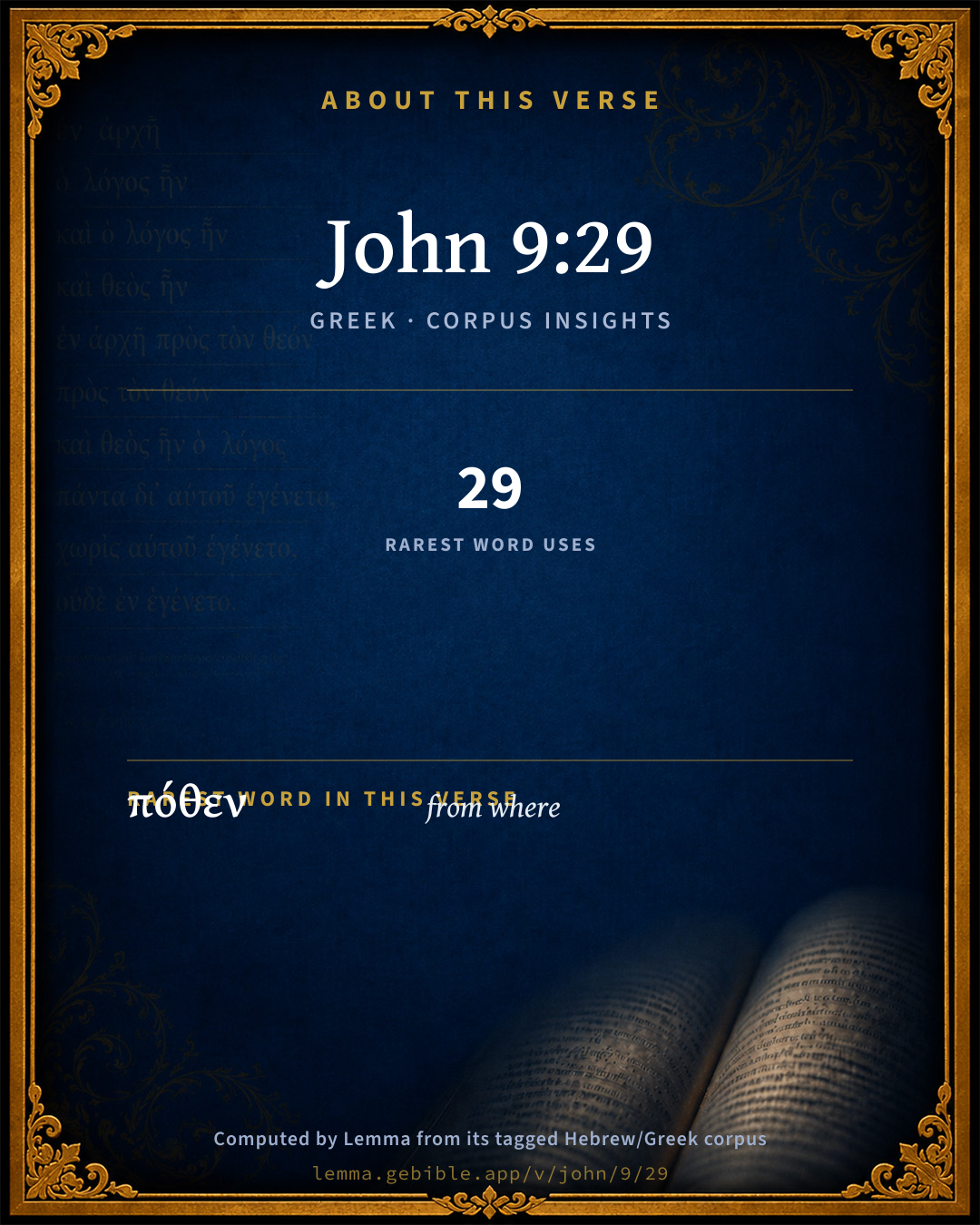
John 9:29

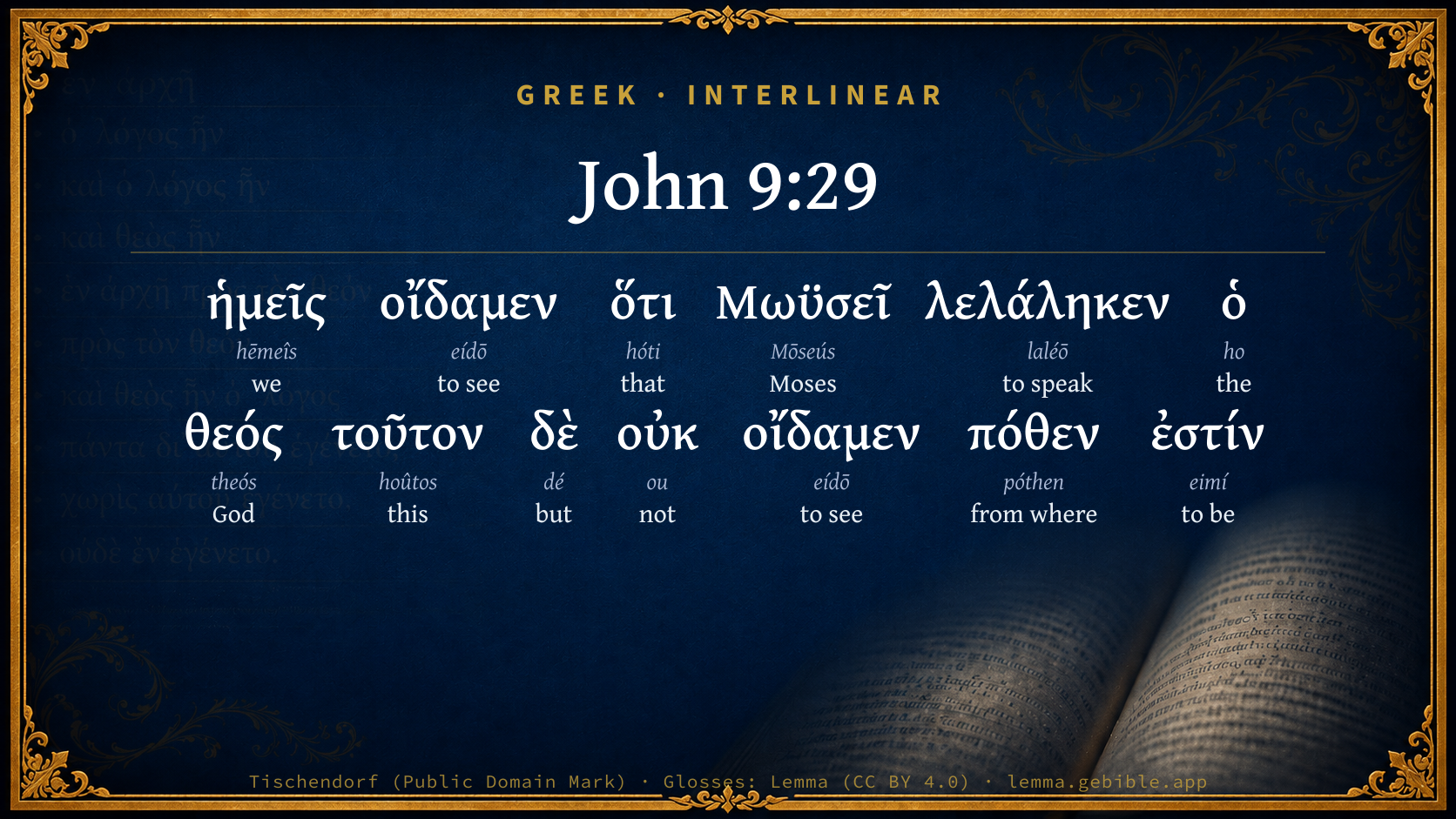
Greek (Tischendorf 8th ed.) John 9:29 appears in the Greek New Testament. The text above is from the Tischendorf 8th edition. Each word links to its Strong’s number and a concise gloss. Click any word for its full Thayer’s Greek Lexicon entry.
Download image
Cite this verse

John 9:29 (World English Bible). Public Domain. Lemma interlinear Bible study tool, https://lemma.gebible.app/v/john/9/29.

Show BibTeX & RIS
BibTeX
RIS
English Translation
We know that God has spoken to Moses. But as for this man, we don't know where he comes from."
World English Bible · Public Domain
Download a study sheet

One document with this verse’s original text, its word-by-word gloss line, the meaning frame, cross-references with their text, attributed commentary, and full source and license credits — printable, and it pastes into notes with its structure intact.

This verse Autodidact and up

Study sheet (.html) Plain text (.txt)

A passage Seminary Student

Up to 50 verses in one chapter. A passage sheet keeps up to 6 commentary sources and 12 cross-references per verse, in the order this page ranks them, and says so on the sheet whenever that leaves anything out. Ask for a single verse and you get the Autodidact verse sheet above.

Everything on this page stays free to read, with no account — the sheet is a download of what is already on screen, not access to it.

Want to remove ads? Support Godless Engineer
Compare translations 3

The same verse in 3 English versions, stacked beneath the original-language interlinear above. Click any original word for its lexicon entry.

Each is an independent rendering of the whole verse — the interlinear is not word-aligned to these translations.

Highlighted words mark where these versions differ — a whole-verse word diff, not a word-by-word alignment.

  • World English Bible Public Domain
    We know that God has spoken to Moses. But as for this man, we don't know where he comes from."
  • King James Version Public Domain
    We know that God spake unto Moses: as for this fellow, we know not from whence he is.
  • unfoldingWord Literal Text CC BY-SA 4.0
    We know that God has spoken to Moses, but we do not know where this one is from.”

unfoldingWord Literal Text — © unfoldingWord, licensed CC BY-SA 4.0. Word-aligned USFM3 via Door43 (git.door43.org/unfoldingWord/en_ult).

Versions to compare (up to 4)

3 of 4 selected

Show all 19 translations

Every available English version of this verse, each an independent rendering of the whole verse.

  • World English Bible Public Domain
    We know that God has spoken to Moses. But as for this man, we don't know where he comes from."
  • Berean Standard Bible Public Domain
    We know that God spoke to Moses, but we do not know where this man is from.”
  • Majority Standard Bible Public Domain
    We know that God spoke to Moses, but we do not know where this man is from.”
  • King James Version Public Domain
    We know that God spake unto Moses: as for this fellow, we know not from whence he is.
  • American Standard Version (1901) Public Domain
    We know that God hath spoken unto Moses: but as for this man, we know not whence he is.
  • Revised Version (1885) Public Domain
    We know that God hath spoken unto Moses: but as for this man, we know not whence he is.
  • Geneva Bible (1599) Public Domain
    We know that God spake with Moses: but this man we know not from whence he is.
  • Douay-Rheims (1899) Public Domain
    We know that God spoke to Moses: but as to this man, we know not from whence he is.
  • Young's Literal Translation Public Domain
    we have known that God hath spoken to Moses, but this one -- we have not known whence he is.'
  • Literal Standard Version CC BY-SA 4.0
    we have known that God has spoken to Moses, but this One—we have not known where He is from.”
  • Unlocked Literal Bible CC BY-SA 4.0
    We know that God has spoken to Moses, but we do not know where this one is from.”
  • unfoldingWord Literal Text CC BY-SA 4.0
    We know that God has spoken to Moses, but we do not know where this one is from.”
  • Darby Bible Public Domain
    We know that God spoke to Moses; but [as to] this [man], we know not whence he is.
  • World Messianic Bible Public Domain
    We know that God has spoken to Moses. But as for this man, we don’t know where he comes from.”
  • Webster's Bible Public Domain
    We know that God spoke to Moses: as for this man, we know not whence he is.
  • Free Bible Version CC BY-SA 4.0
    We're disciples of Moses. We know that God spoke to Moses, but as for this person, we don't even know where he comes from.”
  • Bible in Basic English Public Domain
    We are certain that God gave his word to Moses: but as for this man, we have no knowledge where he comes from.
  • Text-Critical English NT CC BY 4.0
    We know that God has spoken to Moses, but as for this man, we do not know where he is from.”
  • Tyndale New Testament (1534) Public Domain
    We are sure that God spake with Moses. This felowe we knowe not from whence he is.

Literal Standard Version (2020), Covenant Press — licensed CC BY-SA 4.0. Text via the HelloAO Bible API (eBible.org). Unlocked Literal Bible (unfoldingWord) — licensed CC BY-SA 4.0. Text via the HelloAO Bible API (eBible.org). unfoldingWord Literal Text — © unfoldingWord, licensed CC BY-SA 4.0. Word-aligned USFM3 via Door43 (git.door43.org/unfoldingWord/en_ult). Free Bible Version, Dr. Jonathan Gallagher — licensed CC BY-SA 4.0. Text via the HelloAO Bible API (eBible.org).

Word by word

More ways to search: Search by grammar → Find every occurrence → Compare this word →

Practice this passage: Drill this verse → Learn its vocabulary →

πόθεν
póthen
G4159
“from where”
Adverb, Interrogative
Part of Speech
Adverb
Degree
Interrogative
Full Thayer's Definition

Origin: from the base of G4213 with enclitic adverb of origin

TDNT: None

1. of place: from where, from what condition 2. of origin or source: from what author or giver 3. of cause: how is that?, how can that be?
  1. ἡμεῖς hēmeîs G2249 “we” Personal pronoun, 1st person, Nominative, Plural
  2. οἴδαμεν eídō G1492 “to see” Verb, Perfect, Active, Indicative, 1st person, Plural
  3. ὅτι hóti G3754 “that” Conjunction
  4. Μωϋσεῖ Mōseús G3475 “Moses” Noun, Dative, Singular, Masculine
  5. λελάληκεν laléō G2980 “to speak” Verb, Perfect, Active, Indicative, 3rd person, Singular
  6. ὁ ho G3588 “the” Article, Nominative, Singular, Masculine
  7. θεός theós G2316 “God” Noun, Nominative, Singular, Masculine
  8. τοῦτον hoûtos G3778 “this” Demonstrative pronoun, Accusative, Singular, Masculine
  9. δὲ dé G1161 “but” Conjunction
  10. οὐκ ou G3756 “not” Particle, Negative
  11. οἴδαμεν eídō G1492 “to see” Verb, Perfect, Active, Indicative, 1st person, Plural
  12. ἐστίν eimí G1510 “to be” Verb, Present, Active, Indicative, 3rd person, Singular

About this verse

These counts appear in no published source. They are computed here, from the morphology-tagged text and Lemma’s own curated glosses. What Lemma adds →

13
words
12
distinct lemmas
Gospels
section

Shared distinctive vocabulary

πόθεν from where G4159 occurs in 26 verses of the Greek New Testament. Also found in:

Repetition

A word recurs within this verse:

  • οἴδαμεν to see G1492 ×2

Cross-references

24

Topical passages linked to John 9:29 in the Treasury of Scripture Knowledge — connected by theme and wording, ordered by reader-vote popularity; previews shown in the World English Bible.

  • John 8:14 Jesus answered them, "Even if I testify about myself, my testimony is true, for I know where I came from, and where I am going; but you don't know where I came from, or where I am going.
  • Numbers 12:2–7 They said, Has Yahweh indeed spoken only with Moses? Hasn't he spoken also with us? Yahweh heard it.
  • Numbers 16:28 Moses said, Hereby you shall know that Yahweh has sent me to do all these works; for [I have] not [done them] of my own mind.
  • Deuteronomy 34:10 There has not arisen a prophet since in Israel like Moses, whom Yahweh knew face to face,
  • 1 Kings 22:27 and say, Thus says the king, Put this fellow in the prison, and feed him with bread of affliction and with water of affliction, until I come in peace.
  • 2 Kings 9:11 Then Jehu came forth to the servants of his lord: and one said to him, Is all well? why came this mad fellow to you? He said to them, You know the man and what his talk was.
  • Psalms 22:6 But I am a worm, and no man; A reproach of men, and despised by the people.
  • Psalms 103:7 He made known his ways to Moses, His deeds to the children of Israel.
  • Psalms 105:26 He sent Moses, his servant, And Aaron, whom he had chosen.
  • Psalms 106:16 They envied Moses also in the camp, And Aaron, Yahweh's saint.
  • Isaiah 53:2–3 For he grew up before him as a tender plant, and as a root out of a dry ground: he has no form nor comeliness; and when we see him, there is no beauty that we should desire him.
  • Malachi 4:4 "Remember the law of Moses my servant, which I commanded to him in Horeb for all Israel, even statutes and ordinances.
  • Matthew 12:24 But when the Pharisees heard it, they said, "This man does not cast out demons, except by Beelzebul, the prince of the demons."
  • Matthew 26:61 and said, "This man said, 'I am able to destroy the temple of God, and to build it in three days.'"
  • Luke 23:2 They began to accuse him, saying, "We found this man perverting the nation, forbidding paying taxes to Caesar, and saying that he himself is Christ, a king."
  • John 1:17 For the law was given through Moses. Grace and truth came through Jesus Christ.
  • John 7:27 However we know where this man comes from, but when the Christ comes, no one will know where he comes from."
  • John 7:41–42 Others said, "This is the Christ." But some said, "What, does the Christ come out of Galilee?
  • John 9:16 Some therefore of the Pharisees said, "This man is not from God, because he doesn't keep the Sabbath." Others said, "How can a man who is a sinner do such signs?" There was division among them.
  • John 9:24 So they called the man who was blind a second time, and said to him, "Give glory to God. We know that this man is a sinner."
  • Acts 7:35 "This Moses, whom they refused, saying, 'Who made you a ruler and a judge?'--God has sent him as both a ruler and a deliverer by the hand of the angel who appeared to him in the bush.
  • Acts 22:22 They listened to him until he said that; then they lifted up their voice, and said, "Rid the earth of this fellow, for he isn't fit to live!"
  • Acts 26:22 Having therefore obtained the help that is from God, I stand to this day testifying both to small and great, saying nothing but what the prophets and Moses said would happen,
  • Hebrews 3:2–5 who was faithful to him who appointed him, as also was Moses in all his house.

Cross-references courtesy of OpenBible.info (CC BY 4.0).

Commentary

Notes on John 9:29 from classic Christian and Jewish commentators (each source and its license shown beneath its notes). The classic Christian expositions comment on the surrounding passage and are grouped to its opening verse, so a note may address several verses; the Jewish commentaries on the Tanakh (Rashi and others) are per-verse, so they appear only where the commentator wrote on this verse.

Lemma curates 59 commentaries, every one of them public domain or Creative Commons licensed, each selected and text-cleaned for this edition rather than reprinted as found. About our sources →

Bengel's Gnomon

Johann Albrecht Bengel

Joh 9:29. Ἡμεῖς οἴδαμεν, we know) They knew it by such testimonies, as at the present clay also are irrefragable.—πόθεν ἐστίν, whence He is) as well as His doctrine.

Bengel's Gnomon of the New Testament — English translation (T&T Clark, Edinburgh, 1860) — public domain. Text from a community e-Sword module.

Expositor's Greek Testament

ed. W. Robertson Nicoll

Joh 9:29 . We know that Moses was a prophet, commissioned by God to speak for Him (for λελάληκεν see Heb 1:1 ); and if this man is commissioned He must show proof of His being sent from God, and not leave us in ignorance of His origin.

The Expositor's Greek Testament, edited by W. Robertson Nicoll (1897–1910) — public domain. Text from a community e-Sword module.

Adam Clarke's Commentary

Verse 29. We know not from whence he is.] As if they had said: We have the fullest assurance that the commission of Moses was Divine; but we have no proof that this man has such a commission: and should we leave Moses, and attach ourselves to this stranger? No.

Adam Clarke's Commentary on the Bible (1810–1826) — public domain. Text from a community e-Sword/MySword module.

John Calvin's Commentaries

29. As for this man, we know not whence he is. When they say so, they refer not to his country or the place of his birth, but to the prophetical office. For they allege that they have no knowledge of his calling, so as to receive him as having proceeded from God.

John Calvin's Commentaries (1540-1563) — public domain. Text from the Calvin Translation Society English edition (1840s-50s) via the Christian Classics Ethereal Library (ccel.org). Calvin's coverage is partial (roughly two-thirds of the Bible); uncommented books and verses are honest gaps, never fabricated. The 19th-century editor's footnotes and remarks are omitted so the notes are faithfully Calvin's own voice.

Ellicott's Commentary for English Readers

(29) We know that God spake unto Moses.—Better, We know that God hath spoken unto Moses. “He was commissioned,” they would say, “by God, and received a revelation from God which remains to us.” They would press here, as before, the authority of the great Lawgiver, which to every Israelite was final. They will not, therefore, accept this Man as a prophet. Their words have tacit reference also to the fact that His works were in their eyes a transgression of the Mosaic law. There is an opposition between them. Both cannot be right, and they will themselves continue to be disciples of Moses. He, it is implied, by confessing Jesus to be a prophet, was practically denying the authority of Moses.

As for this fellow, we know not from whence he is.—In our English version the words in italics are added, but they do not express more than the single Greek word, which is used with contempt. Before they had said, “Howbeit we know this Man whence He is; but when Christ cometh, no man knoweth whence He is” (Joh_7:27; see Notes on this and the next verse). They here oppose the divine authority of the mission of Moses, which was acknowledged by all, to the absence, as they would say, of any such authority for the work of Jesus. Their words are meant to convey more than they express, coming as they do in sharp contrast with “God spake unto Moses.” They would say again, “This Man is not of God” (Joh_9:16), “we know that this Man is a sinner” (Joh_9:24). For the expression, “whence He is,” i.e., “what authority He has,” comp. Joh_19:9, and Mat_21:25.

A Bible Commentary for English Readers, edited by Charles John Ellicott (1878–1897) — public domain. Text from a community e-Sword module.

The Cambridge Bible for Schools and Colleges

gen. ed. J. J. S. Perowne

29. that God spake] Literally, that God hath spoken, i.e. that Moses received a revelation which still remains. This is a frequent meaning of the perfect tense—to express the permanent result of a past action. Thus the frequent formula ‘it is written’ is strictly ‘it has been written,’ or ‘it stands written:’ i.e. it once was written, and the writing still remains. But this is perhaps one of those cases where the Greek perfect is best represented by the English aorist (see on Joh_8:29; Joh_8:10 for the converse).

we know not from whence he is] We know not what commission He has received, nor who has sent Him. Comp. Joh_8:14 and contrast Joh_7:27. Once more He is compared with Moses, as in the synagogue at Capernaum (Joh_6:31-32).

The Cambridge Bible for Schools and Colleges (gen. ed. J. J. S. Perowne; Cambridge University Press, 1878–1918) — public domain. Text from a community e-Sword module.

John Gill's Exposition

The man answered and said unto them,.... Very appropriately and pertinently,

why herein is a marvellous thing; strange and unaccountable,

that ye know not from whence he is; that you learned doctors, men of sagacity and penetration, should not be able to discern that this man is of God, is a prophet sent by him, and that there should be any doubt from whence he comes, or from whom he has his commission:

and yet he hath opened mine eyes; which was so clearly and plainly the work of the Messiah, and to be done by him when he came, Isa 35:4.

John Gill's Exposition of the Whole Bible (1746–1763) — public domain (CC PDM 1.0). Text via the HelloAO Bible API.

Trapp's Complete Commentary

John Trapp

29 We know that God spake unto Moses: as for this fellow, we know not from whence he is.

Ver. 29. We know not whence he is] i.e. Whence he had his mission and commission to act the part of a prophet. His parents they knew, but doubted about his authority, as Papists and officials do of ours. To whom we answer, that we received our ministry immediately from Jesus Christ, whose ambassadors we are: and that his inward call is the main, whether it be that of approbation, as of godly ministers, or the other of Providence as of evil, such as were Judas, Demas, Nicolas, those that preached Christ of envy, Php 1:15, &c.

John Trapp, A Commentary or Exposition upon All the Books of the Old and New Testament (1647–1656) — public domain. Text from a community e-Sword module.

Albert Barnes' Notes on the Bible

We know ... - We know that God commanded Moses to deliver the law. In that they were correct; but they assumed their interpretation of the law to be infallible, and, hence, condemned Jesus.

As for this fellow - The word “fellow” is not in the original. It is simply “this.” The word “fellow” implies contempt, which it cannot be proved they intended to express.

Whence he is - We know not his origin, his family, or his home. The contrast with the preceding member of the sentence shows that they intended to express their belief that he was not from God. They knew not whether he was mad, whether he was instigated by the devil, or whether he spoke of himself. See Joh 7:27; Joh 8:48-52.

Albert Barnes' Notes on the Bible (1834–1885) — public domain. Text from a community e-Sword/MySword module.

Matthew Poole's English Annotations

Concerning Moses indeed they speak honourably, and say, they knew God spake to him; yet did they know it no otherwise than by tradition, and the revelation of the will of God in the law and the prophets. For Christ, they call him τουτον,

this fellow; and say, they know not whence he was; that is, they know of no Divine authority that he had. They were blinded through malice and prejudice. Indeed they did know whence he was as to his human nature, for they often made that the cause of their stumbling at him; that he was of Galilee, that his father was a carpenter, and his mother called Mary: but they knew of no Divine mission or authority that he had: this they might have known also, for he did those things which no man ever did, nor could be effected by any thing less than a Divine power; but their eyes were blinded, and their hearts were judicially hardened; they studied to shut out the light by which they should have seen, and would not know whence he was.

Matthew Poole's English Annotations on the Holy Bible (1683–1685) — public domain. Text from a community e-Sword/MySword module.

Whedon's Commentary on the Bible

Daniel D. Whedon

29. Whence he is—Moses was sent from God; but whence Jesus is sent we know not.

Daniel D. Whedon (gen. ed.), Commentary on the Old and New Testaments (1874–1909) — public domain. Text from a community e-Sword module.

The Pulpit Commentary

They pursue the antithesis between Jesus and Moses, and thus make an involuntary admission of his abnormal and astounding claims. We know it is the fundamental fact of our religions history, and of the Divine revelation entrusted to us. We know, by supreme conviction, as something almost equivalent to a fundamental law of thought, that God hath spoken to Moses. (Observe the perfect lelalhken , "hath spoken" in such fashion that his words abide fur ever and are still sounding in their ears.) Moses was made a little lower than the angels. God spake to him on Sinai, and from the mercy-scat, and face to face as a man speaketh with his friend. (Exo_33:11 Deu_34:10 Num_12:8) The most august ideas and associations clustered round his venerable name. Jesus was supposed to have challenged the supreme authority of Moses, and no sort of comparison could be drawn, in their opinion, between the two. But as for this Man, we know not whence he is. It is remarkable that, in Joh_7:27, they had been equally explicit in declaring, "We know whence he is." Then they thought to discredit iris Messianic claim by drawing a distinction between the well-known parentage and home of Jesus, and the coming of Messiah from some undiscoverable source, some hidden place, where God retained him before his revelation to Israel. (see notes, Joh_7:27, Joh_7:28) While, however, Christ (Joh_8:14) allowed the validity of their superficial knowledge on that occasion, he declared that he alone knew whence he came and whither he was going. (see notes, Joh_8:14) It is, perhaps, in reference to this last expression that they echo his own words. The supernatural source of his being and teaching seemed to their minds, throughout that discourse and controversy, to vacillate between the Divine and the demonic. The contrast between Moses and Jesus in this bitter speech runs along the same low level. "We know not whence" he derives his prophetic character, or his right to legislate for the people of God.

Vers. 29-34. A noble defense.

Notice

I A MARVELLOUS IGNORANCE. "Why herein is a marvelous thing," etc. Their ignorance of the origin and history of Jesus was marvelous considered in reference to the persons themselves. Ignorant:

(a) While they really knew so much. The sum of their general religious knowledge must be considerable.

(b) While they professed and were supposed to know so much. They professed to know all about the Divine communications to Moses; professed to know the less, but profoundly ignorant with regard to the greater.

(c) While they ought to know so much. From their religious training and position as the religious leaders of the people, they ought to know much. Their ignorance was marvelous when considered in relation to the case before them, very marvelous indeed in the light of the following considerations so lucidly and cogently brought under their notice by the man that was blind.

1. The testimony of the miracle.

(1) The miracle was an unquestionable fact. As proved by the man himself, by his parents, by his neighbors; and the genuineness of the miracle was admitted by the council.

(2) It was an unquestionable fact, unquestionably involving the exercise of Divine power. This was generally admitted. Admitted by the opponents themselves. "Give glory to God.

(3) The Divine power was unquestionably exercised by Christ. "He opened mine eyes." This connects him most intimately with the Source of Divine power, if it does not point to him as that Source.

2. The usual way of Gods impartation of his Divine power.

(1) It was imparted in answer to prayer. This was the law by which God"s extraordinary power was imparted to the prophets and seers of old. In answer to prayer.

(2) It was imparted only in answer to the prayer, of the devotional and obedient. Notorious sinners are not in the habit of prayer, and their prayers as such would not be answered. If they prayed so as to be answered, they would cease to be notorious sinners. "God heareth not sinners: but if any man be the worshipper," etc.

(3) This rule of Divine impartation of power was well and generally known. "We know," etc. As if he were to say," Even I know this, much more you.

(4) Ignorance of the Divine character and origin of Christ was marvelous. "He opened mine eyes.

3. The uniqueness of the miracle.

(1) It was unique in relation to the general experience of that age. Such a miracle was never witnessed by any one present, nor by any one then living.

(2) Unique in relation to the oral and written history of the world. "Since the world began was it not heard," etc. History, oral or written, ancient or modern, does not furnish such an instance of Divine power in sight-giving as this.

(3) Unique in relation to the miraculous performance of the great men of the past. As compared with theirs, it stands alone and singular. "It was not heard that any man." Jewish history could boast of the names of great men who through God performed works of wonder and might; but this eclipsed them all. Not even Moses nor Elijah performed such an act with regard to sight.

(4) Unique in its peculiar character and originality. An equal amount of power had been displayed before, but not in the same way. Defective sight had been restored, and total blindness had been removed; bat never a man who had been born blind had his eyes opened. This was reserved for Jesus. This original and new miracle was reserved for a new dispensation a dispensation of spiritual insight and Divine illumination. And if Christ was a sinner, he was more original, eminent, and Divine than the most illustrious and boasted saints of all past ages.

4. The temporal circumstances of Christ. These were such as to be most unfavorable to impress the public and gain a personal reputation. Temporal circumstances are generally favorable and productive of this. Such as:

(1) An illustrious lineage. To come down upon society in the splendor of an illustrious descent goes far with it. But this Jesus did not. He appeared as the Son of Joseph and Mary. True, he descended from David; but this was scarcely known, and the connection was so distant that the effect would be little.

(2) Great wealth. This has a great influence. This Jesus had not. He was the reputed Son of a poor carpenter, and was a poor Carpenter himself, and as such appeared before the public and was known by them.

(3) The patronage of the great. This goes very far in gaining popularity and reputation. But Jesus had not this. From his first public appearance the aristocratic element of the nation was against him, and the social and religious leaders of the people were his deadly foes.

(4) The fame of learning. This is a most powerful element of success; but Jesus had not this. He was not brought up in any of the celebrated schools of his nation, nor sat at the feet of any illustrious rabbi. It is not known that be ever enjoyed the advantage of any school besides that of home, and he was notorious as a Teacher who had no human learning. From the poor village and the common workshop he emerged as the teacher of his nation. All his outward circumstances were against him, so that it was well said, "If this man were not of God, he could do nothing." But, in spite of his disadvantage, his doings far eclipsed those of his most eminent predecessors, which plainly and irresistibly leads to the inference of the man that was born blind that he was of God he was indeed Divine.

II THE MOST OBSTINATE RELIGIOUS BIGOTRY, Their marvelous ignorance was the offspring of the heart rather than of the head, of the will rather than the understanding. It was the offspring of the most obstinate religious bigotry whose character their conduct here reveals.

1. As most bitter in spirit. "Thou wast altogether," etc. This language is:

(1) Most slanderous. A slander on the man, on his parents, on the Creator who made him, and on the Savior who healed him. The charge was not true.

(2) Extremely mean. To upbraid the man with a calamity for which he was not responsible, and to rake up in his breast the painful reminiscences of a misery which he had so long endured, but which happily now had passed away.

(3) Most irrelevant. It is not to the point. What mattered it whether the man was born in sins or not? That had nothing to do with the fact of the miracle, and the character and claims of him who had performed it.

2. As most proud in spirit. "And dost thou teach us?" The spirit evinced here is:

(1) Most contemptuous. "Dost thou," etc.? Contempt of all who dare to differ from their opinion is characteristic of bigots. This man not only differs from the council but teaches them; their contempt is unbounded.

(2) Most proudly self-satisfying. "Teach us!

(3) Most unphilosophic and unprogressive. What philosopher worthy of the name would disdain to listen with respect to one who was the object of such a wonderful operation, in whose eyes were still rays of Divine light, and in whose soul was still burning the inspiration of such an experience? Where is the man in his right mind who would not listen with attention and due deference to such a talc? The members of the Jewish council listened with consummate pride and seething contempt, proving themselves to be most unphilosophic, ungodlike, unprogressive, and blind to the greatest and most brilliant light.

3. As most intolerant in spirit. "And they cast him out." And for what? For exercising the right of private judgment, and respectfully expressing his honest convictions and defending the truth. Their conduct was:

(1) Most weak. Mentally and morally weak. They could not refute his arguments nor stand the light.

(2) Most unreasanable and unjust. A Church has a right to exclude those who are immoral, and violating its fundamental principles. But this was not the case here. A coming Messiah was the most fundamental doctrine of the Jewish Church. This man was excluded for accepting him.

(3) Most cruel.

(4) Most fatal. When a Church begins to persecute, it begins to cease to exist; when it excludes the light of truth, it cannot last long. B.T.

The Pulpit Commentary (1880–1919), ed. H.D.M. Spence-Jones & Joseph S. Exell — public domain. Text from a community e-Sword module.

John Wesley's Explanatory Notes

We know not whence he is - By what power and authority he does these things.

John Wesley, Explanatory Notes Upon the Whole Bible (1754–1765) — public domain. Text via the GEBible commentary corpus.

Cambridge Greek Testament for Schools and Colleges

29. λελάληκεν. Hath spoken, i.e. that Moses received a revelation which still remains. This is a frequent meaning of the perfect tense—to express the permanent result of a past action. Thus the frequent formula γέγραπται is strictly ‘it has been written,’ or ‘it stands written:’ i.e. it once was written, and the writing still remains. But as there are cases where the Greek aorist is best represented by the English perfect (Joh 8:10; Joh 8:29), so there are cases where the Greek perfect is best represented by the English aorist; and this perhaps is one. The meaning is, Moses had a mission plainly declared by God.

οὐκ οἴδ. πόθεν. We know neither His mission, nor who sent Him. In a different sense they declared the very opposite, Joh 7:27. Comp. Pilate’s question (Joh 19:9), and Christ’s declaration (Joh 8:14). As at Capernaum (Joh 6:31-32), He is compared unfavourably with Moses.

Cambridge Greek Testament for Schools and Colleges (Cambridge University Press, 1896; 21 vols, various authors incl. Carr, Maclear, Plummer, Farrar, Lumby, Moule, M. R. James, Simcox) — public domain. Text from a community e-Sword module.

Alford’s Greek Testament

Henry Alford

29.] λελάληκεν, not ἐλάλησεν, is important: it betokens the abiding finality of God’s revelation to Moses, in their estimation: q. d. ‘We stand by God’s revelation to Moses.’

πόθεν—‘whether from God or not.’ But see ch. 7:27, 28, where a very different reason is given for disbelieving Him to be the Christ.

Henry Alford, The Greek Testament (1849–1861) — public domain. Text from a community e-Sword module.

International Critical Commentary

29. ἡμεῖς οἴδαμεν (cf. v. 24) ὅτι Μωϋσεῖ λελάληκεν ὁ θεός (cf. Heb 1:1): that was why they were proud to be disciples of Moses.

τοῦτον δὲ οὐκ οἴδαμεν πόθεν ἐστίν. They profess complete ignorance of the antecedents of Jesus. Some of the people of Jerusalem knew, indeed, whence He came, τοῦτον οἴδαμεν πόθεν ἐστίν (7:27, where see note), although there was a deeper sense in which none of the Jews knew it (8:14). But the Pharisees would not admit that they either knew or cared what was His origin or who were His kindred.

International Critical Commentary — older volumes (1896–1929), various authors — public domain. Text from a community e-Sword module.

Vincent's Word Studies in the New Testament

Marvin R. Vincent

Spake [λελαληκεν] . Perfect tense, hath spoken, and the authority of Moses ' words therefore continues to the present. So Rev., Lalew is to talk, familiarly. See Exo 33:11.

Whence he is. Compare Joh 7:27; Joh 8:14.

Marvin R. Vincent, Word Studies in the New Testament (1887–1900) — public domain. Text from a community e-Sword/MySword module.

Lesson kit

Teaching starters — assembled from the data on this page, not authored interpretation. Every prompt links to the verse data it draws on. Edit before teaching.

John, in the Gospels, opens this verse with 13 words (12 distinct Greek lemmas). Its most distinctive word is póthen (“from where”). A historical commentator’s framing appears above. Read the whole chapter for the surrounding context.

Discussion questions

  1. What does “from where” (póthen) contribute to the verse as a whole?
  2. How does Matthew 13:27, which shares the word «from where», read alongside this verse?
  3. What does the repetition of “to see” (2× in this one verse) do in this verse?
  4. These translations render this verse differently; the difference is in the English rendering, not the original. What questions does that raise?
  5. Compare how Bengel's Gnomon and Expositor's Greek Testament read this verse. Where do they agree or differ?

Things to notice

Reading settings

Reading text

Shown beneath each verse's original-language words.

Old Testament
Old Testament edition

Read the OT as the Masoretic Hebrew (MT) or the Greek Septuagint (LXX).

English shown for the Greek Septuagint (in the Hebrew ↔ Greek comparison).

Comparing translations? Open the Compare panel on any verse page to stack up to four side by side.