John 16:11

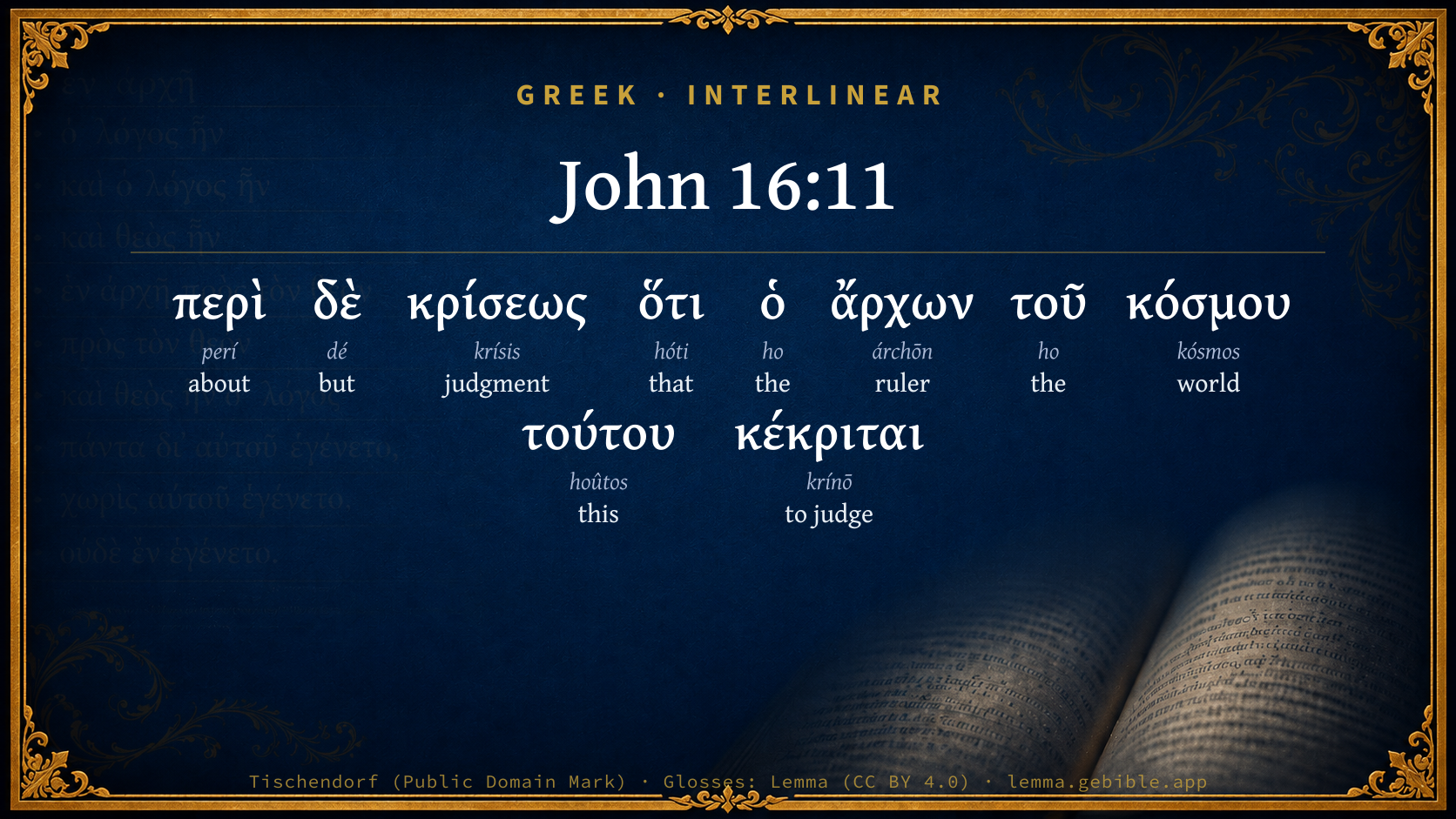
Greek (Tischendorf 8th ed.) John 16:11 appears in the Greek New Testament. The text above is from the Tischendorf 8th edition. Each word links to its Strong’s number and a concise gloss. Click any word for its full Thayer’s Greek Lexicon entry.
Download image
Cite this verse

John 16:11 (World English Bible). Public Domain. Lemma interlinear Bible study tool, https://lemma.gebible.app/v/john/16/11.

Show BibTeX & RIS
BibTeX
RIS
English Translation
about judgment, because the prince of this world has been judged.
World English Bible · Public Domain
Download a study sheet

One document with this verse’s original text, its word-by-word gloss line, the meaning frame, cross-references with their text, attributed commentary, and full source and license credits — printable, and it pastes into notes with its structure intact.

This verse Autodidact and up

Study sheet (.html) Plain text (.txt)

A passage Seminary Student

Up to 50 verses in one chapter. A passage sheet keeps up to 6 commentary sources and 12 cross-references per verse, in the order this page ranks them, and says so on the sheet whenever that leaves anything out. Ask for a single verse and you get the Autodidact verse sheet above.

Everything on this page stays free to read, with no account — the sheet is a download of what is already on screen, not access to it.

Want to remove ads? Support Godless Engineer
Compare translations 3

The same verse in 3 English versions, stacked beneath the original-language interlinear above. Click any original word for its lexicon entry.

Each is an independent rendering of the whole verse — the interlinear is not word-aligned to these translations.

Highlighted words mark where these versions differ — a whole-verse word diff, not a word-by-word alignment.

  • World English Bible Public Domain
    about judgment, because the prince of this world has been judged.
  • King James Version Public Domain
    Of judgment, because the prince of this world is judged.
  • unfoldingWord Literal Text CC BY-SA 4.0
    and about judgment, because the ruler of this world has been judged.

unfoldingWord Literal Text — © unfoldingWord, licensed CC BY-SA 4.0. Word-aligned USFM3 via Door43 (git.door43.org/unfoldingWord/en_ult).

Versions to compare (up to 4)

3 of 4 selected

Show all 19 translations

Every available English version of this verse, each an independent rendering of the whole verse.

  • World English Bible Public Domain
    about judgment, because the prince of this world has been judged.
  • Berean Standard Bible Public Domain
    and in regard to judgment, because the prince of this world has been condemned.
  • Majority Standard Bible Public Domain
    and in regard to judgment, because the prince of this world has been condemned.
  • King James Version Public Domain
    Of judgment, because the prince of this world is judged.
  • American Standard Version (1901) Public Domain
    of judgment, because the prince of this world hath been judged.
  • Revised Version (1885) Public Domain
    of judgment, because the prince of this world hath been judged.
  • Geneva Bible (1599) Public Domain
    Of iudgement, because the prince of this world is iudged.
  • Douay-Rheims (1899) Public Domain
    And of judgment: because the prince of this world is already judged.
  • Young's Literal Translation Public Domain
    and concerning judgment, because the ruler of this world hath been judged.
  • Literal Standard Version CC BY-SA 4.0
    and concerning judgment, because the ruler of this world has been judged.
  • Unlocked Literal Bible CC BY-SA 4.0
    and about judgment, because the ruler of this world has been judged.
  • unfoldingWord Literal Text CC BY-SA 4.0
    and about judgment, because the ruler of this world has been judged.
  • Darby Bible Public Domain
    of judgment, because the ruler of this world is judged.
  • World Messianic Bible Public Domain
    about judgment, because the prince of this world has been judged.
  • Webster's Bible Public Domain
    Of judgment, because the prince of this world is judged.
  • Free Bible Version CC BY-SA 4.0
    Judgment, for the ruler of this world has been condemned.
  • Bible in Basic English Public Domain
    Of being judged, because the ruler of this world has been judged.
  • Text-Critical English NT CC BY 4.0
    and concerning judgment, because the ruler of this world has been condemned.
  • Tyndale New Testament (1534) Public Domain
    and of iudgement because the chefe ruler of this worlde is iudged all ready.

Literal Standard Version (2020), Covenant Press — licensed CC BY-SA 4.0. Text via the HelloAO Bible API (eBible.org). Unlocked Literal Bible (unfoldingWord) — licensed CC BY-SA 4.0. Text via the HelloAO Bible API (eBible.org). unfoldingWord Literal Text — © unfoldingWord, licensed CC BY-SA 4.0. Word-aligned USFM3 via Door43 (git.door43.org/unfoldingWord/en_ult). Free Bible Version, Dr. Jonathan Gallagher — licensed CC BY-SA 4.0. Text via the HelloAO Bible API (eBible.org).

Word by word

More ways to search: Search by grammar → Find every occurrence → Compare this word →

Practice this passage: Drill this verse → Learn its vocabulary →

About this verse

These counts appear in no published source. They are computed here, from the morphology-tagged text and Lemma’s own curated glosses. What Lemma adds →

10
words
9
distinct lemmas
Gospels
section

Shared distinctive vocabulary

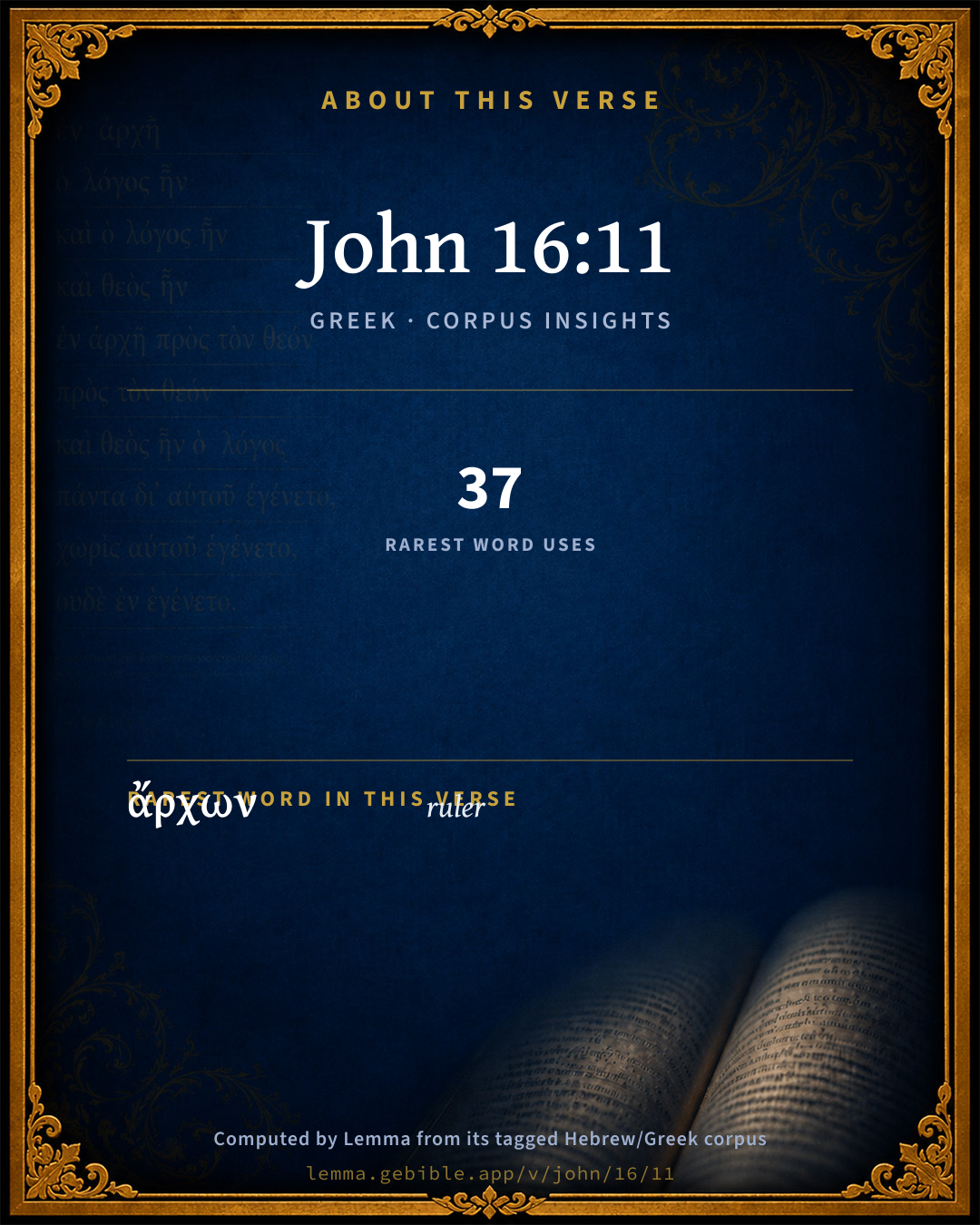
ἄρχων ruler G758 occurs in 36 verses of the Greek New Testament. Also found in:

Repetition

A word recurs within this verse:

Cross-references

33

Topical passages linked to John 16:11 in the Treasury of Scripture Knowledge — connected by theme and wording, ordered by reader-vote popularity; previews shown in the World English Bible.

  • John 12:31 Now is the judgment of this world. Now the prince of this world will be cast out.
  • 1 John 3:8 He who sins is of the devil, for the devil has been sinning from the beginning. To this end the Son of God was revealed, that he might destroy the works of the devil.
  • John 14:30 I will no more speak much with you, for the prince of the world comes, and he has nothing in me.
  • Colossians 2:15 having stripped the principalities and the powers, he made a show of them openly, triumphing over them in it.
  • Hebrews 2:14 Since then the children have shared in flesh and blood, he also himself in like manner partook of the same, that through death he might bring to nothing him who had the power of death, that is, the devil,
  • 2 Corinthians 4:4 in whom the god of this world has blinded the minds of the unbelieving, that the light of the Gospel of the glory of Christ, who is the image of God, should not dawn on them.
  • Isaiah 49:24–26 Shall the prey be taken from the mighty, or the lawful captives be delivered?
  • Revelation 12:7–10 There was war in the sky. Michael and his angels made war on the dragon. The dragon and his angels made war.
  • Revelation 20:10–15 The devil who deceived them was thrown into the lake of fire and sulfur, where the beast and the false prophet are also. They will be tormented day and night forever and ever.
  • Genesis 3:15 I will put enmity between you and the woman, and between your offspring and her offspring. He will bruise your head, and you will bruise his heel."
  • Psalms 68:18 You have ascended on high. You have led away captives. You have received gifts among men, Yes, among the rebellious also, that Yah God might dwell there.
  • Matthew 12:18 "Behold, my servant whom I have chosen; My beloved in whom my soul is well pleased: I will put my Spirit on him. He will proclaim justice to the Gentiles.
  • Matthew 12:36 I tell you that every idle word that men speak, they will give account of it in the day of judgment.
  • Luke 10:18 He said to them, "I saw Satan having fallen like lightning from heaven.
  • John 5:22–27 For the Father judges no one, but he has given all judgment to the Son,
  • Acts 10:42 He charged us to preach to the people and to testify that this is he who is appointed by God as the Judge of the living and the dead.
  • Acts 17:30–31 The times of ignorance therefore God overlooked. But now he commands that all people everywhere should repent,
  • 1 Corinthians 4:5 Therefore judge nothing before the time, until the Lord comes, who will both bring to light the hidden things of darkness, and reveal the counsels of the hearts. Then each man will get his praise from God.
  • 2 Corinthians 5:10–11 For we must all be revealed before the judgment seat of Christ; that each one may receive the things in the body, according to what he has done, whether good or bad.
  • Ephesians 2:2 in which you once walked according to the course of this world, according to the prince of the powers of the air, the spirit who now works in the children of disobedience;
  • Hebrews 6:2 of the teaching of baptisms, of laying on of hands, of resurrection of the dead, and of eternal judgment.
  • Hebrews 9:27 Inasmuch as it is appointed for men to die once, and after this, judgment,
  • 2 Peter 2:4–9 For if God didn't spare angels when they sinned, but cast them down to Tartarus, and committed them to pits of darkness, to be reserved to judgment;
  • 2 Peter 3:7 But the heavens that now are, and the earth, by the same word have been stored up for fire, being reserved against the day of judgment and destruction of ungodly men.
  • Revelation 1:7 Behold, he is coming with the clouds, and every eye will see him, including those who pierced him. All the tribes of the earth will mourn over him. Even so, Amen.
  • Revelation 20:2–3 He seized the dragon, the old serpent, which is the devil and Satan, who deceives the whole inhabited earth, and bound him for a thousand years,
  • Acts 24:25 As he reasoned about righteousness, self-control, and the judgment to come, Felix was terrified, and answered, "Go your way for this time, and when it is convenient for me, I will summon you."
  • Acts 26:18 to open their eyes, that they may turn from darkness to light and from the power of Satan to God, that they may receive remission of sins and an inheritance among those who are sanctified by faith in me.'
  • Romans 2:2–4 We know that the judgment of God is according to truth against those who practice such things.
  • Romans 2:16 in the day when God will judge the secrets of men, according to my Gospel, by Jesus Christ.
  • Romans 14:10–12 But you, why do you judge your brother? Or you again, why do you despise your brother? For we will all stand before the judgment seat of Christ.
  • Romans 16:20 And the God of peace will quickly crush Satan under your feet. The grace of our Lord Jesus Christ be with you.
  • 1 Corinthians 6:3–4 Don't you know that we will judge angels? How much more, things that pertain to this life?

Cross-references courtesy of OpenBible.info (CC BY 4.0).

Commentary

Notes on John 16:11 from classic Christian and Jewish commentators (each source and its license shown beneath its notes). The classic Christian expositions comment on the surrounding passage and are grouped to its opening verse, so a note may address several verses; the Jewish commentaries on the Tanakh (Rashi and others) are per-verse, so they appear only where the commentator wrote on this verse.

Lemma curates 59 commentaries, every one of them public domain or Creative Commons licensed, each selected and text-cleaned for this edition rather than reprinted as found. About our sources →

The Biblical Illustrator

Joseph S. Exell

Joh_16:11

Of Judgment, because the prince of this world is Judged

The prince of this world judged

Through His whole life did Christ judge the prince of this world.

When He, who was born King of the Jews, was born in the stable of Bethlehem, and when the shepherds were called to be the first witnesses of His birth, then was the prince of this world judged; and this judgment was made manifest in that he who sat on the throne of Judaea was so troubled with the tidings, and tried to frustrate the purpose of God by the massacre of the children. Hereby the prince of this world laid bare the hell that boiled in his breast; and though he sent forth the fiercest of his servants he was foiled. When He who came to fulfil all righteousness submitted to be baptized by John, the greater by the less, the sinless by the sinful, God by man, then was the prince of this world judged. Then was man taught not to seek his own glory and righteousness, but the glory and righteousness of God--not to seek to be first, but to be last; and therefore were the heavens opened and the voice from heaven heard, This is My beloved Son, &c. Again in the whole course of our Lords temptation was the prince of this world judged; he was judged in that all his most powerful lures were scattered at once by being brought to the light of Gods Word. Throughout the whole Sermon on the Mount the prince of this world is judged. His most vaunted blessings are declared to be woes, and his woes declared to be blessed. Every time that Christ forgave sins the prince of this world was judged. It was proclaimed in the sight of heaven, God Himself bearing witness that a Man was walking on the earth mightier than the prince of this world, and who could arrest his captives even out of his nethermost prison; and men were taught how they might obtain this deliverance--by faith. By every miracle that Christ wrought, the prince of this world was judged. In that He cast out devils by the Spirit of God it was proved that the kingdom of God had come on mankind, and that among the sons of men there was One who had bound the strong man, and was spoiling his goods; and when the devils took refuge in the herd of swine, and ran down the precipice into the lake, then was it shown what is sins only congenial abode, its only rightful doom. Moreover, by every grace in our Lords character the prince of this world was judged--by His meekness, His patience, His forbearance, His infinite lovingkindness, His perseverance in well-doing, His spotless purity, His zeal. The judgment of the prince of this world was consummated on the cross, and then when he had thus been finally overthrown, death, the last enemy, was also subdued. In all these manifold ways do they who are convinced of judgment by the Comforter perceive that the prince of this world has been judged. And what ensues? Will they follow him into his judgment, share his condemnation, be confounded with him in his confusion? Surely this cannot be. They who have been truly convinced of judgment will no longer cleave to that which they know their Saviour has condemned. Feelings of justice, honour, compassion, may sometimes urge a man to uphold the cause of the vanquished. But here all honour and right and mercy are on the side of the victor, and the victory consists in this, that the shame of sill has been unveiled, that its hatefulness has been disclosed, and mens eyes have been opened to discern its malice and its cruelty, its falsehood and its woe. Those whose eyes have been thus opened must needs loathe and turn away from sin. As Christ condemned sin so will all His faithful servants condemn it. They will condemn it in the world, but still more in their own hearts, for until they have condemned it in themselves, in vain will they try to condemn it in the world. (Archdeacon Hare.)

The Convincer of judgment

The judgment of the world is the natural sequel to its being convinced of sin; and the statement in the text assures us that one day a distinction will be made between the good and the evil, the servants of God and the servants of the devil, and that the result of that distinction and separation will be the condemnation and destruction of the wicked.

I. THE NECESSITY OF THE CONVICTION OF JUDGMENT. If men are to be so convinced of sin as to feel that the service of sin is a hopeless one, they must also be convinced of judgment. It is not enough to set forth the beauty of righteousness, and the deformity of sin. All law, whether human or divine, whether it points out a duty, or forbids a transgression, must have its sanctions. It must have something connected with it, in the shape of rewards, or of punishments, which shall make it to be respected. So it is with regard to righteousness and sin in general. Men must be convinced of more than the mere abstract wrongness of sin, of more than the mere deformity of vice, of more than the rightness, and beauty, of virtue and holiness. It is true that the beauty of holiness was illustrated in the life of our Lord Jesus Christ, and that sin was rebuked by the purity and glory of His character; by means of the righteousness of Christ the conviction of righteousness is worked in the hearts of men. Yet in vain would the Holy Ghost set before many men at least that glorious ideal, or show that sin was a departure from it; unless He could also show that righteousness must triumph, and that sin must be put down and overthrown.

II. THIS NECESSITY GOD HAS BEEN MEETING IN THE PAST HISTORY OF THE WORLD.

1. The first chapters of the sacred history contain this lesson in the probation, fall, and expulsion from paradise of our first parents. Here righteousness and sin confronted each other in their simplest forms of obedience and disobedience. Adam and Eve were put upon trial to see whether they would obey or disobey the Divine command. There was discrimination, an examination of the moral character of their conduct; there was condemnation, and there was rejection, and consequently punishment. All this is involved in the idea of judgment. It was the first lesson given by God to man, the first of a long series by which He has sought to convince His creatures of judgment.

2. We find the same repeated in the Deluge. The sins of mankind waxed grosser and more heinous, and the long-suffering of God waited and warned His rebellious creatures, until, it may be, men ceased to believe in judgment, and thought that to-morrow should be as to-day, and the wicked even as the righteous. But their dream was broken in upon and their delusion dispelled. The Flood came and took them all away.

3. We might point next to the history of Sodom and Gomorrah, but we pass on to the illustration of the subject in the history of Gods dealings with the Israelites. In that remarkable history we have not only law, we have not only guidance and direction, we have judgment also. If God revealed Himself to the Israelites as their Teacher and Ruler, He also manifested Himself as the Judge of them and of the whole earth. The Judge of all the earth does right, even when the evil has been committed and the penalty merited by the seed of Abraham. It would not be judgment, it would not be a help towards convincing men of judgment, unless it were the result of discrimination and the just consequence of the act which had been performed. The whole history of the Israelites illustrates these remarks. It abounds in what we should call especial Divine interpositions; and those interpositions are frequently acts of retribution consequent upon the disobedience of the Divine commands, or a refusal to comply with His requirements. When Israel came out of Egypt, the exodus was accomplished by means of a Divine judgment.

4. We dwell upon these illustrations of Gods dealings with mankind, because we possess His own interpretation of them, and are not liable to the charge of presumption which is sometimes brought against us when we seek to trace the hand of God in secular history. But we must not therefore suppose that the same lesson is not taught, and clearly too, in the whole history of nations. The conviction of judgment, in a measure at least, is impressed upon the religious belief of the whole human race, and is reflected in all their mythologies. Its very distortion is often no mean proof of its reality. The foot-prints of the Avenger are never far separated from those of the evil doer.

III. HOW THEN IS THE CONVICTION OF JUDGMENT WROUGHT BY THE COMFORTER? Let us endeavour to understand what our Lord means when He tells us that the Comforter shall convince the world of judgment, because the prince of this world is judged. The two principles of good and evil have been contending from the beginning of the world; but since the Incarnation it may be said that the great leaders and representatives of these opposing powers have encountered each other face to face. The Son of God was manifested, that He might destroy the works of the devil 1Jn_3:8). And His whole history tells us, that whenever they met in spiritual warfare, the prince of this world was judged.

1. It was so in the temptation of our Lord in the wilderness. The prince of this world was judged. In that contest from which he departed beaten, he had a pledge of the power and authority of Him who was to be his Conqueror.

2. The prince of this world was also judged in our blessed Lords works of Divine power, and especially in His casting out devils. When the disciples of Christ returned with joy to their Master, saying: Even the devils are subject unto us through Thy name, His answer was, I beheld Satan as lightning fail from heaven (Luk_10:17-18). His empire was overthrown: the prince of this world was judged.

3. The same victory was won, the same act of judgment was performed upon the cross. It is clear that our blessed Lord looked forward to the death of the cross as the consummation of His victory. Now, He said in prospect of that hour (Joh_12:27-31), Now is My soul troubled; and what shall I say? Father, save Me from this hour: But for this cause came I unto this hour. And the cause He mentions distinctly directly afterwards, Now is the judgment of this world: now shall the prince of the world be cast out. Blot out the propitiation from the work of Christ, and the judgment of the god of this world is incomplete. That was the great means whereby Satan was cast down; for when the blood of atonement was sprinkled upon the mercy-seat, he had no more claims upon sinful man, and no more hold upon the conscience.

4. And the victory was completed by our Lords resurrection and ascension. If the Cross was the victory, this was the triumph. If Satan was defeated by the Conqueror on the cross, the resurrection declared His defeat. Nay more, it declared by the entrance of the Redeemer into the holy of holies that the curse was done away, that man could now enter into the presence of the Most High. This is what is meant by the accuser of the brethren being cast down, when the Man-child was caught up into heaven Rev_12:5; Rev_12:9-10). Satan falls as lightning from heaven. The prince of this world is judged. We have seen what is meant by the fact of which the Holy Ghost makes use in working the conviction of judgment, we have seen in what sense the prince of this world was judged: let us now ask what use the Comforter makes of this act in producing the conviction of judgment. Evidently the very descent of the Holy Ghost is a witness of the triumph of our Lord. He is the promise of the Father, the gift of the Son. But this not all. He produces this conviction by carrying on the work, by giving effect to the triumph of Christ. In the progress of the Church of Christ, a progress which has been the work of the Holy Ghost, in the triumph of the individual, or of the body over sin and over the opposition of the world, we have seen the conviction of judgment. But the judgment of the prince of this world, which is now being manifested in the overthrow of evil, is the pledge of a future and final judgment. I need not say that the pledge is adequate. The fact of the descent of the Holy Ghost, the mighty works which accompanied, and which since then have followed His descent, the power which He has put forth in human society, all these things are our pledge for the future. And the pledge will be redeemed. We know not when or how; but the time will come when there will be a separation of good and evil, of light and darkness. (W. R. Clark, M. A.)

The Biblical Illustrator, edited by Joseph S. Exell (c. 1880s–1900s) — public domain. Text from a community e-Sword module.

Tyndale Open Study Notes

Tyndale Open Resources

16:11 Judgment of sinners had already begun, for the ruler of this world, Satan, had already been judged (see 12:31). The world thought it was judging Jesus, but the opposite occurred.

Tyndale Open Study Notes — © Tyndale Open Resources, licensed CC BY-SA 4.0. Text via the HelloAO Bible API.

Bengel's Gnomon

Johann Albrecht Bengel

Joh 16:11. Ὁ ἄρχων τοῦ κόσμου τούτου, the prince of this world) Satan has been (is) judged upon the ground (principle) that he is prince of the world.—κέκριται, has been (is) judged) all the power under which the human race has been subjected having been taken from him; and a return under the sceptre of Christ’s righteousness having been thrown open to men, even to the Gentiles who were most alien to God and absorbed in idolatry: whilst those who refuse to avail themselves of the opportunity of a return, are doomed to have at last the same portion assigned them as the prince of the world. It was a most momentous judicial Process which was to be followed by the execution of it.

Bengel's Gnomon of the New Testament — English translation (T&T Clark, Edinburgh, 1860) — public domain. Text from a community e-Sword module.

Meyer's Critical & Exegetical Commentary

Heinrich August Wilhelm Meyer

Joh_16:11. If the Paraclete by means of His testimony convinces the world of its sin of unbelief, and of Christs righteousness, then the third ἔλεγξις also cannot be wanting, which must refer to him, who rules the unbelieving world, and is the original enemy of Christ and His kingdom, to the devil. He is judged, i.e. actually condemned, by the fact that Christ has accomplished His world-redeeming work, whereby in truth every one who becomes a believer is withdrawn from the sway of the devil, so that his cause in and with the fulfilment of the redemptive work is objectively a lost one. Comp. on Joh_12:30-31. Of this the Paraclete will penally convict the world, dependent on the dominion of the devil, in order that the world, in acknowledgment of the sinfulness of its unbelief (Joh_16:9), and of the holy righteousness of the Christ rejected by it (Joh_16:10), may turn its back in penitence on the prince of the world, over whom already sentence has been pronounced (Joh_16:10). Thus, by means of the apostolic preaching is accomplished on the κόσμος the officium Spiritus s. elenchticum.

NOTE.

The three more precise definitions with ὅτι (Joh_16:9-11) express the relations from the standpoint of the presence of the speaker. Hence, in Joh_16:9, the present πιστεύουσιν (which was altered at a very early periodso Vulg. and It.into ἐπίστευσαν); hence also in Joh_16:10 the present ὑπάγω and the second person θεωρεῖτε, because Jesus is speaking to the disciples, and it is in fact His departure from them which is filling His mind, which lively directness of style De Wette unjustly criticizes as surprisingly inappropriate; hence, finally, in Joh_16:11 the perfect κέκριται, because Jesus sees Himself at the end of His work, and therewith the actual condemnation of Satan already completed and secured. Comp. Joh_16:33.

Meyer — Critical and Exegetical Commentary on the New Testament — English translation by Peter Christie, edited by Frederick Crombie (T&T Clark, 1880) — public domain. Text from a community e-Sword module.

Expositor's Greek Testament

ed. W. Robertson Nicoll

Joh 16:11 . περὶ δὲ κρίσεως , “and concerning judgment (between sin and righteousness, and between Christ and the prince of this world, Joh 12:31 , Joh 14:30 ), because the ruler of this world has been judged,” or “is judged”. The distinction between sin and righteousness was, under the Spirit’s teaching, to become absolute. In the crucifixion of Christ the influences which move worldly men ὁ ἄρχων τοῦ κόσμου were finally condemned. The fact that worldliness, blindness to the spiritually excellent, led to that treatment of Christ, is its condemnation. The world, the prince of it, is “judged”. To adhere to it rather than to Christ is to cling to a doomed cause, a sinking ship.

The Expositor's Greek Testament, edited by W. Robertson Nicoll (1897–1910) — public domain. Text from a community e-Sword module.

International Critical Commentary

11. περὶ δὲ κρίσεως. As the Spirit will convict the world of its sin, and reveal the true δικαιοσύνη, thereby the spiritual significance of judgment will be disclosed (cf. 5:30, Act 17:31). There is nothing arbitrary in the Divine judgment; it is the inevitable issue of moral laws. Good is not the same as evil, and the sharpness of the distinction is revealed by the Spirit in His assurance of κρίσις, i.e. separation or judgment. He will convince the world at once of the justice and the inevitableness of God’s judgments.

The world (see 8:23) is not yet judged; but it will be judged at last; and the assurance of this is part of the message of Christ’s Passion; for in this, which was apparently defeat but really victory, ὁ ἄρχων τοῦ κοσμοῦ τούτου (cf. 12:31, 14:30 for this title) κέκριται, “the prince of this world has been judged.” See on 12:31, where this has been said before, in similar words; and cf. 13:31, where the Passion is regarded as already begun. For this aspect of the Passion, that it is the defeat of the Evil One, cf. Heb 2:14, “that through death He might bring to nought him that had the power of death, that is, the devil.” In later times, pious imagination played round the idea of the defeat and judgment of Satan, and the legend of the Harrowing of Hell, first found in the Gospel of Nicodemus, was widespread. All that is said in Jn. is κέκριται, “he has already been judged” (cf. Luk 10:18), and this will issue in final expulsion from the domain over which he claims rule (12:31).

In the fifth century Freer MS. (W), which contains the last twelve verses of Mark, there is interpolated after Mar 16:14, in which Jesus has rebuked the unbelief of the disciples, a remarkable passage which recalls the order of ideas in Joh 16:8-11, as follows: “And they excused themselves, saying that this age of lawlessness and unbelief is under Satan, who, through the agency of unclean spirits, does not allow the true power of God to be apprehended. Wherefore, they said to Christ, reveal now Thy righteousness. And Christ said to them, The limit of the years of Satan’s authority has been fulfilled (πεπλήρωται ὁ ὅρος τῶν ἐτῶν τῆς ἐξουσίας τοῦ Σατανᾶ), but other terrors (δεῖνα) draw near, and I was delivered up to death on behalf of those that have sinned, that they may be turned to the truth and sin no more, so that they may inherit the spiritual and incorruptible glory of righteousness in heaven. But go ye into all the world, etc.” Here we have a complaint of unbelief caused by Satan, to be cured by the revelation of Christ’s righteousness, to which Christ replies that Satan’s power is ended, that is, “he has been judged” (Joh 16:11). The impending “terrors” may be the persecutions foretold in Joh 16:2, Joh 16:3. In this apocryphon there may be preserved an independent tradition of words recorded in Joh 16:2-11.

International Critical Commentary — older volumes (1896–1929), various authors — public domain. Text from a community e-Sword module.

Geneva Bible (1599)

Geneva Bible translators

That is, because they shall then understand and know indeed, that I have overcome the devil, and do govern the world, when all men shall see, that they set themselves against you in vain, for I will arm you with that heavenly power, whereby you may destroy every high thing which is lifted up against the knowledge of God, 2 Cor. 10:12.

Of that authority and power, which I have both in heaven and earth.

Geneva Bible (1599) marginal notes — public domain. Text via Bolls.life.

Jamieson, Fausset & Brown

Robert Jamieson, A. R. Fausset & David Brown

Of judgment, because the prince of this world is judged--By supposing that the final judgment is here meant, the point of this clause is, even by good interpreters, quite missed. The statement, "The prince of this world is judged," means, beyond all reasonable doubt, the same as that in Joh 12:31, "Now shall the prince of this world be cast out"; and both mean that his dominion over men, or his power to enslave and so to ruin them, is destroyed. The death of Christ "judged" or judicially overthrew him, and he was thereupon "cast out" or expelled from his usurped dominion (Heb 2:14; Jo1 3:8; Col 2:15). Thus, then, the Spirit shall bring home to men's conscience: (1) the sense of sin, consummated in the rejection of Him who came to "take away the sin of the world"; (2) the sense of perfect relief in the righteousness of the Father's Servant, now fetched from the earth that spurned Him to that bosom where from everlasting He had dwelt; and (3) the sense of emancipation from the fetters of Satan, whose judgment brings to men liberty to be holy, and transformation out of servants of the devil into sons and daughters of the Lord Almighty. To one class of men, however, all this will carry conviction only; they "will not come to Christ"--revealed though He be to them as the life-giving One--that they may have life. Such, abiding voluntarily under the dominion of the prince of this world, are judged in his judgment, the visible consummation of which will be at the great day. To another class, however, this blessed teaching will have another issue--translating them out of the kingdom of darkness into the kingdom of God's dear Son.

Jamieson, Fausset & Brown — Commentary Critical and Explanatory on the Whole Bible (1871) — public domain (CC PDM 1.0). Text via the HelloAO Bible API.

Adam Clarke's Commentary

Verse 11. Of judgment] Of the false judgment of the Jews in condemning the Lord Jesus, who, as some think, is intended here by the ruler of this world: see Joh 14:30. Others think that Satan is meant whose usurped power over the world was now to be greatly restrained, and by and by totally destroyed: see Joh 12:31; Col 2:15; Re 11:15; Re 12:10-11. Perhaps our Lord's meaning is, that as a most astonishing judgement, or punishment, was now about to fall upon the Jews, in consequence of their obstinate infidelity, the Holy Ghost, by the ministry of the apostles, should demonstrate that this judgment, severe as it might seem, was amply merited by this worst of all people; and may we not say that their continuance in the same crime sufficiently vindicates the judgment of God, not only in its being poured out upon them at first, but in continuing to pursue them?

It is necessary to observe that it was one office of the Spirit to convince of a judgment to come; and this he did particularly by the apostles, in declaring that God had appointed a day in which he would judge the world by him whom he had appointed for that purpose: Ac 17:31. And we find that while Peter was asserting this doctrine at Caesarea, Ac 10:42, the Holy Spirit was poured out on the Jews and the Gentiles which were present, Ac 10:44, c., and many were converted unto the Lord.

One general exposition may be given of these three verses. The Holy Spirit will convince the world of sin committed, and guilt and condemnation thereby incurred. Of righteousness - of the necessity of being pardoned, and made righteous through the blood of the Lamb, who, after being offered up for sin, went to the Father, ever to appear in his presence as our intercessor: and of judgment - of the great day thereof, when none shall be able to stand but those whose sins are pardoned, and whose souls are made righteous. In all that our Lord says here, there seems to be an allusion to the office of an advocate in a cause, in a court of justice who, by producing witnesses, and pleading upon the proof, convicts the opposite party of sin, demonstrates the righteousness of his client, and shows the necessity of passing judgment upon the accuser.

The faith of the Gospel discovers unto us three different states of man: it shows him:

1. Under sin, in which there is nothing but infidelity towards God, because there is no faith in Jesus Christ.

2. Under grace, in which sin is pardoned, and righteousness acquired by faith in Christ; who is gone to the Father to carry on, by his intercession, the great work of redemption.

3. In the peace and glory of heaven, where Christ will reign with his members; the devil, with his angels and servants, being banished into hell by the last judgment.

Thus, in the Christian revelation, we are made acquainted with three grand truths, which contain the sum and substance of all true religion.

The first is the general corruption of human nature, and the reign of sin till the coming of Christ.

The second is the reparation of our nature by the Lord Jesus, and the reign of righteousness by his grace: Ro 5:21.

The third is the condemnation of sinners, and the total destruction of the kingdom of sin, and of all the power of the devil, by the last judgment.

Adam Clarke's Commentary on the Bible (1810–1826) — public domain. Text from a community e-Sword/MySword module.

John Calvin's Commentaries

11. Of judgment. Those who understand the word (κρίσεως) judgment as signifying condemnation, have some argument on their side; for Christ immediately adds, that the prince of this world hath been judged But I prefer a different opinion, namely, that, the light of the Gospel having been kindled, the Spirit manifests that the world has been brought into a state of good order by the victory of Christ, by which he overturned the authority of Satan; as if he had said, that this is a true restoration, by which all things are reformed, when Christ alone holds the kingdom, having subdued and triumphed over Satan. Judgment, therefore, is contrasted with what is confused and disordered, or, to express it briefly, it is the opposite (τὢς ἀταξίας) of confusion, or, we might call it righteousness, a sense which it often bears in Scripture. The meaning therefore is, that Satan, so long as he retains the government, perplexes and disturbs all things, so that there is an unseemly and disgraceful confusion in the works of God; but when he is stripped of his tyranny by Christ, then the world is restored, and good order is seen to reign. Thus the Spirit convinces the world of judgment; that is, having vanquished the prince of wickedness, Christ restores to order those things which formerly were torn and decayed.

John Calvin's Commentaries (1540-1563) — public domain. Text from the Calvin Translation Society English edition (1840s-50s) via the Christian Classics Ethereal Library (ccel.org). Calvin's coverage is partial (roughly two-thirds of the Bible); uncommented books and verses are honest gaps, never fabricated. The 19th-century editor's footnotes and remarks are omitted so the notes are faithfully Calvin's own voice.

Ellicott's Commentary for English Readers

(11) Of judgment, because the prince of this world is judged.—Comp. Notes on Joh_3:17-18, and Joh_12:30-31. The tense here is perfect, marking the completion of the condemnation. “The prince of this world hath been and remaineth judged.” The conviction is regarded from the point of view of the coming of the Advocate when Christ’s work shall have been completed. That work is the redemption of the world, and is, therefore, the condemnation of the prince of this world. The conviction of this judgment follows upon that of sin and upon that of righteousness. The two kingdoms stand out in clear distinction. The power of the prince of this world is overcome by the opening of the kingdom of heaven to all believers. The King of Righteousness is in victory seated upon His throne, and claims mankind, whose nature He has assumed and whom He has redeemed, to be free from sin and servants of righteousness.

It is not within the scope of these Notes to discuss the theories of interpretation, and the many difficulties which attend every interpretation of Joh_16:7-11. All that can be attempted is to place the reader in possession of what seems to be the simplest meaning of the words. A more full treatment is the less necessary as a complete discussion of the whole subject is easily accessible in the Sermons of the late Archdeacon of Lewes, preached before the University of Cambridge, in 1840. The Notes attached to the Sermons are an exhaustive summary of the views held in ancient and modern times by men most capable of judging. (See J. C. Hare, Mission of the Comforter, Ed 3, 1876.)

A Bible Commentary for English Readers, edited by Charles John Ellicott (1878–1897) — public domain. Text from a community e-Sword module.

The Cambridge Bible for Schools and Colleges

gen. ed. J. J. S. Perowne

11. Of judgment … judged] Better, Concerning judgment, because the ruler of this world hath been judged (see on Joh_12:31 and Joh_14:30). As the world has had its own false views about sin and righteousness, so also it has had its own false standards of judgment. The Advocate convicts the world of its error in this point also. The world might think that ‘the power of darkness’ conquered at Gethsemane and Calvary, but the Resurrection and Ascension proved that what looked like victory was most signal defeat: instead of conquering he was judged. This result is so certain that from the point of view of the Spirit’s coming it is spoken of as already accomplished.

The Cambridge Bible for Schools and Colleges (gen. ed. J. J. S. Perowne; Cambridge University Press, 1878–1918) — public domain. Text from a community e-Sword module.

John Gill's Exposition

Howbeit, when the Spirit of truth is come,.... Of this character of the Spirit, see Joh 14:17. His coming, as before, intends more especially his descent on the apostles at Pentecost; though what is here said of him is true of his office, and of his operations on other persons, and at other times:

he will guide you into all truth; necessary to be known, useful to men, profitable to the churches, even the whole counsel of God; what relates to worship, the nature, form, and spirituality of it, as well as doctrine. He is as a guide, he goes before, leads the way, removes obstructions, opens the understanding, makes things plain and clear, teaches to profit, and leads in the way men should go, without turning to the right hand or left, which, without such a guide, they would be apt to do. The Jews (y) have a notion of the Holy Ghost being a guide into all wisdom and knowledge.

"R. Phinehas says, the Holy Spirit rested upon Joseph from his youth to the day of his death, and "guided him into all wisdom", as a shepherd leads his flock, according to Psa 80:1;''

For he shall not speak of himself: as Christ, the Son, spoke not of himself in opposition to the Father, so the Spirit speaks not of himself in opposition either to the Father, or the Son, but in perfect agreement with both; being, as of the same nature and essence, power and glory, so of the same mind, understanding, and will; and as they agreed and wrought jointly and harmoniously, in the works of nature and providence, so in the economy of grace and salvation.

But whatsoever he shall hear, that shall he speak; as Christ himself did, Joh 15:15; and they are such things as ear has not heard besides; what were secretly transacted in the council and covenant of peace, and agreed upon by all the three persons; things which concern the salvation of men, the Gospel church state, another world, and the glory of all the divine persons:

and he will show you things to come; which would come to pass after the death, resurrection, and ascension of Christ; things relating to the state and settlement of the Gospel church, the partition wall being broken down, the law of commandments contained in ordinances abolished, and a new face of things appearing in the kingdom and interest of Christ, in consequence of the Spirit being sent forth, and poured down: or this may respect the spirit of prophecy in the apostles, who showed to them many things to come in after ages; as the rise of the man of sin, the great departure from the faith, and decline of the power of godliness in the last days, the calling of the Jews, the destruction of antichrist, the burning of the world, and the making of new heavens and new earth; and, in short, what would be the state of the church of Christ, and religion, in all the several periods of time, quite down to the coming of Christ, when dead saints shall be raised, and living ones changed, as is declared throughout the book of Revelation.

(y) Pirke Eliezer, c. 39.

John Gill's Exposition of the Whole Bible (1746–1763) — public domain (CC PDM 1.0). Text via the HelloAO Bible API.

Trapp's Complete Commentary

John Trapp

11 Of judgment, because the prince of this world is judged.

Ver. 11. Of judgment, because the prince, &c.] Satan is, by the mighty work of the Holy Ghost, cast out of his trenches, forts, cages, castles, heaven of men’s hearts, οχυρωματα, 2Co 10:4; corruption is dejected, though not utterly ejected, Luk 10:18; "The Spirit lusteth against the flesh." So that as we cannot do what good we would, because of the flesh; so neither what evil we would, because of the Spirit.

John Trapp, A Commentary or Exposition upon All the Books of the Old and New Testament (1647–1656) — public domain. Text from a community e-Sword module.

Albert Barnes' Notes on the Bible

Of judgment - That God is just, and will execute judgment. This is proved by what he immediately states.

The prince of this world - Satan. See the notes at Joh 12:31. The death of Christ was a judgment or a condemnation of Satan. In this struggle Jesus gained the victory and subdued the great enemy of man. This proves that God will execute judgment or justice on all his foes. If he vanquished his great enemy who had so long triumphed in this world, he will subdue all others in due time. All sinners in like manner may expect to be condemned. Of this great truth Jesus says the Holy Spirit will convince men. God showed himself to be just in subduing his great enemy. He showed that he was resolved to vanquish his foes, and that all his enemies in like manner must be subdued. This is deeply felt by the convicted sinner. He knows that he is guilty. He learns that God is just. He fears that he will condemn him, and trembles in the apprehension of approaching condemnation. From this state of alarm there is no refuge but to flee to Him who subdued the great enemy of man, and who is able to deliver him from the vengeance due to his sins. Convinced, then, of the righteousness of Jesus Christ, and of his ability and willingness to save him, he flees to his cross, and seeks in him a refuge from the coming storm of wrath.

In these verses we have a condensed and most striking view of the work of the Holy Spirit. These three things comprise the whole of his agency in the conversion of sinful men; and in the accomplishment of this work he still awakens, convinces, and renews. He attends the preaching of the gospel, and blesses the means of grace, and manifests his power in revivals of religion. He thus imparts to man the blessings purchased by the death of Jesus, carries forward and extends the same plan of mercy, and will yet apply it to all the kingdoms and tribes of men. Have we ever felt his power, and been brought by his influence to mourn over our sins, and seek the mercy of a dying Saviour?

Albert Barnes' Notes on the Bible (1834–1885) — public domain. Text from a community e-Sword/MySword module.

Matthew Poole's English Annotations

The third thing to convince the world of which the Spirit is promised, is

judgment. There is a great variety amongst interpreters in their senses, what is to be understood by judgment in this text. Mr. Calvin thinks that by it is to be understood a right order of things: the devil, who is the prince of the world, had made a great disorder and confusion in the world; Christ, having judged him, brought in a reformation, and restored things into order again. Others understand the term, of that judicial power which Christ obtained after his ascension into heaven, when the Lord said unto him, Sit thou at my right hand, until I make thine enemies thy footstool, Psa 110:1; Act 2:34,35. Others understand it of that government which Christ exerciseth over and upon the souls of his people, once delivered out of the power of Satan by the obedience of Christ’s death. Others understand it of that all power given to Christ in heaven and earth, mentioned Mat 28:18; Phi 2:9,10. Others understand it of that perverse and corrupt judgment which the world exercised upon Christ and his apostles. Others understand it of the judgment of condemnation: the world should by the Spirit be convinced, that they lay in wickedness, and exposed to eternal condemnation, when they should see their father the devil, who arrogates to himself the title of the prince of the world, and exerciseth a tyranny over them, cast out, and overcome.

Matthew Poole's English Annotations on the Holy Bible (1683–1685) — public domain. Text from a community e-Sword/MySword module.

Whedon's Commentary on the Bible

Daniel D. Whedon

11. Of judgment—Of scrutiny and of separation between good and evil, to be now begun, continued through future history, and consummated at the Second Advent.

Prince—See on Joh_16:8.

Daniel D. Whedon (gen. ed.), Commentary on the Old and New Testaments (1874–1909) — public domain. Text from a community e-Sword module.

The Pulpit Commentary

In respect of judgment, because the prince of this world is judged. The conviction of sin will have a peculiarly and specially subjective cause; that of judgment will, like that of righteousness, be preceded by two stupendous objective facts the exaltation of Christ and the judgment of Satan. The glorification of the Son of man, to the extent of his being declared to be the Son of God with power, will be the grand event which human nature will be powerless to counteract or ultimately to resist. "Know assuredly that this same Jesus whom you have crucified is both Lord and Christ." The judgment of the prince of this world is also a fact lying outside the politics of the world, which may fume and rage as it will; it is beyond the reach of the philosophy or literature, the courts or armies, the fashions or the force, of this world. The central prince and spirit of the world is judged by the Lord Jesus, and condemned; and the time is coming when the old standard of judgment will be cast out, and the world will be compelled to admit that it has been vanquished.The (Joh_12:31) conviction concerning sin, righteousness, and judgment, by the aid of the Advocate whom Christ will send, will become the great work of the apostles and of the Church, until he comes again in his glory. While commenting upon this sublime assurance the awful process must not be forgotten, nor the fact that the prince of the world dies hard. The atrocious wickedness which burst out after the exaltation of Christ among the people who had rejected their Lord, and the consummation of the mystery of iniquity in the Roman empire, was a part of the providential conviction of the world. Archdeacon Hare, in his "Mission of the Comforter," insists that the entire conviction of judgment, righteousness, and sin must be the work of "the Comforter;" that all the objective facts, all the teaching of example, all the thunder of prophecy, nay, all the outward demonstration of sin, righteousness, and judgment, made in and by the incarnation and sacrifice of Christ, must be complemented by the grace of the Holy Spirit on individuals, nations, and humanity at large; and that it is in the capacity of human "Comforter," or "Advocate," that this conviction is wrought.

The Pulpit Commentary (1880–1919), ed. H.D.M. Spence-Jones & Joseph S. Exell — public domain. Text from a community e-Sword module.

John Wesley's Explanatory Notes

The prince of this world is judged - And in consequence thereof dethroned, deprived of the power he had so long usurped over men. Yet those who reject the deliverance offered them will remain slaves of Satan still.

John Wesley, Explanatory Notes Upon the Whole Bible (1754–1765) — public domain. Text via the GEBible commentary corpus.

Scofield Reference Notes

C. I. Scofield

world

kosmos = world-system. Joh 17:14; Joh 7:7. (See Scofield "Rev 13:8").

The Scofield Reference Bible (1917 edition), notes by C. I. Scofield — public domain. Text from a community e-Sword module.

The People's New Testament

B. W. Johnson

11. Of judgment, because the prince of this world is judged. In chapter 14:30, he declared, “The prince of this world cometh.” It was the prince of this world, the spirit of the world, Satan, as the ruler of the world, who slew him. When Christ rose from the dead, and all power was given into his hands, this was a judgment in the court of the universe against the prince of the world.

B. W. Johnson's The People's New Testament with Notes (1889–1891) — public domain. Electronic text from the Christian Classics Ethereal Library (CCEL) ThML edition.

Cambridge Greek Testament for Schools and Colleges

11. ὁ ἄρχων. The ruler of this world hath been judged (see on Joh 12:31 and Joh 14:30). As the world has had its own false views about sin and righteousness, so also it has had its own false standards of judgment. The Advocate convicts the world of its error in this point also. The world might think that ‘the power of darkness’ conquered at Gethsemane and Calvary, but the Resurrection and Ascension proved that what looked like victory was most signal defeat: instead of conquering Satan was judged. This result is so certain that from the point of view of the Spirit’s coming it is spoken of as already accomplished.

Cambridge Greek Testament for Schools and Colleges (Cambridge University Press, 1896; 21 vols, various authors incl. Carr, Maclear, Plummer, Farrar, Lumby, Moule, M. R. James, Simcox) — public domain. Text from a community e-Sword module.

Alford’s Greek Testament

Henry Alford

11.] As δικαιοσύνη was the world’s righteousness, and the ἔλεγχος of it was the manifesting to them how worthless it (their δικαιοσύνη after its old conception) was of their own by nature, but how perfect and complete it (the same as now newly and more worthily apprehended) is in and by Christ,—so now κρίσις is the world’s judgment:—on the one side, their judgment or estimate, or discrimination of things,—on the other side, God’s judgment, to which it is opposed. This their judgment by nature they form in subjection to the prince of this world, the Devil, of whose power they are not conscious, and whose existence they even deny: but the Spirit of God ἐλέγξει, shall convict this judgment of wrong;—shall shew them how erroneous and destructive it is, and what a bondage they have been under;—shall detect to them the Prince of this world reigning in the children of disobedience, and give them a better judgment, by which they shall “not be ignorant of his devices” (2Co 2:11). But this better judgment itself is that very truth of God manifested in the Lord Jesus, by which (ch. 12:31) the Prince of this world is cast out;—by which the follower of Christ is enabled to say, “Get thee behind me, Satan;” by which the unbelieving world, and its Prince, are finally condemned in the judgment hereafter (see Hare, as above, note V).

I have preferred giving pointedly what I believe to be the sense of this most important passage, to stringing together a multitude of opinions on it: seeing that of even the best Commentators no two bring out exactly the same shade of meaning, and thus classification is next to impossible. I sincerely recommend the student to read the notes in Archdeacon Hare’s work, where he will find the whole literature of the subject, with the exception of Stier’s second edition, and Luthardt’s commentary, which have been published since.

It will be seen that in my view the subjective and objective bearing of the three words are both to be kept in sight, and that the great convictive work of the Spirit is to bring man out of himself into Christ, Who (in His objective manifestation) must be made unto him (subjectively), (1) ἀπολύτρωσις, (2) δικαιοσύνη, (3) σοφία (the fourth, ἁγιασμός, not being here treated of, as being another part of the Spirit’s work, and on those who are no longer the κόσμος, see ch. 17:16, 17); and to condemn those who remain in the world finally, in all these points, as having rejected Christ. And this convictive work of the Spirit is a complex and progressive work; including the ministry of the Apostles, and every step taken towards divine truth in the history of the Church, as well as the conversion of individuals, and condemnation of the unbelieving.

Henry Alford, The Greek Testament (1849–1861) — public domain. Text from a community e-Sword module.

Vincent's Word Studies in the New Testament

Marvin R. Vincent

Is judged [κεκριται] . Perfect tense. Rev., therefore, rightly, hath been judged.

Marvin R. Vincent, Word Studies in the New Testament (1887–1900) — public domain. Text from a community e-Sword/MySword module.

Lesson kit

Teaching starters — assembled from the data on this page, not authored interpretation. Every prompt links to the verse data it draws on. Edit before teaching.

John, in the Gospels, opens this verse with 10 words (9 distinct Greek lemmas). Its most distinctive word is árchōn (“ruler”). A historical commentator’s framing appears above. Read the whole chapter for the surrounding context.

Discussion questions

  1. The word árchōn carries the sense “ruler.” How does it shape the verse?
  2. Matthew 9:18 shares the word «ruler» with this verse. How do the two illuminate each other?
  3. “the” occurs 2× in this one verse. What is the effect of the repetition?
  4. These translations render this verse differently; the difference is in the English rendering, not the original. What questions does that raise?
  5. Reading how The Biblical Illustrator and Tyndale Open Study Notes read this verse, where do the two commentators agree and where do they part?

Things to notice

  • These translations choose different wording for 5 words in this verse.
  • “the” occurs 2× in this single verse.
  • 9 distinct Greek lemmas span 10 words in this verse.

Reading settings

Reading text

Shown beneath each verse's original-language words.

Old Testament
Old Testament edition

Read the OT as the Masoretic Hebrew (MT) or the Greek Septuagint (LXX).

English shown for the Greek Septuagint (in the Hebrew ↔ Greek comparison).

Comparing translations? Open the Compare panel on any verse page to stack up to four side by side.