
John 9:19

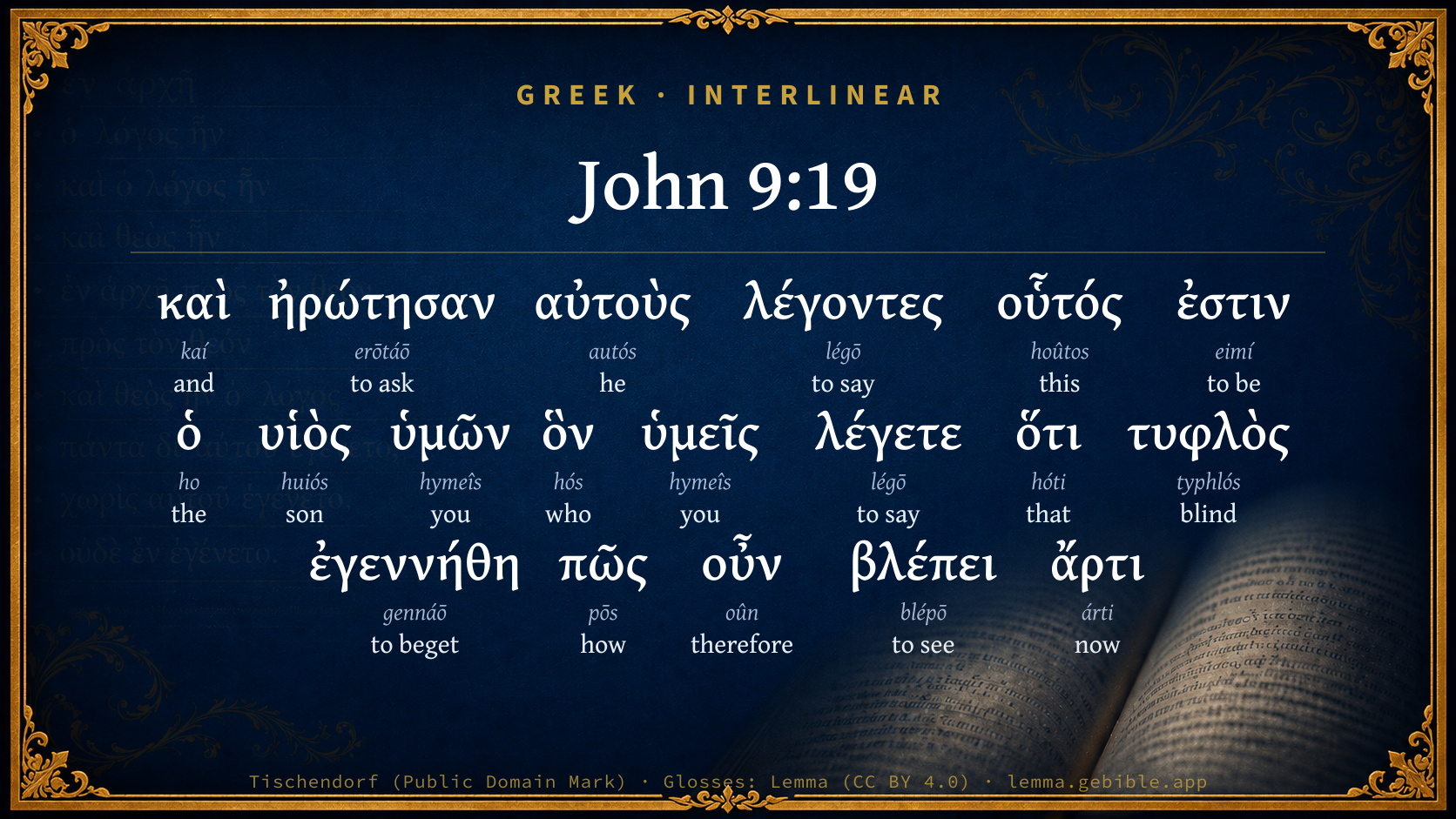
Greek (Tischendorf 8th ed.) John 9:19 appears in the Greek New Testament. The text above is from the Tischendorf 8th edition. Each word links to its Strong’s number and a concise gloss. Click any word for its full Thayer’s Greek Lexicon entry.
Download image
Cite this verse

John 9:19 (World English Bible). Public Domain. Lemma interlinear Bible study tool, https://lemma.gebible.app/v/john/9/19.

Show BibTeX & RIS
BibTeX
RIS
English Translation
and asked them, "Is this your son, who you say was born blind? How then does he now see?"
World English Bible · Public Domain
Download a study sheet

One document with this verse’s original text, its word-by-word gloss line, the meaning frame, cross-references with their text, attributed commentary, and full source and license credits — printable, and it pastes into notes with its structure intact.

This verse Autodidact and up

Study sheet (.html) Plain text (.txt)

A passage Seminary Student

Up to 50 verses in one chapter. A passage sheet keeps up to 6 commentary sources and 12 cross-references per verse, in the order this page ranks them, and says so on the sheet whenever that leaves anything out. Ask for a single verse and you get the Autodidact verse sheet above.

Everything on this page stays free to read, with no account — the sheet is a download of what is already on screen, not access to it.

Want to remove ads? Support Godless Engineer
Compare translations 3

The same verse in 3 English versions, stacked beneath the original-language interlinear above. Click any original word for its lexicon entry.

Each is an independent rendering of the whole verse — the interlinear is not word-aligned to these translations.

Highlighted words mark where these versions differ — a whole-verse word diff, not a word-by-word alignment.

  • World English Bible Public Domain
    and asked them, "Is this your son, who you say was born blind? How then does he now see?"
  • King James Version Public Domain
    And they asked them, saying, Is this your son, who ye say was born blind? how then doth he now see?
  • unfoldingWord Literal Text CC BY-SA 4.0
    And they asked them, saying, “Is this your son, whom you say was born blind? How then does he now see?”

unfoldingWord Literal Text — © unfoldingWord, licensed CC BY-SA 4.0. Word-aligned USFM3 via Door43 (git.door43.org/unfoldingWord/en_ult).

Versions to compare (up to 4)

3 of 4 selected

Show all 19 translations

Every available English version of this verse, each an independent rendering of the whole verse.

  • World English Bible Public Domain
    and asked them, "Is this your son, who you say was born blind? How then does he now see?"
  • Berean Standard Bible Public Domain
    and asked, “Is this your son, the one you say was born blind? So how is it that he can now see?”
  • Majority Standard Bible Public Domain
    and asked, “Is this your son, the one you say was born blind? So how is it that he can now see?”
  • King James Version Public Domain
    And they asked them, saying, Is this your son, who ye say was born blind? how then doth he now see?
  • American Standard Version (1901) Public Domain
    and asked them, saying, Is this your son, who ye say was born blind? How then doth he now see?
  • Revised Version (1885) Public Domain
    and asked them, saying, Is this your son, who ye say was born blind? how then doth he now see?
  • Geneva Bible (1599) Public Domain
    And they asked them, saying, Is this your sonne, whom ye say was borne blinde? How doeth he nowe see then?
  • Douay-Rheims (1899) Public Domain
    And asked them, saying: Is this your son, who you say was born blind? How then doth he now see?
  • Young's Literal Translation Public Domain
    and they asked them, saying, `Is your son, of whom ye say that he was born blind? how then now doth he see?'
  • Literal Standard Version CC BY-SA 4.0
    and they asked them, saying, “Is [this] your son, of whom you say that he was born blind? How then does he now see?”
  • Unlocked Literal Bible CC BY-SA 4.0
    They asked the parents, “Is this your son whom you say was born blind? How then does he now see?”
  • unfoldingWord Literal Text CC BY-SA 4.0
    And they asked them, saying, “Is this your son, whom you say was born blind? How then does he now see?”
  • Darby Bible Public Domain
    And they asked them saying, This is your son, of whom ye say that he was born blind: how then does he now see?
  • World Messianic Bible Public Domain
    and asked them, “Is this your son, whom you say was born blind? How then does he now see?”
  • Webster's Bible Public Domain
    And they asked them, saying, Is this your son, who ye say was born blind? how then doth he now see?
  • Free Bible Version CC BY-SA 4.0
    They asked them, “Is this your son whom you say was born blind? So how is it that now he can see?”
  • Bible in Basic English Public Domain
    And put the question to them, saying, Is this your son, of whom you say that he was blind at birth? how is it then that he is now able to see?
  • Text-Critical English NT CC BY 4.0
    They asked them, “Is this your son, who you say was born blind? How then does he now see?”
  • Tyndale New Testament (1534) Public Domain
    And they axed the saying: Is this youre sonne whome ye saye was borne blynde? How doth he now se then?

Literal Standard Version (2020), Covenant Press — licensed CC BY-SA 4.0. Text via the HelloAO Bible API (eBible.org). Unlocked Literal Bible (unfoldingWord) — licensed CC BY-SA 4.0. Text via the HelloAO Bible API (eBible.org). unfoldingWord Literal Text — © unfoldingWord, licensed CC BY-SA 4.0. Word-aligned USFM3 via Door43 (git.door43.org/unfoldingWord/en_ult). Free Bible Version, Dr. Jonathan Gallagher — licensed CC BY-SA 4.0. Text via the HelloAO Bible API (eBible.org).

Word by word

More ways to search: Search by grammar → Find every occurrence → Compare this word →

Practice this passage: Drill this verse → Learn its vocabulary →

ἄρτι
árti
G737
“now”
Adverb
Part of Speech
Adverb
Full Thayer's Definition

Origin: from a derivative of G142 (cf G740 ) through the idea of suspension

TDNT: 22:26,7

1. just now, this moment 2. now at this time, at this very time, this moment
  1. καὶ kaí G2532 “and” Conjunction
  2. ἠρώτησαν erōtáō G2065 “to ask” Verb, Aorist, Active, Indicative, 3rd person, Plural
  3. αὐτοὺς autós G846 “he” Personal pronoun, Accusative, Plural, Masculine
  4. λέγοντες légō G3004 “to say” Verb, Present, Active, Participle, Nominative, Plural, Masculine
  5. οὗτός hoûtos G3778 “this” Demonstrative pronoun, Nominative, Singular, Masculine
  6. ἐστιν eimí G1510 “to be” Verb, Present, Active, Indicative, 3rd person, Singular
  7. ὁ ho G3588 “the” Article, Nominative, Singular, Masculine
  8. υἱὸς huiós G5207 “son” Noun, Nominative, Singular, Masculine
  9. ὑμῶν hymeîs G5210 “you” Personal pronoun, 2nd person, Genitive, Plural
  10. ὃν hós G3739 “who” Relative pronoun, Accusative, Singular, Masculine
  11. ὑμεῖς hymeîs G5210 “you” Personal pronoun, 2nd person, Nominative, Plural
  12. λέγετε légō G3004 “to say” Verb, Present, Active, Indicative, 2nd person, Plural
  13. ὅτι hóti G3754 “that” Conjunction
  14. τυφλὸς typhlós G5185 “blind” Adjective, Nominative, Singular, Masculine
  15. ἐγεννήθη gennáō G1080 “to beget” Verb, Aorist, Passive, Indicative, 3rd person, Singular
  16. πῶς pōs G4459 “how” Adverb, Interrogative
  17. οὖν oûn G3767 “therefore” Conjunction
  18. βλέπει blépō G991 “to see” Verb, Present, Active, Indicative, 3rd person, Singular

About this verse

These counts appear in no published source. They are computed here, from the morphology-tagged text and Lemma’s own curated glosses. What Lemma adds →

19
words
17
distinct lemmas
Gospels
section

Shared distinctive vocabulary

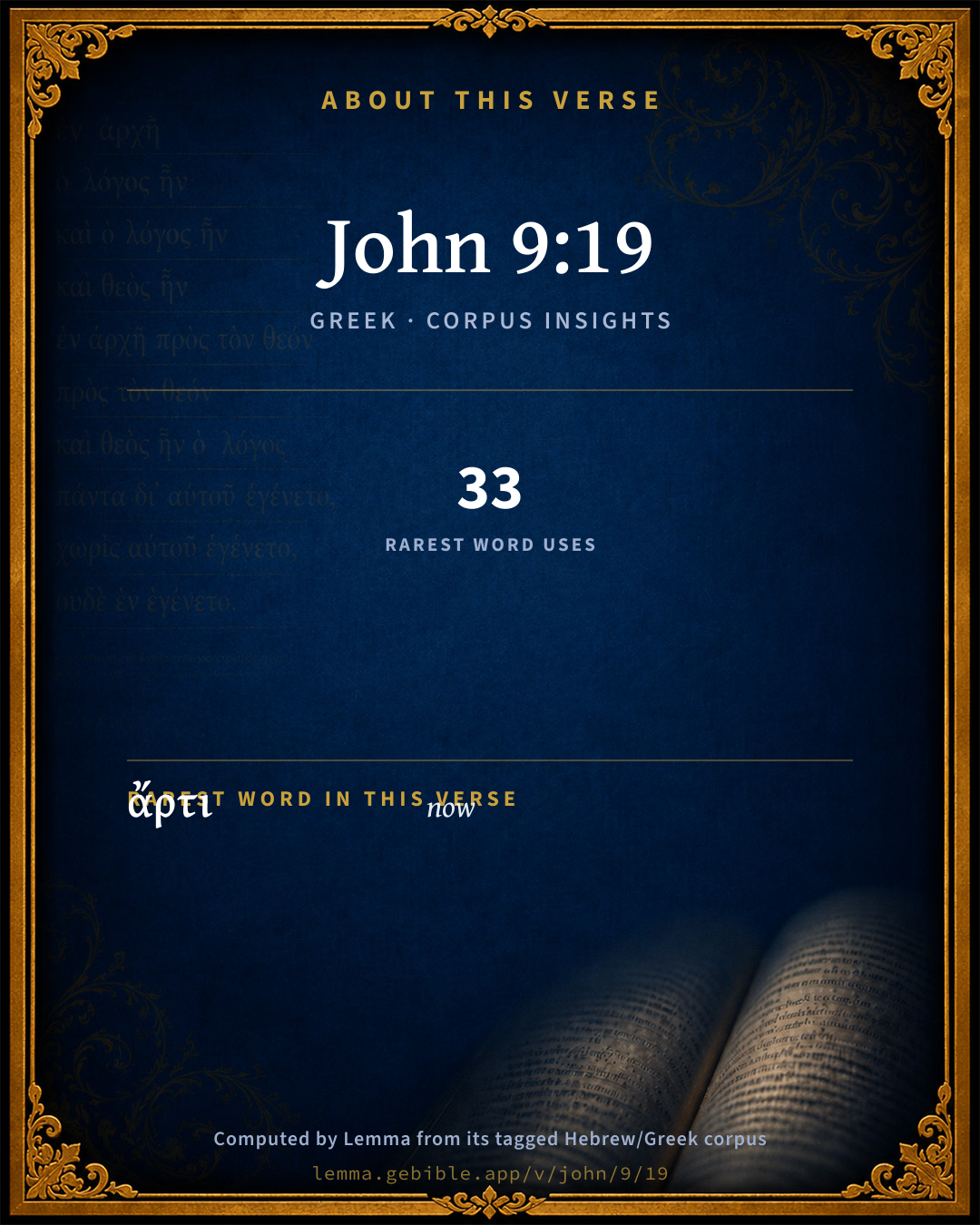
ἄρτι now G737 occurs in 32 verses of the Greek New Testament. Also found in:
Repetition

Words recur within this verse:

  • λέγοντες to say G3004 ×2
  • ὑμῶν you G5210 ×2

Cross-references

3

Topical passages linked to John 9:19 in the Treasury of Scripture Knowledge — connected by theme and wording, ordered by reader-vote popularity; previews shown in the World English Bible.

  • John 9:8–9 The neighbors therefore, and those who saw that he was blind before, said, "Isn't this he who sat and begged?"
  • Acts 4:14 Seeing the man who was healed standing with them, they could say nothing against it.
  • Acts 3:10 They recognized him, that it was he who used to sit begging for gifts for the needy at the Beautiful Gate of the temple. They were filled with wonder and amazement at what had happened to him.

Cross-references courtesy of OpenBible.info (CC BY 4.0).

Commentary

Notes on John 9:19 from classic Christian and Jewish commentators (each source and its license shown beneath its notes). The classic Christian expositions comment on the surrounding passage and are grouped to its opening verse, so a note may address several verses; the Jewish commentaries on the Tanakh (Rashi and others) are per-verse, so they appear only where the commentator wrote on this verse.

Lemma curates 59 commentaries, every one of them public domain or Creative Commons licensed, each selected and text-cleaned for this edition rather than reprinted as found. About our sources →

The Biblical Illustrator

Joseph S. Exell

Joh_9:19-23

Is this your son?

The testimony of the mans parents

I. JOYFUL RECOGNITION. They identified him as their son. The neighbours could only say he was like the beggar they had known (Joh_9:9): the mans parents had no doubt.

II. SORROWFUL CONCESSION. The sons report as to his blindness was correct. He had never known the light of day.

III. CAUTIOUS NEGATION. They declared ignorance of how the miracle had been wrought; so far, at least as their own observation went.

IV. PRUDENT SUGGESTION. The questioners might inquire of their son, who was responsible and was able to answer for himself. (T. Whitelaw, D. D.)

Types of character in relation to Christs work--Those who practically ignore it

The parents who instead of avowing that Christ had healed their son, evaded the question for fear of the Jews. That they felt some interest in one who had conferred such a benefit on their son can scarcely be doubted, but it was not enough to make them courageous for the truth. The great majority now belong to this class. They have no prejudice against Christ, but they have not sufficient interest in Him to avow Him. The parents ignored Christs work

I. ALTHOUGH THEY HAD EVERY OPPORTUNITY OF KNOWING IT. This is the case with millions--wherever they look there are monuments of Christs beneficent operations. In every social circle is some faithful disciple ready to proclaim Him.

II. WHEN GRATITUDE SHOULD HAVE URGED THEM TO ACKNOWLEDGE IT. Christ had given their son a capacity to contribute to their interests. All that is solutary in government, ennobling in literature, fair in commerce, loving in friendship, progressive in intelligence, morality and happiness must be ascribed to Christ. Take from England all she owes to Christ and you leave her in all the confusion, horrors and cruelties of heathenism.

III. FROM COWARDLY MEANNESS OF SOUL (Joh_9:22). Is not Christ ignored today from the fear of losing property, sacrificing friendships, etc. Strange that thousands who have the courage to confront an army are too cowardly to avow Christ. (D. Thomas, D. D.)

Cowardly testimony is despicable

They answered obliquely and over warily; but Christ deserved better of them. Squirrels ever set their holes to the sunny side. Politic professors, neuter-passive Christians will be sure to keep on the warmer side of the hedge; neither will they launch farther into the sea than they may be sure to return safely to the shore. (J. Trapp.)

By what means ha now seeth we know not

Agnosticism

This means Not-know-ism, or Know-nothing-ism, and describes the state of mind of those who say about God, the Bible, and the spiritual world, that they do not know anything. They do not deny, are not profane atheists, they occupy a negative position. Amongst them are distinguished men to whom we are much indebted; but if they are right, we are fatally wrong. We ought, therefore, to find out what foothold we have.

1. There is a Book which professes to tell us about God, the spiritual world and the future. They ignore its testimony, saying they do not know who wrote it, or by what authority it was written. This is a very serious responsibility in relation to such a Book--a Book so distinctively moral in its tone.

2. If we are at liberty to ignore such evidence as is tendered without giving our reason, there is no ground for believing anything in history. I do not know that geology has made any progress. But there are the books which prove it; but I ignore them; they may be corrected; I know nothing of the men who wrote them, or their qualifications. If you tell me they do not claim infallibility, I reply that fallibility constitutes no claim on my confidence. Suppose I say that I cannot be troubled with the examination of fallible theories, and that I will wait until some theory is finally established; then that very theory would bring upon it the identical charge brought against the Bible, viz., that it staggers mankind by the supremacy of its claim.

3. Now the Bible is as positive in its statements as possible. Thus saith the Lord. This fact increases the responsibility of those who ignore the Book. The mere claim of course settles nothing, nor does ignoring the claim. Our object is to ascertain with all the positiveness of positive science what we unquestionably know about the Bible. If certain facts are established we are entitled to say to agnostics, Why herein is a marvellous thing, etc. (Joh_9:30).

I. It is a fact THAT BAD MEN DISLIKE IT, AVOID IT, AND ARE AFRAID OF IT. As a practical argument this amounts to a great deal. No unrighteousness can be vindicated by Christian revelation; not only so; no unholy thought or dishonourable motive is tolerated by it. For these reasons bad men do not consult it, guilty men flee from its judgments, mean men shrink from its standards. If a ruler is a terror to evil doers, the presumption is that he represents the spirit of justice; and if the Bible is avoided by bad men the presumption is that its moral tone is intolerable to their reproachful consciences.

II. It is a fact THAT WHERE IT IS RECEIVED AND THOROUGHLY ACTED UPON THE RESULT IS A PURIFIED MORALITY. You will find the proof of this alike in the humblest and loftiest circles. When men stand up in the court of this world and give their histories, names, and addresses, you are bound either to accept their evidence or disprove it. It is trifling with a great question simply to ignore it. The change they attribute to Christianity is a fact or not a fact; and if it be scientific to mark the progress of a horses development, it cannot be despicable to trace the advances of a human mind.

III. It is a fact THAT IT COMPELS THOSE WHO REALLY BELIEVE IT TO EXERT THEMSELVES IN EVERY POSSIBLE WAY FOR THE GOOD OF MANKIND. It does not leave this an open question. It allows no ignoble ease, smites every self-indulgent excuse, and approves all labour for others. If a man falls below this standard he brings upon himself unsparing condemnation.

IV. It is a fact THAT IN THOSE COUNTRIES THAT ARE NOTED FOR ALLOWING THE FREE USE OF THE BIBLE, LIBERTY, EDUCATION, SCIENCE, ARE HELD IN THE HIGHEST HONOUR. This is not a matter of speculation. It is proved in England, Germany, and America. (J. Parker, D. D.)

He is of age; ask him; he shall speak for himself

Speak for yourself. A challenge

I. THERE ARE TIMES WHEN SAVED MEN ARE COMPELLED TO SPEAK FOR THEMSELVES.

1. When their friends desert them. These parents were willing to own that the young man was their son, and that he was born blind; but they would not go any further for fear of excommunication. So, declining any responsibility, for they had a well-founded confidence in their sons power to take care of himself, they threw upon him the onus of giving an answer likely to incur obloquy, and backed out of it. There are times with young people when their parents turn the cold shoulder to them, and some who hold back suspiciously, leaving others to champion the Masters cause when it comes to a hard push, quietly observing something about casting pearls before swine. But the most likely explanation of such cowardice is that they have no pearls to cast. It is lamentable how many seem afraid to compromise themselves. But whenever a man finds himself thus deserted, let him say gallantly, I am of age; I will speak for myself.

2. When they are much pressed. The Pharisees question the man very closely, and he does not seem to have been disconcerted, but acquitted himself grandly. When we are brought to book, let us not be ashamed to own our Lord. If it comes to a challenge, let us say boldly, I am on the side of Christ.

3. When others revile and slander our Lord. When they said This man is a sinner, He hath opened mine eyes, was the response; and when they averred that they knew not whence Christ was, the man twitted them on their marvellous ignorance, and fought for his Healer so trenchantly that they threw away the weapons of debate and took up stones of abuse. When men speak ill of Christ, shall we be quiet? No! let us throw the gauntlet down for Him. Christian people do not take half the liberty they might. If we speak of religion, or open our Bibles in a railway carriage, it is cant. They may play cards, and utter all sorts of profanity with impunity. In the name of everything that is free we will have our turn. So we see that there are times when men, however quiet and reserved, must speak.

II. IT IS ALWAYS WELL TO BE PREPARED TO SPEAK FOR YOURSELF. When the parents said, Ask him, there was a little twinkle in their eye as much as to say, You will catch a Tartar. He can speak for himself. We want Christians of this sort who, when asked about their faith, can so answer as to be more than a match for their adversaries.

1. Cultivate a general habit of open heartedness and boldness. We have no need to push ourselves and so become a nuisance and a bore; but let us walk through the world as those who have nothing to conceal.

2. Be sure of your ground. Whether He be a sinner or no I know not. So he offered no opinion on a subject on which he could not be positive. But when he had a hard fact there was nothing vague in his statement (Joh_9:25). And there are some of you in whom such a change has taken place. Put your foot down, then, and say, You cannot misjudge this.

3. Have the facts ready to adduce (Joh_9:11). Let them have the plan of salvation, as you first perceived it, very plainly put before them. Be ready to give a reason for the hope that is in you.

4. Be prepared to bear abuse (Joh_9:28; Joh_9:34). The man cared not an atom for their insinuations. Their scorn could not deprive him of his sight. He merely shook his head and said, I can see. Some people are very sensitive of chaff; but what a baby a man is who cannot brave a fools laugh! What does it matter if you are twitted with being a Methodist if you are saved? They will be tired of teasing when they find that our temper triumphs over their senseless tricks.

5. Feel intense gratitude to the Saviour for what He has done.

III. EVERY SAVED MAN SHOULD WILLINGLY SPEAK FOR HIMSELF ABOUT CHRIST.

1. Are we not all debtors to Christ if, indeed, He has saved us? How can we acknowledge the debt if we are ashamed of Him?

2. We each of us know most about what He has done for us. No one else can know so much.

3. The more individual testimonies are borne to Christ the more weight there is in the accumulated force of the great aggregate. A sceptical lawyer attended an experience meeting amongst his neighbours and took notes. When he reviewed the evidence he said, If I had these persons in the witness box on my side, I should feel quite sure of carrying my case. Though each has told his own tale, they all bear witness to the power of Gods grace to change the heart. I am bound to believe after this testimony. And he did, and became a Christian. Do you say, They can do without my story. Nay, it has its own special interest, and may touch the heart of somebody like yourself.

(1) You are only a nursemaid, but your testimony will suit another lass like yourself. Who could have told her mistress that there was healing for Naaman but the captive maid?

(2) You are old and feeble; but you are just the man whose few words have full weight.

(3) You are only a working man; but who can tell working men about your changed character and home like yourself?

IV. AS EVERY CHRISTIAN, BEING OF AGE, HAS TO SPEAK FOR HIMSELF, WE MEAN TO DO IT. You cannot all preach, and should not try; if you all did, what a tumult there be! And there would be no hearers left if all were preachers. Your work is to speak and to let your influence be felt among your servants, children, trades people. You say I am so retiring. Well, then drop a little of your modesty, and distinguish yourself a little more for your manliness. A soldier who was retiring in the day of battle they shot for a coward. (C. H. Spurgeon.)

Accountability

I. INDIVIDUAL ACCOUNTABILITY. The Bible lays down no clearly defined line between the ages when God does and does not regard the child morally accountable for sinful actions. This must depend on the varying circumstances of intelligence, temperament, and social surroundings of the child. But the time does come when with no hesitation we can throw upon the youths conscience the full weight of his individual responsibility, saying with emphasis: He is of age. He must answer for himself.

II. PARENTAL ACCOUNTABILITY. Up to a certain age the parent has no doubt of the salvation of the child. The Saviours atonement satisfies the requirements of every child dying at an early age. Nevertheless, during this tender age character is being formed for future development; and God holds the parents accountable for the manifold influences that are affecting the childs mental and moral vision, saying to them: Is this your son? How then doth he now see? Does your child see kindly glances, Christ-like actions, devout conduct, devotional observances, etc.

III. MUTUAL ACCOUNTABILITY The spirit of Cain has impregnated human history. Am I my brothers keeper is still largely the covert of a mean soul that wants to shirk the duty of fraternal help and counsel, or defence. The fear that here padlocked the parents lips is a sin that thrives in too many hearts. How often has an accused one gone to the grave under a dark cloud that might have been dispersed, if friends had been found of sufficient courage to contradict patronizing accusers. But no! Speaking the truth would have damaged the selfish interests of those who said: Let him speak for himself.

IV. THE PERSONAL ACCOUNTABILITY OF CHURCH RELATIONS. Our knowledge of each other is very limited. Large significance belongs to the apostles words: We know in part. An individual presents himself for Church membership. The question goes round, and very properly so, What do you know of him? But our knowledge here often proves strangely false, whether the testimony is pro or con. The voice of God is, Let him speak for himself. Take the applicant on personal confession, unless his or her life is palpably false. Was not even Judas admitted on personal confession? When the falsity of character is seen then is the time for unchurching. We are familiar with the account of the poor Scotch woman, who, on applying for church membership, was so ignorant of the theological queries put to her by her pastor, that she was sent away as temporarily disqualified. On leaving, she said, with deep emotion: I canna speak for Him, but I could die for Him. (The Study.)

Speak for Christ

A Christian man (Mr. Moody) in a Western city resolved that he would never allow a day to pass without speaking to someone on the subject of personal salvation. He was returning home late one evening, burdened with the thought that the day had gone by, and no one had been invited to Christ. He saw a man leaning against a lamp post, put his hand gently on the shoulder of the stranger, and said, May I ask you if you love the Lord Jesus Christ? The stranger resented the freedom and replied curtly, that that was a personal matter in which nobody else had any concern. But the Christian replied kindly, that they were fellow travellers to another world, and one could not be indifferent whether others had a good hope of entering heaven. After a few more words had passed between them, they parted, the Christian fearing that he had given offence, but carrying the matter to the closet for earnest prayer. Three months after, just as he had retired for the night, a knock was heard at the door. He inquired what was wanted; and a gentleman replied he would like to see him. On opening the door, he recognized the stranger met at the lamp post. The latter grasped him convulsively by the hand, and said, The question you put to me, Do you love the Lord Jesus Christ? has been ringing ever since in my ear; and I have come to ask you what I must do to be saved. They prayed and talked together; and in a few days the stranger was rejoicing in the hope of pardon. He became an earnest and devoted Christian. (E. Foster.)

The Biblical Illustrator, edited by Joseph S. Exell (c. 1880s–1900s) — public domain. Text from a community e-Sword module.

Bengel's Gnomon

Johann Albrecht Bengel

Joh 9:19. Πῶς βλέπει) How it has happened, that he sees.

Bengel's Gnomon of the New Testament — English translation (T&T Clark, Edinburgh, 1860) — public domain. Text from a community e-Sword module.

Meyer's Critical & Exegetical Commentary

Heinrich August Wilhelm Meyer

Joh_9:19-21. To the two questions put in Joh_9:19 exactly corresponding answers are returned in Joh_9:20-21; the second, however, twice nesciendo.

ὃν ὑμεῖς λέγετε] opposed to the personal unbelief of the questioners; ὅν as in Joh_6:71.

πῶς] how does it happen that?

οὖν] as it is alleged that he was born blind.

Joh_9:20. πῶς δὲ ἄρτι βλέπει, ἀγνοεῖν λέγουσι, φοβούμενοι τοὺς Ἰουδαίους. Ἔξω κινδύνου καθιστῶντες ἑαυτοὺς, ἐπὶ τὸν τεθεραπευμένον παραπέμπουσι τὴν ἐρώτησιν, ὡς ἀξιοπιστότερον αὐτῶν ἐν τῷ τοιούτῳ ζητήματι, Euth. Zigabenus.

ἡμεῖς] opposed to the αὐτός … αὐτόν … αὐτός, afterwards thrice repeated, and asyndetically, with passionate emphasis. ἡλικίαν ἔχει] he himself is of full age; comp. Herod. 3. 36, 7. 18; Thuc. 8. 75; Polyb. 9. 23. 9, al. See Kypke, I. p. 387; Loesner, p. 150.

αὐτὸς περὶ αὐτοῦ] he will himself speak concerning himself. αὐτοῦ with the Spir. lenis. Buttm. Neut. Gr. p. 97 f. [E. T. p. 112]).

Meyer — Critical and Exegetical Commentary on the New Testament — English translation by Peter Christie, edited by Frederick Crombie (T&T Clark, 1880) — public domain. Text from a community e-Sword module.

John Calvin's Commentaries

19. Is this your son? Not having succeeded in the former way, they now attempt another; but the Lord not only defeats their attempts in a wonderful manner, but turns them even to an opposite purpose. They do not merely put a single question, but cunningly put a multitude of questions involved in each other, with the view of preventing a reply. But out of a variety of entangled and captious questions, the parents of the blind man select only the half, to which they reply:

John Calvin's Commentaries (1540-1563) — public domain. Text from the Calvin Translation Society English edition (1840s-50s) via the Christian Classics Ethereal Library (ccel.org). Calvin's coverage is partial (roughly two-thirds of the Bible); uncommented books and verses are honest gaps, never fabricated. The 19th-century editor's footnotes and remarks are omitted so the notes are faithfully Calvin's own voice.

Ellicott's Commentary for English Readers

(19) Is this your son, who ye say was born blind?—The “ye” is emphatic; ye say he was born blind, as opposed to us, for we do not believe it. There are three questions. Is this your son? Do ye still say that he was born blind? which is incredible, as he now possesses the faculty of sight (Joh_9:32). If you do, how do you account for the fact that he now sees?

How then doth he now see?—Their question means—“How does it come to pass, since he was born blind, that he all at once seeth?” The word rendered “now,” here and in Joh_9:21; Joh_9:25, conveys the idea of the suddenness of the change which had taken place.

A Bible Commentary for English Readers, edited by Charles John Ellicott (1878–1897) — public domain. Text from a community e-Sword module.

The Cambridge Bible for Schools and Colleges

gen. ed. J. J. S. Perowne

19. Three questions in legal form. Is this your son? Was he born blind? How does he now see?

who ye say] Emphasis on ‘ye,’ implying ‘we do not believe it;’ literally, of whom ye say that he was born blind.

The Cambridge Bible for Schools and Colleges (gen. ed. J. J. S. Perowne; Cambridge University Press, 1878–1918) — public domain. Text from a community e-Sword module.

John Gill's Exposition

And they asked them, saying, is this your son,.... The first question they put was, whether the man that stood before them, pointing to him, was their son or not; whether they knew him by any marks to be their son, and would own him as such: had they answered to this in the negative, they would have got an advantage against him, and would have convicted him of a lie, since he had given out that he was the son of such parents; and proving such a lie upon him, would at once have brought the whole affair into suspicion at least: they add,

who ye say was born blind; this contains a second question, whether, if this was their son, he was born blind or not; and if he was not born blind, though he had been blind, it would have greatly lessened the miracle: and besides, they would have put other questions upon this, whether his blindness was real, and by what means it came. Next follows a third question,

how then doth he now see? By what means has he received his sight? They might hope, that if he was their son, and was really born blind, that he had his sight some other way than by Jesus; or they might object this to his being born, blind, as being a thing impossible, or at least not credible that he should ever see, was that the case.

John Gill's Exposition of the Whole Bible (1746–1763) — public domain (CC PDM 1.0). Text via the HelloAO Bible API.

Trapp's Complete Commentary

John Trapp

19 And they asked them, saying, Is this your son, who ye say was born blind? how then doth he now see?

Ver. 19. Is this your son?] Here they try another trick to obscure the miracle; but it would not be. "God taketh the wise in their own craftiness." Again, "The Lord knoweth the thoughts of the wise, that they are vain," 1Co 3:19-20.

John Trapp, A Commentary or Exposition upon All the Books of the Old and New Testament (1647–1656) — public domain. Text from a community e-Sword module.

Matthew Poole's English Annotations

The parents of this man that was blind, in their answer show a great deal of discretion and prudence. Three things the Pharisees ask:

1. Whether this was their son?

2. Whether (as they said) he was indeed born blind?

3. How he came now to see?

The manner of the propounding their question,

who ye say, lets us know what answer they would have had, and that they did not send for the parents of this blind man out of a desire to know the naked truth of the thing, but hoping to fright them into a speaking doubtfully (at least) whether it was their son, yea or no; or whether he was stark blind when he was born, yea or no. But, alas! The providence of God ordering his condition to be so poor, that he was glad to beg for his livelihood, made this design vain, would his parents have gratified the Pharisees by any shuffling and indirect answer.

Matthew Poole's English Annotations on the Holy Bible (1683–1685) — public domain. Text from a community e-Sword/MySword module.

unfoldingWord translationNotes

Door43 World Missions Community

They asked the parents

"They" refers to the Jewish leaders.

he is an adult

"he is a man" or "he is no longer a child"

unfoldingWord translationNotes — © Distant Shores Media and the Door43 World Missions Community, licensed CC BY-SA 4.0. Source: git.door43.org/Door43/en_tn.

Cambridge Greek Testament for Schools and Colleges

19. Three questions in legal form. Is this your son? Was he born blind? How does he now see?

δν ὑμεῖς λ. Of whom ye say that he was born blind (see on Joh 6:71). The emphatic ὑμεῖς implies ‘we do not believe it.’

Cambridge Greek Testament for Schools and Colleges (Cambridge University Press, 1896; 21 vols, various authors incl. Carr, Maclear, Plummer, Farrar, Lumby, Moule, M. R. James, Simcox) — public domain. Text from a community e-Sword module.

Alford’s Greek Testament

Henry Alford

19.] The question is threefold, and in strict legal formality: ‘Is this your son? Was he born blind? How is it that he now sees?’

Henry Alford, The Greek Testament (1849–1861) — public domain. Text from a community e-Sword module.

International Critical Commentary

19. The Pharisees now cross-examine the parents, in strict fashion. “Is this your son? the son whom you say was born blind? How is it that he now sees?”

ἄρτι is a favourite word with Jn., and signifies “at this moment,” as distinct from the vaguer νῦν, “at the present time.” Cf. v. 25, 13:7, 33, 37, 16:12, 31.

International Critical Commentary — older volumes (1896–1929), various authors — public domain. Text from a community e-Sword module.

Lesson kit

Teaching starters — assembled from the data on this page, not authored interpretation. Every prompt links to the verse data it draws on. Edit before teaching.

John, in the Gospels, opens this verse with 19 words (17 distinct Greek lemmas). Its most distinctive word is árti (“now”). A historical commentator’s framing appears above. Read the whole chapter for the surrounding context.

Discussion questions

  1. What does “now” (árti) contribute to the verse as a whole?
  2. Matthew 3:15 shares the word «now» with this verse. How do the two illuminate each other?
  3. “to say” occurs 2× in this one verse. What is the effect of the repetition?
  4. The translations on this page render this verse differently — a whole-verse word diff, not a word-by-word alignment. What might account for the different wordings?
  5. Reading how The Biblical Illustrator and Bengel's Gnomon read this verse, where do the two commentators agree and where do they part?

Things to notice

  • These translations choose different wording for 5 words in this verse.
  • “to say” occurs 2× in this single verse.
  • 17 distinct Greek lemmas span 19 words in this verse.

Reading settings

Reading text

Shown beneath each verse's original-language words.

Old Testament
Old Testament edition

Read the OT as the Masoretic Hebrew (MT) or the Greek Septuagint (LXX).

English shown for the Greek Septuagint (in the Hebrew ↔ Greek comparison).

Comparing translations? Open the Compare panel on any verse page to stack up to four side by side.