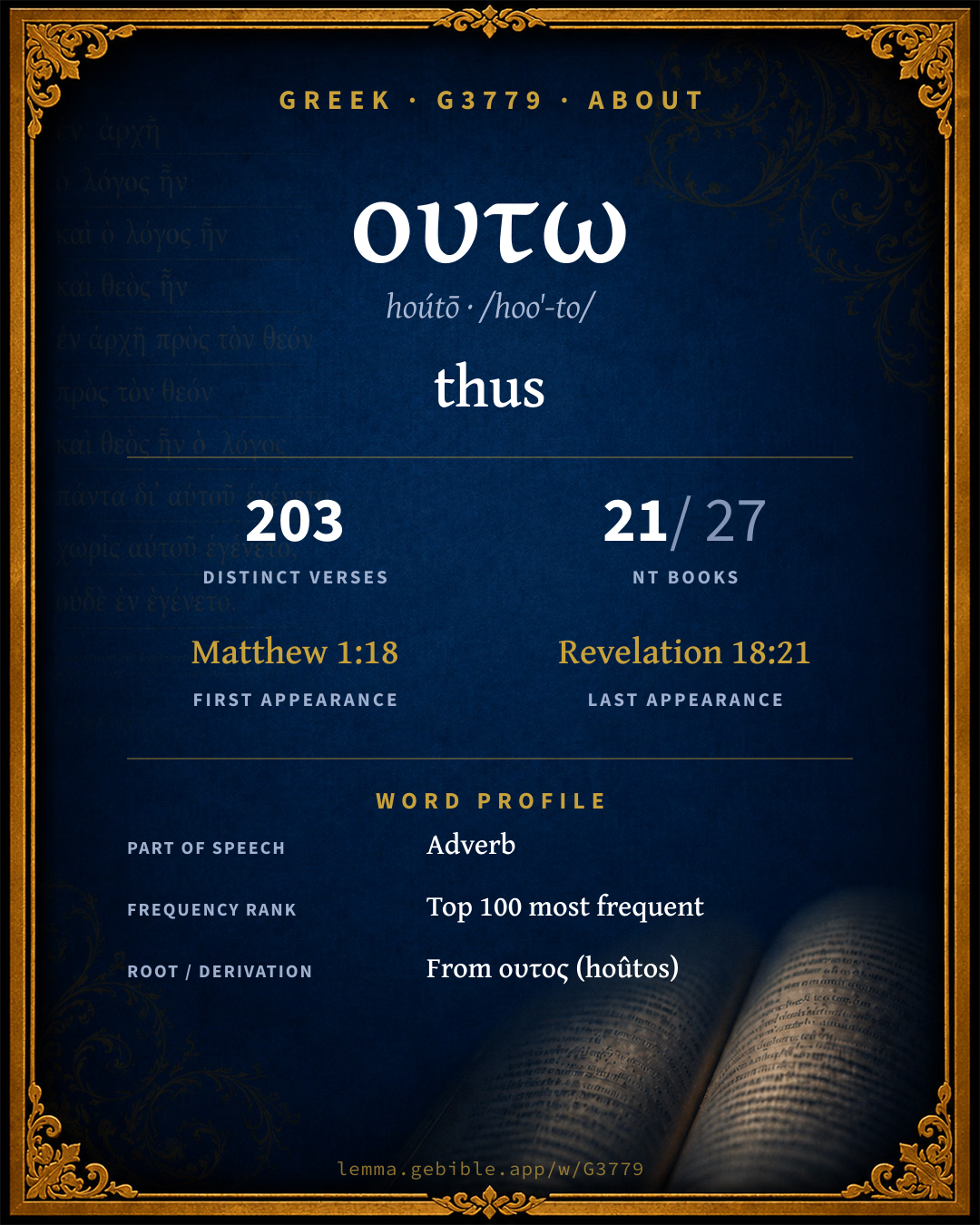
οὕτω
thus
Full lexicon entry — Thayer's Greek Lexicon
From Thayer's Greek Lexicon
Where this word appears
Grammar key — what these labels mean
Part of speech
- Adverb
- A word that modifies a verb, adjective, or other adverb.
Page 1 of 2 — showing verses 1–200 of 203 distinct verses where G3779 appears, across 21 books. Click any verse to open its interlinear word-by-word view. Verse text shown in the World English Bible for context — . Each verse’s Greek form is shown with its reference; the English is not keyword-highlighted, since the data carries no word-level English alignment. Use “Compare translations” on any verse to read it across multiple English versions. This concordance covers the Greek New Testament; Septuagint (Greek Old Testament) occurrences of this word are not indexed here.
Matthew 32 verses
- Matthew 1:18 οὕτως adv Now the birth of Jesus Christ was like this; for after his mother, Mary, was engaged to Joseph, before they came together, she was found pregnant by the Holy Spirit.
- Matthew 2:5 οὕτως adv They said to him, "In Bethlehem of Judea, for thus it is written through the prophet,
- Matthew 3:15 οὕτως adv But Jesus, answering, said to him, "Allow it now, for this is the fitting way for us to fulfill all righteousness." Then he allowed him.
- Matthew 5:12 οὕτως adv Rejoice, and be exceedingly glad, for great is your reward in heaven. For that is how they persecuted the prophets who were before you.
- Matthew 5:16 οὕτως adv Even so, let your light shine before men; that they may see your good works, and glorify your Father who is in heaven.
- Matthew 5:19 οὕτως adv Whoever, therefore, shall break one of these least commandments, and teach others to do so, shall be called least in the Kingdom of Heaven; but whoever shall do and teach them shall be called great in the Kingdom of Heaven.
- Matthew 6:9 οὕτως adv Pray like this: 'Our Father in heaven, may your name be kept holy.
- Matthew 6:30 οὕτως adv But if God so clothes the grass of the field, which today exists, and tomorrow is thrown into the oven, won't he much more clothe you, you of little faith?
- Matthew 7:12 οὕτως adv Therefore whatever you desire for men to do to you, you shall also do to them; for this is the law and the prophets.
- Matthew 7:17 οὕτως adv Even so, every good tree produces good fruit; but the corrupt tree produces evil fruit.
- Matthew 9:33 οὕτως adv When the demon was cast out, the mute man spoke. The multitudes marveled, saying, "Nothing like this has ever been seen in Israel!"
- Matthew 11:26 οὕτως adv Yes, Father, for so it was well-pleasing in your sight.
- Matthew 12:40 οὕτως adv For as Jonah was three days and three nights in the belly of the whale, so will the Son of Man be three days and three nights in the heart of the earth.
- Matthew 12:45 οὕτως adv Then he goes, and takes with himself seven other spirits more evil than he is, and they enter in and dwell there. The last state of that man becomes worse than the first. Even so will it be also to this evil generation."
- Matthew 13:40 οὕτως adv As therefore the darnel is gathered up and burned with fire; so will it be at the end of this age.
- Matthew 13:49 οὕτως adv So will it be in the end of the world. The angels will come forth, and separate the wicked from among the righteous,
- Matthew 17:12 οὕτως adv but I tell you that Elijah has come already, and they didn't recognize him, but did to him whatever they wanted to. Even so the Son of Man will also suffer by them."
- Matthew 18:14 οὕτως adv Even so it is not the will of your Father who is in heaven that one of these little ones should perish.
- Matthew 18:35 οὕτως adv So my heavenly Father will also do to you, if you don't each forgive your brother from your hearts for his misdeeds."
- Matthew 19:8 οὕτως adv He said to them, "Moses, because of the hardness of your hearts, allowed you to divorce your wives, but from the beginning it has not been so.
- Matthew 19:10 οὕτως adv His disciples said to him, "If this is the case of the man with his wife, it is not expedient to marry."
- Matthew 19:12 οὕτως adv For there are eunuchs who were born that way from their mother's womb, and there are eunuchs who were made eunuchs by men; and there are eunuchs who made themselves eunuchs for the Kingdom of Heaven's sake. He who is able to receive it, let him receive it."
- Matthew 20:16 οὕτως adv So the last will be first, and the first last. For many are called, but few are chosen."
- Matthew 20:26 οὕτως adv It shall not be so among you, but whoever desires to become great among you shall be your servant.
- Matthew 23:28 οὕτως adv Even so you also outwardly appear righteous to men, but inwardly you are full of hypocrisy and iniquity.
- Matthew 24:27 οὕτως adv For as the lightning comes forth from the east, and is seen even to the west, so will be the coming of the Son of Man.
- Matthew 24:33 οὕτως adv Even so you also, when you see all these things, know that it is near, even at the doors.
- Matthew 24:37 οὕτως adv "As the days of Noah were, so will be the coming of the Son of Man.
- Matthew 24:39 οὕτως adv and they didn't know until the flood came, and took them all away, so will be the coming of the Son of Man.
- Matthew 24:46 οὕτως adv Blessed is that servant whom his lord finds doing so when he comes.
- Matthew 26:40 οὕτως adv He came to the disciples, and found them sleeping, and said to Peter, "What, couldn't you watch with me for one hour?
- Matthew 26:54 οὕτως adv How then would the Scriptures be fulfilled that it must be so?"
Mark 11 verses
- Mark 2:7 οὕτως adv "Why does this man speak blasphemies like that? Who can forgive sins but God alone?"
- Mark 2:8 οὕτως adv Immediately Jesus, perceiving in his spirit that they so reasoned within themselves, said to them, "Why do you reason these things in your hearts?
- Mark 2:12 οὕτως adv He arose, and immediately took up the mat, and went out in front of them all; so that they were all amazed, and glorified God, saying, "We never saw anything like this!"
- Mark 4:26 οὕτως adv He said, "The Kingdom of God is as if a man should cast seed on the earth,
- Mark 4:40 οὕτως adv He said to them, "Why are you so afraid? How is it that you have no faith?"
- Mark 7:18 οὕτως adv He said to them, "Are you thus without understanding also? Don't you perceive that whatever goes into the man from outside can't defile him,
- Mark 9:3 οὕτως adv His clothing became glistening, exceedingly white, like snow, such as no launderer on earth can whiten them.
- Mark 10:43 οὕτως adv But it shall not be so among you, but whoever wants to become great among you shall be your servant.
- Mark 13:29 οὕτως adv even so you also, when you see these things coming to pass, know that it is near, at the doors.
- Mark 14:59 οὕτως adv Even so, their testimony did not agree.
- Mark 15:39 οὕτως adv When the centurion, who stood by opposite him, saw that he cried out like this and breathed his last, he said, "Truly this man was the Son of God!"
Luke 21 verses
- Luke 1:25 οὕτως adv "Thus has the Lord done to me in the days in which he looked at me, to take away my reproach among men."
- Luke 2:48 οὕτως adv When they saw him, they were astonished, and his mother said to him, "Son, why have you treated us this way? Behold, your father and I were anxiously looking for you."
- Luke 9:15 οὕτως adv They did so, and made them all sit down.
- Luke 10:21 οὕτως adv In that same hour Jesus rejoiced in the Holy Spirit, and said, "I thank you, O Father, Lord of heaven and earth, that you have hidden these things from the wise and understanding, and revealed them to little children. Yes, Father, for so it was well-pleasing in your sight."
- Luke 11:30 οὕτως adv For even as Jonah became a sign to the Ninevites, so will also the Son of Man be to this generation.
- Luke 12:21 οὕτως adv So is he who lays up treasure for himself, and is not rich toward God."
- Luke 12:28 οὕτως adv But if this is how God clothes the grass in the field, which today exists, and tomorrow is cast into the oven, how much more will he clothe you, O you of little faith?
- Luke 12:38 οὕτως adv They will be blessed if he comes in the second or third watch, and finds them so.
- Luke 12:43 οὕτως adv Blessed is that servant whom his lord will find doing so when he comes.
- Luke 12:54 οὕτως adv He said to the multitudes also, "When you see a cloud rising from the west, immediately you say, 'A shower is coming,' and so it happens.
- Luke 14:33 οὕτως adv So therefore whoever of you who doesn't renounce all that he has, he can't be my disciple.
- Luke 15:7 οὕτως adv I tell you that even so there will be more joy in heaven over one sinner who repents, than over ninety-nine righteous people who need no repentance.
- Luke 15:10 οὕτως adv Even so, I tell you, there is joy in the presence of the angels of God over one sinner repenting."
- Luke 17:10 οὕτως adv Even so you also, when you have done all the things that are commanded you, say, 'We are unworthy servants. We have done our duty.'"
- Luke 17:24 οὕτως adv for as the lightning, when it flashes out of the one part under the sky, shines to the other part under the sky; so will the Son of Man be in his day.
- Luke 17:26 οὕτως adv As it happened in the days of Noah, even so will it be also in the days of the Son of Man.
- Luke 19:31 οὕτως adv If anyone asks you, 'Why are you untying it?' say to him: 'The Lord needs it.'"
- Luke 21:31 οὕτως adv Even so you also, when you see these things happening, know that the Kingdom of God is near.
- Luke 22:26 οὕτως adv But not so with you. But one who is the greater among you, let him become as the younger, and one who is governing, as one who serves.
- Luke 24:24 οὕτως adv Some of us went to the tomb, and found it just like the women had said, but they didn't see him."
- Luke 24:46 οὕτως adv He said to them, "Thus it is written, and thus it was necessary for the Christ to suffer and to rise from the dead the third day,
John 14 verses
- John 3:8 οὕτως adv The wind blows where it wants to, and you hear its sound, but don't know where it comes from and where it is going. So is everyone who is born of the Spirit."
- John 3:14 οὕτως adv As Moses lifted up the serpent in the wilderness, even so must the Son of Man be lifted up,
- John 3:16 οὕτως adv For God so loved the world, that he gave his one and only Son, that whoever believes in him should not perish, but have eternal life.
- John 4:6 οὕτως adv Jacob's well was there. Jesus therefore, being tired from his journey, sat down by the well. It was about the sixth hour.
- John 5:21 οὕτως adv For as the Father raises the dead and gives them life, even so the Son also gives life to whom he desires.
- John 5:26 οὕτως adv For as the Father has life in himself, even so he gave to the Son also to have life in himself.
- John 7:46 οὕτως adv The officers answered, "No man ever spoke like this man!"
- John 11:48 οὕτως adv If we leave him alone like this, everyone will believe in him, and the Romans will come and take away both our place and our nation."
- John 12:50 οὕτως adv I know that his commandment is eternal life. The things therefore which I speak, even as the Father has said to me, so I speak."
- John 13:25 οὕτως adv He, leaning back, as he was, on Jesus' breast, asked him, "Lord, who is it?"
- John 14:31 οὕτως adv But that the world may know that I love the Father, and as the Father commanded me, even so I do. Arise, let us go from here.
- John 15:4 οὕτως adv Remain in me, and I in you. As the branch can't bear fruit by itself, unless it remains in the vine, so neither can you, unless you remain in me.
- John 18:22 οὕτως adv When he had said this, one of the officers standing by slapped Jesus with his hand, saying, "Do you answer the high priest like that?"
- John 21:1 οὕτως adv After these things, Jesus revealed himself again to the disciples at the sea of Tiberias. He revealed himself this way.
Acts 27 verses
- Acts 1:11 οὕτως adv who also said, "You men of Galilee, why do you stand looking into the sky? This Jesus, who was received up from you into the sky will come back in the same way as you saw him going into the sky."
- Acts 3:18 οὕτως adv But the things which God announced by the mouth of all his prophets, that Christ should suffer, he thus fulfilled.
- Acts 7:1 οὕτως adv The high priest said, "Are these things so?"
- Acts 7:6 οὕτως adv God spoke in this way: that his seed would live as aliens in a strange land, and that they would be enslaved and mistreated for four hundred years.
- Acts 7:8 οὕτως adv He gave him the covenant of circumcision. So Abraham became the father of Isaac, and circumcised him the eighth day. Isaac became the father of Jacob, and Jacob became the father of the twelve patriarchs.
- Acts 8:32 οὕτως adv Now the passage of the Scripture which he was reading was this, "He was led as a sheep to the slaughter. As a lamb before his shearer is silent, So he doesn't open his mouth.
- Acts 12:8 οὕτως adv The angel said to him, "Get dressed and put on your sandals." He did so. He said to him, "Put on your cloak, and follow me."
- Acts 12:15 οὕτως adv They said to her, "You are crazy!" But she insisted that it was so. They said, "It is his angel."
- Acts 13:8 οὕτως adv But Elymas the sorcerer (for so is his name by interpretation) withstood them, seeking to turn aside the proconsul from the faith.
- Acts 13:34 οὕτως adv "Concerning that he raised him up from the dead, now no more to return to corruption, he has spoken thus: 'I will give you the holy and sure blessings of David.'
- Acts 13:47 οὕτως adv For so has the Lord commanded us, saying, 'I have set you as a light for the Gentiles, That you should bring salvation to the uttermost parts of the earth.'"
- Acts 14:1 οὕτως adv It happened in Iconium that they entered together into the synagogue of the Jews, and so spoke that a great multitude both of Jews and of Greeks believed.
- Acts 17:11 οὕτως adv Now these were more noble than those in Thessalonica, in that they received the word with all readiness of the mind, examining the Scriptures daily to see whether these things were so.
- Acts 17:33 οὕτως adv Thus Paul went out from among them.
- Acts 19:20 Οὕτως adv So the word of the Lord was growing and becoming mighty.
- Acts 20:11 οὕτως adv When he had gone up, and had broken bread, and eaten, and had talked with them a long while, even until break of day, he departed.
- Acts 20:13 οὕτως adv But we who went ahead to the ship set sail for Assos, intending to take Paul aboard there, for he had so arranged, intending himself to go by land.
- Acts 20:35 οὕτως adv In all things I gave you an example, that so laboring you ought to help the weak, and to remember the words of the Lord Jesus, that he himself said, 'It is more blessed to give than to receive.'"
- Acts 21:11 οὕτως adv Coming to us, and taking Paul's belt, he bound his own feet and hands, and said, "Thus says the Holy Spirit: 'So will the Jews at Jerusalem bind the man who owns this belt, and will deliver him into the hands of the Gentiles.'"
- Acts 22:24 οὕτως adv the commanding officer commanded him to be brought into the barracks, ordering him to be examined by scourging, that he might know for what crime they shouted against him like that.
- Acts 23:11 οὕτω adv The following night, the Lord stood by him, and said, "Cheer up, Paul, for as you have testified about me at Jerusalem, so you must testify also at Rome."
- Acts 24:9 οὕτως adv The Jews also joined in the attack, affirming that these things were so.
- Acts 24:14 οὕτως adv But this I confess to you, that after the Way, which they call a sect, so I serve the God of our fathers, believing all things which are according to the law, and which are written in the prophets;
- Acts 27:17 οὕτως adv After they had hoisted it up, they used cables to help reinforce the ship. Fearing that they would run aground on the Syrtis sand bars, they lowered the sea anchor, and so were driven along.
- Acts 27:25 οὕτως adv Therefore, sirs, cheer up! For I believe God, that it will be just as it has been spoken to me.
- Acts 27:44 οὕτως adv and the rest should follow, some on planks, and some on other things from the ship. So it happened that they all escaped safely to the land.
- Acts 28:14 οὕτως adv where we found brothers, and were entreated to stay with them for seven days. So we came to Rome.
Romans 17 verses
- Romans 1:15 οὕτως adv So, as much as is in me, I am eager to preach the Gospel to you also who are in Rome.
- Romans 4:18 οὕτως adv Who in hope believed against hope, to the end that he might become a father of many nations, according to that which had been spoken, "So will your seed be."
- Romans 5:12 οὕτως adv Therefore, as sin entered into the world through one man, and death through sin; and so death passed to all men, because all sinned.
- Romans 5:15 οὕτως adv But the free gift isn't like the trespass. For if by the trespass of the one the many died, much more did the grace of God, and the gift by the grace of the one man, Jesus Christ, abound to the many.
- Romans 5:18 οὕτως adv So then as through one trespass, all men were condemned; even so through one act of righteousness, all men were justified to life.
- Romans 5:19 οὕτως adv For as through the one man's disobedience many were made sinners, even so through the obedience of the one will many be made righteous.
- Romans 5:21 οὕτως adv that as sin reigned in death, even so might grace reign through righteousness to eternal life through Jesus Christ our Lord.
- Romans 6:4 οὕτως adv We were buried therefore with him through baptism to death, that just like Christ was raised from the dead through the glory of the Father, so we also might walk in newness of life.
- Romans 6:11 οὕτως adv Thus also consider yourselves also to be dead to sin, but alive to God in Christ Jesus our Lord.
- Romans 6:19 οὕτως adv I speak in human terms because of the weakness of your flesh, for as you presented your members as servants to uncleanness and to wickedness upon wickedness, even so now present your members as servants to righteousness for sanctification.
- Romans 9:20 οὕτως adv But indeed, O man, who are you to reply against God? Will the thing formed ask him who formed it, "Why did you make me like this?"
- Romans 10:6 οὕτως adv But the righteousness which is of faith says this, "Don't say in your heart, 'Who will ascend into heaven?' (that is, to bring Christ down);
- Romans 11:5 οὕτως adv Even so then at this present time also there is a remnant according to the election of grace.
- Romans 11:26 οὕτως adv and so all Israel will be saved. Even as it is written, "There will come out of Zion the Deliverer, And he will turn away ungodliness from Jacob.
- Romans 11:31 οὕτως adv even so these also have now been disobedient, that by the mercy shown to you they may also obtain mercy.
- Romans 12:5 οὕτως adv so we, who are many, are one body in Christ, and individually members one of another.
- Romans 15:20 οὕτως adv yes, making it my aim to preach the Gospel, not where Christ was already named, that I might not build on another's foundation.
1 Corinthians 27 verses
- 1 Corinthians 2:11 οὕτως adv For who among men knows the things of a man, except the spirit of the man, which is in him? Even so, no one knows the things of God, except God's Spirit.
- 1 Corinthians 3:15 οὕτως adv If any man's work is burned, he will suffer loss, but he himself will be saved, but as through fire.
- 1 Corinthians 4:1 Οὕτως adv So let a man think of us as Christ's servants, and stewards of God's mysteries.
- 1 Corinthians 5:3 οὕτως adv For I most assuredly, as being absent in body but present in spirit, have already, as though I were present, judged him who has done this thing.
- 1 Corinthians 6:5 οὕτως adv I say this to move you to shame. Isn't there even one wise man among you who would be able to decide between his brothers?
- 1 Corinthians 7:7 οὕτως οὕτως adv adv Yet I wish that all men were like me. However each man has his own gift from God, one of this kind, and another of that kind.
- 1 Corinthians 7:17 οὕτως οὕτως adv adv Only, as the Lord has distributed to each man, as God has called each, so let him walk. So I command in all the assemblies.
- 1 Corinthians 7:26 οὕτως adv I think that it is good therefore, because of the distress that is on us, that it is good for a man to be as he is.
- 1 Corinthians 7:36 οὕτως adv But if any man thinks that he is behaving inappropriately toward his virgin, if she is past the flower of her age, and if need so requires, let him do what he desires. He doesn't sin. Let them marry.
- 1 Corinthians 7:40 οὕτως adv But she is happier if she stays as she is, in my judgment, and I think that I also have God's Spirit.
- 1 Corinthians 8:12 οὕτως adv Thus, sinning against the brothers, and wounding their conscience when it is weak, you sin against Christ.
- 1 Corinthians 9:14 οὕτως adv Even so the Lord ordained that those who proclaim the Gospel should live from the Gospel.
- 1 Corinthians 9:15 οὕτως adv But I have used none of these things, and I don't write these things that it may be done so in my case; for I would rather die, than that anyone should make my boasting void.
- 1 Corinthians 9:24 οὕτως adv Don't you know that those who run in a race all run, but one receives the prize? Run like that, that you may win.
- 1 Corinthians 9:26 οὕτως οὕτως adv adv I therefore run like that, as not uncertainly. I fight like that, as not beating the air,
- 1 Corinthians 11:12 οὕτως adv For as woman came from man, so a man also comes through a woman; but all things are from God.
- 1 Corinthians 11:28 οὕτως adv But let a man examine himself, and so let him eat of the bread, and drink of the cup.
- 1 Corinthians 12:12 οὕτως adv For as the body is one, and has many members, and all the members of the body, being many, are one body; so also is Christ.
- 1 Corinthians 14:9 οὕτως adv So also you, unless you uttered by the tongue words easy to understand, how would it be known what is spoken? For you would be speaking into the air.
- 1 Corinthians 14:12 οὕτως adv So also you, since you are zealous for spiritual gifts, seek that you may abound to the building up of the assembly.
- 1 Corinthians 14:21 οὕτως adv In the law it is written, "By men of strange languages and by the lips of strangers I will speak to this people. Not even thus will they hear me, says the Lord."
- 1 Corinthians 14:25 οὕτως adv And thus the secrets of his heart are revealed. So he will fall down on his face and worship God, declaring that God is among you indeed.
- 1 Corinthians 15:11 οὕτως οὕτως adv adv Whether then it is I or they, so we preach, and so you believed.
- 1 Corinthians 15:22 οὕτως adv For as in Adam all die, so also in Christ all will be made alive.
- 1 Corinthians 15:42 οὕτως adv So also is the resurrection of the dead. It is sown in corruption; it is raised in incorruption.
- 1 Corinthians 15:45 οὕτως adv So also it is written, "The first man, Adam, became a living soul." The last Adam became a life-giving spirit.
- 1 Corinthians 16:1 οὕτως adv Now concerning the collection for the saints, as I commanded the assemblies of Galatia, you do likewise.
2 Corinthians 7 verses
- 2 Corinthians 1:5 οὕτως adv For as the sufferings of Christ abound to us, even so our comfort also abounds through Christ.
- 2 Corinthians 1:7 οὕτως adv Our hope for you is steadfast, knowing that, since you are partakers of the sufferings, so also are you of the comfort.
- 2 Corinthians 7:14 οὕτως adv For if in anything I have boasted to him on your behalf, I was not disappointed. But as we spoke all things to you in truth, so our glorying also which I made before Titus was found to be truth.
- 2 Corinthians 8:6 οὕτως adv So we urged Titus, that as he made a beginning before, so he would also complete in you this grace.
- 2 Corinthians 8:11 οὕτως adv But now complete the doing also, that as there was the readiness to be willing, so there may be the completion also out of your ability.
- 2 Corinthians 9:5 οὕτως adv I thought it necessary therefore to entreat the brothers that they would go before to you, and arrange ahead of time the generous gift that you promised before, that the same might be ready as a matter of generosity, and not of greediness.
- 2 Corinthians 10:7 οὕτως adv Do you look at things only as they appear in front of your face? If anyone trusts in himself that he is Christ's, let him consider this again with himself, that, even as he is Christ's, so also we are Christ's.
Galatians 5 verses
- Galatians 1:6 οὕτως adv I marvel that you are so quickly deserting him who called you in the grace of Christ to a different gospel;
- Galatians 3:3 οὕτως adv Are you so foolish? Having begun in the Spirit, are you now completed in the flesh?
- Galatians 4:3 οὕτως adv So we also, when we were children, were held in bondage under the elements of the world.
- Galatians 4:29 οὕτως adv But as then, he who was born according to the flesh persecuted him who was born according to the Spirit, so also it is now.
- Galatians 6:2 οὕτως adv Bear one another's burdens, and so fulfill the law of Christ.
Ephesians 4 verses
- Ephesians 4:20 οὕτως adv But you did not learn Christ that way;
- Ephesians 5:24 οὕτως adv But as the assembly is subject to Christ, so let the wives also be to their own husbands in everything.
- Ephesians 5:28 οὕτως adv Even so ought husbands also to love their own wives as their own bodies. He who loves his own wife loves himself.
- Ephesians 5:33 οὕτως adv Nevertheless each of you must also love his own wife even as himself; and let the wife see that she respects her husband.
Philippians 2 verses
Colossians 1 verse
1 Thessalonians 5 verses
- 1 Thessalonians 2:4 οὕτως adv But even as we have been approved by God to be entrusted with the Gospel, so we speak; not as pleasing men, but God, who tests our hearts.
- 1 Thessalonians 2:8 οὕτως adv Even so, affectionately longing for you, we were well pleased to impart to you, not the Gospel of God only, but also our own souls, because you had become very dear to us.
- 1 Thessalonians 4:14 οὕτως adv For if we believe that Jesus died and rose again, even so those who have fallen asleep in Jesus will God bring with him.
- 1 Thessalonians 4:17 οὕτως adv then we who are alive, who are left, will be caught up together with them in the clouds, to meet the Lord in the air. So we will be with the Lord forever.
- 1 Thessalonians 5:2 οὕτως adv For you yourselves know well that the day of the Lord comes like a thief in the night.
2 Thessalonians 1 verse
2 Timothy 1 verse
Hebrews 9 verses
- Hebrews 4:4 οὕτως adv For he has said this somewhere about the seventh day, "God rested on the seventh day from all his works;"
- Hebrews 5:3 οὕτως adv Because of this, he must offer sacrifices for sins for the people, as well as for himself.
- Hebrews 5:5 οὕτως adv So also Christ didn't glorify himself to be made a high priest, but it was he who said to him, "You are my Son. Today I have become your father."
- Hebrews 6:9 οὕτως adv But, beloved, we are persuaded of better things for you, and things that accompany salvation, even though we speak like this.
- Hebrews 6:15 οὕτως adv Thus, having patiently endured, he obtained the promise.
- Hebrews 9:6 οὕτως adv Now these things having been thus prepared, the priests go in continually into the first tabernacle, accomplishing the services,
- Hebrews 9:28 οὕτως adv so Christ also, having been once offered to bear the sins of many, will appear a second time, without sin, to those who are eagerly waiting for him for salvation.
- Hebrews 10:33 οὕτως adv partly, being exposed to both reproaches and oppressions; and partly, becoming partakers with those who were treated so.
- Hebrews 12:21 οὕτω adv and so fearful was the appearance, that Moses said, "I am terrified and trembling."
James 6 verses
- James 1:11 οὕτως adv For the sun arises with the scorching wind, and withers the grass, and the flower in it falls, and the beauty of its appearance perishes. So also will the rich man fade away in his pursuits.
- James 2:12 οὗτως οὕτως adv adv So speak, and so do, as men who are to be judged by a law of freedom.
- James 2:17 οὕτως adv Even so faith, if it has no works, is dead in itself.
- James 2:26 οὕτως adv For as the body apart from the spirit is dead, even so faith apart from works is dead.
- James 3:5 οὕτως adv So the tongue is also a little member, and boasts great things. See how a small fire can spread to a large forest!
- James 3:10 οὕτως adv Out of the same mouth comes forth blessing and cursing. My brothers, these things ought not to be so.
1 Peter 2 verses
2 Peter 2 verses
- 2 Peter 1:11 οὕτως adv For thus will be richly supplied to you the entrance into the eternal Kingdom of our Lord and Savior, Jesus Christ.
- 2 Peter 3:4 οὕτως adv and saying, "Where is the promise of his coming? For, from the day that the fathers fell asleep, all things continue as they were from the beginning of the creation."
1 John 2 verses
Revelation 7 verses
- Revelation 2:15 οὕτως adv So you also have some who hold to the teaching of the Nicolaitans likewise.
- Revelation 3:5 οὕτως adv He who overcomes will be arrayed in white garments, and I will in no way blot his name out of the book of life, and I will confess his name before my Father, and before his angels.
- Revelation 3:16 οὕτως adv So, because you are lukewarm, and neither hot nor cold, I will vomit you out of my mouth.
- Revelation 9:17 οὕτως adv Thus I saw the horses in the vision, and those who sat on them, having breastplates of fiery red, hyacinth blue, and sulfur yellow; and the heads of lions. Out of their mouths proceed fire, smoke, and sulfur.
About this entry
At a glance — auto-summarized from this page’s data, not written by a person. Every figure links to its source below. This summary describes the numbers; it doesn’t interpret them.
“thus” is the headline sense of the Greek verb ουτω (hoútō). Its earliest occurrence is Matthew 1:18. The Greek New Testament uses it across 203 verses — common. Related forms include ουτος, ταυτα and ταυταις. See the sense tree, 203-verse concordance, and the renderings breakdown below.
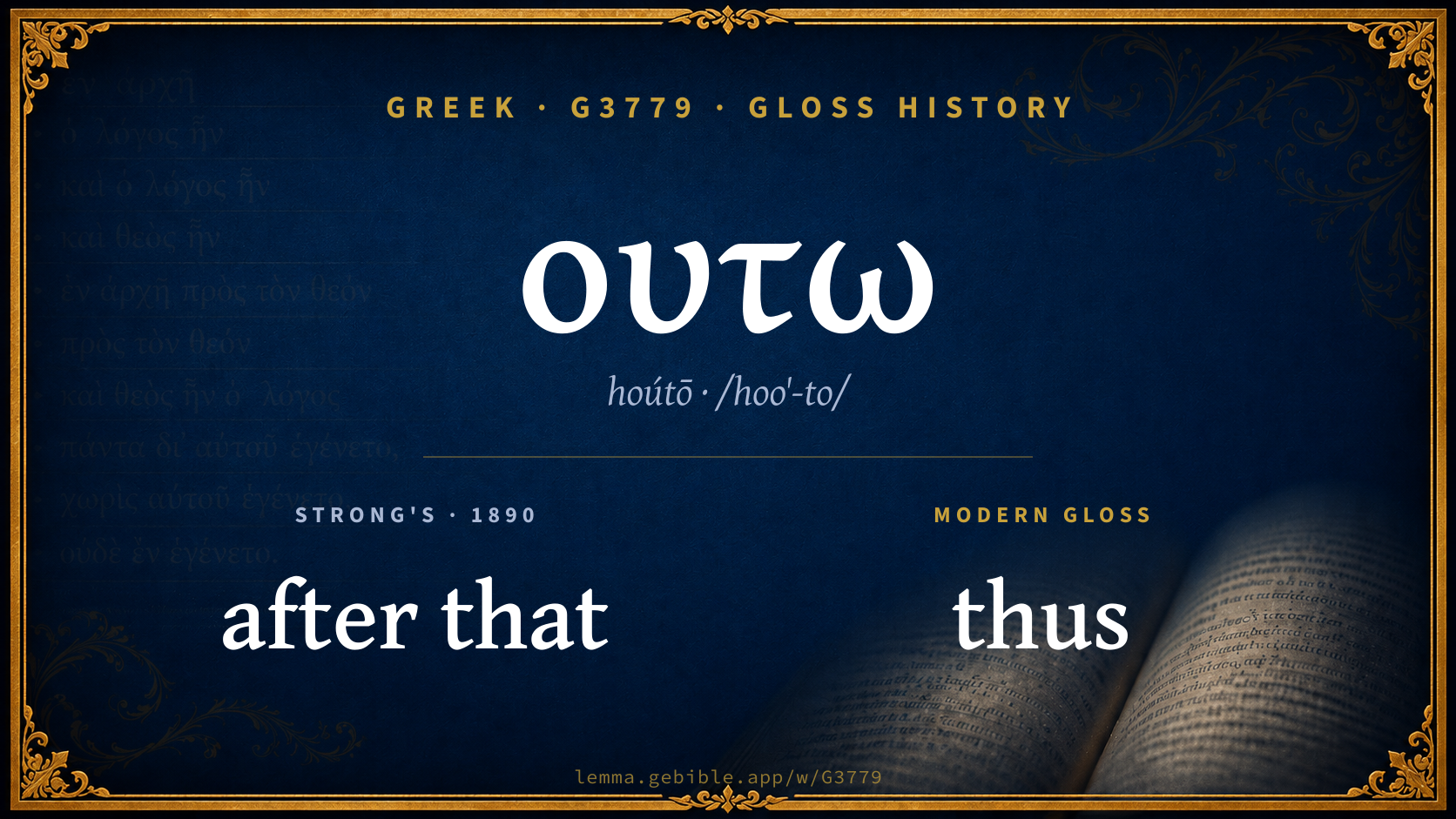
Gloss history
Strong's 1890 vs modern scholarship
About this word
Strong's G3779 catalogs a Greek word from the Greek New Testament.
These counts are not copied from any lexicon or concordance. They are computed here, from the morphology-tagged Greek New Testament. What Lemma adds →
- 203
- distinct verses
- The word appears in 203 distinct verses.
- 21 / 27
- NT books
- The word appears in 21 of 27 New Testament books.
- #79
- by frequency
- Top 100 most frequent Greek words (rank 79 of 5,347 Greek words by occurrence).
View all 203 occurrences in the concordance →
Most concentrated in
- Matthew 32 verses 16%
- Acts 27 verses 13%
- 1 Corinthians 27 verses 13%
By section of the New Testament
By traditional corpus
Conventional, traditional groupings — biblical authorship is debated, so this is a traditional corpus grouping, not an authorship claim. Some books belong to more than one corpus (Luke is in both the Gospels and the Lukan corpus, and so on), so these shares overlap and need not total 100%. Each figure is a share of the word’s 203 distinct verses.
- Gospels 78 verses · 38%
- Pauline corpus 70 verses · 34%
- Lukan (Luke–Acts) 48 verses · 24%
- Johannine 23 verses · 11%
- General (Catholic) Epistles 12 verses · 6%
- Hebrews 9 verses · 4%
- Revelation 7 verses · 3%
How translations render this word
Counts come from each version’s own published word-to-Strong’s tagging or interlinear alignment — an approximate guide to how each version renders this word, not a word-level alignment the data otherwise carries. Because each total is that version’s own tagged count, the per-version totals vary from one another and need not match the appearance or distinct-verse counts above. These counts may also differ from a printed concordance because Lemma counts each distinctly tagged rendering and does not collapse phrase taggings into a single head-word total. This is a fixed set of word-tagged versions (KJV, ASV, BSB, ULT) and does not change with the reading translation you choose elsewhere. Each version’s license is shown beside its name below (and on Sources).
- King James Version: So 165×, Thus 15×, Wise 5×
- American Standard Version: So 142×, Thus 18×, As 4×
- Berean Standard Bible: So 67×, Way 19×, Same way 12×
- unfoldingWord Literal Text: Thus 85×, So 46×, Way 31×
King James Version Public Domain
Renders G3779 across 208 tagged occurrences — most commonly:
Plus 14 renderings that appear only once — usually multi-word phrases or single function words the recovered tagging swept in, not distinct renderings. Not rendered by a distinct English word in 5 further occurrences.
American Standard Version Public Domain
Renders G3779 across 198 tagged occurrences — most commonly:
Plus 22 renderings that appear only once — usually multi-word phrases or single function words the recovered tagging swept in, not distinct renderings. Not rendered by a distinct English word in 3 further occurrences.
Berean Standard Bible Public Domain
Renders G3779 across 163 tagged occurrences — most commonly:
Plus other, less common renderings. Plus 22 renderings that appear only once — usually multi-word phrases or single function words the recovered tagging swept in, not distinct renderings. Not rendered by a distinct English word in 40 further occurrences.
unfoldingWord Literal Text CC BY-SA 4.0
Renders G3779 across 211 tagged occurrences — most commonly:
Plus 9 renderings that appear only once — usually multi-word phrases or single function words the recovered tagging swept in, not distinct renderings.
Senses in Thayer's
The 1 sense Thayer's distinguishes for this word, in lexicon order (not ranked by frequency or importance). The full entry — with sub-senses — is in the Lexicon Entry tab.
- in this manner, thus, so
Word origin
Derived from ουτος (hoûtos) (G3778).
Or before a vowel οὕτως houtō s hoo'-toce . From G3778 ; in this way (referring to what precedes or follows): - after that after (in) this manner as even (so) for all that like (-wise) no more on this fashion (-wise) so (in like manner) thus what.
— Strong’s Exhaustive Concordance (1890), public domain.
Forms in the corpus
The 4 distinct written forms G3779 takes in the Greek New Testament, most frequent first — each parse links to that case’s occurrences in the concordance.
| Form | Parsing | Example | Uses |
|---|---|---|---|
| οὕτως hoútōs | Adverb | Matthew 1:18 | 202 |
| οὕτω hoútō | Adverb | Acts 23:11 | 3 |
| Οὕτως Hoútōs | Adverb | Acts 19:20 | 2 |
| οὗτως hoûtōs | Adverb | James 2:12 | 1 |
Same root — word family
Other Thayer's entries built from the same root as G3779, grouped by Strong’s listed origin. These share a root / origin per the lexicon — not necessarily a shared meaning. Each links to that word’s own entry.
Derives from
Shares the same root
- ταυτα taûta G5023 these
- ταυταις taútais G5025 these
- ταυτη taútēi G5026 this
- τουτο toûto G5124 that thing
- τουτοις toútois G5125 these
- τουτον toûton G5126 this
- τουτου toútou G5127 of this
- τουτους toútous G5128 these
- τουτω toútōi G5129 to this
- τουτων toútōn G5130 of these
Proper names from this root
People and places named from this root — a name, not an additional meaning of the word.
Compare all same-root words → Showing 4 of 13 — not the complete family. 1 of the same-root words is a proper name (a person or place). They share a root, not necessarily a meaning.
Septuagint usage
The same Greek word ουτω appears 664 times in the Greek Old Testament (Septuagint), across 621 verses in 33 books.
- 664
- LXX occurrences
- Tagged occurrences of this Greek word in the Septuagint.
- 621
- verses
- Distinct Septuagint verses containing this word.
- 33 / 39
- OT books
- The word appears in 33 of the 39 Old Testament books.
Sample Septuagint occurrences
- Genesis 1:6 οὕτως
- Exodus 2:14 οὕτως
- Leviticus 4:20 οὕτως
- Numbers 1:54 οὕτως
- Deuteronomy 3:21 οὕτως
- Joshua 1:5 οὕτως
- Judges 1:7 οὕτως
- 1 Samuel 1:7 οὕτως
- 2 Samuel 3:9 οὕτως
- 1 Kings 1:30 οὕτως
- 2 Kings 1:4 οὕτως
- 1 Chronicles 13:4 οὕτως
Septuagint occurrences (same lexeme)
Every verse where the same Strong’s number (G3779) appears in the Greek Septuagint — showing the first 50 of 621. Verse text shown in the World English Bible for context; the Greek form is the matched word — the English is not keyword-highlighted.
- Genesis 1:6 οὕτως God said, "Let there be an expanse in the midst of the waters, and let it divide the waters from the waters."
- Genesis 1:9 οὕτως God said, "Let the waters under the sky be gathered together to one place, and let the dry land appear," and it was so.
- Genesis 1:11 οὕτως God said, "Let the earth put forth grass, herbs yielding seed, and fruit trees bearing fruit after their kind, with its seed in it, on the earth," and it was so.
- Genesis 1:15 οὕτως and let them be for lights in the expanse of sky to give light on the earth," and it was so.
- Genesis 1:20 οὕτως God said, "Let the waters swarm with swarms of living creatures, and let birds fly above the earth in the open expanse of sky."
- Genesis 1:24 οὕτως God said, "Let the earth bring forth living creatures after their kind, cattle, creeping things, and animals of the earth after their kind," and it was so.
- Genesis 1:30 οὕτως To every animal of the earth, and to every bird of the sky, and to everything that creeps on the earth, in which there is life, I have given every green herb for food." And it was so.
- Genesis 4:15 οὕτως Yahweh said to him, "Therefore whoever slays Cain, vengeance will be taken on him sevenfold." Yahweh appointed a sign for Cain, lest any finding him should strike him.
- Genesis 6:15 οὕτως This is how you shall make it. The length of the ark will be three hundred cubits, the breadth of it fifty cubits, and the height of it thirty cubits.
- Genesis 6:22 οὕτως Thus Noah did. According to all that God commanded him, so he did.
- Genesis 15:5 οὕτως Yahweh brought him outside, and said, "Look now toward the sky, and count the stars, if you are able to count them." He said to Abram, "So shall your seed be."
- Genesis 18:5 οὕτως I will get a morsel of bread so you can refresh your heart. After that you may go your way, now that you have come to your servant." They said, "Very well, do as you have said."
- Genesis 24:30 οὕτως It happened, when he saw the ring, and the bracelets on his sister's hands, and when he heard the words of Rebekah his sister, saying, "This is what the man said to me," that he came to the man. Behold, he was standing by the camels at the spring.
- Genesis 25:22 οὕτως The children struggled together within her. She said, "If it be so, why do I live?" She went to inquire of Yahweh.
- Genesis 29:26 οὕτως Laban said, "It is not done so in our place, to give the younger before the first born.
- Genesis 29:28 οὕτως Jacob did so, and fulfilled her week. He gave him Rachel his daughter as wife.
- Genesis 30:15 οὕτως She said to her, "Is it a small matter that you have taken away my husband? Would you take away my son's mandrakes, also?" Rachel said, "Therefore he will lie with you tonight for your son's mandrakes."
- Genesis 31:8 οὕτως If he said this, 'The speckled will be your wages,' then all the flock bore speckled. If he said this, 'The streaked will be your wages,' then all the flock bore streaked.
- Genesis 32:5 οὕτως I have oxen, donkeys, flocks, men-servants, and maid-servants. I have sent to tell my lord, that I may find favor in your sight.'"
- Genesis 34:7 οὕτως The sons of Jacob came in from the field when they heard it. The men were grieved, and they were very angry, because he had done folly in Israel in lying with Jacob's daughter; which thing ought not to be done.
- Genesis 39:19 οὕτως It happened, when his master heard the words of his wife, which she spoke to him, saying, "This is what your servant did to me," that his wrath was kindled.
- Genesis 41:13 οὕτως It happened, as he interpreted to us, so it was: he restored me to my office, and he hanged him."
- Genesis 42:20 οὕτως Bring your youngest brother to me; so will your words be verified, and you won't die." They did so.
- Genesis 42:25 οὕτως Then Joseph commanded to fill their bags with grain, and to restore every man's money into his sack, and to give them food for the way. So it done to them.
- Genesis 43:11 οὕτως Their father, Israel, said to them, "If it be so now, do this. Take from the choice fruits of the land in your bags, and carry down a present for the man, a little balm, a little honey, spices and myrrh, nuts, and almonds;
- Genesis 44:10 οὕτως He said, "Now also let it be according to your words: he with whom it is found will be my bondservant; and you will be blameless."
- Genesis 45:21 οὕτως The sons of Israel did so. Joseph gave them wagons, according to the commandment of Pharaoh, and gave them provision for the way.
- Genesis 48:18 οὕτως Joseph said to his father, "Not so, my father; for this is the firstborn; put your right hand on his head."
- Genesis 50:3 οὕτως Forty days were fulfilled for him, for that is how many the days it takes to embalm. The Egyptians wept for him for seventy days.
- Genesis 50:12 οὕτως His sons did to him just as he commanded them,
- Genesis 50:17 οὕτως "So you shall tell Joseph, 'Now please forgive the disobedience of your brothers, and their sin, because they did evil to you.' Now, please forgive the disobedience of the servants of the God of your father." Joseph wept when they spoke to him.
- Exodus 2:14 οὕτως He said, "Who made you a prince and a judge over us? Do you plan to kill me, as you killed the Egyptian?" Moses was afraid, and said, "Surely this thing is known."
- Exodus 2:20 οὕτως He said to his daughters, "Where is he? Why is it that you have left the man? Call him, that he may eat bread."
- Exodus 3:14 οὕτως God said to Moses, "I AM WHO I AM," and he said, "You shall tell the children of Israel this: "I AM has sent me to you."
- Exodus 3:15 οὕτως God said moreover to Moses, "You shall tell the children of Israel this, 'Yahweh, the God of your fathers, the God of Abraham, the God of Isaac, and the God of Jacob, has sent me to you.' This is my name forever, and this is my memorial to all generations.
- Exodus 5:15 οὕτως Then the officers of the children of Israel came and cried to Pharaoh, saying, "Why do you deal this way with your servants?
- Exodus 6:9 οὕτως Moses spoke so to the children of Israel, but they didn't listen to Moses for anguish of spirit, and for cruel bondage.
- Exodus 7:6 οὕτως Moses and Aaron did so. As Yahweh commanded them, so they did.
- Exodus 7:10 οὕτως Moses and Aaron went in to Pharaoh, and they did so, as Yahweh had commanded: and Aaron cast down his rod before Pharaoh and before his servants, and it became a serpent.
- Exodus 7:20 οὕτως Moses and Aaron did so, as Yahweh commanded; and he lifted up the rod, and struck the waters that were in the river, in the sight of Pharaoh, and in the sight of his servants; and all the waters that were in the river were turned to blood.
- Exodus 8:20 οὕτως Yahweh said to Moses, "Rise up early in the morning, and stand before Pharaoh; behold, he comes forth to the water; and tell him, 'This is what Yahweh says, "Let my people go, that they may serve me.
- Exodus 8:22 οὕτως I will set apart in that day the land of Goshen, in which my people dwell, that no swarms of flies shall be there; to the end you may know that I am Yahweh in the midst of the earth.
- Exodus 10:10 οὕτως He said to them, "Yahweh be with you if I will let you go with your little ones! See, evil is clearly before your faces.
- Exodus 10:11 οὕτως Not so! Go now you who are men, and serve Yahweh; for that is what you desire!" They were driven out from Pharaoh's presence.
- Exodus 10:14 οὕτως The locusts went up over all the land of Egypt, and rested in all the borders of Egypt. They were very grievous. Before them there were no such locusts as they, neither after them shall be such.
- Exodus 12:11 οὕτως This is how you shall eat it: with your loins girded, your shoes on your feet, and your staff in your hand; and you shall eat it in haste: it is Yahweh's Passover.
- Exodus 12:28 οὕτως The children of Israel went and did so; as Yahweh had commanded Moses and Aaron, so they did.
- Exodus 12:50 οὕτως Thus did all the children of Israel. As Yahweh commanded Moses and Aaron, so they did.
- Exodus 14:4 οὕτως I will harden Pharaoh's heart, and he will follow after them; and I will get honor over Pharaoh, and over all his host; and the Egyptians shall know that I am Yahweh." They did so.
- Exodus 16:17 οὕτως The children of Israel did so, and gathered some more, some less.
These are occurrences of the same Greek lexeme (G3779) in the Septuagint — not a translation of any one Hebrew word. The store carries no word-level Hebrew↔Greek alignment, so no Hebrew original is asserted here. Counts come from the recovered LXX Strong's tagging — high-frequency vocabulary is well covered, while rare or late forms may be untagged — so they reflect tagged occurrences and may slightly undercount.