
Genesis 14:2

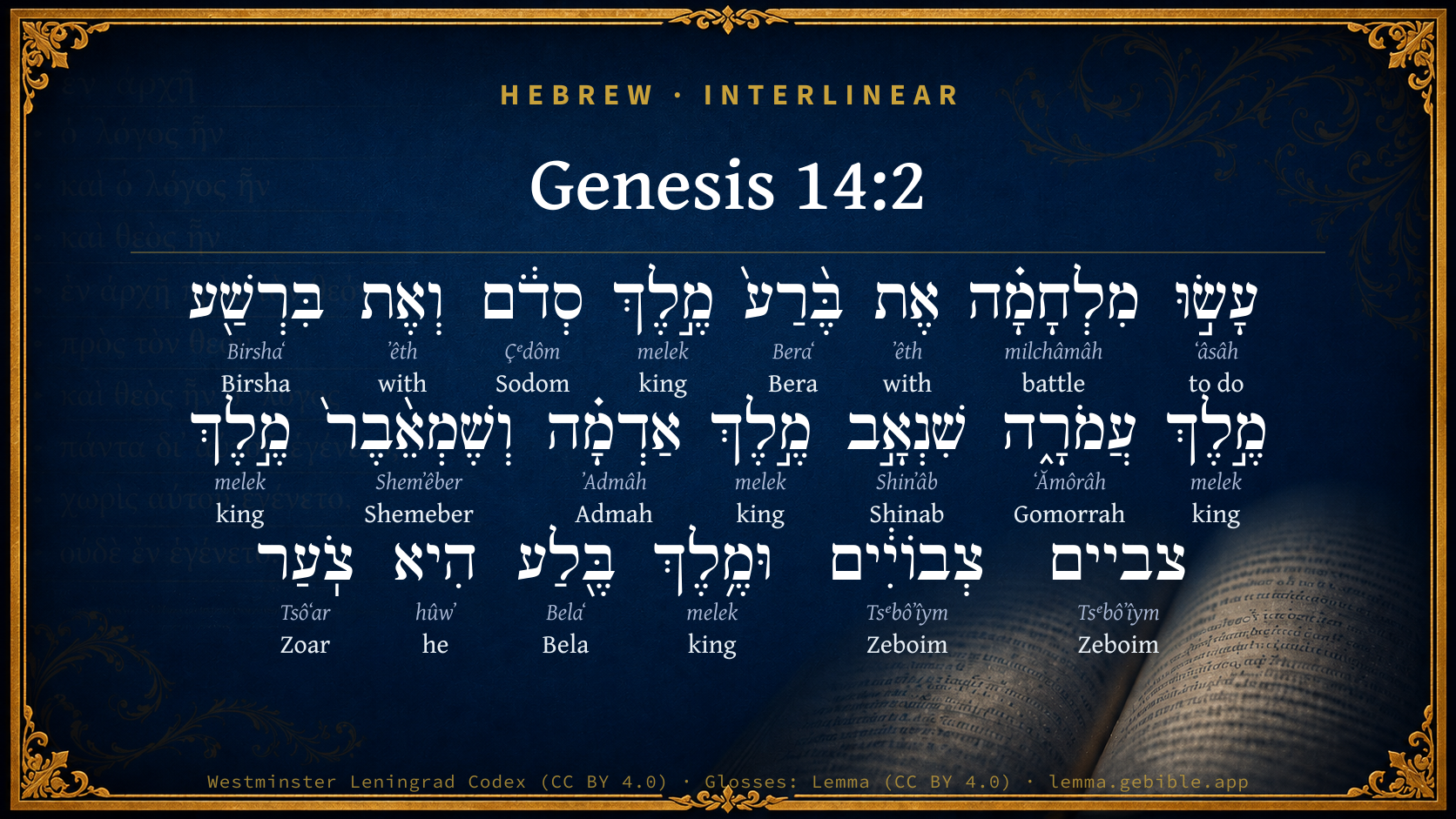
Hebrew (Westminster Leningrad Codex) Genesis 14:2 appears in the Hebrew Old Testament. The text above is from the Westminster Leningrad Codex. Each word links to its Strong’s number, a concise gloss, and parsing drawn from the Open Scriptures Hebrew Bible morphology. Click any word for its full Brown-Driver-Briggs (BDB) entry.
Download image
Cite this verse

Genesis 14:2 (World English Bible). Public Domain. Lemma interlinear Bible study tool, https://lemma.gebible.app/v/genesis/14/2.

Show BibTeX & RIS
BibTeX
RIS
English Translation
that they made war with Bera, king of Sodom, and with Birsha, king of Gomorrah, Shinab, king of Admah, and Shemeber, king of Zeboiim, and the king of Bela (the same is Zoar).
World English Bible · Public Domain
Highlights
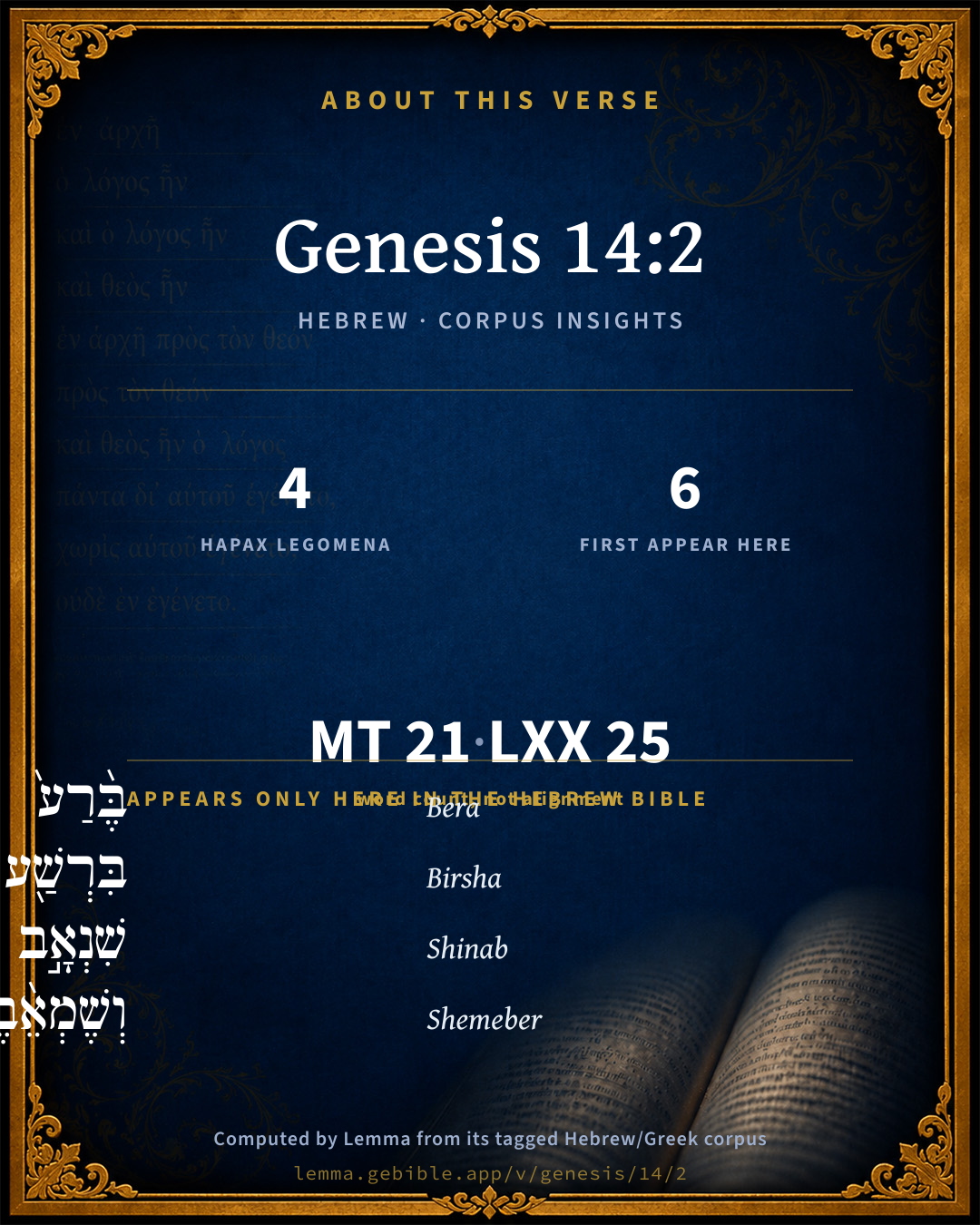
  • 4 hapax legomena — only here in the Hebrew Bible
  • 6 first appearances in the Hebrew Bible
Full analysis ↓
Download a study sheet

One document with this verse’s original text, its word-by-word gloss line, the meaning frame, cross-references with their text, attributed commentary, and full source and license credits — printable, and it pastes into notes with its structure intact.

This verse Autodidact and up

Study sheet (.html) Plain text (.txt)

A passage Seminary Student

Up to 50 verses in one chapter. A passage sheet keeps up to 6 commentary sources and 12 cross-references per verse, in the order this page ranks them, and says so on the sheet whenever that leaves anything out. Ask for a single verse and you get the Autodidact verse sheet above.

Everything on this page stays free to read, with no account — the sheet is a download of what is already on screen, not access to it.

Want to remove ads? Support Godless Engineer
Compare translations 3

The same verse in 3 English versions, stacked beneath the original-language interlinear above. Click any original word for its lexicon entry.

Each is an independent rendering of the whole verse — the interlinear is not word-aligned to these translations.

Highlighted words mark where these versions differ — a whole-verse word diff, not a word-by-word alignment.

  • World English Bible Public Domain
    that they made war with Bera, king of Sodom, and with Birsha, king of Gomorrah, Shinab, king of Admah, and Shemeber, king of Zeboiim, and the king of Bela (the same is Zoar).
  • King James Version Public Domain
    That these made war with Bera king of Sodom, and with Birsha king of Gomorrah, Shinab king of Admah, and Shemeber king of Zeboiim, and the king of Bela, which is Zoar.
  • unfoldingWord Literal Text CC BY-SA 4.0
    they made war against Bera king of Sodom, and against Birsha king of Gomorrah, Shinab king of Admah, and Shemeber king of Zeboiim, and the king of Bela, which Zoar.

unfoldingWord Literal Text — © unfoldingWord, licensed CC BY-SA 4.0. Word-aligned USFM3 via Door43 (git.door43.org/unfoldingWord/en_ult).

Versions to compare (up to 4)

3 of 4 selected

Show all 18 translations

Every available English version of this verse, each an independent rendering of the whole verse.

  • World English Bible Public Domain
    that they made war with Bera, king of Sodom, and with Birsha, king of Gomorrah, Shinab, king of Admah, and Shemeber, king of Zeboiim, and the king of Bela (the same is Zoar).
  • Berean Standard Bible Public Domain
    went to war against Bera king of Sodom, Birsha king of Gomorrah, Shinab king of Admah, Shemeber king of Zeboiim, and the king of Bela (that is, Zoar).
  • Majority Standard Bible Public Domain
    went to war against Bera king of Sodom, Birsha king of Gomorrah, Shinab king of Admah, Shemeber king of Zeboiim, and the king of Bela (that is, Zoar).
  • King James Version Public Domain
    That these made war with Bera king of Sodom, and with Birsha king of Gomorrah, Shinab king of Admah, and Shemeber king of Zeboiim, and the king of Bela, which is Zoar.
  • American Standard Version (1901) Public Domain
    that they made war with Bera king of Sodom, and with Birsha king of Gomorrah, Shinab king of Admah, and Shemeber king of Zeboiim, and the king of Bela (the same is Zoar).
  • Revised Version (1885) Public Domain
    that they made war with Bera king of Sodom, and with Birsha king of Gomorrah, Shinab king of Admah, and Shemeber king of Zeboiim, and the king of Bela (the same is Zoar).
  • Geneva Bible (1599) Public Domain
    These men made warre with Bera King of Sodom, and with Birsha King of Gomorah, Shinab King of Admah, and Shemeber King of Zeboiim, and the King of Bela, which is Zoar.
  • Douay-Rheims (1899) Public Domain
    Made war against Bara king of Sodom, and against Bersa king of Gomorrha, and against Sennaab king of Adama, and against Semeber king of Seboim, and against the king of Bala, which is Segor.
  • Young's Literal Translation Public Domain
    they have made war with Bera king of Sodom, and with Birsha king of Gomorrah, Shinab king of Admah, and Shemeber king of Zeboim, and the king of Bela, which `is' Zoar.
  • Literal Standard Version CC BY-SA 4.0
    they have made war with Bera king of Sodom, and with Birsha king of Gomorrah, Shinab king of Admah, and Shemeber king of Zeboim, and the king of Bela, which [is] Zoar.
  • Unlocked Literal Bible CC BY-SA 4.0
    that they made war against Bera, king of Sodom, Birsha, king of Gomorrah, Shinab, king of Admah, Shemeber, king of Zeboyim, and the king of Bela (also called Zoar).
  • unfoldingWord Literal Text CC BY-SA 4.0
    they made war against Bera king of Sodom, and against Birsha king of Gomorrah, Shinab king of Admah, and Shemeber king of Zeboiim, and the king of Bela, which Zoar.
  • Darby Bible Public Domain
    [that] they made war with Bera the king of Sodom, and with Birsha the king of Gomorrah, Shinab the king of Admah, and Shemeber the king of Zeboim, and the king of Bela, which is Zoar.
  • World Messianic Bible Public Domain
    they made war with Bera, king of Sodom; Birsha, king of Gomorrah; Shinab, king of Admah; Shemeber, king of Zeboiim; and the king of Bela (also called Zoar).
  • Webster's Bible Public Domain
    That these made war with Bera king of Sodom, and with Birsha king of Gomorrah, Shinab king of Admah, and Shemeber king of Zeboiim, and the king of Bela, which is Zoar.
  • Free Bible Version CC BY-SA 4.0
    They attacked Bera, king of Sodom, Birsha, king of Gomorrah, Shinab, king of Admah, Shemeber, king of Zeboiim, and the king of Bela (otherwise known as Zoar).
  • Bible in Basic English Public Domain
    They made war with Bera, king of Sodom, and with Birsha, king of Gomorrah, Shinab, king of Admah, and Shemeber, king of Zeboiim, and the king of Bela (which is Zoar).
  • JPS Tanakh (1917) Public Domain
    that they made war with Bera king of Sodom, and with Birsha king of Gomorrah, Shinab king of Admah, and Shemeber king of Zeboiim, and the king of Bela — the same is Zoar.

Literal Standard Version (2020), Covenant Press — licensed CC BY-SA 4.0. Text via the HelloAO Bible API (eBible.org). Unlocked Literal Bible (unfoldingWord) — licensed CC BY-SA 4.0. Text via the HelloAO Bible API (eBible.org). unfoldingWord Literal Text — © unfoldingWord, licensed CC BY-SA 4.0. Word-aligned USFM3 via Door43 (git.door43.org/unfoldingWord/en_ult). Free Bible Version, Dr. Jonathan Gallagher — licensed CC BY-SA 4.0. Text via the HelloAO Bible API (eBible.org).

Word by word

More ways to search: Search by grammar → Find every occurrence → Compare this word →

Practice this passage: Drill this verse → Learn its vocabulary →

בֶּ֨רַע֙
Beraʻ
H1298
“Bera”
Noun, Proper
Part of Speech
Noun
Type
Proper
Full BDB Definition

Origin: of uncertain derivation

TWOT: None

Bera = "son of evil" - a king of Sodom
  1. עָשׂ֣וּ ʻâsâh H6213 “to do” Verb, Qal, Perfect, 3rd Person, Common, Plural
  2. מִלְחָמָ֗ה milchâmâh H4421 “battle” Noun, Common, Feminine, Singular, Absolute
  3. אֶת ʼêth H854 “with” Preposition
  4. מֶ֣לֶךְ melek H4428 “king of” Noun, Common, Masculine, Singular, Construct
  5. סְדֹ֔ם Çᵉdôm H5467 “Sodom” Noun, Proper
  6. וְאֶת ʼêth H854 “and · with” Conjunction + Preposition
  7. בִּרְשַׁ֖ע Birshaʻ H1306 “Birsha” Noun, Proper
  8. מֶ֣לֶךְ melek H4428 “king of” Noun, Common, Masculine, Singular, Construct
  9. עֲמֹרָ֑ה ʻĂmôrâh H6017 “Gomorrah” Noun, Proper
  10. שִׁנְאָ֣ב Shinʼâb H8134 “Shinab” Noun, Proper
  11. מֶ֣לֶךְ melek H4428 “king of” Noun, Common, Masculine, Singular, Construct
  12. אַדְמָ֗ה ʼAdmâh H126 “Admah” Noun, Proper
  13. וְשֶׁמְאֵ֨בֶר֙ Shemʼêber H8038 “and · Shemeber” Conjunction + Noun, Proper
  14. מֶ֣לֶךְ melek H4428 “king of” Noun, Common, Masculine, Singular, Construct
  15. צביים Tsᵉbôʼîym H6636 “Zeboim” Noun, Proper
  16. צְבוֹיִ֔ים Tsᵉbôʼîym H6636 “Zeboim” Noun, Proper
  17. וּמֶ֥לֶךְ melek H4428 “and · king of” Conjunction + Noun, Common, Masculine, Singular, Construct
  18. בֶּ֖לַע Belaʻ H1106 “Bela” Noun, Proper
  19. הִיא hûwʼ H1931 “he” Pronoun, Personal, 3rd Person, Feminine, Singular
  20. צֹֽעַר Tsôʻar H6820 “Zoar” Noun, Proper

About this verse

These counts appear in no published source. They are computed here, from the morphology-tagged text and Lemma’s own curated glosses. What Lemma adds →

21
words
15
distinct lemmas
Pentateuch
section

Notable vocabulary

4 hapax legomena — words that appear only here in the entire Hebrew Bible:

  • בֶּ֨רַע֙ Bera H1298
  • בִּרְשַׁ֖ע Birsha H1306
  • שִׁנְאָ֣ב Shinab H8134
  • וְשֶׁמְאֵ֨בֶר֙ Shemeber H8038

First appearance in Scripture

These words make their first canonical appearance in the Hebrew Bible here:

  • מִלְחָמָ֗ה battle H4421
  • בֶּ֨רַע֙ Bera H1298
  • בִּרְשַׁ֖ע Birsha H1306
  • שִׁנְאָ֣ב Shinab H8134
  • וְשֶׁמְאֵ֨בֶר֙ Shemeber H8038
  • בֶּ֖לַע Bela H1106

Shared distinctive vocabulary

אַדְמָ֗ה Admah H126 occurs in 5 verses of the Hebrew Bible. Also found in:

Grammatical profile

  • 1 verb
  • 17 nouns
  • 1 pronoun
  • 2 prepositions

Verb forms

  • עָשׂ֣וּ Qal · Perfect

Repetition

Words recur within this verse — often emphatic in Hebrew:

  • מֶ֣לֶךְ king H4428 ×5
  • צביים Zeboim H6636 ×2
  • אֶת with H854 ×2

Hebrew & Septuagint length

In English translation the verse runs 33 words from the Hebrew and 33 from the Septuagint (LXX English) — the same length.

A rough comparison of the two English renderings, which tokenize alike — not a word-level alignment.

Word counts can differ between the Hebrew and the Greek without any difference in meaning — e.g. the Hebrew direct-object marker אֵת has no separate Greek word, and Greek often adds the article ὁ.

In the original languages it is 21 Hebrew tokens and 25 Greek tokens — but the two are counted differently (Hebrew bundles its prefixes and suffixes into one token; the Greek is in lemma form), so that isn’t a like-for-like length.

Cross-references

11

Topical passages linked to Genesis 14:2 in the Treasury of Scripture Knowledge — connected by theme and wording, ordered by reader-vote popularity; previews shown in the World English Bible.

  • Genesis 13:10 Lot lifted up his eyes, and saw all the plain of the Jordan, that it was well watered every where, before Yahweh destroyed Sodom and Gomorrah, like the garden of Yahweh, like the land of Egypt, as you go to Zoar.
  • Deuteronomy 29:23 [and that] the whole land of it is sulfur, and salt, [and] a burning, [that] it is not sown, nor bears, nor any grass grows therein, like the overthrow of Sodom and Gomorrah, Admah and Zeboiim, which Yahweh overthrew in his anger, and in his wrath:
  • Genesis 10:19 The border of the Canaanites was from Sidon, as you go toward Gerar, to Gaza; as you go toward Sodom, Gomorrah, Admah, and Zeboiim, to Lasha.
  • Isaiah 1:9–10 Unless Yahweh of hosts had left to us a very small remnant, We would have been as Sodom; We would have been like Gomorrah.
  • Hosea 11:8 "How can I give you up, Ephraim? How can I hand you over, Israel? How can I make you like Admah? How can I make you like Zeboiim? My heart is turned within me, My compassion is aroused.
  • Genesis 19:20–30 See now, this city is near to flee to, and it is a little one. Oh let me escape there (isn't it a little one?), and my soul will live."
  • Deuteronomy 34:3 and the South, and the Plain of the valley of Jericho the city of palm trees, to Zoar.
  • 1 Samuel 13:18 and another company turned the way to Beth Horon; and another company turned the way of the border that looks down on the valley of Zeboim toward the wilderness.
  • Nehemiah 11:34 Hadid, Zeboim, Neballat,
  • Isaiah 15:5 My heart cries out for Moab; her nobles [flee] to Zoar, to Eglath Shelishiyah: for by the ascent of Luhith with weeping they go up; for in the way of Horonaim they raise up a cry of destruction.
  • Jeremiah 48:34 From the cry of Heshbon even to Elealeh, even to Jahaz have they uttered their voice, from Zoar even to Horonaim, to Eglath Shelishiyah: for the waters of Nimrim also shall become desolate.

Cross-references courtesy of OpenBible.info (CC BY 4.0).

Hebrew and Greek witnesses Masoretic Hebrew ↔ Greek Septuagint

The same verse in the two great witnesses to the Old Testament, shown verse-for-verse.

These are two independent witnesses, not word-aligned to each other, and the Septuagint is shown in lemma (dictionary) form.

Hebrew Genesis 14:2 Masoretic · Westminster Leningrad Codex

עָשׂ֣וּ מִלְחָמָ֗ה אֶת בֶּ֨רַע֙ מֶ֣לֶךְ סְדֹ֔ם וְאֶת בִּרְשַׁ֖ע מֶ֣לֶךְ עֲמֹרָ֑ה שִׁנְאָ֣ב מֶ֣לֶךְ אַדְמָ֗ה וְשֶׁמְאֵ֨בֶר֙ מֶ֣לֶךְ צביים צְבוֹיִ֔ים וּמֶ֥לֶךְ בֶּ֖לַע הִיא צֹֽעַר

that they made war with Bera, king of Sodom, and with Birsha, king of Gomorrah, Shinab, king of Admah, and Shemeber, king of Zeboiim, and the king of Bela (the same is Zoar).

World English Bible · Public Domain

Greek LXX Genesis 14:2 Septuagint · lemma form

ποιέω πόλεμος μετά βαλλα βασιλεύς σοδομα καί μετά βαρσα βασιλεύς γομορρα καί σεννααρ βασιλεύς αδαμα καί συμοβορ βασιλεύς σεβωιμ καί βασιλεύς βαλακ οὗτος εἰμί σηγωρ

made war with Balla king of Sodom, and with Barsa king of Gomorrha, and with Sennaar, king of Adama, and with Symobor king of Seboim and the king of Balac, this is Segor.

LXX2012 (modern English Septuagint) · Public Domain

On this verse, The Cambridge Bible for Schools and Colleges discusses the Septuagint’s reading. Read the note in Commentary ↓

Hebrew: Westminster Leningrad Codex (CC BY 4.0). Greek: Septuagint (public domain); English from LXX2012 (modern English Septuagint) (Public Domain). How the Septuagint differs from the Hebrew →

Targum (Aramaic paraphrase)

2

The Targum is the ancient Jewish Aramaic paraphrase of the Hebrew Scriptures — an interpretive translation, not the Hebrew text itself. Onkelos (literal) and Pseudo-Jonathan (expansive) render the Torah, and Jonathan the Prophets. Coverage is partial: where no permissively-licensed English translation exists for a verse, only the Aramaic is shown. This is verse-level text, not a word-by-word alignment to the Hebrew.

  1. Targum Onkelos Torah (Genesis–Deuteronomy)
    סְדָרוּ (נ''א עֲבָדוּ) קְרָבָא עִם בֶּרַע מַלְכָּא דִסְדוֹם וְעִם בִּרְשַׁע מַלְכָּא דַעֲמֹרָה שִׁנְאָב מַלְכָּא דְאַדְמָה וְשֶׁמְאֵבֶר מַלְכָּא דִצְבוֹיִם וּמַלְכָּא דְבֶלַּע הִיא צוֹעַר

    (that) they made war with Bera, king of Sedom, and with Birsha, king of Amora, Shenab, king of Admah, Shemeber, king of Zeboim, and the king of Bela, which is Zoar.

    Targum Onkelos — Aramaic: “Onkelos Genesis” (public domain); “Onkelos Exodus” (public domain); “Onkelos Leviticus” (public domain); “Onkelos Numbers” (public domain); “Onkelos Deuteronomy” (public domain). English: “Sefaria Community Translation” (CC0 1.0 (public-domain dedication)); “J.W. Etheridge. The Targums of Onkelos and Jonathan Ben Uzziel on the Pentateuch. London: Longmans, Green, 1862” (public domain). Text via Sefaria.

  2. Targum Pseudo-Jonathan Torah (Genesis–Deuteronomy)
    עָבְדוּ קְרָבָא עִם בֶּרַע דְעוֹבְדוֹי בְּבִישׁ מַלְכָּא דִסְדוֹם וְעִם בִּרְשַׁע דְעוֹבְדוֹי בִּרְשִׁיעָא מַלְכָּא דַעֲמוֹרָה שִׁנְאָב דַאֲפִילוּ לְאָבוֹי הֲוָה שָנֵי מַלְכָּא דְאַדְמָה וְשֶׁמְאֵבֶר דִמְחַבֵּל אֵיבְרֵיהּ לִיזְנֵיהּ מַלְכָּא דִצְבוֹיִם וּמַלְכָּא דְקַרְתָּא דִבְלָעַת דַיְירָהָא הִיא זוֹעַר

    made war with Bera, whose deeds were evil, king of Sedom, and with Birsha, whose deeds were with the wicked, king of Amora: Shinab, who had hated his father, king of Admah, and Shemebar, who had corrupted himself with fornication, king of Zeboim; and the king of the city which consumed (Bela) the dwellers thereof, which is Zoar.

    Targum Pseudo-Jonathan — Aramaic: “Targum Jonathan on Genesis” (public domain); “Targum Jonathan on Exodus” (public domain); “Targum Jonathan on Leviticus” (public domain); “Targum Jonathan on Numbers” (public domain); “Targum Jonathan on Deuteronomy” (public domain). English: “The Targum of Jonathan ben Uzziel, trans. J. W. Etheridge, London, 1862” (public domain). Text via Sefaria.

Commentary

Notes on Genesis 14:2 from classic Christian and Jewish commentators (each source and its license shown beneath its notes). The classic Christian expositions comment on the surrounding passage and are grouped to its opening verse, so a note may address several verses; the Jewish commentaries on the Tanakh (Rashi and others) are per-verse, so they appear only where the commentator wrote on this verse.

Lemma curates 59 commentaries, every one of them public domain or Creative Commons licensed, each selected and text-cleaned for this edition rather than reprinted as found. About our sources →

Trapp's Complete Commentary

John Trapp

Gen 14:2 [That these] made war with Bera king of Sodom, and with Birsha king of Gomorrah, Shinab king of Admah, and Shemeber king of Zeboiim, and the king of Bela, which is Zoar.

Ver. 2. That these made war.] War is the slaughter house of mankind, and the hell of this present world. It hews itself a way through a wood of men, and lays "heaps upon heaps" (as Samson did, Jdg 15:16), not with "a jaw-bone of an ass," and one after another, but in a minute of time, and by the mouth of a murdering piece. Alphonsus D. of Ferrara had two of these cannons {a} of a wonderful size; the one whereof he called Archidiabolo, the other, the Earthquake. The Turks battered the walls of Rhodes, with twelve basilisks, so aptly named of the serpent, basiliscus , who, as Pliny writes, killeth man or beast with his very sight. But before these bloody instruments of death were heard of in the world, men could find means to slaughter one another in war; witness these five kings, that came with Chedorlaomer, and smote the Rephaims or giants, the Zuzims or Zamzummims, {Deu 2:20} and the Emims or terrible ones, as their name imports. These they slew by the way, besides what they did in the vale of Siddim, where they joined battle with the five kings, and cut off many. If we may judge one battle by another, hear what was done in a bloody fight between Amurath III, king of the Turks, and Lazarus, despot of Servia. Many thousands fell on both sides; the brightness of the armour and weapons was as like the lightning; the multitude of lances and other horsemen’s staves shadowed the light of the sun. Arrows and darts fell so fast, that a man would have thought they had poured down from heaven. The noise of the instruments of war, with the neighing of horses, and outcries of men, was so terrible and great, that the wild beasts in the mountains stood astonished therewith; and the Turkish histories, {b} to express the terror of the day, vainly say, that the angels in heaven, amazed with that hideous noise, for that time, forgot the heavenly hymns wherewith they always glorify God. In conclusion, Lazarus was slain, and Amurath had the victory, but a very bloody one, and such as he had no great joy of. For he lost many of his Turks; as did likewise Adrian the Emperor of the Romans, when he fought against the Jews and had the better: but with such a loss of his own men, that when he wrote of his victory to the Senate, he forbore to use that common exordium, that the emperors in like ease were wont to use, Si vos liberique vestri valeatis, bene est: Ego quidem et exercitus valemus. {c} There was no such thing, believe it, nor but seldom is there. But as the dragon sucks out the blood of the elephant, and the weight of the falling elephant crushes the dragon, and both usually perish together; {d} so doth it many times fall out with those that undertake war. These four kings beat the five; but, when they got home, became a prey to Abram and his confederates. The Low-countrymen are said to grow rich - whereas {e} all other nations grow poor - with war. But they may thank a good queen, under God (Queen Elizabeth, I mean), who first undertook their protection against the Spaniard. For the which act of hers, all princes admired her fortitude: and the King of Sweden said, that she had now taken the diadem from her head, and set it upon the doubtful chance of war. {f} Dubia sane est Martis alea, nec raro utrique parti noxia , saith Bucholcerus. {g} And I cannot but - as the case stands with us, especially at this present, by reason of these unnatural uncivil wars stirred up amongst us - go on, and give my vote with him. Ideo pons aureus (ut vulgato proverbio dicitur) hosti fugienti extruendus est et magno precio, precibus, patientia ac prudentia alma pax redimenda, ne infoelicitatis portas, pacis tempore clausas, infaustum bellum aperiat . War is sweet, they say, to them that never made trial of it. {h} But I cannot sufficiently wonder at Pyrrhus, king of Epirus, of whom Justin witnesseth, that he took as much pleasure in war, as others do in supreme government. {i} He might have better learned of his own prophets; so St Paul calleth their poets. {Tit 1:12} Homer, the prince of them, ever brings in Mars, as most hated of Jupiter above any other god, as born for a common mischief, and being right of his mother Juno’s disposition, which was fierce, vast, contumacious, and malignant. We that are Christians, as we cannot but, with the prophet Isaiah, count and call war a singular evil; so we must acknowledge with him, that it is an evil of God’s own creating. {Isa 45:7} "I make peace, and create evil," {j} that is, war. I, is emphatic and exclusive, as who should say, I, and I alone. Whencesoever the sword comes, it is bathed in heaven. {Isa 34:5} God is pleased for this to style himself, "A man of war". {Exo 15:3} The Chaldee expresseth it thus, "the Lord and victor of wars". {Gen 17:1} God elsewhere calleth himself, El Shaddai. Aben-Ezra interpreteth Shaddai a conqueror. And indeed the Hebrew word Shadad signifieth to dissipate and destroy: both which he must needs do that becomes a conqueror. {k} God seems to glory much in his workings about warlike affairs. Hence, - "Who {Psa 24:8} is the King of glory? The Lord strong and mighty; the Lord mighty in battle." He is in Scripture said to "send the sword"; {Eze 14:17} to "muster" the men; {Isa 13:4} to order the ammunition; {Jer 50:25} to bring up both van and rear; {Isa 52:12} to give wisdom, valour, and victory. {Psa 144:1 Eze 30:24 Ecc 9:11} The whole battle is his. {1Sa 17:47} And he oft thereby "revengeth the quarrel of his covenant". {Lev 26:25} So he hath done already upon the Jews and Germans: so he is now doing, alas, upon Ireland and England. And here I cannot but insert that which I find observed by a prime preacher of our kingdom. The late battle at Edgehill was fought in a place called "the Vale of the Red Horse," as if God had said, "I have now sent you the red horse, to avenge the quarrel of the white"; {Rev 6:2; Rev 6:4} the blood spilt at Edgehill the same day of the month in which the rebellion broke out in Ireland, the year before, October 23. Yea, and upon the self-same day, if our intelligence be true, in which that bloody battle was fought near Leipsic, in Germany. This conjuncture is a sad presage, that England is to drink deep in Germany’s and Ireland’s cup. "Father, if it be thy will, let this cup pass from us." "A cup of trembling" it is, surely, to myself, among many others; such as maketh my pen almost to fall out of my fingers, while I write these things; and affects me no otherwise - when I consider of the many fearful convulsions of our kingdom, tending doubtless to a deadly consumption-than the siege of Rome did St Jerome. For hearing that that city was besieged, at such time as he was writing a Commentary upon Ezekiel, {l} and that many of his godly acquaintance there were slain, he was so astonished at the news, that for many nights and days he could think of nothing. When I think {m} of what should move the Lord to make this breach upon us, and notwithstanding that he hath been so earnestly besought; yet for all this, his anger is not turned away, but his hand is stretched out still; that of Cajetan comes before me; who, then commenting upon Matthew when the French soldiers having broken into Rome, offered all manner of abuse and violence to the clergy, inserts this passage into his Notes on Mat 5:13 - "Ye are the salt of the earth," - as my former author {n} allegeth, and rendereth him: - "We, the prelates of Rome, do now find the truth of this by woeful experience, being become a scorn and a prey, not to infidels but Christians, by the most righteous judgment of God, because we, who by our places should have been ‘the salt of the earth,’ had ‘lost our savour,’ and were good for little else but looking after the rites and revenues of the Church. {o} Hence it is, that together with us, this city comes to be trodden under foot, this sixth of May 1527." That city, till it became idolatrous, was ever victorious: but since it hath been the nest of Antichrist, it was never besieged but it was taken and sacked. The God of heaven purge out of our Church, daily more and more, that land desolating sin of idolatry, and make good his promise, "That there shall be no more the Canaanite in the house of the Lord of hosts," {Zec 14:21} no evil spirit left in the land. Fiat, fiat . For of England we may now well say, as he once did of Rome: Nunquam magis iustis iudiciis approbatum est, non esse curae Deo securitatem nostrum, esse vindictam. {p}

{a} Peacham’s Valley of Varieties. {Rev 9:17} "Fire, smoke, and brimstone," seem to note out the Turks’ guns and ordnance. For the drawing of that gun that Mohammed used in besieging Constantinople, seventy yokes of oxen and two thousand men were employed.

{b} Turk. Hist., fol. 200.

{c} Dio in Adriano.

{d} Plin.

{e} Heylin’s Geog., p. 253.

{f} Anno 1585. Camden’s Elisab.

{g} Bucholc. Chron., p. 583.

{h} Dulce bellum inexpertis.

{i} Nulli maiorem ex imperio quam Pyrrho ex bello voluptatem fuisse.

{j} Malum per αντονομασιαν ut bellum, quia minime bellum per antiphrasin .

{k} Eundem victorem et vastatorem esse oportet .

{l} Hieron. com. in Ezekiel. - Proem.

{m} Haec scripsi cordiciuts dolens . - August 21, 1643

{n} Mr Arrowsmith, ubi supra, Ep.

{o} Evanuimus, ac ad nihilum utiles, nisi ad externas caeremonias, externaque bona ,& c. - Heylin’s Geog.

{p} Tacit. Hist., lib. i. cap. 1.

John Trapp, A Commentary or Exposition upon All the Books of the Old and New Testament (1647–1656) — public domain. Text from a community e-Sword module.

Adam Clarke's Commentary

Verse 2. These made war with Bera, c.] It appears, from Ge 14:4, that these five Canaanitish kings had been subdued by Chedorlaomer, and were obliged to pay him tribute and that, having been enslaved by him twelve years, wishing to recover their liberty, they revolted in the thirteenth; in consequence of which Chedorlaomer, the following year, summoned to his assistance three of his vassals, invaded Canaan, fought with and discomfited the kings of the Pentapolis or five cities - Sodom, Gomorrah, Zeboiim, Zoar, and Admab, which were situated in the fruitful plain of Siddim, having previously overrun the whole land.

Adam Clarke's Commentary on the Bible (1810–1826) — public domain. Text from a community e-Sword/MySword module.

Ellicott's Commentary for English Readers

(2) Bera king of Sodom.—The failure of the attempt to explain the names of these five kings, and of the cities over which they ruled (with one or two exceptions), by the help of the Hebrew language makes it probable that the inhabitants of the Ciccar were either Canaanites who had come from the sea-coast, or men of some Hamite stock who had colonised this region from the east. The latter is the more probable view, as they do not seem to have had much affinity either with the Amorites or with the Jebusites, their neighbours.

A Bible Commentary for English Readers, edited by Charles John Ellicott (1878–1897) — public domain. Text from a community e-Sword module.

The Cambridge Bible for Schools and Colleges

gen. ed. J. J. S. Perowne

2. that they made war] This anticipates and summarizes the contents of Gen_14:5-10. As Hammurabi, the conqueror of Elam and founder of the Babylonian kingdom, terms himself king of Amurru = Amorites, or northern Palestine, there is nothing unhistorical in the representation of an invasion of this region by the Elamite suzerain.

Bera … Birsha] The kings of the cities of the Plain mentioned in this verse are not otherwise known. Identifications with the Arabic Bari and Birshi, and with the Babylonian Sinabu, have been conjectured. The five cities here named, sometimes (e.g. Wis_10:6) called the Pentapolis, were, according to the tradition, situated at the southern end of the Dead Sea, and, with the exception of Zoar, were overwhelmed in the catastrophe of chap. 19. Each city has its king, as was the case with the cities of Canaan, according to the Book of Joshua and the Tel-el-Amarna tablets.

It is noteworthy that Bera and Birsha can, in the Hebrew letters, denote “with evil” and “with wickedness” respectively.

The LXX (Cod. A) reads “Balla” for “Bera,” and “Sennaar” for “Shinab.”

Admah, and … Zeboiim] These towns are mentioned in Deu_29:23 and Hos_11:8 as having been overthrown in the great catastrophe described in chap. 19.

the king of Bela] The only king whose name is not given. The omission favours the accuracy of the list. The name “Bela,” meaning “destruction,” conceivably contains a local allusion. It has been suggested that we should read “Bela, king of Zoar.” The reader, in reviewing these two verses, will be struck with the fact that Chedorlaomer, king of Elam, whose name is mentioned first in the list of Gen_14:9, and who is evidently the supreme sovereign in Gen_14:4-5, stands third in the list in Gen_14:1. It is not easy to find an explanation. Some scholars suggest that the names are arranged in the order of their nearness to Palestine! Others, by a slight emendation of the text, reading the final “1” in “Amraphel” as a preposition, render as follows: “in the days of Amraph, when Arioch king of Ellasar was king over Shinar, then Chedorlaomer king of Elam and Tidal king of Goiim made war with, &c.” But the mention of the four kings in Gen_14:9, where their order is different, does not favour the conjecture.

A relief on the upper part of the basalt stele on which is inscribed in cuneiform characters the famous Code of Laws.

The Cambridge Bible for Schools and Colleges (gen. ed. J. J. S. Perowne; Cambridge University Press, 1878–1918) — public domain. Text from a community e-Sword module.

John Gill's Exposition

That these made war with Bera king of Sodom,.... A city in the plain of Jordan, which with the four following made the Pentapolis, or five cities of the plain. Strabo (y) says, in this place formerly were thirteen cities, the metropolis of which was Sodom, and which yet had remaining a compass of sixty furlongs; according to Dr. Lightfoot (z), it should be placed in the southern extremity of the lake Asphaltites, whereas it is usually set in the maps in the northern bounds of it:

and with Birsha king of Gomorrah; another city in the plain of Jordan, called by Solinus (a) Gomorrum:

Shinab king of Admah; a third city situated in the same plain:

and Shemeber king of Zeboiim; a fourth city of the plain, which seems to have its name from the pleasantness of its situation:

and the king of Bela, which is Zoar; so it was afterwards called by Lot, being a little city, Gen 19:20; but before, Bela; the name of its king is not mentioned, being a person of no great note and importance, and his city small.

(y) Geograph. l. 16. p. 526. (z) Works, vol. 2. p. 6. Vid. Reland. Palestina illustrata, tom. 2. p. 1020. (a) Polyhistor. c. 48.

John Gill's Exposition of the Whole Bible (1746–1763) — public domain (CC PDM 1.0). Text via the HelloAO Bible API.

Matthew Poole's English Annotations

Once for all, observe that the name of kings is here and elsewhere given by Moses to the chief governors of cities or little provinces. Compare Jos 12:9, &c.

Matthew Poole's English Annotations on the Holy Bible (1683–1685) — public domain. Text from a community e-Sword/MySword module.

Whedon's Commentary on the Bible

Daniel D. Whedon

2. Bera… Birsha — The names of the kings of the pentapolis of this Jordan plain live only in this record. Sodom, Gomorrah, Admah, and Zeboiim are said in Gen_10:19, to have been settled by the sons of Ham. Bela, more commonly known as Zoar, is generally supposed to have been situated at the southern end of the Dead Sea. But Grove, in Smith’s Bib. Dict., places it at the northern, as also Sodom and Gomorrah.

This new theory of Grove is controverted, and the older view ably defended by Wolcott in Bib. Sacra, for 1868, vol. xxv, p. 112, ff.

Daniel D. Whedon (gen. ed.), Commentary on the Old and New Testaments (1874–1909) — public domain. Text from a community e-Sword module.

The Pulpit Commentary

That these made war. The LXX connect the present with the preceding verse by reading "that Arioch," &c. Ewald interpolates "of Abram," before "that Amraphel." ;With Bera. "Gift rA (Gesenius).

King of Sodom. "Burning, conflagration," as being built on bituminous soil, and therefore subject to volcanic eruptions; from conjectured to mean to burn (Gesenius). "Lime place," or "enclosed place;" from hd; s; to surround (Furst). A mountain with fossil salt at the present day is called Hagv Usdum; and Galen also knew of a Sodom mountain. And with Birsha = Vr,ab, "son of wickedness" (Gesenius); "long and thick" (Murphy); "strong, thick" (Furst). King of Gomorrah. GomarjRJa (LXX); perhaps "culture, habitation" (Gesenius); "rent, fissure" (Furst). Shinab. Father"s tooth" (Gesenius); "splendor of Ab" (Furst); "coolness" (Murphy). King of Admah. Fruit region, farm city (Furst). And Shemeber. "Soaring aloft" (Gesenius). King of Zeboiim. Place of hyenas (Gesenius); gazelles (Murphy); a wild place (Furst). And the king of Bela. "Devoured," or "devouring" (Gesenius). Which is Zoar. "The small," a name afterwards given to the city, (Gen_19:22) and here introduced as being better known than the more ancient one.

The Pulpit Commentary (1880–1919), ed. H.D.M. Spence-Jones & Joseph S. Exell — public domain. Text from a community e-Sword module.

Rashi

Rabbi Shlomo Yitzchaki (Rashi)

ברע BERA —Evil (רע) towards God and evil towards mankind (Midrash Tanchuma, Lech Lecha 8).

ברשע BIRSHA — Because he rose by means of wickedness (רָשַׁע) (Midrash Tanchuma, Lech Lecha 8)).

שנאב SHINAB — He hated (שנא) his Father (אב) in heaven (Midrash Tanchuma, Lech Lecha 8)).

שמאבר SHEMEBER — He set his wings (שם אבר) to fly, flapping them to rebel against the Holy One, blessed be He (Midrash Tanchuma, Lech Lecha 8)).

בלע BELA is the name of this king’s city (but the king’s own name is not mentioned here).

Rashi on the Tanakh — English translations: “The Judaica Press complete Tanach with Rashi, translated by A. J. Rosenberg” (CC BY 4.0); “Pentateuch with Rashi's commentary by M. Rosenbaum and A.M. Silbermann, 1929-1934” (public domain); “The Metsudah Tanach series, Lakewood, N.J” (CC BY 4.0); and “The Book of Joshua, Metsudah Publications, 1997” (CC BY 4.0). Text via Sefaria.

Ramban (Nachmanides)

Rabbi Moshe ben Nachman (Ramban / Nachmanides)

AND THE KING OF BELA. The reason [why Scripture does not mention his name as it does with the kings of Sodom, et al], is that he ruled over a small city with few men in it and he had no generally recognized reputation.

Ramban (Nachmanides) on the Tanakh — English translation: “Commentary on the Torah by Ramban (Nachmanides). Translated and annotated by Charles B. Chavel. New York, Shilo Pub. House, 1971-1976” (CC BY 4.0). Text via Sefaria.

Radak

Rabbi David Kimhi (Radak)

עשו מלחמה, now the Torah tells of the battle between them in the valley of Sidim. The fact that there had been previous wars resulting in the five kings becoming subservient to the four kings is mentioned only as a backdrop to this war that prompted Avram’s involvement.

Radak on the Tanakh — English translations: “Sefaria Community Translation” (CC0 1.0 (public-domain dedication)); “Eliyahu Munk, HaChut Hameshulash” (CC BY 4.0); “Rabbi Mike Feuer, Jerusalem Anthology” (CC BY 4.0); and “R. David Kimhi on the first book of Psalms, Translated by R.G. Finch, London, 1919” (public domain). Text via Sefaria.

Lesson kit

Teaching starters — assembled from the data on this page, not authored interpretation. Every prompt links to the verse data it draws on. Edit before teaching.

Genesis, in the Pentateuch, opens this verse with 21 words (15 distinct Hebrew lemmas). Its most distinctive word is Beraʻ (“Bera”). A historical commentator’s framing appears above. Read the whole chapter for the surrounding context.

Discussion questions

  1. What does “Bera” (Beraʻ) contribute to the verse as a whole?
  2. 4 words here appear nowhere else in the Hebrew Bible. Why might the author reach for such rare wording?
  3. 6 words make their first appearance in Scripture here. What does this debut establish?
  4. How does Genesis 10:19, which shares the word «Admah», read alongside this verse?
  5. What does the repetition of “king” (5× in this one verse) do in this verse?
  6. The translations on this page render this verse differently — a whole-verse word diff, not a word-by-word alignment. What might account for the different wordings?
  7. «עָשׂ֣וּ» is a Qal Perfect verb. How does that grammatical form shape the action described?
  8. Compare how Trapp's Complete Commentary and Adam Clarke's Commentary read this verse. Where do they agree or differ?

Things to notice

  • 4 words in this verse appear nowhere else in the Hebrew Bible.
  • 6 words make their first canonical appearance in Scripture here.
  • This verse counts 21 Hebrew ↔ 25 Greek words.
  • These translations choose different wording for 3 words in this verse.
  • “king” occurs 5× in this single verse.

Reading settings

Reading text

Shown beneath each verse's original-language words.

Old Testament
Old Testament edition

Read the OT as the Masoretic Hebrew (MT) or the Greek Septuagint (LXX).

English shown for the Greek Septuagint (in the Hebrew ↔ Greek comparison).

Comparing translations? Open the Compare panel on any verse page to stack up to four side by side.