John 7:39

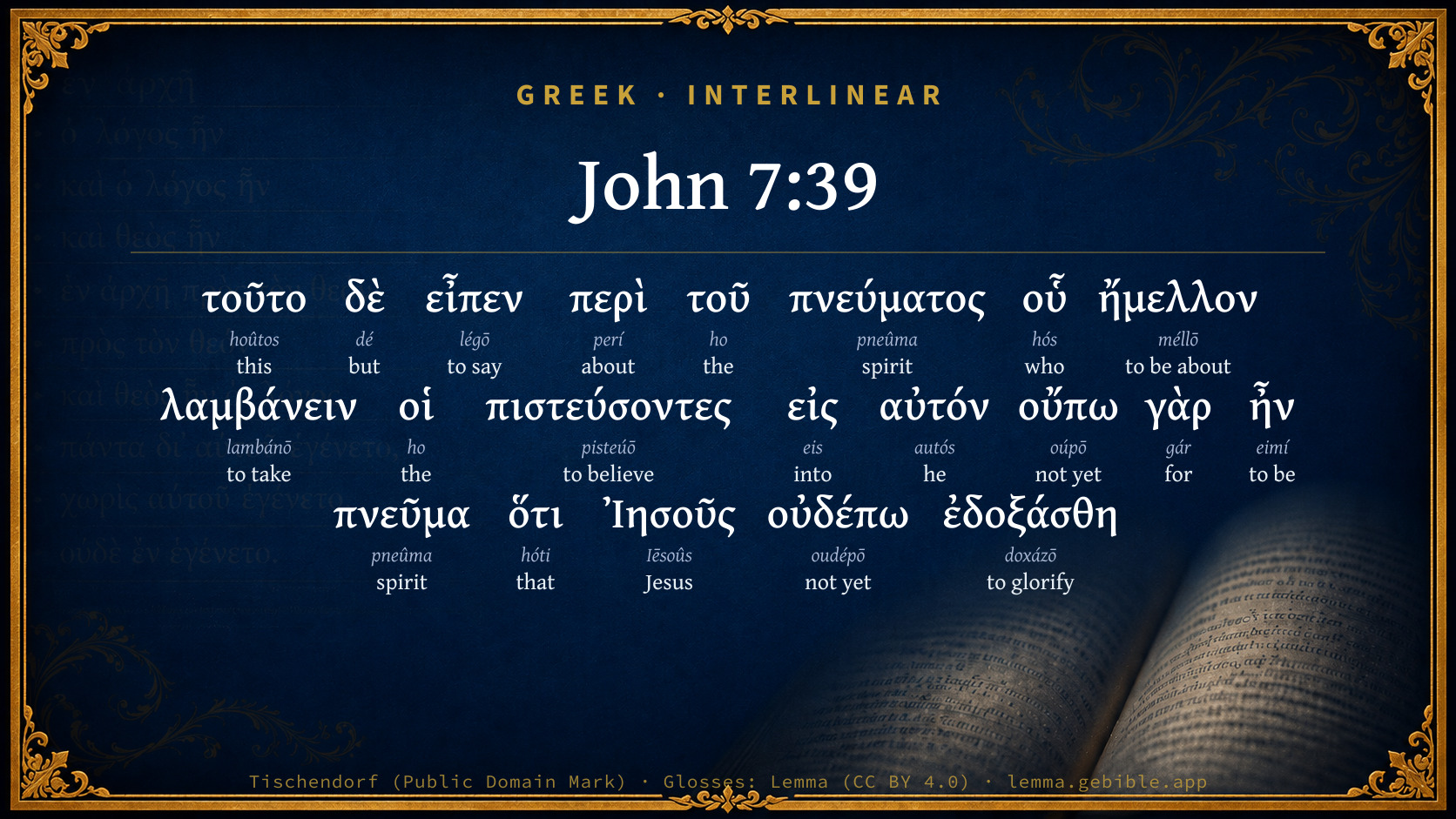
Greek (Tischendorf 8th ed.) John 7:39 appears in the Greek New Testament. The text above is from the Tischendorf 8th edition. Each word links to its Strong’s number and a concise gloss. Click any word for its full Thayer’s Greek Lexicon entry.
Download image
Cite this verse

John 7:39 (World English Bible). Public Domain. Lemma interlinear Bible study tool, https://lemma.gebible.app/v/john/7/39.

Show BibTeX & RIS
BibTeX
RIS
English Translation
But he said this about the Spirit, which those believing in him were to receive. For the Holy Spirit was not yet given, because Jesus wasn't yet glorified.
World English Bible · Public Domain
Download a study sheet

One document with this verse’s original text, its word-by-word gloss line, the meaning frame, cross-references with their text, attributed commentary, and full source and license credits — printable, and it pastes into notes with its structure intact.

This verse Autodidact and up

Study sheet (.html) Plain text (.txt)

A passage Seminary Student

Up to 50 verses in one chapter. A passage sheet keeps up to 6 commentary sources and 12 cross-references per verse, in the order this page ranks them, and says so on the sheet whenever that leaves anything out. Ask for a single verse and you get the Autodidact verse sheet above.

Everything on this page stays free to read, with no account — the sheet is a download of what is already on screen, not access to it.

Want to remove ads? Support Godless Engineer
Compare translations 3

The same verse in 3 English versions, stacked beneath the original-language interlinear above. Click any original word for its lexicon entry.

Each is an independent rendering of the whole verse — the interlinear is not word-aligned to these translations.

Highlighted words mark where these versions differ — a whole-verse word diff, not a word-by-word alignment.

  • World English Bible Public Domain
    But he said this about the Spirit, which those believing in him were to receive. For the Holy Spirit was not yet given, because Jesus wasn't yet glorified.
  • King James Version Public Domain
    (But this spake he of the Spirit, which they that believe on him should receive: for the Holy Ghost was not yet given; because that Jesus was not yet glorified.)
  • unfoldingWord Literal Text CC BY-SA 4.0
    (Now he said this about the Spirit, whom the ones having believed in him were about to receive; for the Spirit was not yet, because Jesus had not yet been glorified.)

unfoldingWord Literal Text — © unfoldingWord, licensed CC BY-SA 4.0. Word-aligned USFM3 via Door43 (git.door43.org/unfoldingWord/en_ult).

Versions to compare (up to 4)

3 of 4 selected

Show all 19 translations

Every available English version of this verse, each an independent rendering of the whole verse.

  • World English Bible Public Domain
    But he said this about the Spirit, which those believing in him were to receive. For the Holy Spirit was not yet given, because Jesus wasn't yet glorified.
  • Berean Standard Bible Public Domain
    He was speaking about the Spirit, whom those who believed in Him were later to receive. For the Spirit had not yet been given, because Jesus had not yet been glorified.
  • Majority Standard Bible Public Domain
    He was speaking about the Spirit, whom those who believed in Him were later to receive. For the Holy Spirit had not yet been given, because Jesus had not yet been glorified.
  • King James Version Public Domain
    (But this spake he of the Spirit, which they that believe on him should receive: for the Holy Ghost was not yet given; because that Jesus was not yet glorified.)
  • American Standard Version (1901) Public Domain
    But this spake he of the Spirit, which they that believed on him were to receive: for the Spirit was not yet `given'; because Jesus was not yet glorified.
  • Revised Version (1885) Public Domain
    But this spake he of the Spirit, which they that believed on him were to receive: for the Spirit was not yet given; because Jesus was not yet glorified.
  • Geneva Bible (1599) Public Domain
    (This spake hee of the Spirite which they that beleeued in him, should receiue: for the holy Ghost was not yet giuen, because that Iesus was not yet glorified.)
  • Douay-Rheims (1899) Public Domain
    Now this he said of the Spirit which they should receive, who believed in him: for as yet the Spirit was not given, because Jesus was not yet glorified.
  • Young's Literal Translation Public Domain
    and this he said of the Spirit, which those believing in him were about to receive; for not yet was the Holy Spirit, because Jesus was not yet glorified.
  • Literal Standard Version CC BY-SA 4.0
    and this He said of the Spirit, which those believing in Him were about to receive; for not yet was the Holy Spirit, because Jesus was not yet glorified.
  • Unlocked Literal Bible CC BY-SA 4.0
    But he said this about the Spirit, whom those who believed in him would receive; the Spirit had not yet been given because Jesus was not yet glorified.
  • unfoldingWord Literal Text CC BY-SA 4.0
    (Now he said this about the Spirit, whom the ones having believed in him were about to receive; for the Spirit was not yet, because Jesus had not yet been glorified.)
  • Darby Bible Public Domain
    But this he said concerning the Spirit, which they that believed on him were about to receive; for [the] Spirit was not yet, because Jesus had not yet been glorified.
  • World Messianic Bible Public Domain
    But he said this about the Spirit, which those believing in him were to receive. For the Holy Spirit was not yet given, because Yeshua wasn’t yet glorified.
  • Webster's Bible Public Domain
    (But this he spoke of the Spirit, which they that believe on him should receive, for the Holy Spirit was not yet given, because that Jesus was not yet glorified.)
  • Free Bible Version CC BY-SA 4.0
    He was referring to the Spirit that those who trusted in him would later receive. The Spirit hadn't been given yet because Jesus hadn't yet been glorified.
  • Bible in Basic English Public Domain
    This he said of the Spirit which would be given to those who had faith in him: the Spirit had not been given then, because the glory of Jesus was still to come.
  • Text-Critical English NT CC BY 4.0
    (He said this about the Spirit, whom those who believed in him were going to receive, for the Holy Spirit had not yet been given, because Jesus had not yet been glorified.)
  • Tyndale New Testament (1534) Public Domain
    This spak he of the sprete which they that beleved on him shuld receave. For the holy goost was not yet there because that Iesus was not yet glorifyed.

Literal Standard Version (2020), Covenant Press — licensed CC BY-SA 4.0. Text via the HelloAO Bible API (eBible.org). Unlocked Literal Bible (unfoldingWord) — licensed CC BY-SA 4.0. Text via the HelloAO Bible API (eBible.org). unfoldingWord Literal Text — © unfoldingWord, licensed CC BY-SA 4.0. Word-aligned USFM3 via Door43 (git.door43.org/unfoldingWord/en_ult). Free Bible Version, Dr. Jonathan Gallagher — licensed CC BY-SA 4.0. Text via the HelloAO Bible API (eBible.org).

Word by word

More ways to search: Search by grammar → Find every occurrence → Compare this word →

Practice this passage: Drill this verse → Learn its vocabulary →

οὐδέπω
oudépō
G3764
“not yet”
Adverb, Negative
Part of Speech
Adverb
Degree
Negative
Full Thayer's Definition

Origin: from G3761 and G4452

TDNT: None

1. not yet, not as yet
  1. τοῦτο hoûtos G3778 “this” Demonstrative pronoun, Accusative, Singular, Neuter
  2. δὲ dé G1161 “but” Conjunction
  3. εἶπεν légō G3004 “to say” Verb, Aorist, Active, Indicative, 3rd person, Singular
  4. περὶ perí G4012 “about” Preposition
  5. τοῦ ho G3588 “the” Article, Genitive, Singular, Neuter
  6. πνεύματος pneûma G4151 “spirit” Noun, Genitive, Singular, Neuter
  7. οὗ hós G3739 “who” Relative pronoun, Genitive, Singular, Neuter
  8. ἤμελλον méllō G3195 “to be about” Verb, Imperfect, Active, Indicative, 1st person, Singular
  9. λαμβάνειν lambánō G2983 “to take” Verb, Present, Active, Infinitive
  10. οἱ ho G3588 “the” Article, Nominative, Plural, Masculine
  11. πιστεύσοντες pisteúō G4100 “to believe” Verb, Future, Active, Participle, Nominative, Plural, Masculine
  12. εἰς eis G1519 “into” Preposition
  13. αὐτόν autós G846 “he” Personal pronoun, Accusative, Singular, Masculine
  14. οὔπω oúpō G3768 “not yet” Adverb, Negative
  15. γὰρ gár G1063 “for” Conjunction
  16. ἦν eimí G1510 “to be” Verb, Imperfect, Active, Indicative, 3rd person, Singular
  17. πνεῦμα pneûma G4151 “spirit” Noun, Nominative, Singular, Neuter
  18. ὅτι hóti G3754 “that” Conjunction
  19. Ἰησοῦς Iēsoûs G2424 “Jesus” Noun, Nominative, Singular, Masculine
  20. ἐδοξάσθη doxázō G1392 “to glorify” Verb, Aorist, Passive, Indicative, 3rd person, Singular

About this verse

These counts appear in no published source. They are computed here, from the morphology-tagged text and Lemma’s own curated glosses. What Lemma adds →

21
words
19
distinct lemmas
Gospels
section

Notable vocabulary

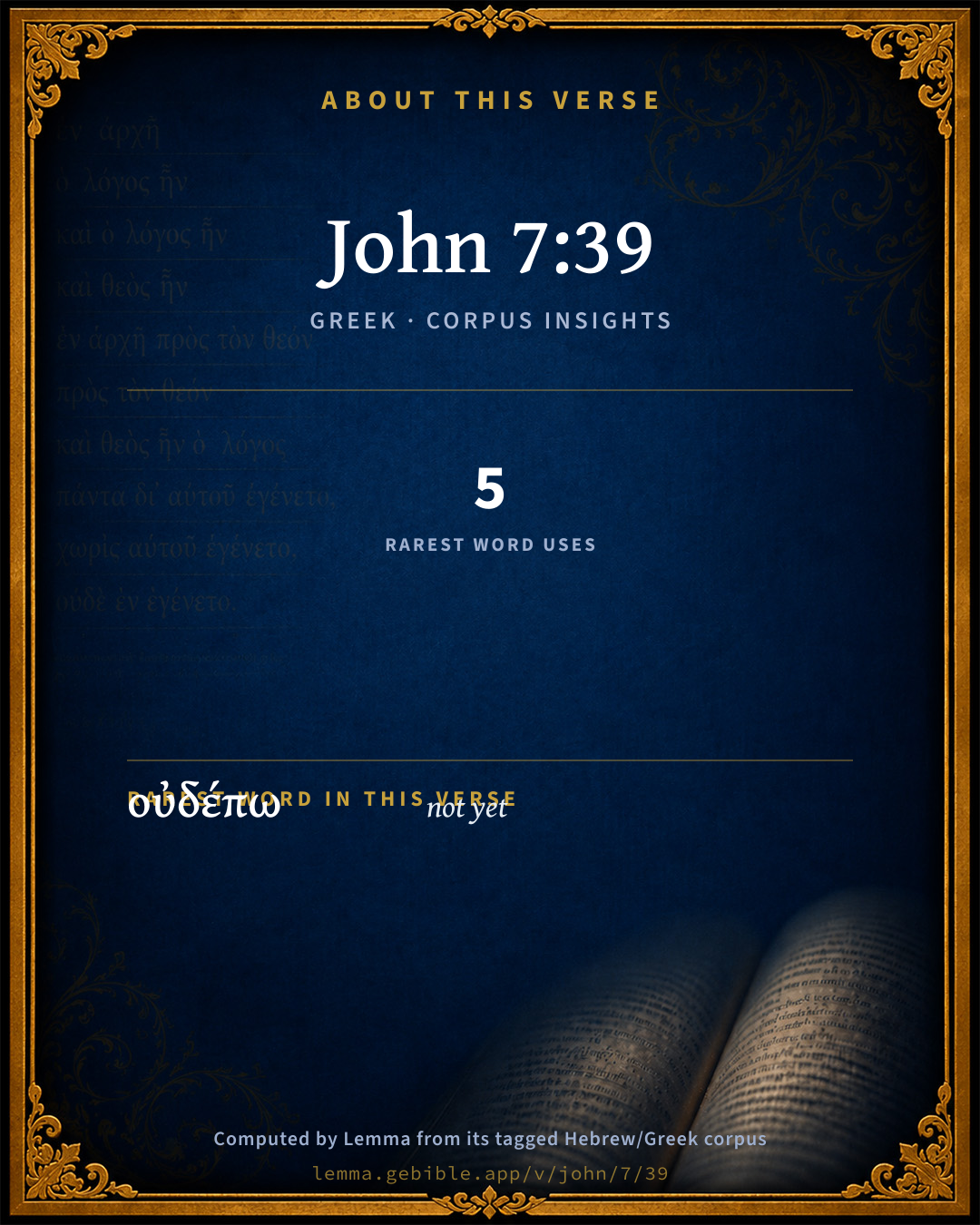
The rarest word here is οὐδέπω not yet G3764 — appearing just 5 times in the whole Greek New Testament.

Shared distinctive vocabulary

οὐδέπω not yet G3764 occurs in 5 verses of the Greek New Testament. Also found in:

Repetition

Words recur within this verse:

  • πνεύματος spirit G4151 ×2
  • τοῦ the G3588 ×2

Cross-references

38

Topical passages linked to John 7:39 in the Treasury of Scripture Knowledge — connected by theme and wording, ordered by reader-vote popularity; previews shown in the World English Bible.

  • Acts 2:17 'It will be in the last days, says God, That I will pour out my Spirit on all flesh. Your sons and your daughters will prophesy. Your young men will see visions. Your old men will dream dreams.
  • Joel 2:28 "It will happen afterward, that I will pour out my Spirit on all flesh; And your sons and your daughters will prophesy. Your old men will dream dreams. Your young men will see visions.
  • John 14:16–17 I will pray to the Father, and he will give you another Counselor, that he may be with you forever,--
  • Acts 2:33 Being therefore exalted by the right hand of God, and having received from the Father the promise of the Holy Spirit, he has poured out this, which you now see and hear.
  • Isaiah 32:15 until the Spirit be poured on us from on high, and the wilderness become a fruitful field, and the fruitful field be esteemed as a forest.
  • John 12:16 His disciples didn't understand these things at first, but when Jesus was glorified, then they remembered that these things were written about him, and that they had done these things to him.
  • John 16:7 Nevertheless I tell you the truth: It is to your advantage that I go away, for if I don't go away, the Counselor won't come to you. But if I go, I will send him to you.
  • Acts 2:4 They were all filled with the Holy Spirit, and began to speak with other languages, as the Spirit gave them the ability to speak.
  • Isaiah 44:3 For I will pour water on him who is thirsty, and streams on the dry ground; I will pour my Spirit on your seed, and my blessing on your offspring:
  • John 12:23 Jesus answered them, "The time has come for the Son of Man to be glorified.
  • John 13:31–32 When he had gone out, Jesus said, "Now the Son of Man has been glorified, and God has been glorified in him.
  • John 20:22 When he had said this, he breathed on them, and said to them, "Receive the Holy Spirit!
  • Acts 2:38 Peter said to them, "Repent, and be baptized, everyone of you, in the name of Jesus Christ for the forgiveness of sins, and you will receive the gift of the Holy Spirit.
  • Romans 8:9 But you are not in the flesh but in the Spirit, if it is so that the Spirit of God dwells in you. But if any man doesn't have the Spirit of Christ, he is not his.
  • John 14:13 Whatever you will ask in my name, that will I do, that the Father may be glorified in the Son.
  • John 17:5 Now, Father, glorify me with your own self with the glory which I had with you before the world existed.
  • Acts 1:4–8 Being assembled together with them, he charged them, "Don't depart from Jerusalem, but wait for the promise of the Father, which you heard from me.
  • Acts 3:13 The God of Abraham, Isaac, and Jacob, the God of our fathers, has glorified his Servant Jesus, whom you delivered up, and denied in the presence of Pilate, when he had determined to release him.
  • Acts 3:22–23 For Moses indeed said to the fathers, 'The Lord God will raise up a prophet for you from among your brothers, like me. You shall listen to him in all things whatever he says to you.
  • Acts 4:31 When they had prayed, the place was shaken where they were gathered together. They were all filled with the Holy Spirit, and they spoke the word of God with boldness.
  • 2 Corinthians 3:8 won't service of the Spirit be with much more glory?
  • Ephesians 1:13–14 in whom you also, having heard the word of the truth, the Gospel of your salvation,--in whom, having also believed, you were sealed with the Holy Spirit of promise,
  • Ephesians 4:30 Don't grieve the Holy Spirit of God, in whom you were sealed for the day of redemption.
  • Proverbs 1:23 Turn at my reproof. Behold, I will pour out my spirit on you. I will make known my words to you.
  • Matthew 16:14 They said, "Some say John the Baptizer, some, Elijah, and others, Jeremiah, or one of the prophets."
  • Luke 3:16 John answered them all, "I indeed baptize you with water, but he comes who is mightier than I, the latchet of whose sandals I am not worthy to loosen. He will baptize you in the Holy Spirit and fire,
  • Luke 7:16 Fear took hold of all, and they glorified God, saying, "A great prophet has arisen among us!" and, "God has visited his people!"
  • Luke 24:49 Behold, I send forth the promise of my Father on you. But wait in the city of Jerusalem until you are clothed with power from on high."
  • John 1:21 They asked him, "What then? Are you Elijah?" He said, "I am not." "Are you the Prophet?" He answered, "No."
  • John 1:25 They asked him, "Why then do you baptize, if you are not the Christ, nor Elijah, nor the Prophet?"
  • John 1:33 I didn't recognize him, but he who sent me to baptize in water, he said to me, 'On whomever you will see the Spirit descending, and remaining on him, the same is he who baptizes in the Holy Spirit.'
  • John 6:14 When therefore the people saw the sign which Jesus did, they said, "This is truly the prophet who comes into the world."
  • John 7:12 There was much murmuring among the multitudes concerning him. Some said, "He is a good man." Others said, "Not so, but he leads the multitude astray."
  • Deuteronomy 18:15–18 Yahweh your God will raise up to you a prophet from the midst of you, of your brothers, like me; to him you shall listen;
  • Psalms 68:18 You have ascended on high. You have led away captives. You have received gifts among men, Yes, among the rebellious also, that Yah God might dwell there.
  • Isaiah 12:3 Therefore with joy you shall draw water out of the wells of salvation.
  • Matthew 21:11 The multitudes said, "This is the prophet, Jesus, from Nazareth of Galilee."
  • John 14:26 But the Counselor, the Holy Spirit, whom the Father will send in my name, he will teach you all things, and will remind you of all that I said to you.

Cross-references courtesy of OpenBible.info (CC BY 4.0).

Where the printed editions differ

2 variants

Places in this verse where the major printed Greek editions disagree on the wording in a way that affects the translation — a comparison of editions, not a manuscript-by-manuscript collation. The editions are the modern critical texts (Nestlé-Aland 28/27, SBL, Westcott-Hort, Tregelles, Tyndale House) and the traditional texts behind the KJV (the Textus Receptus and the Byzantine/Majority text). It is not a claim about which reading is original.

  1. Extra text
    ἅγιον

    “Holy”

    In TynTregTRByz Not in NA28NA27SBLWH

    ἅγιον (hagion) 'Holy' is only in traditional manuscripts (Tyn+Treg+TR+Byz)

  2. Extra text
    δεδομένον,

    “given”

    In NIVKJV03 Not in NA28NA27TynSBLWHTregTRByz

    δεδομένον, (dedomenon) 'given' is only in a few manuscripts (NIV+KJV+03)

Textual data: Translators Amalgamated Greek New Testament (STEPBible TAGNT) · CC BY 4.0.

Commentary

Notes on John 7:39 from classic Christian and Jewish commentators (each source and its license shown beneath its notes). The classic Christian expositions comment on the surrounding passage and are grouped to its opening verse, so a note may address several verses; the Jewish commentaries on the Tanakh (Rashi and others) are per-verse, so they appear only where the commentator wrote on this verse.

Lemma curates 59 commentaries, every one of them public domain or Creative Commons licensed, each selected and text-cleaned for this edition rather than reprinted as found. About our sources →

Godbey's Commentary on the New Testament

William B. Godbey

GLORIFICATION OF JESUS

Joh 7:39. “And He spoke this concerning the Spirit which those who believe on Him were about to receive; for he was not yet [given]; because Jesus was not yet glorified.” The Holy Ghost has been in the world in all ages, illuminating, convicting, regenerating, and sanctifying the people. Of course, He could not comfort the people in the administration of the complete, historic work of Christ till it had been consummated, by His vicarious atonement, resurrection, ascension, and intercession. While He was, in a sense, a Comforter of the O. T. saints, they only enjoyed the consolation of the prophecies setting forth the stupendous work of Christ in the world’s redemption. After the verification of all these wonderful prophecies relative to the stupendous work of the Son, Executive of human redemption from the fall, there was an immeasurable augmentation of the consolatory facilities, in the illumination of the spiritual understanding, in order to the reception and appropriation of the vicarious atonement in all of its grand, inexhaustible, and universal realities, comprehensive of every human being, from Adam down to the latest posterity. Thus the human side necessary to the reception of heavenly consolation was actually centuplicated by the glorious work of Christ, the confirmation of which was the glorification of Jesus. Many have risen claiming to be Christ — e. g., Theudas, Simon Magnus, Marchochab, etc.; and Mohammed even claimed to be greater than Christ, — the trouble with them and all others consisting in the failure of the resurrection. Hence the glorification of Jesus and His ascension to the Father were the indispensable confirmations of His Christhood. Therefore the Holy Ghost must have all of these indisputable historic facts with which to satisfy and comfort the illuminated and sanctified intellect. Consequently this momentous history must actually transpire before the Holy Spirit could use these thrilling realities in the consolation of the saints. Of course, you all see clearly from this Scripture that this climacteric experience of heavenly rivers flowing out of the heart was actually received when the Holy Ghost fell on them at Pentecost. Hence the glorification of Jesus certainly preceded the descension of the Comforter on that notable occasion. We certainly could not conclude that our Lord was glorified long before Pentecost, as evidently these events are closely identified in the order of consecution, the one being the antecedent and the other the consequent. I find the word edoxasthe, for the glorification of Jesus, is in the passive voice and aorist tense, peculiarly signifying an instantaneous and complete action, which evidently took place when He flew up from Mt. Olivet. This work of glorification, wrought by the Holy Ghost, eliminates all ponderous matter out of the organism, simultaneously spiritualizing the body and rendering it imponderable.

William B. Godbey, Commentary on the New Testament (1896–1900) — public domain. Text from a community e-Sword module.

Tyndale Open Study Notes

Tyndale Open Resources

7:39 In Jesus’ crucifixion and resurrection, his life and the Spirit were poured out (see 19:34; 20:22).

Tyndale Open Study Notes — © Tyndale Open Resources, licensed CC BY-SA 4.0. Text via the HelloAO Bible API.

Bengel's Gnomon

Johann Albrecht Bengel

Joh 7:39. Εἷπε, He spake) Jesus.—οὒπω γὰρ ἦν, for not yet was) To be, for to be present: Mat 2:18, “Rachel weeping for her children,—because they are not” [i.e. are no more present with her]; Gen 42:36, “Joseph is not, and Simeon is not.” Comp. by all means 2Ch 15:3.[210] The γάρ is to be referred to ἜΜΕΛΛΟΝ, and this to the future ῬΕΎΣΟΥΣΙΝ.

[210] “Now for a long season Israel hath been without the true God,” i.e. not that God was not with any one Israelite, but He was not specially and manifestly present with them. So as to the Holy Ghost here.—E. and T.

Bengel's Gnomon of the New Testament — English translation (T&T Clark, Edinburgh, 1860) — public domain. Text from a community e-Sword module.

Meyer's Critical & Exegetical Commentary

Heinrich August Wilhelm Meyer

Joh_7:39. Not an interpolated gloss (Scholten), but an observation by John in explanation of this saying. He shows that Jesus meant that the outward effect of which He spoke, the flowing forth, was not at once to occur, but was to commence upon the reception of the Spirit after His glorification. He,self-evidently, and, according to the οὗ ἔμελλον, undoubtedly meaning the Holy Spirit,

He it was who would cause the streams of living water to flow forth from them. Johns explanation, as proceeding from inmost experience, is correct, because the principle of Christian activity in the church, especially in its outward workings, is none other than the Holy Spirit Himself; and He was not given until after the ascension, when through Him the believers spoke with tongues and prophesied, the apostles preached, and so on. Such overflowings of faiths power in its outward working did not take place before then. The objection urged against the accuracy of Johns explanation, that ῥεύσουσιν may be a relative future only, and is not to be taken as referring to that outpouring of the Spirit which was first to take place at a future time (De Wette), disappears if we consider the strong expression ποταμοὶ, κ.τ.λ., Joh_7:38, to which John gives due weight, inasmuch as he takes it to refer not simply to the power of ones own individual faith upon others, so far as that was possible previous to the outpouring of the Spirit, but to something far greater and mightierto those streams of new life which flowed forth from the lips of believers, and which were originated and drawn forth by the Holy Ghost. The strength and importance of the expression (ποταμοὶ, κ.τ.λ.) thus renders it quite unnecessary to supply ποτέ or the like after ῥεύσουσιν (in answer to Lücke); and when Lücke calls Johns explanation epexegetically right, but exegetically incorrect, he overlooks the fact that John does not take the living water itself to be the Holy Ghost, but simply says, regarding Christs declaration as a whole, that Jesus meant it of the Holy Spirit, leaving it to the Christian consciousness to think of the Spirit as the Agens, the divine charismatic motive power of the streams of living water.

It remains to be remarked that the libation at the feast of Tabernacles was interpreted by the Rabbis as a symbol of the outpouring of the Spirit (see Lightfoot); but this is all the less to be connected with the words of Jesus and their interpretation, the more uncertain it is that there is any reference in the words to that libation; see on Joh_7:37.

οὔπω γὰρ ἦν πνεῦμα] nondum enim aderat (Joh_1:9), furnishing the reason for the οὗ ἔμελλον λαμβάνειν as the statement of what was still future. The ἦν, He was present (upon earth), is appropriately elucidated by δεδομένον (Lachmann; see on Act_19:2); Jesus alone possessed Him in His entire fulness (Joh_3:34). The absolute expression οὔπω ἦν is not, therefore, to be weakened, as if it were relative (denoting merely an increase which put out of consideration all former outpourings), as Hengstenberg and Brückner take it, but at the time when Christ preached He promised the Holy Spirit, and therefore the Holy Spirit was not yet there, Luther. Comp. Flacius, Clav. II. p. 326: sc. propalam datus. Videtur negari substantia, cum tamen accidens negetur. See also Calvin. For the rest, the statement does not conflict with the action of the Spirit in the O. T. (Psa_51:13; 1Sa_16:12-13), or upon the prophets in particular (2Pe_1:21; Act_28:25; Act_1:16); for here the Spirit is spoken of as the principle of the specifically Christian life. In this characteristic definiteness, wherein He is distinctively the πνεῦμα Χριστοῦ, the πν. τῆς ἐπαγγελίας (Eph_1:13), τῆς υἱοθεσίας (Rom_8:15), τῆς χάριτος (Heb_10:29), the ἀῤῥαβὼν τῆς κληρονομίας (Eph_1:14), the Spirit of Him who raised Jesus from the dead (Rom_8:11), and according to promise was to be given after Christs exaltation (Act_2:33), He was not yet present; just as also, according to Joh_1:17, grace and truth first came into existence through Christ. The reason of the οὔπω ἦν is: because Jesus was not yet glorified. He must through death return to heaven, and begin His heavenly rule, in order, as σύνθρονος with the Father, and Lord over all (Joh_17:5; 1Co_15:25), as Lord also of the Spirit (2Co_3:18), to send the Spirit from heaven, Joh_16:7. This sending was the condition of the subsequent εἶναι (adesse). The outpouring of the Spirit was the proof that He had entered upon His supra-mundane state (Hofmann, Schriftbeweis, I. p. 196); and so also the office of the Spirit to glorify Christ (Joh_16:14) presupposes, as the condition of its operation, the commencement of the δόξα of Christ. Till then believers were dependent upon the personal manifestation of Jesus; He was the possessor of that Spirit who, though given in His fulness to Christ Himself (Joh_3:34), and though operating through Him in His people (Joh_3:6, Joh_6:63; Luk_9:55), was not, until after Christs return to glory (Eph_4:7-8), to be given to the faithful as the Paraclete and representative of Christ for the carrying on of His work. See chap. 1416. Chap. Joh_20:21-22 does not contradict this; see in loc. The thought of an identity[272] of the glorified Christ with the Holy Spirit might easily present itself here (see on 2Co_3:17; and likewise Gess, Pers. Chr. p. 155). But we must not, with De Wette, seek for the reason of the statement in the receptivity of the disciples, who did not attain to a pure and independent development of the germ of spirit within them until the departure of Jesus; the text is against this. As little can we regard the σάρξ of Christ as a limitation of the Spirit (Luthardt), or introduce the atonement wrought through His death as an intervening event (Messner, Lehre d. Ap. p. 342; Hengstenberg and early writers); because the point lies in the δόξα of Christ (comp. Godet and Weiss, Lehrbegr. p. 286 f.), not in His previous death, nor in the subjective preparation secured by faith. This also tells against Baeumlein, who understands here not the Holy Spirit objectively, but the Spirit formed in believers by Him, which τὸ πνεῦμα never denotes, and on account of λαμβάνειν cannot be the meaning here.

[272] Tholuck. the Spirit communicated to the faithful, as the Son of man Himself glorified into Spirit. Php_3:21 itself speaks decisively enough against such a view. Wörner, Verhältn. d. Geistes, p. 57, speaks in a similar way of the elevation of Christs flesh into the form of the Spirit itself, etc. Baur, on the contrary, N. T. Theol. p. 385, says: Not until His death was the Spirit, hitherto identical with Him, separated from His person in order that it might operate as an independent principle.

Meyer — Critical and Exegetical Commentary on the New Testament — English translation by Peter Christie, edited by Frederick Crombie (T&T Clark, 1880) — public domain. Text from a community e-Sword module.

Expositor's Greek Testament

ed. W. Robertson Nicoll

Joh 7:39 . τοῦτο … ἐδοξάσθη , for these words apparently refer to Pentecost, the initial outpouring of the Spirit, when it once for all became manifest that the Spirit’s presence did not turn men’s thoughts in upon themselves, and their own spiritual anxieties and prospects, but prompted them to communicate to all men the blessings they had received. From the little group in the upper room “rivers” did flow to all. But the appended clause, οὔπω γὰρ ἦν Πνεῦμα Ἅγιον , is difficult. The best attested reading (see critical note) gives the meaning: “The Spirit was not yet, because Jesus was not yet [ οὔπω , not οὐδέπω ] glorified” ἐδοξάσθη with John signifies the entire process of glorification, beginning with and including His death (see chap. Joh 12:23 ; Joh 12:32-33 ); but especially indicating His recognition by the Father as exalted Messiah (see chap. Joh 17:1 ; Joh 17:5 , Joh 13:31 ). Until He thus became Lord the Spirit was not given: and the gift of the Spirit at Pentecost was recognised as the grand proof and sign that He had reached the position of supremacy in the moral universe. (See especially Act 2:32-33 .) The Spirit could not be given before in His fulness, because until Christ no man could receive Him in His fulness. Christ was the lens in whom all the scattered rays were gathered. And it is always and only by accepting Christ as perfect humanity, and by finding in Him our norm and ideal, that we receive the Spirit. It is by the work of the Spirit on the human nature of Christ that we are made aware of the fulness and beauty of that work. It is there we see what the Spirit of God can make of man, and apprehend His grace and power and intimate affinity to man.

The Expositor's Greek Testament, edited by W. Robertson Nicoll (1897–1910) — public domain. Text from a community e-Sword module.

Geneva Bible (1599)

Geneva Bible translators

What is meant by the holy Ghost, he expressed a little before, speaking of the Spirit which they that believed in him should receive. So that by the name of holy Ghost, are meant the virtues and mighty workings of the holy Ghost.

That is, those things were not yet seen and perceived, which were to show and set forth the glory of the only begotten.

Geneva Bible (1599) marginal notes — public domain. Text via Bolls.life.

Jamieson, Fausset & Brown

Robert Jamieson, A. R. Fausset & David Brown

this spake he of the Spirit--who, by His direct personal agency, opens up this spring of living waters in the human spirit (Joh 3:6), and by His indwelling in the renewed soul ensures their unfailing flow.

they that believe, &c.--As the Holy Ghost is, in the redemption of man, entirely at the service of Christ, as His Agent, so it is only in believing connection with Christ that any one "receives" the Spirit.

for the Holy Ghost was not yet given--Beyond all doubt the word "given," or some similar word, is the right supplement. In Joh 16:7 the Holy Ghost is represented not only as the gift of Christ, but a gift the communication of which was dependent upon His own departure to the Father. Now as Christ was not yet gone, so the Holy Ghost was not yet given.

Jesus not yet glorified--The word "glorified" is here used advisedly, to teach the reader not only that the departure of Christ to the Father was indispensable to the giving of the Spirit, but that this illustrious Gift, direct from the hands of the ascended Saviour, was God's intimation to the world that He whom it had cast out, crucified, and slain, was "His Elect, in whom His soul delighted," and that it was through the smiting of that Rock that the waters of the Spirit--for which the Church was waiting, and with pomp at the feast of tabernacles proclaiming its expectation--had gushed forth upon a thirsty world.

Jamieson, Fausset & Brown — Commentary Critical and Explanatory on the Whole Bible (1871) — public domain (CC PDM 1.0). Text via the HelloAO Bible API.

Adam Clarke's Commentary

Verse 39. Was not yet given] δεδομενον, given is added by the Codex Vaticanus, (B.) the Syriac, all the Persic, later Syriac with an asterisk, three copies of the Slavonic, Vulgate, and all the Itala but three; and several of the primitive fathers. The word seems necessary to the completion of the sense.

Certain measures of the Holy Spirit had been vouchsafed from the beginning of the world to believers and unbelievers: but that abundant effusion of his graces spoken of by Joel, Joe 2:28, which peculiarly characterized the Gospel times, was not granted till after the ascension of Christ: 1. Because this Spirit in its plenitude was to come in consequence of his atonement; and therefore could not come till after his crucifixion. 2. It was to supply the place of Christ to his disciples and to all true believers; and therefore it was not necessary till after the removal of his bodily presence from among them. See our Lord's own words, Joh 14:16-18; Joh 14:26; Joh 15:26; Joh 16:7-15.

Adam Clarke's Commentary on the Bible (1810–1826) — public domain. Text from a community e-Sword/MySword module.

John Calvin's Commentaries

39. But this he spoke of the Spirit. The word water is sometimes applied to the Spirit on account of its purity, because it is his office to cleanse our pollutions; but in this and similar passages this term is employed in a different acceptation, which is, that we are destitute of all the sap and moisture of life, unless when the Spirit of God quickens us, and when he waters us, as it were, by secret vigor. Under one part he includes the whole; for under the one word water he includes all the parts of life. Hence we infer also, that all who have not been regenerated by the Spirit of Christ ought to be reckoned dead, whatever may be the pretended life of which they boast.

For the Holy Spirit was not yet given. We know that the Spirit is eternal; but the Evangelist declares that, so long as Christ dwelt in the world in the mean form of a servant, that grace of the Spirit, which was poured out on men after the resurrection of Christ, had not been openly manifested. And, indeed, he speaks comparatively, in the same manner as when the New Testament is compared to the Old. God promises his Spirit to his elect and believers, as if he had never given him to the Fathers. At that very time, the disciples had undoubtedly received the first-fruits of the Spirit; for whence comes faith but from the Spirit? The Evangelist, therefore, does not absolutely affirm that the grace of the Spirit was not offered and given to believers before the death of Christ, but that it was not yet so bright and illustrious as it would afterwards become. For it is the highest ornament of the kingdom of Christ, that he governs his Church by his Spirit; but he entered into the lawful and — what may be called — the solemn possession of his kingdom, when he was exalted to the right hand of the Father; so that we need not wonder if he delayed till that time the full manifestation of the Spirit.

But one question still remains to be answered. Does he mean here the visible graces of the Spirit, or the regeneration which is the fruit of adoption? I answer: The Spirit, who had been promised at the coming of Christ, appeared in those visible gifts, as in mirrors; but here the question relates strictly to the power of the Spirit, by which we are born again in Christ, and become new creatures. That we lie on earth poor, and famished, and almost destitute of spiritual blessings, while Christ now sits in glory at the right hand of the Father, and clothed with the highest majesty of government, ought to be imputed to our slothfulness, and to the small measure of our faith.

John Calvin's Commentaries (1540-1563) — public domain. Text from the Calvin Translation Society English edition (1840s-50s) via the Christian Classics Ethereal Library (ccel.org). Calvin's coverage is partial (roughly two-thirds of the Bible); uncommented books and verses are honest gaps, never fabricated. The 19th-century editor's footnotes and remarks are omitted so the notes are faithfully Calvin's own voice.

Ellicott's Commentary for English Readers

(39) The word “given” is omitted in nearly all MSS. except the Vatican. “Holy” before Ghost is also probably an insertion, though it is found in some of the oldest MSS. and versions. These are additions of copyists who were anxious to preserve from all possibility of misinterpretation the doctrine concerning the Holy Spirit. This doctrine is more fully expounded in John 14-16, where see Notes.

A Bible Commentary for English Readers, edited by Charles John Ellicott (1878–1897) — public domain. Text from a community e-Sword module.

The Cambridge Bible for Schools and Colleges

gen. ed. J. J. S. Perowne

39. this spake he of the Spirit] S. John’s interpretation is to be accepted, whatever may be our theory of inspiration, (1) because no better interpreter of Christ’s words ever lived, even among the Apostles; (2) because it is the result of his own inmost experience. The principle of Christian activity has ever been the Spirit. He moves the waters, and they overflowed at Pentecost. Till then ‘the Spirit was not yet;’ the dispensation of the Spirit had not come.

the Holy Ghost was not yet given] Both ‘the Holy’ and ‘given’ are of doubtful authority: ‘given’ is omitted by nearly all MSS. except the Vatican; it gives the right sense. Like ‘Holy Spirit’ in Joh_1:33, ‘Spirit’ has no article and means a power of the Spirit.

because that Jesus was not yet glorified] Comp. Joh_16:7; Psa_68:18. The Spirit, “though given in His fulness to Christ Himself (Joh_3:34), and operating through Him in His people (Joh_6:63), was not, until after Christ’s return to glory, to be given to the faithful as the Paraclete and representative of Christ for the carrying on of His work.” Meyer.

The Cambridge Bible for Schools and Colleges (gen. ed. J. J. S. Perowne; Cambridge University Press, 1878–1918) — public domain. Text from a community e-Sword module.

John Gill's Exposition

Many of the people therefore,.... Of the common people, and it may be chiefly those that came out of the country:

when they heard this saying; or discourse of Christ, on the last and great day of the feast, relating to the large measure of grace, and the effusion of the Spirit on him, that believed:

said, of a truth this is the prophet; spoken of in Deu 18:15, which some understood not of the Messiah, but of some extraordinary prophet distinct from him, who should come before him, or about the same time; or they imagined he was one of the old prophets raised from the dead, whom they also expected about the times of the Messiah: or their sense might only be, that he was a prophet, which was true, though not all the truth; they had some knowledge, though but small; and they spake of him, though but as children in understanding.

John Gill's Exposition of the Whole Bible (1746–1763) — public domain (CC PDM 1.0). Text via the HelloAO Bible API.

Trapp's Complete Commentary

John Trapp

39 (But this spake he of the Spirit, which they that believe on him should receive: for the Holy Ghost was not yet given; because that Jesus was not yet glorified.)

Ver. 39. But this spake he of the Spirit] Which is many times compared (as to fire, so) to water for its properties of cooling, cleansing, quenching thirst, fructifying, &c.

Should receive] Princes at their inauguration use to receive great gifts from their subjects. Christ also received gifts, not of his subjects, but of his Father, Psa 68:18; and it was for men, and on men he bestowed them, Eph 4:8, as holding it a "more blessed thing to give than to receive," Act 20:35.

Because that Jesus was not yet glorified] As the sun, the nearer it runs to the earth, the weaker (as in winter); but the higher in heaven, the hotter and more effectual; so this Sun of righteousness.

John Trapp, A Commentary or Exposition upon All the Books of the Old and New Testament (1647–1656) — public domain. Text from a community e-Sword module.

Albert Barnes' Notes on the Bible

Of the Spirit - Of the Holy Spirit, that should be sent down to attend their preaching and to convert sinners.

For the Holy Ghost was not yet given - Was not given in such full and large measures as should be after Jesus had ascended to heaven. Certain measures of the influences of the Spirit had been always given in the conversion and sanctification of the ancient saints and prophets; but that abundant and full effusion which the apostles were permitted afterward to behold had not yet been given. See Acts 2; Act 10:44-45.

Jesus was not yet glorified - Jesus had not yet ascended to heaven - to the glory and honor that awaited him there. It was a part of the arrangement in the work of redemption that the influences of the Holy Spirit should descend chiefly after the death of Jesus, as that death was the procuring cause of this great blessing. Hence, he said Joh 16:7, “It is expedient for you that I go away; for if I go not away the Comforter will not come unto you; but if I depart I will send him unto you.” See also Joh 7:8-12; Joh 14:15-16, Joh 14:26. Compare Eph 4:8-11.

Albert Barnes' Notes on the Bible (1834–1885) — public domain. Text from a community e-Sword/MySword module.

Haydock's Catholic Bible Commentary

As yet the spirit was not given, in that particular and extraordinary manner, because Jesus was not yet glorified by his ascension and the coming of the Holy Ghost. (Witham) --- It is said that the Baptist was filled with the Holy Ghost from the womb of his mother; that Zacharias, when he prophesied concerning his son, and the blessed Virgin, when she prophesied concerning our Lord, were both filled with the Holy Ghost; that Simeon and Anna were inspired by the Holy Ghost, to declare the greatness of Christ. How can this be otherwise reconciled with this text of St. John, that by saying that this gift of the Holy Ghost, after the ascension of Christ, was much more abundant that it had ever been before? For we never read that men inspired by the Holy Ghost before the coming of Christ, spoke languages which they had never learned. (St. Augustine, 4 de Trin. chap. xx.) --- The Holy Ghost is still received, but none speak with tongues: because the Church herself, being spread over the whole earth, speaks the languages of all. (St. Augustine, tract. 32. in S. Joan.) --- The primitive Christians of Corinth consulted St. Paul on the subject of these spiritual gifts or graces, frequently communicated in the sacraments of baptism and confirmation. In his Epistle, addressed to them, (1 Corinthians chap. xii.) he explains those gifts, and complains that some among the Corinthians made not a right use of these gifts; especially those who had the gift of tongues, and made use of it rather through vanity, than for the profit of others. In the last verse of 1 Corinthians chap. xii. he adds: But be zealous for the better gifts. And I shew to you a yet more excellent way. And in the 13th chapter, he describes the excellence, the characters of charity which he extols far above all other gifts. (Haydock)

George Leo Haydock (1774–1849), Haydock's Catholic Family Bible and Commentary, 1859 edition — public domain. Excludes Psalms (Douay-Rheims chapter numbering differs from Protestant) and Deuterocanonical books (Catholic canon only).

Matthew Poole's English Annotations

For the evangelist tells us, that this referred to the Spirit, which believers were to receive after that Christ should be ascended into heaven. Those scriptures, Isa 49:10; 58:11; Zec 14:8, seem, among others, to be referred to in this promise of our Saviour.

Matthew Poole's English Annotations on the Holy Bible (1683–1685) — public domain. Text from a community e-Sword/MySword module.

Whedon's Commentary on the Bible

Daniel D. Whedon

39. Holy Ghost was not yet—Not that the Holy Ghost did not yet exist. The term Holy Ghost evidently designates, here, its earthly manifestation or efficient influences, which as yet had not taken place. In this view the italic word given, supplied by the translators, is hardly needed.

Glorified— The ascension of Christ was the fixed condition to the effusion of the Spirit. See note on Joh_16:7.

Daniel D. Whedon (gen. ed.), Commentary on the Old and New Testaments (1874–1909) — public domain. Text from a community e-Sword module.

The Pulpit Commentary

This spake he, said the evangelist, concerning the Spirit, which they that believeon him were to receive: for the (Holy) Spiritwas not yet (given), because Jesus was not yet glorified. This verse has a great weight, as the evangelist"s interpretation of the previous words of the Lord, nor can they be put aside. The history of the outpouring of the Spirit on Pentecost, and the mighty gift of the risen and glorified Jesus to those who believed on him, are their abundant justification. If the thirty-eighth verse were not an immense advance upon the promise of the thirty-seventh verse, it would not be easy to show how the words of the first promise could only find fulfilment in a future and as yet unrealized condition. Eternal life is a present gift. Satisfaction of the thirst of the soul was an immediate bestowment of Christ, and had been realized by untold multitudes of those who had been inwardly cleansed by the Spirit, who had come to the waters of life, who had received the Logos, and known that they were sons of God. But the thirty-eighth verse speaks of a new and nobler life flowing to others from belief in Christ. It looks forward to the production of a worldwide blessing conditioned by what was yet to happen. So that we cannot doubt that John saw more deeply into the Lord"s words than some of those who have criticized his comment. John, says Weiss, does "not mean to explain the metaphor of the living water, but he intends to prove the truth of Jesus" promise from his own blessed experience." The (Holy) Spirit was not yet is, however, a strange and startling statement. The work and Person of the Spirit are spoken of throughout the Old Testament from Gen_1:2 Gen 6:3Jo Gen_26:13 Psa_104:30 Psa_139:7; to Zec_4:6. The redeeming and renewing, quickening powers of the Spirit are represented as equipping judges, artists, warriors, and prophets for their work, as sanctifying the individual soul, (Psa_51:11 Eze_3:24, Eze_3:27) and building the temple of God. (Hag_2:5) The prophetic gift is especially referred to the Spirit by St. Paul. (1Co_12:10, 11 2Pe_1:21; pasa grafh is Yeopneustov , 2Ti_3:16) More than this, our Lord himself is, in the synoptic Gospels, said to be conceived by the Holy Spirit, and his humanity baptized and anointed, empowered and directed throughout by the Spirit, and kept by him in sacred consecration and personal union with the Logos. The union of the Divine and human nature of Christ is maintained by that same Spirit who is the union of the Father and of the Son. In what sense can it be said, "the Holy Spirit was not yet"? Our Lord himself has thrown most light upon this perplexing saying when, on promising the Paraclete, he said, "He shall not speak of or, "from himself: he will take of mine, and show unto you"; (Joh_16:13, Joh_16:14) and when he declared (Joh_16:7-10) that he must himself go to the Father, resume his antenatal glory, carry our nature, dishonoured by man, but now clothed with an infinite majesty, to the very throne of God, as the condition of the gift of the Paraclete. There was, in the constitution of nature, in the order of providence, in the revelations of the prophets, in the Person of the Son of man, that wherewith the blessed Spirit was ever and ceaselessly working; but not until the atonement was made, till God had glorified his Son Jesus, not until the Person of the God-Man was constituted in its infinity of power and perfection of sympathy, were the facts ready, were the truths liberated for the salvation of men, were the streams of living water ready to flow from every heart that received the Divine gift. In comparison with all previous manifestation of the Spirit, this was so wonderful that John could say of all that had gone beforenot yet, not yet. The Baptist"s expression, "I knew him not", (see note, Joh_1:31) and the scene described in Joh_20:21, Joh_20:22, do not contradict this (see note). This is the first time that John mentions the glorification of the Son of mart. Jesus certainly looked at his death, with what followed it, as his glory. (see Joh_12:23, etc.; Joh_13:31 Joh_17:5) This evangelist does not, so clearly as St. Paul (says Westcott), discriminate the two stages of "humiliation" and "glory". (cf. Php 2 with 1Jn_3:5, 1Jn_3:8)

The Pulpit Commentary (1880–1919), ed. H.D.M. Spence-Jones & Joseph S. Exell — public domain. Text from a community e-Sword module.

John Wesley's Explanatory Notes

The Holy Ghost was not yet given - That is, those fruits of the Spirit were not yet given even to true believers, in that full measure.

John Wesley, Explanatory Notes Upon the Whole Bible (1754–1765) — public domain. Text via the GEBible commentary corpus.

Scofield Reference Notes

C. I. Scofield

Spirit

Holy Spirit. Joh 14:17; Joh 14:26; Mat 1:18 See summary note, (See Scofield "Act 2:4").

The Scofield Reference Bible (1917 edition), notes by C. I. Scofield — public domain. Text from a community e-Sword module.

Burkitt's Expository Notes on the New Testament

William Burkitt

These words are the Evangelist St. John’s commentary upon the foregoing promise; he tells us, that Christ spoke this of the miraculous gifts of the Spirit, which did accompany the descent of the Holy Ghost at the feast of Pentecost. For the Holy Ghost was not yet given:

Learn hence, That although the Spirit was in some measure given by God from the beginning to good men, yet the more plentiful effusion of it was deferred, till the ascension and glorification of Jesus Christ.

William Burkitt's Expository Notes on the New Testament (1700–1703) — public domain. Text from a community e-Sword module.

The People's New Testament

B. W. Johnson

39. This spake he of the Spirit, which they that believe on him should receive. This declaration of John makes the second chapter of Acts the best commentary on the preceding verse. Luther says: “So St. Peter, by one sermon on the day of Pentecost, as by a rushing of water, delivered three thousand men from the devil's kingdom, washing them in an hour from sin, death and Satan.” Because Jesus was not yet glorified. Let it be noted, (1) That the Holy Spirit was not given until after the death and ascension of Jesus. (2) The disciples of Christ did not become “fountains of living water” until the Holy Spirit was sent. This marks Pentecost as the beginning of the preaching of the gospel authoritatively by his disciples.

B. W. Johnson's The People's New Testament with Notes (1889–1891) — public domain. Electronic text from the Christian Classics Ethereal Library (CCEL) ThML edition.

unfoldingWord translationNotes

Door43 World Missions Community

General Information:

In this verse the author gives information to clarify what Jesus is talking about. (See: Background Information)

But he

Here "he" refers to Jesus.

the Spirit had not yet been given

John implies that the Spirit would later come to live in those who trusted Jesus. AT: "the Spirit had not yet come to live in the believers" (See: Assumed Knowledge and Implicit Information)

because Jesus was not yet glorified

Here the word "glorified" refers to the time when God would honor the Son after his death and resurrection.

translationWords

Holy Spirit

believe

receive

glory

unfoldingWord translationNotes — © Distant Shores Media and the Door43 World Missions Community, licensed CC BY-SA 4.0. Source: git.door43.org/Door43/en_tn.

Cambridge Greek Testament for Schools and Colleges

39. After πνεῦμα omit ἄγιον (assimilation to Joh 20:22), with אT. D adds ἐπ’ αὐτοῖς and B adds δεδομένον after ἅγιον. Οὔπω for οὐδέπω.

39. περὶ τ. πν. S. John’s interpretation is to be accepted, whatever may be our theory of inspiration, (1) because no better interpreter of Christ’s words ever lived, even among the Apostles; (2) because it is the result of his own inmost experience. The principle of Christian activity has ever been the Spirit. He moves the waters, and they overflowed at Pentecost. Till then ‘the Spirit was not yet;’ the dispensation of the Spirit had not come.

οὗ ἔμελλον. Which they that believed on Him were about to (Joh 6:71) receive: οἱ πιστεύσαντες, those who did believe, the first disciples.

οὔπω γὰρ ἦν πν. As in Joh 1:33 and Joh 20:22 there is no article, and an influence of the Spirit rather than the Third Person is meant: the spiritual life was not yet. Christus Legis, Spiritus Evangelii complementum; Christ completes the Law, the Spirit completes the Gospel.

ὅτι … ἐδοξάσθη. Comp. Joh 16:7, Joh 17:1; Joh 17:5; Psa 68:18. The Spirit, “though given in His fulness to Christ Himself (Joh 3:34), and operating through Him in His people (Joh 6:63), was not, until after Christ’s return to glory, to be given to the faithful as the Paraclete and representative of Christ for the carrying on of His work” (Meyer). Christ did not send the Paraclete until He Himself had resumed the fulness of Divinity; and the Spirit did not give Christ to be the life of the Church until Christ was perfected.

Cambridge Greek Testament for Schools and Colleges (Cambridge University Press, 1896; 21 vols, various authors incl. Carr, Maclear, Plummer, Farrar, Lumby, Moule, M. R. James, Simcox) — public domain. Text from a community e-Sword module.

Alford’s Greek Testament

Henry Alford

39.] The difficulties raised concerning this interpretation of the saying of our Lord have arisen from a misapprehension. John does not say that the words were a prophecy of what happened on the day of Pentecost; but of the Spirit, which the believers were about to receive. Their first reception of Him must not be illogically put in the place of all His indwelling and working, which are here intended. And the symbolism of the N.T. is fully satisfied by the interpretation. Granted that the water is the water of life—what is that life but the life of the Spirit? τὸ φρόνημα τοῦ πνεύμ., ζωή, Rom 8:6; and again, τὸ πνεῦμα, ζωή, ib. ver. 10.

It is lamentable to see such able and generally right-minded Commentators as Lücke carping at the interpretation of an Apostle, and the one Apostle who perhaps of all men living had the deepest insight into the wonderful analogies of spiritual things.

οὔπω ἦν] The additions δεδομένον, δοθέν, ἐπʼ αὐτοῖς, are all glosses, to avoid a misunderstanding which no intelligent reader could fall into. in loc. quotes the verse thus: ὁ εὐαγγελιστὴς ἔλεγεν, Οὔπω γὰρ ἦν πνεῦμα ἅγιον, τουτέστι δοθέν, ἐπεὶ Ἰησοῦς οὔπω ἐδοξάσθη· δόξαν καλῶν τὸν σταυρόν. It is obvious that ἦν cannot refer to the essential existence of the Holy Spirit, as this would be not only in flat contradiction to ch. 1:32, 33; 3:5, 8, 34, but to the whole O.T., in which the agency of the Spirit in the outward world is recognized even more vividly than in the N.T. The ἦν implies not exactly δεδομένον, but rather ἐνεργοῦν, or some similar word: was not,—had not come in; ‘the dispensation of the Spirit was not yet.’

ἐδοξάσθη, through death. The glorified Body of the Lord is the temple from under whose threshold the Holy Spirit flows forth to us: see ch. 1:16: Rom 8:11: Col 2:9.

Henry Alford, The Greek Testament (1849–1861) — public domain. Text from a community e-Sword module.

International Critical Commentary

39. τοῦτο δὲ εἶπεν περὶ τοῦ πνεύματος. We have here an explanatory comment by the evangelist on the words of Jesus which precede it; see, for similar comments, Introd., p. xxxiv. In this passage, at any rate, there can be no question of the accuracy of the interpretation. The Living Water symbolises the Spirit, which believers in Christ (not only the original disciples) were (ἔμελλον, cf. 6:71) to receive (cf. 16:13. 1Jn 3:24, 1Jn 4:13). As Paul has it πάντες ἓν πνεῦμα ἐποτίσθημεν (1Co 12:13), the metaphor, of the Spirit as water, being the same as here.

Lightfoot (Hor. Hebr. iii. 322) quotes a passage from the Talmud, showing that even by the Jews the libation of water at the Feast of Tabernacles (see on v. 37) was taken to symbolise the outpouring of the Spirit: “Why do they call it the house of drawing? Because thence they draw the Holy Spirit” (Beresh. Rabba, fol. 70. 1). The Jews held that the Holy Spirit had departed after the deaths of Zechariah and Malachi, the last of the prophets, and they looked for a future outpouring (Joe 2:28; cf. Act 2:17).

The various readings are mainly due to attempts at interpretation. אDΓΔΘ have πιστεύοντες, but BLTW have πιστεύσαντες, the words primarily referring to the reception of the Spirit by the original group of disciples. B has ὄ for the better attested οὖ. In the second clause of the verse, scribes have defined πνεῦμα by the insertion of ἄγιον (LNWΓΔ), D reading τὸ πνεῦμα ἄγιον ἐπʼ αὐτοῖς and B ἄγιον δεδομένον. LNTWΓΔ have οὐδέπω for οὔπω (the reading of אBDΘ before ἐδοξάσθη.

For the force of πιστεύειν εἰς αὐτόν, see on v. 5.

οὔπω γὰρ ἦν πνεῦμα, i.e. the Spirit was not yet operating or not yet present, εἶναι being used for παρεῖναι, as in Act 19:2 ἀλλʼ οὐδʼ εἰ πνεῦμα ἅγιον ἔστιν ἠκούσαμεν. The Ephesian disciples could not have doubted the existence of the Holy Spirit; it was His presence or His operation of which they were doubtful. See also on 6:20.

Attempts have been made to distinguish τὸ πνεῦμα, with the article, from πνεῦμα without it; the former standing for the personal Spirit, the latter for a gift or manifestation of the Spirit. The distinction may hold sometimes, but here it is hard to maintain it: “He spake περὶ τοῦ πνεύματος, which they who believed on Him were to receive: for πνεῦμα was not yet.” We should expect, if the proposed rule about the article were sound, that at its first occurrence in this verse πνεῦμα should be without it. See above on 3:6, 4:24.

οὔπω γὰρ ἦν πνεῦμα, ὅτι ὁ Ἰησοῦς οὔπω ἐδοξάσθη. Here Jn. introduces a conception, not explicit outside the Fourth Gospel, of the Passion of Jesus as His “glorification” (see on 1:14). It is the word used by Jesus Himself (12:23, and by anticipation 13:31), and Jn. uses it again in his narrative (12:16). This is the supreme illustration of the saying that “he that hateth his life shall keep it” (see on 12:25). It is the continual paradox of the Gospel that death is the beginning of new life. And so it was not until Jesus had been “glorified” in death that the Spirit came upon those who were “in Him.” The seed is not quickened except it die, and, to the thought of Paul, it was not until His Resurrection after death that Christ became a Quickening Spirit, πνεῦμα ζωοποιοῦν (1Co 15:45). Not until He had passed through death could His Spirit descend. Not until the Passion was over could He say λάβετε πνεῦμα ἅγιον (20:22). Pentecost was, necessarily, after Calvary. This great conception is common to Paul and Jn. (cf. 10:17, 12:32); and it follows from it that the death of the Incarnate Word was His “glorification.” Cf. 17:1, and see further on 16:7.

The verb δοξάζεσθαι is used more than once of the death of a Christian martyr in later literature. Not only in the case of Christ (12:16, 23, 13:31) might it be said that martyrdom was a “glorification” of the martyr himself; e.g. in the Canons of Peter of Alexandria (circa 300 a.d.) we have: οὔτω Στέφανος πρῶτος κατʼ ἴχνος αὐτοῦ μαρτύριον ἀναδεξάμενος … ἐν ὀνόματι Χριστοῦ ἐδοξάσθη.1 The τροπαῖον of a martyr, his sign of victory, was the place of his death.2

International Critical Commentary — older volumes (1896–1929), various authors — public domain. Text from a community e-Sword module.

Vincent's Word Studies in the New Testament

Marvin R. Vincent

The Spirit. The Holy Spirit, personally.

The Holy Ghost [πνευμα αγιον] . The best texts omit agion, holy, and the definite article is not in the text, so that the strict rendering is simply spirit. Literally, spirit was not yet. Given, in A. V. and Rev., is added to guard against a possible misconception, which, as Alford observes, "no intelligent reader could fall into." The word spirit, standing thus alone, marks, not the personal Spirit, but His operation or gift or manifestation. Canon Westcott aptly says : "It is impossible not to contrast the mysteriousness of this utterance with the clear teaching of St. John himself on the 'unction' of believers (1Jo 2:20 sqq.), which forms a commentary, gained by later experience, upon the words of the Lord."

Was glorified [εδοξασθη] . We have here one of John's characteristic terms, even as the idea is central to his Gospel - to show forth Jesus as the manifested glory of God (i. 14). The beginning of our Lord 's miracles was a manifestation of His glory (ii. 11). His glory was the expression of the Father 's will (viii. 54). By His work He glorified the Father upon earth (xii. 28; Joh 17:4), and in this was Himself glorified (xvii. 10). The sickness and resurrection of Lazarus were for the glory of God (xi. 4). The consummation of His work was marked by the words, "Now was the Son of man glorified, and God was glorified in Him" (xiii. 31). His glory He had with the Father before the world was (xvii. 5). It is consummated at His ascension (vii. 39; Joh 12:16). The passion is the way to glory (xii. 23, 24; Joh 13:31). The fruitfulness of believers in Him is for the glory of God (xv. 8), and the office of the Spirit is to glorify Christ (xvi. 14).

Marvin R. Vincent, Word Studies in the New Testament (1887–1900) — public domain. Text from a community e-Sword/MySword module.

Godet's Commentaries

Frédéric Louis Godet

Ver. 39. “Now he said this of the Spirit whom they that believed on him were to receive; indeed, the Spirit was not yet, because Jesus was not yet glorified.”

Lucke and others criticise this explanation which John gives of the saying of Jesus. The future ῥεύσουσιν, shall flow, they say, is purely logical; it expresses the consequence which must result from the act of faith. Moreover, the living water is the eternal life which the believer draws from the words of Jesus, and by no means the Holy Spirit. Reuss finds here a proof of the way in which the evangelist misapprehends the meaning and import of certain sayings of the Lord.

Scholten thinks he can reject this passage as an interpolation. Certainly, if Joh 7:38 only reproduced the idea of Joh 7:37, the promise of Jesus might refer to a fact which had already occurred at the time of His speaking: comp. Joh 5:24-25, Joh 6:68-69 (the profession of Peter). But we have seen that the promise of Joh 7:38 passes far beyond that of Joh 7:37, and must refer to a more advanced and more remote state of believers. The facts prove that if, until the day of Pentecost, the apostles were themselves able to quench their thirst in the presence of Jesus, they could not before that event quench that of any one besides. Therivers of living water, those streams of new life which flowed forth from the heart of believers by means of the spiritual gifts (the different χαρίσματα, the gift of tongues, prophecy, teaching), all these signs of the dwelling of Christ in the Church by His Holy Spirit, appeared only after that day. Jesus distinctly marks this advance from the first state to the second in the passage Joh 14:17-18; and no one could understand better than John the difference between these two states. Let us remember St. Peter, the Twelve, the one hundred and twenty, proclaiming the wonderful things of God at Jerusalem, and bringing on that day three thousand persons to the faith! Nothing like this had taken place before. John also does not, as Lucke supposes, confound the Divine Spirit with the spiritual life which He communicates. The figure of living water, of which Jesus makes use, unites these two ideas in one conception: the Spirit, as the principle, and life, as the effect. The term “he said this of ...,” is broad enough to include this double reference.

The strange expression οὔπω ἦν, was not yet, occasioned the gloss δεδομένον, given, of the Vatican MS. and of some MSS. of the Itala, and ἐπ᾿ αὐτοῖς,upon them, of the Cambridge MS. This expression is explained by the words of Jesus: “If I go not away, the Paraclete will not come to you” (Joh 16:7), and by all the words of chaps. 14 and 16 which show that the coming of the Spirit is the spiritual presence of Jesus Himself in the heart; comp. especially Joh 14:17-18. Until the day of Pentecost, the Spirit had acted on men both in the Old Covenant and in the circle of the disciples; but He was not yet in them as a possession and personal life. This is the reason why John employs this very forcible expression: “The Spirit was not,” that is, as already having in men a permanent abode. Weiss supposes that the participle δεδομένον, given, might well be genuine, and that it may have been omitted because, according to 2Co 3:17, Jesus was made the subject of ἦν, was, in this sense: “Because Jesus was not yet spirit (pure spirit), since He was not yet glorified.” But, in that case, why expressly repeat the subject Jesus in the following clause. And how unnatural is this comparison with the passage in Corinthians!

The relation which John establishes between the exaltation of Jesus and the gift of the Holy Spirit is explained in different ways. According to Hengstenberg and others, the ἐδοξάσθη designates the fact of the death of Jesus as the condition of the sending of the Spirit, because this gift implies the pardon of sins. The idea is a true one; but the term to be glorified is nowhere applied to the death of Jesus as such. In this sense, ὑψωθῆναι, to be lifted up (Joh 3:15; Joh 12:32; Joh 12:34) would be necessary. According to de Wette and Vinet, in a fine passage from the latter which Astiequotes, the connection between the glorification of Jesus and Pentecost consists in the fact, that, if Jesus had remained visibly on the earth, the Church could not have walked by faith and consequently could not have lived by the Spirit. But in the word ἐδοξάσθη the emphasis is by no means on the putting aside of the flesh, but on the being clothed with glory.

This remark seems to me also to set aside the explanation of Lucke and Reuss: “It was necessary that the veil of the flesh should fall, in order that the liberated spirit might freely manifest itself in the Church” (Lucke). It is neither the expiatory death nor the bodily disappearance which are laid down as the condition of Pentecost; it is the positive glorification of Jesus, His reinstatement, as man, in His glory as Logos. It is this supreme position which renders Him capable of disposing of the Spirit and of sending Him to His own. The truth expressed by John may also be presented in this other aspect. The work of the Spirit consists in making Christ Himself live in the heart of the believer. But it is evident that it is not a Christ who is not perfected, whom the Spirit is to glorify and to cause to live in humanity, but the God-man having reached His perfect stature. The epithet ἅγιον, holy, was probably added (see the variants) with the purpose of distinguishing the specifically Christian Spirit from the breath of God as it was already acting in the Old Covenant. By reading simply πνεῦμα one might take this word in the special sense in which it is so frequently used in the Epistles of St. Paul: the spiritual life as the fruit of the presence of the Holy Spirit in the Church, the spirit born of the Spirit (Joh 3:6); this would facilitate the explanation of was not yet. Nevertheless, we do not think it possible to defend this meaning.

Frédéric Louis Godet — Commentaries on Luke, John, Romans, and 1 Corinthians — English translation (T&T Clark, Edinburgh, 1870s–1890s) — public domain. Text from a community e-Sword module.

Lesson kit

Teaching starters — assembled from the data on this page, not authored interpretation. Every prompt links to the verse data it draws on. Edit before teaching.

John, in the Gospels, opens this verse with 21 words (19 distinct Greek lemmas). Its most distinctive word is oudépō (“not yet”). A historical commentator’s framing appears above. Read the whole chapter for the surrounding context.

Discussion questions

  1. The word oudépō carries the sense “not yet.” How does it shape the verse?
  2. Luke 23:53 shares the word «not yet» with this verse. How do the two illuminate each other?
  3. “spirit” occurs 2× in this one verse. What is the effect of the repetition?
  4. These translations render this verse differently. What is at stake in choosing one wording over another?
  5. Reading how Godbey's Commentary on the New Testament and Tyndale Open Study Notes read this verse, where do the two commentators agree and where do they part?

Things to notice

Reading settings

Reading text

Shown beneath each verse's original-language words.

Old Testament
Old Testament edition

Read the OT as the Masoretic Hebrew (MT) or the Greek Septuagint (LXX).

English shown for the Greek Septuagint (in the Hebrew ↔ Greek comparison).

Comparing translations? Open the Compare panel on any verse page to stack up to four side by side.