Luke 24:44

Greek (Tischendorf 8th ed.) Luke 24:44 appears in the Greek New Testament. The text above is from the Tischendorf 8th edition. Each word links to its Strong’s number and a concise gloss. Click any word for its full Thayer’s Greek Lexicon entry.
Download image
Cite this verse

Luke 24:44 (World English Bible). Public Domain. Lemma interlinear Bible study tool, https://lemma.gebible.app/v/luke/24/44.

Show BibTeX & RIS
BibTeX
RIS
English Translation
He said to them, "This is what I told you, while I was still with you, that all things which are written in the law of Moses, the prophets, and the psalms, concerning me must be fulfilled."
World English Bible · Public Domain
Download a study sheet

One document with this verse’s original text, its word-by-word gloss line, the meaning frame, cross-references with their text, attributed commentary, and full source and license credits — printable, and it pastes into notes with its structure intact.

This verse Autodidact and up

Study sheet (.html) Plain text (.txt)

A passage Seminary Student

Up to 50 verses in one chapter. A passage sheet keeps up to 6 commentary sources and 12 cross-references per verse, in the order this page ranks them, and says so on the sheet whenever that leaves anything out. Ask for a single verse and you get the Autodidact verse sheet above.

Everything on this page stays free to read, with no account — the sheet is a download of what is already on screen, not access to it.

Want to remove ads? Support Godless Engineer
Compare translations 3

The same verse in 3 English versions, stacked beneath the original-language interlinear above. Click any original word for its lexicon entry.

Each is an independent rendering of the whole verse — the interlinear is not word-aligned to these translations.

Highlighted words mark where these versions differ — a whole-verse word diff, not a word-by-word alignment.

  • World English Bible Public Domain
    He said to them, "This is what I told you, while I was still with you, that all things which are written in the law of Moses, the prophets, and the psalms, concerning me must be fulfilled."
  • King James Version Public Domain
    And he said unto them, These are the words which I spake unto you, while I was yet with you, that all things must be fulfilled, which were written in the law of Moses, and in the prophets, and in the psalms, concerning me.
  • unfoldingWord Literal Text CC BY-SA 4.0
    Then he said to them, “These my words that I spoke to you I was still with you, that all the things having been written about me in the law of Moses, and in the prophets, and in the Psalms, must be fulfilled.”

unfoldingWord Literal Text — © unfoldingWord, licensed CC BY-SA 4.0. Word-aligned USFM3 via Door43 (git.door43.org/unfoldingWord/en_ult).

Versions to compare (up to 4)

3 of 4 selected

Show all 19 translations

Every available English version of this verse, each an independent rendering of the whole verse.

  • World English Bible Public Domain
    He said to them, "This is what I told you, while I was still with you, that all things which are written in the law of Moses, the prophets, and the psalms, concerning me must be fulfilled."
  • Berean Standard Bible Public Domain
    Jesus said to them, “These are the words I spoke to you while I was still with you: Everything must be fulfilled that is written about Me in the Law of Moses, the Prophets, and the Psalms.”
  • Majority Standard Bible Public Domain
    Jesus said to them, “These are the words I spoke to you while I was still with you: Everything must be fulfilled that is written about Me in the Law of Moses, the Prophets, and the Psalms.”
  • King James Version Public Domain
    And he said unto them, These are the words which I spake unto you, while I was yet with you, that all things must be fulfilled, which were written in the law of Moses, and in the prophets, and in the psalms, concerning me.
  • American Standard Version (1901) Public Domain
    And he said unto them, These are my words which I spake unto you, while I was yet with you, that all things must needs be fulfilled, which are written in the law of Moses, and the prophets, and the psalms, concerning me.
  • Revised Version (1885) Public Domain
    And he said unto them, These are my words which I spake unto you, while I was yet with you, how that all things must needs be fulfilled, which are written in the law of Moses, and the prophets, and the psalms, concerning me.
  • Geneva Bible (1599) Public Domain
    And he saide vnto them, These are the wordes, which I spake vnto you while I was yet with you, that all must be fulfilled which are written of me in the Lawe of Moses, and in the Prophets, and in the Psalmes.
  • Douay-Rheims (1899) Public Domain
    And he said to them: These are the words which I spoke to you, while I was yet with you, that all things must needs be fulfilled, which are written in the law of Moses, and in the prophets, and in the psalms, concerning me.
  • Young's Literal Translation Public Domain
    and he said to them, `These `are' the words that I spake unto you, being yet with you, that it behoveth to be fulfilled all the things that are written in the Law of Moses, and the Prophets, and the Psalms, about me.'
  • Literal Standard Version CC BY-SA 4.0
    and He said to them, “These [are] the words that I spoke to you, being yet with you, that it is necessary to be fulfilled all the things that are written in the Law of Moses, and the Prophets, and the Psalms, about Me.”
  • Unlocked Literal Bible CC BY-SA 4.0
    He said to them, “When I was with you, I told you that all that was written in the Law of Moses and the Prophets and the Psalms must be fulfilled.”
  • unfoldingWord Literal Text CC BY-SA 4.0
    Then he said to them, “These my words that I spoke to you I was still with you, that all the things having been written about me in the law of Moses, and in the prophets, and in the Psalms, must be fulfilled.”
  • Darby Bible Public Domain
    And he said to them, These [are] the words which I spoke to you while I was yet with you, that all that is written concerning me in the law of Moses and prophets and psalms must be fulfilled.
  • World Messianic Bible Public Domain
    He said to them, “This is what I told you while I was still with you, that all things which are written in the Torah of Moses, the Prophets, and the Psalms concerning me must be fulfilled.”
  • Webster's Bible Public Domain
    And he said to them, These are the words which I spoke to you, while I was yet with you, that all things must be fulfilled, which were written in the law of Moses, and in the prophets, and in the psalms, concerning me.
  • Free Bible Version CC BY-SA 4.0
    Then Jesus said to them, “This is what I explained to you while I was still with you. Everything written about me in the law of Moses, the prophets, and the psalms, had to be fulfilled.”
  • Bible in Basic English Public Domain
    And he said to them, These are the words which I said to you when I was still with you, how it was necessary for all the things which are in the writings of Moses and the prophets and in the Psalms about me, to be put into effect.
  • Text-Critical English NT CC BY 4.0
    Then he said to them, “These are the words I spoke to you while I was still with you, that everything written about me in the Law of Moses, the Prophets, and the Psalms must be fulfilled.”
  • Tyndale New Testament (1534) Public Domain
    And he sayde vnto them. These are the wordes which I spake vnto you whyll I was yet with you: that all must be fulfilled which were written of me in the lawe of Moses and in the Prophetes and in the Psalmes.

Literal Standard Version (2020), Covenant Press — licensed CC BY-SA 4.0. Text via the HelloAO Bible API (eBible.org). Unlocked Literal Bible (unfoldingWord) — licensed CC BY-SA 4.0. Text via the HelloAO Bible API (eBible.org). unfoldingWord Literal Text — © unfoldingWord, licensed CC BY-SA 4.0. Word-aligned USFM3 via Door43 (git.door43.org/unfoldingWord/en_ult). Free Bible Version, Dr. Jonathan Gallagher — licensed CC BY-SA 4.0. Text via the HelloAO Bible API (eBible.org).

Word by word

More ways to search: Search by grammar → Find every occurrence → Compare this word →

Practice this passage: Drill this verse → Learn its vocabulary →

ψαλμοῖς
psalmós
G5568
“twanging”
Noun, Dative, Plural, Masculine
Part of Speech
Noun
Case
Dative
Number
Plural
Gender
Masculine
Full Thayer's Definition

Origin: from G5567

TDNT: 16:09,1

1. a striking, twanging a. of a striking the chords of a musical instrument b. of a pious song, a psalm
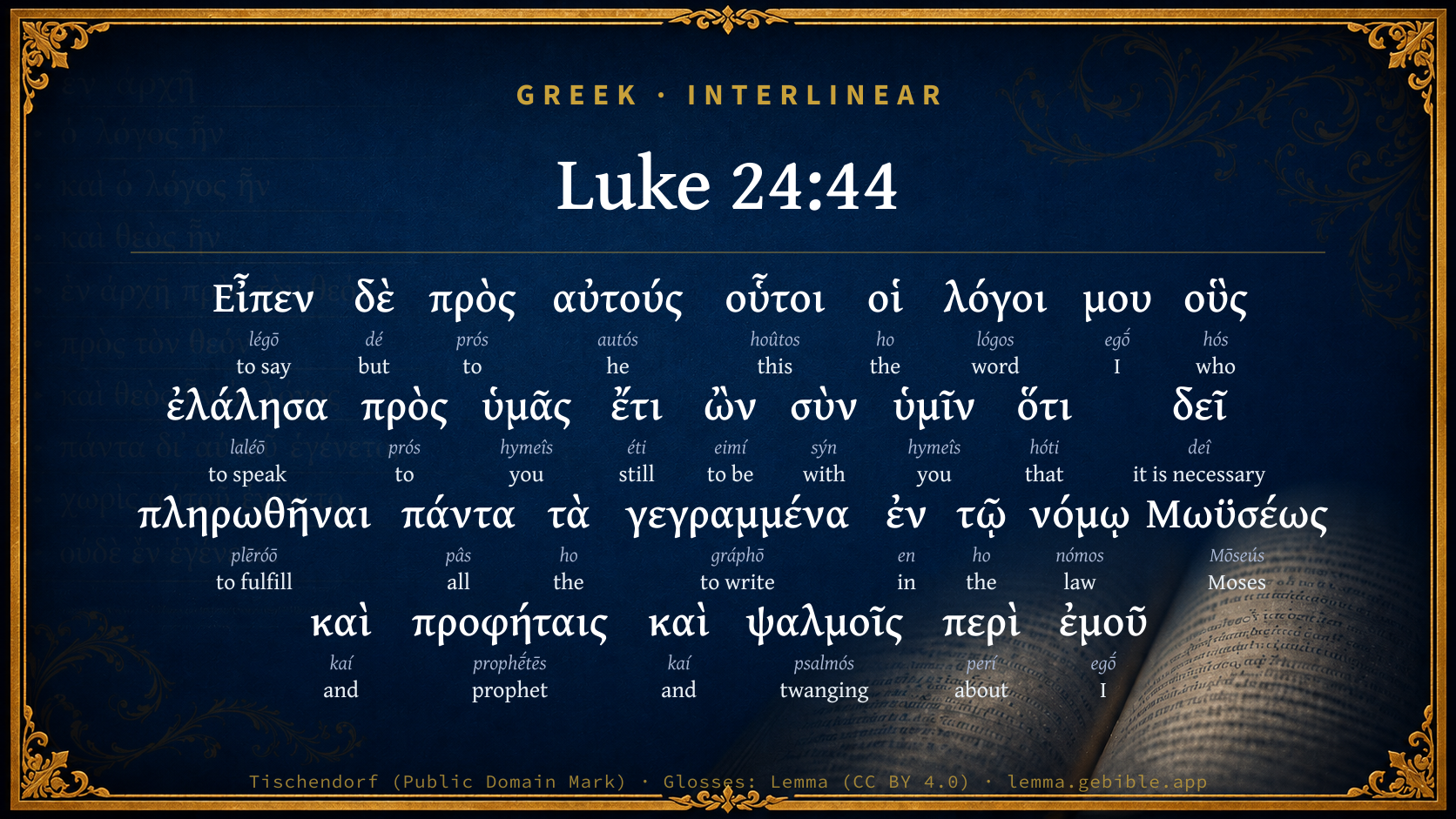
  1. Εἶπεν légō G3004 “to say” Verb, Aorist, Active, Indicative, 3rd person, Singular
  2. δὲ dé G1161 “but” Conjunction
  3. πρὸς prós G4314 “to” Preposition
  4. αὐτούς autós G846 “he” Personal pronoun, Accusative, Plural, Masculine
  5. οὗτοι hoûtos G3778 “this” Demonstrative pronoun, Nominative, Plural, Masculine
  6. οἱ ho G3588 “the” Article, Nominative, Plural, Masculine
  7. λόγοι lógos G3056 “word” Noun, Nominative, Plural, Masculine
  8. μου egṓ G1473 “I” Personal pronoun, 1st person, Genitive, Singular
  9. οὓς hós G3739 “who” Relative pronoun, Accusative, Plural, Masculine
  10. ἐλάλησα laléō G2980 “to speak” Verb, Aorist, Active, Indicative, 1st person, Singular
  11. πρὸς prós G4314 “to” Preposition
  12. ὑμᾶς hymeîs G5210 “you” Personal pronoun, 2nd person, Accusative, Plural
  13. ἔτι éti G2089 “still” Adverb
  14. ὢν eimí G1510 “to be” Verb, Present, Active, Participle, Nominative, Singular, Masculine
  15. σὺν sýn G4862 “with” Preposition
  16. ὑμῖν hymeîs G5210 “you” Personal pronoun, 2nd person, Dative, Plural
  17. ὅτι hóti G3754 “that” Conjunction
  18. δεῖ deî G1163 “it is necessary” Verb, Present, Active, Indicative, 3rd person, Singular
  19. πληρωθῆναι plēróō G4137 “to fulfill” Verb, Aorist, Passive, Infinitive
  20. πάντα pâs G3956 “all” Adjective, Accusative, Plural, Neuter
  21. τὰ ho G3588 “the” Article, Accusative, Plural, Neuter
  22. γεγραμμένα gráphō G1125 “to write” Verb, Perfect, Passive, Participle, Accusative, Plural, Neuter
  23. ἐν en G1722 “in” Preposition
  24. τῷ ho G3588 “the” Article, Dative, Singular, Masculine
  25. νόμῳ nómos G3551 “law” Noun, Dative, Singular, Masculine
  26. Μωϋσέως Mōseús G3475 “Moses” Noun, Genitive, Singular, Masculine
  27. καὶ kaí G2532 “and” Conjunction
  28. προφήταις prophḗtēs G4396 “prophet” Noun, Dative, Plural, Masculine
  29. καὶ kaí G2532 “and” Conjunction
  30. περὶ perí G4012 “about” Preposition
  31. ἐμοῦ egṓ G1473 “I” Personal pronoun, 1st person, Genitive, Singular

About this verse

These counts appear in no published source. They are computed here, from the morphology-tagged text and Lemma’s own curated glosses. What Lemma adds →

32
words
26
distinct lemmas
Gospels
section

Notable vocabulary

The rarest word here is ψαλμοῖς twanging G5568 — appearing just 7 times in the whole Greek New Testament.

Shared distinctive vocabulary

ψαλμοῖς twanging G5568 occurs in 7 verses of the Greek New Testament. Also found in:

Repetition

Words recur within this verse:

Cross-references

85

Topical passages linked to Luke 24:44 in the Treasury of Scripture Knowledge — connected by theme and wording, ordered by reader-vote popularity; previews shown in the World English Bible.

  • Zechariah 12:10 I will pour on the house of David, and on the inhabitants of Jerusalem, the spirit of grace and of supplication; and they will look to me whom they have pierced; and they shall mourn for him, as one mourns for his only son, and will grieve bitterly for him, as one grieves for his firstborn.
  • Luke 24:26–27 Didn't the Christ have to suffer these things and to enter into his glory?"
  • Zechariah 9:9 Rejoice greatly, daughter of Zion! Shout, daughter of Jerusalem! Behold, your king comes to you! He is righteous, and having salvation; Lowly, and riding on a donkey, Even on a colt, the foal of a donkey.
  • Acts 13:33 that God has fulfilled the same to us, their children, in that he raised up Jesus. As it is also written in the second psalm, 'You are my Son. Today I have become your father.'
  • Psalms 110:1–7 Yahweh says to my Lord, "Sit at my right hand, Until I make your enemies your footstool for your feet."
  • Isaiah 11:1–10 There shall come forth a shoot out of the stock of Jesse, and a branch out of his roots shall bear fruit.
  • Isaiah 7:14 Therefore the Lord himself will give you a sign. Behold, the virgin will conceive, and bear a son, and shall call his name Immanuel.
  • Luke 9:22 saying, "The Son of Man must suffer many things, and be rejected by the elders, chief priests, and scribes, and be killed, and the third day be raised up."
  • Deuteronomy 18:15–19 Yahweh your God will raise up to you a prophet from the midst of you, of your brothers, like me; to him you shall listen;
  • Acts 3:22–24 For Moses indeed said to the fathers, 'The Lord God will raise up a prophet for you from among your brothers, like me. You shall listen to him in all things whatever he says to you.
  • Revelation 19:10 I fell down before his feet to worship him. He said to me, "Look! Don't do it! I am a fellow bondservant with you and with your brothers who hold the testimony of Jesus. Worship God, for the testimony of Jesus is the Spirit of Prophecy."
  • Psalms 118:22 The stone which the builders rejected has become the head of the corner.
  • Isaiah 40:1–11 Comfort you, comfort you my people, says your God.
  • Hebrews 10:1 For the law, having a shadow of the good to come, not the very image of the things, can never with the same sacrifices year by year, which they offer continually, make perfect those who draw near.
  • Isaiah 9:6 For to us a child is born, to us a son is given; and the government shall be on his shoulder: and his name shall be called Wonderful, Counselor, Mighty God, Everlasting Father, Prince of Peace.
  • Isaiah 28:16 therefore thus says the Lord Yahweh, Behold, I lay in Zion for a foundation a stone, a tried stone, a precious corner -[stone] of sure foundation: he who believes shall not be in haste.
  • Zechariah 6:12 and speak to him, saying, 'Thus says Yahweh of Hosts, "Behold, the man whose name is the Branch: and he shall grow up out of his place; and he shall build the temple of Yahweh;
  • Luke 24:6–7 He isn't here, but is risen. Remember what he told you when he was still in Galilee,
  • John 5:46 For if you believed Moses, you would believe me; for he wrote about me.
  • Isaiah 42:1–4 Behold, my servant, whom I uphold; my chosen, in whom my soul delights: I have put my Spirit on him; he will bring forth justice to the Gentiles.
  • Daniel 9:24–27 Seventy weeks are decreed on your people and on your holy city, to finish disobedience, and to make an end of sins, and to make reconciliation for iniquity, and to bring in everlasting righteousness, and to seal up vision and prophecy, and to anoint the most holy.
  • Hosea 1:7–11 But I will have mercy on the house of Judah, and will save them by Yahweh their God, and will not save them by bow, nor by sword, nor by battle, by horses, nor by horsemen."
  • Hosea 3:5 Afterward the children of Israel shall return, and seek Yahweh their God, and David their king, and shall come with trembling to Yahweh and to his blessings in the last days.
  • Genesis 22:18 In your seed will all the nations of the earth be blessed, because you have obeyed my voice."
  • Psalms 22:1–31 My God, my God, why have you forsaken me? Why are you so far from helping me, and from the words of my groaning?
  • Psalms 72:1–20 God, give the king your justice; Your righteousness to the royal son.
  • Isaiah 52:13–53:12 Behold, my servant shall deal wisely, he shall be exalted and lifted up, and shall be very high.
  • Zechariah 13:7 "Awake, sword, against my shepherd, And against the man who is close to me," says Yahweh of Hosts. Strike the shepherd, and the sheep will be scattered; And I will turn my hand against the little ones.
  • Numbers 21:8 Yahweh said to Moses, Make you a fiery serpent, and set it on a standard: and it shall happen, that everyone who is bitten, when he sees it, shall live.
  • Psalms 2:1–12 Why do the nations rage, And the peoples plot a vain thing?
  • Psalms 40:6–8 Sacrifice and offering you didn't desire. You have opened my ears: Burnt offering and sin offering you have not required.
  • Psalms 109:4–20 In return for my love, they are my adversaries; But I am in prayer.
  • Isaiah 49:1–8 Listen, isles, to me; and listen, you peoples, from far: Yahweh has called me from the womb; from the bowels of my mother has he made mention of my name:
  • Ezekiel 34:23 I will set up one shepherd over them, and he shall feed them, even my servant David; he shall feed them, and he shall be their shepherd.
  • Genesis 3:15 I will put enmity between you and the woman, and between your offspring and her offspring. He will bruise your head, and you will bruise his heel."
  • Numbers 35:25 and the congregation shall deliver the manslayer out of the hand of the avenger of blood, and the congregation shall restore him to his city of refuge, where he was fled: and he shall dwell therein until the death of the high priest, who was anointed with the holy oil.
  • Psalms 16:9–11 Therefore my heart is glad, and my tongue rejoices. My body shall also dwell in safety.
  • Isaiah 50:2–6 Why, when I came, was there no man? when I called, was there none to answer? Is my hand shortened at all, that it can't redeem? or have I no power to deliver? Behold, at my rebuke I dry up the sea, I make the rivers a wilderness: their fish stink, because there is no water, and die for thirst.
  • Isaiah 61:1–3 The Spirit of the Lord Yahweh is on me; because Yahweh has anointed me to preach good news to the humble; he has sent me to bind up the broken-hearted, to proclaim liberty to the captives, and the opening [of the prison] to those who are bound;
  • Jeremiah 23:5 Behold, the days come, says Yahweh, that I will raise to David a righteous Branch, and he shall reign as king and deal wisely, and shall execute justice and righteousness in the land.
  • Ezekiel 17:22 Thus says the Lord Yahweh: I will also take of the lofty top of the cedar, and will set it; I will crop off from the topmost of its young twigs a tender one, and I will plant it on a high and lofty mountain:
  • Daniel 2:44 In the days of those kings shall the God of heaven set up a kingdom which shall never be destroyed, nor shall the sovereignty of it be left to another people; but it shall break in pieces and consume all these kingdoms, and it shall stand forever.
  • Daniel 7:13 I saw in the night-visions, and, behold, there came with the clouds of the sky one like a son of man, and he came even to the ancient of days, and they brought him near before him.
  • Joel 2:28–32 "It will happen afterward, that I will pour out my Spirit on all flesh; And your sons and your daughters will prophesy. Your old men will dream dreams. Your young men will see visions.
  • Zechariah 11:8–13 I cut off the three shepherds in one month; for my soul was weary of them, and their soul also loathed me.
  • Zechariah 14:4 His feet will stand in that day on the Mount of Olives, which is before Jerusalem on the east; and the Mount of Olives will be split in two, from east to west, making a very great valley. Half of the mountain will move toward the north, and half of it toward the south.
  • Malachi 3:1–3 "Behold, I send my messenger, and he will prepare the way before me; and the Lord, whom you seek, will suddenly come to his temple; and the messenger of the covenant, whom you desire, behold, he comes!" says Yahweh of hosts.
  • John 5:39 "You search the Scriptures, because you think that in them you have eternal life; and these are they which testify about me.
  • Hebrews 9:8 The Holy Spirit is indicating this, that the way into the Holy Place wasn't yet revealed while the first tabernacle was still standing;
  • Genesis 14:18 Melchizedek king of Salem brought forth bread and wine: and he was priest of God Most High.
  • Genesis 49:10 The scepter will not depart from Judah, Nor the ruler's staff from between his feet, Until he comes to whom it belongs. To him will the obedience of the peoples be.
  • Leviticus 16:2–19 and Yahweh said to Moses, "Tell Aaron your brother, not to come at all times into the Most Holy Place within the veil, before the mercy seat which is on the ark; lest he die: for I will appear in the cloud on the mercy seat.
  • Psalms 69:1–36 Save me, God, For the waters have come up to my neck!
  • Jeremiah 33:14 Behold, the days come, says Yahweh, that I will perform that good word which I have spoken concerning the house of Israel and concerning the house of Judah.
  • Micah 5:1–4 Now you shall gather yourself in troops, Daughter of troops. He has laid siege against us; They will strike the judge of Israel with a rod on the cheek.
  • Haggai 2:7–9 and I will shake all nations. The precious things of all nations will come, and I will fill this house with glory, says Yahweh of Hosts.
  • Malachi 4:2–6 But to you who fear my name shall the sun of righteousness arise with healing in its wings. You will go out, and leap like calves of the stall.
  • Luke 24:46 He said to them, "Thus it is written, and thus it was necessary for the Christ to suffer and to rise from the dead the third day,
  • John 3:14 As Moses lifted up the serpent in the wilderness, even so must the Son of Man be lifted up,
  • Psalms 88:1–18 Yahweh, the God of my salvation, I have cried day and night before you.
  • Amos 9:11 In that day I will raise up the tent of David who is fallen, and close up its breaches, and I will raise up its ruins, and I will build it as in the days of old;
  • Matthew 16:21 From that time, Jesus began to show his disciples that he must go to Jerusalem and suffer many things from the elders, chief priests, and scribes, and be killed, and the third day be raised up.
  • Matthew 17:22–23 While they were staying in Galilee, Jesus said to them, "The Son of Man is about to be delivered up into the hands of men,
  • Matthew 26:54 How then would the Scriptures be fulfilled that it must be so?"
  • Matthew 26:56 But all this has happened, that the Scriptures of the prophets might be fulfilled." Then all the disciples left him, and fled.
  • Luke 9:44 "Let these words sink into your ears, for the Son of Man will be delivered up into the hands of men."
  • Luke 21:22 For these are days of vengeance, that all things which are written may be fulfilled.
  • Luke 22:37 For I tell you that this which is written must still be fulfilled in me: 'He was counted with the lawless.' For that which concerns me has an end."
  • Acts 7:37 This is that Moses, who said to the children of Israel, 'The Lord our God will raise up a prophet for you from among your brothers, like me.'
  • Hebrews 3:5 Moses indeed was faithful in all his house as a servant, for a testimony of those things which were afterward to be spoken,
  • Hebrews 7:1 For this Melchizedek, king of Salem, priest of God Most High, who met Abraham returning from the slaughter of the kings and blessed him,
  • Matthew 20:18–19 "Behold, we are going up to Jerusalem, and the Son of Man will be delivered to the chief priests and scribes, and they will condemn him to death,
  • Mark 8:31–32 He began to teach them that the Son of Man must suffer many things, and be rejected by the elders, the chief priests, and the scribes, and be killed, and after three days rise again.
  • Mark 9:31 For he was teaching his disciples, and said to them, "The Son of Man is being handed over to the hands of men, and they will kill him; and when he is killed, on the third day he will rise again."
  • Mark 10:33–34 "Behold, we are going up to Jerusalem. The Son of Man will be delivered to the chief priests and the scribes. They will condemn him to death, and will deliver him to the Gentiles.
  • Luke 18:31–34 He took the twelve aside, and said to them, "Behold, we are going up to Jerusalem, and all the things that are written through the prophets concerning the Son of Man will be completed.
  • John 16:4–5 But I have told you these things, so that when the time comes, you may remember that I told you about them. I didn't tell you these things from the beginning, because I was with you.
  • John 16:16–17 A little while, and you will not see me. Again a little while, and you will see me."
  • John 17:11–13 I am no more in the world, but these are in the world, and I am coming to you. Holy Father, keep them through your name which you have given me, that they may be one, even as we are.
  • John 19:24–37 Then they said to one another, "Let's not tear it, but cast lots for it to decide whose it will be," that the Scripture might be fulfilled, which says, "They parted my garments among them. For my cloak they cast lots." Therefore the soldiers did these things.
  • Acts 3:18 But the things which God announced by the mouth of all his prophets, that Christ should suffer, he thus fulfilled.
  • Acts 13:29–31 When they had fulfilled all things that were written about him, they took him down from the tree, and laid him in a tomb.
  • Acts 17:2–3 Paul, as was his custom, went in to them, and for three Sabbath days reasoned with them from the Scriptures,
  • 1 Corinthians 15:3–4 For I delivered to you first of all that which I also received: that Christ died for our sins according to the Scriptures,
  • 1 Peter 1:11 searching for who or what kind of time the Spirit of Christ, which was in them, pointed to, when he predicted the sufferings of Christ, and the glories that would follow them.

Cross-references courtesy of OpenBible.info (CC BY 4.0).

Where the printed editions differ

1 variant

Places in this verse where the major printed Greek editions disagree on the wording in a way that affects the translation — a comparison of editions, not a manuscript-by-manuscript collation. The editions are the modern critical texts (Nestlé-Aland 28/27, SBL, Westcott-Hort, Tregelles, Tyndale House) and the traditional texts behind the KJV (the Textus Receptus and the Byzantine/Majority text). It is not a claim about which reading is original.

  1. Extra text
    μου

    “of mine”

    In NA28NA27TynSBLWHTreg Not in TRByz

    μου (mou) 'of mine' is only in older manuscripts (NA28+NA27+Tyn+SBL+WH+Treg)

Textual data: Translators Amalgamated Greek New Testament (STEPBible TAGNT) · CC BY 4.0.

Commentary

Notes on Luke 24:44 from classic Christian and Jewish commentators (each source and its license shown beneath its notes). The classic Christian expositions comment on the surrounding passage and are grouped to its opening verse, so a note may address several verses; the Jewish commentaries on the Tanakh (Rashi and others) are per-verse, so they appear only where the commentator wrote on this verse.

Lemma curates 59 commentaries, every one of them public domain or Creative Commons licensed, each selected and text-cleaned for this edition rather than reprinted as found. About our sources →

Joseph Benson's Commentary

Luk 24:44-48. And he said to them — Not, as appears, on the day of his resurrection, but on that of his ascension. These are the words which I spake to you — In private, frequently; while I was yet with you — Dwelling among you: we should better understand what Christ does, if we did but better remember what he hath said; that all must be fulfilled which is written in the law of Moses, and the prophets, and the psalms — Under these three, the Jews were wont to comprehend all the books of the Old Testament. Under the name law, the five books called the pentateuch were included; the chief of the historical books were joined with the prophets, and all the rest with the psalms. The prophecies, as well as types, relating to the Messiah, are contained in one or other of these books. Then opened he their understanding to understand the Scriptures — Especially in their reference to him. He had explained many parts of them before, repeatedly, in the course of his ministry, and since his resurrection, especially to the two as they went to Emmaus. But still they understood them not, till he took off the veil from their hearts, by the illumination of his Spirit. And he said, Thus it is written, &c. — Thus Moses and the prophets foretold that the Messiah should suffer, and rise from the dead on the third day, as Jesus had done; so that, if they had understood the Scriptures, instead of being stumbled at these events, and finding their faith in him as the Messiah shaken by them, they would thereby have found it confirmed. And that repentance and remission of sins — The two principal doctrines of the gospel, inclusive of, or leading to, all the others; should be preached — As they continually were by the apostles, both to Jews and Gentiles. And should they not still be preached? are they not as necessary to be preached as ever? in his name — In imitation of his example as a prophet; through his mediation and grace as a priest; and by his authority and ordinance, as a king; among all the Gentile nations — As well as among the Jews; beginning at Jerusalem — In God’s visible church, where there had long been the greatest light, and the greatest privileges and advantages; where the greatest blessings had been abused, and the greatest guilt contracted; and where, in a little time, judgment would begin, as mercy was to begin now. That the heralds of divine grace should begin at Jerusalem, was appointed both graciously and wisely; graciously, as it encouraged the greatest sinners to repent, when they saw that even the murderers of Christ were not excepted from mercy; and wisely, as hereby Christianity was more abundantly attested, the facts being published first on the very spot where they happened. And ye are witnesses of these things — Chosen of God, and appointed to be such; namely, witnesses of Christ’s life, doctrine, and miracles, and especially of his death, resurrection, and ascension.

Joseph Benson's Commentary on the Old and New Testaments (1811–1818) — public domain. Text from a community e-Sword module.

Whedon's Commentary on the Bible

Daniel D. Whedon

44, 45. Carefully tracing the entire passage, (Luk_24:12-53,) the reader is likely to see no break in the narrative, and will at first conclude that the ascension took place upon the night (or next morning) of the meeting of the two travellers to Emmaus with Jesus, namely, the day of the resurrection. And sceptical critics have stoutly maintained that Luke believed that the ascension took place on the same day with the resurrection. But we shall be relieved, perhaps, from this apparent difficulty by duly taking into view the manner of Luke.

The passage in the Acts (Act_1:1-12) actually goes over the same ground with this chapter, Luk_24:44-53. But if from the passage in Acts you strike out the two words “forty days,” you would suppose that the whole takes place on the day of the ascension; just as in the present Gospel passage you would suppose that all (ascension included) takes place upon the day of the resurrection. Transfer the words “forty days” to any place in the present passage which the syntax would allow, and you instantly see that the entire passage may as readily stretch over the forty days as the parallel passage in Acts. The “forty days,” therefore, explains both passages.

Some commentators suppose that Luk_24:43 terminates the Emmaus narrative, and that Luk_24:44-49 is a general summary of the teachings of Jesus during the “forty days.” Others extend the narrative and make the break at Luk_24:49. For reasons that will appear, we close the Emmaus narrative at Luk_24:45. In Luk_24:44 Jesus explains to them that the present events do but verify his past words and fulfil the Old Testament Scriptures. Luk_24:45, tied to Luk_24:44 by the then, avers that the Lord closed by opening their understanding to comprehend and digest at future leisure the Scripture fulfilments. Thus much looks to the past; what follows (Luk_24:46-49) looks to the future.

44. These are the words—Words, by a Hebraism, signifies the things or events signified by the words. These refers to the events of his death, resurrection, and reappearance. No longer need the apostles doubt, when this whole train of strange events is but the fulfilment of his sayings and of the Scriptures.

Daniel D. Whedon (gen. ed.), Commentary on the Old and New Testaments (1874–1909) — public domain. Text from a community e-Sword module.

The Preacher's Complete Homiletical Commentary

Joseph S. Exell (gen. ed.)

CRITICAL NOTES

Luk_24:44. These are the words.—I.e., “this is the meaning of the words.” Probably in Luk_24:44-49 St. Luke gives a summary of Christ’s discourses during the time between the Resurrection and the Ascension. Law of Moses, etc.—Perhaps here we have a reference to the Jewish division of the books of the Old Testament—i.e., into the Pentateuch, the Prophets (Joshua, Judges, four books of Kings, and the Prophets, except Daniel), and the Hagiographa.

Luk_24:45. Then opened.—Cf. Luk_24:27.

Luk_24:46. And thus it behoved.—Omit these words; omitted in R.V.; probably an explanatory note.

Luk_24:48. These things.—I.e., His death and resurrection.

Luk_24:49. The promise of My Father.—The allusion is to Old-Testament prophecies and to the discourses in John 14-16. Tarry ye.—Lit. “sit ye down.” City of Jerusalem.—Rather, “the city” (R.V.). Endued.—Rather, “clothed” (R.V.). Cf. Jdg_6:34, where the same figure is used in the original.

Luk_24:50. Led them out.—I.e., either from the house in which they were, or from the city. As far as Bethany.—“Not quite to the village itself, but over the brow of the Mount of Olives, where it descends on Bethany; see Act_1:12” (Alford). “On the wild uplands which immediately overhang the village, He finally withdrew from the eyes of His disciples, in a seclusion which, perhaps, could nowhere else be found so near the stir of a mighty city; the long ridge of Olivet screening those hills, and those hills the village beneath them, from all sound or sight of the city behind; the view opening only on the wide waste of desert-rocks and ever-descending valleys, into the depths of the distant Jordan and its mysterious lake. At this point the last interview took place. ‘He led them out as far as Bethany;’ and they ‘returned’ probably by the direct road over the summit of Mount Olivet. The appropriateness of the real scene presents a singular contrast to the inappropriateness of that fixed by a later fancy, ‘seeking for a sign,’ on the broad top of the mountain, out of sight of Bethany, and in full sight of Jerusalem, and thus in equal contradiction to the letter and the spirit of the gospel narrative” (Stanley, Sinai and Palestine). Lift up his hands.—Rather, “lifted up His hands” (R.V.), “lift” being archaic. The attitude was that of prayer and benediction.

Luk_24:51. Was parted from them.—Rather, “parted from them” (R.V.); the verb is not in the passive. Carried up.—“Not by an angel or by a cloud, but absolutely and without reference to any particular agent. We must imagine our Saviour slowly rising above His disciples, with His hands still raised in the attitude of blessing, until a cloud conceals Him from the eyes of His followers.”—Speaker’s Commentary.

Luk_24:52. Worshipped Him.—This can only mean here the adoration which is offered to a Divine Being. With great joy.—“The joy of the disciples in consequence of their Master’s exaltation, which was a pledge of the victory of His cause, already fulfilled the saying of Jesus, ‘If ye loved Me ye would rejoice, because I said, I go unto the Father, for My Father is greater than I (Joh_14:28)” (Godet). “A prelude to Pentecost” (Bengel). Amen.—Omit this word; omitted in R.V.; probably a liturgical addition.

MAIN HOMILETICS OF THE PARAGRAPH.—Luk_24:44-53

The Church Below, the Lord Above.—These closing verses of the Gospel are a summary of all our Lord’s instructions during the forty days before the Ascension. The Gospel reaches its climax in the Resurrection. The space between it and the Ascension, as well as the Ascension itself, are but the results of the Resurrection manifested in act, and as a kind of border-land between the two halves of our Lord’s activity, are even more properly narrated as the foundation of “all that Jesus” continued “to do and teach” since then, than as the crown of His earthly ministry.

I. The teachings of the forty days (Luk_24:44-49).—

1. First was taught Christ’s relation to the Old Testament. He recalled His former declarations, which had sounded so enigmatical then, and were so clear now. The teaching here summarised bore both upon His dignity and office as the Christ and the Fulfiller of the Old-Testament revelation, and on the inmost purpose and contents of that revelation as in all its parts pointing onward to Him. Law, Prophets, and Psalms make up the whole Hebrew Scriptures. So Jesus saw Himself in all the sundry times and divers manners of the older Word of God. The fact of prediction of Him as Messiah, and of His death and resurrection as being the very heart of the Old Testament, is attested by His own authority, which cannot be waived aside as of no moment in the controversies now raging as to these books. Nor can we understand the significance of the Old Testament by dint of learning only. There must be a moral and spiritual preparation; Jesus must open our minds, that we may understand the Scriptures.

2. Instruction in the universal blessings flowing from His death and resurrection. If any gross idea of outward dominion, secured by the sword, lingered in the disciples’ minds, this teaching would end them, unfolding, as it did, the sublime prospect of a universal monarchy, of which the instrument was the proclamation of the Cross and Resurrection, and of which the blessings were repentance and the remission of sin. The weapon seems feeble, but it is mighty, because it is in His name, “based on His revealed character and nature, wielded by His authority, and in dependence on His might, and in a very real sense as representing Himself.

3. The personal duty of the disciples. “Ye are witnesses of these things.” For the first disciples that was true in a way that it cannot be for us. And it is significant of much that the office was declared by Jesus to be that of witnesses; for witness implies “fact.” Not theories nor principles, nor speculations, nor dogmas, still less imaginations and fancies, had they to speak. The gospel is a veracious record of things that actually happened, and is established, not by argument, but by testimony. In a sense, each generation of Christians has the same office and responsibility. We cannot say we have seen, but we can say we have felt. Every man who has himself tasted that the Lord is gracious, is able, and therefore bound, to proclaim Him to others. The Church, in all its members, is Christ’s witness.

4. The gift of the needful qualifications. “The promise of My Father” is that Holy Spirit which is the last of all the Father’s promised gifts, of which He had spoken so abundantly in the last discourses in the upper room, and which, according to St. John, He had breathed upon them when He rose. The possession of that gift is our fitness for the office of witnessing.

II. The departure.—Did the disciples know, like Elisha, that “the Lord would take away their Master from their head that day”? At all events He knew, and the knowledge would breathe peculiar tenderness and urgency over His unrecorded words. “He lifted up His hands and blessed them.” Like the high priest when he had finished his service, He lifted up His hands over the congregation to give the blessing. The hands which had been pierced with nails, the arms which had been stretched out upon the cross, were spread above the bowed heads of the little group, and dropped gifts which fulfilled His benediction. His whole work is summed up, and His whole heart revealed, in that last attitude and act. Sweet, and ever to be remembered, are the last looks of our dear ones. Jesus would have this remembrance of Him stamped deepest on all our hearts. In the act of blessing, our Lord withdrew a step or two, and then, possibly, with arms still lifted in benediction, “was carried up into heaven.” The word employed implies a slow, continuous motion, which we cannot but contrast with the whirlwind which swept Elijah to heaven. The mortal needed to be lifted by an external and forcible agency from his native earth. But Jesus was going to His own home, and needed no aid to raise Him thither, whence it had needed the strong compulsion of His infinite love to bring Him down. The Ascension witnesses to the completeness of His sacrifice, to its acceptance by the Father, to the presence within the veil of our all-powerful Intercessor, to the elevation to supreme authority of the Man who is our Brother. The eternal Word ascended where He had been from before the beginning, but the manhood is new to the throne of the universe. Where He is, there shall also His servants be; and as He is, so shall they, too, become. The disciples showed us how we should think of the Ascension, when they worshipped Him, thus declaring Him to be the Son of God, and then turned all the more joyfully to their homely tasks, and drowned the pain of parting in the flood of joy which poured over their spirits. They made all life worship, every place a temple, and every act and word adoration.—Maclaren.

SUGGESTIVE COMMENTS ON Luk_24:44-53

Luk_24:44-49. The Last Instructions.

I. He recalls His earlier teaching, and causes them to understand the fulfilment He had effected of the prophecies of the Old Testament.

II. He gives directions for the future, and promises help to enable them to accomplish their task.

Luk_24:44. “While I was yet with you.”—The expression is worthy of notice, for it proves that Jesus felt that His departure was already accomplished. He was no longer with them otherwise than exceptionally. His abode was elsewhere.—Godet.

Luk_24:45. “Opened their understanding.”—This teaches us

(1) that Christ has immediate access to the human spirit and power over it; and

(2) that the interpretations of the Old Testament given by the apostles have the direct sanction of Christ.

“That they might understand the scriptures.”—The Word of God by itself is not sufficient; for our due understanding of it we need the illumination of the Spirit.

Luk_24:46-47. The Substance of Christian preaching.

I. Good tidings founded upon the work of the Saviour—His sufferings and His resurrection.

II. The duty of repentance.

III. The privilege of the remission of sins.

Luk_24:46. “To suffer and to rise.”—Here, as everywhere, suffering and glory are inseparably connected.

Luk_24:47. “Beginning at Jerusalem.”—

1. Jerusalem was the centre of the then existing kingdom of God.

2. It contained the worst of sinners—those who had insulted and crucified the Saviour.

Luk_24:48. “Ye are witnesses.”—That which renders testimony valuable is its being given by witnesses who are

(1) possessed of full information;

(2) who are sincere in character; and

(3) who are sober-minded. In all these points the apostles were admirably qualified for their office as witnesses, and their willingness to seal their testimony with their blood shows us how firmly convinced they were of the truths they taught.

Luk_24:49. “The promise of the Father.”—The gift of the Spirit as bestowed on the day of Pentecost. This gift promised in Isa_44:3; Jer_31:33; Eze_36:27; Joe_2:28.

An Equipment of Power.

I. The Lord’s servants must be men of power.

II. An equipment of power is provided.—

1. It is power.

2. It is power from on high.

3. It is not developed out of ourselves.

4. Nor is it obtained by connection with the world.

III. Power is to be waited for.—Roberts.

Ministerial Power.—Some of those powers of the Spirit which experience teaches us to be of most avail in meeting the exigencies of ministerial life in our time.

I. The power of holiness.

II. The power of knowledge.

III. The power of a single aim.

IV. The power of sympathy.

V. The power of the Divine commission.—Vaughan.

Luk_24:50-53. The Ascension.

I. The identity of the crucified and risen Saviour.

II. We, too, must ascend, to be judged, to stand before the throne.

III. The goal of the Church’s hope is the return of the ascended Christ.—Markby.

Christ’s Departure.

I. He ascended by His own power and His own will.

II. He alone left behind Him a finished work.

III. He ascended to begin the second work.—That of intercession—distinct from the work on earth, but yet of one piece with it, and serving to accomplish the same great end.

IV. By His Spirit, He still works in the world.

V. He has marked a way for us into heaven.—A track of light goes through the darkness into the very heart of heaven.—Nicoll.

The Ascension.

I. The gospel is all fact.—All our gospel mysteries, are, in their basis and substance, facts. The Christian year is a commemoration of facts. The Ascension is an event, a historical fact.

II. It is something more.—It is not mere history; it is a life. Like each gospel fact, it presupposes or else predicts every other. The Ascension presupposes the Incarnation, and predicts the Advent. The Ascension says:

1. Your home is not here. Yonder is your rest and your home. Home is a presence more than a place. Where Christ is, is the soul’s true home.

2. Seek Him yonder, correct all that is superstitious and carnal in your religion.—Vaughan.

Luk_24:50. Christ’s Last Hours on Earth.

I. The last meeting.

II. The last journey.

III. The last promise.

IV. The last blessing.

V. The last glimpse.—W. Taylor.

“He lifted up His hands.”—As a father, who is about to leave his children, gathers them together once more, speaks to them, and then raises his hands to bless them, so, at the moment of re-entering into the invisible world, Jesus imposes a benediction upon the head of His apostles which will remain upon the whole Church until His return.—Godet.

Luk_24:51. “While He blessed them.”—As Elijah left his mantle with Elisha, by whom he was seen when taken up, so Christ, at His ascension, left a blessing with His apostles and with His Church.—Wordsworth.

“Carried up into heaven.”—By His resurrection He had taken up again His human life which He had voluntarily given up to death; by His ascension He resumes His celestial life, His life in the form of God (Php_2:6), which He had laid aside on becoming incarnate in human form. And in the new condition in which His exaltation places Him, His human life is so interpenetrated by His Divine life that it becomes the adequate and eternal manifestation of it. “I see,” said the dying Stephen, “the Son of Man standing at the right hand of God” (Act_7:56). “The fulness of the Godhead dwells in Him in a bodily form” (Col_2:9).—Godet.

The Parting Blessing.—The Saviour’s life had been one of continual blessing. And here we have the last impression left on the apostles’ minds of their Lord’s feeling towards them. His last thoughts were with them, His last energies were for them.

I. This thought is the inheritance of the Church.—The “while” bound Christ and the Church together, in the power of a last impression, for the rest of their earthly lives. His ascent on high does not sever Him in blessing from us.

II. But besides connection there is activity.—The ascended Christ is a blessing Christ, unchanged by His exaltation. He uses His exaltation for the benefit of His friends.

III. The thought we should have of the other world is, therefore, one of joy.—To the Christian the unseen must ever be a place of blessing. The place whither Jesus went must partake of His aspect in entering it. The disciples knew, from their Master’s teaching, something of the awfulness of the other world. But now He leaves them something better to think of. He is to bless from heaven. It was to be henceforth a place in which they had the dearest interest. He blessed in ascending, and if so, what but blessing could they look for from that other sphere?—Power.

Luk_24:52. “They worshipped Him.”—No one can reasonably doubt that this worship was offered to Him as a Divine being. St. Luke only uses this word in another place in his gospel (Luk_4:7-8), and there it is used in the sense of rendering the honour due to God alone. In the Acts it is employed in the same sense (Luk_7:43, Luk_8:27, Luk_24:11, Luk_10:25-26).

Luk_24:53. “In the Temple.”—The narrative of St. Luke begins in the Temple and ends in the Temple.

“Praising and blessing God.”—The two essential elements of worship.

I. Adoration.—Acknowledgment of the Divine perfections.

II. Thanksgiving for all the benefits He has bestowed.

The Preacher's Complete Homiletical Commentary (gen. ed. Joseph S. Exell; Funk & Wagnalls, c. 1892) — public domain (pre-1929). A full-Bible homiletical/sermon-outline anthology covering 65 of 66 books (2 John is absent from the source module). Text from a community e-Sword module.

Tyndale Open Study Notes

Tyndale Open Resources

24:44 the law of Moses and the prophets and in the Psalms: Jesus referred to the three sections of the Hebrew Scriptures: the Law, the Prophets, and the Writings. The entire Old Testament points to God’s salvation through Christ.

Tyndale Open Study Notes — © Tyndale Open Resources, licensed CC BY-SA 4.0. Text via the HelloAO Bible API.

Bengel's Gnomon

Johann Albrecht Bengel

Luk 24:44. Εἶπε, He said) namely, on the day of the Ascension. See Luk 24:50, with which comp. Act 1:2; Act 1:5; Act 1:9.[273]—ἔτι, as yet) It was a thing sad to hear of, before that it took place; but now most joyous, when it has taken place.—ἐν τῷ νόμῳ, κ.τ.λ., in the law, etc.) Here we have the division of the Hebrew Bible [the Law, the Prophets, and the Hagiographa],—προφήταις, the Prophets) the former and later Prophets. It is in reference to the former ones, that the Prophets are put before the Psalms. As to the Twelve especially, see Sir 49:12.—ψαλμοῖς, the Psalms) The Hagiographa, the foremost place in which is occupied by the Psalms, a remarkable portion of the Scriptures, in which also the subject of Christ and His kingdom is most copiously discussed. See note on Heb 10:8 [which quotes Psa 40:6, “Sacrifice and offering Thou didst not desire—then said I, Lo, I come,” etc.; proving the great authority of the Psalms].

[273] Verse 47, “Beginning at Jerusalem.” accords with Act 1:8, “Ye shall be witnesses to Me, both in Jerusalem,” etc., spoken just before the Ascension.—E. and T.

Bengel's Gnomon of the New Testament — English translation (T&T Clark, Edinburgh, 1860) — public domain. Text from a community e-Sword module.

Meyer's Critical & Exegetical Commentary

Heinrich August Wilhelm Meyer

Luk_24:44. Εἶπεν δὲ αὐτοῖς] after the eating; a continuation of the same scene. According to the simple narrative, it is altogether unwarrantable to place an interval between these two passages.[277] No impartial reader could do this, and how easy would it have been for Luke to give a hint to that effect!

οὗτοι οἱ λόγοι κ.τ.λ.] these (namely, that Ias ye have now convinced yourselvesafter my sufferings and death have actually arisen) are the words (in their realization, namely) which I spoke to you while I was yet with you, to wit, that all things must he fulfilled, etc. (the substance of the λόγοι). Jesus assuredly often actually said this to them, according to the substance generally. Comp. Luk_18:31 f., Luk_22:37; Mat_26:56, and elsewhere.

ἔτι ὢν σὺν ὑμ.] for by death He was separated from them, and the earlier association with them was not, moreover, now again after the resurrection restored.[278]

ἘΝ Τῷ ΝΌΜῼ Μ. Κ. ΠΡΟΦ. Κ. ΨΑΛΜΟῖς] certainly contains in itself that which is essential of the Jewish tripartite division of the Canon into law (תוֹרָה), prophets (נְבִיאִים), and Hagiographa (כְּתוּבִים). Under the law was reckoned merely the Pentateuch; under the prophets, Joshua, Judges , 1 James , 2 d Samuel, 1James , 2 d Kings (נְבִיאִים רִאשׁוֹנִים), and the prophets properly so called, except Daniel (נְבִיאִים אַהֲרו̇נִים); under the Hagiographa, all the rest of the canonical Scriptures, including Daniel, Esther, Ezra and Nehemiah (the two reckoned together as one book), and Chronicles. See Bava Bathra f. xiv. 2; Lightfoot, p. 900. Yet, according to the use of προφητ. and ψαλμ. elsewhere (comp. Luk_20:42) from the mouth of Jesus, it is not to be assumed that He by these two designations intended to express that definite literary historical extent of the נביאים, and the whole of the Hagiographa. He means the prophets proper who have prophesied of Him (Luk_24:25), from whom He certainly, moreover, did not think Daniel excluded (Mat_24:15); and by ΨΑΛΜ., the actual Psalms in the accustomed sense as that portion of the Scripture in which, besides the law and the prophets, the Messianic prophecy is chiefly deposited. Moreover, observe the non-repetition of the article before ΠΡΟΦ. and ΨΑΛΜ., whereby the three portions appear in their connection as constituting one whole of prophecy.

[277] But to say, with Ebrard, p. 596, that the passage vv. 4449 depicts in general the whole of the teaching communicated to the disciples by Christ after His resurrection, is just as marvellous a despairing clutch of harmonistics. So also older harmonists, and even Grotius. Wieseler, in the Chronol. Synopse, p. 423 f., like Bengel and others, places between ver. 43 and ver. 44 the forty days, after the lapse of which ver. 44 ff. is spoken on the day of the ascension. But his proof depends on the presupposition that in the Gospel and in Acts 1. Luke must needs follow the same tradition in respect of the time of the ascension. The separation of ver. 44 from what precedes ought not only to have been prevented by the use of the δέ (comp. on ver. 50), but also by the use of the οὗτοι, referring as it does to what goes before. Lange, L. J. II. 3, p. 1679, represents ver. 45, beginning with τότε διὴνοιξεν κ.τ.λ., as denoting the forty days ministry of Jesus begun on that evening; for he maintains that the unfolding of the knowledge did not occur in a moment. But why not? At least there needed no longer time for that purpose than for the instructions of ver. 27. Rightly, Hofmann, Schriftbew. II. 2, p. 5, declares himself opposed to separations of that kind; nevertheless, he afterwards comes back to a similar arbitrary interpolation of the forty days in vv. 4549. If the place for the forty days has first been found here, there is indeed sufficient room to place the direction of ver. 49, καθίσατε ἐν τῇ πόλει κ.τ.λ., first after the return of the disciples from Galilee, as Lange does; but Luke does not, since he here absolutely excludes a withdrawal on their part to Galilee. Ewald rightly recognises (Gesch. des Apost. Zeitalt. p. 93) that Luke limits all appearances of the Risen One to the resurrection Sunday. So also, impartially, Bleek, Holtzmann.

[278] Grotius well says: nam tunc tantum κατʼ οἰκονομίαν illis aderat.

Meyer — Critical and Exegetical Commentary on the New Testament — English translation by Peter Christie, edited by Frederick Crombie (T&T Clark, 1880) — public domain. Text from a community e-Sword module.

Expositor's Greek Testament

ed. W. Robertson Nicoll

Luk 24:44-49 . Parting words . εἶπε δὲ αὐτοῖς : it is at this point, if anywhere, that room must be made for an extended period of occasional intercourse between Jesus and His disciples such as Act 1:3 speaks of. It is conceivable that what follows refers to another occasion. But Lk. takes no pains to point that out. His narrative reads as if he were still relating the incidents of the same meeting. In his Gospel the post-resurrection scenes seem all to fall within a single day, that of the resurrection. οὗτοι οἱ λόγοι , etc., these are the words. With Euthy. Zig. we naturally ask: which? ( οὗτοι · ποῖοι ; and there he leaves it). Have we here the concluding fragment of a longer discourse not given by Lk., possibly the end of a document containing a report of the words of Jesus generally (so J. Weiss in Meyer)? As they stand in Lk.’s narrative the sense must be: these events (death and resurrection) fulfil the words I spoke to you before my death. If that be the meaning the mode of expression is peculiar. ἐν τ . ν . Μωσέως , etc.: Moses, Prophets, Psalms, a unity (no article before προφήταις or ψαλμοῖς ) = the whole O.T. canon. So most. Or, these three parts of the O.T. the main sources of the Messianic proof (Meyer, Hahn, etc.). The latter the more likely.

The Expositor's Greek Testament, edited by W. Robertson Nicoll (1897–1910) — public domain. Text from a community e-Sword module.

Godet's Commentaries

Frédéric Louis Godet

5. The last Instructions: Luk 24:44-49.

Vers. 44-49. Meyer, Bleek, and others think that all the sayings which follow were uttered this same evening, and that the ascension itself must, according to Luke, have followed immediately, during the night or toward morning. Luke corrected himself later in the Acts, where, according to a more exact tradition, he puts an interval of forty days between the resurrection and the ascension. A circumstance which might be urged in favour of this hypothesis is, that what Luke omits in the angel’s message (Luk 24:6) is precisely the command to the disciples to return to Galilee. But, on the other hand: 1. May it not be supposed that Luke, having reached the end of the first part of his history, and having the intention of repeating those facts as the point of departure for his second, thought it enough to state them in the most summary way? 2. Is it probable that an author, when beginning the second part of a history, should modify most materially, without in the least apprising his reader, the recital of facts with which he has closed his first? Would it not have been simpler and more honest on the part of Luke to correct the last page of his first volume, instead of confirming it implicitly as he does, Act 1:1; ?Act 1:23. The τότε, then (Luk 24:45), may embrace an indefinite space of time. 4. This more general sense harmonizes with the fragmentary character of the report given of those last utterances: Now He said unto them, Luk 24:44: and He said unto them, Luk 24:46. This inexact form shows clearly that Luke abandons narrative strictly so called, to give as he closes the contents of the last sayings of Jesus, reserving to himself to develope later the historical account of those last days. 5. The author of our Gospel followed the same tradition as Paul (see the appearance to Peter, mentioned only by Paul and Luke). It is, moreover, impossible, considering his relations to that apostle and to the churches of Greece, that he was not acquainted with the first Epistle to the Corinthians. Now, in this epistle a considerable interval is necessarily supposed between the resurrection and the ascension, first because it mentions an appearance of Jesus to more than 500 brethren, which cannot have taken place on the very day of the resurrection; and next, because it expressly distinguishes two appearances to the assembled apostles: the one undoubtedly that the account of which we have just been reading (1Co 15:6); the other, which must have taken place later (Luk 24:7). These facts, irreconcilable with the idea attributed by Meyer and others to Luke, belonged, as Paul himself tells us, 1Co 15:1-3, to the teaching generally received in the Church, to the παράδοσις. How could they have been unknown to such an investigator as Luke? How could they have escaped him in his first book, and that to recur to him without his saying a word in the second? Luke therefore here indicates summarily the substance of the different instructions given by Jesus between His resurrection and ascension all comprised in the words of the Acts: “After that He had given commandments unto the apostles” (Act 1:2).

Ver. 44 relates how Jesus recalled to them His previous predictions regarding His death and resurrection, which fulfilled the prophecies of the O. T.—Οὗτοι οἱ λόγοι, an abridged phrase for ταῦτα ἐστιν οἱ λόγοι: “These events which have just come to pass are those of which I told you in the discourses which you did not understand.” The expression: while I was yet with you, is remarkable; for it proves that, in the mind of Jesus, His separation from them was now consummated. He was with them only exceptionally; His abode was elsewhere.

The three terms: Moses, Prophets, Psalms, may denote the three parts of the O. T. among the Jews: the Pentateuch; the Prophets, comprising, with the historical books (up to the exile), the prophetical books; the Psalms, as representing the entire group of the hagiographa. Bleek rather thinks that Jesus mentions here only the books most essential from a prophetic point of view (περὶ ἐμοῦ). If it is once admitted that the division of the canon which we have indicated existed so early as the time of Jesus, the first meaning is the more natural.

Jesus closes these explanations by an act of power for which they were meant to prepare. He opens the inner sense of His apostles, so that the Scriptures shall henceforth cease to be to them a sealed book. This act is certainly the same as that described by John in the words (Luk 20:22): “And He breathed on them, saying, Receive ye the Holy Ghost.” The only difference is, that John names the efficient cause, Luke the effect produced. The miracle is the same as that which Jesus shall one day work upon Israel collectively, when the veil shall be taken away (2Co 3:15-16).

At Luk 24:46 there begins a new resumé—that of the discourses of the risen Jesus referring to the future, as the preceding bore on the past of the kingdom of God. Καὶ εἶπεν, and He said to them again. So true is it that Luke here gives the summary of the instructions of Jesus during the forty days (Act 1:3), that we find the parallels of these verses scattered up and down in the discourses which the other Gospels give between the resurrection and ascension. The words: should be preached among all nations, recall Mat 28:19: “Go and teach all nations,” and Mar 16:15: “Go ye into all the world, and preach the gospel to every creature.” The words: preaching repentance and remission of sins, recall Joh 20:23: “Whosesoever sins ye remit, they are remitted unto them.” Luk 24:46 forms the transition from the past to the future (Luk 24:47). ῞Οτι depends on: it was so, understood.

The omission of καὶ οὕτως ἔδει, thus it behoved, by the Alex. cannot be justified; it has arisen from negligence. Jesus declares two necessities: the one founded on prophecy (thus it is written), the other on the very nature of things (it behoved). The Alex. reading: repentance unto pardon, instead of: repentance and pardon, has no internal probability. It would be a phrase without analogy in the whole of the N. T.

The partic. ἀρξάμενον is a neut. impersonal accusative, used as a gerund. The Alex. reading ἀρξάμενοι is a correction.

The thought that the kingdom of God must spread from Jerusalem belonged also to prophecy (Psa 110:2, et al.); comp. Act 1:8, where this idea is developed.

To carry out this work of preaching, there must be men specially charged with it. These are the apostles (Luk 24:48). Hence the ὑμεῖς, ye, heading the proposition. The thought of Luk 24:48 is found Joh 15:27: that of Luk 24:49, Joh 15:26.

A testimony so important can only be given worthily and effectively with divine aid (Luk 24:49). ᾿Ιδού, behold, expresses the unforeseen character of this intervention of divine strength; and ἐγώ, I, is put foremost as the correlative of ὑμεῖς, ye (Luk 24:48): “Ye, on the earth, give testimony; and I, from heaven, give you power to do so.” When the disciples shall feel the spirit of Pentecost, they shall know that it is the breath of Jesus glorified, and for what end it is imparted to them. In the phrase: the promise of the Father, the word promise denotes the thing promised. The Holy Spirit is the divine promise par excellence. It is in this supreme gift that all others are to terminate. And this aid is so indispensable to them, that they must beware of beginning the work before having received it. The command to tarry in the city is no wise incompatible with a return of the disciples to Galilee between the resurrection and ascension. Everything depends on the time when Jesus spoke this word; it is not specified in the context. According to Act 1:4, it was on the day of His ascension that Jesus gave them this command. The Alex. reject the word Jerusalem, which indeed is not necessary after Luk 24:47.

Frédéric Louis Godet — Commentaries on Luke, John, Romans, and 1 Corinthians — English translation (T&T Clark, Edinburgh, 1870s–1890s) — public domain. Text from a community e-Sword module.

Geneva Bible (1599)

Geneva Bible translators

The preaching of the Gospel, which was promised to the Prophets and performed in his time, is committed unto the Apostles: the sum whereof, is repentance and remission of sins.

Geneva Bible (1599) marginal notes — public domain. Text via Bolls.life.

Jamieson, Fausset & Brown

Robert Jamieson, A. R. Fausset & David Brown

These are the words, &c.--that is, "Now you will understand what seemed so dark to you when I told you about the Son of man being put to death and rising again" (Luk 18:31-34).

while . . . yet with you--a striking expression, implying that He was now, as the dead and risen Saviour, virtually dissevered from this scene of mortality, and from all ordinary intercourse with His mortal disciples.

law . . . prophets . . . psalms--the three Jewish divisions of the Old Testament Scriptures.

Jamieson, Fausset & Brown — Commentary Critical and Explanatory on the Whole Bible (1871) — public domain (CC PDM 1.0). Text via the HelloAO Bible API.

Adam Clarke's Commentary

Verse 44. The law - the prophets - the psalms] This was the Jewish division of the whole old covenant. The LAW contained the five books of Moses; the PROPHETS, the Jews divided into former and latter; they were, according to Josephus, thirteen. "The PSALMS included not only the book still so named, but also three other books, Proverbs, Job, and Canticles. These all," says the above author, "contain hymns to God, and rules for the conduct of the lives of men." Joseph. Cont. App. i. 8. This account is imperfect: the common Jewish division of the writings of the old covenant is the following, and indeed seems to be the same to which our Lord alludes: -

I. The LAW, תורה thorah, including Genesis, Exodus, Leviticus, Numbers, and Deuteronomy.

II. The PROPHETS, נביאים, nabiaim, or teachers, including Joshua, Judges, the two books of Samuel, and the two books of Kings: these were termed the former prophets. Isaiah, Jeremiah, Ezekiel, Hosea, Joel, Amos, Obadiah, Jonah, Micah, Nahum, Habakkuk, Zephaniah, Haggai, Zechariah, and Malachi: these were termed the latter prophets.

III. The HAGIOGRAPHA, (holy writings), כתובים kethuvim, which comprehended the Psalms, Proverbs, Job, Canticles, Ruth, Lamentations, Ecclesiastes, Esther, Daniel, Ezra, Nehemiah, and the two books of Chronicles. The Jews made anciently only twenty-two books of the whole, to bring them to the number of the letters in the Hebrew alphabet; and this they did by joining Ruth to Judges, making the two books of Samuel only one; and so of Kings and Chronicles; joining the Lamentations to Jeremiah, and making the twelve minor prophets only one book.

Adam Clarke's Commentary on the Bible (1810–1826) — public domain. Text from a community e-Sword/MySword module.

Ellicott's Commentary for English Readers

(44) These are the words which I spake unto you.—As with the travellers to Emmaus, so now with the Ten who were present, our Lord leads His disciples to the true method of interpreting the prophecies which foretold the Christ. And that method was not an afterthought. It had been given in hints and outlines before; now they were led to see it in its fulness. The three-fold division of the Law, the Prophets (including most of the historic books), and the Psalms (the latter term standing for the whole of the Kethubim, the Hagiographa or “holy writings,” of which the Psalms were the most conspicuous portion), corresponded to that which was in common use among the Jews. (See General Introduction I.—The Books of the New Testament.)

A Bible Commentary for English Readers, edited by Charles John Ellicott (1878–1897) — public domain. Text from a community e-Sword module.

The Cambridge Bible for Schools and Colleges

gen. ed. J. J. S. Perowne

44. These are the words] i.e. this is the meaning of the words.

which I spake unto you] Luk_18:31; Mat_16:21.

while I was yet with you] Important as shewing that the forty days between the Resurrection and the Ascension were not intended to be a continuous sojourn with the Disciples, or an integral portion of the Lord’s human life.

which were written] See on Luk_24:26-27.

the law...the prophets., the psalms] This corresponds with the (possibly later) Jewish division of the Old Testament into the Pentateuch, Prophets, and Ketubhim (Hagiographa).

The Cambridge Bible for Schools and Colleges (gen. ed. J. J. S. Perowne; Cambridge University Press, 1878–1918) — public domain. Text from a community e-Sword module.

John Gill's Exposition

And that repentance and remission of sins,.... Which are the sum of the Gospel ministry; see Act 20:21 the doctrine of "repentance" is not of the law, which neither requires, nor admits of it, but of the Gospel. The Persic version calls it, "the Gospel of repentance"; a doctrine preached by John the Baptist, Christ, and his apostles; and the thing itself is a blessing of the covenant, a gift of God's grace, and in the hands of Christ to bestow; and therefore the doctrine of it is published in his name, as well as remission of sins; which, though it springs from the free grace of God, is procured by the blood of Christ, and through him it is preached. These two are joined together, not because repentance is the cause of pardon; for repentance makes no satisfaction for sin, or atonement for it; nor does the law at all regard it: tears of repentance will not wash away sin; notwithstanding these, iniquity remains marked before God; Christ's tears themselves did not take away, nor atone for sin; his blood must be shed, and it was shed for the remission of it; and that is the only meritorious cause it. The Syriac version wrongly reads, "repentance for the remission of sins": the Jews (c) indeed have a notion that repentance atones for sin; but it is a very bad one, and has no countenance neither from the law of nature, nor the law of Moses: but these two are put together, because there is a connection between them, as there is between repentance, and life, and salvation: repentance issues in these things; and to whomsoever the grace of repentance is given, to them the forgiveness of sins is applied; nor need any truly repenting sinner despair of the pardon of his sin: and indeed, there is no true evangelical repentance without views, or at least hopes of pardoning grace, and mercy; for that is attended with faith in Christ, and is heightened by the discoveries of forgiving love: such who have the fullest view of the remission of their sins, have the clearest sense of sin, and have the most sorrow for it, and loath themselves on account of it, and are ashamed of it, and do most frankly confess it, and most thoroughly forsake it. And now it was necessary, according to Old Testament prophecies, that both these

should be preached in his name; in the name of the Messiah; by his authority, and as coming through him; since the remission of sin is by his blood; and he is exalted as a prince, and a Saviour, to give both repentance and forgiveness of sins to all the Israel of God, whether Jews or Gentiles; and therefore it is fitting and proper that these should be preached,

among all nations; of the world, where God's elect are; that so they may be brought hereby to repentance, and receive the forgiveness of their sins:

beginning at Jerusalem; from whence, according to the Old Testament, the word and doctrine of the Lord were to go forth, Psa 110:2 and is particularly mentioned, because the Gospel was to be first preached to the Jews, and be the power of God unto salvation to them; and because that in Jerusalem lived those who had been concerned in crucifying Christ, to whom repentance and forgiveness must be preached; and which would be a great encouragement to the vilest of sinners, to hope for mercy and forgiveness, since such received both.

(c) T. Bab. Ceritot, fol. 7. 1.

John Gill's Exposition of the Whole Bible (1746–1763) — public domain (CC PDM 1.0). Text via the HelloAO Bible API.

Trapp's Complete Commentary

John Trapp

44 And he said unto them, These are the words which I spake unto you, while I was yet with you, that all things must be fulfilled, which were written in the law of Moses, and in the prophets, and in the psalms, concerning me.

Ver. 44. And in the Psalms] When a book is set forth, verses of commendation are often set before it. Christ by this one sentence hath more honoured and authorized the Book of Psalms, than all men could have done by their prefaces and eulogies prefixed thereunto. The Turks disclaim both Testaments, yet swear as solemnly by the Psalms of David as by the Koran of Mahomet.

John Trapp, A Commentary or Exposition upon All the Books of the Old and New Testament (1647–1656) — public domain. Text from a community e-Sword module.

Albert Barnes' Notes on the Bible

These are the words - Or this is the “fulfillment” of what I before told you respecting my death. See Luk 18:33; Mar 10:33.

While I was yet with you - Before my death. While I was with you as a teacher and guide.

In the law of Moses - The five books of Moses - Genesis, Exodus, Leviticus, Numbers, Deuteronomy. Among the Jews this was the first division of the Old Testament, and was called the “law.”

The prophets - This was the second and largest part of the Hebrew Scriptures. It comprehended the books of Joshua, Judges, 1st and 2nd Samuel, 1st and 2nd Kings, which were called the “former prophets;” and Isaiah, Jeremiah, Ezekiel, and the twelve smaller books from Daniel, to Malachi, which were called the “latter prophets.”

The psalms - The word here used probably means what were comprehended under the name of “Hagiographa,” or holy writings. This consisted of the Psalms, Proverbs, Job, Song of Solomon, Ruth, Lamentations, Ecclesiastes, Esther, Daniel, Ezra, and Nehemiah, and the two books of Chronicles. This division of the Old Testament was in use long before the time of Christ, and was what he referred to here; and he meant to say that in “each of” these divisions of the Old Testament there were prophecies respecting himself. The “particular” subject before them was his “resurrection from the dead.” A most striking prediction of this is contained in Psa 16:9-11. Compare it with Act 2:24-32; Act 13:35-37.

Albert Barnes' Notes on the Bible (1834–1885) — public domain. Text from a community e-Sword/MySword module.

Matthew Poole's English Annotations

The Jews ordinarily divided the Old Testament into the law, the prophets, and the holy writings, which they called the Hagiographa. The Book of Psalms was one of the last sort, and one of the most noted amongst them. So as by these three terms our Saviour understands all the Scriptures of the Old Testament. He tells them, that he had before his death, while he conversed with them, told them that all things (which were very many) which were found in any of these books concerning him must be fulfilled: he had told them so, Luk 18:31; Mat 16:21; 17:22; 20:18; Mar 9:31; 10:34.

Matthew Poole's English Annotations on the Holy Bible (1683–1685) — public domain. Text from a community e-Sword/MySword module.

The Pulpit Commentary

Vers. 44-49. A summary of some of the Lord"s last words. The next six verses do not record sayings uttered the same first Easter evening. They are, in fact, a very brief summary of instructions given by the Master on different occasions during the forty days which elapsed between the Resurrection and the Ascension.

In considering the reasons of the omission of any special reference to the Galilaean appearances of the risen Lord, two points must be borne in mind.

(1) Neither Luke nor Paul had any personal reminiscences, like Matthew, or Mark (who wrote down, we believe, St. Peter"s memories), or St. John. Luke was dependent on other sources altogether.

(2) Luke, when he wrote the Gospel bearing his name, probably proposed to complete his recital of the close of the earthly ministry of the Lord in his second work, the Acts of the Apostles. His knowledge of what took place after the Resurrection was evidently derived from a source unfamiliar with the Galilaean manifestations of the risen Lord.

St. Luke"s knowledge of the Ascension seems to have been most precise. He evidently lays great stress upon the importance of this last scene, both as a piece of evidence and as a theme of teaching; for he not only concludes his Gospel with it, but commences his book of the Acts with the same recital, accompanied with further details.

And he said unto them, These are the words which I spoke unto you, while I was yet with you, that all things must be fulfilled, which were written in the Law of Moses, and in the prophets, and in the Psalms, concerning me. The words, "while I was yet with you," plainly show that, in the Master"s mind, the period of his sojourn with men was, in the human sense of the expression, past. His abode now was elsewhere. This and the next verse (45) probably refer to what the Master said that first Easter evening to the assembled disciples, but the exact fixing the time in the forty days (the time specially mentioned by St. Luke in the Acts as elapsing between the Resurrection and the Ascension, Act_1:3) is of comparatively small importance. What is, however, of real moment is the weight Jesus showed that he attached to Old Testament words and types and prophecies by this repeated mention. The remarks of Meyer and Van Oosterzee on this subject are well worthy of being quoted: "If the exegete should read the Old Testament Scriptures without knowing to whom and to what they everywhere point, the New Testament clearly directs his understanding, and places him under an obligation, if he would be a sound Christian teacher, to acknowledge its authority and interpret accordingly. Doubt as to the validity of our Lord and of his apostles" method of expounding, involves necessarily a renunciation of Christianity" (Meyer). "They who consult the teaching of Jesus and his apostles with respect to the prophecies concerning the Messiah, need not grope in uncertainty, but should, nevertheless, remember that the Lord probably directed the attention of the disciples, on this occasion (he is referring to the walk to Emmaus), less to isolated Scriptures than to the whole tenor of the Old Testament in its typical and symbolical character" (Van Oosterzee).

Vers. 44-49. The instruction of the apostles.

The words contained in these verses are a summary of the instruction given by the risen Lord during the forty days in which he showed himself alive after his Passion. They are not to be regarded as the outline of only one discourse, following the appearance to the eleven recorded in the previous verses; they are rather the heads of the teaching which was imparted in the great period between the Resurrection and the Ascension. "We must suppose the evangelist to be hurrying to a close in this portion of his history, and to be giving us a brief sketch of the words and actions of our Lord which are summed up in the expression in the first chapter of the Book of Acts, "Jesus had given commandment unto the apostles." Note the points in this instruction.

I THE SWORD WHICH HIS CHURCH IS TO WIELD. (Vers. 44, 45) As St. Paul afterwards said, "The sword of the Spirit, which is the Word of God. The Lord gives the treasury from which the Church is to draw the Law, the prophets, the psalms, the Scriptures; but these writings, with the key to their inner meaning, to their saving force things in them concerning me." The great word spelt through all the books each book, as Dr. Quincey put it, forming as it were a letter of the word is "Christ." And not only so; these Scriptures are to be expounded and enforced in the light and through the skill of the opened understanding. This is the secret of the effect; it is this that makes them the sword. Only when they are thus the weapon of the Spirit, illuminating the mind of the teacher, as well as acting on the conscience of the hearer, are they quick and powerful. The opening of the understanding is spoken of as a definite action at a definite time. Then opened he their understanding." What a new light is then shed on the sacred page! What a blessed "Eureka!" is then realized! The foolish and slow in heart go forth with the sword of the Spirit, "conquering and to conquer.

II THE MESSAGE WHICH THE CHURCH IS TO DELIVER. (Ver. 46) The message is: the Christ whom God has sent, and the world needs the historical Christ, incarnate, suffering, crucified, risen; and this Christ presented as the fulfilment of all Scripture, the consummation of Divine thought and purpose, "the Lamb slain from the foundation of the world" the Prophet, Priest, and King, by whom man is redeemed, in whom the nature and want, the hope and desire, of all nations are interpreted. The Church is called to teach that "thus it behoved Christ to suffer, and to rise from the dead the third day." Wide is the environment of truth, and the Church must sweep this environment in its vision; but this is the centre of all the circle.

III THE CONDITIONS OF FELLOWSHIP IN THE KINGDOM OF GOD WHICH IT IS TO DECLARE. (Ver. 47) The beginning of the gospel preached by Christ was the word "repent". (Mat_4:17) Now he solemnly and emphatically urges that repentance is to be the great fact in New Testament preaching. The end to be ever before the Church is "to open the eyes, and turn men from darkness to light, and from the power of Satan to God." And with this repentance is to be associated the blessing of the kingdom, "remission of sins; i.e. the sending of the guilt and power of sin away from between the soul and God, and thus making the inner vision clear, inspiring with the consciousness of the spirit of adoption and the spirit of brotherhood, confirming in the liberty wherewith Christ makes free. In the name of Christ, all nations are to be summoned to repent, and receive this remission; the voice lifted up with strength, "There is none other Name given under heaven among men whereby we must be saved.

IV THE WITNESS WHICH THE CHURCH IS TO REALIZE. (Ver. 48)

1. Its range. "Among all nations." The universality and catholicity of the Christian word, of the Christian Church, are asserted, with regal authority, at the conference on the mountain in Galilee. (Mat_28:18-20)

2. Its course. "Beginning at Jerusalem." There, where the Lord of glory was crucified, the first call to repentance is to be sounded, the first offer of the Christ for the remission of sins is to be made. So it was. (Ac 2) But, from Jerusalem, the course of the witness is ever outward Judaea, Samaria, the uttermost parts of the earth." We are first to find our own; but the love which begins, is never to stop, at home.

3. Its power. (Ver. 49) Not in the witnessing man or woman; not in the things witnessed to; not in word, ordinance, ministry; no, the power is from on high. Christ reasserts what he taught in the last discourse before he suffered. The great consolation then was the promise of the Father that in which his Fatherly love and will are expressed, his great promise to his Son the Holy Ghost. It is the Holy Ghost who testifies of him. He is not the accompaniment of the Church; the Church is his accompaniment. "He shall testify of me: and ye also shall bear witness". (Joh_15:26, Joh_15:27)

Now, in the forty days" instruction, he repeats this word. He reminds us that the power of witnessing is a descent from on high, the anointing of the man by the Holy Spirit. Two things are said the one, the declaration that the promise is imminent, "I am sending it;" and the other, the injunction to wait in the city, to attempt nothing, until the promise is made good, and they are endued with the power. Let the Church, let every Christian, remember the injunction; let eternal thanksgiving arise because the promise of the Father has been sent, and the Holy Spirit now dwells with the Church.

The Pulpit Commentary (1880–1919), ed. H.D.M. Spence-Jones & Joseph S. Exell — public domain. Text from a community e-Sword module.

John Wesley's Explanatory Notes

And he said - On the day of his ascension. In the law, and the prophets, and the Psalms - The prophecies as well as types, relating to the Messiah, are contained either in the books of Moses (usually called the law) in the Psalms, or in the writings of the prophets; little being said directly concerning him in the historical books.

John Wesley, Explanatory Notes Upon the Whole Bible (1754–1765) — public domain. Text via the GEBible commentary corpus.

Scofield Reference Notes

C. I. Scofield

psalms

See Summary, (See Scofield "Psa 118:29").

The Scofield Reference Bible (1917 edition), notes by C. I. Scofield — public domain. Text from a community e-Sword module.

McGarvey & Pendleton's Commentaries

J. W. McGarvey

J. W. McGarvey's The Fourfold Gospel [CXLIII. Ninth and Tenth Appearances].

CXLIII. NINTH AND TENTH APPEARANCES OF JESUS. (Jerusalem.) cLUKE XXIV. 44-49; eACTS I. 3-8; fI. COR. XV. 7.

f7 then he appeared to James [of this appearance also we have no details]; then to all the apostles; e3 To whom he also showed himself alive after his passion by many proofs, appearing unto them by the space of forty days, and speaking the things concerning the kingdom of God [this shows us that Jesus spoke many things at his appearances beside the brief words which are recorded]: 4 and, being assembled together with them, he charged them not to depart from Jerusalem, but to wait for the promise of the Father, which, i said he, ye heard from me [ Joh_14:16, Joh_14:26, Joh_15:26]: 5 For John indeed baptized with water; but ye shall be baptized in the Holy Spirit not many days hence. [This promised baptism came ten days later, at Pentecost.] c44 And he said unto them, These are my words which I spake unto you, while I was yet with you, that all things must needs be fulfilled, which are written in the law of Moses, and the prophets, and the psalms, concerning me. [That is, these recent events are simply what I told you should come to pass according to the Scriptures, but ye did not understand. The phrase, "while I was yet," etc., shows that in the mind of Jesus, he was already parted from them, and his presence was the exception and not the rule.] 45 Then opened he their mind, that they might [764] understand the scriptures [some think that this illumination was of a miraculous nature, and confound it with what the Lord is said to have done at Joh_20:22, but the Luk_24:46 suggests that he did it by discourse, just as he had done it already to the two on the way to Emmaus-- Luk_24:27]; 46 and he said unto them, Thus it is written, that the Christ should suffer, and rise again from the dead the third day [Both the written prophecy and the unwritten nature of things required that Christ should do as he had done. The saying forms an important credential for the Book of Jonah; where else have we the period of three days fixed as the time between our Lord's burial and resurrection?-- Mat_12:38-40]; 47 and that repentance and remission of sins should be preached in his name unto all the nations, beginning from Jerusalem. [See previous section.] 48 Ye are witnesses of these things. 49 And behold, I send forth the promise of my Father upon you: but tarry ye in the city, until ye be clothed with power from on high. e6 They [the apostles] therefore, when they were come together, asked him, saying, Lord, dost thou at this time restore the kingdom to Israel? [Despite all that they had seen and heard, the apostles were still expecting that Jesus would revive the old Jewish kingdom, and have himself enthroned in Jerusalem as the heir and successor of David.] 7 And he said unto them, It is not for you to know times or seasons, which the Father hath set within His own authority. 8 But ye shall receive power, when the Holy Spirit is come upon you: and ye shall be my witnesses both in Jerusalem, and in all Judaea and Samaria, and unto the uttermost part of the earth. [Jesus enlightens them as to their duty, and not as to the kingdom; Pentecost would make all clear as to the nature of Christ's rule and dominion.] [765]

[FFG 764-765]

J. W. McGarvey (with Philip Y. Pendleton), Commentaries on the New Testament (The Fourfold Gospel, 1914; Acts; and the epistles) — public domain. Text from a community e-Sword/MySword module.

The People's New Testament

B. W. Johnson

44–49. And he said unto them. Between verses 43 and 44, Luke passes over an interval of weeks, and many appearances of the Risen Christ, to come at once to the event of his Ascension. The Lord, about to send them forth to preach, “opens their mind that they might understand the Scriptures,” and then repeats the Commission, before given in Galilee. He requires that (1) Repentance, (2) Remission of Sins, (3) Shall be Preached in his Name, (4) Unto All Nations, (5) Beginning at Jerusalem. This was literally obeyed on the day of Pentecost.

The promise of my Father. Of the baptism of the Holy Spirit. Tarry ye. They were not to begin the great work until the endowment from on High came.

B. W. Johnson's The People's New Testament with Notes (1889–1891) — public domain. Electronic text from the Christian Classics Ethereal Library (CCEL) ThML edition.

unfoldingWord translationNotes

Door43 World Missions Community

When I was with you

"When I was with you before"

all that was written ... Psalms must be fulfilled

This can be stated in active form. AT: "God would fulfill all that was written ... Psalms" or "God would cause all that was written ... Psalms to happen" (See: Active or Passive)

all that was written in the Law of Moses and the Prophets and the Psalms

The words "Law of Moses," "the Prophets," and "the Psalms" are proper names for parts of the Hebrew Bible. This can be stated in active form and using common nouns. AT: "all that Moses wrote in the Law, all that the prophets wrote, and all that the writers of the Psalms wrote about me" (See: Active or Passive)

translationWords

law

prophet

psalm

fulfill

unfoldingWord translationNotes — © Distant Shores Media and the Door43 World Missions Community, licensed CC BY-SA 4.0. Source: git.door43.org/Door43/en_tn.

Cambridge Greek Testament for Schools and Colleges

44. οὗτοι οἱ λόγοι, i.e. this is the meaning of the words.

οὓς ἐλάλησα. Luk 18:31; Mat 16:21.

ἔτι ὢν σὺν ὑμῖν. Important as shewing that the forty days between the Resurrection and the Ascension were not intended to be a continuous sojourn with the disciples, or an integral portion of the Lord’s human life.

τὰ γεγραμμένα. See on Luk 24:26-27.

νόμῳ … προφήταις … ψαλμοῖς. This corresponds with the (possibly later) Jewish division of the Old Testament into the Pentateuch, Prophets, and Kethubhim (Hagiographa).

Cambridge Greek Testament for Schools and Colleges (Cambridge University Press, 1896; 21 vols, various authors incl. Carr, Maclear, Plummer, Farrar, Lumby, Moule, M. R. James, Simcox) — public domain. Text from a community e-Sword module.

Alford’s Greek Testament

Henry Alford

44.] Certainly, from the recurrence of δέ, which implies immediate sequence, Luke, at the time of writing his Gospel, was not in possession of records of any Galilæan appearances of the Lord, nor indeed of any later than this one. That he corrects this in Act_1, shews him meantime to have become acquainted with some other sources of information, not however perhaps including the Galilæan appearances (see Prolegg. to Luke, § iv. 2).

The following discourse apparently contains a summary of many things said during the last forty days before the ascension;—they cannot have been said on this evening; for after the command in ver. 49, the disciples would not have gone away into Galilee. Whether the Evangelist regarded it as a summary, is to me extremely doubtful. Knowing apparently of no Galilæan appearances, he seems to relate the command of ver. 49, both here and in the Acts, as intended to apply to the whole time between the Resurrection and the descent of the Holy Ghost.

οὗτοι οἱ λ., ‘behold the realization of the words,’ &c.

οὓς ἐλ.] See ch. 18:31-33; 22:37: Mat 26:56 al.; but doubtless He had often said things to them on these matters, which have not been recorded for us. So in Joh 10:25, we have perhaps a reference to a saying not recorded.

This threefold division of the O.T. is the ordinary Jewish one, into the Law (תּוֹרָה), Prophets (נְבִיאִים), and Hagiographa (כְּתוּבִים)—the first containing the Pentateuch; the second Joshua, Judges, the four books of Kings, and the Prophets, except Daniel; the third the Psalms, and all the rest of the canonical books,—Daniel, Esther, Ezra, and Nehemiah being reckoned as one book, and the Chronicles closing the canon.

Henry Alford, The Greek Testament (1849–1861) — public domain. Text from a community e-Sword module.

International Critical Commentary

44-49. Christ’s Farewell Instructions. This section seems to be a condensation of what was said by Christ to the Apostles between the Resurrection and the Ascension, partly on Easter Day and partly on other occasions. But we have no sure data by which to determine what was said that same evening, and what was spoken later. Thus Lange assigns only ver. 44 to Easter Day, Godet at least vv. 44, 45, Euthymius vv. 44-49, while Meyer and others assign all the remaining verses also (44-53) to this same evening. On the other hand Didon would give the whole of this section to a later occasion, after the manifestations in Galilee. It is evident that the command to remain ἐν τῇ πόλει (ver. 49) cannot have been given until after those manifestations, and was almost certainly given in Jerusalem.

44. εἶπεν δὲ πρὸς αὐτούς. This new introduction points to a break of some kind between vv. 43 and 44; but whether of moments or of days we cannot be certain. It is probable that Lk. himself, when he wrote his Gospel, did not know what the interval was. This was one of several points about which he had obtained more exact information when he wrote the first chapter of the Acts.

οὗτοι οἱ λόγοι. “These are My words, which I spake unto you formerly (and repeat now), viz. that all things,” etc.

ἔτι ὢν σὺν ὑμῖν: refers to His intercourse with them before His death, a mode of intercourse which is entirely at an end: comp. Act 9:39. Not that the new intercourse will be less close or continuous, but it will be of a different kind. His being visible is now the exception and not the rule, and He is ceasing to share in the externals of their lives. That the words refer to what He said during the walk to Emmaus (ver. 26) is most improbable. Christ is addressing all the disciples present, not merely those was walked with Him to Emmaus. Such passages as 18:31-33 and 9:22 are meant.

ἐν τῷ νόμῳ Μωυσέως καὶ [τοῖς] προφήταις καὶ ψαλμοῖς. This is the only place in N.T. in which the tripartite division of the Hebrew Canon of Scripture is clearly made. But it does not prove that the Canon was at this time fixed and closed; nor need we suppose that “Psalms” here means the whole of the Kethubim or Hagiographa. Of that division of the Jewish Scriptures the Psalter was the best known and most influential book; and, moreover, it contained, very much about the Messiah. Hence it is naturally singled out as representative of the group. In the prologue to Ecclesiasticus we have the tripartite division in three slightly different forms (1) “the Law and the Prophets and others that have followed their-steps” (2) “the Law and the Prophets and other our fathers” (3) “the Law and the Prophets and the rest of the books.” Elsewhere we have “the Law and the Prophets” (16:16; Mat 7:12); “Moses and the Prophets” (16:29, 31, 24:27); and “the Law of Moses and the Prophets” (Act 28:23); where the third division is not to be regarded as excluded because not specially mentioned. Ryle, Canon of the O.T. pp. 150, 191, 291.

Note that the prep. is not repeated with either προφήταις or ψαλμοῖς, and that the art. is not repeated with ψαλμοῖς and not quite certainly with προφήταις: the three divisions are regarded as one storehouse of Messianic prophecy. The evidence stands thus: καὶ προφήταις (A Δ N X Γ D Δ Π, et prophetis Latt.), καὶ τοῖς προφήταις (B, Boh.), ἐν τοῖς prof. (א), καὶ ἐν τοῖς προφ. (L).

International Critical Commentary — older volumes (1896–1929), various authors — public domain. Text from a community e-Sword module.

Vincent's Word Studies in the New Testament

Marvin R. Vincent

The words. The best texts insert my.

Must [δει] . See on ought not, ver. 26.

Marvin R. Vincent, Word Studies in the New Testament (1887–1900) — public domain. Text from a community e-Sword/MySword module.

Lesson kit

Teaching starters — assembled from the data on this page, not authored interpretation. Every prompt links to the verse data it draws on. Edit before teaching.

Luke, in the Gospels, opens this verse with 32 words (26 distinct Greek lemmas). Its most distinctive word is psalmós (“twanging”). A historical commentator’s framing appears above. Read the whole chapter for the surrounding context.

Discussion questions

  1. How does “twanging” (psalmós) shape what this verse is saying?
  2. How does Luke 20:42, which shares the word «twanging», read alongside this verse?
  3. What does the repetition of “the” (3× in this one verse) do in this verse?
  4. These translations render this verse differently; the difference is in the English rendering, not the original. What questions does that raise?
  5. Compare how Joseph Benson's Commentary and Whedon's Commentary on the Bible read this verse. Where do they agree or differ?

Things to notice

Reading settings

Reading text

Shown beneath each verse's original-language words.

Old Testament
Old Testament edition

Read the OT as the Masoretic Hebrew (MT) or the Greek Septuagint (LXX).

English shown for the Greek Septuagint (in the Hebrew ↔ Greek comparison).

Comparing translations? Open the Compare panel on any verse page to stack up to four side by side.