John 8:23

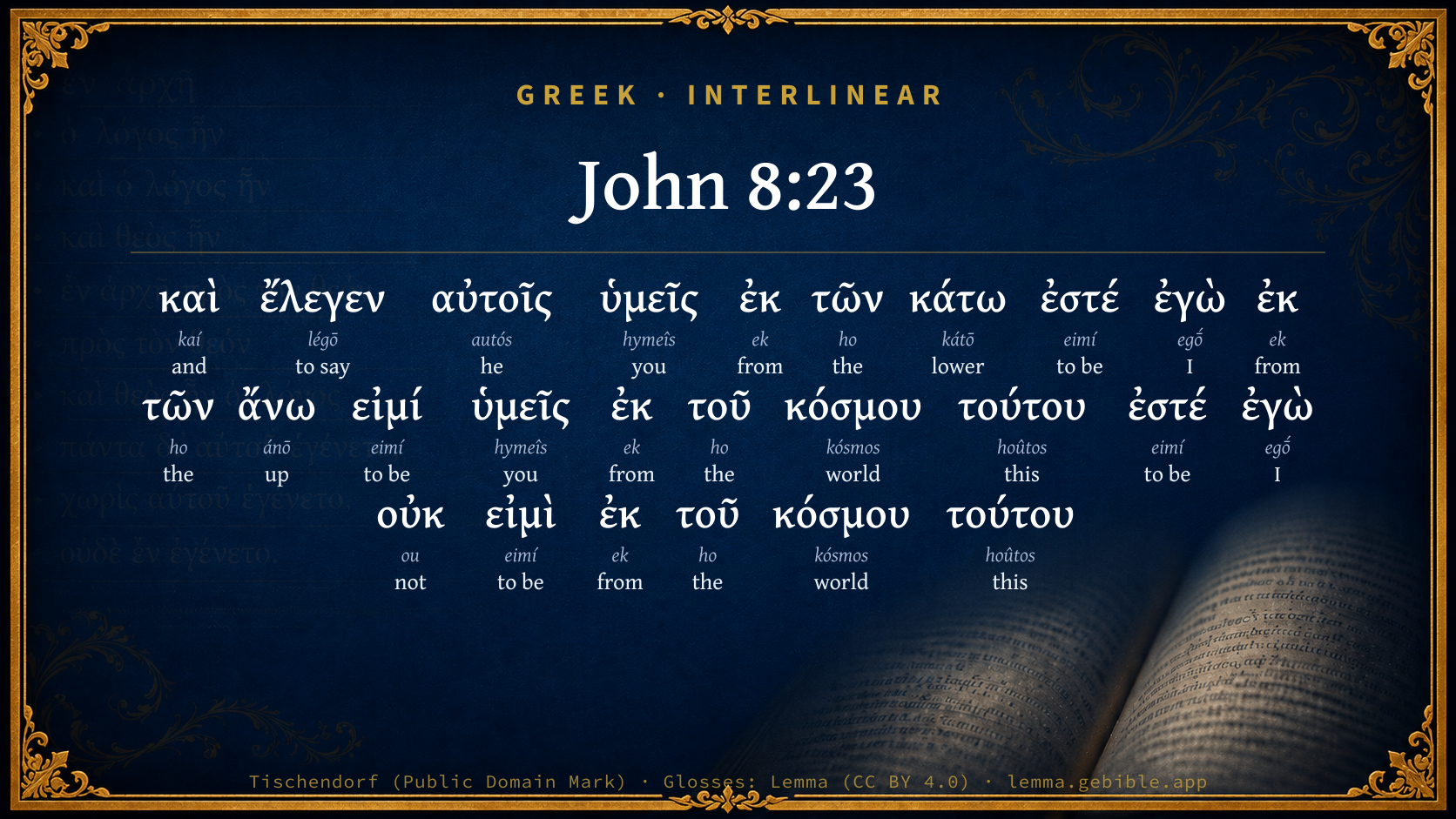
Greek (Tischendorf 8th ed.) John 8:23 appears in the Greek New Testament. The text above is from the Tischendorf 8th edition. Each word links to its Strong’s number and a concise gloss. Click any word for its full Thayer’s Greek Lexicon entry.
Download image
Cite this verse

John 8:23 (World English Bible). Public Domain. Lemma interlinear Bible study tool, https://lemma.gebible.app/v/john/8/23.

Show BibTeX & RIS
BibTeX
RIS
English Translation
He said to them, "You are from beneath. I am from above. You are of this world. I am not of this world.
World English Bible · Public Domain
Download a study sheet

One document with this verse’s original text, its word-by-word gloss line, the meaning frame, cross-references with their text, attributed commentary, and full source and license credits — printable, and it pastes into notes with its structure intact.

This verse Autodidact and up

Study sheet (.html) Plain text (.txt)

A passage Seminary Student

Up to 50 verses in one chapter. A passage sheet keeps up to 6 commentary sources and 12 cross-references per verse, in the order this page ranks them, and says so on the sheet whenever that leaves anything out. Ask for a single verse and you get the Autodidact verse sheet above.

Everything on this page stays free to read, with no account — the sheet is a download of what is already on screen, not access to it.

Want to remove ads? Support Godless Engineer
Compare translations 3

The same verse in 3 English versions, stacked beneath the original-language interlinear above. Click any original word for its lexicon entry.

Each is an independent rendering of the whole verse — the interlinear is not word-aligned to these translations.

Highlighted words mark where these versions differ — a whole-verse word diff, not a word-by-word alignment.

  • World English Bible Public Domain
    He said to them, "You are from beneath. I am from above. You are of this world. I am not of this world.
  • King James Version Public Domain
    And he said unto them, Ye are from beneath; I am from above: ye are of this world; I am not of this world.
  • unfoldingWord Literal Text CC BY-SA 4.0
    And he said to them, “You are from the things below; I am from the things above. You are from this world; I am not from this world.

unfoldingWord Literal Text — © unfoldingWord, licensed CC BY-SA 4.0. Word-aligned USFM3 via Door43 (git.door43.org/unfoldingWord/en_ult).

Versions to compare (up to 4)

3 of 4 selected

Show all 19 translations

Every available English version of this verse, each an independent rendering of the whole verse.

  • World English Bible Public Domain
    He said to them, "You are from beneath. I am from above. You are of this world. I am not of this world.
  • Berean Standard Bible Public Domain
    Then He told them, “You are from below; I am from above. You are of this world; I am not of this world.
  • Majority Standard Bible Public Domain
    Then He told them, “You are from below; I am from above. You are of this world; I am not of this world.
  • King James Version Public Domain
    And he said unto them, Ye are from beneath; I am from above: ye are of this world; I am not of this world.
  • American Standard Version (1901) Public Domain
    And he said unto them, Ye are from beneath; I am from above: ye are of this world; I am not of this world.
  • Revised Version (1885) Public Domain
    And he said unto them, Ye are from beneath; I am from above: ye are of this world; I am not of this world.
  • Geneva Bible (1599) Public Domain
    And hee saide vnto them, Ye are from beneath, I am from aboue: ye are of this world, I am not of this worlde.
  • Douay-Rheims (1899) Public Domain
    And he said to them: You are from beneath, I am from above. You are of this world, I am not of this world.
  • Young's Literal Translation Public Domain
    and he said to them, `Ye are from beneath, I am from above; ye are of this world, I am not of this world;
  • Literal Standard Version CC BY-SA 4.0
    And He said to them, “You are from beneath, I am from above; you are of this world, I am not of this world;
  • Unlocked Literal Bible CC BY-SA 4.0
    Jesus said to them, “You are from below; I am from above. You are of this world; I am not of this world.
  • unfoldingWord Literal Text CC BY-SA 4.0
    And he said to them, “You are from the things below; I am from the things above. You are from this world; I am not from this world.
  • Darby Bible Public Domain
    And he said to them, Ye are from beneath; I am from above. Ye are of this world; I am not of this world.
  • World Messianic Bible Public Domain
    He said to them, “You are from beneath. I am from above. You are of this world. I am not of this world.
  • Webster's Bible Public Domain
    And he said to them, Ye are from beneath; I am from above: ye are of this world; I am not of this world.
  • Free Bible Version CC BY-SA 4.0
    Jesus told them, “You are from below; I am from above. You are of this world; I am not of this world.
  • Bible in Basic English Public Domain
    And he said to them, You are of the earth; I am from heaven: you are of this world; I am not of this world.
  • Text-Critical English NT CC BY 4.0
    He said to them, “You are from below; I am from above. You are of this world; I am not of this world.
  • Tyndale New Testament (1534) Public Domain
    I sayde therfore vnto you that ye shall dye in youre synnes. For except ye beleve that I am he ye shall dye in youre synnes.

Literal Standard Version (2020), Covenant Press — licensed CC BY-SA 4.0. Text via the HelloAO Bible API (eBible.org). Unlocked Literal Bible (unfoldingWord) — licensed CC BY-SA 4.0. Text via the HelloAO Bible API (eBible.org). unfoldingWord Literal Text — © unfoldingWord, licensed CC BY-SA 4.0. Word-aligned USFM3 via Door43 (git.door43.org/unfoldingWord/en_ult). Free Bible Version, Dr. Jonathan Gallagher — licensed CC BY-SA 4.0. Text via the HelloAO Bible API (eBible.org).

Word by word

More ways to search: Search by grammar → Find every occurrence → Compare this word →

Practice this passage: Drill this verse → Learn its vocabulary →

ἄνω
ánō
G507
“up”
Adverb
Part of Speech
Adverb
Full Thayer's Definition

Origin: from G473

TDNT: 07:16,6

1. up, upwards, above, on high 2. of the quarters of the heaven, northward 3. of countries, inland, up from the coast 4. of time, formerly In Gal. 4:26 the word could refer to either place or time, i.e. place - the Jerusalem which is above - in the heavens time - the eternal Jerusalem which preceded the earthly one
  1. καὶ kaí G2532 “and” Conjunction
  2. ἔλεγεν légō G3004 “to say” Verb, Imperfect, Active, Indicative, 3rd person, Singular
  3. αὐτοῖς autós G846 “he” Personal pronoun, Dative, Plural, Masculine
  4. ὑμεῖς hymeîs G5210 “you” Personal pronoun, 2nd person, Nominative, Plural
  5. ἐκ ek G1537 “from” Preposition
  6. τῶν ho G3588 “the” Article, Genitive, Plural, Masculine
  7. κάτω kátō G2736 “lower” Adverb
  8. ἐστέ eimí G1510 “to be” Verb, Present, Active, Indicative, 2nd person, Plural
  9. ἐγὼ egṓ G1473 “I” Personal pronoun, 1st person, Nominative, Singular
  10. ἐκ ek G1537 “from” Preposition
  11. τῶν ho G3588 “the” Article, Genitive, Plural, Masculine
  12. εἰμί eimí G1510 “to be” Verb, Present, Active, Indicative, 1st person, Singular
  13. ὑμεῖς hymeîs G5210 “you” Personal pronoun, 2nd person, Nominative, Plural
  14. ἐκ ek G1537 “from” Preposition
  15. τοῦ ho G3588 “the” Article, Genitive, Singular, Masculine
  16. κόσμου kósmos G2889 “world” Noun, Genitive, Singular, Masculine
  17. τούτου hoûtos G3778 “this” Demonstrative pronoun, Genitive, Singular, Masculine
  18. ἐστέ eimí G1510 “to be” Verb, Present, Active, Indicative, 2nd person, Plural
  19. ἐγὼ egṓ G1473 “I” Personal pronoun, 1st person, Nominative, Singular
  20. οὐκ ou G3756 “not” Particle, Negative
  21. εἰμὶ eimí G1510 “to be” Verb, Present, Active, Indicative, 1st person, Singular
  22. ἐκ ek G1537 “from” Preposition
  23. τοῦ ho G3588 “the” Article, Genitive, Singular, Masculine
  24. κόσμου kósmos G2889 “world” Noun, Genitive, Singular, Masculine
  25. τούτου hoûtos G3778 “this” Demonstrative pronoun, Genitive, Singular, Masculine

About this verse

These counts appear in no published source. They are computed here, from the morphology-tagged text and Lemma’s own curated glosses. What Lemma adds →

26
words
13
distinct lemmas
Gospels
section

Notable vocabulary

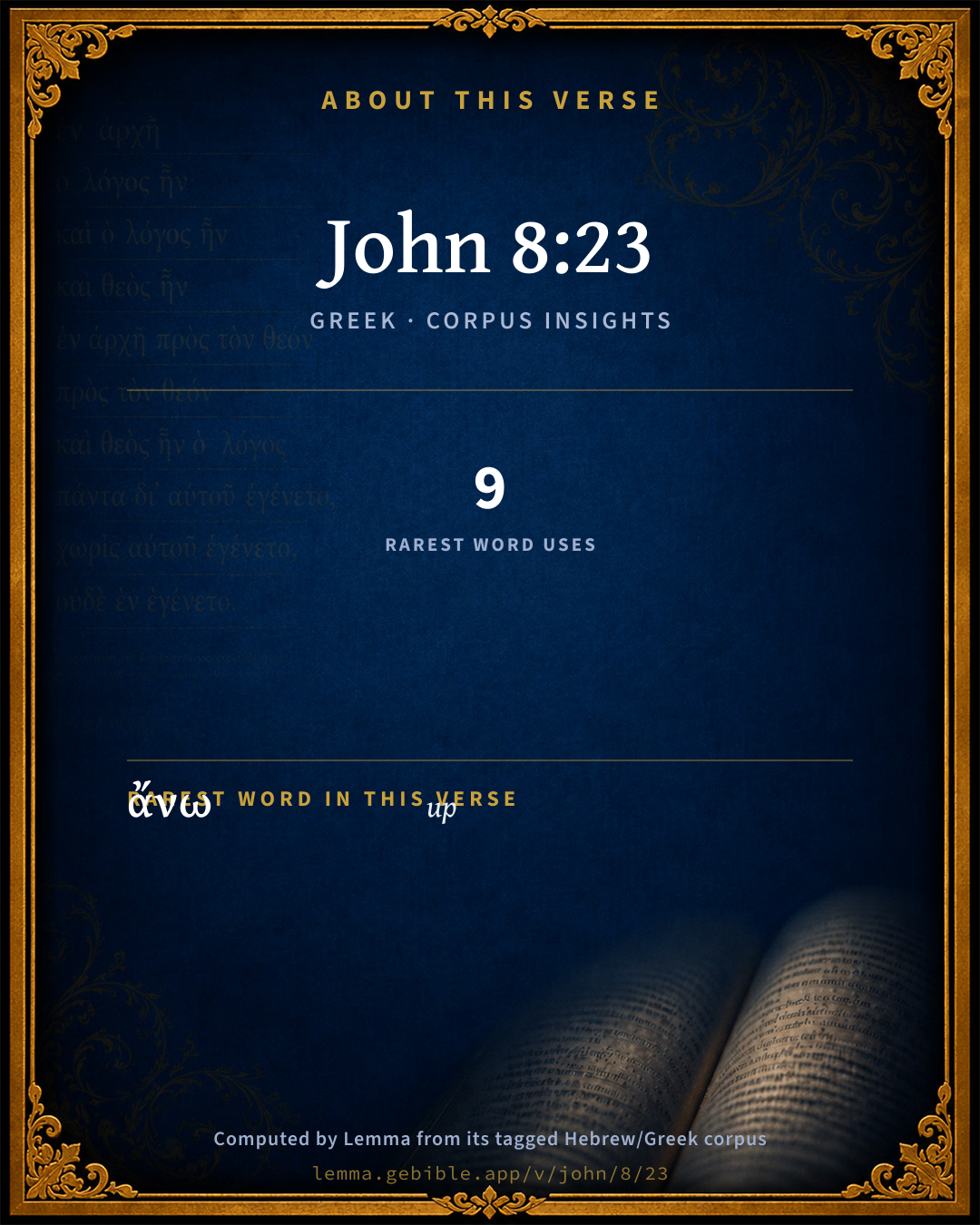
The rarest word here is ἄνω up G507 — appearing just 9 times in the whole Greek New Testament.

Shared distinctive vocabulary

ἄνω up G507 occurs in 9 verses of the Greek New Testament. Also found in:

Repetition

Words recur within this verse:

  • ἐστέ to be G1510 ×4
  • κόσμου world G2889 ×2
  • ἐκ from G1537 ×4
  • τῶν the G3588 ×4
  • ὑμεῖς you G5210 ×2
  • ἐγὼ I G1473 ×2
  • τούτου this G3778 ×2

Cross-references

15

Topical passages linked to John 8:23 in the Treasury of Scripture Knowledge — connected by theme and wording, ordered by reader-vote popularity; previews shown in the World English Bible.

  • John 3:31 He who comes from above is above all. He who is from the Earth belongs to the Earth, and speaks of the Earth. He who comes from heaven is above all.
  • 1 John 2:15–16 Don't love the world, neither the things that are in the world. If anyone loves the world, the Father's love isn't in him.
  • John 17:14 I have given them your word. The world hated them, because they are not of the world, even as I am not of the world.
  • John 17:16 They are not of the world even as I am not of the world.
  • 1 John 4:5–6 They are of the world. Therefore they speak of the world, and the world hears them.
  • Psalms 17:4 As for the works of men, by the word of your lips I have kept myself from the ways of the violent.
  • James 4:4 You adulterers and adulteresses, don't you know that friendship with the world is enmity with God? Whoever therefore wants to be a friend of the world makes himself an enemy of God.
  • 1 John 5:19–20 We know that we are of God, and the whole world lies in the power of the evil one.
  • John 1:14 The Word became flesh, and lived among us. We saw his glory, such glory as of the one and only Son of the Father, full of grace and truth.
  • John 3:13 No one has ascended into heaven, but he who descended out of heaven, the Son of Man, who is in heaven.
  • John 15:18–19 If the world hates you, you know that it has hated me before it hated you.
  • Romans 8:7–8 because the mind of the flesh is hostile towards God; for it is not subject to God's law, neither indeed can it be.
  • 1 Corinthians 15:47–48 The first man is of the earth, made of dust. The second man is the Lord from heaven.
  • James 3:15–17 This wisdom is not that which comes down from above, but is earthly, sensual, and demonic.
  • Philippians 3:19–21 whose end is destruction, whose god is the belly, and whose glory is in their shame, who think about earthly things.

Cross-references courtesy of OpenBible.info (CC BY 4.0).

Commentary

Notes on John 8:23 from classic Christian and Jewish commentators (each source and its license shown beneath its notes). The classic Christian expositions comment on the surrounding passage and are grouped to its opening verse, so a note may address several verses; the Jewish commentaries on the Tanakh (Rashi and others) are per-verse, so they appear only where the commentator wrote on this verse.

Lemma curates 59 commentaries, every one of them public domain or Creative Commons licensed, each selected and text-cleaned for this edition rather than reprinted as found. About our sources →

Tyndale Open Study Notes

Tyndale Open Resources

8:23 Jesus’ listeners were from below; they could not comprehend Jesus’ meaning because he was from above (3:31; see study note on 3:3).

Tyndale Open Study Notes — © Tyndale Open Resources, licensed CC BY-SA 4.0. Text via the HelloAO Bible API.

Bengel's Gnomon

Johann Albrecht Bengel

Joh 8:23. Ὑμεῖς, ye) Again Jesus passes by their interrogatory; and proves what He said, Joh 8:21, “Ye shall die in your sins; whither I go ye cannot come;” comp. ch. Joh 3:13, “No man hath ascended up to heaven, but He that came down from heaven, even the Son of man, which is in heaven.”—ἐκ τῶν κάτω, from those things which are below) from the earth.—ἐγώ, I) He shows whence He is, and hath come, and whither He is about to go; from the world to the Father.—τούτου, of this) By this being added, it is shown that there is also another world: ch. Joh 9:39, “For judgment I am come into this world.”

Bengel's Gnomon of the New Testament — English translation (T&T Clark, Edinburgh, 1860) — public domain. Text from a community e-Sword module.

Meyer's Critical & Exegetical Commentary

Heinrich August Wilhelm Meyer

Joh_8:23-24. Without further noticing their venomous scorn, Jesus simply holds up before them, with more firm and elevated calmness, their own low nature, which made them capable of thus mocking Him, because they did not understand Him, the heavenly One.

ἐκ τῶν κάτω] from the lower regions, i.e. ἐκ τῆς γῆς (comp. Act_2:19), the opposite of τὰ ἄνω, the heavenly regions; ἄνω being used of heavenly relations in solemn discourse (Col_3:1-2; Gal_4:26; Php_3:14); comp. on ἄνωθεν, Joh_3:31. ʼΕκ designates derivation; you spring from the earth, I from the heaven. To understand κάτω as denoting the lower world (Origen, Nonnus, Lange), a meaning which Godet also considers as included in it, would correspond, indeed, to the current classical usage, but is opposed by the parallel of the second half of the verse.

οὐκ εἰμὶ ἐκ τ. κόσμου τούτου] I do not spring from this (pre-Messianic, comp. αἰὼν οὗτος) world; negative expression of His supramundane, heavenly derivation.[13] Comp. Joh_18:36. Both halves of the verse contain the same thought; and the clauses ἐκ τῶν κάτω ἐστέ and ἐκ τοῦ κόσμου τούτου ἐστέ imply, in their full signification, that those men are also of such a character and disposition as correspond to their low extraction, without higher wisdom and divine life. Comp. Joh_3:31. Therefore had Jesus said to them

He refers them again to His words in Joh_8:24they would die in their sins; and now He adds the reason: ἐὰν γὰρ, etc.; for only faith can help those to the higher divine ζωή in time and eternity (Joh_1:12, Joh_3:15 f., Joh_6:40 ff., Joh_17:3, al.), who are ἐκ τῶν κάτω and ἐκ τοῦ κόσμου τούτου, and consequently, as such, are born flesh of flesh.

Notice, that in this repetition of the minatory words the emphasis, which in Joh_8:20 rested on ἐν τ. ἁμ. ὑμ., is laid on ἀποθαν.; and that thus prominence is given to the perishing itself, which could only be averted by conversion to faith.

ὅτι ἐγώ εἰμι] namely, the Messiah, the great name which every one understood without explanation, which concentrated in itself the highest hopes of all Israel on the basis of the old prophecies, and which was the most present thought both to Jesus and the Jews, especially in all their discussionsto Jesus, in the form, I am the Messiah; to the Jews, in the form of either, Is He the Messiah? or, This is not the Messiah, but another, who is yet to come. Comp. Joh_8:28; Joh_13:19. In opposition to the notion of there being another, Jesus uses the emphatic ἐγώ. The non-mention of the name, which was taken for granted (it had been mentioned in Joh_4:25-26), confers on it a quiet majesty that makes an irresistible impression on the minds of the hearers whilst Christ gives utterance to the brief words, ὅτι ἐγώ εἰμι. As God comprehended the sum of the Old Testament faith in אֲנִי הוּא (Deu_32:39; Isa_41:13; Isa_43:10), so Christ that of the New Testament in ὅτι ἐγώ εἰμι. Comp. Hofmann, Schrifbew. I. p. 63 f. The definite confession of this faith is given in Joh_16:3, Joh_6:68-69; 1Jn_4:2.

[13] Not merely of the heavenly direction of His spirit (Weizsäcker), which must be taken for granted in the Christ who springs from above (comp. Joh_3:31). Wherever Christ speaks of His heavenly descent, He speaks in the consciousness of having had a pre-human, supra-mundane existence (in the consciousness of the Logos), Joh_17:5, and lays claim to a transcendent relation of His essential nature. (Comp. Weiss, Lehrbegr. p. 215 f. Nonnus: ξεῖνος ἔφυν κόσμοιο.

Meyer — Critical and Exegetical Commentary on the New Testament — English translation by Peter Christie, edited by Frederick Crombie (T&T Clark, 1880) — public domain. Text from a community e-Sword module.

Expositor's Greek Testament

ed. W. Robertson Nicoll

Joh 8:23 . But disregarding the interruption, and wishing more clearly to show why they could not follow Him, and what constituted the real separation in destiny between Him and them, He says: Ὑμεῖς … τούτου , “You belong to the things below, I to the things above: you are of this world, I am not of this world”. The two clauses balance and interpret one another: “things below” being equivalent to “this world”. It was because this gulf naturally separated them from Him and His destiny and because their destiny was that of the world that He had warned them.

The Expositor's Greek Testament, edited by W. Robertson Nicoll (1897–1910) — public domain. Text from a community e-Sword module.

Godet's Commentaries

Frédéric Louis Godet

Vv. 23-25. “And he said to them, you are from beneath, I am from above; you are of this world, I am not of this world. 24. Therefore I said to you, that you shall die in your sins; for, if you do not believe that I am he, you shall die in your sins. 25. They said therefore to him, Who art thou? Jesus said to them, Precisely that which I also declare to you.”

Jesus lets their jesting go unnoticed. He continues the warning which was begun in Joh 8:21. An abyss separates them from Him; this is the reason why He cannot serve them as a Saviour and raise them with Himself to heaven, His own country. The parallelism between the expressions: “from beneath” and “of this world” (Joh 8:23) does not permit us to include in the former the idea of Hades. We must rather see in the first antithesis: from beneath and from above, the opposition of nature, and in the second: of this world and not of this world, the contrast of disposition and moral activity. The world designates human life constituted independently of the divine will and consequently in opposition to it. One may be from beneath (by nature), without being of the world (by tendency), in case the soul attains to the desire of the higher good. The negative form: I am not of this world, expresses forcibly the repugnance inspired in Jesus by this whole course of human life, which is destitute of the divine inspiring breath.

Their perdition is consequently certain, if they refuse to attach themselves to Him, for He alone could have been for them the bridge between beneath and above. The brief clause by which Jesus formulates the contents of faith: “If you believe not that I am ...” (literally), is remarkable because of the absence of a predicate. The whole attention is thus evidently directed to the subject, ἐγώ, I: “that it is I who am...and no other.” It seems to me difficult to suppose that, in using this expression, Jesus is not thinking of that by which Jehovah often expresses what He is for Israel (e.g., Deu 32:39; Isa 43:10 : ki ani hou, literally, for I am He). As has been said: in this word is summed up by God Himself the whole faith of the Old Testament: “I am your God, besides whom there is no other.” In the same way, Jesus sums up in this word the whole faith of the new covenant: “I am the Saviour besides whom there is no other.” It is remarkable that in the passage in Deuteronomy, the LXX. use, for the translation of these words, precisely the same Greek expression which we find here: ἴδετε ὅτι ἐγώ εἰμι; which leads us to think that Jesus used the same Hebrew expression as the Old Testament. The understood predicate was certainly the Christ.But Jesus carefully avoided this term, because of the political coloring which it had assumed in Israel. The hearers could understand paraphrases such as these: He whom you are expecting: He who alone can answer the true aspirations of your soul; He who can save you from sin and lead you to God. But this word Christ which He carefully avoids is precisely the one which His hearers desired to wrest from Him; this is the aim of their question: who art thou then? In other words: “Have at last the courage to speak out plainly!” His enemies might indeed use to their advantage as against His life an express declaration on His part on this decisive point.

The reply of Jesus is one of the most controverted passages in the Gospel. There are two principal classes of interpretations, in accordance with the two chief meanings of ἀρχή : beginning (temporal) and origin (substantial or logical). In the first class must be reckoned that of Cyril, Fritzsche, Hengstenberg: “From eternity (ἀρχή, Joh 1:1), I am that which I declare unto you.” But why not, instead of the unusual phrase τὴν ἀρχήν, simply say ἀπ᾿ ἀρχῆς, as in Joh 1:1? Then, in this sense, would not the perfect λελάληκα have been more suitable than the present λαλῶ ? Besides, the thought of Jesus would in any case have been altogether impenetrable for His hearers. The Latin Fathers, e.g.,, Augustine, translated as if it were the nominative: “who art thou? The beginning (the origin of things).” There would be but one way of justifying this sense grammatically; it would be to make the accusative τὴν ἀρχήν a case of attraction from the following ὅτι : “The beginning, that which I also say to you.” But the construction, as well as the idea, remains none the less forced. Tholuck, abandoning this transcendental sense of ἀρχή, applies this word to the beginning of Jesus’ ministry: “I am what I have unceasingly said to you ever since I began to speak to you.” But why not simply say ἀπ᾿ ἀρχῆς, as in Joh 15:27?

And it must be admitted that the inversion of τὴν ἀρχήνcannot well be explained, any more than can the καί, also, before λαλῶ . There remains, in the temporal sense ofἀρχή, the explanation of Meyer. He holds that there is at once an interrogation and an ellipsis: “What I say to you concerning Myself from the beginning (is this what you ask me)?” The ellipsis is as forced as the thought is idle. And how can we explain the καί, the choice of the unusual term τὴν ἀρχήν, and the use of the present λαλῶ, instead of the perfect λελάληκα which would certainly be better suited to this meaning? The interpreters who give to ἀρχή alogical sense and make τὴν ἀρχήν an adverbial phrase: before all, in general, absolutely, are able to cite numerous examples drawn from the classic Greek. Thus Luthardt and Reuss: “At first, I am what I say to you”—which means: “This is the first and only answer that I have to give to you. If you wish to know who I am, you have only to weigh, in the first place, my testimonies respecting My own person.” The sense is good; but to what subsequent way of explaining Himself would this in the first place allude (see, however, below)? And why not, in this sense, simply say πρῶτον (Rom 3:2)? Chrysostom, Lucke, Weiss, Westcott explain thus: “In general, why do I still speak with you?” Understand: “I do not myself know” (Lucke), or: “This is what you should ask me.” I confess that I do not understand how it is possible to put into the mouth of Jesus anything so insignificant. Then, if we could overlook these ellipses, which are, however, quite unnatural, what are we to do with the ὅ τι ? Are we to take it in the sense of τί or διατί, why, or because of what? Weiss acknowledges that the examples from the New Testament which are cited for one of these senses (e.g.,, Mar 9:11), are not to be thus explained. The only analogous use of this word seems to me to be found in the LXX., 1Ch 17:6; comp. with 2Sa 7:7. Is this sufficient to legitimate this use in our passage? Moreover, the very rare phrase τὴν ἀρχήν is not sufficiently justified on this interpretation.

The only logical sense of this expression which seems to me probable is that which Winer has defended in his Grammar of the New Testament (§ 54, 1) and to which de Wette, Bruckner, Keil, etc., have given their adhesion, and in the main Reuss also: “Absolutely what I also declare unto you,” that is to say: “neither more nor less than what my word contains.” Jesus appeals thus to His testimonies respecting His person as the adequate expression of His nature. “Fathom myspeech and you will discern my nature.” This sense fully accounts for the minutest details of the text: 1. The striking position of the word τὴν ἀρχήν, absolutely; 2. The choice of the pronoun ὅ τι all that which: “whatever it may be that I may have said to you;” they have only to sum up His affirmations respecting Himself, the light of the world, the rock from which flows the living water, the bread which came down from heaven..., etc., and they will know what He is; 3. The particle καί, also, which brings out distinctly the identity between His nature and His speech; 4. The use of the verb λαλεῖν, to declare, instead of λέγειν, to say, to teach. As Keil well says in reply to Weiss: “His λαλεῖνdoes not designate what He has said of Himself on this or that occasion; it is His discourse in general, presented as an adequate expression of His nature;” finally, 5. The present tense of the verb, which gives us to understand that His testimonies are not yet at their end. It is objected, it is true, that τὴν ἀρχήν does not have this sense ofabsolutely except in negative propositions. But, in the first place, the sense of the proposition is essentially negative: “Absolutely nothing else than what I declare.”

And can we demand of the New Testament all the strictness of the classical forms? Besides, Baumlein cites the following example from Herodotus: ἀρχὴν γὰρ ἐγὼ μηχανήσομαι (Joh 1:9; Joh 1:1), an example whose value seems to be but little diminished by the fact that the phrase is followed by a negative proposition. This explanation seems to me indisputably preferable to all the others. I still ask myself, however, whether we cannot revert to the temporal sense of ἀρχή, beginning, and in that case explain: “To begin, that is to say, for the moment,” and find the afterwards or at the end, which should correspond to the beginning, in Joh 8:28 : “When you shall have lifted up the Son of man, then you shall know...” At present, Jesus reveals Himself only by His speech; but when the great facts of salvation shall have been accomplished, then they will receive a new revelation still more luminous. If this relation between Joh 8:25 and Joh 8:28 seems forced, we must, as I think, abide by the preceding explanation. We omit a multitude of explanations which are only varieties of the preceding meanings, or which are too entirely erroneous to make it possible to consider them.

The application of this answer of Jesus was that the thorough examination of the testimony which He bore continually to Himself was enough to lead to the discovery therein of His nature and of His mission as related to Israel and to the world. On this path, one will learn to know Him successively as the true temple (chap. 2), as the living water (chap. 4), as the true Son (chap. 5), as the bread from heaven (chap. 6), etc. And in this way it is that His name Christ will be in a manner spelled out, letter after letter, in the heart of the believer, and will formulate itself there as a spontaneous discovery, which will be worth infinitely more than if he had learned it in the form of a lesson from an outward teaching. To be salutary indeed, this profession: “Thou art the Christ,” must be, as in the case of Peter (Joh 6:66-69), the fruit of the experiences of faith. Comp. Mat 16:17 : “Flesh and blood have not revealed it unto thee, but my Father who is in heaven.” Such was the way in which the homage of Palm-day arose. Jesus never either sought or accepted an adhesion arising from any other origin than that of moral conviction. This reply is one of the most marvelous touches of Jesus’ wisdom. It perfectly explains why, in the Synoptics, He forbade the Twelve to say that He was the Christ.

Frédéric Louis Godet — Commentaries on Luke, John, Romans, and 1 Corinthians — English translation (T&T Clark, Edinburgh, 1870s–1890s) — public domain. Text from a community e-Sword module.

Jamieson, Fausset & Brown

Robert Jamieson, A. R. Fausset & David Brown

Ye are from beneath; I am from above--contrasting Himself, not as in Joh 3:31, simply with earthborn messengers of God, but with men sprung from and breathing an opposite element from His, which rendered it impossible that He and they should have any present fellowship, or dwell eternally together. (Again see on Joh 7:33; also see on Joh 8:44).

Jamieson, Fausset & Brown — Commentary Critical and Explanatory on the Whole Bible (1871) — public domain (CC PDM 1.0). Text via the HelloAO Bible API.

Adam Clarke's Commentary

Verse 23. Ye are from beneath] Ye are capable of murder, and of self-murder too, because ye have nothing of God in you. Ye are altogether earthly, sensual, and devilish. They verified this character in murdering the Lord Jesus; and many of them afterwards, to escape famine, &c., put an end to their own lives.

Adam Clarke's Commentary on the Bible (1810–1826) — public domain. Text from a community e-Sword/MySword module.

John Calvin's Commentaries

23. You are from beneath, I am from above. As they did not deserve that he should teach them, he wished only to strike them with reproofs conveyed in few words, as in this passage he declares that they do not receive his doctrine, because they have an utter dislike of the kingdom of God. Under the words, world and beneath, he includes all that men naturally possess, and thus points out the disagreement which exists between his Gospel and the ingenuity and sagacity of the human mind; for the Gospel is heavenly wisdom, but our mind grovels on the earth. No man, therefore, will ever be qualified to become a disciple of Christ, till Christ has formed him by his Spirit. And hence it arises that faith is so seldom found in the world, because all mankind are naturally opposed and averse to Christ, except those whom he elevates by the special grace of his Holy Spirit.

John Calvin's Commentaries (1540-1563) — public domain. Text from the Calvin Translation Society English edition (1840s-50s) via the Christian Classics Ethereal Library (ccel.org). Calvin's coverage is partial (roughly two-thirds of the Bible); uncommented books and verses are honest gaps, never fabricated. The 19th-century editor's footnotes and remarks are omitted so the notes are faithfully Calvin's own voice.

Ellicott's Commentary for English Readers

(23) There is indeed a gulf which they cannot pass, but it is not that between souls in Abraham’s bosom and souls in Hades. It is the gulf between heaven and earth. This He brings out in two pairs of antithetic clauses. (Comp. Note on Joh_1:3.) These clauses interpret each other, and no deeper meaning is to be given to the first pair than is borne by the second. We may arrange them in a pair of affirmatives and a pair of negatives—

“Ye are from beneath;” “ye are of this world.”

“I am from above” (not from beneath); “I am not of this world.”

We have thus the full Hebrew expression of one thought, and this is the thought which John the Baptist, from another point of view, taught his disciples in Joh_3:31. They are by origin and nature of the earth. He was by origin and nature from heaven. Of the earth, their feelings and thoughts and life were of the earth, and, by devotion to things of the earth, they are destroying the spirit made in the image of God, which is within them, and the link between them and heaven. He is from heaven in origin, and is divine in nature. He has come to reveal the heavenly and the divine to the earthly and the human. In Him, and in Him only, can their spirits find deliverance from sin, and find the true life; for in Him, and in Him only, the divine and the human meet.

A Bible Commentary for English Readers, edited by Charles John Ellicott (1878–1897) — public domain. Text from a community e-Sword module.

The Cambridge Bible for Schools and Colleges

gen. ed. J. J. S. Perowne

23. Ye are from beneath] At first sight it might seem as if this meant ‘ye are from hell.’ Christ uses strong language later on (Joh_8:44), and this interpretation would make good sense with what precedes. ‘Ye suggest that I am going to hell by self-destruction: it is ye who come from thence.’ But what follows forbids this. The two halves of the verse are manifestly equivalent, and ‘ye are from beneath’ = ‘ye are of this world.’ The pronouns throughout are emphatically opposed. The whole verse is a good instance of ‘the spirit of parallelism, the informing power of Hebrew poetry,’ which runs more or less through the whole Gospel. Comp. Joh_14:27.

The Cambridge Bible for Schools and Colleges (gen. ed. J. J. S. Perowne; Cambridge University Press, 1878–1918) — public domain. Text from a community e-Sword module.

John Gill's Exposition

Then said they unto him, who art thou?.... That talks at this rate, and threatens with death, in case of unbelief; this they said with an haughty air, and in a scornful manner:

and Jesus saith unto them, even the same that I said unto you from the beginning; meaning, either of this discourse, as that he was the light of the world, and which he continued to assert; or of his being had before the sanhedrim, when he affirmed that God was his Father, and by many strong arguments proved his divine sonship; or of his ministry, when by miracles, as well as doctrines, he made it to appear that he was he that was to come, the true Messiah; or who spake from the beginning to Moses, saying, I am that I am, hath sent thee, and to the church, and Jewish fathers in the wilderness; and who is that word that was from the beginning with God; and who is called the beginning, the first cause of all things, and of the creation of God; and some think this is intended here.

John Gill's Exposition of the Whole Bible (1746–1763) — public domain (CC PDM 1.0). Text via the HelloAO Bible API.

Trapp's Complete Commentary

John Trapp

23 And he said unto them, Ye are from beneath; I am from above: ye are of this world; I am not of this world.

Ver. 23. Ye are from beneath] Vos infernales estis, Ego Supernus. (Beza.) So the wicked are called the inhabitants of the earth and of the sea, Rev 12:12, in opposition to the Church, which is said to be in heaven, and called "Jerusalem which is above," Gal 4:26.

John Trapp, A Commentary or Exposition upon All the Books of the Old and New Testament (1647–1656) — public domain. Text from a community e-Sword module.

Albert Barnes' Notes on the Bible

Ye are from beneath - The expression from bequeath, here, is opposed to the phrase from above. It means, You are of the earth, or are influenced by earthly, sensual, and corrupt passions. You are governed by the lowest and vilest views and feelings, such as are opposed to heaven, and such as have their origin in earth or in hell.

I am from above - From heaven. My views are heavenly, and my words should have been so interpreted.

Ye are of this world - You think and act like the corrupt men of this world.

I am not of this world - My views are above these earthly and corrupt notions. The meaning of the verse is: “Your reference to self-murder shows that you are earthly and corrupt in your views. You are governed by the mad passions of men, and can think only of these.” We see here how difficult it is to excite wicked men to the contemplation of heavenly things. They interpret all things in a low and corrupt sense, and suppose all others to be governed as they are themselves.

Albert Barnes' Notes on the Bible (1834–1885) — public domain. Text from a community e-Sword/MySword module.

Haydock's Catholic Bible Commentary

I am not of this world: he speaks of his divine person, as the words evidently shew. (Witham)

George Leo Haydock (1774–1849), Haydock's Catholic Family Bible and Commentary, 1859 edition — public domain. Excludes Psalms (Douay-Rheims chapter numbering differs from Protestant) and Deuterocanonical books (Catholic canon only).

Matthew Poole's English Annotations

Ye are not only of an earthly extraction, creatures of the earth, not descended from heaven, as I am; but also of earthly spirits and principles; you savour nothing that is sublime and spiritual, and therefore you do not understand me. I tell you,

I am not of this world; my original is not from it, nor am I to determine my being in it. I shall die, but I shall rise again from the dead, and ascend into heaven, where you cannot come. Still our Saviour asserts his Divine nature; and the stress of all, he saith, lieth there; their unbelief of which was the cause of all their disputings and errors. He had given them the greatest evidence of it imaginable in the works which he had done in their sight, which were not only above the power of nature, but such as God had never authorized, or enabled any creature to do; yet they, being destitute of supernatural grace, did not believe in him. And they were inexcusable, because that grace was denied them for their wilful corruption and wickedness, which they might have avoided by the use of that common grace which was not denied them.

Matthew Poole's English Annotations on the Holy Bible (1683–1685) — public domain. Text from a community e-Sword/MySword module.

Whedon's Commentary on the Bible

Daniel D. Whedon

23. From beneath—An expression quite as strong as (Joh_8:44) of your father, the devil. As opposed to from above or heaven, it must mean from the infernal, from hell. The fact that they were thus infernal is verified both by their infernal suggestion in regard to suicide, and by the fact that dying in sin their destiny is hell.

Daniel D. Whedon (gen. ed.), Commentary on the Old and New Testaments (1874–1909) — public domain. Text from a community e-Sword module.

The Pulpit Commentary

Yet this essential divergence is not based on fatalistic grounds, but on moral ones. The argument of the twenty-fourth verse explains the description of ver. 23. The ground of this utter alienation is the lack of belief, which will leave them in their sins to die. He said to them, Ye are from beneath; I am from above. You spring from the lower as opposed to the higher world; you are influenced by considerations drawn from the earthly, sensual, superficial, and transitory. It is not necessary to suppose that our Lord is clenching the Jews" harsh speech about the underworld with a tu-quoque, as though they verily belonged to the Gehenna to which they were consigning him; for the next pair of clauses are in parallel apposition with the former. In the words, Ye are of this world; I am not of this world, "This world" corresponds with the twn katw of the previous clause, and the "not of this world" corresponds with the ta anw , the heavenly regions from which he has continually declared, in many varieties of phrase, that he had come, or descended, or been sent. Certainly and broadly speaking, this is true, as a contrast between Christ and all other men before their regeneration. Our Lord especially charges home upon these earth-bound souls, on these purely human, selfish, unspiritual, unrenewed, unbelieving men, this antagonism to himself, this refusal to walk in his light or receive his life. "That which is born of the flesh is flesh". (Joh_3:6) They are flesh. He does not exclude them forever from such participation in his own heavenly life as would reverse the descriptive and characteristic features of their being. The reason why they have not seen the kingdom or the King is that they are not born of the Spirit.

The Pulpit Commentary (1880–1919), ed. H.D.M. Spence-Jones & Joseph S. Exell — public domain. Text from a community e-Sword module.

John Wesley's Explanatory Notes

Ye are - Again he passes over their interruption, and proves what he advanced, ver. 21. Of them that are beneath - From the earth. I am of them that are above - Here he directly shows whence he came, even from heaven, and whither he goes.

John Wesley, Explanatory Notes Upon the Whole Bible (1754–1765) — public domain. Text via the GEBible commentary corpus.

Scofield Reference Notes

C. I. Scofield

world

kosmos = world-system. Joh 12:25; Joh 12:31; Joh 7:7 (See Scofield "Rev 13:8").

The Scofield Reference Bible (1917 edition), notes by C. I. Scofield — public domain. Text from a community e-Sword module.

The People's New Testament

B. W. Johnson

23, 24. I am from above. He shows more clearly that he returns to heaven, where they never can enter on account of their sins. This leads them to ask:

B. W. Johnson's The People's New Testament with Notes (1889–1891) — public domain. Electronic text from the Christian Classics Ethereal Library (CCEL) ThML edition.

unfoldingWord translationNotes

Door43 World Missions Community

You are from below

"You were born in this world"

I am from above

"I came from heaven"

You are of this world

"You belong to this world"

I am not of this world

"I do not belong to this world"

you will die in your sins

"you will die without God's forgiving your sins"

that I AM

Possible meanings are that 1) Jesus was identifying himself as Yahweh, which means "I am" or 2) Jesus expected the people to understand that he was referring to what he already said he was: "I am from above."

translationWords

world

die

sin

believe

unfoldingWord translationNotes — © Distant Shores Media and the Door43 World Missions Community, licensed CC BY-SA 4.0. Source: git.door43.org/Door43/en_tn.

Cambridge Greek Testament for Schools and Colleges

23. ἐκ τῶν κάτω ἐστέ. At first sight it might seem as if this meant ‘ye are from hell.’ Christ uses strong language later on (Joh 8:44), and this interpretation would make good sense with what precedes. ‘Ye suggest that I am going to hell by self-destruction: it is ye who come from thence.’ But what follows forbids this. The two halves of the verse are manifestly equivalent, and ‘ye are from beneath’ = ‘ye are of this world.’ They were σὰρξ ἐκ τῆς σαρκός (Joh 3:6) and judged κατὰ τ. σάρκα (Joh 8:15): He was ἐκ τοῦ οὐράνου (Joh 3:31). The pronouns throughout are emphatically opposed. The whole verse is a good instance of ‘the spirit of parallelism, the informing power of Hebrew poetry,’ which runs more or less through the whole Gospel. Comp. Joh 13:16, Joh 14:27.

Cambridge Greek Testament for Schools and Colleges (Cambridge University Press, 1896; 21 vols, various authors incl. Carr, Maclear, Plummer, Farrar, Lumby, Moule, M. R. James, Simcox) — public domain. Text from a community e-Sword module.

Alford’s Greek Testament

Henry Alford

23.] ‘Ye cannot come where I am going, because we both shall return thither whence we came: I to the Father from Whom (ἐκ τῶν ἄνω) I came: ye to the earth and under the earth (for that more awful meaning surely is not excluded) whence ye came’ (ἐκ τῶν κάτω).

Then ὁ κόσμος οὗτος of course does not only imply ‘this present state of things,’ but involves the deeper meaning, of the origin of that state of things (see ver. 44) and its end, ver. 24.

Henry Alford, The Greek Testament (1849–1861) — public domain. Text from a community e-Sword module.

International Critical Commentary

23. καὶ ἔλεγεν. The rec. has εἶπεν, but אBDLNTWΘ have the imperfect ἔλεγεν, which suggests that what follows was a habitual saying of Jesus. He leaves their taunt unanswered, but adds that His origin and natural home were different from the origin and home of “the Jews.” It was not surprising that they did not understand Him when He said that He was moving to a region where they could not follow. Cf. Mat 6:21.

ὑμεῖς ἐκ τῶν κάτω ἐστέ, “You are from beneath,” i.e. “of the earth.” Cf. ἐπὶ τῆς γῆς κάτω (Act 2:19). κάτω does not occur again in Jn. (but cf. 8:8).

ἐγὼ ἐκ τῶν ἄνω εἰμί. The contrast is the same as that of 3:31. The implied argument, sc. that the Jews’ failure of understanding has its root in moral causes, has met us before (5:38f., 7:17f.), and is repeated 8:42.

ὑμεῖς ἐκ τούτου τοῦ κόσμου ἐστέ. BT give the emphatic τούτου τοῦ κόσμου here, but the more usual τοῦ κόσμου τούτου in the second clause of the verse (so W in both clauses). אDLΓΔ give τοῦ κόσμου τούτου in both clauses, and ὁ κόσμος οὗτος is the order in every other N.T. passage where the expression occurs. So, too, we always find ὁ αἰὼν οὗτος (except Mat 12:32).

The idea of imperfection which the word κόσμος, the totality of created being, suggests in Jn. has been noted on 1:9. This idea is specially brought out in the phrase ὁ κόσμος οὗτος. When thus limited, the word does not embrace any plane of creation other than that of earth (11:9), and “this world” is contrasted with the spiritual or heavenly world, as being in a special degree affected by evil powers (16:11) and as awaiting the Judgment (9:39, 12:31). The kingdom of Jesus is not of “this world” (18:36), from which He passed after His Passion (13:1). It is the place of our earthly discipline (1Jn 4:17), in which he who hates his life shall keep it to life eternal (12:25). The phrase occurs with a like hint of evil, 1Co 3:19, 1Co 5:10, 1Co 7:31.1Co 7:1

So here it is said of the Jews ὑμεῖς ἐκ τοῦ κόσμου τούτου ἐστέ. Cf. for the same construction εἶναι ἐκ, 1Jn 4:5 αὐτοὶ ἐκ τοῦ κόσμου εἰσί.

ἐγὼ (emphatic) οὐκ εἰμὶ ἐκ τοῦ κόσμου τούτου. Cf. 17:14, 16. It is the perpetual theme of the Fourth Gospel that He who was not “of the world” came “into the world” for its rescue.

International Critical Commentary — older volumes (1896–1929), various authors — public domain. Text from a community e-Sword module.

Vincent's Word Studies in the New Testament

Marvin R. Vincent

Ye are from beneath [εκ των κατω εστε] . A phrase peculiar to John and to his Gospel. Jesus states the radical antagonism between His opposers and Himself, as based upon difference of origin and nature. They spring from the lower, sensual, earthly economy; He from the heavenly. Compare Jas 3:15 sqq.

From above [εκ των ανω] . Also peculiar to John's Gospel. Compare Col 3:1. On the phrase to be of [ειναι εκ] see on 1 46.

Ye are of this world [εκ του κοσμου τουτου εστε] . Peculiar to John, and occurring in the First Epistle. On kosmou, world, see on 1 9. Ye are of this earthly order or economy.

Marvin R. Vincent, Word Studies in the New Testament (1887–1900) — public domain. Text from a community e-Sword/MySword module.

Lesson kit

Teaching starters — assembled from the data on this page, not authored interpretation. Every prompt links to the verse data it draws on. Edit before teaching.

John, in the Gospels, opens this verse with 26 words (13 distinct Greek lemmas). Its most distinctive word is ánō (“up”). A historical commentator’s framing appears above. Read the whole chapter for the surrounding context.

Discussion questions

  1. What does “up” (ánō) contribute to the verse as a whole?
  2. John 2:7 shares the word «up» with this verse. How do the two illuminate each other?
  3. “to be” occurs 4× in this one verse. What is the effect of the repetition?
  4. These translations render this verse differently; the difference is in the English rendering, not the original. What questions does that raise?
  5. Reading how Tyndale Open Study Notes and Bengel's Gnomon read this verse, where do the two commentators agree and where do they part?

Things to notice

  • These translations choose different wording for 4 words in this verse.
  • “to be” occurs 4× in this single verse.
  • 13 distinct Greek lemmas span 26 words in this verse.

Reading settings

Reading text

Shown beneath each verse's original-language words.

Old Testament
Old Testament edition

Read the OT as the Masoretic Hebrew (MT) or the Greek Septuagint (LXX).

English shown for the Greek Septuagint (in the Hebrew ↔ Greek comparison).

Comparing translations? Open the Compare panel on any verse page to stack up to four side by side.