
John 1:31

Greek (Tischendorf 8th ed.) John 1:31 appears in the Greek New Testament. The text above is from the Tischendorf 8th edition. Each word links to its Strong’s number and a concise gloss. Click any word for its full Thayer’s Greek Lexicon entry.
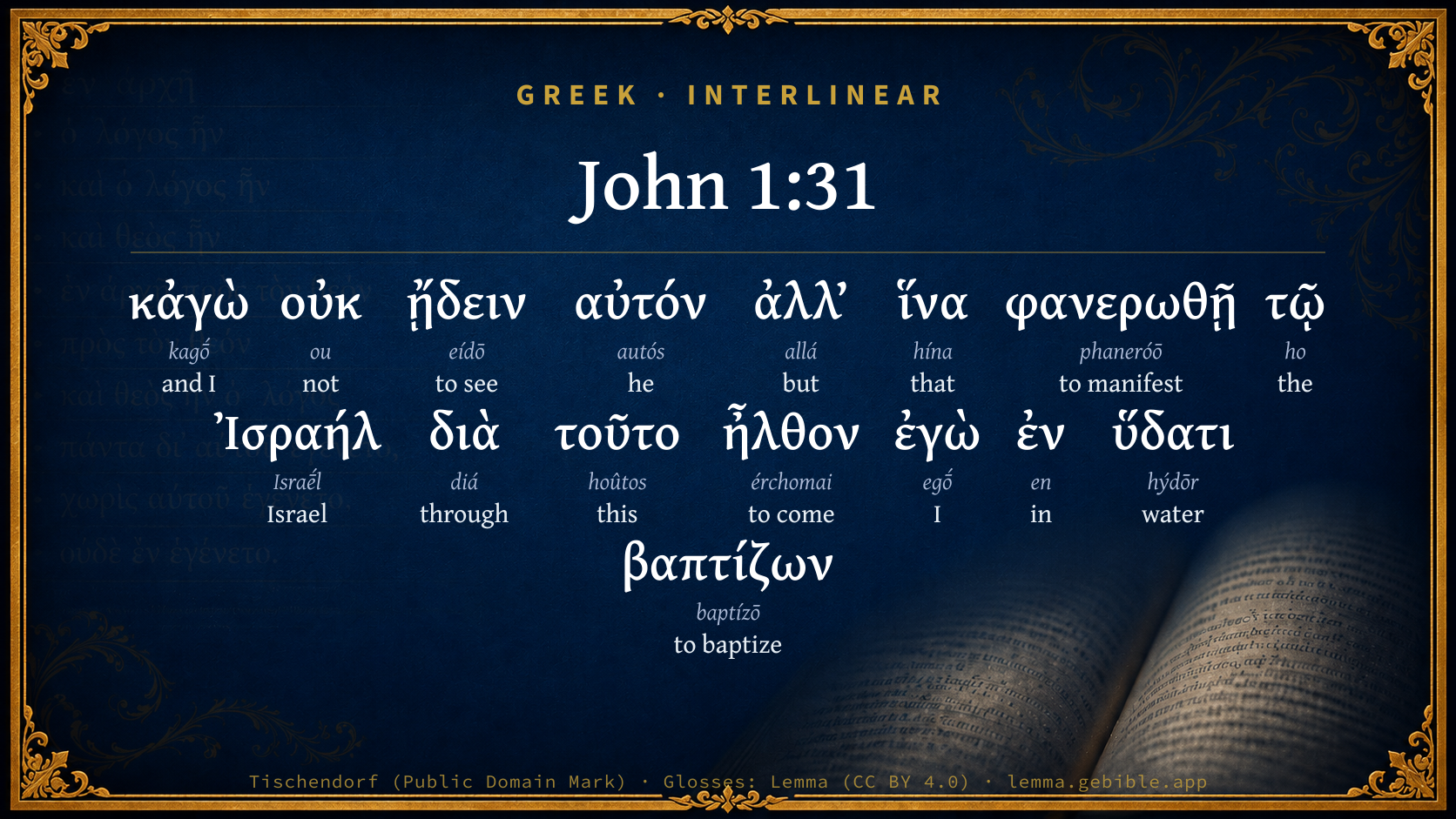
Download image
Cite this verse

John 1:31 (World English Bible). Public Domain. Lemma interlinear Bible study tool, https://lemma.gebible.app/v/john/1/31.

Show BibTeX & RIS
BibTeX
RIS
English Translation
I didn't know him, but for this reason I came baptizing in water: that he would be revealed to Israel."
World English Bible · Public Domain
Download a study sheet

One document with this verse’s original text, its word-by-word gloss line, the meaning frame, cross-references with their text, attributed commentary, and full source and license credits — printable, and it pastes into notes with its structure intact.

This verse Autodidact and up

Study sheet (.html) Plain text (.txt)

A passage Seminary Student

Up to 50 verses in one chapter. A passage sheet keeps up to 6 commentary sources and 12 cross-references per verse, in the order this page ranks them, and says so on the sheet whenever that leaves anything out. Ask for a single verse and you get the Autodidact verse sheet above.

Everything on this page stays free to read, with no account — the sheet is a download of what is already on screen, not access to it.

Want to remove ads? Support Godless Engineer
Compare translations 3

The same verse in 3 English versions, stacked beneath the original-language interlinear above. Click any original word for its lexicon entry.

Each is an independent rendering of the whole verse — the interlinear is not word-aligned to these translations.

Highlighted words mark where these versions differ — a whole-verse word diff, not a word-by-word alignment.

  • World English Bible Public Domain
    I didn't know him, but for this reason I came baptizing in water: that he would be revealed to Israel."
  • King James Version Public Domain
    And I knew him not: but that he should be made manifest to Israel, therefore am I come baptizing with water.
  • unfoldingWord Literal Text CC BY-SA 4.0
    And I did not know him, but so that he might be revealed to Israel, because of this, I came baptizing in water.”

unfoldingWord Literal Text — © unfoldingWord, licensed CC BY-SA 4.0. Word-aligned USFM3 via Door43 (git.door43.org/unfoldingWord/en_ult).

Versions to compare (up to 4)

3 of 4 selected

Show all 19 translations

Every available English version of this verse, each an independent rendering of the whole verse.

  • World English Bible Public Domain
    I didn't know him, but for this reason I came baptizing in water: that he would be revealed to Israel."
  • Berean Standard Bible Public Domain
    I myself did not know Him, but the reason I came baptizing with water was that He might be revealed to Israel.”
  • Majority Standard Bible Public Domain
    I myself did not know Him, but the reason I came baptizing with water was that He might be revealed to Israel.”
  • King James Version Public Domain
    And I knew him not: but that he should be made manifest to Israel, therefore am I come baptizing with water.
  • American Standard Version (1901) Public Domain
    And I knew him not; but that he should be made manifest to Israel, for this cause came I baptizing in water.
  • Revised Version (1885) Public Domain
    And I knew him not; but that he should be made manifest to Israel, for this cause came I baptizing with water.
  • Geneva Bible (1599) Public Domain
    And I knewe him not: but because he should be declared to Israel, therefore am I come, baptizing with water.
  • Douay-Rheims (1899) Public Domain
    And I knew him not, but that he may be made manifest in Israel, therefore am I come baptizing with water.
  • Young's Literal Translation Public Domain
    and I knew him not, but, that he might be manifested to Israel, because of this I came with the water baptizing.
  • Literal Standard Version CC BY-SA 4.0
    and I did not know Him, but that He might be revealed to Israel, because of this I came immersing in water.”
  • Unlocked Literal Bible CC BY-SA 4.0
    I did not know him, but it was so that he could be revealed to Israel that I came baptizing with water.”
  • unfoldingWord Literal Text CC BY-SA 4.0
    And I did not know him, but so that he might be revealed to Israel, because of this, I came baptizing in water.”
  • Darby Bible Public Domain
    and I knew him not; but that he might be manifested to Israel, therefore have I come baptising with water.
  • World Messianic Bible Public Domain
    I didn’t know him, but for this reason I came immersing in water, that he would be revealed to Israel.”
  • Webster's Bible Public Domain
    And I knew him not: but that he should be made manifest to Israel, therefore am I come baptizing with water.
  • Free Bible Version CC BY-SA 4.0
    I didn't know myself who he was, but I came baptizing with water so that he could be revealed to Israel.”
  • Bible in Basic English Public Domain
    I myself had no knowledge of him, but I came giving baptism with water so that he might be seen openly by Israel.
  • Text-Critical English NT CC BY 4.0
    I myself did not know him, but I came baptizing with water so that he might be revealed to Israel.”
  • Tyndale New Testament (1534) Public Domain
    and I knew him not: but that he shuld be declared to Israell therfore am I come baptisynge with water.

Literal Standard Version (2020), Covenant Press — licensed CC BY-SA 4.0. Text via the HelloAO Bible API (eBible.org). Unlocked Literal Bible (unfoldingWord) — licensed CC BY-SA 4.0. Text via the HelloAO Bible API (eBible.org). unfoldingWord Literal Text — © unfoldingWord, licensed CC BY-SA 4.0. Word-aligned USFM3 via Door43 (git.door43.org/unfoldingWord/en_ult). Free Bible Version, Dr. Jonathan Gallagher — licensed CC BY-SA 4.0. Text via the HelloAO Bible API (eBible.org).

Word by word

More ways to search: Search by grammar → Find every occurrence → Compare this word →

Practice this passage: Drill this verse → Learn its vocabulary →

φανερωθῇ
phaneróō
G5319
“to manifest”
Verb, Aorist, Passive, Subjunctive, 3rd person, Singular
Part of Speech
Verb
Tense
Aorist
Voice
Passive
Mood
Subjunctive
Person
3rd person
Number
Singular
Full Thayer's Definition

Origin: from G5318

TDNT: 09:03,1

1. to make manifest or visible or known what has been hidden or unknown, to manifest, whether by words, or deeds, or in any other way a. make actual and visible, realised b. to make known by teaching c. to become manifest, be made known d. of a person 1. expose to view, make manifest, to show one's self, appear e. to become known, to be plainly recognised, thoroughly understood 1. who and what one is
  1. κἀγὼ kagṓ G2504 “and I” Personal pronoun, 1st person, Nominative, Singular, Aramaic form
  2. οὐκ ou G3756 “not” Particle, Negative
  3. ᾔδειν eídō G1492 “to see” Verb, Pluperfect, Active, Indicative, 1st person, Singular
  4. αὐτόν autós G846 “he” Personal pronoun, Accusative, Singular, Masculine
  5. ἀλλ’ allá G235 “but” Conjunction
  6. ἵνα hína G2443 “that” Conjunction
  7. τῷ ho G3588 “the” Article, Dative, Singular, Masculine
  8. Ἰσραήλ Israḗl G2474 “Israel” Noun, Proper, indeclinable
  9. διὰ diá G1223 “through” Preposition
  10. τοῦτο hoûtos G3778 “this” Demonstrative pronoun, Accusative, Singular, Neuter
  11. ἦλθον érchomai G2064 “to come” Verb, Aorist, Active, Indicative, 1st person, Singular
  12. ἐγὼ egṓ G1473 “I” Personal pronoun, 1st person, Nominative, Singular
  13. ἐν en G1722 “in” Preposition
  14. ὕδατι hýdōr G5204 “water” Noun, Dative, Singular, Neuter
  15. βαπτίζων baptízō G907 “to baptize” Verb, Present, Active, Participle, Nominative, Singular, Masculine

About this verse

These counts appear in no published source. They are computed here, from the morphology-tagged text and Lemma’s own curated glosses. What Lemma adds →

16
words
16
distinct lemmas
Gospels
section

Shared distinctive vocabulary

φανερωθῇ to manifest G5319 occurs in 43 verses of the Greek New Testament. Also found in:
Cross-references

12

Topical passages linked to John 1:31 in the Treasury of Scripture Knowledge — connected by theme and wording, ordered by reader-vote popularity; previews shown in the World English Bible.

  • Malachi 3:1 "Behold, I send my messenger, and he will prepare the way before me; and the Lord, whom you seek, will suddenly come to his temple; and the messenger of the covenant, whom you desire, behold, he comes!" says Yahweh of hosts.
  • Luke 1:17 He will go before him in the spirit and power of Elijah, 'to turn the hearts of the fathers to the children,' and the disobedient to the wisdom of the just; to make ready a people prepared for the Lord."
  • John 1:7 The same came as a witness, that he might testify about the light, that all might believe through him.
  • John 1:33 I didn't recognize him, but he who sent me to baptize in water, he said to me, 'On whomever you will see the Spirit descending, and remaining on him, the same is he who baptizes in the Holy Spirit.'
  • Isaiah 40:3–5 The voice of one who cries, Prepare you in the wilderness the way of Yahweh; make level in the desert a highway for our God.
  • Malachi 4:2–5 But to you who fear my name shall the sun of righteousness arise with healing in its wings. You will go out, and leap like calves of the stall.
  • Matthew 3:6 They were baptized by him in the Jordan, confessing their sins.
  • Mark 1:3–5 The voice of one crying in the wilderness, 'Make ready the way of the Lord! Make his paths straight!'"
  • Luke 3:3–4 He came into all the region around the Jordan, preaching the baptism of repentance for remission of sins.
  • Luke 1:76–80 And you, child, will be called a prophet of the Most High, For you will go before the face of the Lord to make ready his ways,
  • Luke 2:39–42 When they had accomplished all things that were according to the law of the Lord, they returned into Galilee, to their own city, Nazareth.
  • Acts 19:4 Paul said, "John indeed baptized with the baptism of repentance, saying to the people that they should believe in the one who would come after him, that is, in Jesus."

Cross-references courtesy of OpenBible.info (CC BY 4.0).

Commentary

Notes on John 1:31 from classic Christian and Jewish commentators (each source and its license shown beneath its notes). The classic Christian expositions comment on the surrounding passage and are grouped to its opening verse, so a note may address several verses; the Jewish commentaries on the Tanakh (Rashi and others) are per-verse, so they appear only where the commentator wrote on this verse.

Lemma curates 59 commentaries, every one of them public domain or Creative Commons licensed, each selected and text-cleaned for this edition rather than reprinted as found. About our sources →

Burkitt's Expository Notes on the New Testament

William Burkitt

Observe here, 1. That though John the Baptist was a near kinsman of Christ, according to the flesh, yet the providence of God so ordered it, that for thirty years together they did not know one another, nor converse with each other, nor probably ever saw the faces of each other; to be sure, he did not know him to be the Messiah. This, no doubt, was overruled by the wisdom of God to prevent all suspicion, as if John and Christ had compacted together to give one another credit; that the world mnight suspect nothing of the truth of John’s testimony concerning Christ, or have the least jealousy that what he said of Christ was from any bias of mind to his person, therefore he repeats it a second time, I knew him not. Joh 1:31; Joh 1:33.

Hence we may learn, That a corporal sight of Christ, and an outward personal acquaintance with him is not simply needful, and absolutely necessary, for enabling a minister to set him forth, and represent him savingly to the world.

Observe, 2. The means declared by which John came to know Christ to be the true Messiah; it was by a sign from heaven, namely, The Holy Ghost descending like a dove upon our Saviour: He that sent me to baptize with water, the same said unto me, Upon whom thou shalt see the Spirit descending and remaining, the same is he.

Learn hence, 1. that Christ taking upon him our nature, did so cover his glory with the veil of our flesh and common infirmities, that he could not be known by bodily sight from another man. Till John had a divine revelation, and an evident sign from heaven, that Christ was the Son of God, he knew him not.

Learn, 2. That Christ in his solemn entry upon his office, as Mediator, was sealed unto the work by the descending of the Holy Ghost upon him; he was sealed by the Holy Ghost’s descending, and the Father’s testifying, that this was his beloved Son, in whom he was well pleased. Now it was, that God gave not of the Spirit to Christ by measure, for the effectual administration of his mediatorial office; now it pleased the Father, that in Christ should all fulness dwell. He was filled extensively with all kinds of grace, and filled intensively with all degrees of grace, in the day of his inauguration, when the Holy Spirit descended upon him.

William Burkitt's Expository Notes on the New Testament (1700–1703) — public domain. Text from a community e-Sword module.

Bengel's Gnomon

Johann Albrecht Bengel

Joh 1:31. Οὐκ ᾔδειν) I knew Him not by face, just as yourselves [knew Him not], Joh 1:26. “There standeth one among you, whom ye know not;” at the time that I said, There cometh after me: see Mat 3:14, notes. This manifestly tends to prove that John was divinely instructed to testify as to Christ Jesus.—ἵνα, that) expresses not the sole end, but still the primary one, why he came baptizing with water; Act 19:4: “John verily baptized with the baptism of repentance, saying unto the people, that they should believe on Him which should come after him, that is, on Christ Jesus.”—βαπτίζων, baptizing) The connecting link of [i.e. of the previous words with] the words of John the Baptist, after the parenthesis of the Evangelist, presently to be observed.

Bengel's Gnomon of the New Testament — English translation (T&T Clark, Edinburgh, 1860) — public domain. Text from a community e-Sword module.

Meyer's Critical & Exegetical Commentary

Heinrich August Wilhelm Meyer

Joh_1:31. Κἀγώ] not I also, like all others, but and I, resuming and carrying forward the ἐγώ of Joh_1:30. Though the Baptist had borne witness in a general way concerning the Messiah, as Joh_1:30 affirms, Jesus was, at the time when he bare that witness, still unknown to him as in His own person the historic Messiah. Joh_1:34 shows that καὶ in κἀγώ is the simple and; for the thrice repeated κἀγώ, Joh_1:31-34, can only be arbitrarily interpreted in different senses. The emphasis of the ἐγώ, however (I on my part), consists in his ignorance of the special individuality, in the face of the divine revelation which he had received.

οὐκ ᾔδειν αὐτόν] that is, as the Messiah, see Joh_1:33; not as the manifestation of a pre-existent personality (Hilgenfeld); still not denying, in general, every kind of previous acquaintance with Jesus (Lücke, Godet), which the following ἵνα φανερωθῇ and ὃν ὑμεῖς οὐκ οἴδατε in Joh_1:26 forbid. This οὐκ ᾔδειν leaves it quite uncertain whether the Baptist had any personal acquaintance generally with Jesus (and this is by no means placed beyond doubt by the legendary prefatory history in Luk_1:36 ff., which is quite irreconcilable with the text before us). That Jesus was the Messiah became known to the Baptist only at the baptism itself, by the sign of the descending dove; and this sign was immediately preceded only by the prophetic presentiment of which Mat_3:14 is the impress (see on that passage). Accordingly, we are not to assume any contradiction between our text and Matt. l.c. (Strauss, Baur, and most others), nor leave the οὐκ ᾔδειν with its meaning unexplained (Brückner); nor, again, are we to interpret it only comparatively as a denial of clear and certain knowledge (Neander, Maier, Riggenbach, Hengstenberg, Ewald).

ἀλλʼ ἵνα φανερωθῇ, κ.τ.λ.] occupying an emphatic position at the beginning of the clause, and stating the purpose of the Baptists manifestation as referring to Messiah, and as still applying notwithstanding the κἀγὼ οὐκ ᾔδειν, and being thus quite independent of his own intention and choice, and purely a matter of divine ordination.

ἵνα φανερωθῇ] This special purpose, in the expression of which, moreover, no reference can be traced to Isa_40:5 (against Hengstenberg), does not exclude the more generally and equally divine ordinance in Joh_1:23, but is included in it. Comp. the tradition in Justin, c. Tryph. 8, according to which the Messiah remained unknown to Himself and others, until Elias anointed Him and made Him manifest to all (φανερὸν πᾶσι ποιήσῃ).

ἐν τῷ ὕδατι βαπτίζων] a humble description of his own baptism as compared with that of Him who baptizes with the Spirit, Joh_1:33; comp. Joh_1:26. Hence also the ἐγώ, Ι on my part. For the rest, we must understand ἐν τ. ὕδ. βαπτ. of Johns call to baptize in general, in which was also included the conception of the baptizing of Jesus, to which Joh_1:32 refers.[119]

[119] For ἐν τῷ ὕδατι, Lachmann (now also Tischendorf), following B. C. G. L. P. Λ. א., cursives, and some of the Fathers, reads ἐν ὕδατι; but the article after ver. 26, comp. ver. 33, would be more easily omitted than inserted. It is demonstrative, for John as he speaks is standing by the Jordan.

Meyer — Critical and Exegetical Commentary on the New Testament — English translation by Peter Christie, edited by Frederick Crombie (T&T Clark, 1880) — public domain. Text from a community e-Sword module.

Expositor's Greek Testament

ed. W. Robertson Nicoll

Joh 1:31 . κἀγὼ οὐκ ἤδειν αὐτόν , i.e. , I did not know Him to be the Messiah. Mat 3:14 shows that John knew Jesus as a man. This meaning is also determined by the clause added: ἀλλʼ ἵνα … ἐν ὕδατι βαπτίζων . The object of the Baptist’s mission was the manifestation of the Christ. It was the Baptist’s preaching and the religious movement it initiated which summoned Jesus into public life. He alone could satisfy the cravings quickened by the Baptist. And it was at the baptism of Jesus, undergone in sympathy with the sinful people and as one with them, that the Spirit of the Messiah was fully imparted to Him and He was recognised as the Messiah. How John himself became convinced that Jesus was the Messiah he explains to the people, Joh 1:32-34 .

The Expositor's Greek Testament, edited by W. Robertson Nicoll (1897–1910) — public domain. Text from a community e-Sword module.

Geneva Bible (1599)

Geneva Bible translators

I never knew him by face before.

Geneva Bible (1599) marginal notes — public domain. Text via Bolls.life.

Jamieson, Fausset & Brown

Robert Jamieson, A. R. Fausset & David Brown

knew him not--Living mostly apart, the one at Nazareth, the other in the Judean desert--to prevent all appearance of collusion, John only knew that at a definite time after his own call, his Master would show Himself. As He drew near for baptism one day, the last of all the crowd, the spirit of the Baptist heaving under a divine presentiment that the moment had at length arrived, and an air of unwonted serenity and dignity, not without traits, probably, of the family features, appearing in this Stranger, the Spirit said to him as to Samuel of his youthful type, "Arise, anoint Him, for this is He!" (Sa1 16:12). But the sign which he was told to expect was the visible descent of the Spirit upon Him as He emerged out of the baptismal water. Then, catching up the voice from heaven, "he saw and bare record that this is the Son of God."

Jamieson, Fausset & Brown — Commentary Critical and Explanatory on the Whole Bible (1871) — public domain (CC PDM 1.0). Text via the HelloAO Bible API.

Adam Clarke's Commentary

Verse 31. And I knew him not, &c.] John did not know our Lord personally, and perhaps had never seen him, at the time he spoke the words in Joh 1:15. Nor is it any wonder that the Baptist should have been unacquainted with Christ, as he had spent thirty years in the hill country of Hebron, and our Lord remained in a state of great privacy in the obscure city of Nazareth, in the extreme borders of Galilee.

But that he should be made manifest to Israel] One design of my publicly baptizing was, that he, coming to my baptism, should be shown to be what he is, by some extraordinary sign from heaven.

Adam Clarke's Commentary on the Bible (1810–1826) — public domain. Text from a community e-Sword/MySword module.

John Calvin's Commentaries

31. And I knew him not. That his testimony may not be suspected of having been given either from friendship or favor, he anticipates such a doubt, by affirming that he had no other knowledge of Christ than what he had obtained by divine inspiration. The meaning, therefore, amounts to this, that John does not speak at his own suggestion, nor for the favor of man, but by the inspiration of the Spirit and the command of God.

I came baptizing with water; that is, I was called and appointed to this office, that I might manifest him to Israel; which the Evangelist afterwards explains more fully, and confirms, when he introduces John the Baptist, testifying that he had no knowledge of Christ but what he had obtained by oracle; that is, by information or revelation from God. Instead of what we find here, I came to baptize, he there states expressly (verse 33) that he was sent; for it is only the calling of God that makes lawful ministers, because every person who of his own accord, thrusts himself forward, whatever learning or eloquence he may possess, is not entitled to any authority, and the reason is, that he is not authorized by God. Now since it was necessary that John, in order that he might lawfully baptize, should be sent by God, let it be inferred from this, that it is not in the power of any man whatever to institute sacraments, but that this right belongs to God alone, as Christ, on another occasion, in order to prove the baptism of John, asks if it was from heaven, or from men, (Matthew 21:25.)

John Calvin's Commentaries (1540-1563) — public domain. Text from the Calvin Translation Society English edition (1840s-50s) via the Christian Classics Ethereal Library (ccel.org). Calvin's coverage is partial (roughly two-thirds of the Bible); uncommented books and verses are honest gaps, never fabricated. The 19th-century editor's footnotes and remarks are omitted so the notes are faithfully Calvin's own voice.

Ellicott's Commentary for English Readers

(31) And I knew him not.—Better, and I also knew Him not; so again in Joh_1:33. The reference is to “whom ye know not” of Joh_1:26, and the assertion is not, therefore, inconsistent with the fact that John did know Him on His approach to baptism (Mat_3:13, see Note). In the sense that they did not know Him standing among them, he did not know Him, though with the incidents of His birth and earlier years and even features he must have been familiar. It cannot be that the Son of Mary was unknown to the son of Elizabeth, though One had dwelt in Nazareth and the other “was in the deserts till the day of his showing unto Israel” (Luk_1:80; Luk_2:51). He knew not all, but there must have been many wondering thoughts of that wondrous life. Could it be the life that all looked for? but no; there was little of the Jewish idea of the Messiah in the carpenter of a country village (comp. Mar_6:3). What he did know was, that his own work as herald declared “that He should be made manifest to Israel,” and in that conviction he proclaimed the coming King, and began the Messianic baptism. The Person would be His own witness. Heaven would give its own sign to those who could spiritually read it. The Baptiser with the Spirit would Himself be so fully baptised with the Spirit coming upon and dwelling in Him, that to the spiritual eye it would take visual form and be seen “as a dove descending from heaven.”

Am I come.—Better, came.

A Bible Commentary for English Readers, edited by Charles John Ellicott (1878–1897) — public domain. Text from a community e-Sword module.

The Cambridge Bible for Schools and Colleges

gen. ed. J. J. S. Perowne

31. And I knew him not] Or, I also knew Him not; I, like you, did not at first know Him to be the Messiah. There is no contradiction between this and Mat_3:14. (1) ‘I knew Him not’ need not mean ‘I had no knowledge of Him whatever.’ (2) John’s professing that he needed to be baptized by Jesus does not prove that he had already recognised Jesus as the Messiah, but only as superior to himself.

that he should be made manifest] This was the Baptist’s second duty. He had (1) to prepare for the Messiah by preaching repentance; (2) to point out the Messiah. The word for ‘manifest’ is one of S. John’s favourite words (phaneroun); Joh_2:11, Joh_3:21, Joh_7:4, Joh_9:3, Joh_17:6, Joh_21:1; Joh_21:14; 1Jn_1:2; 1Jn_2:19; 1Jn_2:28; 1Jn_3:2; 1Jn_3:5; 1Jn_3:8-9; Rev_3:18; Rev_15:4.

therefore am I come] Better, for this cause (Joh_12:18; Joh_12:27) came I (comp. Joh_5:16; Joh_5:18, Joh_7:22, Joh_8:47).

baptizing with water] In humble contrast to Him Who baptizeth with the Holy Ghost’ (Joh_1:33). ‘With water’ is literally ‘in water’ here and Joh_1:26.

The Cambridge Bible for Schools and Colleges (gen. ed. J. J. S. Perowne; Cambridge University Press, 1878–1918) — public domain. Text from a community e-Sword module.

John Gill's Exposition

And I knew him not,.... "by sight", as Nonnus paraphrases it; personally he had never seen him, nor had had any conversation and familiarity with him; for though they were related to each other, yet lived at such a distance, as not to know one another, or have a correspondence with each other: John was in the deserts, until the day of his showing unto Israel; and Christ dwelt with his parents at Nazareth, in a very mean and obscure manner, till he came from thence to Jordan to John, to be baptized by him; and which was the first interview they had: and this was so ordered by providence, as also this is said by John, lest it should be thought, that the testimony he bore to Jesus, and the high commendation he gave of him, arose from the relation between them; or from a confederacy and compact they had entered into:

but that he should be made manifest to Israel; who had been for many years hid in Galilee, an obscure part of the world: and though he had been known to Joseph and Mary, and to Zacharias and Elisabeth, and to Simeon and Anna; yet he was not made manifest to the people of Israel in common; nor did they know that the Messiah was come: but that he might be known:

therefore am I come baptizing with water; or in water, as before: for by administering this new ordinance, the people were naturally put upon inquiry after the Messiah, whether come, and where he was, since such a new rite was introduced; and besides, John, when he baptized any, he exhorted them to believe on him, which should come after him, that is, on Christ Jesus; and moreover, by Christ's coming to his baptism, he came to have a personal knowledge of him himself, and so was capable of pointing him out, and making him manifest to others, as he did.

John Gill's Exposition of the Whole Bible (1746–1763) — public domain (CC PDM 1.0). Text via the HelloAO Bible API.

Trapp's Complete Commentary

John Trapp

31 And I knew him not: but that he should be made manifest to Israel, therefore am I come baptizing with water.

Ver. 31. And I knew him not] By face not at all; lest the people should think that this was done and said by consent or compact beforehand between them. Nor did John ever know Christ so fully till now: his former knowledge was but ignorance, in comparison; none are too good to learn. The very angels know not so much of Christ, but they would know more, Eph 3:10, and therefore look intently into the mystery of Christ, as the cherubims did into the ark, 1Pe 1:12.

But that he should be manifested] Ministers must hold up the tapestry, as it were, and show men Christ. They are the mouth of the Holy Ghost, whose office it is to take Christ’s excellencies, and hold them out to the world, Joh 16:14.

John Trapp, A Commentary or Exposition upon All the Books of the Old and New Testament (1647–1656) — public domain. Text from a community e-Sword module.

Albert Barnes' Notes on the Bible

I knew him not - John was not personally acquainted with Jesus. Though they were remotely related to each other, yet it seems that they had had heretofore no personal acquaintance. John had lived chiefly in the hill country of Judea. Jesus had been employed with Joseph at Nazareth. Until Jesus came to be baptized Mat 3:13-14, it seems that John had no acquaintance with him. He understood that he was to announce that the Messiah was about to appear. He was sent to proclaim his coming, but he did not personally know Jesus, or that he was to be the Messiah. This proves that there could have been no collusion or agreement between them to impose on the people.

Should be made manifest - That the Messiah should be “exhibited,” or made known. He came to prepare the way for the Messiah, and it now appeared that the Messiah was Jesus of Nazareth.

To Israel - To the Jews.

Albert Barnes' Notes on the Bible (1834–1885) — public domain. Text from a community e-Sword/MySword module.

Matthew Poole's English Annotations

This verse is best expounded by Joh 1:33, where the same words are repeated, I knew him not; and it is added, but he that sent me to baptize with water, the same said unto me, Upon whom thou shalt see the Spirit descending, &c. Lest any should think that Christ and John had compacted together to give one another credit, or that there was some near relation between John and Christ, John saith, I knew him not; for Christ had spent his time at home, Luk 2:51, John had lived in desert places; the providence of God so ordering it, that John should not know Christ so much as by face, until that time came when Christ was to be made manifest to Israel. But that God might make his Son manifest unto Israel, when God by an extraordinary mission sent John to baptize with water, he gave him this token, That he upon whom he should see the Spirit descending and remaining on him, as Joh 1:33, that was the Messiah, the Lamb of God, that should take away the sin of the world; he who should baptize with the Holy Ghost.

And therefore (saith John) am I come baptizing with water. I did not run without sending, nor introduce a new rite or sacrament without commission; but being thus sent of God, and that I might give Christ an opportunity of coming to me, that I might see the Spirit descending and remaining upon him. From whence we learn, that none but Christ can institute a sacrament. John baptized not, till he was sent to baptize with water.

Matthew Poole's English Annotations on the Holy Bible (1683–1685) — public domain. Text from a community e-Sword/MySword module.

The Pulpit Commentary

Vers. 31-34. (3) The purpose of Johns own mission was to introduce to Israel the Baptizer with the Holy Ghost.

And I for my part knew him not. This is thought by some to be incompatible with the statement of Mat_3:14, where the Baptist displayed sufficient knowledge of Jesus to have exclaimed, "I have need to be baptized of thee." Early commentators, e.g. Ammonius, quoted in "Catena Patrum," suggested that John"s long residence in the wilderness had prevented his knowing his kinsman; Chrysostom, "Hom. 16. in Joannem," urged that he was not familiar with his person; Epiphanius, "Adv. Haer.," 30., and Justin Martyr, "Dial.," 100, 88, refer to a long passage in the "Gospel of the Ebionites," which, notwithstanding numerous perversions, yet suggests a method of conciliation of the two narratives, that the sign of the opening heavens and the voice occasioned the consternation of John, and explains his deprecation of the act which he had already performed (see my "John the Baptist," pp. 313, 314; Nicholson, "Gospel according to the Hebrews," pp. 38-40). Neander has suggested the true explanation: "In contradistinction to that which John now saw in the Divine light, all his previous knowledge appeared to be a non-knowledge." John knew of Jesus, as his kinsman; he knew him as One mightier than himself One whose coming, as compared with his own, was as the coming of the Lord. When Jesus approached him for baptism, John therefore knew quite enough to make him hesitate to baptize the Christ. He knew more than enough to induce him to say, "I have need to be baptized of thee." Godet imagines that, since baptism was preceded by confession, John found that the confession made by Jesus was of such a lofty, saintly, God-like type of repudiation of sin, as that John himself had never attained to. This representation fails from attributing to John the function of a sacerdotal confessor of later days, and is out of harmony altogether with the meaning and potency of our Lord"s confession of the sin of the whole of that human nature which he had taken upon himself. The knowledge which John had of Jesus was as nothing to the blaze of light which burst upon him when he realized the idea that Jesus was the Son of God. The "I knew him not" of this verse was a subsequent reflection of the Baptist when the sublime humility, the dovelike sweetness, and the spiritual might of Jesus were revealed to him. A blind man who had received his sight during the hours of darkness might imagine, when he saw the reflected glory of the moon or morning star in the eye of dawn, that he knew the nature and had felt the glory of light; but amidst the splendours of sunrise or of noon he might justly say, "I knew it not" (compare the language of Php_3:10, and of this same evangelist, Rev_1:17. See Archdeacon Farrar"s "Life of Christ," vol. 1:117; my "John the Baptist," p. 315). But that he should be manifested to Israel, for this cause I came baptizing in (with) water. It was traditionally expected that Elijah should anoint Messiah. John perceives now the transitional nature of his own mission. His baptism retires into the background. He sees that its whole meaning was the introduction of Messiah, the manifestation of the Son of God to Israel. It may be said that the ministry of the wilderness, with the vast impression it produced, is represented by the synoptists as of more essential importance in itself. John"s own judgment, however, here recorded, is the true key to the whole representation. The synoptic narrative shows very clearly that, as a matter of fact, the Johannine ministry culminated at the baptism of Jesus, and lost itself in the dawn of the great day which it inaugurated and heralded. The Fourth Gospel does but give the rationale of such an arrangement, and refer the origin of the idea to John himself. If John did not intensify the sense of sin which Messiah was to soothe and take away; if John did not, by baptism with water, excite a desire for an infinitely nobler and more precious baptism; if John did not prepare a way for One of vastly more moment to mankind and to the kingdom of God than himself, his whole work was a failure. In that John saw his own relation to the Christ he saw his own place in the dispensations of Providence.

The Pulpit Commentary (1880–1919), ed. H.D.M. Spence-Jones & Joseph S. Exell — public domain. Text from a community e-Sword module.

John Wesley's Explanatory Notes

I knew him not - Till he came to be baptized. How surprising is this; considering how nearly they were related, and how remarkable the conception and birth of both had been. But there was a peculiar providence visible in our saviour's living, from his infancy to his baptism, at Nazareth: John all the time living the life of a hermit in the deserts of Judea, Luke i, 80, ninety or more miles from Nazareth: hereby that acquaintance was prevented which might have made John's testimony of Christ suspected.

John Wesley, Explanatory Notes Upon the Whole Bible (1754–1765) — public domain. Text via the GEBible commentary corpus.

The People's New Testament

B. W. Johnson

31. I knew him not. Knew not that God had chosen him to be the Christ. He knew, however, that he should be manifested in some way through his baptism.

B. W. Johnson's The People's New Testament with Notes (1889–1891) — public domain. Electronic text from the Christian Classics Ethereal Library (CCEL) ThML edition.

Cambridge Greek Testament for Schools and Colleges

31. κἀγὼ οὐκ ἤδειν αὐτόν. I also knew Him not; I, like you (Joh 5:26), did not at first know Him to be the Messiah. This does not contradict Mat 3:14. (1) ‘I knew Him not’ need not mean ‘I had no knowledge of Him whatever.’ (2) John’s declaration of his need to be baptized by Jesus does not prove that he had already recognized Jesus as the Messiah, but only as superior to himself.

ἀλλ’ ἵνα. See on Joh 1:8. This is the second half of the Divine purpose respecting the Baptist. He was (1) to prepare for the Messiah by preaching repentance; (2) to point out the Messiah.

φανερωθῇ. One of S. John’s favourite words; Joh 2:11, Joh 3:21, Joh 7:4, Joh 9:3, Joh 17:6, Joh 21:1; Joh 21:14; 1Jn 1:2; 1Jn 2:19; 1Jn 2:28; 1Jn 3:2; 1Jn 3:5; 1Jn 3:8-9; Rev 3:18; Rev 15:4. See on Joh 2:11.

διὰ τοῦτο. For this cause (Joh 12:18; Joh 12:27) came I: comp. Joh 5:16; Joh 5:18, Joh 7:22, Joh 8:47, Joh 19:11. In translation we must distinguish διὰ τοῦτο from S. John’s favourite particle οὖν.

ἐν [τῷ] ὕδατι. Placed before βαπτίζων for emphasis, because here he contrasts himself as baptizing with water with Him who baptizes with the Holy Spirit.

Cambridge Greek Testament for Schools and Colleges (Cambridge University Press, 1896; 21 vols, various authors incl. Carr, Maclear, Plummer, Farrar, Lumby, Moule, M. R. James, Simcox) — public domain. Text from a community e-Sword module.

Alford’s Greek Testament

Henry Alford

31.] On the apparent discrepancy between this statement, οὐκ ῃδειν αὐτόν, and St. Matthew’s narrative, I have stated my view on Mat 3:14. Both accounts are entirely consistent with the supposition that John had been from youth upwards acquainted with our Lord, and indeed may have in his own mind believed Him to be the Christ:—but having (ver. 33) a special sign appointed him, by which to recognize Him as such,—until that sign was given, he, like the rest of the people (κἀγώ, I also, see ver. 26), had no certain knowledge of Him. Lücke’s whole note proceeds upon the unworthy view of the historical character of the Gospels which his school has adopted. The same may be said of Neander, Leben Jesu, pp. 86 ff.

De Wette gives the sense well: “This testimony (ver. 30) does not rest upon my long personal acquaintance with Him, but on that which happened during my work of baptizing.”

ἀλλʼ ἵνα φαν.] Justin Martyr represents Trypho the Jew saying, χριστὸς δὲ εἰ καὶ γεγέννηται, καὶ ἔστι που, ἄγνωστός ἐστι, καὶ οὐδὲ αὐτός πω ἑαυτὸν ἐπίσταται, οὐδὲ ἔχει δύναμίν τινα, μέχρις ἂν ἐλθὼν Ἡλίας χρίσῃ αὐτὸν καὶ φανερόν πᾶσι ποιήσῃ, § 8, p. 110. But our narrative is not built upon any such Jewish belief, for it is evidently only as a spiritual preparation, through repentance, for the knowledge of Him, that John regarded his baptism, not as any thing ἐκεῖνον φανερὸν πᾶσι ποιοῦν.

ἐν [τῷ] ὕδ., hardly distinguishable in English from ἐν ὕδ., but importing, ‘in the water which it is my custom to use,’—‘in the water in which you see I do baptize.’

32,

Henry Alford, The Greek Testament (1849–1861) — public domain. Text from a community e-Sword module.

International Critical Commentary

31. κἀγὼ οὐκ ᾔδειν αὐτόν, repeated v. 33, “even I did not know Him” (cf. v. 26), sc. as the Messiah. That John the Baptist knew Jesus in their early years is hardly doubtful, but the statement here made is that he did not recognise Him for what He was before His Baptism. The account in Mat 3:14f. is different, and represents John as unwilling to baptize Jesus because he was aware of His Messiahship. Jn’s narrative, here as at other points (see v. 32), is more primitive than the Matthæan tradition.

ἵνα φανερωθῇ τῷ Ἰσραήλ. John knew that his ministry was one of preparation only; its ultimate purpose was that in its exercise the Expected One should be made manifest.

φανεροῦν, “to reveal,” is a late Greek word, occurring in LXX only at Jer 33:6. In the Synoptic Gospels it appears once only (Mar 4:22), but is used in the Marcan Appendix (16:12, 14) of the “manifestation” of the Person of Jesus, as in Jn. (7:4, 21:1, 14; cf. 1Jn 1:2). The verb always indicates emergence from mysterious obscurity, and a sudden breaking forth into clear light. Cf. 2:11 where it is used of the manifestation of the glory of Jesus; and 3:21 of the manifestation in Him of the works of God. At 1Ti 3:16 it suggests Divine pre-existence, and of this there may be a hint here (cf. v. 15), as there certainly is in 1Jn 3:5, ἐκεῖνος ἐφανερώθη ἵνα τὰς ἁμαρτίας ἄρῃ.

τῷ Ἰσραήλ. The “manifestation” for which the Baptist looked was only to Israel. The exhortation of the brethren of Jesus was, indeed, φανέρωσον σεαυτὸν τῷ κόσμῳ (7:4), but even there no more is suggested than a public manifestation to the Jews. Jn. is fond of the term κόσμος (see on v. 9), and the thought that Jesus manifested Himself to the whole order of created life is deep-rooted in his thought; but he does not suggest that the Baptist had any such wide vision.

ἦλθον ἐγὼ ἐν ὕδατι βαπτίζων. This was the most conspicuous feature of his ministry; cf. v. 26, and see further on v. 33.

International Critical Commentary — older volumes (1896–1929), various authors — public domain. Text from a community e-Sword module.

Godet's Commentaries

Frédéric Louis Godet

Ver. 31. “And neither did I know him; but that he might be manifested to Israel, I am come baptizing with water.

The word κἀγώ, and neither I, placed at the beginning and repeated, as it is in Joh 1:33, has necessarily an especial emphasis. The meaning is obvious; he has just said to his hearers: “He whom you know not.” When, therefore, he adds: “And neither did I know him,” it is clear that he means: “And neither did I, when he came to present himself to me to be baptized, know him any more than you now know him.” Weiss and Keil object to this meaning, that it cannot be applied to the two κἀγώ of Joh 1:33-34. We shall see that this is not correct. According to these interpreters the “and I” signifies: “I, for my part, that is, according to my mere human individuality, and independently of the divine revelation.” But it is this meaning which is inapplicable to Joh 1:34; and besides, it is very far-fetched. John means: I did not know him absolutely when he came to present himself to me; I did not know, therefore, that He was the Messiah. But we must not neglect to draw from this only natural meaning the important consequence which is implied in it: that John also did not know Jesus as a man, as the Son of Mary; for, if he had known Him as such, it would have been impossible for him not to know Him also as the Messiah.

He could not be ignorant of the circumstances which had accompanied his own birth and that of Jesus. If, therefore, he did not know Jesus as Messiah, no more did he know Him personally. And this can be understood: having lived in the wilderness up to the time of his manifestation to Israel (Luk 1:80), he might indeed have heard the marvelous circumstances of his own birth and of the birth of the Son of Mary related by his parents, but without having ever seen Him. It must necessarily, even, have been so, in order to his not recognizing Jesus as the Messiah, when He presented Himself to Him for baptism. And it is only in this way that the testimony given by him to Jesus is raised above all suspicion of bias. This is the reason why John brings out this circumstance with so much stress by the three successive κἀγώ . Here is the guarantee of the truth of his testimony. But, in this case, how can we explain the word which John addresses to Jesus in the narrative of Matthew (Mat 3:14): “I have need to be baptized of thee.” To resolve this difficulty, it is not necessary to resort to the expedient, which was found already in the Gospel of the Hebrews and which Lucke has renewed,—that of placing this conversation between John and Jesus after the baptism of the latter. We have already recalled the fact that, according to Mat 3:6 and Mar 1:5, the baptism of John was preceded, on the part of the neophyte, by an act of confession of sins. The confession which the forerunner heard proceeding from the mouth of Jesus might easily convince him that he had to do with a more holy being than himself, who had a deep sense of sin and condemned it, as he had never felt and condemned it himself, and could thus extort from him the exclamation which Matthew relates. Not knowing Jesus personally, John received Him as he did every other Israelite; after having heard Him speak of the sin of the world, he caught sight of the first gleam of the truth; finally, the scene which followed completed his conviction.

The logical connection between this clause and the following one is this: “And that I might bring to an end that ignorance in which I still was, even as you are now, is the very reason why God has sent me to baptize.” The Baptist’s ministry had undoubtedly a more general aim: to prepare the people for the Kingdom of God by repentance, or, as he has said himself in Joh 1:22 : “to make straight the way of the Lord.” But he makes prominent here only that which forms the culminating point of his ministry, the testimony borne to the person of the Messiah, without which all his labor would have been useless. The article τῷ before ὕδατι (the water) appears to me to have been wrongly rejected by the Alexandrian authorities; there is something dramatic in it: “I am come to baptize with that water” (pointing to the Jordan). Without the article, there would be a tacit contrast between the baptism of water and another (that of the Spirit), which is not in the thought of the context. John now explains how that ignorance ceased for him on the occasion of the baptism which he began to solemnize by the command of God.

Frédéric Louis Godet — Commentaries on Luke, John, Romans, and 1 Corinthians — English translation (T&T Clark, Edinburgh, 1870s–1890s) — public domain. Text from a community e-Sword module.

Lesson kit

Teaching starters — assembled from the data on this page, not authored interpretation. Every prompt links to the verse data it draws on. Edit before teaching.

John, in the Gospels, opens this verse with 16 words (16 distinct Greek lemmas). Its most distinctive word is phaneróō (“to manifest”). A historical commentator’s framing appears above. Read the whole chapter for the surrounding context.

Discussion questions

  1. What does “to manifest” (phaneróō) contribute to the verse as a whole?
  2. Mark 4:22 shares the word «to manifest» with this verse. How do the two illuminate each other?
  3. These translations render this verse differently. What is at stake in choosing one wording over another?
  4. Reading how Burkitt's Expository Notes on the New Testament and Bengel's Gnomon read this verse, where do the two commentators agree and where do they part?

Things to notice

Reading settings

Reading text

Shown beneath each verse's original-language words.

Old Testament
Old Testament edition

Read the OT as the Masoretic Hebrew (MT) or the Greek Septuagint (LXX).

English shown for the Greek Septuagint (in the Hebrew ↔ Greek comparison).

Comparing translations? Open the Compare panel on any verse page to stack up to four side by side.