John 16:25

Greek (Tischendorf 8th ed.) John 16:25 appears in the Greek New Testament. The text above is from the Tischendorf 8th edition. Each word links to its Strong’s number and a concise gloss. Click any word for its full Thayer’s Greek Lexicon entry.
Download image
Cite this verse

John 16:25 (World English Bible). Public Domain. Lemma interlinear Bible study tool, https://lemma.gebible.app/v/john/16/25.

Show BibTeX & RIS
BibTeX
RIS
English Translation
I have spoken these things to you in figures of speech. But the time is coming when I will no more speak to you in figures of speech, but will tell you plainly about the Father.
World English Bible · Public Domain
Download a study sheet

One document with this verse’s original text, its word-by-word gloss line, the meaning frame, cross-references with their text, attributed commentary, and full source and license credits — printable, and it pastes into notes with its structure intact.

This verse Autodidact and up

Study sheet (.html) Plain text (.txt)

A passage Seminary Student

Up to 50 verses in one chapter. A passage sheet keeps up to 6 commentary sources and 12 cross-references per verse, in the order this page ranks them, and says so on the sheet whenever that leaves anything out. Ask for a single verse and you get the Autodidact verse sheet above.

Everything on this page stays free to read, with no account — the sheet is a download of what is already on screen, not access to it.

Want to remove ads? Support Godless Engineer
Compare translations 3

The same verse in 3 English versions, stacked beneath the original-language interlinear above. Click any original word for its lexicon entry.

Each is an independent rendering of the whole verse — the interlinear is not word-aligned to these translations.

Highlighted words mark where these versions differ — a whole-verse word diff, not a word-by-word alignment.

  • World English Bible Public Domain
    I have spoken these things to you in figures of speech. But the time is coming when I will no more speak to you in figures of speech, but will tell you plainly about the Father.
  • King James Version Public Domain
    These things have I spoken unto you in proverbs: but the time cometh, when I shall no more speak unto you in proverbs, but I shall shew you plainly of the Father.
  • unfoldingWord Literal Text CC BY-SA 4.0
    I have said these things to you in figures of speech; an hour is coming when I will no longer speak to you in figures of speech, but instead I will tell you plainly about the Father.

unfoldingWord Literal Text — © unfoldingWord, licensed CC BY-SA 4.0. Word-aligned USFM3 via Door43 (git.door43.org/unfoldingWord/en_ult).

Versions to compare (up to 4)

3 of 4 selected

Show all 19 translations

Every available English version of this verse, each an independent rendering of the whole verse.

  • World English Bible Public Domain
    I have spoken these things to you in figures of speech. But the time is coming when I will no more speak to you in figures of speech, but will tell you plainly about the Father.
  • Berean Standard Bible Public Domain
    I have spoken these things to you in figures of speech. An hour is coming when I will no longer speak to you this way, but will tell you plainly about the Father.
  • Majority Standard Bible Public Domain
    I have spoken these things to you in figures of speech. But an hour is coming when I will no longer speak to you this way, but will tell you plainly about the Father.
  • King James Version Public Domain
    These things have I spoken unto you in proverbs: but the time cometh, when I shall no more speak unto you in proverbs, but I shall shew you plainly of the Father.
  • American Standard Version (1901) Public Domain
    These things have I spoken unto you in dark sayings: the hour cometh, when I shall no more speak unto you in dark sayings, but shall tell you plainly of the Father.
  • Revised Version (1885) Public Domain
    These things have I spoken unto you in proverbs: the hour cometh, when I shall no more speak unto you in proverbs, but shall tell you plainly of the Father.
  • Geneva Bible (1599) Public Domain
    These things haue I spoken vnto you in parables: but the time will come, when I shall no more speake to you in parables: but I shall shew you plainely of the Father.
  • Douay-Rheims (1899) Public Domain
    These things I have spoken to you in proverbs. The hour cometh, when I will no more speak to you in proverbs, but will shew you plainly of the Father.
  • Young's Literal Translation Public Domain
    `These things in similitudes I have spoken to you, but there cometh an hour when no more in similitudes will I speak to you, but freely of the Father, will tell you.
  • Literal Standard Version CC BY-SA 4.0
    I have spoken these things in allegories to you, but there comes an hour when I will no longer speak to you in allegories, but will tell you freely of the Father.
  • Unlocked Literal Bible CC BY-SA 4.0
    I have said these things to you in figures of speech, but the hour is coming when I will no longer speak to you in figures of speech, but instead I will tell you plainly about the Father.
  • unfoldingWord Literal Text CC BY-SA 4.0
    I have said these things to you in figures of speech; an hour is coming when I will no longer speak to you in figures of speech, but instead I will tell you plainly about the Father.
  • Darby Bible Public Domain
    These things I have spoken to you in allegories; the hour is coming that I will no longer speak to you in allegories, but will declare to you openly concerning the Father.
  • World Messianic Bible Public Domain
    “I have spoken these things to you in figures of speech. But the time is coming when I will no more speak to you in figures of speech, but will tell you plainly about the Father.
  • Webster's Bible Public Domain
    These things have I spoken to you in proverbs: but the time cometh when I shall no more speak to you in proverbs, but I shall show you plainly concerning the Father.
  • Free Bible Version CC BY-SA 4.0
    I've been talking to you using picture language. But shortly I won't use such picture language any more when I speak to you. Instead I'll explain the Father to you very plainly.
  • Bible in Basic English Public Domain
    All this I have said to you in veiled language: but the time is coming when I will no longer say things in veiled language but will give you knowledge of the Father clearly.
  • Text-Critical English NT CC BY 4.0
    “I have told you these things in figures of speech, but an hour is coming when I will no longer use figures of speech but will tell you plainly about the Father.
  • Tyndale New Testament (1534) Public Domain
    These thinges have I spoken vnto you in proverbes. The tyme will come when I shall no moare speake to you in proverbes: but I shall shewe you playnly from my father.

Literal Standard Version (2020), Covenant Press — licensed CC BY-SA 4.0. Text via the HelloAO Bible API (eBible.org). Unlocked Literal Bible (unfoldingWord) — licensed CC BY-SA 4.0. Text via the HelloAO Bible API (eBible.org). unfoldingWord Literal Text — © unfoldingWord, licensed CC BY-SA 4.0. Word-aligned USFM3 via Door43 (git.door43.org/unfoldingWord/en_ult). Free Bible Version, Dr. Jonathan Gallagher — licensed CC BY-SA 4.0. Text via the HelloAO Bible API (eBible.org).

Word by word

More ways to search: Search by grammar → Find every occurrence → Compare this word →

Practice this passage: Drill this verse → Learn its vocabulary →

παροιμίαις
paroimía
G3942
“parable”
Noun, Dative, Plural, Feminine
Part of Speech
Noun
Case
Dative
Number
Plural
Gender
Feminine
Full Thayer's Definition

Origin: from a compound of G3844 and perhaps a derivative of G3633

TDNT: 19:14,8

1. a saying out of the usual course or deviating from the usual manner of speaking a. a current or trite saying, a proverb 2. any dark saying which shadows forth some didactic truth a. esp. a symbolic or figurative saying b. speech or discourse in which a thing is illustrated by the use of similes and comparisons c. an allegory 1. extended and elaborate metaphor
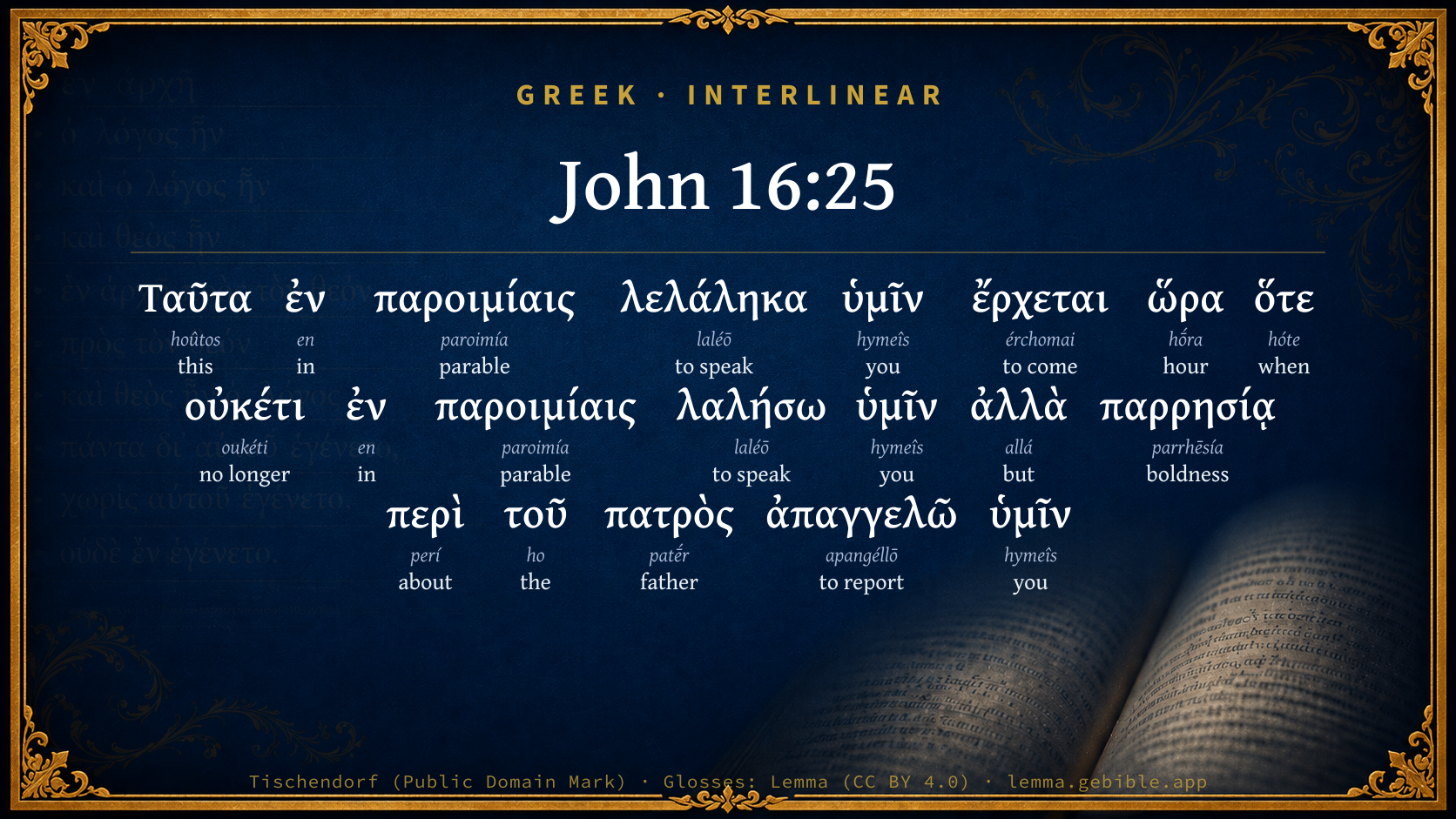
  1. Ταῦτα hoûtos G3778 “this” Demonstrative pronoun, Accusative, Plural, Neuter
  2. ἐν en G1722 “in” Preposition
  3. λελάληκα laléō G2980 “to speak” Verb, Perfect, Active, Indicative, 1st person, Singular
  4. ὑμῖν hymeîs G5210 “you” Personal pronoun, 2nd person, Dative, Plural
  5. ἔρχεται érchomai G2064 “to come” Verb, Present, Middle or Passive deponent, Indicative, 3rd person, Singular
  6. ὥρα hṓra G5610 “hour” Noun, Nominative, Singular, Feminine
  7. ὅτε hóte G3753 “when” Adverb
  8. οὐκέτι oukéti G3765 “no longer” Adverb, Negative
  9. ἐν en G1722 “in” Preposition
  10. παροιμίαις paroimía G3942 “parable” Noun, Dative, Plural, Feminine
  11. λαλήσω laléō G2980 “to speak” Verb, Future, Active, Indicative, 1st person, Singular
  12. ὑμῖν hymeîs G5210 “you” Personal pronoun, 2nd person, Dative, Plural
  13. ἀλλὰ allá G235 “but” Conjunction
  14. παρρησίᾳ parrhēsía G3954 “boldness” Noun, Dative, Singular, Feminine
  15. περὶ perí G4012 “about” Preposition
  16. τοῦ ho G3588 “the” Article, Genitive, Singular, Masculine
  17. πατρὸς patḗr G3962 “father” Noun, Genitive, Singular, Masculine
  18. ἀπαγγελῶ apangéllō G518 “to report” Verb, Future, Active, Indicative, 1st person, Singular
  19. ὑμῖν hymeîs G5210 “you” Personal pronoun, 2nd person, Dative, Plural

About this verse

These counts appear in no published source. They are computed here, from the morphology-tagged text and Lemma’s own curated glosses. What Lemma adds →

20
words
15
distinct lemmas
Gospels
section

Notable vocabulary

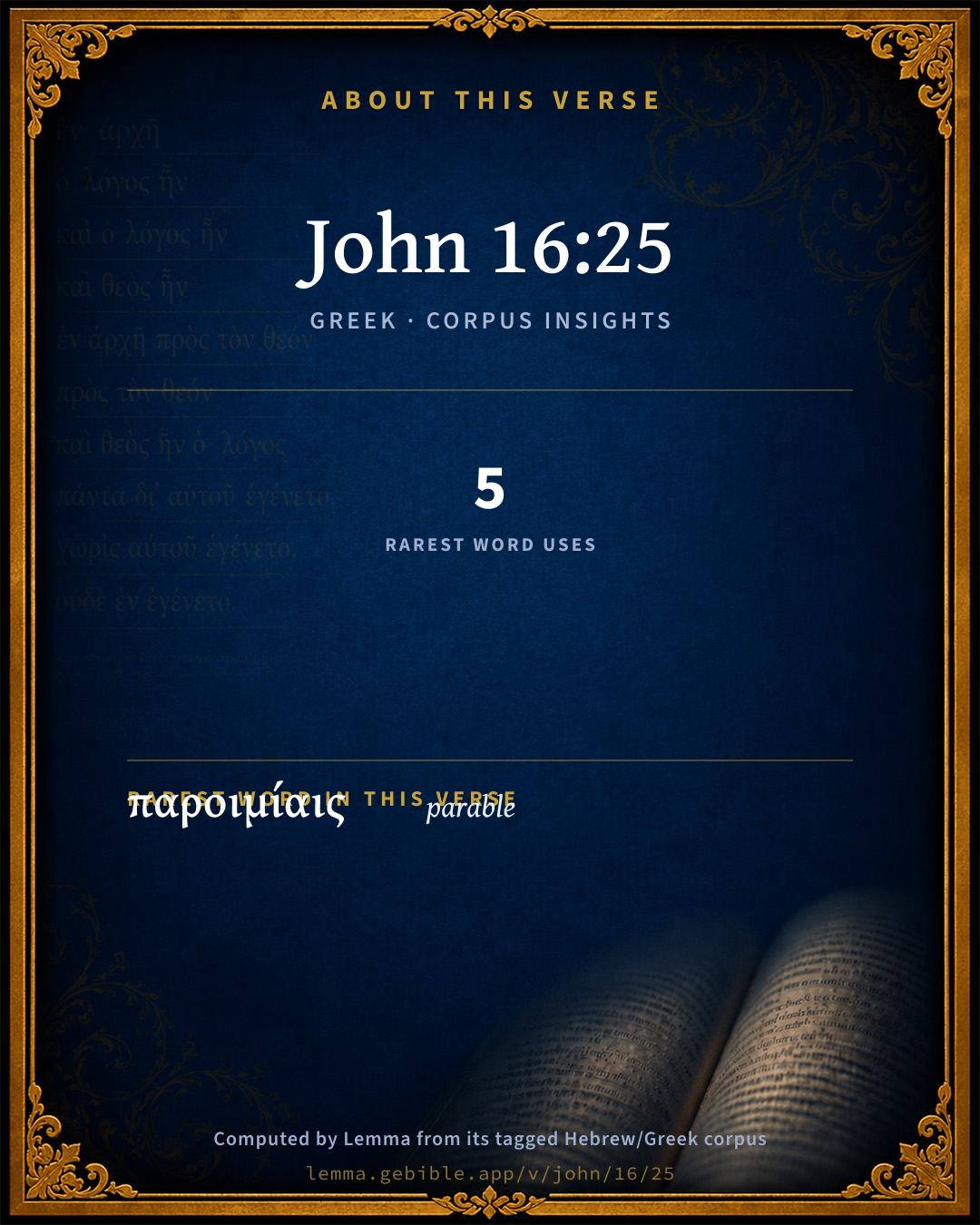
The rarest word here is παροιμίαις parable G3942 — appearing just 5 times in the whole Greek New Testament.

Shared distinctive vocabulary

παροιμίαις parable G3942 occurs in 4 verses of the Greek New Testament. Also found in:

Repetition

Words recur within this verse:

  • παροιμίαις parable G3942 ×2
  • λελάληκα to speak G2980 ×2
  • ὑμῖν you G5210 ×3
  • ἐν in G1722 ×2

Cross-references

14

Topical passages linked to John 16:25 in the Treasury of Scripture Knowledge — connected by theme and wording, ordered by reader-vote popularity; previews shown in the World English Bible.

  • John 16:12 "I have yet many things to tell you, but you can't bear them now.
  • Matthew 13:34–35 Jesus spoke all these things in parables to the multitudes; and without a parable, he didn't speak to them,
  • Mark 4:13 He said to them, "Don't you understand this parable? How will you understand all of the parables?
  • John 10:6 Jesus spoke this parable to them, but they didn't understand what he was telling them.
  • John 16:28–29 I came out from the Father, and have come into the world. Again, I leave the world, and go to the Father."
  • Psalms 49:4 I will incline my ear to a proverb. I will open my riddle on the harp.
  • Psalms 78:2 I will open my mouth in a parable. I will utter dark sayings of old,
  • Matthew 13:10–11 The disciples came, and said to him, "Why do you speak to them in parables?"
  • 2 Corinthians 3:12–18 Having therefore such a hope, we use great boldness of speech,
  • Proverbs 1:6 To understand a proverb, and parables, The words and riddles of the wise.
  • John 16:2 They will put you out of the synagogues. Yes, the time comes that whoever kills you will think that he offers service to God.
  • John 16:16–17 A little while, and you will not see me. Again a little while, and you will see me."
  • Acts 2:33–36 Being therefore exalted by the right hand of God, and having received from the Father the promise of the Holy Spirit, he has poured out this, which you now see and hear.
  • 2 Corinthians 4:2 But we have renounced the hidden things of shame, not walking in craftiness, nor handling the word of God deceitfully; but by the manifestation of the truth commending ourselves to every man's conscience in the sight of God.

Cross-references courtesy of OpenBible.info (CC BY 4.0).

Where the printed editions differ

1 variant

Places in this verse where the major printed Greek editions disagree on the wording in a way that affects the translation — a comparison of editions, not a manuscript-by-manuscript collation. The editions are the modern critical texts (Nestlé-Aland 28/27, SBL, Westcott-Hort, Tregelles, Tyndale House) and the traditional texts behind the KJV (the Textus Receptus and the Byzantine/Majority text). It is not a claim about which reading is original.

  1. Extra text
    ἀλλ᾽

    “but”

    In TRByz Not in NA28NA27TynSBLWHTreg

    ἀλλ᾽ (all᾽) 'but' is only in traditional manuscripts (TR+Byz)

Textual data: Translators Amalgamated Greek New Testament (STEPBible TAGNT) · CC BY 4.0.

Commentary

Notes on John 16:25 from classic Christian and Jewish commentators (each source and its license shown beneath its notes). The classic Christian expositions comment on the surrounding passage and are grouped to its opening verse, so a note may address several verses; the Jewish commentaries on the Tanakh (Rashi and others) are per-verse, so they appear only where the commentator wrote on this verse.

Lemma curates 59 commentaries, every one of them public domain or Creative Commons licensed, each selected and text-cleaned for this edition rather than reprinted as found. About our sources →

The Biblical Illustrator

Joseph S. Exell

Joh_16:25-28

These things have I spoken unto you in proverbs

Christ in heaven, the Church on earth

I.

CHRIST IN HEAVEN.

1. As the Revealer of the Father. He came to be this here, and did reveal the Father, but chiefly in parables, figures, dark sayings. There was a sort of veil over what He said regarding the Father. But when He departed, all that dimness went. From Pentecost there was the plain and full revelation of the Father. This the Epistles contain. There may be in them things hard to be understood: but they are the plainest and fullest revelation that man has had. This unfolding is what the world needed and needs still. Acquaintance with God removes the worlds darkness, and heals its wounds.

2. As the medium of communication between us and the Father. He is in heaven as Advocate and High Priest. As such He carries on the intercourse between us and God, and through Him we have access by one Spirit unto the Father. I do not say that I will pray (or make inquiries for you like the high priest with Urim and Thummim) the Father; i.e., I need not say that I will act thus as your High Priest, and yet this is not because the Father requires to be persuaded to love you; for He loves you already.

II. THE CHURCH ON EARTH.

1. Receiving revelations of the Father. He speaks and she listens. As a willing listener to what Jesus speaks of to the Father, she goes on her way here and does the Fathers work. She learns each day more fully the meaning of the marvellous words, God is love, and he that dwelleth in love, &c. It is this revelation that she preaches us glad tidings of great joy.

2. Praying in Christs name. In a sense, that name had been known from the beginning. The seed of the woman with the bruised heel was known as He through whom all communications were made between the sinner and God. On the credit of His name, prayer got its answer all along. But still that name was but dimly known, and not known as that of Jesus of Nazareth. Hence-forth in that name all prayer was to be presented, and success thus assured. Christ gives us this name to make use of in all our dealings with

God, and we need nothing else. Never, then, let us go to God without it, but going with it, let us be confident. Let us not dishonour that name by distrust.

3. Enjoying the Fathers love. This is no doubtful thing, but as sure as it is blessed. This love is the sunshine of life. But it is love through Christ. God loves us as lovers of, and believers in, His Son,

4. Loving the Son. In an unloving world, the Church loves Him whom the Father loveth. This marks her out from all around. To her He is the altogether lovely. My Beloved is the name she gives Him. The question He asks is, Lovest thou Me?

5. Believing that He came out from God. This is the first thing though it comes last. This brings us into the circle of discipleship and sonship. What think ye, then, of Chirst? (H. Bonar, D. D.)

The day of the Spirit

That day is

1. A long day. It began at Pentecost, and will last till the restitution of all things.

2. It is the best day that has dawned on humanity since the Fall--better than the prophetic day, or the day of Christs earthly ministry.

3. It is a day that will grow brighter and brighter until it floods all souls with the sunshine of infinite love.

4. It is the notable day of the Lord, a day in which moral wonders multiply every hour.

5. It runs into the endless day of retribution. The text suggests two thoughts concerning it. It is a day

I. IN WHICH CHRISTLY TEACHING BECOMES MORE AND MORE INDEPENDENT OF WORDS. Proverbs, words, language, are not truth; at best they are mere vehicles. They are no more truth than water pipes are water. The pipes may be broken, but the water still flows, and will find other channels. Christ used words to convey truth. Sometimes they conveyed truth to His disciples spirits, sometimes not. When He says, therefore, I will no more speak unto you in proverbs, He points to a more direct, thorough, and effective way, the way in which the Paraclete would bring all things to their remembrance. The men who are under the influence of this Paraelete are seldom able to trace their most sacred impressions, aspirations, resolves, experiences to any words. No words, e.g., can plainly show the Father. He can only be seen by the loving and pure heart.

II. WHEN FELLOWSHIP WITH THE FATHER BECOMES MORE AND MORE INDEPENDENT OF THE MEDIATION, Christ seems to say, in illustration of this

1. That His disciples in this day will pray in His name, and therefore will not require Him to pray for them (verse 26). He had just said, Hitherto ye have asked nothing in My name. Why? At that time they had not received the Paraelete; but when He came, they would pray in His name, i.e., the Holy Spirit would so inspire them with the sentiments and purposes of Christ, that they would always pray in the spirit of Christ, and therefore their prayer would be real and effective.

2. That His disciples will have a special sense of the Fathers love (verse 27). Observe

(1) That God loves men individually. He loves all, but does not overlook the individual in the millions. His love embraces each, as if each were the whole.

(2) That God loves the individuals especially who love His Son. He loves all, but He has a special love for those who love His Son. No man can love the Father who does not love His image and Revealer. And no man who does not love the Father can be conscious of the Fathers love for him. The mutual love provides direct communication. (D. Thomas, D. D.)

The Biblical Illustrator, edited by Joseph S. Exell (c. 1880s–1900s) — public domain. Text from a community e-Sword module.

Joseph Benson's Commentary

Joh 16:25-28. These things — Though very weighty and important; have I spoken unto you in proverbs — In the obscurity of parables, which have appeared dark and mysterious to you; but the time cometh, &c. — You may comfort yourselves with this thought, that the time is at hand when I shall speak unto you no more in proverbs — No more in that obscure manner; but I shall show you plainly of the Father — Shall, by the teaching of my Spirit, declare to you, in plain terms, the whole counsel of God relating to the erection of his church and the salvation of men. At that day ye shall ask in my name, &c. — I repeat it to you again, that after my ascension you shall offer up all your addresses unto the Father, through my mediation; I say not that I will pray the Father for you — I do not mean that I will solicit the Father in your behalf, as if he were unwilling to bestow on you the blessings you stand in need of; for the Father himself loveth you — In a peculiar manner; and therefore will be always ready to grant your requests, and to watch over you with paternal affection and care; because ye have loved me — With sincerity and fervency; and have believed that I came out from God — As the Messenger of his grace to men; and have accordingly relied on me with such steadfastness, that you have ventured your all upon that belief. And you have therein acted a very prudent and happy part; for indeed I came forth from the Father, and am come into the world — For purposes of infinite importance to the glory of God and the happiness of the human race; again — Having finished the work I came to do, I leave the world and go to the Father — From whom I came, with whom I shall continually abide, and into whose presence I will shortly conduct you, putting you in possession of a more glorious kingdom than you ever expected, or could expect on earth.

Joseph Benson's Commentary on the Old and New Testaments (1811–1818) — public domain. Text from a community e-Sword module.

MacLaren's Expositions of Holy Scripture

Alexander MacLaren

John

THE JOYS OF ‘THAT DAY’

Joh 16:25 - Joh 16:27.

The stream which we have been tracking for so long in these discourses has now nearly reached its close. Our Lord, in these all but final words, sums up the great salient features which He has already more than once specified, of the time when His followers shall live with an absent and yet present Christ. He reiterates here substantially just what He has been saying before, but in somewhat different connection, and with some slight expansion. And this reiteration of the glad features of the day which was about to dawn suggests how much the disciples needed, and how much we need, to have repeated over and over again the blessed and profound lessons of these words.

What a sublime self-repression there was in the Master! Not one word escapes from His lips of the personal pain and agony into which He had to plunge and be baptized, before that day could dawn. All that was crushed down and kept back, and He only speaks to the disciples and to us of the joy that comes to them, and not at all of the bitter sorrow by which it is bought. There are set forth in these words, as it seems to me, especially three characteristics which belong to the whole period between the ascension of Jesus Christ and His coming again for judgment. It is a day of continual and clearer teaching by Him. It is a day of desires in His name. It is a day of filial experience of a Father’s love. These are the characteristics of the Christian period, and they ought to be the characteristics of our individual Christian life. My brother! are they the characteristics of yours?

Let us note them in order.

I. First, our Lord tells us that the whole period of the Christian life upon earth is to be a period of continuous and clearer teaching by Himself.

‘Hitherto I have spoken to you in proverbs,’ or parables. The word means, not only a comparison or parable, but also, and perhaps primarily, a mysterious and enigmatical saying. The reference is, of course, directly to the immediately preceding thoughts, in which His departure and the sorrow that accompanied it and was to merge into joy, were described under that touching figure of the woman in travail. But the reference must be extended very much farther than that. It includes not only this discourse, but the whole of His teaching by word whilst He was here upon earth.

Now the first thing that strikes me here is this strange fact. Here is a man who knew Himself to be within four-and-twenty hours of His death, and knew that scarcely another word of instruction was to come from His lips upon earth, calmly asserting that, for all the subsequent ages of the world’s history, He is to continue its Teacher. We know how the wisest and profoundest of earthly teachers have their lips sealed by death, so as that no counsel can come from them any more, and their disciples long in vain for responses from the silenced oracle, which is dumb whatever new problems may arise. But Jesus Christ calmly poses before the world as not having His teaching activity in the slightest degree suspended by that fact which puts a conclusive and complete close to all other teachers’ words. Rather He says that after death He will, more clearly than in life, be the Teacher of the world.

What does He mean by that? Well, remember first of all the facts which followed this saying-the Cross, the Grave, Olivet, the Heavens, the Throne. These were still in the future when He spoke. And have not these-the bitter passion, the supernatural resurrection, the triumphant ascension, and the everlasting session of the Son at the right hand of God-taught the whole world the meaning of the Father’s name, and the love of the Father’s heart, and the power of the Father’s Son, as nothing else, not even the sweetest and tenderest of His utterances, could have taught them? When, then, He declares the continuance of His teaching functions unbroken through death and beyond it, He refers partly to the future facts of His earthly manifestation, and still more does He refer to that continuous teaching which, by that divine Spirit whom He sends, is granted to every believing soul all through the ages.

This great truth, which recurs over and over again in these discourses of our Lord, is far too much dropped out of the consciousness and creeds of the modern Christian Church. We call ourselves Christ’s disciples. If there be disciples, there must be a Master. His teaching is by no means merely the effect of the recorded facts and utterances of the Lord, preserved here in the Book for us, and to be pondered upon by ourselves, but it is also the hourly communication, to waiting hearts and souls that keep themselves near the Lord, of deeper insight into His will, of larger views of His purposes, of a firmer grasp of the contents of Scripture, and a more complete subjection of the whole nature to the truth as it is in Jesus. Christian men and women! do you know anything about what it is to learn of Christ in the sense that He Himself, and no poor human voice like mine, nor even merely the records of His past words and deeds as garnered in these Gospels and expounded by His Apostles, is the source of your growing knowledge of Him? If we would keep our hearts and minds clearer than we do of the babble of earthly voices, and be more loyal and humble and constant and patient in our sitting on the benches in Christ’s school till the Master Himself came to give us His lessons, these great words of my text would not, as they so often do in the mass of professing Christians, lack the verification of experience and the assurance that it is so with us. Have you sat in Christ’s school, and do you know the secret and illuminative whispers of His teaching? If not, there is something wrong in your Christian character, and something insincere in your Christian profession.

Notice, still further, that our Lord here ranks that subsequent teaching before all that He said upon earth, great and precious as it was. Now I do not mean for one moment to allege that fresh communications of truth, uncontained in Scripture, are given to us in the age-long and continuous teaching of Jesus Christ. That I do not suppose to be the meaning of the great promises before us, for the facts of revelation were finished when He ascended, and the inspired commentary upon the facts of revelation was completed with these writings which follow the Gospels in our New Testament. But Christ’s teaching brings us up to the understanding of the facts and of the commentary upon them which Scripture contains, so that what was parable or proverb, dimly apprehended, mysterious and enigmatical when it was spoken, and what remains mysterious and enigmatical to us until we grow up to it, gradually becomes full of significance and weighty with a plain and certain meaning. This is the teaching which goes on through the ages-the lifting of His children to the level of apprehending more and more of the inexhaustible and manifold wisdom which is stored for us in this Book. The mine has been worked on the surface, but the deeper it goes the richer is the lode; and no ages will exhaust the treasures that are hid in Christ Jesus our Lord.

He uses the new problems, the new difficulties, the new circumstances of each successive age, and of each individual Christian, in order to evolve from His word larger lessons, and to make the earlier lessons more fully and deeply understood. And this generation, with all its new problems, with all its uneasiness about social questions, with all its new attitude to many ancient truths, will find that Jesus Christ is, as He has been to all past generations,-the answer to all its doubts, using even these doubts as a means of evolving the deeper harmonies of His Word, and of unveiling in the ancient truth more than former generations have seen in it. ‘Brethren, I write unto you no new commandment. Again, a new commandment I write unto you.’ The inexhaustible freshness of the old word taught us anew, with deeper significance and larger applications, by the everlasting Teacher of the Church, is the hope that shines through these words. I commend to you, dear brethren, the one simple, personal question, Have I submitted myself to that Teacher, and said to men and systems and preachers and books and magazines, and all the rest of the noisy and clamorous tongues that bewilder under pretence of enlightening this generation-have I said to them all, ‘Hold your peace! and let me, in the silence of my waiting soul, hear the Teacher Himself speak to me. Speak, Lord! for Thy servant heareth. Teach me Thy way and lead me, for Thou art my Master, and I the humblest of Thy scholars’?

II. In the next place, another of the glad features of this dawning day is that it is to be a day of desires based upon Christ, and Christlike.

‘In that day ye shall ask in My name.’ Our translators have wisely put a colon at the end of that clause, in order that we may not hurry over it too quickly in haste to get to the next one. For there is a substantial blessing and privilege wrapped up in it. Our Lord has just been saying the same thing in the previous verses, but He repeats it here in order to emphasise it, and to set it by the subsequent words in a somewhat different light. But I dwell upon it for a very simple, practical purpose. I have already explained in former sermons the full, deep meaning of that phrase, ‘asking in Christ’s name,’ and have suggested to you that it implies two things-the one, that our desires should all be based upon His great work as the only ground of our acceptance with God; and the other, that our desires should all be such as represent His heart and His mind. When we ‘ask in His name’ we ask, first, for His sake, and, second, as in His person. And such desires, resting their hopes of answer solely upon His mighty sacrifice and all-sufficient merit, and shaped accurately and fully after the pattern of the wishes that are dear to His heart, are to be the prerogative and the joy of His servants, in the new ‘day’ that is about to dawn.

Note how beautifully this thought, of wishes moulded into conformity with Jesus Christ, and offered in reliance upon His great sacrifice, follows upon that other thought, ‘I will tell you plainly of the Father.’ The Master’s voice speaks, revealing the paternal heart, the scholar’s voice answers with desires kindled by the revelation. Longings and aspirations humbly offered for His sake, and after the pattern of His own, are our true response to His teaching voice. As the astronomer, the more powerful his telescope, though it may resolve some of the nebulae that resisted feebler instruments, only has his bounds of vision enlarged as he looks through it, and sees yet other and mightier star-clouds lying mysterious beyond its ken-so each new influx and tidal wave of knowledge of the Father, which Christ gives to His waiting child, leads on to enlarged desires, to longings to press still further into the unexplored mysteries of that magnificent and boundless land, and to nestle still closer into the infinite heart of God. He declares to us the Father, and the answer of the child to the declaration of the Father is the cry, ‘Abba! Father! show me yet more of Thy heart.’ Thus aspiration and fruition, longing and satisfaction in unsatiated and inexhaustible and unwearying alternation, are the two blessed poles between which the life of a Christian may revolve in smoothness and music.

My friend! is that anything like the transcript of our experience, that the more we know of God, the more we long to know of, and to possess, Him? and the more we long to know of, and to possess, Him, the more full, gracious, confidential, tender, and continuous are the teachings of our Master? Is not this a far higher level of Christian life than that we live upon? And why so? Is Christ’s word faithless? Hath He forgotten to be gracious? Was this promise of His idle wind? Or is it that you and I have never grasped the fulness of privileges that He bestows upon us?

III. Note, lastly, that that day is to be a day of filial experience of a Father’s love.

‘I say not unto you that I will pray the Father for you, for the Father Himself loveth you because ye have loved Me, and have believed that I came out from God.’ Jesus Christ does not deny His intercession. He simply does not bring it into evidence here. To deny it would have been impossible, for soon afterwards we find Him saying, ‘I pray for them which Thou hast given Me, for they are Thine.’ But He does not emphasise it here, in order that He may emphasise another blessed source of solace-viz., that to those who listen to the Master’s teaching, and have their desires moulded into harmony with His, and their wishes and hopes all based upon His sacrifice and work, the divine Father’s love directly flows. There is no need of any intercession to turn Him to be merciful. Men sometimes caricature the thought of the intercession of Christ, as if it meant that He, by His prayer, bent the reluctant will of the Father in heaven. All such horrible misconceptions Christ sweeps out of the field here, even whilst there remains, in the fact that the prayers of which He is speaking are offered in His name, the substance and reality of all that we mean by the intercession of Jesus Christ.

And now note that God loves the men who love Jesus Christ. So completely does the Father identify Himself with the Son, that love to Christ is love to Him, and brings the blessed answer of His love to us. Whosoever loves Christ loves God.

Whosoever loves Christ must do so, believing that He ‘came forth from God.’ There are the two characteristics of a Christian disciple,-faith in the divine mission of the Son, and love that flows from faith. Now, of course, it does not follow from the words before us, that this divine love which comes down upon the heart which loves Christ is the original and first flow of that love towards that heart. ‘We love Him because He first loved us.’ Christ is not here tracking the stream to its source, but is pointing to it midway in its flow. If you want to go up to the fountain-head you have to go up to the divine Father’s heart, who loved when there was no love in us; and, because He loved, sent the Son. First comes the unmotived, spontaneous, self-originated, undeserved, infinite love of God to sinners and aliens and enemies; then the Cross and the mission of Jesus Christ; then the faith in His divine mission; then the love which is the child of faith, as it grasps the Cross and recognises the love that lies behind it; and then, after that, the special, tender, and paternal love of God falling upon the hearts that love Him in His Son. There is nothing here in the slightest degree to conflict with the grand universal truth that God loves enemies and sinners and aliens. But there is the truth, as precious as the other, that they who have ‘known and believed the love that God hath to us’ live under the selectest influences of His loving heart, and have a place in its tenderness which it is impossible that any should have who do not so love. And that sweet commerce of a divine love answering a human, which itself is the answer to a prior divine love, brings with it the firm confidence that prayers in His name shall not be prayers in vain.

So, dear friends, growing knowledge, an ever-present Teacher, the peace of calm desires built upon Christ’s Cross and fashioned after Christ’s Spirit, and the assurance in my quiet and filial heart that my Father in the heavens loves me, and will neither give me ‘serpents’ when I ask for them, thinking them to be ‘fishes,’ nor refuse ‘bread’ when I ask for it-these things ought to mark the lives of all professing Christians. Are they our experience? If not, why are they not, but because we do not believe that ‘Thou art come forth from God,’ nor love Thee as we ought?

Alexander MacLaren, Expositions of Holy Scripture (1904–1910) — public domain. Text from a community e-Sword module.

Tyndale Open Study Notes

Tyndale Open Resources

16:25 Jesus spoke using figures of speech, which could only be interpreted with God’s help (1 Cor 1:18-25). With the coming of the Spirit, the disciples would understand.

Tyndale Open Study Notes — © Tyndale Open Resources, licensed CC BY-SA 4.0. Text via the HelloAO Bible API.

Bengel's Gnomon

Johann Albrecht Bengel

Joh 16:25. Ἐν παροιμίαις, in more covert words, in somewhat dark sayings) In antithesis to παῤῥησίᾳ, openly, plainly, without a veil: πάροιμος, is one who is somewhere about the way (οἴμη), but not in the way, whence παροιμία (ch. Joh 10:6) is a mode of speaking whereby is meant not the literal thing, which the words express to the ear, but yet something not unlike it (from which notion also the term παραβολὴ, משל, is formed). Such was that expression, μικρὸν, a little while; Joh 16:16, whereupon the disciples said, What is this? Joh 16:18.—περὶ, concerning) The same particle occurs in the following verse. I shall show you concerning the Father, and in Joh 16:26, I will pray (request) the Father concerning (for) you, are sweetly correlative.

Bengel's Gnomon of the New Testament — English translation (T&T Clark, Edinburgh, 1860) — public domain. Text from a community e-Sword module.

Meyer's Critical & Exegetical Commentary

Heinrich August Wilhelm Meyer

Joh_16:25. Ταῦτα] that, namely, after which the disciples, in Joh_16:17-18, had asked, and what He Himself, Joh_16:20 ff., had more fully carried out; that, consequently, which had been spoken of His departure and of His being seen again, and its circumstances and consequences. He has uttered this in improper, allegorical expressions (ἐν παροιμ., comp. on Joh_10:6, and on the generic plur., Mar_12:1), proportioned to their capacity of comprehension; but when the hour of the fulfilment of the promise of the Paraclete shall have arrived, He will then, and that by means of the Paraclete, no longer speak to them under such sensuous veils of thought, but without circumlocution, and directly, frankly and freely (παῤῥησίᾳ, adverbial instrumental dative, as in Joh_11:14), give them tidings of the Father. In answer to Luthardt, who refers ταῦτα to all that was previously said, including the discourse on the vine (comp. also Godet), Joh_16:1 is already decisive, and also the fact that before Joh_16:19 the disciples have spoken.

Meyer — Critical and Exegetical Commentary on the New Testament — English translation by Peter Christie, edited by Frederick Crombie (T&T Clark, 1880) — public domain. Text from a community e-Sword module.

Expositor's Greek Testament

ed. W. Robertson Nicoll

Joh 16:25 . Another great change would characterize the economy into which they were passing. Instead of dark figurative utterances which only dimly revealed things spiritual, direct and intelligible disclosures regarding the Father would be made to the disciples: ταῦτα ἐν παροιμίαις … ὑμῖν . παροιμία . See Joh 10:6 ; “dark sayings” or “riddles” expresses what is here meant. It is opposed to παρρησίᾳ , open, plain, easily intelligible, meant to be understood. He does not refer to particular utterances, such as Joh 15:1 , Joh 16:21 , etc. but to the reserved character of the whole evening’s conversation, and of all His previous teaching. “The promise is that the reserve imposed by a yet unfinished history, by a manifestation in the flesh, by the incapacity of the hearers, and by their gradual education, will then be succeeded by clear, full, unrestricted information, fitted to create in those who receive it that ‘full assurance of understanding’ which contributes so largely to the ‘full assurance of faith’.” Bernard. περὶ τοῦ πατρός , the Father is the central theme of Christ’s teaching, both while on earth and above.

The Expositor's Greek Testament, edited by W. Robertson Nicoll (1897–1910) — public domain. Text from a community e-Sword module.

Godet's Commentaries

Frédéric Louis Godet

Vv. 25-33.

1. That the time referred to in Joh 16:25 ff. is the same with that described in Joh 16:20-24 is indicated by the fact that the same great characteristic of the period mentioned is here set forth as in the previous verses:—the communication with the Father in the name of Christ. It is also indicated by the fact that after the ταῦτα λελάληκα of Joh 16:25 there is no distinct suggestion of a new subject, such as we find in Joh 15:12; Joh 15:18.

2. The force of the words καὶ οὐ λέγω κ.τ.λ. of Joh 16:26 is undoubtedly this: that the presentation of a request from Himself would not be necessary, because the Father would have an independent personal love for them on the ground of their acceptance of Him and love towards Him. The words “I do not say,” instead of an expression such as “I deny that I will, or say that I will not,” as well as the very nature of the relation between Jesus and the disciples—we may add, the indications elsewhere given of Jesus as an intercessor—show that He does not mean to deny that He will thus ask the Father for them. He did not need, indeed, to assure them of this, for they could not doubt that it would be so. But the one thought here is, that they might have confidence, when approaching the Father in prayer, that He had a personal love for them, and, by reason of this, would be ready to answer their petitions—and this would be a vital element in their future permanent joy.

3. The words of the disciples in Joh 16:29-30, which have a special reference to Joh 16:28, in its connection with what precedes, are a new declaration and measure of their belief. Coming, as this declaration does, at the close of the discourses and conversations of Jesus in chs. 13-16, it must be regarded as their profession of faith in view of this latest and most remarkable σημεῖον, in the sphere, not of works, but of words; and, by its position and its contents taken together, it shows an increase in their belief beyond any former utterance.

4. In Joh 16:31-32 Jesus acknowledges their faith (ἄρτι πιστεύετε is an affirmation, not a question), and, at the same time, reminds them that it is not yet perfected. It will show its remaining weakness as the approaching evils and dangers come. Therefore He has spoken to them all the words of this discourse (the ταῦτα λελάληκα of Joh 16:33 points back to the whole of chs. 15, 16), that they may have peace and good courage in the midst of tribulation, being assured that He has overcome the world.

Vv. 25-27.—“I have spoken these things to you in similitudes; but the hour is coming when I shall no more speak to you in similitudes, but when I shall speak to you openly of the Father. 26. In that day ye will need only to ask in my name; and I say not to you that I will pray the Father for you; 27, for the Father himself loves you, because you have loved me and have believed that I came forth from God.”

It is not necessary to understand by the similitudes of which Jesus speaks the figures of the vine and the branches or the woman in childbirth, which He has just used, still less of the parables which have been preserved for us by the Synoptics. He means to characterize in general the manner of speaking of divine things in figurative language; comp. the terms Father’s house, way, to come, to see again, to manifest oneself, to make one’s abode, etc. It belongs only to the Spirit to speak the language which is really adequate to the divine truth. All teaching in words is but a figure, so long as the Spirit Himself does not explain. Παρρησία here: in appropriate terms, which do not compromise the idea by exposing it to a false interpretation; comp. Joh 11:14. On the word παροιμία, see Joh 10:6.

We may hesitate between the two verbs ἀπαγγέλλειν which signifies rather to announce (Alex.) and ἀναγγέλλειν, to declare (Byz.).

From the words περὶ τοῦ πατρός, concerning the Father, Weiss concludes that this promise can bear only upon the contents of Joh 16:23-24, and that the expression to speak in figures refers only to the symbolic term Father by which Jesus has just designated God. But how can we in a natural way explain in this sense the plurals ταῦτα and παροιμίαι ? Then Keil asks with good reason if the name of Father was for Jesus a simple figure. Is it not evident that the question here is of the teaching of the Holy Spirit, which will be a revelation of the Father, of His character, His will, His plans with relation to humanity? Besides, Weiss finds himself obliged, from Joh 16:25 onward, to acknowledge that there can be no longer a question as to the appearances of the Risen One, since the language in which Jesus spoke with His disciples after His resurrection did not differ at all from the ordinary human language which He had made use of previously. But how is it that he does not see that in acknowledging that the state described from Joh 16:25 onward is that which will follow the day of Pentecost, he retracts by this very fact his whole previous interpretation from ch. 14 onward? For Joh 16:26 evidently does not describe a different state from that in Joh 16:23-24; the day of which Joh 16:26 speaks and that of which Joh 16:23; Joh 16:25 speak cannot be any other than that of Joh 14:20-23. Why should not the speaking openly of the Father be the inward fact described in Joh 14:23 : “The Father and I, we will come and make our abode with him.” And if the expression: I will openly announce in our Joh 16:25 refers to the day of Pentecost, as Weiss concedes, why should it not be the parallel of the: I will come again of Joh 14:18?

The declaration of Joh 16:26 seems, at the first glance, to contradict that of Joh 14:16. But in this latter passage, Jesus is still speaking of the time which will precede the day of Pentecost; He says that He will pray for the disciples,in order that He may be able to send the Spirit to them; here, on the contrary, the Paraclete is supposed to be already present and acting in them; this is the reason why they pray themselves to the Father in the name of Jesus, because they are in direct communication with Him. Consequently, as long as they abide in this state of union with God, the intercession of Jesus (Rom 8:34, Heb 7:25) is not necessary for them. But as soon as they sin, they have need of the advocate with the Father, Jesus Christ the righteous (1 John ii 1, 2). The expression: I say not that I will pray, is very admirably adapted to this state. He does not say that He will pray; for so long as they shall be in the normal state of fidelity, they will have no need of this; He prays then throughthem, not for them. Nevertheless, He does not say that He will not pray; for it may be that they will still have need of His intercession, if any separation intervenes between them and the Father. We see how completely Grotius and others have mistaken the idea in understanding the words: “I say not to you that...” in the sense: “not to say that I also will pray for you.” This is to make Jesus say just the contrary of His thought, as is clearly shown by Joh 16:27.

On the words: The Father loves you because you have loved me, comp. Joh 14:21; Joh 14:23. The perfect tenses indicate a condition already gained: “Because you are become those who love me and believe....” In general Jesus does not place faith after love; but here He speaks of a special faith, of the belief in His divine origin. They were heartily attached to His person for a long time before comprehending all His greatness, as they were beginning to comprehend it now.

Jesus comes back in these words from the future, the day of Pentecost, to the work now accomplished in them, because this is the condition and basis of that future (Joh 14:17). And in fact the supreme moment is approaching: it is time to affix the seal to this faith now already formed.

To this end, Jesus formulates the essential contents of it in a definite proposition: “you have believed that I came forth from God.” Tischendorf himself rejects the reading of the Sinaitic MS. and the other thirteen Mjj. which read: from the Father, instead of: from God. It is thedivine origin and mission of Jesus, and not His filial relation with God, which must be emphasized at this moment as the essential object of the apostles’ faith. The case is wholly different in Joh 16:28. The preposition παρά, from, and the verb ἐξῆλθον, I came forth, express more than the simple mission, which would be designated by ἀπό and ἐλήλυθα; these terms characterize the divine sphere, in general, from which Jesus derives His origin. They well bring out the heroism of the apostles’ faith. In this being of flesh and bones, this weak, despised man, they have been able to recognize a being who came to them from the divine abode.

Frédéric Louis Godet — Commentaries on Luke, John, Romans, and 1 Corinthians — English translation (T&T Clark, Edinburgh, 1870s–1890s) — public domain. Text from a community e-Sword module.

Geneva Bible (1599)

Geneva Bible translators

The holy Ghost which was poured upon the Apostles after the Ascension of Christ, instructed both them in all chiefest mysteries and secrets of our salvation, and also by them the Church, and will also instruct it to the end of the world.

Geneva Bible (1599) marginal notes — public domain. Text via Bolls.life.

Jamieson, Fausset & Brown

Robert Jamieson, A. R. Fausset & David Brown

in proverbs--in obscure language, opposed to "showing plainly"--that is, by the Spirit's teaching.

Jamieson, Fausset & Brown — Commentary Critical and Explanatory on the Whole Bible (1871) — public domain (CC PDM 1.0). Text via the HelloAO Bible API.

Adam Clarke's Commentary

Verse 25. In Proverbs] That is, words which, besides their plain, literal meaning, have another, viz. a spiritual or figurative one. I have represented heavenly things to you through the medium of earthly.

The time cometh] viz. the interval from his resurrection to his ascension, which consisted of forty days, during which he instructed his disciples in the most sublime mysteries and truths of his kingdom. Ac 1:3.

Adam Clarke's Commentary on the Bible (1810–1826) — public domain. Text from a community e-Sword/MySword module.

John Calvin's Commentaries

25. These things I have spoken to you in proverbs. The intention of Christ is to give courage to his disciples, that, entertaining good hopes of making better progress, they may not think that the instruction to which they now listen is useless, though there be but little of it that they comprehend; for such a suspicion might lead them to suppose that Christ did not wish to be understood, and that he purposely kept them in suspense. He declares, therefore, that they will soon perceive the fruit of this doctrine, which, by its obscurity, might produce disgust in their minds. The Hebrew word, משל (mashal) sometimes denotes a proverb; but as proverbs most commonly contain tropes and figures, this is the reason why the Hebrews give the name of משלים (meshalim) to enigmas or remarkable sayings, which the Greeks call (ἀποφθέγματα) apophthegms, which have almost always some ambiguity or obscurity. The meaning therefore is, “You think that I now speak to you figuratively, and not in plain and direct language; but I will soon speak to you in a more familiar manner, in order that there may be nothing puzzling or difficult to you in my doctrine.”

We now see what I mentioned a little ago, that this is intended to encourage the disciples by holding out to them the expectation of making greater progress, that they may not reject the doctrine, because they do not yet understand what it means; for, if we are not animated by the hope of profiting, the desire of learning must, unavoidably, be cooled. The fact, however, clearly shows that Christ did not employ terms purposely obscure, but addressed his disciples in a simple and even homely style but such was their ignorance that they hung on his lips with astonishment. That obscurity, therefore, did not lie so much in the doctrine as in their understandings; and, indeed, the same thing happens to us in the present day, for not without good reason does the word of God receive this commendation, that it is our light, (Psalm 119:105; 2 Peter 1:19;) but its brightness is so obscured by our darkness, that, what we hear we reckon to be pure allegories. For, as he threatens by the prophet, that he will be a barbarian to the unbelievers and reprobate, as if he had a stammering tongue, (Isaiah 28:11;) and Paul says that

the Gospel is hidden from such persons, because Satan hath blinded their understandings, (2 Corinthians 4:3, 4;)

so to the weak and ignorant it commonly appears to be something so confused that it cannot be understood. For, though their understandings are not completely darkened, like those of unbelievers, still they are covered, as it were, with clouds. Thus God permits us to be stupefied for a time, in order to humble us by a conviction of our own poverty; but those whom he enlightens by his Spirit he causes to make such progress, that the word of God is known and familiar to them. Such, too, is the import of the next clause:

But the time cometh; that is, the time will soon come, when I shall no more speak to you in figurative language. The Holy Spirit, certainly, did not teach the apostles anything else than what they had heard from the mouth of Christ himself, but, by enlightening their hearts, he drove away their darkness, so that they heard Christ speak, as it were, in a new and different manner, and thus they easily understood his meaning.

But will tell you plainly about the Father. When he says that he will tell them about the Father, he reminds us that the design of his doctrine is to lead us to God, in whom true happiness lies. But another question remains: How does he say, elsewhere, that

it was given to the disciples to know the mysteries of the kingdom of heaven? (Matthew 13:11.)

For here he acknowledges that he has spoken to them in obscure language, but there he lays down a distinction between them and the rest of the people, that he speaketh to the people in parables, (Matthew 13:13.) I reply, the ignorance of the apostles was not so gross that they had not, at least, a slight perception of what their Master meant, and, therefore, it is not without reason that he excludes them from the number of the blind. He now says that his discourses have hitherto been allegorical, in comparison of that clear light of understanding which he would soon give to them by the grace of his Spirit. Both statements are therefore true, that the disciples were far above those who had no relish for the word of the Gospel, and yet they were still like children learning the alphabet, in comparison of the new wisdom which was bestowed on them by the Holy Spirit.

John Calvin's Commentaries (1540-1563) — public domain. Text from the Calvin Translation Society English edition (1840s-50s) via the Christian Classics Ethereal Library (ccel.org). Calvin's coverage is partial (roughly two-thirds of the Bible); uncommented books and verses are honest gaps, never fabricated. The 19th-century editor's footnotes and remarks are omitted so the notes are faithfully Calvin's own voice.

Ellicott's Commentary for English Readers

(25) These things have I spoken unto you in proverbs.—Better, as in the margin, . . . in parables. So in the second clause of the verse and in Joh_16:29. (Comp. Note on Joh_10:6.) “These things” refers specially to what He had just said from Joh_16:16 onwards. There is a sense in which it is necessarily true of all Christ’s teaching, and of all teaching in words. They are but parables until the truth which they contain has been thought out by the man that hears them. For the disciples much of Christ’s teaching remained in a parabolic form, until the Spirit brought all things which He had said to the mind, and quickened their minds so that they could grasp its meaning. (Comp. e.g., Joh_2:20-22.)

But the time cometh, when I shall no more speak unto you in proverbs.—For “proverbs,” read parables, as in last verse. For the time referred to, comp. Joh_16:16; Joh_16:23. In that time He will be present with them in the Advocate, and will no longer need parables or words, but will, to the depth of their spirit, communicate to them in all fulness and plainness the eternal truth of the Father (Joh_16:13 et seq.).

A Bible Commentary for English Readers, edited by Charles John Ellicott (1878–1897) — public domain. Text from a community e-Sword module.

The Cambridge Bible for Schools and Colleges

gen. ed. J. J. S. Perowne

25–33. Summary and conclusion of these discourses

25. These things] As in Joh_16:1 there is some uncertainty as to how much is included. Some refer ‘these things’ to Joh_16:19-24; others to Joh_15:1 to Joh_16:24. Perhaps even the latter is too narrow a limit. The words can apply to all Christ’s teaching, of which there was much which the multitudes were not allowed (Mat_13:11) and the Apostles were not able (Joh_2:22) to understand at the time.

in proverbs] Better, in allegories (see on Joh_10:6).

but the time cometh] Better, there cometh an hour (Joh_4:21; Joh_4:23, Joh_5:25, Joh_16:2; Joh_16:32). Omit ‘but’ with the best authorities.

shew] Or, declare, as in Joh_16:13-15. The best MSS. give a different compound of the same verb as is used in Joh_16:13-15, but the difference cannot well be marked in English.

plainly] Frankly, without reserve (see on Joh_7:4 and comp. Joh_7:13; Joh_7:26, Joh_10:24, Joh_11:14; Joh_11:54, Joh_18:20).

The Cambridge Bible for Schools and Colleges (gen. ed. J. J. S. Perowne; Cambridge University Press, 1878–1918) — public domain. Text from a community e-Sword module.

John Gill's Exposition

For the Father himself loveth you,.... The Father loved them as well, and as much as the Son did, and of himself too, without any merit or motive in them: he loved them from everlasting, and had given proofs of it in time, in the gift of his Son to them, and for them; and in calling them by his grace; and therefore being thus strongly affected to them, they might depend upon a ready and speedy answer from him, as might be best for his glory, and their good.

Because ye have loved me; not that their love to Christ was the cause of the Father's love to them; but, on the contrary, the Father's love to them was the cause of their love to Christ; and therefore as the cause is known by its effect, they might be assured of the Father's love to them by their love to Christ; for if the Father had not loved them, they had never loved God, nor Christ; but since they did love Christ, it was a clear case the Father loved them: and this their love is joined with faith;

and have believed that I came out from God; being sent by him, and am no impostor, but the true Messiah that was to come: faith in Christ, and love to him, go together; where the one is, there is the other; faith works by love; they are both the gifts of God's grace, and the fruits and effects of his everlasting love; and those who are possessed of them may be firmly persuaded of their interest therein.

John Gill's Exposition of the Whole Bible (1746–1763) — public domain (CC PDM 1.0). Text via the HelloAO Bible API.

Trapp's Complete Commentary

John Trapp

25 These things have I spoken unto you in proverbs: but the time cometh, when I shall no more speak unto you in proverbs, but I shall shew you plainly of the Father.

Ver. 25. These things have I spoken, &c.] He spake plain enough, but they were so slow of hear and dull of hearing, that they thought he spake to them in riddles and parables. Legum obscuritate non assignemus culpae scribentium, sed inscitiae non assequentium. (Sex. Cecil. apud Gell.) So though the prophet dealt with the people as with little ones newly weaned, mincing and masticating their meat for them, laying before them "precept upon precept, line upon line," &c., yet was he to them (through their singular stupidity) as one that lisped half words, or spake in a strange tongue, Isa 28:10-12. Ac si btaeais esset labiis.

John Trapp, A Commentary or Exposition upon All the Books of the Old and New Testament (1647–1656) — public domain. Text from a community e-Sword module.

Albert Barnes' Notes on the Bible

In proverbs - In a manner that appears obscure, enigmatical, and difficult to be understood. It is worthy of remark, that though his declarations in these chapters about his death and resurrection appear to us to be plain, yet to the apostles, filled with Jewish prejudices, and unwilling to believe that he was about to die, they would appear exceedingly obscure and perplexed. The plainest declarations to them on the subject would appear to be involved in mystery.

The time cometh - This refers, doubtless, to the time after his ascension to heaven, when he would send the Holy Spirit to teach them the great truths of religion. It does not appear that he himself, after his resurrection, gave them any more clear or full instruction than he had done before.

I shall show you plainly - As Jesus said that he would send the Holy Spirit Joh 16:7, and as he came to carry forward the work of Christ, so it may be said that the teachings of the Holy Spirit were the teachings of Christ himself.

Of the Father - Concerning the will and plan of the Father; particularly his plan in the establishment and spread of the Christian religion, and in organizing the church. See Acts 10.

Albert Barnes' Notes on the Bible (1834–1885) — public domain. Text from a community e-Sword/MySword module.

Matthew Poole's English Annotations

That by proverbs is meant any dark sayings, is plain from the opposition in the text of that term

plainly. Christ had spoken, though not all things, yet many things to them in dark phrases, and under many figurative expressions;

but (saith he) the time cometh, when I shall show you plainly of the Father: that time is either Christ’s second coming, or after the pouring out of the Spirit, which latter is most probably what our Saviour doth here intend, because of those great measures of knowledge which at and after that time were given out. He had before given to his disciples to know the mysteries of the kingdom of heaven, far beyond others, Mat 13:11; but yet it appears by Joh 14:1-6, and many other texts, that they had a very confused and imperfect knowledge of the Trinity, and Christ’s oneness with the Father, and their mutual personal relation one to another.

Matthew Poole's English Annotations on the Holy Bible (1683–1685) — public domain. Text from a community e-Sword/MySword module.

Whedon's Commentary on the Bible

Daniel D. Whedon

25. These things—To Joh_16:28 Jesus now opens a new promise. The obscurity now resting upon his words to their minds should be withdrawn. New facts and new revelations should be made, which should throw back their broad light upon his past discourses.

Proverbs—The proverb, as the word is here used, is a brief expression of a great truth in language concise and somewhat enigmatical. Its very riddle detains the attention of the mind upon it, and so fastens it upon the memory. Our Lord had discoursed in what were to a great degree enigmas; but those very enigmas served as vehicles to hold fast the truth until the day of explanation.

Time cometh— The time was doubtless the period of the forty days after his resurrection. And yet in spirit it covered the whole period of their apostolic office.

Daniel D. Whedon (gen. ed.), Commentary on the Old and New Testaments (1874–1909) — public domain. Text from a community e-Sword module.

The Pulpit Commentary

Vers. 25-33. (d) The final conviction wrought that Jesus was what he had said that he was. The joy of Christ, with its note of warning.

These things I have spoken to you in proverbs; (see Joh_10:6) i.e. in concentrated and to some extent enigmatical utterances, "in dark sayings upon a harp," in words which subsequent events and higher enlightenment would interpret (cf. here Christ"s distinction between his disciples and the multitude in the matter of parables, Matthew 13). He used the parable to the stupefied, that they might thus separate between those who were susceptible to his teaching and those who were not. To his disciples he interpreted his parables, still leaving much which might be regarded as paroimiai , condensed word-utterances, in which words stood for higher things than in their ordinary usage. Thus the similitudes adopted throughout Joh 9, 10, 11, 12-16, are numerous, intended to draw the disciples on from their ordinary ideas to the heights of his thought and the mystery of his Person. The all is omitted by modern editors. The hour cometh the great climacteric period of my revelationwhen I shall no longer speak to you in proverbs, when, indeed, the sound of my voice will be hushed, and words will no longer be needed, when Divine inspirations and heavenly pulsations shall convey to you what my parabolic teaching and my paroimic interpretations have failed to impart, when I shall be with you and in you, and by the energy of the Paraclete I shall declare (to you) plainly, with clearness and openness, in the fullness of spiritual light, without reserve, circumlocution, or parable, concerning the Father. This promise declares that the glorious revelations of Pentecost and the teaching of those who received the Holy Ghost will be verily and indeed our Lord Christ"s own most personal and frank and outspoken revelations of the Father.

The Pulpit Commentary (1880–1919), ed. H.D.M. Spence-Jones & Joseph S. Exell — public domain. Text from a community e-Sword module.

Burkitt's Expository Notes on the New Testament

William Burkitt

Here our Saviour tells his disciples that although he had spoken many things to them in dark parables and figurative expressions, yet now the time was approaching, namely, the Comforter’s coming, when he would, by the Holy Ghost, clearly enlighten their understandings in the knowledge of divine mysteries, and the things pertaining to the kingdom of God, and particularly in the knowledge of God as his Father, and their Father in him.

Hence learn, 1. That the clearest truths will be but parables, proverbs, and dark myteries, even to disciples themselves, till the Holy Spirit enlightens their understandings.

2. That the clear and full manifestation of divine truth was reserved till the coming of the comforter, who did communicate it to the apostles, and by them to the church, or body of Christians: I, by him, will shew you plainly of the Father.

William Burkitt's Expository Notes on the New Testament (1700–1703) — public domain. Text from a community e-Sword module.

The People's New Testament

B. W. Johnson

25. Spoken in proverbs. In figures.

B. W. Johnson's The People's New Testament with Notes (1889–1891) — public domain. Electronic text from the Christian Classics Ethereal Library (CCEL) ThML edition.

unfoldingWord translationNotes

Door43 World Missions Community

in figures of speech

"in language that is not clear"

the hour is coming

"it will soon happen"

tell you plainly about the Father

"tell you about the Father in a way that you will clearly understand."

Father

This is an important title for God. (See: Translating Son and Father)

translationWords

hour, hours

God the Father

unfoldingWord translationNotes — © Distant Shores Media and the Door43 World Missions Community, licensed CC BY-SA 4.0. Source: git.door43.org/Door43/en_tn.

Cambridge Greek Testament for Schools and Colleges

25–33. SUMMARY AND CONCLUSION OF THESE DISCOURSES

25. Before ἔρχεται omit ἀλλ’, and read ἀπαγγελῶ for ἀναγγελῶ (from Joh 16:13-15).

25. ταῦτα. As in Joh 16:1 there is some uncertainty as to how, much is included. Some refer ‘these things’ to Joh 16:19-24; others to Joh 15:1 to Joh 16:24. Perhaps even the latter is too narrow; the words can apply to all Christ’s teaching, of which there was much which the multitudes were not allowed (Mat 13:11) and the Apostles were not able (Joh 2:22) to understand at the time. For παροιμίαις see on Joh 10:6, and for παρρησίᾳ on Joh 7:13. Ἀπαγγελῶ, the better reading, looks to the maker of the announcement, ἀναγγελῶ to the recipients of it.

Cambridge Greek Testament for Schools and Colleges (Cambridge University Press, 1896; 21 vols, various authors incl. Carr, Maclear, Plummer, Farrar, Lumby, Moule, M. R. James, Simcox) — public domain. Text from a community e-Sword module.

Alford’s Greek Testament

Henry Alford

25-33.] Their present real weakness and imperfection, though fancied strength: their future high blessedness and share in His triumph, though in tribulation in the world.

25.] παροιμία, properly, a proverb:—but implying generally in Scriptural and oriental usage something dark and enigmatical: see especially Sir. 6:35; 8:8; 39:3; 47:17: “in dictis tectioribus,” Bengel.

This is true of the whole discourse—and of the discourses of the Lord in general, as they must then have seemed to them, before the Holy Spirit furnished the key to their meaning.

ἔρχεται ὥρα, viz. the same as that indicated in vv. 16 and 23;—but here again, not one ὥρα only exclusive of all others, but to be understood of the several steps of spiritual knowledge.

Olshausen finely remarks, that all human language is a παροιμία, only able to hint at, not to express fully, the things of God; and that the Lord contrasts the use of this weak and insufficient medium, with the inward teaching of the Holy Spirit. This inward teaching, because it is a real imparting of the divine Nature and Life, brings with it not only prayer in the name of Jesus, but a free access to the Father Himself. This παῤῥησίᾳ λαλεῖν however, he continues, is spoken of here by the Lord in its ideal perfection (as it will hereafter be): and is only approximated to on earth; for, as long as the old man yet lives in us, we require still the Lord’s intercessory prayer (ch. 17:15), daily washing from the pollution of the world; by which Intercession alone the faithful man notwithstanding his imperfection can enjoy in peace the grace of God vouchsafed to him.

Henry Alford, The Greek Testament (1849–1861) — public domain. Text from a community e-Sword module.

International Critical Commentary

25. ταῦτα ἐν παροιμίαις λελάληκα ὑμῖν. For παροιμία, see on 10:6; cf. Psa 78:2.

We have seen (on 15:11) that ταῦτα in the seven-times-repeated ταῦτα λελάληκα ὑμῖν refers in each case to what has immediately preceded. So here ταῦτα points back to the sayings in 16:15ff. about the approaching departure of Jesus. The apostles had not understood the meaning of ὑπάγω πρὸς τὸν πατέρα (v. 18), or of what Jesus had said about their seeing Him again. He puts it more plainly in v. 28, whereupon they reply at once that now they know what He means (v. 29). Whatever allusion ταῦτα ἐν παροιμίαις λελάληκα ὑμῖν may carry to the veiled teachings suggested by the images of the Vine (15:1) and of the Woman in Travail (16:21), or more generally by the parables of the Ministry (Mar 4:33), the primary reference here is to vv. 15-18.

For the phrase ἔρχεται ὥρα, see on v. 2 and 4:21. Here it must be equated with ἐν ἐκείνῃ τῇ ἡμέρᾳ of v. 26 (see v. 23 above). When the visible presence of Jesus was withdrawn, and when His oral teaching was replaced by the fuller teaching of the Spirit (see on 14:26), then His revelation of the Father (the central theme of His ministry), conveyed through the Spirit, would be plainer.

For παρρησία, “unreserved and open speech,” see on 7:4.

ἀπαγγελῶ. So ABC*DLWΘ, but the rec. (with N) has ἀναγγελῶ (from vv. 13, 14, 15). On the other hand, ἀπαγγέλλειν occurs again in Jn. only twice (1Jn 1:2, 1Jn 1:3), while we have ἀναγγέλλειν at Joh 4:25, Joh 4:5:15, Joh 4:16:13, Joh 4:14, Joh 4:15, 1Jn 1:5. It is doubtful if any distinction in meaning can be traced. παρρησίᾳ περὶ τοῦ πατρὸς ἀπαγγελῶ ὑμῖν means “I will bring word to you plainly about the Father”; ἀπαγγέλλειν, “to report,” being a quite appropriate word to employ of the revelations which the Spirit is to bring.

If it be urged that ἀπαγγελῶ must refer to some future oral teachings of Jesus Himself, then we must suppose that the post-Resurrection discourses contained such fuller and plainer doctrine (cf. 20:17); but it is most likely that the future disclosures of the Spirit are in view.

International Critical Commentary — older volumes (1896–1929), various authors — public domain. Text from a community e-Sword module.

Vincent's Word Studies in the New Testament

Marvin R. Vincent

Proverbs [παροιμιαις] . See on parables, Mt 13:3. He had spoken under figures, as the vine, and the woman in travail.

Shall shew [αναγγελω] . Rev., tell. See on ver. 13. The best texts read ajpaggelw, the original force of which is to bring tidings from [απο] something or someone.

Plainly [παρρησια] . See on 7 13.

Marvin R. Vincent, Word Studies in the New Testament (1887–1900) — public domain. Text from a community e-Sword/MySword module.

Lesson kit

Teaching starters — assembled from the data on this page, not authored interpretation. Every prompt links to the verse data it draws on. Edit before teaching.

John, in the Gospels, opens this verse with 20 words (15 distinct Greek lemmas). Its most distinctive word is paroimía (“parable”). A historical commentator’s framing appears above. Read the whole chapter for the surrounding context.

Discussion questions

  1. What does “parable” (paroimía) contribute to the verse as a whole?
  2. How does John 10:6, which shares the word «parable», read alongside this verse?
  3. What does the repetition of “parable” (2× in this one verse) do in this verse?
  4. The translations on this page render this verse differently — a whole-verse word diff, not a word-by-word alignment. What might account for the different wordings?
  5. Compare how The Biblical Illustrator and Joseph Benson's Commentary read this verse. Where do they agree or differ?

Things to notice

Reading settings

Reading text

Shown beneath each verse's original-language words.

Old Testament
Old Testament edition

Read the OT as the Masoretic Hebrew (MT) or the Greek Septuagint (LXX).

English shown for the Greek Septuagint (in the Hebrew ↔ Greek comparison).

Comparing translations? Open the Compare panel on any verse page to stack up to four side by side.