
John 7:35

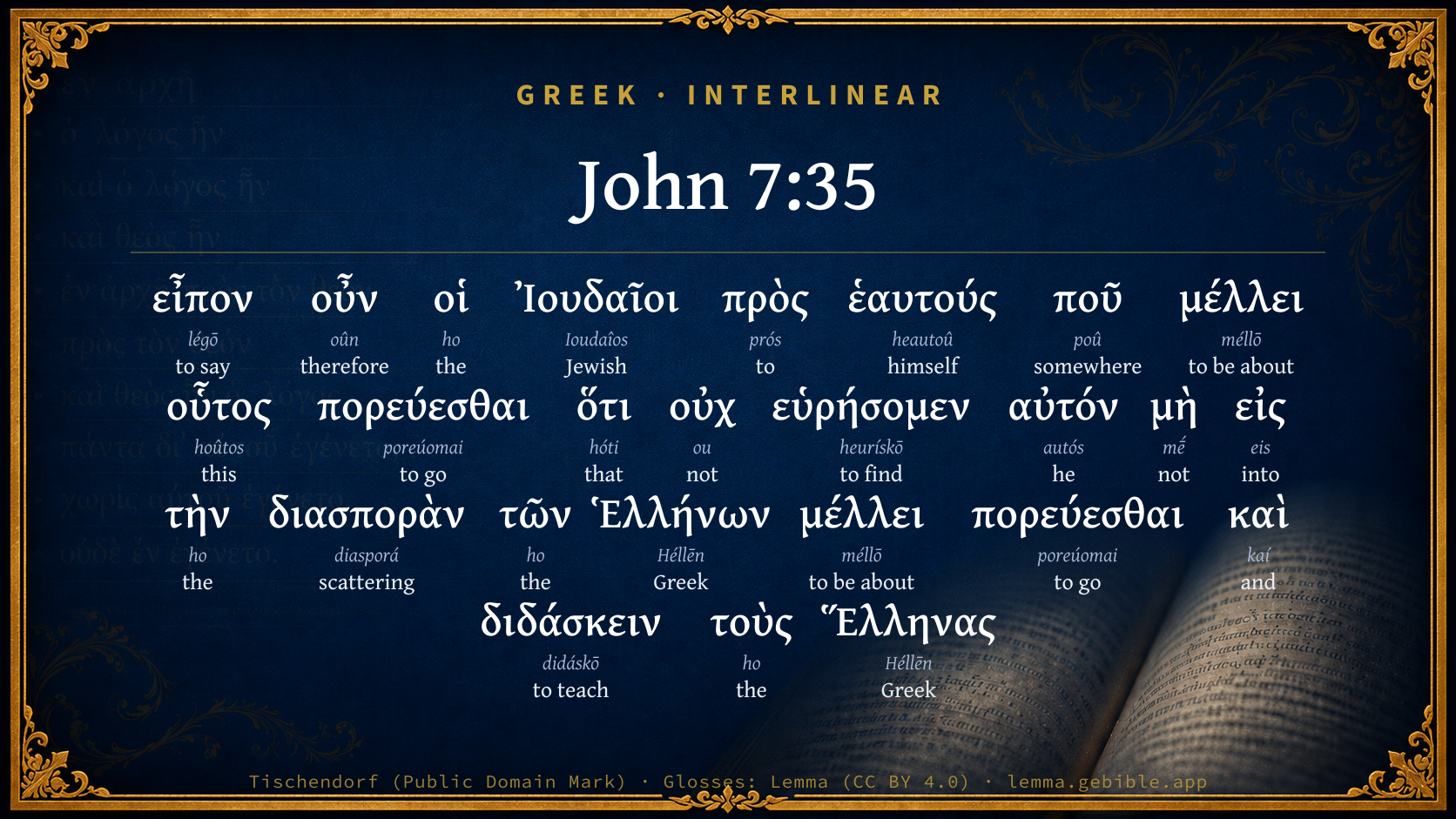
Greek (Tischendorf 8th ed.) John 7:35 appears in the Greek New Testament. The text above is from the Tischendorf 8th edition. Each word links to its Strong’s number and a concise gloss. Click any word for its full Thayer’s Greek Lexicon entry.
Download image
Cite this verse

John 7:35 (World English Bible). Public Domain. Lemma interlinear Bible study tool, https://lemma.gebible.app/v/john/7/35.

Show BibTeX & RIS
BibTeX
RIS
English Translation
The Jews therefore said among themselves, "Where will this man go that we won't find him? Will he go to the Dispersion among the Greeks, and teach the Greeks?
World English Bible · Public Domain
Highlights
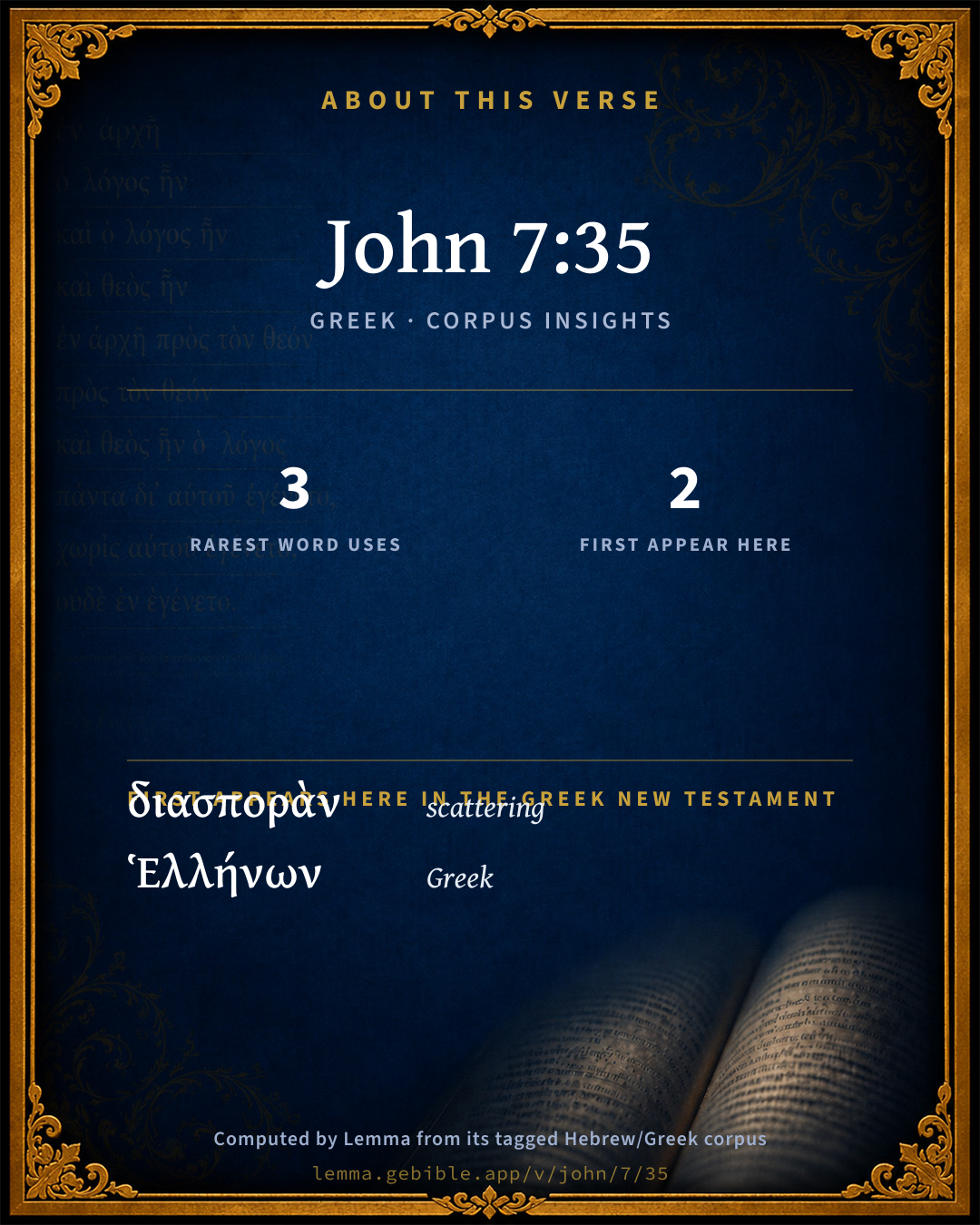
  • 2 first appearances in the Greek New Testament
Full analysis ↓
Download a study sheet

One document with this verse’s original text, its word-by-word gloss line, the meaning frame, cross-references with their text, attributed commentary, and full source and license credits — printable, and it pastes into notes with its structure intact.

This verse Autodidact and up

Study sheet (.html) Plain text (.txt)

A passage Seminary Student

Up to 50 verses in one chapter. A passage sheet keeps up to 6 commentary sources and 12 cross-references per verse, in the order this page ranks them, and says so on the sheet whenever that leaves anything out. Ask for a single verse and you get the Autodidact verse sheet above.

Everything on this page stays free to read, with no account — the sheet is a download of what is already on screen, not access to it.

Want to remove ads? Support Godless Engineer
Compare translations 3

The same verse in 3 English versions, stacked beneath the original-language interlinear above. Click any original word for its lexicon entry.

Each is an independent rendering of the whole verse — the interlinear is not word-aligned to these translations.

Highlighted words mark where these versions differ — a whole-verse word diff, not a word-by-word alignment.

  • World English Bible Public Domain
    The Jews therefore said among themselves, "Where will this man go that we won't find him? Will he go to the Dispersion among the Greeks, and teach the Greeks?
  • King James Version Public Domain
    Then said the Jews among themselves, Whither will he go, that we shall not find him? will he go unto the dispersed among the Gentiles, and teach the Gentiles?
  • unfoldingWord Literal Text CC BY-SA 4.0
    The Jews therefore said among themselves, “Where is this one about to go that we will not find him? He is not about to go to the dispersion of the Greeks and to teach the Greeks, is he?

unfoldingWord Literal Text — © unfoldingWord, licensed CC BY-SA 4.0. Word-aligned USFM3 via Door43 (git.door43.org/unfoldingWord/en_ult).

Versions to compare (up to 4)

3 of 4 selected

Show all 19 translations

Every available English version of this verse, each an independent rendering of the whole verse.

  • World English Bible Public Domain
    The Jews therefore said among themselves, "Where will this man go that we won't find him? Will he go to the Dispersion among the Greeks, and teach the Greeks?
  • Berean Standard Bible Public Domain
    At this, the Jews said to one another, “Where does He intend to go that we will not find Him? Will He go where the Jews are dispersed among the Greeks, and teach the Greeks?
  • Majority Standard Bible Public Domain
    At this, the Jews said to one another, “Where does He intend to go that we will not find Him? Will He go where the Jews are dispersed among the Greeks, and teach the Greeks?
  • King James Version Public Domain
    Then said the Jews among themselves, Whither will he go, that we shall not find him? will he go unto the dispersed among the Gentiles, and teach the Gentiles?
  • American Standard Version (1901) Public Domain
    The Jews therefore said among themselves, Whither will this man go that we shall not find him? will he go unto the Dispersion among the Greeks, and teach the Greeks?
  • Revised Version (1885) Public Domain
    The Jews therefore said among themselves, Whither will this man go that we shall not find him? will he go unto the Dispersion among the Greeks, and teach the Greeks?
  • Geneva Bible (1599) Public Domain
    Then saide the Iewes amongs themselues, Whither will he goe, that we shall not finde him? Will he goe vnto them that are dispersed among the Grecians, and teache the Grecians?
  • Douay-Rheims (1899) Public Domain
    The Jews therefore said among themselves: Whither will he go, that we shall not find him? will he go unto the dispersed among the Gentiles, and teach the Gentiles?
  • Young's Literal Translation Public Domain
    The Jews, therefore, said among themselves, `Whither is this one about to go that we shall not find him? -- to the dispersion of the Greeks is he about to go? and to teach the Greeks;
  • Literal Standard Version CC BY-SA 4.0
    The Jews, therefore, said among themselves, “To where is this One about to go that we will not find Him? Is He about to go to the dispersion of the Greeks, and to teach the Greeks?
  • Unlocked Literal Bible CC BY-SA 4.0
    The Jews therefore said among themselves, “Where will this man go that we will not be able to find him? Will he go to the dispersion among the Greeks and teach the Greeks?
  • unfoldingWord Literal Text CC BY-SA 4.0
    The Jews therefore said among themselves, “Where is this one about to go that we will not find him? He is not about to go to the dispersion of the Greeks and to teach the Greeks, is he?
  • Darby Bible Public Domain
    The Jews therefore said to one another, Where is he about to go that we shall not find him? Is he about to go to the dispersion among the Greeks, and teach the Greeks?
  • World Messianic Bible Public Domain
    The Judeans therefore said among themselves, “Where will this man go that we won’t find him? Will he go to the Diaspora among the Greeks and teach the Greeks?
  • Webster's Bible Public Domain
    Then said the Jews among themselves, Whither will he go, that we shall not find him? will he go to the dispersed among the Gentiles, and teach the Gentiles?
  • Free Bible Version CC BY-SA 4.0
    The Jews said to each other, “Where could he be going that we couldn't find him? Is he planning to go to those scattered among the foreigners, and teach the foreigners?
  • Bible in Basic English Public Domain
    So the Jews said among themselves, To what place is he going where we will not see him? will he go to the Jews living among the Greeks and become the teacher of the Greeks?
  • Text-Critical English NT CC BY 4.0
    Then the Jews said to one another, “Where is this man about to go that we will not find him? Is he about to go to the Jews who are scattered among the Greeks and teach the Greeks?
  • Tyndale New Testament (1534) Public Domain
    Then sayde the Iewes bitwene the selves: whyther will he goo that we shall not fynde him? Will he goo amonge the gentyls which are scattered all a broade and teache the gentyls?

Literal Standard Version (2020), Covenant Press — licensed CC BY-SA 4.0. Text via the HelloAO Bible API (eBible.org). Unlocked Literal Bible (unfoldingWord) — licensed CC BY-SA 4.0. Text via the HelloAO Bible API (eBible.org). unfoldingWord Literal Text — © unfoldingWord, licensed CC BY-SA 4.0. Word-aligned USFM3 via Door43 (git.door43.org/unfoldingWord/en_ult). Free Bible Version, Dr. Jonathan Gallagher — licensed CC BY-SA 4.0. Text via the HelloAO Bible API (eBible.org).

Word by word

More ways to search: Search by grammar → Find every occurrence → Compare this word →

Practice this passage: Drill this verse → Learn its vocabulary →

διασπορὰν
diasporá
G1290
“scattering”
Noun, Accusative, Singular, Feminine
Part of Speech
Noun
Case
Accusative
Number
Singular
Gender
Feminine
Full Thayer's Definition

Origin: from G1289

TDNT: 03:38,2

1. a scattering, dispersion a. of Israelites dispersed among foreign nations b. of the Christians scattered abroad among the Gentiles
  1. εἶπον légō G3004 “to say” Verb, Aorist, Active, Indicative, 3rd person, Plural
  2. οὖν oûn G3767 “therefore” Conjunction
  3. οἱ ho G3588 “the” Article, Nominative, Plural, Masculine
  4. Ἰουδαῖοι Ioudaîos G2453 “Jewish” Adjective, Nominative, Plural, Masculine
  5. πρὸς prós G4314 “to” Preposition
  6. ἑαυτούς heautoû G1438 “himself” Reflexive pronoun, 3rd person, Accusative, Plural, Masculine
  7. ποῦ poû G4226 “somewhere” Particle, Interrogative
  8. μέλλει méllō G3195 “to be about” Verb, Present, Active, Indicative, 3rd person, Singular
  9. οὗτος hoûtos G3778 “this” Demonstrative pronoun, Nominative, Singular, Masculine
  10. πορεύεσθαι poreúomai G4198 “to go” Verb, Present, Middle or Passive deponent, Infinitive
  11. ὅτι hóti G3754 “that” Conjunction
  12. οὐχ ou G3756 “not” Particle, Negative
  13. εὑρήσομεν heurískō G2147 “to find” Verb, Future, Active, Indicative, 1st person, Plural
  14. αὐτόν autós G846 “he” Personal pronoun, Accusative, Singular, Masculine
  15. μὴ mḗ G3361 “not” Particle, Negative
  16. εἰς eis G1519 “into” Preposition
  17. τὴν ho G3588 “the” Article, Accusative, Singular, Feminine
  18. τῶν ho G3588 “the” Article, Genitive, Plural, Masculine
  19. Ἑλλήνων Héllēn G1672 “Greek” Noun, Genitive, Plural, Masculine
  20. μέλλει méllō G3195 “to be about” Verb, Present, Active, Indicative, 3rd person, Singular
  21. πορεύεσθαι poreúomai G4198 “to go” Verb, Present, Middle or Passive deponent, Infinitive
  22. καὶ kaí G2532 “and” Conjunction
  23. διδάσκειν didáskō G1321 “to teach” Verb, Present, Active, Infinitive
  24. τοὺς ho G3588 “the” Article, Accusative, Plural, Masculine
  25. Ἕλληνας Héllēn G1672 “Greek” Noun, Accusative, Plural, Masculine

About this verse

These counts appear in no published source. They are computed here, from the morphology-tagged text and Lemma’s own curated glosses. What Lemma adds →

26
words
20
distinct lemmas
Gospels
section

Notable vocabulary

The rarest word here is διασπορὰν scattering G1290 — appearing just 3 times in the whole Greek New Testament.

First appearance in Scripture

These words make their first canonical appearance in the Greek New Testament here:

  • διασπορὰν scattering G1290
  • Ἑλλήνων Greek G1672

Shared distinctive vocabulary

διασπορὰν scattering G1290 occurs in 3 verses of the Greek New Testament. Also found in:
Repetition

Words recur within this verse:

  • μέλλει to be about G3195 ×2
  • πορεύεσθαι to go G4198 ×2
  • Ἑλλήνων Greek G1672 ×2
  • οἱ the G3588 ×4

Cross-references

21

Topical passages linked to John 7:35 in the Treasury of Scripture Knowledge — connected by theme and wording, ordered by reader-vote popularity; previews shown in the World English Bible.

  • James 1:1 James, a servant of God and of the Lord Jesus Christ, to the twelve tribes which are in the Dispersion: Greetings.
  • Isaiah 11:12 He will set up an ensign for the nations, and will assemble the outcasts of Israel, and gather together the dispersed of Judah from the four corners of the earth.
  • Zephaniah 3:10 From beyond the rivers of Cush, my worshipers, even the daughter of my dispersed people, will bring my offering.
  • 1 Peter 1:1 Peter, an apostle of Jesus Christ, to the chosen ones who are living as strangers in the Dispersion in Pontus, Galatia, Cappadocia, Asia, and Bithynia,
  • Isaiah 11:10 It shall happen in that day, that the root of Jesse, who stands for an ensign of the peoples, to him shall the nations seek; and his resting-place shall be glorious.
  • John 12:20 Now there were certain Greeks among those that went up to worship at the feast.
  • Psalms 67:1–2 May God be merciful to us, bless us, And cause his face to shine on us. Selah.
  • Psalms 98:2–3 Yahweh has made known his salvation. He has openly shown his righteousness in the sight of the nations.
  • Isaiah 27:12–13 It shall happen in that day, that Yahweh will beat off [his fruit] from the flood of the River to the brook of Egypt; and you shall be gathered one by one, you children of Israel.
  • Isaiah 49:6 yes, he says, It is too light a thing that you should be my servant to raise up the tribes of Jacob, and to restore the preserved of Israel: I will also give you for a light to the Gentiles, that you may be my salvation to the end of the earth.
  • Matthew 12:21 In his name, the Gentiles will hope."
  • Luke 2:32 A light for revelation to the Gentiles, And the glory of your people Israel."
  • John 8:22 The Jews therefore said, "Will he kill himself, that he says, 'Where I am going, you can't come?'"
  • Acts 11:18 When they heard these things, they held their peace, and glorified God, saying, "Then God has also granted to the Gentiles repentance to life!"
  • Acts 13:46–48 Paul and Barnabas spoke out boldly, and said, "It was necessary that God's word should be spoken to you first. Since indeed you thrust it from you, and judge yourselves unworthy of eternal life, behold, we turn to the Gentiles.
  • Acts 21:21 They have been informed about you, that you teach all the Jews who are among the Gentiles to forsake Moses, telling them not to circumcise their children neither to walk after the customs.
  • Acts 22:21 "He said to me, 'Depart, for I will send you out far from here to the Gentiles.'"
  • Ephesians 3:8 To me, the very least of all saints, was this grace given, to preach to the Gentiles the unsearchable riches of Christ,
  • Colossians 1:27 to whom God was pleased to make known what are the riches of the glory of this mystery among the Gentiles, which is Christ in you, the hope of glory;
  • 1 Timothy 2:7 to which I was appointed a preacher and an apostle (I am telling the truth in Christ, not lying), a teacher of the Gentiles in faith and truth.
  • 2 Timothy 1:11 For this, I was appointed as a preacher, an apostle, and a teacher of the Gentiles.

Cross-references courtesy of OpenBible.info (CC BY 4.0).

Commentary

Notes on John 7:35 from classic Christian and Jewish commentators (each source and its license shown beneath its notes). The classic Christian expositions comment on the surrounding passage and are grouped to its opening verse, so a note may address several verses; the Jewish commentaries on the Tanakh (Rashi and others) are per-verse, so they appear only where the commentator wrote on this verse.

Lemma curates 59 commentaries, every one of them public domain or Creative Commons licensed, each selected and text-cleaned for this edition rather than reprinted as found. About our sources →

Joseph Benson's Commentary

Joh 7:35-36. Then said the Jews, Whither will he go — Jesus spake concerning his death, resurrection, and ascension, but the Jews did not understand him; for they imagined that he threatened to leave them, and go among their brethren of the dispersion. Will he go unto the dispersed among the Gentiles — Greek, των Ελληνων, of the Greeks, that is, the Jews scattered abroad in different nations, Greece particularly; and teach the Gentiles — Τους Ελληνας, the Greeks, the heathen themselves. By Greeks, we are here to understand idolatrous Gentiles, and not Hellenists, or Jews, who used the Greek language; for these were the dispersed among them. There is, therefore, says Dr. Doddridge, a sarcasm “in these words, beyond what commentators have observed. They insinuate that if he was to go into foreign countries, to address himself to the Jews there, who might be supposed not so well instructed as those who lived in Judea and at Jerusalem, he would not be able to make any proselytes, even among these; but would be constrained to apply himself to the ignorant and stupid Gentiles, to seek disciples among them; which, to be sure, appeared to these haughty scorners one of the most infamous circumstances that could be imagined, and most incompatible with the character of the true Messiah.” What manner of saying is this — This saying is unintelligible and absurd: for though his meaning be, that he is going to preach among the Gentiles, surely it is possible for us to follow him thither.

Joseph Benson's Commentary on the Old and New Testaments (1811–1818) — public domain. Text from a community e-Sword module.

Bengel's Gnomon

Johann Albrecht Bengel

Joh 7:35. Ποῦ, whither) More unseasonably they afterwards say, Whether will He kill Himself? ch. Joh 8:22—διασποράν) So the Septuag., Deu 28:25 [ἔσῃ διασπορὰ ἐν πάσαις βασιλείαις τῆς γης, thou shalt be a dispersion—a dispersed remnant—among all the kingdoms of the earth] Deu 30:4.—τῶν Ἑλλήνων, of the Greeks) in other words, the Jews outside of Palestine. They think that they will drag Him forth to the light by means of letters, wherever throughout the world He may take His dwelling among Jews.

Bengel's Gnomon of the New Testament — English translation (T&T Clark, Edinburgh, 1860) — public domain. Text from a community e-Sword module.

Meyer's Critical & Exegetical Commentary

Heinrich August Wilhelm Meyer

Joh_7:35-36. An insolent and scornful supposition, which they themselves, however, do not deem probable (therefore the question is asked with μή), regarding the meaning of words to them so utterly enigmatical. The bolder mode of teaching adopted by Jesus, His universalistic declarations, His partial non-observance of the law of the Sabbath, would lead them, perhaps, to associate with the unintelligible statement a mocking thought like this, and all the more because much interest was felt among the heathen, partly of an earnest kind, and partly (comp. St. Paul in Athens) arising from curiosity merely, regarding the oriental religions, especially Judaism; see Ewald, Gesch. Chr. p. 110 f. ed. 3.

πρὸς ἑαυτούς] the same as πρὸς ἀλλήλους, yet so that the conversation was confined to one party among the people, to the exclusion of the others. See Kühner, ad Xen. Mem. ii. 6. 20.

οὗτος] contemptuously, that man!

ὅτι] not to be arbitrarily supplemented by a supposed λέγων put before it, or in some other way (Buttmaim, N. T. Gr. p. 305 [E. T. p. 358]); but the simple because: Where will this man go, because, or seeing, that we are not (according to his words) to find him? It thus states the reason why the ποῦ is unknown.

εἰς τ. διασπ. τ. Ἑλλ.] to the dispersion among the Greeks. Comp. Winer, p. 176 [E. T. p. 234]; and upon the thing referred to, Schneckenburger, N. T. Zeitgesch. p. 94 ff. The subjects of the διασπορά are the Jews,[268] who lived beyond Palestine dispersed among the heathen, and these latter are denoted by the genitive τῶν Ἑλλήν. Comp. 1Pe_1:1, and Steiger and Huther thereon. Differently in 2Ma_1:27; LXX. Psa_146:2. The abstract διασπορά is simply the sum-total of the concretes, like περιτομή and other words. See 2Ma_1:27. Ἕλληνες in the N. T. invariably means the heathen, Gentiles, not the Hellenists (Graecian Jews), so even in Joh_12:20; and it is wrong, therefore, to understand τῶν Ἑλλήν. of the latter, and to take these words as the subject of the διασπορά (Scaliger, Lightfoot, Hammond, B. Crusius, Ammon), and render διδάσκ. τ. Ἑλλ.: teach the Hellenists. The thought is rather: Will Jesus go to the Jews scattered among the Gentiles, in order to unite there with the Gentiles, and to become their teacher? This was really the course of the subsequent labours of the apostles.

Joh_7:36. τίς ἐστιν] Their scornful conjecture does not even satisfy themselves; for that they should seek Him, and not be able to come to Himthey know not what the assertion can mean (τίς ἐστιν, κ.τ.λ.).

[268] Not the heathen, as if ἡ διασπ. τ. Ἑλλ. were the same as Dispersi Graeci (Chrysostom and his followers, Rupertius, Maldonatus, Hengstenberg, and most). Against this Beza well says: Vix conveniret ipsis indigenis populis nomen διασπορᾶς.

Meyer — Critical and Exegetical Commentary on the New Testament — English translation by Peter Christie, edited by Frederick Crombie (T&T Clark, 1880) — public domain. Text from a community e-Sword module.

Expositor's Greek Testament

ed. W. Robertson Nicoll

Joh 7:35 . This was quite unintelligible to the Jews, εἶπον οὖν … ἐλθεῖν . The only meaning they could put upon His words was that, finding no reception among the Jews of Judaea and Galilee, He intended to go to the Jews of the Dispersion and teach them and the Greeks among whom they lived. The διασπορὰ τῶν Ἑλλήνων does not mean, as Chrysostom and Euthymius suppose, the Gentiles διὰ τὸ διεσπάρθαι πανταχοῦ , but the Jews dispersed among the Gentiles, see Deu 28:25 , Jer 34:17 , 1Pe 1:1 , Jas 1:1 ( cf. Schürer, Div. II., vol. ii., and Morrison, Jews under Roman Rule ). But the following clause, καὶ διδάσκειν τοὺς Ἕλληνας , indicates that they supposed He might teach the Greeks themselves: thus ignorantly anticipating the course Christianity took; what seemed unlikely and impossible to them became actual. τίς ἐστιν οὗτος ὁ λόγος … The saying has impressed itself on their memory, though they find it unintelligible. How they could not go where He could, they could not fathom. Cf. Peter’s “Lord, why can I not follow Thee now?” and the whole conversation, chap. Joh 13:33 to Joh 14:6 , “No one comes to the Father but through me”.

The Expositor's Greek Testament, edited by W. Robertson Nicoll (1897–1910) — public domain. Text from a community e-Sword module.

Godet's Commentaries

Frédéric Louis Godet

Vv. 35, 36. “Then the Jews said among themselves, Whither will he go then, that we shall not find him? Does he mean to go to those who are scattered among the Greeks and to teach the Greeks? 36. What means this word which he has said: You shall seek me and shall not find me;and where I am you cannot come.”

These words are, of course, ironical. Rejected by the only Jews who are truly worthy of the name, those who live in the Holy Land and speak the language of the fathers, will Jesus go and try to play His part as Christ among the Jews who are dispersed in the Greek world, and, through their agency, exercise His function as Messiah among the heathen? A fine Messiah, indeed, He who, rejected by the Jews, should become the teacher of the Gentiles! The expressionδιασπορὰ τῶν῾Ελλήνων, literally: dispersion of the Greeks, designates that portion of the Jewish people who lived outside of Palestine, dispersed through Greek countries. Τοὺς ῝Ελληνας, the Greeks, refers to the Gentiles properly so called. The dispersed Jews will be for this Messiah the means of passing from the Jews to the Gentile peoples! They themselves, however, do not seriously regard this supposition as well founded; and they mechanically repeat the word of Jesus, as if not discovering any meaning in it. Meyer has asserted that this course of action would be impossible, if in Joh 7:33 Jesus really expressed Himself as the evangelist makes Him speak: “I go to Him who sent me.”

These last words would have explained everything. They would have understood that a return to God was the thing in question. According to Reuss also, Joh 7:35 contains a too flagrant misapprehension to be conceivable. But either these words: to Him who sent me had left in their minds only a vague idea, or more probably, regarding Jesus as an impostor, they see in them only a vain boast designed to cover a plan of exile, as at Joh 8:22, a plan of suicide. We cannot form a sufficiently accurate idea of the gross materialism of the contemporaries of Jesus, so as to fix the limits of possibility in their misapprehensions. After having passed years with Jesus, the apostles still interpreted a bidding to beware of the leaven of the Pharisees as a reproof for having neglected to provide themselves with bread—it is they themselves who relate this misunderstanding in the Synoptical Gospels; how then should the Jews, to whom the idea of the departure of the Messiah was as strange as would be to us, at the present hour, that of His visible reign (comp. Joh 12:34), have immediately understood that, in the preceding words, Jesus was speaking to them of entering into the perfect communion with His Father?

The evangelist takes a kind of pleasure in reproducing in extenso this derisive supposition. Why? Because, like the saying of Caiaphas in chap. 12, it seemed at the time and in the regions in which John was writing and in which it was read, like an involuntary prophecy. Indeed, had not Jesus really become the Messiah of the Greeks? Was not John composing this Gospel in the country, and even in the language, of the Gentiles at the same time that the prophecy of Jesus contained in the preceding verses, and turned into ridicule by the Jews, was finding its accomplishment with respect to them in a striking and awful manner before the eyes of the whole world?

Frédéric Louis Godet — Commentaries on Luke, John, Romans, and 1 Corinthians — English translation (T&T Clark, Edinburgh, 1870s–1890s) — public domain. Text from a community e-Sword module.

Geneva Bible (1599)

Geneva Bible translators

Word for word, (to the dispersion of the Gentiles or Greeks) and under the name of the Greeks he understandeth the Jews which were dispersed amongst the Gentiles.

Geneva Bible (1599) marginal notes — public domain. Text via Bolls.life.

Jamieson, Fausset & Brown

Robert Jamieson, A. R. Fausset & David Brown

Whither will he go, &c.--They cannot comprehend Him, but seem awed by the solemn grandeur of His warning. He takes no notice, however, of their questions.

Jamieson, Fausset & Brown — Commentary Critical and Explanatory on the Whole Bible (1871) — public domain (CC PDM 1.0). Text via the HelloAO Bible API.

Adam Clarke's Commentary

Verse 35. The dispersed among the Gentiles] Or Greeks. By the dispersed, are meant here the Jews who were scattered through various parts of that empire which Alexander the Great had founded, in Greece, Syria, Egypt, and Asia Minor, where the Greek language was used, and where the Jewish Scriptures in the Greek version of the Septuagint were read. Others suppose that the Gentiles themselves are meant-others, that the ten tribes which had been long lost are here intended.

Adam Clarke's Commentary on the Bible (1810–1826) — public domain. Text from a community e-Sword/MySword module.

John Calvin's Commentaries

35. Whither will he go? This was added by the Evangelist, for the express purpose of showing how great was the stupidity of the people. Thus not only are wicked men deaf to hear God’s instruction, but even dreadful threatenings are allowed by them to pass by in mockery, as if they were listening to a fable. Christ spoke expressly of the Father, but they remain fixed on the earth, and think of nothing else than a departure to distant countries.

Will he go to the dispersion of the Greeks? It is well known that the Jews gave the name of Greeks to all nations beyond the sea; but they do not mean that Christ will go to the uncircumcised nations, but to the Jews, who were dispersed through the various countries of the world. For the word dispersion would not apply to those who are natives of the place, and who inhabit their native soil, but applies well to the Jews, who were fugitives and exiles. Thus Peter inscribes his First Epistle παρεπιδήμοις διασπορᾶς, to the strangers of the dispersion, that is, to the strangers who are scattered through Pontus, Galatia, Cappadocia, Asia, and Bithynia, (1 Peter 1:1;) and James salutes the twelve tribes ἐν τὣ διασπορᾷ, in the dispersion, that is, scattered abroad, (James 1:1.) The meaning of the words therefore is, “Will he cross the sea, to go to Jews who dwell in a world unknown to us?” And it is possible that they intended to teaze Christ by this mockery. “If this be the Messiah, will he fix the seat of his reign in Greece, since God has assigned to him the land of Canaan as his own habitation?” But however that may be, we see that the severe threatening which Christ had uttered did not at all affect them.

John Calvin's Commentaries (1540-1563) — public domain. Text from the Calvin Translation Society English edition (1840s-50s) via the Christian Classics Ethereal Library (ccel.org). Calvin's coverage is partial (roughly two-thirds of the Bible); uncommented books and verses are honest gaps, never fabricated. The 19th-century editor's footnotes and remarks are omitted so the notes are faithfully Calvin's own voice.

Ellicott's Commentary for English Readers

(35) Whither will he go that we shall not find him?—He had said in Joh_7:33, “I go unto Him that sent Me,” and in Joh_7:28. He had declared that they knew not Him that sent Him. There is, then, no contradiction between these verses, and their question, strange as it seems, is but another instance of their total want of power to read any meaning which does not lie upon the surface. He is going away, and they will not be able to find Him, and they can only think of distant lands where other Jews had gone, as of Babylon, or of Egypt, or of Greece. Will He join some distant colony of Jews where they cannot follow Him? They have no thought of His death and return to His Father’s home.

Will he go unto the dispersed among the Gentiles, and teach the Gentiles?—Better, Will He go unto the dispersion among the Gentiles, and teach the Gentiles? The word for “dispersion” (διασπορά, diaspora) occurs again, in the New Testament, only in the opening verses of the Epistle of St. James and of the First Epistle of St. Peter, and is in both these passages represented by the English word “scattered.” The only other instance of its occurrence in the Bible, is in the Greek version (LXX.) of Psa_146:2. (In Authorised version, Psa_147:2, “He gathereth together the outcasts of Israel.”) It is also found in 2Ma_1:27, “Gather those together that are scattered from us.” (Comp. Jos. Wars, vii. 3, § 3; Ant. xii. 1-3; 15:3, § 1.) The abstract word is used like “the circumcision,” e.g., as a comprehensive title for the individuals included in it. These were the Jews who did not dwell within the limits of the Holy Land, but spreading from the three chief centres, Babylonia, Egypt, and Syria, were found in every part of the civilised world. The Babylonian Diaspora owed its origin to the vast number of exiles who preferred to remain in the positions they had acquired for themselves in their new homes, and did not return to Palestine after the Captivity. They were by far the greater part of the nation, and were scattered through the whole extent of the Persian empire. Of the origin of the Egyptian Diaspora, we find traces in the Old Testament, as in Jer_41:17; Jer_42:18. Their numbers were greatly increased under Alexander the Great and his successors, so that they extended over the whole country (Jos. Ant. xvi. 7, §2). Much less numerous than their brethren of Babylonia, and regarded as less pure in descent, they have, through their contact with Western thought and the Greek language, left a deeper and wider influence on after ages. To them we owe the LXX. translation of the Old Testament Scriptures, and the Alexandrian school of Jewish philosophers, two of the most important influences which first prepared the way for, and afterwards moulded the forms of, Christianity. The Syrian Diaspora is traced by Josephus (Ant. vii. 3, § 1) to the conquests of Seleucus Nicator (B.C. 300). Under the persecution of Antiochus Epiphanes, they spread over a wider area, including the whole of Asia Minor, and thence to the islands and mainland of Greece. It was less numerous than either that of Babylonia or that of Egypt, but the synagogues of this Diaspora formed the connecting links between the older and the newer revelation, and were the first buildings in which Jesus was preached as the Messiah.

But though thus scattered abroad, the Jews of the Diaspora regarded Jerusalem as the common religious centre, and maintained a close communion with the spiritual authorities who dwelt there. They sent liberal offerings to the Temple, and were represented by numerous synagogues in the city, and flocked in large numbers to the chief festivals. (Comp. Notes on Act_2:9-11.) The Diaspora, then, was a network of Judaism, spreading to every place of intellectual or commercial importance, and linking it to Jerusalem, and a means by which the teaching of the Old Testament was made familiarly known, even in the cities of the Gentiles. “Moses of old time hath in every city them that preach him, being read in the synagogues every sabbath day” (Act_15:21).

Such was the dispersion among the Gentiles of which these rulers of the Jews speak. They ask the question in evident scorn. “Will this Rabbi, leaving Jerusalem, the centre of light and learning, go to those who dwell among the heathen, and become a teacher of the very heathen themselves?” We feel that there is some fact which gives point to their question, and is not apparent in the narrative. We shall find this, it may be, if we remember that He Himself had before this crossed the limits of the Holy Land, and had given words to teach and power to save, in the case of the Greek woman who was a Syro-Phœnician by nation. (Comp. Notes on Mat_15:21-28; Mar_7:24-30.) More fully still do the words find their interpretation in the after history. They are, like the words of Caiaphas (Joh_11:49-51), an unconscious prophecy, and may be taken as summing up in one sentence the method of procedure in the earliest mission-work of the church. The great high-roads of the Diaspora were those which the Apostles followed. Every apostolic church of the Gentiles may be said to have grown out of a synagogue of the Jews. There is a striking instance of the irony of history, in the fact that the very words of these Jews of Palestine are recorded in the Greek language, by a Jew of Palestine, presiding over a Christian church, in a Gentile city.

For “Gentiles,” the margin reads “Greeks,” and this is the more exact translation, but the almost constant New Testament use of the word is in distinction from Jews, and our translators felt rightly that this is better conveyed to the reader by the word “Gentiles.” (Comp. Notes on Mar_7:26 and Act_11:20.) We must be careful to avoid the not unfrequent mistake of rendering the word as though it were “Hellenist,” which means a Græcised Jew. This is to miss the point of their scorn, which is in the idea of His teaching those outside the pale of Judaism.

A Bible Commentary for English Readers, edited by Charles John Ellicott (1878–1897) — public domain. Text from a community e-Sword module.

The Cambridge Bible for Schools and Colleges

gen. ed. J. J. S. Perowne

35. Then said the Jews] The Jews therefore said, i.e. in consequence of what Christ had said, shewing that it is to the official representatives of the nation that His words are addressed.

Whither will he go, &c.] Better, Where does this fellow intend to go, seeing that we shall not find Him? Does He intend to go unto the dispersion among the Gentiles, &c.

the dispersed] Or, the dispersion, meaning those Jews who were dispersed among the heathen outside Palestine; the abstract for the concrete, like ‘the circumcision’ for the Jews generally. The word for ‘dispersion’ (diaspora), occurs Jas_1:1 and 1Pe_1:1 (see notes there), and nowhere else in N.T. There were three chief colonies of these ‘dispersed’ or ‘scattered’ Jews, in Babylonia, Egypt, and Syria, whence they spread over the whole world. ‘Moses of old time hath in every city them that preach him,’ Act_15:21. These opponents of Christ, therefore, suggest that He means to go to the Jews scattered among the Gentiles in order to reach the Gentiles and teach them—the very mode of proceeding afterwards adopted by the Apostles. But here it is spoken in sarcasm. Christ’s utter disregard of Jewish exclusiveness and apparent non-observance of the ceremonial law gave a handle to the sneer; which would be pointless if the word translated ‘Gentiles’ (margin ‘Greeks’) were rendered ‘Hellenists,’ i.e. Grecised Jews. Hellenes, or ‘Greeks,’ in N.T. always means Gentiles or heathen. See on Joh_12:20.

The Cambridge Bible for Schools and Colleges (gen. ed. J. J. S. Perowne; Cambridge University Press, 1878–1918) — public domain. Text from a community e-Sword module.

John Gill's Exposition

What manner of saying is this that he said,.... It is not easy to be understood; and if that is not meant, which is suggested, what should he mean by saying,

ye shall seek me, and shall not find me, and where I am, thither ye cannot come? repeating the words of Christ just now expressed by him.

John Gill's Exposition of the Whole Bible (1746–1763) — public domain (CC PDM 1.0). Text via the HelloAO Bible API.

Trapp's Complete Commentary

John Trapp

35 Then said the Jews among themselves, Whither will he go, that we shall not find him? will he go unto the dispersed among the Gentiles, and teach the Gentiles?

Ver. 35. Teach the Gentiles] Which the Jews could not endure to think on. They profess to this day, that rather than the heathen bastards should have benefit by their Messiah, they would crucify him over and over, Luk 4:25-29. The rustics of Nazareth understood our Saviour of preaching to the Gentiles, which put them into an anger, and him into a danger.

John Trapp, A Commentary or Exposition upon All the Books of the Old and New Testament (1647–1656) — public domain. Text from a community e-Sword module.

Albert Barnes' Notes on the Bible

The dispersed among the Gentiles - To the Jews scattered among the Gentiles, or living in distant parts of the earth. It is well known that at that time there were Jews dwelling in almost every land. There were multitudes in Egypt, in Asia Minor, in Greece, in Rome, etc., and in all these places they had synagogues. The question which they asked was whether he would leave an ungrateful country, and go into those distant nations and teach them.

Gentiles - In the original, Greeks. All those who were not Jews were called Greeks, because they were chiefly acquainted with those pagans only who spake the Greek language. It is remarkable that Jesus returned no answer to these inquiries. He rather chose to turn off their minds from a speculation about the place to which he was going, to the great affairs of their own personal salvation.

Albert Barnes' Notes on the Bible (1834–1885) — public domain. Text from a community e-Sword/MySword module.

Haydock's Catholic Bible Commentary

Will he go to the dispersed among the Gentiles, or to the dispersed Gentiles, and Jews among them to preach to them? (Witham)

George Leo Haydock (1774–1849), Haydock's Catholic Family Bible and Commentary, 1859 edition — public domain. Excludes Psalms (Douay-Rheims chapter numbering differs from Protestant) and Deuterocanonical books (Catholic canon only).

Matthew Poole's English Annotations

The Jews, not at all believing the Divine nature of Christ, notwithstanding all that Christ had said, and all the miracles he had wrought, are at a mighty loss to conclude what our Saviour spake of, and whither he would go; they thought he could go no where in the land of Jewry, but they should hear of him, and be able to come where he was; they conclude therefore that he would go into some pagan country. In the Greek it is, Will he go into the dispersion of the Grecians? There were two most famous dispersions, of which we read in history. The first was of the Jews, of which we read in sacred history, in the captivities of Assyria, whither the ten tribes were carried, 2Ki 17:6; and Babylon, whither the two tribes were carried, 2Ki 24:14. And that of the Grecians by the Macedonians; when also many of the Jews were dispersed by Alexander the Great, and his successors. Peter directeth his Epistle to the strangers scattered throughout Pontus, Galatia, Cappadocia, Asia, and Bithynia, 1Pe 1:1. And James directs his Epistle to the twelve tribes scattered abroad. They fancy that our Saviour would go into some of these places, and preach; by which means the Gentiles would be taught the mysteries of the Jewish religion, which was what above all things they were impatient of hearing; and yet had reason from the prophecies of the Old Testament to fear, viz. their own rejection, and the receiving in of the Gentiles, which afterward came to pass, Rom 11:15.

Matthew Poole's English Annotations on the Holy Bible (1683–1685) — public domain. Text from a community e-Sword/MySword module.

Whedon's Commentary on the Bible

Daniel D. Whedon

35. Said the Jews—This comes from, not the people, nor the Jerusalemites; but from the hostile Judaists, who are speculating how to take him and what course he will pursue.

35. That we shall not find him—They seem to think that if he remains within the limits of Israel they would be able to find him. It must be, therefore, that he means to go to the

Gentiles. The dispersed—The diaspora or dispersion; that is, the locality or countries of the Gentiles wherever the Jews are scattered.

Teach the Gentiles—Here was uttered an unconscious prophecy. Christ did, through his apostles, go to the Jews, as scattered through Gentile lands, and evangelize the Gentiles.

Daniel D. Whedon (gen. ed.), Commentary on the Old and New Testaments (1874–1909) — public domain. Text from a community e-Sword module.

The Pulpit Commentary

The Jews therefore said among themselves, Whither will this Man go, that we shall not find him? With their murderous designs they are blinded even to the meaning of his words. They pretend that he was not making any reference to their sworn purpose of rejecting his claims. They would not lift their thoughts to that eternal glory in which he would soon, by their own execrable acts, be enshrouded. They could not grasp the eternal life involved in the acceptance of the Father"s revelation in him. They are resolved to put ironical and confusing meaning into his words, to pour an air of contempt over his reply; and to insert veritable though unconscious prophecy of their own into his words. Will he goto the Dispersion (of) or, among the Greeks, and teach the Greeks? The word "Greek" is, throughout the New Testament, the Gentile, the Pagan world, at that time so largely Greek in speech, if not in race. Another word, "Grecian" or "Hellenist," is used for the Jews who had adopted Greek ideas, habits, and speech. Whatever may be the strict meaning of that word (see Roberts"s "Discussions on the Gospels," and other works, where that writer seeks to establish the Greek-speaking peculiarity of all Palestinian Jews, and limits the word to Greek ideas rather than to Greek speech), the word "Greek" is the antithesis to "Jew" in every respect. The Dispcrsion (twn Ellhnwn) may mean

(1) the Jewish dispersion among the Greeks beyond the limits of Palestine. (RAPC 2Ma 1:27) It is also found in Josephus for the outcast of Israel. (see Psa_146:2; cf. Jam_1:1 1Pe_1:1) There was a wide "dispersion" in Babylon and Syria, throughout Persia, Egypt, Asia Minor, and Cyprus, even in Achaia, Macedonia, and Italy. The Dispersion was the Greater Israel. Most intimate relations subsisted between these scattered Israelites and their political and ecclesiastical centre in the metropolis. Often those at the greatest distance front the temple were the most passionately loyal and patriotic. But for the Messiah to commence a prophetic career among them, after having been repudiated by the great council of the nation, was a bitter sarcasm. But

(2) the "Dispersion" may refer to the wide scattering of the Greeks themselves, the natural antithesis to God"s covenanted people.

Now (1) is certainly a very awkward and unique rendering of the genitive, and (2) applies the "dispersion" in a peculiar sense not elsewhere used. Alford says the word means the land where the Jews are scattered. Still, (2) appears to me a fair rendering of the words, especially as it is followed by "and teach the Greeks." Nothing could more adequately express the utter scorn of the Jewish mind for a pseudo-Messiah who, failing with his own people, and hero in the courts of the Lord"s house, would turn to the Gentiles. Such a bare supposition would bring utter discomfiture, as they thought, upon his claims. What a forecast they made in their malicious suggestions! Long before John reported this speech he himself had taken up his seat in Ephesus. In all the great cities of the empire it was avowed on both sides that "in Christ Jesus there was neither Jew nor Greek." Had not Jesus already given indication of this laxity as to the privileges of Israel: "Many shall come," etc.? (Mat_8:11) Had he not referred to the ministry of Elijah and Elisha severally to the Syro-Phoenician and the Syrian? (Luk_4:25-27) Had he not shown culpable leniency to the hated Samaritan? Surely they meant to suggest the uttermost treason to the traditions of Israel, when they thus chose to put a meaning into his words. Like Caiaphas in Joh_11:49-51, they said and prophesied more than they knew. Archdeacon Watkins says, "The irony of history is seen in the fact that the very words of these Jews of Palestine are recorded in Greek, by a Jew of Palestine, presiding over a Christian Church in a Gentile city."

The Pulpit Commentary (1880–1919), ed. H.D.M. Spence-Jones & Joseph S. Exell — public domain. Text from a community e-Sword module.

John Wesley's Explanatory Notes

Will he go to the dispersed among the Greeks - The Jews scattered abroad in heathen nations, Greece particularly. Or, Will he teach the Greeks? - The heathens themselves.

John Wesley, Explanatory Notes Upon the Whole Bible (1754–1765) — public domain. Text via the GEBible commentary corpus.

unfoldingWord translationNotes

Door43 World Missions Community

The Jews therefore said among themselves

The "Jews" is a synecdoche that represents the leaders of the Jews who opposed Jesus. AT: "The Jewish leaders said among themselves" (See: Synecdoche)

the dispersion

This refers to the Jews that were spread all across the Greek world, outside of Palestine.

What is this word that he said

This "word" is a metonym which stands for the meaning of the message that Jesus had shared, which the Jewish leaders had failed to understand. AT: "What is he talking about when he said" (See: Metonymy)

translationWords

Jew

Greek

unfoldingWord translationNotes — © Distant Shores Media and the Door43 World Missions Community, licensed CC BY-SA 4.0. Source: git.door43.org/Door43/en_tn.

International Critical Commentary

35. εἶπον οὖν οἱ Ἰουδαῖοι πρὸς ἑαυτούς, “the Jews said among themselves,” i.e. the Jewish leaders or Pharisees of v. 32.

ποῦ οὗτος μέλλει πορεύεσθαι; “Where is this person (οὗτος suggesting contempt) about to go?” They did not understand what Jesus had said (vv. 33, 34) in words of mystery. μέλλειν here only indicates simple futurity (see on 6:71 for Jn.’s use of this verb).

ὅτι ἡμεῖς οὐχ εὑρήσομεν αὐτόν. They speak ironically, feeling that it will be impossible for Him to escape them. ἡμεῖς is omitted by אD, but ins. BLTNΔΓΘ. Cf. 8:22.

μὴ εἰς τὴν διασπορὰν τῶν Ἑλλήνων κτλ., “Will He go to the Dispersion of the Greeks?” i.e. to the Jews who lived among Greek populations. Jews who lived out of Palestine were the διασπορὰ τοῦ Ἰσραήλ (Psa 147:2, Isa 49:6), and the term is often applied to them (cf. Isa 11:12, Isa 56:8, Zep 3:10, Jer 15:7, etc.). In 1Pe 1:1 (where see Hort’s note), we have διασπορὰ Πόντου, Ἀσίας, etc., the place of their residence being thus indicated. So here, ἡ διασπορὰ τῶν Ἑλλήνων is “the Dispersion among the Greeks.”

καὶ διδάσκειν τοὺς Ἕλληνας; “and teach the Greeks,” i.e. the heathen Greeks themselves, among whom the Jews of the Dispersion lived. (See on 12:20 for Ἕλληνες as indicating Greek proselytes, which is not the meaning here.)

The Palestinian Jews of the stricter sort looked down on the Jews of the Dispersion and despised all Gentiles. There is, then, something contemptuous in their suggestion that Jesus may be contemplating a journey to foreign parts, where He may make disciples of Hellenistic Jews or even of the Greeks themselves. It is an instance of the “irony” of the evangelist (see on 1:45) that he does not stay to make the obvious comment that what the Jewish critics of Jesus thought so absurd was afterwards accomplished by the first preachers of His gospel, which embraced both Greek and Jew.

International Critical Commentary — older volumes (1896–1929), various authors — public domain. Text from a community e-Sword module.

Vincent's Word Studies in the New Testament

Marvin R. Vincent

Will He go [ουτος μελλει πορευεσθαι] . Literally, whither does this man intend to go, or whither is He thinking of going? The A. V. misses the contemptuous insinuation in this man (Rev.).

We shall not find him [ημεις] . The pronoun is emphatic; we, the religious leaders, the wise men, who scrutinize the claims of all professed teachers and keep a watchful eye on all impostors.

The dispersed among the Gentiles [την διασποραν των ελληνων] . Literally, the dispersion of the Greeks. The Jews who remained in foreign lands after the return from the Captivity were called by two names :

1. The Captivity, which was expressed in Greek by three words, viz., ajpoikia, a settlement far from home, which does not occur in the New Testament; metoikesia, change of abode, which is found in Mt 1:11, 12, 17, and always of the carrying into Babylon; aijcmalwsia, a taking at the point of the spear; Eph 4:8; Rev 13:10.

2. The Dispersion [διασπορα] . See on 1Pe 1:1; Jas 1:1. The first name marks their relation to their own land; the second to the strange lands.

The Gentiles (%Ellhnav). Literally, the Greeks. So Rev. See on Act 6:1.

Marvin R. Vincent, Word Studies in the New Testament (1887–1900) — public domain. Text from a community e-Sword/MySword module.

Lesson kit

Teaching starters — assembled from the data on this page, not authored interpretation. Every prompt links to the verse data it draws on. Edit before teaching.

John, in the Gospels, opens this verse with 26 words (20 distinct Greek lemmas). Its most distinctive word is diasporá (“scattering”). A historical commentator’s framing appears above. Read the whole chapter for the surrounding context.

Discussion questions

  1. How does “scattering” (diasporá) shape what this verse is saying?
  2. 2 words here appear for the first time in Scripture. What is being introduced at this debut?
  3. James 1:1 shares the word «scattering» with this verse. How do the two illuminate each other?
  4. “to be about” occurs 2× in this one verse. What is the effect of the repetition?
  5. These translations render this verse differently; the difference is in the English rendering, not the original. What questions does that raise?
  6. Reading how Joseph Benson's Commentary and Bengel's Gnomon read this verse, where do the two commentators agree and where do they part?

Things to notice

  • 2 words make their first canonical appearance in Scripture here.
  • These translations choose different wording for 12 words in this verse.
  • “to be about” occurs 2× in this single verse.
  • 20 distinct Greek lemmas span 26 words in this verse.

Reading settings

Reading text

Shown beneath each verse's original-language words.

Old Testament
Old Testament edition

Read the OT as the Masoretic Hebrew (MT) or the Greek Septuagint (LXX).

English shown for the Greek Septuagint (in the Hebrew ↔ Greek comparison).

Comparing translations? Open the Compare panel on any verse page to stack up to four side by side.