John 12:16

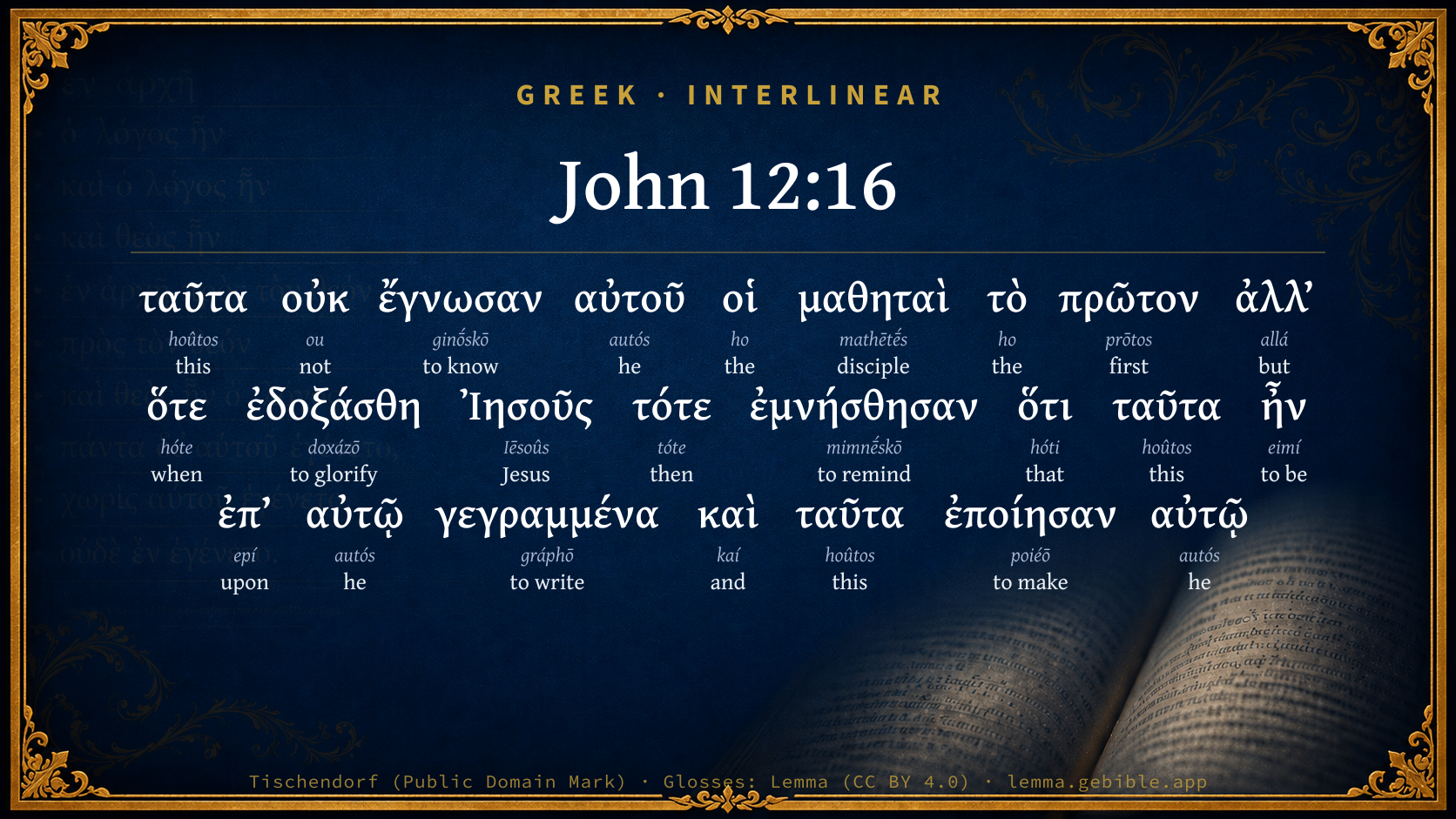
Greek (Tischendorf 8th ed.) John 12:16 appears in the Greek New Testament. The text above is from the Tischendorf 8th edition. Each word links to its Strong’s number and a concise gloss. Click any word for its full Thayer’s Greek Lexicon entry.
Download image
Cite this verse

John 12:16 (World English Bible). Public Domain. Lemma interlinear Bible study tool, https://lemma.gebible.app/v/john/12/16.

Show BibTeX & RIS
BibTeX
RIS
English Translation
His disciples didn't understand these things at first, but when Jesus was glorified, then they remembered that these things were written about him, and that they had done these things to him.
World English Bible · Public Domain
Download a study sheet

One document with this verse’s original text, its word-by-word gloss line, the meaning frame, cross-references with their text, attributed commentary, and full source and license credits — printable, and it pastes into notes with its structure intact.

This verse Autodidact and up

Study sheet (.html) Plain text (.txt)

A passage Seminary Student

Up to 50 verses in one chapter. A passage sheet keeps up to 6 commentary sources and 12 cross-references per verse, in the order this page ranks them, and says so on the sheet whenever that leaves anything out. Ask for a single verse and you get the Autodidact verse sheet above.

Everything on this page stays free to read, with no account — the sheet is a download of what is already on screen, not access to it.

Want to remove ads? Support Godless Engineer
Compare translations 3

The same verse in 3 English versions, stacked beneath the original-language interlinear above. Click any original word for its lexicon entry.

Each is an independent rendering of the whole verse — the interlinear is not word-aligned to these translations.

Highlighted words mark where these versions differ — a whole-verse word diff, not a word-by-word alignment.

  • World English Bible Public Domain
    His disciples didn't understand these things at first, but when Jesus was glorified, then they remembered that these things were written about him, and that they had done these things to him.
  • King James Version Public Domain
    These things understood not his disciples at the first: but when Jesus was glorified, then remembered they that these things were written of him, and that they had done these things unto him.
  • unfoldingWord Literal Text CC BY-SA 4.0
    His disciples did not understand these things at first; but when Jesus was glorified, then they remembered that these things had been written about him and that they had done these things to him.

unfoldingWord Literal Text — © unfoldingWord, licensed CC BY-SA 4.0. Word-aligned USFM3 via Door43 (git.door43.org/unfoldingWord/en_ult).

Versions to compare (up to 4)

3 of 4 selected

Show all 19 translations

Every available English version of this verse, each an independent rendering of the whole verse.

  • World English Bible Public Domain
    His disciples didn't understand these things at first, but when Jesus was glorified, then they remembered that these things were written about him, and that they had done these things to him.
  • Berean Standard Bible Public Domain
    At first His disciples did not understand these things, but after Jesus was glorified they remembered what had been done to Him, and they realized that these very things had also been written about Him.
  • Majority Standard Bible Public Domain
    At first His disciples did not understand these things, but after Jesus was glorified they remembered what had been done to Him, and they realized that these very things had also been written about Him.
  • King James Version Public Domain
    These things understood not his disciples at the first: but when Jesus was glorified, then remembered they that these things were written of him, and that they had done these things unto him.
  • American Standard Version (1901) Public Domain
    These things understood not his disciples at the first: but when Jesus was glorified, then remembered they that these things were written of him, and that they had done these things unto him.
  • Revised Version (1885) Public Domain
    These things understood not his disciples at the first: but when Jesus was glorified, then remembered they that these things were written of him, and that they had done these things unto him.
  • Geneva Bible (1599) Public Domain
    But his disciples vnderstoode not these thinges at the first: but when Iesus was glorified, then remembred they, that these thinges were written of him, and that they had done these things vnto him.
  • Douay-Rheims (1899) Public Domain
    These things his disciples did not know at the first; but when Jesus was glorified, then they remembered that these things were written of him, and that they had done these things to him.
  • Young's Literal Translation Public Domain
    And these things his disciples did not know at the first, but when Jesus was glorified, then they remembered that these things were having been written about him, and these things they did to him.
  • Literal Standard Version CC BY-SA 4.0
    And His disciples did not know these things at first, but when Jesus was glorified, then they remembered that these things were having been written about Him, and these things they did to Him.
  • Unlocked Literal Bible CC BY-SA 4.0
    His disciples did not understand these things at first; but when Jesus was glorified, they remembered that these things had been written about him and that they had done these things to him.
  • unfoldingWord Literal Text CC BY-SA 4.0
    His disciples did not understand these things at first; but when Jesus was glorified, then they remembered that these things had been written about him and that they had done these things to him.
  • Darby Bible Public Domain
    [Now] his disciples knew not these things at the first; but when Jesus was glorified, then they remembered that these things were written of him, and that they had done these things to him.
  • World Messianic Bible Public Domain
    His disciples didn’t understand these things at first, but when Yeshua was glorified, then they remembered that these things were written about him, and that they had done these things to him.
  • Webster's Bible Public Domain
    These things his disciples understood not at the first: but when Jesus was glorified, then they remembered that these things were written concerning him, and that they had done these things to him.
  • Free Bible Version CC BY-SA 4.0
    At the time, Jesus' disciples did not understand what these things meant. It was only later when he was glorified that they realized what had happened had been prophesied and applied to him.
  • Bible in Basic English Public Domain
    (These things were not clear to his disciples at first: but when Jesus had been lifted up into his glory, then it came to their minds that these things in the Writings were about him and that they had been done to him.)
  • Text-Critical English NT CC BY 4.0
    (His disciples did not understand these things at first, but when Jesus was glorified, they remembered that these things were written about him, and that these things had been done to him.)
  • Tyndale New Testament (1534) Public Domain
    These thinges vnderstode not his disciples at the fyrst: but when Iesus was gloryfied then remembryd they that soche thinges were written of him and that soche thinges they had done vnto him.

Literal Standard Version (2020), Covenant Press — licensed CC BY-SA 4.0. Text via the HelloAO Bible API (eBible.org). Unlocked Literal Bible (unfoldingWord) — licensed CC BY-SA 4.0. Text via the HelloAO Bible API (eBible.org). unfoldingWord Literal Text — © unfoldingWord, licensed CC BY-SA 4.0. Word-aligned USFM3 via Door43 (git.door43.org/unfoldingWord/en_ult). Free Bible Version, Dr. Jonathan Gallagher — licensed CC BY-SA 4.0. Text via the HelloAO Bible API (eBible.org).

Word by word

More ways to search: Search by grammar → Find every occurrence → Compare this word →

Practice this passage: Drill this verse → Learn its vocabulary →

ἐμνήσθησαν
mimnḗskō
G3403
“to remind”
Verb, Aorist, Passive, Indicative, 3rd person, Plural
Part of Speech
Verb
Tense
Aorist
Voice
Passive
Mood
Indicative
Person
3rd person
Number
Plural
Full Thayer's Definition

Origin: a prolonged form of G3415 (from which some of the tenses are borrowed)

TDNT: None

1. to remind a. to be recalled or to return to one's mind, to remind one's self of, to remember b. to be recalled to mind, to be remembered, had in remembrance c. to remember a thing d. be mindful of
  1. ταῦτα hoûtos G3778 “this” Demonstrative pronoun, Accusative, Plural, Neuter
  2. οὐκ ou G3756 “not” Particle, Negative
  3. ἔγνωσαν ginṓskō G1097 “to know” Verb, Aorist, Active, Indicative, 3rd person, Plural
  4. αὐτοῦ autós G846 “he” Personal pronoun, Genitive, Singular, Masculine
  5. οἱ ho G3588 “the” Article, Nominative, Plural, Masculine
  6. μαθηταὶ mathētḗs G3101 “disciple” Noun, Nominative, Plural, Masculine
  7. τὸ ho G3588 “the” Article, Accusative, Singular, Neuter
  8. πρῶτον prōtos G4413 “first” Adjective, Accusative, Singular, Neuter, Superlative
  9. ἀλλ’ allá G235 “but” Conjunction
  10. ὅτε hóte G3753 “when” Adverb
  11. ἐδοξάσθη doxázō G1392 “to glorify” Verb, Aorist, Passive, Indicative, 3rd person, Singular
  12. Ἰησοῦς Iēsoûs G2424 “Jesus” Noun, Nominative, Singular, Masculine
  13. τότε tóte G5119 “then” Adverb
  14. ὅτι hóti G3754 “that” Conjunction
  15. ταῦτα hoûtos G3778 “this” Demonstrative pronoun, Nominative, Plural, Neuter
  16. ἦν eimí G1510 “to be” Verb, Imperfect, Active, Indicative, 3rd person, Singular
  17. ἐπ’ epí G1909 “upon” Preposition
  18. αὐτῷ autós G846 “he” Personal pronoun, Dative, Singular, Masculine
  19. γεγραμμένα gráphō G1125 “to write” Verb, Perfect, Passive, Participle, Nominative, Plural, Neuter
  20. καὶ kaí G2532 “and” Conjunction
  21. ταῦτα hoûtos G3778 “this” Demonstrative pronoun, Accusative, Plural, Neuter
  22. ἐποίησαν poiéō G4160 “to make” Verb, Aorist, Active, Indicative, 3rd person, Plural
  23. αὐτῷ autós G846 “he” Personal pronoun, Dative, Singular, Masculine

About this verse

These counts appear in no published source. They are computed here, from the morphology-tagged text and Lemma’s own curated glosses. What Lemma adds →

24
words
19
distinct lemmas
Gospels
section

Notable vocabulary

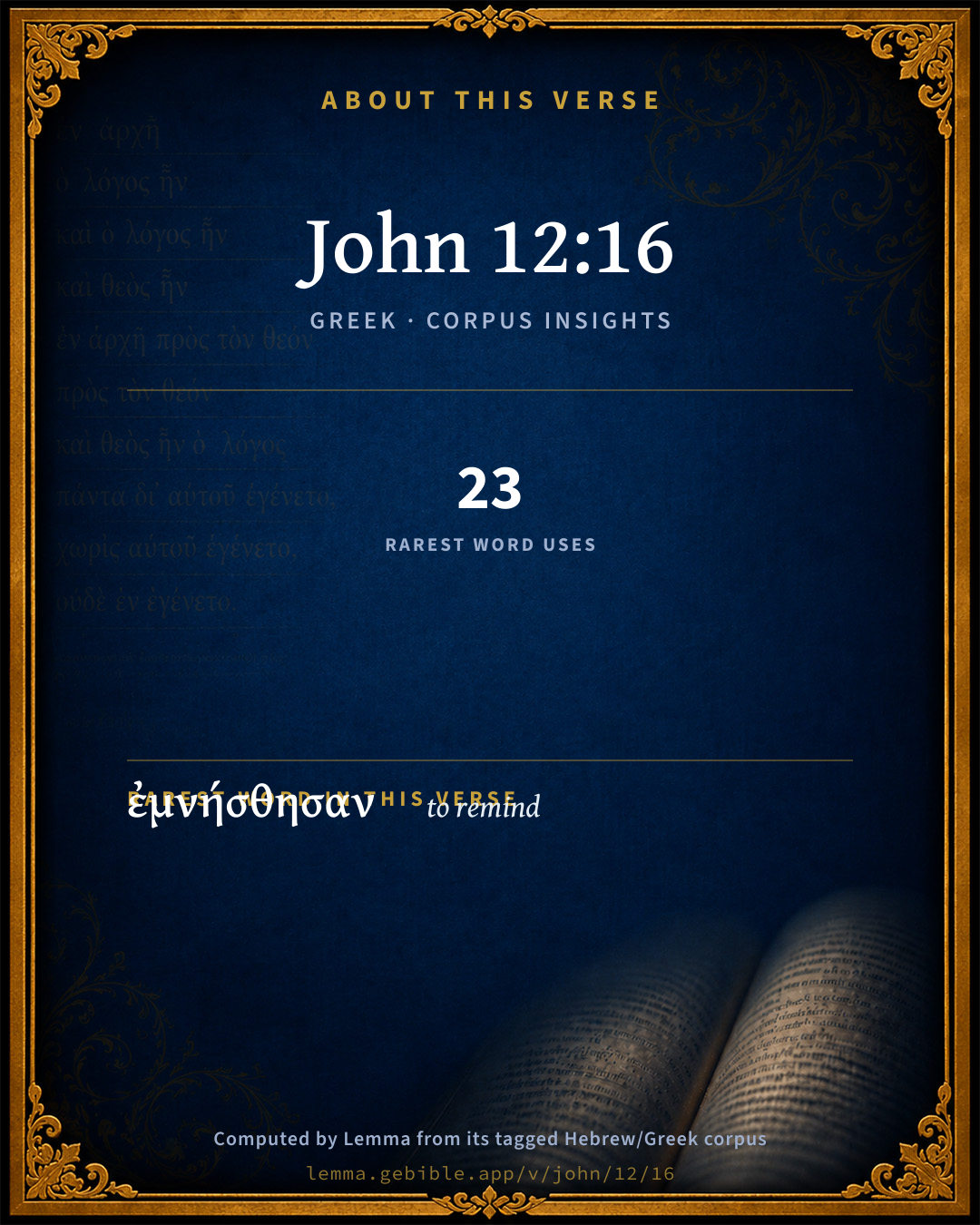
The rarest word here is ἐμνήσθησαν to remind G3403 — appearing just 23 times in the whole Greek New Testament.

Shared distinctive vocabulary

ἐμνήσθησαν to remind G3403 occurs in 23 verses of the Greek New Testament. Also found in:

Repetition

Words recur within this verse:

  • ταῦτα this G3778 ×3
  • αὐτοῦ he G846 ×3
  • οἱ the G3588 ×2

Cross-references

19

Topical passages linked to John 12:16 in the Treasury of Scripture Knowledge — connected by theme and wording, ordered by reader-vote popularity; previews shown in the World English Bible.

  • John 2:22 When therefore he was raised from the dead, his disciples remembered that he said this, and they believed the Scripture, and the word which Jesus had said.
  • John 14:26 But the Counselor, the Holy Spirit, whom the Father will send in my name, he will teach you all things, and will remind you of all that I said to you.
  • John 7:39 But he said this about the Spirit, which those believing in him were to receive. For the Holy Spirit was not yet given, because Jesus wasn't yet glorified.
  • John 12:23 Jesus answered them, "The time has come for the Son of Man to be glorified.
  • Acts 2:36 "Let all the house of Israel therefore know assuredly that God has made him both Lord and Christ, this Jesus whom you crucified."
  • Luke 9:45 But they didn't understand this saying. It was concealed from them, that they should not perceive it, and they were afraid to ask him about this saying.
  • Luke 18:34 They understood none of these things. This saying was hidden from them, and they didn't understand the things that were said.
  • Luke 24:6–8 He isn't here, but is risen. Remember what he told you when he was still in Galilee,
  • Luke 24:25 He said to them, "Foolish men, and slow of heart to believe in all that the prophets have spoken!
  • Luke 24:45 Then he opened their minds, that they might understand the Scriptures.
  • John 16:4 But I have told you these things, so that when the time comes, you may remember that I told you about them. I didn't tell you these things from the beginning, because I was with you.
  • Acts 2:33 Being therefore exalted by the right hand of God, and having received from the Father the promise of the Holy Spirit, he has poured out this, which you now see and hear.
  • Acts 3:13 The God of Abraham, Isaac, and Jacob, the God of our fathers, has glorified his Servant Jesus, whom you delivered up, and denied in the presence of Pilate, when he had determined to release him.
  • Hebrews 8:1 Now in the things which we are saying, the main point is this. We have such a high priest, who sat down on the right hand of the throne of the Majesty in the heavens,
  • Hebrews 12:2 looking to Jesus, the author and perfecter of faith, who for the joy that was set before him endured the cross, despising shame, and has sat down at the right hand of the throne of God.
  • Mark 9:32 But they didn't understand the saying, and were afraid to ask him.
  • Mark 16:19 So then the Lord Jesus, after he had spoken to them, was received up into heaven, and sat down at the right hand of God.
  • John 13:31–32 When he had gone out, Jesus said, "Now the Son of Man has been glorified, and God has been glorified in him.
  • John 17:5 Now, Father, glorify me with your own self with the glory which I had with you before the world existed.

Cross-references courtesy of OpenBible.info (CC BY 4.0).

Commentary

Notes on John 12:16 from classic Christian and Jewish commentators (each source and its license shown beneath its notes). The classic Christian expositions comment on the surrounding passage and are grouped to its opening verse, so a note may address several verses; the Jewish commentaries on the Tanakh (Rashi and others) are per-verse, so they appear only where the commentator wrote on this verse.

Lemma curates 59 commentaries, every one of them public domain or Creative Commons licensed, each selected and text-cleaned for this edition rather than reprinted as found. About our sources →

The Biblical Illustrator

Joseph S. Exell

Joh_12:16-18

These things understood not His disciples at first

1.

Men may be in the midst of great mercies and actings, and may not only be witnesses of the Lords working and the works of others, but even actors themselves in that which for the time they do little or nothing understand; for these things understood not the disciples at the first. Men have much brutish ignorance fed with inadvertency and may be little expecting the things that God is doing in such a time or case (Gen_16:13; Gen_28:16), and therefore do not discern them.

2. When the Lords people are ignorant and under a cloud, He useth not to take advantage of them, but can guide them as right as may be, so that a back-look thereunto when they get light will be sweet unto them; for in all this they act as rightly as if they had understood, and afterward they find that what was written of Him they had done unto Him (Psa_73:22-24).

3. However, the Lord for a time suffer His people to lie under clouds, and ignorant of what He or they are doing, yet in due time He will clear them in so far as is needful; for afterward they remembered (Joh_13:7).

4. The treasures of knowledge hid up in Christ were not fully opened up till Christ was glorified; for when Jesus was glorified, then remembered they, etc. Hereby is kept a due proportion betwixt the head and his members, that he shall be first exalted before they get their full allowance. And hereby also Christ being exalted giveth evidence that He remembers His people (Joh_7:39; Act_2:33; Eph_4:8).

5. Confession of infirmity and ignorance is a sweet fruit of the Spirit poured out; and the more one have received they will be the more sensible of, and ready to acknowledge their frailties; for John, the beloved disciple, being now enlightened, is most forward to record that they understood not these things at the first.

6. When the Spirit of God is most amply poured out, He will still lead men to the Scriptures to discern of Christ and compare their own actings by it; for so was it in the disciples best days, they remembered that these things were written of Him and that they had done these things to Him. It is an evidence of Christs being exalted at the right hand of the Father for the good of His people when He brings Scriptures to their minds, makes them clear to them, and clears their practice there, for, when Jesus was glorified, this was a comfortable evidence of it, they remembered these things. (G. Hutcheson.)

Prophecy

I. GOD DOES FORETELL IN HIS WORD MANY EVENTS BEFORE THEY COME TO PASS. This appears from the text and from the whole history of His conduct from the first prediction of Genesis to the last in Revelation. Witness the fulfilled promises concerning the Jews, heathen nations, Christ, His Church, etc.

II. GOD ALWAYS BRINGS TO PASS THE EVENTS WHICH HE FORETELLS. This will appear if we consider

1. That we have no evidence that. He has ever failed to bring to pass any event that He has foretold. Though the disciples did not know at first that Zechariahs prophecy had been fulfilled, they knew it afterwards.

2. God never foretold any events but such as

(1) He was willing to bring to pass. He never could be under any compulsion to foretell.

(2) His own glory requires to be brought to pass.

(3) He is able to bring to pass. God can do anything that power can do and that does not involve a contradiction. His opponents He can break in pieces.

III. GOD HAS GOOD REASONS FOR FORETELLING EVENTS BEFORE THEY COME TO PASS.

1. To convince men that He is concerned in bringing them about.

2. To demonstrate the truth of His bringing to pass other events not predicted. Predicted events stand inseparably related to unpredicted. The Messianic prophecies are connected with other events which took place in every part of the world. Improvement: It appears from the design of prophecy, that the Bible predictions

1. Are the last He will ever give (Rev_22:18-19).

2. Will answer their end though not understood till fulfilled.

3. Being disbelieved does not destroy their evidence or importance.

4. Are an infallible evidence of the truth of the Bible. (N. Emmons, D. D.)

The continuous fulfilment of Scripture

There was much written as in sympathetic ink, invisible for a season, yet ready to flash out in lines and characters of light whenever the appointed hour had arrived. Or to use another figure, Holy Scripture progressively unfolding what it contains may be likened to some magnificent landscape on which the sun is gradually rising, and even as it rises is bringing out one headland into light and prominence, and then another; anon kindling the glory smitten summit of some far mountain, and presently lighting up the recesses of some near valley which had hitherto abided in gloom, and so travelling on till nothing remains in shadow, but the whole prospect stands out in the clearness and splendour of the brightest noon. The Church informed and quickened by the Spirit of God, more and more discovers what in Scripture is given her. She has always possessed what she now possesses, only not always with the same distinctness of consciousness. He has not added to her wealth, but she has become more and more aware of that wealth; her dowry has remained always the same, but that dowry was so rich and rare that only little by little she has counted over and taken stock and inventory of her jewels. She has consolidated her doctrine compelled thereto by the provocation of her enemies, or induced to it by a growing sense of her own needs. She has brought together utterances of Holy Writ, and those which apart were comparatively barren, when thus married, have been fruitful to her. And yet all this she possessed implicitly though not explicitly--even as the shut hand is as perfect a hand as the open, or as our dominion in that huge island of the Pacific is as truly ours, and that region as vast in extent now as it will be when every mountain and valley, rivulet and bay, have been explored, and the flag of England has waved over all. (Archbishop Trench.)

The people therefore … bare record

The popular testimony to the resurrection of Lazarus

1. It is the part of all such as have been witnesses to Christs working on themselves or others to publish the same to His praise; for the people that was with Him when He called Lazarus, etc., bare record.

2. As it is at all times a sin to smother the praises of Christ. So, in particular, in days of solemnity, it is our sin not to join and bring in what we know to make up the song, for they bring in that particular to make up the triumph.

3. In a day of Christs power, and when He is to get glory to Himself, He can furnish means and make them effectual to bring it to pass, for He makes that miracle an occasion to bring about this triumph.

4. It may encourage men to publish the praise of Christs working as they know of it, that God may make their weak endeavours effectual to work upon very many, for the testimony of some drew out this great confluence to Christ.

5. It is the duty of them who hear anything of Christs commendation to go and seek Him, and do homage to Him, for, for this cause, the people also met Him, for that they had heard that He had done this miracle. (G. Hutcheson.)

The Biblical Illustrator, edited by Joseph S. Exell (c. 1880s–1900s) — public domain. Text from a community e-Sword module.

Tyndale Open Study Notes

Tyndale Open Resources

12:16 The crowds and even the disciples didn’t understand Jesus’ true significance. When the disciples received the Holy Spirit following Jesus’ glorification, they fully comprehended who Jesus was (see 2:22).

Tyndale Open Study Notes — © Tyndale Open Resources, licensed CC BY-SA 4.0. Text via the HelloAO Bible API.

Bengel's Gnomon

Johann Albrecht Bengel

Joh 12:16. Ταῦτα, these things) This His entry, of so momentous importance, and His prediction.—οὐκ ἔγνωσαν, understood not) The reason of the Divine proceedings and words is generally hidden from us at the beginning. Therefore accordingly we ought to believe and obey, and commit ourselves to the Divine governance [guidance]: ch. Joh 13:7, “What I do (washing their feet) thou knowest not now, but thou shalt know hereafter;” Joh 12:36, [Jesus to Simon] “Whither I go thou canst not follow Me now, but thou shalt follow Me afterwards;” Joh 16:4, “These things have I told you, that when the time shall come, ye may remember that I told you of them. And these things I said not unto you in the beginning;” Joh 2:22, “When therefore He was risen from the dead, His disciples remembered that He had said this unto them (Destroy this temple, and in three days I will raise it up), and they believed.” The whole work of faith is to embrace those things which we do not yet comprehend, but which hereafter we shall perceive.—τὸ πρῶτον, at the first) During the time of their discipleship, before that the Lord was glorified.—ἐδοξάσθη, was glorified) by His resurrection and ascension. For there were many things which at a subsequent time they understood.—τότε, then) That afterwards in a remarkable degree confirmed their faith.—ταῦτα, καὶ ταῦτα, these things, and these things) A sweet repetition, expressing the consonance between the prophecy and the event. At καί, and, understand ὅτι, that, as in ch. Joh 20:18, “Μαριάμ—ἀγγέλλουσα, ὅτι ἑώρακεν τὸν Κύριον, καὶ (sc. ὅτι) ταῦτα εἶπεν.” For the force of the verb, they remembered, falls more properly on “that they had done,” than upon “that these things were written.”—ἐποίησαν, had done) namely, both the disciples themselves, and the people: Joh 12:12.

Bengel's Gnomon of the New Testament — English translation (T&T Clark, Edinburgh, 1860) — public domain. Text from a community e-Sword module.

Meyer's Critical & Exegetical Commentary

Heinrich August Wilhelm Meyer

Joh_12:16. Observation by John. Comp. Joh_2:22, Joh_20:9. But this which here took place, namely, that Jesus mounted a young ass which He had obtained, His disciples at first (when it took place) did not understand, so far, namely, as the connection of the matter with the prediction of the prophet remained still hidden from them; when, however, Jesus was glorified, they remembered (under the illumination of the Spirit, Joh_7:39, Joh_14:26) that this, this riding on the young ass, did not accidentally occur, but that it was written of Him, and that they (the disciples) did this, nothing other than this which had been written of Him, to Him, on the occasion of that entrance,in bringing, namely, the ass to Him, whereby they became the instruments of the fulfilment of prophecy. In this ἐποίησαν αὐτῷ there is the echo from Johns recollection of the way and manner of the εὑρὼν ὀνάριον as known from the Synoptics. To take ἐποίησαν generally: they (indef.) did, and to refer it to Joh_12:13 (De Wette, Ewald, and older commentators), is incorrect, since the first two ταῦτα can only point to Joh_12:14-15.

On ἐπʼ αὐτῷ see Bernhardy, p. 249. Winer, p. 367 [E. T. p. 491].

Meyer — Critical and Exegetical Commentary on the New Testament — English translation by Peter Christie, edited by Frederick Crombie (T&T Clark, 1880) — public domain. Text from a community e-Sword module.

Expositor's Greek Testament

ed. W. Robertson Nicoll

Joh 12:16 . The significance of “His action was not at that time perceived by the disciples: ταῦτα … πρῶτον , but when Jesus had been glorified, then they remembered that this had been written concerning Him and that the people had made this demonstration in His favour, καὶ ταῦτα ἐποίησαν αὐτῷ

The Expositor's Greek Testament, edited by W. Robertson Nicoll (1897–1910) — public domain. Text from a community e-Sword module.

Jamieson, Fausset & Brown

Robert Jamieson, A. R. Fausset & David Brown

when Jesus was glorified, then remembered they that these things were written of him, &c.--The Spirit, descending on them from the glorified Saviour at Pentecost, opened their eyes suddenly to the true sense of the Old Testament, brought vividly to their recollection this and other Messianic predictions, and to their unspeakable astonishment showed them that they, and all the actors in these scenes, had been unconsciously fulfilling those predictions.

Jamieson, Fausset & Brown — Commentary Critical and Explanatory on the Whole Bible (1871) — public domain (CC PDM 1.0). Text via the HelloAO Bible API.

Adam Clarke's Commentary

Verse 16. Then remembered they, &c.] After the ascension of Christ, the disciples saw the meaning of many prophecies which referred to Christ, and applied them to him, which they had not fully comprehended before. Indeed it is only in the light of the new covenant, that the old is to be fully understood.

Adam Clarke's Commentary on the Bible (1810–1826) — public domain. Text from a community e-Sword/MySword module.

John Calvin's Commentaries

16. These things his disciples did not understand at first. As the seed does not spring up as soon as it is thrown into the earth, so the result of the works of God is not immediately seen. The Apostles are the servants of God to fulfill the prophecy, but they do not understand what they are doing. They hear the shout of the multitude, which was no confused noise, but a distinct salutation of Christ as King; but they do not perceive what is the object of it, or what it means. To them, therefore, it is an unmeaning exhibition, until the Lord, after his glorious resurrection, opens their eyes.

When it is said, that they at length remembered that these things had been written concerning him, the Evangelist points out the cause of such gross ignorance, by which their knowledge was preceded. It was because they had not the Scripture at that time as their guide and instructor, to direct their minds to just and accurate views; for we are blind, unless the word of God go before,, our steps, and it is not even enough that the word of God shine on us, if the Spirit do not also enlighten our eyes, which otherwise would be blind amidst the clearest light. This grace Christ bestowed on his disciples after his resurrection, because the full time, when the Spirit should bestow his riches in great abundance, was not come, until he was received into the heavenly glory, as we have seen under John 7:39

Taught by this example, let us learn to form our judgment of every thing that relates to Christ, not by our own carnal feelings, but by the Scripture. Besides, let us remember that it is a special favor of the Holy Spirit to instruct us in a gradual manner, that we may not be stupid in considering the works of God.

That these things had been written concerning him, and that they had done these things to him. I interpret that clause in this manner: “Then, for the first time, did it occur to the disciples that Christ did not do these things rashly, and that those men were not employed in idle amusement; but that the whole of this transaction had been regulated by the providence of God, because those things which had been written must necessarily be fulfilled;” so that the words may be thus arranged: “They did these things to him, as they had been written concerning him.”

John Calvin's Commentaries (1540-1563) — public domain. Text from the Calvin Translation Society English edition (1840s-50s) via the Christian Classics Ethereal Library (ccel.org). Calvin's coverage is partial (roughly two-thirds of the Bible); uncommented books and verses are honest gaps, never fabricated. The 19th-century editor's footnotes and remarks are omitted so the notes are faithfully Calvin's own voice.

Ellicott's Commentary for English Readers

(16) These things understood not his disciples at the first . . .—Comp. Notes on Joh_2:22; Joh_20:9. It is a touch peculiar to St. John, and exactly in his manner. He remembers the difference between the spiritual receptivity, before and after Pentecost, in the Apostolic band itself. He remembers how the Old Testament Scriptures became filled with a new life and meaning, as the Spirit brought to the memory their words, and the words of Him of whom they told.

When Jesus was glorified.—Comp. Note on Joh_7:39.

They had done these things unto Him.—The narrative implies, these, the incidents which the others state. The phrase “these things” occurs three times, referring emphatically to the correspondence between the prophecy and the actual incidents.

A Bible Commentary for English Readers, edited by Charles John Ellicott (1878–1897) — public domain. Text from a community e-Sword module.

The Cambridge Bible for Schools and Colleges

gen. ed. J. J. S. Perowne

16. understood not] A mark of candour (see on Joh_11:12): comp. Joh_2:22 (where see note) and Joh_20:9. Would a Christian of the second century have invented this dulness of apprehension in Apostles? After Pentecost, however, much that had passed unnoticed or had been obscure before was brought to their remembrance and made clear (Joh_14:26). Note ‘these things’ thrice repeated; Joh_12:14-15 shew that the placing Him on the young ass is primarily meant.

was glorified] Comp. Joh_7:39 and Joh_11:4, where see notes.

The Cambridge Bible for Schools and Colleges (gen. ed. J. J. S. Perowne; Cambridge University Press, 1878–1918) — public domain. Text from a community e-Sword module.

John Gill's Exposition

The people therefore that was with him,.... The Jews, that came from Jerusalem to Bethany, to comfort the two sisters of Lazarus upon his death, who believed in Christ; and others of the town of Bethany, who with them were along with Christ:

when he called Lazarus out of his grave; saying, Lazarus, come forth:

and raised him from the dead; to life:

bare record: to the Jews at Jerusalem, and to the people that came out of the several countries, of the truth of that fact; declaring, that they were eye and ear witnesses of the whole, and that it was a truth that might be depended on.

John Gill's Exposition of the Whole Bible (1746–1763) — public domain (CC PDM 1.0). Text via the HelloAO Bible API.

Trapp's Complete Commentary

John Trapp

16 These things understood not his disciples at the first: but when Jesus was glorified, then remembered they that these things were written of him, and that they had done these things unto him.

Ver. 16. These things understood not, &c.] They only beheld it as a pretty pageant. They had read it often, in the prophet, and now saw it acted; yet were never the wiser, for the present. Read, or hear, though thou understandest not; God may drop in divine light when thou least lookest for it.

John Trapp, A Commentary or Exposition upon All the Books of the Old and New Testament (1647–1656) — public domain. Text from a community e-Sword module.

Matthew Poole's English Annotations

The evangelist, amongst others, confesseth his own ignorance also. The disciples saw the thing done, Christ riding into the city upon the foal of an ass, the people strewing of boughs, and throwing their clothes in the way; but to what purpose these things were done, or what fulfilling of prophecies was in this thing, that they understood not, so long as Christ was alive: their eyes were upon the Messiah a temporal prince, that should come in great state and majesty, so as they were wholly blinded from seeing any thing of the truth and faithfulness of God fulfilled in this little triumph of their Lord’s. But after that Christ had died, and was risen again from the dead, and ascended up to heaven, so declaring himself with power to be the Son of God; then they began to remember these things, so as to confirm their faith in him as the true Messiah, whom God had sent into the world. The word of the Lord which we hear, and the works of God which we see, though oft times they do not profit us, nor are improved by us at the present, yet afterward become of use and profit to us: it is therefore good to hear, and see, and observe God’s words and works, and to lay them up in our hearts, as it is said Mary pondered the sayings of the angel; expecting fruit afterwards of what at present we see no fruit and effect.

Matthew Poole's English Annotations on the Holy Bible (1683–1685) — public domain. Text from a community e-Sword/MySword module.

Whedon's Commentary on the Bible

Daniel D. Whedon

16. Understood not his disciples at the first—Of the triumphal entry John gives but slight description; but the language of this verse indicates that he fully realized its significance, and shows that his record is brief because he knows that the detail by the other Evangelists is full. While the miracle, the triumph, and the cross are passing in rapid succession before their eyes, they are confused in their perceptions. But when all are past and rise up as one whole before them, when they see the accordance of prophecy and event, as taught by the voice of the risen Jesus (Luk_24:25-35) and by the refreshing power of the quickening Spirit, (Joh_14:26,) they comprehend the entire symmetrical plan. Then they understand the CHRIST, and thenceforward are competent to herald him forth to the world.

Daniel D. Whedon (gen. ed.), Commentary on the Old and New Testaments (1874–1909) — public domain. Text from a community e-Sword module.

The Pulpit Commentary

These things understood not his disciples at the first: but when Jesus was glorified, then remembered they that these things were written of him. This verse shows that the disciples (of whom John was one) took part in the celebration, though they did not see at the time, nor until after the Ascension not until they saw by faith the doxa into which the Lord had entered that the honor which they had done to him had corresponded strangely with the marvelous words of the old prophecy. And that they had done clearly the disciples, on grammatical grounds; oi mayhtai , is the subject of epoihsanthese things unto him. Edoxasyh is used of the uplifting to the glory which he had before the world was; not until then was the Spirit given that explained so much of the mysterious life. (For other illustrations of to prwton , in the rare sense of "at first," see Joh_10:40 Joh_19:39)

(1) Men often act and speak without perceiving the full meaning of deed or word, not grasping the link of connection thus instituted between a consecrated past and a predestined future.

(2) Words and actions are freely done from personal motives and in entire spontaneity when they are nevertheless fulfilling the Divine purpose and working out the plan of God.

(3) The revealing moment comes, and the whole significance flashes into view.

The Pulpit Commentary (1880–1919), ed. H.D.M. Spence-Jones & Joseph S. Exell — public domain. Text from a community e-Sword module.

John Wesley's Explanatory Notes

These things his disciples understood not at first - The design of God's providential dispensations is seldom understood at first. We ought therefore to believe, though we understand not, and to give ourselves up to the Divine disposal. The great work of faith is, to embrace those things which we knew not now, but shall know hereafter. When he had been glorified - At his ascension.

John Wesley, Explanatory Notes Upon the Whole Bible (1754–1765) — public domain. Text via the GEBible commentary corpus.

unfoldingWord translationNotes

Door43 World Missions Community

General Information:

John, the writer, interrupts here to give the reader some background information about what the disciples later understood. (See: Background Information)

His disciples did not understand these things

Here the words "these things" refer to the words that the prophet had written about Jesus.

when Jesus was glorified

You can translate this in an active form. AT: "when God glorified Jesus" (See: Active or Passive)

they had done these things to him

The words "these things" refer to what the people did when Jesus rode into Jerusalem on a donkey (praising him and waving the palm branches).

translationWords

disciple

glory

unfoldingWord translationNotes — © Distant Shores Media and the Door43 World Missions Community, licensed CC BY-SA 4.0. Source: git.door43.org/Door43/en_tn.

Cambridge Greek Testament for Schools and Colleges

16. οὐκ ἔγνωσαν. A mark of candour: see on Joh 2:22, Joh 11:12, Joh 20:9. After Pentecost much that had been unnoticed or obscure before was brought to their remembrance and made clear (Joh 14:26). But would a Christian of the second century have invented this dulness in Apostles? Ταῦτα, with threefold emphasis, refers primarily to the placing Him on the young ass. For ἐδοξάσθη see on Joh 7:39, Joh 11:4. The nom. to ἐποίησαν is οἱ μαθηταί: they themselves had unwittingly helped to fulfil the prophecy (Luk 19:29; Luk 19:37; Luk 19:39).

Cambridge Greek Testament for Schools and Colleges (Cambridge University Press, 1896; 21 vols, various authors incl. Carr, Maclear, Plummer, Farrar, Lumby, Moule, M. R. James, Simcox) — public domain. Text from a community e-Sword module.

Alford’s Greek Testament

Henry Alford

16.] Important, as shewing that this, and probably other prophetic citations under similar circumstances, were the effect of the light poured into the minds of the Apostles by the Holy Spirit after the Ascension.

ἐπʼ αὐτῷ] So Æsch. Eum. 343, γιγνομέναισι λάχη τάδʼ ἐφʼ ἁμῖν ἐκράνθη: Soph. Trach. 997, οἵαν ἐπί μοι χάριν ἠνύσω; Plato, Euthyd. 278 a, ὄνομα ἐπʼ ἀνθρώποις ἐναντίως ἔχουσι κείμενον.

ταῦτα ἐποίησαν αὐτῷ—viz. the going out to meet Him, strewing clothes and branches in the way, and shouting ‘Hosanna’ before Him: also perhaps, the setting Him on the ass, implied in the concise narrative. Notice the thrice-repeated ταῦτα, each time signifying ‘this which was written by the Prophet,’ ‘the above citation.’

Henry Alford, The Greek Testament (1849–1861) — public domain. Text from a community e-Sword module.

International Critical Commentary

16. A similar reminiscence of the evangelist is set down at 2:22, where see note. The saying of Jesus about restoration, after the Cleansing of the Temple, was not understood by the disciples until after His Resurrection. So, too, they did not perceive the significance in connexion with prophecy of His entry into Jerusalem, riding upon an ass, until He was “glorified,” and they began to reflect upon the events of His ministry.

For ἐδοξάσθη, see on 7:39, 12:23. Cf. also 13:31.

אBLWΘ omit δέ after the first ταῦτα, which the rec. inserts. αὐτοῦ οἱ μαθηταί (אBΘ) is the true order of words.

The rec. (with DWΘ) inserts ὁ before Ἰησοῦς, which is omitted in אABL. This omission of the article is not in accordance with Jn.’s general usage (see on 1:29), and it is possible that the whole verse is an explanatory gloss added by an editor other than the evangelist himself. The threefold repetition of ταῦτα is somewhat clumsy, and can hardly be intentional. Again, the phrase ἐπʼ αὐτῷ γεγραμμένα is unlike Jn. (cf. Rev 10:11, Rev 22:16): it must mean that the Scriptures quoted were, as it were, “based on Him.” D substitutes περὶ αὐτοῦ for ἐπʼ αὐτῷ, recognising the difficulty. And, finally, the last clause of the verse, which says that the disciples afterwards remembered “that they had done these things to Him,” invites the question, “What things?” Evidently, the answer is that the reference is to the search for the ass, in accordance with the instructions of Jesus, of which the Synoptists tell. But, as we have seen, Jn. tells nothing of this incident. He says only (v. 14) that “Jesus having found the ass, sat thereon,” but he does not mention the co-operation of the disciples in this, or that they took any part in the entry to the city. It seems likely that the comment preserved in the last clause of this verse is due to some one who was thinking of the Synoptic narrative.

International Critical Commentary — older volumes (1896–1929), various authors — public domain. Text from a community e-Sword module.

Godet's Commentaries

Frédéric Louis Godet

Ver. 16. “Now the disciples did not understand these things at the moment; but when Jesus had been glorified, then they remembered that these things were written of him and that they had done these things to him.”

It was only afterwards, when after the ascension, and when enlightened by the Holy Spirit, they retraced the earthly life of their Master, that they discerned the meaning of this event and recognized in it the fulfillment of a prophecy. In the light of the heavenly elevation of Jesus, they understood this fact which had prefigured it (these things). There is, therefore, no reason to turn aside from the natural sense of ἐδοξάσθη, was glorified, and to refer this term, as Reuss does, to the death of Jesus, as the transition to His exaltation. What a charlatan the pseudo-John of Baur, who, by means of this want of understanding invented by him, would give himself the appearance of having himself been one of these disciples whom the ascension had enlightened! We are surprised at the expression “that they had done these things to him”; for, in the scene related by John, the apostles had done nothing to Jesus. So many take ἐποίησαν in the sense in which it is found in Joh 12:2 : “They (indefinite) had done to him,” and assign as subject to this verb the multitude (Joh 12:12-13).

But the subject of they had done cannot be different from that of they understood and they remembered. John wished to set forth precisely the fact that the disciples understood afterwards what they had done themselves in the fulfillment of a prophecy of which no one of them dreamed. The co- operation of the disciples, indicated by John, is described in detail in Luk 19:29-36 and the paral lels. We find here a new proof of the abridged character of his narrative and his thoroughly conscious relation to the narrative of the Synoptics. We see from the words: they had done these things to him, how arbitrary is the idea of Keim, according to which John’s narrative tends to make the disciples and Jesus passive in this scene, and this because the author wished to give utterance to his repugnance to the idea of the Jewish Messiah!

Frédéric Louis Godet — Commentaries on Luke, John, Romans, and 1 Corinthians — English translation (T&T Clark, Edinburgh, 1870s–1890s) — public domain. Text from a community e-Sword module.

Lesson kit

Teaching starters — assembled from the data on this page, not authored interpretation. Every prompt links to the verse data it draws on. Edit before teaching.

John, in the Gospels, opens this verse with 24 words (19 distinct Greek lemmas). Its most distinctive word is mimnḗskō (“to remind”). A historical commentator’s framing appears above. Read the whole chapter for the surrounding context.

Discussion questions

  1. How does “to remind” (mimnḗskō) shape what this verse is saying?
  2. How does Matthew 5:23, which shares the word «to remind», read alongside this verse?
  3. What does the repetition of “this” (3× in this one verse) do in this verse?
  4. The translations on this page render this verse differently — a whole-verse word diff, not a word-by-word alignment. What might account for the different wordings?
  5. Compare how The Biblical Illustrator and Tyndale Open Study Notes read this verse. Where do they agree or differ?

Things to notice

  • These translations choose different wording for 6 words in this verse.
  • “this” occurs 3× in this single verse.
  • 19 distinct Greek lemmas span 24 words in this verse.

Reading settings

Reading text

Shown beneath each verse's original-language words.

Old Testament
Old Testament edition

Read the OT as the Masoretic Hebrew (MT) or the Greek Septuagint (LXX).

English shown for the Greek Septuagint (in the Hebrew ↔ Greek comparison).

Comparing translations? Open the Compare panel on any verse page to stack up to four side by side.