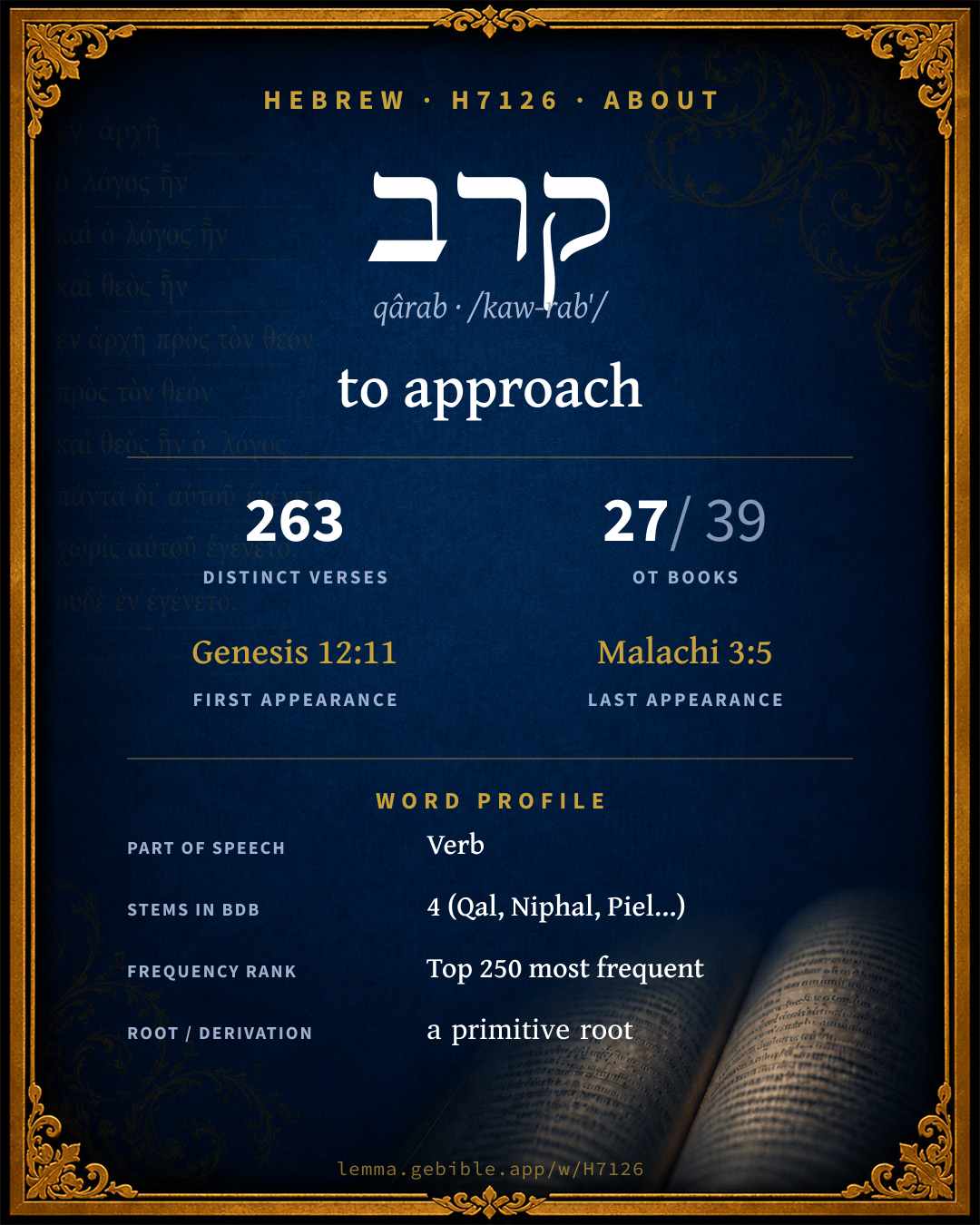
קָרַב
to approach
‘to approach’ is one of 5 main senses fuller range ↓
Full lexicon entry — Brown-Driver-Briggs (BDB)
From Brown-Driver-Briggs (BDB)
Where this word appears
See every Hiphil verb in the Hebrew Bible →
Grammar key — what these labels mean
Part of speech
- Verb
- An action or state-of-being word.
Stem
- Hiphil
- The causative active stem (“he caused / brought about”). Here: ‘bring near’
- Qal
- The basic, simple active stem — the plain form of the verb (“he wrote”). Here: ‘draw near for a purpose’
- Piel
- An intensive or resultative active stem. Here: ‘in space’
- Niphal
- Usually the simple passive or reflexive of the Qal (“he was written”).
Form
- Sequential Perfect
- A perfect with prefixed waw continuing a preceding imperfect or command (waw-consecutive perfect).
- Sequential Imperfect
- An imperfect with prefixed waw — the standard past-narrative form (waw-consecutive imperfect).
- Infinitive Construct
- A bound verbal noun, frequently with prepositions (“to write / in writing”).
- Imperfect
- An incomplete, ongoing, or future action (“he will / would write”).
- Participle Active
- A verbal adjective expressing ongoing or characteristic action (“writing / one who writes”).
- Perfect
- A completed action or state — Hebrew marks aspect (completeness) more than strict tense (“he wrote”).
- Imperative
- A direct command (“write!”).
- Cohortative
- A first-person volitional form expressing wish or resolve (“let me / let us write”).
- Jussive
- A third- or second-person volitional form expressing wish or command (“let him write”).
- Infinitive Absolute
- An unbound verbal noun, often intensifying or standing in for a finite verb.
State
- Absolute
- The independent form of a noun, not bound to a following word.
- Construct
- A noun bound to a following noun in a possessive / “of” relationship (the construct chain).
Person
- 3rd Person
- The one spoken about (“he / she / it / they”).
- 2nd Person
- The one addressed (“you”).
- 1st Person
- The speaker (“I / we”).
Gender
- Masculine
- Grammatically masculine.
- Common
- Either gender — not distinguished for this form.
- Feminine
- Grammatically feminine.
Number
- Singular
- One.
- Plural
- More than one (in Hebrew, generally three or more).
Grammatical forms 60 distinct
- Verb, Hiphil, Sequential Perfect, 3rd Person, Masculine, Singular 26 times (9%)
- Verb, Hiphil, Sequential Imperfect, 3rd Person, Masculine, Singular 19 times (7%)
- Verb, Hiphil, Infinitive Construct 18 times (6%)
- Verb, Hiphil, Imperfect, 3rd Person, Masculine, Singular 16 times (6%)
- Verb, Hiphil, Sequential Perfect, 2nd Person, Masculine, Plural 12 times (4%)
- Verb, Hiphil, Imperfect, 2nd Person, Masculine, Singular 12 times (4%)
- Verb, Hiphil, Imperfect, 2nd Person, Masculine, Plural 11 times (4%)
- Verb, Hiphil, Imperfect, 3rd Person, Masculine, Plural 10 times (4%)
+52 more forms (159 occurrences)
Parsed forms decoded from the imported morphology (morphhb / Westminster Leningrad Codex — WLC text public domain, morphhb tagging CC BY 4.0), counted across 283 parsed occurrences — not distinct verses.
Page 1 of 2 — showing verses 1–200 of 263 distinct verses where H7126 appears, across 27 books. Click any verse to open its interlinear word-by-word view. Verse text shown in the World English Bible for context — . Each verse’s Hebrew form is shown with its reference; the English is not keyword-highlighted, since the data carries no word-level English alignment. Use “Compare translations” on any verse to read it across multiple English versions. This concordance covers the Hebrew Bible; Septuagint (Greek Old Testament) occurrences are not indexed here.
Genesis 5 verses
- Genesis 12:11 הִקְרִ֖יב Hiphil pf 3ms It happened, when he was come near to enter into Egypt, that he said to Sarai his wife, "See now, I know that you are a beautiful woman to look on.
- Genesis 20:4 קָרַ֖ב Qal pf 3ms Now Abimelech had not come near her. He said, "Lord, will you kill even a righteous nation?
- Genesis 27:41 יִקְרְבוּ֙ Qal impf 3mp Esau hated Jacob because of the blessing with which his father blessed him. Esau said in his heart, "The days of mourning for my father are at hand. Then I will kill my brother Jacob."
- Genesis 37:18 יִקְרַ֣ב Qal impf 3ms They saw him afar off, and before he came near to them, they conspired against him to kill him.
- Genesis 47:29 וַ/יִּקְרְב֣וּ conj + Qal wimpf 3mp The time drew near that Israel must die, and he called his son Joseph, and said to him, "If now I have found favor in your sight, please put your hand under my thigh, and deal kindly and truly with me. Please don't bury me in Egypt,
Exodus 16 verses
- Exodus 3:5 תִּקְרַ֣ב Qal juss 2ms He said, "Don't come close. Take off your sandals from off your feet, for the place you are standing on is holy ground."
- Exodus 12:48 יִקְרַ֣ב Qal juss 3ms When a stranger shall live as a foreigner with you, and will keep the Passover to Yahweh, let all his males be circumcised, and then let him come near and keep it; and he shall be as one who is born in the land: but no uncircumcised person shall eat of it.
- Exodus 14:10 הִקְרִ֑יב Hiphil pf 3ms When Pharaoh drew near, the children of Israel lifted up their eyes, and behold, the Egyptians were marching after them; and they were very afraid. The children of Israel cried out to Yahweh.
- Exodus 14:20 קָרַ֥ב Qal pf 3ms It came between the camp of Egypt and the camp of Israel; and there was the cloud and the darkness, yet gave it light by night: and the one didn't come near the other all the night.
- Exodus 16:9 קִרְב֖וּ Qal impv 2mp Moses said to Aaron, "Tell all the congregation of the children of Israel, 'Come near before Yahweh, for he has heard your murmurings.'"
- Exodus 22:8 וְ/נִקְרַ֥ב conj + Niphal pf 3ms If the thief isn't found, then the master of the house shall come near to God, to find out if he hasn't put his hand to his neighbor's goods.
- Exodus 28:1 הַקְרֵ֣ב Hiphil impv 2ms "Bring Aaron your brother, and his sons with him, near to you from among the children of Israel, that he may minister to me in the priest's office, even Aaron, Nadab and Abihu, Eleazar and Ithamar, Aaron's sons.
- Exodus 29:3 וְ/הִקְרַבְתָּ֥ conj + Hiphil wpf 2ms You shall put them into one basket, and bring them in the basket, with the bull and the two rams.
- Exodus 29:4 תַּקְרִ֔יב Hiphil impf 2ms You shall bring Aaron and his sons to the door of the tent of meeting, and shall wash them with water.
- Exodus 29:8 תַּקְרִ֑יב Hiphil impf 2ms You shall bring his sons, and put coats on them.
- Exodus 29:10 וְ/הִקְרַבְתָּ֙ conj + Hiphil wpf 2ms "You shall bring the bull before the tent of meeting: and Aaron and his sons shall lay their hands on the head of the bull.
- Exodus 32:19 קָרַב֙ Qal pf 3ms It happened, as soon as he came near to the camp, that he saw the calf and the dancing: and Moses' anger grew hot, and he threw the tablets out of his hands, and broke them beneath the mountain.
- Exodus 36:2 לְ/קָרְבָ֥ה prep + Qal inf.cs Moses called Bezalel and Oholiab, and every wise-hearted man, in whose heart Yahweh had put wisdom, even everyone whose heart stirred him up to come to the work to do it:
- Exodus 40:12 וְ/הִקְרַבְתָּ֤ conj + Hiphil wpf 2ms You shall bring Aaron and his sons to the door of the tent of meeting, and shall wash them with water.
- Exodus 40:14 תַּקְרִ֑יב Hiphil impf 2ms You shall bring his sons, and put coats on them.
- Exodus 40:32 וּ/בְ/קָרְבָתָ֛/ם conj + prep + Qal inf.cs + sfx pers 3mp When they went into the tent of meeting, and when they came near to the altar, they washed, as Yahweh commanded Moses.
Leviticus 91 verses
- Leviticus 1:2 יַקְרִ֥יב תַּקְרִ֖יבוּ Hiphil impf 3ms Hiphil impf 2mp "Speak to the children of Israel, and tell them, 'When anyone of you offers an offering to Yahweh, you shall offer your offering of the cattle, from the herd and from the flock.
- Leviticus 1:3 יַקְרִיבֶ֑/נּוּ יַקְרִ֣יב Hiphil impf 3ms + sfx pers 3ms Hiphil impf 3ms "'If his offering is a burnt offering from the herd, he shall offer a male without blemish. He shall offer it at the door of the Tent of Meeting, that he may be accepted before Yahweh.
- Leviticus 1:5 וְ֠/הִקְרִיבוּ conj + Hiphil wpf 3cp He shall kill the bull before Yahweh. Aaron's sons, the priests, shall present the blood and sprinkle the blood around on the altar that is at the door of the Tent of Meeting.
- Leviticus 1:10 יַקְרִיבֶֽ/נּוּ Hiphil impf 3ms + sfx pers 3ms "'If his offering is from the flock, from the sheep, or from the goats, for a burnt offering, he shall offer a male without blemish.
- Leviticus 1:13 וְ/הִקְרִ֨יב conj + Hiphil wpf 3ms but the innards and the legs he shall wash with water. The priest shall offer the whole, and burn it on the altar. It is a burnt offering, an offering made by fire, of a sweet savor to Yahweh.
- Leviticus 1:14 וְ/הִקְרִ֣יב conj + Hiphil wpf 3ms "'If his offering to Yahweh is a burnt offering of birds, then he shall offer his offering of turtledoves, or of young pigeons.
- Leviticus 1:15 וְ/הִקְרִיב֤/וֹ conj + Hiphil wpf 3ms + sfx pers 3ms The priest shall bring it to the altar, and wring off its head, and burn it on the altar; and its blood shall be drained out on the side of the altar;
- Leviticus 2:1 תַקְרִ֞יב Hiphil impf 3fs "'When anyone offers an offering of a meal offering to Yahweh, his offering shall be of fine flour; and he shall pour oil on it, and put frankincense on it.
- Leviticus 2:4 תַקְרִ֛ב Hiphil impf 2ms "'When you offer an offering of a meal offering baked in the oven, it shall be unleavened cakes of fine flour mixed with oil, or unleavened wafers anointed with oil.
- Leviticus 2:8 וְ/הִקְרִיבָ/הּ֙ conj + Hiphil wpf 3ms + sfx pers 3fs You shall bring the meal offering that is made of these things to Yahweh: and it shall be presented to the priest, and he shall bring it to the altar.
- Leviticus 2:11 תַּקְרִ֨יבוּ֙ Hiphil impf 2mp "'No meal offering, which you shall offer to Yahweh, shall be made with yeast; for you shall burn no yeast, nor any honey, as an offering made by fire to Yahweh.
- Leviticus 2:12 תַּקְרִ֥יבוּ Hiphil impf 2mp As an offering of firstfruits you shall offer them to Yahweh: but they shall not come up for a sweet savor on the altar.
- Leviticus 2:13 תַּקְרִ֥יב Hiphil impf 2ms Every offering of your meal offering you shall season with salt; neither shall you allow the salt of the covenant of your God to be lacking from your meal offering. With all your offerings you shall offer salt.
- Leviticus 2:14 תַּקְרִ֛יב תַּקְרִ֕יב Hiphil impf 2ms Hiphil impf 2ms "'If you offer a meal offering of first fruits to Yahweh, you shall offer for the meal offering of your first fruits grain in the ear parched with fire, bruised grain of the fresh ear.
- Leviticus 3:1 מַקְרִ֔יב יַקְרִיבֶ֖/נּוּ Hiphil ptcp.act ms Hiphil impf 3ms + sfx pers 3ms "'If his offering is a sacrifice of peace offerings; if he offers it from the herd, whether male or female, he shall offer it without blemish before Yahweh.
- Leviticus 3:3 וְ/הִקְרִיב֙ conj + Hiphil wpf 3ms He shall offer of the sacrifice of peace offerings an offering made by fire to Yahweh; the fat that covers the innards, and all the fat that is on the innards,
- Leviticus 3:6 יַקְרִיבֶֽ/נּוּ Hiphil impf 3ms + sfx pers 3ms "'If his offering for a sacrifice of peace offerings to Yahweh is from the flock; male or female, he shall offer it without blemish.
- Leviticus 3:7 מַקְרִ֖יב וְ/הִקְרִ֥יב Hiphil ptcp.act ms conj + Hiphil wpf 3ms If he offers a lamb for his offering, then he shall offer it before Yahweh;
- Leviticus 3:9 וְ/הִקְרִ֨יב conj + Hiphil wpf 3ms He shall offer from the sacrifice of peace offerings an offering made by fire to Yahweh; its fat, the entire tail fat, he shall take away close to the backbone; and the fat that covers the inwards, and all the fat that is on the inwards,
- Leviticus 3:12 וְ/הִקְרִיב֖/וֹ conj + Hiphil wpf 3ms + sfx pers 3ms "'If his offering is a goat, then he shall offer it before Yahweh:
- Leviticus 3:14 וְ/הִקְרִ֤יב conj + Hiphil wpf 3ms He shall offer from it as his offering, an offering made by fire to Yahweh; the fat that covers the innards, and all the fat that is on the innards,
- Leviticus 4:3 וְ/הִקְרִ֡יב conj + Hiphil wpf 3ms if the anointed priest sins so as to bring guilt on the people, then let him offer for his sin, which he has sinned, a young bull without blemish to Yahweh for a sin offering.
- Leviticus 4:14 וְ/הִקְרִ֨יבוּ conj + Hiphil wpf 3cp when the sin in which they have sinned is known, then the assembly shall offer a young bull for a sin offering, and bring it before the Tent of Meeting.
- Leviticus 5:8 וְ/הִקְרִ֛יב conj + Hiphil wpf 3ms He shall bring them to the priest, who shall first offer the one which is for the sin offering, and wring off its head from its neck, but shall not sever it completely.
- Leviticus 6:14 הַקְרֵ֨ב Hiphil inf.abs "'This is the law of the meal offering: the sons of Aaron shall offer it before Yahweh, before the altar.
- Leviticus 6:20 יַקְרִ֣יבוּ Hiphil impf 3mp "This is the offering of Aaron and of his sons, which they shall offer to Yahweh in the day when he is anointed: the tenth part of an ephah of fine flour for a meal offering perpetually, half of it in the morning, and half of it in the evening.
- Leviticus 6:21 תַּקְרִ֥יב Hiphil impf 2ms It shall be made with oil in a baking pan. When it is soaked, you shall bring it in. You shall offer the meal offering in baked pieces for a sweet savor to Yahweh.
- Leviticus 7:3 יַקְרִ֣יב Hiphil impf 3ms He shall offer all of its fat: the fat tail, and the fat that covers the innards,
- Leviticus 7:8 הַ/מַּקְרִ֖יב הִקְרִ֔יב ptcl def.art + Hiphil ptcp.act ms Hiphil pf 3ms The priest who offers any man's burnt offering, even the priest shall have for himself the skin of the burnt offering which he has offered.
- Leviticus 7:9 הַ/מַּקְרִ֥יב ptcl def.art + Hiphil ptcp.act ms Every meal offering that is baked in the oven, and all that is dressed in the frying pan, and on the baking pan, shall be the priest's who offers it.
- Leviticus 7:11 יַקְרִ֖יב Hiphil impf 3ms "'This is the law of the sacrifice of peace offerings, which one shall offer to Yahweh.
- Leviticus 7:12 יַקְרִיבֶ/נּוּ֒ וְ/הִקְרִ֣יב Hiphil impf 3ms + sfx pers 3ms conj + Hiphil wpf 3ms If he offers it for a thanksgiving, then he shall offer with the sacrifice of thanksgiving unleavened cakes mixed with oil, and unleavened wafers anointed with oil, and cakes mixed with oil.
- Leviticus 7:13 יַקְרִ֖יב Hiphil impf 3ms With cakes of leavened bread he shall offer his offering with the sacrifice of his peace offerings for thanksgiving.
- Leviticus 7:14 וְ/הִקְרִ֨יב conj + Hiphil wpf 3ms Of it he shall offer one out of each offering for a heave offering to Yahweh. It shall be the priest's who sprinkles the blood of the peace offerings.
- Leviticus 7:16 הַקְרִיב֥/וֹ Hiphil inf.cs + sfx pers 3ms "'But if the sacrifice of his offering is a vow, or a freewill offering, it shall be eaten on the day that he offers his sacrifice; and on the next day what remains of it shall be eaten:
- Leviticus 7:18 הַ/מַּקְרִ֣יב ptcl def.art + Hiphil ptcp.act ms If any of the flesh of the sacrifice of his peace offerings is eaten on the third day, it will not be accepted, neither shall it be imputed to him who offers it. It will be an abomination, and the soul who eats any of it will bear his iniquity.
- Leviticus 7:25 יַקְרִ֥יב Hiphil impf 3ms For whoever eats the fat of the animal, of which men offer an offering made by fire to Yahweh, even the soul who eats it shall be cut off from his people.
- Leviticus 7:29 הַ/מַּקְרִ֞יב ptcl def.art + Hiphil ptcp.act ms "Speak to the children of Israel, saying, 'He who offers the sacrifice of his peace offerings to Yahweh shall bring his offering to Yahweh out of the sacrifice of his peace offerings.
- Leviticus 7:33 הַ/מַּקְרִ֞יב ptcl def.art + Hiphil ptcp.act ms He among the sons of Aaron who offers the blood of the peace offerings, and the fat, shall have the right thigh for a portion.
- Leviticus 7:35 הִקְרִ֣יב Hiphil pf 3ms This is the anointing portion of Aaron, and the anointing portion of his sons, out of the offerings of Yahweh made by fire, in the day when he presented them to minister to Yahweh in the priest's office;
- Leviticus 7:38 לְ/הַקְרִ֧יב prep + Hiphil inf.cs which Yahweh commanded Moses in Mount Sinai, in the day that he commanded the children of Israel to offer their offerings to Yahweh, in the wilderness of Sinai.
- Leviticus 8:6 וַ/יַּקְרֵ֣ב conj + Hiphil wimpf 3ms Moses brought Aaron and his sons, and washed them with water.
- Leviticus 8:13 וַ/יַּקְרֵ֨ב conj + Hiphil wimpf 3ms Moses brought Aaron's sons, and clothed them with coats, and tied sashes on them, and put headbands on them; as Yahweh commanded Moses.
- Leviticus 8:18 וַ/יַּקְרֵ֕ב conj + Hiphil wimpf 3ms He presented the ram of the burnt offering: and Aaron and his sons laid their hands on the head of the ram.
- Leviticus 8:22 וַ/יַּקְרֵב֙ conj + Hiphil wimpf 3ms He presented the other ram, the ram of consecration: and Aaron and his sons laid their hands on the head of the ram.
- Leviticus 8:24 וַ/יַּקְרֵ֞ב conj + Hiphil wimpf 3ms He brought Aaron's sons; and Moses put some of the blood on the tip of their right ear, and on the thumb of their right hand, and on the great toe of their right foot; and Moses sprinkled the blood on the altar round about.
- Leviticus 9:2 וְ/הַקְרֵ֖ב conj + Hiphil impv 2ms and he said to Aaron, "Take a calf from the herd for a sin offering, and a ram for a burnt offering, without blemish, and offer them before Yahweh.
- Leviticus 9:5 וַֽ/יִּקְרְבוּ֙ conj + Qal wimpf 3mp They brought what Moses commanded before the Tent of Meeting: and all the congregation drew near and stood before Yahweh.
- Leviticus 9:7 קְרַ֤ב Qal impv 2ms Moses said to Aaron, "Draw near to the altar, and offer your sin offering, and your burnt offering, and make atonement for yourself, and for the people; and offer the offering of the people, and make atonement for them; as Yahweh commanded."
- Leviticus 9:8 וַ/יִּקְרַ֥ב conj + Qal wimpf 3ms So Aaron drew near to the altar, and killed the calf of the sin offering, which was for himself.
- Leviticus 9:9 וַ֠/יַּקְרִבוּ conj + Hiphil wimpf 3mp The sons of Aaron presented the blood to him; and he dipped his finger in the blood, and put it on the horns of the altar, and poured out the blood at the base of the altar:
- Leviticus 9:15 וַ/יַּקְרֵ֕ב conj + Hiphil wimpf 3ms He presented the people's offering, and took the goat of the sin offering which was for the people, and killed it, and offered it for sin, like the first.
- Leviticus 9:16 וַ/יַּקְרֵ֖ב conj + Hiphil wimpf 3ms He presented the burnt offering, and offered it according to the ordinance.
- Leviticus 9:17 וַ/יַּקְרֵב֮ conj + Hiphil wimpf 3ms He presented the meal offering, and filled his hand from there, and burned it upon the altar, besides the burnt offering of the morning.
- Leviticus 10:1 וַ/יַּקְרִ֜בוּ conj + Hiphil wimpf 3mp Nadab and Abihu, the sons of Aaron, each took his censer, and put fire in it, and laid incense on it, and offered strange fire before Yahweh, which he had not commanded them.
- Leviticus 10:4 קִ֠רְב֞וּ Qal impv 2mp Moses called Mishael and Elzaphan, the sons of Uzziel the uncle of Aaron, and said to them, "Draw near, carry your brothers from before the sanctuary out of the camp."
- Leviticus 10:5 וַֽ/יִּקְרְב֗וּ conj + Qal wimpf 3mp So they drew near, and carried them in their coats out of the camp, as Moses had said.
- Leviticus 10:19 הִקְרִ֨יבוּ Hiphil pf 3cp Aaron spoke to Moses, "Behold, this day they have offered their sin offering and their burnt offering before Yahweh; and such things as these have happend to me: and if I had eaten the sin offering today, would it have been pleasing in the sight of Yahweh?"
- Leviticus 12:7 וְ/הִקְרִיב֞/וֹ conj + Hiphil wpf 3ms + sfx pers 3ms and he shall offer it before Yahweh, and make atonement for her; and she shall be cleansed from the fountain of her blood. "'This is the law for her who bears, whether a male or a female.
- Leviticus 14:12 וְ/הִקְרִ֥יב conj + Hiphil wpf 3ms "The priest shall take one of the male lambs, and offer him for a trespass offering, with the log of oil, and wave them for a wave offering before Yahweh.
- Leviticus 16:1 בְּ/קָרְבָתָ֥/ם prep + Qal inf.cs + sfx pers 3mp Yahweh spoke to Moses, after the death of the two sons of Aaron, when they drew near before Yahweh, and died;
- Leviticus 16:6 וְ/הִקְרִ֧יב conj + Hiphil wpf 3ms "Aaron shall offer the bull of the sin offering, which is for himself, and make atonement for himself and for his house.
- Leviticus 16:9 וְ/הִקְרִ֤יב conj + Hiphil wpf 3ms Aaron shall present the goat on which the lot fell for Yahweh, and offer him for a sin offering.
- Leviticus 16:11 וְ/הִקְרִ֨יב conj + Hiphil wpf 3ms "Aaron shall present the bull of the sin offering, which is for himself, and shall make atonement for himself and for his house, and shall kill the bull of the sin offering which is for himself.
- Leviticus 16:20 וְ/הִקְרִ֖יב conj + Hiphil wpf 3ms "When he has made an end of atoning for the Holy Place, the Tent of Meeting, and the altar, he shall present the live goat.
- Leviticus 17:4 לְ/הַקְרִ֤יב prep + Hiphil inf.cs and hasn't brought it to the door of the Tent of Meeting, to offer it as an offering to Yahweh before the tabernacle of Yahweh: blood shall be imputed to that man. He has shed blood; and that man shall be cut off from among his people.
- Leviticus 18:6 תִקְרְב֖וּ Qal impf 2mp "'None of you shall approach anyone who are his close relatives, to uncover their nakedness: I am Yahweh.
- Leviticus 18:14 תִקְרָ֔ב Qal impf 2ms "'You shall not uncover the nakedness of your father's brother, you shall not approach his wife: she is your aunt.
- Leviticus 18:19 תִקְרַ֔ב Qal impf 2ms "'You shall not approach a woman to uncover her nakedness, as long as she is impure by her uncleanness.
- Leviticus 20:16 תִּקְרַ֤ב Qal impf 3fs "'If a woman approaches any animal, and lies down with it, you shall kill the woman, and the animal: they shall surely be put to death; their blood shall be upon them.
- Leviticus 21:6 מַקְרִיבִ֖ם Hiphil ptcp.act mp They shall be holy to their God, and not profane the name of their God; for they offer the offerings of Yahweh made by fire, the bread of their God; therefore they shall be holy.
- Leviticus 21:8 מַקְרִ֑יב Hiphil ptcp.act ms You shall sanctify him therefore; for he offers the bread of your God: he shall be holy to you: for I Yahweh, who sanctify you, am holy.
- Leviticus 21:17 יִקְרַ֔ב לְ/הַקְרִ֖יב Qal impf 3ms prep + Hiphil inf.cs "Say to Aaron, 'None of your seed throughout their generations who has a blemish, may approach to offer the bread of his God.
- Leviticus 21:18 יִקְרָ֑ב Qal impf 3ms For whatever man he is that has a blemish, he shall not draw near: a blind man, or a lame, or he who has a flat nose, or any deformity,
- Leviticus 21:21 לְ/הַקְרִ֖יב לְ/הַקְרִֽיב prep + Hiphil inf.cs prep + Hiphil inf.cs no man of the seed of Aaron the priest, who has a blemish, shall come near to offer the offerings of Yahweh made by fire. Since has a blemish, he shall not come near to offer the bread of his God.
- Leviticus 22:3 יִקְרַ֣ב Qal impf 3ms Tell them, 'If anyone of all your seed throughout your generations approaches the holy things, which the children of Israel make holy to Yahweh, having his uncleanness on him, that soul shall be cut off from before me. I am Yahweh.
- Leviticus 22:18 יַקְרִ֤יב יַקְרִ֥יבוּ Hiphil impf 3ms Hiphil impf 3mp "Speak to Aaron, and to his sons, and to all the children of Israel, and say to them, 'Whoever is of the house of Israel, or of the foreigners in Israel, who offers his offering, whether it be any of their vows, or any of their freewill offerings, which they offer to Yahweh for a burnt offering;
- Leviticus 22:20 תַקְרִ֑יבוּ Hiphil impf 2mp But whatever has a blemish, that you shall not offer: for it shall not be acceptable for you.
- Leviticus 22:21 יַקְרִ֤יב Hiphil impf 3ms Whoever offers a sacrifice of peace offerings to Yahweh to accomplish a vow, or for a freewill offering, of the herd or of the flock, it shall be perfect to be accepted; there shall be no blemish therein.
- Leviticus 22:22 תַקְרִ֥יבוּ Hiphil impf 2mp Blind, injured, maimed, having a wart, festering, or having a running sore, you shall not offer these to Yahweh, nor make an offering by fire of them on the altar to Yahweh.
- Leviticus 22:24 תַקְרִ֖יבוּ Hiphil impf 2mp That which has its testicles bruised, crushed, broken, or cut, you shall not offer to Yahweh; neither shall you do thus in your land.
- Leviticus 22:25 תַקְרִ֛יבוּ Hiphil impf 2mp Neither from the hand of a foreigner shall you offer the bread of your God of any of these; because their corruption is in them. There is a blemish in them. They shall not be accepted for you.'"
- Leviticus 23:8 וְ/הִקְרַבְתֶּ֥ם conj + Hiphil wpf 2mp But you shall offer an offering made by fire to Yahweh seven days. In the seventh day is a holy convocation: you shall do no regular work.'"
- Leviticus 23:16 וְ/הִקְרַבְתֶּ֛ם conj + Hiphil wpf 2mp even to the next day after the seventh Sabbath you shall number fifty days; and you shall offer a new meal offering to Yahweh.
- Leviticus 23:18 וְ/הִקְרַבְתֶּ֣ם conj + Hiphil wpf 2mp You shall present with the bread seven lambs without blemish a year old, one young bull, and two rams. Yhey shall be a burnt offering to Yahweh, with their meal offering, and their drink offerings, even an offering made by fire, of a sweet aroma to Yahweh.
- Leviticus 23:25 וְ/הִקְרַבְתֶּ֥ם conj + Hiphil wpf 2mp You shall do no regular work; and you shall offer an offering made by fire to Yahweh.'"
- Leviticus 23:27 וְ/הִקְרַבְתֶּ֥ם conj + Hiphil wpf 2mp "However on the tenth day of this seventh month is the day of atonement: it shall be a holy convocation to you, and you shall afflict yourselves; and you shall offer an offering made by fire to Yahweh.
- Leviticus 23:36 תַּקְרִ֥יבוּ וְ/הִקְרַבְתֶּ֨ם Hiphil impf 2mp conj + Hiphil wpf 2mp Seven days you shall offer an offering made by fire to Yahweh. On the eighth day shall be a holy convocation to you; and you shall offer an offering made by fire to Yahweh. It is a solemn assembly; you shall do no regular work.
- Leviticus 23:37 לְ/הַקְרִ֨יב prep + Hiphil inf.cs "'These are the appointed feasts of Yahweh, which you shall proclaim to be holy convocations, to offer an offering made by fire to Yahweh, a burnt offering, and a meal offering, a sacrifice, and drink offerings, each on its own day;
- Leviticus 27:9 יַקְרִ֧יבוּ Hiphil impf 3mp "'If it is an animal, of which men offer an offering to Yahweh, all that any man gives of such to Yahweh becomes holy.
- Leviticus 27:11 יַקְרִ֧יבוּ Hiphil impf 3mp If it is any unclean animal, of which they do not offer as an offering to Yahweh, then he shall set the animal before the priest;
Numbers 59 verses
- Numbers 1:51 הַ/קָּרֵ֖ב ptcl def.art + Adjective Adjective ms When the tabernacle is to move, the Levites shall take it down; and when the tabernacle is to be set up, the Levites shall set it up. The stranger who comes near shall be put to death.
- Numbers 3:4 בְּֽ/הַקְרִבָ/ם֩ prep + Hiphil inf.cs + sfx pers 3mp Nadab and Abihu died before Yahweh, when they offered strange fire before Yahweh, in the wilderness of Sinai, and they had no children. Eleazar and Ithamar ministered in the priest's office in the presence of Aaron their father.
- Numbers 3:6 הַקְרֵב֙ Hiphil impv 2ms "Bring the tribe of Levi near, and set them before Aaron the priest, that they may minister to him.
- Numbers 3:10 הַ/קָּרֵ֖ב ptcl def.art + Adjective Adjective ms You shall appoint Aaron and his sons, and they shall keep their priesthood. The stranger who comes near shall be put to death."
- Numbers 3:38 הַ/קָּרֵ֖ב ptcl def.art + Adjective Adjective ms Those who encamp before the tabernacle eastward, in front of the Tent of Meeting toward the sunrise, shall be Moses, and Aaron and his sons, keeping the charge of the sanctuary for the charge of the children of Israel. The stranger who comes near shall be put to death.
- Numbers 5:9 יַקְרִ֥יבוּ Hiphil impf 3mp Every heave offering of all the holy things of the children of Israel, which they present to the priest, shall be his.
- Numbers 5:16 וְ/הִקְרִ֥יב conj + Hiphil wpf 3ms The priest shall bring her near, and set her before Yahweh;
- Numbers 5:25 וְ/הִקְרִ֥יב conj + Hiphil wpf 3ms The priest shall take the meal offering of jealousy out of the woman's hand, and shall wave the meal offering before Yahweh, and bring it to the altar.
- Numbers 6:14 וְ/הִקְרִ֣יב conj + Hiphil wpf 3ms and he shall offer his offering to Yahweh, one male lamb a year old without blemish for a burnt offering, and one ewe lamb a year old without blemish for a sin offering, and one ram without blemish for peace offerings,
- Numbers 6:16 וְ/הִקְרִ֥יב conj + Hiphil wpf 3ms The priest shall present them before Yahweh, and shall offer his sin offering, and his burnt offering.
- Numbers 7:2 וַ/יַּקְרִ֨יבוּ֙ conj + Hiphil wimpf 3mp that the princes of Israel, the heads of their fathers' houses, offered. These were the princes of the tribes. These are they who were over those who were numbered:
- Numbers 7:3 וַ/יַּקְרִ֥יבוּ conj + Hiphil wimpf 3mp and they brought their offering before Yahweh, six covered wagons, and twelve oxen; a wagon for every two of the princes, and for each one an ox: and they presented them before the tabernacle.
- Numbers 7:10 וַ/יַּקְרִ֣יבוּ וַ/יַּקְרִ֧יבוּ conj + Hiphil wimpf 3mp conj + Hiphil wimpf 3mp The princes gave offerings for the dedication of the altar in the day that it was anointed, even the princes gave their offerings before the altar.
- Numbers 7:11 יַקְרִ֨יבוּ֙ Hiphil impf 3mp Yahweh said to Moses, "They shall offer their offering, each prince on his day, for the dedication of the altar."
- Numbers 7:12 הַ/מַּקְרִ֛יב ptcl def.art + Hiphil ptcp.act ms He who offered his offering the first day was Nahshon the son of Amminadab, of the tribe of Judah,
- Numbers 7:18 הִקְרִ֖יב Hiphil pf 3ms On the second day Nethanel the son of Zuar, prince of Issachar, gave his offering.
- Numbers 7:19 הִקְרִ֨ב Hiphil pf 3ms He offered for his offering: one silver platter, the weight of which was one hundred thirty shekels, one silver bowl of seventy shekels, after the shekel of the sanctuary; both of them full of fine flour mixed with oil for a meal offering;
- Numbers 8:9 וְ/הִקְרַבְתָּ֙ conj + Hiphil wpf 2ms You shall present the Levites before the Tent of Meeting. You shall assemble the whole congregation of the children of Israel.
- Numbers 8:10 וְ/הִקְרַבְתָּ֥ conj + Hiphil wpf 2ms You shall present the Levites before Yahweh. The children of Israel shall lay their hands on the Levites,
- Numbers 9:6 וַֽ/יִּקְרְב֞וּ conj + Qal wimpf 3mp There were certain men, who were unclean because of the dead body of a man, so that they could not keep the Passover on that day, and they came before Moses and before Aaron on that day.
- Numbers 9:7 הַקְרִ֜ב Hiphil inf.cs Those men said to him, "We are unclean because of the dead body of a man. Why are we kept back, that we may not offer the offering of Yahweh in its appointed season among the children of Israel?"
- Numbers 9:13 הִקְרִיב֙ Hiphil pf 3ms But the man who is clean, and is not on a journey, and fails to keep the Passover, that soul shall be cut off from his people. Because he didn't offer the offering of Yahweh in its appointed season, that man shall bear his sin.
- Numbers 15:4 וְ/הִקְרִ֛יב הַ/מַּקְרִ֥יב conj + Hiphil wpf 3ms ptcl def.art + Hiphil ptcp.act ms then shall he who offers his offering offer to Yahweh a meal-offering of a tenth part [of an ephah] of fine flour mixed with the fourth part of a hin of oil:
- Numbers 15:7 תַּקְרִ֥יב Hiphil impf 2ms and for the drink-offering you shall offer the third part of a hin of wine, of a sweet savor to Yahweh.
- Numbers 15:9 וְ/הִקְרִ֤יב conj + Hiphil wpf 3ms then shall he offer with the bull a meal-offering of three tenth parts [of an ephah] of fine flour mixed with half a hin of oil:
- Numbers 15:10 תַּקְרִ֥יב Hiphil impf 2ms and you shall offer for the drink-offering half a hin of wine, for an offering made by fire, of a sweet savor to Yahweh.
- Numbers 15:13 לְ/הַקְרִ֛יב prep + Hiphil inf.cs All who are home-born shall do these things after this manner, in offering an offering made by fire, of a sweet savor to Yahweh.
- Numbers 15:27 וְ/הִקְרִ֛יבָה conj + Hiphil wpf 3fs If one person sin unwittingly, then he shall offer a female goat a year old for a sin-offering.
- Numbers 15:33 וַ/יַּקְרִ֣יבוּ conj + Hiphil wimpf 3mp Those who found him gathering sticks brought him to Moses and Aaron, and to all the congregation.
- Numbers 16:5 וְ/הִקְרִ֣יב יַקְרִ֥יב conj + Hiphil wpf 3ms Hiphil impf 3ms and he spoke to Korah and to all his company, saying, In the morning Yahweh will show who are his, and who is holy, and will cause him to come near to him: even him whom he shall choose will he cause to come near to him.
- Numbers 16:9 לְ/הַקְרִ֥יב prep + Hiphil inf.cs [seems it but] a small thing to you, that the God of Israel has separated you from the congregation of Israel, to bring you near to himself, to do the service of the tent of Yahweh, and to stand before the congregation to minister to them;
- Numbers 16:10 וַ/יַּקְרֵב֙ conj + Hiphil wimpf 3ms and that he has brought you near, and all your brothers the sons of Levi with you? and seek you the priesthood also?
- Numbers 16:17 וְ/הִקְרַבְתֶּ֞ם conj + Hiphil wpf 2mp and take every man his censer, and put incense on them, and bring you before Yahweh every man his censer, two hundred fifty censers; you also, and Aaron, each his censer.
- Numbers 16:35 מַקְרִיבֵ֖י Hiphil ptcp.act mp cs Fire came forth from Yahweh, and devoured the two hundred fifty men who offered the incense.
- Numbers 16:38 הִקְרִיבֻ֥/ם Hiphil pf 3cp + sfx pers 3mp even the censers of these sinners against their own lives; and let them be made beaten plates for a covering of the altar: for they offered them before Yahweh; therefore they are holy; and they shall be a sign to the children of Israel.
- Numbers 16:39 הִקְרִ֖יבוּ Hiphil pf 3cp Eleazar the priest took the brazen censers, which those who were burnt had offered; and they beat them out for a covering of the altar,
- Numbers 16:40 יִקְרַ֜ב Qal impf 3ms to be a memorial to the children of Israel, to the end that no stranger, who isn't of the seed of Aaron, comes near to burn incense before Yahweh; that he not be as Korah, and as his company: as Yahweh spoke to him by Moses.
- Numbers 18:2 הַקְרֵ֣ב Hiphil impv 2ms Your brothers also, the tribe of Levi, the tribe of your father, bring you near with you, that they may be joined to you, and minister to you: but you and your sons with you shall be before the tent of the testimony.
- Numbers 18:3 יִקְרָ֔בוּ Qal impf 3mp They shall keep your charge, and the charge of all the Tent: only they shall not come near to the vessels of the sanctuary and to the altar, that they not die, neither they, nor you.
- Numbers 18:4 יִקְרַ֥ב Qal impf 3ms They shall be joined to you, and keep the charge of the tent of meeting, for all the service of the Tent: and a stranger shall not come near to you.
- Numbers 18:7 הַ/קָּרֵ֖ב ptcl def.art + Adjective Adjective ms You and your sons with you shall keep your priesthood for everything of the altar, and for that within the veil; and you shall serve: I give you the priesthood as a service of gift: and the stranger who comes near shall be put to death.
- Numbers 18:15 יַקְרִ֧יבוּ Hiphil impf 3mp Everything that opens the womb, of all flesh which they offer to Yahweh, both of man and animal shall be yours: nevertheless the firstborn of man shall you surely redeem, and the firstborn of unclean animals shall you redeem.
- Numbers 18:22 יִקְרְב֥וּ Qal impf 3mp Henceforth the children of Israel shall not come near the tent of meeting, lest they bear sin, and die.
- Numbers 25:6 וַ/יַּקְרֵ֤ב conj + Hiphil wimpf 3ms Behold, one of the children of Israel came and brought to his brothers a Midianite woman in the sight of Moses, and in the sight of all the congregation of the children of Israel, while they were weeping at the door of the tent of meeting.
- Numbers 26:61 בְּ/הַקְרִיבָ֥/ם prep + Hiphil inf.cs + sfx pers 3mp Nadab and Abihu died, when they offered strange fire before Yahweh.
- Numbers 27:1 וַ/תִּקְרַ֜בְנָה conj + Qal wimpf 3fp Then drew near the daughters of Zelophehad, the son of Hepher, the son of Gilead, the son of Machir, the son of Manasseh, of the families of Manasseh the son of Joseph; and these are the names of his daughters: Mahlah, Noah, and Hoglah, and Milcah, and Tirzah.
- Numbers 27:5 וַ/יַּקְרֵ֥ב conj + Hiphil wimpf 3ms Moses brought their cause before Yahweh.
- Numbers 28:2 לְ/הַקְרִ֥יב prep + Hiphil inf.cs Command the children of Israel, and tell them, My offering, my food for my offerings made by fire, of a sweet savor to me, shall you observe to offer to me in their due season.
- Numbers 28:3 תַּקְרִ֖יבוּ Hiphil impf 2mp You shall tell them, This is the offering made by fire which you shall offer to Yahweh: he-lambs a year old without blemish, two day by day, for a continual burnt offering.
- Numbers 28:11 תַּקְרִ֥יבוּ Hiphil impf 2mp In the beginnings of your months you shall offer a burnt offering to Yahweh: two young bulls, and one ram, seven he-lambs a year old without blemish;
- Numbers 28:19 וְ/הִקְרַבְתֶּ֨ם conj + Hiphil wpf 2mp but you shall offer an offering made by fire, a burnt offering to Yahweh: two young bulls, and one ram, and seven he-lambs a year old; they shall be to you without blemish;
- Numbers 28:26 בְּ/הַקְרִ֨יבְ/כֶ֜ם prep + Hiphil inf.cs + sfx pers 2mp Also in the day of the first fruits, when you offer a new meal-offering to Yahweh in your [feast of] weeks, you shall have a holy convocation; you shall do no servile work;
- Numbers 28:27 וְ/הִקְרַבְתֶּ֨ם conj + Hiphil wpf 2mp but you shall offer a burnt offering for a sweet savor to Yahweh: two young bulls, one ram, seven he-lambs a year old;
- Numbers 29:8 וְ/הִקְרַבְתֶּ֨ם conj + Hiphil wpf 2mp but you shall offer a burnt offering to Yahweh for a sweet savor: one young bull, one ram, seven he-lambs a year old; they shall be to you without blemish;
- Numbers 29:13 וְ/הִקְרַבְתֶּ֨ם conj + Hiphil wpf 2mp and you shall offer a burnt offering, an offering made by fire, of a sweet savor to Yahweh; thirteen young bulls, two rams, fourteen he-lambs a year old; they shall be without blemish;
- Numbers 29:36 וְ/הִקְרַבְתֶּ֨ם conj + Hiphil wpf 2mp but you shall offer a burnt offering, an offering made by fire, of a sweet savor to Yahweh: one bull, one ram, seven he-lambs a year old without blemish;
- Numbers 31:48 וַֽ/יִּקְרְבוּ֙ conj + Qal wimpf 3mp The officers who were over the thousands of the host, the captains of thousands, and the captains of hundreds, came near to Moses;
- Numbers 31:50 וַ/נַּקְרֵ֞ב conj + Hiphil wimpf 1cp We have brought Yahweh's offering, what every man has gotten, of jewels of gold, ankle-chains, and bracelets, signet-rings, ear-rings, and armlets, to make atonement for our souls before Yahweh.
- Numbers 36:1 וַֽ/יִּקְרְב֞וּ conj + Qal wimpf 3mp The heads of the fathers' [houses] of the family of the children of Gilead, the son of Machir, the son of Manasseh, of the families of the sons of Joseph, came near, and spoke before Moses, and before the princes, the heads of the fathers' [houses] of the children of Israel:
Deuteronomy 13 verses
- Deuteronomy 1:17 תַּקְרִב֥וּ/ן Hiphil impf 2mp + sfx n You shall not show partiality in judgment; you shall hear the small and the great alike; you shall not be afraid of the face of man; for the judgment is God's: and the cause that is too hard for you, you shall bring to me, and I will hear it.
- Deuteronomy 1:22 וַ/תִּקְרְב֣וּ/ן conj + Qal wimpf 2mp + sfx n You came near to me everyone of you, and said, Let us send men before us, that they may search the land for us, and bring us word again of the way by which we must go up, and the cities to which we shall come.
- Deuteronomy 2:19 וְ/קָרַבְתָּ֗ conj + Qal wpf 2ms and when you come near over against the children of Ammon, don't bother them, nor contend with them; for I will not give you of the land of the children of Ammon for a possession; because I have given it to the children of Lot for a possession.
- Deuteronomy 2:37 קָרָ֑בְתָּ Qal pf 2ms only to the land of the children of Ammon you didn't come near; all the side of the river Jabbok, and the cities of the hill-country, and wherever Yahweh our God forbade us.
- Deuteronomy 4:11 וַ/תִּקְרְב֥וּ/ן conj + Qal wimpf 2mp + sfx n You came near and stood under the mountain; and the mountain burned with fire to the heart of the sky, with darkness, cloud, and thick darkness.
- Deuteronomy 5:23 וַ/תִּקְרְב֣וּ/ן conj + Qal wimpf 2mp + sfx n It happened, when you heard the voice out of the midst of the darkness, while the mountain was burning with fire, that you came near to me, even all the heads of your tribes, and your elders;
- Deuteronomy 5:27 קְרַ֤ב Qal impv 2ms Go you near, and hear all that Yahweh our God shall say: and speak you to us all that Yahweh our God shall speak to you; and we will hear it, and do it.
- Deuteronomy 15:9 קָֽרְבָ֣ה Qal pf 3fs Beware that there not be a base thought in your heart, saying, The seventh year, the year of release, is at hand; and your eye be evil against your poor brother, and you give him nothing; and he cry to Yahweh against you, and it be sin to you.
- Deuteronomy 20:2 כְּ/קָֽרָבְ/כֶ֖ם prep + Qal inf.cs + sfx pers 2mp It shall be, when you draw near to the battle, that the priest shall approach and speak to the people,
- Deuteronomy 20:10 תִקְרַ֣ב Qal impf 2ms When you draw near to a city to fight against it, then proclaim peace to it.
- Deuteronomy 22:14 וָ/אֶקְרַ֣ב conj + Qal wimpf 1cs and lay shameful things to her charge, and bring up an evil name on her, and say, I took this woman, and when I came near to her, I didn't find in her the tokens of virginity;
- Deuteronomy 25:11 וְ/קָֽרְבָה֙ conj + Qal wpf 3fs When men strive together one with another, and the wife of the one draws near to deliver her husband out of the hand of him who strikes him, and puts forth her hand, and takes him by the secrets;
- Deuteronomy 31:14 קָרְב֣וּ Qal pf 3cp Yahweh said to Moses, Behold, your days approach that you must die: call Joshua, and present yourselves in the tent of meeting, that I may give him a charge. Moses and Joshua went, and presented themselves in the tent of meeting.
Joshua 9 verses
- Joshua 3:4 תִּקְרְב֣וּ Qal juss 2mp Yet there shall be a space between you and it, about two thousand cubits by measure: don't come near to it, that you may know the way by which you must go; for you have not passed this way heretofore.
- Joshua 7:14 וְ/נִקְרַבְתֶּ֥ם יִקְרַ֣ב תִּקְרַ֣ב יִקְרַ֖ב conj + Niphal wpf 2mp Qal impf 3ms Qal impf 3fs Qal impf 3ms In the morning therefore you shall be brought near by your tribes: and it shall be, that the tribe which Yahweh takes shall come near by families; and the family which Yahweh shall take shall come near by households; and the household which Yahweh shall take shall come near man by man.
- Joshua 7:16 וַ/יַּקְרֵ֥ב conj + Hiphil wimpf 3ms So Joshua rose up early in the morning, and brought Israel near by their tribes; and the tribe of Judah was taken:
- Joshua 7:17 וַ/יַּקְרֵב֙ וַ/יַּקְרֵ֞ב conj + Hiphil wimpf 3ms conj + Hiphil wimpf 3ms and he brought near the family of Judah; and he took the family of the Zerahites: and he brought near the family of the Zerahites man by man; and Zabdi was taken:
- Joshua 7:18 וַ/יַּקְרֵ֥ב conj + Hiphil wimpf 3ms and he brought near his household man by man; and Achan, the son of Carmi, the son of Zabdi, the son of Zerah, of the tribe of Judah, was taken.
- Joshua 8:5 נִקְרַ֖ב Qal impf 1cp and I, and all the people who are with me, will approach to the city. It shall happen, when they come out against us, as at the first, that we will flee before them;
- Joshua 8:23 וַ/יַּקְרִ֥בוּ conj + Hiphil wimpf 3mp The king of Ai they took alive, and brought him to Joshua.
- Joshua 10:24 קִרְב֗וּ וַֽ/יִּקְרְב֔וּ Qal impv 2mp conj + Qal wimpf 3mp It happened, when they brought forth those kings to Joshua, that Joshua called for all the men of Israel, and said to the chiefs of the men of war who went with him, Come near, put your feet on the necks of these kings. They came near, and put their feet on the necks of them.
- Joshua 17:4 וַ/תִּקְרַ֡בְנָה conj + Qal wimpf 3fp They came near before Eleazar the priest, and before Joshua the son of Nun, and before the princes, saying, Yahweh commanded Moses to give us an inheritance among our brothers: therefore according to the commandment of Yahweh he gave them an inheritance among the brothers of their father.
Judges 5 verses
- Judges 3:17 וַ/יַּקְרֵב֙ conj + Hiphil wimpf 3ms He offered the tribute to Eglon king of Moab: now Eglon was a very fat man.
- Judges 3:18 לְ/הַקְרִ֖יב prep + Hiphil inf.cs When he had made an end of offering the tribute, he sent away the people who bore the tribute.
- Judges 5:25 הִקְרִ֥יבָה Hiphil pf 3fs He asked water, [and] she gave him milk; She brought him butter in a lordly dish.
- Judges 19:13 וְ/נִקְרְבָ֖ה conj + Qal coh 1cp He said to his servant, Come and let us draw near to one of these places; and we will lodge in Gibeah, or in Ramah.
- Judges 20:24 וַ/יִּקְרְב֧וּ conj + Qal wimpf 3mp The children of Israel came near against the children of Benjamin the second day.
1 Samuel 4 verses
- 1 Samuel 10:20 וַ/יַּקְרֵ֣ב conj + Hiphil wimpf 3ms So Samuel brought all the tribes of Israel near, and the tribe of Benjamin was taken.
- 1 Samuel 10:21 וַ/יַּקְרֵ֞ב conj + Hiphil wimpf 3ms He brought the tribe of Benjamin near by their families; and the family of the Matrites was taken; and Saul the son of Kish was taken: but when they sought him, he could not be found.
About this entry
At a glance — auto-summarized from this page’s data, not written by a person. Every figure links to its source below. This summary describes the numbers; it doesn’t interpret them.
קרב — transliterated qârab — is a Hebrew verb carrying the sense “to approach.” Its English rendering has broadened — “offer” classically, “present” (Berean Standard Bible) and “and” (unfoldingWord Literal Text) in modern versions; see the renderings breakdown. Spanning 263 verses in 27 books, it ranks among the common words of the Hebrew Bible. Its uses concentrate in Leviticus (35% of all occurrences). Read the stem: it spans 4 stems, including Qal and Niphal. See the sense tree, 263-verse concordance, and the renderings breakdown below.
Gloss history
Strong's 1890 vs modern scholarship
About this word
Strong's H7126 catalogs a Hebrew word from the Hebrew Old Testament.
These counts are not copied from any lexicon or concordance. They are computed here, from the morphology-tagged Hebrew Old Testament. What Lemma adds →
- 263
- distinct verses
- The word appears in 263 distinct verses.
- 27 / 39
- OT books
- The word appears in 27 of 39 Old Testament books.
- #177
- by frequency
- Top 250 most frequent Hebrew words (rank 177 of 8,640 Hebrew words by occurrence).
View all 263 occurrences in the concordance →
By section of the Old Testament
By traditional corpus
Conventional, traditional groupings — biblical authorship is debated, so this is a traditional corpus grouping, not an authorship claim. Each share is this word’s portion of its verses in that division of the Hebrew canon. Each figure is a share of the word’s 263 distinct verses.
- Torah (Pentateuch) 184 verses · 70%
- Prophets (Nevi'im) 62 verses · 24%
- Writings (Ketuvim) 17 verses · 6%
How translations render this word
Counts come from each version’s own published word-to-Strong’s tagging or interlinear alignment — an approximate guide to how each version renders this word, not a word-level alignment the data otherwise carries. Because each total is that version’s own tagged count, the per-version totals vary from one another and need not match the appearance or distinct-verse counts above. These counts may also differ from a printed concordance because Lemma counts each distinctly tagged rendering and does not collapse phrase taggings into a single head-word total. This is a fixed set of word-tagged versions (KJV, ASV, BSB, ULT) and does not change with the reading translation you choose elsewhere. Each version’s license is shown beside its name below (and on Sources).
- King James Version: Offer 15×, He shall offer 14×, He brought 12×
- American Standard Version: He shall offer 17×, Ye shall offer 13×, Offer 12×
- Berean Standard Bible: Present 23×, Approached 12×, You are to present 12×
- unfoldingWord Literal Text: And 29×, He shall present 19×, Present 19×
King James Version Public Domain
Renders H7126 across 281 tagged occurrences — most commonly:
Plus other, less common renderings. Plus 96 renderings that appear only once — usually multi-word phrases or single function words the recovered tagging swept in, not distinct renderings.
American Standard Version Public Domain
Renders H7126 across 279 tagged occurrences — most commonly:
Plus other, less common renderings. Plus 114 renderings that appear only once — usually multi-word phrases or single function words the recovered tagging swept in, not distinct renderings.
Berean Standard Bible Public Domain
Renders H7126 across 276 tagged occurrences — most commonly:
Plus other, less common renderings. Plus 103 renderings that appear only once — usually multi-word phrases or single function words the recovered tagging swept in, not distinct renderings. Not rendered by a distinct English word in 4 further occurrences.
unfoldingWord Literal Text CC BY-SA 4.0
Renders H7126 across 359 tagged occurrences — most commonly:
Plus other, less common renderings. Plus 71 renderings that appear only once — usually multi-word phrases or single function words the recovered tagging swept in, not distinct renderings.
21 senses and sub-senses in the full BDB
Hebrew verbs can shift meaning by stem (binyan): Qal is the basic action, Niphal is often passive or reflexive, Piel often intensifies or makes it factitive, and Hiphil is typically causative. The senses below are grouped under the stem BDB assigns to each.
What do BDB’s symbols mean?
BDB uses these scholarly abbreviations:
| Symbol | Meaning |
|---|---|
| 𝔊 | the Septuagint (the ancient Greek translation, LXX) |
| 𝔙 | the Vulgate (the Latin translation) |
| 𝔖 | the Syriac version (the Peshitta) |
| 𝔗 | the Targum (the Aramaic translation) |
| ψ | the Psalms |
| √ | root (the underlying root or stem) |
| ‖ | parallel passage (a synonymous or contrasted parallel) |
| † | the dagger: every passage where the word occurs is cited |
The 21 senses and sub-senses the full Brown-Driver-Briggs lexicon distinguishes for this word, in lexicon order (not ranked by frequency), with BDB’s own verbatim wording and sub-sense lettering. Shown in Hebrew script with BDB’s own scholarly abbreviations. The condensed entry is in the Lexicon Entry tab. See also the Forms in the corpus table below.
Qal
- Pf. 3 ms. ק׳ Gn 20:4 +; 3 fs. קָרֵ֑בָה Zp 3:2, etc.; Impf. 3 ms. יִקְרַב Gn 37:18 + etc.; Imv. ms. קְרַב 2 S 20:16 +, קָ֫רְבָה ψ 69:19; mpl. קִרְבוּ Ex 16:9; Inf. abs. קָרוֹב Ec 4:17 De Siegf Ol§ 249c Sta§ 642c Köi. 175; cstr. קְרֹב ψ 27:2; 32:9, לְקָרְבָה Ex 36:2, etc.;—approach: e.g. Genesis 20:4
- 1.
- a. c. אֶל pers. (27 times) Gn 37:18; Nu 18:4; Mal 3:5 (+ לַמִּשְׁפָּט), Jon 1:6 +; in kindness 1 K 2:7, of י׳ to help ψ 69:19; for war, battle, Ex 14:20; Ju 20:24; unto God †1 S 14:36 (+ הֲלוֹם), Zp 3:2, י׳ †Ez 44:15; Is 48:16; approach sexually, of man, †Gn 20:4; Is 8:3; Dt 22:14; Lv 18:6, 14, 19; (H) Ez 18:6; of woman †Lv 20:16 (אֶל of beast); ק׳ אֵלֶיךָ Is 65:5 = keep to thyself (‖ אַל־תִּגַּשׁ־בִּי); c. עַל pers., in hostility, ψ 27:2 (+ inf. purpose), so prob. מִקְרָב־לִי ψ 55:19 that none may approach me (ק׳ inf. cstr., so Che Bae Dr, > n. = battle). e.g. Genesis 37:18
- b. אֶל loc. Ex 32:19; Dt 2:37; 20:10; Jos 8:5; Pr 5:8; אֶל rei Jos 3:3; Ez 42:14; 44:16; Lv 22:3; (H), Ex 36:2 + 5 times P; עַל־הַמִּזְבֵּחַ 2 K 16:12; אֶל־הַמִּלְחָמָה Dt 20:2. e.g. Exodus 32:19
- c. לִפְנֵי pers. (י׳) Ex 16:9; Lv 16:1 ψ 119:169 (of cry); before men Nu 9:6; Jos 17:4. e.g. Exodus 16:9
- d. מוּל gent. Dt 2:19. e.g. Deuteronomy 2:19
- e. ב loc. Ju 19:13 ψ 91:10 (of evil). e.g. Judges 19:13
- f. ל loc. Jb 33:22; adv. loc. הֲלֹם Ex 3:5, הֵ֫נָּה Is 57:3 (cf. g, 2 S 20:16). e.g. Job 33:22
- g. draw near for a purpose, c. Inf. 1 S 17:48; 2 S 15:5; Dt 25:11; Ex 12:48; Lv 21:17; Nu 17:5; Is 34:1; Ec 4:17, + (Inf. om.) Lv 21:18; c. וְ subord. 2 S 20:16 (+ עַד־הֵ֫נָּה); c. לַמִּשְׁפָּט Is 41:1 (cf. a. Mal 3:5); + Imv. Dt 5:24; Jos 10:24; Lv 10:4, + Impf. Jos 10:24; Lv 10:5. e.g. 1 Samuel 17:48
- h. abs. (15 times) Jos 7:14(×3) (technically of approach to sanctuary, for trial by lot), Is 5:19 (of י׳’s counsel), 41:5 +, La 3:57 (of י׳, to help); וַתִּק׳ הַמִּלְחָמָה 1 K 20:29 i.e. the battle was joined; of calamities Ez 9:1, ק׳ קִצֵּנוּ La 4:18. e.g. Joshua 7:14
- 2. of time, draw near, Gn 27:41; Dt 15:9; Ez 12:23; spec. ק׳ יְמֵי פ׳ לָמוּת Gn 47:29; Dt 31:14; 1 K 2:1. e.g. Genesis 27:41
Niphal
- Pf. 3 ms. consec. וְנִקְרַב אֶל־הָאֱלֹהִים Ex 22:7 he shall be brought unto God (at the sanctuary), also (abs., reflex.) 2 mpl. consec. וְנִקְרַבְתֶּם Jos 7:14 (cf. Qal 1 h). e.g. Exodus 22:7
Piel
- Pf. 1 s. קֵרַבְתִּי Is 46:13; 3 pl. קֵרְבוּ Ho 7:6 (v. infr.), Ez 36:8; Impf. 2 ms. וּתְקָרֵב ψ 65:5; 1 s. sf. אֲקָֽרְבֶנּוּ Jb 31:37; Imv. ms. קָרַב Ez 37:17; mpl. קָֽרְבוּ Is 41:21;—cause to approach, bring near: e.g. Isaiah 46:13
- 1. in space, acc. rei + אֶל Ez 37:17; = receive, acc. pers. Jb 31:37 (Thes Du; most approach majestically, march up to), acc. om. ψ 65:5; ק׳ רִיבְכֶם Is 41:21 bring on your suit! e.g. Ezekiel 37:17
- 2. in time, ק׳ צִדְקָתִי Is 46:13 (of י׳), ק׳ לָבוֹא Ez 36:8 they have brought near to come, brought their coming near, it is at hand (cf. Hiph. Gn 12:11).—Ho 7:6 read בָּעַר for קֵרְבוּ (קִרְבּוֹ RSProph. iv, N. 19), cf. 𝔊 Now. e.g. Isaiah 46:13
Hiphil
- Pf. 3 ms. הִקְרִיב Gn 12:11 +, -רִב Nu 7:19; 2 ms. וְהִקְרַבְתָּ֫ Ex 29:3 +, etc.; Impf. 3 ms. יַקְרִיב Ez 44:27 +, -רִב 46:4; וַיַּקְרֵב Ju 3:17 +; 1 pl. וַנַּקְרֵב Nu 31:50, etc.; Imv. ms. הַקְרֵב Nu 3:6 +, etc.; Inf. abs. הַקְרֵב Lv 6:7; cstr. הַקְרִיב Ju 3:18 +, etc.; Pt. מַקְרִיב Lv 3:1 +, etc.;— e.g. Genesis 12:11
- 1.
- a. bring near, bring, present, c. acc. rei, Ju 5:25 (+ בְּסֵפֶל), cf. Ex 29:3 (+ בַּסָּל); tribute ψ 72:10; מִנְחָה Ju 3:17 (+ ל pers.), v 18; cf. (ל pers.) Mal 1:8; שָׂדֶה בְּשָׂדֶה יַק׳ Is 5:8 i.e. join, incorporate; pregn., c. מִן loc. 2 K 16:14 (v. RSSem i. 466 ff., 2nd ed. 486 ff.); acc. of case, affair, †Dt 1:17 (+ אֶל pers.), Nu 27:5 (+ לִפְנֵי י׳); c. acc. pers.: + אֶל pers. Nu 15:33; 25:6; Jos 8:23, + אֶל reflex. Ex 28:1, + אֶת (prep.) reflex. Nu 18:2; abs., of pers., make an approach Ex 14:10. e.g. Judges 5:25
- b. of time, הִקְרִיב לָבוֹא Gn 12:11; תַּקְרִיב לָלֶדֶת Is 26:17; וַתַּקְרִיבִי יָמַיִךְ Ez 22:4. e.g. Genesis 12:11
- 2. as term. techn. (c. 158 times), chiefly in Ez HP, bring near, of presenting, dedicating, or offering to י׳:
- a. c. acc. pers., (1) Aaron and his sons, and Levites, sometimes c. אֶל, לְפְנֵי, pers. or loc., Ex 29:4, 8; 40:12, 14; Lv 3:6; 7:35; 8:6, 13, 24 Nu 8:9, 10; 16:5(×2), 9, 10, cf. (of prince, subj. י׳) Je 30:21; (2) for selection by let Jos 7:16, 17(×2), 18; 1 S 10:20, 21; (3) for ordeal of מֵי הַמָּרִים Nu 5:16. e.g. Exodus 29:4
- b. usually (c. 142 times) c. acc. of offering, with or without further complement (אֶל, לִפְנֵי loc., לי׳, לְפְנֵי י׳; rarely אֶל, ל, of priest, etc.): (1) animal-offering Lv 3:7, 12; 8:18, 22 (all + סָמַךְ of offerer), Ex 29:10; Lv 1:15; 4:3, 14 +, etc.; (2) זֶבַח Lv 7:16; עֹלָה Nu 29:13, 36; אִשֶּׁה Lv 3:3, 14; 23:8, 25 +; †(3) blood Lv 1:5 (+ זָרַק), 7:33; 9:9; (4) מִנְחָה Lv 2:8; 6:7; 7:12; 23:16; Nu 5:25; 6:16; 15:9; לֶחֶם אֱלֹהָיו Lv 21:6, 8, 17, 21, etc.; (5) incense Nu 16:35, censer v 17; 17:3, 4; אֵשׁ זָרָה Lv 10:1 Nu 3:4; 26:61; (6) especially c. acc. cogn. קָרְבָּן Lv 1:2(×2), 14; 2:1, 4; 22:18 Nu 7:10, 11; 31:50 + (c. 33 times); (7) acc. om. 2 Ch 35:12. e.g. Leviticus 3:7
- c. abs. make an offering Nu 7:2, 18. e.g. Numbers 7:2
Senses from the full Brown-Driver-Briggs lexicon (Brown, Driver, Briggs; Oxford 1906 — public domain), digitized via Sefaria, supplemented by the OpenScriptures HebrewLexicon (CC BY 4.0). Full attribution on Sources.
Word origin
vb. come near, approach (NH approach, be offered; Assyrian ḳarâbu, approach; Arabic قَرِبَ, قَرُبَ be near, approach; so Ethiopic ቀርበ: Sab. קרב approach a woman (sexually, v. 1 a infr.), DHMHofmus. No. 6. 1. 2, but also gen. דֿ רחק וקרב he who is far and he who is near CISiv, no. 95, 7, 8 cf. SabDenkmNo. 12, 9, 10; Aramaic קְרֵב, ܩܪܶܒ, approach; also, = oblation, Sab. קרבן DHMZMG xxx (1876), 672 Arabic قُرْبَانٌ, Old Aramaic קרבן, 𝔗 קוּרְבָּנָא, Syriac ܩܽܘܪܒܳܢܳܐ; cf. Assyrian kurbannu (כ), DlHWB 351);—
— Brown-Driver-Briggs (Oxford 1906, public domain), digitized via Sefaria, supplemented by the OpenScriptures HebrewLexicon (CC BY 4.0). See Sources.
Origin: a primitive root
Jastrow Dictionary
A second Hebrew/Aramaic lexicon for comparison, covering Aramaic and post-biblical (Talmudic, Targumic, Midrashic) usage that the biblical-Hebrew BDB does not. Matched by lemma rather than by Strong’s number, so a lemma may carry more than one Jastrow headword (shown separately below), and the entries cover usage well beyond the Bible.
קָרֵב
- (b. h.)
- 1. to join, come near, be near; to be offered as קָרְבָּן. Zeb. VIII, 2 יִקְרַב לשם מי שהוא let it be offered in behalf of him to whom it may belong. Ib. 5 אם ק׳ … יִקְרְבוּ וכ׳ if one of the heads has been offered, let all of them be offered. Ib. 67ᵇ; Ḳinnim III, 3 חטאת קְרֵיבָה למעלה וכ׳ the sin-offering may have been offered on top and the burnt-offering beneath it. Men. VI, 1 הקומץ ק׳ … קְרֵבִים לעצמן the handful (of the priests’ meal-offering) is offered separately and the remainder separately; Y. Sot. III, 19ᵇ top קְרֵיבִין. Sifré Num. 29 קבע זמן לקריבים … למקריבים a time is fixed for the things to be offered (Lev. XXII, 27), and a time for those who offer (Num. VI, 10); a. fr. e.g. Leviticus 22:27
- 2. to come before court; to sue, complain. Gen. R. s. 96 (ref. to ויקרבו, Gen. XLVII, 29) כאדם … ק׳ על וכ׳ as one says, that man has brought suit against his neighbor, v. קָבַל II; Yalk. ib. 156 קבל (corr. acc.). e.g. Genesis 47:29
- 1. same, same, to come near. Ex. R. s. 20, beg. לא קי׳ אצל וכ׳ he had not come near Sarah.—Esp. to approach; to pray, intercede, mediate, conciliate. Y. Ber. IV, 8ᵇ top זה שעובר … בא וקָרֵב עשה קרבנינו וכ׳ we do not say to him who is to pass before the ark (v. תֵּיבָה), ‘come and pray’, but, ‘come, draw near’, (which means) ‘do our offerings’, ‘satisfy our needs’ &c.
- 2. to bring near; to befriend, attract, invite. B. Kam. 24ᵃ ק׳ נגיחותיו if the ox did his gorings in near intervals (of less than three days). Eduy. VIII, 7 אין אליהו … לרחק ולְקָרֵב … המְקוֹרָבִין בזרוע וכ׳ Elijah shall come not to decide between clean and unclean, nor to expel (declare genealogically degraded) and to receive (reinstate), but to expel those who have been received by force, and to reinstate those who have been expelled by force. Ib. משפחת … וקֵרְבָהּ בן וכ׳ there was a family … which Ben-Zion expelled by force, and another which they received by force (Bab. ed. וקֵרְבוּהָ בני וב׳; v. Rabb. D. S. a. l. note 40); Tosef. ib. III, 4; Kidd. 71ᵃ. Eduy. l. c. לא לרחק ולא לקרב וכ׳ neither to expel nor to reinstate, but to make peace &c. Sabb. 31ᵃ קֵירְבָנוּ תחת וכ׳, v. עִנְוְתָנוּת. Ib. שקֵרַבְתַּנִי וכ׳ Ms. M. (ed. שהקרבתני) thou hast brought us near &c. Tanḥ. Tsav 8 (ref. to Ps. LXV, 5) אשרי מי שבחרו … קֵרְבוֹ blessed he whom the Lord has chosen, although he did not bring him near; Num. R. s. 3 הקריבו. Ib. ק׳ את עצמו he brought himself near (to God, through his own deeds); ib. יתרו קרבו הקב"ה the Lord brought Jethro near (caused him to be converted); Yalk. Ex. 379; a. fr.—Sifré Num. 94 (expl. לזרא, Num. XI, 20, cmp. זָר) שתהיו מרחיקים … מְקָרְבִים אותו you will keep it at a distance (loathe it) more than you have been inviting (wishing for) it; Lev. R. s. 48.—Part. pass. מְקוֹרָב; pl. מְקוֹרָבִין, v. supra. e.g. Psalms 65:5
- 1. to bring near, receive. Y. Dem. II, 23ᵃ top מַקְרִיבִין לכנפים, v. כָּנָף. Num. R. l. c.; Sabb. l. c., v. supra; a. fr.
- 2. to offer, sacrifice. Men. XIII, 10 יַקְרִיבֶנָּה במקדש he must offer it in the Temple (of Jerusalem), ואם הִקְרִיבָהּ וכ׳ but if he offered it in the Temple of Ḥonyo (in Egypt). Zeb. 67ᵇ ותַקְרִיבֶנָּה למעלה and let her offer it on top, (v. supra Kal); Kinn. III, 6 ויַקְרִיבֶנָּה וכ׳ Mish. (Bab. ed. ויקרבנה, corr. acc.) and he (the priest) must offer it &c. Ber. 6ᵇ כאילו ה׳ תודה as if he had offered a thank-offering. Ib. 17ᵃ as long as the Temple stood אדם חוטא ומַקְרִיב וכ׳ a man sinned and brought a sacrifice; ואין מקריבין וכ׳ yet only its fat and its blood were offered; כאילו הִקְרַבְתִּיו לפניך וכ׳ as if I had offered it (my fat and blood) on the altar before thee; a. v. fr.
- to be offered. Y. Meg. I, 70ᶜ top ונִקְרְבוּ מהן וכ׳ and from their contributions was taken the wood for sacrifices; (Y. Taan. IV, 68ᵇ; Y. Shek. IV, beg. 47ᵈ וקרבו).
- 1. to be brought near, be received. Num. R. s. 3 יש נבחר ונדחה ונ׳ וכ׳ some are chosen and repelled (disgraced) and received again &c. Sifra Tsav, Milluïm ידע משה שנ׳ אהרן Moses learned that Aaron was received again (in grace); Yalk. Lev. 515; a. fr.
- 2. to be offered, sacrificed. Y. Taan. l. c. שלא יהא קרבן מִתְקָרֵב וכ׳ that none but their contributions should be offered first. Pirké d’R. El. ch. XXXI אותו האיל … ובא להִתְקָרֵב וכ׳ that ram … ran and came to offer himself as a sacrifice in place of Isaac &c.; Yalk. Gen. 101; a. e.
- 3. to claim relationship. Deut. R. s. 2 אם קרובו עני … פלוני מתקרב לי if a man’s relative is poor, he makes himself the main person and him subordinate, saying, this man claims relationship to me; Y. Ber. IX, 13ᵇ (in mutilated text) ההן פלן מתקרב לן.
קְרֵב
- 1. to be near, come near, touch. Targ. Num. XXVII, 1. Targ. Ex. XXXVI, 2. Targ. I Kings II, 1; a. fr.—Pesik. Zakhor, p. 24ᵇ קריב לגביה, v. בָּלַם II. Eduy. VIII, 4 דיִקְרַב במיתא he who touches a corpse; a. e.
- 2. to intercede, protect. Y. Dem. I, 22ᵃ בני קרתי קוֹרְבִין לי (not קרתיה) fellow-citizens, protect me!; בני דודי קורבין לי (not דידי) children of my friend (the Lord), protect you me!; Y. Taan. III, 66ᶜ top בני דילי וכ׳ (corr. acc.).
- 3. to complain, sue. Y. B. Bath. IX, beg. 16ᵈ אתון בנוי קַרְבוּן וכ׳ his sons came and complained before R. E. Ib. אתת וקְרֵיבָה וכ׳ she came and complained &c.
- 4. to bring near; to offer, v. infra.
- 1. to bring near; to offer. Targ. Gen. XLVIII, 9, sq. Ib. 13 (Y. ed. Vien. קְריב; h. text ויַּגֵּשׁ). Targ. Is. LVIII, 3 (h. text תִּנְגּשׁוֹּ!). Targ. O. Lev. I, 2 יְקָרֵיב (Y. יִקְרַב). Ib. 3 (Y. יַקְרִיב Af.). Ib. 14 (Y. also יַקְרִיב); a. fr.—Gitt. 56ᵃ סבור רבנן לקָרוּבֵיה the rabbis were of the opinion that it should be offered. Y. Ber. IX, 13ᵈ top הוה … אתי למִיקָרְבָה וכ׳ (or למִיקְרְבָה) when a man came to offer, to the idol, an ox &c. Y. Snh. X, 29ᵇ מְקָרְבָא לגיחזי to bring Gehazi near (befriend him again). Num. R. s. 3 אלהכון מאן הוא בעי מְקָרֵיב does your God bring near him (grace) whomever he chooses to? B. Bath. 168ᵃ אפי׳ צורבא … לְקָרוּבֵיה even in the case of a young scholar whom it may be supposed his intended father-in-law likes to bring into his family; a. fr.—Part. pass. מְקָרַב; f. מְקָרְבָא, מְקָרְבָה; pl. מְקָרְבִין; מְקָרְבָן near, friendly. Sabb. 104ᵃ מ"ט שקר ק׳ מיליה אמת וכ׳ why are the letters of שקר (falsehood) near together (in the order of the alphabet), and those of אמת (truth) far apart? Snh. 29ᵃ מק׳ דעתיה he is friendly, v. רְחַק.—3) to intercede, lead in prayer. Midr. Till. to Ps. XIX חזיוה לחזנא דקָרֵיב וכ׳ they noticed that the officer of the synagogue led in prayer and said &c.
- to bring near; to offer. Targ. Mal. II, 12; a. fr.—Gitt. l. c. אי מַקְרְבִין ליה (or מְקָרְבִין Pa.), v. קָרְבַּן. Ḥag. 8ᵇ האי דלא אַקְרְבִינְהוּ וכ׳ the reason why they did not offer them was &c.; a. fr.—Yeb. 39ᵇ איקרבת ית וכ׳ (read: אַקְרִיבַת) she brought before us (the court) such and such a person &c.
- 1. to approach, come near. Targ. Y. Deut. XX, 3; O. ib. ed. Berl. (oth. ed. קריבין). Ib. XXV, 9; a. fr.—Keth. 56ᵃ משום אִיקָּרוּבֵי דעתא הוא והא אִיקָּרְבָא דעתא (when a man promises his bride an additional jointure,) it is in order that an attachment be formed; well, now, the attachment has been formed (and we have a right to assume that he wanted his bride to get that addition, even if he should die before the wedding).
- 2. to claim relationship, v. preced.
קֶרֶב
- preced.)
- 1. inside, intestine.—Du. קְרָבַיִם, קְרָבַיִים; constr. קִרְבֵּי, קִירְ׳. Num. R. s. 7 (ref. to Num. XIV, 11 בקרבו) אטר אעשה עמו … בקרבו כמה … עשיתי בקִרְבֵּיהֶן וכ׳ it does not read, ‘which I do with them’, but ‘which I do within them’:… how many signs and wonders have I done in their intestines (that the manna was entirely resorbed in their bowels) &c. (with ref. to קֶרֶב Lev. VIII, 21). Tam. IV, 2. Ḥull. 16ᵇ קירבי דגים entrails of fish. Y. Sabb. II, 4ᵈ ק׳ דגים כל זמן וכ׳ the fat of fish entrails (used as oil) has no bad odor as long as it burns. B. Mets. 60ᵇ, v. נָפַח; a. fr.—Ned. 54ᵇ ק׳ לאו בשר וכ׳ entrails are no meat and he who eats them is no man; Y. ib. VII, beg. 40ᵇ קרבייא (ch. form). Ber. 10ᵃ; a. fr. e.g. Numbers 14:11
- 2. innermost; בְּקֶרֶב within. Pesik. R. s. 13 בְּקִרְבַּנוּ, v. רָחַשׁ; a. e.
קָרֵב ²
- m., v. קָרֵיב
קְרָב
- preced. wds.) hostile contact, attack, war. Y. Sot. VIII, 21ᶜ top רומי לק׳ the Roman (Latin) language is adapted for military affairs; Y. Meg. I, 71ᵇ bot.; Esth. R. to I, 22. Sabb. 59ᵃ בשעה שבורח מן הק׳ וכ׳ when he flees from the battle, he puts it on &c.; a. e.
קְרָב ²
- Targ. II Sam. XXI, 15. Targ. Ps. XXVII, 3. Ib. XXXV, 1; a. fr.—Ib. קְרַבְתִּי, v. קְרָבוּ.—Tosef. Sot. XIII, 5, v. נְגַח; Y. ib. IX, 24ᵇ; Bab. ib. 33ᵃ. Lev. R. s. 22 דעבד ק׳ עם וכ׳ who wages war with a king &c. Gitt. 56ᵃ ניפוק … ק׳ בהדייהו let us go out and offer them (the Romans) battle; a. fr.—Pl. קְרָבִין, קְרָבַיָּא. Targ. Num. XXI, 14. Targ. I Chr. XXVIII, 3; a. e.
A Dictionary of the Targumim, the Talmud Babli and Yerushalmi, and the Midrashic Literature (Marcus Jastrow; London, Luzac, 1903) — Public Domain. Digitized via Sefaria. Digitized via Sefaria. Full attribution on Sources.
Forms in the corpus
The 204 distinct written forms H7126 takes in the Hebrew Bible, most frequent first — each parse links to that stem’s occurrences in the concordance. Hebrew forms include their vowel points and cantillation, so a single lemma takes many written forms.
The 60 most common forms are shown; 144 rarer forms follow in the full concordance.
Same root — word family
Other BDB entries built from the same root as H7126, grouped by Strong’s listed origin. These share a root / origin per the lexicon — not necessarily a shared meaning. Each links to that word’s own entry.
Derived from this word
- קרב qᵉrêb H7127 to approach
- קרב qᵉrâb H7128 battle
- קרב qereb H7130 midst
- קרב qârêb H7131 near
- קרבה qᵉrâbâh H7132 approach
- קרבן qorbân H7133 offering
- קרוב qârôwb H7138 near
Compare all same-root words → Showing 4 of 8 — not the complete family. They share a root, not necessarily a meaning.
Septuagint verse parallels
This word appears in 256 verses that also exist in the Greek Old Testament (Septuagint), out of the 263 Hebrew verses it occurs in. You can read those verses in Greek by switching the Old Testament edition to the Septuagint.
Read these verses in the Septuagint
- Genesis 12:11
- Exodus 3:5
- Leviticus 1:2
- Numbers 1:51
- Deuteronomy 1:17
- Joshua 3:4
- Judges 3:17
- 1 Samuel 10:20
- 2 Samuel 15:5
- 1 Kings 2:1
- 2 Kings 16:12
- 1 Chronicles 16:1
This is a verse-level parallel only — the same verses exist in both the Hebrew and Greek Old Testaments. No word-level Hebrew↔Greek correspondence is claimed: the data carries no such alignment, so no Greek word is shown as this Hebrew word’s translation. Coverage is not total — the Septuagint omits the deuterocanon and renumbers the Psalms, so some Hebrew verses have no direct Greek parallel.