
Leviticus 6:21

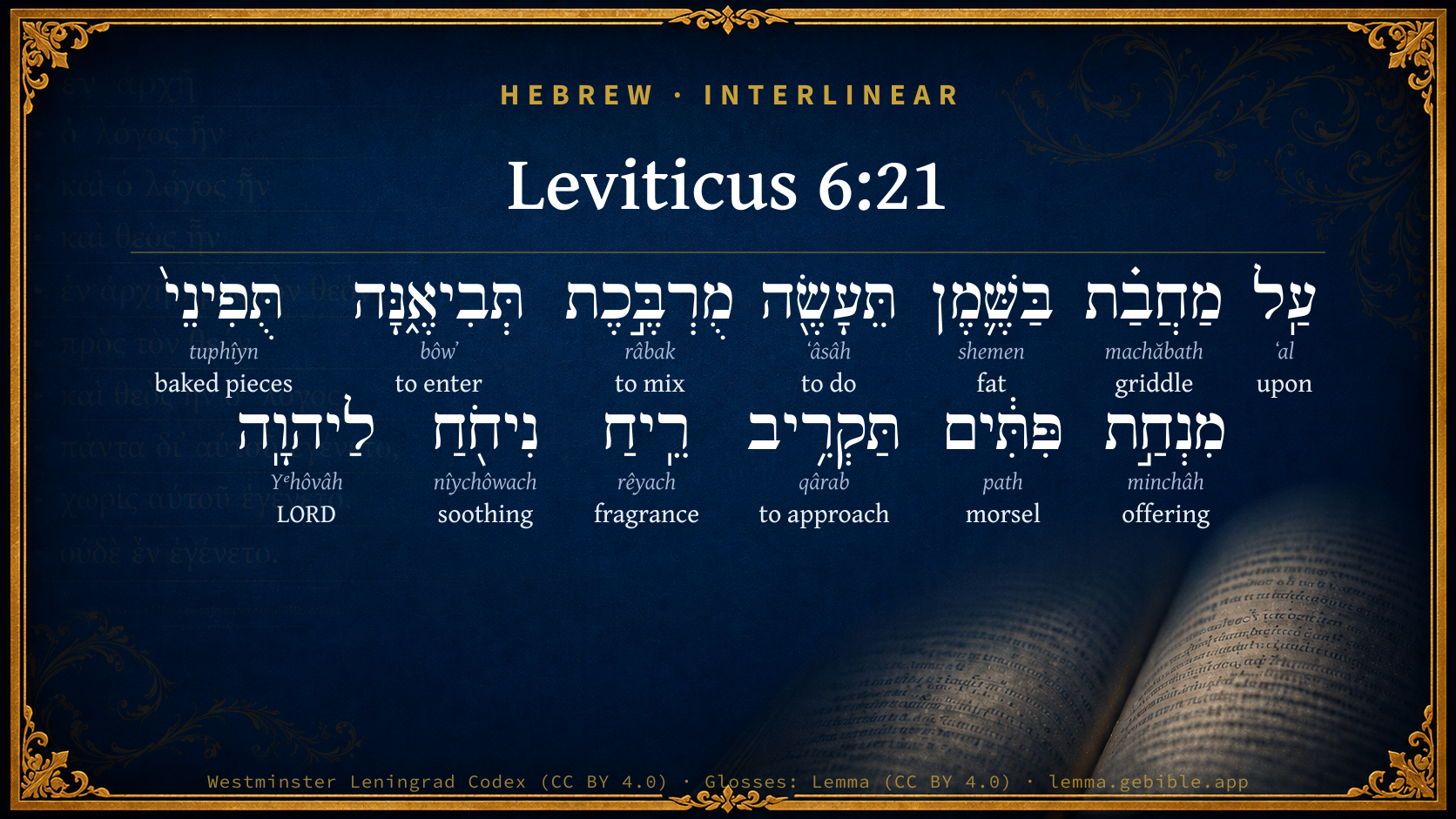
Hebrew (Westminster Leningrad Codex) Leviticus 6:21 appears in the Hebrew Old Testament. The text above is from the Westminster Leningrad Codex. Each word links to its Strong’s number, a concise gloss, and parsing drawn from the Open Scriptures Hebrew Bible morphology. Click any word for its full Brown-Driver-Briggs (BDB) entry.
Download image
Cite this verse

Leviticus 6:21 (World English Bible). Public Domain. Lemma interlinear Bible study tool, https://lemma.gebible.app/v/leviticus/6/21.

Show BibTeX & RIS
BibTeX
RIS
English Translation
It shall be made with oil in a baking pan. When it is soaked, you shall bring it in. You shall offer the meal offering in baked pieces for a sweet savor to Yahweh.
World English Bible · Public Domain
Highlights
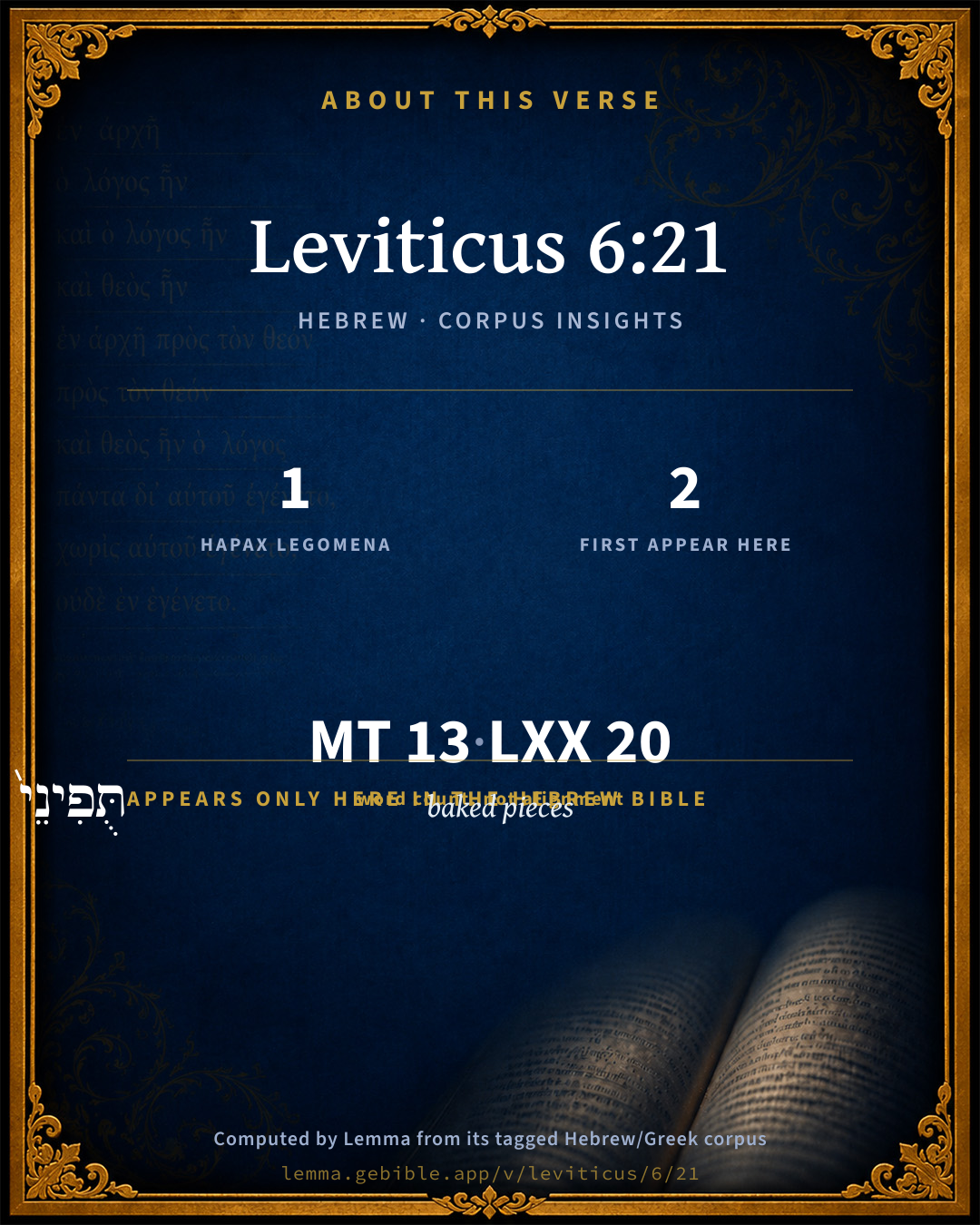
  • 1 hapax legomenon — only here in the Hebrew Bible
  • 2 first appearances in the Hebrew Bible
Full analysis ↓
Download a study sheet

One document with this verse’s original text, its word-by-word gloss line, the meaning frame, cross-references with their text, attributed commentary, and full source and license credits — printable, and it pastes into notes with its structure intact.

This verse Autodidact and up

Study sheet (.html) Plain text (.txt)

A passage Seminary Student

Up to 50 verses in one chapter. A passage sheet keeps up to 6 commentary sources and 12 cross-references per verse, in the order this page ranks them, and says so on the sheet whenever that leaves anything out. Ask for a single verse and you get the Autodidact verse sheet above.

Everything on this page stays free to read, with no account — the sheet is a download of what is already on screen, not access to it.

Want to remove ads? Support Godless Engineer
Compare translations 3

The same verse in 3 English versions, stacked beneath the original-language interlinear above. Click any original word for its lexicon entry.

Each is an independent rendering of the whole verse — the interlinear is not word-aligned to these translations.

Highlighted words mark where these versions differ — a whole-verse word diff, not a word-by-word alignment.

  • World English Bible Public Domain
    It shall be made with oil in a baking pan. When it is soaked, you shall bring it in. You shall offer the meal offering in baked pieces for a sweet savor to Yahweh.
  • King James Version Public Domain
    In a pan it shall be made with oil; and when it is baked, thou shalt bring it in: and the baked pieces of the meat offering shalt thou offer for a sweet savor unto the LORD.
  • unfoldingWord Literal Text CC BY-SA 4.0
    It shall be made on a griddle in oil. Mixed, you shall bring it; broken parts of a grain offering of pieces you shall present, a scent of pleasing to Yahweh.

unfoldingWord Literal Text — © unfoldingWord, licensed CC BY-SA 4.0. Word-aligned USFM3 via Door43 (git.door43.org/unfoldingWord/en_ult).

Versions to compare (up to 4)

3 of 4 selected

Show all 18 translations

Every available English version of this verse, each an independent rendering of the whole verse.

  • World English Bible Public Domain
    It shall be made with oil in a baking pan. When it is soaked, you shall bring it in. You shall offer the meal offering in baked pieces for a sweet savor to Yahweh.
  • Berean Standard Bible Public Domain
    It shall be prepared with oil on a griddle; you are to bring it well-kneaded and present it as a grain offering broken in pieces, a pleasing aroma to the LORD.
  • Majority Standard Bible Public Domain
    It shall be prepared with oil on a griddle; you are to bring it well-kneaded and present it as a grain offering broken in pieces, a pleasing aroma to the LORD.
  • King James Version Public Domain
    In a pan it shall be made with oil; and when it is baked, thou shalt bring it in: and the baked pieces of the meat offering shalt thou offer for a sweet savor unto the LORD.
  • American Standard Version (1901) Public Domain
    On a baking-pan it shall be made with oil; when it is soaked, thou shalt bring it in: in baken pieces shalt thou offer the meal-offering for a sweet savor unto Jehovah.
  • Revised Version (1885) Public Domain
    On a baking pan it shall be made with oil; when it is soaked, thou shalt bring it in: in baken pieces shalt thou offer the meal offering for a sweet savour unto the LORD.
  • Geneva Bible (1599) Public Domain
    In the frying panne it shalbe made with oyle: thou shalt bring it fryed, and shalt offer the baken pieces of the meate offering for a sweete sauour vnto the Lord.
  • Douay-Rheims (1899) Public Domain
    It shall be tempered with oil, and shall be fried in a fryingpan.
  • Young's Literal Translation Public Domain
    on a girdel with oil it is made -- fried thou dost bring it in; baked pieces of the present thou dost bring near, a sweet fragrance to Jehovah.
  • Literal Standard Version CC BY-SA 4.0
    it is made on a griddle with oil—you bring it in stirred; you bring baked pieces of the present near [for] a refreshing fragrance to YHWH.
  • Unlocked Literal Bible CC BY-SA 4.0
    It will be made with oil in a baking pan. When it is soaked, you will bring it in. In baked pieces you will offer the grain offering to produce a sweet aroma for Yahweh.
  • unfoldingWord Literal Text CC BY-SA 4.0
    It shall be made on a griddle in oil. Mixed, you shall bring it; broken parts of a grain offering of pieces you shall present, a scent of pleasing to Yahweh.
  • Darby Bible Public Domain
    It shall be prepared in the pan with oil: saturated with oil shalt thou bring it: baken pieces of the oblation shalt thou present [for] a sweet odour to Jehovah.
  • World Messianic Bible Public Domain
    It shall be made with oil in a griddle. When it is soaked, you shall bring it in. You shall offer the meal offering in baked pieces for a pleasant aroma to the LORD.
  • Webster's Bible Public Domain
    \\6:28\\But the earthen vessel in which it is boiled shall be broken: and if it shall be boiled in a brazen pot, it shall be both scoured, and rinsed in water.
  • Free Bible Version CC BY-SA 4.0
    Cook it with olive oil on a griddle. Bring it well-kneaded and present it as a grain offering broken into pieces, to be accepted by the Lord.
  • Bible in Basic English Public Domain
    But the vessel of earth in which the flesh was cooked is to be broken; or if a brass vessel was used, it is to be rubbed clean and washed out with water.
  • JPS Tanakh (1917) Public Domain
    (6-14) On a griddle it shall be made with oil; when it is soaked, thou shalt bring it in; in broken pieces shalt thou offer the meal-offering for a sweet savour unto the LORD.

Literal Standard Version (2020), Covenant Press — licensed CC BY-SA 4.0. Text via the HelloAO Bible API (eBible.org). Unlocked Literal Bible (unfoldingWord) — licensed CC BY-SA 4.0. Text via the HelloAO Bible API (eBible.org). unfoldingWord Literal Text — © unfoldingWord, licensed CC BY-SA 4.0. Word-aligned USFM3 via Door43 (git.door43.org/unfoldingWord/en_ult). Free Bible Version, Dr. Jonathan Gallagher — licensed CC BY-SA 4.0. Text via the HelloAO Bible API (eBible.org).

Word by word

More ways to search: Search by grammar → Find every occurrence → Compare this word →

Practice this passage: Drill this verse → Learn its vocabulary →

תֻּפִינֵי֙
tuphîyn
H8601
“baked pieces of”
Noun, Common, Masculine, Plural, Construct
Part of Speech
Noun
Type
Common
Gender
Masculine
Number
Plural
State
Construct
Full BDB Definition

Origin: from H644

TWOT: 2533

broken piece, baked pieces, pieces cooked - meaning dubious
  1. עַֽל ʻal H5921 “upon” Preposition
  2. מַחֲבַ֗ת machăbath H4227 “griddle” Noun, Common, Feminine, Singular, Absolute
  3. בַּשֶּׁ֛מֶן shemen H8081 “in/at the · fat” Preposition, Determined + Noun, Common, Masculine, Singular, Absolute
  4. תֵּעָשֶׂ֖ה ʻâsâh H6213 “to do” Verb, Niphal, Imperfect, 3rd Person, Feminine, Singular
  5. מֻרְבֶּ֣כֶת râbak H7246 “mixed” Verb, Hophal, Participle Passive, Feminine, Singular, Absolute
  6. תְּבִיאֶ֑נָּה bôwʼ H935 “to enter · her” Verb, Hiphil, Imperfect, 2nd Person, Masculine, Singular + Suffix, Personal, 3rd Person, Feminine, Singular
  7. מִנְחַ֣ת minchâh H4503 “offering of” Noun, Common, Feminine, Singular, Construct
  8. פִּתִּ֔ים path H6595 “morsels” Noun, Common, Feminine, Plural, Absolute
  9. תַּקְרִ֥יב qârab H7126 “to approach” Verb, Hiphil, Imperfect, 2nd Person, Masculine, Singular
  10. רֵֽיחַ rêyach H7381 “fragrance of” Noun, Common, Masculine, Singular, Construct
  11. נִיחֹ֖חַ nîychôwach H5207 “soothing” Noun, Common, Masculine, Singular, Absolute
  12. לַיהוָֽה Yᵉhôvâh H3068 “to/for · LORD” Preposition + Noun, Proper

About this verse

These counts appear in no published source. They are computed here, from the morphology-tagged text and Lemma’s own curated glosses. What Lemma adds →

13
words
13
distinct lemmas
Pentateuch
section

Notable vocabulary

1 hapax legomenon — a word that appears only here in the entire Hebrew Bible:

  • תֻּפִינֵי֙ baked pieces H8601

First appearance in Scripture

These words make their first canonical appearance in the Hebrew Bible here:

  • מֻרְבֶּ֣כֶת to mix H7246
  • תֻּפִינֵי֙ baked pieces H8601

Shared distinctive vocabulary

מֻרְבֶּ֣כֶת to mix H7246 occurs in 3 verses of the Hebrew Bible. Also found in:

Grammatical profile

  • 4 verbs
  • 8 nouns
  • 1 preposition

Verb forms

  • תֵּעָשֶׂ֖ה Niphal · Imperfect
  • מֻרְבֶּ֣כֶת Hophal · Participle Passive
  • תְּבִיאֶ֑נָּה Hiphil · Imperfect
  • תַּקְרִ֥יב Hiphil · Imperfect

Hebrew & Septuagint length

In English translation the verse runs 34 words from the Hebrew and 30 from the Septuagint (LXX English) — closely comparable.

A rough comparison of the two English renderings, which tokenize alike — not a word-level alignment.

Word counts can differ between the Hebrew and the Greek without any difference in meaning — e.g. the Hebrew direct-object marker אֵת has no separate Greek word, and Greek often adds the article ὁ.

In the original languages it is 13 Hebrew tokens and 20 Greek tokens — but the two are counted differently (Hebrew bundles its prefixes and suffixes into one token; the Greek is in lemma form), so that isn’t a like-for-like length.

Cross-references

3

Topical passages linked to Leviticus 6:21 in the Treasury of Scripture Knowledge — connected by theme and wording, ordered by reader-vote popularity; previews shown in the World English Bible.

  • Leviticus 2:5 If your offering is a meal offering of the baking pan, it shall be of unleavened fine flour, mixed with oil.
  • Leviticus 7:9 Every meal offering that is baked in the oven, and all that is dressed in the frying pan, and on the baking pan, shall be the priest's who offers it.
  • 1 Chronicles 9:31 Mattithiah, one of the Levites, who was the firstborn of Shallum the Korahite, had the office of trust over the things that were baked in pans.

Cross-references courtesy of OpenBible.info (CC BY 4.0).

Hebrew and Greek witnesses Masoretic Hebrew ↔ Greek Septuagint

The same verse in the two great witnesses to the Old Testament, shown verse-for-verse.

These are two independent witnesses, not word-aligned to each other, and the Septuagint is shown in lemma (dictionary) form.

Hebrew Leviticus 6:21 Masoretic · Westminster Leningrad Codex

עַֽל מַחֲבַ֗ת בַּשֶּׁ֛מֶן תֵּעָשֶׂ֖ה מֻרְבֶּ֣כֶת תְּבִיאֶ֑נָּה תֻּפִינֵי֙ מִנְחַ֣ת פִּתִּ֔ים תַּקְרִ֥יב רֵֽיחַ נִיחֹ֖חַ לַיהוָֽה

It shall be made with oil in a baking pan. When it is soaked, you shall bring it in. You shall offer the meal offering in baked pieces for a sweet savor to Yahweh.

World English Bible · Public Domain

Greek LXX Leviticus 6:21 Septuagint · lemma form

καί σκεῦος ὀστράκινος οὗ ἐάν ἕψω ἐν αὐτός συντρίβω ἐάν δέ ἐν σκεῦος χαλκός ἕψω ἐκτρίβω αὐτός καί ἐκκλύζω ὕδωρ

It shall be made with oil in a frying-pan; he shall offer it kneaded and in rolls, an offering of fragments, an offering of a sweet savor to the Lord.

LXX2012 (modern English Septuagint) · Public Domain

Hebrew: Westminster Leningrad Codex (CC BY 4.0). Greek: Septuagint (public domain); English from LXX2012 (modern English Septuagint) (Public Domain). How the Septuagint differs from the Hebrew →

Targum (Aramaic paraphrase)

2

The Targum is the ancient Jewish Aramaic paraphrase of the Hebrew Scriptures — an interpretive translation, not the Hebrew text itself. Onkelos (literal) and Pseudo-Jonathan (expansive) render the Torah, and Jonathan the Prophets. Coverage is partial: where no permissively-licensed English translation exists for a verse, only the Aramaic is shown. This is verse-level text, not a word-by-word alignment to the Hebrew.

  1. Targum Onkelos Torah (Genesis–Deuteronomy)
    וּמָן דַחֲסַף דִי תִתְבַּשֵׁל בֵּהּ יִתָּבָר וְאִם בְּמָנָא דִנְחָשָׁא תִּתְבַּשֵׁל וְיִתְמְרֵק וְיִשְׁתַּטֵף בְּמַיָא

    (no public-domain English translation for this verse)

    Targum Onkelos — Aramaic: “Onkelos Genesis” (public domain); “Onkelos Exodus” (public domain); “Onkelos Leviticus” (public domain); “Onkelos Numbers” (public domain); “Onkelos Deuteronomy” (public domain). English: “Sefaria Community Translation” (CC0 1.0 (public-domain dedication)); “J.W. Etheridge. The Targums of Onkelos and Jonathan Ben Uzziel on the Pentateuch. London: Longmans, Green, 1862” (public domain). Text via Sefaria.

  2. Targum Pseudo-Jonathan Torah (Genesis–Deuteronomy)
    וְכָל מַאן דְפָחַר דְתִתְבַּשֵׁל בֵּיהּ יִתְבַּר מְטוֹל דְלָא יְבַשְׁלוּן בֵּיהּ חוּלֵי וְאִין בְּמָנָא דִנְחָשָׁא תִּתְבַּשֵׁל וְיִסְתְּפַן בְּגַרְגִישְׁתָּא וְיִשְׁתְּטִיף בְּמוֹי

    And every earthen vessel in which (the flesh of it) is boiled shall be broken, lest that which is common be boiled in it; or if it be boiled in a vessel of brass, it shall be scoured with potter's earth and washed in waters.

    Targum Pseudo-Jonathan — Aramaic: “Targum Jonathan on Genesis” (public domain); “Targum Jonathan on Exodus” (public domain); “Targum Jonathan on Leviticus” (public domain); “Targum Jonathan on Numbers” (public domain); “Targum Jonathan on Deuteronomy” (public domain). English: “The Targum of Jonathan ben Uzziel, trans. J. W. Etheridge, London, 1862” (public domain). Text via Sefaria.

Commentary

Notes on Leviticus 6:21 from classic Christian and Jewish commentators (each source and its license shown beneath its notes). The classic Christian expositions comment on the surrounding passage and are grouped to its opening verse, so a note may address several verses; the Jewish commentaries on the Tanakh (Rashi and others) are per-verse, so they appear only where the commentator wrote on this verse.

Lemma curates 59 commentaries, every one of them public domain or Creative Commons licensed, each selected and text-cleaned for this edition rather than reprinted as found. About our sources →

Trapp's Complete Commentary

John Trapp

Lev 6:21 In a pan it shall be made with oil; [and when it is] baken, thou shalt bring it in: [and] the baken pieces of the meat offering shalt thou offer [for] a sweet savour unto the LORD.

Ver. 21. In a pan.] Figuring out the sufferings of Christ, who was so parched with the fire of afflictions for our sins.

John Trapp, A Commentary or Exposition upon All the Books of the Old and New Testament (1647–1656) — public domain. Text from a community e-Sword module.

Geneva Bible (1599)

Geneva Bible translators

Or, fried.

Geneva Bible (1599) marginal notes — public domain. Text via Bolls.life.

The Cambridge Bible for Schools and Colleges

gen. ed. J. J. S. Perowne

21. a baking pan] See note on Lev_2:5.

when it is soaked] baken A.V. The Heb. word occurs only here and in Lev_7:12 (where see note), 1Ch_23:29 (fried A.V.), and means something mixed.

in baken pieces shalt thou offer the meal offering] lit. —— a meal offering in pieces (cp. Lev_2:6 ‘Thou shalt part it in pieces’) shalt thou offer. The first word is uncertain, and is left blank. The Oxf. Lex. suggests, with a slight change of letters and vocalisation, to render ‘thou shalt break’ (it into a Meal-Offering of pieces and offer etc.), thus making the word a verb, and the root from which the following substantive ‘pieces’ is formed. If the description of Josephus and the Mishna (see additional note) be accepted as determining the meaning, then the word (? slightly amended) might be translated ‘baken pieces.’ The word is in appearance similar to that immediately preceding; perhaps it should be omitted as due to a scribal error. That the offering is baked is already indicated in the first part of the verse.

The Cambridge Bible for Schools and Colleges (gen. ed. J. J. S. Perowne; Cambridge University Press, 1878–1918) — public domain. Text from a community e-Sword module.

John Gill's Exposition

And the priest of his sons that is anointed in his stead shall offer it,.... The successor of the high priest:

it is a statute for ever unto the Lord; which he by an everlasting statute appointed to be offered to him by every high priest, until the Messiah should come:

it shall be wholly burnt; of a common meat offering only a handful was burnt, and the rest was the priest's; see Lev 6:15.

John Gill's Exposition of the Whole Bible (1746–1763) — public domain (CC PDM 1.0). Text via the HelloAO Bible API.

Albert Barnes' Notes on the Bible

In a pan - See Lev 2:5 note.

Albert Barnes' Notes on the Bible (1834–1885) — public domain. Text from a community e-Sword/MySword module.

Matthew Poole's English Annotations

When it is baken, or fried, so that it swells and bubbles up.

Thou shalt bring it in, who art so anointed and consecrated, Lev 6:22.

Matthew Poole's English Annotations on the Holy Bible (1683–1685) — public domain. Text from a community e-Sword/MySword module.

Whedon's Commentary on the Bible

Daniel D. Whedon

21. In a pan… with oil — See Lev_2:5.

Daniel D. Whedon (gen. ed.), Commentary on the Old and New Testaments (1874–1909) — public domain. Text from a community e-Sword module.

John Wesley's Explanatory Notes

Thou - Who art so anointed and consecrated.

John Wesley, Explanatory Notes Upon the Whole Bible (1754–1765) — public domain. Text via the GEBible commentary corpus.

unfoldingWord translationNotes

Door43 World Missions Community

It will be made

This can be translated in active form. AT: "You will make it" (See: Active or Passive)

in a baking pan

This is a thick plate made of either clay or metal. The plate was placed over a fire, and the dough cooked on top of the plate. See how you translated "flat iron pan" in Leviticus 2:5. (See: Translate Unknowns)

When it is soaked

"When the flour is completely wet with oil"

you will bring it in

Here "you" refers to the person offering the sacrifice. (See: Forms of You)

to produce a sweet aroma for Yahweh

Yahweh being pleased with the sincere worshiper who offered the sacrifice is spoken of as if God were pleased with the aroma of the burning sacrifice. See how you translated this in Leviticus 1:9. (See: Metaphor)

As commanded

This can be stated in active form. AT: "As Yahweh has commanded you" (See: Active or Passive)

all of it shall be burned

This can be stated in active form. AT: "he must burn all of it" (See: Active or Passive)

will be completely burned up

This can be stated in active form. AT: "he must burn it up completely" (See: Active or Passive)

It must not be eaten

This can be stated in active form. AT: "No one must eat it" (See: Active or Passive)

translationWords

oil

grain offering

Yahweh

high priest

command

unfoldingWord translationNotes — © Distant Shores Media and the Door43 World Missions Community, licensed CC BY-SA 4.0. Source: git.door43.org/Door43/en_tn.

Rashi

Rabbi Shlomo Yitzchaki (Rashi)

ישבר [BUT AN EARTHEN VESSEL WHEREIN IT IS SODDEN] SHALL BE BROKEN — because the substance absorbed in it becomes what is known as נותר (the technical term for any portion of a sacrifice not eaten by the time prescribed for this) (cf. Avodah Zarah 76a). That, too, is the regulation applicable to all sacrifices (i. e. that an earthen vessel wherein they have been cooked must be broken).

ומרק — of the same root and meaning as the noun in (Esther 2:12) “the things for purifying (תמרוקי) women”; escourement in old French; English, scouring.

ומרק ושטף [AND IF IT BE SODDEN IN A COPPER POT] IT SHALL BE BOTH SCOURED AND RINSED [IN WATER] — in order that it should give out what it has absorbed: but as far as an earthen vessel is concerned Scripture teaches you that it can never get rid of its taint (lit., can never leave the grasp which its taint has on it) (Avodah Zarah 34a; Pesachim 30b).

Rashi on the Tanakh — English translations: “The Judaica Press complete Tanach with Rashi, translated by A. J. Rosenberg” (CC BY 4.0); “Pentateuch with Rashi's commentary by M. Rosenbaum and A.M. Silbermann, 1929-1934” (public domain); “The Metsudah Tanach series, Lakewood, N.J” (CC BY 4.0); and “The Book of Joshua, Metsudah Publications, 1997” (CC BY 4.0). Text via Sefaria.

Lesson kit

Teaching starters — assembled from the data on this page, not authored interpretation. Every prompt links to the verse data it draws on. Edit before teaching.

Leviticus, in the Pentateuch, opens this verse with 13 words (13 distinct Hebrew lemmas). Its most distinctive word is tuphîyn (“baked pieces”). A historical commentator’s framing appears above. Read the whole chapter for the surrounding context.

Discussion questions

  1. What does “baked pieces” (tuphîyn) contribute to the verse as a whole?
  2. 1 word here appears nowhere else in the Hebrew Bible. Why might the author reach for such rare wording?
  3. 2 words make their first appearance in Scripture here. What does this debut establish?
  4. How does Leviticus 7:12, which shares the word «to mix», read alongside this verse?
  5. The translations on this page render this verse differently — a whole-verse word diff, not a word-by-word alignment. What might account for the different wordings?
  6. «תֵּעָשֶׂ֖ה» is a Niphal Imperfect verb. How does that grammatical form shape the action described?
  7. Compare how Trapp's Complete Commentary and Geneva Bible (1599) read this verse. Where do they agree or differ?

Things to notice

Reading settings

Reading text

Shown beneath each verse's original-language words.

Old Testament
Old Testament edition

Read the OT as the Masoretic Hebrew (MT) or the Greek Septuagint (LXX).

English shown for the Greek Septuagint (in the Hebrew ↔ Greek comparison).

Comparing translations? Open the Compare panel on any verse page to stack up to four side by side.