Numbers 3:6

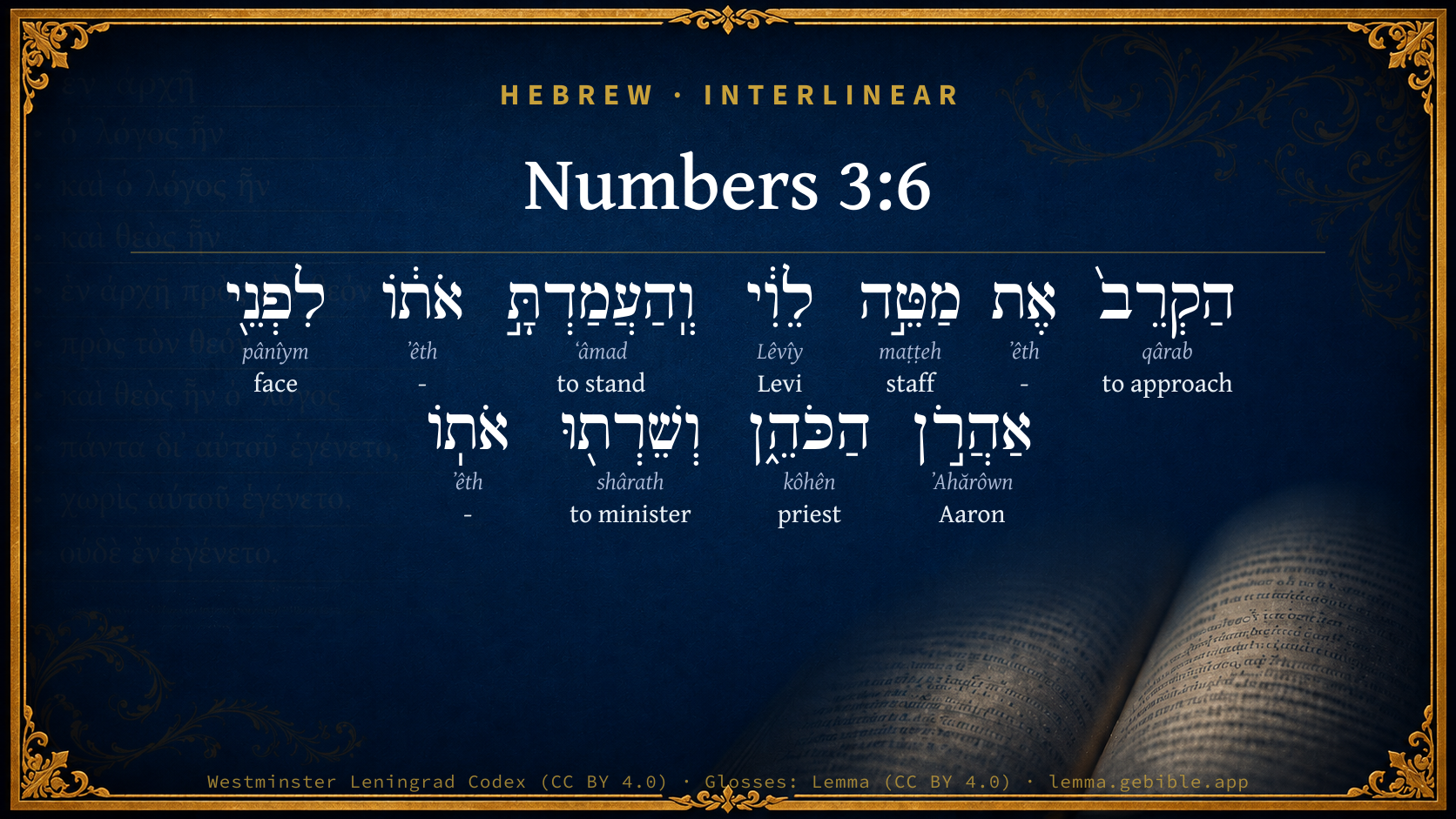
Hebrew (Westminster Leningrad Codex) Numbers 3:6 appears in the Hebrew Old Testament. The text above is from the Westminster Leningrad Codex. Each word links to its Strong’s number, a concise gloss, and parsing drawn from the Open Scriptures Hebrew Bible morphology. Click any word for its full Brown-Driver-Briggs (BDB) entry.
Download image
Cite this verse

Numbers 3:6 (World English Bible). Public Domain. Lemma interlinear Bible study tool, https://lemma.gebible.app/v/numbers/3/6.

Show BibTeX & RIS
BibTeX
RIS
English Translation
"Bring the tribe of Levi near, and set them before Aaron the priest, that they may minister to him.
World English Bible · Public Domain
Download a study sheet

One document with this verse’s original text, its word-by-word gloss line, the meaning frame, cross-references with their text, attributed commentary, and full source and license credits — printable, and it pastes into notes with its structure intact.

This verse Autodidact and up

Study sheet (.html) Plain text (.txt)

A passage Seminary Student

Up to 50 verses in one chapter. A passage sheet keeps up to 6 commentary sources and 12 cross-references per verse, in the order this page ranks them, and says so on the sheet whenever that leaves anything out. Ask for a single verse and you get the Autodidact verse sheet above.

Everything on this page stays free to read, with no account — the sheet is a download of what is already on screen, not access to it.

Want to remove ads? Support Godless Engineer
Compare translations 3

The same verse in 3 English versions, stacked beneath the original-language interlinear above. Click any original word for its lexicon entry.

Each is an independent rendering of the whole verse — the interlinear is not word-aligned to these translations.

Highlighted words mark where these versions differ — a whole-verse word diff, not a word-by-word alignment.

  • World English Bible Public Domain
    "Bring the tribe of Levi near, and set them before Aaron the priest, that they may minister to him.
  • King James Version Public Domain
    Bring the tribe of Levi near, and present them before Aaron the priest, that they may minister unto him.
  • unfoldingWord Literal Text CC BY-SA 4.0
    “Bring near the tribe of Levi and station it to the face of Aaron the priest. And they shall minister to him.

unfoldingWord Literal Text — © unfoldingWord, licensed CC BY-SA 4.0. Word-aligned USFM3 via Door43 (git.door43.org/unfoldingWord/en_ult).

Versions to compare (up to 4)

3 of 4 selected

Show all 18 translations

Every available English version of this verse, each an independent rendering of the whole verse.

  • World English Bible Public Domain
    "Bring the tribe of Levi near, and set them before Aaron the priest, that they may minister to him.
  • Berean Standard Bible Public Domain
    “Bring the tribe of Levi and present them to Aaron the priest to assist him.
  • Majority Standard Bible Public Domain
    “Bring the tribe of Levi and present them to Aaron the priest to assist him.
  • King James Version Public Domain
    Bring the tribe of Levi near, and present them before Aaron the priest, that they may minister unto him.
  • American Standard Version (1901) Public Domain
    Bring the tribe of Levi near, and set them before Aaron the priest, that they may minister unto him.
  • Revised Version (1885) Public Domain
    Bring the tribe of Levi near, and set them before Aaron the priest, that they may minister unto him.
  • Geneva Bible (1599) Public Domain
    Bring the tribe of Leui, and set the before Aaron the Priest that they may serue him,
  • Douay-Rheims (1899) Public Domain
    Bring the tribe of Levi, and make them stand in the sight of Aaron the priest to minister to him, and let them watch,
  • Young's Literal Translation Public Domain
    `Bring near the tribe of Levi, and thou hast caused it to stand before Aaron the priest, and they have served him,
  • Literal Standard Version CC BY-SA 4.0
    “Bring the tribe of Levi near, and you have caused it to stand before Aaron the priest, and they have served him,
  • Unlocked Literal Bible CC BY-SA 4.0
    “Bring the tribe of Levi and present them to Aaron the priest for them to help him.
  • unfoldingWord Literal Text CC BY-SA 4.0
    “Bring near the tribe of Levi and station it to the face of Aaron the priest. And they shall minister to him.
  • Darby Bible Public Domain
    Bring the tribe of Levi near, and present them before Aaron the priest, that they may minister unto him;
  • World Messianic Bible Public Domain
    “Bring the tribe of Levi near, and set them before Aaron the priest, that they may minister to him.
  • Webster's Bible Public Domain
    Bring the tribe of Levi near, and present them before Aaron the priest, that they may minister to him.
  • Free Bible Version CC BY-SA 4.0
    “Gather the tribe of Levi together and present them to Aaron the priest to help him with the ministry.
  • Bible in Basic English Public Domain
    Make the tribe of Levi come near, and put them before Aaron the priest, to be his helpers,
  • JPS Tanakh (1917) Public Domain
    'Bring the tribe of Levi near, and set them before Aaron the priest, that they may minister unto him.

Literal Standard Version (2020), Covenant Press — licensed CC BY-SA 4.0. Text via the HelloAO Bible API (eBible.org). Unlocked Literal Bible (unfoldingWord) — licensed CC BY-SA 4.0. Text via the HelloAO Bible API (eBible.org). unfoldingWord Literal Text — © unfoldingWord, licensed CC BY-SA 4.0. Word-aligned USFM3 via Door43 (git.door43.org/unfoldingWord/en_ult). Free Bible Version, Dr. Jonathan Gallagher — licensed CC BY-SA 4.0. Text via the HelloAO Bible API (eBible.org).

Word by word

More ways to search: Search by grammar → Find every occurrence → Compare this word →

Practice this passage: Drill this verse → Learn its vocabulary →

לֵוִ֔י
Lêvîy
H3878
“Levi”
Noun, Proper
Part of Speech
Noun
Type
Proper
Full BDB Definition

Origin: from H3867

TWOT: 1093

Levi = "joined to" - the 3rd son of Jacob by Leah and progenitor of tribe of Levites
  1. הַקְרֵב֙ qârab H7126 “approach” Verb, Hiphil, Imperative, 2nd Person, Masculine, Singular
  2. אֶת ʼêth H853 “-” Particle, Direct Object
  3. מַטֵּ֣ה maṭṭeh H4294 “staff of” Noun, Common, Masculine, Singular, Construct
  4. וְֽהַעֲמַדְתָּ֣ ʻâmad H5975 “and · to stand” Conjunction + Verb, Hiphil, Sequential Perfect, 2nd Person, Masculine, Singular
  5. אֹת֔וֹ ʼêth H853 “- · him” Particle, Direct Object + Suffix, Personal, 3rd Person, Masculine, Singular
  6. לִפְנֵ֖י pânîym H6440 “to/for · face(s) of” Preposition + Noun, Common, Both, Plural, Construct
  7. אַהֲרֹ֣ן ʼAhărôwn H175 “Aaron” Noun, Proper
  8. הַכֹּהֵ֑ן kôhên H3548 “the · priest” Particle, Definite Article + Noun, Common, Masculine, Singular, Absolute
  9. וְשֵׁרְת֖וּ shârath H8334 “and · to minister” Conjunction + Verb, Piel, Sequential Perfect, 3rd Person, Common, Plural
  10. אֹתֽוֹ ʼêth H853 “- · him” Particle, Direct Object + Suffix, Personal, 3rd Person, Masculine, Singular

About this verse

These counts appear in no published source. They are computed here, from the morphology-tagged text and Lemma’s own curated glosses. What Lemma adds →

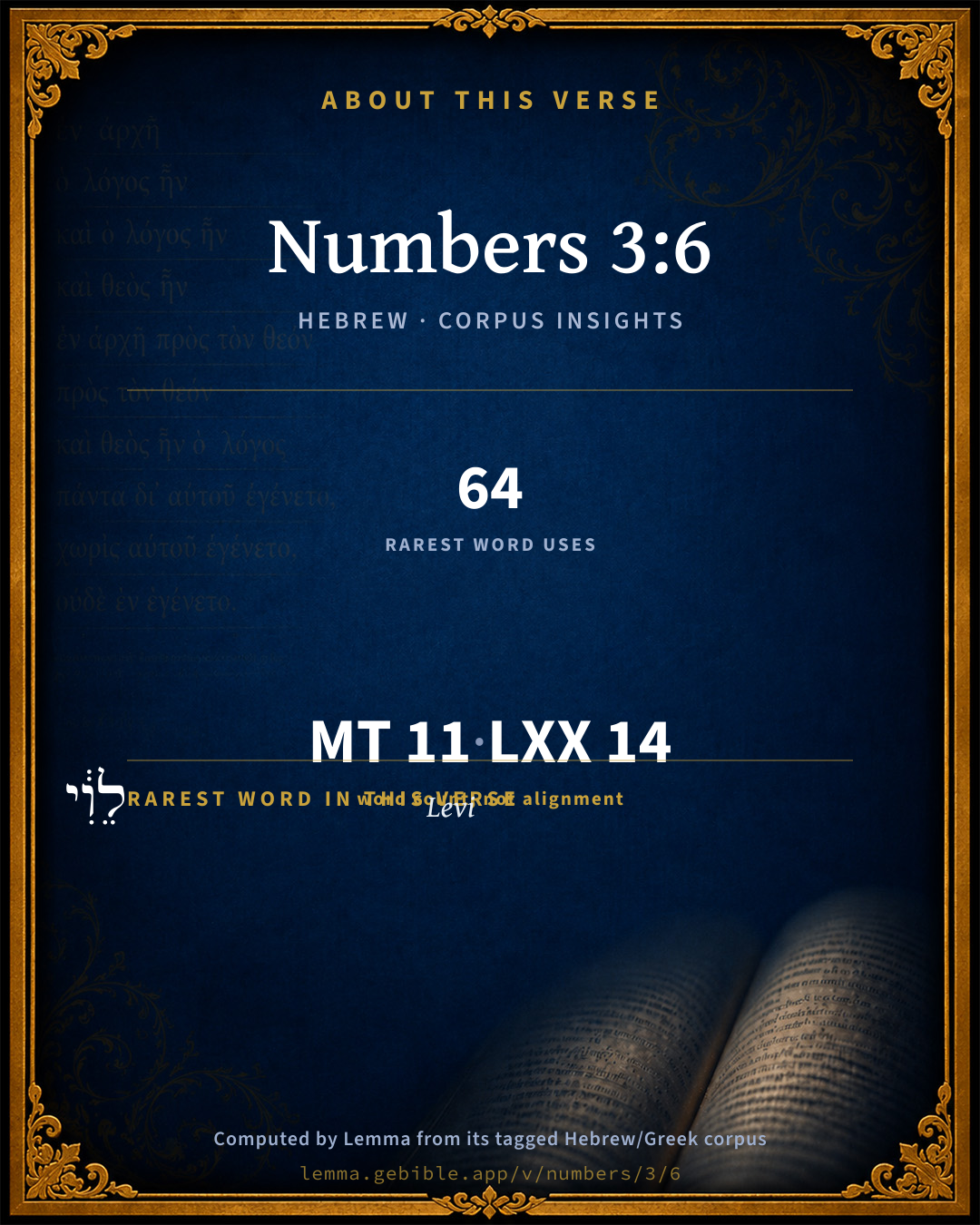
11
words
9
distinct lemmas
Pentateuch
section

Grammatical profile

  • 3 verbs
  • 5 nouns
  • 3 particles

Verb forms

  • הַקְרֵב֙ Hiphil · Imperative
  • וְֽהַעֲמַדְתָּ֣ Hiphil · Sequential Perfect
  • וְשֵׁרְת֖וּ Piel · Sequential Perfect

Hebrew & Septuagint length

In English translation the verse runs 19 words from the Hebrew and 20 from the Septuagint (LXX English) — closely comparable.

A rough comparison of the two English renderings, which tokenize alike — not a word-level alignment.

Word counts can differ between the Hebrew and the Greek without any difference in meaning — e.g. the Hebrew direct-object marker אֵת has no separate Greek word, and Greek often adds the article ὁ.

In the original languages it is 11 Hebrew tokens and 14 Greek tokens — but the two are counted differently (Hebrew bundles its prefixes and suffixes into one token; the Greek is in lemma form), so that isn’t a like-for-like length.

Cross-references

10

Topical passages linked to Numbers 3:6 in the Treasury of Scripture Knowledge — connected by theme and wording, ordered by reader-vote popularity; previews shown in the World English Bible.

  • Exodus 32:26–29 then Moses stood in the gate of the camp, and said, "Whoever is on Yahweh's side, come to me!" All the sons of Levi gathered themselves together to him.
  • Numbers 1:49–53 "Only the tribe of Levi you shall not number, neither shall you take a census of them among the children of Israel;
  • Numbers 2:17 "Then the tent of meeting shall set out, with the camp of the Levites in the midst of the camps. As they encamp, so shall they set out, every man in his place, by their standards.
  • Numbers 2:33 But the Levites were not numbered among the children of Israel; as Yahweh commanded Moses.
  • Numbers 8:6–26 "Take the Levites from among the children of Israel, and cleanse them.
  • Numbers 16:9–11 [seems it but] a small thing to you, that the God of Israel has separated you from the congregation of Israel, to bring you near to himself, to do the service of the tent of Yahweh, and to stand before the congregation to minister to them;
  • Numbers 18:1–7 Yahweh said to Aaron, You and your sons and your fathers' house with you shall bear the iniquity of the sanctuary; and you and your sons with you shall bear the iniquity of your priesthood.
  • Deuteronomy 10:8 At that time Yahweh set apart the tribe of Levi, to bear the ark of the covenant of Yahweh, to stand before Yahweh to minister to him, and to bless in his name, to this day.
  • Deuteronomy 33:8–9 Of Levi he said, Your Thummim and your Urim are with your godly one, Whom you did prove at Massah, With whom you did strive at the waters of Meribah;
  • Malachi 2:4 You will know that I have sent this commandment to you, that my covenant may be with Levi," says Yahweh of Hosts.

Cross-references courtesy of OpenBible.info (CC BY 4.0).

Hebrew and Greek witnesses Masoretic Hebrew ↔ Greek Septuagint

The same verse in the two great witnesses to the Old Testament, shown verse-for-verse.

These are two independent witnesses, not word-aligned to each other, and the Septuagint is shown in lemma (dictionary) form.

Hebrew Numbers 3:6 Masoretic · Westminster Leningrad Codex

הַקְרֵב֙ אֶת מַטֵּ֣ה לֵוִ֔י וְֽהַעֲמַדְתָּ֣ אֹת֔וֹ לִפְנֵ֖י אַהֲרֹ֣ן הַכֹּהֵ֑ן וְשֵׁרְת֖וּ אֹתֽוֹ

"Bring the tribe of Levi near, and set them before Aaron the priest, that they may minister to him.

World English Bible · Public Domain

Greek LXX Numbers 3:6 Septuagint · lemma form

λαμβάνω ὁ φυλή λευί καί ἵστημι αὐτός ἐναντίον ἀαρών ὁ ἱερεύς καί λειτουργέω αὐτός

Take the tribe of Levi, and you shall set them before Aaron the priest, and they shall minister to him,

LXX2012 (modern English Septuagint) · Public Domain

Hebrew: Westminster Leningrad Codex (CC BY 4.0). Greek: Septuagint (public domain); English from LXX2012 (modern English Septuagint) (Public Domain). How the Septuagint differs from the Hebrew →

Targum (Aramaic paraphrase)

2

The Targum is the ancient Jewish Aramaic paraphrase of the Hebrew Scriptures — an interpretive translation, not the Hebrew text itself. Onkelos (literal) and Pseudo-Jonathan (expansive) render the Torah, and Jonathan the Prophets. Coverage is partial: where no permissively-licensed English translation exists for a verse, only the Aramaic is shown. This is verse-level text, not a word-by-word alignment to the Hebrew.

  1. Targum Onkelos Torah (Genesis–Deuteronomy)
    קָרֵב יָת שִׁבְטָּא דְלֵוִי וּתְקֵים יָתֵהּ קֳדָם אַהֲרֹן כַּהֲנָא וִישַׁמְשׁוּן יָתֵהּ

    (no public-domain English translation for this verse)

    Targum Onkelos — Aramaic: “Onkelos Genesis” (public domain); “Onkelos Exodus” (public domain); “Onkelos Leviticus” (public domain); “Onkelos Numbers” (public domain); “Onkelos Deuteronomy” (public domain). English: “Sefaria Community Translation” (CC0 1.0 (public-domain dedication)); “J.W. Etheridge. The Targums of Onkelos and Jonathan Ben Uzziel on the Pentateuch. London: Longmans, Green, 1862” (public domain). Text via Sefaria.

  2. Targum Pseudo-Jonathan Torah (Genesis–Deuteronomy)
    קְרַב יַת שִׁבְטָא דְלֵוִי וּתְקֵים יָתֵיהּ קֳדָם אַהֲרן כַּהֲנָא וִישַׁמְשׁוּן יָתֵיהּ

    Bring the tribe of Levi near, and appoint them before Aharon the priest to minister with him, (or, to do him service;)

    Targum Pseudo-Jonathan — Aramaic: “Targum Jonathan on Genesis” (public domain); “Targum Jonathan on Exodus” (public domain); “Targum Jonathan on Leviticus” (public domain); “Targum Jonathan on Numbers” (public domain); “Targum Jonathan on Deuteronomy” (public domain). English: “The Targum of Jonathan ben Uzziel, trans. J. W. Etheridge, London, 1862” (public domain). Text via Sefaria.

Commentary

Notes on Numbers 3:6 from classic Christian and Jewish commentators (each source and its license shown beneath its notes). The classic Christian expositions comment on the surrounding passage and are grouped to its opening verse, so a note may address several verses; the Jewish commentaries on the Tanakh (Rashi and others) are per-verse, so they appear only where the commentator wrote on this verse.

Lemma curates 59 commentaries, every one of them public domain or Creative Commons licensed, each selected and text-cleaned for this edition rather than reprinted as found. About our sources →

Joseph Benson's Commentary

Num 3:6. Present them — Offer them to the Lord for his special service. This was promised to them before, and now actually conferred.

Joseph Benson's Commentary on the Old and New Testaments (1811–1818) — public domain. Text from a community e-Sword module.

Geneva Bible (1599)

Geneva Bible translators

Offer them unto Aaron for the use of the Tabernacle.

Geneva Bible (1599) marginal notes — public domain. Text via Bolls.life.

Adam Clarke's Commentary

Verse 6. Bring the tribe of Levi near] The original word הקרב hakreb is properly a sacrificial word, and signifies the presenting of a sacrifice or offering to the Lord. As an offering, the tribe of Levi was given up entirely to the service of the sanctuary, to be no longer their own, but the Lord's property.

Adam Clarke's Commentary on the Bible (1810–1826) — public domain. Text from a community e-Sword/MySword module.

The Cambridge Bible for Schools and Colleges

gen. ed. J. J. S. Perowne

6. minister unto him] i.e. unto all the priests, whom Aaron represented.

The Cambridge Bible for Schools and Colleges (gen. ed. J. J. S. Perowne; Cambridge University Press, 1878–1918) — public domain. Text from a community e-Sword module.

John Gill's Exposition

Bring the tribe of Levi near,.... Separate them from the rest, set them apart for special service about, the sanctuary, let them have a place nearer to it than the other tribes, or offer them, that is, to the Lord, as in Num 8:11; as well as bring them near to Aaron; so it follows:

and present them before Aaron the priest; that he may receive them as a gift unto him, as servants to wait upon him; and! that he may appoint and declare unto them their work, and set them about it:

that they may minister unto him; in guarding the tabernacle taking care of the vessels of it, taking it down, carrying it, from place to place, and setting it up as there was occasion for it.

John Gill's Exposition of the Whole Bible (1746–1763) — public domain (CC PDM 1.0). Text via the HelloAO Bible API.

Haydock's Catholic Bible Commentary

To him, and to the other priests, who had to perform the higher offices. The Levites did not approach near the altar, except when they had to carry it and the tabernacle. (Calmet)

George Leo Haydock (1774–1849), Haydock's Catholic Family Bible and Commentary, 1859 edition — public domain. Excludes Psalms (Douay-Rheims chapter numbering differs from Protestant) and Deuterocanonical books (Catholic canon only).

Matthew Poole's English Annotations

Present them; offer them to the lord for his special service. This was promised to them before, and now actually conferred upon them.

Matthew Poole's English Annotations on the Holy Bible (1683–1685) — public domain. Text from a community e-Sword/MySword module.

The Pulpit Commentary

Bring the tribe of Levi near. Not by any outward act of presentation, but by assigning to them solemnly the duties following. The expression is often used of servants coming to receive orders from their masters.

The Pulpit Commentary (1880–1919), ed. H.D.M. Spence-Jones & Joseph S. Exell — public domain. Text from a community e-Sword module.

John Wesley's Explanatory Notes

Present them - Offer them to the Lord for his special service. This was promised to them before, and now actually conferred.

John Wesley, Explanatory Notes Upon the Whole Bible (1754–1765) — public domain. Text via the GEBible commentary corpus.

Rashi

Rabbi Shlomo Yitzchaki (Rashi)

ושרתו אתו [BRING THE TRIBE OF LEVI … BEFORE AARON] THAT THEY MINISTER UNTO HIM — And wherein consists their ministering?

ושמרו את משמרתו THAT THEY SHALL KEEP HIS CHARGE — Because the care of the Sanctuary, viz., that no stranger should approach it, was committed to his charge, as it is said, (Numbers 18:1) "Thou and thy sons, and thy father’s house with thee, shall bear the iniquity of the sanctuary”, (which Rashi explains to have reference to the iniquity committed by a “stranger” in approaching the holy things), and these Levites aided them — this therefore, was their ministering [alluded to here].

Rashi on the Tanakh — English translations: “The Judaica Press complete Tanach with Rashi, translated by A. J. Rosenberg” (CC BY 4.0); “Pentateuch with Rashi's commentary by M. Rosenbaum and A.M. Silbermann, 1929-1934” (public domain); “The Metsudah Tanach series, Lakewood, N.J” (CC BY 4.0); and “The Book of Joshua, Metsudah Publications, 1997” (CC BY 4.0). Text via Sefaria.

Lesson kit

Teaching starters — assembled from the data on this page, not authored interpretation. Every prompt links to the verse data it draws on. Edit before teaching.

Numbers, in the Pentateuch, opens this verse with 11 words (9 distinct Hebrew lemmas). Its most distinctive word is Lêvîy (“Levi”). A historical commentator’s framing appears above. Read the whole chapter for the surrounding context.

Discussion questions

  1. The word Lêvîy carries the sense “Levi.” How does it shape the verse?
  2. How does Exodus 32:26–29, which shares this passage’s theme, read alongside this verse?
  3. The translations on this page render this verse differently — a whole-verse word diff, not a word-by-word alignment. What might account for the different wordings?
  4. «הַקְרֵב֙» is a Hiphil Imperative verb. How does that grammatical form shape the action described?
  5. Compare how Joseph Benson's Commentary and Geneva Bible (1599) read this verse. Where do they agree or differ?

Things to notice

Reading settings

Reading text

Shown beneath each verse's original-language words.

Old Testament
Old Testament edition

Read the OT as the Masoretic Hebrew (MT) or the Greek Septuagint (LXX).

English shown for the Greek Septuagint (in the Hebrew ↔ Greek comparison).

Comparing translations? Open the Compare panel on any verse page to stack up to four side by side.