
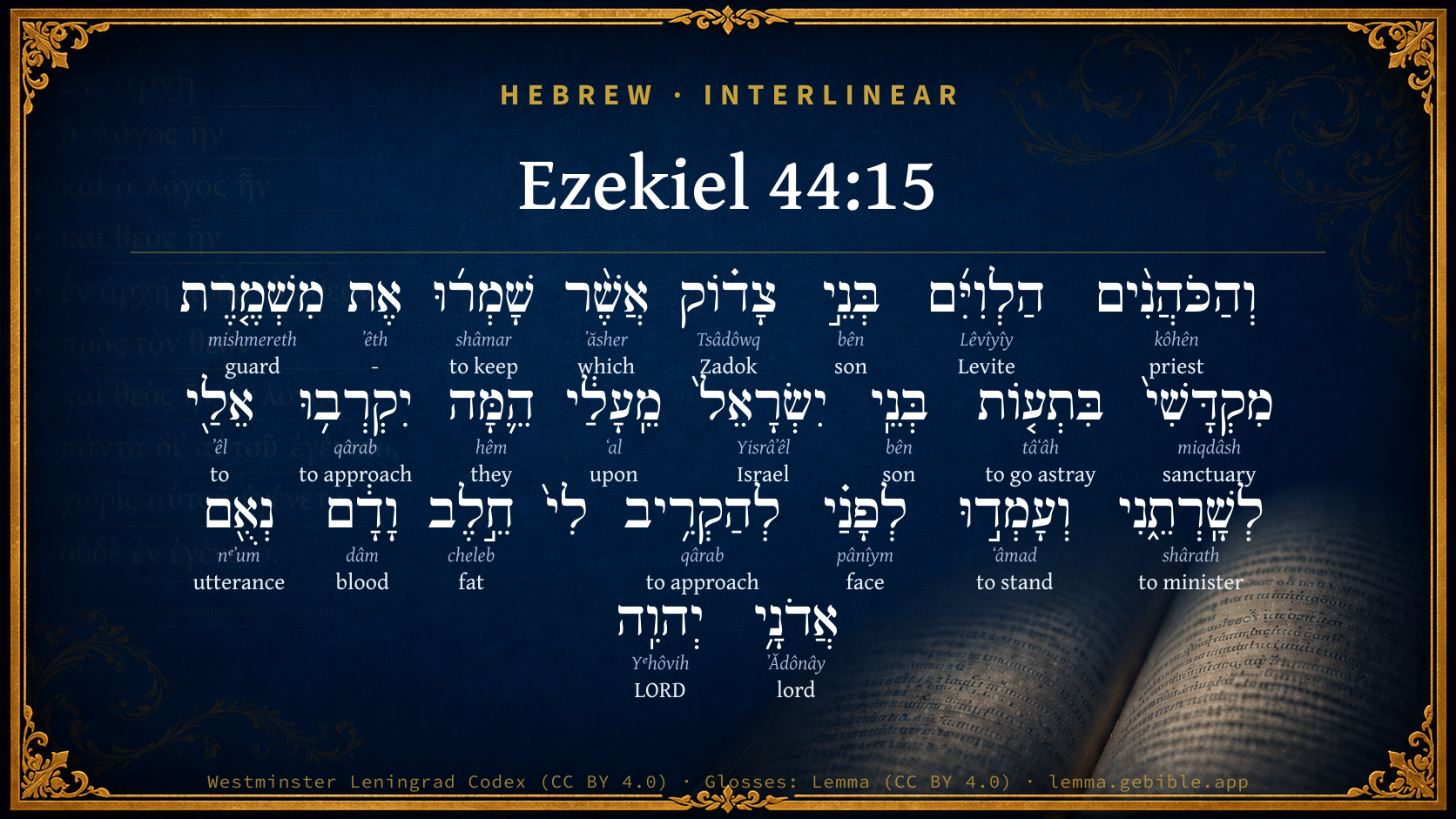
Ezekiel 44:15

Hebrew (Westminster Leningrad Codex) Ezekiel 44:15 appears in the Hebrew Old Testament. The text above is from the Westminster Leningrad Codex. Each word links to its Strong’s number, a concise gloss, and parsing drawn from the Open Scriptures Hebrew Bible morphology. Click any word for its full Brown-Driver-Briggs (BDB) entry.
Download image
Cite this verse

Ezekiel 44:15 (World English Bible). Public Domain. Lemma interlinear Bible study tool, https://lemma.gebible.app/v/ezekiel/44/15.

Show BibTeX & RIS
BibTeX
RIS
English Translation
But the priests the Levites, the sons of Zadok, who kept the charge of my sanctuary when the children of Israel went astray from me, they shall come near to me to minister to me; and they shall stand before me to offer to me the fat and the blood, says the Lord Yahweh:
World English Bible · Public Domain
Download a study sheet

One document with this verse’s original text, its word-by-word gloss line, the meaning frame, cross-references with their text, attributed commentary, and full source and license credits — printable, and it pastes into notes with its structure intact.

This verse Autodidact and up

Study sheet (.html) Plain text (.txt)

A passage Seminary Student

Up to 50 verses in one chapter. A passage sheet keeps up to 6 commentary sources and 12 cross-references per verse, in the order this page ranks them, and says so on the sheet whenever that leaves anything out. Ask for a single verse and you get the Autodidact verse sheet above.

Everything on this page stays free to read, with no account — the sheet is a download of what is already on screen, not access to it.

Want to remove ads? Support Godless Engineer
Compare translations 3

The same verse in 3 English versions, stacked beneath the original-language interlinear above. Click any original word for its lexicon entry.

Each is an independent rendering of the whole verse — the interlinear is not word-aligned to these translations.

Highlighted words mark where these versions differ — a whole-verse word diff, not a word-by-word alignment.

  • World English Bible Public Domain
    But the priests the Levites, the sons of Zadok, who kept the charge of my sanctuary when the children of Israel went astray from me, they shall come near to me to minister to me; and they shall stand before me to offer to me the fat and the blood, says the Lord Yahweh:
  • King James Version Public Domain
    But the priests the Levites, the sons of Zadok, that kept the charge of my sanctuary when the children of Israel went astray from me, they shall come near to me to minister unto me, and they shall stand before me to offer unto me the fat and the blood, saith the Lord GOD:
  • unfoldingWord Literal Text CC BY-SA 4.0
    Then the Levitical priests, those sons of Zadok who fulfilled the duties of my sanctuary when the people of Israel were wandering away from me—they will come near me to worship me. They will stand before me to offer me the fat and the blood—this is the Lord Yahweh’s declaration.

unfoldingWord Literal Text — © unfoldingWord, licensed CC BY-SA 4.0. Word-aligned USFM3 via Door43 (git.door43.org/unfoldingWord/en_ult).

Versions to compare (up to 4)

3 of 4 selected

Show all 18 translations

Every available English version of this verse, each an independent rendering of the whole verse.

  • World English Bible Public Domain
    But the priests the Levites, the sons of Zadok, who kept the charge of my sanctuary when the children of Israel went astray from me, they shall come near to me to minister to me; and they shall stand before me to offer to me the fat and the blood, says the Lord Yahweh:
  • Berean Standard Bible Public Domain
    But the Levitical priests, who are descended from Zadok and who kept charge of My sanctuary when the Israelites went astray from Me, are to approach Me to minister before Me. They will stand before Me to offer Me fat and blood, declares the Lord GOD.
  • Majority Standard Bible Public Domain
    But the Levitical priests, who are descended from Zadok and who kept charge of My sanctuary when the Israelites went astray from Me, are to approach Me to minister before Me. They will stand before Me to offer Me fat and blood, declares the Lord GOD.
  • King James Version Public Domain
    But the priests the Levites, the sons of Zadok, that kept the charge of my sanctuary when the children of Israel went astray from me, they shall come near to me to minister unto me, and they shall stand before me to offer unto me the fat and the blood, saith the Lord GOD:
  • American Standard Version (1901) Public Domain
    But the priests the Levites, the sons of Zadok, that kept the charge of my sanctuary when the children of Israel went astray from me, they shall come near to me to minister unto me; and they shall stand before me to offer unto me the fat and the blood, saith the Lord Jehovah:
  • Revised Version (1885) Public Domain
    But the priests the Levites, the sons of Zadok, that kept the charge of my sanctuary when the children of Israel went astray from me, they shall come near to me to minister unto me; and they shall stand before me to offer unto me the fat and the blood, saith the Lord GOD:
  • Geneva Bible (1599) Public Domain
    But the Priests of the Leuites, the sonnes of Zadok, that kept the charge of my Sanctuarie, when the children of Israel went astray from me, they shall come neere to me to serue me, and they shall stande before me to offer me the fat and the blood, saith the Lord God.
  • Douay-Rheims (1899) Public Domain
    But the priests, and Levites, the sons of Sadoc, who kept the ceremonies or my sanctuary, when the children of Israel went astray from me, they shall come near to me, to minister to me: and they shall stand before me, to offer me the fat, and the blood, saith the Lord God.
  • Young's Literal Translation Public Domain
    `And the priests, the Levites, sons of Zadok, who have kept the charge of My sanctuary in the wandering of the sons of Israel from off Me, they draw near unto Me to serve Me, and have stood before Me, to bring near to Me fat and blood -- an affirmation of the Lord Jehovah:
  • Literal Standard Version CC BY-SA 4.0
    And the priests, the Levites, sons of Zadok, who have kept the charge of My sanctuary in the wandering of the sons of Israel from off Me, they draw near to Me to serve Me, and have stood before Me, to bring fat and blood near to Me—a declaration of Lord YHWH:
  • Unlocked Literal Bible CC BY-SA 4.0
    Then the Levitical priests, those sons of Zadok who fulfilled the duties of my sanctuary when the people of Israel were wandering away from me—they will come near me to worship me. They will stand before me to offer me the fat and the blood—this is the Lord Yahweh's declaration.
  • unfoldingWord Literal Text CC BY-SA 4.0
    Then the Levitical priests, those sons of Zadok who fulfilled the duties of my sanctuary when the people of Israel were wandering away from me—they will come near me to worship me. They will stand before me to offer me the fat and the blood—this is the Lord Yahweh’s declaration.
  • Darby Bible Public Domain
    But the priests, the Levites, the sons of Zadok, that kept the charge of my sanctuary when the children of Israel went astray from me, they shall approach unto me to minister unto me, and they shall stand before me to present unto me the fat and the blood, saith the Lord Jehovah.
  • World Messianic Bible Public Domain
    “‘“But the Levitical priests, the sons of Zadok, who performed the duty of my sanctuary when the children of Israel went astray from me, shall come near to me to minister to me. They shall stand before me to offer to me the fat and the blood,” says the Lord GOD.
  • Webster's Bible Public Domain
    But the priests the Levites, the sons of Zadok, that kept the charge of my sanctuary when the children of Israel went astray from me, they shall come near to me to minister to me, and they shall stand before me to offer to me the fat and the blood, saith the Lord GOD:
  • Free Bible Version CC BY-SA 4.0
    It is the Levitical priests, descended from Zadok and who took care of my sanctuary when the Israelites abandoned me, who are the ones to come near to me and minister before me. They will stand in my presence to offer me fat and blood, declares the Lord God.
  • Bible in Basic English Public Domain
    But as for the priests, the sons of Zadok, who took care of my holy place when the children of Israel were turned away from me, they are to come near me to do my work, they will take their places before me, offering to me the fat and the blood, says the Lord;
  • JPS Tanakh (1917) Public Domain
    But the priests the Levites, the sons of Zadok, that kept the charge of My sanctuary when the children of Israel went astray from Me, they shall come near to Me to minister unto Me; and they shall stand before Me to offer unto Me the fat and the blood, saith the Lord GOD;

Literal Standard Version (2020), Covenant Press — licensed CC BY-SA 4.0. Text via the HelloAO Bible API (eBible.org). Unlocked Literal Bible (unfoldingWord) — licensed CC BY-SA 4.0. Text via the HelloAO Bible API (eBible.org). unfoldingWord Literal Text — © unfoldingWord, licensed CC BY-SA 4.0. Word-aligned USFM3 via Door43 (git.door43.org/unfoldingWord/en_ult). Free Bible Version, Dr. Jonathan Gallagher — licensed CC BY-SA 4.0. Text via the HelloAO Bible API (eBible.org).

Word by word

More ways to search: Search by grammar → Find every occurrence → Compare this word →

Practice this passage: Drill this verse → Learn its vocabulary →

בִּתְע֤וֹת
tâʻâh
H8582
“in/at · to go astray”
Preposition + Verb, Qal, Infinitive Construct
Part of Speech
Preposition + Verb
Stem
Qal
Form
Infinitive Construct
Full BDB Definition

Origin: a primitive root

TWOT: 2531

to err, wander, go astray, stagger - (Qal) to err - to wander about (physically) - of intoxication - of sin (ethically) - wandering (of the mind) - (Niphal) - to be made to wander about, be made to stagger (drunkard) - to be led astray (ethically) - (Hiphil) to cause to wander - to cause to wander about (physically) - to cause to wander (of intoxication) - to cause to err, mislead (mentally and morally)
  1. וְהַכֹּהֲנִ֨ים kôhên H3548 “and · the · priests” Conjunction + Particle, Definite Article + Noun, Common, Masculine, Plural, Absolute
  2. הַלְוִיִּ֜ם Lêvîyîy H3881 “the · Levites” Particle, Definite Article + Noun, Gentilic, Masculine, Plural, Absolute
  3. בְּנֵ֣י bên H1121 “sons of” Noun, Common, Masculine, Plural, Construct
  4. צָד֗וֹק Tsâdôwq H6659 “Zadok” Noun, Proper
  5. אֲשֶׁ֨ר ʼăsher H834 “which” Particle, Relative
  6. שָׁמְר֜וּ shâmar H8104 “to keep” Verb, Qal, Perfect, 3rd Person, Common, Plural
  7. אֶת ʼêth H853 “-” Particle, Direct Object
  8. מִשְׁמֶ֤רֶת mishmereth H4931 “guard of” Noun, Common, Feminine, Singular, Construct
  9. מִקְדָּשִׁי֙ miqdâsh H4720 “sanctuary · my” Noun, Common, Masculine, Singular, Construct + Suffix, Personal, 1st Person, Common, Singular
  10. בְּנֵֽי bên H1121 “sons of” Noun, Common, Masculine, Plural, Construct
  11. יִשְׂרָאֵל֙ Yisrâʼêl H3478 “Israel” Noun, Proper
  12. מֵֽעָלַ֔י ʻal H5921 “from · upon · me” Preposition + Preposition + Suffix, Personal, 1st Person, Common, Singular
  13. הֵ֛מָּה hêm H1992 “they” Pronoun, Personal, 3rd Person, Masculine, Plural
  14. יִקְרְב֥וּ qârab H7126 “to approach” Verb, Qal, Imperfect, 3rd Person, Masculine, Plural
  15. אֵלַ֖י ʼêl H413 “to · me” Preposition + Suffix, Personal, 1st Person, Common, Singular
  16. לְשָֽׁרְתֵ֑נִי shârath H8334 “to minister · me” Preposition + Verb, Piel, Infinitive Construct + Suffix, Personal, 1st Person, Common, Singular
  17. וְעָמְד֣וּ ʻâmad H5975 “and · to stand” Conjunction + Verb, Qal, Sequential Perfect, 3rd Person, Common, Plural
  18. לְפָנַ֗י pânîym H6440 “to/for · face(s) · my” Preposition + Noun, Common, Both, Plural, Construct + Suffix, Personal, 1st Person, Common, Singular
  19. לְהַקְרִ֥יב qârab H7126 “to approach” Preposition + Verb, Hiphil, Infinitive Construct
  20. חֵ֣לֶב cheleb H2459 “fat” Noun, Common, Masculine, Singular, Absolute
  21. וָדָ֔ם dâm H1818 “and · blood” Conjunction + Noun, Common, Masculine, Singular, Absolute
  22. נְאֻ֖ם nᵉʼum H5002 “utterance of” Noun, Common, Masculine, Singular, Construct
  23. אֲדֹנָ֥י ʼĂdônây H136 “Lord · my” Noun, Common, Masculine, Plural, Construct + Suffix, Personal, 1st Person, Common, Singular
  24. יְהוִֽה Yᵉhôvih H3069 “LORD” Noun, Proper

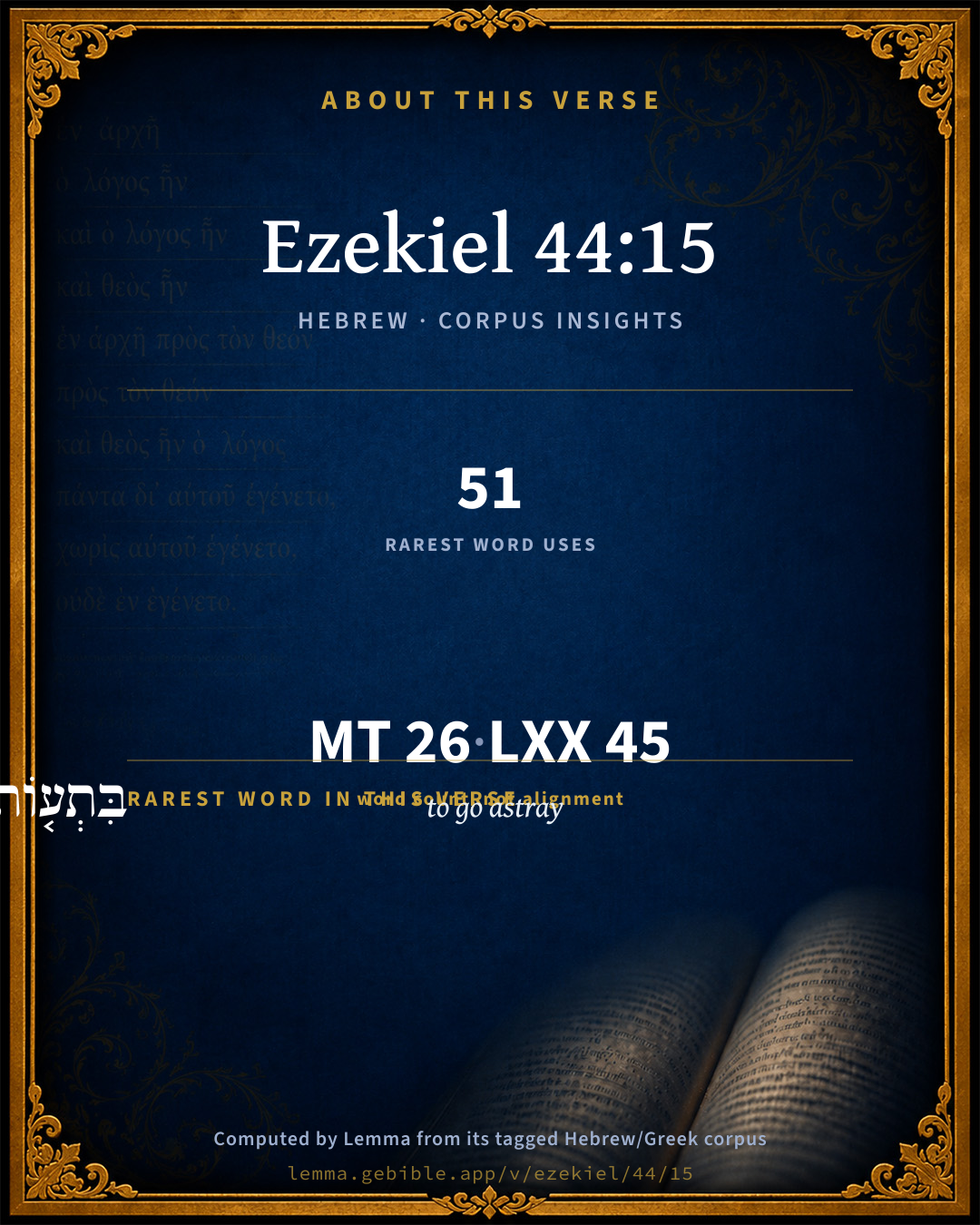
About this verse

These counts appear in no published source. They are computed here, from the morphology-tagged text and Lemma’s own curated glosses. What Lemma adds →

26
words
23
distinct lemmas
Prophets
section

Shared distinctive vocabulary

בִּתְע֤וֹת to go astray H8582 occurs in 45 verses of the Hebrew Bible. Also found in:

Grammatical profile

  • 6 verbs
  • 14 nouns
  • 1 pronoun
  • 3 prepositions
  • 2 particles

Verb forms

  • שָׁמְר֜וּ Qal · Perfect
  • בִּתְע֤וֹת Qal · Infinitive Construct
  • יִקְרְב֥וּ Qal · Imperfect
  • לְשָֽׁרְתֵ֑נִי Piel · Infinitive Construct
  • וְעָמְד֣וּ Qal · Sequential Perfect
  • לְהַקְרִ֥יב Hiphil · Infinitive Construct

Repetition

Words recur within this verse — often emphatic in Hebrew:

  • בְּנֵ֣י son H1121 ×2
  • יִקְרְב֥וּ to approach H7126 ×2

Hebrew & Septuagint length

In English translation the verse runs 54 words from the Hebrew and 54 from the Septuagint (LXX English) — the same length.

A rough comparison of the two English renderings, which tokenize alike — not a word-level alignment.

Word counts can differ between the Hebrew and the Greek without any difference in meaning — e.g. the Hebrew direct-object marker אֵת has no separate Greek word, and Greek often adds the article ὁ.

In the original languages it is 26 Hebrew tokens and 45 Greek tokens — but the two are counted differently (Hebrew bundles its prefixes and suffixes into one token; the Greek is in lemma form), so that isn’t a like-for-like length.

Cross-references

22

Topical passages linked to Ezekiel 44:15 in the Treasury of Scripture Knowledge — connected by theme and wording, ordered by reader-vote popularity; previews shown in the World English Bible.

  • Deuteronomy 10:8 At that time Yahweh set apart the tribe of Levi, to bear the ark of the covenant of Yahweh, to stand before Yahweh to minister to him, and to bless in his name, to this day.
  • Ezekiel 48:11 [It shall be] for the priests who are sanctified of the sons of Zadok, who have kept my charge, who didn't go astray when the children of Israel went astray, as the Levites went astray.
  • Ezekiel 40:46 and the chamber whose prospect is toward the north is for the priests, the keepers of the charge of the altar: these are the sons of Zadok, who from among the sons of Levi come near to Yahweh to minister to him.
  • Ezekiel 43:19 You shall give to the priests the Levites who are of the seed of Zadok, who are near to me, to minister to me, says the Lord Yahweh, a young bull for a sin-offering.
  • Ezekiel 44:7 in that you have brought in foreigners, uncircumcised in heart and uncircumcised in flesh, to be in my sanctuary, to profane it, even my house, when you offer my bread, the fat and the blood, and they have broken my covenant, [to add] to all your abominations.
  • Leviticus 3:16–17 The priest shall burn them on the altar: it is the food of the offering made by fire, for a sweet savor; all the fat is Yahweh's.
  • 1 Samuel 2:35 I will raise me up a faithful priest, that shall do according to that which is in my heart and in my mind: and I will build him a sure house; and he shall walk before my anointed forever.
  • Zechariah 3:1–7 He showed me Joshua the high priest standing before the angel of Yahweh, and Satan standing at his right hand to be his adversary.
  • 2 Timothy 2:2 The things which you have heard from me among many witnesses, commit the same to faithful men, who will be able to teach others also.
  • Leviticus 17:5–6 This is to the end that the children of Israel may bring their sacrifices, which they sacrifice in the open field, that they may bring them to Yahweh, to the door of the Tent of Meeting, to the priest, and sacrifice them for sacrifices of peace offerings to Yahweh.
  • 1 Kings 2:35 The king put Benaiah the son of Jehoiada in his room over the host; and Zadok the priest did the king put in the room of Abiathar.
  • Jeremiah 33:18 neither shall the priests the Levites want a man before me to offer burnt offerings, and to burn meal-offerings, and to do sacrifice continually.
  • Ezekiel 44:10 But the Levites who went far from me, when Israel went astray, who went astray from me after their idols, they shall bear their iniquity.
  • 1 Timothy 3:3–10 not a drinker, not violent, not greedy for money, but gentle, not quarrelsome, not covetous;
  • Revelation 2:1 To the angel of the assembly in Ephesus write: "He who holds the seven stars in his right hand, he who walks among the seven golden lampstands says these things:
  • Revelation 2:8 "To the angel of the assembly in Smyrna write: "The first and the last, who was dead, and has come to life says these things:
  • Revelation 2:12 "To the angel of the assembly in Pergamum write: "He who has the sharp two-edged sword says these things:
  • Revelation 2:18 "To the angel of the assembly in Thyatira write: "The Son of God, who has his eyes like a flame of fire, and his feet are like burnished brass, says these things:
  • Revelation 3:1 "And to the angel of the assembly in Sardis write: He who has the seven Spirits of God, and the seven stars says these things: "I know your works, that you have a reputation of being alive, but you are dead.
  • Revelation 3:7 "To the angel of the assembly in Philadelphia write: "He who is holy, he who is true, he who has the key of David, he who opens and no one can shut, and who shuts and no one opens, says these things:
  • Revelation 3:14 "To the angel of the assembly in Laodicea write: "The Amen, the Faithful and True Witness, the Head of God's creation, says these things:
  • Revelation 3:22 He who has an ear, let him hear what the Spirit says to the assemblies."

Cross-references courtesy of OpenBible.info (CC BY 4.0).

Hebrew and Greek witnesses Masoretic Hebrew ↔ Greek Septuagint

The same verse in the two great witnesses to the Old Testament, shown verse-for-verse.

These are two independent witnesses, not word-aligned to each other, and the Septuagint is shown in lemma (dictionary) form.

Hebrew Ezekiel 44:15 Masoretic · Westminster Leningrad Codex

וְהַכֹּהֲנִ֨ים הַלְוִיִּ֜ם בְּנֵ֣י צָד֗וֹק אֲשֶׁ֨ר שָׁמְר֜וּ אֶת מִשְׁמֶ֤רֶת מִקְדָּשִׁי֙ בִּתְע֤וֹת בְּנֵֽי יִשְׂרָאֵל֙ מֵֽעָלַ֔י הֵ֛מָּה יִקְרְב֥וּ אֵלַ֖י לְשָֽׁרְתֵ֑נִי וְעָמְד֣וּ לְפָנַ֗י לְהַקְרִ֥יב לִי֙ חֵ֣לֶב וָדָ֔ם נְאֻ֖ם אֲדֹנָ֥י יְהוִֽה

But the priests the Levites, the sons of Zadok, who kept the charge of my sanctuary when the children of Israel went astray from me, they shall come near to me to minister to me; and they shall stand before me to offer to me the fat and the blood, says the Lord Yahweh:

World English Bible · Public Domain

Greek LXX Ezekiel 44:15 Septuagint · lemma form

ὁ ἱερεύς ὁ λευίτης ὁ υἱός ὁ σαδδουκ ὅστις φυλάσσω ὁ φυλακή ὁ ἅγιος ἐγώ ἐν ὁ πλανάω οἶκος ἰσραήλ ἀπό ἐγώ οὗτος προςἄγω πρός ἐγώ ὁ λειτουργέω ἐγώ καί ἵστημι πρό πρόσωπον ἐγώ ὁ προςφέρω ἐγώ θυσία στέαρ καί αἷμα λέγω κύριος ὁ θεός

The priests the Levites, the sons of Sadduc, who kept the charges of my sanctuary when the house of Israel went astray from me, these shall draw near to me to minister to me, and shall stand before my face, to offer sacrifice to me, the fat and the blood, says the Lord God.

LXX2012 (modern English Septuagint) · Public Domain

Hebrew: Westminster Leningrad Codex (CC BY 4.0). Greek: Septuagint (public domain); English from LXX2012 (modern English Septuagint) (Public Domain). How the Septuagint differs from the Hebrew →

Targum (Aramaic paraphrase)

1

The Targum is the ancient Jewish Aramaic paraphrase of the Hebrew Scriptures — an interpretive translation, not the Hebrew text itself. Onkelos (literal) and Pseudo-Jonathan (expansive) render the Torah, and Jonathan the Prophets. Coverage is partial: where no permissively-licensed English translation exists for a verse, only the Aramaic is shown. This is verse-level text, not a word-by-word alignment to the Hebrew.

  1. Targum Jonathan Prophets (Joshua–Malachi)
    וְכַהֲנַיָא לֵיוָאֵי בְּנֵי צָדוֹק דִי נְטַרוּ יַת מַטְרַת מַקְדְשִׁי בְּמִטְעֵי בְּנֵי יִשְׂרָאֵל מִבָּתַר פּוּלְחָנִי אִינוּן יִתְקַרְבוּן לְפוּלְחָנִי לְשַׁמָשָׁא קֳדָמַי וִישַׁמִשׁוּן עַל מַדְבְּחִי לְקָרָבָא קֳדָמַי תְּרַב וְדָם נִכְסַת קוּדְשִׁין אֲמַר יְיָ אֱלֹהִים:

    (no public-domain English translation for this verse)

    Targum Jonathan — Aramaic: “Mikraot Gedolot” (public domain). English: “Sefaria Community Translation” (CC0 1.0 (public-domain dedication)); “London "Chaldee Paraphrase," 1871” (public domain). Text via Sefaria.

Commentary

Notes on Ezekiel 44:15 from classic Christian and Jewish commentators (each source and its license shown beneath its notes). The classic Christian expositions comment on the surrounding passage and are grouped to its opening verse, so a note may address several verses; the Jewish commentaries on the Tanakh (Rashi and others) are per-verse, so they appear only where the commentator wrote on this verse.

Lemma curates 59 commentaries, every one of them public domain or Creative Commons licensed, each selected and text-cleaned for this edition rather than reprinted as found. About our sources →

Trapp's Complete Commentary

John Trapp

Eze 44:15 But the priests the Levites, the sons of Zadok, that kept the charge of my sanctuary when the children of Israel went astray from me, they shall come near to me to minister unto me, and they shall stand before me to offer unto me the fat and the blood, saith the Lord GOD:

Ver. 15. But the priests, the sons of Zadok.] Who follow their father’s footsteps, and are careful to fulfil the ministry that they have received in the Lord; to be best in the worst times as right heirs of Moses’s benediction. {Deu 33:9, &c.}

Saith the Lord God.] "Them that honour me I will honour." {1Sa 2:20} This is a bargain of God’s own making. Huius rei fides penes Deum tota est; { a} we may trust to it.

{a} Oecolamp.

John Trapp, A Commentary or Exposition upon All the Books of the Old and New Testament (1647–1656) — public domain. Text from a community e-Sword module.

Joseph Benson's Commentary

Eze 44:15-16. The priests the Levites — The Levites who are priests; the sons of Zadok — Who continued faithful; they shall stand before me to offer the fat, &c. — They shall serve at the altar of burnt-offering, and offer sacrifices thereon. They shall enter into my sanctuary — Into the holy place; to minister unto me — To burn incense there upon the golden altar, to sprinkle the blood of the victims before the veil, to trim the lamps, and to change the loaves on the sacred table every sabbath. They shall keep my charge — They shall have this honour in reward of their fidelity. Observe, reader, God will put marks of honour upon those who are faithful to him in trying times, and will employ those in his service who have kept close to it when others drew back.

Joseph Benson's Commentary on the Old and New Testaments (1811–1818) — public domain. Text from a community e-Sword module.

Tyndale Open Study Notes

Tyndale Open Resources

44:15-16 In contrast to the Levites and the people who abandoned the Lord for idols, the Levitical priests of the family of Zadok remained faithful to the Lord. Zadok was the high priest of Solomon’s day. His family’s reward was renewed access to the inner courtyard, where they were to perform the crucial sacrificial rituals nearer to the presence of God. A repeated theme in these chapters is that those who were faithful in the past would be rewarded with closer access to God and greater privilege in his presence, while those who were unfaithful would be kept at a greater distance.

Tyndale Open Study Notes — © Tyndale Open Resources, licensed CC BY-SA 4.0. Text via the HelloAO Bible API.

Geneva Bible (1599)

Geneva Bible translators

Which observed the Law of God, and fell not to idolatry.

Geneva Bible (1599) marginal notes — public domain. Text via Bolls.life.

Jamieson, Fausset & Brown

Robert Jamieson, A. R. Fausset & David Brown

Zadok--The priests of the line of Ithamar were to be discharged from ministrations in the temple, because of their corruptions, following in the steps of Eli's sons, against whom the same denunciation was uttered (Sa1 2:32, Sa1 2:35). Zadok, according to his name (which means "righteous") and his line, were to succeed (Kg1 2:35; Ch1 24:3), as they did not take part in the general apostasy to the same degree, and perhaps [FAIRBAIRN] the prophet, referring to their original state, speaks of them as they appeared when first chosen to the office.

Jamieson, Fausset & Brown — Commentary Critical and Explanatory on the Whole Bible (1871) — public domain (CC PDM 1.0). Text via the HelloAO Bible API.

Ellicott's Commentary for English Readers

(15) The sons of Zadok.—See Note on Eze_40:46. They are here described as those who continued faithful in the general apostasy, and it is probable that Ezekiel uses the term in this sense. As Zadok had continued faithful in the rebellion of Adonijah, when even the high priest and life-long friend of David went astray (1Ki_1:7-8), so all the faithful priests in the time of apostasy were called “sons of Zadok.”

A Bible Commentary for English Readers, edited by Charles John Ellicott (1878–1897) — public domain. Text from a community e-Sword module.

The Cambridge Bible for Schools and Colleges

gen. ed. J. J. S. Perowne

15, 16. The priests of the family of Zadok alone shall be priests in the new Temple. These continued faithful to Jehovah when the provincial priests went far from him. The judgment of the prophet may be to some extent a comparative one. The worship at Jerusalem never sank to the level of the licentiousness and corruption prevailing at the rural sanctuaries, though undoubtedly the record of the reform of Josiah reveals great corruptions at Jerusalem also (2 Kings 23). How far these were introduced by the kings, such as Manasseh, despite the opposition of the priests, cannot be ascertained. The reforms of Hezekiah most probably, and certainly those of Josiah, were promoted by the priests (2 Kings 22). The family of Zadok dates from Solomon, who deposed Abiathar on account of his favouring the pretensions of Adonijah and installed Zadok in his place. Since those remote times the Zadokites had served in the temple, and upon the whole the prophet’s favourable judgment of them is no doubt justified (cf. 2 Kings 11; Isa_8:2).

The Cambridge Bible for Schools and Colleges (gen. ed. J. J. S. Perowne; Cambridge University Press, 1878–1918) — public domain. Text from a community e-Sword module.

John Gill's Exposition

But the priests the Levites, the sons of Zadok;.... The priests who were of the tribe of Levi, whom the Lord chose and separated, to minister to him, and so had a lawful call to this office, and were regularly invested with it; and design true and lawful, as well as faithful, ministers of the word; these are called the sons of Zadok, who descended from Eleazar the son of Aaron in the line of Phinehas, to whom the Lord promised the everlasting priesthood, and who was put into this office by Solomon in the room of Abiathar, Kg1 2:35, his name signifies "righteous", and was a type of Christ; who, as a divine Person, is essentially righteous; as man, truly and perfectly so; and, as Mediator, God's righteous servant; and who, by his obedience and sufferings, is the author of righteousness to his people; who are his spiritual seed and offspring; children given him of his Father; who have his sonship and adoption through him, and are born of him, his Spirit, and grace; and these are made righteous by him, through his righteousness imputed to them, and may be rightly called sons of Zadok: and this agrees with all the saints; and who, under the Gospel dispensation, are all priests, and offer up themselves, souls and bodies, and their spiritual sacrifices of prayer and praise, unto God by Christ; though all have not a right to preach the word, and administer ordinances, as ministers lawfully called have, and who seem to be more particularly designed here; and such as are regenerated persons, and justified by Christ's righteousness, and preach the doctrine of free justification by it, are the only fit persons for such an office:

that kept the charge of my sanctuary, when the children of Israel went astray from me; that kept and held fast the pure doctrines of the Gospel, committed as a sacred depositum to them, without mixture, and without wavering, with courage and valour; though a greater number were on the other side, and though they were reproached and persecuted for it; and who taught the people to keep the ordinances of the Gospel as they were first delivered, in faith and love, and without sinister ends, and so administered them themselves; and such faithful ministers and members of churches, especially in a time of great declension and general defection, God takes notice of, and has promised them great and good things; see Rev 2:7.

they shall come near to me to minister unto me; in holy things to his people, which is called ministering unto him; as to pray to him for them; lo preach to them in his name, and administer ordinances: all the saints indeed are priests, and may draw nigh to God through Christ; men are at a distance from him, through sin; there is no coming near to him but by Christ; and this coming near is not local, but spiritual, and includes all acts of worship, particularly prayer; and is a great favour and blessing:

and they shall stand before me, to offer unto me the fat and the blood, saith the Lord God; which, under the law, were both the Lord's; the one was burnt, and the other sprinkled, on divers things, and in various places: here it may respect the administration of the ordinance of the Lord's supper, that feast of fat things, and which may be eminently called the goodness and fatness of the house of God; and in which the blood of Christ is represented as shed for the remission of sins, and as spiritual drink indeed to believers; and the sacrifice of Christ is commemorated, the feast being kept in remembrance of that.

John Gill's Exposition of the Whole Bible (1746–1763) — public domain (CC PDM 1.0). Text via the HelloAO Bible API.

Haydock's Catholic Bible Commentary

And Levites, of the higher order. (Haydock) --- No simple Levites wee of this family. It enjoyed the high priesthood form the time of Solomon.

George Leo Haydock (1774–1849), Haydock's Catholic Family Bible and Commentary, 1859 edition — public domain. Excludes Psalms (Douay-Rheims chapter numbering differs from Protestant) and Deuterocanonical books (Catholic canon only).

Matthew Poole's English Annotations

The priests; so called from their office. The Levites; by descent from Levi, Jacob’s son.

Sons of Zadok; who was of Eleazar’s family, to whose father Phinehas a covenant of salt insured the high priesthood, and all the honour, privileges, and advantages thereof, Num 25:12,13.

Kept the charge; were constant, zealous, and faithful in their priestly office, and their duties in it.

Went astray: this may possibly refer to that transgression in the matter of Baal-peor, of which Num 25:3; Psa 106:28-30. See Eze 44:10. They shall come near to me: see Eze 40:46.

To offer unto me the fat and the blood; to offer expiatory sacrifices, to make atonement and intercede for the people. This honour God put upon them for their integrity and constancy in the things of God.

Matthew Poole's English Annotations on the Holy Bible (1683–1685) — public domain. Text from a community e-Sword/MySword module.

The Pulpit Commentary

Vers. 15, 16The ordinance for the priests. That Ezekiel derived the phrase, the priests the Levites, from Deuteronomy (Deu_17:9; Deu_18:1; Deu_24:8; Deu_27:9) may be granted without admitting that the Levites were all priests, or that the phrase had other import than that the priests were, as the Deuteronomist says, "sons of Levi". (Deu_21:5; Deu_31:9) The priesthood, at its institution, having been entrusted to Aaron and his sons (Exo_27:20, 21 28:1-4 29:9, 44; Num_3:10 Num_16:40 Num_18:7 Num_25:13) on Aaron"s death the high priesthood passed into the hands of Eleazar, his eldest (living) son, (Num_20:26-28) and after Eleazar"s death into those of Phinehas, his eldest son. (Num_25:11-13) In the last days of the judges, when the ark and tabernacle stood at Shiloh? The high priesthood belonged to Eli, of the line of Ithamar (comp. 1Sa_14:3 and 1Sa_22:20, 1Ch_24:3) in which line it continued till the reign of David, when it was held conjointly by Abiathar (called also Ahimelech) of the line of Ithamar, and Zadok of the line of Eleazar. (2Sa_8:17; 1Ki_4:4) This arrangement, however, Solomon eventually overturned, by deposing the former for espousing Adonijah"s pretensions to the throne, (1Ki_1:7 1Ki_2:26) and from that time forward till the exile the high priesthood remained with Zadok and his sons. (1Ch_29:22) When, therefore, it is announced to Ezekiel that his vision-sanctuary should have as priests the sons of Zadok, that kept the charge of Jehovah"s sanctuary, when the children of Israel went astray from him; the first question that arises is To what does this allude? Kliefoth holds it cannot mean that, while Israel as a whole declined into idolatry, the Zadokite priests remained faithful to the worship of Jehovah, because the vision of Judah"s idolatries granted to the prophet, Eze_8:16, revealed quite clearly that the priesthood was as much caught in the national apostasy as were the princes or the people. Nor is the language of the text perfectly satisfied by the view of Havernick, Keil, Delitzsch, and others, that it goes beck to Zadok"s fidelity to the throne of David at the time of Absalom"s rebellion, (2Sa_15:24-29) a fidelity exhibited also by Abiathar, or to his adherence to Solomon in preference to Adonijah, (1Ki_1:8, 1Ki_1:39) this time without Abiathar"s concurrence, rather in the face of his opposition. In neither of these instances was Zadok"s fidelity specially directed towards Jehovah"s sanctuary, but concerned expressly and exclusively David"s throne. Hence the commendation of the Zadokites" fidelity can only signify that, while the priesthood as a body were corrupt like the people, there were among them, as among the people, some who, like Ezekiel, continued steadfast to Jehovah"s sanctuary; that these faithful few were Zadokites, (see Eze_48:11) and that to these should be entrusted the priesthood in the new sanctuary. But, at this point, a second question starts Was it intended to declare that the new priesthood should be Zadokites in body, i.e. in respect of lineal descent, or only in soul, i.e. in respect of moral and religious excellence? The former is contended by Kuenen, Wellhausen, Smend, and others, who see in the vision-sanctuary a plan of the second, or post-exilic, temple, and in its ordinances a program for the establishment of the Levitical hierarchy; but this contention shatters itself on the fact that no proof exists either that the second temple was constructed after Ezekiel"s as a model, or that those who served in it were exclusively flesh and blood Zadokites. The latter opinion, favored by Kliefoth, appears the more correct, that moral and spiritual resemblance to the sons of Zadok should form the first qualification for the priesthood in this ideal sanctuary of the future. (see note at the end of Eze 48)

Vers. 15, 16Appointed ministrations.

The priests were an essential element in the Mosaic system, and their duties were prescribed with a precise exactness. After the Captivity, they still fulfilled their appointed duties, although their relative importance was probably diminished, whilst the scribes became growingly the religious leaders and teachers of the people. In the dispensation of the Spirit, the priesthood, so far as it is perpetuated, has been widened so as to include the whole Christian congregation.

I MINISTRY IN THE CHURCH IS THE APPOINTMENT OF GOD. As the priesthood was instituted by Divine wisdom, so the will and pleasure of the great Head of the Church is that the members of the spiritual society should regard themselves as called by God to the fulfillment of varied duties as his servants.

II MINISTRY IN THE CHURCH IS UPON THE PATTERN OF THE MINISTRY OF CHRIST THE HEAD. The Son of man came, not to be ministered unto, but to minister. The Lord was himself Servant of all, and those who are his are summoned to follow the example of him who declared that he was among his people as One who served.

III MINISTRY IN THE CHURCH IS FOR MUTUAL BENEFIT. It is sometimes taken for granted that there are certain persons who minister to their fellow-Christians, whilst the rest simply receive and enjoy the advantages of their services. But in reality there is no one member of the true Church who is not commissioned for some special work which it is for him to do, who has not some gifts and opportunities for serving his fellow-disciples, for the edification of the body of Christ.

IV MINISTRY IN THE CHURCH IS FOR THE SALVATION OF THE WORLD. The Jewish Church was restricted; the Christian Church has a universal mission a mission for the benefit of mankind. They who have Christ"s Spirit will live as disciples of him who said, "I, if I be lifted up from the earth, will draw all men unto myself.

V MINISTRY IN THE CHURCH INVOLVES ACCOUNTABILITY TO GOD. With calling and gifts and influence there is associated responsibility. And this responsibility is to him who is the one, only, all-sufficient Judge and Lord. From this responsibility there is no escape; and it must ever be the aim and the hope of every Christian that he himself and his work may be acceptable and approved at last, when every man shall have praise of God. T.

Vers. 15, 16Fidelity and its reward.

We do not suppose that the statement respecting the sons of Zadok is to be pressed to historical exactitude. Their steadfastness is assumed for the purpose of exhortation, to point out the reward of fidelity in the kingdom of God. We have

I THE FACT AND THE ACCOUNT OF UNFAITHFULNESS. There is no more patent fact before our eyes than that men do "go astray;" they go astray, like these Levites, from God, from truth, from wisdom, from purity, from their earlier convictions and their noble life. The frequency of the fact cannot dull our eyes to the extreme sadness of it. What sadness was there in the tone of the Master"s question, Will ye also go away?" With what profound regret do we now witness the descent or" a human soul from the heights of heavenly wisdom to the depths of disbelief or iniquity! If we are asked to account for it, we suggest three powerful temptations which prove too strong for resistance.

1. The fascinations of novelty; the love of looking at things in new lights or of treading new paths.

2. The strength of the social current; the unconscious and (often) the wholly unreasonable deference we pay to the opinions of those around us. It is difficult to row against the stream of current thought and practice; it is pleasant to go with the tide, even though we suspect it is bearing us out to the open sea of uncertainty and unbelief.

3. Concern for our temporal interests; for it often happens that a firm adherence to conviction means a painful parting, not only from friends, but from the source of "food and raiment.

II THE SUMMONS TO FIDELITY. Many things demand of us that we should be faithful even to the end. Fidelity is:

1. Obligatory. We cannot leave the service of God or of truth without breaking the most sacred bonds, without laying ourselves open to self-reproach and doing that which we shall look back upon with shame and sorrow. We owe it to those who are coming up after us especially to our own children that we turn not our back on our old principles.

2. Excellent. There is something honorable and admirable in a very high degree in a consistent and faithful life; not, of course, the unintelligent repetition of the old sounds, but the adherence, through good report and evil report, through storm and sunshine, to the vital principles we learnt at the feet of Jesus Christ. The head that has grown white with the consistent advocacy and illustration of elevating and ennobling truth does wear a glorious crown.

3. Attended with a large and a true reward. Steadfastness, as compared with vacillation or apostasy, not only commands the esteem of men, and not only enables its possessor to enjoy his own self-respect, but it secures for him the abiding favor of God. God calls such men not only to the gate or door of the sanctuary; he bids them "enter into it," and "come near to his table," to "minister unto him." For them is reserved the closer fellowship and the more honorable and essential service. In the service of Christ fidelity not only aspires to the higher and better service of the Master and of mankind below, but it looks forward to an admission within the blessed gates, and sitting down to the "table" of the Lord in the heavenly kingdom. C. (Luk_22:30)

The Pulpit Commentary (1880–1919), ed. H.D.M. Spence-Jones & Joseph S. Exell — public domain. Text from a community e-Sword module.

John Wesley's Explanatory Notes

That kept the charge - Were constant, zealous, and faithful in their priestly office.

John Wesley, Explanatory Notes Upon the Whole Bible (1754–1765) — public domain. Text via the GEBible commentary corpus.

unfoldingWord translationNotes

Door43 World Missions Community

General Information:

Yahweh continues giving Ezekiel his message to the house of Israel.

those sons of Zadok who fulfilled

"who are descendants of Zadok and fulfilled"

were wandering away from me

This is an idiom. "stopped listening and obeying me" (See: Idiom)

translationWords

Levi

priest

Zadok

fulfill

sanctuary

Israel

worship

blood

Lord Yahweh

unfoldingWord translationNotes — © Distant Shores Media and the Door43 World Missions Community, licensed CC BY-SA 4.0. Source: git.door43.org/Door43/en_tn.

Rashi

Rabbi Shlomo Yitzchaki (Rashi)

But the priests, the Levites [i.e., the priests, who are] of the tribe of Levi.

the sons of Zadok Since he was the High Priest who served as the first one in the Sanctuary of Solomon’s days, they are called by his name.

when...went astray [Heb. בִּתְעוֹת,] quand ils erraient, in Fr., when they strayed.

Rashi on the Tanakh — English translations: “The Judaica Press complete Tanach with Rashi, translated by A. J. Rosenberg” (CC BY 4.0); “Pentateuch with Rashi's commentary by M. Rosenbaum and A.M. Silbermann, 1929-1934” (public domain); “The Metsudah Tanach series, Lakewood, N.J” (CC BY 4.0); and “The Book of Joshua, Metsudah Publications, 1997” (CC BY 4.0). Text via Sefaria.

Lesson kit

Teaching starters — assembled from the data on this page, not authored interpretation. Every prompt links to the verse data it draws on. Edit before teaching.

Ezekiel, in the Prophets, opens this verse with 26 words (23 distinct Hebrew lemmas). Its most distinctive word is tâʻâh (“to go astray”). A historical commentator’s framing appears above. Read the whole chapter for the surrounding context.

Discussion questions

  1. How does “to go astray” (tâʻâh) shape what this verse is saying?
  2. How does Genesis 20:13, which shares the word «to go astray», read alongside this verse?
  3. What does the repetition of “son” (2× in this one verse) do in this verse?
  4. These translations render this verse differently. What is at stake in choosing one wording over another?
  5. «שָׁמְר֜וּ» is a Qal Perfect verb. How does that grammatical form shape the action described?
  6. Compare how Trapp's Complete Commentary and Joseph Benson's Commentary read this verse. Where do they agree or differ?

Things to notice

Reading settings

Reading text

Shown beneath each verse's original-language words.

Old Testament
Old Testament edition

Read the OT as the Masoretic Hebrew (MT) or the Greek Septuagint (LXX).

English shown for the Greek Septuagint (in the Hebrew ↔ Greek comparison).

Comparing translations? Open the Compare panel on any verse page to stack up to four side by side.