
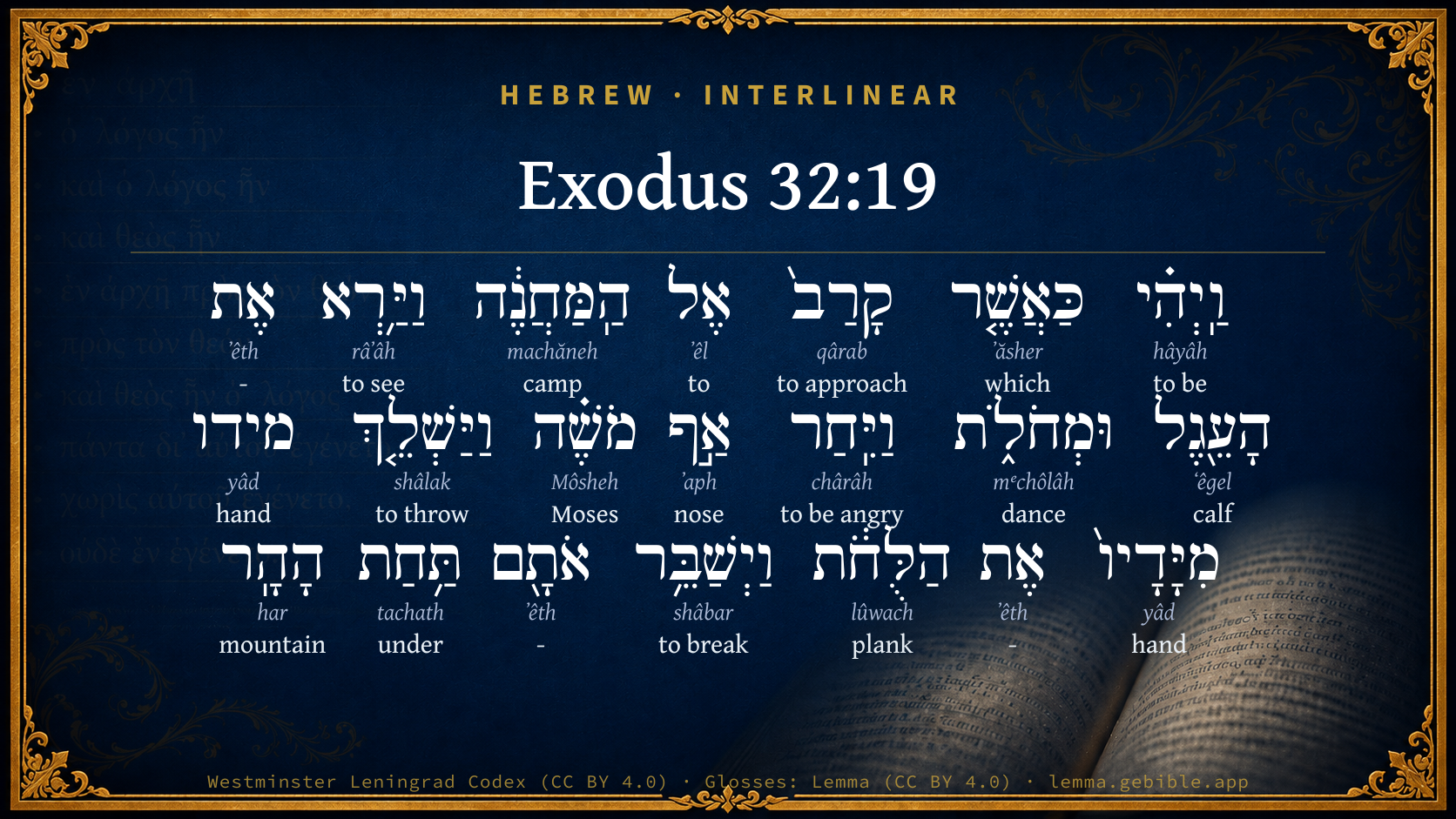
Exodus 32:19

Hebrew (Westminster Leningrad Codex) Exodus 32:19 appears in the Hebrew Old Testament. The text above is from the Westminster Leningrad Codex. Each word links to its Strong’s number, a concise gloss, and parsing drawn from the Open Scriptures Hebrew Bible morphology. Click any word for its full Brown-Driver-Briggs (BDB) entry.
Download image
Cite this verse

Exodus 32:19 (World English Bible). Public Domain. Lemma interlinear Bible study tool, https://lemma.gebible.app/v/exodus/32/19.

Show BibTeX & RIS
BibTeX
RIS
English Translation
It happened, as soon as he came near to the camp, that he saw the calf and the dancing: and Moses' anger grew hot, and he threw the tablets out of his hands, and broke them beneath the mountain.
World English Bible · Public Domain
Download a study sheet

One document with this verse’s original text, its word-by-word gloss line, the meaning frame, cross-references with their text, attributed commentary, and full source and license credits — printable, and it pastes into notes with its structure intact.

This verse Autodidact and up

Study sheet (.html) Plain text (.txt)

A passage Seminary Student

Up to 50 verses in one chapter. A passage sheet keeps up to 6 commentary sources and 12 cross-references per verse, in the order this page ranks them, and says so on the sheet whenever that leaves anything out. Ask for a single verse and you get the Autodidact verse sheet above.

Everything on this page stays free to read, with no account — the sheet is a download of what is already on screen, not access to it.

Want to remove ads? Support Godless Engineer
Compare translations 3

The same verse in 3 English versions, stacked beneath the original-language interlinear above. Click any original word for its lexicon entry.

Each is an independent rendering of the whole verse — the interlinear is not word-aligned to these translations.

Highlighted words mark where these versions differ — a whole-verse word diff, not a word-by-word alignment.

  • World English Bible Public Domain
    It happened, as soon as he came near to the camp, that he saw the calf and the dancing: and Moses' anger grew hot, and he threw the tablets out of his hands, and broke them beneath the mountain.
  • King James Version Public Domain
    And it came to pass, as soon as he came nigh unto the camp, that he saw the calf, and the dancing: and Moses' anger waxed hot, and he cast the tables out of his hands, and brake them beneath the mount.
  • unfoldingWord Literal Text CC BY-SA 4.0
    And it happened, as he approached to the camp, that he saw the calf and dancing, and the nose of Moses burned, and he threw the tablets from his hands and shattered them under the mountain.

unfoldingWord Literal Text — © unfoldingWord, licensed CC BY-SA 4.0. Word-aligned USFM3 via Door43 (git.door43.org/unfoldingWord/en_ult).

Versions to compare (up to 4)

3 of 4 selected

Show all 18 translations

Every available English version of this verse, each an independent rendering of the whole verse.

  • World English Bible Public Domain
    It happened, as soon as he came near to the camp, that he saw the calf and the dancing: and Moses' anger grew hot, and he threw the tablets out of his hands, and broke them beneath the mountain.
  • Berean Standard Bible Public Domain
    As Moses approached the camp and saw the calf and the dancing, he burned with anger and threw the tablets out of his hands, shattering them at the base of the mountain.
  • Majority Standard Bible Public Domain
    As Moses approached the camp and saw the calf and the dancing, he burned with anger and threw the tablets out of his hands, shattering them at the base of the mountain.
  • King James Version Public Domain
    And it came to pass, as soon as he came nigh unto the camp, that he saw the calf, and the dancing: and Moses' anger waxed hot, and he cast the tables out of his hands, and brake them beneath the mount.
  • American Standard Version (1901) Public Domain
    And it came to pass, as soon as he came nigh unto the camp, that he saw the calf and the dancing: and Moses' anger waxed hot, and he cast the tables out of his hands, and brake them beneath the mount.
  • Revised Version (1885) Public Domain
    And it came to pass, as soon as he came nigh unto the camp, that he saw the calf and the dancing: and Moses’ anger waxed hot, and he cast the tables out of his hands, and brake them beneath the mount.
  • Geneva Bible (1599) Public Domain
    Nowe, as soone as he came neere vnto the hoste, he sawe the calfe and the dancing: so Moses wrath waxed hote, and he cast the Tables out of his handes, and brake them in pieces beneath the mountaine.
  • Douay-Rheims (1899) Public Domain
    And when he came nigh to the camp, he saw the calf, and the dances: and being very angry, he threw the tables out of his hand, and broke them at the foot of the mount:
  • Young's Literal Translation Public Domain
    And it cometh to pass, when he hath drawn near unto the camp, that he seeth the calf, and the dancing, and the anger of Moses burneth, and he casteth out of his hands the tables, and breaketh them under the mount;
  • Literal Standard Version CC BY-SA 4.0
    And it comes to pass, when he has drawn near to the camp, that he sees the calf, and the dancing, and the anger of Moses burns, and he casts the tablets out of his hands, and breaks them below the mountain;
  • Unlocked Literal Bible CC BY-SA 4.0
    When Moses approached the camp, he saw the calf and the people dancing. He became very angry. He threw the tablets out of his hands and broke them at the bottom of the mountain.
  • unfoldingWord Literal Text CC BY-SA 4.0
    And it happened, as he approached to the camp, that he saw the calf and dancing, and the nose of Moses burned, and he threw the tablets from his hands and shattered them under the mountain.
  • Darby Bible Public Domain
    And it came to pass, when he came near the camp, and saw the calf and the dancing, that Moses' anger burned, and he cast the tables out of his hands, and shattered them beneath the mountain.
  • World Messianic Bible Public Domain
    As soon as he came near to the camp, he saw the calf and the dancing. Then Moses’ anger grew hot, and he threw the tablets out of his hands, and broke them beneath the mountain.
  • Webster's Bible Public Domain
    And it came to pass as soon as he came nigh to the camp, that he saw the calf, and the dancing: and Moses's anger waxed hot, and he cast the tables from his hands, and broke them beneath the mount.
  • Free Bible Version CC BY-SA 4.0
    As he approached the camp he saw the bull calf idol and the dancing. He got so angry that he threw down the stone tablets and smashed them there at the foot of the mountain.
  • Bible in Basic English Public Domain
    And when he came near the tents he saw the image of the ox, and the people dancing; and in his wrath Moses let the stones go from his hands, and they were broken at the foot of the mountain.
  • JPS Tanakh (1917) Public Domain
    And it came to pass, as soon as he came nigh unto the camp, that he saw the calf and the dancing; and Moses' anger waxed hot, and he cast the tables out of his hands, and broke them beneath the mount.

Literal Standard Version (2020), Covenant Press — licensed CC BY-SA 4.0. Text via the HelloAO Bible API (eBible.org). Unlocked Literal Bible (unfoldingWord) — licensed CC BY-SA 4.0. Text via the HelloAO Bible API (eBible.org). unfoldingWord Literal Text — © unfoldingWord, licensed CC BY-SA 4.0. Word-aligned USFM3 via Door43 (git.door43.org/unfoldingWord/en_ult). Free Bible Version, Dr. Jonathan Gallagher — licensed CC BY-SA 4.0. Text via the HelloAO Bible API (eBible.org).

Word by word

More ways to search: Search by grammar → Find every occurrence → Compare this word →

Practice this passage: Drill this verse → Learn its vocabulary →

וּמְחֹלֹ֑ת
mᵉchôlâh
H4246
“and · dances”
Conjunction + Noun, Common, Feminine, Plural, Absolute
Part of Speech
Conjunction + Noun
Type
Common
Gender
Feminine
Number
Plural
State
Absolute
Full BDB Definition

Origin: from H4284

TWOT: 623h

dancing, dance
  1. וַֽיְהִ֗י hâyâh H1961 “and · to be” Conjunction + Verb, Qal, Sequential Imperfect, 3rd Person, Masculine, Singular
  2. כַּאֲשֶׁ֤ר ʼăsher H834 “like/as · which” Preposition + Particle, Relative
  3. קָרַב֙ qârab H7126 “to approach” Verb, Qal, Perfect, 3rd Person, Masculine, Singular
  4. אֶל ʼêl H413 “to” Preposition
  5. הַֽמַּחֲנֶ֔ה machăneh H4264 “the · camp” Particle, Definite Article + Noun, Common, Both, Singular, Absolute
  6. וַיַּ֥רְא râʼâh H7200 “and · to see” Conjunction + Verb, Qal, Sequential Imperfect, 3rd Person, Masculine, Singular
  7. אֶת ʼêth H853 “-” Particle, Direct Object
  8. הָעֵ֖גֶל ʻêgel H5695 “the · calf” Particle, Definite Article + Noun, Common, Masculine, Singular, Absolute
  9. וַיִּֽחַר chârâh H2734 “and · to be angry” Conjunction + Verb, Qal, Sequential Imperfect, 3rd Person, Masculine, Singular
  10. אַ֣ף ʼaph H639 “nose” Particle, Accusative
  11. מֹשֶׁ֗ה Môsheh H4872 “Moses” Noun, Proper
  12. וַיַּשְׁלֵ֤ךְ shâlak H7993 “and · to throw” Conjunction + Verb, Hiphil, Sequential Imperfect, 3rd Person, Masculine, Singular
  13. מידו yâd H3027 “from · hand · his” Preposition + Noun, Common, Both, Singular, Construct + Suffix, Personal, 3rd Person, Masculine, Singular
  14. מִיָּדָיו֙ yâd H3027 “from · hands · his” Preposition + Noun, Common, Both, Dual, Construct + Suffix, Personal, 3rd Person, Masculine, Singular
  15. אֶת ʼêth H853 “-” Particle, Direct Object
  16. הַלֻּחֹ֔ת lûwach H3871 “the · planks” Particle, Definite Article + Noun, Common, Masculine, Plural, Absolute
  17. וַיְשַׁבֵּ֥ר shâbar H7665 “and · to break” Conjunction + Verb, Piel, Sequential Imperfect, 3rd Person, Masculine, Singular
  18. אֹתָ֖ם ʼêth H853 “- · them” Particle, Direct Object + Suffix, Personal, 3rd Person, Masculine, Plural
  19. תַּ֥חַת tachath H8478 “under” Preposition
  20. הָהָֽר har H2022 “the · mountain” Particle, Definite Article + Noun, Common, Masculine, Singular, Absolute

About this verse

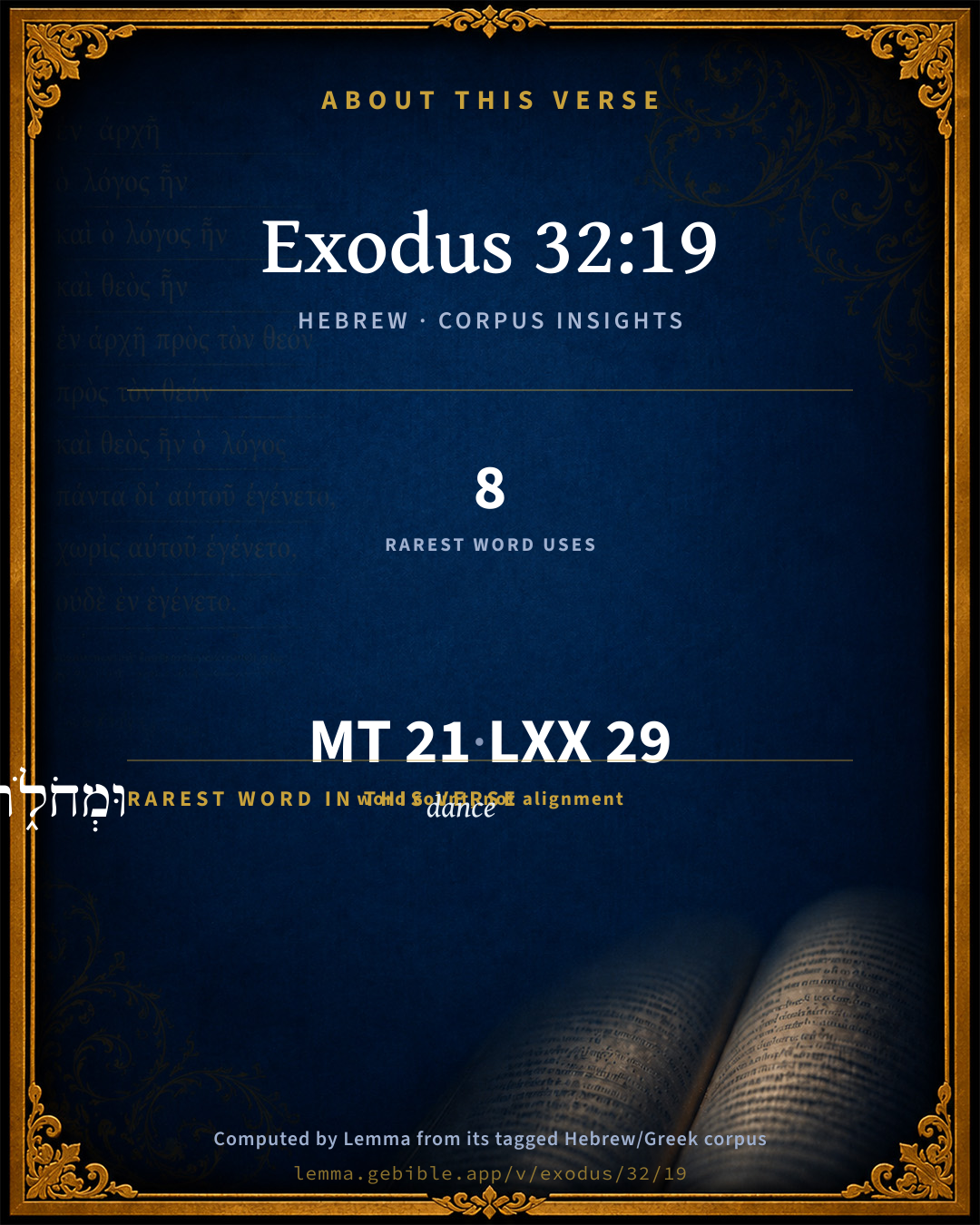
These counts appear in no published source. They are computed here, from the morphology-tagged text and Lemma’s own curated glosses. What Lemma adds →

21
words
18
distinct lemmas
Pentateuch
section

Notable vocabulary

The rarest word here is וּמְחֹלֹ֑ת dance H4246 — appearing just 8 times in the whole Hebrew Bible.

Shared distinctive vocabulary

וּמְחֹלֹ֑ת dance H4246 occurs in 8 verses of the Hebrew Bible. Also found in:

Grammatical profile

  • 6 verbs
  • 8 nouns
  • 2 prepositions
  • 5 particles

Verb forms

  • וַֽיְהִ֗י Qal · Sequential Imperfect
  • קָרַב֙ Qal · Perfect
  • וַיַּ֥רְא Qal · Sequential Imperfect
  • וַיִּֽחַר Qal · Sequential Imperfect
  • וַיַּשְׁלֵ֤ךְ Hiphil · Sequential Imperfect
  • וַיְשַׁבֵּ֥ר Piel · Sequential Imperfect

Repetition

A word recurs within this verse — often emphatic in Hebrew:

  • מידו hand H3027 ×2

Hebrew & Septuagint length

In English translation the verse runs 39 words from the Hebrew and 36 from the Septuagint (LXX English) — closely comparable.

A rough comparison of the two English renderings, which tokenize alike — not a word-level alignment.

Word counts can differ between the Hebrew and the Greek without any difference in meaning — e.g. the Hebrew direct-object marker אֵת has no separate Greek word, and Greek often adds the article ὁ.

In the original languages it is 21 Hebrew tokens and 29 Greek tokens — but the two are counted differently (Hebrew bundles its prefixes and suffixes into one token; the Greek is in lemma form), so that isn’t a like-for-like length.

Cross-references

15

Topical passages linked to Exodus 32:19 in the Treasury of Scripture Knowledge — connected by theme and wording, ordered by reader-vote popularity; previews shown in the World English Bible.

  • Deuteronomy 9:16–17 I looked, and, behold, you had sinned against Yahweh your God; you had made you a molten calf: you had turned aside quickly out of the way which Yahweh had commanded you.
  • Exodus 15:20 Miriam the prophetess, the sister of Aaron, took a tambourine in her hand; and all the women went out after her with tambourines and with dances.
  • Exodus 32:4–6 He received what they handed him, and fashioned it with an engraving tool, and made it a molten calf; and they said, "These are your gods, Israel, which brought you up out of the land of Egypt."
  • Exodus 32:11 Moses begged Yahweh his God, and said, "Yahweh, why does your wrath burn hot against your people, that you have brought forth out of the land of Egypt with great power and with a mighty hand?
  • Numbers 12:3 Now the man Moses was very humble, above all the men who were on the surface of the earth.
  • Deuteronomy 27:26 Cursed be he who doesn't confirm the words of this law to do them. All the people shall say, Amen.
  • 2 Samuel 6:14 David danced before Yahweh with all his might; and David was girded with a linen ephod.
  • Jeremiah 31:32 not according to the covenant that I made with their fathers in the day that I took them by the hand to bring them out of the land of Egypt; which my covenant they broke, although I was a husband to them, says Yahweh.
  • Lamentations 5:15 The joy of our heart is ceased; Our dance is turned into mourning.
  • Zechariah 11:10–11 I took my staff Favor, and cut it apart, that I might break my covenant that I had made with all the peoples.
  • Zechariah 11:14 Then I cut apart my other staff, even Union, that I might break the brotherhood between Judah and Israel.
  • Matthew 5:22 But I tell you, that everyone who is angry with his brother without a cause shall be in danger of the judgment; and whoever shall say to his brother, 'Raca!' shall be in danger of the council; and whoever shall say, 'You fool!' shall be in danger of the fire of Gehenna.
  • Mark 3:5 When he had looked around at them with anger, being grieved at the hardening of their hearts, he said to the man, "Stretch out your hand." He stretched it out, and his hand was restored as healthy as the other.
  • Mark 10:14 But when Jesus saw it, he was moved with indignation, and said to them, "Allow the little children to come to me! Don't forbid them, for the Kingdom of God belongs to such as these.
  • Ephesians 4:26 "Be angry, and don't sin." Don't let the sun go down on your wrath,

Cross-references courtesy of OpenBible.info (CC BY 4.0).

Hebrew and Greek witnesses Masoretic Hebrew ↔ Greek Septuagint

The same verse in the two great witnesses to the Old Testament, shown verse-for-verse.

These are two independent witnesses, not word-aligned to each other, and the Septuagint is shown in lemma (dictionary) form.

Hebrew Exodus 32:19 Masoretic · Westminster Leningrad Codex

וַֽיְהִ֗י כַּאֲשֶׁ֤ר קָרַב֙ אֶל הַֽמַּחֲנֶ֔ה וַיַּ֥רְא אֶת הָעֵ֖גֶל וּמְחֹלֹ֑ת וַיִּֽחַר אַ֣ף מֹשֶׁ֗ה וַיַּשְׁלֵ֤ךְ מידו מִיָּדָיו֙ אֶת הַלֻּחֹ֔ת וַיְשַׁבֵּ֥ר אֹתָ֖ם תַּ֥חַת הָהָֽר

It happened, as soon as he came near to the camp, that he saw the calf and the dancing: and Moses' anger grew hot, and he threw the tablets out of his hands, and broke them beneath the mountain.

World English Bible · Public Domain

Greek LXX Exodus 32:19 Septuagint · lemma form

καί ἡνίκα ἐγγίζω ὁ παρεμβολή ὁράω ὁ μόσχος καί ὁ χορός καί ὀργίζω θυμός μωυσῆς ῥίπτω ἀπό ὁ χείρ αὐτός ὁ δύο πλάξ καί συντρίβω αὐτός ὑπό ὁ ὄρος

And when he drew near to the camp, he sees the calf and the dances; and Moses being very angry cast the two tables out of his hands, and broke them to pieces under the mountain.

LXX2012 (modern English Septuagint) · Public Domain

Hebrew: Westminster Leningrad Codex (CC BY 4.0). Greek: Septuagint (public domain); English from LXX2012 (modern English Septuagint) (Public Domain). How the Septuagint differs from the Hebrew →

Targum (Aramaic paraphrase)

2

The Targum is the ancient Jewish Aramaic paraphrase of the Hebrew Scriptures — an interpretive translation, not the Hebrew text itself. Onkelos (literal) and Pseudo-Jonathan (expansive) render the Torah, and Jonathan the Prophets. Coverage is partial: where no permissively-licensed English translation exists for a verse, only the Aramaic is shown. This is verse-level text, not a word-by-word alignment to the Hebrew.

  1. Targum Onkelos Torah (Genesis–Deuteronomy)
    וַהֲוָה כַּד קָרִיב לְמַשְׁרִיתָא וַחֲזָא יָת עֶגְלָא וְחִנְגִין וּתְקֵיף רוּגְזָא דְמשֶׁה וּרְמָא מִידוֹהִי יָת לוּחַיָא וְתַבַּר יָתְהוֹן בְּשִׁפּוֹלֵי טּוּרָא:

    (no public-domain English translation for this verse)

    Targum Onkelos — Aramaic: “Onkelos Genesis” (public domain); “Onkelos Exodus” (public domain); “Onkelos Leviticus” (public domain); “Onkelos Numbers” (public domain); “Onkelos Deuteronomy” (public domain). English: “Sefaria Community Translation” (CC0 1.0 (public-domain dedication)); “J.W. Etheridge. The Targums of Onkelos and Jonathan Ben Uzziel on the Pentateuch. London: Longmans, Green, 1862” (public domain). Text via Sefaria.

  2. Targum Pseudo-Jonathan Torah (Genesis–Deuteronomy)
    וַהֲוָה כַּד קָרֵיב משֶׁה לְמַשְׁרִיתָא וַחֲמָא יַת עִיגְלָא וְחִינְגִין בִּידֵיהוֹן דְּרַשִׁיעַיָא מְחַנְגִין וּמְגַחֲנִין קֳדָמוֹי וְסִטְנָא הֲוָה בְּגַוֵּיהּ מְטַפֵּז וּמְשַׁוֵּור קֳדָם עַמָּא וּמִן יַד תְּקַף רָתַח רוּגְזֵיהּ דְּמשֶׁה וּטְלַק מִן יְדוֹי יַת לוּחַיָא וּתְבַר יַתְהוֹן בְּשִׁיפּוּלֵי טַוְורָא בְּרַם כְּתָבָא קַדִּישָׁא דִי בְּהוֹן הֲוָה פָּרַח וְטַיַיס לְאַוֵיר שְׁמַיָיא וַהֲוָה צָוַוח וַאֲמַר חֲבַל עַל עַמָּא דְשָׁמְעוּ בְּסִינַי מִן פּוּם קוּדְשָׁא לָא תַעַבְדוּן לְכוֹן צְלַם וְצוּרָה וְכָל דְּמוּי וּלְסוֹף אַרְבְּעִין יוֹמִין עֲבָדוּ עֵיגַל מַתְּכָא דְלֵית בֵּיהּ מַשָׁשָׁא

    And it was when Mosheh came near the camp, and saw the calf, and the instruments of music in the hands of the wicked, who were dancing and bowing before it, and Satana among them dancing and leaping before the people, the wrath of Mosheh was suddenly kindled, and he cast the tables from his hands, and brake them at the foot of the mountain;- the holy writing that was on them, however, flew, and was carried away into the air of the heavens;- and he cried, and said, Woe upon the people who heard at Sinai from the mouth of the Holy One, Thou shalt not make to thyself an image, or figure, or any likeness,- and yet, at the end of forty days, make a useless molten calf!

    Targum Pseudo-Jonathan — Aramaic: “Targum Jonathan on Genesis” (public domain); “Targum Jonathan on Exodus” (public domain); “Targum Jonathan on Leviticus” (public domain); “Targum Jonathan on Numbers” (public domain); “Targum Jonathan on Deuteronomy” (public domain). English: “The Targum of Jonathan ben Uzziel, trans. J. W. Etheridge, London, 1862” (public domain). Text via Sefaria.

Commentary

Notes on Exodus 32:19 from classic Christian and Jewish commentators (each source and its license shown beneath its notes). The classic Christian expositions comment on the surrounding passage and are grouped to its opening verse, so a note may address several verses; the Jewish commentaries on the Tanakh (Rashi and others) are per-verse, so they appear only where the commentator wrote on this verse.

Lemma curates 59 commentaries, every one of them public domain or Creative Commons licensed, each selected and text-cleaned for this edition rather than reprinted as found. About our sources →

Trapp's Complete Commentary

John Trapp

Exo 32:19 And it came to pass, as soon as he came nigh unto the camp, that he saw the calf, and the dancing: and Moses’ anger waxed hot, and he cast the tables out of his hands, and brake them beneath the mount.

Ver. 19. And Moses’s anger waxed hot.] Meekness in this case had been no better than mopishness. How blessedly blown up was Moses here! So, Cranmer the martyr, though in his own cause so meek and mild, that it was grown to a proverb, "Do my Lord of Canterbury a shrewd turn, and you shall be sure to have him your friend for ever after," yet in the truth’s cause, opposed by any man, no general in battle ever showed greater courage and constancy than he, saith our Churchantiquary. {a}

He saw the calf, and the dancing.] One calf about another. It was a custom among Papists, that men should run to the image of St Virus, and there they should dance all day, usque ad animae deliquium, till they fainted and fell into a swoon. {b}

{a} Antiq. Eccl. Brit., p. 341

{b} Joh. Maulii, loc. com., 187.

John Trapp, A Commentary or Exposition upon All the Books of the Old and New Testament (1647–1656) — public domain. Text from a community e-Sword module.

Joseph Benson's Commentary

Exo 32:19. He saw the calf and the dancing, and his anger waxed hot — It is no breach of the law of meekness to show our displeasure at wickedness. Those are angry and sin not, that are angry at sin only. Moses showed himself angry, both by breaking the tables, and burning the calf, that he might, by these expressions of a strong passion, awaken the people to a sense of the greatness of their sin. He broke the tables before their eyes, (as it is Deu 9:17,) that the sight of it might fill them with confusion when they saw what blessings they had lost. The greatest sign of God’s displeasure against any people is his taking his law from them.

Joseph Benson's Commentary on the Old and New Testaments (1811–1818) — public domain. Text from a community e-Sword module.

Tyndale Open Study Notes

Tyndale Open Resources

32:19 While the act of smashing the tablets might simply have been a reaction of fury, it might also have been Moses’ way of saying that the covenant with God was now irrevocably broken. God later reminded Moses rather pointedly that Moses was the one who had smashed the tablets (see 34:1).

Tyndale Open Study Notes — © Tyndale Open Resources, licensed CC BY-SA 4.0. Text via the HelloAO Bible API.

Jamieson, Fausset & Brown

Robert Jamieson, A. R. Fausset & David Brown

Moses' anger waxed hot, and he cast the tables out of his hands--The arrival of the leader, like the appearance of a specter, arrested the revellers in the midst of their carnival, and his act of righteous indignation when he dashed on the ground the tables of the law, in token that as they had so soon departed from their covenant relation, so God could withdraw the peculiar privileges that He had promised them--that act, together with the rigorous measures that followed, forms one of the most striking scenes recorded in sacred history.

Jamieson, Fausset & Brown — Commentary Critical and Explanatory on the Whole Bible (1871) — public domain (CC PDM 1.0). Text via the HelloAO Bible API.

Adam Clarke's Commentary

Verse 19. He saw the calf, and the dancing] Dancing before the idol takes place in almost every Hindoo idolatrous feast.-Ward.

He cast the tables out of his hands, and brake them] He might have done this through distress and anguish of spirit, on beholding their abominable idolatry and dissolute conduct; or he probably did it emblematically, intimating thereby that, as by this act of his the tables were broken in pieces, on which the law of God was written; so they, by their present conduct, had made a breach in the covenant, and broken the laws of their Maker. But we must not excuse this act; it was rash and irreverent; God's writing should not have been treated in this way.

Adam Clarke's Commentary on the Bible (1810–1826) — public domain. Text from a community e-Sword/MySword module.

Ellicott's Commentary for English Readers

(19) And the dancing.—Heb., and dances. What Moses saw was “the calf” which had already been mentioned, and “dances” which had not been mentioned, but which were now going on after the usual fashion of idolatrous festivity. Such dancing among Oriental nations was uniformly of a lascivious character. (Comp. Exo_32:25.)

He cast the tables out of his hands.—Comp. Deu_9:17. In righteous indignation, but perhaps with some revival of the hot temper which had led him astray in his younger days (Exo_2:12).

A Bible Commentary for English Readers, edited by Charles John Ellicott (1878–1897) — public domain. Text from a community e-Sword module.

The Cambridge Bible for Schools and Colleges

gen. ed. J. J. S. Perowne

19. the dancing] For dancing at a religious ceremony, see on Exo_15:20.

The Cambridge Bible for Schools and Colleges (gen. ed. J. J. S. Perowne; Cambridge University Press, 1878–1918) — public domain. Text from a community e-Sword module.

John Gill's Exposition

And he took the calf which they had made, and burnt it in the fire,.... Melted it down into a mass of gold, whereby it lost its form, and had no more the appearance of a calf:

and ground it to powder; but how this was done is not easy to say, whether by beating the mass of gold into thin plates, and then filing them small; for this art has remained unknown; the chemists have boasted of it as only possessed of it; but it seems Moses, learned in all the learning of the Egyptians, had it: however, it is now certain by various experiments, that gold, though a very thick and heavy body, consists of parts which are separable from one another, and to be divided into infinite subtler parts: the famous Dr. Halley has shown that one grain of gold may be divided into 10,000 parts, and yet visible; and Dr. Keil has demonstrated that a cubic thumb's breadth of gold is divisible into 47,619,047 parts, which do not escape the sight: according to the computation of the said Dr. Halley, leaf gold, with which silver threads are gilded, is not thicker than the 124,500 part of a thumb's breadth; so that a cube of the hundredth part of a thumb's breadth of the said subtle parts may contain 243,000,000 (l):

and strawed it upon the water; of the brook that descended out of the mount, Deu 9:21 now called the fountain of St. Catharine; which Dr. Shaw (m) says, after it has supplied the demands of the convent (now built on this mount) is received without into a large basin, which running over, forms a little rill: and another traveller (n) speaks of a fountain about the middle of Mount Sinai, which, though small, was found in it running water very wholesome and refreshing: but if this was a brook of running water, it seems more likely that water was taken out of it and put into a proper vessel or vessels, on which the powder of the golden calf was strewed; or otherwise it would have been carried away with the stream, and could not have been taken up and given to the people to drink, as is next said; and this shows that it must be reduced to a very small light powder indeed, to float upon the top of the water and not sink to the bottom, as mere filings of gold would necessarily do:

and made the children of Israel drink of it; not the whole body of them, or every individual, but the more principal persons, and such who had been the most active in encouraging the making of the calf, and the worshipping of it: this was done not only that they might entirely lose their gold and have no manner of profit by it, but that the idol, which is nothing in the world, might be brought to nothing indeed, and that there might be no remains of it to be abused to superstitious uses, as well as to show them their folly in worshipping that which could not save itself; and by drinking it, whereby it passed through them and became an excrement, to express the utmost abhorrence and detestation of it; as also to show that they deserved the curse of God to enter into them, as oil into their bowels, as that water did, and be utterly destroyed: the Jewish writers, as Jarchi and Aben Ezra, suppose this water, with the powder of the golden calf in it, had the same effect and was for the same use as the water of jealousy, that it made the bellies of those that drank it to swell: and the Targum of Jonathan observes, that whoever gave any golden vessel towards the making of the calf, there was a sign appeared in his countenance: and Aben Ezra suggests the same, but neither of them say what it was: but an ancient Latin poet, quoted by Selden (o), reports from the Hebrew writers, that whoever were guilty of this idolatry, as soon as they drank of the water their beards became yellow as gold, whereby the Levites knew who were guilty, and slew them; but as this is quite fabulous, so I have not met with it in any Jewish writer, only an author of theirs, of great antiquity and credit with them, says (p), that whoever kissed the calf with his whole heart, his lips became golden.

(l) Vid. Scheuchzer. Physic. Sacr. vol. 2. p. 247. (m) Travels, p. 242. Ed. 2. (n) Baumgarten. peregrinatio, l. 1. c. 24. p. 61, 62. (o) De Diis Syris Syntagma, 1. c. 4. p. 156. (p) Pirke Eliezer, c. 45.

John Gill's Exposition of the Whole Bible (1746–1763) — public domain (CC PDM 1.0). Text via the HelloAO Bible API.

Haydock's Catholic Bible Commentary

Mount. "Finding the people abandoned to luxury and sacrilege, he broke the tables, deeming it a nation unworthy to be entrusted with the law of God." (Sulpitius i. 33.) By this action, Moses foreshewed the dissolution of the covenant with the Jews, that the new covenant might take place. (St. Augustine, q. 144.) The Jews kept the 17th of the fourth month as a fast, in memory of this event. (St. Jerome in Zac. viii.)

George Leo Haydock (1774–1849), Haydock's Catholic Family Bible and Commentary, 1859 edition — public domain. Excludes Psalms (Douay-Rheims chapter numbering differs from Protestant) and Deuterocanonical books (Catholic canon only).

Matthew Poole's English Annotations

Not through rash anger, but by Divine instinct, partly to punish their idolatry with so great a loss, and partly to show that the covenant made between God and them, so much to their advantage, which was contained in those tables, was by their sin broken, and now of none effect, and not to be renewed but by bitter repentance.

Matthew Poole's English Annotations on the Holy Bible (1683–1685) — public domain. Text from a community e-Sword/MySword module.

Whedon's Commentary on the Bible

Daniel D. Whedon

19. Moses’ anger waxed hot — He who had pleaded so powerfully in the mount (Exo_32:11-13) now feels the kindlings of a wrath akin to that which moved Jehovah to retributive judgment. Fiery indignation against sin is a passion as pure and worthy of God or man as love for truth and righteousness, for, indeed, the former is begotten of the latter.

Cast the tables… and brake them — Significant sign that Israel had broken the law written thereon.

Daniel D. Whedon (gen. ed.), Commentary on the Old and New Testaments (1874–1909) — public domain. Text from a community e-Sword module.

The Pulpit Commentary

The dancing. Rather "dancing." There is no article; and as the subject had not been mentioned before, the use of the article would have been unmeaning. Dances were a part of the religious ceremonial in most ancient nations. Sometimes they were solemn and grave, like the choric dances of the ancient Dorians, and (probably) that of David in front of the; (2Sa_6:5-22) sometimes festive and joyous, yet not immodest, like the Pyrrhic and other dances at Sparta, and the dancing of the Salii at Rome; but more often, and especially among the Oriental nations, they were of a loose and lascivious character. In Egypt, the dancers appear to have been professionals of a degraded class, and the dancing itself to have been always sensual and indecent; while in Syria, Asia Minor, and Babylon, dancing was a wild orgy, at once licentious and productive of a species of phrenzy. We must suspect that it was this sort of dancing in which the Israelites were engaged whence the terrible anger of Moses. He saw idolatry before his eyes, and idolatry with its worst accompaniments. In the extremity of his anger, he cast the tables out of his hands, dashed them violently against the ground, and brake them. For this act he is never reprehended. It is viewed as the natural outcome of a righteous indignation, provoked by the extreme wickedness of the people. We must bear this in mind when we come to consider the justice or injustice of the punishment which he proceeded to inflict on them for their sin (vers. 26-29).

The Pulpit Commentary (1880–1919), ed. H.D.M. Spence-Jones & Joseph S. Exell — public domain. Text from a community e-Sword module.

John Wesley's Explanatory Notes

He saw the calf, and the dancing, and his anger waxed hot - It is no breach of the law of meekness to shew our displeasure at wickedness. Those are angry and sin not, that are angry at sin only. Moses shewed himself angry, both by breaking the tables, and burning the calf, that he might by these expressions of a strong passion awaken the people to a sense of the greatness of their sin. He broke the tables before their eyes, as it is Deut. ix, 17, that the sight of it might fill them with confusion when they saw what blessings they had lost. The greatest sign of God's displeasure against any people is his taking his law from them.

John Wesley, Explanatory Notes Upon the Whole Bible (1754–1765) — public domain. Text via the GEBible commentary corpus.

Keil & Delitzsch

C. F. Keil & F. Delitzsch

But when he came nearer to the camp, and saw the calf and the dancing, his anger burned, and he threw down the tables of the covenant and broke them at the foot of the mountain, as a sign that Israel had broken the covenant.

Keil & Delitzsch — Biblical Commentary on the Old Testament (1861–1891) — public domain (CC PDM 1.0). Text via the HelloAO Bible API. (Old Testament only.)

unfoldingWord translationNotes

Door43 World Missions Community

the tablets

"the two stone slabs that Yahweh had written on"

translationWords

cow

unfoldingWord translationNotes — © Distant Shores Media and the Door43 World Missions Community, licensed CC BY-SA 4.0. Source: git.door43.org/Door43/en_tn.

Rashi

Rabbi Shlomo Yitzchaki (Rashi)

וישלך מידו AND HE CAST [THE TABLETS] OUT OF HIS HAND — He said: “What is the law regarding the Paschal lamb which is only one of the commandments? The Torah states: (Exodus 12:43) “No stranger shall eat thereof”! (cf. Rashi on that verse: a stranger means one who has enstranged himself by his doings from his Father in heaven — an apostate). “But the whole Torah is here (written on the tablets) and all the Israelites are apostates, can I possibly give it (the Torah) to them?!” (Shabbat 87a).

תחת ההר BENEATH THE MOUNTAIN — i. e. at the foot of the mountain.

Rashi on the Tanakh — English translations: “The Judaica Press complete Tanach with Rashi, translated by A. J. Rosenberg” (CC BY 4.0); “Pentateuch with Rashi's commentary by M. Rosenbaum and A.M. Silbermann, 1929-1934” (public domain); “The Metsudah Tanach series, Lakewood, N.J” (CC BY 4.0); and “The Book of Joshua, Metsudah Publications, 1997” (CC BY 4.0). Text via Sefaria.

Lesson kit

Teaching starters — assembled from the data on this page, not authored interpretation. Every prompt links to the verse data it draws on. Edit before teaching.

Exodus, in the Pentateuch, opens this verse with 21 words (18 distinct Hebrew lemmas). Its most distinctive word is mᵉchôlâh (“dance”). A historical commentator’s framing appears above. Read the whole chapter for the surrounding context.

Discussion questions

  1. The word mᵉchôlâh carries the sense “dance.” How does it shape the verse?
  2. How does Exodus 15:20, which shares the word «dance», read alongside this verse?
  3. What does the repetition of “hand” (2× in this one verse) do in this verse?
  4. The translations on this page render this verse differently — a whole-verse word diff, not a word-by-word alignment. What might account for the different wordings?
  5. «וַֽיְהִ֗י» is a Qal Sequential Imperfect verb. How does that grammatical form shape the action described?
  6. Compare how Trapp's Complete Commentary and Joseph Benson's Commentary read this verse. Where do they agree or differ?

Things to notice

Reading settings

Reading text

Shown beneath each verse's original-language words.

Old Testament
Old Testament edition

Read the OT as the Masoretic Hebrew (MT) or the Greek Septuagint (LXX).

English shown for the Greek Septuagint (in the Hebrew ↔ Greek comparison).

Comparing translations? Open the Compare panel on any verse page to stack up to four side by side.