
Leviticus 2:4

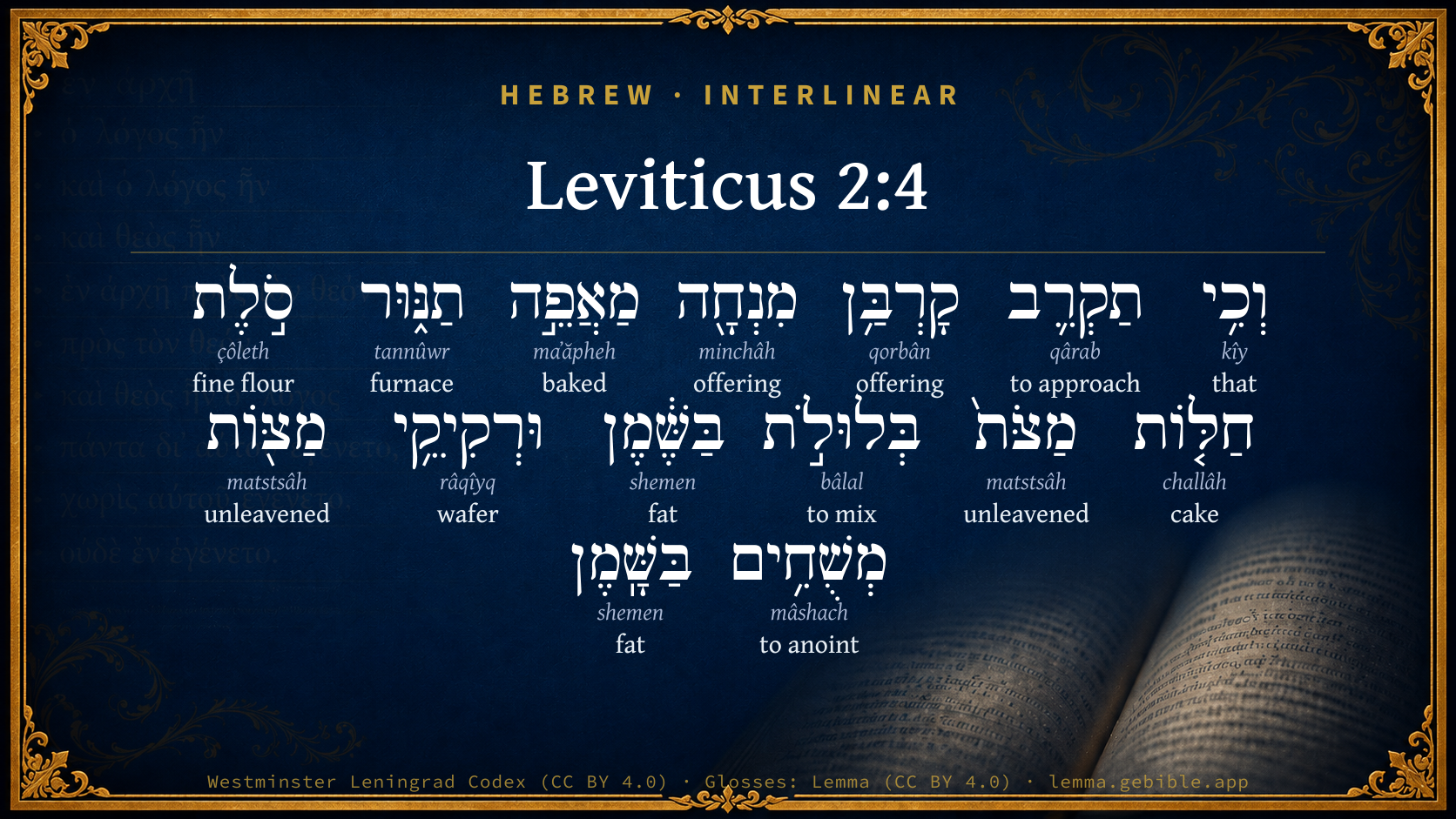
Hebrew (Westminster Leningrad Codex) Leviticus 2:4 appears in the Hebrew Old Testament. The text above is from the Westminster Leningrad Codex. Each word links to its Strong’s number, a concise gloss, and parsing drawn from the Open Scriptures Hebrew Bible morphology. Click any word for its full Brown-Driver-Briggs (BDB) entry.
Download image
Cite this verse

Leviticus 2:4 (World English Bible). Public Domain. Lemma interlinear Bible study tool, https://lemma.gebible.app/v/leviticus/2/4.

Show BibTeX & RIS
BibTeX
RIS
English Translation
"'When you offer an offering of a meal offering baked in the oven, it shall be unleavened cakes of fine flour mixed with oil, or unleavened wafers anointed with oil.
World English Bible · Public Domain
Highlights
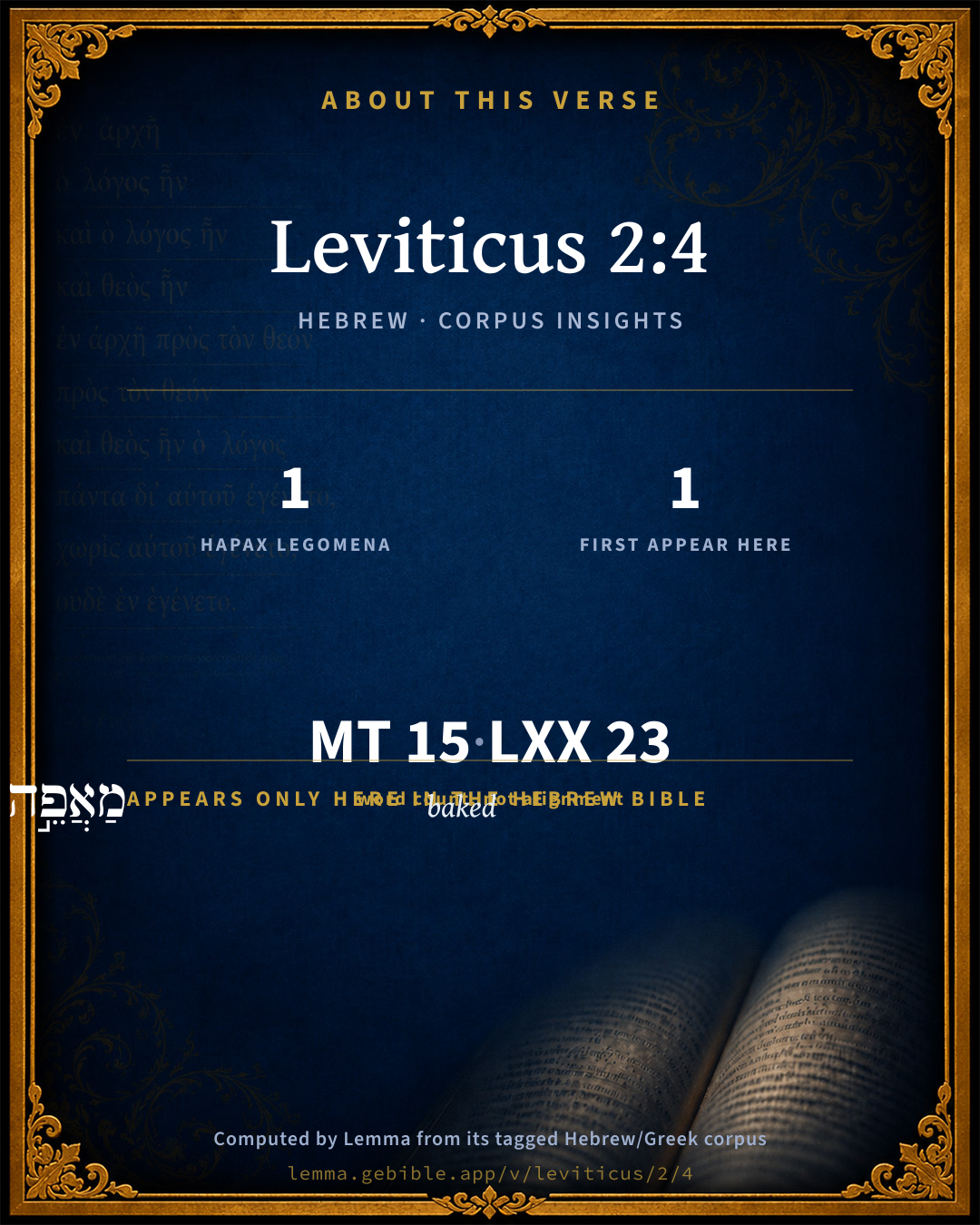
  • 1 hapax legomenon — only here in the Hebrew Bible
  • 1 first appearance in the Hebrew Bible
Full analysis ↓
Download a study sheet

One document with this verse’s original text, its word-by-word gloss line, the meaning frame, cross-references with their text, attributed commentary, and full source and license credits — printable, and it pastes into notes with its structure intact.

This verse Autodidact and up

Study sheet (.html) Plain text (.txt)

A passage Seminary Student

Up to 50 verses in one chapter. A passage sheet keeps up to 6 commentary sources and 12 cross-references per verse, in the order this page ranks them, and says so on the sheet whenever that leaves anything out. Ask for a single verse and you get the Autodidact verse sheet above.

Everything on this page stays free to read, with no account — the sheet is a download of what is already on screen, not access to it.

Want to remove ads? Support Godless Engineer
Compare translations 3

The same verse in 3 English versions, stacked beneath the original-language interlinear above. Click any original word for its lexicon entry.

Each is an independent rendering of the whole verse — the interlinear is not word-aligned to these translations.

Highlighted words mark where these versions differ — a whole-verse word diff, not a word-by-word alignment.

  • World English Bible Public Domain
    "'When you offer an offering of a meal offering baked in the oven, it shall be unleavened cakes of fine flour mixed with oil, or unleavened wafers anointed with oil.
  • King James Version Public Domain
    And if thou bring an oblation of a meat offering baked in the oven, it shall be unleavened cakes of fine flour mingled with oil, or unleavened wafers anointed with oil.
  • unfoldingWord Literal Text CC BY-SA 4.0
    And when you present an offering of a grain offering, a baked item of the oven, flour of loaves of unleavened bread mixed with oil or wafers of unleavened bread anointed with oil.

unfoldingWord Literal Text — © unfoldingWord, licensed CC BY-SA 4.0. Word-aligned USFM3 via Door43 (git.door43.org/unfoldingWord/en_ult).

Versions to compare (up to 4)

3 of 4 selected

Show all 18 translations

Every available English version of this verse, each an independent rendering of the whole verse.

  • World English Bible Public Domain
    "'When you offer an offering of a meal offering baked in the oven, it shall be unleavened cakes of fine flour mixed with oil, or unleavened wafers anointed with oil.
  • Berean Standard Bible Public Domain
    Now if you bring an offering of grain baked in an oven, it must consist of fine flour, either unleavened cakes mixed with oil or unleavened wafers coated with oil.
  • Majority Standard Bible Public Domain
    Now if you bring an offering of grain baked in an oven, it must consist of fine flour, either unleavened cakes mixed with oil or unleavened wafers coated with oil.
  • King James Version Public Domain
    And if thou bring an oblation of a meat offering baked in the oven, it shall be unleavened cakes of fine flour mingled with oil, or unleavened wafers anointed with oil.
  • American Standard Version (1901) Public Domain
    And when thou offerest an oblation of a meal-offering baken in the oven, it shall be unleavened cakes of fine flour mingled with oil, or unleavened wafers anointed with oil.
  • Revised Version (1885) Public Domain
    And when thou offerest an oblation of a meal offering baken in the oven, it shall be unleavened cakes of fine flour mingled with oil, or unleavened wafers anointed with oil.
  • Geneva Bible (1599) Public Domain
    If thou bring also a meate offring baken in the ouen, it shalbe an vnleauened cake of fine floure mingled with oyle, or an vnleauened wafer anointed with oyle.
  • Douay-Rheims (1899) Public Domain
    But when thou offerest a sacrifice baked in the oven of flour, to wit, loaves without leaven, tempered with oil, and unleavened wafers, anointed with oil:
  • Young's Literal Translation Public Domain
    `And when thou bringest near an offering, a present baked in an oven, `it is of' unleavened cakes of flour mixed with oil, or thin unleavened cakes anointed with oil.
  • Literal Standard Version CC BY-SA 4.0
    And when you bring an offering near, a present baked in an oven, [it is of] unleavened cakes of flour mixed with oil, or thin unleavened cakes anointed with oil.
  • Unlocked Literal Bible CC BY-SA 4.0
    When you offer a grain offering without yeast that is baked in an oven, it must be soft bread of fine flour mixed with oil, or hard bread without yeast, which is spread with oil.
  • unfoldingWord Literal Text CC BY-SA 4.0
    And when you present an offering of a grain offering, a baked item of the oven, flour of loaves of unleavened bread mixed with oil or wafers of unleavened bread anointed with oil.
  • Darby Bible Public Domain
    And if thou present an offering of an oblation baken in the oven, it shall be unleavened cakes of fine flour mingled with oil, or unleavened wafers anointed with oil.
  • World Messianic Bible Public Domain
    “‘When you offer an offering of a meal offering baked in the oven, it shall be unleavened cakes of fine flour mixed with oil, or unleavened wafers anointed with oil.
  • Webster's Bible Public Domain
    And if thou shalt bring an oblation of a meat-offering baked in the oven, it shall be unleavened cakes of fine flour mingled with oil, or unleavened wafers anointed with oil.
  • Free Bible Version CC BY-SA 4.0
    If your offering is of grain baked in an oven, it must be made from fine flour without using yeast. It can be cakes mixed with olive oil or wafers with olive oil spread on them.
  • Bible in Basic English Public Domain
    And when you give a meal offering cooked in the oven, let it be of unleavened cakes of the best meal mixed with oil, or thin unleavened cakes covered with oil.
  • JPS Tanakh (1917) Public Domain
    And when thou bringest a meal-offering baked in the oven, it shall be unleavened cakes of fine flour mingled with oil, or unleavened wafers spread with oil.

Literal Standard Version (2020), Covenant Press — licensed CC BY-SA 4.0. Text via the HelloAO Bible API (eBible.org). Unlocked Literal Bible (unfoldingWord) — licensed CC BY-SA 4.0. Text via the HelloAO Bible API (eBible.org). unfoldingWord Literal Text — © unfoldingWord, licensed CC BY-SA 4.0. Word-aligned USFM3 via Door43 (git.door43.org/unfoldingWord/en_ult). Free Bible Version, Dr. Jonathan Gallagher — licensed CC BY-SA 4.0. Text via the HelloAO Bible API (eBible.org).

Word by word

More ways to search: Search by grammar → Find every occurrence → Compare this word →

Practice this passage: Drill this verse → Learn its vocabulary →

מַאֲפֵ֣ה
maʼăpheh
H3989
“baked of”
Noun, Common, Masculine, Singular, Construct
Part of Speech
Noun
Type
Common
Gender
Masculine
Number
Singular
State
Construct
Full BDB Definition

Origin: from H644

TWOT: 143a

baked, thing baked
  1. וְכִ֥י kîy H3588 “and · that” Conjunction + Conjunction
  2. תַקְרִ֛ב qârab H7126 “to approach” Verb, Hiphil, Imperfect, 2nd Person, Masculine, Singular
  3. קָרְבַּ֥ן qorbân H7133 “offering of” Noun, Common, Masculine, Singular, Construct
  4. מִנְחָ֖ה minchâh H4503 “offering” Noun, Common, Feminine, Singular, Absolute
  5. תַנּ֑וּר tannûwr H8574 “furnace” Noun, Common, Masculine, Singular, Absolute
  6. סֹ֣לֶת çôleth H5560 “fine flour of” Noun, Common, Feminine, Singular, Construct
  7. חַלּ֤וֹת challâh H2471 “cakes” Noun, Common, Feminine, Plural, Absolute
  8. מַצֹּת֙ matstsâh H4682 “unleavened bread” Noun, Common, Feminine, Plural, Absolute
  9. בְּלוּלֹ֣ת bâlal H1101 “mixed” Verb, Qal, Participle Passive, Feminine, Plural, Absolute
  10. בַּשֶּׁ֔מֶן shemen H8081 “in/at the · fat” Preposition, Determined + Noun, Common, Masculine, Singular, Absolute
  11. וּרְקִיקֵ֥י râqîyq H7550 “and · wafers of” Conjunction + Noun, Common, Masculine, Plural, Construct
  12. מַצּ֖וֹת matstsâh H4682 “unleavened bread” Noun, Common, Feminine, Plural, Absolute
  13. מְשֻׁחִ֥ים mâshach H4886 “anointed” Verb, Qal, Participle Passive, Masculine, Plural, Absolute
  14. בַּשָּֽׁמֶן shemen H8081 “in/at the · fat” Preposition, Determined + Noun, Common, Masculine, Singular, Absolute

About this verse

These counts appear in no published source. They are computed here, from the morphology-tagged text and Lemma’s own curated glosses. What Lemma adds →

15
words
13
distinct lemmas
Pentateuch
section

Notable vocabulary

1 hapax legomenon — a word that appears only here in the entire Hebrew Bible:

  • מַאֲפֵ֣ה baked H3989

First appearance in Scripture

This word makes its first canonical appearance in the Hebrew Bible here:

  • מַאֲפֵ֣ה baked H3989

Shared distinctive vocabulary

וּרְקִיקֵ֥י wafer H7550 occurs in 8 verses of the Hebrew Bible. Also found in:

Grammatical profile

  • 3 verbs
  • 11 nouns
  • 1 conjunction

Verb forms

  • תַקְרִ֛ב Hiphil · Imperfect
  • בְּלוּלֹ֣ת Qal · Participle Passive
  • מְשֻׁחִ֥ים Qal · Participle Passive

Repetition

Words recur within this verse — often emphatic in Hebrew:

  • מַצֹּת֙ unleavened H4682 ×2
  • בַּשֶּׁ֔מֶן fat H8081 ×2

Hebrew & Septuagint length

In English translation the verse runs 30 words from the Hebrew and 35 from the Septuagint (LXX English) — closely comparable.

A rough comparison of the two English renderings, which tokenize alike — not a word-level alignment.

Word counts can differ between the Hebrew and the Greek without any difference in meaning — e.g. the Hebrew direct-object marker אֵת has no separate Greek word, and Greek often adds the article ὁ.

In the original languages it is 15 Hebrew tokens and 23 Greek tokens — but the two are counted differently (Hebrew bundles its prefixes and suffixes into one token; the Greek is in lemma form), so that isn’t a like-for-like length.

Cross-references

20

Topical passages linked to Leviticus 2:4 in the Treasury of Scripture Knowledge — connected by theme and wording, ordered by reader-vote popularity; previews shown in the World English Bible.

  • Exodus 29:2 unleavened bread, unleavened cakes mixed with oil, and unleavened wafers anointed with oil: you shall make them of fine wheat flour.
  • Psalms 22:14 I am poured out like water. All my bones are out of joint. My heart is like wax; It is melted within me.
  • 1 Corinthians 5:7–8 Purge out the old yeast, that you may be a new lump, even as you are unleavened. For indeed Christ, our Passover, has been sacrificed in our place.
  • Leviticus 10:12 Moses spoke to Aaron, and to Eleazar and to Ithamar, his sons who were left, "Take the meal offering that remains of the offerings of Yahweh made by fire, and eat it without yeast beside the altar; for it is most holy;
  • Isaiah 42:1 Behold, my servant, whom I uphold; my chosen, in whom my soul delights: I have put my Spirit on him; he will bring forth justice to the Gentiles.
  • Matthew 26:38 Then he said to them, "My soul is exceedingly sorrowful, even to death. Stay here, and watch with me."
  • John 3:34 For he whom God has sent speaks the words of God; for God gives the Spirit without measure.
  • John 12:27 "Now my soul is troubled. What shall I say? 'Father, save me from this time?' But for this cause I came to this time.
  • Hebrews 7:26 For such a high priest was fitting for us: holy, guiltless, undefiled, separated from sinners, and made higher than the heavens;
  • 1 Peter 2:1 Putting away therefore all wickedness, all deceit, hypocrisies, envies, and all evil speaking,
  • 1 Peter 2:22 who did not sin, "neither was deceit found in his mouth."
  • Exodus 12:8 They shall eat the flesh in that night, roasted with fire, and unleavened bread. They shall eat it with bitter herbs.
  • Exodus 16:31 The house of Israel called the name of it Manna, and it was like coriander seed, white; and its taste was like wafers with honey.
  • Leviticus 1:11 He shall kill it on the north side of the altar before Yahweh. Aaron's sons, the priests, shall sprinkle its blood around on the altar.
  • Leviticus 6:17 It shall not be baked with yeast. I have given it as their portion of my offerings made by fire. It is most holy, as the sin offering, and as the trespass offering.
  • Leviticus 7:12 If he offers it for a thanksgiving, then he shall offer with the sacrifice of thanksgiving unleavened cakes mixed with oil, and unleavened wafers anointed with oil, and cakes mixed with oil.
  • 1 Chronicles 23:28–29 For their office was to wait on the sons of Aaron for the service of the house of Yahweh, in the courts, and in the chambers, and in the purifying of all holy things, even the work of the service of the house of God;
  • Isaiah 44:3–5 For I will pour water on him who is thirsty, and streams on the dry ground; I will pour my Spirit on your seed, and my blessing on your offspring:
  • Isaiah 61:1 The Spirit of the Lord Yahweh is on me; because Yahweh has anointed me to preach good news to the humble; he has sent me to bind up the broken-hearted, to proclaim liberty to the captives, and the opening [of the prison] to those who are bound;
  • Ezekiel 46:20 He said to me, This is the place where the priests shall boil the trespass-offering and the sin-offering, [and] where they shall bake the meal-offering; that they not bring them forth into the outer court, to sanctify the people.

Cross-references courtesy of OpenBible.info (CC BY 4.0).

Hebrew and Greek witnesses Masoretic Hebrew ↔ Greek Septuagint

The same verse in the two great witnesses to the Old Testament, shown verse-for-verse.

These are two independent witnesses, not word-aligned to each other, and the Septuagint is shown in lemma (dictionary) form.

Hebrew Leviticus 2:4 Masoretic · Westminster Leningrad Codex

וְכִ֥י תַקְרִ֛ב קָרְבַּ֥ן מִנְחָ֖ה מַאֲפֵ֣ה תַנּ֑וּר סֹ֣לֶת חַלּ֤וֹת מַצֹּת֙ בְּלוּלֹ֣ת בַּשֶּׁ֔מֶן וּרְקִיקֵ֥י מַצּ֖וֹת מְשֻׁחִ֥ים בַּשָּֽׁמֶן

"'When you offer an offering of a meal offering baked in the oven, it shall be unleavened cakes of fine flour mixed with oil, or unleavened wafers anointed with oil.

World English Bible · Public Domain

Greek LXX Leviticus 2:4 Septuagint · lemma form

ἐάν δέ προςφέρω δῶρον θυσία πέσσω ἐν κλίβανος δῶρον κύριος ἐκ σεμίδαλις ἄρτος ἄζυμος φυράω ἐν ἔλαιον καί λάγανον ἄζυμος διαχρίω ἐν ἔλαιον

And if he bring as a gift a sacrifice baked from the oven, a gift to the Lord of fine flour, he shall bring unleavened bread kneaded with oil, and unleavened cakes anointed with oil.

LXX2012 (modern English Septuagint) · Public Domain

On this verse, Keil & Delitzsch discusses the Septuagint’s reading. Read the note in Commentary ↓

Hebrew: Westminster Leningrad Codex (CC BY 4.0). Greek: Septuagint (public domain); English from LXX2012 (modern English Septuagint) (Public Domain). How the Septuagint differs from the Hebrew →

Targum (Aramaic paraphrase)

2

The Targum is the ancient Jewish Aramaic paraphrase of the Hebrew Scriptures — an interpretive translation, not the Hebrew text itself. Onkelos (literal) and Pseudo-Jonathan (expansive) render the Torah, and Jonathan the Prophets. Coverage is partial: where no permissively-licensed English translation exists for a verse, only the Aramaic is shown. This is verse-level text, not a word-by-word alignment to the Hebrew. Some Onkelos verses here show an unreviewed machine translation (clearly flagged), not a published edition.

  1. Targum Onkelos Torah (Genesis–Deuteronomy)
    וַאֲרֵי תְקָרֵיב קוּרְבַּן מִנְחָתָא מַאֲפֵה תַנוּרָא סוּלְתָּא גְרִיצָן פַּטִירָן דְפִילָן בִּמְשָׁח וְאִסְפּוּגִין פַטִירִין דִמְשִׁיחִין בִּמְשָׁח

    Unreviewed machine translation (Claude Sonnet 5) — not public domain confidence: high

    And if you offer an offering of a meal-offering baked in the oven, of fine flour: unleavened cakes mixed with oil, and unleavened wafers anointed with oil.

    Generated by an AI translate-then-audit pipeline and checked against an independent public-domain English translation of the underlying Hebrew for drift only. Not a published edition; pending human review.

    Aramaic base: public-domain Targum Onkelos (via Sefaria). The English above is the unreviewed machine translation, not public domain.

  2. Targum Pseudo-Jonathan Torah (Genesis–Deuteronomy)
    וַאֲרוּם תַּקְרִיב קָרְבַּן מִנְחָתָא דְמִתְאַפֵי בְּתַנוּרָא סְמִידָא גְרִיצִין פַּטִירִין פְּתִיכַן בִּמְשָׁח וּסְפוּגִין פַּטִירִין דִמְשִׁיחִין בִּמְשָׁח

    And when thou wilt offer the oblation of a mincha of that which is baked in the oven, it shall be cakes of flour, unleavened and mixed with oil, and wafers unleavened, which are anointed with oil.

    Targum Pseudo-Jonathan — Aramaic: “Targum Jonathan on Genesis” (public domain); “Targum Jonathan on Exodus” (public domain); “Targum Jonathan on Leviticus” (public domain); “Targum Jonathan on Numbers” (public domain); “Targum Jonathan on Deuteronomy” (public domain). English: “The Targum of Jonathan ben Uzziel, trans. J. W. Etheridge, London, 1862” (public domain). Text via Sefaria.

Commentary

Notes on Leviticus 2:4 from classic Christian and Jewish commentators (each source and its license shown beneath its notes). The classic Christian expositions comment on the surrounding passage and are grouped to its opening verse, so a note may address several verses; the Jewish commentaries on the Tanakh (Rashi and others) are per-verse, so they appear only where the commentator wrote on this verse.

Lemma curates 59 commentaries, every one of them public domain or Creative Commons licensed, each selected and text-cleaned for this edition rather than reprinted as found. About our sources →

Ellicott's Commentary for English Readers

(4) A meat offering baked in the oven.—The second kind of meat offering consisted of preparations baked with oil in the oven, or in the pan, or cooked in a pot (Lev_2:4-10). The oven is probably the portable pot, open at the top, about three feet high and liable to be broken (Lev_11:35), which is still used in the East for making bread and cakes. After the vessel is thoroughly heated, the dough, which is made into large, thin, oval cakes resembling pancakes or Scotch oatcakes, is dexterously thrown against the sides, the aperture above is covered, and the bread is completely baked in a few minutes. Though the bread when first taken out is soft, and can be rolled up like paper, it hardens and becomes crisp when it is kept.

A Bible Commentary for English Readers, edited by Charles John Ellicott (1878–1897) — public domain. Text from a community e-Sword module.

The Cambridge Bible for Schools and Colleges

gen. ed. J. J. S. Perowne

4. The pouring and the mixing may be done by the ordinary Israelite; from the taking of the handful and onwards the priest officiates. (Rashi.)

The cakes or wafers must be 10 in number.

4–10. After the general description of Lev_2:1-3, three methods of preparing the Meal-Offering are specified. It may be (1) baken in the oven (Lev_2:4), or (2) on a flat plate (Lev_2:5, mg. of R.V. and A.V.), or (3) in a frying pan (Lev_2:7). In all cases the material is the same; fine flour and oil, and the priest is to treat it in the same way (Lev_2:9-10 repeat the directions of Lev_2:2-3).

The Cambridge Bible for Schools and Colleges (gen. ed. J. J. S. Perowne; Cambridge University Press, 1878–1918) — public domain. Text from a community e-Sword module.

Trapp's Complete Commentary

John Trapp

Lev 2:4 And if thou bring an oblation of a meat offering baken in the oven, [it shall be] unleavened cakes of fine flour mingled with oil, or unleavened wafers anointed with oil.

Ver. 4. Unleavened cake of fine flour mingled with oil.] Sincerity is the mother of serenity; truth, of tranquillity.

John Trapp, A Commentary or Exposition upon All the Books of the Old and New Testament (1647–1656) — public domain. Text from a community e-Sword module.

Albert Barnes' Notes on the Bible

The four kinds of bread and the three cooking utensils which are mentioned in this section were probably such as were in common use in the daily life of the Israelites; and there appears no reason to doubt that they were such as are still used in the East. The variety of the offerings was most likely permitted to suit the different circumstances of the worshippers.

Lev 2:4

Oven - This was probably a portable vessel of earthenware; in shape a cone about 3 ft. 6 in. high, and 1 ft. 6 in. in diameter. Similar jars are now used for the same purpose by the Arabs. After the vessel has been thoroughly heated by a fire lighted in the inside, the cakes are placed within it, and the top is covered up until they are sufficiently baked. Meantime the outside of the vessel is turned to account. Dough rolled out very thin is spread over it, and a sort of wafer is produced considerably thinner than a Scotch oat-cake.

Lev 2:5

A pan - Rather, as in the margin, a flat plate. It was probably of earthenware, like the oven.

Lev 2:6

Part it in pieces - Break, not cut. The Bedouins are in the habit of breaking up their cakes when warm and mixing the fragments with butter when that luxury can be obtained.

Lev 2:7

Fryingpan - Rather, pan, commonly used for boiling. It is possible that the cakes here spoken of were boiled in oil. The “pan” and the “frying pan” Lev 2:5, Lev 2:7 may have been the common cooking implements of the poorest of the people.

Albert Barnes' Notes on the Bible (1834–1885) — public domain. Text from a community e-Sword/MySword module.

Tyndale Open Study Notes

Tyndale Open Resources

2:4 A large ceramic oven was placed in a hole, and around it a fire was kindled. Once the oven was hot, the flat bread baked against the inside of its wall. • without any yeast: See study note on 2:11; see also Exod 12:8.

Tyndale Open Study Notes — © Tyndale Open Resources, licensed CC BY-SA 4.0. Text via the HelloAO Bible API.

Jamieson, Fausset & Brown

Robert Jamieson, A. R. Fausset & David Brown

if thou bring an oblation of a meat offering baken in the oven--generally a circular hole excavated in the floor, from one to five feet deep, the sides of which are covered with hardened plaster, on which cakes are baked of the form and thickness of pancakes. (See on Gen 18:6). The shape of Eastern ovens varies considerably according to the nomadic or settled habits of the people.

Jamieson, Fausset & Brown — Commentary Critical and Explanatory on the Whole Bible (1871) — public domain (CC PDM 1.0). Text via the HelloAO Bible API.

Adam Clarke's Commentary

Verse 4. Baken in the oven] תנור tannur, from נר nar, to split, divide, says Mr. Parkhurst; and hence the oven, because of its burning, dissolving, and melting heat.

Adam Clarke's Commentary on the Bible (1810–1826) — public domain. Text from a community e-Sword/MySword module.

John Gill's Exposition

And if thou bring an oblation of a meat offering baken in an oven,.... This is another kind of meat offering, or in another form; the former was only fine flour and oil mixed together, and frankincense put on it, but this was made up into cakes, and baked in an oven, and not in anything else, according to the Jewish tradition (i); he that says, lo, upon me be a meat offering baked in an oven, he may not bring that baked otherwise; and this meat offering was made into cakes and wafers, and then baked, as follows: and

it shall be unleavened cakes of fine flour mingled with oil, or unleavened wafers anointed with oil; which according to the Jews were made after this manner (k); the priest put the oil into a vessel before the making of it, then put the fine flour to it, and put oil upon it, and mixed it, and kneaded it, and baked it, and cut it in pieces, and put oil upon it, and mixed it, and again put oil upon it, and took the handful, and it was the fourth part of an hin of oil that was divided into the several cakes; the cakes, they say, were obliged to be mixed, and the wafers to be anointed; the cakes were mixed, but not the wafers the wafers were anointed, and not the cakes. The oil denoted the grace of the Spirit of God in Christ, and in his people; and being unleavened, the sincerity and truth with which the meat offering, Christ, is to be upon.

(i) Misn. Menachot, c. 5. sect. 9. Maimon. & Bartenora in. ib. (k) T. Bab. Menachot, fol. 75. 1.

John Gill's Exposition of the Whole Bible (1746–1763) — public domain (CC PDM 1.0). Text via the HelloAO Bible API.

Matthew Poole's English Annotations

Baken in the oven; made in the sanctuary for that use, as may seem from 1Ch 23:28,29; Eze 46:20.

Matthew Poole's English Annotations on the Holy Bible (1683–1685) — public domain. Text from a community e-Sword/MySword module.

Whedon's Commentary on the Bible

Daniel D. Whedon

4. Oblation — The Hebrew korban. It is a general term for offering, and is so translated in Lev_1:2.

Baken in the oven — There is no in in the original. Hence we infer that the oven was of the kind used by the Arabs, a great stone pitcher heated by a fire within it. To the exterior of this, thin cakes or wafers are applied, which are instantly baked.

Unleavened cakes — Leaven is expressly forbidden in the bread offering.

See Lev_2:11. The ground of this prohibition is, that the fermentation of the leaven is incipient decay, and the bread is rendered impure. This is the testimony of modern chemistry and hygiene, which has led to the attempt to substitute aerated and salt-raised bread for that corrupted by leaven. Our Lord Jesus and St. Paul always regarded leaven as a symbol of moral putrefaction. Mat_16:6; 1Co_5:6-8. Thus, according to St. Paul, unleavened cakes are emblematical of “sincerity (pureness) and truth.” Leaven in food was not forbidden except in the passover week. Because the bread of the peace offering was eaten and not burned, (Lev_2:11,) leaven was permitted in that peace offering. Lev_7:14.

Daniel D. Whedon (gen. ed.), Commentary on the Old and New Testaments (1874–1909) — public domain. Text from a community e-Sword module.

The Pulpit Commentary

Vers. 4-11. The second form of meat offering, when the flour and oil were made up into four varieties of cakes. The ritual of offering is not different from that of the first form. The frankincense is not mentioned, but doubtless is understood. The rabbinical rule, that meat offerings, when following upon burnt offerings or peace offerings, had no frankincense burnt with them, rests on no solid foundation.

Vers. 4-16. The various kinds of meat offerings.

Without dwelling on every minute regulation, the following main points may be distinguished as representative.

I OFFERED FOOD. Acknowledgment of dependence. Praise for life and its gifts. Joys and pleasures should be consecrated. The will of God in them and over them. Family worship a duty. Recognition of God in common life. Firstfruits are God"s, not the remnant or gleanings of our faculties and opportunities, but all.

II OFFERING DIVIDED BETWEEN OFFERER AND PRIESTS. Connection of daily labour and its results with the sanctuary and religious duties. The secular and sacred only nominally distinct. The house of God and the house of man should open into one another. Nothing should be allowed to interfere with the holiness of that which is assigned to God"s service in the sanctuary. It is most holy." Too often Christians fall into a carelessness with respect to sacred appointments which reacts on the spirit and life. Our partnership with God involves responsibility.

III NO LEAVEN, NO HONEY. In all things purity and humility. There must be no corrupt principle admitted into our service of God. The doctrine must be purified of leaven. The motives must be examined. We ought not to serve God for the sake of filthy lucre, under the influence of mere sensational excitement. Truth and sobriety in worship.

IV SALT WITH EVERY SACRIFICE. All must be brought to God in the spirit of penitent faith. Salt preserves life, sets forth the dependence of man upon God. The gracious covenant is the source of all. He who commands is himself the giver of all power to fulfill his word. He is the Alpha and the Omega of the spiritual life.

V FRANKINCENSE AND OIL. Fragrance and brightness. Heaven and earth mingled together. Reconciliation of God and man. The outpoured spirit of light and life. Joy in God and in his gifts. The anointing oil mingled in the fire and increased the flame. The Messiah is the true Anointed One. Every Israelite, in a lower degree, was himself a Messiah, an anointed one, taken up into the Son of God and blessed. The people are a holy, consecrated people, separated unto Jehovah. Every individual act of religion is acceptable as the oil of the Spirit is poured upon it. What a new view of life can thus be obtained! Make all a meat offering to the Lord. R.

The Pulpit Commentary (1880–1919), ed. H.D.M. Spence-Jones & Joseph S. Exell — public domain. Text from a community e-Sword module.

John Wesley's Explanatory Notes

In the oven - Made in the sanctuary for that use.

John Wesley, Explanatory Notes Upon the Whole Bible (1754–1765) — public domain. Text via the GEBible commentary corpus.

Keil & Delitzsch

C. F. Keil & F. Delitzsch

The second kind consisted of pastry of fine flour and oil prepared in different forms. The first was maapheh tannur, oven-baking: by תּנּוּר we are not to understand a baker's over (Hos 7:4, Hos 7:6), but a large pot in the room, such as are used for baking cakes in the East even to the present day (see my Archol. 99, 4). The oven-baking might consist either of "cakes of unleavened meal mixed (made) with oil," or of "pancakes of unleavened meal anointed (smeared) with oil." Challoth: probably from חלל to pierce, perforated cakes, of a thicker kind. Rekkim: from רקק to be beaten out thin; hence cakes or pancakes. As the latter were to be smeared with oil, we cannot understand בּלוּל as signifying merely the pouring of oil upon the baked cakes, but must take it in the sense of mingled, mixed, i.e., kneaded with oil (pefurame'nous lxx, or according to Hesychius, μεμιγμένους).

Lev 2:5-6

Secondly, if the minchah was an offering upon the pan, it was also to be made of fine flour mixed with oil and unleavened. Machabath is a pan, made, according to Eze 4:3, of iron-no doubt a large iron plate, such as the Arabs still use for baking unleavened bread in large round cakes made flat and thin (Robinson, Palestine i. 50, ii. 180). These girdles or flat pans are still in use among the Turcomans of Syria and the Armenians (see Burckhardt, Syr. p. 1003; Tavernier, Reise 1, p. 280), whilst the Berbians and Cabyles of Africa use shallow iron frying-pans for the purpose, and call them tajen, - the same name, no doubt, as τήγανον, with which the lxx have rendered machabath. These cakes were to be broken in pieces for the minchah, and oil to be poured upon them (the inf. abs. as in Exo 13:3; Exo 20:8, vid., Ges. 131, 4); just as the Bedouins break the cakes which they bake in the hot ashes into small pieces, and prepare them for eating by pouring butter or oil upon them.

Lev 2:7

Thirdly, "If thy oblation be a tigel-minchah, it shall be made of fine flour with oil." Marchesheth is not a gridiron (ἔσχαρα, lxx); but, as it is derived from חרשׁ, ebullivit, it must apply to a vessel in which food was boiled. We have therefore to think of cakes boiled in oil.

Keil & Delitzsch — Biblical Commentary on the Old Testament (1861–1891) — public domain (CC PDM 1.0). Text via the HelloAO Bible API. (Old Testament only.)

unfoldingWord translationNotes

Door43 World Missions Community

General Information:

Yahweh continues telling Moses what the people and priests must do so their offerings will be acceptable to him.

that is baked in an oven

This can be stated in active form. AT: "that you baked in an oven" (See: Active or Passive)

oven

This was probably a hollow object made of clay. A fire was lit under the oven, and the heat would bake the dough inside of the oven. (See: Translate Unknowns)

soft bread of fine flour

It is understood that the soft bread contained no yeast. (See: Ellipsis)

which is spread with oil

Translate this phrase to indicate that the oil is to be spread onto the bread. AT: "with oil on the bread" (See: Assumed Knowledge and Implicit Information)

If your grain offering is baked with a flat iron pan

This can be stated in active form. AT: "If you bake your grain offering in a flat iron pan" (See: Active or Passive)

a flat iron pan

This is a thick plate made of either clay or metal. The plate was placed over a fire, and the dough cooked on top of the plate. (See: Translate Unknowns)

translationWords

grain offering

yeast

bread

oil

unfoldingWord translationNotes — © Distant Shores Media and the Door43 World Missions Community, licensed CC BY-SA 4.0. Source: git.door43.org/Door43/en_tn.

Rashi

Rabbi Shlomo Yitzchaki (Rashi)

וכי ‎‎'ו גו‎תקריב‎‎‎‎‎ AND IF THOU OFFER [AN OFFERING OF AN OBLATION BAKEN IN THE OVEN] in that one said, “I take upon myself the obligation to bring a meal-offering taken in the oven. Scripture teaches you that he may bring either cakes or wafers, the cakes being mingled with oil and the wafers being anointed with oil (Sifra, Vayikra Dibbura d'Nedavah, Section 10 2). Our Rabbis are of different opinions as to their anointing. Some hold that they smeared them with oil and then repeatedly smeared them until the oil in the log was at an end, for every kind of meal-offering required a log of oil: whilst others hold that they smeared them only in the form of a Greek X (cf. Rashi on Exodus 29:7 and Note thereon) and that the rest of the oil was consumed separately by the priests (Menachot 75a; cf. Sifra, Vayikra Dibbura d'Nedavah, Chapter 11 6). — Why is the word בשמן used twice in this verse (it would have sufficed to state: חלות מצות בלולות בשמן ורקיקי מצות משוחים בו)? In order to permit for use with the meal-offering the “second grade of oil” and the “third grade of oil” which comes out of the olives) (Sifra, Vayikra Dibbura d'Nedavah, Chapter 11 6), and to teach that “the first oil” is required only for the candelabrum of which it is stated, (Exodus 27:20) “clear [olive oil for the light]”. — We read in Treatise Menachoth 76a: All the meal-offerings that were baked before the “fistful” was taken from them and at which the קמיצה could therefore be performed only by first breaking them into pieces — each of them had to be offered of ten cakes, and that at which “wafers” are prescribed was offered of ten wafers.

Rashi on the Tanakh — English translations: “The Judaica Press complete Tanach with Rashi, translated by A. J. Rosenberg” (CC BY 4.0); “Pentateuch with Rashi's commentary by M. Rosenbaum and A.M. Silbermann, 1929-1934” (public domain); “The Metsudah Tanach series, Lakewood, N.J” (CC BY 4.0); and “The Book of Joshua, Metsudah Publications, 1997” (CC BY 4.0). Text via Sefaria.

Lesson kit

Teaching starters — assembled from the data on this page, not authored interpretation. Every prompt links to the verse data it draws on. Edit before teaching.

Leviticus, in the Pentateuch, opens this verse with 15 words (13 distinct Hebrew lemmas). Its most distinctive word is maʼăpheh (“baked”). A historical commentator’s framing appears above. Read the whole chapter for the surrounding context.

Discussion questions

  1. The word maʼăpheh carries the sense “baked.” How does it shape the verse?
  2. This verse holds 1 word here found nowhere else in the Hebrew Bible. What might the rare word draw attention to?
  3. The word “baked” first appears here in Scripture. What is being introduced at this debut?
  4. Exodus 29:2 shares the word «wafer» with this verse. How do the two illuminate each other?
  5. “unleavened” occurs 2× in this one verse. What is the effect of the repetition?
  6. These translations render this verse differently; the difference is in the English rendering, not the original. What questions does that raise?
  7. The verb «תַקְרִ֛ב» is Hiphil Imperfect. How does its form color the action?
  8. Reading how Ellicott's Commentary for English Readers and The Cambridge Bible for Schools and Colleges read this verse, where do the two commentators agree and where do they part?

Things to notice

  • 1 word in this verse appears nowhere else in the Hebrew Bible.
  • 1 word makes its first canonical appearance in Scripture here.
  • This verse counts 15 Hebrew ↔ 23 Greek words.
  • These translations choose different wording for 17 words in this verse.
  • “unleavened” occurs 2× in this single verse.

Reading settings

Reading text

Shown beneath each verse's original-language words.

Old Testament
Old Testament edition

Read the OT as the Masoretic Hebrew (MT) or the Greek Septuagint (LXX).

English shown for the Greek Septuagint (in the Hebrew ↔ Greek comparison).

Comparing translations? Open the Compare panel on any verse page to stack up to four side by side.