
Deuteronomy 5:27

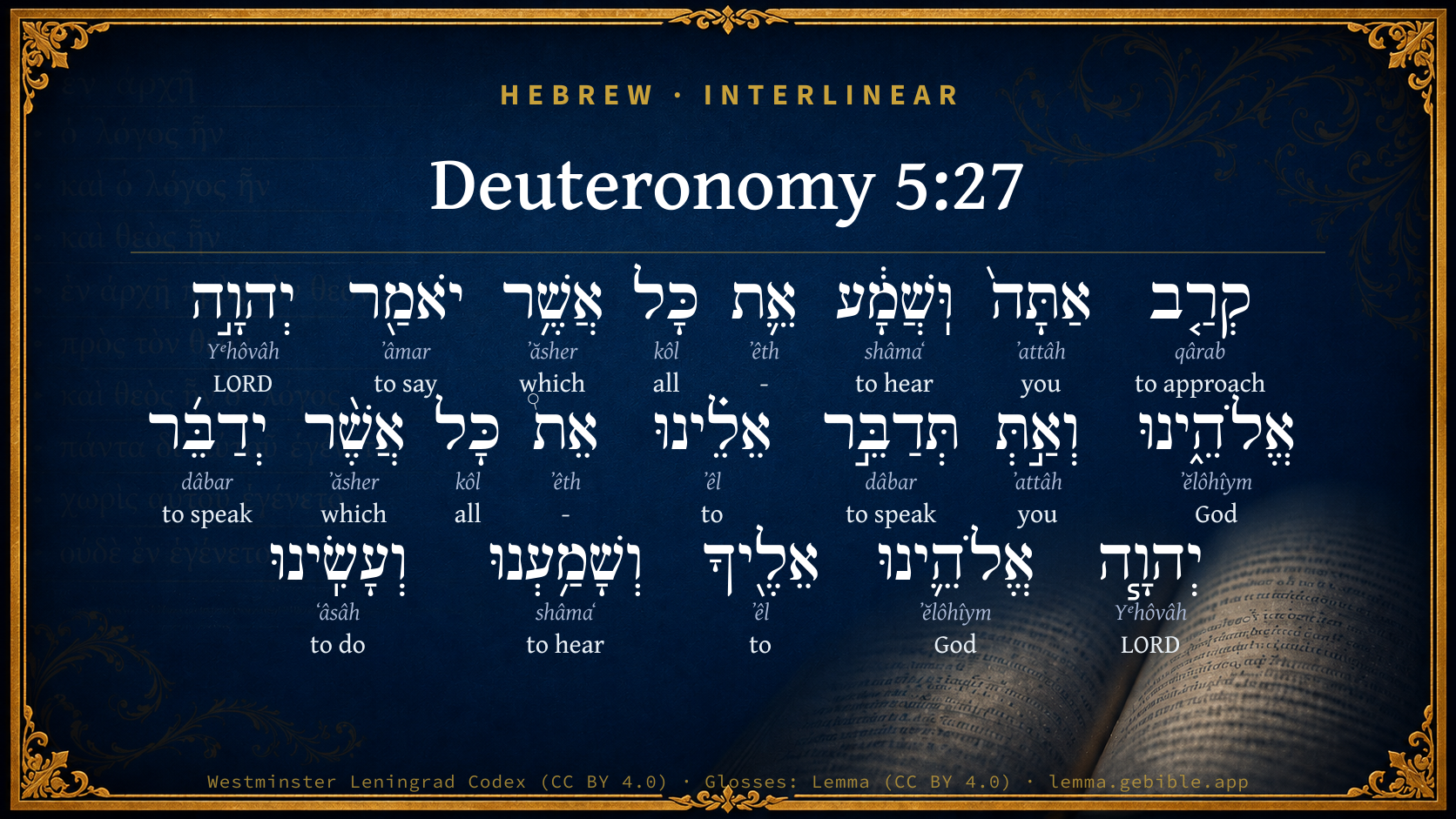
Hebrew (Westminster Leningrad Codex) Deuteronomy 5:27 appears in the Hebrew Old Testament. The text above is from the Westminster Leningrad Codex. Each word links to its Strong’s number, a concise gloss, and parsing drawn from the Open Scriptures Hebrew Bible morphology. Click any word for its full Brown-Driver-Briggs (BDB) entry.
Download image
Cite this verse

Deuteronomy 5:27 (World English Bible). Public Domain. Lemma interlinear Bible study tool, https://lemma.gebible.app/v/deuteronomy/5/27.

Show BibTeX & RIS
BibTeX
RIS
English Translation
Go you near, and hear all that Yahweh our God shall say: and speak you to us all that Yahweh our God shall speak to you; and we will hear it, and do it.
World English Bible · Public Domain
Download a study sheet

One document with this verse’s original text, its word-by-word gloss line, the meaning frame, cross-references with their text, attributed commentary, and full source and license credits — printable, and it pastes into notes with its structure intact.

This verse Autodidact and up

Study sheet (.html) Plain text (.txt)

A passage Seminary Student

Up to 50 verses in one chapter. A passage sheet keeps up to 6 commentary sources and 12 cross-references per verse, in the order this page ranks them, and says so on the sheet whenever that leaves anything out. Ask for a single verse and you get the Autodidact verse sheet above.

Everything on this page stays free to read, with no account — the sheet is a download of what is already on screen, not access to it.

Want to remove ads? Support Godless Engineer
Compare translations 3

The same verse in 3 English versions, stacked beneath the original-language interlinear above. Click any original word for its lexicon entry.

Each is an independent rendering of the whole verse — the interlinear is not word-aligned to these translations.

Highlighted words mark where these versions differ — a whole-verse word diff, not a word-by-word alignment.

  • World English Bible Public Domain
    Go you near, and hear all that Yahweh our God shall say: and speak you to us all that Yahweh our God shall speak to you; and we will hear it, and do it.
  • King James Version Public Domain
    Go thou near, and hear all that the LORD our God shall say: and speak thou unto us all that the LORD our God shall speak unto thee; and we will hear it, and do it.
  • unfoldingWord Literal Text CC BY-SA 4.0
    You approach and listen to everything that Yahweh our God says and speak to us everything that Yahweh our God says to you, and we will listen and obey.’

unfoldingWord Literal Text — © unfoldingWord, licensed CC BY-SA 4.0. Word-aligned USFM3 via Door43 (git.door43.org/unfoldingWord/en_ult).

Versions to compare (up to 4)

3 of 4 selected

Show all 18 translations

Every available English version of this verse, each an independent rendering of the whole verse.

  • World English Bible Public Domain
    Go you near, and hear all that Yahweh our God shall say: and speak you to us all that Yahweh our God shall speak to you; and we will hear it, and do it.
  • Berean Standard Bible Public Domain
    Go near and listen to all that the LORD our God says. Then you can tell us everything the LORD our God tells you; we will listen and obey.”
  • Majority Standard Bible Public Domain
    Go near and listen to all that the LORD our God says. Then you can tell us everything the LORD our God tells you; we will listen and obey.”
  • King James Version Public Domain
    Go thou near, and hear all that the LORD our God shall say: and speak thou unto us all that the LORD our God shall speak unto thee; and we will hear it, and do it.
  • American Standard Version (1901) Public Domain
    Go thou near, and hear all that Jehovah our God shall say: and speak thou unto us all that Jehovah our God shall speak unto thee; and we will hear it, and do it.
  • Revised Version (1885) Public Domain
    Go thou near, and hear all that the LORD our God shall say: and speak thou unto us all that the LORD our God shall speak unto thee; and we will hear it, and do it.
  • Geneva Bible (1599) Public Domain
    Go thou neere and heare all that the Lord our God saith: and declare thou vnto vs all that the Lord our God saith vnto thee, and we will heare it, and doe it.
  • Douay-Rheims (1899) Public Domain
    Approach thou rather: and hear all things that the Lord our God shall say to thee, and thou shalt speak to us, and we will hear and will do them.
  • Young's Literal Translation Public Domain
    Draw near thou, and hear all that which Jehovah our God saith, and thou, thou dost speak unto us all that which Jehovah our God speaketh unto thee, and we have hearkened, and done it.
  • Literal Standard Version CC BY-SA 4.0
    Draw near and hear all that which our God YHWH says, and you, you speak to us all that which our God YHWH speaks to you, and we have listened and done it.
  • Unlocked Literal Bible CC BY-SA 4.0
    As for you, you should go and listen to everything that Yahweh our God says; repeat to us everything that Yahweh our God says to you; we will listen to it and obey it.'
  • unfoldingWord Literal Text CC BY-SA 4.0
    You approach and listen to everything that Yahweh our God says and speak to us everything that Yahweh our God says to you, and we will listen and obey.’
  • Darby Bible Public Domain
    Come thou near, and hear all that Jehovah our God will say; and speak thou to us all that Jehovah our God will speak to thee; and we will hear it, and do it.
  • World Messianic Bible Public Domain
    Go near, and hear all that the LORD our God shall say, and tell us all that the LORD our God tells you; and we will hear it, and do it.”
  • Webster's Bible Public Domain
    Go thou near, and hear all that the LORD our God shall say; and speak thou to us all that the LORD our God shall speak to thee; and we will hear it, and do it.
  • Free Bible Version CC BY-SA 4.0
    You go and listen to everything the Lord our God tells you. Then you can repeat to us everything the Lord our God tells you. We promise to listen and obey.”
  • Bible in Basic English Public Domain
    Do you go near: and after hearing everything which the Lord our God has to say, give us an account of all he has said to you, and we will give ear, and do it.
  • JPS Tanakh (1917) Public Domain
    (5-24) Go thou near, and hear all that the LORD our God may say; and thou shalt speak unto us all that the LORD our God may speak unto thee; and we will hear it and do it.'

Literal Standard Version (2020), Covenant Press — licensed CC BY-SA 4.0. Text via the HelloAO Bible API (eBible.org). Unlocked Literal Bible (unfoldingWord) — licensed CC BY-SA 4.0. Text via the HelloAO Bible API (eBible.org). unfoldingWord Literal Text — © unfoldingWord, licensed CC BY-SA 4.0. Word-aligned USFM3 via Door43 (git.door43.org/unfoldingWord/en_ult). Free Bible Version, Dr. Jonathan Gallagher — licensed CC BY-SA 4.0. Text via the HelloAO Bible API (eBible.org).

Word by word

More ways to search: Search by grammar → Find every occurrence → Compare this word →

Practice this passage: Drill this verse → Learn its vocabulary →

קְרַ֤ב
qârab
H7126
“approach”
Verb, Qal, Imperative, 2nd Person, Masculine, Singular
Part of Speech
Verb
Stem
Qal
Form
Imperative
Person
2nd Person
Gender
Masculine
Number
Singular
Full BDB Definition

Origin: a primitive root

TWOT: 2065

to come near, approach, enter into, draw near - (Qal) to approach, draw near - (Niphal) to be brought near - (Piel) to cause to approach, bring near, cause to draw near - (Hiphil) to bring near, bring, present
  1. אַתָּה֙ ʼattâh H859 “you” Pronoun, Personal, 2nd Person, Masculine, Singular
  2. וּֽשֲׁמָ֔ע shâmaʻ H8085 “and · hear” Conjunction + Verb, Qal, Imperative, 2nd Person, Masculine, Singular
  3. אֵ֛ת ʼêth H853 “-” Particle, Direct Object
  4. כָּל kôl H3605 “all of” Noun, Common, Masculine, Singular, Construct
  5. אֲשֶׁ֥ר ʼăsher H834 “which” Particle, Relative
  6. יֹאמַ֖ר ʼâmar H559 “to say” Verb, Qal, Imperfect, 3rd Person, Masculine, Singular
  7. יְהוָ֣ה Yᵉhôvâh H3068 “LORD” Noun, Proper
  8. אֱלֹהֵ֑ינוּ ʼĕlôhîym H430 “God(s) · our” Noun, Common, Masculine, Plural, Construct + Suffix, Personal, 1st Person, Common, Plural
  9. וְאַ֣תְּ ʼattâh H859 “and · you” Conjunction + Pronoun, Personal, 2nd Person, Feminine, Singular
  10. תְּדַבֵּ֣ר dâbar H1696 “to speak” Verb, Piel, Imperfect, 2nd Person, Masculine, Singular
  11. אֵלֵ֗ינוּ ʼêl H413 “to · us” Preposition + Suffix, Personal, 1st Person, Common, Plural
  12. אֵת֩ ʼêth H853 “-” Particle, Direct Object
  13. כָּל kôl H3605 “all of” Noun, Common, Masculine, Singular, Construct
  14. אֲשֶׁ֨ר ʼăsher H834 “which” Particle, Relative
  15. יְדַבֵּ֜ר dâbar H1696 “to speak” Verb, Piel, Imperfect, 3rd Person, Masculine, Singular
  16. יְהוָ֧ה Yᵉhôvâh H3068 “LORD” Noun, Proper
  17. אֱלֹהֵ֛ינוּ ʼĕlôhîym H430 “God(s) · our” Noun, Common, Masculine, Plural, Construct + Suffix, Personal, 1st Person, Common, Plural
  18. אֵלֶ֖יךָ ʼêl H413 “to · you” Preposition + Suffix, Personal, 2nd Person, Masculine, Singular
  19. וְשָׁמַ֥עְנוּ shâmaʻ H8085 “and · to hear” Conjunction + Verb, Qal, Sequential Perfect, 1st Person, Common, Plural
  20. וְעָשִֽׂינוּ ʻâsâh H6213 “and · to do” Conjunction + Verb, Qal, Sequential Perfect, 1st Person, Common, Plural

About this verse

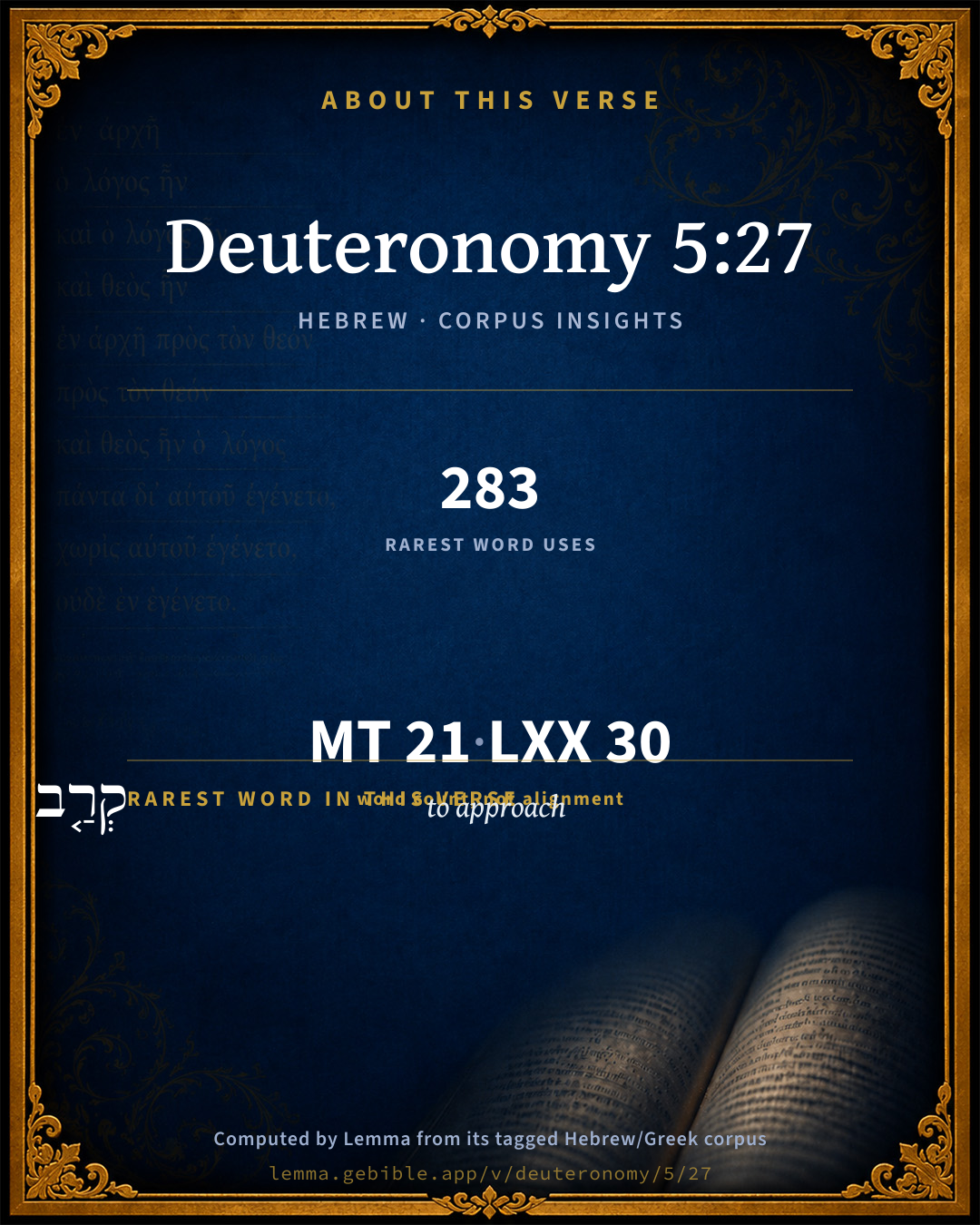
These counts appear in no published source. They are computed here, from the morphology-tagged text and Lemma’s own curated glosses. What Lemma adds →

21
words
12
distinct lemmas
Pentateuch
section

Grammatical profile

  • 7 verbs
  • 6 nouns
  • 2 pronouns
  • 2 prepositions
  • 4 particles

Verb forms

  • קְרַ֤ב Qal · Imperative
  • וּֽשֲׁמָ֔ע Qal · Imperative
  • יֹאמַ֖ר Qal · Imperfect
  • תְּדַבֵּ֣ר Piel · Imperfect
  • יְדַבֵּ֜ר Piel · Imperfect
  • וְשָׁמַ֥עְנוּ Qal · Sequential Perfect
  • וְעָשִֽׂינוּ Qal · Sequential Perfect

Repetition

Words recur within this verse — often emphatic in Hebrew:

  • וּֽשֲׁמָ֔ע to hear H8085 ×2
  • כָּל all H3605 ×2
  • יְהוָ֣ה LORD H3068 ×2
  • אֱלֹהֵ֑ינוּ God H430 ×2
  • תְּדַבֵּ֣ר to speak H1696 ×2
  • אַתָּה֙ you H859 ×2
  • אֲשֶׁ֥ר which H834 ×2
  • אֵלֵ֗ינוּ to H413 ×2

Hebrew & Septuagint length

In English translation the verse runs 34 words from the Hebrew and 37 from the Septuagint (LXX English) — closely comparable.

A rough comparison of the two English renderings, which tokenize alike — not a word-level alignment.

Word counts can differ between the Hebrew and the Greek without any difference in meaning — e.g. the Hebrew direct-object marker אֵת has no separate Greek word, and Greek often adds the article ὁ.

In the original languages it is 21 Hebrew tokens and 30 Greek tokens — but the two are counted differently (Hebrew bundles its prefixes and suffixes into one token; the Greek is in lemma form), so that isn’t a like-for-like length.

Cross-references

2

Topical passages linked to Deuteronomy 5:27 in the Treasury of Scripture Knowledge — connected by theme and wording, ordered by reader-vote popularity; previews shown in the World English Bible.

  • Exodus 20:19 They said to Moses, "Speak with us yourself, and we will listen; but don't let God speak with us, lest we die."
  • Hebrews 12:19 the sound of a trumpet, and the voice of words; which those who heard it begged that not one more word should be spoken to them,

Cross-references courtesy of OpenBible.info (CC BY 4.0).

Hebrew and Greek witnesses Masoretic Hebrew ↔ Greek Septuagint

The same verse in the two great witnesses to the Old Testament, shown verse-for-verse.

These are two independent witnesses, not word-aligned to each other, and the Septuagint is shown in lemma (dictionary) form.

Hebrew Deuteronomy 5:27 Masoretic · Westminster Leningrad Codex

קְרַ֤ב אַתָּה֙ וּֽשֲׁמָ֔ע אֵ֛ת כָּל אֲשֶׁ֥ר יֹאמַ֖ר יְהוָ֣ה אֱלֹהֵ֑ינוּ וְאַ֣תְּ תְּדַבֵּ֣ר אֵלֵ֗ינוּ אֵת֩ כָּל אֲשֶׁ֨ר יְדַבֵּ֜ר יְהוָ֧ה אֱלֹהֵ֛ינוּ אֵלֶ֖יךָ וְשָׁמַ֥עְנוּ וְעָשִֽׂינוּ

Go you near, and hear all that Yahweh our God shall say: and speak you to us all that Yahweh our God shall speak to you; and we will hear it, and do it.

World English Bible · Public Domain

Greek LXX Deuteronomy 5:27 Septuagint · lemma form

προςἔρχομαι σύ καί ἀκούω ὅσος ἐάν εἶπον κύριος ὁ θεός ἐγώ καί σύ λαλέω πρός ἐγώ πᾶς ὅσος ἄν λαλέω κύριος ὁ θεός ἐγώ πρός σύ καί ἀκούω καί ποιέω

Do you draw near, and hear all that the Lord our God shall say, and you shall speak to us all things whatever the Lord our God shall speak to you, and we will hear, and do.

LXX2012 (modern English Septuagint) · Public Domain

Hebrew: Westminster Leningrad Codex (CC BY 4.0). Greek: Septuagint (public domain); English from LXX2012 (modern English Septuagint) (Public Domain). How the Septuagint differs from the Hebrew →

Targum (Aramaic paraphrase)

2

The Targum is the ancient Jewish Aramaic paraphrase of the Hebrew Scriptures — an interpretive translation, not the Hebrew text itself. Onkelos (literal) and Pseudo-Jonathan (expansive) render the Torah, and Jonathan the Prophets. Coverage is partial: where no permissively-licensed English translation exists for a verse, only the Aramaic is shown. This is verse-level text, not a word-by-word alignment to the Hebrew.

  1. Targum Onkelos Torah (Genesis–Deuteronomy)
    אִזֵל אֱמַר לְהוֹן תּוּבוּ לְכוֹן לְמַשְׁכְּנֵיכוֹן

    (no public-domain English translation for this verse)

    Targum Onkelos — Aramaic: “Onkelos Genesis” (public domain); “Onkelos Exodus” (public domain); “Onkelos Leviticus” (public domain); “Onkelos Numbers” (public domain); “Onkelos Deuteronomy” (public domain). English: “Sefaria Community Translation” (CC0 1.0 (public-domain dedication)); “J.W. Etheridge. The Targums of Onkelos and Jonathan Ben Uzziel on the Pentateuch. London: Longmans, Green, 1862” (public domain). Text via Sefaria.

  2. Targum Pseudo-Jonathan Torah (Genesis–Deuteronomy)
    אִיזֵל אֵימַר לְהוֹן שָׁרֵי לְכוֹן לְאִזְדַוְוגָא עִם נְשֵׁיכוֹן דְּאִתְפַּרַשְׁתּוּן דְּנַן תְּלָתָא יוֹמִין

    {Go, say to them: he has permitted you to join with your wives since you have been separated three days.}

    Targum Pseudo-Jonathan — Aramaic: “Targum Jonathan on Genesis” (public domain); “Targum Jonathan on Exodus” (public domain); “Targum Jonathan on Leviticus” (public domain); “Targum Jonathan on Numbers” (public domain); “Targum Jonathan on Deuteronomy” (public domain). English: “The Targum of Jonathan ben Uzziel, trans. J. W. Etheridge, London, 1862” (public domain). Text via Sefaria.

Commentary

Notes on Deuteronomy 5:27 from classic Christian and Jewish commentators (each source and its license shown beneath its notes). The classic Christian expositions comment on the surrounding passage and are grouped to its opening verse, so a note may address several verses; the Jewish commentaries on the Tanakh (Rashi and others) are per-verse, so they appear only where the commentator wrote on this verse.

Lemma curates 59 commentaries, every one of them public domain or Creative Commons licensed, each selected and text-cleaned for this edition rather than reprinted as found. About our sources →

Trapp's Complete Commentary

John Trapp

Deu 5:27 Go thou near, and hear all that the LORD our God shall say: and speak thou unto us all that the LORD our God shall speak unto thee; and we will hear [it], and do [it].

Ver. 27. We will hear it and do it.] This is well said if as well done. Many can think of nothing but working themselves to life, spinning a thread of their own to climb up to heaven by. But that will never be.

John Trapp, A Commentary or Exposition upon All the Books of the Old and New Testament (1647–1656) — public domain. Text from a community e-Sword module.

The Biblical Illustrator

Joseph S. Exell

Deu_5:27

Speak thou unto us all that the Lord our God shall speak unto thee.

The duty of ministers

I. It is his special business and privilege to approach with frequency into the presence of God, and to keep up an intimate and familiar intercourse with Him, that he may obtain enlarged disclosures of His will, and receive fuller manifestations of His character and excellence.

1. That one and the principal source of their information in reference to Divine things, is the inspired Word of God.

2. The Christian minister is to go near, and hear what the Lord God says, by a close and enlightened attention to the dispensations of Providence.

3. The Christian minister is to go near, and hear what the Lord God says, in the frequent and fervent exercise of secret prayer.

II. The other department of duty attached to the ministerial office, as suggested by the text, is the declaration of the mind of God to the people.

1. He is to speak unto the people only what God speaks unto him.

2. He is to speak all that God speaks to him. He must away with that base, time-serving principle, that would smooth down, or expunge altogether, the holy truths of God, to meet the vitiated tastes of degenerate men. (Alex. Fisher.)

Israels commendable request

I. It bespoke just feelings of Gods terrible majesty, and their own littleness. It was the beginning of a right acquaintance with Him. The meeting at Sinai was a corrective at once for profane indifference and self-righteous security; it exhibited what God was. They had hitherto heard of Him by the hearing of the ear, but then their eyes saw Him; they were abashed and trembled. Who among the listening myriads could harbour light thoughts of Him with that quaking mountain in their sight, and that voice rolling in their ears? Who among them but must have felt his self-importance annihilated in that blaze of glory, and the conviction filling all his soul, that men could not be profitable unto God, nor was it any gain to Him that they made their ways perfect? The majesty of Jehovah burst upon them in its true proportions and splendour. Was it any wonder that they removed and stood afar off? Was it not a proper feeling that led them to retire from the presence, fearful, submissive, and adoring?

II. It was further agreeable to God because it bespoke a new formed conviction of the strictness, dignity, and purity of the Divine law. The imperfect knowledge of God in which they had hitherto lived must have been attended with very false or defective notions concerning the requirements of the law and the measure of their own obedience. It is hard to say what their views upon the subject may have been, but it is not unwarrantable to suppose that they did not differ herein from their fellow sinners of all times, whose error it has always been to underrate the demands made on them, and to overrate their own payment of obedience. One thing is certain, that they have first discovered an unbending strictness in the law for which they were not prepared, a minute and severe exaction which astonished and confounded them. Before this, their ideas of obedience might have been lax--a few transgressions seeming of little importance; and provision, they might have thought, was made in the law for human weakness, so as to admit to the credit of the doers of the law all not stained with gross crimes or perverse immoralities. But a far better lesson was taught them when they were brought forth by Moses to meet with God: they learned that sin of any the smallest kind, in thought even, was a transgression of the law, and that every sin was capital. Commandment after commandment, as it came from Gods voice, only confirmed their condemnation. Overcome with alarm, fearing lest each successive declaration of His will should be the reiteration of their doom, they took advantage of the first pause, and eagerly requested to be relieved from their most uncomfortable condition.

III. The chief propriety of the Israelites request lay in this: that it bespoke their sense of the necessity of a mediator--of someone to go between them and the dread Majesty of Heaven. Conscious that their sins had separated them from their God, they desired one to be the channel of free, unrestrained communion with Him; one who, without the terrors of the Godhead, could make known the Divine will as he should receive commandment, and take back to the Eternal their submission and their requests. Accordingly, because they could not think of a better, they selected Moses for this office. But the wisdom of Jehovah knew better how to supply their need, and shortly after made known to them His intentions in this matter (Deu_18:15). You know that our Lord Jesus Christ gave ample proof that He was this prophet who should come into the world. He is the only one who can effectually mediate between guilty man and his offended God. Moses exceedingly feared; but Jesus cannot be disturbed by the awfulness of His own Godhead; yet He has veiled that Godhead in our human nature, that we may come with boldness to the throne of grace, no longer panic-struck by the sight of Sinai. He can best speak to us the things that God shall say, for He is in the Father, and the Father in Him. Such a Mediator God has given, according to His promise; and, because a sense of our need of a Saviour is the best preparation for accepting the Saviour, God approved the words in which the Israelites expressed such a sense. (R. Henderson, M. A.)

We will hear it and do it.--

The duty of hearers

1. That it is their duty to hear, by which we mean it is their duty to place themselves within the reach of hearing, the Gospel; that is, it is incumbent on them to be regular in their attendance upon public ordinances.

2. That it is their duty to hear with attention. Iris incumbent on them to collect their scattered thoughts, and ridding their minds of subjects of inferior weight, to direct them with perseverance to the truths which they assemble to hear.

3. That it is their duty to hear with candour. It is enjoined upon us to divest ourselves of all prejudices and partial affections, whether in reference to the truths that are set before us, or to the person that declares them; that it is our duty to avoid captiousness and disingenuity, and to hear with sincerity of mind all that the Lord God says.

4. That it is their duty to hear with faith. We must believe the record that God has given of His Son.

5. That it is their duty to hear with a view to obedience. We will hear, said the Israelites, and do it. Christianity is throughout a practical system. Though the method of salvation which it reveals is entirely of grace, and accomplished by Divine agency, to the utter exclusion of human merit, it nevertheless does enjoin unreserved obedience to the Divine law, and furnishes motives of the greatest efficacy to dispose us to yield it. (Alex Fisher.)

The pastors question and the peoples answer

I. The pastors question. What shall I say unto theme (Exo_3:18.) The Christian minister is an agent, not a principal. He is a messenger charged with the delivery of a message; but he does not originate that message, he receives it at the hand of another, and he is only responsible for its faithful delivery. This was the ease with Moses: The God of your fathers hath sent me unto you.

(1) What are the essential truths which Scripture reveals to us, and which it is absolutely necessary for us to know?

(2) What proportion do these truths bear to one another, and also to other truths not essential? What is their relative magnitude and importance?

(3) How may the several truths be harmonised? Again, Scripture occupies itself with two great thoughts: the one having man as its centre; the other God. The thought concerning man is concerning man as a sinner: the thought concerning God is concerning God as a Saviour: and the two streams of thought unite in the further idea, that, namely, of salvation. Thus, to the pastors question, What shall I say unto him? answer may be given thus. Declare to thy people, on the authority of God, their responsibility as men, and their ruin as sinners. But it is not enough that man should know himself as a sinner; such knowledge, if it stand alone, can issue only in despair. God has revealed Himself not only as a just God, but also and emphatically as a Saviour.

II. The peoples answer. Our responsibility is a joint responsibility. So far as we faithfully expound Gods Word to our people, they are to receive it not as the word of men, but, as it is in truth, the Word of God. Now this implies that they hear--

1. Willingly. Not because custom requires or respectability demands.

2. Attentively. The willing hearer is commonly an attentive hearer. Lydia attended unto the things which were spoken of Paul.

3. Thoughtfully. Attention is one thing, thought is another.

4. Honestly, by which I mean without prejudice, with a single desire to know the will of God, and with the fearless unreserved purpose of doing it when known. We will hear it and do it.

5. Prayerfully. Apart from the Divine blessing and the teaching of the Holy Spirit we preach and we hear in vain. And for that Divine gift we must pray. (E. Bayley, D. D.)

The Biblical Illustrator, edited by Joseph S. Exell (c. 1880s–1900s) — public domain. Text from a community e-Sword module.

The Cambridge Bible for Schools and Colleges

gen. ed. J. J. S. Perowne

27. Go thou near] The technical term for approach to the Deity, and to His representatives (Deu_5:23 and Deu_1:22). E, using another verb, has and Moses drew near (Exo_20:21). For the rest of the verse E has simply Speak thou with us and we shall hearken (Exo_20:19).

The Cambridge Bible for Schools and Colleges (gen. ed. J. J. S. Perowne; Cambridge University Press, 1878–1918) — public domain. Text from a community e-Sword module.

John Gill's Exposition

Go say to them, get you into your tents again. Which they had left, being brought by Moses, at the direction of God, to the foot of Mount Sinai, to receive the law from his mouth; this being done, they are ordered to return to their tents again, to their families, wives, and children.

Go say to them, get you into your tents again. Which they had left, being brought by Moses, at the direction of God, to the foot of Mount Sinai, to receive the law from his mouth; this being done, they are ordered to return to their tents again, to their families, wives, and children.

Deuteronomy 5:31

deu 5:31

deu 5:31

deu 5:31But as for thee, stand thou here by me,.... On the mount by him whither he was called up; Moses was not permitted to go to his tent when the children of Israel were, but was ordered to wait upon the Lord to receive instructions from him, which he was to communicate to the people, being a kind of a mediator between God and them, as they requested, and which was granted them:

and I will speak unto thee all the commandments, and the statutes, and the judgments: all laws, moral, ceremonial, and judicial, which belong to them as men, as in a church state, and members of a body politic:

which thou shalt teach them, that they may do them; for all doctrine is in order to practice, without which all instructions, and theoretical notions, signify little: and these they were more especially to do, and some of them peculiarly:

in the land which I give them to possess it: the land of Canaan, and which laid on them no small obligation to do the commandments of God; since of his free favour and good will, and as a pure gift of his, he had bestowed upon them a land flowing with milk and honey, into which he was just now about to bring them; as nothing can more strongly engage souls to a cheerful obedience to the service of God, whether in private or in public, than the consideration of the great and good things which God of his rich grace bestows upon them, and has promised to them, and prepared for them, and will quickly put them into the possession of; and upon such an account Moses presses the observance of the commands of God in the following verses.

John Gill's Exposition of the Whole Bible (1746–1763) — public domain (CC PDM 1.0). Text via the HelloAO Bible API.

Lesson kit

Teaching starters — assembled from the data on this page, not authored interpretation. Every prompt links to the verse data it draws on. Edit before teaching.

Deuteronomy, in the Pentateuch, opens this verse with 21 words (12 distinct Hebrew lemmas). Its most distinctive word is qârab (“to approach”). A historical commentator’s framing appears above. Read the whole chapter for the surrounding context.

Discussion questions

  1. The word qârab carries the sense “to approach.” How does it shape the verse?
  2. How does Exodus 20:19, which shares this passage’s theme, read alongside this verse?
  3. What does the repetition of “to hear” (2× in this one verse) do in this verse?
  4. The translations on this page render this verse differently — a whole-verse word diff, not a word-by-word alignment. What might account for the different wordings?
  5. «קְרַ֤ב» is a Qal Imperative verb. How does that grammatical form shape the action described?
  6. Compare how Trapp's Complete Commentary and The Biblical Illustrator read this verse. Where do they agree or differ?

Things to notice

Reading settings

Reading text

Shown beneath each verse's original-language words.

Old Testament
Old Testament edition

Read the OT as the Masoretic Hebrew (MT) or the Greek Septuagint (LXX).

English shown for the Greek Septuagint (in the Hebrew ↔ Greek comparison).

Comparing translations? Open the Compare panel on any verse page to stack up to four side by side.