
Numbers 6:14

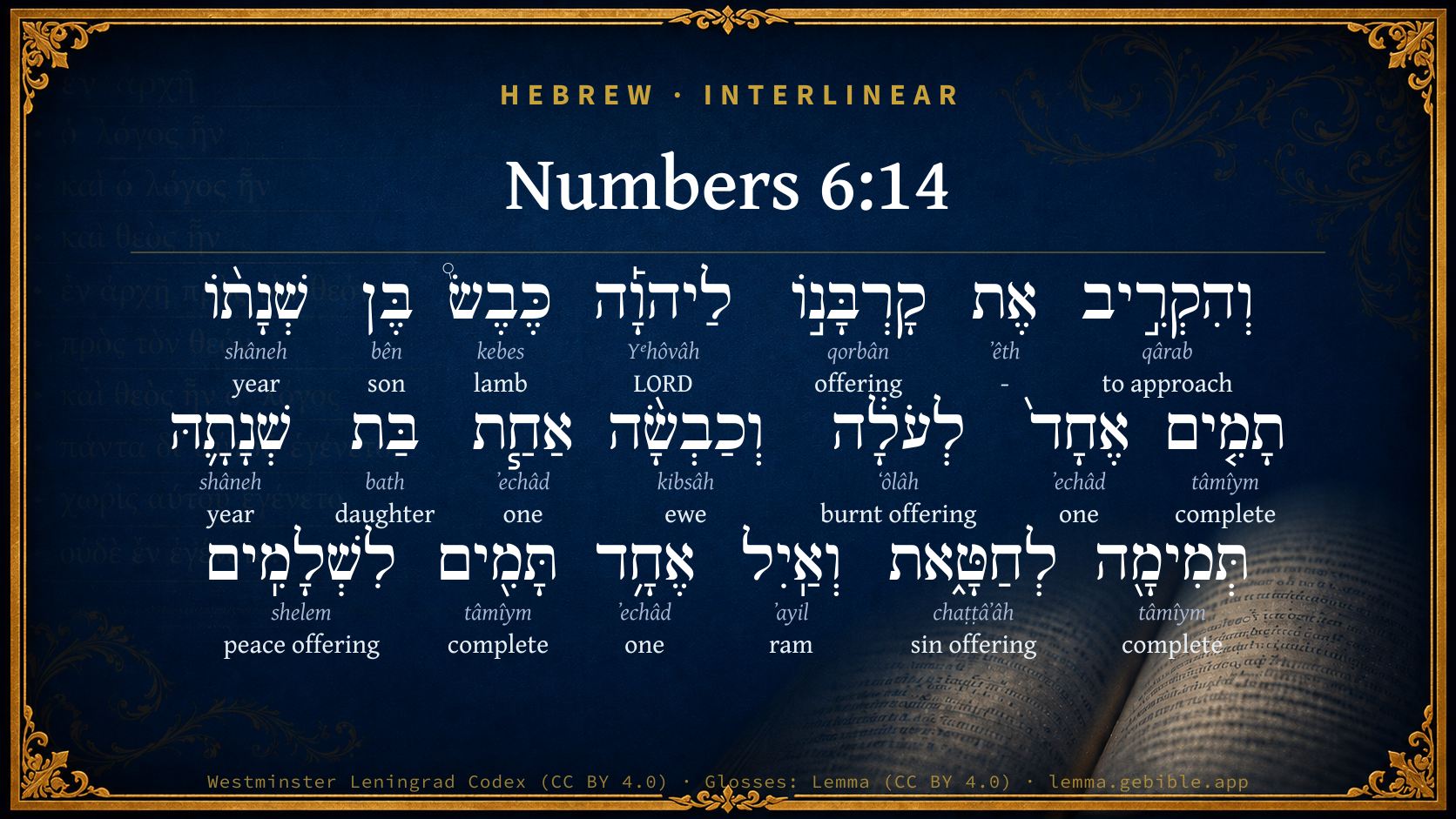
Hebrew (Westminster Leningrad Codex) Numbers 6:14 appears in the Hebrew Old Testament. The text above is from the Westminster Leningrad Codex. Each word links to its Strong’s number, a concise gloss, and parsing drawn from the Open Scriptures Hebrew Bible morphology. Click any word for its full Brown-Driver-Briggs (BDB) entry.
Download image
Cite this verse

Numbers 6:14 (World English Bible). Public Domain. Lemma interlinear Bible study tool, https://lemma.gebible.app/v/numbers/6/14.

Show BibTeX & RIS
BibTeX
RIS
English Translation
and he shall offer his offering to Yahweh, one male lamb a year old without blemish for a burnt offering, and one ewe lamb a year old without blemish for a sin offering, and one ram without blemish for peace offerings,
World English Bible · Public Domain
Download a study sheet

One document with this verse’s original text, its word-by-word gloss line, the meaning frame, cross-references with their text, attributed commentary, and full source and license credits — printable, and it pastes into notes with its structure intact.

This verse Autodidact and up

Study sheet (.html) Plain text (.txt)

A passage Seminary Student

Up to 50 verses in one chapter. A passage sheet keeps up to 6 commentary sources and 12 cross-references per verse, in the order this page ranks them, and says so on the sheet whenever that leaves anything out. Ask for a single verse and you get the Autodidact verse sheet above.

Everything on this page stays free to read, with no account — the sheet is a download of what is already on screen, not access to it.

Want to remove ads? Support Godless Engineer
Compare translations 3

The same verse in 3 English versions, stacked beneath the original-language interlinear above. Click any original word for its lexicon entry.

Each is an independent rendering of the whole verse — the interlinear is not word-aligned to these translations.

Highlighted words mark where these versions differ — a whole-verse word diff, not a word-by-word alignment.

  • World English Bible Public Domain
    and he shall offer his offering to Yahweh, one male lamb a year old without blemish for a burnt offering, and one ewe lamb a year old without blemish for a sin offering, and one ram without blemish for peace offerings,
  • King James Version Public Domain
    And he shall offer his offering unto the LORD, one he lamb of the first year without blemish for a burnt offering, and one ewe lamb of the first year without blemish for a sin offering, and one ram without blemish for peace offerings,
  • unfoldingWord Literal Text CC BY-SA 4.0
    and he shall present his offering to Yahweh: one perfect male lamb, a son of his year, for a burnt offering; and one perfect female lamb, a daughter of her year, for a sin offering; and one perfect ram for a peace offering;

unfoldingWord Literal Text — © unfoldingWord, licensed CC BY-SA 4.0. Word-aligned USFM3 via Door43 (git.door43.org/unfoldingWord/en_ult).

Versions to compare (up to 4)

3 of 4 selected

Show all 18 translations

Every available English version of this verse, each an independent rendering of the whole verse.

  • World English Bible Public Domain
    and he shall offer his offering to Yahweh, one male lamb a year old without blemish for a burnt offering, and one ewe lamb a year old without blemish for a sin offering, and one ram without blemish for peace offerings,
  • Berean Standard Bible Public Domain
    and he is to present an offering to the LORD of an unblemished year-old male lamb as a burnt offering, an unblemished year-old female lamb as a sin offering, and an unblemished ram as a peace offering—
  • Majority Standard Bible Public Domain
    and he is to present an offering to the LORD of an unblemished year-old male lamb as a burnt offering, an unblemished year-old female lamb as a sin offering, and an unblemished ram as a peace offering—
  • King James Version Public Domain
    And he shall offer his offering unto the LORD, one he lamb of the first year without blemish for a burnt offering, and one ewe lamb of the first year without blemish for a sin offering, and one ram without blemish for peace offerings,
  • American Standard Version (1901) Public Domain
    and he shall offer his oblation unto Jehovah, one he-lamb a year old without blemish for a burnt-offering, and one ewe-lamb a year old without blemish for a sin-offering, and one ram without blemish for peace-offerings,
  • Revised Version (1885) Public Domain
    and he shall offer his oblation unto the LORD, one he-lamb of the first year without blemish for a burnt offering, and one ewe-lamb of the first year without blemish for a sin offering, and one ram without blemish for peace offerings,
  • Geneva Bible (1599) Public Domain
    And hee shall bring his offering vnto the Lord, an hee lambe of a yeere olde without blemish for a burnt offering, and a shee lambe of a yere olde without blemish for a sinne offring, and a ramme without blemish for peace offrings,
  • Douay-Rheims (1899) Public Domain
    And shall offer his oblation to the Lord: one he lamb of a year old without blemish for a holocaust, and one awe lamb of a year old without blemish for a sin offering, and one ram without blemish for a victim of peace offering,
  • Young's Literal Translation Public Domain
    and he hath brought near his offering to Jehovah, one he-lamb, a son of a year, a perfect one, for a burnt-offering, and one she-lamb, a daughter of a year, a perfect one, for a sin-offering, and one ram, a perfect one, for peace-offerings,
  • Literal Standard Version CC BY-SA 4.0
    and he has brought his offering near to YHWH—one male lamb, a son of a year, a perfect one, for a burnt-offering, and one female lamb, a daughter of a year, a perfect one, for a sin-offering, and one ram, a perfect one, for peace-offerings,
  • Unlocked Literal Bible CC BY-SA 4.0
    He must present his offering to Yahweh. He must offer as a burnt offering a male lamb one year old and without blemish. He must bring as a sin offering a female lamb one year old and without blemish. He must bring a ram as a fellowship offering that is without blemish.
  • unfoldingWord Literal Text CC BY-SA 4.0
    and he shall present his offering to Yahweh: one perfect male lamb, a son of his year, for a burnt offering; and one perfect female lamb, a daughter of her year, for a sin offering; and one perfect ram for a peace offering;
  • Darby Bible Public Domain
    And he shall present his offering to Jehovah, one yearling he-lamb without blemish for a burnt-offering, and one yearling ewe-lamb without blemish for a sin-offering, and one ram without blemish for a peace-offering;
  • World Messianic Bible Public Domain
    and he shall offer his offering to the LORD: one male lamb a year old without defect for a burnt offering, one ewe lamb a year old without defect for a sin offering, one ram without defect for peace offerings,
  • Webster's Bible Public Domain
    And he shall offer his offering to the LORD, one he-lamb of the first year without blemish for a burnt-offering, and one ewe-lamb of the first year without blemish for a sin-offering, and one ram without blemish for peace-offerings,
  • Free Bible Version CC BY-SA 4.0
    There they are to present an offering to the Lord of a one-year-old male lamb without defects as a burnt offering, a one-year-old female lamb without defects as a sin offering, and a ram without defects as a peace offering.
  • Bible in Basic English Public Domain
    And make his offering to the Lord; one he-lamb of the first year, without a mark, for a burned offering, and one female lamb of the first year, without a mark, for a sin-offering, and one male sheep, without a mark, for peace-offerings,
  • JPS Tanakh (1917) Public Domain
    and he shall present his offering unto the LORD, one he-lamb of the first year without blemish for a burnt-offering, and one ewe-lamb of the first year without blemish for a sin-offering, and one ram without blemish for peace-offerings,

Literal Standard Version (2020), Covenant Press — licensed CC BY-SA 4.0. Text via the HelloAO Bible API (eBible.org). Unlocked Literal Bible (unfoldingWord) — licensed CC BY-SA 4.0. Text via the HelloAO Bible API (eBible.org). unfoldingWord Literal Text — © unfoldingWord, licensed CC BY-SA 4.0. Word-aligned USFM3 via Door43 (git.door43.org/unfoldingWord/en_ult). Free Bible Version, Dr. Jonathan Gallagher — licensed CC BY-SA 4.0. Text via the HelloAO Bible API (eBible.org).

Word by word

More ways to search: Search by grammar → Find every occurrence → Compare this word →

Practice this passage: Drill this verse → Learn its vocabulary →

וְכַבְשָׂ֨ה
kibsâh
H3535
“and · ewe”
Conjunction + Noun, Common, Feminine, Singular, Absolute
Part of Speech
Conjunction + Noun
Type
Common
Gender
Feminine
Number
Singular
State
Absolute
Full BDB Definition

Origin: from H3532

TWOT: 950

ewe-lamb, lamb
  1. וְהִקְרִ֣יב qârab H7126 “and · to approach” Conjunction + Verb, Hiphil, Sequential Perfect, 3rd Person, Masculine, Singular
  2. אֶת ʼêth H853 “-” Particle, Direct Object
  3. קָרְבָּנ֣וֹ qorbân H7133 “offering · his” Noun, Common, Masculine, Singular, Construct + Suffix, Personal, 3rd Person, Masculine, Singular
  4. לַיהוָ֡ה Yᵉhôvâh H3068 “to/for · LORD” Preposition + Noun, Proper
  5. כֶּבֶשׂ֩ kebes H3532 “lamb” Noun, Common, Masculine, Singular, Absolute
  6. בֶּן bên H1121 “son of” Noun, Common, Masculine, Singular, Construct
  7. שְׁנָת֨וֹ shâneh H8141 “year · his” Noun, Common, Feminine, Singular, Construct + Suffix, Personal, 3rd Person, Masculine, Singular
  8. תָמִ֤ים tâmîym H8549 “complete” Adjective, Adjective, Masculine, Singular, Absolute
  9. אֶחָד֙ ʼechâd H259 “one” Adjective, Cardinal number, Masculine, Singular, Absolute
  10. לְעֹלָ֔ה ʻôlâh H5930 “to/for · burnt offering” Preposition + Noun, Common, Feminine, Singular, Absolute
  11. אַחַ֧ת ʼechâd H259 “one” Adjective, Cardinal number, Feminine, Singular, Absolute
  12. בַּת bath H1323 “daughter of” Noun, Common, Feminine, Singular, Construct
  13. שְׁנָתָ֛הּ shâneh H8141 “year · her” Noun, Common, Feminine, Singular, Construct + Suffix, Personal, 3rd Person, Feminine, Singular
  14. תְּמִימָ֖ה tâmîym H8549 “complete” Adjective, Adjective, Feminine, Singular, Absolute
  15. לְחַטָּ֑את chaṭṭâʼâh H2403 “to/for · sin offering” Preposition + Noun, Common, Feminine, Singular, Absolute
  16. וְאַֽיִל ʼayil H352 “and · ram” Conjunction + Noun, Common, Masculine, Singular, Absolute
  17. אֶחָ֥ד ʼechâd H259 “one” Adjective, Cardinal number, Masculine, Singular, Absolute
  18. תָּמִ֖ים tâmîym H8549 “complete” Adjective, Adjective, Masculine, Singular, Absolute
  19. לִשְׁלָמִֽים shelem H8002 “to/for · peace offerings” Preposition + Noun, Common, Masculine, Plural, Absolute

About this verse

These counts appear in no published source. They are computed here, from the morphology-tagged text and Lemma’s own curated glosses. What Lemma adds →

20
words
15
distinct lemmas
Pentateuch
section

Notable vocabulary

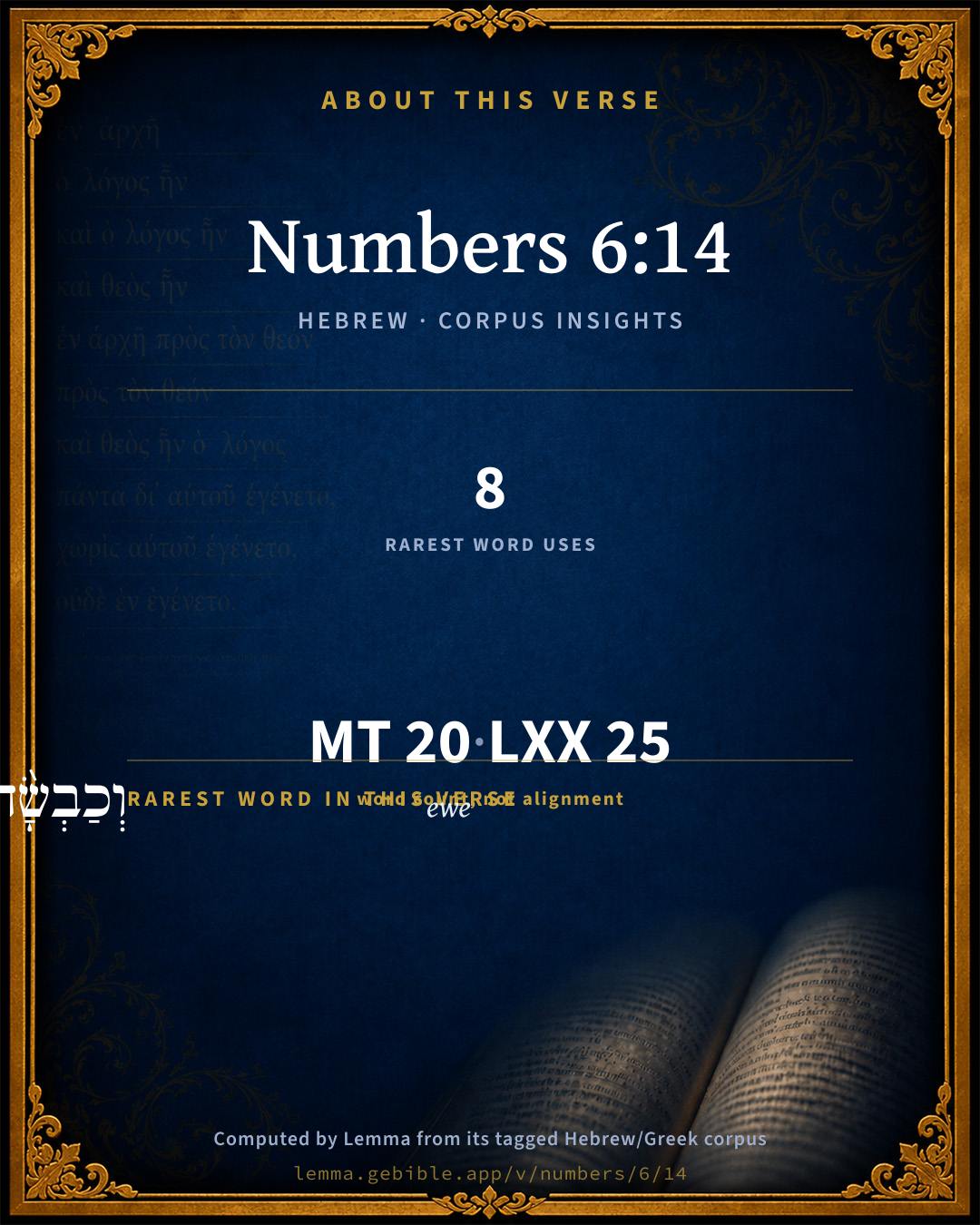
The rarest word here is וְכַבְשָׂ֨ה ewe H3535 — appearing just 8 times in the whole Hebrew Bible.

Shared distinctive vocabulary

וְכַבְשָׂ֨ה ewe H3535 occurs in 8 verses of the Hebrew Bible. Also found in:

Grammatical profile

  • 1 verb
  • 12 nouns
  • 6 adjectives
  • 1 particle

Verb forms

  • וְהִקְרִ֣יב Hiphil · Sequential Perfect

Repetition

Words recur within this verse — often emphatic in Hebrew:

  • תָמִ֤ים complete H8549 ×3
  • אֶחָד֙ one H259 ×3
  • שְׁנָת֨וֹ year H8141 ×2

Hebrew & Septuagint length

In English translation the verse runs 41 words from the Hebrew and 42 from the Septuagint (LXX English) — closely comparable.

A rough comparison of the two English renderings, which tokenize alike — not a word-level alignment.

Word counts can differ between the Hebrew and the Greek without any difference in meaning — e.g. the Hebrew direct-object marker אֵת has no separate Greek word, and Greek often adds the article ὁ.

In the original languages it is 20 Hebrew tokens and 25 Greek tokens — but the two are counted differently (Hebrew bundles its prefixes and suffixes into one token; the Greek is in lemma form), so that isn’t a like-for-like length.

Cross-references

11

Topical passages linked to Numbers 6:14 in the Treasury of Scripture Knowledge — connected by theme and wording, ordered by reader-vote popularity; previews shown in the World English Bible.

  • Leviticus 3:6 "'If his offering for a sacrifice of peace offerings to Yahweh is from the flock; male or female, he shall offer it without blemish.
  • Leviticus 4:32 "'If he brings a lamb as his offering for a sin offering, he shall bring a female without blemish.
  • Leviticus 1:10–13 "'If his offering is from the flock, from the sheep, or from the goats, for a burnt offering, he shall offer a male without blemish.
  • Leviticus 4:2–3 "Speak to the children of Israel, saying, 'If anyone sins unintentionally, in any of the things which Yahweh has commanded not to be done, and does any one of them:
  • Leviticus 4:27 "'If anyone of the common people sins unwittingly, in doing any of the things which Yahweh has commanded not to be done, and is guilty;
  • Leviticus 14:10 "On the eighth day he shall take two male lambs without blemish, and one ewe lamb a year old without blemish, and three tenths of an ephah of fine flour for a meal offering, mingled with oil, and one log of oil.
  • Numbers 15:27 If one person sin unwittingly, then he shall offer a female goat a year old for a sin-offering.
  • 1 Chronicles 15:26 It happened, when God helped the Levites who bore the ark of the covenant of Yahweh, that they sacrificed seven bulls and seven rams.
  • 1 Chronicles 15:28–29 Thus all Israel brought up the ark of the covenant of Yahweh with shouting, and with sound of the cornet, and with trumpets, and with cymbals, sounding aloud with psalteries and harps.
  • Malachi 1:13–14 You say also, 'Behold, what a weariness it is!' and you have sniffed at it," says Yahweh of Hosts; "and you have brought that which was taken by violence, the lame, and the sick; thus you bring the offering. Should I accept this at your hand?" says Yahweh.
  • 1 Peter 1:19 but with precious blood, as of a lamb without spot, the blood of Christ;

Cross-references courtesy of OpenBible.info (CC BY 4.0).

Hebrew and Greek witnesses Masoretic Hebrew ↔ Greek Septuagint

The same verse in the two great witnesses to the Old Testament, shown verse-for-verse.

These are two independent witnesses, not word-aligned to each other, and the Septuagint is shown in lemma (dictionary) form.

Hebrew Numbers 6:14 Masoretic · Westminster Leningrad Codex

וְהִקְרִ֣יב אֶת קָרְבָּנ֣וֹ לַיהוָ֡ה כֶּבֶשׂ֩ בֶּן שְׁנָת֨וֹ תָמִ֤ים אֶחָד֙ לְעֹלָ֔ה וְכַבְשָׂ֨ה אַחַ֧ת בַּת שְׁנָתָ֛הּ תְּמִימָ֖ה לְחַטָּ֑את וְאַֽיִל אֶחָ֥ד תָּמִ֖ים לִשְׁלָמִֽים

and he shall offer his offering to Yahweh, one male lamb a year old without blemish for a burnt offering, and one ewe lamb a year old without blemish for a sin offering, and one ram without blemish for peace offerings,

World English Bible · Public Domain

Greek LXX Numbers 6:14 Septuagint · lemma form

καί προςἄγω ὁ δῶρον αὐτός κύριος ἀμνός ἐνιαύσιος ἄμωμος εἷς εἰς ὁλοκαύτωσις καί ἀμνάς ἐνιαύσιος ἄμωμος εἷς εἰς ἁμαρτία καί κριός εἷς ἄμωμος εἰς σωτήριον

And he shall bring his gift to the Lord; one he-lamb of a year old without blemish for a whole burnt offering, and one ewe-lamb of a year old without blemish for a sin-offering, and one ram without blemish for a peace-offering;

LXX2012 (modern English Septuagint) · Public Domain

On this verse, The Cambridge Bible for Schools and Colleges discusses the Septuagint’s reading. Read the note in Commentary ↓

Hebrew: Westminster Leningrad Codex (CC BY 4.0). Greek: Septuagint (public domain); English from LXX2012 (modern English Septuagint) (Public Domain). How the Septuagint differs from the Hebrew →

Targum (Aramaic paraphrase)

2

The Targum is the ancient Jewish Aramaic paraphrase of the Hebrew Scriptures — an interpretive translation, not the Hebrew text itself. Onkelos (literal) and Pseudo-Jonathan (expansive) render the Torah, and Jonathan the Prophets. Coverage is partial: where no permissively-licensed English translation exists for a verse, only the Aramaic is shown. This is verse-level text, not a word-by-word alignment to the Hebrew.

  1. Targum Onkelos Torah (Genesis–Deuteronomy)
    וִיקָרֵב יָת קֻרְבָּנֵהּ קֳדָם יְיָ אִמַר בַּר שַׁתֵּהּ שְׁלִים חַד לַעֲלָתָא וְאִמַרְתָּא חֲדָא בַּת שַׁתָּהּ שְׁלֶמְתָּא לְחַטָאתָא וּדְכַר חַד שְׁלִים לְנִכְסַת קוּדְשַׁיָא

    (no public-domain English translation for this verse)

    Targum Onkelos — Aramaic: “Onkelos Genesis” (public domain); “Onkelos Exodus” (public domain); “Onkelos Leviticus” (public domain); “Onkelos Numbers” (public domain); “Onkelos Deuteronomy” (public domain). English: “Sefaria Community Translation” (CC0 1.0 (public-domain dedication)); “J.W. Etheridge. The Targums of Onkelos and Jonathan Ben Uzziel on the Pentateuch. London: Longmans, Green, 1862” (public domain). Text via Sefaria.

  2. Targum Pseudo-Jonathan Torah (Genesis–Deuteronomy)
    וְיַקְרִיב יַת קוּרְבָּנֵיהּ קֳדָם יְיָ אִימַר בַּר שַׁתֵּיהּ שְׁלִים חָד לַעֲלָתָא וְאִימַרְתָּא חֲדָא בְּרַת שַׁתָּא שְׁלֵימְתָּא לְחַטָאתָא וּדְכַר חַד שְׁלִים לְנִכְסַת קוּדְשַׁיָא

    and bring his oblation before the Lord, one lamb of the year unblemished for a burnt offering, and one ewe Iamb of the year unblemished for a sin offering, and one ram unblemished for the consecrated oblation;

    Targum Pseudo-Jonathan — Aramaic: “Targum Jonathan on Genesis” (public domain); “Targum Jonathan on Exodus” (public domain); “Targum Jonathan on Leviticus” (public domain); “Targum Jonathan on Numbers” (public domain); “Targum Jonathan on Deuteronomy” (public domain). English: “The Targum of Jonathan ben Uzziel, trans. J. W. Etheridge, London, 1862” (public domain). Text via Sefaria.

Commentary

Notes on Numbers 6:14 from classic Christian and Jewish commentators (each source and its license shown beneath its notes). The classic Christian expositions comment on the surrounding passage and are grouped to its opening verse, so a note may address several verses; the Jewish commentaries on the Tanakh (Rashi and others) are per-verse, so they appear only where the commentator wrote on this verse.

Lemma curates 59 commentaries, every one of them public domain or Creative Commons licensed, each selected and text-cleaned for this edition rather than reprinted as found. About our sources →

Trapp's Complete Commentary

John Trapp

Num 6:14 And he shall offer his offering unto the LORD, one he lamb of the first year without blemish for a burnt offering, and one ewe lamb of the first year without blemish for a sin offering, and one ram without blemish for peace offerings,

Ver. 14. And he shall offer his offering.] Though he had fulfilled his vow in the best manner, yet he must come with his sin offering, &c., leading him to Christ, for pardon of failings in the manner; and with his thank offering, for what he had been enabled to do, before he could be released of his Nazariteship.

John Trapp, A Commentary or Exposition upon All the Books of the Old and New Testament (1647–1656) — public domain. Text from a community e-Sword module.

Joseph Benson's Commentary

Num 6:14. A sin-offering — Whereby he confessed his miscarriages, notwithstanding the strictness of his vow, and all the diligence which he could use, and consequently acknowledged his need of the grace of God in Christ Jesus, the true Nazarite. For peace-offerings — For thankfulness to God, who had given him grace to make, and, in some measure, to keep such a vow. So he offered all the three sorts of offerings, that he might so far fulfil all righteousness, and profess his obligation to observe the will of God in all things.

Joseph Benson's Commentary on the Old and New Testaments (1811–1818) — public domain. Text from a community e-Sword module.

Ellicott's Commentary for English Readers

(14) And he shall offer.—The word which is here rendered offer is different from that which is used in Num_6:11, and means literally to bring near. The cognate noun is Corban—a word which St. Mark translates into Greek dovon, and which means a gift offered to God. (Comp. St. Mat_15:5-6; St. Mar_7:11). The sin-offering was an offering of atonement for sins committed during the period of the consecration of the Nazirite, and the burnt-offering typified the entire consecration of the body, soul, and spirit of the offerer to the Lord.

A Bible Commentary for English Readers, edited by Charles John Ellicott (1878–1897) — public domain. Text from a community e-Sword module.

The Cambridge Bible for Schools and Colleges

gen. ed. J. J. S. Perowne

14. peace-offerings] Heb. shelâmîm. The meaning is uncertain. Some connect it with shâlôm ‘peace,’ and explain it as ‘the sacrifice offered when friendly relations existed towards God, as distinct from piacular offerings which presupposed estrangement.’ So LXX. θυσία εἰρηνική. Others derive it from a verb shillçm denoting to ‘make restitution,’ and so ‘to pay what is due’; hence a thank- or votive-offering. It was generally offered on joyful occasions, God and the worshipper partaking together of the sacrifice. God’s portion comprised the fat and viscera of the victim, which were offered to Him by being burnt.

The Cambridge Bible for Schools and Colleges (gen. ed. J. J. S. Perowne; Cambridge University Press, 1878–1918) — public domain. Text from a community e-Sword module.

John Gill's Exposition

And a basket of unleavened bread,.... As at the consecration of Aaron and his sons, Exo 29:2; though for peace offerings for thanksgiving leavened bread was offered, Lev 7:13,

cakes of fine flour mingled with oil, and wafers of unleavened bread anointed with oil; ten of each sort, as Jarchi says, ten cakes and ten wafers, see Exo 29:9,

and their meat offering and their drink offering; which always used to attend every sacrifice.

John Gill's Exposition of the Whole Bible (1746–1763) — public domain (CC PDM 1.0). Text via the HelloAO Bible API.

Matthew Poole's English Annotations

For a sin-offering, whereby he confessed and bewailed his frailties and miscarriages, notwithstanding the strictness of his vow and all the diligence and care which he could use, and consequently acknowledged his need of the grace of God in Christ Jesus the true Nazarite.

For peace-offerings; for thankfulness to God, who had given him grace to make and in some measure to keep such a vow. So he offered all the three sorts of offerings, that he might so far fulfil all righteousness, and profess his obligation to observe the will of God in all things.

Matthew Poole's English Annotations on the Holy Bible (1683–1685) — public domain. Text from a community e-Sword/MySword module.

Whedon's Commentary on the Bible

Daniel D. Whedon

14. Lamb… without blemish — See Lev_1:3.

Peace offerings — Since the occasion was joyous these festive offerings were especially pertinent. See Lev_3:1; Lev_7:11-21, notes. The sin offering is pertinent to an involuntary sin, unknown yet presumed on the ground of human imperfection. See Lev_4:2, note, and concluding notes. Thus was the Nazarite not only estopped from claiming any merit, but he was also taught that even his best endeavours needed the blood of sprinkling, and that not even a conscience void of offence was to be trusted in as a ground of acceptance. See 1Co_4:4.

Daniel D. Whedon (gen. ed.), Commentary on the Old and New Testaments (1874–1909) — public domain. Text from a community e-Sword module.

The Pulpit Commentary

He shall offer his offering. This offering included all the four ordinary sacrifices the sin offering, the burnt offering, the peace offering, and the meat offering. For the meaning of these see Le 4, 1, 3, 2.

The Pulpit Commentary (1880–1919), ed. H.D.M. Spence-Jones & Joseph S. Exell — public domain. Text from a community e-Sword module.

John Wesley's Explanatory Notes

A sin-offering - Whereby he confessed his miscarriages, notwithstanding the strictness of his vow and all the diligence which he could use, and consequently acknowledged his need of the grace of God in Christ Jesus the true Nazarite. For peace- offerings - For thankfulness to God, who had given him grace to make and in some measure to keep such a vow. So he offered all the three sorts of offerings, that he might so far fulfil all righteousness and profess his obligation to observe the will of God in all things.

John Wesley, Explanatory Notes Upon the Whole Bible (1754–1765) — public domain. Text via the GEBible commentary corpus.

Lesson kit

Teaching starters — assembled from the data on this page, not authored interpretation. Every prompt links to the verse data it draws on. Edit before teaching.

Numbers, in the Pentateuch, opens this verse with 20 words (15 distinct Hebrew lemmas). Its most distinctive word is kibsâh (“ewe”). A historical commentator’s framing appears above. Read the whole chapter for the surrounding context.

Discussion questions

  1. The word kibsâh carries the sense “ewe.” How does it shape the verse?
  2. How does Genesis 21:28, which shares the word «ewe», read alongside this verse?
  3. What does the repetition of “complete” (3× in this one verse) do in this verse?
  4. These translations render this verse differently. What is at stake in choosing one wording over another?
  5. «וְהִקְרִ֣יב» is a Hiphil Sequential Perfect verb. How does that grammatical form shape the action described?
  6. Compare how Trapp's Complete Commentary and Joseph Benson's Commentary read this verse. Where do they agree or differ?

Things to notice

Reading settings

Reading text

Shown beneath each verse's original-language words.

Old Testament
Old Testament edition

Read the OT as the Masoretic Hebrew (MT) or the Greek Septuagint (LXX).

English shown for the Greek Septuagint (in the Hebrew ↔ Greek comparison).

Comparing translations? Open the Compare panel on any verse page to stack up to four side by side.