
Deuteronomy 20:2

Hebrew (Westminster Leningrad Codex) Deuteronomy 20:2 appears in the Hebrew Old Testament. The text above is from the Westminster Leningrad Codex. Each word links to its Strong’s number, a concise gloss, and parsing drawn from the Open Scriptures Hebrew Bible morphology. Click any word for its full Brown-Driver-Briggs (BDB) entry.
Download image
Cite this verse

Deuteronomy 20:2 (World English Bible). Public Domain. Lemma interlinear Bible study tool, https://lemma.gebible.app/v/deuteronomy/20/2.

Show BibTeX & RIS
BibTeX
RIS
English Translation
It shall be, when you draw near to the battle, that the priest shall approach and speak to the people,
World English Bible · Public Domain
Download a study sheet

One document with this verse’s original text, its word-by-word gloss line, the meaning frame, cross-references with their text, attributed commentary, and full source and license credits — printable, and it pastes into notes with its structure intact.

This verse Autodidact and up

Study sheet (.html) Plain text (.txt)

A passage Seminary Student

Up to 50 verses in one chapter. A passage sheet keeps up to 6 commentary sources and 12 cross-references per verse, in the order this page ranks them, and says so on the sheet whenever that leaves anything out. Ask for a single verse and you get the Autodidact verse sheet above.

Everything on this page stays free to read, with no account — the sheet is a download of what is already on screen, not access to it.

Want to remove ads? Support Godless Engineer
Compare translations 3

The same verse in 3 English versions, stacked beneath the original-language interlinear above. Click any original word for its lexicon entry.

Each is an independent rendering of the whole verse — the interlinear is not word-aligned to these translations.

Highlighted words mark where these versions differ — a whole-verse word diff, not a word-by-word alignment.

  • World English Bible Public Domain
    It shall be, when you draw near to the battle, that the priest shall approach and speak to the people,
  • King James Version Public Domain
    And it shall be, when ye are come nigh unto the battle, that the priest shall approach and speak unto the people,
  • unfoldingWord Literal Text CC BY-SA 4.0
    And it will be, as you draw near to the battle, then the priest shall approach and speak to the people.

unfoldingWord Literal Text — © unfoldingWord, licensed CC BY-SA 4.0. Word-aligned USFM3 via Door43 (git.door43.org/unfoldingWord/en_ult).

Versions to compare (up to 4)

3 of 4 selected

Show all 18 translations

Every available English version of this verse, each an independent rendering of the whole verse.

  • World English Bible Public Domain
    It shall be, when you draw near to the battle, that the priest shall approach and speak to the people,
  • Berean Standard Bible Public Domain
    When you are about to go into battle, the priest is to come forward and address the army,
  • Majority Standard Bible Public Domain
    When you are about to go into battle, the priest is to come forward and address the army,
  • King James Version Public Domain
    And it shall be, when ye are come nigh unto the battle, that the priest shall approach and speak unto the people,
  • American Standard Version (1901) Public Domain
    And it shall be, when ye draw nigh unto the battle, that the priest shall approach and speak unto the people,
  • Revised Version (1885) Public Domain
    And it shall be, when ye draw nigh unto the battle, that the priest shall approach and speak unto the people,
  • Geneva Bible (1599) Public Domain
    And when ye are come neere vnto the battel, then the Priest shall come forth to speake vnto the people,
  • Douay-Rheims (1899) Public Domain
    And when the battle is now at hand, the priest shall stand before the army, and shall speak to the people in this manner:
  • Young's Literal Translation Public Domain
    and it hath been, in your drawing near unto the battle, that the priest hath come nigh, and spoken unto the people,
  • Literal Standard Version CC BY-SA 4.0
    and it has been, in your drawing near to the battle, that the priest has come near, and spoken to the people,
  • Unlocked Literal Bible CC BY-SA 4.0
    When you are about to enter into battle, the priest must approach and speak to the people.
  • unfoldingWord Literal Text CC BY-SA 4.0
    And it will be, as you draw near to the battle, then the priest shall approach and speak to the people.
  • Darby Bible Public Domain
    And it shall be, when ye approach unto the battle, that the priest shall draw near and speak unto the people,
  • World Messianic Bible Public Domain
    It shall be, when you draw near to the battle, that the priest shall approach and speak to the people,
  • Webster's Bible Public Domain
    And it shall be when ye are come nigh to the battle, that the priest shall approach and speak to the people,
  • Free Bible Version CC BY-SA 4.0
    Before you go into battle, the priest shall come and speak to the army.
  • Bible in Basic English Public Domain
    And when you are on the point of attacking, let the priest come forward and say to the people,
  • JPS Tanakh (1917) Public Domain
    And it shall be, when ye draw nigh unto the battle, that the priest shall approach and speak unto the people,

Literal Standard Version (2020), Covenant Press — licensed CC BY-SA 4.0. Text via the HelloAO Bible API (eBible.org). Unlocked Literal Bible (unfoldingWord) — licensed CC BY-SA 4.0. Text via the HelloAO Bible API (eBible.org). unfoldingWord Literal Text — © unfoldingWord, licensed CC BY-SA 4.0. Word-aligned USFM3 via Door43 (git.door43.org/unfoldingWord/en_ult). Free Bible Version, Dr. Jonathan Gallagher — licensed CC BY-SA 4.0. Text via the HelloAO Bible API (eBible.org).

Word by word

More ways to search: Search by grammar → Find every occurrence → Compare this word →

Practice this passage: Drill this verse → Learn its vocabulary →

וְנִגַּ֥שׁ
nâgash
H5066
“and · to approach”
Conjunction + Verb, Niphal, Sequential Perfect, 3rd Person, Masculine, Singular
Part of Speech
Conjunction + Verb
Stem
Niphal
Form
Sequential Perfect
Person
3rd Person
Gender
Masculine
Number
Singular
Full BDB Definition

Origin: a primitive root

TWOT: 1297

to draw near, approach - (Qal) to draw or come near - of humans - of sexual intercourse - of inanimate subject - to approach one another - (Niphal) to draw near - (Hiphil) to cause to approach, bring near, bring - (Hophal) to be brought near - (Hithpael) to draw near
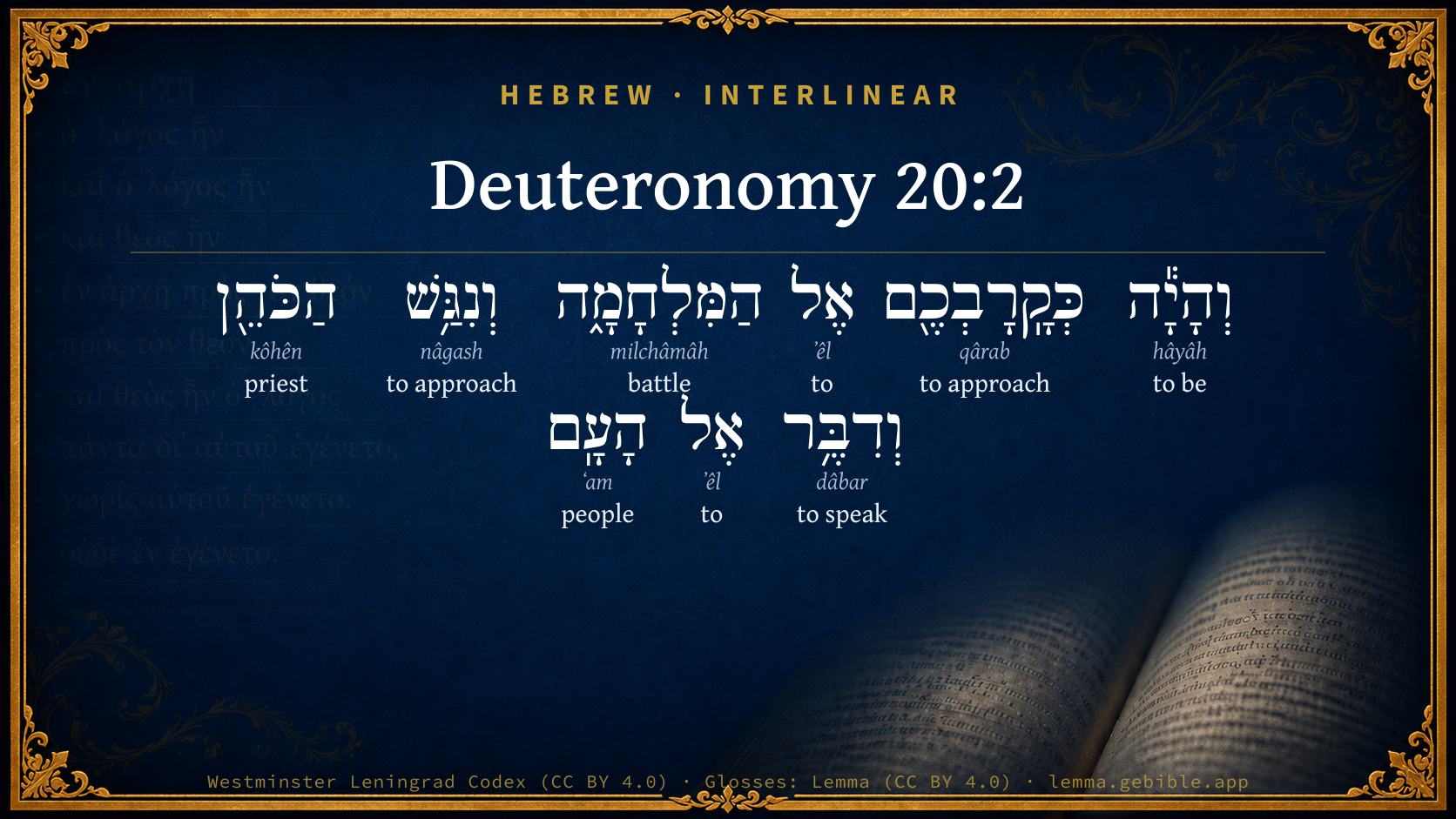
  1. וְהָיָ֕ה hâyâh H1961 “and · to be” Conjunction + Verb, Qal, Sequential Perfect, 3rd Person, Masculine, Singular
  2. כְּקָֽרָבְכֶ֖ם qârab H7126 “like/as · to approach · you” Preposition + Verb, Qal, Infinitive Construct + Suffix, Personal, 2nd Person, Masculine, Plural
  3. אֶל ʼêl H413 “to” Preposition
  4. הַמִּלְחָמָ֑ה milchâmâh H4421 “the · battle” Particle, Definite Article + Noun, Common, Feminine, Singular, Absolute
  5. הַכֹּהֵ֖ן kôhên H3548 “the · priest” Particle, Definite Article + Noun, Common, Masculine, Singular, Absolute
  6. וְדִבֶּ֥ר dâbar H1696 “and · to speak” Conjunction + Verb, Piel, Sequential Perfect, 3rd Person, Masculine, Singular
  7. אֶל ʼêl H413 “to” Preposition
  8. הָעָֽם ʻam H5971 “the · people” Particle, Definite Article + Noun, Common, Masculine, Singular, Absolute

About this verse

These counts appear in no published source. They are computed here, from the morphology-tagged text and Lemma’s own curated glosses. What Lemma adds →

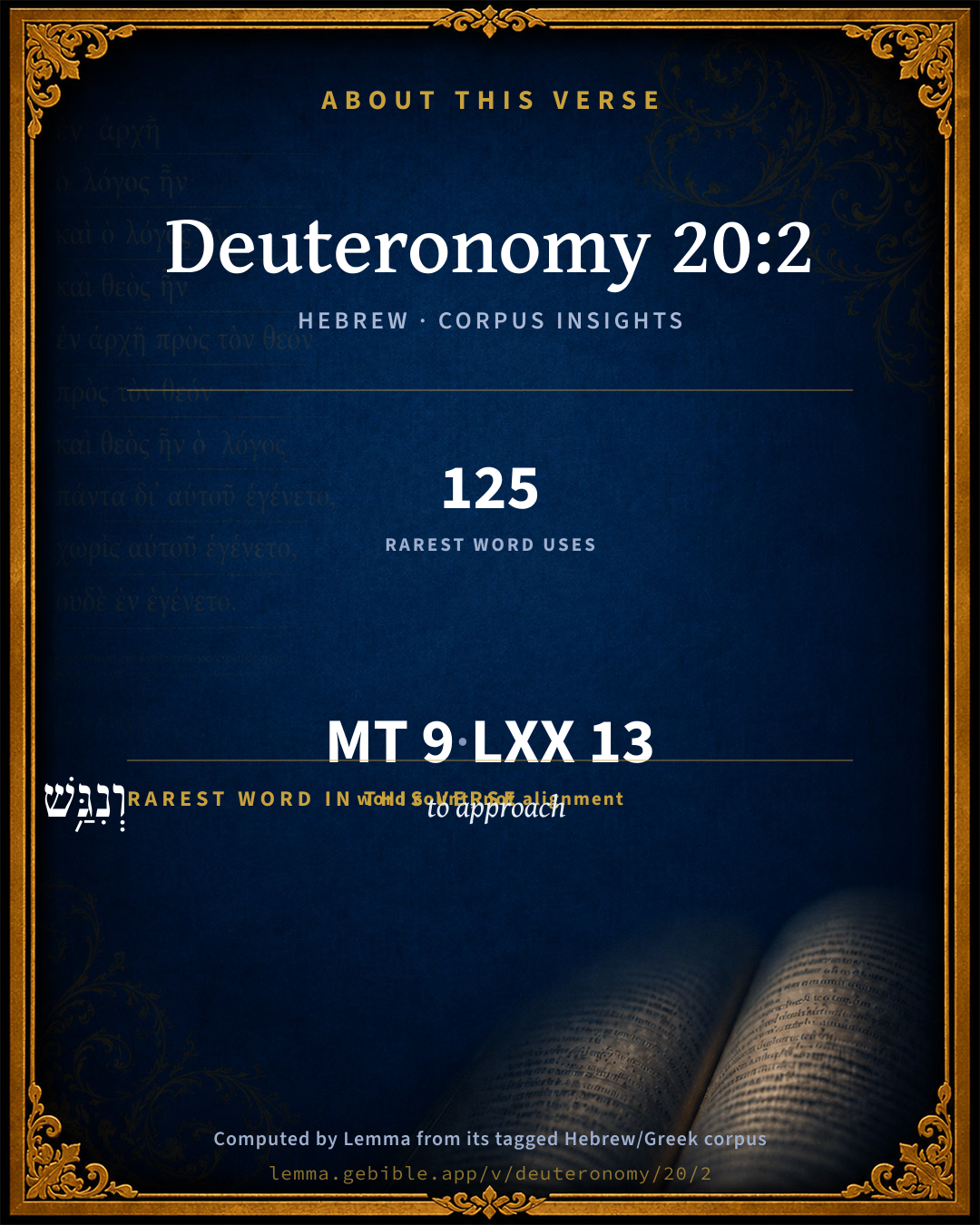
9
words
8
distinct lemmas
Pentateuch
section

Grammatical profile

  • 4 verbs
  • 3 nouns
  • 2 prepositions

Verb forms

  • וְהָיָ֕ה Qal · Sequential Perfect
  • כְּקָֽרָבְכֶ֖ם Qal · Infinitive Construct
  • וְנִגַּ֥שׁ Niphal · Sequential Perfect
  • וְדִבֶּ֥ר Piel · Sequential Perfect

Repetition

A word recurs within this verse — often emphatic in Hebrew:

  • אֶל to H413 ×2

Hebrew & Septuagint length

In English translation the verse runs 20 words from the Hebrew and 29 from the Septuagint (LXX English) — the Septuagint runs noticeably longer here. See the side-by-side →

A rough comparison of the two English renderings, which tokenize alike — not a word-level alignment.

Word counts can differ between the Hebrew and the Greek without any difference in meaning — e.g. the Hebrew direct-object marker אֵת has no separate Greek word, and Greek often adds the article ὁ.

In the original languages it is 9 Hebrew tokens and 13 Greek tokens — but the two are counted differently (Hebrew bundles its prefixes and suffixes into one token; the Greek is in lemma form), so that isn’t a like-for-like length.

Cross-references

6

Topical passages linked to Deuteronomy 20:2 in the Treasury of Scripture Knowledge — connected by theme and wording, ordered by reader-vote popularity; previews shown in the World English Bible.

  • Numbers 10:8–9 The sons of Aaron, the priests, shall blow the trumpets; and they shall be to you for a statute forever throughout your generations.
  • Numbers 31:6 Moses sent them, one thousand of every tribe, to the war, them and Phinehas the son of Eleazar the priest, to the war, with the vessels of the sanctuary and the trumpets for the alarm in his hand.
  • 2 Chronicles 13:12 Behold, God is with us at our head, and his priests with the trumpets of alarm to sound an alarm against you. Children of Israel, don't you fight against Yahweh, the God of your fathers; for you shall not prosper.
  • Judges 20:27–28 The children of Israel asked of Yahweh (for the ark of the covenant of God was there in those days,
  • 1 Samuel 14:18 Saul said to Ahijah, Bring here the ark of God. For the ark of God was [there] at that time with the children of Israel.
  • 1 Samuel 30:7–8 David said to Abiathar the priest, the son of Ahimelech, Please bring me here the ephod. Abiathar brought there the ephod to David.

Cross-references courtesy of OpenBible.info (CC BY 4.0).

Hebrew and Greek witnesses Masoretic Hebrew ↔ Greek Septuagint

The same verse in the two great witnesses to the Old Testament, shown verse-for-verse.

Here the Septuagint runs noticeably longer than the Hebrew — LXX2012 (modern English Septuagint) 29 words vs World English Bible 20. A rough length comparison of the two English translations, not a word-level alignment — read both below.

These are two independent witnesses, not word-aligned to each other, and the Septuagint is shown in lemma (dictionary) form.

Hebrew Deuteronomy 20:2 Masoretic · Westminster Leningrad Codex

וְהָיָ֕ה כְּקָֽרָבְכֶ֖ם אֶל הַמִּלְחָמָ֑ה וְנִגַּ֥שׁ הַכֹּהֵ֖ן וְדִבֶּ֥ר אֶל הָעָֽם

It shall be, when you draw near to the battle, that the priest shall approach and speak to the people,

World English Bible · Public Domain

Greek LXX Deuteronomy 20:2 Septuagint · lemma form

καί εἰμί ὅταν ἐγγίζω ὁ πόλεμος καί προςἐγγίζω ὁ ἱερεύς λαλέω ὁ λαός

And it shall come to pass whenever you shall draw near to battle, that the priest shall draw near and speak to the people, and shall say to them,

LXX2012 (modern English Septuagint) · Public Domain

On this verse, The Cambridge Bible for Schools and Colleges discusses the Septuagint’s reading. Read the note in Commentary ↓

Hebrew: Westminster Leningrad Codex (CC BY 4.0). Greek: Septuagint (public domain); English from LXX2012 (modern English Septuagint) (Public Domain). How the Septuagint differs from the Hebrew →

Targum (Aramaic paraphrase)

2

The Targum is the ancient Jewish Aramaic paraphrase of the Hebrew Scriptures — an interpretive translation, not the Hebrew text itself. Onkelos (literal) and Pseudo-Jonathan (expansive) render the Torah, and Jonathan the Prophets. Coverage is partial: where no permissively-licensed English translation exists for a verse, only the Aramaic is shown. This is verse-level text, not a word-by-word alignment to the Hebrew.

  1. Targum Onkelos Torah (Genesis–Deuteronomy)
    וִיהֵי כְּמִקְרָבְכוֹן לַאֲגָחָא קְרָבָא וְיִתְקְרִיב כַּהֲנָא וִימַלֵל עִם עַמָא

    (no public-domain English translation for this verse)

    Targum Onkelos — Aramaic: “Onkelos Genesis” (public domain); “Onkelos Exodus” (public domain); “Onkelos Leviticus” (public domain); “Onkelos Numbers” (public domain); “Onkelos Deuteronomy” (public domain). English: “Sefaria Community Translation” (CC0 1.0 (public-domain dedication)); “J.W. Etheridge. The Targums of Onkelos and Jonathan Ben Uzziel on the Pentateuch. London: Longmans, Green, 1862” (public domain). Text via Sefaria.

  2. Targum Pseudo-Jonathan Torah (Genesis–Deuteronomy)
    וִיהֵי בִּזְמַן דְּאַתּוּן קָרֵיבִין לְאַגָּחָא קְרָבָא וְיִתְקָרֵב כַּהֲנָא וִימַלֵּל עִם עַמָּא

    And at the time that you draw nigh to do battle, the priest shall approach and speak with the people,

    Targum Pseudo-Jonathan — Aramaic: “Targum Jonathan on Genesis” (public domain); “Targum Jonathan on Exodus” (public domain); “Targum Jonathan on Leviticus” (public domain); “Targum Jonathan on Numbers” (public domain); “Targum Jonathan on Deuteronomy” (public domain). English: “The Targum of Jonathan ben Uzziel, trans. J. W. Etheridge, London, 1862” (public domain). Text via Sefaria.

Commentary

Notes on Deuteronomy 20:2 from classic Christian and Jewish commentators (each source and its license shown beneath its notes). The classic Christian expositions comment on the surrounding passage and are grouped to its opening verse, so a note may address several verses; the Jewish commentaries on the Tanakh (Rashi and others) are per-verse, so they appear only where the commentator wrote on this verse.

Lemma curates 59 commentaries, every one of them public domain or Creative Commons licensed, each selected and text-cleaned for this edition rather than reprinted as found. About our sources →

Trapp's Complete Commentary

John Trapp

Deu 20:2 And it shall be, when ye are come nigh unto the battle, that the priest shall approach and speak unto the people,

Ver. 2. That the priest shall approach.] For some priests ordinarily went along with the army; not to be Tuba rebellionis, as the Papists said of Zuinglius, nor evangelium flammeum praedicare, as they said of Beza, as a common firebrand or fomenter of discord; but to blow the holy trumpets, "that the people might be remembered before the Lord, and saved from their enemies"; {Num 10:8-9 2Ch 13:12} and to say unto them, as in 2Ch 19:11, "Deal courageously, and the Lord shall be with the good." The valour of the Gauls was admired by the Romans. It proceeded from that instruction of the Druids, their priests, concerning the immortality of the soul, &c.

John Trapp, A Commentary or Exposition upon All the Books of the Old and New Testament (1647–1656) — public domain. Text from a community e-Sword module.

Joseph Benson's Commentary

Deu 20:2. The priest shall approach — The Jews say there was a priest anointed for the purpose, whose office, as we may gather from Num 31:6, was to blow with the trumpet when they were preparing for battle. And shall speak to the people — Probably exhorting them, in the most persuasive manner, to a courageous and undaunted performance of their duty, considering their cause as God’s, and relying on his protection and aid.

Joseph Benson's Commentary on the Old and New Testaments (1811–1818) — public domain. Text from a community e-Sword module.

Jamieson, Fausset & Brown

Robert Jamieson, A. R. Fausset & David Brown

when ye are come nigh unto the battle, that the priest shall approach and speak unto the people--Jewish writers say that there was a war priest appointed by a special ceremonial to attend the army. It was natural that the solemn objects and motives of religion should have been applied to animate patriotism, and so give additional impulse to valor; other people have done this. But in the case of Israel, the regular attendance of a priest on the battlefield was in accordance with their theocratic government, in which everything was done directly by God through His delegated ministers. It was the province of this priest to sound the trumpets (Num 10:9; Num 31:6), and he had others under him who repeated at the head of each battalion the exhortations which he addressed to the warriors in general. The speech (Deu 20:3-4) is marked by a brevity and expressiveness admirably suited to the occasion, namely, when the men were drawn up in line.

Jamieson, Fausset & Brown — Commentary Critical and Explanatory on the Whole Bible (1871) — public domain (CC PDM 1.0). Text via the HelloAO Bible API.

Adam Clarke's Commentary

Verse 2. The priest shall approach, and speak unto the people] The priest on these occasions was the representative of that God whose servant he was, and whose worship he conducted. It is remarkable that almost all ancient nations took their priests with them to battle, as they did not expect success without having the object of their adoration with them, and they supposed they secured his presence by having that of his representative.

Adam Clarke's Commentary on the Bible (1810–1826) — public domain. Text from a community e-Sword/MySword module.

Ellicott's Commentary for English Readers

(2) The priest.—There is no mention of the Levite here. The priest is named as a distinct personage. The words which the priest are to pronounce are, as it were, the blessing of Jehovah on the campaign. It follows that Israel could not lawfully go to war except when the blessing of Jehovah might be invoked.

A Bible Commentary for English Readers, edited by Charles John Ellicott (1878–1897) — public domain. Text from a community e-Sword module.

The Cambridge Bible for Schools and Colleges

gen. ed. J. J. S. Perowne

2. when ye draw nigh] LXX thou drawest nigh: see introd. note.

to the war] Not battle. The captains had still to be appointed (Deu_20:9) and this must have taken place at the start of the campaign, not on the eve of engagement with the foe.

the priest] Or (it may equally be) a priest: see introd.

Hear, O Israel] Deu_4:1; here as there with Pl. vbs following.

The Cambridge Bible for Schools and Colleges (gen. ed. J. J. S. Perowne; Cambridge University Press, 1878–1918) — public domain. Text from a community e-Sword module.

John Gill's Exposition

When all things are preparing for it, and it seems unavoidable:

that the priest shall approach and speak unto the people; not any priest, but one appointed for this service; who is called

the anointed of war, as Jarchi and Aben Ezra observe, and concerning whom Maimonides (d) is more particular; he says,"they appoint a priest to speak to the people at the time of war, and they anoint him with the anointing oil, and he is called the anointed of war; twice the anointed of war speaks unto the people, once in a book at the time they go forth, before they set in battle array, he says to the people, "what man is there", &c. and when he has caused his words to be heard, he returns; at another time, when they are set in array, he says, "fear not", &c.''this man seems to be an emblem of Gospel ministers, who are anointed with the gifts and graces of the Spirit of God, and whose business it is to encourage the people of God to fight the Lord's battles against sin, Satan, and the world, and not to be afraid of their spiritual enemies; directing them to take to them the whole armour of God, and to endure hardness as good soldiers of Christ, to follow him the captain of their salvation, assuring them of victory through him who makes them more than conquerors, and that their warfare is or shortly will be accomplished.

(d) Hilchot Melachim, c. 7. sect. 1, 2.

John Gill's Exposition of the Whole Bible (1746–1763) — public domain (CC PDM 1.0). Text via the HelloAO Bible API.

Albert Barnes' Notes on the Bible

The priest - Not the high priest, but one appointed for the purpose, and called, according to the rabbis, “the anointed of the war”: hence, perhaps the expression of Jer 6:4, etc. “prepare ye” (literally consecrate) “war.” Thus, Phinehas went with the warriors to fight against Midian (Num 31:6; compare 1Sa 4:4, 1Sa 4:11; 2Ch 13:12).

Albert Barnes' Notes on the Bible (1834–1885) — public domain. Text from a community e-Sword/MySword module.

Haydock's Catholic Bible Commentary

Priest. Eleazar, the high priest, acted in this capacity in the war against Madian, and sounded the trumpet, as it was not beneath his dignity. Many priests always attended the army, (Calmet) the captain of whom (Haydock) first made the declarations (ver. 5, 6, 7,) to the whole army; and these were repeated by the inferior priests at the head of each company, when the army was set in array. So were also the promises of protection, (ver. 3, 4,) when all were ready for battle. The Rabbins assert, that the option was granted only in those wars which were undertaken without the express command of God, and that officers were placed in the rear with hatchets or scythes, to cut the legs of those who attempted to flee. (Grotius; &c.) --- But this seems to be an invention of their own, and Moses makes no distinction between voluntary wars and those of precept. These regulations were, no doubt, observed, through the sacred historians do not mention the particulars. (Calmet) See 1 Machabees iii. 56.

George Leo Haydock (1774–1849), Haydock's Catholic Family Bible and Commentary, 1859 edition — public domain. Excludes Psalms (Douay-Rheims chapter numbering differs from Protestant) and Deuterocanonical books (Catholic canon only).

Matthew Poole's English Annotations

The priest; an eminent priest appointed for this work, and to blow with the holy trumpets, Num 10:9; 31:6.

Speak unto the people; either successively to one regiment of the army after another, or to some by himself, to others by his brethren or deputies, which accompanied him for that end.

Matthew Poole's English Annotations on the Holy Bible (1683–1685) — public domain. Text from a community e-Sword/MySword module.

Whedon's Commentary on the Bible

Daniel D. Whedon

2. The priest shall approach and speak unto the people — According to the rabbins, the priest who thus accompanied the army was called the “Anointed for the war.” He held a high rank. See Num_31:6.

Daniel D. Whedon (gen. ed.), Commentary on the Old and New Testaments (1874–1909) — public domain. Text from a community e-Sword module.

The Pulpit Commentary

The priest. Not the high priest or any one of the priests, but the military priest, the priest appointed to accompany the army, "the anointed for the war;" hmjlmh jyvm, as the rabbins designate him (cf. Num_21:6; 1Sa_4:4; 2Ch_13:12) His business was to exhort the people, and to encourage them by reminding them that the Lord was their Leader, and would help them in the conflict. The formula of his exhortation is given in vers. 3, 4.

Vers. 5-7. The officers; the shoterim, the keepers of the genealogical tables. (Deu_16:18) It belonged to them to appoint the men who were to serve, and to release those who had been summoned to the war, but whose domestic relations were such as to entitle them to exemption. If there was one who had built a house, but had not dedicated it, i.e. by taking possession of it and dwelling in it; or if there was one who had planted a vineyard and had not eaten of the fruit thereof; or if there was one who had betrothed a wife, but had not yet married her; such were to be allowed to return home, lest they should die in battle, and it be left to others to consummate what they had begun. According to Josephus, this exemption was for a year, according to the analogy of Deu_24:5. Dedicated; probably formal possession was taken of the house by some solemn ceremony, followed by a festive entertainment. Vineyard. The Hebrew word ( here used designates "a field or park of the nobler plants and trees cultivated in the manner of a garden or orchard" (Ges.); so that not vineyards alone, but also olive yards and plots of the more valuable fruit trees may be intended. Hath not eaten of it; literally, hath not laid it open, made it common, i.e. begun to use it, to gather its produce for common use (cf. Deu_28:30; Jer_31:5) Trees planted for food were not to be used before the fifth year of their growth. (Lev_19:23, etc.; of Deu_24:5)

The Pulpit Commentary (1880–1919), ed. H.D.M. Spence-Jones & Joseph S. Exell — public domain. Text from a community e-Sword module.

John Wesley's Explanatory Notes

Speak unto the people - Probably to one regiment of the army after another.

John Wesley, Explanatory Notes Upon the Whole Bible (1754–1765) — public domain. Text via the GEBible commentary corpus.

unfoldingWord translationNotes

Door43 World Missions Community

General Information:

Moses continues speaking to the people of Israel.

speak to the people

"speak to the soldiers of Israel"

Do not let your hearts faint. Do not fear or tremble. Do not be afraid of them

These four expressions all mean the same thing and strongly emphasize that they are not to be afraid. If your language does not have four ways to express this concept, you may use less than four. (See: Parallelism)

Do not let your hearts faint

Here "hearts" represents people's courage. For a heart to faint is an idiom that means "Do not be afraid." (See: Metonymy and Idiom)

Yahweh your God is the one who is going with you to fight for you against your enemies

Yahweh defeating the enemies of the people of Israel is spoken of as if Yahweh were a warrior who would fight along with the people of Israel. (See: Metaphor)

to save you

"to give you victory"

translationWords

priest

Israel

heart

save

unfoldingWord translationNotes — © Distant Shores Media and the Door43 World Missions Community, licensed CC BY-SA 4.0. Source: git.door43.org/Door43/en_tn.

Rashi

Rabbi Shlomo Yitzchaki (Rashi)

כקרבכם אל המלחמה [IT SHALL BE] WHEN YE COME NIGH UNTO THE BATTLE, [THAT THE PRIEST … SHALL SPEAK] — i.e. when ye are on the point of leaving the ספר — the boundary of your land (Sifrei Devarim 191).

ונגש הכהן AND “THE” PRIEST SHALL STEP NIGH [AND SPEAK] “the” priest means, he who has been anointed for that purpose; it is the one who is termed in the Talmud משוח מלחמה, “the priest anointed for war” (Sotah 42a).

ודבר אל העם AND HE SHALL SPEAK UNTO THE PEOPLE — in the Holy Language (Sotah 42a).

Rashi on the Tanakh — English translations: “The Judaica Press complete Tanach with Rashi, translated by A. J. Rosenberg” (CC BY 4.0); “Pentateuch with Rashi's commentary by M. Rosenbaum and A.M. Silbermann, 1929-1934” (public domain); “The Metsudah Tanach series, Lakewood, N.J” (CC BY 4.0); and “The Book of Joshua, Metsudah Publications, 1997” (CC BY 4.0). Text via Sefaria.

Lesson kit

Teaching starters — assembled from the data on this page, not authored interpretation. Every prompt links to the verse data it draws on. Edit before teaching.

Deuteronomy, in the Pentateuch, opens this verse with 9 words (8 distinct Hebrew lemmas). Its most distinctive word is nâgash (“to approach”). The Greek Septuagint runs longer here. A historical commentator’s framing appears above. Read the whole chapter for the surrounding context.

Discussion questions

  1. How does “to approach” (nâgash) shape what this verse is saying?
  2. How does Numbers 10:8–9, which shares this passage’s theme, read alongside this verse?
  3. What does the repetition of “to” (2× in this one verse) do in this verse?
  4. The Septuagint runs longer here than the Hebrew. What might account for the difference?
  5. The translations on this page render this verse differently — a whole-verse word diff, not a word-by-word alignment. What might account for the different wordings?
  6. «וְהָיָ֕ה» is a Qal Sequential Perfect verb. How does that grammatical form shape the action described?
  7. Compare how Trapp's Complete Commentary and Joseph Benson's Commentary read this verse. Where do they agree or differ?

Things to notice

Reading settings

Reading text

Shown beneath each verse's original-language words.

Old Testament
Old Testament edition

Read the OT as the Masoretic Hebrew (MT) or the Greek Septuagint (LXX).

English shown for the Greek Septuagint (in the Hebrew ↔ Greek comparison).

Comparing translations? Open the Compare panel on any verse page to stack up to four side by side.