
Joshua 7:17

Hebrew (Westminster Leningrad Codex) Joshua 7:17 appears in the Hebrew Old Testament. The text above is from the Westminster Leningrad Codex. Each word links to its Strong’s number, a concise gloss, and parsing drawn from the Open Scriptures Hebrew Bible morphology. Click any word for its full Brown-Driver-Briggs (BDB) entry.
Download image
Cite this verse

Joshua 7:17 (World English Bible). Public Domain. Lemma interlinear Bible study tool, https://lemma.gebible.app/v/joshua/7/17.

Show BibTeX & RIS
BibTeX
RIS
English Translation
and he brought near the family of Judah; and he took the family of the Zerahites: and he brought near the family of the Zerahites man by man; and Zabdi was taken:
World English Bible · Public Domain
Download a study sheet

One document with this verse’s original text, its word-by-word gloss line, the meaning frame, cross-references with their text, attributed commentary, and full source and license credits — printable, and it pastes into notes with its structure intact.

This verse Autodidact and up

Study sheet (.html) Plain text (.txt)

A passage Seminary Student

Up to 50 verses in one chapter. A passage sheet keeps up to 6 commentary sources and 12 cross-references per verse, in the order this page ranks them, and says so on the sheet whenever that leaves anything out. Ask for a single verse and you get the Autodidact verse sheet above.

Everything on this page stays free to read, with no account — the sheet is a download of what is already on screen, not access to it.

Want to remove ads? Support Godless Engineer
Compare translations 3

The same verse in 3 English versions, stacked beneath the original-language interlinear above. Click any original word for its lexicon entry.

Each is an independent rendering of the whole verse — the interlinear is not word-aligned to these translations.

Highlighted words mark where these versions differ — a whole-verse word diff, not a word-by-word alignment.

  • World English Bible Public Domain
    and he brought near the family of Judah; and he took the family of the Zerahites: and he brought near the family of the Zerahites man by man; and Zabdi was taken:
  • King James Version Public Domain
    And he brought the family of Judah; and he took the family of the Zarhites: and he brought the family of the Zarhites man by man; and Zabdi was taken:
  • unfoldingWord Literal Text CC BY-SA 4.0
    And he brought near the clans of Judah, and the clan of the Zerahite was taken. And he brought near the clan of the Zerahite by men, and Zabdi was taken.

unfoldingWord Literal Text — © unfoldingWord, licensed CC BY-SA 4.0. Word-aligned USFM3 via Door43 (git.door43.org/unfoldingWord/en_ult).

Versions to compare (up to 4)

3 of 4 selected

Show all 18 translations

Every available English version of this verse, each an independent rendering of the whole verse.

  • World English Bible Public Domain
    and he brought near the family of Judah; and he took the family of the Zerahites: and he brought near the family of the Zerahites man by man; and Zabdi was taken:
  • Berean Standard Bible Public Domain
    He had the clans of Judah come forward, and the clan of the Zerahites was selected. He had the clan of the Zerahites come forward, and the family of Zabdi was selected.
  • Majority Standard Bible Public Domain
    He had the clans of Judah come forward, and the clan of the Zerahites was selected. He had the clan of the Zerahites come forward, and the family of Zabdi was selected.
  • King James Version Public Domain
    And he brought the family of Judah; and he took the family of the Zarhites: and he brought the family of the Zarhites man by man; and Zabdi was taken:
  • American Standard Version (1901) Public Domain
    and he brought near the family of Judah; and he took the family of the Zerahites: and he brought near the family of the Zerahites man by man; and Zabdi was taken:
  • Revised Version (1885) Public Domain
    and he brought near the family of Judah; and he took the family of the Zerahites: and he brought near the family of the Zerahites man by man; and Zabdi was taken:
  • Geneva Bible (1599) Public Domain
    And he brought the families of Iudah, and tooke the familie of the Zarhites, and he brought the familie of the Zarhites, man by man, and Zabdi was taken.
  • Douay-Rheims (1899) Public Domain
    Which being brought by its families, it was found to be the family of Zare. Bringing that also by the houses, he found it to be Zabdi.
  • Young's Literal Translation Public Domain
    and he bringeth near the family of Judah, and he captureth the family of the Zarhite; and he bringeth near the family of the Zarhite by men, and Zabdi is captured;
  • Literal Standard Version CC BY-SA 4.0
    and he brings the family of Judah near, and he captures the family of the Zerahite; and he brings the family of the Zerahite near by men, and Zabdi is captured;
  • Unlocked Literal Bible CC BY-SA 4.0
    Joshua brought the clans of Judah near, and the clan of the Zerahites was selected. He brought near the clan of the Zerahites person by person, and Zabdi was selected.
  • unfoldingWord Literal Text CC BY-SA 4.0
    And he brought near the clans of Judah, and the clan of the Zerahite was taken. And he brought near the clan of the Zerahite by men, and Zabdi was taken.
  • Darby Bible Public Domain
    And he caused the families of Judah to come forward, and he took the family of the Zarhites. And he caused the family of the Zarhites to come forward man by man, and Zabdi was taken.
  • World Messianic Bible Public Domain
    He brought near the family of Judah, and he selected the family of the Zerahites. He brought near the family of the Zerahites man by man, and Zabdi was selected.
  • Webster's Bible Public Domain
    And he brought the family of Judah; and he took the family of the Zarhites: and he brought the family of the Zarhites man by man; and Zabdi was taken:
  • Free Bible Version CC BY-SA 4.0
    The tribe of Judah was chosen. The clans of Judah came forward and the Zerahites were chosen. The clan of Zerahites came forward, and the family of Zabdi was chosen.
  • Bible in Basic English Public Domain
    Then he made Judah come forward, and the family of the Zerahites was taken; and he made the family of the Zerahites come forward man by man; and Zabdi was taken;
  • JPS Tanakh (1917) Public Domain
    And he brought near the family of Judah; and he took the family of the Zerahites. And he brought near the family of the Zerahites man by man; and Zabdi was taken.

Literal Standard Version (2020), Covenant Press — licensed CC BY-SA 4.0. Text via the HelloAO Bible API (eBible.org). Unlocked Literal Bible (unfoldingWord) — licensed CC BY-SA 4.0. Text via the HelloAO Bible API (eBible.org). unfoldingWord Literal Text — © unfoldingWord, licensed CC BY-SA 4.0. Word-aligned USFM3 via Door43 (git.door43.org/unfoldingWord/en_ult). Free Bible Version, Dr. Jonathan Gallagher — licensed CC BY-SA 4.0. Text via the HelloAO Bible API (eBible.org).

Word by word

More ways to search: Search by grammar → Find every occurrence → Compare this word →

Practice this passage: Drill this verse → Learn its vocabulary →

הַזַּרְחִ֑י
Zarchîy
H2227
“the · Zarhites”
Particle, Definite Article + Noun, Gentilic, Masculine, Singular, Absolute
Part of Speech
Particle + Noun
Type
Gentilic
Gender
Masculine
Number
Singular
State
Absolute
Full BDB Definition

Origin: patronymically from H2226

TWOT: None

Zarhites = see Zerah - descendants of Zerah
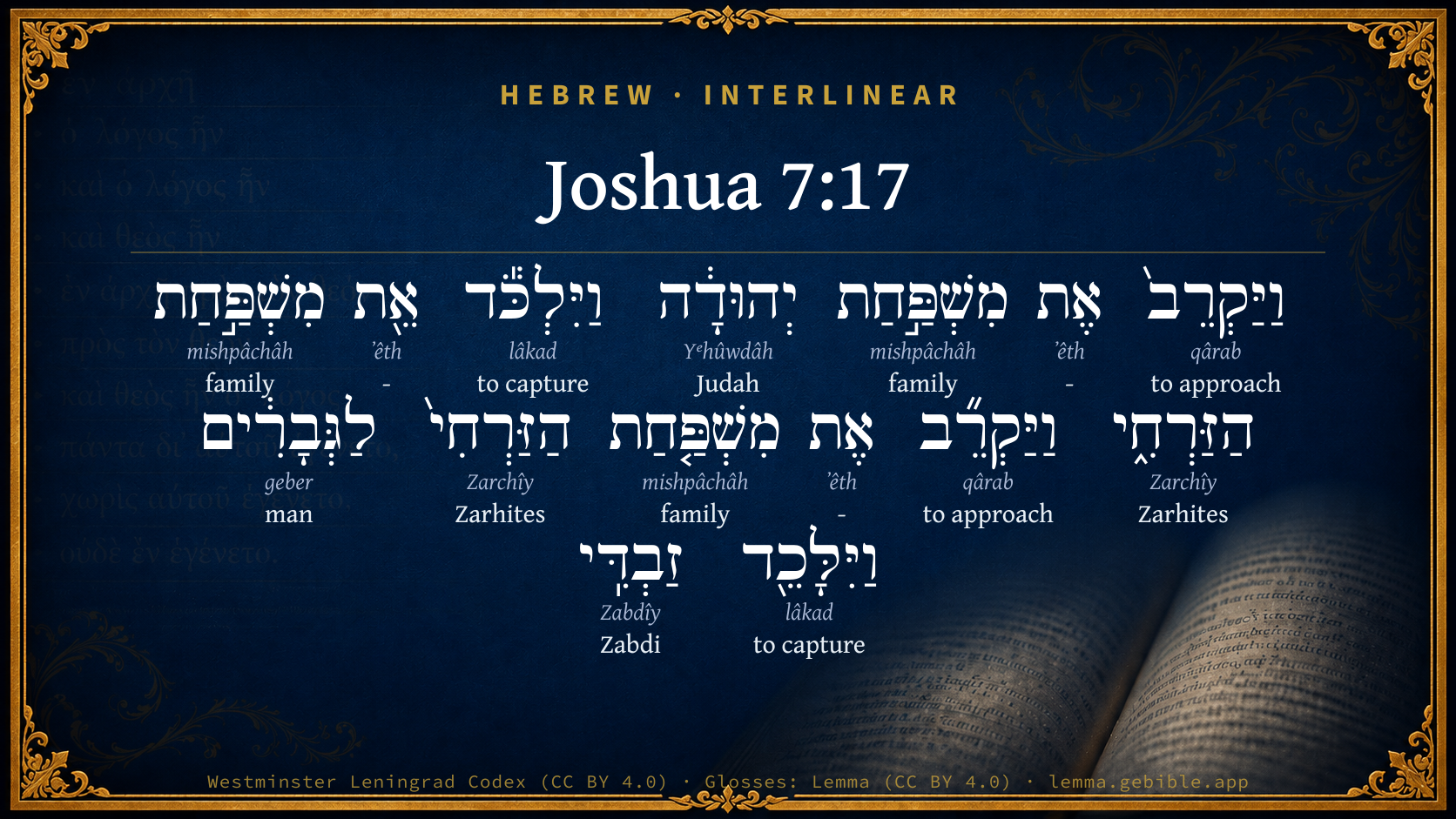
  1. וַיַּקְרֵב֙ qârab H7126 “and · to approach” Conjunction + Verb, Hiphil, Sequential Imperfect, 3rd Person, Masculine, Singular
  2. אֶת ʼêth H853 “-” Particle, Direct Object
  3. מִשְׁפַּ֣חַת mishpâchâh H4940 “family of” Noun, Common, Feminine, Singular, Construct
  4. יְהוּדָ֔ה Yᵉhûwdâh H3063 “Judah” Noun, Proper
  5. וַיִּלְכֹּ֕ד lâkad H3920 “and · to capture” Conjunction + Verb, Qal, Sequential Imperfect, 3rd Person, Masculine, Singular
  6. אֵ֖ת ʼêth H853 “-” Particle, Direct Object
  7. מִשְׁפַּ֣חַת mishpâchâh H4940 “family of” Noun, Common, Feminine, Singular, Construct
  8. וַיַּקְרֵ֞ב qârab H7126 “and · to approach” Conjunction + Verb, Hiphil, Sequential Imperfect, 3rd Person, Masculine, Singular
  9. אֶת ʼêth H853 “-” Particle, Direct Object
  10. מִשְׁפַּ֤חַת mishpâchâh H4940 “family of” Noun, Common, Feminine, Singular, Construct
  11. הַזַּרְחִי֙ Zarchîy H2227 “the · Zarhites” Particle, Definite Article + Noun, Gentilic, Masculine, Singular, Absolute
  12. לַגְּבָרִ֔ים geber H1397 “to/for the · men” Preposition, Determined + Noun, Common, Masculine, Plural, Absolute
  13. וַיִּלָּכֵ֖ד lâkad H3920 “and · to capture” Conjunction + Verb, Niphal, Sequential Imperfect, 3rd Person, Masculine, Singular
  14. זַבְדִּֽי Zabdîy H2067 “Zabdi” Noun, Proper

About this verse

These counts appear in no published source. They are computed here, from the morphology-tagged text and Lemma’s own curated glosses. What Lemma adds →

15
words
8
distinct lemmas
Historical
section

Notable vocabulary

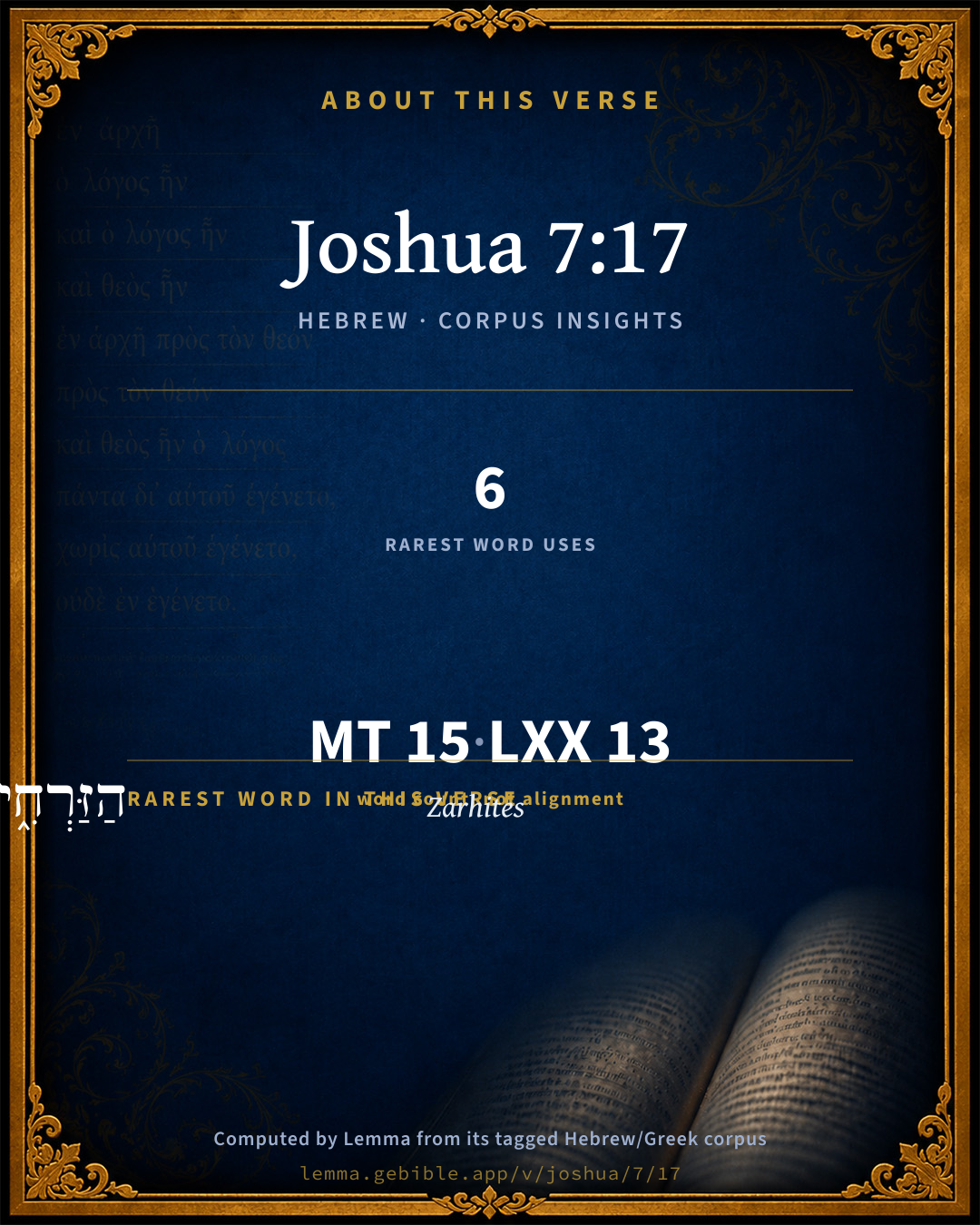
The rarest word here is הַזַּרְחִ֑י Zarhites H2227 — appearing just 6 times in the whole Hebrew Bible.

Shared distinctive vocabulary

הַזַּרְחִ֑י Zarhites H2227 occurs in 5 verses of the Hebrew Bible. Also found in:

Grammatical profile

  • 4 verbs
  • 8 nouns
  • 3 particles

Verb forms

  • וַיַּקְרֵב֙ Hiphil · Sequential Imperfect
  • וַיִּלְכֹּ֕ד Qal · Sequential Imperfect
  • וַיַּקְרֵ֞ב Hiphil · Sequential Imperfect
  • וַיִּלָּכֵ֖ד Niphal · Sequential Imperfect

Repetition

Words recur within this verse — often emphatic in Hebrew:

  • מִשְׁפַּ֣חַת family H4940 ×3
  • וַיַּקְרֵב֙ to approach H7126 ×2
  • וַיִּלְכֹּ֕ד to capture H3920 ×2
  • הַזַּרְחִ֑י Zarhites H2227 ×2

Hebrew & Septuagint length

In English translation the verse runs 32 words from the Hebrew and 15 from the Septuagint (LXX English) — the Septuagint runs noticeably shorter here. See the side-by-side →

A rough comparison of the two English renderings, which tokenize alike — not a word-level alignment.

Word counts can differ between the Hebrew and the Greek without any difference in meaning — e.g. the Hebrew direct-object marker אֵת has no separate Greek word, and Greek often adds the article ὁ.

In the original languages it is 15 Hebrew tokens and 13 Greek tokens — but the two are counted differently (Hebrew bundles its prefixes and suffixes into one token; the Greek is in lemma form), so that isn’t a like-for-like length.

Cross-references

3

Topical passages linked to Joshua 7:17 in the Treasury of Scripture Knowledge — connected by theme and wording, ordered by reader-vote popularity; previews shown in the World English Bible.

  • Numbers 26:20 The sons of Judah after their families were: of Shelah, the family of the Shelanites; of Perez, the family of the Perezites; of Zerah, the family of the Zerahites.
  • Genesis 38:30 Afterward his brother came out, that had the scarlet thread on his hand, and his name was called Zerah.
  • 1 Chronicles 2:4–7 Tamar his daughter-in-law bore him Perez and Zerah. All the sons of Judah were five.

Cross-references courtesy of OpenBible.info (CC BY 4.0).

Hebrew and Greek witnesses Masoretic Hebrew ↔ Greek Septuagint

The same verse in the two great witnesses to the Old Testament, shown verse-for-verse.

Here the Septuagint runs noticeably shorter than the Hebrew — LXX2012 (modern English Septuagint) 15 words vs World English Bible 32. A rough length comparison of the two English translations, not a word-level alignment — read both below.

These are two independent witnesses, not word-aligned to each other, and the Septuagint is shown in lemma (dictionary) form.

Hebrew Joshua 7:17 Masoretic · Westminster Leningrad Codex

וַיַּקְרֵב֙ אֶת מִשְׁפַּ֣חַת יְהוּדָ֔ה וַיִּלְכֹּ֕ד אֵ֖ת מִשְׁפַּ֣חַת הַזַּרְחִ֑י וַיַּקְרֵ֞ב אֶת מִשְׁפַּ֤חַת הַזַּרְחִי֙ לַגְּבָרִ֔ים וַיִּלָּכֵ֖ד זַבְדִּֽי

and he brought near the family of Judah; and he took the family of the Zerahites: and he brought near the family of the Zerahites man by man; and Zabdi was taken:

World English Bible · Public Domain

Greek LXX Joshua 7:17 Septuagint · lemma form

καί προςἄγω κατά δῆμος καί ἐνδεικνύω δῆμος ὁ ζαραϊ καί προςἄγω κατά ἀνήρ

And it was brought by their families, and family of the Zaraites was pointed out.

LXX2012 (modern English Septuagint) · Public Domain

Hebrew: Westminster Leningrad Codex (CC BY 4.0). Greek: Septuagint (public domain); English from LXX2012 (modern English Septuagint) (Public Domain). How the Septuagint differs from the Hebrew →

Targum (Aramaic paraphrase)

1

The Targum is the ancient Jewish Aramaic paraphrase of the Hebrew Scriptures — an interpretive translation, not the Hebrew text itself. Onkelos (literal) and Pseudo-Jonathan (expansive) render the Torah, and Jonathan the Prophets. Coverage is partial: where no permissively-licensed English translation exists for a verse, only the Aramaic is shown. This is verse-level text, not a word-by-word alignment to the Hebrew.

  1. Targum Jonathan Prophets (Joshua–Malachi)
    וְקָרֵיב יַת זַרְעֲיַת יְהוּדָה וְאַחַד יַת זַרְעֲיַת זָרַח וְקָרֵיב יַת זַרְעֲיַת זָרַח לְגַבְרַיָא וְאִתְאַחַד זַבְדִי:

    (no public-domain English translation for this verse)

    Targum Jonathan — Aramaic: “Mikraot Gedolot” (public domain). English: “Sefaria Community Translation” (CC0 1.0 (public-domain dedication)); “London "Chaldee Paraphrase," 1871” (public domain). Text via Sefaria.

Commentary

Notes on Joshua 7:17 from classic Christian and Jewish commentators (each source and its license shown beneath its notes). The classic Christian expositions comment on the surrounding passage and are grouped to its opening verse, so a note may address several verses; the Jewish commentaries on the Tanakh (Rashi and others) are per-verse, so they appear only where the commentator wrote on this verse.

Lemma curates 59 commentaries, every one of them public domain or Creative Commons licensed, each selected and text-cleaned for this edition rather than reprinted as found. About our sources →

Adam Clarke's Commentary

Verse 17. And he brought the family of Judah] Dr. Kennicott observes, "All Israel came near by TRIBES, and one tribe was fixed on; then that tribe came by its FAMILIES, and one family was fixed on; then came that family by its HOUSEHOLDS, and one household was fixed on, and then that household, coming MAN by MAN, one man was fixed on. Yet according to the present text, in the execution of this command, all Israel came, and the tribe of Judah was fixed on; secondly came the families of Judah, and the family of the Zarhites was fixed on; thirdly came the family of the Zarhites MAN by MAN, and Zabdi was fixed on; and fourthly came the household of Zabdi MAN by MAN, and Achan was fixed on. So that in the third article the word for by households is most certainly left out; and the fourth article, man by man, is improperly expressed twice. Instead of לגברים laggebarim, MAN by MAN, in Jos 7:17, the true word לבתים labbottim, by HOUSEHOLDS, is preserved in six Hebrew copies, and the Syriac version. By this method was discovered Achan, as he is here five times called, though the valley in which he was stoned is called Achor. He is also called Achar in the text, and in all the versions, in 1Ch 2:7. He is called Achar in the five places of Joshua in the Syrian version; also in all five in the Greek of the Vatican MS., and twice in the Alexandrian MS., and so in Josephus." - Kennicott's Observat.

Adam Clarke's Commentary on the Bible (1810–1826) — public domain. Text from a community e-Sword/MySword module.

Trapp's Complete Commentary

John Trapp

Jos 7:17 And he brought the family of Judah; and he took the family of the Zarhites: and he brought the family of the Zarhites man by man; and Zabdi was taken:

Ver. 17. And Zabdi was taken.] Yet all this while Achan repenteth not, confesseth not his fault. The devil had gagged him, and his heart was hardened by the deceitfulness of that cursed sin of covetousness, the property whereof is first to turn men’s hearts into earth and mud, and afterwards to freeze and congeal them into steel and adamant.

John Trapp, A Commentary or Exposition upon All the Books of the Old and New Testament (1647–1656) — public domain. Text from a community e-Sword module.

Joseph Benson's Commentary

Jos 7:17. The family — Either, 1st, The tribe or people, as the word family sometimes signifies; or, 2d, The families, as Jos 7:14, the singular number being put for the plural, the chief of each of their five families, Num 26:20-21. Man by man — Not every individual person, as is evident from Jos 7:18, but every head of the several houses or lesser families of that greater family of the Zarhites, of which see 1Ch 2:6.

Joseph Benson's Commentary on the Old and New Testaments (1811–1818) — public domain. Text from a community e-Sword module.

John Gill's Exposition

And he brought the family of Judah,.... That is, the tribe of Judah, as Kimchi and Ben Melech interpret it, (z); or rather, the several families in that tribe, even the heads of them:

and he took the family of the Zarhites: which descended from Zerah the son of Judah; that was taken by lot:

and he brought the family of the Zarhites man by man; and cast lots on them:

and Zabdi was taken: that part of the family of the Zarhites which sprung from Zabdi, a son of Zerah.

(z) So R. Sol. Ohel Moed, fol. 94. 2.

John Gill's Exposition of the Whole Bible (1746–1763) — public domain (CC PDM 1.0). Text via the HelloAO Bible API.

Matthew Poole's English Annotations

The family of Judah; either,

1. The tribe or people, as the word family sometimes signifies, as Jdg 13:2; Zec 12:13; Amo 3:1; Act 3:25, compared with Rev 1:7. Or,

2. The families, as Jos 7:14, the singular number for the plural, the chief of each of their five families, Num 26:20,21.

Man by man; not every individual person, as is evident from Jos 7:18, but every head of the several houses or lesser families of that greater family of the Zarhites, of which see 1Ch 2:6.

Matthew Poole's English Annotations on the Holy Bible (1683–1685) — public domain. Text from a community e-Sword/MySword module.

Whedon's Commentary on the Bible

Daniel D. Whedon

17. The family of Judah — Some codices read families of Judah, but the singular is to be preferred. The meaning is the tribe, or collective family.

He took the family of the Zarhites — The lot, under Divine guidance, designated this division of Judah as containing the criminal.

Daniel D. Whedon (gen. ed.), Commentary on the Old and New Testaments (1874–1909) — public domain. Text from a community e-Sword module.

John Wesley's Explanatory Notes

The family - Either,

1. the tribe or people, as the word family sometimes signifies, or,

2. the families, as ver. 14, the singular number for the plural, the chief of each of their five families, Num. xxvi, 20, 21. Man by man - Not every individual person, as is evident from ver. 18, but every head of the several houses, or lesser families of that greater family of the Zarhites, of which see 1 Chron. ii, 6.

John Wesley, Explanatory Notes Upon the Whole Bible (1754–1765) — public domain. Text via the GEBible commentary corpus.

Rashi

Rabbi Shlomo Yitzchaki (Rashi)

And when he brought near the family of Yehudah. To the initial casting of lots he brought the heads of families near, one man from each family, and they cast lots [to see] on whom it would fall. Afterwards lots were cast on each household— one man from each household came to the casting of lots, and then came all the men of that particular household.

Rashi on the Tanakh — English translations: “The Judaica Press complete Tanach with Rashi, translated by A. J. Rosenberg” (CC BY 4.0); “Pentateuch with Rashi's commentary by M. Rosenbaum and A.M. Silbermann, 1929-1934” (public domain); “The Metsudah Tanach series, Lakewood, N.J” (CC BY 4.0); and “The Book of Joshua, Metsudah Publications, 1997” (CC BY 4.0). Text via Sefaria.

Lesson kit

Teaching starters — assembled from the data on this page, not authored interpretation. Every prompt links to the verse data it draws on. Edit before teaching.

Joshua, in the Historical, opens this verse with 15 words (8 distinct Hebrew lemmas). Its most distinctive word is Zarchîy (“Zarhites”). The Greek Septuagint runs shorter here. A historical commentator’s framing appears above. Read the whole chapter for the surrounding context.

Discussion questions

  1. How does “Zarhites” (Zarchîy) shape what this verse is saying?
  2. How does Numbers 26:13, which shares the word «Zarhites», read alongside this verse?
  3. What does the repetition of “family” (3× in this one verse) do in this verse?
  4. The Septuagint runs shorter here than the Hebrew. What might account for the difference?
  5. These translations render this verse differently; the difference is in the English rendering, not the original. What questions does that raise?
  6. «וַיַּקְרֵב֙» is a Hiphil Sequential Imperfect verb. How does that grammatical form shape the action described?
  7. Compare how Adam Clarke's Commentary and Trapp's Complete Commentary read this verse. Where do they agree or differ?

Things to notice

Reading settings

Reading text

Shown beneath each verse's original-language words.

Old Testament
Old Testament edition

Read the OT as the Masoretic Hebrew (MT) or the Greek Septuagint (LXX).

English shown for the Greek Septuagint (in the Hebrew ↔ Greek comparison).

Comparing translations? Open the Compare panel on any verse page to stack up to four side by side.