
Numbers 18:15

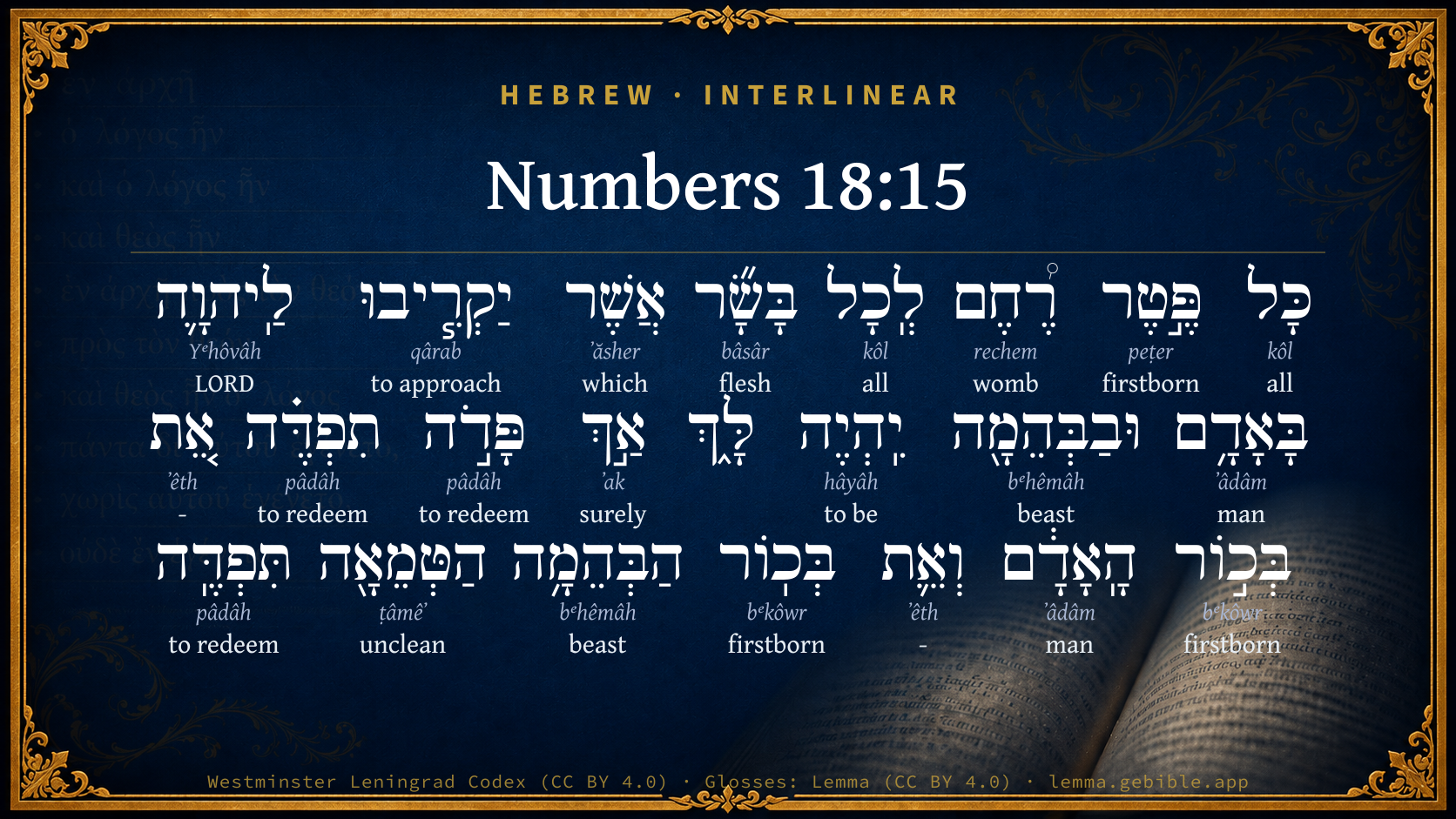
Hebrew (Westminster Leningrad Codex) Numbers 18:15 appears in the Hebrew Old Testament. The text above is from the Westminster Leningrad Codex. Each word links to its Strong’s number, a concise gloss, and parsing drawn from the Open Scriptures Hebrew Bible morphology. Click any word for its full Brown-Driver-Briggs (BDB) entry.
Download image
Cite this verse

Numbers 18:15 (World English Bible). Public Domain. Lemma interlinear Bible study tool, https://lemma.gebible.app/v/numbers/18/15.

Show BibTeX & RIS
BibTeX
RIS
English Translation
Everything that opens the womb, of all flesh which they offer to Yahweh, both of man and animal shall be yours: nevertheless the firstborn of man shall you surely redeem, and the firstborn of unclean animals shall you redeem.
World English Bible · Public Domain
Download a study sheet

One document with this verse’s original text, its word-by-word gloss line, the meaning frame, cross-references with their text, attributed commentary, and full source and license credits — printable, and it pastes into notes with its structure intact.

This verse Autodidact and up

Study sheet (.html) Plain text (.txt)

A passage Seminary Student

Up to 50 verses in one chapter. A passage sheet keeps up to 6 commentary sources and 12 cross-references per verse, in the order this page ranks them, and says so on the sheet whenever that leaves anything out. Ask for a single verse and you get the Autodidact verse sheet above.

Everything on this page stays free to read, with no account — the sheet is a download of what is already on screen, not access to it.

Want to remove ads? Support Godless Engineer
Compare translations 3

The same verse in 3 English versions, stacked beneath the original-language interlinear above. Click any original word for its lexicon entry.

Each is an independent rendering of the whole verse — the interlinear is not word-aligned to these translations.

Highlighted words mark where these versions differ — a whole-verse word diff, not a word-by-word alignment.

  • World English Bible Public Domain
    Everything that opens the womb, of all flesh which they offer to Yahweh, both of man and animal shall be yours: nevertheless the firstborn of man shall you surely redeem, and the firstborn of unclean animals shall you redeem.
  • King James Version Public Domain
    Every thing that openeth the matrix in all flesh, which they bring unto the LORD, whether it be of men or beasts, shall be thine: nevertheless the firstborn of man shalt thou surely redeem, and the firstling of unclean beasts shalt thou redeem.
  • unfoldingWord Literal Text CC BY-SA 4.0
    Every opener of the womb for all flesh which they present to Yahweh, among the man and among the animal, shall be for you. Only redeeming you shall redeem the firstborn of the man, and the firstborn of the unclean animal you shall redeem.

unfoldingWord Literal Text — © unfoldingWord, licensed CC BY-SA 4.0. Word-aligned USFM3 via Door43 (git.door43.org/unfoldingWord/en_ult).

Versions to compare (up to 4)

3 of 4 selected

Show all 18 translations

Every available English version of this verse, each an independent rendering of the whole verse.

  • World English Bible Public Domain
    Everything that opens the womb, of all flesh which they offer to Yahweh, both of man and animal shall be yours: nevertheless the firstborn of man shall you surely redeem, and the firstborn of unclean animals shall you redeem.
  • Berean Standard Bible Public Domain
    The firstborn of every womb, whether man or beast, that is offered to the LORD belongs to you. But you must surely redeem every firstborn son and every firstborn male of unclean animals.
  • Majority Standard Bible Public Domain
    The firstborn of every womb, whether man or beast, that is offered to the LORD belongs to you. But you must surely redeem every firstborn son and every firstborn male of unclean animals.
  • King James Version Public Domain
    Every thing that openeth the matrix in all flesh, which they bring unto the LORD, whether it be of men or beasts, shall be thine: nevertheless the firstborn of man shalt thou surely redeem, and the firstling of unclean beasts shalt thou redeem.
  • American Standard Version (1901) Public Domain
    Everything that openeth the womb, of all flesh which they offer unto Jehovah, both of man and beast shall be thine: nevertheless the first-born of man shalt thou surely redeem, and the firstling of unclean beasts shalt thou redeem.
  • Revised Version (1885) Public Domain
    Every thing that openeth the womb, of all flesh which they offer unto the LORD, both of man and beast, shall be thine: nevertheless the firstborn of man shalt thou surely redeem, and the firstling of unclean beasts shalt thou redeem.
  • Geneva Bible (1599) Public Domain
    All that first openeth the matrice of any flesh, which they shall offer vnto the Lord, of man or beast, shalbe thine: but the first borne of man shalt thou redeeme, and the first borne of the vncleane beast shalt thou redeeme.
  • Douay-Rheims (1899) Public Domain
    Whatsoever is firstborn of all flesh, which they offer to the Lord, whether it be of men, or of beasts, shall belong to thee: only for the firstborn of man thou shalt take a price, and every beast that is unclean thou shalt cause to be redeemed,
  • Young's Literal Translation Public Domain
    every one opening a womb of all flesh which they bring near to Jehovah, among man and among beast, is thine; only, thou dost certainly ransom the first-born of man, and the firstling of the unclean beast thou dost ransom.
  • Literal Standard Version CC BY-SA 4.0
    everyone opening a womb of all flesh which they bring near to YHWH, among man and among beast, is yours; only, you certainly ransom the firstborn of man, and you ransom the firstling of the unclean beast.
  • Unlocked Literal Bible CC BY-SA 4.0
    Everything that opens the womb, all the firstborn which the people offer to Yahweh, both of man and animal, will be yours. Nevertheless, the people must certainly buy back every firstborn son, and they must buy back the firstborn male of unclean animals.
  • unfoldingWord Literal Text CC BY-SA 4.0
    Every opener of the womb for all flesh which they present to Yahweh, among the man and among the animal, shall be for you. Only redeeming you shall redeem the firstborn of the man, and the firstborn of the unclean animal you shall redeem.
  • Darby Bible Public Domain
    Everything that breaketh open the womb of all flesh, which they present to Jehovah, of men or of beasts, shall be thine; nevertheless the firstborn of man shalt thou in any case ransom, and the firstborn of unclean beasts shalt thou ransom.
  • World Messianic Bible Public Domain
    Everything that opens the womb, of all flesh which they offer to the LORD, both of man and animal, shall be yours. Nevertheless, you shall surely redeem the firstborn of man, and you shall redeem the firstborn of unclean animals.
  • Webster's Bible Public Domain
    Every thing that openeth the matrix in all flesh, which they bring to the LORD, whether of men or beast, shall be thine: nevertheless, the first born of man shalt thou surely redeem, and the firstling of unclean beasts shalt thou redeem.
  • Free Bible Version CC BY-SA 4.0
    Every firstborn, whether human or animal, that is offered to the Lord is yours. But you must buy back every firstborn son and every firstborn male of unclean animals.
  • Bible in Basic English Public Domain
    The first birth of every living thing which is offered to the Lord, of man or beast, is to be yours; but for the first sons of man payment is to be made, and for the first young of unclean beasts.
  • JPS Tanakh (1917) Public Domain
    Every thing that openeth the womb, of all flesh which they offer unto the LORD, both of man and beast, shall be thine; howbeit the first-born of man shalt thou surely redeem, and the firstling of unclean beasts shalt thou redeem.

Literal Standard Version (2020), Covenant Press — licensed CC BY-SA 4.0. Text via the HelloAO Bible API (eBible.org). Unlocked Literal Bible (unfoldingWord) — licensed CC BY-SA 4.0. Text via the HelloAO Bible API (eBible.org). unfoldingWord Literal Text — © unfoldingWord, licensed CC BY-SA 4.0. Word-aligned USFM3 via Door43 (git.door43.org/unfoldingWord/en_ult). Free Bible Version, Dr. Jonathan Gallagher — licensed CC BY-SA 4.0. Text via the HelloAO Bible API (eBible.org).

Word by word

More ways to search: Search by grammar → Find every occurrence → Compare this word →

Practice this passage: Drill this verse → Learn its vocabulary →

פֶּ֣טֶר
peṭer
H6363
“firstborn of”
Noun, Common, Masculine, Singular, Construct
Part of Speech
Noun
Type
Common
Gender
Masculine
Number
Singular
State
Construct
Full BDB Definition

Origin: from H6362

TWOT: 1764a , 1764b

firstborn, firstling, that which separates or first opens
  1. כָּל kôl H3605 “all of” Noun, Common, Masculine, Singular, Construct
  2. רֶ֠חֶם rechem H7358 “womb” Noun, Common, Masculine, Singular, Absolute
  3. לְֽכָל kôl H3605 “to/for · all of” Preposition + Noun, Common, Masculine, Singular, Construct
  4. בָּשָׂ֞ר bâsâr H1320 “flesh” Noun, Common, Masculine, Singular, Absolute
  5. אֲשֶׁר ʼăsher H834 “which” Particle, Relative
  6. יַקְרִ֧יבוּ qârab H7126 “to approach” Verb, Hiphil, Imperfect, 3rd Person, Masculine, Plural
  7. לַֽיהוָ֛ה Yᵉhôvâh H3068 “to/for · LORD” Preposition + Noun, Proper
  8. בָּאָדָ֥ם ʼâdâm H120 “in/at the · man” Preposition, Determined + Noun, Common, Masculine, Singular, Absolute
  9. וּבַבְּהֵמָ֖ה bᵉhêmâh H929 “and · in/at the · beast” Conjunction + Preposition, Determined + Noun, Common, Feminine, Singular, Absolute
  10. יִֽהְיֶה hâyâh H1961 “to be” Verb, Qal, Imperfect, 3rd Person, Masculine, Singular
  11. אַ֣ךְ ʼak H389 “surely” Particle, Accusative
  12. פָּדֹ֣ה pâdâh H6299 “to redeem” Verb, Qal, Infinitive Absolute
  13. תִפְדֶּ֗ה pâdâh H6299 “to redeem” Verb, Qal, Imperfect, 2nd Person, Masculine, Singular
  14. אֵ֚ת ʼêth H853 “-” Particle, Direct Object
  15. בְּכ֣וֹר bᵉkôwr H1060 “firstborn of” Noun, Common, Masculine, Singular, Construct
  16. הָֽאָדָ֔ם ʼâdâm H120 “the · man” Particle, Definite Article + Noun, Common, Masculine, Singular, Absolute
  17. וְאֵ֛ת ʼêth H853 “and · -” Conjunction + Particle, Direct Object
  18. בְּכֽוֹר bᵉkôwr H1060 “firstborn of” Noun, Common, Masculine, Singular, Construct
  19. הַבְּהֵמָ֥ה bᵉhêmâh H929 “the · beast” Particle, Definite Article + Noun, Common, Feminine, Singular, Absolute
  20. הַטְּמֵאָ֖ה ṭâmêʼ H2931 “the · unclean” Particle, Definite Article + Adjective, Adjective, Feminine, Singular, Absolute
  21. תִּפְדֶּֽה pâdâh H6299 “to redeem” Verb, Qal, Imperfect, 2nd Person, Masculine, Singular

About this verse

These counts appear in no published source. They are computed here, from the morphology-tagged text and Lemma’s own curated glosses. What Lemma adds →

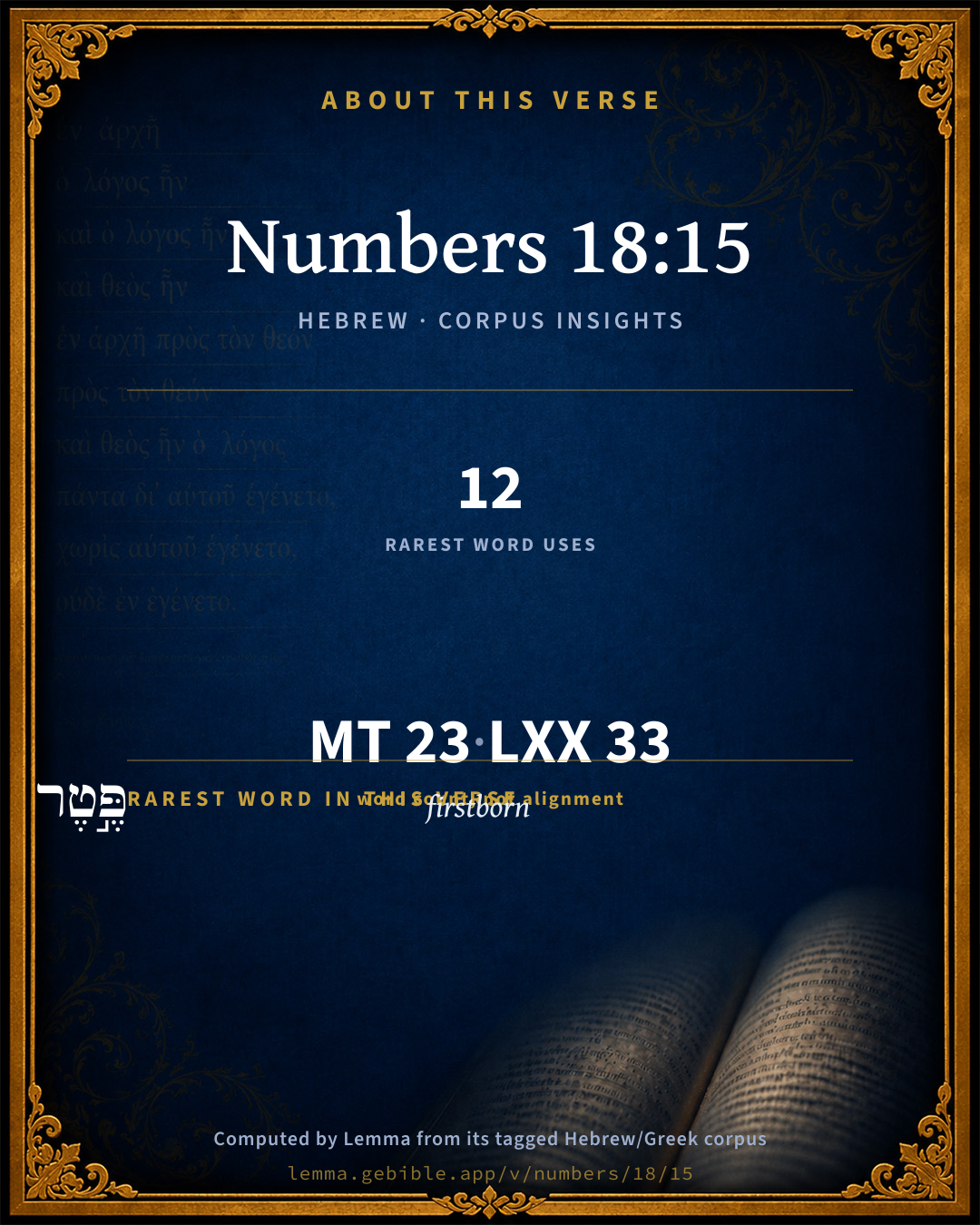
23
words
15
distinct lemmas
Pentateuch
section

Notable vocabulary

The rarest word here is פֶּ֣טֶר firstborn H6363 — appearing just 12 times in the whole Hebrew Bible.

Shared distinctive vocabulary

פֶּ֣טֶר firstborn H6363 occurs in 10 verses of the Hebrew Bible. Also found in:

Grammatical profile

  • 5 verbs
  • 12 nouns
  • 1 adjective
  • 1 preposition
  • 4 particles

Verb forms

  • יַקְרִ֧יבוּ Hiphil · Imperfect
  • יִֽהְיֶה Qal · Imperfect
  • פָּדֹ֣ה Qal · Infinitive Absolute
  • תִפְדֶּ֗ה Qal · Imperfect
  • תִּפְדֶּֽה Qal · Imperfect

Repetition

Words recur within this verse — often emphatic in Hebrew:

  • פָּדֹ֣ה to redeem H6299 ×3
  • כָּל all H3605 ×2
  • בָּאָדָ֥ם man H120 ×2
  • וּבַבְּהֵמָ֖ה beast H929 ×2
  • בְּכ֣וֹר firstborn H1060 ×2

Hebrew & Septuagint length

In English translation the verse runs 39 words from the Hebrew and 41 from the Septuagint (LXX English) — closely comparable.

A rough comparison of the two English renderings, which tokenize alike — not a word-level alignment.

Word counts can differ between the Hebrew and the Greek without any difference in meaning — e.g. the Hebrew direct-object marker אֵת has no separate Greek word, and Greek often adds the article ὁ.

In the original languages it is 23 Hebrew tokens and 33 Greek tokens — but the two are counted differently (Hebrew bundles its prefixes and suffixes into one token; the Greek is in lemma form), so that isn’t a like-for-like length.

Cross-references

7

Topical passages linked to Numbers 18:15 in the Treasury of Scripture Knowledge — connected by theme and wording, ordered by reader-vote popularity; previews shown in the World English Bible.

  • Exodus 34:20 The firstborn of a donkey you shall redeem with a lamb: and if you will not redeem it, then you shall break its neck. All the firstborn of your sons you shall redeem. No one shall appear before me empty.
  • Exodus 13:2 "Sanctify to me all of the firstborn, whatever opens the womb among the children of Israel, both of man and of animal. It is mine."
  • Exodus 13:12–13 that you shall set apart to Yahweh all that opens the womb, and every firstborn which you have that comes from an animal. The males shall be Yahweh's.
  • Exodus 22:29 "You shall not delay to offer from your harvest and from the outflow of your presses. "You shall give the firstborn of your sons to me.
  • Leviticus 27:26–27 "'Only the firstborn among animals, which is made a firstborn to Yahweh, no man may dedicate it; whether an ox or sheep, it is Yahweh's.
  • Numbers 3:13 for all the firstborn are mine. On the day that I struck down all the firstborn in the land of Egypt I made holy to me all the firstborn in Israel, both man and animal. They shall be mine. I am Yahweh."
  • Numbers 3:46 For the redemption of the two hundred seventy-three of the firstborn of the children of Israel, who exceed the number of the Levites,

Cross-references courtesy of OpenBible.info (CC BY 4.0).

Hebrew and Greek witnesses Masoretic Hebrew ↔ Greek Septuagint

The same verse in the two great witnesses to the Old Testament, shown verse-for-verse.

These are two independent witnesses, not word-aligned to each other, and the Septuagint is shown in lemma (dictionary) form.

Hebrew Numbers 18:15 Masoretic · Westminster Leningrad Codex

כָּל פֶּ֣טֶר רֶ֠חֶם לְֽכָל בָּשָׂ֞ר אֲשֶׁר יַקְרִ֧יבוּ לַֽיהוָ֛ה בָּאָדָ֥ם וּבַבְּהֵמָ֖ה יִֽהְיֶה לָּ֑ךְ אַ֣ךְ פָּדֹ֣ה תִפְדֶּ֗ה אֵ֚ת בְּכ֣וֹר הָֽאָדָ֔ם וְאֵ֛ת בְּכֽוֹר הַבְּהֵמָ֥ה הַטְּמֵאָ֖ה תִּפְדֶּֽה

Everything that opens the womb, of all flesh which they offer to Yahweh, both of man and animal shall be yours: nevertheless the firstborn of man shall you surely redeem, and the firstborn of unclean animals shall you redeem.

World English Bible · Public Domain

Greek LXX Numbers 18:15 Septuagint · lemma form

καί πᾶς δια ἀναοἴγω μήτρα ἀπό πᾶς σάρξ ὅς προςφέρω κύριος ἀπό ἄνθρωπος ἕως κτῆνος σύ εἰμί ἀλλά ἤ λύτρον λυτρόω ὁ πρωτότοκος ὁ ἄνθρωπος καί ὁ πρωτότοκος ὁ κτῆνος ὁ ἀκάθαρτος λυτρόω

And every thing that opens the womb of all flesh, whatever they bring to the Lord, whether man or beast, shall be yours: only the firstborn of men shall be surely redeemed, and you shall redeem the firstborn of unclean cattle.

LXX2012 (modern English Septuagint) · Public Domain

On this verse, Whedon's Commentary on the Bible discusses the Septuagint’s reading. Read the note in Commentary ↓

Hebrew: Westminster Leningrad Codex (CC BY 4.0). Greek: Septuagint (public domain); English from LXX2012 (modern English Septuagint) (Public Domain). How the Septuagint differs from the Hebrew →

Targum (Aramaic paraphrase)

2

The Targum is the ancient Jewish Aramaic paraphrase of the Hebrew Scriptures — an interpretive translation, not the Hebrew text itself. Onkelos (literal) and Pseudo-Jonathan (expansive) render the Torah, and Jonathan the Prophets. Coverage is partial: where no permissively-licensed English translation exists for a verse, only the Aramaic is shown. This is verse-level text, not a word-by-word alignment to the Hebrew.

  1. Targum Onkelos Torah (Genesis–Deuteronomy)
    כָּל פְּתַח וַלְדָא לְכָל בִּשְׂרָא דִי יְקָרְבוּן קֳדָם יְיָ בֶּאֱנָשָׁא וּבִבְעִירָא יְהֵי לָךְ בְּרַם מִפְרַק תִּפְרוֹק יָת בּוּכְרָא דֶאֱנָשָׁא וְיָת בּוּכְרָא דִבְעִירָא מְסַאֲבָא תִּפְרוֹק

    (no public-domain English translation for this verse)

    Targum Onkelos — Aramaic: “Onkelos Genesis” (public domain); “Onkelos Exodus” (public domain); “Onkelos Leviticus” (public domain); “Onkelos Numbers” (public domain); “Onkelos Deuteronomy” (public domain). English: “Sefaria Community Translation” (CC0 1.0 (public-domain dedication)); “J.W. Etheridge. The Targums of Onkelos and Jonathan Ben Uzziel on the Pentateuch. London: Longmans, Green, 1862” (public domain). Text via Sefaria.

  2. Targum Pseudo-Jonathan Torah (Genesis–Deuteronomy)
    כָּל פְּתַח וַלְדָא לְכָל בִּשְרָא בִּבְעִירָא דְיִקְרְבוּן מִינָהּ קֳדָם יְיָ כְּדִינָא דְאֵינָשָׁא כֵּן דִינָא בִּבְעִירָא לְמֶהֱוֵי דִילָךְ בְּרַם מִפְרַק תִּפְרוֹק יַת בּוּכְרָא דְאֵינָשָׁא בְּחַמְשָׁא סִלְעִין וְיַת בּוּכְרָא דִבְעִירָא מְסָאָבָא תִּפְרוֹק בְּאִמְרַיָא

    Whatever openeth the womb, of all flesh among animals which they offer before the Lord, as the regulation concerning men, so the regulation concerning cattle, it is to be thine: only thou art to redeem the firstborn of man by the five shekels, and the firstlings of the unclean animal thou shalt redeem with lambs.

    Targum Pseudo-Jonathan — Aramaic: “Targum Jonathan on Genesis” (public domain); “Targum Jonathan on Exodus” (public domain); “Targum Jonathan on Leviticus” (public domain); “Targum Jonathan on Numbers” (public domain); “Targum Jonathan on Deuteronomy” (public domain). English: “The Targum of Jonathan ben Uzziel, trans. J. W. Etheridge, London, 1862” (public domain). Text via Sefaria.

Commentary

Notes on Numbers 18:15 from classic Christian and Jewish commentators (each source and its license shown beneath its notes). The classic Christian expositions comment on the surrounding passage and are grouped to its opening verse, so a note may address several verses; the Jewish commentaries on the Tanakh (Rashi and others) are per-verse, so they appear only where the commentator wrote on this verse.

Lemma curates 59 commentaries, every one of them public domain or Creative Commons licensed, each selected and text-cleaned for this edition rather than reprinted as found. About our sources →

Tyndale Open Study Notes

Tyndale Open Resources

18:15-16 The Lord provided for the Hebrew priests and their families out of what was set aside for the Lord. The priests had rights to firstborn animal offerings and to the redemption fee for Israel’s firstborn sons. Both the firstborn sons and the offspring of unclean animals had to be redeemed by a fee paid in silver, since neither could be sacrificed (see 3:13, 40-51; Exod 13:2).

Tyndale Open Study Notes — © Tyndale Open Resources, licensed CC BY-SA 4.0. Text via the HelloAO Bible API.

Adam Clarke's Commentary

Verse 15. The first-born of man - and the firstling of unclean beasts] Thus vain man is ranked with the beasts that perish; and with the worst kinds of them too, those deemed unclean.

Adam Clarke's Commentary on the Bible (1810–1826) — public domain. Text from a community e-Sword/MySword module.

Ellicott's Commentary for English Readers

(15) Every thing that openeth the matrix . . . —(See Lev_27:6; Lev_27:26-27.) Five shekels was the redemption-price paid for each of the firstborn who were not redeemed by the Levites (Num_3:47).

A Bible Commentary for English Readers, edited by Charles John Ellicott (1878–1897) — public domain. Text from a community e-Sword module.

The Cambridge Bible for Schools and Colleges

gen. ed. J. J. S. Perowne

15. of all flesh which they offer] i.e. clean animals, for they alone could be offered.

The Cambridge Bible for Schools and Colleges (gen. ed. J. J. S. Perowne; Cambridge University Press, 1878–1918) — public domain. Text from a community e-Sword module.

John Gill's Exposition

And those that are to be redeemed,.... Which is to be understood not of unclean beasts last mentioned, for they were redeemed with lambs and not with money; and after they were eight days and not a month old, as follows, Exo 13:13; but of the firstborn of men:

from a month old shalt thou redeem, according to thine estimation: that is, take the redemption money next mentioned; and though both time and price are fixed, yet said to be according to the estimation of the priest; see Lev 27:5,

for the money of five shekels; which was about eleven or twelve shillings of our money, and is the price given for the redemption of the firstborn, when the Levites were taken in their stead, Num 3:47,

after the shekel of the sanctuary, which is twenty gerahs; see Gill on Num 3:47; of the manner of redeeming the firstborn; see Gill on Exo 13:15.

John Gill's Exposition of the Whole Bible (1746–1763) — public domain (CC PDM 1.0). Text via the HelloAO Bible API.

Albert Barnes' Notes on the Bible

Surely redeem ... redeem - A stronger expression is intentionally used in reference to the redemption of the first-born of man than in reference to that of unclean beasts. For the rule as to the former admitted of no exception: the owner of the latter, if unwilling to redeem, might destroy the beasts. Compare the marginal references.

Albert Barnes' Notes on the Bible (1834–1885) — public domain. Text from a community e-Sword/MySword module.

Haydock's Catholic Bible Commentary

Beast. The Rabbins restrain this to the ass alone, which they pretend was deemed the only unclean animal by the Israelites, in Egypt, when this law was established; and Moses indeed specifies it alone, Exodus xiii. 13. (Abenezra) --- But we cannot doubt but that camels, and all other unclean animals, were to be included, if the Hebrews kept them; (Calmet) and those which were rendered impure by some defect, were also to be redeemed. (Menochius)

George Leo Haydock (1774–1849), Haydock's Catholic Family Bible and Commentary, 1859 edition — public domain. Excludes Psalms (Douay-Rheims chapter numbering differs from Protestant) and Deuterocanonical books (Catholic canon only).

Matthew Poole's English Annotations

Whether it be of men, which were offered to God in his temple, Exo 13:12; Luk 2:22, and to his service and disposal.

Matthew Poole's English Annotations on the Holy Bible (1683–1685) — public domain. Text from a community e-Sword/MySword module.

Whedon's Commentary on the Bible

Daniel D. Whedon

15. Every thing that openeth the matrix — Every firstborn male. The female firstborn of man and beast were exempted from consecration. See Lev_27:26, note. The firstborn of man were to be consecrated to Jehovah as a sacrifice, not after the manner of the heathen, by slaying and burning upon the altar, but by presenting them to the Lord as living sacrifices, devoting all their powers of body and mind to his service. Rom_12:1, note. “As the Egyptians were judged in their firstborn children because of their guilt, so that the children took the place of the whole nation, and bore as a sacrifice the curse of extermination which lay on all; so, on the contrary, Israel — the people chosen by Jehovah and redeemed from the bondage of man — in testimony that it owes its existence and possessions to divine grace alone,… shall bring to God, as payment, the firstling blessings of his house in place of the whole.” — Oehler. Since the first birth represented all the births, the whole nation was to consecrate itself to Jehovah, and present itself as a priestly nation in the consecration of the firstborn, thus fore-shadowing the “royal priesthood” of every individual believer in Christ. See the Septuagint of Exo_19:6, and 1Pe_2:9.

Daniel D. Whedon (gen. ed.), Commentary on the Old and New Testaments (1874–1909) — public domain. Text from a community e-Sword module.

John Wesley's Explanatory Notes

Of men - Which were offered to God in his temple, and to his service and disposal.

John Wesley, Explanatory Notes Upon the Whole Bible (1754–1765) — public domain. Text via the GEBible commentary corpus.

Lesson kit

Teaching starters — assembled from the data on this page, not authored interpretation. Every prompt links to the verse data it draws on. Edit before teaching.

Numbers, in the Pentateuch, opens this verse with 23 words (15 distinct Hebrew lemmas). Its most distinctive word is peṭer (“firstborn”). A historical commentator’s framing appears above. Read the whole chapter for the surrounding context.

Discussion questions

  1. How does “firstborn” (peṭer) shape what this verse is saying?
  2. How does Exodus 13:2, which shares the word «firstborn», read alongside this verse?
  3. What does the repetition of “to redeem” (3× in this one verse) do in this verse?
  4. These translations render this verse differently; the difference is in the English rendering, not the original. What questions does that raise?
  5. «יַקְרִ֧יבוּ» is a Hiphil Imperfect verb. How does that grammatical form shape the action described?
  6. Compare how Tyndale Open Study Notes and Adam Clarke's Commentary read this verse. Where do they agree or differ?

Things to notice

Reading settings

Reading text

Shown beneath each verse's original-language words.

Old Testament
Old Testament edition

Read the OT as the Masoretic Hebrew (MT) or the Greek Septuagint (LXX).

English shown for the Greek Septuagint (in the Hebrew ↔ Greek comparison).

Comparing translations? Open the Compare panel on any verse page to stack up to four side by side.