
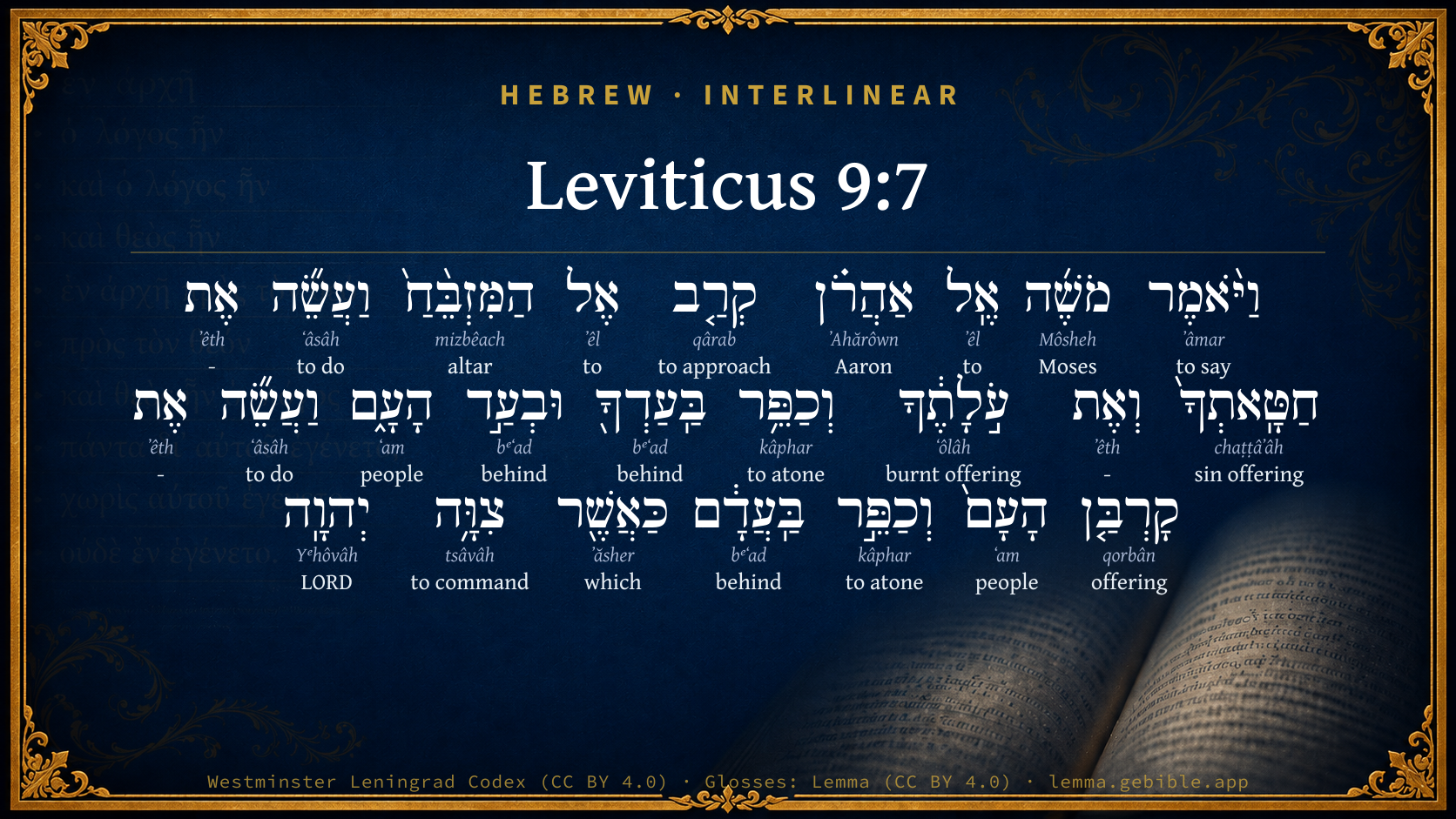
Leviticus 9:7

Hebrew (Westminster Leningrad Codex) Leviticus 9:7 appears in the Hebrew Old Testament. The text above is from the Westminster Leningrad Codex. Each word links to its Strong’s number, a concise gloss, and parsing drawn from the Open Scriptures Hebrew Bible morphology. Click any word for its full Brown-Driver-Briggs (BDB) entry.
Download image
Cite this verse

Leviticus 9:7 (World English Bible). Public Domain. Lemma interlinear Bible study tool, https://lemma.gebible.app/v/leviticus/9/7.

Show BibTeX & RIS
BibTeX
RIS
English Translation
Moses said to Aaron, "Draw near to the altar, and offer your sin offering, and your burnt offering, and make atonement for yourself, and for the people; and offer the offering of the people, and make atonement for them; as Yahweh commanded."
World English Bible · Public Domain
Download a study sheet

One document with this verse’s original text, its word-by-word gloss line, the meaning frame, cross-references with their text, attributed commentary, and full source and license credits — printable, and it pastes into notes with its structure intact.

This verse Autodidact and up

Study sheet (.html) Plain text (.txt)

A passage Seminary Student

Up to 50 verses in one chapter. A passage sheet keeps up to 6 commentary sources and 12 cross-references per verse, in the order this page ranks them, and says so on the sheet whenever that leaves anything out. Ask for a single verse and you get the Autodidact verse sheet above.

Everything on this page stays free to read, with no account — the sheet is a download of what is already on screen, not access to it.

Want to remove ads? Support Godless Engineer
Compare translations 3

The same verse in 3 English versions, stacked beneath the original-language interlinear above. Click any original word for its lexicon entry.

Each is an independent rendering of the whole verse — the interlinear is not word-aligned to these translations.

Highlighted words mark where these versions differ — a whole-verse word diff, not a word-by-word alignment.

  • World English Bible Public Domain
    Moses said to Aaron, "Draw near to the altar, and offer your sin offering, and your burnt offering, and make atonement for yourself, and for the people; and offer the offering of the people, and make atonement for them; as Yahweh commanded."
  • King James Version Public Domain
    And Moses said unto Aaron, Go unto the altar, and offer thy sin offering, and thy burnt offering, and make an atonement for thyself, and for the people: and offer the offering of the people, and make an atonement for them; as the LORD commanded.
  • unfoldingWord Literal Text CC BY-SA 4.0
    And Moses said to Aaron, “Draw near to the altar and make your sin offering and your burnt offering and make atonement for the benefit of yourself and for the benefit of the people. And make the offering of the people and make atonement for their benefit, just as Yahweh commanded.”

unfoldingWord Literal Text — © unfoldingWord, licensed CC BY-SA 4.0. Word-aligned USFM3 via Door43 (git.door43.org/unfoldingWord/en_ult).

Versions to compare (up to 4)

3 of 4 selected

Show all 18 translations

Every available English version of this verse, each an independent rendering of the whole verse.

  • World English Bible Public Domain
    Moses said to Aaron, "Draw near to the altar, and offer your sin offering, and your burnt offering, and make atonement for yourself, and for the people; and offer the offering of the people, and make atonement for them; as Yahweh commanded."
  • Berean Standard Bible Public Domain
    Then Moses said to Aaron, “Approach the altar and sacrifice your sin offering and your burnt offering to make atonement for yourself and for the people. And sacrifice the people’s offering to make atonement for them, as the LORD has commanded.”
  • Majority Standard Bible Public Domain
    Then Moses said to Aaron, “Approach the altar and sacrifice your sin offering and your burnt offering to make atonement for yourself and for the people. And sacrifice the people’s offering to make atonement for them, as the LORD has commanded.”
  • King James Version Public Domain
    And Moses said unto Aaron, Go unto the altar, and offer thy sin offering, and thy burnt offering, and make an atonement for thyself, and for the people: and offer the offering of the people, and make an atonement for them; as the LORD commanded.
  • American Standard Version (1901) Public Domain
    And Moses said unto Aaron, Draw near unto the altar, and offer thy sin-offering, and thy burnt-offering, and make atonement for thyself, and for the people; and offer the oblation of the people, and make atonement for them; as Jehovah commanded.
  • Revised Version (1885) Public Domain
    And Moses said unto Aaron, Draw near unto the altar, and offer thy sin offering, and thy burnt offering, and make atonement for thyself, and for the people: and offer the oblation of the people, and make atonement for them; as the LORD commanded.
  • Geneva Bible (1599) Public Domain
    Then Moses sayd vnto Aaron, Draw neere to the Altar, and offer thy sinne offering, and thy burnt offring, and make an attonement for thee and for the people: offer also the offring of the people, and make an atonement for them, as the Lord hath commanded.
  • Douay-Rheims (1899) Public Domain
    And he said to Aaron: Approach to the altar, and offer sacrifice for thy sin: offer the holocaust, and pray for thyself and for the people: and when thou hast slain the people's victim, pray for them, as the Lord hath commanded.
  • Young's Literal Translation Public Domain
    And Moses saith unto Aaron, `Draw near unto the altar, and make thy sin-offering, and thy burnt-offering, and make atonement for thyself, and for the people, and make the offering of the people, and make atonement for them, as Jehovah hath commanded.'
  • Literal Standard Version CC BY-SA 4.0
    And Moses says to Aaron, “Draw near to the altar, and make your sin-offering, and your burnt-offering, and make atonement for yourself, and for the people, and make the offering of the people, and make atonement for them, as YHWH has commanded.”
  • Unlocked Literal Bible CC BY-SA 4.0
    Moses said to Aaron, “Come near the altar and offer your sin offering and burnt offering, and make atonement for yourself and for the people, and offer the sacrifice for the people to make atonement for them, as Yahweh has commanded.”
  • unfoldingWord Literal Text CC BY-SA 4.0
    And Moses said to Aaron, “Draw near to the altar and make your sin offering and your burnt offering and make atonement for the benefit of yourself and for the benefit of the people. And make the offering of the people and make atonement for their benefit, just as Yahweh commanded.”
  • Darby Bible Public Domain
    And Moses said unto Aaron, Go to the altar, and offer thy sin-offering, and thy burnt-offering, and make atonement for thyself, and for the people; and offer the offering of the people, and make atonement for them, as Jehovah has commanded.
  • World Messianic Bible Public Domain
    Moses said to Aaron, “Draw near to the altar, and offer your sin offering, and your burnt offering, and make atonement for yourself, and for the people; and offer the offering of the people, and make atonement for them, as the LORD commanded.”
  • Webster's Bible Public Domain
    And Moses said to Aaron, Go to the altar, and offer thy sin-offering, and thy burnt-offering, and make an atonement for thyself, and for the people: and offer the offering of the people, and make an atonement for them; as the LORD commanded.
  • Free Bible Version CC BY-SA 4.0
    Then Moses told Aaron, “Go to the altar and sacrifice your sin offering and your burnt offering to make you and the people right. Then sacrifice the offerings brought by the people as a means to make them right, as the Lord ordered.”
  • Bible in Basic English Public Domain
    And Moses said to Aaron, Come near to the altar and make your sin-offering and your burned offering to take away your sin and the sin of the people, and make the people's offering to take away their sin; as the Lord has given orders.
  • JPS Tanakh (1917) Public Domain
    And Moses said unto Aaron: 'Draw near unto the altar, and offer thy sin-offering, and thy burnt-offering, and make atonement for thyself, and for the people; and present the offering of the people, and make atonement for them; as the LORD commanded.'

Literal Standard Version (2020), Covenant Press — licensed CC BY-SA 4.0. Text via the HelloAO Bible API (eBible.org). Unlocked Literal Bible (unfoldingWord) — licensed CC BY-SA 4.0. Text via the HelloAO Bible API (eBible.org). unfoldingWord Literal Text — © unfoldingWord, licensed CC BY-SA 4.0. Word-aligned USFM3 via Door43 (git.door43.org/unfoldingWord/en_ult). Free Bible Version, Dr. Jonathan Gallagher — licensed CC BY-SA 4.0. Text via the HelloAO Bible API (eBible.org).

Word by word

More ways to search: Search by grammar → Find every occurrence → Compare this word →

Practice this passage: Drill this verse → Learn its vocabulary →

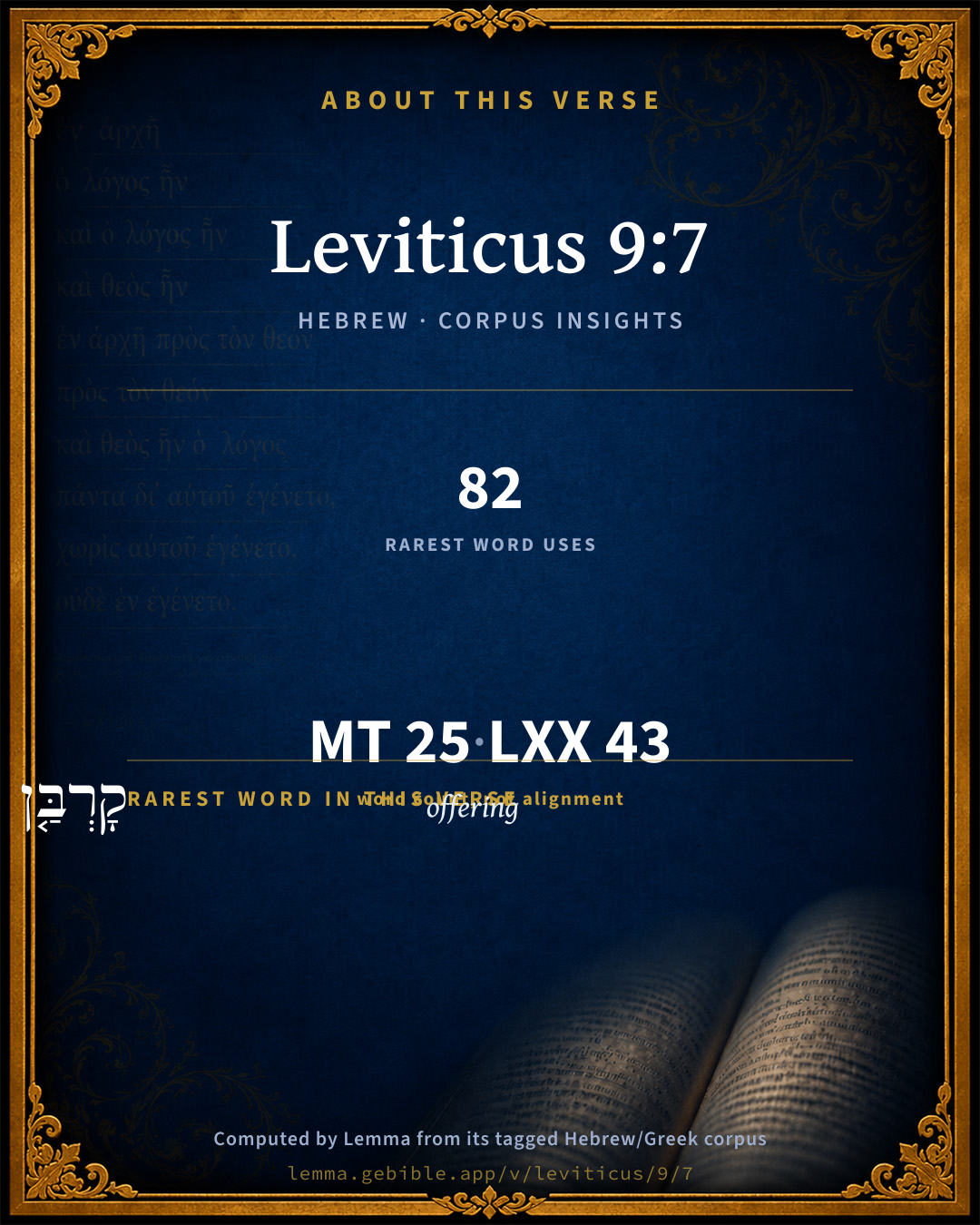
קָרְבַּ֤ן
qorbân
H7133
“offering of”
Noun, Common, Masculine, Singular, Construct
Part of Speech
Noun
Type
Common
Gender
Masculine
Number
Singular
State
Construct
Full BDB Definition

Origin: from H7126

TWOT: 2065e

offering, oblation
  1. וַיֹּ֨אמֶר ʼâmar H559 “and · to say” Conjunction + Verb, Qal, Sequential Imperfect, 3rd Person, Masculine, Singular
  2. מֹשֶׁ֜ה Môsheh H4872 “Moses” Noun, Proper
  3. אֶֽל ʼêl H413 “to” Preposition
  4. אַהֲרֹ֗ן ʼAhărôwn H175 “Aaron” Noun, Proper
  5. קְרַ֤ב qârab H7126 “approach” Verb, Qal, Imperative, 2nd Person, Masculine, Singular
  6. אֶל ʼêl H413 “to” Preposition
  7. הַמִּזְבֵּ֨חַ֙ mizbêach H4196 “the · altar” Particle, Definite Article + Noun, Common, Masculine, Singular, Absolute
  8. וַעֲשֵׂ֞ה ʻâsâh H6213 “and · do” Conjunction + Verb, Qal, Imperative, 2nd Person, Masculine, Singular
  9. אֶת ʼêth H853 “-” Particle, Direct Object
  10. חַטָּֽאתְךָ֙ chaṭṭâʼâh H2403 “sin offering · your” Noun, Common, Feminine, Singular, Construct + Suffix, Personal, 2nd Person, Masculine, Singular
  11. וְאֶת ʼêth H853 “and · -” Conjunction + Particle, Direct Object
  12. עֹ֣לָתֶ֔ךָ ʻôlâh H5930 “burnt offering · your” Noun, Common, Feminine, Singular, Construct + Suffix, Personal, 2nd Person, Masculine, Singular
  13. וְכַפֵּ֥ר kâphar H3722 “and · atone” Conjunction + Verb, Piel, Imperative, 2nd Person, Masculine, Singular
  14. בַּֽעַדְךָ֖ bᵉʻad H1157 “behind · you” Preposition + Suffix, Personal, 2nd Person, Masculine, Singular
  15. וּבְעַ֣ד bᵉʻad H1157 “and · behind” Conjunction + Preposition
  16. הָעָ֑ם ʻam H5971 “the · people” Particle, Definite Article + Noun, Common, Masculine, Singular, Absolute
  17. וַעֲשֵׂ֞ה ʻâsâh H6213 “and · do” Conjunction + Verb, Qal, Imperative, 2nd Person, Masculine, Singular
  18. אֶת ʼêth H853 “-” Particle, Direct Object
  19. הָעָם֙ ʻam H5971 “the · people” Particle, Definite Article + Noun, Common, Masculine, Singular, Absolute
  20. וְכַפֵּ֣ר kâphar H3722 “and · atone” Conjunction + Verb, Piel, Imperative, 2nd Person, Masculine, Singular
  21. בַּֽעֲדָ֔ם bᵉʻad H1157 “behind · them” Preposition + Suffix, Personal, 3rd Person, Masculine, Plural
  22. כַּאֲשֶׁ֖ר ʼăsher H834 “like/as · which” Preposition + Particle, Relative
  23. צִוָּ֥ה tsâvâh H6680 “to command” Verb, Piel, Perfect, 3rd Person, Masculine, Singular
  24. יְהוָֽה Yᵉhôvâh H3068 “LORD” Noun, Proper

About this verse

These counts appear in no published source. They are computed here, from the morphology-tagged text and Lemma’s own curated glosses. What Lemma adds →

25
words
17
distinct lemmas
Pentateuch
section

Grammatical profile

  • 7 verbs
  • 9 nouns
  • 5 prepositions
  • 4 particles

Verb forms

  • וַיֹּ֨אמֶר Qal · Sequential Imperfect
  • קְרַ֤ב Qal · Imperative
  • וַעֲשֵׂ֞ה Qal · Imperative
  • וְכַפֵּ֥ר Piel · Imperative
  • וַעֲשֵׂ֞ה Qal · Imperative
  • וְכַפֵּ֣ר Piel · Imperative
  • צִוָּ֥ה Piel · Perfect

Repetition

Words recur within this verse — often emphatic in Hebrew:

  • בַּֽעַדְךָ֖ behind H1157 ×3
  • וַעֲשֵׂ֞ה to do H6213 ×2
  • וְכַפֵּ֥ר to atone H3722 ×2
  • הָעָ֑ם people H5971 ×2
  • אֶֽל to H413 ×2

Hebrew & Septuagint length

In English translation the verse runs 42 words from the Hebrew and 45 from the Septuagint (LXX English) — closely comparable.

A rough comparison of the two English renderings, which tokenize alike — not a word-level alignment.

Word counts can differ between the Hebrew and the Greek without any difference in meaning — e.g. the Hebrew direct-object marker אֵת has no separate Greek word, and Greek often adds the article ὁ.

In the original languages it is 25 Hebrew tokens and 43 Greek tokens — but the two are counted differently (Hebrew bundles its prefixes and suffixes into one token; the Greek is in lemma form), so that isn’t a like-for-like length.

Cross-references

9

Topical passages linked to Leviticus 9:7 in the Treasury of Scripture Knowledge — connected by theme and wording, ordered by reader-vote popularity; previews shown in the World English Bible.

  • Hebrews 5:3 Because of this, he must offer sacrifices for sins for the people, as well as for himself.
  • Hebrews 5:1 For every high priest, being taken from among men, is appointed for men in things pertaining to God, that he may offer both gifts and sacrifices for sins.
  • Leviticus 4:3 if the anointed priest sins so as to bring guilt on the people, then let him offer for his sin, which he has sinned, a young bull without blemish to Yahweh for a sin offering.
  • Hebrews 9:7 but into the second the high priest alone, once in the year, not without blood, which he offers for himself, and for the errors of the people.
  • Leviticus 4:16–20 The anointed priest shall bring of the blood of the bull to the Tent of Meeting:
  • Leviticus 8:34 What has been done this day, so Yahweh has commanded to do, to make atonement for you.
  • Leviticus 9:2 and he said to Aaron, "Take a calf from the herd for a sin offering, and a ram for a burnt offering, without blemish, and offer them before Yahweh.
  • 1 Samuel 3:14 Therefore I have sworn to the house of Eli, that the iniquity of Eli's house shall not be expiated with sacrifice nor offering forever.
  • Hebrews 7:27–28 who doesn't need, like those high priests, to daily offer up sacrifices, first for his own sins, and then for the sins of the people. For this he did once for all, when he offered up himself.

Cross-references courtesy of OpenBible.info (CC BY 4.0).

Hebrew and Greek witnesses Masoretic Hebrew ↔ Greek Septuagint

The same verse in the two great witnesses to the Old Testament, shown verse-for-verse.

These are two independent witnesses, not word-aligned to each other, and the Septuagint is shown in lemma (dictionary) form.

Hebrew Leviticus 9:7 Masoretic · Westminster Leningrad Codex

וַיֹּ֨אמֶר מֹשֶׁ֜ה אֶֽל אַהֲרֹ֗ן קְרַ֤ב אֶל הַמִּזְבֵּ֨חַ֙ וַעֲשֵׂ֞ה אֶת חַטָּֽאתְךָ֙ וְאֶת עֹ֣לָתֶ֔ךָ וְכַפֵּ֥ר בַּֽעַדְךָ֖ וּבְעַ֣ד הָעָ֑ם וַעֲשֵׂ֞ה אֶת קָרְבַּ֤ן הָעָם֙ וְכַפֵּ֣ר בַּֽעֲדָ֔ם כַּאֲשֶׁ֖ר צִוָּ֥ה יְהוָֽה

Moses said to Aaron, "Draw near to the altar, and offer your sin offering, and your burnt offering, and make atonement for yourself, and for the people; and offer the offering of the people, and make atonement for them; as Yahweh commanded."

World English Bible · Public Domain

Greek LXX Leviticus 9:7 Septuagint · lemma form

καί εἶπον μωυσῆς ὁ ἀαρών προςἔρχομαι πρός ὁ θυσιαστήριον καί ποιέω ὁ περί ὁ ἁμαρτία σύ καί ὁ ὁλοκαύτωμα σύ καί ἐκἱλάσκομαι περί σεαυτοῦ καί ὁ οἶκος σύ καί ποιέω ὁ δῶρον ὁ λαός καί ἐκἱλάσκομαι περί αὐτός καθάπερ ἐντέλλομαι κύριος ὁ μωυσῆς

And Moses said to Aaron, Draw near to the altar, and offer your sin-offering, and your whole burnt offering, and make atonement for yourself, and for your house; and offer the gifts of the people, and make atonement for them, as the Lord commanded Moses.

LXX2012 (modern English Septuagint) · Public Domain

On this verse, The Cambridge Bible for Schools and Colleges discusses the Septuagint’s reading. Read the note in Commentary ↓

Hebrew: Westminster Leningrad Codex (CC BY 4.0). Greek: Septuagint (public domain); English from LXX2012 (modern English Septuagint) (Public Domain). How the Septuagint differs from the Hebrew →

Targum (Aramaic paraphrase)

2

The Targum is the ancient Jewish Aramaic paraphrase of the Hebrew Scriptures — an interpretive translation, not the Hebrew text itself. Onkelos (literal) and Pseudo-Jonathan (expansive) render the Torah, and Jonathan the Prophets. Coverage is partial: where no permissively-licensed English translation exists for a verse, only the Aramaic is shown. This is verse-level text, not a word-by-word alignment to the Hebrew.

  1. Targum Onkelos Torah (Genesis–Deuteronomy)
    וַאֲמַר מֹשֶׁה לְאַהֲרֹן קְרַב לְמַדְבְּחָא וְעִבֵד יָת חַטָאתָךְ וְיָת עֲלָתָךְ וְכַפֵּר עֲלָךְ וְעַל עַמָא וְעִבֵד יָת קֻרְבַּן עַמָא וְכַפֵּר עֲלֵיהוֹן כְּמָא דִי פַקִיד יְיָ

    (no public-domain English translation for this verse)

    Targum Onkelos — Aramaic: “Onkelos Genesis” (public domain); “Onkelos Exodus” (public domain); “Onkelos Leviticus” (public domain); “Onkelos Numbers” (public domain); “Onkelos Deuteronomy” (public domain). English: “Sefaria Community Translation” (CC0 1.0 (public-domain dedication)); “J.W. Etheridge. The Targums of Onkelos and Jonathan Ben Uzziel on the Pentateuch. London: Longmans, Green, 1862” (public domain). Text via Sefaria.

  2. Targum Pseudo-Jonathan Torah (Genesis–Deuteronomy)
    וַהֲוָה כֵּיוָן דְחָמָא אַהֲרן מַדְבְּחָא בְּקַרְנוֹי מִדַמֵי לְעִיגְלָא אִיסְתְּפֵי לְמִיקְרַב לְגַבֵּיהּ בְּכֵן אָמַר לֵיהּ משֶׁה אָנִיס מִנְדְעָךְ וּקְרֵיב לְמַדְבְּחָא וְלָא תִסְתְּפֵי וְעִיבַד יַת חַטָאתָךְ וְיַת עֲלָתָךְ וְכַפֵּר אַמְטוּלָתָךְ וְאַמְטוּל עַמָא וְעִיבַד יַת קָרְבַּן עַמָא וְכַפֵּר עֲלֵיהוֹן הֵי כְּמָא דְפַקֵיד יְיָ

    But when Aharon saw at the corner of the altar the form of the calf, he was afraid to approach to its side. Mosheh, therefore, said to him, Take courage, and go near to the altar, fearing not, and offer thy sin offering, and make atonement for thyseIf and for the people, and perform the oblation of the people, and make atonement for them, as the Lord hath commanded.

    Targum Pseudo-Jonathan — Aramaic: “Targum Jonathan on Genesis” (public domain); “Targum Jonathan on Exodus” (public domain); “Targum Jonathan on Leviticus” (public domain); “Targum Jonathan on Numbers” (public domain); “Targum Jonathan on Deuteronomy” (public domain). English: “The Targum of Jonathan ben Uzziel, trans. J. W. Etheridge, London, 1862” (public domain). Text via Sefaria.

Commentary

Notes on Leviticus 9:7 from classic Christian and Jewish commentators (each source and its license shown beneath its notes). The classic Christian expositions comment on the surrounding passage and are grouped to its opening verse, so a note may address several verses; the Jewish commentaries on the Tanakh (Rashi and others) are per-verse, so they appear only where the commentator wrote on this verse.

Lemma curates 59 commentaries, every one of them public domain or Creative Commons licensed, each selected and text-cleaned for this edition rather than reprinted as found. About our sources →

Adam Clarke's Commentary

Verse 7. Make an atonement for thyself] This showed the imperfection of the Levitical law; the high priest was obliged to make an expiation for his own sins before he could make one for the sins of the people. See the use made of this by the apostle, Heb 5:3; Heb 7:27; Heb 9:7.

Adam Clarke's Commentary on the Bible (1810–1826) — public domain. Text from a community e-Sword/MySword module.

Trapp's Complete Commentary

John Trapp

Lev 9:7 And Moses said unto Aaron, Go unto the altar, and offer thy sin offering, and thy burnt offering, and make an atonement for thyself, and for the people: and offer the offering of the people, and make an atonement for them; as the LORD commanded.

Ver. 7. Make an atonement for thyself] See Heb 5:3; Heb 7:27-28. {See Trapp on "Heb 5:3"} {See Trapp on "Heb 7:27"} {See Trapp on "Heb 7:28"}

John Trapp, A Commentary or Exposition upon All the Books of the Old and New Testament (1647–1656) — public domain. Text from a community e-Sword module.

The Expositor's Bible

THE ORDER OF THE OFFERINGS

Lev_9:7-21

"And Moses said onto Aaron. Draw near unto the altar, and offer thy sin offering, and thy burnt offering, and make atonement for thyself, and for the people: and offer the oblation of the people, and make atonement for them; as the Lord commanded. So Aaron drew near unto the altar, and slew the calf of the sin offering, which was for himself. And the sons of Aaron presented the blood unto him: and he dipped his finger in the blood, and put it upon the horns of the altar, and poured out the blood at the base of the altar: but the fat and the kidneys and the caul from the liver of the sin offering, he burnt upon the altar; as the Lord commanded Moses. And the flesh and the skin he burnt with fire without the camp. And he slew the burnt offering; and Aarons sons delivered unto him the blood, and he sprinkled it upon the altar round about. And they delivered the burnt offering unto him, piece by piece, and the head; and he burnt them upon the altar. And he washed the inwards and the legs, and burnt them upon the burnt offering on the altar. And he presented the peoples oblation, and took the goat of the sin offering which was for the people, and slew it, and offered it for sin, as the first. And he presented the burnt offering, and offered it according to the ordinance. And he presented the meal offering, and filled his hand therefrom, and burnt it upon the altar, besides the burnt offering of the morning. He slew also the ox and the ram, the sacrifice of peace offerings, which was for the people: and Aarons sons delivered unto him the blood, and he sprinkled it upon the altar round about, and the fat of the ox; and of the ram, the fat tail and that which covered the inwards, and the kidneys, and the caul of the liver: and they put the fat upon the breasts and he burnt the fat upon the altar; and the breast and the right thigh Aaron waved for a wave offering before the Lord; as Moses commanded."

Lev_9:7-21 detail the way in which this commandment of Moses was carried out in the offerings, first, for Aaron and his sons, and then for all the people; but, as the peculiarities of these several offerings have been already explained, they need not here detain us. That which is new, and of profound spiritual and typical meaning, is the order of the sacrifices as here enjoined; an order which, as we learn from many Scriptures, represented what was intended to be the permanent and invariable law. The appointed order of the offerings was as follows: first, whenever presented, came the sin offering, as here; then, the burnt offering, with its meal offering; and last, always, the peace offering, with its characteristic sacrificial feast.

The significance of this order will readily appear if we consider the distinctive meaning of each of these offerings. The sin offering had for its central thought, expiation of sin by the shedding of blood; the burnt offering, the full surrender of the person symbolised by the victim, to God; the meal offering, in like manner, the consecration of the fruit of his labours; the peace offering, sustenance of life from Gods table, and fellowship in peace and joy with God and with one another. And the great lesson for us now from this model tabernacle service is this: that this order is determined by a law of the spiritual life.

So much as this, even without clear prevision of the Antitype of all these sacrifices, the thoughtful Israelite might have discerned; and even though the truth thus symbolised is placed before us no more in rite and symbol, yet it abides, and ever will abide, a truth. Man everywhere needs fellowship with God, and cannot rest without it; to attain such fellowship is the object of all religions which recognise the being of a God at all. Even among the heathen, we are truly told, there are many who are feeling after God "if haply they may find Him"; and, among ourselves in Christian lands, and even in the external fellowship of Christian churches, there are many who with aching hearts are seeking after an unrealised experience of peace and fellowship with God. And yet God is "not far from any one of us"; and the whole Scripture represent Him as longing on His part with an incomprehensible condescension and love after fellowship with us, desiring to communicate to us His fulness; and still so many seek and find not!

We need not go further than this order of the offerings, and the spiritual truth it signifies regarding the order of grace, to discover the secret of these spiritual failures.

The peace offering, the sacrificial feast of fellowship with God, the joyful banqueting on the food of His table, was always, as on this day, in order. Before this must ever come the burnt offering. The ritual prescribed that the peace offering should be burnt "upon the burnt offering"; the presence of the burnt offering is thus presupposed in every acceptable peace offering. But what if one had ventured to ignore this divinely-appointed order, and had offered his peace offering to be burnt alone; can we imagine that it would have been accepted?

These things are a parable, and not a hard one. For the burnt offering with its meal offering symbolised full consecration of the person and the works to the Lord. Remembering this, we see that the order is not arbitrary. For, in the nature of the case, full consecration to God must precede fellowship with God; he who would know what it is to have God give Himself to him, must first be ready to give himself to God. And that God should enter into loving fellowship with anyone who is holding back from loving self-surrender is not to be expected. This is not merely an Old Testament law, still less merely a fanciful deduction from the Mosaic symbolism; everywhere in the New Testament is the thought pressed upon us, no longer indeed in symbol, but in plainest language. It is taught by precept in some of the most familiar words of the great Teacher. There is promise, for example, of constant supply of sufficient food and raiment, fellowship with God in temporal things; but only on condition that "we seek first the kingdom of God, and His righteousness," shall "all these things be added unto us". {Mat_6:33} There is a promise of "a hundred fold in this life, and in the world to come, eternal life"; but it is prefaced by the condition of surrender of father, mother, brethren sisters of houses and lands, for the Lords sake. {Mat_19:29} Not, indeed, that the actual parting with these is enjoined in every case; but, certainly, it is intended that we shall hold all at the Lords disposal, possessing, but "as though we possessed not";-this is the least that we can take out of these words.

Full consecration of the person and the works, this then is the condition of fellowship with God; and if so many lament the lack of the latter, it is no doubt because of the lack of the former. We often act strangely in this matter; half unconsciously, searching, perhaps, every corner of our life but the right one, from looking into which by the clear light of Gods Word we instinctively shrink, conscience softly whispering that just there is something about which we have a lurking doubt, and which therefore, if we will be fully consecrated, we must at once give up, till we are sure that it is right, and right for us; and for that self-denial, that renunciation unto God, we are not ready. Is it a wonder that, if such be our experience, we lack that blessed, joyful fellowship with the Lord, of which some tell us? Is it not rather the chief wonder that we should wonder at the lack, when yet we are not ready to consecrate all, body, soul, and spirit, with all our works, unto the Lord? Let us then remember the law of the offerings upon this point. No Israelite could have the blessed feast of the peace offering, except, first the burnt offering and the meal offering, symbolising full consecration, were smoking on the altar.

But this full consecration seems to many so exceeding hard, -nay, we may say more, to many it is utterly impossible. A consecration of some things, especially those for which they care little, this they can hear of; but a consecration of all, that the whole may be consumed upon the altar before and unto God, this they cannot think of. Which means-can we escape the conclusion?-that the love of God does not yet rule supreme. How sad! and how strange! But the law of the offerings will again declare the secret of the strange holding back from full consecration. For it was ordained, that wherever there was sin in the offerer, unconfessed and unforgiven, before even the burnt offering must go the sin offering, expiating sin by blood presented on the altar before God. And here we come upon another law of the spiritual life in all ages. If fellowship with God in peace and joy is conditioned by the full consecration of person and service to Him., this consecration, even as a possibility for us, is in turn conditioned by the expiation of sin through the great Sin offering. So long as conscience is not satisfied that the question of sin has been settled in grace and righteousness with God, so long it is a spiritual impossibility that the soul should come into that experience of the love of God, manifested through atonement, which alone can lead to full consecration.

This truth is always of vital importance; but it is, if possible, more important than ever to insist upon it in our day, when, more and more, the doctrine of the expiation of sin through the blood of the Lamb of God is denied, and that, forsooth, under the claim of superior enlightenment. Men are well pleased to hear of a burnt offering, so long especially as it is made to signify no more than the self-devotement of the offerer; but for a sin offering, much modern theology has no place. So soon as we begin to speak of the sacrifice of our Lord for sin in the dialect of the ancient altar-which, it must never be forgotten, is that of Christ and His apostles-we are told that "it would be better for the world if the Christian doctrine of sacrifice could be presented to men apart from the old Jewish ideas and terms, which only serve to obscure the simplicity that is in Christ(!)" And so men, under the pretext of magnifying the love of God, and laying a truer basis for spiritual life, in effect deny the supreme and incomparable manifestation of that love, that God made Him who knew no sin to be sin on our behalf. {2Co_5:21}

Very different is the teaching, not merely of the law of Moses, but of the whole New Testament; which, in all it has to say of the Christian life as proceeding from full self-surrender, ever represents this full consecration as inspired by the believing recognition and penitent acceptance of Christ, not merely as the great Example of perfect consecration, but as a sin offering, reconciling us first of all by His death, before He saves us by His life. {Rom_5:10} The expiation of sin by the sin offering, before the consecration which burnt offering and meal offering typify, this is the invariable order in both Testaments. The Apostle Paul, in his account of his own full consecration, is in full accord with the spiritual teaching of the Mosaic ritual when he gives this as the order. He describes himself, and that in terms of no undue exaggeration, as so under the constraint of the love of Christ as to seem to some beside himself; and theft he goes on to explain the secret of this consecration, in which he had placed himself and all he had upon Gods altar, as a whole burnt sacrifice, as consisting just in this, that he had first apprehended the mystery of Christs death, as a substitution so true and real of the sinless Victim in the place of sinful men, that it might be said that "one died for all, therefore all died"; whence he thus judged, "that they which live should no longer live unto themselves, but unto Him who for their sakes died and rose again". {2Co_5:13-15} To the same effect is the teaching of the Apostle John. For all true consecration springs from the thankful recognition of the love of God; and, according to this Apostle also, the Divine love which inspires the consecration is manifest in this, that "He sent His Son to be the propitiation for our sins". {1Jn_4:10} The apprehension, then, of the reality of the expiation made by the great Sin Offering, and the believing appropriation of its virtue to the cancelling of our guilt, this is the inseparable previous condition of full consecration of person and work unto the Lord. It is so, because only the apprehension of the need of expiation by the blood of the Son of God, as the necessary condition of forgiveness, can give us any adequate measure of the depth of our guilt and ruin, as God sees it; and, on the other hand, only when we remember that God spared not His only-begotten Son, but sent Him to become, through death upon the cross, a propitiation for our sins, can we begin to have such an estimate of the love of God and of Christ His Son as shall make full consecration easy, or even possible.

Let us then, on no account, miss this lesson from the order of this ritual; before the peace offering, the burnt offering; before the burnt offering, the sin offering. Or, translating the symbolism, perfect fellowship with God in peace and joy and life, only after consecration; and the consecration only possible in fulness, and only accepted of God, in any case, when the great Sin offering has been first believingly appropriated, according to Gods ordination, as the propitiation for our sins, for the cancelling of our guilt.

But there is yet more in this order of the offerings. For, as the New Testament in every way teaches us, the Antitype of every offering was Christ. As we have already seen, in the Sin Offering we have the type of Christ as our propitiation, or expiation; in the burnt offering, of Christ as consecrating Himself unto God in our behalf; in the meal offering, as, in like manner, consecrating all His works in our behalf; in the peace offering, as imparting Himself to us as our life, and thus bringing us into fellowship of peace and love and joy with the Father.

Now this last is, in fact. the ultimate aim of salvation: rather, indeed, we may say, it is salvation. For life in its fulness means the cancelling of death; death spiritual, and bodily death also, in resurrection from the dead: it means also perfect fellowship with the living God, and this, attained, is heaven. Hence it must needs be that the peace offering which represents Christ as giving Himself to us as our life, and introducing us into this blessed state, comes last.

But before this, in order, not of time, but of grace, as also of logic, must be Christ as Sin Offering, and Christ as Burnt Offering. And, first of all, Christ as Sin Offering. For Gods way of peace puts the cancelling of guilt, the satisfaction of His holy law and justice, and therewith the restoration of our right relation to Him, first, and in order to a holy life and fellowship; while man will ever put these last, and regard the latter as the means to obtaining a right standing with God. Hence, inasmuch as Christ, coming to save us, finds us under a curse, the first thing in order is, and must be, the removal of that curse of the holy wrath of God, against everyone that "continueth not in all things that are written in the book of the law, to do them." And so, first in order in the typical ritual is the sin offering which represents Christ as made "a curse for us," that He might thus redeem us from the curse of the law. {Gal_3:13}

But this is not a complete account of the work of our Lord for us in the days of His flesh. His work indeed was one, but the Scriptures set it forth in a twofold aspect. On the one hand, He is the Sinless One, bearing the curse for us; but also, in all His suffering for our sins, He is also manifested as the Righteous One, making many righteous by His obedience, even an obedience unto the death of the cross. {Rom_5:19; Php_2:8} And if we ask what was the essence of this obedience of our Lord for us, what was it, indeed, but that which is the essence of all obedience to God, namely, full, unreserved, uninterrupted consecration and self-surrender to the will of the Father? And as, by His suffering, Christ endured the curse for us, so by all His obedience and suffering in full submission to the will of God, He became also "the Lord our righteousness." And this, as repeatedly remarked, is the central thought of the burnt offering and the meal offering, -full consecration of the person and the work to God.

In the sin offering, then, we see Christ as our propitiation; in the burnt offering, we see Him rather as our righteousness; but the former is presupposed in the latter; and apart from this, that in His death He became the expiation of our sins, His obedience could have availed us nothing. But given now Christ as our propitiation and also our righteousness, the whole question of the relation of Christs people to God in law and righteousness is settled, and the way is now clear for the communication of life which the peace offering symbolised. Thus, as by faith in Christ as the Sin offering, our propitiation and righteousness, we are "justified freely by grace," "apart from the works of the law," so now the way is open, by the appropriation of Christ as our life in the peace offering, for our sanctification and complete redemption. In a word, the law of the order of the offerings teaches, symbolically and typically, exactly what, in Romans 6 and 7, the Apostle Paul teaches dogmatically, namely, that the order of grace is first justification, then sanctification; but both by the same crucified Christ, our propitiation, our righteousness, and our life: in whom we come to have fellowship in all good and blessing with the Father.

It is interesting to observe that after the analogy of this order of the offerings, is the most usual order of the development of Christian experience. For the awakened soul is usually first of all concerned about the question of forgiveness of sin and acceptance; and hence, most commonly, faith first apprehends Christ in this aspect, as the One who "bare our sins in His Body," by whose stripes we are healed; and then, at a later period of experience, as the One who also, in lowly consecration to the Fathers will, obeyed for us, that we might be made righteous through His obedience. But no one who is truly justified by faith in Christ as our propitiation and righteousness, can long rest with this. He very quickly finds what he had little thought of before, that the evil nature abides even in the justified and accepted believer; nay, more, that it has still a terrible strength to overcome him and lead him into sin, even often when he would not. And this prepares the believer, still in accord with the law of the order of grace here set forth, to lay hold also on Christ by faith as His Peace offering, by feeding on whom we receive spiritual strength, so that He thus, in a word, becomes our sanctification and, at last, full redemption.

William Robertson Nicoll, ed., The Expositor's Bible (London: Hodder & Stoughton, 1887–1910) — public domain. 65 of 66 books (1 Corinthians is not separately keyed, as that volume carries no machine-parseable verse references); section-level commentary keyed to the opening verse. Introductory and overview sections not keyed to a specific passage are excluded.

Tyndale Open Study Notes

Tyndale Open Resources

9:7 your sin offering . . . burnt offering: Before the high priest could make atonement for the people, he had to be right with God himself.

Tyndale Open Study Notes — © Tyndale Open Resources, licensed CC BY-SA 4.0. Text via the HelloAO Bible API.

Geneva Bible (1599)

Geneva Bible translators

Read for the understanding of this peace, Heb. 4:5 and 7:27.

Geneva Bible (1599) marginal notes — public domain. Text via Bolls.life.

Ellicott's Commentary for English Readers

(7) And Moses said unto Aaron.—Though he was now the duly-installed high priest, yet he did not approach the altar till he was solemnly called upon by Moses to do it, thereby showing the authorised representatives of the people that Aaron did not take this honour to himself, but that it was the call of God by Moses. Hence, the remark of the Apostle, “And no man taketh this honour unto himself, but he that is called of God, as was Aaron; so also Christ glorified not himself to be made an high priest, but he that said. unto him,” &c. (Heb_5:4-5.)

Make atonement for thyself and the people.—The fact that these sacrifices which the high priest is to bring are here described as designed to make atonement for himself and the people, goes far to confirm the ancient interpretation that reference is here made to the particular sin which Aaron and the people committed in common, and that it is the sin of the golden calf (see Lev_9:2), which is so emphatically described in the words “they made the calf which Aaron made” (Exo_32:35). Hence, whilst their share of the sin is to be atoned by a special sacrifice (see Lev_9:15), they are yet to participate in the atoning virtue of Aaron’s sacrifice because they prevailed on him to make the calf (Exo_32:1).

A Bible Commentary for English Readers, edited by Charles John Ellicott (1878–1897) — public domain. Text from a community e-Sword module.

The Cambridge Bible for Schools and Colleges

gen. ed. J. J. S. Perowne

7. and for the people] LXX. has ‘and for thy house’ as in Lev_16:11; Lev_16:17. This seems right, as atonement for the people comes in the next clause.

The Cambridge Bible for Schools and Colleges (gen. ed. J. J. S. Perowne; Cambridge University Press, 1878–1918) — public domain. Text from a community e-Sword module.

John Gill's Exposition

And Moses said unto Aaron,.... This is only observed to show, that as Aaron did not take upon him this office of himself, but was called unto it, and invested with it, by the appointment of God, so neither did he enter upon it but through the call of God by Moses, in the sight of the congregation:

go unto the altar, and offer thy sin offering, and thy burnt offering; the young calf and ram:

and make an atonement for thyself and for the people; first for himself, and then for the people; for, as Aben Ezra says, a man cannot atone for another until he is pure from all sin; which is a character only to be found in Christ, our great High Priest, and so a proper person to atone for and take away the sins of others: hence the priests under the law, with their sacrifices, could never take away sin really, only typically; and this shows the imperfection of the Levitical priesthood, that the priests of that order were obliged to offer first for their own sins; this our high priest, of another order, needed not to do; see Heb 7:27.

and offer the offering of the people, and make atonement for them; typical of the true and full atonement made by Christ, when he offered himself without spot to God:

as the Lord commanded; Aaron to do, and as he commanded Christ, his Son and our surety, the antitype of Aaron, Joh 10:18.

John Gill's Exposition of the Whole Bible (1746–1763) — public domain (CC PDM 1.0). Text via the HelloAO Bible API.

Albert Barnes' Notes on the Bible

It is to be remarked that Aaron offers no peace-offering for himself. It was enough that he should participate in the peace-offerings of the consecration Lev 8:31, and in the two peace-offerings about to be sacrificed for the people.

His sin-offering was probably regarded not so much as a sacrifice for his own actual sins as a typical acknowledgment of his sinful nature and of his future duty to offer for his own sins and those of the People. See marginal references. “The law maketh men high priests which have infirmity; but the word of the oath, which was since the law, maketh the Son, who is consecrated (in the margin perfected, see Lev 8:22 note) forevermore, Heb 7:28.

Albert Barnes' Notes on the Bible (1834–1885) — public domain. Text from a community e-Sword/MySword module.

Haydock's Catholic Bible Commentary

Thy sin. Christ needed not daily (as the other priests) to offer sacrifices, first for his own sins, and then for the people’s, Hebrews vii. 27.

George Leo Haydock (1774–1849), Haydock's Catholic Family Bible and Commentary, 1859 edition — public domain. Excludes Psalms (Douay-Rheims chapter numbering differs from Protestant) and Deuterocanonical books (Catholic canon only).

Matthew Poole's English Annotations

Moses had hitherto sacrificed, but now he resigneth his work to Aaron, and actually gives him that commission which from God he had received for him.

The order is very observable, first for thyself, otherwise thou art unfit to do it for the people. Hereby God would teach us, both the deficiency of this priesthood, and the absolute necessity of a higher and better Priest, Heb 7:26,27, and how important and needful it is that God’s ministers should be in the grace and favour of God themselves, that their ministrations may be acceptable to God, and profitable to the people.

Matthew Poole's English Annotations on the Holy Bible (1683–1685) — public domain. Text from a community e-Sword/MySword module.

Whedon's Commentary on the Bible

Daniel D. Whedon

7. Make an atonement for thyself — After seven days of consecration τελειωσις — making perfect — Lev_8:11, note,) Aaron is not absolutely holy and perfect, but only an imperfect shadow of the High Priest “who is holy, harmless, undefiled, and made higher than the heavens.” “Only as one who had been himself atoned for could the high priest make atonement for others, on the received principle, An innocent man must come and make an atonement for the guilty; but the guilty may not come and make an atonement for the innocent.” — Delitzsch, Heb, 5:3. The person of the atoner must not be offensive to the Supreme Executor of the law. The high priest accompanied his sin offering with a threefold confession — the first for himself and his own family, the second for the priesthood in general, and the third for all Israel. The first was thus: “O Jehovah, do thou expiate the misdeeds, the crimes, and the sins wherewith I have done evil, and have sinned before thee, I and my house, as it is written in the law of Moses thy servant.” “On that day shall the priest make an atonement for you, to cleanse you; that ye may be clean from all your sins before Jehovah.” Lev_16:30. For the nature of the Old Testament atonement see Lev_1:4; Lev_4:20, notes.

Daniel D. Whedon (gen. ed.), Commentary on the Old and New Testaments (1874–1909) — public domain. Text from a community e-Sword module.

The Pulpit Commentary

Make an atonement for thyself, and for the people. By means of the sin offering for the high priest, whose sin brought guilt both on himself and upon the people. (Lev_4:3) After he had (symbolically) purified himself and them of this guilt, he was to offer the offering of the people, which should purify them from the guilt contrasted by their own sins, and make an atonement for them.

Sacrifice for sin.

We may look first at our subject simply as an incident in human history, apart from the consideration of its place in the respired record. Then we have

I A REPRESENTATIVE SCENE IN THE HISTORY OF MAN. The most eminent civilian in the nation says to the most eminent ecclesiastic, "Go unto the altar, and offer thy sin offering,... and make an atonement for thyself, and for thy people." Under every sky, in every age, we have the sad, solemn facts of which these words are the expression.

1. Man conscious of sin, saying, "I ought" and "I ought not," knowing in his heart that he has done that which should have been left undone, and has omitted to do that which he should have done; with the language of conscious guilt upon his lips.

2. Man seeking reconciliation with an offended God, feeling and owning that, in addition to other duties, and even above all other considerations, he must seek and find a way by which God, by which the Supreme Power, may be conciliated.

3. Man seeking restoration by sacrifice; practically acknowledging that death is due to sin, dramatically appealing to the offended Power to accept the life of the slain animal instead of his own; "making atonement" for sin. The priest at the altar is a picture which all nations have presented a picture of humanity conscious of its guilt seeking mercy and restoration, hoping to attain it by a substitutionary sacrifice. The want deep and wide; how shall it be met? It was met, in the first instance, by the ritual under the Law, by

II GOD"S TEMPORARY PROVISION. "The Lord commanded" Moses to say to Aaron, "Go unto the altar," etc. This act of religious service was done by Divine direction. Elsewhere men were blindly groping after him, and endeavouring to find a way of approach and reconciliation. Here, in the wilderness of Sinai, was a people, the nucleus of a nation, which "knew what it worshipped", (Joh_4:22) which was taught of God himself. The Hebrew nation had been divinely instructed, and by its sacrifices declared:

1. That God had included all under sin, both priest and people, "for thyself and for the people.

2. That sin was deserving of death.

3. That a sin offering would be accepted by the merciful and righteous sOne.

4. That only a separated and holy man might approach the altar in sacrifice.

5. That the sin offering, having been presented and accepted, by the Holy One, all who would might, in sacred symbolism (the burnt offering), consecrate themselves to the service of a gracious God. But we must look further to

III THE DIVINE INTENTION WHICH LAY BEHIND. "This commandment of the Lord" was not final. It was adequate for the purpose. It was good for a time, for a dispensation; but it did not meet the wants of the race. Nor did it realize "the eternal purpose which he purposed", (Eph_3:11) nor exhaust the possibilities of the Divine wisdom and grace. "It is not possible that the blood of bulls and of goats should take away sins". (Heb_10:4) God would manifest his power and love in a far mightier way than this.

1. The altar should give place to the cross.

2. The victim from the herd and flock to the Lamb of God himself.

3. The fallible, changing priesthood to the holy, ever-living Savior.

4. The many offerings continually repeated to the "one Sacrifice for sins for ever". (Heb_10:12)

5. With the pagan and the Jew, we share the common human consciousness of sin and need.

6. With the Jew, in distinction from the pagan, we have a divinely sanctioned method of approach and reconciliation.

7. With immeasurable advantage over Jew and pagan, we all have access at all times through the one Mediator, and can plead at every hour the one all-sufficient Sacrifice for sin. flow great and high the privilege! How serious and solemn the responsibility! C.

The Pulpit Commentary (1880–1919), ed. H.D.M. Spence-Jones & Joseph S. Exell — public domain. Text from a community e-Sword module.

John Wesley's Explanatory Notes

Go and offer - Moses had hitherto sacrificed, but now he resigns his work to Aaron, and actually gives him that commission which from God he had received for him. For thyself and for the people - The order is very observable, first for thyself, otherwise thou art unfit to do it for the people. Hereby God would teach us, both the deficiency of this priesthood, and how important it is that God's ministers should be in the favour of God themselves, that their ministrations may be acceptable to God, and profitable to the people.

John Wesley, Explanatory Notes Upon the Whole Bible (1754–1765) — public domain. Text via the GEBible commentary corpus.

Rashi

Rabbi Shlomo Yitzchaki (Rashi)

קרב אל המזבח [AND MOSES SAID TO AARON] GO TO THE ALTAR, for Aaron was diffident and feared to go there. Moses therefore said to him “Wherefore art thou diffident? For this purpose hast thou been selected!” (cf. Sifra, Shemini, Mechilta d'Miluim 2 8).

את חטאתך THY SIN OFFERING — the young calf (v. 2).

ואת עלתך AND THY BURNT OFFERING — the ram (v. 2).

קרבן העם THE OFFERING OF THE PEOPLE — the kid of the goats and the calf and the lamb (v. 3). Wherever the term עגל, “calf” is mentioned without further definition it denotes one in its first year, and it is from this passage that you may derive this rule (cf. Sifra on 4:2; Rosh Hashanah 10a).

Rashi on the Tanakh — English translations: “The Judaica Press complete Tanach with Rashi, translated by A. J. Rosenberg” (CC BY 4.0); “Pentateuch with Rashi's commentary by M. Rosenbaum and A.M. Silbermann, 1929-1934” (public domain); “The Metsudah Tanach series, Lakewood, N.J” (CC BY 4.0); and “The Book of Joshua, Metsudah Publications, 1997” (CC BY 4.0). Text via Sefaria.

Ramban (Nachmanides)

Rabbi Moshe ben Nachman (Ramban / Nachmanides)

DRAW NEAR UNTO THE ALTAR. 8. AND AARON DREW NEAR UNTO THE ALTAR AND SLEW THE CALF. It seems to me in accordance with the plain meaning of Scripture that Moses said to Aaron: “Draw near to the north side of the altar and offer there the sin-offering and the burnt-offering, for they are to be slaughtered on the north side of the altar.” Moses, however, said it briefly since Aaron already knew [that these offerings were to be slaughtered on the north side of the altar].Our Rabbis in the Torath Kohanim were, however, prompted by [the use of] these expressions to draw a parable [and to say]: 8. The Rabbis were prompted by the use of the phrase “draw near,” which Ramban explained to mean “draw near to the north side of the altar.” “To what can this be compared? To a human king who married a woman, who in her shyness [did not dare to enter] before him. Her sister then approached her, saying, ‘My sister, why did you enter this matter? Was it not in order that you serve the king? Embolden yourself and go in to serve the king!’ Similarly did Moses say to Aaron: ‘My brother! Why were you chosen to be the High Priest? Was it not so that you minister before G-d? Embolden yourself and come and do your priestly activities.’ Some Rabbis say that Aaron saw the [horned] altar in the form of the bull [which — as stated in Psalms 106: 20 — Israel had worshipped], and he was frightened by it. Then Moses came near and said to him, ‘My brother, Aaron, do not be afraid of that which you fear. Embolden yourself and come near it.’ This is why he said, draw near unto the altar, and [Aaron] drew near unto the altar — with zeal.” The reason for this [apparition which Aaron saw in the altar] was that since Aaron was the holy one of the Eternal, having no sin on his soul except for the incident of the golden calf, therefore that sin was firmly fixed in his mind, something like that which is said, and my sin is ever before me., 51:5. It thus appeared to him as if the form of the calf was there [in the altar] preventing his [attaining] atonement [through the offerings he was to bring]. That is why Moses said to him, “Embolden yourself so that you should not be of such humble spirit,” for G-d has already accepted his works. Other scholars explain that it was Satan who showed him this apparition, just as they have said there in the Torath Kohanim: 3. “My brother Aaron, although G-d has agreed to grant atonement for your sin, you must nonetheless close the mouth of Satan [through your offerings], lest he accuse you when you enter the Sanctuary etc.” And the expression, and make atonement for thyself, and for the people means as follows: “draw near unto the altar to bring all the offerings, and offer first thy sin-offering, and thy burnt-offering, and make atonement for thyself first with thy offerings, and for the people afterwards, through bringing their offering and atoning for them by means thereof.” Thus Moses taught Aaron that the guiltless should come and effect atonement for those who are guilty.

Ramban (Nachmanides) on the Tanakh — English translation: “Commentary on the Torah by Ramban (Nachmanides). Translated and annotated by Charles B. Chavel. New York, Shilo Pub. House, 1971-1976” (CC BY 4.0). Text via Sefaria.

Ibn Ezra

Rabbi Abraham ibn Ezra

And atone on your [own] behalf. Moshe told Aharon that it was a mitzvah that he should atone for himself and for the entire congregation; with the calf for a sin offering he atoned for himself, and afterwards he should bring the people’s offering and atone for them, because a person can only atone for another when he is pure without sin.

Ibn Ezra on the Tanakh — English translations: “Sefaria Community Translation” (CC0 1.0 (public-domain dedication)); “Yalkut, Sifsei Chachomim Chumash, Metsudah Publications, 2009” (CC BY 4.0); and “Commentary of Ibn Ezra on Isaiah - trans. by M. Friedlander, 1873” (public domain). Text via Sefaria.

Lesson kit

Teaching starters — assembled from the data on this page, not authored interpretation. Every prompt links to the verse data it draws on. Edit before teaching.

Leviticus, in the Pentateuch, opens this verse with 25 words (17 distinct Hebrew lemmas). Its most distinctive word is qorbân (“offering”). A historical commentator’s framing appears above. Read the whole chapter for the surrounding context.

Discussion questions

  1. How does “offering” (qorbân) shape what this verse is saying?
  2. Hebrews 5:3 shares this passage’s theme. How do the two illuminate each other?
  3. “behind” occurs 3× in this one verse. What is the effect of the repetition?
  4. These translations render this verse differently; the difference is in the English rendering, not the original. What questions does that raise?
  5. The verb «וַיֹּ֨אמֶר» is Qal Sequential Imperfect. How does its form color the action?
  6. Reading how Adam Clarke's Commentary and Trapp's Complete Commentary read this verse, where do the two commentators agree and where do they part?

Things to notice

Reading settings

Reading text

Shown beneath each verse's original-language words.

Old Testament
Old Testament edition

Read the OT as the Masoretic Hebrew (MT) or the Greek Septuagint (LXX).

English shown for the Greek Septuagint (in the Hebrew ↔ Greek comparison).

Comparing translations? Open the Compare panel on any verse page to stack up to four side by side.