
Numbers 16:40

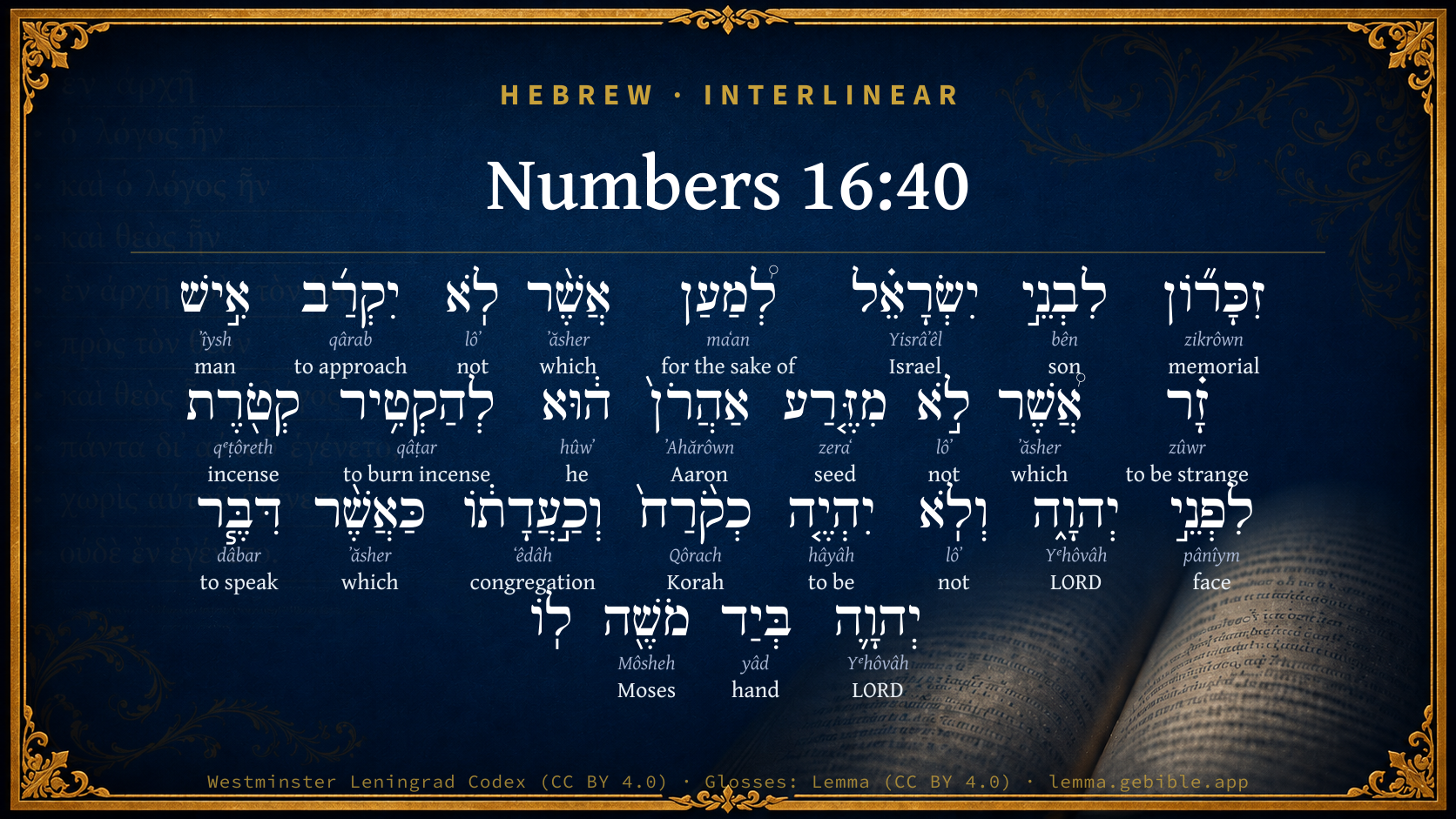
Hebrew (Westminster Leningrad Codex) Numbers 16:40 appears in the Hebrew Old Testament. The text above is from the Westminster Leningrad Codex. Each word links to its Strong’s number, a concise gloss, and parsing drawn from the Open Scriptures Hebrew Bible morphology. Click any word for its full Brown-Driver-Briggs (BDB) entry.
Download image
Cite this verse

Numbers 16:40 (World English Bible). Public Domain. Lemma interlinear Bible study tool, https://lemma.gebible.app/v/numbers/16/40.

Show BibTeX & RIS
BibTeX
RIS
English Translation
to be a memorial to the children of Israel, to the end that no stranger, who isn't of the seed of Aaron, comes near to burn incense before Yahweh; that he not be as Korah, and as his company: as Yahweh spoke to him by Moses.
World English Bible · Public Domain
Download a study sheet

One document with this verse’s original text, its word-by-word gloss line, the meaning frame, cross-references with their text, attributed commentary, and full source and license credits — printable, and it pastes into notes with its structure intact.

This verse Autodidact and up

Study sheet (.html) Plain text (.txt)

A passage Seminary Student

Up to 50 verses in one chapter. A passage sheet keeps up to 6 commentary sources and 12 cross-references per verse, in the order this page ranks them, and says so on the sheet whenever that leaves anything out. Ask for a single verse and you get the Autodidact verse sheet above.

Everything on this page stays free to read, with no account — the sheet is a download of what is already on screen, not access to it.

Want to remove ads? Support Godless Engineer
Compare translations 3

The same verse in 3 English versions, stacked beneath the original-language interlinear above. Click any original word for its lexicon entry.

Each is an independent rendering of the whole verse — the interlinear is not word-aligned to these translations.

Highlighted words mark where these versions differ — a whole-verse word diff, not a word-by-word alignment.

  • World English Bible Public Domain
    to be a memorial to the children of Israel, to the end that no stranger, who isn't of the seed of Aaron, comes near to burn incense before Yahweh; that he not be as Korah, and as his company: as Yahweh spoke to him by Moses.
  • King James Version Public Domain
    To be a memorial unto the children of Israel, that no stranger, which is not of the seed of Aaron, come near to offer incense before the LORD; that he be not as Korah, and as his company: as the LORD said to him by the hand of Moses.
  • unfoldingWord Literal Text CC BY-SA 4.0
    a memorial for the sons of Israel, so that a strange man, who not from the seed of Aaron, shall not come near to cause incense to become smoke to the face of Yahweh, and he shall not be like Korah and like his congregation, just as Yahweh spoke in the hand of Moses to him.

unfoldingWord Literal Text — © unfoldingWord, licensed CC BY-SA 4.0. Word-aligned USFM3 via Door43 (git.door43.org/unfoldingWord/en_ult).

Versions to compare (up to 4)

3 of 4 selected

Show all 18 translations

Every available English version of this verse, each an independent rendering of the whole verse.

  • World English Bible Public Domain
    to be a memorial to the children of Israel, to the end that no stranger, who isn't of the seed of Aaron, comes near to burn incense before Yahweh; that he not be as Korah, and as his company: as Yahweh spoke to him by Moses.
  • Berean Standard Bible Public Domain
    just as the LORD commanded him through Moses. This was to be a reminder to the Israelites that no outsider who is not a descendant of Aaron should approach to offer incense before the LORD, lest he become like Korah and his followers.
  • Majority Standard Bible Public Domain
    just as the LORD commanded him through Moses. This was to be a reminder to the Israelites that no outsider who is not a descendant of Aaron should approach to offer incense before the LORD, lest he become like Korah and his followers.
  • King James Version Public Domain
    To be a memorial unto the children of Israel, that no stranger, which is not of the seed of Aaron, come near to offer incense before the LORD; that he be not as Korah, and as his company: as the LORD said to him by the hand of Moses.
  • American Standard Version (1901) Public Domain
    to be a memorial unto the children of Israel, to the end that no stranger, that is not of the seed of Aaron, come near to burn incense before Jehovah; that he be not as Korah, and as his company: as Jehovah spake unto him by Moses.
  • Revised Version (1885) Public Domain
    to be a memorial unto the children of Israel, to the end that no stranger, which is not of the seed of Aaron, come near to burn incense before the LORD; that he be not as Korah, and as his company: as the LORD spake unto him by the hand of Moses.
  • Geneva Bible (1599) Public Domain
    It is a remembrance vnto the children of Israel, that no stranger which is not of the seede of Aaron, come neere to offer incense before the Lord, that he be not like Korah and his company, as the Lord said to him by the hand of Moses.
  • Douay-Rheims (1899) Public Domain
    That the children of Israel might have for the time to come wherewith they should be admonished, that no stranger or any one that is not of seed of Aaron should come near to offer incense to the Lord, lest he should suffer as Core suffered, and all his congregation, according as the Lord spoke to Moses.
  • Young's Literal Translation Public Domain
    a memorial to the sons of Israel, so that a stranger who is not of the seed of Aaron doth not draw near to make a perfume before Jehovah, and is not as Korah, and as his company, -- as Jehovah hath spoken by the hand of Moses to him.
  • Literal Standard Version CC BY-SA 4.0
    a memorial to the sons of Israel, so that a stranger who is not of the seed of Aaron does not draw near to make incense before YHWH, and is not as Korah and as his congregation, as YHWH has spoken by the hand of Moses to him.
  • Unlocked Literal Bible CC BY-SA 4.0
    to be a reminder to the people of Israel, so that no outsider who was not descended from Aaron should come up to burn incense before Yahweh, so they might not become like Korah and his group—just as Yahweh had commanded through Moses.
  • unfoldingWord Literal Text CC BY-SA 4.0
    a memorial for the sons of Israel, so that a strange man, who not from the seed of Aaron, shall not come near to cause incense to become smoke to the face of Yahweh, and he shall not be like Korah and like his congregation, just as Yahweh spoke in the hand of Moses to him.
  • Darby Bible Public Domain
    as a memorial to the children of Israel, that no stranger who is not of the seed of Aaron come near to burn incense before Jehovah, that he be not as Korah, and as his band, -- as Jehovah had said to him through Moses.
  • World Messianic Bible Public Domain
    to be a memorial to the children of Israel, to the end that no stranger who isn’t of the offspring of Aaron, would come near to burn incense before the LORD, that he not be as Korah and as his company; as the LORD spoke to him by Moses.
  • Webster's Bible Public Domain
    To be a memorial to the children of Israel, that no stranger, who is not of the seed of Aaron, should come near to offer incense before the LORD; that he may not be as Korah, and as his company: as the LORD said to him by the hand of Moses.
  • Free Bible Version CC BY-SA 4.0
    following the instructions given to him from the Lord through Moses. This was to remind the Israelites that no one who is not a descendant of Aaron should come and offer incense before the Lord, otherwise they could end up like Korah and those with him.
  • Bible in Basic English Public Domain
    To be a sign, kept in memory for ever by the children of Israel, that no man who is not of the seed of Aaron has the right of burning spices before the Lord, so that he may not be like Korah and his band: as the Lord said to him by the mouth of Moses.
  • JPS Tanakh (1917) Public Domain
    (17-5) to be a memorial unto the children of Israel, to the end that no common man, that is not of the seed of Aaron, draw near to burn incense before the LORD; that he fare not as Korah, and as his company; as the LORD spoke unto him by the hand of Moses.

Literal Standard Version (2020), Covenant Press — licensed CC BY-SA 4.0. Text via the HelloAO Bible API (eBible.org). Unlocked Literal Bible (unfoldingWord) — licensed CC BY-SA 4.0. Text via the HelloAO Bible API (eBible.org). unfoldingWord Literal Text — © unfoldingWord, licensed CC BY-SA 4.0. Word-aligned USFM3 via Door43 (git.door43.org/unfoldingWord/en_ult). Free Bible Version, Dr. Jonathan Gallagher — licensed CC BY-SA 4.0. Text via the HelloAO Bible API (eBible.org).

Word by word

More ways to search: Search by grammar → Find every occurrence → Compare this word →

Practice this passage: Drill this verse → Learn its vocabulary →

זִכָּר֞וֹן
zikrôwn
H2146
“memorial”
Noun, Common, Masculine, Singular, Absolute
Part of Speech
Noun
Type
Common
Gender
Masculine
Number
Singular
State
Absolute
Full BDB Definition

Origin: from H2142

TWOT: 551b

memorial, reminder, remembrance
  1. לִבְנֵ֣י bên H1121 “to/for · sons of” Preposition + Noun, Common, Masculine, Plural, Construct
  2. יִשְׂרָאֵ֗ל Yisrâʼêl H3478 “Israel” Noun, Proper
  3. לְ֠מַעַן maʻan H4616 “for the sake of” Preposition
  4. אֲשֶׁ֨ר ʼăsher H834 “which” Particle, Relative
  5. לֹֽא lôʼ H3808 “not” Particle, Negative
  6. יִקְרַ֜ב qârab H7126 “to approach” Verb, Qal, Imperfect, 3rd Person, Masculine, Singular
  7. אִ֣ישׁ ʼîysh H376 “man” Noun, Common, Masculine, Singular, Absolute
  8. זָ֗ר zûwr H2114 “strange” Adjective, Adjective, Masculine, Singular, Absolute
  9. אֲ֠שֶׁר ʼăsher H834 “which” Particle, Relative
  10. לֹ֣א lôʼ H3808 “not” Particle, Negative
  11. מִזֶּ֤רַע zeraʻ H2233 “from · seed of” Preposition + Noun, Common, Masculine, Singular, Construct
  12. אַהֲרֹן֙ ʼAhărôwn H175 “Aaron” Noun, Proper
  13. ה֔וּא hûwʼ H1931 “he” Pronoun, Personal, 3rd Person, Masculine, Singular
  14. לְהַקְטִ֥יר qâṭar H6999 “to burn incense” Preposition + Verb, Hiphil, Infinitive Construct
  15. קְטֹ֖רֶת qᵉṭôreth H7004 “incense” Noun, Common, Feminine, Singular, Absolute
  16. לִפְנֵ֣י pânîym H6440 “to/for · face(s) of” Preposition + Noun, Common, Both, Plural, Construct
  17. יְהוָ֑ה Yᵉhôvâh H3068 “LORD” Noun, Proper
  18. וְלֹֽא lôʼ H3808 “and · not” Conjunction + Particle, Negative
  19. יִהְיֶ֤ה hâyâh H1961 “to be” Verb, Qal, Imperfect, 3rd Person, Masculine, Singular
  20. כְקֹ֨רַח֙ Qôrach H7141 “like/as · Korah” Preposition + Noun, Proper
  21. וְכַ֣עֲדָת֔וֹ ʻêdâh H5712 “and · like/as · congregation · his” Conjunction + Preposition + Noun, Common, Feminine, Singular, Construct + Suffix, Personal, 3rd Person, Masculine, Singular
  22. כַּאֲשֶׁ֨ר ʼăsher H834 “like/as · which” Preposition + Particle, Relative
  23. דִּבֶּ֧ר dâbar H1696 “to speak” Verb, Piel, Perfect, 3rd Person, Masculine, Singular
  24. יְהוָ֛ה Yᵉhôvâh H3068 “LORD” Noun, Proper
  25. בְּיַד yâd H3027 “in/at · hand of” Preposition + Noun, Common, Both, Singular, Construct
  26. מֹשֶׁ֖ה Môsheh H4872 “Moses” Noun, Proper

About this verse

These counts appear in no published source. They are computed here, from the morphology-tagged text and Lemma’s own curated glosses. What Lemma adds →

28
words
22
distinct lemmas
Pentateuch
section

Notable vocabulary

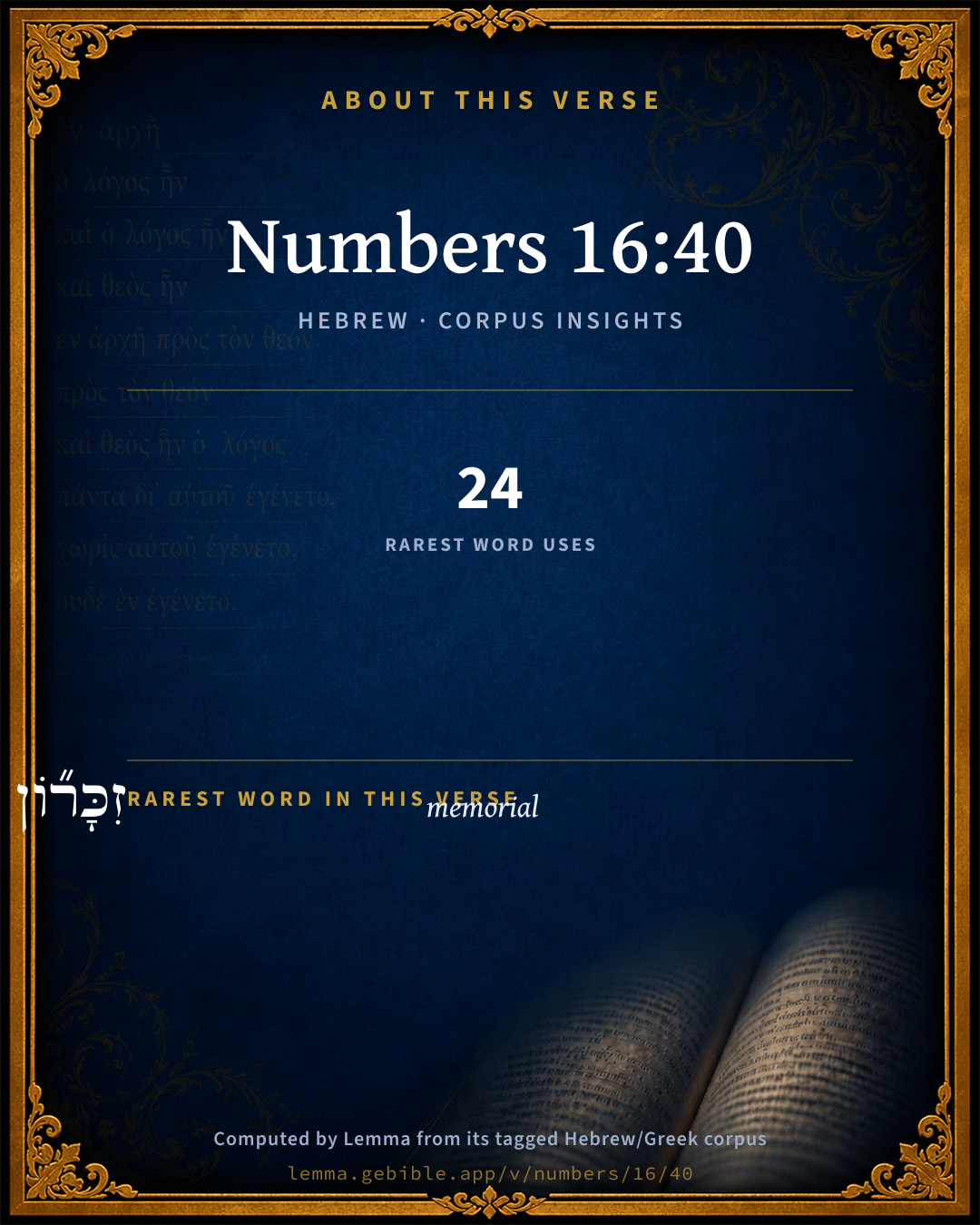
The rarest word here is זִכָּר֞וֹן memorial H2146 — appearing just 24 times in the whole Hebrew Bible.

Shared distinctive vocabulary

זִכָּר֞וֹן memorial H2146 occurs in 22 verses of the Hebrew Bible. Also found in:

Grammatical profile

  • 4 verbs
  • 14 nouns
  • 1 adjective
  • 1 pronoun
  • 2 prepositions
  • 6 particles

Verb forms

  • יִקְרַ֜ב Qal · Imperfect
  • לְהַקְטִ֥יר Hiphil · Infinitive Construct
  • יִהְיֶ֤ה Qal · Imperfect
  • דִּבֶּ֧ר Piel · Perfect

Repetition

Words recur within this verse — often emphatic in Hebrew:

  • יְהוָ֑ה LORD H3068 ×2
  • אֲשֶׁ֨ר which H834 ×3
  • לֹֽא not H3808 ×3

Hebrew & Septuagint length

In English translation the verse runs 46 words from the Hebrew and 52 from the Septuagint (LXX English) — closely comparable.

A rough comparison of the two English renderings, which tokenize alike — not a word-level alignment.

Word counts can differ between the Hebrew and the Greek without any difference in meaning — e.g. the Hebrew direct-object marker אֵת has no separate Greek word, and Greek often adds the article ὁ.

Cross-references

9

Topical passages linked to Numbers 16:40 in the Treasury of Scripture Knowledge — connected by theme and wording, ordered by reader-vote popularity; previews shown in the World English Bible.

  • Numbers 3:10 You shall appoint Aaron and his sons, and they shall keep their priesthood. The stranger who comes near shall be put to death."
  • Numbers 18:4–7 They shall be joined to you, and keep the charge of the tent of meeting, for all the service of the Tent: and a stranger shall not come near to you.
  • 2 Chronicles 26:16–21 But when he was strong, his heart was lifted up, so that he did corruptly, and he trespassed against Yahweh his God; for he went into the temple of Yahweh to burn incense on the altar of incense.
  • Exodus 30:7–10 Aaron shall burn incense of sweet spices on it every morning. When he tends the lamps, he shall burn it.
  • Leviticus 22:10 "'No stranger shall eat of the holy thing: a foreigner living with the priests, or a hired servant, shall not eat of the holy thing.
  • Numbers 1:51 When the tabernacle is to move, the Levites shall take it down; and when the tabernacle is to be set up, the Levites shall set it up. The stranger who comes near shall be put to death.
  • Numbers 3:38 Those who encamp before the tabernacle eastward, in front of the Tent of Meeting toward the sunrise, shall be Moses, and Aaron and his sons, keeping the charge of the sanctuary for the charge of the children of Israel. The stranger who comes near shall be put to death.
  • 1 Kings 13:1–3 Behold, there came a man of God out of Judah by the word of Yahweh to Beth El: and Jeroboam was standing by the altar to burn incense.
  • Jude 1:11 Woe to them! For they went in the way of Cain, and ran riotously in the error of Balaam for hire, and perished in Korah's rebellion.

Cross-references courtesy of OpenBible.info (CC BY 4.0).

Hebrew and Greek witnesses Masoretic Hebrew ↔ Greek Septuagint

The same verse in the two great witnesses to the Old Testament, shown verse-for-verse.

These are two independent witnesses, not word-aligned to each other, and the Septuagint is shown in lemma (dictionary) form.

Hebrew Numbers 16:40 Masoretic · Westminster Leningrad Codex

זִכָּר֞וֹן לִבְנֵ֣י יִשְׂרָאֵ֗ל לְ֠מַעַן אֲשֶׁ֨ר לֹֽא יִקְרַ֜ב אִ֣ישׁ זָ֗ר אֲ֠שֶׁר לֹ֣א מִזֶּ֤רַע אַהֲרֹן֙ ה֔וּא לְהַקְטִ֥יר קְטֹ֖רֶת לִפְנֵ֣י יְהוָ֑ה וְלֹֽא יִהְיֶ֤ה כְקֹ֨רַח֙ וְכַ֣עֲדָת֔וֹ כַּאֲשֶׁ֨ר דִּבֶּ֧ר יְהוָ֛ה בְּיַד מֹשֶׁ֖ה לֽוֹ

to be a memorial to the children of Israel, to the end that no stranger, who isn't of the seed of Aaron, comes near to burn incense before Yahweh; that he not be as Korah, and as his company: as Yahweh spoke to him by Moses.

World English Bible · Public Domain

Greek LXX Numbers 16:40 Septuagint · lemma form
a memorial to the children of Israel that no stranger might draw near, who is not of the seed of Aaron, to offer incense before the Lord; so he shall not be as Core and as they that conspired with him, as the Lord spoke to him by the hand of Moses.

LXX2012 (modern English Septuagint) · Public Domain

Hebrew: Westminster Leningrad Codex (CC BY 4.0). Greek: Septuagint (public domain); English from LXX2012 (modern English Septuagint) (Public Domain). How the Septuagint differs from the Hebrew →

Commentary

Notes on Numbers 16:40 from classic Christian and Jewish commentators (each source and its license shown beneath its notes). The classic Christian expositions comment on the surrounding passage and are grouped to its opening verse, so a note may address several verses; the Jewish commentaries on the Tanakh (Rashi and others) are per-verse, so they appear only where the commentator wrote on this verse.

Lemma curates 59 commentaries, every one of them public domain or Creative Commons licensed, each selected and text-cleaned for this edition rather than reprinted as found. About our sources →

Trapp's Complete Commentary

John Trapp

Num 16:40 [To be] a memorial unto the children of Israel, that no stranger, which [is] not of the seed of Aaron, come near to offer incense before the LORD; that he be not as Korah, and as his company: as the LORD said to him by the hand of Moses.

Ver. 40. To be a memorial.] God cannot abide to be forgotten; and they are worthily made examples that will not take them; as that second captain in 2Ki 1:11-12

John Trapp, A Commentary or Exposition upon All the Books of the Old and New Testament (1647–1656) — public domain. Text from a community e-Sword module.

Geneva Bible (1599)

Geneva Bible translators

Who presumed above his vocation.

Geneva Bible (1599) marginal notes — public domain. Text via Bolls.life.

Ellicott's Commentary for English Readers

(40) To be a memorial unto the children of Israel.—The Apostle Jude warns Christians by the same example against the profanation of Divine ordinances (Num_16:11).

A Bible Commentary for English Readers, edited by Charles John Ellicott (1878–1897) — public domain. Text from a community e-Sword module.

The Cambridge Bible for Schools and Colleges

gen. ed. J. J. S. Perowne

40. which is not of the seed of Aaron] i.e. a priest, and not a Levite as Korah was (see note before Num_16:37).

The Cambridge Bible for Schools and Colleges (gen. ed. J. J. S. Perowne; Cambridge University Press, 1878–1918) — public domain. Text from a community e-Sword module.

John Gill's Exposition

To be a memorial unto the children of Israel,.... The whole body of them; this explains what is meant by sign, Num 16:38; that it was to put or keep in mind what follows:

that no stranger which is not of the seed of Aaron come near to offer incense before the Lord; not only any Gentile but any Israelite, and not any Israelite only, but any Levite; none but those of the family of Aaron might offer incense before the Lord:

that he be not as Korah and as his company; this makes it clear that Korah perished at this time, though it is nowhere expressed; and it seems pretty plain from hence that he perished by fire, as his company, the two hundred fifty men with censers, did:

as the Lord said unto him by the hand of Moses; either to Korah, who is the immediate antecedent, and who perished as the Lord had told him by Moses he should; so some understand it, mentioned by Aben Ezra and Jarchi; or else to Aaron, as they interpret it; and then the sense is, that none but those of Aaron's seed should offer incense, as the Lord had declared to him by Moses; see Num 3:10; or it may be rather to Eleazar, as Abendana, who did as the Lord spake to him by Moses, took up the censers of the men that were burnt, and got them beaten into broad plates, and covered the altar of burnt offering with them.

John Gill's Exposition of the Whole Bible (1746–1763) — public domain (CC PDM 1.0). Text via the HelloAO Bible API.

Haydock's Catholic Bible Commentary

Stranger, though he be even of royal dignity. Thus Osias was afflicted with a perpetual leprosy, which rendered him incapable of exercising even the office of king, because he had attempted to offer incense, 2 Kings xv. 5., and 2 Paralipomenon xxvi. 17. (Haydock)

George Leo Haydock (1774–1849), Haydock's Catholic Family Bible and Commentary, 1859 edition — public domain. Excludes Psalms (Douay-Rheims chapter numbering differs from Protestant) and Deuterocanonical books (Catholic canon only).

Matthew Poole's English Annotations

As Korah, and as his company, i.e. that he do not imitate them in their sin, and therefore bring upon himself the same plague.

To him, i.e. to Eleazar. These words belong to Num 16:38; the meaning is, that Eleazar did as God bade him.

Matthew Poole's English Annotations on the Holy Bible (1683–1685) — public domain. Text from a community e-Sword/MySword module.

Whedon's Commentary on the Bible

Daniel D. Whedon

40. A memorial, or warning against grasping after priestly prerogatives. It is the purpose of God to turn every man’s life to the best account. When, through a perverse use of his free agency, God cannot secure the wicked man’s well-being, he makes his punishment an instrument of good to others by deterring them from sin. Thus the humane society hangs a bell to the mast of the sunken ship for the admonition of other ships sailing through that perilous channel. Hence the purpose subserved by eternal punishment. “But those who have committed the most extreme injustice, and have become incurable through such crimes, serve as examples to others, and these are not benefited at all, as being incurable, but others are benefited by beholding them suffering forever the greatest punishments for their sins,being suspended in the prison of hades altogether as examples, a spectacle and warning to the unjust men who are continually arriving.” — Plato in the Gorgias.

Daniel D. Whedon (gen. ed.), Commentary on the Old and New Testaments (1874–1909) — public domain. Text from a community e-Sword module.

The Pulpit Commentary

That he be not as Korah. jyjyiAalow. That he do not meet with the same fate as Korah.

The Pulpit Commentary (1880–1919), ed. H.D.M. Spence-Jones & Joseph S. Exell — public domain. Text from a community e-Sword module.

John Wesley's Explanatory Notes

To him - To Eleazer. These words belong to ver. 38, the meaning is, that Eleazer did as God bade him.

John Wesley, Explanatory Notes Upon the Whole Bible (1754–1765) — public domain. Text via the GEBible commentary corpus.

Lesson kit

Teaching starters — assembled from the data on this page, not authored interpretation. Every prompt links to the verse data it draws on. Edit before teaching.

Numbers, in the Pentateuch, opens this verse with 28 words (22 distinct Hebrew lemmas). Its most distinctive word is zikrôwn (“memorial”). A historical commentator’s framing appears above. Read the whole chapter for the surrounding context.

Discussion questions

  1. The word zikrôwn carries the sense “memorial.” How does it shape the verse?
  2. How does Exodus 12:14, which shares the word «memorial», read alongside this verse?
  3. What does the repetition of “LORD” (2× in this one verse) do in this verse?
  4. These translations render this verse differently; the difference is in the English rendering, not the original. What questions does that raise?
  5. «יִקְרַ֜ב» is a Qal Imperfect verb. How does that grammatical form shape the action described?
  6. Compare how Trapp's Complete Commentary and Geneva Bible (1599) read this verse. Where do they agree or differ?

Things to notice

Reading settings

Reading text

Shown beneath each verse's original-language words.

Old Testament
Old Testament edition

Read the OT as the Masoretic Hebrew (MT) or the Greek Septuagint (LXX).

English shown for the Greek Septuagint (in the Hebrew ↔ Greek comparison).

Comparing translations? Open the Compare panel on any verse page to stack up to four side by side.