
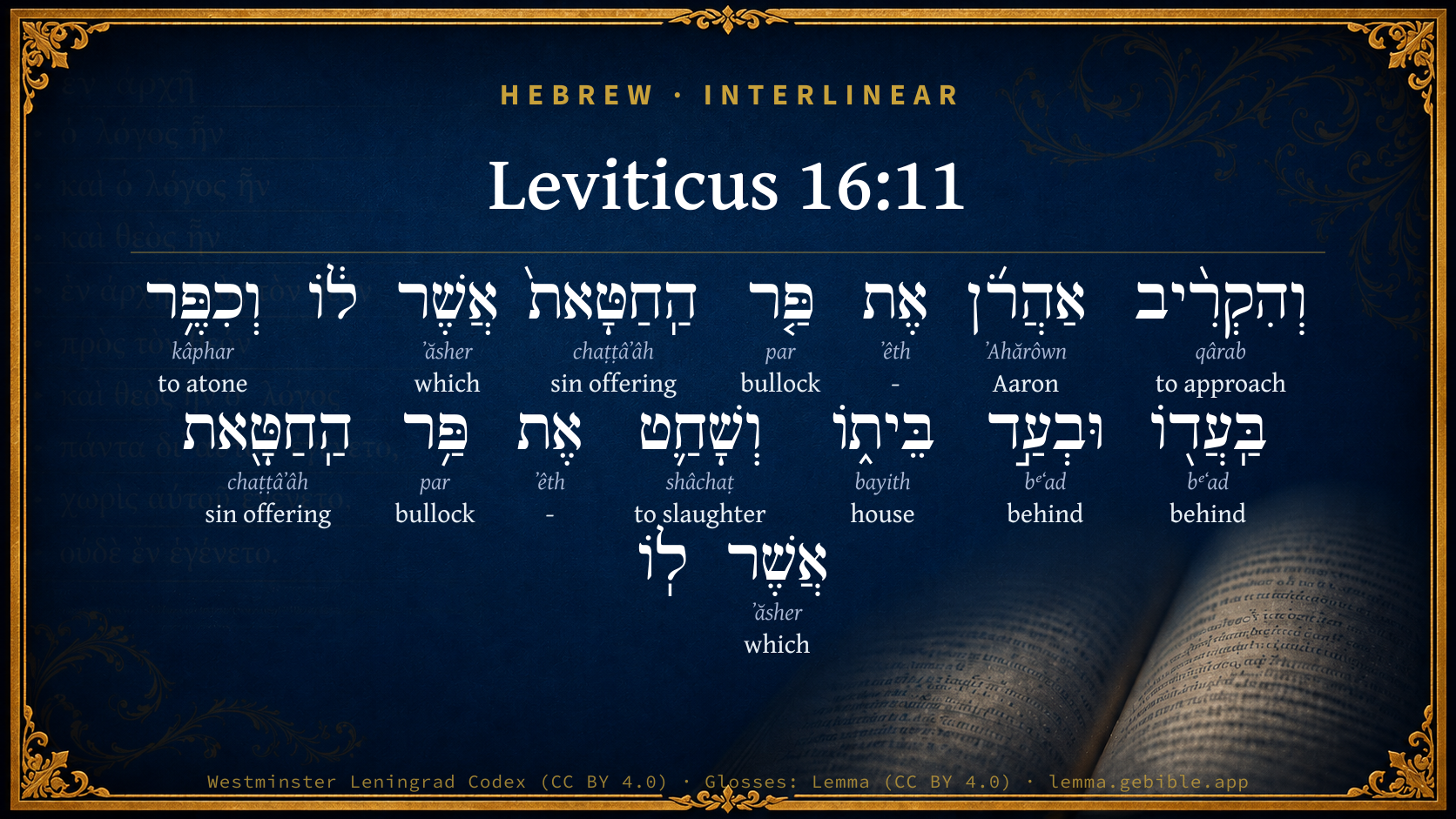
Leviticus 16:11

Hebrew (Westminster Leningrad Codex) Leviticus 16:11 appears in the Hebrew Old Testament. The text above is from the Westminster Leningrad Codex. Each word links to its Strong’s number, a concise gloss, and parsing drawn from the Open Scriptures Hebrew Bible morphology. Click any word for its full Brown-Driver-Briggs (BDB) entry.
Download image
Cite this verse

Leviticus 16:11 (World English Bible). Public Domain. Lemma interlinear Bible study tool, https://lemma.gebible.app/v/leviticus/16/11.

Show BibTeX & RIS
BibTeX
RIS
English Translation
"Aaron shall present the bull of the sin offering, which is for himself, and shall make atonement for himself and for his house, and shall kill the bull of the sin offering which is for himself.
World English Bible · Public Domain
Download a study sheet

One document with this verse’s original text, its word-by-word gloss line, the meaning frame, cross-references with their text, attributed commentary, and full source and license credits — printable, and it pastes into notes with its structure intact.

This verse Autodidact and up

Study sheet (.html) Plain text (.txt)

A passage Seminary Student

Up to 50 verses in one chapter. A passage sheet keeps up to 6 commentary sources and 12 cross-references per verse, in the order this page ranks them, and says so on the sheet whenever that leaves anything out. Ask for a single verse and you get the Autodidact verse sheet above.

Everything on this page stays free to read, with no account — the sheet is a download of what is already on screen, not access to it.

Want to remove ads? Support Godless Engineer
Compare translations 3

The same verse in 3 English versions, stacked beneath the original-language interlinear above. Click any original word for its lexicon entry.

Each is an independent rendering of the whole verse — the interlinear is not word-aligned to these translations.

Highlighted words mark where these versions differ — a whole-verse word diff, not a word-by-word alignment.

  • World English Bible Public Domain
    "Aaron shall present the bull of the sin offering, which is for himself, and shall make atonement for himself and for his house, and shall kill the bull of the sin offering which is for himself.
  • King James Version Public Domain
    And Aaron shall bring the bullock of the sin offering, which is for himself, and shall make an atonement for himself, and for his house, and shall kill the bullock of the sin offering which is for himself:
  • unfoldingWord Literal Text CC BY-SA 4.0
    And Aaron shall present the bull of the sin offering that for himself. And he shall make atonement on his behalf and on behalf of his house. And he shall slaughter the bull of the sin offering that for himself.

unfoldingWord Literal Text — © unfoldingWord, licensed CC BY-SA 4.0. Word-aligned USFM3 via Door43 (git.door43.org/unfoldingWord/en_ult).

Versions to compare (up to 4)

3 of 4 selected

Show all 18 translations

Every available English version of this verse, each an independent rendering of the whole verse.

  • World English Bible Public Domain
    "Aaron shall present the bull of the sin offering, which is for himself, and shall make atonement for himself and for his house, and shall kill the bull of the sin offering which is for himself.
  • Berean Standard Bible Public Domain
    When Aaron presents the bull for his sin offering and makes atonement for himself and his household, he is to slaughter the bull for his own sin offering.
  • Majority Standard Bible Public Domain
    When Aaron presents the bull for his sin offering and makes atonement for himself and his household, he is to slaughter the bull for his own sin offering.
  • King James Version Public Domain
    And Aaron shall bring the bullock of the sin offering, which is for himself, and shall make an atonement for himself, and for his house, and shall kill the bullock of the sin offering which is for himself:
  • American Standard Version (1901) Public Domain
    And Aaron shall present the bullock of the sin-offering, which is for himself, and shall make atonement for himself, and for his house, and shall kill the bullock of the sin-offering which is for himself:
  • Revised Version (1885) Public Domain
    And Aaron shall present the bullock of the sin offering, which is for himself, and shall make atonement for himself, and for his house, and shall kill the bullock of the sin offering which is for himself:
  • Geneva Bible (1599) Public Domain
    Thus Aaron shall offer the bullocke for his sinne offring, and make a reconciliation for himselfe, and for his house, and shall kill the bullocke for his sinne offring.
  • Douay-Rheims (1899) Public Domain
    After these things are duly celebrated, he shall offer the calf, and praying for himself and for his own house, he shall immolate it:
  • Young's Literal Translation Public Domain
    `And Aaron hath brought near the bullock of the sin-offering which is his own, and hath made atonement for himself, and for his house, and hath slaughtered the bullock of the sin-offering which `is' his own,
  • Literal Standard Version CC BY-SA 4.0
    And Aaron has brought the bullock of the sin-offering near, which is his own, and has made atonement for himself and for his house, and has slaughtered the bullock of the sin-offering which [is] his own,
  • Unlocked Literal Bible CC BY-SA 4.0
    Then Aaron must present the bull for the sin offering, which will be for himself. He must make atonement for himself and for his family, so he must kill the bull as a sin offering for himself.
  • unfoldingWord Literal Text CC BY-SA 4.0
    And Aaron shall present the bull of the sin offering that for himself. And he shall make atonement on his behalf and on behalf of his house. And he shall slaughter the bull of the sin offering that for himself.
  • Darby Bible Public Domain
    And Aaron shall present the bullock of the sin-offering, which is for himself, and shall make atonement for himself and for his house, and shall slaughter the bullock of the sin-offering which is for himself.
  • World Messianic Bible Public Domain
    “Aaron shall present the bull of the sin offering, which is for himself, and shall make atonement for himself and for his house, and shall kill the bull of the sin offering which is for himself.
  • Webster's Bible Public Domain
    And Aaron shall bring the bullock of the sin-offering, which is for himself, and shall make an atonement for himself, and for his house, and shall kill the bullock of the sin-offering which is for himself:
  • Free Bible Version CC BY-SA 4.0
    Aaron is to present the bull for his sin offering to make things right for himself and his household by killing the bull as his own sin offering.
  • Bible in Basic English Public Domain
    And Aaron is to give the ox of the sin-offering for himself and take away sin from himself and his house, and put to death the ox of the sin-offering which is for himself.
  • JPS Tanakh (1917) Public Domain
    And Aaron shall present the bullock of the sin-offering, which is for himself, and shall make atonement for himself, and for his house, and shall kill the bullock of the sin-offering which is for himself.

Literal Standard Version (2020), Covenant Press — licensed CC BY-SA 4.0. Text via the HelloAO Bible API (eBible.org). Unlocked Literal Bible (unfoldingWord) — licensed CC BY-SA 4.0. Text via the HelloAO Bible API (eBible.org). unfoldingWord Literal Text — © unfoldingWord, licensed CC BY-SA 4.0. Word-aligned USFM3 via Door43 (git.door43.org/unfoldingWord/en_ult). Free Bible Version, Dr. Jonathan Gallagher — licensed CC BY-SA 4.0. Text via the HelloAO Bible API (eBible.org).

Word by word

More ways to search: Search by grammar → Find every occurrence → Compare this word →

Practice this passage: Drill this verse → Learn its vocabulary →

וְשָׁחַ֛ט
shâchaṭ
H7819
“and · to slaughter”
Conjunction + Verb, Qal, Sequential Perfect, 3rd Person, Masculine, Singular
Part of Speech
Conjunction + Verb
Stem
Qal
Form
Sequential Perfect
Person
3rd Person
Gender
Masculine
Number
Singular
Full BDB Definition

Origin: a primitive root

TWOT: 2362

to kill, slaughter, beat (verb) - (Qal) - to slaughter - beast for food - sacrifice - person in human sacrifice - beaten, hammered (of shekels) - (Niphal) to be slaughtered, be slain (of food or sacrifice) - (BDB) slaughtering (noun feminine) - word doubtful
  1. וְהִקְרִ֨יב qârab H7126 “and · to approach” Conjunction + Verb, Hiphil, Sequential Perfect, 3rd Person, Masculine, Singular
  2. אַהֲרֹ֜ן ʼAhărôwn H175 “Aaron” Noun, Proper
  3. אֶת ʼêth H853 “-” Particle, Direct Object
  4. פַּ֤ר par H6499 “bullock of” Noun, Common, Masculine, Singular, Construct
  5. הַֽחַטָּאת֙ chaṭṭâʼâh H2403 “the · sin offering” Particle, Definite Article + Noun, Common, Feminine, Singular, Absolute
  6. אֲשֶׁר ʼăsher H834 “which” Particle, Relative
  7. וְכִפֶּ֥ר kâphar H3722 “and · to atone” Conjunction + Verb, Piel, Sequential Perfect, 3rd Person, Masculine, Singular
  8. בַּֽעֲד֖וֹ bᵉʻad H1157 “behind · him” Preposition + Suffix, Personal, 3rd Person, Masculine, Singular
  9. וּבְעַ֣ד bᵉʻad H1157 “and · behind” Conjunction + Preposition
  10. בֵּית֑וֹ bayith H1004 “house · his” Noun, Common, Masculine, Singular, Construct + Suffix, Personal, 3rd Person, Masculine, Singular
  11. אֶת ʼêth H853 “-” Particle, Direct Object
  12. פַּ֥ר par H6499 “bullock of” Noun, Common, Masculine, Singular, Construct
  13. הַֽחַטָּ֖את chaṭṭâʼâh H2403 “the · sin offering” Particle, Definite Article + Noun, Common, Feminine, Singular, Absolute
  14. אֲשֶׁר ʼăsher H834 “which” Particle, Relative

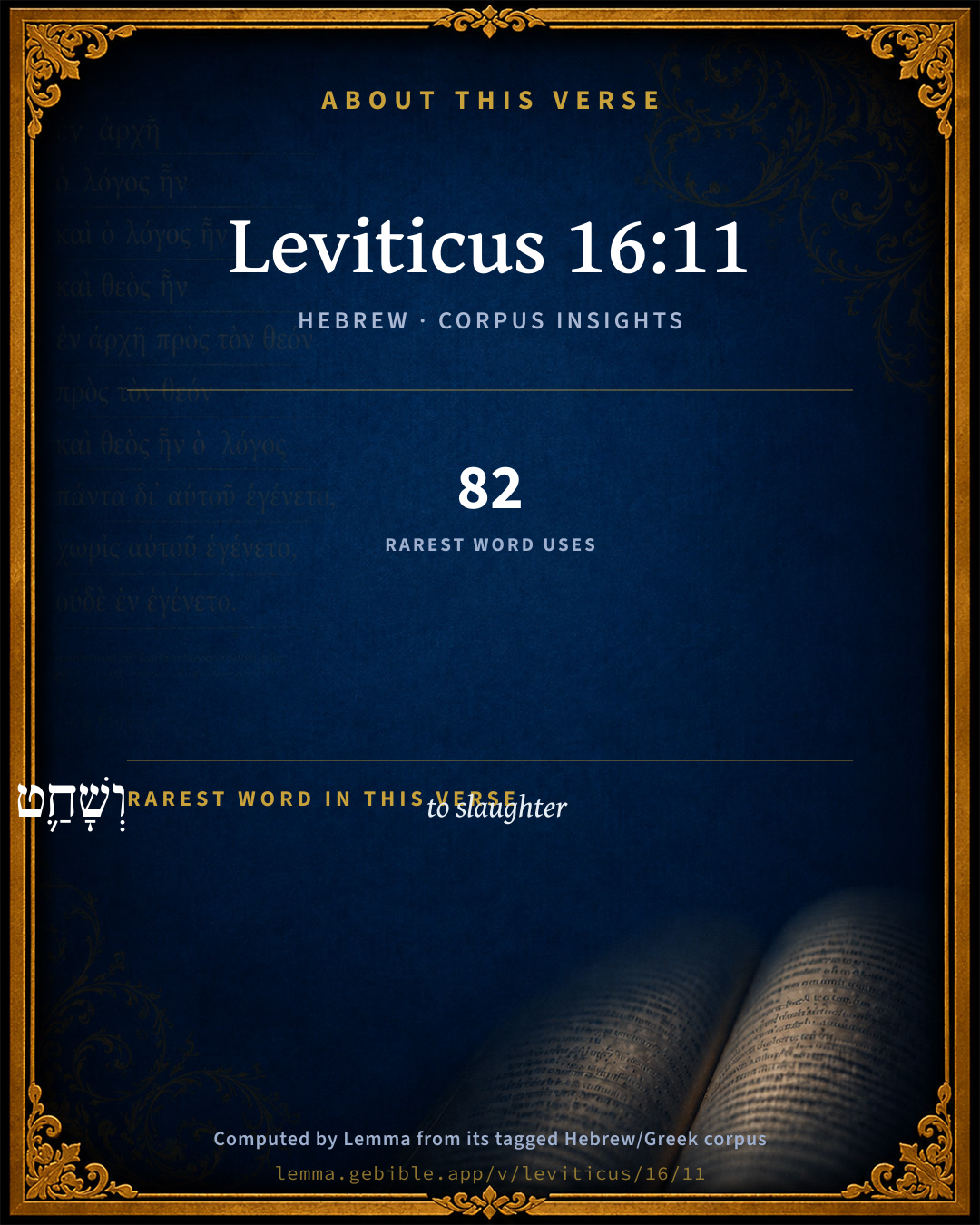
About this verse

These counts appear in no published source. They are computed here, from the morphology-tagged text and Lemma’s own curated glosses. What Lemma adds →

17
words
10
distinct lemmas
Pentateuch
section

Grammatical profile

  • 3 verbs
  • 6 nouns
  • 4 prepositions
  • 4 particles

Verb forms

  • וְהִקְרִ֨יב Hiphil · Sequential Perfect
  • וְכִפֶּ֥ר Piel · Sequential Perfect
  • וְשָׁחַ֛ט Qal · Sequential Perfect

Repetition

Words recur within this verse — often emphatic in Hebrew:

  • פַּ֤ר bullock H6499 ×2
  • הַֽחַטָּאת֙ sin offering H2403 ×2
  • בַּֽעֲד֖וֹ behind H1157 ×2
  • אֲשֶׁר which H834 ×2

Hebrew & Septuagint length

In English translation the verse runs 36 words from the Hebrew and 29 from the Septuagint (LXX English) — closely comparable.

A rough comparison of the two English renderings, which tokenize alike — not a word-level alignment.

Word counts can differ between the Hebrew and the Greek without any difference in meaning — e.g. the Hebrew direct-object marker אֵת has no separate Greek word, and Greek often adds the article ὁ.

Cross-references

4

Topical passages linked to Leviticus 16:11 in the Treasury of Scripture Knowledge — connected by theme and wording, ordered by reader-vote popularity; previews shown in the World English Bible.

  • Leviticus 16:6 "Aaron shall offer the bull of the sin offering, which is for himself, and make atonement for himself and for his house.
  • Leviticus 16:3 "Herewith shall Aaron come into the sanctuary: with a young bull for a sin offering, and a ram for a burnt offering.
  • Hebrews 7:27 who doesn't need, like those high priests, to daily offer up sacrifices, first for his own sins, and then for the sins of the people. For this he did once for all, when he offered up himself.
  • Hebrews 9:7 but into the second the high priest alone, once in the year, not without blood, which he offers for himself, and for the errors of the people.

Cross-references courtesy of OpenBible.info (CC BY 4.0).

Hebrew and Greek witnesses Masoretic Hebrew ↔ Greek Septuagint

The same verse in the two great witnesses to the Old Testament, shown verse-for-verse.

These are two independent witnesses, not word-aligned to each other, and the Septuagint is shown in lemma (dictionary) form.

Hebrew Leviticus 16:11 Masoretic · Westminster Leningrad Codex

וְהִקְרִ֨יב אַהֲרֹ֜ן אֶת פַּ֤ר הַֽחַטָּאת֙ אֲשֶׁר ל֔וֹ וְכִפֶּ֥ר בַּֽעֲד֖וֹ וּבְעַ֣ד בֵּית֑וֹ וְשָׁחַ֛ט אֶת פַּ֥ר הַֽחַטָּ֖את אֲשֶׁר לֽוֹ

"Aaron shall present the bull of the sin offering, which is for himself, and shall make atonement for himself and for his house, and shall kill the bull of the sin offering which is for himself.

World English Bible · Public Domain

Greek LXX Leviticus 16:11 Septuagint · lemma form

καί προςἄγω ἀαρών ὁ μόσχος ὁ περί ὁ ἁμαρτία ὁ αὐτός καί ὁ οἶκος αὐτός μόνος καί ἐκἱλάσκομαι περί αὐτός καί ὁ οἶκος αὐτός καί σφάζω ὁ μόσχος ὁ περί ὁ ἁμαρτία ὁ αὐτός

And Aaron shall bring the calf for his sin, and he shall make atonement for himself and for his house, and he shall kill the calf for his sin-offering.

LXX2012 (modern English Septuagint) · Public Domain

Hebrew: Westminster Leningrad Codex (CC BY 4.0). Greek: Septuagint (public domain); English from LXX2012 (modern English Septuagint) (Public Domain). How the Septuagint differs from the Hebrew →

Targum (Aramaic paraphrase)

2

The Targum is the ancient Jewish Aramaic paraphrase of the Hebrew Scriptures — an interpretive translation, not the Hebrew text itself. Onkelos (literal) and Pseudo-Jonathan (expansive) render the Torah, and Jonathan the Prophets. Coverage is partial: where no permissively-licensed English translation exists for a verse, only the Aramaic is shown. This is verse-level text, not a word-by-word alignment to the Hebrew.

  1. Targum Onkelos Torah (Genesis–Deuteronomy)
    וִיקָרֵב אַהֲרֹן יָת תּוֹרָא דְחַטָאתָא דִי לֵהּ וִיכַפֵּר עֲלוֹהִי וְעַל אֱנַשׁ בֵּיתֵהּ וְיִכּוֹס יָת תּוֹרָא דְחַטָאתָא דִי לֵהּ

    (no public-domain English translation for this verse)

    Targum Onkelos — Aramaic: “Onkelos Genesis” (public domain); “Onkelos Exodus” (public domain); “Onkelos Leviticus” (public domain); “Onkelos Numbers” (public domain); “Onkelos Deuteronomy” (public domain). English: “Sefaria Community Translation” (CC0 1.0 (public-domain dedication)); “J.W. Etheridge. The Targums of Onkelos and Jonathan Ben Uzziel on the Pentateuch. London: Longmans, Green, 1862” (public domain). Text via Sefaria.

  2. Targum Pseudo-Jonathan Torah (Genesis–Deuteronomy)
    וְיַקְרֵיב אַהֲרן יַת תּוֹרָא דִילֵיהּ וִיכַפֵּר בְּאִישְׁתְּעוּת מִילַיָא עֲלוֹי וְעַל אֵינַשׁ בֵּיתֵיהּ וְיִכּוֹס יַת תּוֹרָא דְחַטָאתָא דִילֵיהּ

    And Aharon shall bring the bullock which is for himself, and make atonement with confession of words for himself, and for the men of his house, and kill the bullock for his sin offering.

    Targum Pseudo-Jonathan — Aramaic: “Targum Jonathan on Genesis” (public domain); “Targum Jonathan on Exodus” (public domain); “Targum Jonathan on Leviticus” (public domain); “Targum Jonathan on Numbers” (public domain); “Targum Jonathan on Deuteronomy” (public domain). English: “The Targum of Jonathan ben Uzziel, trans. J. W. Etheridge, London, 1862” (public domain). Text via Sefaria.

Commentary

Notes on Leviticus 16:11 from classic Christian and Jewish commentators (each source and its license shown beneath its notes). The classic Christian expositions comment on the surrounding passage and are grouped to its opening verse, so a note may address several verses; the Jewish commentaries on the Tanakh (Rashi and others) are per-verse, so they appear only where the commentator wrote on this verse.

Lemma curates 59 commentaries, every one of them public domain or Creative Commons licensed, each selected and text-cleaned for this edition rather than reprinted as found. About our sources →

The Cambridge Bible for Schools and Colleges

gen. ed. J. J. S. Perowne

11. According to the Mishna (Tal. Bab. Yoma), the high priest on presenting his bullock (Lev_16:6) made a confession of sin to which the people answered ‘Blessed be the Name of the glory of His Kingdom for ever and ever.’ He cast lots upon the goats, and declared which was for the Lord, and they answered ‘Blessed be the Name, etc.’ (fol. 39 a). He put a tongue-shaped piece of scarlet wool upon the head of the goat to be sent away, and came beside his bullock (Lev_16:11) the second time and repeated his confession, and they answered ‘Blessed be the Name, etc’ (41b). He killed the bullock, and caught the blood in a bowl; he took the censer and put burning coals from the altar in it (43b). They brought him the cup and the censer; he filled his hands with incense and put it into the cup; he took the censer in his right hand and the cup in his left (47a), and went into the temple, and when he came to the altar, he heaped the incense on the burning coals and the whole house was filled with smoke; he returned, and offered a short prayer in the outer house, but did not prolong it, lest (by a lengthy absence) he should cause terror in Israel (51b, 52b). In the second temple the high priest placed the censer on a stone in the Holy of Holies, called ‘foundation, which was three fingers high. [There was no altar in the second temple.] He took the blood of the bullock and returned within the veil, and sprinkled of it once upwards and seven times downwards; he went out and placed the bowl on a column in the sanctuary. He then killed the goat, and brought the blood within the veil, and sprinkled it as he did with the blood of the bullock; he went out and placed the bowl on a column in the sanctuary [tradition varies as to whether the column was the same as that on which the bowl containing the bullock’s blood had been placed]; he then sprinkled the blood of the bullock on the veil on the outside, and afterwards the blood of the goat, both sprinklings being once upwards and seven times downwards, as he sprinkled the blood within the veil; he then mixed the blood of the bullock with that of the goat (53b), and went out to the altar that is ‘before the Lord,’ the golden altar [but cp. note on Lev_16:18], and began cleansing it; he sprinkled on the middle [the clean place] of the altar seven times, and some of the remainder of the blood he poured out on the western base of the outer altar [the altar of Burnt-Offering] and the remainder of the blood he poured out on the southern base of that altar (58b). If the high priest did not perform the work of the Day of Atonement in the prescribed order, it was invalid (60b). Concerning the two goats for the Day of Atonement, it is commanded that they should be alike in colour, height, and price, with provision in the event of one of the goats dying (61b). The high priest placed his two hands on the goat to be sent away, and said (Tal. Bab. Yoma, 66a): O Lord, Thy people the house of Israel have committed iniquity, and transgressed, and sinned before Thee. O Lord pardon now the iniquities, the transgressions, and the sins which Thy people, the house of Israel, have iniquitously done, transgressed, and sinned before Thee, as it is written in the law of Moses Thy servant, ‘For on this day shall atonement be made for you, to cleanse you; from all your sins shall ye be clean before the Lord’ (Lev_16:30).

And the priests and the people when they heard the Name from the mouth of the priest, bowed, and worshipped, and fell on their faces and said, ‘Blessed be the Name, etc.’ (66a). The goat was conducted to a place called Ẓôḳ, about 12 miles from Jerusalem (66b), where it was thrown backwards from the edge of a cliff. Booths were placed at the end of each of the first ten miles; the nobles of Jerusalem accompanied the goat to the first booth, and the rest of the people as far as the last booth from which they watched the actions of the man who took charge of the goat. Watchmen made signals when the goat arrived at the edge of the wilderness, and its arrival was thus made known to the high priest (67a, 68b).

This treatise, though it contains many additional directions not found in Scripture, throws light on some parts of the Biblical account. It makes clear the occasions on which the high priest enters the Most Holy place: (1) he goes in with the censer and the incense as ordered in Lev_16:12-13; (2) after going out to fetch the blood of the bullock he enters the Most Holy place the second time (Lev_16:14); he then kills the goat, the Sin-Offering of the people; and (3) enters the Most Holy place the third time with the blood of the goat (Lev_16:15). It also mentions the mixing of the blood of the bullock with that of the goat, which seems implied in Lev_16:18. The text of Lev_16:14-15 ordains sprinkling upon the mercy-seat, according to EVV, and the generally accepted meaning of the Heb. But according to the Jewish tradition the sprinkling was in front of the mercy-seat, and the mercy-seat itself was not touched with the blood.

The Cambridge Bible for Schools and Colleges (gen. ed. J. J. S. Perowne; Cambridge University Press, 1878–1918) — public domain. Text from a community e-Sword module.

Trapp's Complete Commentary

John Trapp

Lev 16:11 And Aaron shall bring the bullock of the sin offering, which [is] for himself, and shall make an atonement for himself, and for his house, and shall kill the bullock of the sin offering which [is] for himself:

Ver. 11. An atonement for himself.] That having first made his own peace, he may be in case to atone for the people. This was David’s method. {Psa 25:1-22 Psa 51:1-19}

John Trapp, A Commentary or Exposition upon All the Books of the Old and New Testament (1647–1656) — public domain. Text from a community e-Sword module.

Joseph Benson's Commentary

Lev 16:11. The bullock — Mentioned in general, Lev 16:6; the ceremonies respecting which are here particularly described. This was a very different sacrifice from that of the red heifer spoken of Numbers 19., as evidently appears upon comparing the two places. He shall kill the bullock which is for himself — Here we may clearly see, as the apostle to the Hebrews argues, the utter insufficiency of the Jewish dispensation to “make the comers thereunto perfect,” or to furnish those who were under it with every thing necessary for their complete justification and salvation. It made nothing perfect, because it made men priests that were sinful creatures like others, and had need to offer year after year for their own sins; for “there was a remembrance made again of sins every year.” But in Christ we have a very different high-priest and intercessor, who is, and when on earth was, holy, harmless, undefiled, and separate from sinners, and higher than the heavens, who needeth not daily (as the Jewish high-priests) to offer up sacrifices first for his own sins and then for the people’s: for this he did; he offered for the people’s sins, having none of his own to expiate, once when he offered up himself. For “the law made men priests which had infirmity, but the word of the oath, which was since the law, maketh the Son, who is consecrated for evermore, and is able to save to the uttermost all that come unto God by him, seeing he ever liveth to make intercession for them.”

Joseph Benson's Commentary on the Old and New Testaments (1811–1818) — public domain. Text from a community e-Sword module.

Whedon's Commentary on the Bible

Daniel D. Whedon

A DETAILED DESCRIPTION OF CERTAIN RITES, Lev_16:11-28.

11. Bullock for himself — It must be purchased with the money of the high priest.

And for his house — The entire priesthood. There is an antitype; “Ye also, as lively stones, are built up a spiritual house, a holy-priesthood, to offer up spiritual sacrifices, acceptable to God by Jesus Christ.” 1Pe_2:5.

Daniel D. Whedon (gen. ed.), Commentary on the Old and New Testaments (1874–1909) — public domain. Text from a community e-Sword module.

Jamieson, Fausset & Brown

Robert Jamieson, A. R. Fausset & David Brown

Aaron shall bring the bullock of the sin offering which is for himself, &c.--The first part of the service was designed to solemnize his own mind, as well as the minds of the people, by offering the sacrifices for their sins. The sin offerings being slain had the sins of the offerer judicially transferred to them by the imputation of his hands on their head (Lev 4:4, Lev 4:15, Lev 4:24, Lev 4:29, Lev 4:33); and thus the young bullock, which was to make atonement for himself and the other priests (called "his house," Psa 135:19), was killed by the hands of the high priest. While the blood of the victim was being received into a vessel, taking a censer of live coals in his right hand and a platter of sweet incense in his left, he, amid the solemn attention and the anxious prayers of the assembled multitude, crossed the porch and the holy place, opened the outer veil which led into the holy of holies and then the inner veil. Standing before the ark, he deposited the censer of coals on the floor, emptied the plate of incense into his hand, poured it on the burning coals; and the apartment was filled with fragrant smoke, intended, according to Jewish writers, to prevent any presumptuous gazer prying too curiously into the form of the mercy seat, which was the Lord's throne. The high priest having done this, perfumed the sanctuary, returned to the door, took the blood of the slain bullock, and, carrying it into the holy of holies, sprinkled it with his finger once upon the mercy seat "eastward"--that is, on the side next to himself; and seven times "before the mercy seat"--that is, on the front of the ark. Leaving the coals and the incense burning, he went out a second time, to sacrifice at the altar of burnt offering the goat which had been assigned as a sin offering for the people; and carrying its blood into the holy of holies, he made similar sprinklings as he had done before with the blood of the bullock. While the high priest was thus engaged in the most holy place, none of the ordinary priests were allowed to remain within the precincts of the tabernacle. The sanctuary or holy place and the altar of burnt offering were in like manner sprinkled seven times with the blood of the bullock and the goat. The object of this solemn ceremonial was to impress the minds of the Israelites with the conviction that the whole tabernacle was stained by the sins of a guilty people, that by their sins they had forfeited the privileges of the divine presence and worship, and that an atonement had to be made as the condition of God's remaining with them. The sins and shortcomings of the past year having polluted the sacred edifice, the expiation required to be annually renewed. The exclusion of the priests indicated their unworthiness and the impurities of their service. The mingled blood of the two victims being sprinkled on the horns of the altar indicated that the priests and the people equally needed an atonement for their sins. But the sanctuary being thus ceremonially purified, and the people of Israel reconciled by the blood of the consecrated victim, the Lord continued to dwell in the midst of them, and to honor them with His gracious presence.

Jamieson, Fausset & Brown — Commentary Critical and Explanatory on the Whole Bible (1871) — public domain (CC PDM 1.0). Text via the HelloAO Bible API.

Ellicott's Commentary for English Readers

(11) And Aaron shall bring the bullock.—Having formally dedicated the bullock for his own sin offering (see Lev_16:6), and after the two goats which constituted the people’s sin offering had been presented and their lots decided (Lev_16:7-10), Aaron comes back to his own sin offering a second time. He again laid both his hands on the victim and repeated the confession for himself, for his house, and for the whole priesthood, as given in Lev_16:6.

And shall make an atonement for himself.—His own sins had first to be expiated before he could offer the atoning sacrifices for the people. (Comp. Heb_5:3; Heb_9:7.)

And shall kill the bullock.—Being a sacrifice offered up for himself the high priest, like any layman, had to slaughter the victim, and could not delegate this work to anyone else. (See Lev_1:5.) He received the blood in the sprinkling bowl, which he handed over to a priest to stir the blood lest it should coagulate while he performed the fumigation.

A Bible Commentary for English Readers, edited by Charles John Ellicott (1878–1897) — public domain. Text from a community e-Sword module.

John Gill's Exposition

And Aaron shall bring the bullock of the sin offering which is for himself,.... In the same manner, and is to be understood in the same sense as in Lev 16:6,

and shall make atonement for himself and for his house: by a confession of words, as the Targum of Jonathan adds, and which Jarchi calls the second confession; for the same was made, and in the same words as before; see Gill on Lev 16:6,

and shall kill the bullock of the sin offering which is for himself; which was a type of Christ; the creature itself was, being strong for labour, and patient in bearing the yoke; Christ had a laborious service to perform, the work of man's redemption, and he was strong for it, able to go through it, and did not only readily take upon him the yoke of the law, and became obedient to every command of his divine Father, but even to death itself, the death of the cross; the kind of sacrifice was a sin offering, and such Christ in soul and body was made for his people; in order to which, as this sacrifice, he was put to death, the use of which was, to atone for all the sins of his mystical self, his body, the church; for all his family, his children, the priests of the Lord.

John Gill's Exposition of the Whole Bible (1746–1763) — public domain (CC PDM 1.0). Text via the HelloAO Bible API.

Albert Barnes' Notes on the Bible

It is important, in reference to the meaning of the day of atonement, to observe the order of the rites as they are described in these verses.

Lev 16:12

A censer - See Exo 25:38 note.

The altar before the Lord - i. e. the altar of burnt-offering on which the fire was always burning.

Lev 16:14

The high priest must have come out from the most holy place to fetch the blood, leaving the censer smoking within, and then have entered again within the veil. He sprinkled the blood seven times upon the mercy-seat, on its east side (not “eastward”), and then seven times upon the floor in front of it. If the mercy-seat may be regarded as an altar, the holiest one of the three, on this one occasion in the year atonement was thus made for it, as for the other altars, with sacrificial blood.

Lev 16:15

Having completed the atonement in the holy of holies on behalf of the priests, the high priest had now to do the same thing on behalf of the people.

Lev 16:16

The “holy place” - Here the place within the veil, the holy of holies.

Tabernacle of the congregation - tent of meeting. atonement was now to be made for the tabernacle as a whole. The sense is very briefly expressed, but there seems to be no room to doubt that the high priest was to sprinkle the blood of each of the victims before the altar of incense, as he had done before the mercy-seat within the veil; and also to touch with blood the horns of the altar of incense Exo 30:10.

That remaineth among them in the midst of their uncleanness - Compare Lev 16:19. The most sacred earthly things which came into contact with the nature of man needed from time to time to be cleansed and sanctified by the blood of the sin-offerings which had been taken into the presence of Yahweh. See Exo 28:38 note.

Lev 16:18

The order of the ceremony required that atonement should first be made for the most holy place with the mercy-seat, then for the holy place with the golden altar, and then for the altar in the court. See Lev 16:20, Lev 16:33. The horns of the brazen altar were touched with the blood, as they were in the ordinary sin-offerings. Lev 4:25, Lev 4:30, Lev 4:34.

Of the blood of the bullock, and of the blood of the goat - Some of the blood of the two victims was mingled together in a basin.

Lev 16:21

Confess over him - The form of confession used on this occasion in later times was: “O Lord, Thy people, the house of Israel, have transgressed, they have rebelled, they have sinned before Thee. I beseech Thee now absolve their transgressions, their rebellion, and their sin that they have sinned against Thee, as it is written in the law of Moses Thy servant, that on this day he shall make atonement for you to cleanse you from all your sins, and ye shall be clean.”

A fit man - literally, a timely man, or a man at hand. Tradition says that the man was appointed for this work the year before.

Lev 16:22

Unto a land not inhabited - Unto a place cut off, or (as in the margin) a place “of separation.”

It is evident that the one signification of the ceremony of this goat was the complete removal of the sins which were confessed over him. No symbol could so plainly set forth the completeness of Yahweh’s acceptance of the penitent, as a sin-offering in which a life was given up for the altar, and yet a living being survived to carry away all sin and uncleanness.

Albert Barnes' Notes on the Bible (1834–1885) — public domain. Text from a community e-Sword/MySword module.

Haydock's Catholic Bible Commentary

After....celebrated. These words are not in the Hebrew.

George Leo Haydock (1774–1849), Haydock's Catholic Family Bible and Commentary, 1859 edition — public domain. Excludes Psalms (Douay-Rheims chapter numbering differs from Protestant) and Deuterocanonical books (Catholic canon only).

Matthew Poole's English Annotations

The bullock, mentioned in general Lev 16:6; the ceremonies whereof are here particularly described. This was a differing bullock or heifer from that Num 19, as appears by comparing the places.

Matthew Poole's English Annotations on the Holy Bible (1683–1685) — public domain. Text from a community e-Sword/MySword module.

The Pulpit Commentary

After having offered the bullock for his own sin offering, and presented the two goats, which constituted the sin offering of the people, and offered one of them, Aaron kills the bullock for the sin offering. A considerable interval had to elapse before he could make use of the bullock"s blood for purposes of propitiation, and during this interval, occupied by his entrance into the holy of holies with the incense, the blood was held by an attendant, probably by one of his sons, and prevented from coagulating by being kept in motion.

The Pulpit Commentary (1880–1919), ed. H.D.M. Spence-Jones & Joseph S. Exell — public domain. Text from a community e-Sword module.

John Wesley's Explanatory Notes

The bullock - Mentioned in general, ver. 6. The ceremonies whereof are here particularly described. This was a different bullock or heifer from that Num. xix, 2, 5, 9, 10, 17, as appears by comparing the places.

John Wesley, Explanatory Notes Upon the Whole Bible (1754–1765) — public domain. Text via the GEBible commentary corpus.

Keil & Delitzsch

C. F. Keil & F. Delitzsch

He was then to slay the bullock of the sin-offering, and make atonement for himself and his house (or family, i.e., for the priests, Lev 16:33). But before bringing the blood of the sin-offering into the most holy place, he was to take "the filling of the censer (machtah, a coal-pan, Exo 25:38) with fire-coals," i.e., as many burning coals as the censer would hold, from the altar of burnt-offering, and "the filling of his hands," i.e., two hands full of "fragrant incense" (Exo 30:34), and go with this within the vail, i.e., into the most holy place, and there place the incense upon the fire before Jehovah, "that the cloud of (burning) incense might cover the capporeth above the testimony, and he might not die." The design of these instructions was not that the holiest place, the place of Jehovah's presence, might be hidden by the cloud of incense from the gaze of the unholy eye of man, and so he might separate himself reverentially from it, that the person approaching might not be seized with destruction. But as burning incense was a symbol of prayer, this covering of the capporeth with the cloud of incense was a symbolical covering of the glory of the Most Holy One with prayer to God, in order that He might not see the sin, nor suffer His holy wrath to break forth upon the sinner, but might graciously accept, in the blood of the sin-offering, the souls for which it was presented. Being thus protected by the incense from the wrath of the holy God, he was to sprinkle (once) some of the blood of the ox with his finger, first upon the capporeth in front, i.e., not upon the top of the capporeth, but merely upon or against the front of it, and then seven times before the capporeth, i.e., upon the ground in front of it. It is here assumed as a matter of course, that when the offering of incense was finished, he would necessarily come out of the most holy place again, and go to the altar of burnt-offering to fetch some of the blood of the ox which had been slaughtered there.

Keil & Delitzsch — Biblical Commentary on the Old Testament (1861–1891) — public domain (CC PDM 1.0). Text via the HelloAO Bible API. (Old Testament only.)

Scofield Reference Notes

C. I. Scofield

atonement (See Scofield "Exo 29:33").

The Scofield Reference Bible (1917 edition), notes by C. I. Scofield — public domain. Text from a community e-Sword module.

unfoldingWord translationNotes

Door43 World Missions Community

General Information:

Yahweh continues telling Moses what Aaron must do on the Day of Atonement.

he must kill the bull

Aaron would catch the blood of the bull in a bowl so he could later sprinkle it on the atonement lid. The full meaning of this statement can be made explicit. (See: Assumed Knowledge and Implicit Information)

translationWords

Aaron

cow

sin offering

atonement

unfoldingWord translationNotes — © Distant Shores Media and the Door43 World Missions Community, licensed CC BY-SA 4.0. Source: git.door43.org/Door43/en_tn.

Rashi

Rabbi Shlomo Yitzchaki (Rashi)

'וכפר בעדו וגו‎ AND HE SHALL MAKE AN EXPIATION FOR HIMSELF etc. — This implies a second confession of sins which he was to make for himself and on behalf of his brother-priests, who may all be termed “his house”, as it said (Psalms 135:19) “Bless the Lord, o house of Aaron, etc." (cf. Shevuot 14a). Hence we learn that the priests become atoned for by means of it (the bullock). The expiation effected by it extended, however, only to those sins committed by causing uncleanness to the Sanctuary or holy things (i.e. by the priests having entered the Sanctuary or eaten of the holy things in such a state), as it is said (v. 16) “And he shall make an expiation for the holy place because of the uncleanness [of the children of Israel] etc.”.

Rashi on the Tanakh — English translations: “The Judaica Press complete Tanach with Rashi, translated by A. J. Rosenberg” (CC BY 4.0); “Pentateuch with Rashi's commentary by M. Rosenbaum and A.M. Silbermann, 1929-1934” (public domain); “The Metsudah Tanach series, Lakewood, N.J” (CC BY 4.0); and “The Book of Joshua, Metsudah Publications, 1997” (CC BY 4.0). Text via Sefaria.

Lesson kit

Teaching starters — assembled from the data on this page, not authored interpretation. Every prompt links to the verse data it draws on. Edit before teaching.

Leviticus, in the Pentateuch, opens this verse with 17 words (10 distinct Hebrew lemmas). Its most distinctive word is shâchaṭ (“to slaughter”). A historical commentator’s framing appears above. Read the whole chapter for the surrounding context.

Discussion questions

  1. The word shâchaṭ carries the sense “to slaughter.” How does it shape the verse?
  2. How does Leviticus 16:6, which shares this passage’s theme, read alongside this verse?
  3. What does the repetition of “bullock” (2× in this one verse) do in this verse?
  4. The translations on this page render this verse differently — a whole-verse word diff, not a word-by-word alignment. What might account for the different wordings?
  5. «וְהִקְרִ֨יב» is a Hiphil Sequential Perfect verb. How does that grammatical form shape the action described?
  6. Compare how The Cambridge Bible for Schools and Colleges and Trapp's Complete Commentary read this verse. Where do they agree or differ?

Things to notice

Reading settings

Reading text

Shown beneath each verse's original-language words.

Old Testament
Old Testament edition

Read the OT as the Masoretic Hebrew (MT) or the Greek Septuagint (LXX).

English shown for the Greek Septuagint (in the Hebrew ↔ Greek comparison).

Comparing translations? Open the Compare panel on any verse page to stack up to four side by side.