Leviticus 9:2

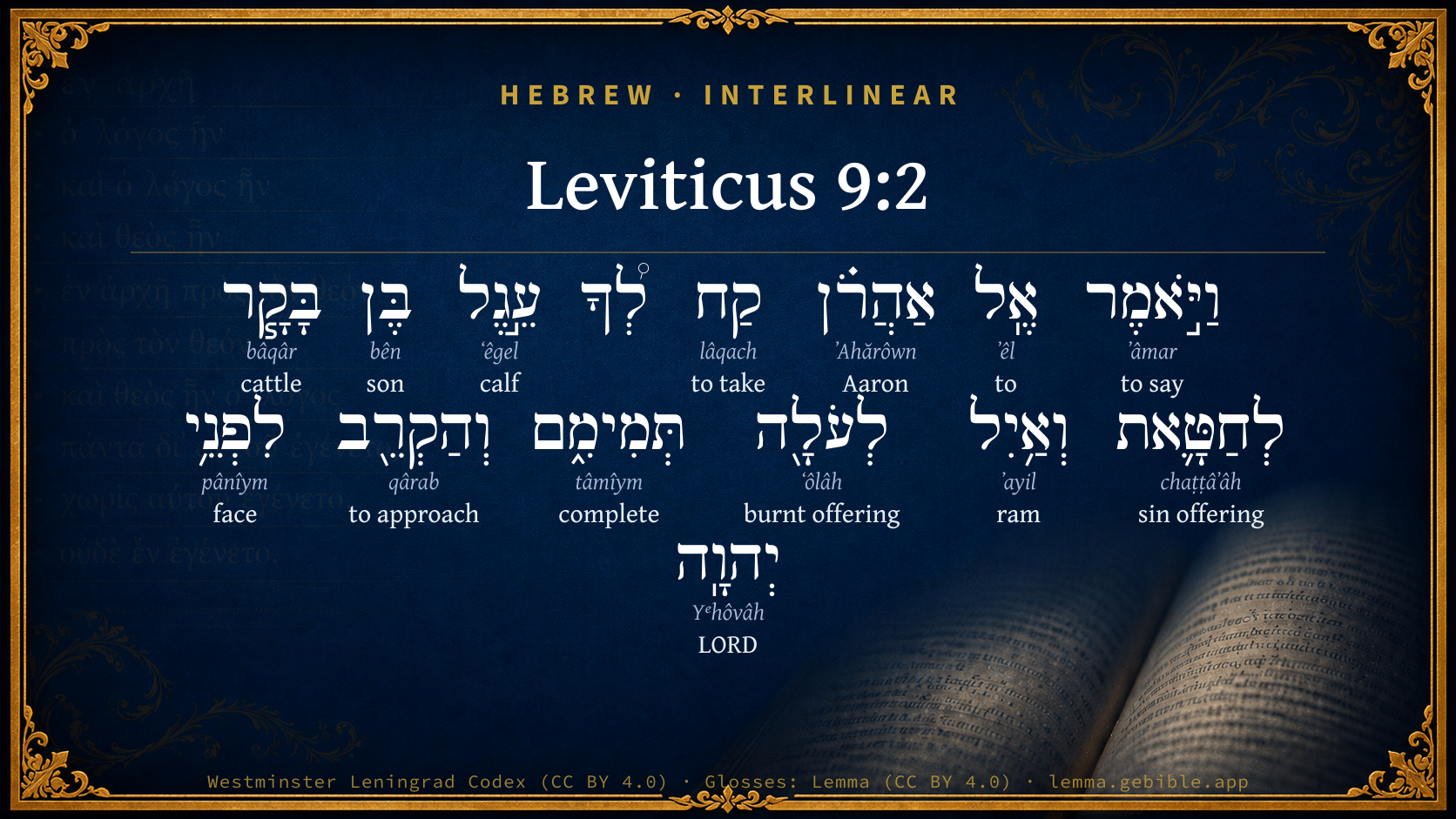
Hebrew (Westminster Leningrad Codex) Leviticus 9:2 appears in the Hebrew Old Testament. The text above is from the Westminster Leningrad Codex. Each word links to its Strong’s number, a concise gloss, and parsing drawn from the Open Scriptures Hebrew Bible morphology. Click any word for its full Brown-Driver-Briggs (BDB) entry.
Download image
Cite this verse

Leviticus 9:2 (World English Bible). Public Domain. Lemma interlinear Bible study tool, https://lemma.gebible.app/v/leviticus/9/2.

Show BibTeX & RIS
BibTeX
RIS
English Translation
and he said to Aaron, "Take a calf from the herd for a sin offering, and a ram for a burnt offering, without blemish, and offer them before Yahweh.
World English Bible · Public Domain
Download a study sheet

One document with this verse’s original text, its word-by-word gloss line, the meaning frame, cross-references with their text, attributed commentary, and full source and license credits — printable, and it pastes into notes with its structure intact.

This verse Autodidact and up

Study sheet (.html) Plain text (.txt)

A passage Seminary Student

Up to 50 verses in one chapter. A passage sheet keeps up to 6 commentary sources and 12 cross-references per verse, in the order this page ranks them, and says so on the sheet whenever that leaves anything out. Ask for a single verse and you get the Autodidact verse sheet above.

Everything on this page stays free to read, with no account — the sheet is a download of what is already on screen, not access to it.

Want to remove ads? Support Godless Engineer
Compare translations 3

The same verse in 3 English versions, stacked beneath the original-language interlinear above. Click any original word for its lexicon entry.

Each is an independent rendering of the whole verse — the interlinear is not word-aligned to these translations.

Highlighted words mark where these versions differ — a whole-verse word diff, not a word-by-word alignment.

  • World English Bible Public Domain
    and he said to Aaron, "Take a calf from the herd for a sin offering, and a ram for a burnt offering, without blemish, and offer them before Yahweh.
  • King James Version Public Domain
    And he said unto Aaron, Take thee a young calf for a sin offering, and a ram for a burnt offering, without blemish, and offer them before the LORD.
  • unfoldingWord Literal Text CC BY-SA 4.0
    And he said to Aaron, “Take for yourself a calf, a son of the cattle, for a sin offering, and a ram for a burnt offering, perfect, and present to the face of Yahweh.

unfoldingWord Literal Text — © unfoldingWord, licensed CC BY-SA 4.0. Word-aligned USFM3 via Door43 (git.door43.org/unfoldingWord/en_ult).

Versions to compare (up to 4)

3 of 4 selected

Show all 18 translations

Every available English version of this verse, each an independent rendering of the whole verse.

  • World English Bible Public Domain
    and he said to Aaron, "Take a calf from the herd for a sin offering, and a ram for a burnt offering, without blemish, and offer them before Yahweh.
  • Berean Standard Bible Public Domain
    He said to Aaron, “Take for yourself a young bull for a sin offering and a ram for a burnt offering, both without blemish, and present them before the LORD.
  • Majority Standard Bible Public Domain
    He said to Aaron, “Take for yourself a young bull for a sin offering and a ram for a burnt offering, both without blemish, and present them before the LORD.
  • King James Version Public Domain
    And he said unto Aaron, Take thee a young calf for a sin offering, and a ram for a burnt offering, without blemish, and offer them before the LORD.
  • American Standard Version (1901) Public Domain
    and he said unto Aaron, Take thee a calf of the herd for a sin-offering, and a ram for a burnt-offering, without blemish, and offer them before Jehovah.
  • Revised Version (1885) Public Domain
    and he said unto Aaron, Take thee a bull calf for a sin offering, and a ram for a burnt offering, without blemish, and offer them before the LORD.
  • Geneva Bible (1599) Public Domain
    Then hee sayde vnto Aaron, Take thee a yong calfe for a sinne offring, and a ram for a burnt offring, both without blemish, and bring them before the Lord.
  • Douay-Rheims (1899) Public Domain
    Take of the herd a calf for sin, and a ram for a holocaust, both without blemish, and offer them before the Lord.
  • Young's Literal Translation Public Domain
    and he saith unto Aaron, `Take to thyself a calf, a son of the herd, for a sin-offering, and a ram for a burnt-offering, perfect ones, and bring near before Jehovah.
  • Literal Standard Version CC BY-SA 4.0
    and he says to Aaron, “Take a calf for yourself, a son of the herd, for a sin-offering, and a ram for a burnt-offering, perfect ones, and bring [them] near before YHWH.
  • Unlocked Literal Bible CC BY-SA 4.0
    He said to Aaron, “Take a calf from the herd for a sin offering, and a ram without blemish for a burnt offering, and offer them before Yahweh.
  • unfoldingWord Literal Text CC BY-SA 4.0
    And he said to Aaron, “Take for yourself a calf, a son of the cattle, for a sin offering, and a ram for a burnt offering, perfect, and present to the face of Yahweh.
  • Darby Bible Public Domain
    and said to Aaron, Take thee a young calf for a sin-offering, and a ram for a burnt-offering, without blemish, and present [them] before Jehovah;
  • World Messianic Bible Public Domain
    and he said to Aaron, “Take a calf from the herd for a sin offering, and a ram for a burnt offering, without defect, and offer them before the LORD.
  • Webster's Bible Public Domain
    And he said to Aaron, Take thee a young calf for a sin-offering, and a ram for a burnt-offering, without blemish, and offer them before the LORD.
  • Free Bible Version CC BY-SA 4.0
    He told Aaron, “You need to bring a young bull as a sin offering and a ram as a burnt offering, both without defects, and present them before the Lord.
  • Bible in Basic English Public Domain
    And he said to Aaron, Take a young ox for a sin-offering and a male sheep for a burned offering, without a mark, and make an offering of them before the Lord.
  • JPS Tanakh (1917) Public Domain
    and he said unto Aaron: 'Take thee a bull-calf for a sin-offering, and a ram for a burnt-offering, without blemish, and offer them before the LORD.

Literal Standard Version (2020), Covenant Press — licensed CC BY-SA 4.0. Text via the HelloAO Bible API (eBible.org). Unlocked Literal Bible (unfoldingWord) — licensed CC BY-SA 4.0. Text via the HelloAO Bible API (eBible.org). unfoldingWord Literal Text — © unfoldingWord, licensed CC BY-SA 4.0. Word-aligned USFM3 via Door43 (git.door43.org/unfoldingWord/en_ult). Free Bible Version, Dr. Jonathan Gallagher — licensed CC BY-SA 4.0. Text via the HelloAO Bible API (eBible.org).

Word by word

More ways to search: Search by grammar → Find every occurrence → Compare this word →

Practice this passage: Drill this verse → Learn its vocabulary →

עֵ֣גֶל
ʻêgel
H5695
“calf”
Noun, Common, Masculine, Singular, Absolute
Part of Speech
Noun
Type
Common
Gender
Masculine
Number
Singular
State
Absolute
Full BDB Definition

Origin: from the same as H5696

TWOT: 1560a

calf, bull-calf
  1. וַיֹּ֣אמֶר ʼâmar H559 “and · to say” Conjunction + Verb, Qal, Sequential Imperfect, 3rd Person, Masculine, Singular
  2. אֶֽל ʼêl H413 “to” Preposition
  3. אַהֲרֹ֗ן ʼAhărôwn H175 “Aaron” Noun, Proper
  4. קַח lâqach H3947 “take” Verb, Qal, Imperative, 2nd Person, Masculine, Singular
  5. בֶּן bên H1121 “son of” Noun, Common, Masculine, Singular, Construct
  6. בָּקָ֧ר bâqâr H1241 “cattle” Noun, Common, Both, Singular, Absolute
  7. לְחַטָּ֛את chaṭṭâʼâh H2403 “to/for · sin offering” Preposition + Noun, Common, Feminine, Singular, Absolute
  8. וְאַ֥יִל ʼayil H352 “and · ram” Conjunction + Noun, Common, Masculine, Singular, Absolute
  9. לְעֹלָ֖ה ʻôlâh H5930 “to/for · burnt offering” Preposition + Noun, Common, Feminine, Singular, Absolute
  10. תְּמִימִ֑ם tâmîym H8549 “complete” Adjective, Adjective, Masculine, Plural, Absolute
  11. וְהַקְרֵ֖ב qârab H7126 “and · approach” Conjunction + Verb, Hiphil, Imperative, 2nd Person, Masculine, Singular
  12. לִפְנֵ֥י pânîym H6440 “to/for · face(s) of” Preposition + Noun, Common, Both, Plural, Construct
  13. יְהוָֽה Yᵉhôvâh H3068 “LORD” Noun, Proper

About this verse

These counts appear in no published source. They are computed here, from the morphology-tagged text and Lemma’s own curated glosses. What Lemma adds →

15
words
14
distinct lemmas
Pentateuch
section

Shared distinctive vocabulary

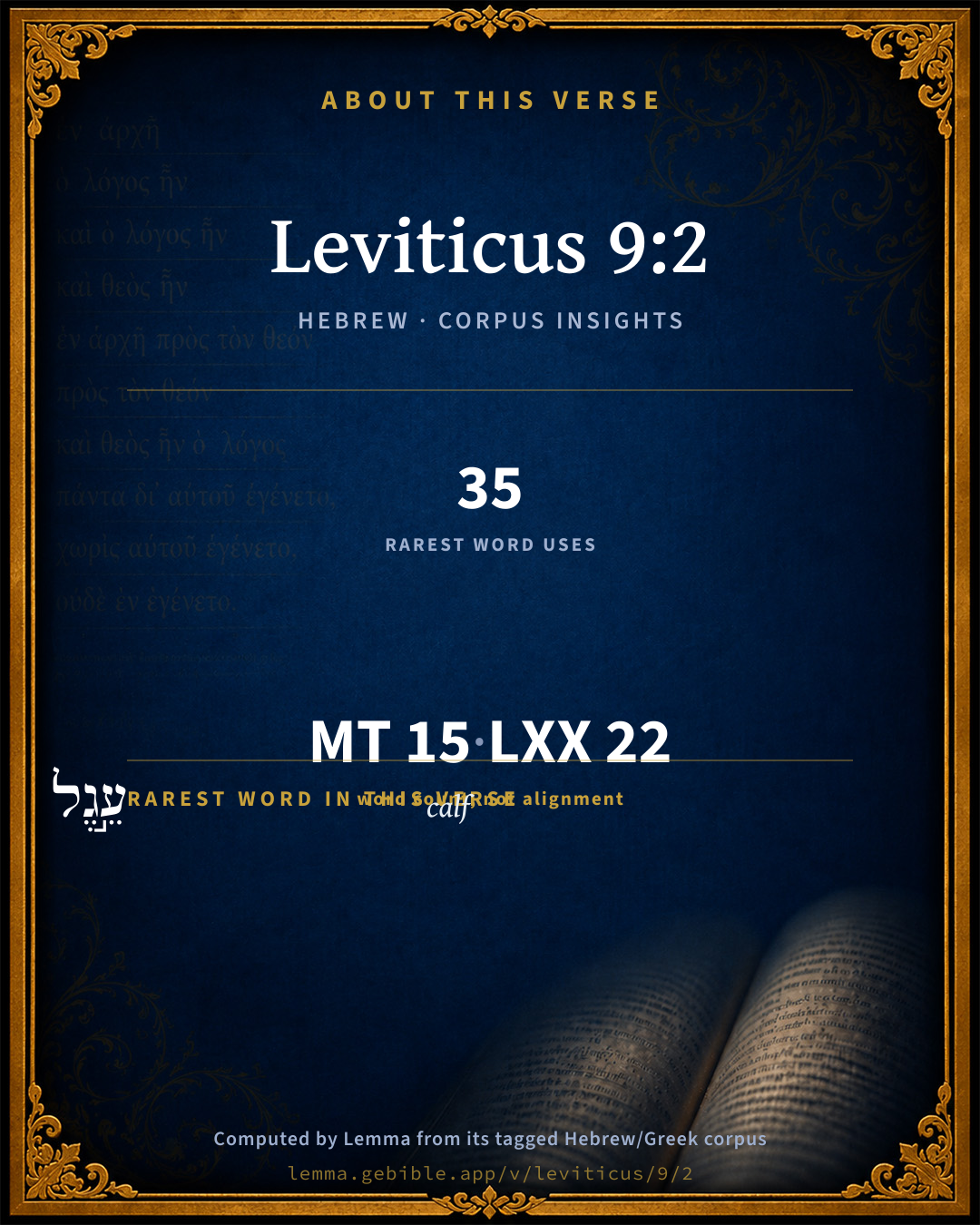
עֵ֣גֶל calf H5695 occurs in 35 verses of the Hebrew Bible. Also found in:

Grammatical profile

  • 3 verbs
  • 9 nouns
  • 1 adjective
  • 2 prepositions

Verb forms

  • וַיֹּ֣אמֶר Qal · Sequential Imperfect
  • קַח Qal · Imperative
  • וְהַקְרֵ֖ב Hiphil · Imperative

Hebrew & Septuagint length

In English translation the verse runs 29 words from the Hebrew and 32 from the Septuagint (LXX English) — closely comparable.

A rough comparison of the two English renderings, which tokenize alike — not a word-level alignment.

Word counts can differ between the Hebrew and the Greek without any difference in meaning — e.g. the Hebrew direct-object marker אֵת has no separate Greek word, and Greek often adds the article ὁ.

In the original languages it is 15 Hebrew tokens and 22 Greek tokens — but the two are counted differently (Hebrew bundles its prefixes and suffixes into one token; the Greek is in lemma form), so that isn’t a like-for-like length.

Cross-references

9

Topical passages linked to Leviticus 9:2 in the Treasury of Scripture Knowledge — connected by theme and wording, ordered by reader-vote popularity; previews shown in the World English Bible.

  • Leviticus 4:3 if the anointed priest sins so as to bring guilt on the people, then let him offer for his sin, which he has sinned, a young bull without blemish to Yahweh for a sin offering.
  • Exodus 29:1 "This is the thing that you shall do to them to make them holy, to minister to me in the priest's office: take one young bull and two rams without blemish,
  • Leviticus 8:14 He brought the bull of the sin offering, and Aaron and his sons laid their hands on the head of the bull of the sin offering.
  • Leviticus 8:18 He presented the ram of the burnt offering: and Aaron and his sons laid their hands on the head of the ram.
  • 2 Corinthians 5:21 For him who knew no sin he made to be sin on our behalf; so that in him we might become the righteousness of God.
  • Hebrews 7:27 who doesn't need, like those high priests, to daily offer up sacrifices, first for his own sins, and then for the sins of the people. For this he did once for all, when he offered up himself.
  • Hebrews 10:10–14 by which will we have been sanctified through the offering of the body of Jesus Christ once for all.
  • Leviticus 9:7–8 Moses said to Aaron, "Draw near to the altar, and offer your sin offering, and your burnt offering, and make atonement for yourself, and for the people; and offer the offering of the people, and make atonement for them; as Yahweh commanded."
  • Hebrews 5:3 Because of this, he must offer sacrifices for sins for the people, as well as for himself.

Cross-references courtesy of OpenBible.info (CC BY 4.0).

Hebrew and Greek witnesses Masoretic Hebrew ↔ Greek Septuagint

The same verse in the two great witnesses to the Old Testament, shown verse-for-verse.

These are two independent witnesses, not word-aligned to each other, and the Septuagint is shown in lemma (dictionary) form.

Hebrew Leviticus 9:2 Masoretic · Westminster Leningrad Codex

וַיֹּ֣אמֶר אֶֽל אַהֲרֹ֗ן קַח לְ֠ךָ עֵ֣גֶל בֶּן בָּקָ֧ר לְחַטָּ֛את וְאַ֥יִל לְעֹלָ֖ה תְּמִימִ֑ם וְהַקְרֵ֖ב לִפְנֵ֥י יְהוָֽה

and he said to Aaron, "Take a calf from the herd for a sin offering, and a ram for a burnt offering, without blemish, and offer them before Yahweh.

World English Bible · Public Domain

Greek LXX Leviticus 9:2 Septuagint · lemma form

καί εἶπον μωυσῆς πρός ἀαρών λαμβάνω σεαυτοῦ μοσχάριον ἐκ βοῦς περί ἁμαρτία καί κριός εἰς ὁλοκαύτωμα ἄμωμος καί προςφέρω αὐτός ἔναντι κύριος

and Moses said to Aaron, Take to yourself a young calf of the herd for a sin-offering, and a ram for a whole burnt offering, unblemished, and offer them before the Lord.

LXX2012 (modern English Septuagint) · Public Domain

Hebrew: Westminster Leningrad Codex (CC BY 4.0). Greek: Septuagint (public domain); English from LXX2012 (modern English Septuagint) (Public Domain). How the Septuagint differs from the Hebrew →

Targum (Aramaic paraphrase)

2

The Targum is the ancient Jewish Aramaic paraphrase of the Hebrew Scriptures — an interpretive translation, not the Hebrew text itself. Onkelos (literal) and Pseudo-Jonathan (expansive) render the Torah, and Jonathan the Prophets. Coverage is partial: where no permissively-licensed English translation exists for a verse, only the Aramaic is shown. This is verse-level text, not a word-by-word alignment to the Hebrew.

  1. Targum Onkelos Torah (Genesis–Deuteronomy)
    וַאֲמַר לְאַהֲרֹן סַב לָךְ עֵגֶל בַּר תּוֹרֵי לְחַטָּאתָא וּדְכַר לַעֲלָתָא שַׁלְמִין וְקָרֵב קֳדָם יְיָ

    (no public-domain English translation for this verse)

    Targum Onkelos — Aramaic: “Onkelos Genesis” (public domain); “Onkelos Exodus” (public domain); “Onkelos Leviticus” (public domain); “Onkelos Numbers” (public domain); “Onkelos Deuteronomy” (public domain). English: “Sefaria Community Translation” (CC0 1.0 (public-domain dedication)); “J.W. Etheridge. The Targums of Onkelos and Jonathan Ben Uzziel on the Pentateuch. London: Longmans, Green, 1862” (public domain). Text via Sefaria.

  2. Targum Pseudo-Jonathan Torah (Genesis–Deuteronomy)
    וַאֲמַר לְאַהֲרן סַב לָךְ עֵיגַל בַּר תּוֹרֵי לְחַטָאתָא מְטוֹל דְלָא יִשְׁתְּעֵי עֲלָךְ שִטְנָא לִישָׁן תְּלִיתָאֵי עַל עֵיסַק עֵיגְלָא דְעָבַדְתָּ בְּחוֹרֵב וּבְרַם דְכַר לַעֲלָתָא תִּיסַב מִן בִּגְלַל דִי יִדְכַּר לָךְ זְכוּתָא דְיִצְחָק דְכַפְתֵיהּ אָבוֹי כְּדִיכְרָא בְּטַוָור פּוּלְחָנָא תְּרֵיהוֹן יְהוֹן שַׁלְמִין וּקְרֵיב קֳדָם יְיָ

    And he said to Aharon, Take thou a calf, the young of a bullock, for a sin offering, that Satan may not accuse thee concerning the calf that thou madest at Horeb; and take a ram for the burnt sacrifice, that there may be a memorial for thee of the righteousness of Izhak whom his father bound as a ram on the mountain of worship, both of them shall be perfect, and bring them before the Lord.

    Targum Pseudo-Jonathan — Aramaic: “Targum Jonathan on Genesis” (public domain); “Targum Jonathan on Exodus” (public domain); “Targum Jonathan on Leviticus” (public domain); “Targum Jonathan on Numbers” (public domain); “Targum Jonathan on Deuteronomy” (public domain). English: “The Targum of Jonathan ben Uzziel, trans. J. W. Etheridge, London, 1862” (public domain). Text via Sefaria.

Commentary

Notes on Leviticus 9:2 from classic Christian and Jewish commentators (each source and its license shown beneath its notes). The classic Christian expositions comment on the surrounding passage and are grouped to its opening verse, so a note may address several verses; the Jewish commentaries on the Tanakh (Rashi and others) are per-verse, so they appear only where the commentator wrote on this verse.

Lemma curates 59 commentaries, every one of them public domain or Creative Commons licensed, each selected and text-cleaned for this edition rather than reprinted as found. About our sources →

Trapp's Complete Commentary

John Trapp

Lev 9:2 And he said unto Aaron, Take thee a young calf for a sin offering, and a ram for a burnt offering, without blemish, and offer [them] before the LORD.

Ver. 2. Take thee a young calf] In remembrance, and for the remission of Aaron’s sin about the golden calf; as some Hebrews are of opinion.

John Trapp, A Commentary or Exposition upon All the Books of the Old and New Testament (1647–1656) — public domain. Text from a community e-Sword module.

Joseph Benson's Commentary

Lev 9:2. For a sin-offering — For himself and his own sins, which was an evidence of the imperfection of that priesthood, and of the necessity of a better. The Jewish writers suggest, that a calf was appointed to remind him of his sin in making the golden calf. Thereby he had rendered himself for ever unworthy of the honour of the priesthood; on which he had reason to reflect with sorrow and shame, in all the atonements he made.

Joseph Benson's Commentary on the Old and New Testaments (1811–1818) — public domain. Text from a community e-Sword module.

Tyndale Open Study Notes

Tyndale Open Resources

9:2-4 These sacrifices—the sin and whole burnt offerings for the priests and the sin, burnt, peace, and grain offerings for the people—were offered at the beginning of the priests’ ministry to make certain that all sin was atoned for and the covenant with God affirmed. Only the guilt offering was omitted.

Tyndale Open Study Notes — © Tyndale Open Resources, licensed CC BY-SA 4.0. Text via the HelloAO Bible API.

Geneva Bible (1599)

Geneva Bible translators

Aaron entereth into the possession of the Priesthood: and offereth the four principal sacrifices, the burnt offering, the sin offering, the peace offerings, and the meat offering.

Geneva Bible (1599) marginal notes — public domain. Text via Bolls.life.

Adam Clarke's Commentary

Verse 2. Take thee a young calf, &c.] As these sacrifices were for Aaron himself, they are furnished by himself and not by the people, for they were designed to make atonement for his own sin. See Le 4:3. And this is supposed by the Jews to have been intended to make an atonement for his sin in the matter of the golden calf. This is very probable, as no formal atonement for that transgression had yet been made.

Adam Clarke's Commentary on the Bible (1810–1826) — public domain. Text from a community e-Sword/MySword module.

Ellicott's Commentary for English Readers

(2) A young calf for a sin offering.—Literally, a calf, the son of a bull, which, according to the canonical law, was a calf of the second year, whilst a steer, the son of a bull, rendered in the Authorised Version by “young bullock,” was defined to be three years old, or in its third year. (See Lev_4:3.) Before they could mediate for the forgiveness of the people, Aaron and his sons had first to bring a sin offering for themselves, in expiation probably for the feeling of pride which they might have fostered at having been so highly distinguished and chosen to be the mediators of the people. This sin offering, however, showed him that, though a high priest, he was beset with the same infirmities, and stood in need of the same atonement, as the people whom he represented. As this is the only instance in which a calf is appointed for a sin offering, and as the offerer who is ordered to bring this exceptional sacrifice is Aaron, Jewish tradition will have it that it was designed to refer to the sin of the golden calf which he made for the people. (Exo_32:4-6.) So old and universal is this interpretation, that it is expressed in the ancient Chaldee Version of the Pentateuch. This sense seems to derive support from Lev_9:7.

Before the Lord.—That is, before the door of the tent of meeting (see Lev_1:5; Lev_1:11), on the altar of burnt offering.

A Bible Commentary for English Readers, edited by Charles John Ellicott (1878–1897) — public domain. Text from a community e-Sword module.

The Cambridge Bible for Schools and Colleges

gen. ed. J. J. S. Perowne

2. a bull calf] Only here is a calf appointed for a Sin-Offering. According to Jewish tradition, expressed in Targ. Jon., it was to remind Aaron of his sin in making the golden calf at Horeb (Exodus 32).

The Cambridge Bible for Schools and Colleges (gen. ed. J. J. S. Perowne; Cambridge University Press, 1878–1918) — public domain. Text from a community e-Sword module.

John Gill's Exposition

And he said unto Aaron,.... In the presence of the people of Israel:

take thee a young calf for a sin offering; one not exceeding a year old, as in Lev 9:3 but this was not for the sin of making the calf only, to which the Jewish writers restrain it, but for all other sins of his, which it was necessary should be expiated before he offered sacrifices for the sins of others:

and a ram for a burnt offering; being a strong and innocent creature, was a proper emblem of Christ, the Lamb of God, that takes away by his sacrifice the sins of men:

without blemish; this character belongs, as Aben Ezra observes, both to the calf and ram, which were both to be without spot, and so proper types of Christ the Lamb without spot and blemish, free both from original and actual sin:

and offer them before the Lord; on the altar of burnt offering, which stood in the court of the tabernacle near where Jehovah was, to whom every sacrifice for sin was to be offered, being committed against him, and whose justice must be satisfied for it.

John Gill's Exposition of the Whole Bible (1746–1763) — public domain (CC PDM 1.0). Text via the HelloAO Bible API.

Haydock's Catholic Bible Commentary

Calf. As they had formerly adored a calf, so now they sacrifice one to God. (St. Jerome in Jer. vii.)

George Leo Haydock (1774–1849), Haydock's Catholic Family Bible and Commentary, 1859 edition — public domain. Excludes Psalms (Douay-Rheims chapter numbering differs from Protestant) and Deuterocanonical books (Catholic canon only).

Matthew Poole's English Annotations

A young calf, Heb. a calf, the son of a bull or cow; which may seem to be added purposely to intimate that it was not a young calf properly so called, but a young bullock, for that was the sacrifice enjoined for the high priest’s sin-offering, Lev 4:3. Though it be not material, if this be a young calf, and that a young bull, because the grounds and ends of the several sacrifices differ, that Le 4; being for his particular sin, and this for his own and family’s sins in general, and therefore no wonder if the sacrifices also differ. For a sin offering, for himself and his own sins, which was an evidence of the imperfection of that priesthood, and of the necessity of another and a better.

Matthew Poole's English Annotations on the Holy Bible (1683–1685) — public domain. Text from a community e-Sword/MySword module.

Whedon's Commentary on the Bible

Daniel D. Whedon

2. Calf for a sin offering — The Hebrew for calf also signifies calf image.

Exo_32:4. Thus Moses delicately reminds Aaron of the great sin which he had committed in making the golden calf, and teaches him that the animal which was the object of idolatrous worship among the Egyptians, as a symbol of the deity, is fit only for a sin offering to Jehovah, the Creator of all things. See chap. iv, Introductory.

Without blemish — See Lev_1:3, note.

Before the Lord — This was at the door of the tabernacle. Lev_1:3, note.

Daniel D. Whedon (gen. ed.), Commentary on the Old and New Testaments (1874–1909) — public domain. Text from a community e-Sword module.

John Wesley's Explanatory Notes

For a sin-offering - For himself and his own sins, which was an evidence of the imperfection of that priesthood, and of the necessity of a better. The Jewish writers suggest, that a calf was appointed, to remind him of his sin in making the golden calf. Thereby he had rendered himself forever unworthy of the honour of the priesthood: on which he had reason to reflect with sorrow and shame, in all the atonements he made.

John Wesley, Explanatory Notes Upon the Whole Bible (1754–1765) — public domain. Text via the GEBible commentary corpus.

Rashi

Rabbi Shlomo Yitzchaki (Rashi)

קח לך עגל TAKE THEE A CALF — This animal was selected as a sin offering to announce to him that the Holy One, blessed be He, granted him atonement by means of this calf for the incident of the golden calf which he had made (Midrash Tanchuma, Shmini 4)

Rashi on the Tanakh — English translations: “The Judaica Press complete Tanach with Rashi, translated by A. J. Rosenberg” (CC BY 4.0); “Pentateuch with Rashi's commentary by M. Rosenbaum and A.M. Silbermann, 1929-1934” (public domain); “The Metsudah Tanach series, Lakewood, N.J” (CC BY 4.0); and “The Book of Joshua, Metsudah Publications, 1997” (CC BY 4.0). Text via Sefaria.

Ramban (Nachmanides)

Rabbi Moshe ben Nachman (Ramban / Nachmanides)

AND HE [Moses] SAID TO AARON: TAKE THEE A BULL-CALF FOR A SIN-OFFERING. Moses, our teacher, had been commanded about these offerings, as he said at the end [of the section], This is the thing which the Eternal commanded that ye should do, although this [command for these specific offerings] is not expressly mentioned. Similarly, And Moses said: This is the thing which the Eternal hath commanded: Let an omerful of it be kept throughout your generations, [where the verse indicates that Moses received a Divine command although it is not specifically mentioned]. Also, I am the G-d of Beth-el, when Jacob related [to his wives all that G-d’s angel had told him in the dream], even though it is not mentioned in Scripture that he was so told. I have already shown to you, 12:21. many such examples in the sections on the commandments regarding the Passover.

Ramban (Nachmanides) on the Tanakh — English translation: “Commentary on the Torah by Ramban (Nachmanides). Translated and annotated by Charles B. Chavel. New York, Shilo Pub. House, 1971-1976” (CC BY 4.0). Text via Sefaria.

Lesson kit

Teaching starters — assembled from the data on this page, not authored interpretation. Every prompt links to the verse data it draws on. Edit before teaching.

Leviticus, in the Pentateuch, opens this verse with 15 words (14 distinct Hebrew lemmas). Its most distinctive word is ʻêgel (“calf”). A historical commentator’s framing appears above. Read the whole chapter for the surrounding context.

Discussion questions

  1. How does “calf” (ʻêgel) shape what this verse is saying?
  2. How does Exodus 32:4, which shares the word «calf», read alongside this verse?
  3. These translations render this verse differently. What is at stake in choosing one wording over another?
  4. «וַיֹּ֣אמֶר» is a Qal Sequential Imperfect verb. How does that grammatical form shape the action described?
  5. Compare how Trapp's Complete Commentary and Joseph Benson's Commentary read this verse. Where do they agree or differ?

Things to notice

Reading settings

Reading text

Shown beneath each verse's original-language words.

Old Testament
Old Testament edition

Read the OT as the Masoretic Hebrew (MT) or the Greek Septuagint (LXX).

English shown for the Greek Septuagint (in the Hebrew ↔ Greek comparison).

Comparing translations? Open the Compare panel on any verse page to stack up to four side by side.