
Numbers 31:50

Hebrew (Westminster Leningrad Codex) Numbers 31:50 appears in the Hebrew Old Testament. The text above is from the Westminster Leningrad Codex. Each word links to its Strong’s number, a concise gloss, and parsing drawn from the Open Scriptures Hebrew Bible morphology. Click any word for its full Brown-Driver-Briggs (BDB) entry.
Download image
Cite this verse

Numbers 31:50 (World English Bible). Public Domain. Lemma interlinear Bible study tool, https://lemma.gebible.app/v/numbers/31/50.

Show BibTeX & RIS
BibTeX
RIS
English Translation
We have brought Yahweh's offering, what every man has gotten, of jewels of gold, ankle-chains, and bracelets, signet-rings, ear-rings, and armlets, to make atonement for our souls before Yahweh.
World English Bible · Public Domain
Highlights Full analysis ↓
Download a study sheet

One document with this verse’s original text, its word-by-word gloss line, the meaning frame, cross-references with their text, attributed commentary, and full source and license credits — printable, and it pastes into notes with its structure intact.

This verse Autodidact and up

Study sheet (.html) Plain text (.txt)

A passage Seminary Student

Up to 50 verses in one chapter. A passage sheet keeps up to 6 commentary sources and 12 cross-references per verse, in the order this page ranks them, and says so on the sheet whenever that leaves anything out. Ask for a single verse and you get the Autodidact verse sheet above.

Everything on this page stays free to read, with no account — the sheet is a download of what is already on screen, not access to it.

Want to remove ads? Support Godless Engineer
Compare translations 3

The same verse in 3 English versions, stacked beneath the original-language interlinear above. Click any original word for its lexicon entry.

Each is an independent rendering of the whole verse — the interlinear is not word-aligned to these translations.

Highlighted words mark where these versions differ — a whole-verse word diff, not a word-by-word alignment.

  • World English Bible Public Domain
    We have brought Yahweh's offering, what every man has gotten, of jewels of gold, ankle-chains, and bracelets, signet-rings, ear-rings, and armlets, to make atonement for our souls before Yahweh.
  • King James Version Public Domain
    We have therefore brought an oblation for the LORD, what every man hath gotten, of jewels of gold, chains, and bracelets, rings, earrings, and tablets, to make an atonement for our souls before the LORD.
  • unfoldingWord Literal Text CC BY-SA 4.0
    And we have offered the offering of Yahweh, a man what he found of the objects of gold, armlet, and bracelet, signet ring, earring, and ornament, to make atonement for our lives before the face of Yahweh.”

unfoldingWord Literal Text — © unfoldingWord, licensed CC BY-SA 4.0. Word-aligned USFM3 via Door43 (git.door43.org/unfoldingWord/en_ult).

Versions to compare (up to 4)

3 of 4 selected

Show all 18 translations

Every available English version of this verse, each an independent rendering of the whole verse.

  • World English Bible Public Domain
    We have brought Yahweh's offering, what every man has gotten, of jewels of gold, ankle-chains, and bracelets, signet-rings, ear-rings, and armlets, to make atonement for our souls before Yahweh.
  • Berean Standard Bible Public Domain
    So we have brought to the LORD an offering of the gold articles each man acquired—armlets, bracelets, rings, earrings, and necklaces—to make atonement for ourselves before the LORD.”
  • Majority Standard Bible Public Domain
    So we have brought to the LORD an offering of the gold articles each man acquired—armlets, bracelets, rings, earrings, and necklaces—to make atonement for ourselves before the LORD.”
  • King James Version Public Domain
    We have therefore brought an oblation for the LORD, what every man hath gotten, of jewels of gold, chains, and bracelets, rings, earrings, and tablets, to make an atonement for our souls before the LORD.
  • American Standard Version (1901) Public Domain
    And we have brought Jehovah's oblation, what every man hath gotten, of jewels of gold, ankle-chains, and bracelets, signet-rings, ear-rings, and armlets, to make atonement for our souls before Jehovah.
  • Revised Version (1885) Public Domain
    And we have brought the LORD’S oblation, what every man hath gotten, of jewels of gold, ankle chains, and bracelets, signet-rings, earrings, and armlets, to make atonement for our souls before the LORD.
  • Geneva Bible (1599) Public Domain
    We haue therefore brought a present vnto the Lord, what euery man found of iewels of golde, bracelets, and cheines, rings, eare ringes, and ornaments of the legges, to make an atonement for our soules before the Lord.
  • Douay-Rheims (1899) Public Domain
    Therefore we offer as gifts to the Lord what gold every one of us could find in the booty, in garters and tablets, rings and bracelets, and chains, that thou mayst pray to the Lord for us.
  • Young's Literal Translation Public Domain
    and we bring near Jehovah's offering, each that which he hath found, vessels of gold -- chain, and bracelet, seal-ring, `ear'-ring, and bead -- to make atonement for ourselves before Jehovah.'
  • Literal Standard Version CC BY-SA 4.0
    and we bring YHWH’s offering near, each of that which he has found of vessels of gold—chain, and bracelet, seal-ring, [ear]-ring, and bead—to make atonement for ourselves before YHWH.”
  • Unlocked Literal Bible CC BY-SA 4.0
    We have brought Yahweh's offering, what each man found, articles of gold, armlets and bracelets, signet rings, earrings, and necklaces, to make atonement for ourselves before Yahweh.”
  • unfoldingWord Literal Text CC BY-SA 4.0
    And we have offered the offering of Yahweh, a man what he found of the objects of gold, armlet, and bracelet, signet ring, earring, and ornament, to make atonement for our lives before the face of Yahweh.”
  • Darby Bible Public Domain
    So we present the offering of Jehovah, that which each one hath found, jewels of gold, chains, and bracelets, rings, earrings, and necklaces, to make atonement for our souls before Jehovah.
  • World Messianic Bible Public Domain
    We have brought the LORD’s offering, what every man found: gold ornaments, armlets, bracelets, signet rings, earrings, and necklaces, to make atonement for our souls before the LORD.”
  • Webster's Bible Public Domain
    We have therefore brought an oblation for the LORD, what every man hath obtained of jewels of gold, chains, and bracelets, rings, ear-rings, and tablets, to make an atonement for our souls before the LORD.
  • Free Bible Version CC BY-SA 4.0
    So we have brought the Lord an offering of the gold objects each man received—armlets, bracelets, rings, earrings, and necklaces—in order that we may be right before the Lord.”
  • Bible in Basic English Public Domain
    And we have here an offering for the Lord from what every man took in the war, ornaments of gold, leg-chains and arm-rings, finger-rings, ear-rings, and neck-ornaments, to make our souls free from sin before the Lord.
  • JPS Tanakh (1917) Public Domain
    And we have brought the LORD'S offering, what every man hath gotten, of jewels of gold, armlets, and bracelets, signet-rings, ear-rings, and girdles, to make atonement for our souls before the LORD.'

Literal Standard Version (2020), Covenant Press — licensed CC BY-SA 4.0. Text via the HelloAO Bible API (eBible.org). Unlocked Literal Bible (unfoldingWord) — licensed CC BY-SA 4.0. Text via the HelloAO Bible API (eBible.org). unfoldingWord Literal Text — © unfoldingWord, licensed CC BY-SA 4.0. Word-aligned USFM3 via Door43 (git.door43.org/unfoldingWord/en_ult). Free Bible Version, Dr. Jonathan Gallagher — licensed CC BY-SA 4.0. Text via the HelloAO Bible API (eBible.org).

Word by word

More ways to search: Search by grammar → Find every occurrence → Compare this word →

Practice this passage: Drill this verse → Learn its vocabulary →

אֶצְעָדָ֣ה
ʼetsʻâdâh
H685
“bracelet”
Noun, Common, Feminine, Singular, Absolute
Part of Speech
Noun
Type
Common
Gender
Feminine
Number
Singular
State
Absolute
Full BDB Definition

Origin: a variation from H6807

TWOT: 1943e

armlet, bracelet, ankle chain
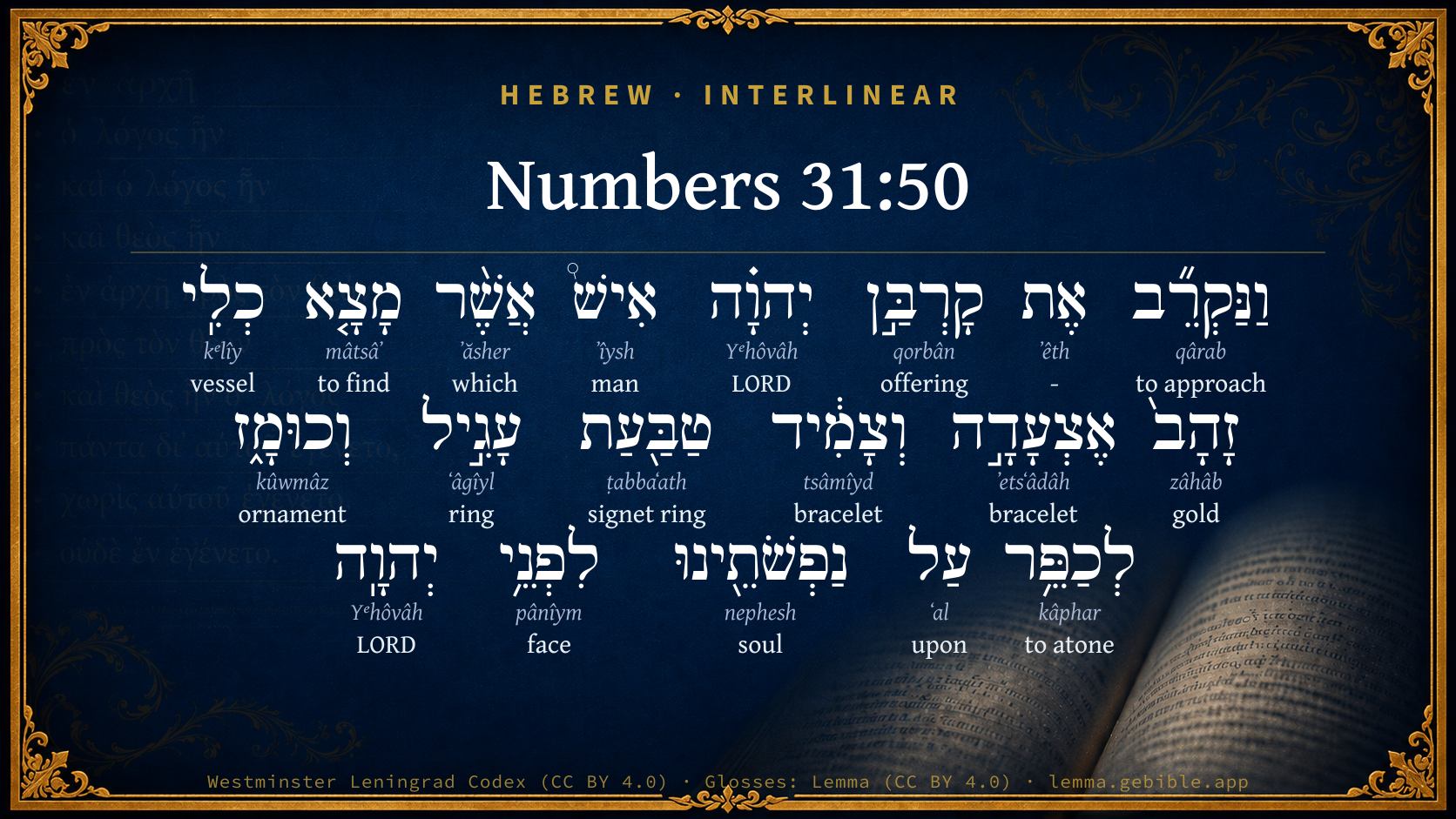
  1. וַנַּקְרֵ֞ב qârab H7126 “and · to approach” Conjunction + Verb, Hiphil, Sequential Imperfect, 1st Person, Common, Plural
  2. אֶת ʼêth H853 “-” Particle, Direct Object
  3. קָרְבַּ֣ן qorbân H7133 “offering of” Noun, Common, Masculine, Singular, Construct
  4. יְהוָ֗ה Yᵉhôvâh H3068 “LORD” Noun, Proper
  5. אִישׁ֩ ʼîysh H376 “man” Noun, Common, Masculine, Singular, Absolute
  6. אֲשֶׁ֨ר ʼăsher H834 “which” Particle, Relative
  7. מָצָ֤א mâtsâʼ H4672 “to find” Verb, Qal, Perfect, 3rd Person, Masculine, Singular
  8. כְלִֽי kᵉlîy H3627 “vessel of” Noun, Common, Masculine, Singular, Construct
  9. זָהָב֙ zâhâb H2091 “gold” Noun, Common, Masculine, Singular, Absolute
  10. וְצָמִ֔יד tsâmîyd H6781 “and · bracelet” Conjunction + Noun, Common, Masculine, Singular, Absolute
  11. טַבַּ֖עַת ṭabbaʻath H2885 “signet ring” Noun, Common, Feminine, Singular, Absolute
  12. עָגִ֣יל ʻâgîyl H5694 “ring” Noun, Common, Masculine, Singular, Absolute
  13. וְכוּמָ֑ז kûwmâz H3558 “and · ornament” Conjunction + Noun, Common, Masculine, Singular, Absolute
  14. לְכַפֵּ֥ר kâphar H3722 “to atone” Preposition + Verb, Piel, Infinitive Construct
  15. עַל ʻal H5921 “upon” Preposition
  16. נַפְשֹׁתֵ֖ינוּ nephesh H5315 “souls · our” Noun, Common, Both, Plural, Construct + Suffix, Personal, 1st Person, Common, Plural
  17. לִפְנֵ֥י pânîym H6440 “to/for · face(s) of” Preposition + Noun, Common, Both, Plural, Construct
  18. יְהוָֽה Yᵉhôvâh H3068 “LORD” Noun, Proper

About this verse

These counts appear in no published source. They are computed here, from the morphology-tagged text and Lemma’s own curated glosses. What Lemma adds →

19
words
18
distinct lemmas
Pentateuch
section

Notable vocabulary

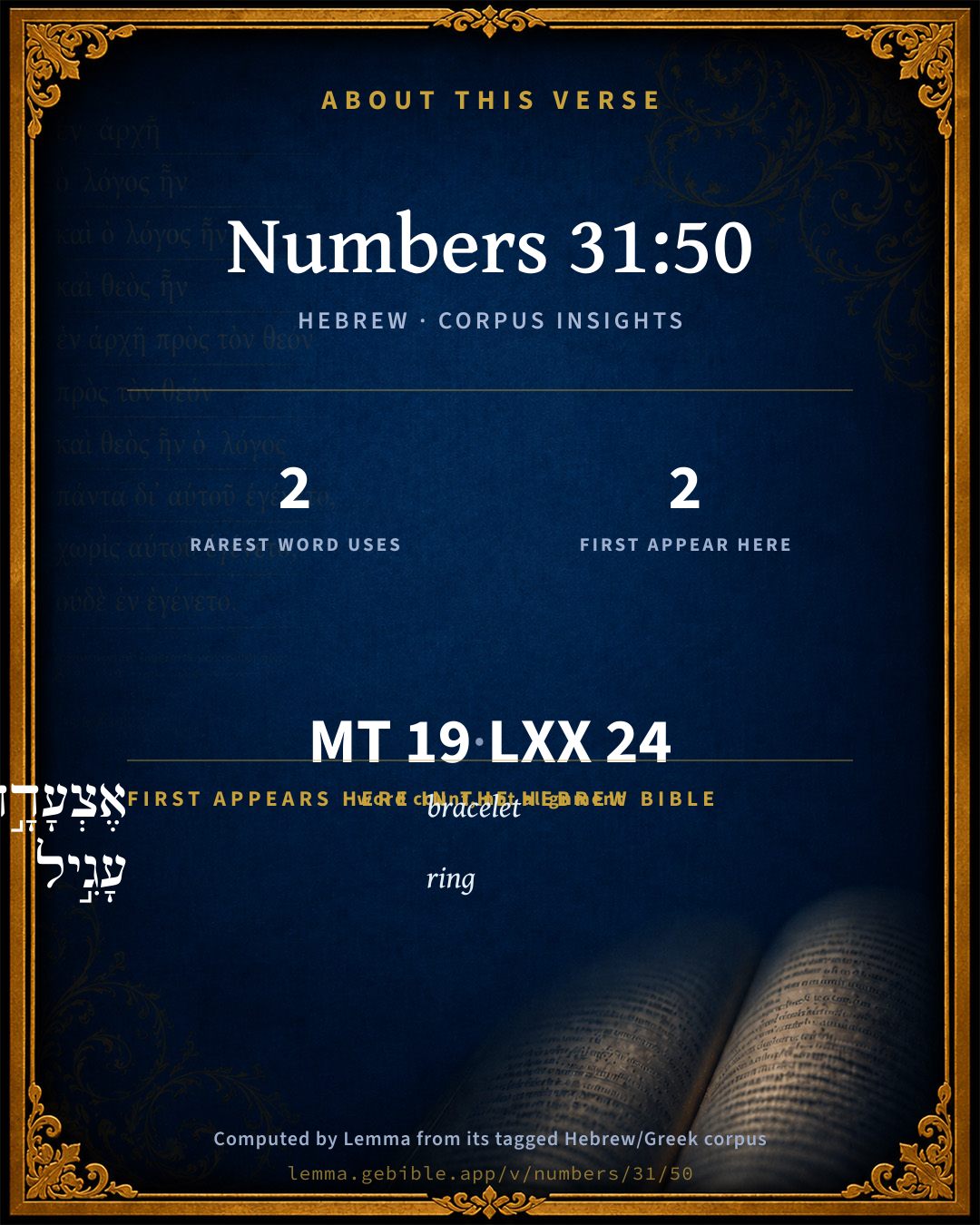
The rarest word here is אֶצְעָדָ֣ה bracelet H685 — appearing just 2 times in the whole Hebrew Bible.

First appearance in Scripture

These words make their first canonical appearance in the Hebrew Bible here:

  • אֶצְעָדָ֣ה bracelet H685
  • עָגִ֣יל ring H5694

Shared distinctive vocabulary

אֶצְעָדָ֣ה bracelet H685 occurs in 2 verses of the Hebrew Bible. Also found in:

Grammatical profile

  • 3 verbs
  • 13 nouns
  • 1 preposition
  • 2 particles

Verb forms

  • וַנַּקְרֵ֞ב Hiphil · Sequential Imperfect
  • מָצָ֤א Qal · Perfect
  • לְכַפֵּ֥ר Piel · Infinitive Construct

Repetition

A word recurs within this verse — often emphatic in Hebrew:

  • יְהוָ֗ה LORD H3068 ×2

Hebrew & Septuagint length

In English translation the verse runs 29 words from the Hebrew and 43 from the Septuagint (LXX English) — the Septuagint runs noticeably longer here. See the side-by-side →

A rough comparison of the two English renderings, which tokenize alike — not a word-level alignment.

Word counts can differ between the Hebrew and the Greek without any difference in meaning — e.g. the Hebrew direct-object marker אֵת has no separate Greek word, and Greek often adds the article ὁ.

In the original languages it is 19 Hebrew tokens and 24 Greek tokens — but the two are counted differently (Hebrew bundles its prefixes and suffixes into one token; the Greek is in lemma form), so that isn’t a like-for-like length.

Cross-references

7

Topical passages linked to Numbers 31:50 in the Treasury of Scripture Knowledge — connected by theme and wording, ordered by reader-vote popularity; previews shown in the World English Bible.

  • Exodus 30:12 "When you take a census of the children of Israel, according to those who are numbered among them, then each man shall give a ransom for his soul to Yahweh, when you number them; that there be no plague among them when you number them.
  • Exodus 30:15–16 The rich shall not give more, and the poor shall not give less, than the half shekel, when they give the offering of Yahweh, to make atonement for your souls.
  • Leviticus 17:11 For the life of the flesh is in the blood; and I have given it to you on the altar to make atonement for your souls: for it is the blood that makes atonement by reason of the life.
  • Psalms 107:15 Let them praise Yahweh for his loving kindness, For his wonderful works to the children of men!
  • Psalms 107:21–22 Let them praise Yahweh for his loving kindness, For his wonderful works to the children of men!
  • Psalms 116:12 What will I give to Yahweh for all his benefits toward me?
  • Psalms 116:17 I will offer to you the sacrifice of thanksgiving, And will call on the name of Yahweh.

Cross-references courtesy of OpenBible.info (CC BY 4.0).

Hebrew and Greek witnesses Masoretic Hebrew ↔ Greek Septuagint

The same verse in the two great witnesses to the Old Testament, shown verse-for-verse.

Here the Septuagint runs noticeably longer than the Hebrew — LXX2012 (modern English Septuagint) 43 words vs World English Bible 29. A rough length comparison of the two English translations, not a word-level alignment — read both below.

These are two independent witnesses, not word-aligned to each other, and the Septuagint is shown in lemma (dictionary) form.

Hebrew Numbers 31:50 Masoretic · Westminster Leningrad Codex

וַנַּקְרֵ֞ב אֶת קָרְבַּ֣ן יְהוָ֗ה אִישׁ֩ אֲשֶׁ֨ר מָצָ֤א כְלִֽי זָהָב֙ אֶצְעָדָ֣ה וְצָמִ֔יד טַבַּ֖עַת עָגִ֣יל וְכוּמָ֑ז לְכַפֵּ֥ר עַל נַפְשֹׁתֵ֖ינוּ לִפְנֵ֥י יְהוָֽה

We have brought Yahweh's offering, what every man has gotten, of jewels of gold, ankle-chains, and bracelets, signet-rings, ear-rings, and armlets, to make atonement for our souls before Yahweh.

World English Bible · Public Domain

Greek LXX Numbers 31:50 Septuagint · lemma form

καί προςφέρω ὁ δῶρον κύριος ἀνήρ ὅς εὑρίσκω σκεῦος χρυσοῦς χλιδῶν καί ψέλιον καί δακτύλιος καί περιδέξιον καί ἐμπλόκιον ἐκἱλάσκομαι περί ἐγώ ἔναντι κύριος

And we have brought our gift to the Lord, every man who has found an article of gold, whether an armlet, or a chain, or a ring, or a bracelet, or a clasp for hair, to make atonement for us before the Lord.

LXX2012 (modern English Septuagint) · Public Domain

On this verse, Haydock's Catholic Bible Commentary discusses the Septuagint’s reading. Read the note in Commentary ↓

Hebrew: Westminster Leningrad Codex (CC BY 4.0). Greek: Septuagint (public domain); English from LXX2012 (modern English Septuagint) (Public Domain). How the Septuagint differs from the Hebrew →

Targum (Aramaic paraphrase)

2

The Targum is the ancient Jewish Aramaic paraphrase of the Hebrew Scriptures — an interpretive translation, not the Hebrew text itself. Onkelos (literal) and Pseudo-Jonathan (expansive) render the Torah, and Jonathan the Prophets. Coverage is partial: where no permissively-licensed English translation exists for a verse, only the Aramaic is shown. This is verse-level text, not a word-by-word alignment to the Hebrew.

  1. Targum Onkelos Torah (Genesis–Deuteronomy)
    וְקָרֶבְנָא יָת קוּרְבָּנָא דַיְיָ גְבַר דְאַשְׁכַּח מַאן דִדְהַב שִׁירִין וְשִׁבְּכִין עִזְקָן קַדָשִׁין וּמָחוֹךְ לְכַפָּרָא עַל נַפְשָׁתָנָא קֳדָם יְיָ

    (no public-domain English translation for this verse)

    Targum Onkelos — Aramaic: “Onkelos Genesis” (public domain); “Onkelos Exodus” (public domain); “Onkelos Leviticus” (public domain); “Onkelos Numbers” (public domain); “Onkelos Deuteronomy” (public domain). English: “Sefaria Community Translation” (CC0 1.0 (public-domain dedication)); “J.W. Etheridge. The Targums of Onkelos and Jonathan Ben Uzziel on the Pentateuch. London: Longmans, Green, 1862” (public domain). Text via Sefaria.

  2. Targum Pseudo-Jonathan Torah (Genesis–Deuteronomy)
    וְקָרִיבְנָא דוֹרוֹנָא לִשְׁמָא דַיְיָ כֵּיוַן דְמָסַר יְיָ יַת מִדְיָנָאֵי בִידֵינָן וּכְבַשְׁנָן יַת אַרְעֲהוֹן וְיַת מְדִינַתְהוֹן וַהֲוֵינָן עַיְילִין לִטְרַקְלִינֵיהוֹן וְחַמְיַין בְּנָתֵיהוֹן יָאֲתָא חַטְיָיתָא מְפַרְנְקָתָא וְכָל גְבַר דַהֲוָה מַשְׁכַּח עֲלֵיהוֹן מָאנִין דִדְהַב הֲוָה שָׁרֵי כְּלִילַיָא מִן רֵישֵׁיהוֹן קַדִישַׁיָא מִן אוּדְנֵיהוֹן קַטְלַיָא מִן צַוְורֵיהוֹן שִׁירַיָא מִן אֶדְרָעֵיהוֹן עִזְקָתָא מִן אֶצְבְּעָתֵיהוֹן מְחוּכְיָא מִבֵּית חַדְיֵיהוֹן וּבְכָל דָא חַס לָן לְמִיתְלֵי עֵינָן בָּן וְלָא אִסְתַּכְּלוּן בַּחֲדָא מִנְהוֹן דְלָא לִמְחַיְיבָא בַּחֲדָא מִנְהוֹן וְלָא נְמוּת בְּמִתוּתָא דְמַיְיתוּן בָּהּ רַשִׁיעַיָא לְעַלְמָא דְאָתֵי וְדָא יַידְכַּר לָן לְיוֹם דִינָא רַבָּא לִמְכַפְּרָא עַל נַפְשָׁתָן קֳדָם יְיָ

    And we have brought a gift unto the Name of the Lord, forasmuch as the Lord hath delivered the Midianites into our hands, and we have been able to subdue their land and their cities. And we entered into their chambers, and there saw their daughters, fair, tender, and delicate; and every man who found on them jewels of gold, loosened the coronets from their heads, the earrings from their ears, the necklaces from their necks, the bracelets from their arms, the rings from their fingers, and the brooches from their bosoms;-but in all this we abstained from lifting our eyes upon themselves, or gazing on one of them, lest we should sin with any one of them, and die the death which the wicked die in the world to come. And may this be had in memorial for us in the day of the great judgment, to make propitiation for our souls before the Lord.

    Targum Pseudo-Jonathan — Aramaic: “Targum Jonathan on Genesis” (public domain); “Targum Jonathan on Exodus” (public domain); “Targum Jonathan on Leviticus” (public domain); “Targum Jonathan on Numbers” (public domain); “Targum Jonathan on Deuteronomy” (public domain). English: “The Targum of Jonathan ben Uzziel, trans. J. W. Etheridge, London, 1862” (public domain). Text via Sefaria.

Commentary

Notes on Numbers 31:50 from classic Christian and Jewish commentators (each source and its license shown beneath its notes). The classic Christian expositions comment on the surrounding passage and are grouped to its opening verse, so a note may address several verses; the Jewish commentaries on the Tanakh (Rashi and others) are per-verse, so they appear only where the commentator wrote on this verse.

Lemma curates 59 commentaries, every one of them public domain or Creative Commons licensed, each selected and text-cleaned for this edition rather than reprinted as found. About our sources →

Joseph Benson's Commentary

Num 31:50. We have brought an oblation — Finding, to their great joy and surprise, that not a single man was missing of the whole twelve thousand, they unanimously resolved, out of the free plunder, to make a voluntary offering to God, for the service of religion. To make an atonement — For their error, noted Num 31:14-16; and withal for memorial, or by way of gratitude for such a stupendous assistance and deliverance. We should never take any thing to ourselves, in war or trade, of which we cannot in faith consecrate a part to God, who hates robbery for burnt-offerings. But when God has remarkably preserved and succeeded us, he expects we should make some particular return of gratitude to him.

Joseph Benson's Commentary on the Old and New Testaments (1811–1818) — public domain. Text from a community e-Sword module.

Tyndale Open Study Notes

Tyndale Open Resources

31:50-54 The commanders gladly offered gold objects in gratitude for a great victory that resulted in no loss of life (cp. Exod 30:12). Ancient art and literature indicate that the Midianites and other desert peoples, both males and females, wore gold jewelry as adornment and as a form of portable wealth (e.g., Judg 8:24-26). Moses and Eleazar brought this large collection to the Tabernacle as a memorial of this special event (cp. Num 16:39-40; Zech 6:14).

Tyndale Open Study Notes — © Tyndale Open Resources, licensed CC BY-SA 4.0. Text via the HelloAO Bible API.

Geneva Bible (1599)

Geneva Bible translators

The captains by the free offering acknowledge the great benefit of God in preserving his people.

Geneva Bible (1599) marginal notes — public domain. Text via Bolls.life.

Adam Clarke's Commentary

Verse 50. We have - brought an oblation for the Lord] So it appears there was a great deal of booty taken which did not come into the general account; and of this the soldiers, of their own will, made a very extensive offering to God, because he had preserved them from falling in battle. That not one man should have been slain is a most extraordinary circumstance, and powerfully marks the peculiar superintendence of God's especial providence. The Midianites must certainly have made some resistance; but that was ineffectual, because it was against the Lord. When any nation undertakes a crusade against those whom they are pleased to call the Lord's enemies, let them bring from the contest this proof of their Divine mission, viz., that not one man of them is either lost or missing; and then, and not till then, shall we believe that God hath sent them.

To make an atonement for our souls] That is, to make an acknowledgment to God for the preservation of their lives. The gold offered on this occasion amounted to 16,750 shekels, equal to £37,869, 16s. 5d. of our money. See Clarke on Ex 25:39, where the true value of the shekel is given, and a rule laid down to reduce it to English money.

Adam Clarke's Commentary on the Bible (1810–1826) — public domain. Text from a community e-Sword/MySword module.

The Cambridge Bible for Schools and Colleges

gen. ed. J. J. S. Perowne

50. jewels of gold] Golden ornaments were taken from the Midianites when Gideon won his victory (Jdg_8:24-26). They were worn by roving nomads and traders, such as the Midianites were (cf. Gen_37:28), more than by the members of settled communities. This seems to be the meaning of the parenthesis in Jdg_8:24, where ‘Ishmaelites’ is apparently a general term for nomads.

The Cambridge Bible for Schools and Colleges (gen. ed. J. J. S. Perowne; Cambridge University Press, 1878–1918) — public domain. Text from a community e-Sword module.

Albert Barnes' Notes on the Bible

The “chains” were “armlets” 2Sa 1:10. The “rings” were “finger-rings,” or “seal-rings;” and the “tablets” were worn suspended from the neck Exo 35:22.

To make an atonement for our souls before the Lord - Compare Exo 30:11-16. The atonement was not for any special offence committed (which would have called for a sacrifice of blood-shedding), but rather like the half-shekel given at the census in the Book of Exodus (loc. cite), was an acknowledgment of having received undeserved mercies. These, if unacknowledged, would have entailed guilt on the soul.

Albert Barnes' Notes on the Bible (1834–1885) — public domain. Text from a community e-Sword/MySword module.

Haydock's Catholic Bible Commentary

Garters. Septuagint, "bracelets," put on the arm, 2 Kings i. 10. Sometimes the Eastern nations wore large precious rings on their legs. --- Tablets. Hebrew tsamid, an ornament of the hand, Genesis xxiv. 22. The armillæ, or viriliæ, were worn by men near the shoulder. --- Bracelets, (dextralia) for the right hand, Ecclesiasticus xxi. 14. Hebrew hagil, means an ear-ring, Ezechiel xvi. 12. --- Chains of gold and silver interlaced, worn round the neck. (St. Jerome, ep. ad Marcel.) The Madianites went to battle in their richest attire, (Judges vi. 21,) as did also the Persians; (Bellon. 2,) and the Turks do so still, (Calmet) being descended from Ismael, the half brother of Madian, who both settled in Arabia. (Haydock)

His own. Gold, and such ornaments as might easily be concealed by the soldiers, where not required to be brought to the common stock to be equally divided. (Calmet) --- There were 840,000 head of living creatures, including the 32,000 virgins, which were distributed. The gold, which was voluntarily presented to the Lord, amounted to above five talents. (Salien, B.C. 1470.) --- The princes made a voluntary offering of their gold, but the common soldiers retained what each man had gotten. (Du Hamel)

George Leo Haydock (1774–1849), Haydock's Catholic Family Bible and Commentary, 1859 edition — public domain. Excludes Psalms (Douay-Rheims chapter numbering differs from Protestant) and Deuterocanonical books (Catholic canon only).

Matthew Poole's English Annotations

For their error, noted, Num 31:14-16, and withal

for a memorial, as it is said Num 31:54, or by way of gratitude for such a stupendous assistance and deliverance, as appears from the word therefore in the beginning of this verse, and from Num 31:49.

Matthew Poole's English Annotations on the Holy Bible (1683–1685) — public domain. Text from a community e-Sword/MySword module.

Whedon's Commentary on the Bible

Daniel D. Whedon

50. An oblation for the Lord — A practical expression of gratitude shown by every man for his miraculous preservation.

Jewels — Modern scholarship thus revises this list: ankle chains, (R.V.,) or arm rings, (2Sa_1:10,) bands or bracelets, signet rings, hoops, (Eze_16:12,) earrings, and gold buckles or balls, Or, R.V., armlets, (margin,) necklaces.

An atonement for our souls — Knobel, in his attempt to find some sin to be expiated, fixes upon Israel’s failure to destroy all the Midianites, but Keil and Baumgarten think that the feeling of the soldiers that they were unworthy of any such grace as had been shown them in exemption from death in war justifies this strong expression, “for the expiation of their souls.” Hence the oblation constructively “covers” the guilt incurred by unacknowledged mercies by preventing its imputation. In the same manner the half shekel was an atonement. Exo_30:15. Sin actually incurred was usually expiated by blood, (Leviticus iv and Num_17:11, notes,) but sometimes by intercession (Exo_32:30) or its symbol, the burning of holy incense, (Num_16:46, note,) and once by extraordinary zeal in punishing crime. Num_25:8; Num_25:13.

Daniel D. Whedon (gen. ed.), Commentary on the Old and New Testaments (1874–1909) — public domain. Text from a community e-Sword module.

The Pulpit Commentary

What every man hath gotten. The whole, apparently, of their booty in golden ornaments was given up as a thank offering, and in addition to this was all that the soldiers had taken and kept. The abundance of costly ornaments among a race of nomads living in squalid tents and hovels may excite surprise; but it is still the ease (under circumstances far less favourable to the amassing of such wealth) among the Bedawin and kindred tribes. (see also on Jud 8:24-26) Chains. hdxa. Septuagint, clidwna . Clasps for the arm, as in 2Sa_1:10. Tablets. zmWK. Probably golden balls or beads hung round the neck. (see on Exo_35:22) A different word is used in Isa_3:20.

The Pulpit Commentary (1880–1919), ed. H.D.M. Spence-Jones & Joseph S. Exell — public domain. Text from a community e-Sword module.

John Wesley's Explanatory Notes

An atonement - For their error noted, ver. 14, 15, 16, and withal for a memorial, or by way of gratitude for such a stupendous assistance and deliverance. We should never take any thing to ourselves in war or trade, of which we cannot in faith consecrate a part to God, who hates robbery for burnt-offerings. But when God has remarkably preserved and succeeded us, he expects we should make some particular return of gratitude to him.

John Wesley, Explanatory Notes Upon the Whole Bible (1754–1765) — public domain. Text via the GEBible commentary corpus.

Scofield Reference Notes

C. I. Scofield

atonement

(See Scofield "Exo 29:33").

The Scofield Reference Bible (1917 edition), notes by C. I. Scofield — public domain. Text from a community e-Sword module.

unfoldingWord translationNotes

Door43 World Missions Community

General Information:

The officers of the army continue speaking to Moses.

armlets and bracelets, signet rings, earrings, and necklaces

These are all types of jewelry that people wore.

to make atonement for ourselves before Yahweh

"to thank God for saving our lives"

the gold and all the articles of craftsmanship

"all the articles of gold" or "all the golden jewelry"

translationWords

Yahweh

sacrifice

gold

atonement

Moses

unfoldingWord translationNotes — © Distant Shores Media and the Door43 World Missions Community, licensed CC BY-SA 4.0. Source: git.door43.org/Door43/en_tn.

Rashi

Rabbi Shlomo Yitzchaki (Rashi)

אצעדה — These are BANDS FOR THE FOOT (anklets).

וצמיד are BANDS FOR THE HAND (bracelets).

עגיל are EARRINGS.

וכומז is an ornament in the form of the womb — to atone for the thoughts their hearts had entertained for the daughters of Midian (Shabbat 64a).

Rashi on the Tanakh — English translations: “The Judaica Press complete Tanach with Rashi, translated by A. J. Rosenberg” (CC BY 4.0); “Pentateuch with Rashi's commentary by M. Rosenbaum and A.M. Silbermann, 1929-1934” (public domain); “The Metsudah Tanach series, Lakewood, N.J” (CC BY 4.0); and “The Book of Joshua, Metsudah Publications, 1997” (CC BY 4.0). Text via Sefaria.

Lesson kit

Teaching starters — assembled from the data on this page, not authored interpretation. Every prompt links to the verse data it draws on. Edit before teaching.

Numbers, in the Pentateuch, opens this verse with 19 words (18 distinct Hebrew lemmas). Its most distinctive word is ʼetsʻâdâh (“bracelet”). The Greek Septuagint runs longer here. A historical commentator’s framing appears above. Read the whole chapter for the surrounding context.

Discussion questions

  1. How does “bracelet” (ʼetsʻâdâh) shape what this verse is saying?
  2. 2 words make their first appearance in Scripture here. What does this debut establish?
  3. How does 2 Samuel 1:10, which shares the word «bracelet», read alongside this verse?
  4. What does the repetition of “LORD” (2× in this one verse) do in this verse?
  5. The Septuagint runs longer here than the Hebrew. What might account for the difference?
  6. These translations render this verse differently. What is at stake in choosing one wording over another?
  7. «וַנַּקְרֵ֞ב» is a Hiphil Sequential Imperfect verb. How does that grammatical form shape the action described?
  8. Compare how Joseph Benson's Commentary and Tyndale Open Study Notes read this verse. Where do they agree or differ?

Things to notice

Reading settings

Reading text

Shown beneath each verse's original-language words.

Old Testament
Old Testament edition

Read the OT as the Masoretic Hebrew (MT) or the Greek Septuagint (LXX).

English shown for the Greek Septuagint (in the Hebrew ↔ Greek comparison).

Comparing translations? Open the Compare panel on any verse page to stack up to four side by side.