
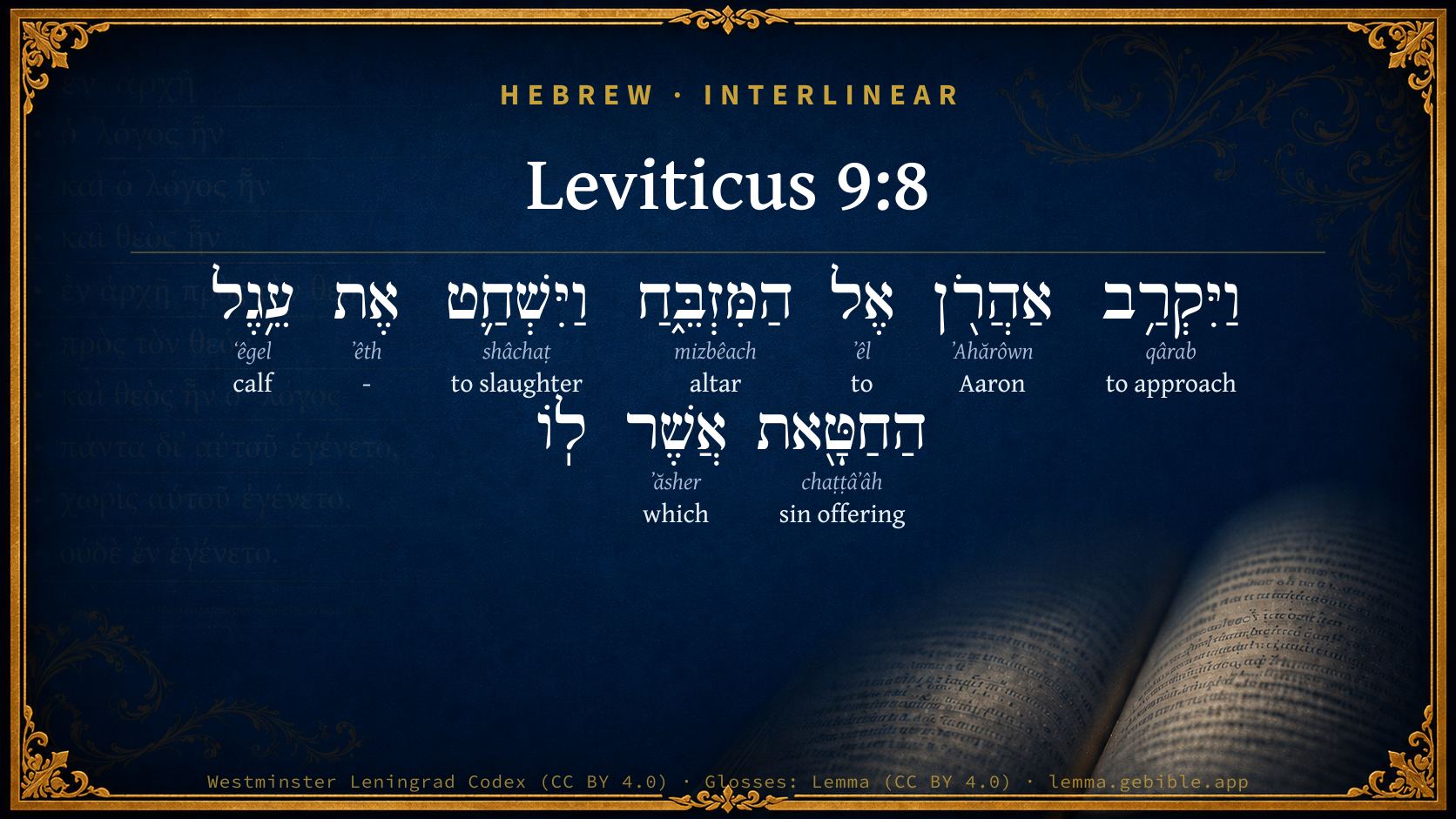
Leviticus 9:8

Hebrew (Westminster Leningrad Codex) Leviticus 9:8 appears in the Hebrew Old Testament. The text above is from the Westminster Leningrad Codex. Each word links to its Strong’s number, a concise gloss, and parsing drawn from the Open Scriptures Hebrew Bible morphology. Click any word for its full Brown-Driver-Briggs (BDB) entry.
Download image
Cite this verse

Leviticus 9:8 (World English Bible). Public Domain. Lemma interlinear Bible study tool, https://lemma.gebible.app/v/leviticus/9/8.

Show BibTeX & RIS
BibTeX
RIS
English Translation
So Aaron drew near to the altar, and killed the calf of the sin offering, which was for himself.
World English Bible · Public Domain
Download a study sheet

One document with this verse’s original text, its word-by-word gloss line, the meaning frame, cross-references with their text, attributed commentary, and full source and license credits — printable, and it pastes into notes with its structure intact.

This verse Autodidact and up

Study sheet (.html) Plain text (.txt)

A passage Seminary Student

Up to 50 verses in one chapter. A passage sheet keeps up to 6 commentary sources and 12 cross-references per verse, in the order this page ranks them, and says so on the sheet whenever that leaves anything out. Ask for a single verse and you get the Autodidact verse sheet above.

Everything on this page stays free to read, with no account — the sheet is a download of what is already on screen, not access to it.

Want to remove ads? Support Godless Engineer
Compare translations 3

The same verse in 3 English versions, stacked beneath the original-language interlinear above. Click any original word for its lexicon entry.

Each is an independent rendering of the whole verse — the interlinear is not word-aligned to these translations.

Highlighted words mark where these versions differ — a whole-verse word diff, not a word-by-word alignment.

  • World English Bible Public Domain
    So Aaron drew near to the altar, and killed the calf of the sin offering, which was for himself.
  • King James Version Public Domain
    Aaron therefore went unto the altar, and slew the calf of the sin offering, which was for himself.
  • unfoldingWord Literal Text CC BY-SA 4.0
    And Aaron drew near to the altar, and he slaughtered the calf of the sin offering, which for himself.

unfoldingWord Literal Text — © unfoldingWord, licensed CC BY-SA 4.0. Word-aligned USFM3 via Door43 (git.door43.org/unfoldingWord/en_ult).

Versions to compare (up to 4)

3 of 4 selected

Show all 18 translations

Every available English version of this verse, each an independent rendering of the whole verse.

  • World English Bible Public Domain
    So Aaron drew near to the altar, and killed the calf of the sin offering, which was for himself.
  • Berean Standard Bible Public Domain
    So Aaron approached the altar and slaughtered the calf as a sin offering for himself.
  • Majority Standard Bible Public Domain
    So Aaron approached the altar and slaughtered the calf as a sin offering for himself.
  • King James Version Public Domain
    Aaron therefore went unto the altar, and slew the calf of the sin offering, which was for himself.
  • American Standard Version (1901) Public Domain
    So Aaron drew near unto the altar, and slew the calf of the sin-offering, which was for himself.
  • Revised Version (1885) Public Domain
    So Aaron drew near unto the altar, and slew the calf of the sin offering, which was for himself.
  • Geneva Bible (1599) Public Domain
    Aaron therefore went vnto the Altar, and killed the calfe of the sinne offring, which was for himselfe.
  • Douay-Rheims (1899) Public Domain
    And forthwith Aaron, approaching to the altar, immolated the calf for his sin:
  • Young's Literal Translation Public Domain
    And Aaron draweth near unto the altar, and slaughtereth the calf of the sin-offering, which `is' for himself;
  • Literal Standard Version CC BY-SA 4.0
    And Aaron draws near to the altar, and slaughters the calf of the sin-offering, which [is] for himself;
  • Unlocked Literal Bible CC BY-SA 4.0
    So Aaron went near the altar and killed the calf for the sin offering, which was for himself.
  • unfoldingWord Literal Text CC BY-SA 4.0
    And Aaron drew near to the altar, and he slaughtered the calf of the sin offering, which for himself.
  • Darby Bible Public Domain
    And Aaron went to the altar and slaughtered the calf of the sin-offering which was for himself;
  • World Messianic Bible Public Domain
    So Aaron came near to the altar, and killed the calf of the sin offering, which was for himself.
  • Webster's Bible Public Domain
    Aaron therefore went to the altar, and slew the calf of the sin-offering, which was for himself.
  • Free Bible Version CC BY-SA 4.0
    So Aaron went to the altar and killed the calf as a sin offering for himself.
  • Bible in Basic English Public Domain
    So Aaron came near to the altar and put to death the ox for the sin-offering for himself;
  • JPS Tanakh (1917) Public Domain
    So Aaron drew near unto the altar, and slew the calf of the sin-offering, which was for himself.

Literal Standard Version (2020), Covenant Press — licensed CC BY-SA 4.0. Text via the HelloAO Bible API (eBible.org). Unlocked Literal Bible (unfoldingWord) — licensed CC BY-SA 4.0. Text via the HelloAO Bible API (eBible.org). unfoldingWord Literal Text — © unfoldingWord, licensed CC BY-SA 4.0. Word-aligned USFM3 via Door43 (git.door43.org/unfoldingWord/en_ult). Free Bible Version, Dr. Jonathan Gallagher — licensed CC BY-SA 4.0. Text via the HelloAO Bible API (eBible.org).

Word by word

More ways to search: Search by grammar → Find every occurrence → Compare this word →

Practice this passage: Drill this verse → Learn its vocabulary →

About this verse

These counts appear in no published source. They are computed here, from the morphology-tagged text and Lemma’s own curated glosses. What Lemma adds →

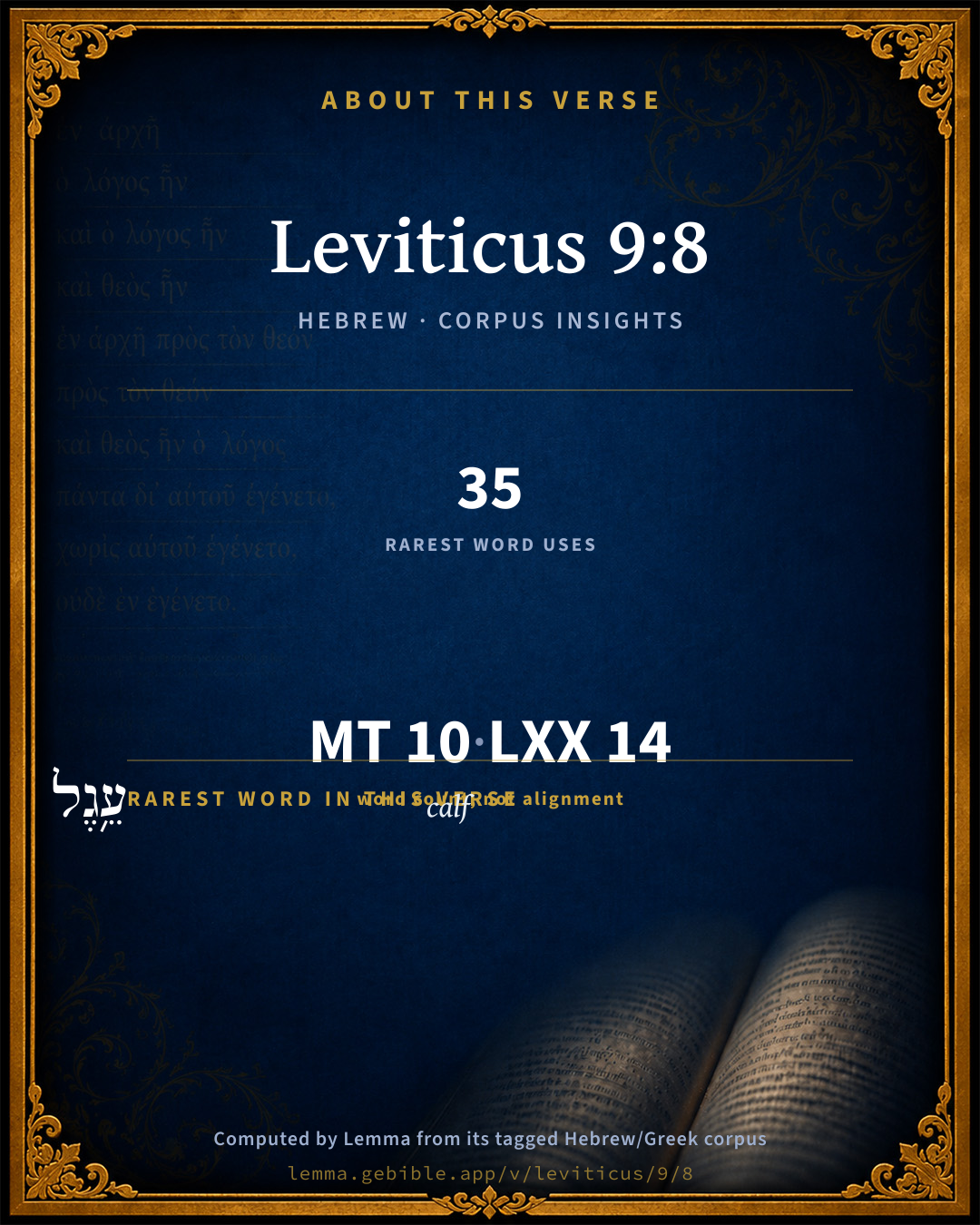
10
words
9
distinct lemmas
Pentateuch
section

Shared distinctive vocabulary

עֵ֥גֶל calf H5695 occurs in 35 verses of the Hebrew Bible. Also found in:

Grammatical profile

  • 2 verbs
  • 4 nouns
  • 2 prepositions
  • 2 particles

Verb forms

  • וַיִּקְרַ֥ב Qal · Sequential Imperfect
  • וַיִּשְׁחַ֛ט Qal · Sequential Imperfect

Hebrew & Septuagint length

In English translation the verse runs 19 words from the Hebrew and 14 from the Septuagint (LXX English) — closely comparable.

A rough comparison of the two English renderings, which tokenize alike — not a word-level alignment.

Word counts can differ between the Hebrew and the Greek without any difference in meaning — e.g. the Hebrew direct-object marker אֵת has no separate Greek word, and Greek often adds the article ὁ.

In the original languages it is 10 Hebrew tokens and 14 Greek tokens — but the two are counted differently (Hebrew bundles its prefixes and suffixes into one token; the Greek is in lemma form), so that isn’t a like-for-like length.

Cross-references

3

Topical passages linked to Leviticus 9:8 in the Treasury of Scripture Knowledge — connected by theme and wording, ordered by reader-vote popularity; previews shown in the World English Bible.

  • Leviticus 1:4–5 He shall lay his hand on the head of the burnt offering, and it shall be accepted for him to make atonement for him.
  • Leviticus 4:1–12 Yahweh spoke to Moses, saying,
  • Leviticus 4:29 He shall lay his hand on the head of the sin offering, and kill the sin offering in the place of burnt offering.

Cross-references courtesy of OpenBible.info (CC BY 4.0).

Hebrew and Greek witnesses Masoretic Hebrew ↔ Greek Septuagint

The same verse in the two great witnesses to the Old Testament, shown verse-for-verse.

These are two independent witnesses, not word-aligned to each other, and the Septuagint is shown in lemma (dictionary) form.

Hebrew Leviticus 9:8 Masoretic · Westminster Leningrad Codex

וַיִּקְרַ֥ב אַהֲרֹ֖ן אֶל הַמִּזְבֵּ֑חַ וַיִּשְׁחַ֛ט אֶת עֵ֥גֶל הַחַטָּ֖את אֲשֶׁר לֽוֹ

So Aaron drew near to the altar, and killed the calf of the sin offering, which was for himself.

World English Bible · Public Domain

Greek LXX Leviticus 9:8 Septuagint · lemma form

καί προςἔρχομαι ἀαρών πρός ὁ θυσιαστήριον καί σφάζω ὁ μοσχάριον ὁ περί ὁ ἁμαρτία

And Aaron drew near to the altar, and killed the calf of his sin-offering.

LXX2012 (modern English Septuagint) · Public Domain

Hebrew: Westminster Leningrad Codex (CC BY 4.0). Greek: Septuagint (public domain); English from LXX2012 (modern English Septuagint) (Public Domain). How the Septuagint differs from the Hebrew →

Targum (Aramaic paraphrase)

2

The Targum is the ancient Jewish Aramaic paraphrase of the Hebrew Scriptures — an interpretive translation, not the Hebrew text itself. Onkelos (literal) and Pseudo-Jonathan (expansive) render the Torah, and Jonathan the Prophets. Coverage is partial: where no permissively-licensed English translation exists for a verse, only the Aramaic is shown. This is verse-level text, not a word-by-word alignment to the Hebrew.

  1. Targum Onkelos Torah (Genesis–Deuteronomy)
    וּקְרַב אַהֲרֹן לְמַדְבְּחָא וּנְכֵס יָת עֶגְלָא דְחַטָאתָא דִי לֵהּ

    (no public-domain English translation for this verse)

    Targum Onkelos — Aramaic: “Onkelos Genesis” (public domain); “Onkelos Exodus” (public domain); “Onkelos Leviticus” (public domain); “Onkelos Numbers” (public domain); “Onkelos Deuteronomy” (public domain). English: “Sefaria Community Translation” (CC0 1.0 (public-domain dedication)); “J.W. Etheridge. The Targums of Onkelos and Jonathan Ben Uzziel on the Pentateuch. London: Longmans, Green, 1862” (public domain). Text via Sefaria.

  2. Targum Pseudo-Jonathan Torah (Genesis–Deuteronomy)
    וּקְרֵיב אַהֲרן לְמַדְבְּחָא בִּזְרֵיזוּתָא וּנְכֵיס יַת עֶגְלָא דְחַטָאתָא דִידֵיהּ

    And Aharon approached to the altar with resolution, and slew the calf for his own sin offering.

    Targum Pseudo-Jonathan — Aramaic: “Targum Jonathan on Genesis” (public domain); “Targum Jonathan on Exodus” (public domain); “Targum Jonathan on Leviticus” (public domain); “Targum Jonathan on Numbers” (public domain); “Targum Jonathan on Deuteronomy” (public domain). English: “The Targum of Jonathan ben Uzziel, trans. J. W. Etheridge, London, 1862” (public domain). Text via Sefaria.

Commentary

Notes on Leviticus 9:8 from classic Christian and Jewish commentators (each source and its license shown beneath its notes). The classic Christian expositions comment on the surrounding passage and are grouped to its opening verse, so a note may address several verses; the Jewish commentaries on the Tanakh (Rashi and others) are per-verse, so they appear only where the commentator wrote on this verse.

Lemma curates 59 commentaries, every one of them public domain or Creative Commons licensed, each selected and text-cleaned for this edition rather than reprinted as found. About our sources →

Matthew Henry's Commentary

These being the first offerings that ever were offered by the levitical priesthood, according to the newly-enacted law of sacrifices, the manner of offering them is particularly related, that it might appear how exactly they agreed with the institution. 1. Aaron with his own hands slew the offering (Lev 9:8), and did the work of the inferior priests; for, great as he was, he must not think any service below him which he could do for the honour of God: and, as Moses had shown him how to do this work decently and dexterously, so he showed his sons, that they might do likewise; for this is the best way of teaching, and thus parents should instruct their children by example. Therefore as Moses before, so Aaron now offered some of each of the several sorts of sacrifices that were appointed, whose rites differed, that they might be thoroughly furnished for every good work. 2. He offered these besides the burnt-sacrifice of the morning, which was every day offered first, Lev 9:17. Note, Our accustomed devotions morning and evening, alone and in our families, must not be omitted upon any pretence whatsoever, no, not when extraordinary services are to be performed; whatever is added, these must not be diminished. 3. It is not clear whether, when it is said that he burnt such and such parts of the sacrifices upon the altar (Lev 9:10-20), the meaning is that he burnt them immediately with ordinary fire, as formerly, or that he laid them upon the altar ready to be burnt with the fire from heaven which they expected (Lev 9:24), or whether, as bishop Patrick thinks, he burnt the offerings for himself with ordinary fire, but when they were burnt out he laid the people's sacrifices upon the altar, which were kindled and consumed by the fire of the Lord. I would rather conjecture, because it is said of all these sacrifices that he burnt them (except the burnt-offering for the people, of which it is said that he offered it according to the manner, Lev 9:16, which seems to be equivalent), that he did not kindle the fire to burn them, but that then the fire from the Lord fastened upon them, put out the fire that he had kindled (as we know a greater fire puts out a less), and suddenly consumed the remainder, which the fire he had kindled would have consumed slowly. 4. When Aaron had done all that on his part was to be done about the sacrifices he lifted up his hand towards the people, and blessed them, Lev 9:22. This was one part of the priest's work, in which he was a type of Christ, who came into the world to bless us, and when he was parted from his disciples, at his ascension, lifted up his hands and blessed them, and in them his whole church, of which they were the elders and representatives, as the great high priest of our profession. Aaron lifted up his hands in blessing them, to intimate whence he desired and expected the blessing to come, even from heaven, which is God's throne. Aaron could but crave a blessing, it is God's prerogative to command it. Aaron, when he had blessed, came down; Christ, when he blessed, went up.

Matthew Henry's Commentary on the Whole Bible (1708–1710) — public domain (CC PDM 1.0). Text via the HelloAO Bible API.

Trapp's Complete Commentary

John Trapp

Lev 9:8 Aaron therefore went unto the altar, and slew the calf of the sin offering, which [was] for himself.

Ver. 8. Went unto the altar,] i.e., The brazen altar; for he had not yet access to the altar of incense. We must slay our corruptions before we present our supplications, wash our hearts from wickedness, and then compass God’s altar.

John Trapp, A Commentary or Exposition upon All the Books of the Old and New Testament (1647–1656) — public domain. Text from a community e-Sword module.

Whedon's Commentary on the Bible

Daniel D. Whedon

AARON’S PERSONAL OFFERINGS, Lev_9:8-14.

8. Aaron… slew — In person or by command.

Daniel D. Whedon (gen. ed.), Commentary on the Old and New Testaments (1874–1909) — public domain. Text from a community e-Sword module.

Keil & Delitzsch

C. F. Keil & F. Delitzsch

Accordingly, he offered first of all the sin-offering and burnt-offering for himself, and then (Lev 9:15-21) the offerings of the people. The sin-offering always went first, because it served to remove the estrangement of man from the holy God arising from sin, by means of the expiation of the sinner, and to clear away the hindrances to his approach to God. Then followed the burnt-offering, as an expression of the complete surrender of the person expiated to the Lord; and lastly the peace-offering, on the one hand as the utterance of thanksgiving for mercy received, and prayer for its further continuance, and on the other hand, as a seal of covenant fellowship with the Lord in the sacrificial meal. But when Moses says in Lev 9:7, that Aaron is to make atonement for himself and the nation with his sin-offering and burnt-offering, the atoning virtue which Aaron's sacrifice was to have for the nation also, referred not to sins which the people had committed, but to the guilt which the high priest, as the head of the whole congregation, had brought upon the nation by his sin (Lev 4:3). In offering the sacrifices, Aaron was supported by his sons, who handed him the blood to sprinkle, and the sacrificial portions to burn upon the altar. The same course was adopted with Aaron's sin-offering (Lev 9:8-11) as Moses had pursued with the sin-offering at the consecration of the priests (Lev 8:14-17). The blood was not taken into the sanctuary, but only applied to the horns of the altar of burnt-offering; because the object was not to expiate some particular sin of Aaron's, but to take away the sin which might make his service on behalf of the congregation displeasing to God; and the communion of the congregation with the Lord was carried on at the altar of burnt-offering. The flesh and skin of the animal were burnt outside the camp, as in the case of all the sin-offerings for the priesthood (Lev 4:11-12).

Keil & Delitzsch — Biblical Commentary on the Old Testament (1861–1891) — public domain (CC PDM 1.0). Text via the HelloAO Bible API. (Old Testament only.)

Jamieson, Fausset & Brown

Robert Jamieson, A. R. Fausset & David Brown

Aaron . . . went unto the altar, and slew the calf of the sin offering--Whether it had been enjoined the first time, or was unavoidable from the divisions of the priestly labor not being as yet completely arranged, Aaron, assisted by his sons, appears to have slain the victims with his own hands, as well as gone through all the prescribed ritual at the altar.

Jamieson, Fausset & Brown — Commentary Critical and Explanatory on the Whole Bible (1871) — public domain (CC PDM 1.0). Text via the HelloAO Bible API.

Ellicott's Commentary for English Readers

(8) And slew the calf.—As the sacrificer Aaron, like every ordinary offerer, slaughtered the victim himself (see Lev_1:5) on the north side of the altar. (See Lev_1:11.)

A Bible Commentary for English Readers, edited by Charles John Ellicott (1878–1897) — public domain. Text from a community e-Sword module.

The Cambridge Bible for Schools and Colleges

gen. ed. J. J. S. Perowne

8–11. The Sin-Offering is offered with the same ritual as in Lev_8:14-17. The blood is not brought into the holy place, but what is not burnt on the altar is consumed without the camp.

The Cambridge Bible for Schools and Colleges (gen. ed. J. J. S. Perowne; Cambridge University Press, 1878–1918) — public domain. Text from a community e-Sword module.

John Gill's Exposition

Aaron therefore went unto the altar,.... Of burnt offering, freely and cheerfully, at the direction and introduction of Moses, who acted in this affair in the name of the Lord:

and slew the calf of the sin offering, which was for himself; which was to be offered first, as it was proper it should, that, atonement being made for his sins, his after burnt offering might be accepted with God, and he be fit to offer the sacrifices of the people: the calf he slew on the north side of the altar, where all the sin offerings and burnt offerings were slain; see Lev 1:11.

John Gill's Exposition of the Whole Bible (1746–1763) — public domain (CC PDM 1.0). Text via the HelloAO Bible API.

The Pulpit Commentary

Vers. 8-14. The high priest"s sin offering and burnt offering for himself. The meat offering does not appear to have accompanied the burnt offering the law having not yet been promulgated which ordered that the two sacrifices should always be presented together. (Num_15:4) The burnt offering, with the pieces thereof, in verse 13, should rather be the burnt offering in its several pieces. The sinfulness of the Aaronic priesthood and the need of a perfect priest is indicated by this sacrifice. (see Heb_7:24-27)

Vers. 8-23. The first act of the new priesthood is sacrifice, by which reconciliation was ceremonially effected; the second (verses 22, 23), a double benediction. As soon as the people are reconciled to him, God"s blessing abundantly pours itself on them. The sacrifice is:

1. For themselves, showing the weakness of the Aaronic priesthood.

2. For the people, showing its power.

Vers. 8-24. Aaron"s first priestly services.

Moses officiated as the priest of the Lord until the consecration of Aaron and his sons was completed. Now they enter upon their functions, and the verses recited furnish us with an account of their first services. In reviewing these we notice

I THE OFFERINGS.

1. Aaron"s offering for himself.

(1) The Jews say this was intended to make atonement for his sin in connection with the golden calf. Possibly this may have been so; for we have no record elsewhere of any formal atonement for that offense. Aaron, doubtless, had many offenses to atone for. The sacrifice of Christ is not only for sins, but also for sin.

(2) Aaron"s own hands slew this victim. What a graphic confession of sin was this! What an unequivocal acknowledgment of his deserving to die! Our confession of sin before God should be with deep conviction and reality.

(3) He put the blood upon the horns of the altar. These were fronting the vail, behind which was the ark of the covenant and the glory of the Lord. This putting of the blood with the finger before the face of God was, as it were, pointing it out to him, calling his attention to it. So should the faith of the sinner point out to God"s mercy the blood of the cross which satisfies his justice.

(4) Aaron"s sons served with him at the altar. They brought the blood to have it sprinkled. This was the confession of their part in the guilt of their father. Guilt is hereditary and relatively distributive. (see Num_16:32, 33Jo 7:24, 25) It was also an expression of their faith in the blood of the common Redeemer.

(5) This offering of Aaron for his own sin before he could offer for the people suggests the imperfection of the Levitical priesthood, and therefore the necessity of the priesthood of the gospel. (see Heb_5:3 Heb_7:26-28 Heb_9:7-14)

2. The offerings for the people.

(1) Aaron himself slew also these victims (verses 15, 16). This he did as the representative of the people. Individuals were directed to slay their own victims. (comp. Lev_1:5, 11 3:4, 8, 13) But these were for the congregation.

(2) The sons of Aaron helped him here also. They "presented unto him the blood, which he sprinkled upon the altar round about." They also brought the fat of the inwards to him (verses 18-20). This was suggestive of the nature of the Levitical priesthood, which was destined to pass from hand to hand. The comparison here is favourable to the priesthood of Christ, which is "unchangeable". (Heb_7:23-25)

(3) The breast and shoulder were waved and heaved, and afterwards came to the lot of Aaron and his sons. Here we are taught that it is God"s order that "they which preach the gospel should live of the gospel". (see 1Co_9:13, 14 Mat_10:10)

II THE BLESSING.

1. The blessing from the altar (verse 22).

(1) As Aaron, standing upon the altar, pronounced his first blessing upon the people, this shows the Source from whence all blessing springs. Even in heaven, the Great Sacrifice of the altar of Calvary will be the burden of the song of the redeemed. (Rev_5:9-14)

(2) In blessing, Aaron acted as the type of Christ, who, while he moved about upon this earth, which was the altar of his sacrifice, dispensed blessings in a thousand forms. Witness

(a) the beatitudes in the Sermon on the Mount.

(b) The miracles of beneficence.

(c) His official benedictions.

(3) As Aaron, standing upon the altar, lifted up his bands, blessed the people, and then went into the holy place, so Jesus, standing on the Mount of Olives, after lifting up his hands and blessing his disciples, ascended into the holy place of the heavens. (comp. Luk_24:50, Luk_24:51)

2. The blessing from the holy place.

(1) Coming forth from the holy place, Aaron again blessed the people. The words of the benediction are given in Num_6:23-27. Between these and those of the apostolic benediction, which sets forth the genius of the gospel, there is remarkable correspondence. (see 2Co_13:14)

(2) In response to this second benediction, "the glory of the Lord appeared unto all the people." We are here reminded how Jesus, before ascending into heaven, encouraged his disciples "not to depart from Jerusalem, but wait for the promise of the Father," and how, "when the day of Pentecost was fully come," that promise was verified.

(3) "And there came a fire cut from before the Lord," etc. (verse 24). This was the emblem of the Holy Spirit, whose baptism, like fire, searches into substances, while water can only wash the surfaces. (Mat_3:11, Mat_3:12) So in the baptism on the day of Pentecost, tongues of flame sat on the disciples. (Act_2:3)

(4) The consuming of the fat of the inwards on the altar by the sacred fire foreshowed how the body of our sins is destroyed in the sacrifice of Christ, who, "through the Eternal Spirit, offered himself without spot to God". (Heb_9:14) It also describes the manner in which the wicked will be treated who persist in their rebellion against God. (Psa_37:20) Those whose sins are not consumed in the fires of love will themselves be consumed in the fires of wrath. J.A.M.

Vers. 8-21. The priest at the altar.

Aaron now enters on the great and high work to which he is appointed that of God"s chosen high priest. He "went unto the altar." As we follow him in that first official act (verse 8) and see him, with the help of his sons (verse 9), slaying the calf or the goat (verses 8, 15), putting the blood on the horns, or pouring it at the bottom of the altar (verse 9), we are reminded of fundamental truth which does not belong to one dispensation or one race, but to man everywhere and arrays.

I THE SAD ASSUMPTION UNIVERSAL GUILT. Some truths are rather assumed than enunciated in Scripture: this is one. Not that it is not stated. (Rom_3:9, 23 Gal_3:22, etc.) But it is more often taken for granted. Thus in this scene. Aaron and his sons present sin offerings for themselves. It is assumed that there are not only "sinners of the Gentiles" needing mercy, but that the "holy nation" itself, the priestly family itself, nay, the high priest himself, is numbered among the sinful. This accords with our experience.

1. A large proportion of men are notoriously, presumptuously guilty; their lives proclaim aloud that they are transgressors against God.

2. Of the rest, a very large proportion are confessedly guilty; they allow freely that they have sinned by omission and commission.

3. The rest are evidently mistaken concerning themselves. If not apparent to human eye, it is obvious to the Divine that their lives are faulty and their souls stained. There is not one exception in the whole camp, in the entire congregation, in the nation, in the race. All have sinned, and need atonement.

II THE FIRST DEEP NEED OF THE SOUL DIVINE MERCY. The first sacrifice presented by Aaron for himself was "the calf of the sin offering" (verse 8); the first for the people was "the goat which was the sin offering" (verse 15). Man can do nothing in God"s service till he is pardoned and accepted. "Forgiveness of sins" is the first great need of the soul, as it is the first great gift of the gospel. (Luk_24:47 Act_2:38 Act_26:18, etc.) "There is forgiveness with God, that he may be feared". (Psa_130:4) There would be no "fear," no reverence, no worship, no service of the Holy One, if forgiveness of sin were not attainable at once. That is the starting-point and. condition of human devotion.

III THE ATTENDANT SPIRITUAL STEP SELF-SURRENDER. When Aaron had presented the sin offering for himself, he had not concluded his oblation; "he slew the burnt offering" also (verse 12). So with "the people"s offering" (verses 15, 16). The significance of this second sacrifice was that the worshipper consecrated himself on the altar (to the service) of Jehovah. A perfect picture of sacred and abiding truth. We cannot go in humility and penitence, seeking mercy through Christ Jesus, without offering ourselves to him who has bought us with the price or" his own blood. The soul longing for reconciliation with God offers itself freely in holy service unto him, lays itself on his altar, a "whole burnt offering unto the Lord." A living faith in Christ implies the eager taking of everything from him, and the cheerful giving of everything to him.

IV THE CERTAIN ISSUE A BLESSED SPIRITUAL ESTATE. A "meat offering" and "peace offerings" (verses 17, 18) came after the other two. Sin forgiven, self-surrendered, then comes a sense of reconciliation, grateful acknowledgment of God"s kindness, a holy joy in him. (Rom_5:1, Rom_5:11) The assurance in the heart of Divine forgiveness, and the consequent surpassing peace and elevated joy, may not immediately fellow. In the Divine life, the peace offering does not always come directly after the burnt offering. But it will come; it does come; and then, "oh, the blessedness of the man whose transgression is forgiven!" etc.. (literal translation, Psa_32:1) "Seek, and ye shall find". C. (Mat_7:7)

The Pulpit Commentary (1880–1919), ed. H.D.M. Spence-Jones & Joseph S. Exell — public domain. Text from a community e-Sword module.

Kretzmann's Popular Commentary

Paul E. Kretzmann

The First Offerings

v. 8. Aaron, therefore, went unto the altar, and slew the calf of the sin-offering, which was for himself.

v. 9. And the sons of Aaron brought the blood unto him, thus performing the work which was afterward assigned to the Levites in catching the blood of the slaughtered animal and keeping it from coagulating; and he dipped his finger in the blood, and put it upon the horns of the altar, and poured out the blood at the bottom of the altar. He brought no blood into the Holy Place, for the object at this time was the removal of the sin which might make his service in the name of the congregation displeasing to the Lord. The sin-offering served to remove the estrangement which existed between God and the people on account of the trespasses made by Israel, individually and collectively.

v. 10. But the fat and the kidneys and the caul above the liver of the sin-offering he burned upon the altar, as the Lord commanded Moses, Lev 4:8.

v. 11. And the flesh and the hide he burned with fire without the camp, Lev 4:11.

v. 12. And he slew the burnt offering, according to the ordinance, Lev 1:3-9; Lev 8:18-21; and Aaron’s sons presented unto him the blood, passed it to him as before, which he sprinkled round about upon the altar.

v. 13. And they presented the burnt offering unto him with the pieces thereof and the head; they passed the single pieces to him as he had dissected the animal; and he burned them upon the altar. This sacrifice expressed the complete and devout surrender of the worshipers to the Lord.

v. 14. And he did wash the inwards and the legs, and burned them upon the burnt offering on the altar. No mention is made of an oblation of meat-offering with this sacrifice, either because the special law referring to this rite was not yet given, Num 15:2 ff. or because it had already been made in connection with the morning sacrifice.

v. 15. And he brought the people’s offering, which consisted of all three varieties of sacrifices, made in the usual order, and took the goat, which was the sin-offering for the people, and slew it, and offered it for sin, as the first. In this case also the blood was not brought into the Holy Place, for the purpose at this time was merely to make the proper beginning of the sacrificial worship.

v. 16. And he brought the burnt offering, the young bullock and the lamb, and offered it according to the manner, as the ordinance required it.

v. 17. And he brought the meat-offering, which accompanied the burnt offering, and took an handful thereof, and burned it upon the altar beside, that is, in addition to, the burnt sacrifice of the morning; for the usual offerings had been made on this morning, as always.

v. 18. He slew also the bullock and the ram for a sacrifice of peace-offerings, which was for the people, an act of thanksgiving for the grace received till now and a prayer for the maintenance of the merciful fellowship on the part of Jehovah. And Aaron’s sons presented unto him the blood, which he sprinkled upon the altar round about.

v. 19. And the fat of the bullock and of the ram, the rump, that is, the heavy, fatty tail, and that which covereth the inwards and the kidneys and the caul above the liver, all the loose fat of the abdominal cavities;

v. 20. and they put the fat upon the breasts, upon the wave-breasts of the two animals, and passed it to Aaron in this manner; and he burned the fat upon the altar;

v. 21. and the breasts and the right shoulder, the wave-breasts and the heave-shoulders, Aaron waved for a wave-offering before the Lord, Lev 7:30-34; as Moses commanded.

v. 22. And Aaron, standing upon the elevated slope which led to the altar of burnt offering, lifted up his hand toward the people, in a gesture transmitting the grace of the Lord, and blessed them, and came down from offering of the sin-offering and the burnt offering and peace-offerings. The various animals had been dissected and laid on the fire according to the ordinance of God, and the service was concluded with the blessing. Cf Num 6:22-24.

v. 23. And Moses and Aaron went into the Tabernacle of the Congregation; for the latter had to be introduced to his future place of activity, as a part of the ceremony of installation; and came out and blessed the people. And the glory of the Lord appeared unto all the people; there was some glorious manifestation in the cloud which covered the Tabernacle, the presence of the Lord thus being demonstrated with great effectiveness.

v. 24. And there came a fire out from before the Lord, and consumed upon the altar the burnt offering and the fat. Either the entire cloud shone with a supernatural light, or there was a sudden flash of fire from the cloud, like a bolt of lightning, which in a moment completely devoured the sacrifices smoldering upon the altar. Similar manifestations of God’s glory are related also at later times, especially at the dedication of the Temple of Solomon. Which when all the people saw, they shouted, they called out in glad wonder, thanksgiving, and praise, and fell on their faces, in the gesture expressing joyful and reverential awe, The awe which we Christians feel at the manifestation of Him in whom is life, and the life is the light of men, Joh 1:4, will continue through time into eternity.

Paul E. Kretzmann, Popular Commentary of the Bible (1921–1924) — public domain. Text from a community e-Sword module.

unfoldingWord translationNotes

Door43 World Missions Community

sons of Aaron presented the blood to him

This implies that they caught the blood in a bowl as the blood drained from the animal. The full meaning of this statement can be made explicit. (See: Assumed Knowledge and Implicit Information)

horns of the altar

This refers to the corners of the altar. They are shaped like the horns of an ox. See how you translated this in Leviticus 4:7.

at the base of the altar

"at the bottom of the altar"

translationWords

Aaron

altar

cow

sin offering

blood

unfoldingWord translationNotes — © Distant Shores Media and the Door43 World Missions Community, licensed CC BY-SA 4.0. Source: git.door43.org/Door43/en_tn.

Lesson kit

Teaching starters — assembled from the data on this page, not authored interpretation. Every prompt links to the verse data it draws on. Edit before teaching.

Leviticus, in the Pentateuch, opens this verse with 10 words (9 distinct Hebrew lemmas). Its most distinctive word is ʻêgel (“calf”). A historical commentator’s framing appears above. Read the whole chapter for the surrounding context.

Discussion questions

  1. How does “calf” (ʻêgel) shape what this verse is saying?
  2. How does Exodus 32:4, which shares the word «calf», read alongside this verse?
  3. These translations render this verse differently; the difference is in the English rendering, not the original. What questions does that raise?
  4. «וַיִּקְרַ֥ב» is a Qal Sequential Imperfect verb. How does that grammatical form shape the action described?
  5. Compare how Matthew Henry's Commentary and Trapp's Complete Commentary read this verse. Where do they agree or differ?

Things to notice

Reading settings

Reading text

Shown beneath each verse's original-language words.

Old Testament
Old Testament edition

Read the OT as the Masoretic Hebrew (MT) or the Greek Septuagint (LXX).

English shown for the Greek Septuagint (in the Hebrew ↔ Greek comparison).

Comparing translations? Open the Compare panel on any verse page to stack up to four side by side.