Judges 3:18

Hebrew (Westminster Leningrad Codex) Judges 3:18 appears in the Hebrew Old Testament. The text above is from the Westminster Leningrad Codex. Each word links to its Strong’s number, a concise gloss, and parsing drawn from the Open Scriptures Hebrew Bible morphology. Click any word for its full Brown-Driver-Briggs (BDB) entry.
Download image
Cite this verse

Judges 3:18 (World English Bible). Public Domain. Lemma interlinear Bible study tool, https://lemma.gebible.app/v/judges/3/18.

Show BibTeX & RIS
BibTeX
RIS
English Translation
When he had made an end of offering the tribute, he sent away the people who bore the tribute.
World English Bible · Public Domain
Download a study sheet

One document with this verse’s original text, its word-by-word gloss line, the meaning frame, cross-references with their text, attributed commentary, and full source and license credits — printable, and it pastes into notes with its structure intact.

This verse Autodidact and up

Study sheet (.html) Plain text (.txt)

A passage Seminary Student

Up to 50 verses in one chapter. A passage sheet keeps up to 6 commentary sources and 12 cross-references per verse, in the order this page ranks them, and says so on the sheet whenever that leaves anything out. Ask for a single verse and you get the Autodidact verse sheet above.

Everything on this page stays free to read, with no account — the sheet is a download of what is already on screen, not access to it.

Want to remove ads? Support Godless Engineer
Compare translations 3

The same verse in 3 English versions, stacked beneath the original-language interlinear above. Click any original word for its lexicon entry.

Each is an independent rendering of the whole verse — the interlinear is not word-aligned to these translations.

Highlighted words mark where these versions differ — a whole-verse word diff, not a word-by-word alignment.

  • World English Bible Public Domain
    When he had made an end of offering the tribute, he sent away the people who bore the tribute.
  • King James Version Public Domain
    And when he had made an end to offer the present, he sent away the people that bare the present.
  • unfoldingWord Literal Text CC BY-SA 4.0
    Now it happened, when he had finished bringing the tribute, that he sent away the people, the bearers of the tribute.

unfoldingWord Literal Text — © unfoldingWord, licensed CC BY-SA 4.0. Word-aligned USFM3 via Door43 (git.door43.org/unfoldingWord/en_ult).

Versions to compare (up to 4)

3 of 4 selected

Show all 18 translations

Every available English version of this verse, each an independent rendering of the whole verse.

  • World English Bible Public Domain
    When he had made an end of offering the tribute, he sent away the people who bore the tribute.
  • Berean Standard Bible Public Domain
    After Ehud had finished presenting the tribute, he ushered out those who had carried it.
  • Majority Standard Bible Public Domain
    After Ehud had finished presenting the tribute, he ushered out those who had carried it.
  • King James Version Public Domain
    And when he had made an end to offer the present, he sent away the people that bare the present.
  • American Standard Version (1901) Public Domain
    And when he had made an end of offering the tribute, he sent away the people that bare the tribute.
  • Revised Version (1885) Public Domain
    And when he had made an end of offering the present, he sent away the people that bare the present.
  • Geneva Bible (1599) Public Domain
    And when he had now presented the present, he sent away the people that bare ye present,
  • Douay-Rheims (1899) Public Domain
    And when he had presented the gifts unto him, he followed his companions that came along with him.
  • Young's Literal Translation Public Domain
    And it cometh to pass, when he hath finished to bring near the present, that he sendeth away the people bearing the present,
  • Literal Standard Version CC BY-SA 4.0
    And it comes to pass, when he has finished to bring the present near, that he sends the people carrying the present away,
  • Unlocked Literal Bible CC BY-SA 4.0
    After Ehud had presented the tribute payment, he left with those who had carried it in.
  • unfoldingWord Literal Text CC BY-SA 4.0
    Now it happened, when he had finished bringing the tribute, that he sent away the people, the bearers of the tribute.
  • Darby Bible Public Domain
    And when Ehud had finished presenting the tribute, he sent away the people that carried the tribute.
  • World Messianic Bible Public Domain
    When Ehud had finished offering the tribute, he sent away the people who carried the tribute.
  • Webster's Bible Public Domain
    And when he had made an end to offer the present, he sent away the people that bore the present.
  • Free Bible Version CC BY-SA 4.0
    Then after delivering the tribute he sent home those who had helped carry it.
  • Bible in Basic English Public Domain
    And after giving the offering, he sent away the people who had come with the offering.
  • JPS Tanakh (1917) Public Domain
    And when he had made an end of offering the present, he sent away the people that bore the present.

Literal Standard Version (2020), Covenant Press — licensed CC BY-SA 4.0. Text via the HelloAO Bible API (eBible.org). Unlocked Literal Bible (unfoldingWord) — licensed CC BY-SA 4.0. Text via the HelloAO Bible API (eBible.org). unfoldingWord Literal Text — © unfoldingWord, licensed CC BY-SA 4.0. Word-aligned USFM3 via Door43 (git.door43.org/unfoldingWord/en_ult). Free Bible Version, Dr. Jonathan Gallagher — licensed CC BY-SA 4.0. Text via the HelloAO Bible API (eBible.org).

Word by word

More ways to search: Search by grammar → Find every occurrence → Compare this word →

Practice this passage: Drill this verse → Learn its vocabulary →

כִּלָּ֔ה
kâlâh
H3615
“to finish”
Verb, Piel, Perfect, 3rd Person, Masculine, Singular
Part of Speech
Verb
Stem
Piel
Form
Perfect
Person
3rd Person
Gender
Masculine
Number
Singular
Full BDB Definition

Origin: a primitive root

TWOT: 982 , 983 , 984

to accomplish, cease, consume, determine, end, fail, finish, be complete, be accomplished, be ended, be at an end, be finished, be spent - (Qal) - to be complete, be at an end - to be completed, be finished - to be accomplished, be fulfilled - to be determined, be plotted (bad sense) - to be spent, be used up - to waste away, be exhausted, fail - to come to an end, vanish, perish, be destroyed - (Piel) - to complete, bring to an end, finish - to complete (a period of time) - to finish (doing a thing) - to make an end, end - to accomplish, fulfil, bring to pass - to accomplish, determine (in thought) - to put an end to, cause to cease - to cause to fail, exhaust, use up, spend - to destroy, exterminate - (Pual) to be finished, be ended, be completed

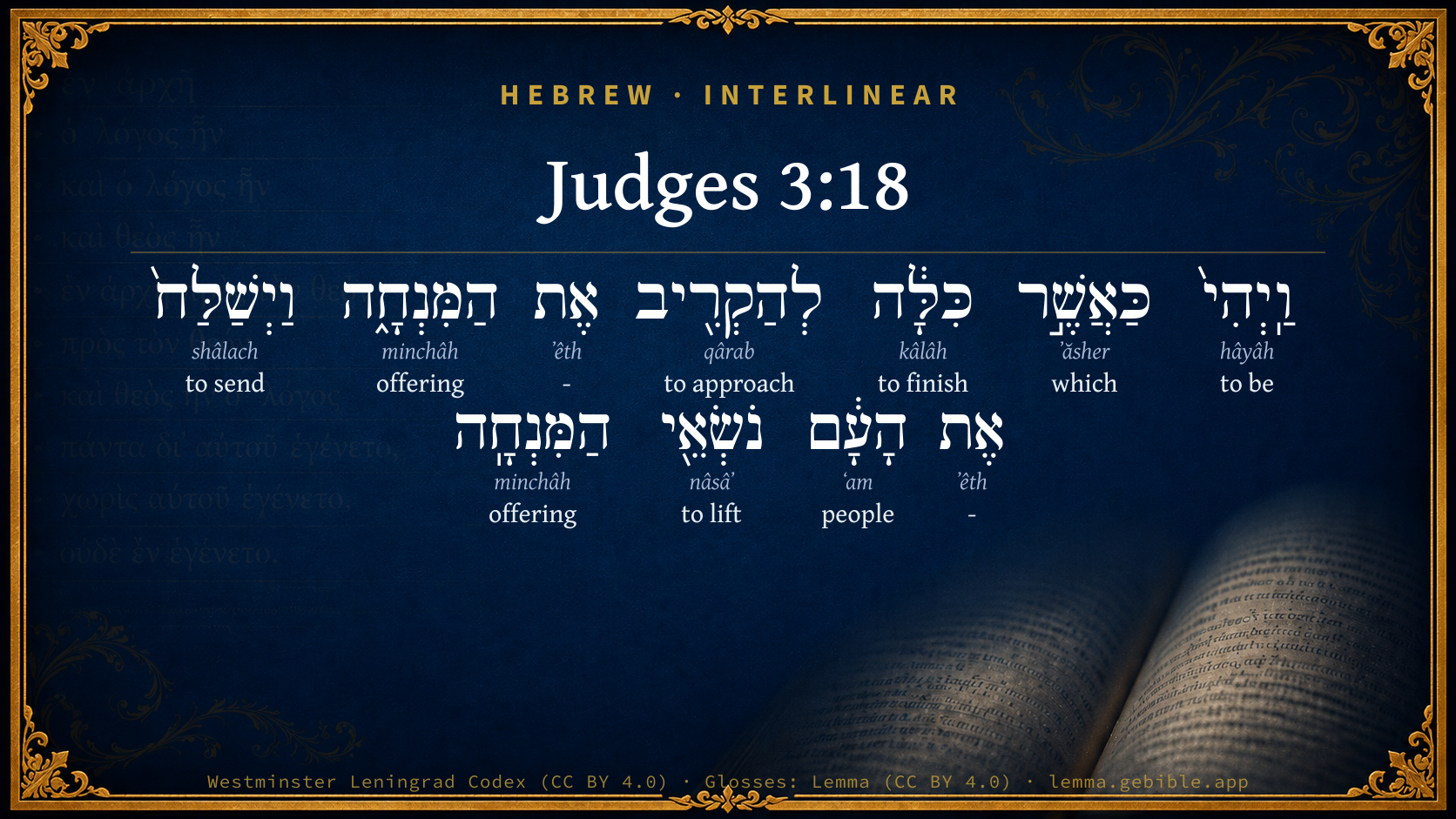
  1. וַֽיְהִי֙ hâyâh H1961 “and · to be” Conjunction + Verb, Qal, Sequential Imperfect, 3rd Person, Masculine, Singular
  2. כַּאֲשֶׁ֣ר ʼăsher H834 “like/as · which” Preposition + Particle, Relative
  3. לְהַקְרִ֖יב qârab H7126 “to approach” Preposition + Verb, Hiphil, Infinitive Construct
  4. אֶת ʼêth H853 “-” Particle, Direct Object
  5. הַמִּנְחָ֑ה minchâh H4503 “the · offering” Particle, Definite Article + Noun, Common, Feminine, Singular, Absolute
  6. וַיְשַׁלַּח֙ shâlach H7971 “and · to send” Conjunction + Verb, Piel, Sequential Imperfect, 3rd Person, Masculine, Singular
  7. אֶת ʼêth H853 “-” Particle, Direct Object
  8. הָעָ֔ם ʻam H5971 “the · people” Particle, Definite Article + Noun, Common, Masculine, Singular, Absolute
  9. נֹשְׂאֵ֖י nâsâʼ H5375 “lifting” Verb, Qal, Participle Active, Masculine, Plural, Construct
  10. הַמִּנְחָֽה minchâh H4503 “the · offering” Particle, Definite Article + Noun, Common, Feminine, Singular, Absolute

About this verse

These counts appear in no published source. They are computed here, from the morphology-tagged text and Lemma’s own curated glosses. What Lemma adds →

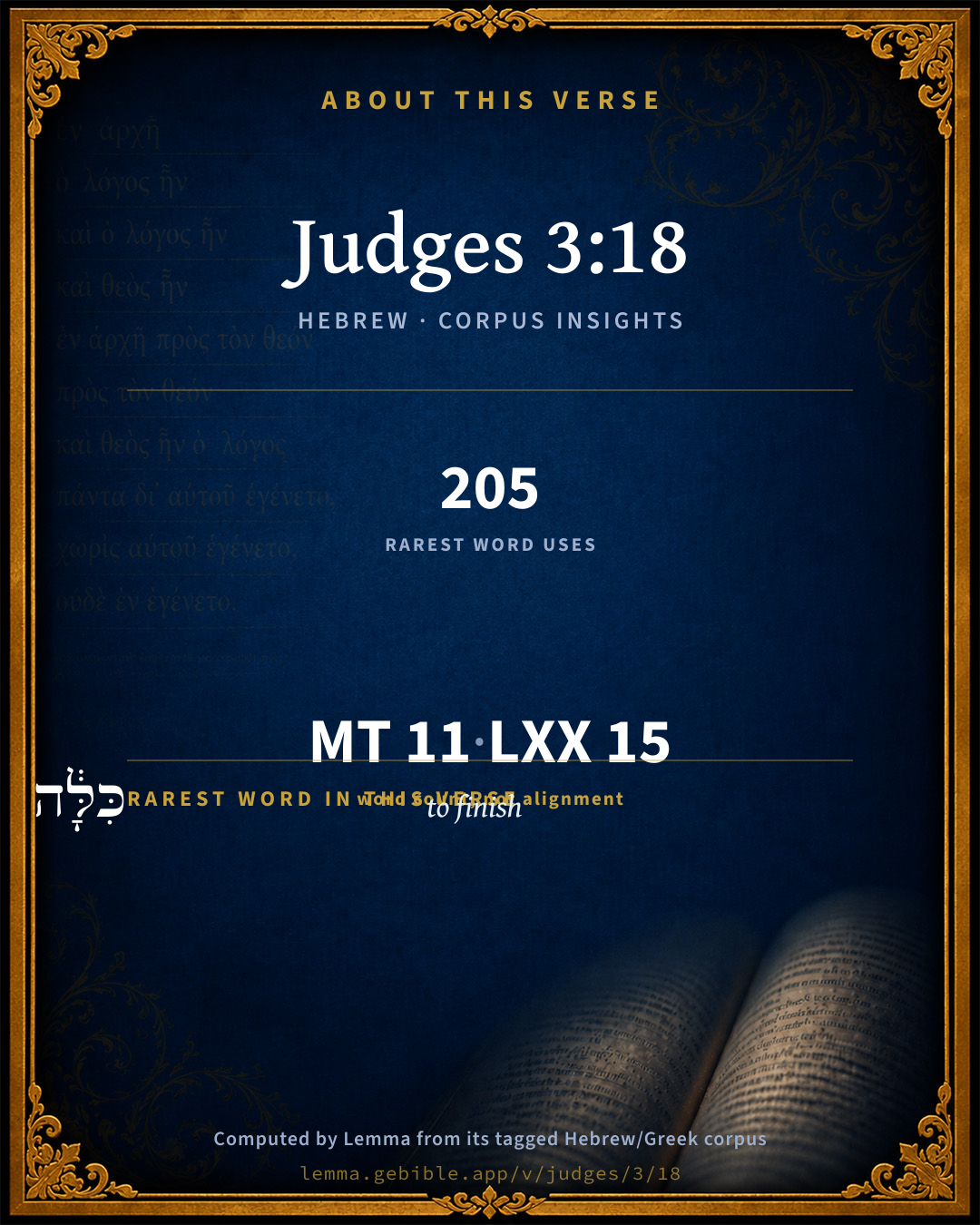
11
words
9
distinct lemmas
Historical
section

Grammatical profile

  • 5 verbs
  • 3 nouns
  • 3 particles

Verb forms

  • וַֽיְהִי֙ Qal · Sequential Imperfect
  • כִּלָּ֔ה Piel · Perfect
  • לְהַקְרִ֖יב Hiphil · Infinitive Construct
  • וַיְשַׁלַּח֙ Piel · Sequential Imperfect
  • נֹשְׂאֵ֖י Qal · Participle Active

Repetition

A word recurs within this verse — often emphatic in Hebrew:

  • הַמִּנְחָ֑ה offering H4503 ×2

Hebrew & Septuagint length

In English translation the verse runs 19 words from the Hebrew and 23 from the Septuagint (LXX English) — closely comparable.

A rough comparison of the two English renderings, which tokenize alike — not a word-level alignment.

Word counts can differ between the Hebrew and the Greek without any difference in meaning — e.g. the Hebrew direct-object marker אֵת has no separate Greek word, and Greek often adds the article ὁ.

In the original languages it is 11 Hebrew tokens and 15 Greek tokens — but the two are counted differently (Hebrew bundles its prefixes and suffixes into one token; the Greek is in lemma form), so that isn’t a like-for-like length.

Hebrew and Greek witnesses Masoretic Hebrew ↔ Greek Septuagint

The same verse in the two great witnesses to the Old Testament, shown verse-for-verse.

These are two independent witnesses, not word-aligned to each other, and the Septuagint is shown in lemma (dictionary) form.

Hebrew Judges 3:18 Masoretic · Westminster Leningrad Codex

וַֽיְהִי֙ כַּאֲשֶׁ֣ר כִּלָּ֔ה לְהַקְרִ֖יב אֶת הַמִּנְחָ֑ה וַיְשַׁלַּח֙ אֶת הָעָ֔ם נֹשְׂאֵ֖י הַמִּנְחָֽה

When he had made an end of offering the tribute, he sent away the people who bore the tribute.

World English Bible · Public Domain

Greek LXX Judges 3:18 Septuagint · lemma form

καί γίγνομαι ἡνίκα συντελέω αωδ προςφέρω ὁ δῶρον καί ἐκ ἀποστέλλω ὁ φέρω ὁ δῶρον

And it came to pass when Aod had made an end of offering his gifts, that he dismissed those that brought the gifts.

LXX2012 (modern English Septuagint) · Public Domain

On this verse, Joseph Benson's Commentary discusses the Septuagint’s reading. Read the note in Commentary ↓

Hebrew: Westminster Leningrad Codex (CC BY 4.0). Greek: Septuagint (public domain); English from LXX2012 (modern English Septuagint) (Public Domain). How the Septuagint differs from the Hebrew →

Targum (Aramaic paraphrase)

1

The Targum is the ancient Jewish Aramaic paraphrase of the Hebrew Scriptures — an interpretive translation, not the Hebrew text itself. Onkelos (literal) and Pseudo-Jonathan (expansive) render the Torah, and Jonathan the Prophets. Coverage is partial: where no permissively-licensed English translation exists for a verse, only the Aramaic is shown. This is verse-level text, not a word-by-word alignment to the Hebrew.

  1. Targum Jonathan Prophets (Joshua–Malachi)
    וַהֲוָה כַּד שֵׁיצֵי לְקָרָבָא יַת תִּקְרוּבְתָּא וּשְׁלַח יַת עַמָא נַטְלֵי תִּקְרוּבְתָּא:

    (no public-domain English translation for this verse)

    Targum Jonathan — Aramaic: “Mikraot Gedolot” (public domain). English: “Sefaria Community Translation” (CC0 1.0 (public-domain dedication)); “London "Chaldee Paraphrase," 1871” (public domain). Text via Sefaria.

Commentary

Notes on Judges 3:18 from classic Christian and Jewish commentators (each source and its license shown beneath its notes). The classic Christian expositions comment on the surrounding passage and are grouped to its opening verse, so a note may address several verses; the Jewish commentaries on the Tanakh (Rashi and others) are per-verse, so they appear only where the commentator wrote on this verse.

Lemma curates 59 commentaries, every one of them public domain or Creative Commons licensed, each selected and text-cleaned for this edition rather than reprinted as found. About our sources →

Trapp's Complete Commentary

John Trapp

Jdg 3:18 And when he had made an end to offer the present, he sent away the people that bare the present.

Ver. 18. He sent away the people that bare the present.] It was therefore no small present, the more to ingratiate. But he sent away the men that bare it, that he might the better accomplish his design, and have the less to care for.

John Trapp, A Commentary or Exposition upon All the Books of the Old and New Testament (1647–1656) — public domain. Text from a community e-Sword module.

Joseph Benson's Commentary

Jdg 3:18-19. He sent away the people — He accompanied them part of the way, and then dismissed them, and returned to Eglon alone, that so he might have more easy access to him. He himself turned again from the quarries, as if he had forgotten some important business. Houbigant takes the word פשׂילים, pesilim, here rendered quarries, for the name of a place. But the Septuagint and Vulgate take it for graven images, as indeed it commonly signifies in the Scriptures, and as it is rendered in the margin of our Bibles. Some suppose that these images had been placed there by the Moabites, in contempt of the God of Israel, who had so long honoured Gilgal with his presence; and that they might ascribe the subjection of the land to their idols, as the Israelites gave the glory of their conquest to the true God. And they further suppose that when Ehud beheld these idolatrous images, he was inflamed with zeal and indignation, so that instead of proceeding any further in his return home, he went back with a full resolution to revenge the indignity offered to the Divine Majesty, as well as the oppression of his people. Who said, Keep silence — That is, forbear to speak till my servants are withdrawn. For he would not have them to be made acquainted with a business which he supposed to be of great importance.

Joseph Benson's Commentary on the Old and New Testaments (1811–1818) — public domain. Text from a community e-Sword module.

Adam Clarke's Commentary

Verse 18. Made an end to offer the present] Presents, tribute, c., in the eastern countries were offered with very great ceremony and to make the more parade several persons, ordinarily slaves, sumptuously dressed, and in considerable number, were employed to carry what would not be a burden even to one. This appears to have been the case in the present instance.

Adam Clarke's Commentary on the Bible (1810–1826) — public domain. Text from a community e-Sword/MySword module.

Ellicott's Commentary for English Readers

(18) The people.—The tribute-bearers, headed by Ehud, would carry their offerings in long and pompous array, according to the fashion of the East, which always aims at making a present seem as large as possible (see Gen_32:16). “Fifty persons often bear what one man could easily carry” (Chardin, iii. 217).

A Bible Commentary for English Readers, edited by Charles John Ellicott (1878–1897) — public domain. Text from a community e-Sword module.

The Cambridge Bible for Schools and Colleges

gen. ed. J. J. S. Perowne

18. he sent away] From the foll. verse it seems that Ehud accompanied the carriers (cf. the same vb. in Gen_18:16 ‘to bring them on the way’) until they were at a safe distance, and then returned to the king’s house alone. Judging from the analogy quoted in the footnote (p. 39) the carriers were Israelites.

The Cambridge Bible for Schools and Colleges (gen. ed. J. J. S. Perowne; Cambridge University Press, 1878–1918) — public domain. Text from a community e-Sword module.

John Gill's Exposition

But he himself turned again from the quarries that were by Gilgal,...., For so far he accompanied the men that came with him. These quarries were places where they dug stones and hewed them, according to the Targum, and most Jewish writers; but some render the word "engravings", and understand them of inscriptions engraved on pillars here, which remained from the times of Seth the son of Adam; of which see more on Jdg 3:26; but according to the Vulgate Latin, and other versions, graven images or idols are meant, which the king of Moab set up here in contempt of the Israelites, it being a place where the ark remained some time, and circumcision had been performed, Jos 5:3; or in order to draw them into idolatry, those idols perhaps being made of the twelve stones they had set up there, Jos 4:20; or rather in honour of his gods, to invoke their assistance when he first entered into the land, or by way of gratitude and thankfulness for the subduing of it: and this it is thought by some stirred up the spirit of Ehud, and caused him to turn back, resolving to avenge this profaneness:

and said; when he came to the palace of the king of Moab, and into his presence:

I have a secret errand unto thee, O king; which he had forgot when with him before, as he might pretend; or something new had occurred unto him to acquaint him of, and which required privacy:

who said, keep silence; that is, the king of Moab said so either to Ehud, to be silent until be had sent out his servants that were about him, that they might not hear the secret; or to a person or persons that were speaking to him, whom he bid to desist and depart, it being his pleasure to hear Ehud before them; so Ben Gersom; but the former sense rather seems best:

and all that stood by him went out from him; his servants, his courtiers that were waiting upon him, or such as were admitted into his presence, to have audience of him, and deliver their messages, or make their petitions to him.

John Gill's Exposition of the Whole Bible (1746–1763) — public domain (CC PDM 1.0). Text via the HelloAO Bible API.

Haydock's Catholic Bible Commentary

Him; or according to the Hebrew, Septuagint, and Chaldean, "he sent away the men who had brought the presents." (Calmet) --- But is seems he followed after them as far as Galgal, (Haydock) whence he returned, as if he had been consulting the oracle, and had orders to communicate something of importance to the king, unless we translate, "He dismissed, &c., (19.) and as he was returned from the idols at Galgal, he said," &c., at the same interview. (Calmet) He would not expose his companions to danger. (Menochius)

George Leo Haydock (1774–1849), Haydock's Catholic Family Bible and Commentary, 1859 edition — public domain. Excludes Psalms (Douay-Rheims chapter numbering differs from Protestant) and Deuterocanonical books (Catholic canon only).

Matthew Poole's English Annotations

He accompanied them part of the way, and then dismissed them, and returned to Eglon alone, that so he might have more easy access to him, and privacy with him; and that he might the better make his escape.

Matthew Poole's English Annotations on the Holy Bible (1683–1685) — public domain. Text from a community e-Sword/MySword module.

Whedon's Commentary on the Bible

Daniel D. Whedon

18. The people that bare the present — Eastern style required quite a pompous retinue to bring a gift to a distinguished person. See 2Ki_5:15.

Daniel D. Whedon (gen. ed.), Commentary on the Old and New Testaments (1874–1909) — public domain. Text from a community e-Sword module.

John Wesley's Explanatory Notes

Sent the people - He accompanied them part of the way, and then dismissed them, and returned to Eglon alone, that so he might have more easy access to him.

John Wesley, Explanatory Notes Upon the Whole Bible (1754–1765) — public domain. Text via the GEBible commentary corpus.

Keil & Delitzsch

C. F. Keil & F. Delitzsch

After presenting the gift, Ehud dismissed the people who had carried the present to their own homes; namely, as we learn from Jdg 3:19, after they had gone some distance from Jericho. But he himself returned from the stone-quarries at Gilgal, sc., to Jericho to king Eglon. הפּסילים מן refers to some place by Gilgal. In Deu 7:25; Isa 21:9; Jer 8:19, pesilim signifies idols. And if we would retain this meaning here, as the lxx, Vulg., and others have done, we must assume that in the neighbourhood of Gilgal there were stone idols set up in the open air-a thing which is very improbable. The rendering "stone quarries," from פּסל, to hew out stones (Exo 34:1, etc.), which is the one adopted in the Chaldee, and by Rashi and others, is more likely to be the correct one. Gilgal cannot be the Gilgal between Jericho and the Jordan, which was the first encampment of the Israelites in Canaan, as is commonly supposed, since Ehud passed the Pesilim on his flight from the king's dwelling-place to the mountains of Ephraim (Jdg 3:26, Jdg 3:27); and we can neither assume, as Bertheau does, that Eglon did not reside in the conquered palm-city (Jericho), but in some uncultivated place in the neighbourhood of the Jordan, nor suppose that after the murder of Eglon Ehud could possibly have gone from Jericho to the Gilgal which was half an hour's journey towards the east, for the purpose of escaping by a circuitous route of this kind to Seirah in the mountains of Ephraim, which was on the north-west of Jericho. Gilgal is more likely to be Geliloth, which was on the west of Jericho opposite to the ascent of Adummim (Kaalat ed Dom), on the border of Judah and Benjamin (Jos 18:17), and which was also called Gilgal (Jos 15:7). Having returned to the king's palace, Ehud sent in a message to him: "I have a secret word to thee, O king." The context requires that we should understand "he said" in the sense of "he had him told" (or bade say to him), since Ehud himself did not go in to the king, who was sitting in his room, till afterwards (Jdg 3:20). In consequence of this message the king said: הס, lit. be silent (the imperative of הסה fo); here it is a proclamation, Let there be quiet. Thereupon all who were standing round (viz., his attendants) left the room, and Ehud went in (Jdg 3:20). The king was sitting "in his upper room of cooling alone." The "room of cooling" (Luther, Sommerlaube, summer-arbour) was a room placed upon the flat roof of a house, which was open to the currents of air, and so afforded a cool retreat, such as are still met with in the East (vid., Shaw, pp. 188-9). Then Ehud said, "A word of God I have to thee;" whereupon the king rose from his seat, from reverence towards the word of God which Ehud pretended that he had to deliver to him, not to defend himself, as Bertheau supposes, of which there is not the slightest intimation in the text.

Keil & Delitzsch — Biblical Commentary on the Old Testament (1861–1891) — public domain (CC PDM 1.0). Text via the HelloAO Bible API. (Old Testament only.)

Rashi

Rabbi Shlomo Yitzchaki (Rashi)

He escorted the people. He turned back to accompany the delegation of Yisroelites who came with him to bear the gift. He escorted them until Gilgal.

Rashi on the Tanakh — English translations: “The Judaica Press complete Tanach with Rashi, translated by A. J. Rosenberg” (CC BY 4.0); “Pentateuch with Rashi's commentary by M. Rosenbaum and A.M. Silbermann, 1929-1934” (public domain); “The Metsudah Tanach series, Lakewood, N.J” (CC BY 4.0); and “The Book of Joshua, Metsudah Publications, 1997” (CC BY 4.0). Text via Sefaria.

Lesson kit

Teaching starters — assembled from the data on this page, not authored interpretation. Every prompt links to the verse data it draws on. Edit before teaching.

Judges, in the Historical, opens this verse with 11 words (9 distinct Hebrew lemmas). Its most distinctive word is kâlâh (“to finish”). A historical commentator’s framing appears above. Read the whole chapter for the surrounding context.

Discussion questions

  1. The word kâlâh carries the sense “to finish.” How does it shape the verse?
  2. “offering” occurs 2× in this one verse. What is the effect of the repetition?
  3. These translations render this verse differently. What is at stake in choosing one wording over another?
  4. The verb «וַֽיְהִי֙» is Qal Sequential Imperfect. How does its form color the action?
  5. Reading how Trapp's Complete Commentary and Joseph Benson's Commentary read this verse, where do the two commentators agree and where do they part?

Things to notice

Reading settings

Reading text

Shown beneath each verse's original-language words.

Old Testament
Old Testament edition

Read the OT as the Masoretic Hebrew (MT) or the Greek Septuagint (LXX).

English shown for the Greek Septuagint (in the Hebrew ↔ Greek comparison).

Comparing translations? Open the Compare panel on any verse page to stack up to four side by side.