
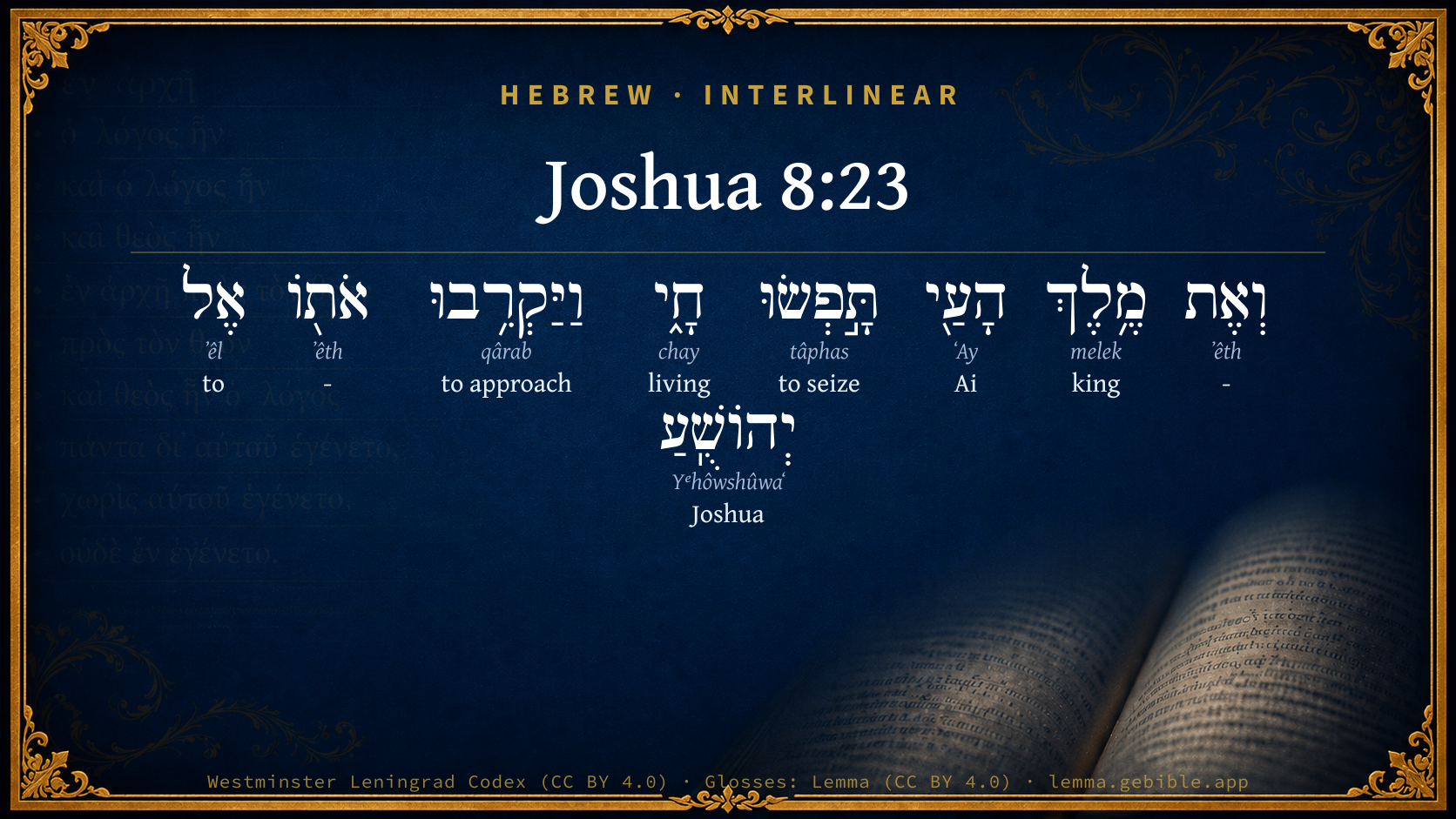
Joshua 8:23

Hebrew (Westminster Leningrad Codex) Joshua 8:23 appears in the Hebrew Old Testament. The text above is from the Westminster Leningrad Codex. Each word links to its Strong’s number, a concise gloss, and parsing drawn from the Open Scriptures Hebrew Bible morphology. Click any word for its full Brown-Driver-Briggs (BDB) entry.
Download image
Cite this verse

Joshua 8:23 (World English Bible). Public Domain. Lemma interlinear Bible study tool, https://lemma.gebible.app/v/joshua/8/23.

Show BibTeX & RIS
BibTeX
RIS
English Translation
The king of Ai they took alive, and brought him to Joshua.
World English Bible · Public Domain
Download a study sheet

One document with this verse’s original text, its word-by-word gloss line, the meaning frame, cross-references with their text, attributed commentary, and full source and license credits — printable, and it pastes into notes with its structure intact.

This verse Autodidact and up

Study sheet (.html) Plain text (.txt)

A passage Seminary Student

Up to 50 verses in one chapter. A passage sheet keeps up to 6 commentary sources and 12 cross-references per verse, in the order this page ranks them, and says so on the sheet whenever that leaves anything out. Ask for a single verse and you get the Autodidact verse sheet above.

Everything on this page stays free to read, with no account — the sheet is a download of what is already on screen, not access to it.

Want to remove ads? Support Godless Engineer
Compare translations 3

The same verse in 3 English versions, stacked beneath the original-language interlinear above. Click any original word for its lexicon entry.

Each is an independent rendering of the whole verse — the interlinear is not word-aligned to these translations.

Highlighted words mark where these versions differ — a whole-verse word diff, not a word-by-word alignment.

  • World English Bible Public Domain
    The king of Ai they took alive, and brought him to Joshua.
  • King James Version Public Domain
    And the king of Ai they took alive, and brought him to Joshua.
  • unfoldingWord Literal Text CC BY-SA 4.0
    And they seized the king of Ai alive, and they brought him to Joshua.

unfoldingWord Literal Text — © unfoldingWord, licensed CC BY-SA 4.0. Word-aligned USFM3 via Door43 (git.door43.org/unfoldingWord/en_ult).

Versions to compare (up to 4)

3 of 4 selected

Show all 18 translations

Every available English version of this verse, each an independent rendering of the whole verse.

  • World English Bible Public Domain
    The king of Ai they took alive, and brought him to Joshua.
  • Berean Standard Bible Public Domain
    But they took the king of Ai alive and brought him to Joshua.
  • Majority Standard Bible Public Domain
    But they took the king of Ai alive and brought him to Joshua.
  • King James Version Public Domain
    And the king of Ai they took alive, and brought him to Joshua.
  • American Standard Version (1901) Public Domain
    And the king of Ai they took alive, and brought him to Joshua.
  • Revised Version (1885) Public Domain
    And the king of Ai they took alive, and brought him to Joshua.
  • Geneva Bible (1599) Public Domain
    And the King of Ai they tooke aliue, and brought him to Ioshua.
  • Douay-Rheims (1899) Public Domain
    And they took the king of the city of Hai alive, and brought him to Josue.
  • Young's Literal Translation Public Domain
    and the king of Ai they caught alive, and bring him near unto Joshua.
  • Literal Standard Version CC BY-SA 4.0
    and they have caught the king of Ai alive, and bring him near to Joshua.
  • Unlocked Literal Bible CC BY-SA 4.0
    They kept the king of Ai, whom they captured alive, and they brought him to Joshua.
  • unfoldingWord Literal Text CC BY-SA 4.0
    And they seized the king of Ai alive, and they brought him to Joshua.
  • Darby Bible Public Domain
    And the king of Ai they took alive, and brought him to Joshua.
  • World Messianic Bible Public Domain
    They captured the king of Ai alive, and brought him to Joshua.
  • Webster's Bible Public Domain
    And the king of Ai they took alive, and brought him to Joshua.
  • Free Bible Version CC BY-SA 4.0
    Only the king of Ai was captured alive, and he was brought before Joshua.
  • Bible in Basic English Public Domain
    But the king of Ai they made prisoner, and took him to Joshua.
  • JPS Tanakh (1917) Public Domain
    And the king of Ai they took alive, and brought him to Joshua.

Literal Standard Version (2020), Covenant Press — licensed CC BY-SA 4.0. Text via the HelloAO Bible API (eBible.org). Unlocked Literal Bible (unfoldingWord) — licensed CC BY-SA 4.0. Text via the HelloAO Bible API (eBible.org). unfoldingWord Literal Text — © unfoldingWord, licensed CC BY-SA 4.0. Word-aligned USFM3 via Door43 (git.door43.org/unfoldingWord/en_ult). Free Bible Version, Dr. Jonathan Gallagher — licensed CC BY-SA 4.0. Text via the HelloAO Bible API (eBible.org).

Word by word

More ways to search: Search by grammar → Find every occurrence → Compare this word →

Practice this passage: Drill this verse → Learn its vocabulary →

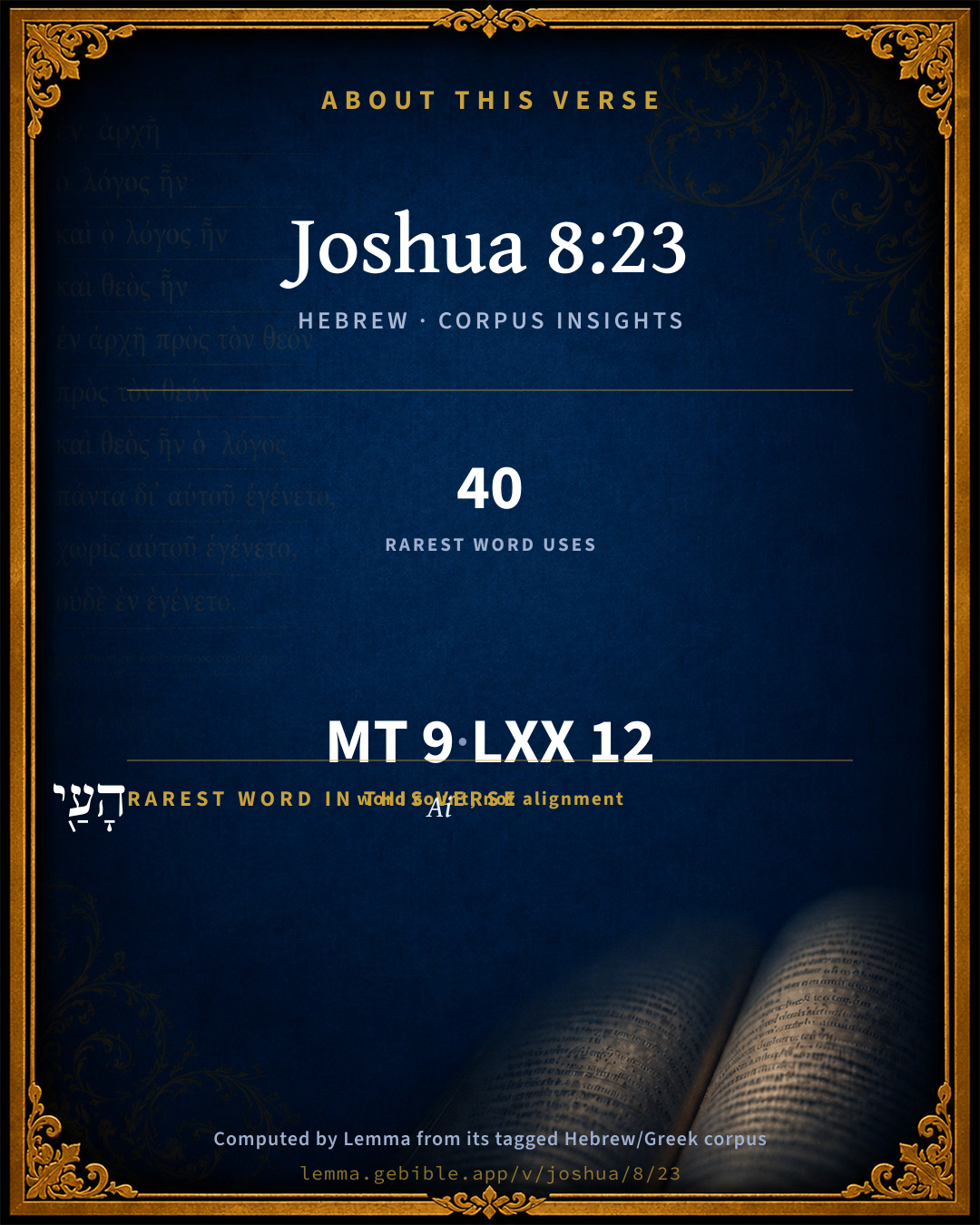
About this verse

These counts appear in no published source. They are computed here, from the morphology-tagged text and Lemma’s own curated glosses. What Lemma adds →

9
words
8
distinct lemmas
Historical
section

Shared distinctive vocabulary

הָעַ֖י Ai H5857 occurs in 34 verses of the Hebrew Bible. Also found in:

Grammatical profile

  • 2 verbs
  • 3 nouns
  • 1 adjective
  • 1 preposition
  • 2 particles

Verb forms

  • תָּ֣פְשׂוּ Qal · Perfect
  • וַיַּקְרִ֥בוּ Hiphil · Sequential Imperfect

Hebrew & Septuagint length

In English translation the verse runs 12 words from the Hebrew and 13 from the Septuagint (LXX English) — closely comparable.

A rough comparison of the two English renderings, which tokenize alike — not a word-level alignment.

Word counts can differ between the Hebrew and the Greek without any difference in meaning — e.g. the Hebrew direct-object marker אֵת has no separate Greek word, and Greek often adds the article ὁ.

In the original languages it is 9 Hebrew tokens and 12 Greek tokens — but the two are counted differently (Hebrew bundles its prefixes and suffixes into one token; the Greek is in lemma form), so that isn’t a like-for-like length.

Cross-references

4

Topical passages linked to Joshua 8:23 in the Treasury of Scripture Knowledge — connected by theme and wording, ordered by reader-vote popularity; previews shown in the World English Bible.

  • 1 Samuel 15:8 He took Agag the king of the Amalekites alive, and utterly destroyed all the people with the edge of the sword.
  • Joshua 8:29 The king of Ai he hanged on a tree until the evening: and at the going down of the sun Joshua commanded, and they took his body down from the tree, and cast it at the entrance of the gate of the city, and raised thereon a great heap of stones, to this day.
  • Joshua 10:17 It was told Joshua, saying, The five kings are found, hidden in the cave at Makkedah.
  • Revelation 19:20 The beast was taken, and with him the false prophet who worked the signs in his sight, with which he deceived those who had received the mark of the beast and those who worshiped his image. These two were thrown alive into the lake of fire that burns with sulfur.

Cross-references courtesy of OpenBible.info (CC BY 4.0).

Hebrew and Greek witnesses Masoretic Hebrew ↔ Greek Septuagint

The same verse in the two great witnesses to the Old Testament, shown verse-for-verse.

These are two independent witnesses, not word-aligned to each other, and the Septuagint is shown in lemma (dictionary) form.

Hebrew Joshua 8:23 Masoretic · Westminster Leningrad Codex

וְאֶת מֶ֥לֶךְ הָעַ֖י תָּ֣פְשׂוּ חָ֑י וַיַּקְרִ֥בוּ אֹת֖וֹ אֶל יְהוֹשֻֽׁעַ

The king of Ai they took alive, and brought him to Joshua.

World English Bible · Public Domain

Greek LXX Joshua 8:23 Septuagint · lemma form

καί ὁ βασιλεύς ὁ γαι συνλαμβάνω ζάω καί προςἄγω αὐτός πρός ἰησοῦς

And they took the king of Gai alive, and brought him to Joshua.

LXX2012 (modern English Septuagint) · Public Domain

Hebrew: Westminster Leningrad Codex (CC BY 4.0). Greek: Septuagint (public domain); English from LXX2012 (modern English Septuagint) (Public Domain). How the Septuagint differs from the Hebrew →

Targum (Aramaic paraphrase)

1

The Targum is the ancient Jewish Aramaic paraphrase of the Hebrew Scriptures — an interpretive translation, not the Hebrew text itself. Onkelos (literal) and Pseudo-Jonathan (expansive) render the Torah, and Jonathan the Prophets. Coverage is partial: where no permissively-licensed English translation exists for a verse, only the Aramaic is shown. This is verse-level text, not a word-by-word alignment to the Hebrew.

  1. Targum Jonathan Prophets (Joshua–Malachi)
    וְיַת מַלְכָּא דְעַי אֲחָדוּ כַּד חָי וְקָרִיבוּ יָתֵיהּ לְוַת יְהוֹשֻׁעַ:

    (no public-domain English translation for this verse)

    Targum Jonathan — Aramaic: “Mikraot Gedolot” (public domain). English: “Sefaria Community Translation” (CC0 1.0 (public-domain dedication)); “London "Chaldee Paraphrase," 1871” (public domain). Text via Sefaria.

Commentary

Notes on Joshua 8:23 from classic Christian and Jewish commentators (each source and its license shown beneath its notes). The classic Christian expositions comment on the surrounding passage and are grouped to its opening verse, so a note may address several verses; the Jewish commentaries on the Tanakh (Rashi and others) are per-verse, so they appear only where the commentator wrote on this verse.

Lemma curates 59 commentaries, every one of them public domain or Creative Commons licensed, each selected and text-cleaned for this edition rather than reprinted as found. About our sources →

Matthew Henry's Commentary

We have here an account of the improvement which the Israelites made of their victory over Ai. 1. They put all to the sword, not only in the field, but in the city, man, woman, and child, none of them remained, Jos 8:24. God, the righteous Judge, had passed this sentence upon them for their wickedness, so that the Israelites were only the ministers of his justice and the executioners of his doom. Once in this story, and but once, mention is made of the men of Beth-el, as confederates with the men of Ai, Jos 8:17. Though they had a king of their own, and were not subjects to the king of Ai (for the king of Beth-el is reckoned among the thirty-one kings that Joshua destroyed, Jos 12:16), yet Ai being a stronger place they threw themselves into that, for their own safety, and the strengthening of their neighbours' hands, and so (we may presume) were all cut off with them; thus that by which they hoped to prevent their own ruin hastened it. The whole number of the slain, it seems, was but 12,000, and inconsiderable body to make head against all the thousands of Israel; but those whom God will destroy he infatuates. Here it is said (Jos 8:26) that Joshua drew not his hand back wherewith he stretched out the spear (Jos 8:18) till the slaughter was completed. Some think the spear he stretched out was not to slay the enemies, but to animate and encourage his own soldiers, some flag or ensign being hung out at the end of this spear; and they observe it as an instance of his self-denial that though the fire of courage wherewith his breast was filled would have pushed him forward, sword in hand, into the hottest of the action, yet, in obedience to God, he kept the inferior post of a standard-bearer, and did not quit it till the work was done. By the spear stretched out, he directed the people to expect their help from God, and to him to give the praise. 2. They plundered the city and took all the spoil to themselves, Jos 8:27. Thus the wealth of the sinner is laid up for the just; the spoil they brought out of Egypt, by borrowing of their neighbours, was much of it expended upon the tabernacle they had reared in the wilderness, for which they are now reimbursed with interest. The spoil here taken, it is probable, was all brought together, and distributed by Joshua in due proportions, as that of the Midianites was, Num 31:26, etc. It was not seized with irregularity or violence, for God is the God or order and equity, and not of confusion. 3. They laid the city in ashes, and left it to remain so, Jos 8:28. Israel must yet dwell in tents, and therefore this city, as well as Jericho, must be burnt. And, though there was no curse entailed upon him that should rebuild it, yet, it seems, it was not rebuilt unless it be the same with Aijah, which we read of, long after, Neh 11:31. Some think it was not rebuilt because Israel had received a defeat before it, the remembrance of which should be buried in the ruins of the city. 4. The king of Ai was taken prisoner and cut off, not by the sword of war as a soldier, but by the sword of justice as a malefactor. Joshua ordered him to be hanged, and his dead body thrown at the gate of his own city, under a heap of stone, Jos 8:23, Jos 8:29. Some particular reason, no doubt, there was for this severity against the king of Ai; it is likely he had been notoriously wicked and vile, and a blasphemer of the God of Israel, perhaps upon occasion of the repulse he had given to the forces of Israel in their first onset. Some observe that his dead body was thrown at the gate where he had been wont to sit in judgment that so much the greater contempt might thereby be poured upon the dignity he had been proud of, and he might be punished for the unrighteous decrees he had made in the very place where he had made them. Thus the Lord is known by the judgments which he executes.

Matthew Henry's Commentary on the Whole Bible (1708–1710) — public domain (CC PDM 1.0). Text via the HelloAO Bible API.

Trapp's Complete Commentary

John Trapp

Jos 8:23 And the king of Ai they took alive, and brought him to Joshua.

Ver. 23. And the king of Ai they took alive.] His preservation was but a reservation to a more solemn execution: so {Rev 19:20} the beast and false prophet were cast alive into the fiery lake, when the remnant were slain with the sword. Potentes potenter torquebuntur.

John Trapp, A Commentary or Exposition upon All the Books of the Old and New Testament (1647–1656) — public domain. Text from a community e-Sword module.

Jamieson, Fausset & Brown

Robert Jamieson, A. R. Fausset & David Brown

the king of Ai they took alive, and brought him to Joshua--to be reserved for a more ignominious death, as a greater criminal in God's sight than his subjects. In the mingled attack from before and behind, all the men were massacred.

Jamieson, Fausset & Brown — Commentary Critical and Explanatory on the Whole Bible (1871) — public domain (CC PDM 1.0). Text via the HelloAO Bible API.

John Gill's Exposition

And the king of Ai they took alive,.... They spared him, and reserved him for a more shameful death:

and brought him to Joshua; their general; delivering him into his hands as his prisoner, to do will, him as seemed good in his sight.

John Gill's Exposition of the Whole Bible (1746–1763) — public domain (CC PDM 1.0). Text via the HelloAO Bible API.

Haydock's Catholic Bible Commentary

Josue. This king was reserved for greater torments and ignominy. It was the ancient custom to present kings and chief commanders to the victorious general, who rewarded those who brought them. (Grotius)

George Leo Haydock (1774–1849), Haydock's Catholic Family Bible and Commentary, 1859 edition — public domain. Excludes Psalms (Douay-Rheims chapter numbering differs from Protestant) and Deuterocanonical books (Catholic canon only).

Matthew Poole's English Annotations

Reserving him to a peculiar and more ignominious punishment, for the terror of the other kings, who were the chief causes of all that opposition and disturbance which Israel met with in gaining the possession of the Promised Land.

Matthew Poole's English Annotations on the Holy Bible (1683–1685) — public domain. Text from a community e-Sword/MySword module.

Whedon's Commentary on the Bible

Daniel D. Whedon

23. And the king of Ai they took alive — Kings were anciently spared in battle, either to grace the triumph of the victor, or for the accomplishment of some political end, or, as in this case, for a more formal and impressive execution. The king of Bethel (Jos_12:16) was, perhaps, killed in this battle, and left among the common dead, so that no special notice of his death is here recorded.

Daniel D. Whedon (gen. ed.), Commentary on the Old and New Testaments (1874–1909) — public domain. Text from a community e-Sword module.

John Wesley's Explanatory Notes

Took alive - Reserving him to a more ignominious punishment.

John Wesley, Explanatory Notes Upon the Whole Bible (1754–1765) — public domain. Text via the GEBible commentary corpus.

Lesson kit

Teaching starters — assembled from the data on this page, not authored interpretation. Every prompt links to the verse data it draws on. Edit before teaching.

Joshua, in the Historical, opens this verse with 9 words (8 distinct Hebrew lemmas). Its most distinctive word is ʻAy (“Ai”). A historical commentator’s framing appears above. Read the whole chapter for the surrounding context.

Discussion questions

  1. The word ʻAy carries the sense “Ai.” How does it shape the verse?
  2. How does Genesis 12:8, which shares the word «Ai», read alongside this verse?
  3. The translations on this page render this verse differently — a whole-verse word diff, not a word-by-word alignment. What might account for the different wordings?
  4. «תָּ֣פְשׂוּ» is a Qal Perfect verb. How does that grammatical form shape the action described?
  5. Compare how Matthew Henry's Commentary and Trapp's Complete Commentary read this verse. Where do they agree or differ?

Things to notice

Reading settings

Reading text

Shown beneath each verse's original-language words.

Old Testament
Old Testament edition

Read the OT as the Masoretic Hebrew (MT) or the Greek Septuagint (LXX).

English shown for the Greek Septuagint (in the Hebrew ↔ Greek comparison).

Comparing translations? Open the Compare panel on any verse page to stack up to four side by side.