

Job 31:37

Hebrew (Westminster Leningrad Codex) Job 31:37 appears in the Hebrew Old Testament. The text above is from the Westminster Leningrad Codex. Each word links to its Strong’s number, a concise gloss, and parsing drawn from the Open Scriptures Hebrew Bible morphology. Click any word for its full Brown-Driver-Briggs (BDB) entry.
Download image
Cite this verse

Job 31:37 (World English Bible). Public Domain. Lemma interlinear Bible study tool, https://lemma.gebible.app/v/job/31/37.

Show BibTeX & RIS
BibTeX
RIS
English Translation
I would declare to him the number of my steps. As a prince would I go near to him.
World English Bible · Public Domain
Download a study sheet

One document with this verse’s original text, its word-by-word gloss line, the meaning frame, cross-references with their text, attributed commentary, and full source and license credits — printable, and it pastes into notes with its structure intact.

This verse Autodidact and up

Study sheet (.html) Plain text (.txt)

A passage Seminary Student

Up to 50 verses in one chapter. A passage sheet keeps up to 6 commentary sources and 12 cross-references per verse, in the order this page ranks them, and says so on the sheet whenever that leaves anything out. Ask for a single verse and you get the Autodidact verse sheet above.

Everything on this page stays free to read, with no account — the sheet is a download of what is already on screen, not access to it.

Want to remove ads? Support Godless Engineer
Compare translations 3

The same verse in 3 English versions, stacked beneath the original-language interlinear above. Click any original word for its lexicon entry.

Each is an independent rendering of the whole verse — the interlinear is not word-aligned to these translations.

Highlighted words mark where these versions differ — a whole-verse word diff, not a word-by-word alignment.

  • World English Bible Public Domain
    I would declare to him the number of my steps. As a prince would I go near to him.
  • King James Version Public Domain
    I would declare unto him the number of my steps; as a prince would I go near unto him.
  • unfoldingWord Literal Text CC BY-SA 4.0
    I would declare to him an account of my steps; I would approach him like a noble.

unfoldingWord Literal Text — © unfoldingWord, licensed CC BY-SA 4.0. Word-aligned USFM3 via Door43 (git.door43.org/unfoldingWord/en_ult).

Versions to compare (up to 4)

3 of 4 selected

Show all 18 translations

Every available English version of this verse, each an independent rendering of the whole verse.

  • World English Bible Public Domain
    I would declare to him the number of my steps. As a prince would I go near to him.
  • Berean Standard Bible Public Domain
    I would give account of all my steps; I would approach Him like a prince.)—
  • Majority Standard Bible Public Domain
    I would give account of all my steps; I would approach Him like a prince.)—
  • King James Version Public Domain
    I would declare unto him the number of my steps; as a prince would I go near unto him.
  • American Standard Version (1901) Public Domain
    I would declare unto him the number of my steps; As a prince would I go near unto him.
  • Revised Version (1885) Public Domain
    I would declare unto him the number of my steps; as a prince would I go near unto him.
  • Geneva Bible (1599) Public Domain
    I will tell him the nomber of my goings, and goe vnto him as to a prince.
  • Douay-Rheims (1899) Public Domain
    At every step of mine I would pronounce it, and offer it as to a prince.
  • Young's Literal Translation Public Domain
    The number of my steps I tell Him, As a leader I approach Him.
  • Literal Standard Version CC BY-SA 4.0
    The number of my steps I tell Him, || As a leader I approach Him.
  • Unlocked Literal Bible CC BY-SA 4.0
    I would declare to him an accounting for my steps; as a confident prince I would go up to him.
  • unfoldingWord Literal Text CC BY-SA 4.0
    I would declare to him an account of my steps; I would approach him like a noble.
  • Darby Bible Public Domain
    I would declare unto him the number of my steps; as a prince would I come near to him.
  • World Messianic Bible Public Domain
    I would declare to him the number of my steps. I would go near to him like a prince.
  • Webster's Bible Public Domain
    I would declare to him the number of my steps; as a prince would I go near to him.
  • Free Bible Version CC BY-SA 4.0
    I would explain to him everything I'd done; I would hold my head high before him.
  • Bible in Basic English Public Domain
    I would make clear the number of my steps, I would put it before him like a prince! The words of Job are ended.
  • JPS Tanakh (1917) Public Domain
    I would declare unto him the number of my steps; as a prince would I go near unto him.

Literal Standard Version (2020), Covenant Press — licensed CC BY-SA 4.0. Text via the HelloAO Bible API (eBible.org). Unlocked Literal Bible (unfoldingWord) — licensed CC BY-SA 4.0. Text via the HelloAO Bible API (eBible.org). unfoldingWord Literal Text — © unfoldingWord, licensed CC BY-SA 4.0. Word-aligned USFM3 via Door43 (git.door43.org/unfoldingWord/en_ult). Free Bible Version, Dr. Jonathan Gallagher — licensed CC BY-SA 4.0. Text via the HelloAO Bible API (eBible.org).

Word by word

More ways to search: Search by grammar → Find every occurrence → Compare this word →

Practice this passage: Drill this verse → Learn its vocabulary →

About this verse

These counts appear in no published source. They are computed here, from the morphology-tagged text and Lemma’s own curated glosses. What Lemma adds →

6
words
6
distinct lemmas
Wisdom
section

Notable vocabulary

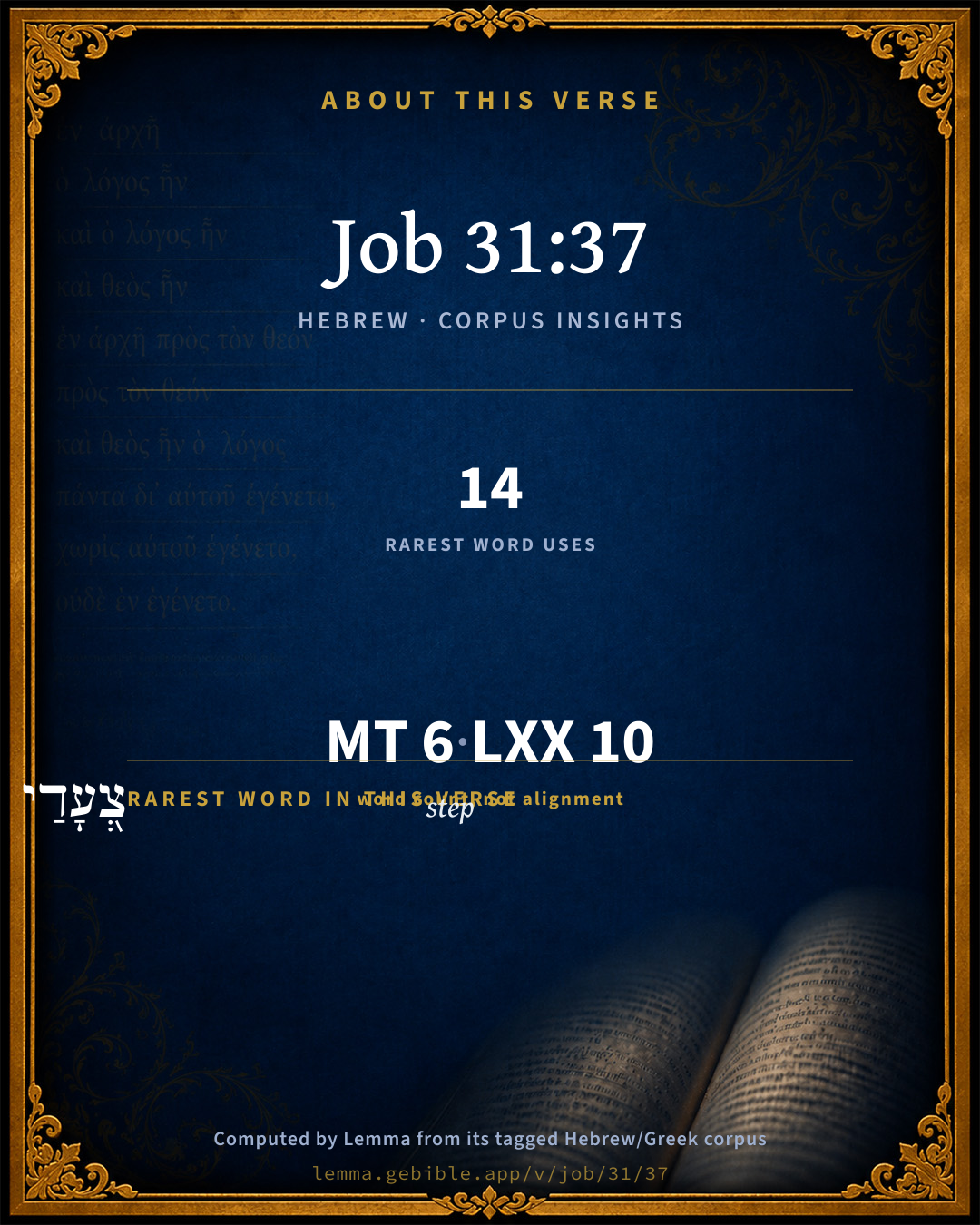
The rarest word here is צְ֭עָדַי step H6806 — appearing just 14 times in the whole Hebrew Bible.

Shared distinctive vocabulary

צְ֭עָדַי step H6806 occurs in 14 verses of the Hebrew Bible. Also found in:

Grammatical profile

  • 2 verbs
  • 3 nouns
  • 1 preposition

Verb forms

  • אַגִּידֶ֑נּוּ Hiphil · Imperfect
  • אֲקָרֲבֶֽנּוּ Piel · Imperfect

Hebrew & Septuagint length

In English translation the verse runs 19 words from the Hebrew and 16 from the Septuagint (LXX English) — closely comparable.

A rough comparison of the two English renderings, which tokenize alike — not a word-level alignment.

Word counts can differ between the Hebrew and the Greek without any difference in meaning — e.g. the Hebrew direct-object marker אֵת has no separate Greek word, and Greek often adds the article ὁ.

In the original languages it is 6 Hebrew tokens and 10 Greek tokens — but the two are counted differently (Hebrew bundles its prefixes and suffixes into one token; the Greek is in lemma form), so that isn’t a like-for-like length.

Cross-references

11

Topical passages linked to Job 31:37 in the Treasury of Scripture Knowledge — connected by theme and wording, ordered by reader-vote popularity; previews shown in the World English Bible.

  • Job 13:15 Behold, he will kill me; I have no hope. Nevertheless, I will maintain my ways before him.
  • Ephesians 3:12 in whom we have boldness and access in confidence through our faith in him.
  • Hebrews 4:15–16 For we don't have a high priest who can't be touched with the feeling of our infirmities, but one who has been in all points tempted like we are, yet without sin.
  • Genesis 32:28 He said, "Your name will no longer be called 'Jacob,' but, 'Israel,' for you have fought with God and with men, and have prevailed."
  • Job 1:3 His possessions also were seven thousand sheep, three thousand camels, five hundred yoke of oxen, five hundred she-donkeys, and a very great household; so that this man was the greatest of all the children of the east.
  • Job 9:3 If he is pleased to contend with him, He can't answer him one time in a thousand.
  • Job 14:16 But now you number my steps. Don't you watch over my sin?
  • Job 29:25 I chose out their way, and sat as chief. I lived as a king in the army, As one who comforts the mourners.
  • Job 42:3–6 You asked, 'Who is this who hides counsel without knowledge?' Therefore I have uttered that which I did not understand, Things too wonderful for me, which I didn't know.
  • Psalms 19:12 Who can discern his errors? Forgive me from hidden errors.
  • 1 John 3:19–21 And by this we know that we are of the truth, and persuade our hearts before him,

Cross-references courtesy of OpenBible.info (CC BY 4.0).

Hebrew and Greek witnesses Masoretic Hebrew ↔ Greek Septuagint

The same verse in the two great witnesses to the Old Testament, shown verse-for-verse.

These are two independent witnesses, not word-aligned to each other, and the Septuagint is shown in lemma (dictionary) form.

Hebrew Job 31:37 Masoretic · Westminster Leningrad Codex

מִסְפַּ֣ר צְ֭עָדַי אַגִּידֶ֑נּוּ כְּמוֹ נָ֝גִ֗יד אֲקָרֲבֶֽנּוּ

I would declare to him the number of my steps. As a prince would I go near to him.

World English Bible · Public Domain

Greek LXX Job 31:37 Septuagint · lemma form

καί εἰ μή ῥήγνυμι αὐτός ἀποδίδωμι οὐδείς λαμβάνω παρά χρεοφειλέτης

And if I did not read it and return it, having taken nothing from the debtor:

LXX2012 (modern English Septuagint) · Public Domain

Hebrew: Westminster Leningrad Codex (CC BY 4.0). Greek: Septuagint (public domain); English from LXX2012 (modern English Septuagint) (Public Domain). How the Septuagint differs from the Hebrew →

Commentary

Notes on Job 31:37 from classic Christian and Jewish commentators (each source and its license shown beneath its notes). The classic Christian expositions comment on the surrounding passage and are grouped to its opening verse, so a note may address several verses; the Jewish commentaries on the Tanakh (Rashi and others) are per-verse, so they appear only where the commentator wrote on this verse.

Lemma curates 59 commentaries, every one of them public domain or Creative Commons licensed, each selected and text-cleaned for this edition rather than reprinted as found. About our sources →

Trapp's Complete Commentary

John Trapp

Job 31:37 I would declare unto him the number of my steps; as a prince would I go near unto him.

Ver. 37. I would declare unto him the number of my steps] I would tell him all that ever I know by myself, and turn him the inside outward, deal ingeniously with him, and make him my confessor; and so help him make up his book. Elice igitur hine, Therefore entice this, saith Lavater. Hence we may learn so to demean ourselves in all companies and conditions of life, that we may neither be ashamed to live nor afraid to die; and that we need not care though our greatest enemies knew of our worst practices, though our faults were written in our foreheads, as they say. Of Socrates Pliny saith, that his name was not the name of a man, but of integrity itself (Nat. Hist. 1. 7, c. 31). Of Cato Major Paterculus saith, that he was free from all human vices, and as like to virtue itself as might be. Cicero saith, that he was one of those few that lived and died with glory. How much more truly and boldly may we affirm the like of Joseph, Moses, Samuel, Daniel, Nehemiah, Paul, who knew nothing by himself, Melancthon, George, prince of Anhalt, John Bradford, and many others famous in their generations, whom, for their piety and patience, as their enemies could not but admire, so their friends could never sufficiently extol them. This is no small help to the cause, said Erasmus concerning Luther, that his enemies could find no fault or flaw in his life.

As a prince would I go near unto him] Id est, Animo heroico et imperterrito, quippe bene sibi conscio (Piscat.); that is, with a heroic spirit, and an undaunted courage: I would not shrink back, or flinch him a jot, as having a clearing, cheering conscience that feareth no colours, that would not budge or yield a hair for an angel’s authority, Gal 1:8. Quasi Princeps, hoc est, animo liberrimo et expositissimo, &c., saith Brentius, As a prince against whom there is no rising up. I would speak my mind, and lay open the whole matter of my deportment very freely and fully, that both present and future ages might judge it. Of Trajan the emperor it is recorded, that he neither hated nor feared any man living. And of Trajan, general to Valens, the Arian emperor, that as he could speak his mind fitly, so he dared speak it freely. Think the same of Job.

John Trapp, A Commentary or Exposition upon All the Books of the Old and New Testament (1647–1656) — public domain. Text from a community e-Sword module.

Joseph Benson's Commentary

Job 31:37. I would declare to him — To the Almighty, my judge; the number of my steps — The whole course of my life and actions, step by step, as far as I could remember: as a prince would I go near him — That is, with courage and confidence of success: I would stand before him with a look as upright and assured as that of a prince. Nothing can be plainer than that the book, or libel, here supposed to be written by Job’s adversary, cannot be meant of one drawn up by God. For how was it possible for him to triumph in this? If it were a bill of accusation, coming from the God of truth, he had more reason to tremble, certainly, than to triumph. We must therefore conclude that by the adversary must be meant one or all of Job’s friends, who were his only accusers that we know of: and God is here appealed to as a hearer or judge between them. In this it is that Job, with reason, rejoices and triumphs as being conscious of his integrity before God, and his sincere desire and endeavour to know and do his will in all things. See Peters and Dodd.

Joseph Benson's Commentary on the Old and New Testaments (1811–1818) — public domain. Text from a community e-Sword module.

Tyndale Open Study Notes

Tyndale Open Resources

31:37 A prince who had been wrongly accused had the right to come before his king to make an appeal.

Tyndale Open Study Notes — © Tyndale Open Resources, licensed CC BY-SA 4.0. Text via the HelloAO Bible API.

Geneva Bible (1599)

Geneva Bible translators

I will make him account of all my life, without fear.

Geneva Bible (1599) marginal notes — public domain. Text via Bolls.life.

Jamieson, Fausset & Brown

Robert Jamieson, A. R. Fausset & David Brown

A good conscience imparts a princely dignity before man and free assurance in approaching God. This can be realized, not in Job's way (Job 42:5-6); but only through Jesus Christ (Heb 10:22).

Jamieson, Fausset & Brown — Commentary Critical and Explanatory on the Whole Bible (1871) — public domain (CC PDM 1.0). Text via the HelloAO Bible API.

Adam Clarke's Commentary

Verse 37. I would declare unto him the number of my steps] I would show this adversary the different stations I had been in, and the offices which I had filled in life, that he might trace me through the whole of my civil, military, and domestic life, in order to get evidence against me.

As a prince would I go near] Though carrying my own accusation, I would go into the presence of my judge as the נגיד nagid, chief, or sovereign commander and judge, of the people and country, and would not shrink from having my conduct investigated by even the meanest of my subjects.

In these three verses we may observe the following particulars: -

1. Job wishes to be brought to trial, that he might have the opportunity of vindicating himself: O that I might have a hearing!

2. That his adversary, Eliphaz and his companions, whom he considers as one party, and joined together in one, would reduce their vague charges to writing, that they might come before the court in a legal form: O that my adversary would write down the charge!

3. That the Almighty, שדי Shaddai, the all-sufficient GOD, and not man, should be the judge, who would not permit his adversaries to attempt, by false evidence, to establish what was false, nor suffer himself to cloak with a hypocritical covering what was iniquitous in his conduct: O that the Almighty might answer for me - take notice of or be judge in the cause!

4. To him he purposes cheerfully to confess all his ways, who could at once judge if he prevaricated, or concealed the truth.

5. This would give him the strongest encouragement: he would go boldly before him, with the highest persuasion of an honourable acquittal.

Adam Clarke's Commentary on the Bible (1810–1826) — public domain. Text from a community e-Sword/MySword module.

Ellicott's Commentary for English Readers

(37) I would declare—i.e., “I would readily give an account of all my actions, and meet him with alacrity and perfect confidence.” Others suppose the meaning to be, “I would meet him as I would meet a prince, with the utmost deference and respect, not at all as an enemy, but as one worthy of all honour and regard.” The actual meaning is uncertain. On the other hand, he has been spoken of by his friends: as a fool (Job_5:2), by Eliphaz; as a man full of words, a liar, and a mocker (Job_11:2-3), by Zophar; as perverse, wicked, and iniquitous (Job_11:12; Job_11:14); a blasphemer and a hypocrite, by Eliphaz (Job_15:4-5; Job_15:13; Job_15:16; Job_15:34, &c.); as wicked, a robber, and ignorant of God, by Bildad (Job_18:5; Job_18:14); as wicked and a hypocrite, by Zophar (Job_20:5); as extortionate and oppressive (Job_31:15; Job_31:19, &c.); as a tyrant and an impious man, by Eliphaz (Job_22:5; Job_22:9; Job_22:13; Job_22:17, &c.).

A Bible Commentary for English Readers, edited by Charles John Ellicott (1878–1897) — public domain. Text from a community e-Sword module.

The Cambridge Bible for Schools and Colleges

gen. ed. J. J. S. Perowne

37. the number of my steps] i. e. every act of my life.

as a prince] In the consciousness and pride of true nobility; with the confident step and erect bearing of one who knows that nothing dishonouring can be laid to his charge.

The Cambridge Bible for Schools and Colleges (gen. ed. J. J. S. Perowne; Cambridge University Press, 1878–1918) — public domain. Text from a community e-Sword module.

John Gill's Exposition

If I have eaten the fruits thereof without money,.... Or, "the strength thereof without silver" (b); see Gen 4:12, silver being the money chiefly in use in those times. Job's meaning is, that he ate not anything of the fruits and increase of his own land, without having paid for the same, which he would have done, if he had got his land out of the hands of the rightful owners of it, by deceit or violence; or if he had not paid his workmen for ploughing, sowing, reaping, &c. or if he had demanded the fruits of the earth of his tenants, to whom he had let out his farms, without giving them a proper price for them:

or have caused the owners thereof to lose their life; as Jezebel caused Naboth to lose his, who was the original proprietor, that Ahab might possess it, Kg1 21:7; or it may signify tenants, to whom Job rented out fields, but did not starve them by renting them under hard leases, or lands on hard terms, so that they could not live upon them; or it may design the tillers of the land, as Jarchi and Bar Tzemach; those that wrought in it, the servants that were employed in ploughing, &c. to whom wages were due, and who had not too hard labour imposed upon them, to the endangering of their lives; or he did not "afflict and grieve" (c) them, as some versions; or make their lives bitter, through hard bondage and service, as the Israelites in Egypt.

(b) "robur ejus", Montanus, Bolducius, Mercerus, Drusius; "vim ejus", Junius & Tremellius, Cocceius, Michaelis, Schultens; "sine, vel absque argento", Mercer, Drusius, Cocceius, Michaelis, Schultens.

(c) "afflixi", V. L. "dolore affeci", Pagninus; so Broughton.

John Gill's Exposition of the Whole Bible (1746–1763) — public domain (CC PDM 1.0). Text via the HelloAO Bible API.

Albert Barnes' Notes on the Bible

I would declare unto him the number of my steps - That is, I would disclose to him the whole course of my life. This is language also appropriate to a judicial trial, and the meaning is, that Job was so confident of his integrity that he would approach God and make his whole course of life known to him.

As a prince would I go near unto him - With the firm and upright step with which a prince commonly walks. I would not go in a base, cringing manner, but in a manner that evinced a consciousness of integrity. I would not go bowed down under the consciousness of guilt, as a self-condemned malefactor, but with the firm and elastic foot-tread of one conscious of innocence. It must be remembered that all this is said with reference to the charges which had been brought against him by his friends, and not as claiming absolute perfection. He was accused of gross hypocrisy, and it was maintained that he was suffering the judicial infliction of heaven on account of that. So far as those charges were concerned, he now says that he could go before God with the firm and elastic tread of a prince - with entire cheerfulness and boldness. We are not, however, to suppose that he did not regard himself as having the common infirmities and sinfulness of our fallen nature. The discussion does not turn at all on that point.

Albert Barnes' Notes on the Bible (1834–1885) — public domain. Text from a community e-Sword/MySword module.

Haydock's Catholic Bible Commentary

To a. Hebrew, "as a prince would I approach to him," and not fear my adversary. (Haydock)

George Leo Haydock (1774–1849), Haydock's Catholic Family Bible and Commentary, 1859 edition — public domain. Excludes Psalms (Douay-Rheims chapter numbering differs from Protestant) and Deuterocanonical books (Catholic canon only).

Matthew Poole's English Annotations

Unto him, i.e. to my judge, or adversary.

The number of my steps, i.e. the whole course of my life and actions, which I would exactly number to him, step by step, so far as I can remember. I would not answer his allegations against me, but furnish him with further matter of the same kind, and then answer all together.

As a prince, i.e. with undaunted courage, and confidence, and assurance of success, as being clearly conscious of my own sincerity; not like a self-condemned malefactor, as my friends suppose me to be.

Would I go near unto him, and not run away, or hide myself from my judge, as guilty persons desire to do.

Matthew Poole's English Annotations on the Holy Bible (1683–1685) — public domain. Text from a community e-Sword/MySword module.

Whedon's Commentary on the Bible

Daniel D. Whedon

37. Near unto him — In the hour of fancied triumph he regards as his highest honour that of drawing near unto God.

Daniel D. Whedon (gen. ed.), Commentary on the Old and New Testaments (1874–1909) — public domain. Text from a community e-Sword module.

The Pulpit Commentary

I would declare unto him the number of my steps; i.e. I would conceal nothing. I would willingly divulge every act of my life. I would make full and complete answer to the indictment in every particular. As a prince would I go near unto him. There should be no timidity or cringing on my part. I would face my accuser boldly, and bear myself as a prince in his presence.

The Pulpit Commentary (1880–1919), ed. H.D.M. Spence-Jones & Joseph S. Exell — public domain. Text from a community e-Sword module.

John Wesley's Explanatory Notes

Him - My judge, or adversary. My steps - The whole course of my life. A prince - With undaunted courage and confidence.

John Wesley, Explanatory Notes Upon the Whole Bible (1754–1765) — public domain. Text via the GEBible commentary corpus.

Rashi

Rabbi Shlomo Yitzchaki (Rashi)

I will tell him the number of my steps to that man.

Rashi on the Tanakh — English translations: “The Judaica Press complete Tanach with Rashi, translated by A. J. Rosenberg” (CC BY 4.0); “Pentateuch with Rashi's commentary by M. Rosenbaum and A.M. Silbermann, 1929-1934” (public domain); “The Metsudah Tanach series, Lakewood, N.J” (CC BY 4.0); and “The Book of Joshua, Metsudah Publications, 1997” (CC BY 4.0). Text via Sefaria.

Lesson kit

Teaching starters — assembled from the data on this page, not authored interpretation. Every prompt links to the verse data it draws on. Edit before teaching.

Job, in the Wisdom, opens this verse with 6 words (6 distinct Hebrew lemmas). Its most distinctive word is tsaʻad (“step”). A historical commentator’s framing appears above. Read the whole chapter for the surrounding context.

Discussion questions

  1. How does “step” (tsaʻad) shape what this verse is saying?
  2. How does 2 Samuel 6:13, which shares the word «step», read alongside this verse?
  3. The translations on this page render this verse differently — a whole-verse word diff, not a word-by-word alignment. What might account for the different wordings?
  4. «אַגִּידֶ֑נּוּ» is a Hiphil Imperfect verb. How does that grammatical form shape the action described?
  5. Compare how Trapp's Complete Commentary and Joseph Benson's Commentary read this verse. Where do they agree or differ?

Things to notice

Reading settings

Reading text

Shown beneath each verse's original-language words.

Old Testament
Old Testament edition

Read the OT as the Masoretic Hebrew (MT) or the Greek Septuagint (LXX).

English shown for the Greek Septuagint (in the Hebrew ↔ Greek comparison).

Comparing translations? Open the Compare panel on any verse page to stack up to four side by side.