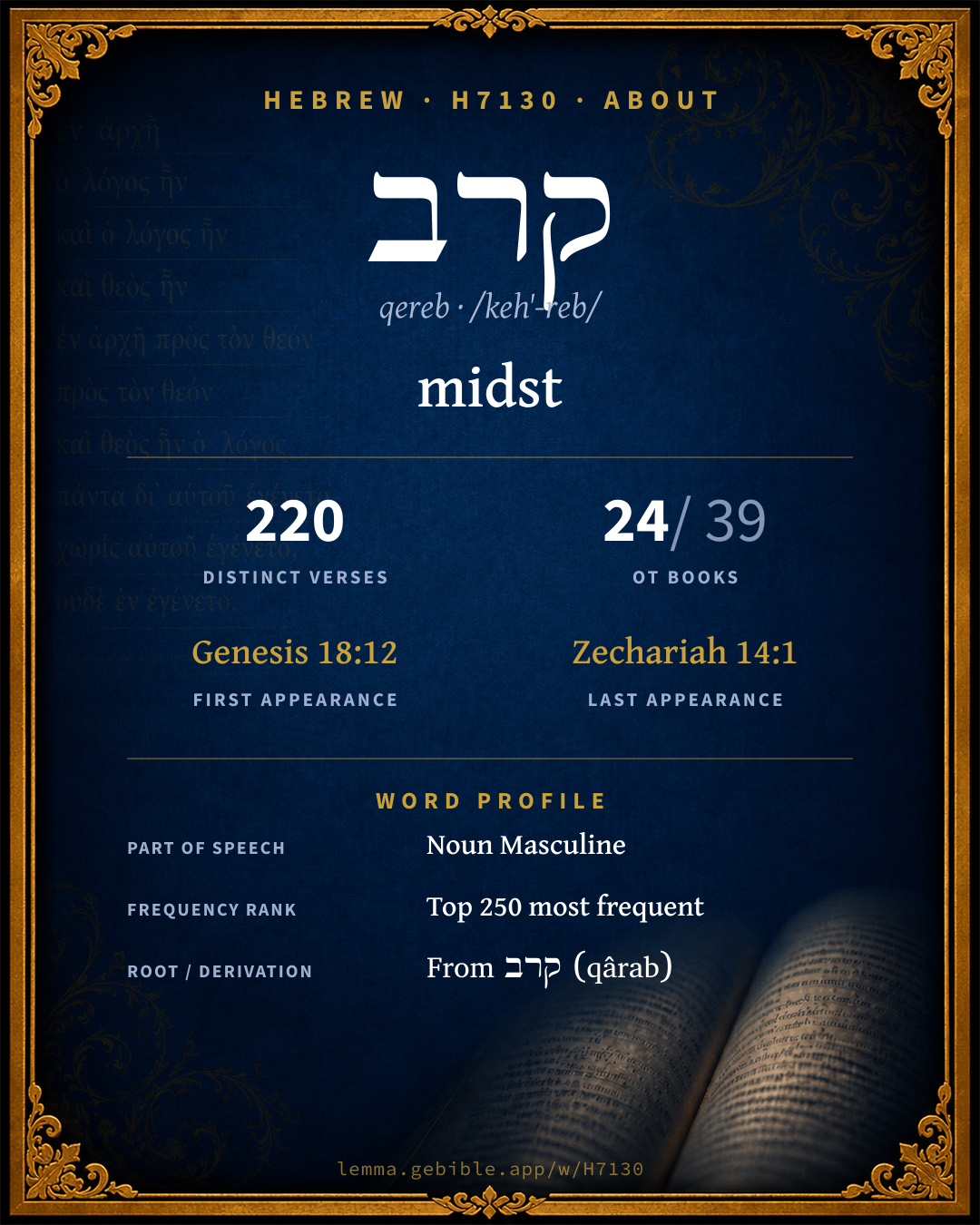
קֶ֫רֶב
midst
also: among, inner part, middle fuller range ↓
Full lexicon entry — Brown-Driver-Briggs (BDB)
From Brown-Driver-Briggs (BDB)
Where this word appears
See every Construct-state word in the Hebrew Bible →
Grammar key — what these labels mean
Part of speech
- Noun
- A naming word — a person, place, thing, or idea.
Noun type
- Common
- A common noun — a general class of person, place, or thing (“king,” “city,” “water”), not a specific name.
State
- Construct
- A noun bound to a following noun in a possessive / “of” relationship (the construct chain).
- Absolute
- The independent form of a noun, not bound to a following word.
Gender
- Masculine
- Grammatically masculine.
Number
- Singular
- One.
- Plural
- More than one (in Hebrew, generally three or more).
Grammatical forms
- Noun, Common, Masculine, Singular, Construct 210 times (93%)
- Noun, Common, Masculine, Singular, Absolute 16 times (7%)
- Noun, Common, Masculine, Plural, Construct 1 time (0%)
Parsed forms decoded from the imported morphology (morphhb / Westminster Leningrad Codex — WLC text public domain, morphhb tagging CC BY 4.0), counted across 227 parsed occurrences — not distinct verses.
Page 1 of 2 — showing verses 1–200 of 220 distinct verses where H7130 appears, across 24 books. Click any verse to open its interlinear word-by-word view. Verse text shown in the World English Bible for context — . Each verse’s Hebrew form is shown with its reference; the English is not keyword-highlighted, since the data carries no word-level English alignment. Use “Compare translations” on any verse to read it across multiple English versions. This concordance covers the Hebrew Bible; Septuagint (Greek Old Testament) occurrences are not indexed here.
Genesis 7 verses
- Genesis 18:12 בְּ/קִרְבָּ֣/הּ prep + n c ms cs + sfx pers 3fs Sarah laughed within herself, saying, "After I have grown old will I have pleasure, my lord being old also?"
- Genesis 18:24 בְּ/קִרְבָּֽ/הּ prep + n c ms cs + sfx pers 3fs What if there are fifty righteous within the city? Will you consume and not spare the place for the fifty righteous who are therein?
- Genesis 24:3 בְּ/קִרְבּֽ/וֹ prep + n c ms cs + sfx pers 3ms I will make you swear by Yahweh, the God of heaven and the God of the earth, that you shall not take a wife for my son of the daughters of the Canaanites, among whom I live.
- Genesis 25:22 בְּ/קִרְבָּ֔/הּ prep + n c ms cs + sfx pers 3fs The children struggled together within her. She said, "If it be so, why do I live?" She went to inquire of Yahweh.
- Genesis 41:21 קִרְבֶּ֗/נָה קִרְבֶּ֔/נָה n c ms cs + sfx pers 3fp n c ms cs + sfx pers 3fp and when they had eaten them up, it couldn't be known that they had eaten them, but they were still ill-favored, as at the beginning. So I awoke.
- Genesis 45:6 בְּ/קֶ֣רֶב prep + n c ms cs For these two years the famine has been in the land, and there are yet five years, in which there will be neither plowing nor harvest.
- Genesis 48:16 בְּ/קֶ֥רֶב prep + n c ms cs the angel who has redeemed me from all evil, bless the lads, and let my name be named on them, and the name of my fathers Abraham and Isaac. Let them grow into a multitude in the midst of the earth."
Exodus 16 verses
- Exodus 3:20 בְּ/קִרְבּ֑/וֹ prep + n c ms cs + sfx pers 3ms I will put forth my hand and strike Egypt with all my wonders which I will do in the midst of it, and after that he will let you go.
- Exodus 8:22 בְּ/קֶ֥רֶב prep + n c ms cs I will set apart in that day the land of Goshen, in which my people dwell, that no swarms of flies shall be there; to the end you may know that I am Yahweh in the midst of the earth.
- Exodus 10:1 בְּ/קִרְבּֽ/וֹ prep + n c ms cs + sfx pers 3ms Yahweh said to Moses, "Go in to Pharaoh, for I have hardened his heart, and the heart of his servants, that I may show these my signs in the midst of them,
- Exodus 12:9 קִרְבּֽ/וֹ n c ms cs + sfx pers 3ms Don't eat it raw, nor boiled at all with water, but roasted with fire; with its head, its legs and its inner parts.
- Exodus 17:7 בְּ/קִרְבֵּ֖/נוּ prep + n c ms cs + sfx pers 1cp He called the name of the place Massah, and Meribah, because the children of Israel quarreled, and because they tested Yahweh, saying, "Is Yahweh among us, or not?"
- Exodus 23:21 בְּ/קִרְבּֽ/וֹ prep + n c ms cs + sfx pers 3ms Pay attention to him, and listen to his voice. Don't provoke him, for he will not pardon your disobedience, for my name is in him.
- Exodus 23:25 מִ/קִּרְבֶּֽ/ךָ prep + n c ms cs + sfx pers 2ms You shall serve Yahweh your God, and he will bless your bread and your water, and I will take sickness away from your midst.
- Exodus 29:13 הַ/קֶּרֶב֒ ptcl def.art + n c ms You shall take all the fat that covers the innards, the cover of the liver, the two kidneys, and the fat that is on them, and burn them on the altar.
- Exodus 29:17 קִרְבּ/וֹ֙ n c ms cs + sfx pers 3ms You shall cut the ram into its pieces, and wash its innards, and its legs, and put them with its pieces, and with its head.
- Exodus 29:22 הַ/קֶּ֗רֶב ptcl def.art + n c ms Also you shall take some of the ram's fat, the fat tail, the fat that covers the innards, the cover of the liver, the two kidneys, the fat that is on them, and the right thigh (for it is a ram of consecration),
- Exodus 31:14 מִ/קֶּ֥רֶב prep + n c ms cs You shall keep the Sabbath therefore; for it is holy to you. Everyone who profanes it shall surely be put to death; for whoever does any work therein, that soul shall be cut off from among his people.
- Exodus 33:3 בְּ/קִרְבְּ/ךָ֗ prep + n c ms cs + sfx pers 2ms to a land flowing with milk and honey: for I will not go up in the midst of you, for you are a stiff-necked people, lest I consume you in the way."
- Exodus 33:5 בְ/קִרְבְּ/ךָ֖ prep + n c ms cs + sfx pers 2ms Yahweh said to Moses, "Tell the children of Israel, 'You are a stiff-necked people. If I were to go up into your midst for one moment, I would consume you. Therefore now take off your jewelry from you, that I may know what to do to you."
- Exodus 34:9 בְּ/קִרְבֵּ֑/נוּ prep + n c ms cs + sfx pers 1cp He said, "If now I have found favor in your sight, Lord, please let the Lord go in the midst of us; although this is a stiff-necked people; pardon our iniquity and our sin, and take us for your inheritance."
- Exodus 34:10 בְ/קִרְבּ֜/וֹ prep + n c ms cs + sfx pers 3ms He said, "Behold, I make a covenant: before all your people I will do marvels, such as have not been worked in all the earth, nor in any nation; and all the people among which you are shall see the work of Yahweh; for it is an awesome thing that I do with you.
- Exodus 34:12 בְּ/קִרְבֶּֽ/ךָ prep + n c ms cs + sfx pers 2ms Be careful, lest you make a covenant with the inhabitants of the land where you are going, lest it be for a snare in the midst of you:
Leviticus 20 verses
- Leviticus 1:9 וְ/קִרְבּ֥/וֹ conj + n c ms cs + sfx pers 3ms but its innards and its legs he shall wash with water. The priest shall burn the whole on the altar, for a burnt offering, an offering made by fire, of a sweet savor to Yahweh.
- Leviticus 1:13 וְ/הַ/קֶּ֥רֶב conj + ptcl def.art + n c ms but the innards and the legs he shall wash with water. The priest shall offer the whole, and burn it on the altar. It is a burnt offering, an offering made by fire, of a sweet savor to Yahweh.
- Leviticus 3:3 הַ/קֶּ֔רֶב הַ/קֶּֽרֶב ptcl def.art + n c ms ptcl def.art + n c ms He shall offer of the sacrifice of peace offerings an offering made by fire to Yahweh; the fat that covers the innards, and all the fat that is on the innards,
- Leviticus 3:9 הַ/קֶּ֔רֶב הַ/קֶּֽרֶב ptcl def.art + n c ms ptcl def.art + n c ms He shall offer from the sacrifice of peace offerings an offering made by fire to Yahweh; its fat, the entire tail fat, he shall take away close to the backbone; and the fat that covers the inwards, and all the fat that is on the inwards,
- Leviticus 3:14 הַ/קֶּ֔רֶב הַ/קֶּֽרֶב ptcl def.art + n c ms ptcl def.art + n c ms He shall offer from it as his offering, an offering made by fire to Yahweh; the fat that covers the innards, and all the fat that is on the innards,
- Leviticus 4:8 הַ/קֶּ֔רֶב הַ/קֶּֽרֶב ptcl def.art + n c ms ptcl def.art + n c ms He shall take all the fat of the bull of the sin offering off of it; the fat that covers the innards, and all the fat that is on the innards,
- Leviticus 4:11 וְ/קִרְבּ֖/וֹ conj + n c ms cs + sfx pers 3ms The bull's skin, all its flesh, with its head, and with its legs, its innards, and its dung,
- Leviticus 7:3 הַ/קֶּֽרֶב ptcl def.art + n c ms He shall offer all of its fat: the fat tail, and the fat that covers the innards,
- Leviticus 8:16 הַ/קֶּרֶב֒ ptcl def.art + n c ms He took all the fat that was on the innards, and the cover of the liver, and the two kidneys, and their fat; and Moses burned it on the altar.
- Leviticus 8:21 הַ/קֶּ֥רֶב ptcl def.art + n c ms He washed the innards and the legs with water; and Moses burned the whole ram on the altar. It was a burnt offering for a sweet savor. It was an offering made by fire to Yahweh; as Yahweh commanded Moses.
- Leviticus 8:25 הַ/קֶּרֶב֒ ptcl def.art + n c ms He took the fat, and the fat tail, and all the fat that was on the innards, and the cover of the liver, and the two kidneys, and their fat, and the right thigh;
- Leviticus 9:14 הַ/קֶּ֖רֶב ptcl def.art + n c ms He washed the innards and the legs, and burned them on the burnt offering on the altar.
- Leviticus 17:4 מִ/קֶּ֥רֶב prep + n c ms cs and hasn't brought it to the door of the Tent of Meeting, to offer it as an offering to Yahweh before the tabernacle of Yahweh: blood shall be imputed to that man. He has shed blood; and that man shall be cut off from among his people.
- Leviticus 17:10 מִ/קֶּ֥רֶב prep + n c ms cs "'Any man of the house of Israel, or of the strangers who live as foreigners among them, who eats any kind of blood, I will set my face against that soul who eats blood, and will cut him off from among his people.
- Leviticus 18:29 מִ/קֶּ֥רֶב prep + n c ms cs "'For whoever shall do any of these abominations, even the souls that do them shall be cut off from among their people.
- Leviticus 20:3 מִ/קֶּ֣רֶב prep + n c ms cs I also will set my face against that person, and will cut him off from among his people because he has given of his seed to Molech, to defile my sanctuary, and to profane my holy name.
- Leviticus 20:5 מִ/קֶּ֥רֶב prep + n c ms cs then I will set my face against that man, and against his family, and will cut him off, and all who play the prostitute after him, to play the prostitute with Molech, from among their people.
- Leviticus 20:6 מִ/קֶּ֥רֶב prep + n c ms cs "'The person that turns to those who are mediums, and to the wizards, to play the prostitute after them, I will even set my face against that person, and will cut him off from among his people.
- Leviticus 20:18 מִ/קֶּ֥רֶב prep + n c ms cs "'If a man lies with a woman having her monthly period, and uncovers her nakedness; he has made naked her fountain, and she has uncovered the fountain of her blood: and both of them shall be cut off from among their people.
- Leviticus 23:30 מִ/קֶּ֥רֶב prep + n c ms cs Whoever it is who does any manner of work in that same day, that person I will destroy from among his people.
Numbers 10 verses
- Numbers 5:27 בְּ/קֶ֥רֶב prep + n c ms cs When he has made her drink the water, then it shall happen, if she is defiled, and has committed a trespass against her husband, that the water that causes the curse will enter into her and become bitter, and her body will swell, and her thigh will fall away: and the woman will be a curse among her people.
- Numbers 11:4 בְּ/קִרְבּ֔/וֹ prep + n c ms cs + sfx pers 3ms The mixed multitude that was among them lusted exceedingly: and the children of Israel also wept again, and said, Who shall give us flesh to eat?
- Numbers 11:20 בְּ/קִרְבְּ/כֶ֔ם prep + n c ms cs + sfx pers 2mp but a whole month, until it come out at your nostrils, and it be loathsome to you; because that you have rejected Yahweh who is among you, and have wept before him, saying, Why came we forth out of Egypt?
- Numbers 11:21 בְּ/קִרְבּ֑/וֹ prep + n c ms cs + sfx pers 3ms Moses said, The people, among whom I am, are six hundred thousand footmen; and you have said, I will give them flesh, that they may eat a whole month.
- Numbers 14:11 בְּ/קִרְבּֽ/וֹ prep + n c ms cs + sfx pers 3ms Yahweh said to Moses, How long will this people despise me? and how long will they not believe in me, for all the signs which I have worked among them?
- Numbers 14:13 מִ/קִּרְבּֽ/וֹ prep + n c ms cs + sfx pers 3ms Moses said to Yahweh, Then the Egyptians will hear it; for you brought up this people in your might from among them;
- Numbers 14:14 בְּ/קֶ֖רֶב prep + n c ms cs and they will tell it to the inhabitants of this land. They have heard that you Yahweh are in the midst of this people; for you Yahweh are seen face to face, and your cloud stands over them, and you go before them, in a pillar of cloud by day, and in a pillar of fire by night.
- Numbers 14:42 בְּ/קִרְבְּ/כֶ֑ם prep + n c ms cs + sfx pers 2mp Don't go up, for Yahweh isn't among you; that you not be struck down before your enemies.
- Numbers 14:44 מִ/קֶּ֥רֶב prep + n c ms cs But they presumed to go up to the top of the mountain: nevertheless the ark of the covenant of Yahweh, and Moses, didn't depart out of the camp.
- Numbers 15:30 מִ/קֶּ֥רֶב prep + n c ms cs But the soul who does anything with a high hand, whether he is home-born or a foreigner, the same blasphemes Yahweh; and that soul shall be cut off from among his people.
Deuteronomy 41 verses
- Deuteronomy 1:42 בְּ/קִרְבְּ/כֶ֑ם prep + n c ms cs + sfx pers 2mp Yahweh said to me, Tell them, Don't go up, neither fight; for I am not among you; lest you be struck before your enemies.
- Deuteronomy 2:14 מִ/קֶּ֣רֶב prep + n c ms cs The days in which we came from Kadesh-barnea, until we were come over the brook Zered, were thirty-eight years; until all the generation of the men of war were consumed from the midst of the camp, as Yahweh swore to them.
- Deuteronomy 2:15 מִ/קֶּ֣רֶב prep + n c ms cs Moreover the hand of Yahweh was against them, to destroy them from the midst of the camp, until they were consumed.
- Deuteronomy 2:16 מִ/קֶּ֥רֶב prep + n c ms cs So it happened, when all the men of war were consumed and dead from among the people,
- Deuteronomy 4:3 מִ/קִּרְבֶּֽ/ךָ prep + n c ms cs + sfx pers 2ms Your eyes have seen what Yahweh did because of Baal Peor; for all the men who followed Baal Peor, Yahweh your God has destroyed them from the midst of you.
- Deuteronomy 4:5 בְּ/קֶ֣רֶב prep + n c ms cs Behold, I have taught you statutes and ordinances, even as Yahweh my God commanded me, that you should do so in the midst of the land where you go in to possess it.
- Deuteronomy 4:34 מִ/קֶּ֣רֶב prep + n c ms cs Or has God tried to go and take him a nation from the midst of [another] nation, by trials, by signs, and by wonders, and by war, and by a mighty hand, and by an outstretched arm, and by great terrors, according to all that Yahweh your God did for you in Egypt before your eyes?
- Deuteronomy 6:15 בְּ/קִרְבֶּ֑/ךָ prep + n c ms cs + sfx pers 2ms for Yahweh your God in the midst of you is a jealous God; lest the anger of Yahweh your God be kindled against you, and he destroy you from off the face of the earth.
- Deuteronomy 7:21 בְּ/קִרְבֶּ֔/ךָ prep + n c ms cs + sfx pers 2ms You shall not be scared of them; for Yahweh your God is in the midst of you, a great and awesome God.
- Deuteronomy 11:6 בְּ/קֶ֖רֶב prep + n c ms cs and what he did to Dathan and Abiram, the sons of Eliab, the son of Reuben; how the earth opened its mouth, and swallowed them up, and their households, and their tents, and every living thing that followed them, in the midst of all Israel:
- Deuteronomy 13:1 בְּ/קִרְבְּ/ךָ֙ prep + n c ms cs + sfx pers 2ms If there arise in the midst of you a prophet, or a dreamer of dreams, and he give you a sign or a wonder,
- Deuteronomy 13:5 מִ/קִּרְבֶּֽ/ךָ prep + n c ms cs + sfx pers 2ms That prophet, or that dreamer of dreams, shall be put to death, because he has spoken rebellion against Yahweh your God, who brought you out of the land of Egypt, and redeemed you out of the house of bondage, to draw you aside out of the way which Yahweh your God commanded you to walk in. So shall you put away the evil from the midst of you.
- Deuteronomy 13:11 בְּ/קִרְבֶּֽ/ךָ prep + n c ms cs + sfx pers 2ms All Israel shall hear, and fear, and shall not do any more such wickedness as this is in the midst of you.
- Deuteronomy 13:13 מִ/קִּרְבֶּ֔/ךָ prep + n c ms cs + sfx pers 2ms Certain base fellows are gone out from the midst of you, and have drawn away the inhabitants of their city, saying, Let us go and serve other gods, which you have not known;
- Deuteronomy 13:14 בְּ/קִרְבֶּֽ/ךָ prep + n c ms cs + sfx pers 2ms then shall you inquire, and make search, and ask diligently; and, behold, if it be truth, and the thing certain, that such abomination is done in the midst of you,
- Deuteronomy 15:11 מִ/קֶּ֣רֶב prep + n c ms cs For the poor will never cease out of the land: therefore I command you, saying, You shall surely open your hand to your brother, to your needy, and to your poor, in your land.
- Deuteronomy 16:11 בְּ/קִרְבֶּ֑/ךָ prep + n c ms cs + sfx pers 2ms and you shall rejoice before Yahweh your God, you, and your son, and your daughter, and your man-servant, and your maid-servant, and the Levite who is within your gates, and the foreigner, and the fatherless, and the widow, who are in the midst of you, in the place which Yahweh your God shall choose, to cause his name to dwell there.
- Deuteronomy 17:2 בְ/קִרְבְּ/ךָ֙ prep + n c ms cs + sfx pers 2ms If there be found in the midst of you, within any of your gates which Yahweh your God gives you, man or woman, who does that which is evil in the sight of Yahweh your God, in transgressing his covenant,
- Deuteronomy 17:7 מִ/קִּרְבֶּֽ/ךָ prep + n c ms cs + sfx pers 2ms The hand of the witnesses shall be first on him to put him to death, and afterward the hand of all the people. So you shall put away the evil from the midst of you.
- Deuteronomy 17:15 מִ/קֶּ֣רֶב prep + n c ms cs you shall surely set him king over you, whom Yahweh your God shall choose: one from among your brothers shall you set king over you; you may not put a foreigner over you, who is not your brother.
- Deuteronomy 17:20 בְּ/קֶ֥רֶב prep + n c ms cs that his heart not be lifted up above his brothers, and that he not turn aside from the commandment, to the right hand, or to the left: to the end that he may prolong his days in his kingdom, he and his children, in the midst of Israel.
- Deuteronomy 18:2 בְּ/קֶ֣רֶב prep + n c ms cs They shall have no inheritance among their brothers: Yahweh is their inheritance, as he has spoken to them.
- Deuteronomy 18:15 מִ/קִּרְבְּ/ךָ֤ prep + n c ms cs + sfx pers 2ms Yahweh your God will raise up to you a prophet from the midst of you, of your brothers, like me; to him you shall listen;
- Deuteronomy 18:18 מִ/קֶּ֥רֶב prep + n c ms cs I will raise them up a prophet from among their brothers, like you; and I will put my words in his mouth, and he shall speak to them all that I shall command him.
- Deuteronomy 19:10 בְּ/קֶ֣רֶב prep + n c ms cs that innocent blood not be shed in the midst of your land, which Yahweh your God gives you for an inheritance, and so blood be on you.
- Deuteronomy 19:19 מִ/קִּרְבֶּֽ/ךָ prep + n c ms cs + sfx pers 2ms then shall you do to him, as he had thought to do to his brother: so shall you put away the evil from the midst of you.
- Deuteronomy 19:20 בְּ/קִרְבֶּֽ/ךָ prep + n c ms cs + sfx pers 2ms Those who remain shall hear, and fear, and shall henceforth commit no more any such evil in the midst of you.
- Deuteronomy 21:8 בְּ/קֶ֖רֶב prep + n c ms cs Forgive, Yahweh, your people Israel, whom you have redeemed, and don't allow innocent blood [to remain] in the midst of your people Israel. The blood shall be forgiven them.
- Deuteronomy 21:9 מִ/קִּרְבֶּ֑/ךָ prep + n c ms cs + sfx pers 2ms So shall you put away the innocent blood from the midst of you, when you shall do that which is right in the eyes of Yahweh.
- Deuteronomy 21:21 מִ/קִּרְבֶּ֑/ךָ prep + n c ms cs + sfx pers 2ms All the men of his city shall stone him to death with stones: so shall you put away the evil from the midst of you; and all Israel shall hear, and fear.
- Deuteronomy 22:21 מִ/קִּרְבֶּֽ/ךָ prep + n c ms cs + sfx pers 2ms then they shall bring out the young lady to the door of her father's house, and the men of her city shall stone her to death with stones, because she has done folly in Israel, to play the prostitute in her father's house: so shall you put away the evil from the midst of you.
- Deuteronomy 22:24 מִ/קִּרְבֶּֽ/ךָ prep + n c ms cs + sfx pers 2ms then you shall bring them both out to the gate of that city, and you shall stone them to death with stones; the lady, because she didn't cry, being in the city; and the man, because he has humbled his neighbor's wife: so you shall put away the evil from the midst of you.
- Deuteronomy 23:14 בְּ/קֶ֣רֶב prep + n c ms cs for Yahweh your God walks in the midst of your camp, to deliver you, and to give up your enemies before you; therefore shall your camp be holy, that he may not see an unclean thing in you, and turn away from you.
- Deuteronomy 23:16 בְּ/קִרְבְּ/ךָ֗ prep + n c ms cs + sfx pers 2ms he shall dwell with you, in the midst of you, in the place which he shall choose within one of your gates, where it pleases him best: you shall not oppress him.
- Deuteronomy 24:7 מִ/קִּרְבֶּֽ/ךָ prep + n c ms cs + sfx pers 2ms If a man be found stealing any of his brothers of the children of Israel, and he deal with him as a slave, or sell him; then that thief shall die: so shall you put away the evil from the midst of you.
- Deuteronomy 26:11 בְּ/קִרְבֶּֽ/ךָ prep + n c ms cs + sfx pers 2ms and you shall rejoice in all the good which Yahweh your God has given to you, and to your house, you, and the Levite, and the foreigner who is in the midst of you.
- Deuteronomy 28:43 בְּ/קִרְבְּ/ךָ֔ prep + n c ms cs + sfx pers 2ms The foreigner who is in the midst of you shall mount up above you higher and higher; and you shall come down lower and lower.
- Deuteronomy 29:11 בְּ/קֶ֣רֶב prep + n c ms cs your little ones, your wives, and your foreigner who is in the midst of your camps, from the one who cuts your wood to the one who draws your water;
- Deuteronomy 29:16 בְּ/קֶ֥רֶב prep + n c ms cs (for you know how we lived in the land of Egypt, and how we came through the midst of the nations through which you passed;
- Deuteronomy 31:16 בְּ/קִרְבּ֔/וֹ prep + n c ms cs + sfx pers 3ms Yahweh said to Moses, Behold, you shall sleep with your fathers; and this people will rise up, and play the prostitute after the strange gods of the land, where they go to be among them, and will forsake me, and break my covenant which I have made with them.
- Deuteronomy 31:17 בְּ/קִרְבִּ֔/י prep + n c ms cs + sfx pers 1cs Then my anger shall be kindled against them in that day, and I will forsake them, and I will hide my face from them, and they shall be devoured, and many evils and troubles shall come on them; so that they will say in that day, Haven't these evils come on us because our God is not among us?
Joshua 19 verses
- Joshua 1:11 בְּ/קֶ֣רֶב prep + n c ms cs Pass through the midst of the camp, and command the people, saying, Prepare food; for within three days you are to pass over this Jordan, to go in to possess the land, which Yahweh your God gives you to possess it.
- Joshua 3:2 בְּ/קֶ֥רֶב prep + n c ms cs It happened after three days, that the officers went through the midst of the camp;
- Joshua 3:5 בְּ/קִרְבְּ/כֶ֖ם prep + n c ms cs + sfx pers 2mp Joshua said to the people, Sanctify yourselves; for tomorrow Yahweh will do wonders among you.
- Joshua 3:10 בְּ/קִרְבְּ/כֶ֑ם prep + n c ms cs + sfx pers 2mp Joshua said, Hereby you shall know that the living God is among you, and that he will without fail drive out from before you the Canaanite, and the Hittite, and the Hivite, and the Perizzite, and the Girgashite, and the Amorite, and the Jebusite.
- Joshua 4:6 בְּ/קִרְבְּ/כֶ֑ם prep + n c ms cs + sfx pers 2mp that this may be a sign among you, that when your children ask in time to come, saying, What do you mean by these stones?
- Joshua 6:25 בְּ/קֶ֣רֶב prep + n c ms cs But Rahab the prostitute, and her father's household, and all that she had, did Joshua save alive; and she lived in the midst of Israel to this day, because she hid the messengers, whom Joshua sent to spy out Jericho.
- Joshua 7:12 מִֽ/קִּרְבְּ/כֶֽם prep + n c ms cs + sfx pers 2mp Therefore the children of Israel can't stand before their enemies; they turn their backs before their enemies, because they are become accursed: I will not be with you any more, except you destroy the devoted thing from among you.
- Joshua 7:13 בְּ/קִרְבְּ/ךָ֙ מִֽ/קִּרְבְּ/כֶֽם prep + n c ms cs + sfx pers 2ms prep + n c ms cs + sfx pers 2mp Up, sanctify the people, and say, Sanctify yourselves against tomorrow: for thus says Yahweh, the God of Israel, There is a devoted thing in the midst of you, Israel; you can not stand before your enemies, until you take away the devoted thing from among you.
- Joshua 8:35 בְּ/קִרְבָּֽ/ם prep + n c ms cs + sfx pers 3mp There was not a word of all that Moses commanded, which Joshua didn't read before all the assembly of Israel, and the women, and the little ones, and the foreigners who were among them.
- Joshua 9:7 בְּ/קִרְבִּ/י֙ prep + n c ms cs + sfx pers 1cs The men of Israel said to the Hivites, What if you dwell among us; and how shall we make a covenant with you?
- Joshua 9:16 וּ/בְ/קִרְבּ֖/וֹ conj + prep + n c ms cs + sfx pers 3ms It happened at the end of three days after they had made a covenant with them, that they heard that they were their neighbors, and that they lived among them.
- Joshua 9:22 בְּ/קִרְבֵּ֥/נוּ prep + n c ms cs + sfx pers 1cp Joshua called for them, and he spoke to them, saying, Why have you deceived us, saying, We are very far from you; when you dwell among us?
- Joshua 10:1 בְּ/קִרְבָּֽ/ם prep + n c ms cs + sfx pers 3mp Now it happened, when Adoni-zedek king of Jerusalem heard how Joshua had taken Ai, and had utterly destroyed it; as he had done to Jericho and her king, so he had done to Ai and her king; and how the inhabitants of Gibeon had made peace with Israel, and were among them;
- Joshua 13:13 בְּ/קֶ֣רֶב prep + n c ms cs Nevertheless the children of Israel didn't drive out the Geshurites, nor the Maacathites: but Geshur and Maacath dwell in the midst of Israel to this day.
- Joshua 16:10 בְּ/קֶ֤רֶב prep + n c ms cs They didn't drive out the Canaanites who lived in Gezer: but the Canaanites dwell in the midst of Ephraim to this day, and are become servants to do forced labor.
- Joshua 18:7 בְּ/קִרְבְּ/כֶ֔ם prep + n c ms cs + sfx pers 2mp For the Levites have no portion among you; for the priesthood of Yahweh is their inheritance: and Gad and Reuben and the half-tribe of Manasseh have received their inheritance beyond the Jordan eastward, which Moses the servant of Yahweh gave them.
- Joshua 24:5 בְּ/קִרְבּ֑/וֹ prep + n c ms cs + sfx pers 3ms I sent Moses and Aaron, and I plagued Egypt, according to that which I did in the midst of it: and afterward I brought you out.
- Joshua 24:17 בְּ/קִרְבָּֽ/ם prep + n c ms cs + sfx pers 3mp for Yahweh our God, he it is who brought us and our fathers up out of the land of Egypt, from the house of bondage, and who did those great signs in our sight, and preserved us in all the way in which we went, and among all the peoples through the midst of whom we passed;
- Joshua 24:23 בְּ/קִרְבְּ/כֶ֑ם prep + n c ms cs + sfx pers 2mp Now therefore put away, [said he], the foreign gods which are among you, and incline your heart to Yahweh, the God of Israel.
Judges 8 verses
- Judges 1:29 בְּ/קִרְבּ֖/וֹ prep + n c ms cs + sfx pers 3ms Ephraim didn't drive out the Canaanites who lived in Gezer; but the Canaanites lived in Gezer among them.
- Judges 1:30 בְּ/קִרְבּ֔/וֹ prep + n c ms cs + sfx pers 3ms Zebulun didn't drive out the inhabitants of Kitron, nor the inhabitants of Nahalol; but the Canaanites lived among them, and became subject to forced labor.
- Judges 1:32 בְּ/קֶ֥רֶב prep + n c ms cs but the Asherites lived among the Canaanites, the inhabitants of the land; for they did not drive them out.
- Judges 1:33 בְּ/קֶ֥רֶב prep + n c ms cs Naphtali didn't drive out the inhabitants of Beth-shemesh, nor the inhabitants of Beth Anath; but he lived among the Canaanites, the inhabitants of the land: nevertheless the inhabitants of Beth-shemesh and of Beth Anath became subject to forced labor.
- Judges 3:5 בְּ/קֶ֣רֶב prep + n c ms cs The children of Israel lived among the Canaanites, the Hittites, and the Amorites, and the Perizzites, and the Hivites, and the Jebusites:
- Judges 10:16 מִ/קִּרְבָּ֔/ם prep + n c ms cs + sfx pers 3mp They put away the foreign gods from among them, and served Yahweh; and his soul was grieved for the misery of Israel.
- Judges 18:7 בְּ/קִרְבָּ֣/הּ prep + n c ms cs + sfx pers 3fs Then the five men departed, and came to Laish, and saw the people who were therein, how they lived in security, after the manner of the Sidonians, quiet and secure; for there was none in the land, possessing authority, that might put [them] to shame in anything, and they were far from the Sidonians, and had no dealings with any man.
- Judges 18:20 בְּ/קֶ֥רֶב prep + n c ms cs The priest's heart was glad, and he took the ephod, and the teraphim, and the engraved image, and went in the midst of the people.
1 Samuel 3 verses
- 1 Samuel 4:3 בְ/קִרְבֵּ֔/נוּ prep + n c ms cs + sfx pers 1cp When the people were come into the camp, the elders of Israel said, Why has Yahweh struck us today before the Philistines? Let us get the ark of the covenant of Yahweh out of Shiloh to us, that it may come among us, and save us out of the hand of our enemies.
- 1 Samuel 16:13 בְּ/קֶ֣רֶב prep + n c ms cs Then Samuel took the horn of oil, and anointed him in the midst of his brothers: and the Spirit of Yahweh came mightily on David from that day forward. So Samuel rose up, and went to Ramah.
- 1 Samuel 25:37 בְּ/קִרְבּ֔/וֹ prep + n c ms cs + sfx pers 3ms It happened in the morning, when the wine was gone out of Nabal, that his wife told him these things, and his heart died within him, and he became as a stone.
1 Kings 4 verses
- 1 Kings 3:28 בְּ/קִרְבּ֖/וֹ prep + n c ms cs + sfx pers 3ms All Israel heard of the judgment which the king had judged; and they feared the king: for they saw that the wisdom of God was in him, to do justice.
- 1 Kings 17:21 קִרְבּֽ/וֹ n c ms cs + sfx pers 3ms He stretched himself on the child three times, and cried to Yahweh, and said, Yahweh my God, please let this child's soul come into him again.
- 1 Kings 17:22 קִרְבּ֖/וֹ n c ms cs + sfx pers 3ms Yahweh listened to the voice of Elijah; and the soul of the child came into him again, and he revived.
- 1 Kings 20:39 בְ/קֶֽרֶב prep + n c ms cs As the king passed by, he cried to the king; and he said, Your servant went out into the midst of the battle; and, behold, a man turned aside, and brought a man to me, and said, Keep this man: if by any means he be missing, then shall your life be for his life, or else you shall pay a talent of silver.
Job 1 verse
Psalms 27 verses
- Psalms 5:9 קִרְבָּ֪/ם n c ms cs + sfx pers 3mp For there is no faithfulness in their mouth. Their heart is destruction. Their throat is an open tomb. They flatter with their tongue.
- Psalms 36:1 בְּ/קֶ֣רֶב prep + n c ms cs An oracle is within my heart about the disobedience of the wicked: "There is no fear of God before his eyes."
- Psalms 39:3 בְּ/קִרְבִּ֗/י prep + n c ms cs + sfx pers 1cs My heart was hot within me. While I meditated, the fire burned: I spoke with my tongue:
- Psalms 46:5 בְּ֭/קִרְבָּ/הּ prep + n c ms cs + sfx pers 3fs God is in her midst. She shall not be moved. God will help her at dawn.
- Psalms 48:9 בְּ֝/קֶ֗רֶב prep + n c ms cs We have thought about your loving kindness, God, In the midst of your temple.
- Psalms 49:11 קִרְבָּ֤/ם n c ms cs + sfx pers 3mp Their inward thought is that their houses will endure forever, And their dwelling places to all generations. They name their lands after themselves.
- Psalms 51:10 בְּ/קִרְבִּֽ/י prep + n c ms cs + sfx pers 1cs Create in me a clean heart, O God. Renew a right spirit within me.
- Psalms 55:4 בְּ/קִרְבִּ֑/י prep + n c ms cs + sfx pers 1cs My heart is severely pained within me. The terrors of death have fallen on me.
- Psalms 55:10 בְּ/קִרְבָּֽ/הּ prep + n c ms cs + sfx pers 3fs Day and night they prowl around on its walls. Malice and abuse are also within her.
- Psalms 55:11 בְּ/קִרְבָּ֑/הּ prep + n c ms cs + sfx pers 3fs Destructive forces are within her. Threats and lies don't depart from her streets.
- Psalms 55:15 בְּ/קִרְבָּֽ/ם prep + n c ms cs + sfx pers 3mp Let death come suddenly on them. Let them go down alive into Sheol. For wickedness is in their dwelling, in the midst of them.
- Psalms 62:4 וּ֝/בְ/קִרְבָּ֗/ם conj + prep + n c ms cs + sfx pers 3mp They fully intend to throw him down from his lofty place. They delight in lies. They bless with their mouth, but they curse inwardly. Selah.
- Psalms 64:6 וְ/קֶ֥רֶב conj + n c ms cs They plot injustice, saying, "We have made a perfect plan!" Surely man's mind and heart are cunning.
- Psalms 74:4 בְּ/קֶ֣רֶב prep + n c ms cs Your adversaries have roared in the midst of your assembly. They have set up their standards as signs.
- Psalms 74:11 מִ/קֶּ֖רֶב prep + n c ms cs Why do you draw back your hand, even your right hand? Take it out of your pocket and consume them!
- Psalms 74:12 בְּ/קֶ֣רֶב prep + n c ms cs Yet God is my King of old, Working salvation in the midst of the earth.
- Psalms 78:28 בְּ/קֶ֣רֶב prep + n c ms cs He let them fall in the midst of their camp, Around their habitations.
- Psalms 82:1 בְּ/קֶ֖רֶב prep + n c ms cs God presides in the great assembly. He judges among the gods.
- Psalms 94:19 בְּ/קִרְבִּ֑/י prep + n c ms cs + sfx pers 1cs In the multitude of my thoughts within me, Your comforts delight my soul.
- Psalms 101:2 בְּ/קֶ֣רֶב prep + n c ms cs I will be careful to live a blameless life. When will you come to me? I will walk within my house with a blameless heart.
- Psalms 101:7 בְּ/קֶ֥רֶב prep + n c ms cs He who practices deceit won't dwell within my house. He who speaks falsehood won't be established before my eyes.
- Psalms 103:1 קְ֝רָבַ֗/י n c mp cs + sfx pers 1cs Praise Yahweh, my soul! All that is within me, praise his holy name!
- Psalms 109:18 בְּ/קִרְבּ֑/וֹ prep + n c ms cs + sfx pers 3ms He clothed himself also with cursing as with his garment. It came into his inward parts like water, Like oil into his bones.
- Psalms 109:22 בְּ/קִרְבִּֽ/י prep + n c ms cs + sfx pers 1cs For I am poor and needy. My heart is wounded within me.
- Psalms 110:2 בְּ/קֶ֣רֶב prep + n c ms cs Yahweh will send forth the rod of your strength out of Zion. Rule in the midst of your enemies.
- Psalms 138:7 בְּ/קֶ֥רֶב prep + n c ms cs Though I walk in the midst of trouble, you will revive me. You will stretch forth your hand against the wrath of my enemies. Your right hand will save me.
- Psalms 147:13 בְּ/קִרְבֵּֽ/ךְ prep + n c ms cs + sfx pers 2fs For he has strengthened the bars of your gates. He has blessed your children within you.
Proverbs 3 verses
- Proverbs 14:33 וּ/בְ/קֶ֥רֶב conj + prep + n c ms cs Wisdom rests in the heart of one who has understanding, And is even made known in the inward part of fools.
- Proverbs 15:31 בְּ/קֶ֖רֶב prep + n c ms cs The ear that listens to reproof lives, And will be at home among the wise.
- Proverbs 26:24 וּ֝/בְ/קִרְבּ֗/וֹ conj + prep + n c ms cs + sfx pers 3ms A malicious man disguises himself with his lips, But he harbors evil in his heart.
Isaiah 17 verses
- Isaiah 4:4 מִ/קִּרְבָּ֑/הּ prep + n c ms cs + sfx pers 3fs when the Lord shall have washed away the filth of the daughters of Zion, and shall have purged the blood of Jerusalem from its midst, by the spirit of justice, and by the spirit of burning.
- Isaiah 5:8 בְּ/קֶ֥רֶב prep + n c ms cs Woe to those who join house to house, Who lay field to field, until there is no room, And you are made to dwell alone in the midst of the land!
- Isaiah 5:25 בְּ/קֶ֣רֶב prep + n c ms cs Therefore Yahweh's anger burns against his people, And he has stretched out his hand against them, and has struck them. The mountains tremble, And their dead bodies are as refuse in the midst of the streets. For all this, his anger is not turned away, But his hand is still stretched out.
- Isaiah 6:12 בְּ/קֶ֥רֶב prep + n c ms cs And Yahweh has removed men far away, And the forsaken places are many in the midst of the land.
- Isaiah 7:22 בְּ/קֶ֥רֶב prep + n c ms cs and it shall happen, that because of the abundance of milk which they shall give he shall eat butter: for everyone will eat butter and honey that is left in the midst of the land.
- Isaiah 10:23 בְּ/קֶ֥רֶב prep + n c ms cs For a full end, and that determined, will the Lord, Yahweh of Hosts, make in the midst of all the earth.
- Isaiah 12:6 בְּ/קִרְבֵּ֖/ךְ prep + n c ms cs + sfx pers 2fs Cry aloud and shout, you inhabitant of Zion; for great in the midst of you is the Holy One of Israel!"
- Isaiah 16:11 וְ/קִרְבִּ֖/י conj + n c ms cs + sfx pers 1cs Why my heart sounds like a harp for Moab, and my inward parts for Kir Heres.
- Isaiah 19:1 בְּ/קִרְבּֽ/וֹ prep + n c ms cs + sfx pers 3ms The burden of Egypt. Behold, Yahweh rides on a swift cloud, and comes to Egypt: and the idols of Egypt shall tremble at his presence; and the heart of Egypt shall melt in the midst of it.
- Isaiah 19:3 בְּ/קִרְבּ֔/וֹ prep + n c ms cs + sfx pers 3ms The spirit of Egypt shall fail in the midst of it; and I will destroy the counsel of it: and they shall seek to the idols, and to the charmers, and to those who have familiar spirits, and to the wizards.
- Isaiah 19:14 בְּ/קִרְבָּ֖/הּ prep + n c ms cs + sfx pers 3fs Yahweh has mixed a spirit of perverseness in the midst of her; and they have caused Egypt to go astray in every work of it, as a drunken man staggers in his vomit.
- Isaiah 19:24 בְּ/קֶ֥רֶב prep + n c ms cs In that day shall Israel be the third with Egypt and with Assyria, a blessing in the midst of the earth;
- Isaiah 24:13 בְּ/קֶ֥רֶב prep + n c ms cs For thus shall it be in the midst of the earth among the peoples, as the shaking of an olive tree, as the gleanings when the vintage is done.
- Isaiah 25:11 בְּ/קִרְבּ֔/וֹ prep + n c ms cs + sfx pers 3ms He shall spread forth his hands in the midst of it, as he who swims spreads forth [his hands] to swim; but [Yahweh] will lay low his pride together with the craft of his hands.
- Isaiah 26:9 בְ/קִרְבִּ֖/י prep + n c ms cs + sfx pers 1cs With my soul have I desired you in the night; yes, with my spirit within me will I seek you earnestly: for when your judgments are in the earth, the inhabitants of the world learn righteousness.
- Isaiah 29:23 בְּ/קִרְבּ֖/וֹ prep + n c ms cs + sfx pers 3ms But when he sees his children, the work of my hands, in the midst of him, they shall sanctify my name; yes, they shall sanctify the Holy One of Jacob, and shall stand in awe of the God of Israel.
- Isaiah 63:11 בְּ/קִרְבּ֖/וֹ prep + n c ms cs + sfx pers 3ms Then he remembered the days of old, Moses [and] his people, [saying], Where is he who brought them up out of the sea with the shepherds of his flock? where is he who put his holy Spirit in the midst of them?
Jeremiah 10 verses
- Jeremiah 4:14 בְּ/קִרְבֵּ֖/ךְ prep + n c ms cs + sfx pers 2fs Jerusalem, wash your heart from wickedness, that you may be saved. How long shall your evil thoughts lodge within you?
- Jeremiah 6:1 מִ/קֶּ֨רֶב֙ prep + n c ms cs Flee for safety, you children of Benjamin, out of the midst of Jerusalem, and blow the trumpet in Tekoa, and raise up a signal on Beth Haccherem; for evil looks forth from the north, and a great destruction.
- Jeremiah 6:6 בְּ/קִרְבָּֽ/הּ prep + n c ms cs + sfx pers 3fs For thus has Yahweh of Hosts said, Hew you down trees, and cast up a mound against Jerusalem: this is the city to be visited; she is wholly oppression in the midst of her.
- Jeremiah 9:8 וּ/בְ/קִרְבּ֖/וֹ conj + prep + n c ms cs + sfx pers 3ms Their tongue is a deadly arrow; it speaks deceit: one speaks peaceably to his neighbor with his mouth, but in his heart he lays wait for him.
- Jeremiah 14:9 בְ/קִרְבֵּ֣/נוּ prep + n c ms cs + sfx pers 1cp Why should you be like a scared man, as a mighty man who can't save? yet you, Yahweh, are in the midst of us, and we are called by your name; don't leave us.
- Jeremiah 23:9 בְ/קִרְבִּ֗/י prep + n c ms cs + sfx pers 1cs Concerning the prophets. My heart within me is broken, all my bones shake; I am like a drunken man, and like a man whom wine has overcome, because of Yahweh, and because of his holy words.
- Jeremiah 29:8 בְּ/קִרְבְּ/כֶ֖ם prep + n c ms cs + sfx pers 2mp For thus says Yahweh of hosts, the God of Israel: Don't let your prophets who are in the midst of you, and your diviners, deceive you; neither listen you to your dreams which you cause to be dreamed.
- Jeremiah 30:21 מִ/קִּרְבּ֣/וֹ prep + n c ms cs + sfx pers 3ms Their prince shall be of themselves, and their ruler shall proceed from the midst of them; and I will cause him to draw near, and he shall approach to me: for who is he who has had boldness to approach to me? says Yahweh.
- Jeremiah 31:33 בְּ/קִרְבָּ֔/ם prep + n c ms cs + sfx pers 3mp But this is the covenant that I will make with the house of Israel after those days, says Yahweh: I will put my law in their inward parts, and in their heart will I write it; and I will be their God, and they shall be my people:
- Jeremiah 46:21 בְ/קִרְבָּ/הּ֙ prep + n c ms cs + sfx pers 3fs Also her hired men in the midst of her are like calves of the stall; for they also are turned back, they are fled away together, they didn't stand: for the day of their calamity is come on them, the time of their visitation.
Lamentations 4 verses
- Lamentations 1:15 בְּ/קִרְבִּ֔/י prep + n c ms cs + sfx pers 1cs The Lord has set at nothing all my mighty men in the midst of me; He has called a solemn assembly against me to crush my young men: The Lord has trodden as in a winepress the virgin daughter of Judah.
- Lamentations 1:20 בְּ/קִרְבִּ֔/י prep + n c ms cs + sfx pers 1cs See, Yahweh; for I am in distress; my heart is troubled; My heart is turned within me; for I have grievously rebelled: Abroad the sword bereaves, at home there is as death.
- Lamentations 3:45 בְּ/קֶ֥רֶב prep + n c ms cs You have made us an off-scouring and refuse in the midst of the peoples.
- Lamentations 4:13 בְּ/קִרְבָּ֖/הּ prep + n c ms cs + sfx pers 3fs [It is] because of the sins of her prophets, [and] the iniquities of her priests, That have shed the blood of the just in the midst of her.
Ezekiel 4 verses
- Ezekiel 11:19 בְּ/קִרְבְּ/כֶ֑ם prep + n c ms cs + sfx pers 2mp I will give them one heart, and I will put a new spirit within you; and I will take the stony heart out of their flesh, and will give them a heart of flesh;
- Ezekiel 22:27 בְ/קִרְבָּ֔/הּ prep + n c ms cs + sfx pers 3fs Her princes in the midst of it are like wolves ravening the prey, to shed blood, [and] to destroy souls, that they may get dishonest gain.
- Ezekiel 36:26 בְּ/קִרְבְּ/כֶ֑ם prep + n c ms cs + sfx pers 2mp A new heart also will I give you, and a new spirit will I put within you; and I will take away the stony heart out of your flesh, and I will give you a heart of flesh.
- Ezekiel 36:27 בְּ/קִרְבְּ/כֶ֑ם prep + n c ms cs + sfx pers 2mp I will put my Spirit within you, and cause you to walk in my statutes, and you shall keep my ordinances, and do them.
Hosea 2 verses
- Hosea 5:4 בְּ/קִרְבָּ֔/ם prep + n c ms cs + sfx pers 3mp Their deeds won't allow them to turn to their God; For the spirit of prostitution is within them, And they don't know Yahweh.
- Hosea 11:9 בְּ/קִרְבְּ/ךָ֣ prep + n c ms cs + sfx pers 2ms I will not execute the fierceness of my anger. I will not return to destroy Ephraim: For I am God, and not man; the Holy One in the midst of you; And I will not come in wrath.
Joel 1 verse
Amos 5 verses
- Amos 2:3 מִ/קִּרְבָּ֑/הּ prep + n c ms cs + sfx pers 3fs And I will cut off the judge from their midst, And will kill all its princes with him," says Yahweh.
- Amos 3:9 בְּ/קִרְבָּֽ/הּ prep + n c ms cs + sfx pers 3fs Proclaim in the palaces at Ashdod, And in the palaces in the land of Egypt, And say, "Assemble yourselves on the mountains of Samaria, And see what unrest is in her, And what oppression is among them."
- Amos 5:17 בְּ/קִרְבְּ/ךָ֖ prep + n c ms cs + sfx pers 2ms In all vineyards there will be wailing; For I will pass through the midst of you," says Yahweh.
About this entry
At a glance — auto-summarized from this page’s data, not written by a person. Every figure links to its source below. This summary describes the numbers; it doesn’t interpret them.
קרב (qereb) is a Hebrew noun most often rendered “midst.” Translators differ — “among” in the King James Version, then “among you” (Berean Standard Bible), as the renderings breakdown shows. It turns up in 220 verses across 24 books, a common footprint. It first appears in Genesis 18:12. The lexical range runs to 4 senses — “midst” plus “among”, “inner part”, and “middle”. For the data behind this summary, explore the sense tree and the renderings breakdown below.
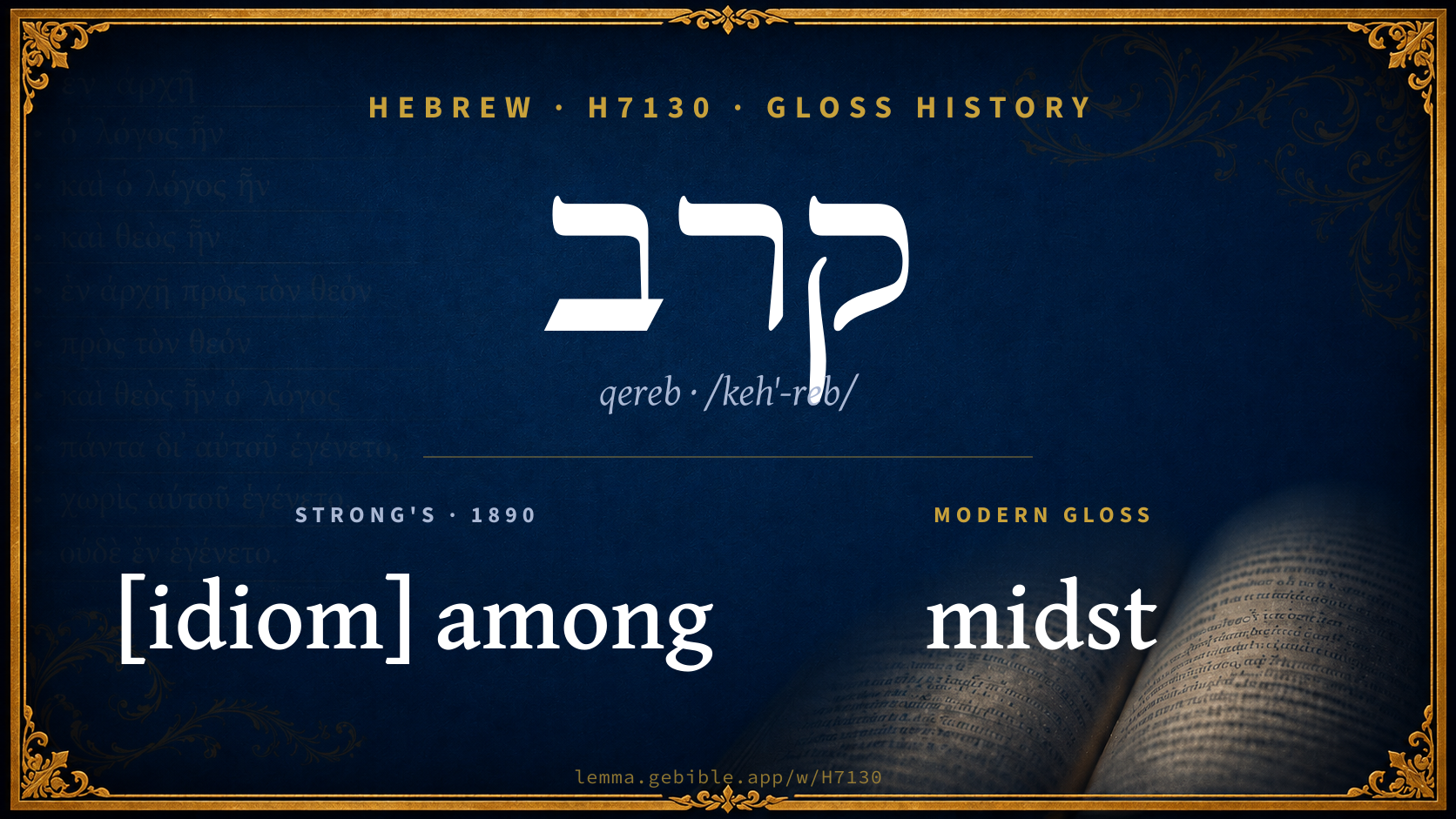
Gloss history
Strong's 1890 vs modern scholarship
About this word
Strong's H7130 catalogs a Hebrew word from the Hebrew Old Testament.
These counts are not copied from any lexicon or concordance. They are computed here, from the morphology-tagged Hebrew Old Testament. What Lemma adds →
- 220
- distinct verses
- The word appears in 220 distinct verses.
- 24 / 39
- OT books
- The word appears in 24 of 39 Old Testament books.
- #207
- by frequency
- Top 250 most frequent Hebrew words (rank 207 of 8,640 Hebrew words by occurrence).
View all 220 occurrences in the concordance →
Most concentrated in
- Deuteronomy 41 verses 19%
- Psalms 27 verses 12%
- Leviticus 20 verses 9%
By section of the Old Testament
By traditional corpus
Conventional, traditional groupings — biblical authorship is debated, so this is a traditional corpus grouping, not an authorship claim. Each share is this word’s portion of its verses in that division of the Hebrew canon. Each figure is a share of the word’s 220 distinct verses.
- Torah (Pentateuch) 94 verses · 43%
- Prophets (Nevi'im) 91 verses · 41%
- Writings (Ketuvim) 35 verses · 16%
How translations render this word
Counts come from each version’s own published word-to-Strong’s tagging or interlinear alignment — an approximate guide to how each version renders this word, not a word-level alignment the data otherwise carries. Because each total is that version’s own tagged count, the per-version totals vary from one another and need not match the appearance or distinct-verse counts above. These counts may also differ from a printed concordance because Lemma counts each distinctly tagged rendering and does not collapse phrase taggings into a single head-word total. This is a fixed set of word-tagged versions (KJV, ASV, BSB, ULT) and does not change with the reading translation you choose elsewhere. Each version’s license is shown beside its name below (and on Sources).
- King James Version: Among 60×, Midst 54×, Within 22×
- American Standard Version: Midst 54×, Among 27×, Inwards 13×
- Berean Standard Bible: Among you 34×, Among 28×, Entrails 15×
- unfoldingWord Literal Text: Midst 52×, Midst of 41×, Among you 17×
King James Version Public Domain
Renders H7130 across 225 tagged occurrences — most commonly:
Plus other, less common renderings. Plus 33 renderings that appear only once — usually multi-word phrases or single function words the recovered tagging swept in, not distinct renderings. Not rendered by a distinct English word in 2 further occurrences.
American Standard Version Public Domain
Renders H7130 across 226 tagged occurrences — most commonly:
Plus other, less common renderings. Plus 50 renderings that appear only once — usually multi-word phrases or single function words the recovered tagging swept in, not distinct renderings.
Berean Standard Bible Public Domain
Renders H7130 across 212 tagged occurrences — most commonly:
Plus other, less common renderings. Plus 39 renderings that appear only once — usually multi-word phrases or single function words the recovered tagging swept in, not distinct renderings. Not rendered by a distinct English word in 15 further occurrences.
unfoldingWord Literal Text CC BY-SA 4.0
Renders H7130 across 227 tagged occurrences — most commonly:
Plus other, less common renderings. Plus 43 renderings that appear only once — usually multi-word phrases or single function words the recovered tagging swept in, not distinct renderings.
Senses in BDB
The 4 senses BDB distinguishes for this word, in lexicon order (not ranked by frequency or importance). The full entry — with sub-senses — is in the Lexicon Entry tab.
- midst, among, inner part, middle
- inward part
- in the midst, among, from among (of a number of persons)
- entrails (of sacrificial animals)
Word origin
קֶ֫רֶב 227 n.[m.] inward part, midst
— Brown-Driver-Briggs (Oxford 1906, public domain), digitized via Sefaria, supplemented by the OpenScriptures HebrewLexicon (CC BY 4.0). See Sources.
Derived from קרב (qârab) (H7126) — to approach.
Jastrow Dictionary
A second Hebrew/Aramaic lexicon for comparison, covering Aramaic and post-biblical (Talmudic, Targumic, Midrashic) usage that the biblical-Hebrew BDB does not. Matched by lemma rather than by Strong’s number, so a lemma may carry more than one Jastrow headword (shown separately below), and the entries cover usage well beyond the Bible.
קָרֵב
- (b. h.)
- 1. to join, come near, be near; to be offered as קָרְבָּן. Zeb. VIII, 2 יִקְרַב לשם מי שהוא let it be offered in behalf of him to whom it may belong. Ib. 5 אם ק׳ … יִקְרְבוּ וכ׳ if one of the heads has been offered, let all of them be offered. Ib. 67ᵇ; Ḳinnim III, 3 חטאת קְרֵיבָה למעלה וכ׳ the sin-offering may have been offered on top and the burnt-offering beneath it. Men. VI, 1 הקומץ ק׳ … קְרֵבִים לעצמן the handful (of the priests’ meal-offering) is offered separately and the remainder separately; Y. Sot. III, 19ᵇ top קְרֵיבִין. Sifré Num. 29 קבע זמן לקריבים … למקריבים a time is fixed for the things to be offered (Lev. XXII, 27), and a time for those who offer (Num. VI, 10); a. fr. e.g. Leviticus 22:27
- 2. to come before court; to sue, complain. Gen. R. s. 96 (ref. to ויקרבו, Gen. XLVII, 29) כאדם … ק׳ על וכ׳ as one says, that man has brought suit against his neighbor, v. קָבַל II; Yalk. ib. 156 קבל (corr. acc.). e.g. Genesis 47:29
- 1. same, same, to come near. Ex. R. s. 20, beg. לא קי׳ אצל וכ׳ he had not come near Sarah.—Esp. to approach; to pray, intercede, mediate, conciliate. Y. Ber. IV, 8ᵇ top זה שעובר … בא וקָרֵב עשה קרבנינו וכ׳ we do not say to him who is to pass before the ark (v. תֵּיבָה), ‘come and pray’, but, ‘come, draw near’, (which means) ‘do our offerings’, ‘satisfy our needs’ &c.
- 2. to bring near; to befriend, attract, invite. B. Kam. 24ᵃ ק׳ נגיחותיו if the ox did his gorings in near intervals (of less than three days). Eduy. VIII, 7 אין אליהו … לרחק ולְקָרֵב … המְקוֹרָבִין בזרוע וכ׳ Elijah shall come not to decide between clean and unclean, nor to expel (declare genealogically degraded) and to receive (reinstate), but to expel those who have been received by force, and to reinstate those who have been expelled by force. Ib. משפחת … וקֵרְבָהּ בן וכ׳ there was a family … which Ben-Zion expelled by force, and another which they received by force (Bab. ed. וקֵרְבוּהָ בני וב׳; v. Rabb. D. S. a. l. note 40); Tosef. ib. III, 4; Kidd. 71ᵃ. Eduy. l. c. לא לרחק ולא לקרב וכ׳ neither to expel nor to reinstate, but to make peace &c. Sabb. 31ᵃ קֵירְבָנוּ תחת וכ׳, v. עִנְוְתָנוּת. Ib. שקֵרַבְתַּנִי וכ׳ Ms. M. (ed. שהקרבתני) thou hast brought us near &c. Tanḥ. Tsav 8 (ref. to Ps. LXV, 5) אשרי מי שבחרו … קֵרְבוֹ blessed he whom the Lord has chosen, although he did not bring him near; Num. R. s. 3 הקריבו. Ib. ק׳ את עצמו he brought himself near (to God, through his own deeds); ib. יתרו קרבו הקב"ה the Lord brought Jethro near (caused him to be converted); Yalk. Ex. 379; a. fr.—Sifré Num. 94 (expl. לזרא, Num. XI, 20, cmp. זָר) שתהיו מרחיקים … מְקָרְבִים אותו you will keep it at a distance (loathe it) more than you have been inviting (wishing for) it; Lev. R. s. 48.—Part. pass. מְקוֹרָב; pl. מְקוֹרָבִין, v. supra. e.g. Psalms 65:5
- 1. to bring near, receive. Y. Dem. II, 23ᵃ top מַקְרִיבִין לכנפים, v. כָּנָף. Num. R. l. c.; Sabb. l. c., v. supra; a. fr.
- 2. to offer, sacrifice. Men. XIII, 10 יַקְרִיבֶנָּה במקדש he must offer it in the Temple (of Jerusalem), ואם הִקְרִיבָהּ וכ׳ but if he offered it in the Temple of Ḥonyo (in Egypt). Zeb. 67ᵇ ותַקְרִיבֶנָּה למעלה and let her offer it on top, (v. supra Kal); Kinn. III, 6 ויַקְרִיבֶנָּה וכ׳ Mish. (Bab. ed. ויקרבנה, corr. acc.) and he (the priest) must offer it &c. Ber. 6ᵇ כאילו ה׳ תודה as if he had offered a thank-offering. Ib. 17ᵃ as long as the Temple stood אדם חוטא ומַקְרִיב וכ׳ a man sinned and brought a sacrifice; ואין מקריבין וכ׳ yet only its fat and its blood were offered; כאילו הִקְרַבְתִּיו לפניך וכ׳ as if I had offered it (my fat and blood) on the altar before thee; a. v. fr.
- to be offered. Y. Meg. I, 70ᶜ top ונִקְרְבוּ מהן וכ׳ and from their contributions was taken the wood for sacrifices; (Y. Taan. IV, 68ᵇ; Y. Shek. IV, beg. 47ᵈ וקרבו).
- 1. to be brought near, be received. Num. R. s. 3 יש נבחר ונדחה ונ׳ וכ׳ some are chosen and repelled (disgraced) and received again &c. Sifra Tsav, Milluïm ידע משה שנ׳ אהרן Moses learned that Aaron was received again (in grace); Yalk. Lev. 515; a. fr.
- 2. to be offered, sacrificed. Y. Taan. l. c. שלא יהא קרבן מִתְקָרֵב וכ׳ that none but their contributions should be offered first. Pirké d’R. El. ch. XXXI אותו האיל … ובא להִתְקָרֵב וכ׳ that ram … ran and came to offer himself as a sacrifice in place of Isaac &c.; Yalk. Gen. 101; a. e.
- 3. to claim relationship. Deut. R. s. 2 אם קרובו עני … פלוני מתקרב לי if a man’s relative is poor, he makes himself the main person and him subordinate, saying, this man claims relationship to me; Y. Ber. IX, 13ᵇ (in mutilated text) ההן פלן מתקרב לן.
קְרֵב
- 1. to be near, come near, touch. Targ. Num. XXVII, 1. Targ. Ex. XXXVI, 2. Targ. I Kings II, 1; a. fr.—Pesik. Zakhor, p. 24ᵇ קריב לגביה, v. בָּלַם II. Eduy. VIII, 4 דיִקְרַב במיתא he who touches a corpse; a. e.
- 2. to intercede, protect. Y. Dem. I, 22ᵃ בני קרתי קוֹרְבִין לי (not קרתיה) fellow-citizens, protect me!; בני דודי קורבין לי (not דידי) children of my friend (the Lord), protect you me!; Y. Taan. III, 66ᶜ top בני דילי וכ׳ (corr. acc.).
- 3. to complain, sue. Y. B. Bath. IX, beg. 16ᵈ אתון בנוי קַרְבוּן וכ׳ his sons came and complained before R. E. Ib. אתת וקְרֵיבָה וכ׳ she came and complained &c.
- 4. to bring near; to offer, v. infra.
- 1. to bring near; to offer. Targ. Gen. XLVIII, 9, sq. Ib. 13 (Y. ed. Vien. קְריב; h. text ויַּגֵּשׁ). Targ. Is. LVIII, 3 (h. text תִּנְגּשׁוֹּ!). Targ. O. Lev. I, 2 יְקָרֵיב (Y. יִקְרַב). Ib. 3 (Y. יַקְרִיב Af.). Ib. 14 (Y. also יַקְרִיב); a. fr.—Gitt. 56ᵃ סבור רבנן לקָרוּבֵיה the rabbis were of the opinion that it should be offered. Y. Ber. IX, 13ᵈ top הוה … אתי למִיקָרְבָה וכ׳ (or למִיקְרְבָה) when a man came to offer, to the idol, an ox &c. Y. Snh. X, 29ᵇ מְקָרְבָא לגיחזי to bring Gehazi near (befriend him again). Num. R. s. 3 אלהכון מאן הוא בעי מְקָרֵיב does your God bring near him (grace) whomever he chooses to? B. Bath. 168ᵃ אפי׳ צורבא … לְקָרוּבֵיה even in the case of a young scholar whom it may be supposed his intended father-in-law likes to bring into his family; a. fr.—Part. pass. מְקָרַב; f. מְקָרְבָא, מְקָרְבָה; pl. מְקָרְבִין; מְקָרְבָן near, friendly. Sabb. 104ᵃ מ"ט שקר ק׳ מיליה אמת וכ׳ why are the letters of שקר (falsehood) near together (in the order of the alphabet), and those of אמת (truth) far apart? Snh. 29ᵃ מק׳ דעתיה he is friendly, v. רְחַק.—3) to intercede, lead in prayer. Midr. Till. to Ps. XIX חזיוה לחזנא דקָרֵיב וכ׳ they noticed that the officer of the synagogue led in prayer and said &c.
- to bring near; to offer. Targ. Mal. II, 12; a. fr.—Gitt. l. c. אי מַקְרְבִין ליה (or מְקָרְבִין Pa.), v. קָרְבַּן. Ḥag. 8ᵇ האי דלא אַקְרְבִינְהוּ וכ׳ the reason why they did not offer them was &c.; a. fr.—Yeb. 39ᵇ איקרבת ית וכ׳ (read: אַקְרִיבַת) she brought before us (the court) such and such a person &c.
- 1. to approach, come near. Targ. Y. Deut. XX, 3; O. ib. ed. Berl. (oth. ed. קריבין). Ib. XXV, 9; a. fr.—Keth. 56ᵃ משום אִיקָּרוּבֵי דעתא הוא והא אִיקָּרְבָא דעתא (when a man promises his bride an additional jointure,) it is in order that an attachment be formed; well, now, the attachment has been formed (and we have a right to assume that he wanted his bride to get that addition, even if he should die before the wedding).
- 2. to claim relationship, v. preced.
קֶרֶב
- preced.)
- 1. inside, intestine.—Du. קְרָבַיִם, קְרָבַיִים; constr. קִרְבֵּי, קִירְ׳. Num. R. s. 7 (ref. to Num. XIV, 11 בקרבו) אטר אעשה עמו … בקרבו כמה … עשיתי בקִרְבֵּיהֶן וכ׳ it does not read, ‘which I do with them’, but ‘which I do within them’:… how many signs and wonders have I done in their intestines (that the manna was entirely resorbed in their bowels) &c. (with ref. to קֶרֶב Lev. VIII, 21). Tam. IV, 2. Ḥull. 16ᵇ קירבי דגים entrails of fish. Y. Sabb. II, 4ᵈ ק׳ דגים כל זמן וכ׳ the fat of fish entrails (used as oil) has no bad odor as long as it burns. B. Mets. 60ᵇ, v. נָפַח; a. fr.—Ned. 54ᵇ ק׳ לאו בשר וכ׳ entrails are no meat and he who eats them is no man; Y. ib. VII, beg. 40ᵇ קרבייא (ch. form). Ber. 10ᵃ; a. fr. e.g. Numbers 14:11
- 2. innermost; בְּקֶרֶב within. Pesik. R. s. 13 בְּקִרְבַּנוּ, v. רָחַשׁ; a. e.
קָרֵב ²
- m., v. קָרֵיב
קְרָב
- preced. wds.) hostile contact, attack, war. Y. Sot. VIII, 21ᶜ top רומי לק׳ the Roman (Latin) language is adapted for military affairs; Y. Meg. I, 71ᵇ bot.; Esth. R. to I, 22. Sabb. 59ᵃ בשעה שבורח מן הק׳ וכ׳ when he flees from the battle, he puts it on &c.; a. e.
קְרָב ²
- Targ. II Sam. XXI, 15. Targ. Ps. XXVII, 3. Ib. XXXV, 1; a. fr.—Ib. קְרַבְתִּי, v. קְרָבוּ.—Tosef. Sot. XIII, 5, v. נְגַח; Y. ib. IX, 24ᵇ; Bab. ib. 33ᵃ. Lev. R. s. 22 דעבד ק׳ עם וכ׳ who wages war with a king &c. Gitt. 56ᵃ ניפוק … ק׳ בהדייהו let us go out and offer them (the Romans) battle; a. fr.—Pl. קְרָבִין, קְרָבַיָּא. Targ. Num. XXI, 14. Targ. I Chr. XXVIII, 3; a. e.
A Dictionary of the Targumim, the Talmud Babli and Yerushalmi, and the Midrashic Literature (Marcus Jastrow; London, Luzac, 1903) — Public Domain. Digitized via Sefaria. Digitized via Sefaria. Full attribution on Sources.
Forms in the corpus
The 91 distinct written forms H7130 takes in the Hebrew Bible, most frequent first — each parse links to that state’s occurrences in the concordance. Hebrew forms include their vowel points and cantillation, so a single lemma takes many written forms.
The 60 most common forms are shown; 31 rarer forms follow in the full concordance.
Same root — word family
Other BDB entries built from the same root as H7130, grouped by Strong’s listed origin. These share a root / origin per the lexicon — not necessarily a shared meaning. Each links to that word’s own entry.
Derives from
Shares the same root
- קרב qᵉrêb H7127 to approach
- קרב qᵉrâb H7128 battle
- קרב qârêb H7131 near
- קרבה qᵉrâbâh H7132 approach
- קרבן qorbân H7133 offering
- קרוב qârôwb H7138 near
Compare all same-root words → Showing 4 of 8 — not the complete family. They share a root, not necessarily a meaning.
Septuagint verse parallels
This word appears in 208 verses that also exist in the Greek Old Testament (Septuagint), out of the 220 Hebrew verses it occurs in. You can read those verses in Greek by switching the Old Testament edition to the Septuagint.
Read these verses in the Septuagint
- Genesis 18:12
- Exodus 3:20
- Leviticus 1:9
- Numbers 5:27
- Deuteronomy 1:42
- Joshua 1:11
- Judges 1:29
- 1 Samuel 4:3
- 1 Kings 3:28
- Job 20:14
- Psalms 5:9
- Proverbs 14:33
This is a verse-level parallel only — the same verses exist in both the Hebrew and Greek Old Testaments. No word-level Hebrew↔Greek correspondence is claimed: the data carries no such alignment, so no Greek word is shown as this Hebrew word’s translation. Coverage is not total — the Septuagint omits the deuterocanon and renumbers the Psalms, so some Hebrew verses have no direct Greek parallel.