
Leviticus 22:18

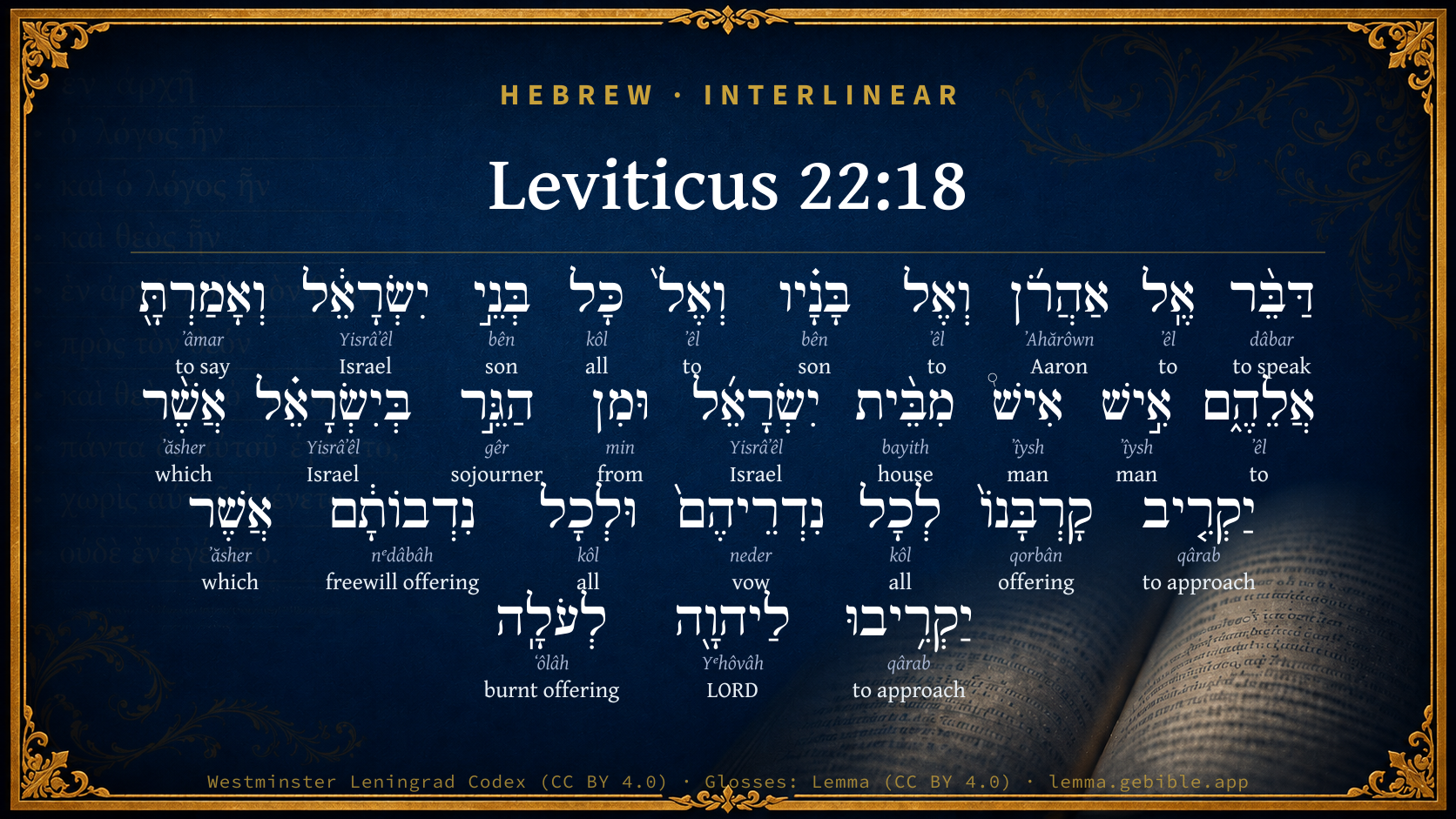
Hebrew (Westminster Leningrad Codex) Leviticus 22:18 appears in the Hebrew Old Testament. The text above is from the Westminster Leningrad Codex. Each word links to its Strong’s number, a concise gloss, and parsing drawn from the Open Scriptures Hebrew Bible morphology. Click any word for its full Brown-Driver-Briggs (BDB) entry.
Download image
Cite this verse

Leviticus 22:18 (World English Bible). Public Domain. Lemma interlinear Bible study tool, https://lemma.gebible.app/v/leviticus/22/18.

Show BibTeX & RIS
BibTeX
RIS
English Translation
"Speak to Aaron, and to his sons, and to all the children of Israel, and say to them, 'Whoever is of the house of Israel, or of the foreigners in Israel, who offers his offering, whether it be any of their vows, or any of their freewill offerings, which they offer to Yahweh for a burnt offering;
World English Bible · Public Domain
Download a study sheet

One document with this verse’s original text, its word-by-word gloss line, the meaning frame, cross-references with their text, attributed commentary, and full source and license credits — printable, and it pastes into notes with its structure intact.

This verse Autodidact and up

Study sheet (.html) Plain text (.txt)

A passage Seminary Student

Up to 50 verses in one chapter. A passage sheet keeps up to 6 commentary sources and 12 cross-references per verse, in the order this page ranks them, and says so on the sheet whenever that leaves anything out. Ask for a single verse and you get the Autodidact verse sheet above.

Everything on this page stays free to read, with no account — the sheet is a download of what is already on screen, not access to it.

Want to remove ads? Support Godless Engineer
Compare translations 3

The same verse in 3 English versions, stacked beneath the original-language interlinear above. Click any original word for its lexicon entry.

Each is an independent rendering of the whole verse — the interlinear is not word-aligned to these translations.

Highlighted words mark where these versions differ — a whole-verse word diff, not a word-by-word alignment.

  • World English Bible Public Domain
    "Speak to Aaron, and to his sons, and to all the children of Israel, and say to them, 'Whoever is of the house of Israel, or of the foreigners in Israel, who offers his offering, whether it be any of their vows, or any of their freewill offerings, which they offer to Yahweh for a burnt offering;
  • King James Version Public Domain
    Speak unto Aaron, and to his sons, and unto all the children of Israel, and say unto them, Whatsoever he be of the house of Israel, or of the strangers in Israel, that will offer his oblation for all his vows, and for all his freewill offerings, which they will offer unto the LORD for a burnt offering;
  • unfoldingWord Literal Text CC BY-SA 4.0
    “Speak to Aaron and to his sons and to all the sons of Israel, and you shall say to them, ‘A man, a man from the house of Israel or from the sojourner in Israel, who presents his offering, for any of their vows or for any of their freewill offerings, which they present to Yahweh as a burnt offering,

unfoldingWord Literal Text — © unfoldingWord, licensed CC BY-SA 4.0. Word-aligned USFM3 via Door43 (git.door43.org/unfoldingWord/en_ult).

Versions to compare (up to 4)

3 of 4 selected

Show all 18 translations

Every available English version of this verse, each an independent rendering of the whole verse.

  • World English Bible Public Domain
    "Speak to Aaron, and to his sons, and to all the children of Israel, and say to them, 'Whoever is of the house of Israel, or of the foreigners in Israel, who offers his offering, whether it be any of their vows, or any of their freewill offerings, which they offer to Yahweh for a burnt offering;
  • Berean Standard Bible Public Domain
    “Speak to Aaron and his sons and all the Israelites and tell them, ‘Any man of the house of Israel or any foreign resident who presents a gift for a burnt offering to the LORD, whether to fulfill a vow or as a freewill offering,
  • Majority Standard Bible Public Domain
    “Speak to Aaron and his sons and all the Israelites and tell them, ‘Any man of the house of Israel or any foreign resident who presents a gift for a burnt offering to the LORD, whether to fulfill a vow or as a freewill offering,
  • King James Version Public Domain
    Speak unto Aaron, and to his sons, and unto all the children of Israel, and say unto them, Whatsoever he be of the house of Israel, or of the strangers in Israel, that will offer his oblation for all his vows, and for all his freewill offerings, which they will offer unto the LORD for a burnt offering;
  • American Standard Version (1901) Public Domain
    Speak unto Aaron, and to his sons, and unto all the children of Israel, and say unto them, Whosoever he be of the house of Israel, or of the sojourners in Israel, that offereth his oblation, whether it be any of their vows, or any of their freewill-offerings, which they offer unto Jehovah for a burnt-offering;
  • Revised Version (1885) Public Domain
    Speak unto Aaron, and to his sons, and unto all the children of Israel, and say unto them, Whosoever he be of the house of Israel, or of the strangers in Israel, that offereth his oblation, whether it be any of their vows, or any of their freewill offerings, which they offer unto the LORD for a burnt offering;
  • Geneva Bible (1599) Public Domain
    Speake vnto Aaron, and to his sonnes, and to all the children of Israel, and say vnto them, Whosoeuer he be of the house of Israel, or of the strangers in Israel, that will offer his sacrifice for all their vowes, and for all their free offrings, which they vse to offer vnto the Lord for a burnt offring,
  • Douay-Rheims (1899) Public Domain
    Speak to Aaron, and to his sons, and to all the children of Israel, and thou shalt say to them: The man of the house of Israel, and of the strangers who dwell with you, that offereth his oblation, either paying his vows, or offering of his own accord, whatsoever it be which he presenteth for a holocaust of the Lord,
  • Young's Literal Translation Public Domain
    `Speak unto Aaron, and unto his sons, and unto all the sons of Israel, and thou hast said unto them, Any man of the house of Israel, or of the sojourners in Israel, who bringeth near his offering, of all his vows, or of all his willing offerings which they bring near to Jehovah for a burnt-offering;
  • Literal Standard Version CC BY-SA 4.0
    “Speak to Aaron, and to his sons, and to all the sons of Israel, and you have said to them: Any man of the house of Israel, or of the sojourners in Israel, who brings his offering near, of all his vows, or of all his willing offerings which they bring near to YHWH for a burnt-offering—
  • Unlocked Literal Bible CC BY-SA 4.0
    “Speak to Aaron and his sons, and to all the people of Israel. Say to them, 'Any Israelite, or an alien living in Israel, when they present a sacrifice—whether it is to fulfill a vow, or whether it is a freewill offering, or they present to Yahweh a burnt offering,
  • unfoldingWord Literal Text CC BY-SA 4.0
    “Speak to Aaron and to his sons and to all the sons of Israel, and you shall say to them, ‘A man, a man from the house of Israel or from the sojourner in Israel, who presents his offering, for any of their vows or for any of their freewill offerings, which they present to Yahweh as a burnt offering,
  • Darby Bible Public Domain
    Speak unto Aaron, and to his sons, and unto all the children of Israel, and say unto them, Whatever man of the house of Israel, or of the sojourners in Israel, that presenteth his offering for any of his vows, and for any of his voluntary offerings, which they present to Jehovah as a burnt-offering,
  • World Messianic Bible Public Domain
    “Speak to Aaron, and to his sons, and to all the children of Israel, and say to them, ‘Whoever is of the house of Israel, or of the foreigners in Israel, who offers his offering, whether it is any of their vows or any of their free will offerings, which they offer to the LORD for a burnt offering:
  • Webster's Bible Public Domain
    Speak to Aaron, and to his sons, and to all the children of Israel, and say to them, Whoever he may be of the house of Israel, or of the strangers in Israel, that will offer his oblation for all his vows, and for all his free-will-offerings, which they will offer to the LORD for a burnt-offering:
  • Free Bible Version CC BY-SA 4.0
    “Tell Aaron, his sons and all the Israelites: If you or a foreigner living with you wants to make a gift as a burnt offering to the Lord, whether it's to fulfill a promise or as a freewill offering, this is what you are to do.
  • Bible in Basic English Public Domain
    Say to Aaron and to his sons and to all the children of Israel, If any man of the children of Israel, or of another nation living in Israel, makes an offering, given because of an oath or freely given to the Lord for a burned offering;
  • JPS Tanakh (1917) Public Domain
    Speak unto Aaron, and to his sons, and unto all the children of Israel, and say unto them: Whosoever he be of the house of Israel, or of the strangers in Israel, that bringeth his offering, whether it be any of their vows, or any of their free-will-offerings, which are brought unto the LORD for a burnt-offering;

Literal Standard Version (2020), Covenant Press — licensed CC BY-SA 4.0. Text via the HelloAO Bible API (eBible.org). Unlocked Literal Bible (unfoldingWord) — licensed CC BY-SA 4.0. Text via the HelloAO Bible API (eBible.org). unfoldingWord Literal Text — © unfoldingWord, licensed CC BY-SA 4.0. Word-aligned USFM3 via Door43 (git.door43.org/unfoldingWord/en_ult). Free Bible Version, Dr. Jonathan Gallagher — licensed CC BY-SA 4.0. Text via the HelloAO Bible API (eBible.org).

Word by word

More ways to search: Search by grammar → Find every occurrence → Compare this word →

Practice this passage: Drill this verse → Learn its vocabulary →

נִדְבוֹתָ֔ם
nᵉdâbâh
H5071
“freewill offerings · their”
Noun, Common, Feminine, Plural, Construct + Suffix, Personal, 3rd Person, Masculine, Plural
Part of Speech
Noun
Type
Common
Gender
Feminine
Number
Plural
State
Construct
Full BDB Definition

Origin: from H5068

TWOT: 1299a

voluntariness, free-will offering - voluntariness - freewill, voluntary, offering
  1. דַּבֵּ֨ר dâbar H1696 “speak” Verb, Piel, Imperative, 2nd Person, Masculine, Singular
  2. אֶֽל ʼêl H413 “to” Preposition
  3. אַהֲרֹ֜ן ʼAhărôwn H175 “Aaron” Noun, Proper
  4. וְאֶל ʼêl H413 “and · to” Conjunction + Preposition
  5. בָּנָ֗יו bên H1121 “sons · his” Noun, Common, Masculine, Plural, Construct + Suffix, Personal, 3rd Person, Masculine, Singular
  6. וְאֶל֙ ʼêl H413 “and · to” Conjunction + Preposition
  7. כָּל kôl H3605 “all of” Noun, Common, Masculine, Singular, Construct
  8. בְּנֵ֣י bên H1121 “sons of” Noun, Common, Masculine, Plural, Construct
  9. יִשְׂרָאֵ֔ל Yisrâʼêl H3478 “Israel” Noun, Proper
  10. וְאָמַרְתָּ֖ ʼâmar H559 “and · to say” Conjunction + Verb, Qal, Sequential Perfect, 2nd Person, Masculine, Singular
  11. אֲלֵהֶ֑ם ʼêl H413 “to · them” Preposition + Suffix, Personal, 3rd Person, Masculine, Plural
  12. אִ֣ישׁ ʼîysh H376 “man” Noun, Common, Masculine, Singular, Absolute
  13. אִישׁ֩ ʼîysh H376 “man” Noun, Common, Masculine, Singular, Absolute
  14. מִבֵּ֨ית bayith H1004 “from · house of” Preposition + Noun, Common, Masculine, Singular, Construct
  15. יִשְׂרָאֵ֜ל Yisrâʼêl H3478 “Israel” Noun, Proper
  16. וּמִן min H4480 “and · from” Conjunction + Preposition
  17. הַגֵּ֣ר gêr H1616 “the · sojourner” Particle, Definite Article + Noun, Common, Masculine, Singular, Absolute
  18. בְּיִשְׂרָאֵ֗ל Yisrâʼêl H3478 “in/at · Israel” Preposition + Noun, Proper
  19. אֲשֶׁ֨ר ʼăsher H834 “which” Particle, Relative
  20. יַקְרִ֤יב qârab H7126 “to approach” Verb, Hiphil, Imperfect, 3rd Person, Masculine, Singular
  21. קָרְבָּנוֹ֙ qorbân H7133 “offering · his” Noun, Common, Masculine, Singular, Construct + Suffix, Personal, 3rd Person, Masculine, Singular
  22. לְכָל kôl H3605 “to/for · all of” Preposition + Noun, Common, Masculine, Singular, Construct
  23. נִדְרֵיהֶם֙ neder H5088 “vows · their” Noun, Common, Masculine, Plural, Construct + Suffix, Personal, 3rd Person, Masculine, Plural
  24. וּלְכָל kôl H3605 “and · to/for · all of” Conjunction + Preposition + Noun, Common, Masculine, Singular, Construct
  25. אֲשֶׁר ʼăsher H834 “which” Particle, Relative
  26. יַקְרִ֥יבוּ qârab H7126 “to approach” Verb, Hiphil, Imperfect, 3rd Person, Masculine, Plural
  27. לַיהוָ֖ה Yᵉhôvâh H3068 “to/for · LORD” Preposition + Noun, Proper
  28. לְעֹלָֽה ʻôlâh H5930 “to/for · burnt offering” Preposition + Noun, Common, Feminine, Singular, Absolute

About this verse

These counts appear in no published source. They are computed here, from the morphology-tagged text and Lemma’s own curated glosses. What Lemma adds →

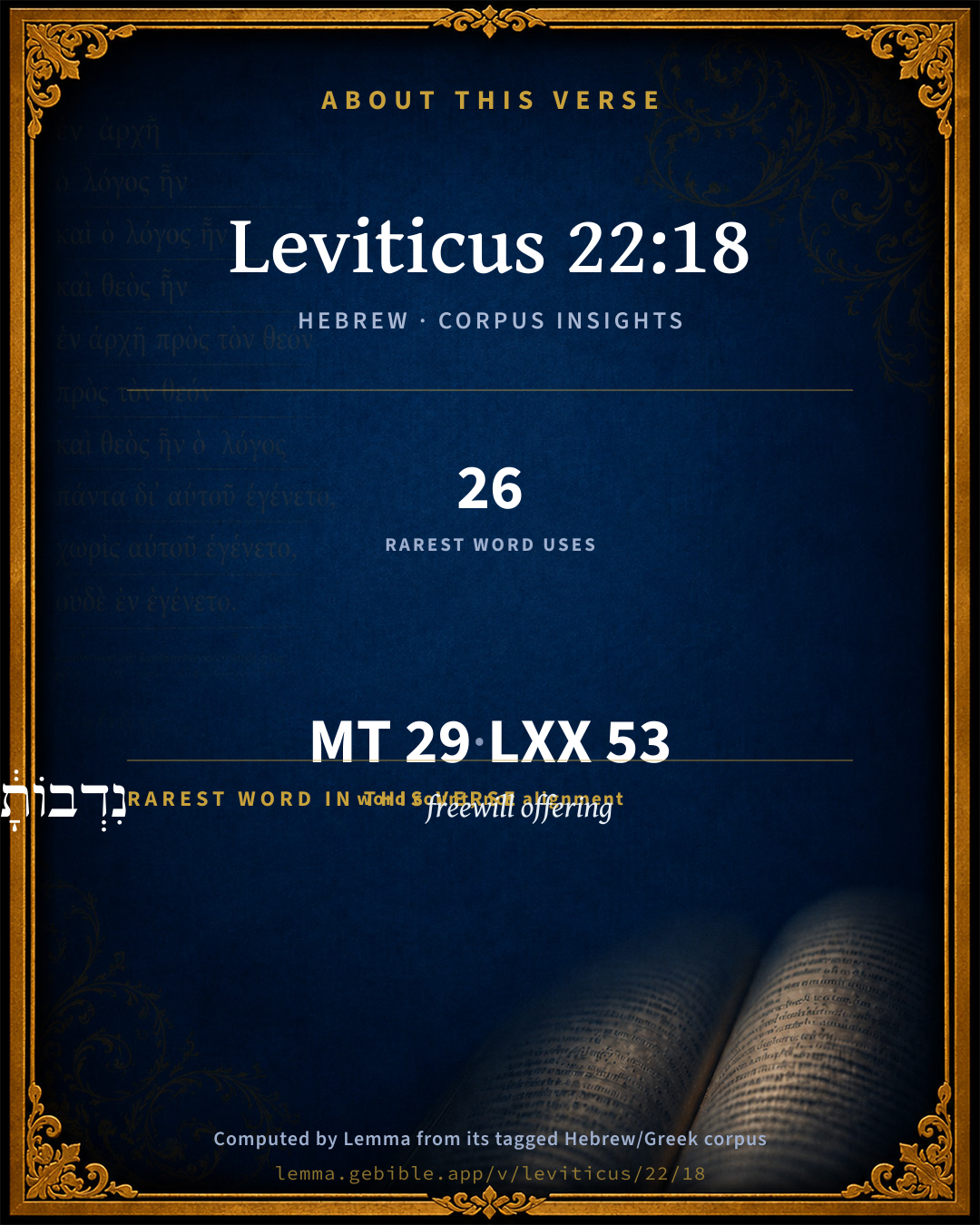
29
words
18
distinct lemmas
Pentateuch
section

Shared distinctive vocabulary

נִדְבוֹתָ֔ם freewill offering H5071 occurs in 25 verses of the Hebrew Bible. Also found in:

Grammatical profile

  • 4 verbs
  • 18 nouns
  • 5 prepositions
  • 2 particles

Verb forms

  • דַּבֵּ֨ר Piel · Imperative
  • וְאָמַרְתָּ֖ Qal · Sequential Perfect
  • יַקְרִ֤יב Hiphil · Imperfect
  • יַקְרִ֥יבוּ Hiphil · Imperfect

Repetition

Words recur within this verse — often emphatic in Hebrew:

  • כָּל all H3605 ×3
  • יִשְׂרָאֵ֔ל Israel H3478 ×3
  • בָּנָ֗יו son H1121 ×2
  • אִ֣ישׁ man H376 ×2
  • יַקְרִ֤יב to approach H7126 ×2
  • אֶֽל to H413 ×4
  • אֲשֶׁ֨ר which H834 ×2

Hebrew & Septuagint length

In English translation the verse runs 57 words from the Hebrew and 63 from the Septuagint (LXX English) — closely comparable.

A rough comparison of the two English renderings, which tokenize alike — not a word-level alignment.

Word counts can differ between the Hebrew and the Greek without any difference in meaning — e.g. the Hebrew direct-object marker אֵת has no separate Greek word, and Greek often adds the article ὁ.

In the original languages it is 29 Hebrew tokens and 53 Greek tokens — but the two are counted differently (Hebrew bundles its prefixes and suffixes into one token; the Greek is in lemma form), so that isn’t a like-for-like length.

Cross-references

24

Topical passages linked to Leviticus 22:18 in the Treasury of Scripture Knowledge — connected by theme and wording, ordered by reader-vote popularity; previews shown in the World English Bible.

  • Leviticus 1:2 "Speak to the children of Israel, and tell them, 'When anyone of you offers an offering to Yahweh, you shall offer your offering of the cattle, from the herd and from the flock.
  • Numbers 15:3 and will make an offering by fire to Yahweh, a burnt offering, or a sacrifice, to accomplish a vow, or as a freewill-offering, or in your set feasts, to make a sweet savor to Yahweh, of the herd, or of the flock;
  • Deuteronomy 12:6 and there you shall bring your burnt offerings, and your sacrifices, and your tithes, and the heave-offering of your hand, and your vows, and your freewill-offerings, and the firstborn of your herd and of your flock:
  • Psalms 56:12 Your vows are on me, God. I will give thank offerings to you.
  • Jonah 1:16 Then the men feared Yahweh exceedingly; and they offered a sacrifice to Yahweh, and made vows.
  • Jonah 2:9 But I will sacrifice to you with the voice of thanksgiving. I will pay that which I have vowed. Salvation belongs to Yahweh."
  • Leviticus 1:10 "'If his offering is from the flock, from the sheep, or from the goats, for a burnt offering, he shall offer a male without blemish.
  • Leviticus 7:16 "'But if the sacrifice of his offering is a vow, or a freewill offering, it shall be eaten on the day that he offers his sacrifice; and on the next day what remains of it shall be eaten:
  • Leviticus 17:10 "'Any man of the house of Israel, or of the strangers who live as foreigners among them, who eats any kind of blood, I will set my face against that soul who eats blood, and will cut him off from among his people.
  • Leviticus 17:13 "'Whatever man there is of the children of Israel, or of the strangers who live as foreigners among them, who takes in hunting any animal or bird that may be eaten; he shall pour out its blood, and cover it with dust.
  • Leviticus 23:38 besides the Sabbaths of Yahweh, and besides your gifts, and besides all your vows, and besides all your freewill offerings, which you give to Yahweh.
  • Numbers 15:14–16 If a stranger lives as a foreigner with you, or whoever may be among you throughout your generations, and will offer an offering made by fire, of a sweet savor to Yahweh; as you do, so he shall do.
  • Deuteronomy 12:17 You may not eat within your gates the tithe of your grain, or of your new wine, or of your oil, or the firstborn of your herd or of your flock, nor any of your vows which you vow, nor your freewill-offerings, nor the heave-offering of your hand;
  • Deuteronomy 16:10 You shall keep the feast of weeks to Yahweh your God with a tribute of a freewill-offering of your hand, which you shall give, according as Yahweh your God blesses you:
  • Psalms 22:25 Of you comes my praise in the great assembly. I will pay my vows before those who fear him.
  • Psalms 61:5 For you, God, have heard my vows. You have given me the heritage of those who fear your name.
  • Psalms 61:8 So I will sing praise to your name forever, That I may fulfill my vows daily.
  • Psalms 65:1 Praise waits for you, God, in Zion. To you shall vows be performed.
  • Psalms 66:13 I will come into your temple with burnt offerings. I will pay my vows to you,
  • Psalms 116:14 I will pay my vows to Yahweh, Yes, in the presence of all his people.
  • Psalms 116:18 I will pay my vows to Yahweh, Yes, in the presence of all his people,
  • Ecclesiastes 5:4 When you vow a vow to God, don't defer to pay it; for he has no pleasure in fools. Pay that which you vow.
  • Nahum 1:15 Behold, on the mountains the feet of him who brings good news, who publishes peace! Keep your feasts, Judah! Perform your vows, for the wicked one will no more pass through you. He is utterly cut off.
  • Acts 18:18 Paul, having stayed after this many more days, took his leave of the brothers, and sailed from there for Syria, together with Priscilla and Aquila. He shaved his head in Cenchreae, for he had a vow.

Cross-references courtesy of OpenBible.info (CC BY 4.0).

Hebrew and Greek witnesses Masoretic Hebrew ↔ Greek Septuagint

The same verse in the two great witnesses to the Old Testament, shown verse-for-verse.

These are two independent witnesses, not word-aligned to each other, and the Septuagint is shown in lemma (dictionary) form.

Hebrew Leviticus 22:18 Masoretic · Westminster Leningrad Codex

דַּבֵּ֨ר אֶֽל אַהֲרֹ֜ן וְאֶל בָּנָ֗יו וְאֶל֙ כָּל בְּנֵ֣י יִשְׂרָאֵ֔ל וְאָמַרְתָּ֖ אֲלֵהֶ֑ם אִ֣ישׁ אִישׁ֩ מִבֵּ֨ית יִשְׂרָאֵ֜ל וּמִן הַגֵּ֣ר בְּיִשְׂרָאֵ֗ל אֲשֶׁ֨ר יַקְרִ֤יב קָרְבָּנוֹ֙ לְכָל נִדְרֵיהֶם֙ וּלְכָל נִדְבוֹתָ֔ם אֲשֶׁר יַקְרִ֥יבוּ לַיהוָ֖ה לְעֹלָֽה

"Speak to Aaron, and to his sons, and to all the children of Israel, and say to them, 'Whoever is of the house of Israel, or of the foreigners in Israel, who offers his offering, whether it be any of their vows, or any of their freewill offerings, which they offer to Yahweh for a burnt offering;

World English Bible · Public Domain

Greek LXX Leviticus 22:18 Septuagint · lemma form

λαλέω ἀαρών καί ὁ υἱός αὐτός καί πᾶς συναγωγή ἰσραήλ καί εἶπον πρός αὐτός ἄνθρωπος ἄνθρωπος ἀπό ὁ υἱός ἰσραήλ ἤ ὁ υἱός ὁ προσήλυτος ὁ προςκεῖμαι πρός αὐτός ἐν ἰσραήλ ὅς ἄν προςφέρω ὁ δῶρον αὐτός κατά πᾶς ὁμολογία αὐτός ἤ κατά πᾶς αἵρεσις αὐτός ὅσος ἄν προςφέρω ὁ θεός εἰς ὁλοκαύτωμα

Speak to Aaron and his sons, and to all the congregation of Israel, and you shall say to them, Any man of the children of Israel, or of the strangers that abide among them in Israel, who shall offer his gifts according to all their confession and according to all their choice, whatever they may bring to the Lord for whole burnt offerings—

LXX2012 (modern English Septuagint) · Public Domain

Hebrew: Westminster Leningrad Codex (CC BY 4.0). Greek: Septuagint (public domain); English from LXX2012 (modern English Septuagint) (Public Domain). How the Septuagint differs from the Hebrew →

Targum (Aramaic paraphrase)

2

The Targum is the ancient Jewish Aramaic paraphrase of the Hebrew Scriptures — an interpretive translation, not the Hebrew text itself. Onkelos (literal) and Pseudo-Jonathan (expansive) render the Torah, and Jonathan the Prophets. Coverage is partial: where no permissively-licensed English translation exists for a verse, only the Aramaic is shown. This is verse-level text, not a word-by-word alignment to the Hebrew.

  1. Targum Onkelos Torah (Genesis–Deuteronomy)
    מַלֵל עִם אַהֲרֹן וְעִם בְּנוֹהִי וְעִם כָּל בְּנֵי יִשְׂרָאֵל וְתֵימַר לְהוֹן גְבַר גְבַר מִבֵּית יִשְׂרָאֵל וּמִן גִיוֹרָא בְּיִשְׂרָאֵל דִי יְקָרֵב קֻרְבָּנֵהּ לְכָל נִדְרֵיהוֹן וּלְכָל נִדְבָתְהוֹן דִי יְקָרְבוּן קֳדָם יְיָ לַעֲלָתָא

    (no public-domain English translation for this verse)

    Targum Onkelos — Aramaic: “Onkelos Genesis” (public domain); “Onkelos Exodus” (public domain); “Onkelos Leviticus” (public domain); “Onkelos Numbers” (public domain); “Onkelos Deuteronomy” (public domain). English: “Sefaria Community Translation” (CC0 1.0 (public-domain dedication)); “J.W. Etheridge. The Targums of Onkelos and Jonathan Ben Uzziel on the Pentateuch. London: Longmans, Green, 1862” (public domain). Text via Sefaria.

  2. Targum Pseudo-Jonathan Torah (Genesis–Deuteronomy)
    מַלֵיל עִם אַהֲרן וְעִם בְּנוֹי וְעִם כָּל בְּנֵי יִשְרָאֵל גְבַר טְלֵי אוֹ גְבַר סִיב מִבֵּית גְנִיסַת יִשְרָאֵל וּמִן גִיוֹרָא דִבְיִשְרָאֵל דְיִקְרַב קוּרְבָּנֵיהּ לְכָל נִדְרֵיהוֹן וּלְכָל נְסִיבַתְהוֹן דִיקַרְבוּן קֳדָם יְיָ לְעָלָתָא

    Speak with Aharon and with his sons and with all the children of Israel: -A man, whether young or old, of the house of the family of Israel, or of the strangers who are in Israel, who shall offer his oblation of any of their vows, or their free will offerings which they present before the Lord for a burnt sacrifice,

    Targum Pseudo-Jonathan — Aramaic: “Targum Jonathan on Genesis” (public domain); “Targum Jonathan on Exodus” (public domain); “Targum Jonathan on Leviticus” (public domain); “Targum Jonathan on Numbers” (public domain); “Targum Jonathan on Deuteronomy” (public domain). English: “The Targum of Jonathan ben Uzziel, trans. J. W. Etheridge, London, 1862” (public domain). Text via Sefaria.

Commentary

Notes on Leviticus 22:18 from classic Christian and Jewish commentators (each source and its license shown beneath its notes). The classic Christian expositions comment on the surrounding passage and are grouped to its opening verse, so a note may address several verses; the Jewish commentaries on the Tanakh (Rashi and others) are per-verse, so they appear only where the commentator wrote on this verse.

Lemma curates 59 commentaries, every one of them public domain or Creative Commons licensed, each selected and text-cleaned for this edition rather than reprinted as found. About our sources →

Tyndale Open Study Notes

Tyndale Open Resources

22:18 Apparently individuals could present a whole burnt offering instead of a peace offering if they desired (see 1:3).

Tyndale Open Study Notes — © Tyndale Open Resources, licensed CC BY-SA 4.0. Text via the HelloAO Bible API.

Ellicott's Commentary for English Readers

(18) And unto all the children of Israel.—As the following laws presented the condition of the animals which the Israelites are to offer, they are addressed to the laity as well as to the priests.

Whatsoever he be.—Better, what man soever there be, as it is translated in the Authorised version Lev_17:3 (and see Note on Lev_17:8).

Offer his oblation.—Better, offer his offering, as the Authorised version translates it in Lev_3:7; Lev_3:14; Lev_7:12; Lev_17:4, &c. It is difficult to divine why the translators gave here a different rendering of a fixed sacrificial formula which it is important to reproduce uniformly in a translation.

For all his vows, and for all his freewill offerings.—Better, for any manner of vow, or for any manner of freewill offering. That is, if an Israelite by race, or one who was originally a stranger but has joined the Jewish community, brings a sacrifice, be it in consequence of a vow which he has made, or be it a freewill offering. Both these kinds of sacrifices were entirely voluntary, and the difference between them is described in Lev_7:16.

A Bible Commentary for English Readers, edited by Charles John Ellicott (1878–1897) — public domain. Text from a community e-Sword module.

John Gill's Exposition

Ye shall offer at your own will,.... For vows and freewill offerings were at their own option, and depended on their own will and pleasure, and when offered should be with a willing mind, and from their whole heart: or "for good will to you"; as the Targums of Onkelos and Jonathan; or for gracious, acceptation, that is, that they might be well pleasing to God, and acceptable in his sight, so Jarchi; in order to which the following direction was strictly to be observed:

a male without blemish, of the beeves, of the sheep, and of the goats; bullocks, sheep, and goats, were the only sorts of beasts, out of which sacrifices were taken, and those that were for burnt offerings were always to be males, and unblemished, see Lev 1:3; but for other offerings, as peace offerings and sin offerings, females might be used, see Lev 3:1. Fowls are not mentioned, though burnt offerings were of them, because it was not required in them, only of beasts, that they should be males, and without blemish; for, as Jarchi observes, these were not rejected on account of a blemish, only for want of a member.

John Gill's Exposition of the Whole Bible (1746–1763) — public domain (CC PDM 1.0). Text via the HelloAO Bible API.

Haydock's Catholic Bible Commentary

Strangers: proselytes of justice, or converts of the Jewish religion. See ver. 25.

George Leo Haydock (1774–1849), Haydock's Catholic Family Bible and Commentary, 1859 edition — public domain. Excludes Psalms (Douay-Rheims chapter numbering differs from Protestant) and Deuterocanonical books (Catholic canon only).

Matthew Poole's English Annotations

Or of the strangers; such as were proselytes.

For all his vows. See on Lev 7:16.

Matthew Poole's English Annotations on the Holy Bible (1683–1685) — public domain. Text from a community e-Sword/MySword module.

Whedon's Commentary on the Bible

Daniel D. Whedon

ACCEPTABLE SACRIFICES, Lev_22:17-28.

18. Strangers in Israel — For their religious privileges, see Lev_1:2, note. For their civil rights, see chap. 23, note.

Vows — There are exigencies in the history of every man when he is impelled to make religious resolutions. For the character of the sacrifices prescribed for the release from the vow, and also for the freewill offerings, see Lev_7:11; Lev_7:16, notes.

Burnt offering — See chapters 1 and Lev_6:9, notes.

Daniel D. Whedon (gen. ed.), Commentary on the Old and New Testaments (1874–1909) — public domain. Text from a community e-Sword module.

John Wesley's Explanatory Notes

Strangers - Such as were proselytes.

John Wesley, Explanatory Notes Upon the Whole Bible (1754–1765) — public domain. Text via the GEBible commentary corpus.

Rashi

Rabbi Shlomo Yitzchaki (Rashi)

נדריהם THEIR VOWS — [An animal is termed נדר when an obligation is entered into by the words:] Behold, I take it upon myself [to bring a burnt-offering].

נדבותם THEIR FREE-WILL OFFERINGS — [it is a נדבה when one states:] Behold, this animal [shall be a burnt-offering] (Megillah 8a).

Rashi on the Tanakh — English translations: “The Judaica Press complete Tanach with Rashi, translated by A. J. Rosenberg” (CC BY 4.0); “Pentateuch with Rashi's commentary by M. Rosenbaum and A.M. Silbermann, 1929-1934” (public domain); “The Metsudah Tanach series, Lakewood, N.J” (CC BY 4.0); and “The Book of Joshua, Metsudah Publications, 1997” (CC BY 4.0). Text via Sefaria.

Ramban (Nachmanides)

Rabbi Moshe ben Nachman (Ramban / Nachmanides)

FOR ALL ‘NIDREIHEM’ (THEIR VOW-OFFERINGS) AND FOR ALL ‘NIDVOTHAM’ (THEIR FREEWILL-OFFERINGS). “Nidreihem (their vow-offerings). This is when one says, ‘I pledge myself [to bring an offering].’ Nidvotham (their freewill-offerings). This is when one says, ‘This shall be [an offering].’” This is Rashi’s language. It appears to me that because Scripture states ‘l’phalei’ (to clearly utter) contains also the letters of the word pele (wonder), and accordingly Ramban interprets the verse in this light. See Note 125. in fulfillment of a vow or for a freewill-offering, and similarly it always uses this [identical] expression in the section dealing with the drink-offerings, and likewise it is used in the verse, when a man ‘yaphli’ (shall clearly utter) a vow of persons, and so also in the section dealing with the Nazirite — [therefore it appears] that “the vow” is something which comes in connection with that which is beyond our power, the person in distress vowing unto G-d that “if You will deal ‘wondrously’ or yaphli, for since the root is pele (wonder, surpassing, or extraordinary) it suggests that the vow-offering is generally made when a person is in distress, and vows that if G-d will do wondrously with him he will bring an offering. with me to save me from this trouble, then I will bring a burnt-offering or peace-offering,” similar to that which is stated: And Jacob vowed a vow, saying: ‘If G-d will be with me;’ And Israel vowed a vow unto the Eternal, and said: ‘If Thou wilt deliver this people into my hand;’ and they vowed vows, and so also all similar verses.And our Rabbis have said: “Which is a vow-offering? When he says, ‘I pledge myself to bring a burnt-offering.’ [Which is] a freewill-offering? When he says, ‘This [animal] shall be a burnt-offering.’ And what is the difference between a vow-offering and a freewill-offering? In the case of a vow-offering, one is responsible for it [and must replace it] if it dies or is stolen, [since he took upon himself a general obligation to offer an animal], but in the case of a freewill-offering, he is not responsible for it if it dies or is stolen” [since he did not assume a general pledge upon himself, but merely said that this particular animal should be an offering]. Now the reason for this difference between them [a vow and a freewill-offering], is because the custom of those vowing in the time of their distress is to say, “If G-d will be with me [and guard me] in this [trouble], then I pledge myself to offer a burnt-offering or a [peace-] offering,” and this is not usually called a freewill-offering, [since he has not yet set aside any particular animal for it]. But [a vow which is followed] by setting aside immediately [an animal] and giving it, is called “a freewill-offering,” because from the moment of giving, his spirit made him willing. Thus Scripture is stating here that whether he brings a burnt-offering or a peace-offering which he vowed at the time of his distress, or whether he brings them because his spirit made him willing — in either case it must be perfect [without blemish], for perhaps we might have thought that [it is more important that] the vow-offering should be perfect than the freewill-offering. This is the meaning of the verse.

Ramban (Nachmanides) on the Tanakh — English translation: “Commentary on the Torah by Ramban (Nachmanides). Translated and annotated by Charles B. Chavel. New York, Shilo Pub. House, 1971-1976” (CC BY 4.0). Text via Sefaria.

Sforno

Rabbi Ovadia Sforno

Who will bring his offering. After the Torah spoke about the kohanim who offer the sacrifices and their holiness, it speaks about the stipulations of the animals being offered. It says, “For any of their vows or for any of their free-will-offerings … To gain acceptance [it must be] an unblemished male” — even though someone offering free-will offerings might think whatever he offers will be acceptable, even a blemished animal, [nevertheless, it must be unblemished]. Some of Israel made this mistake until the prophet admonished them (Malachi 1:8): “When you offer a blind [animal] for a sacrifice, is there nothing wrong? And when you offer a lame or a sick one, is there nothing wrong? Were you to offer it to your governor, would he accept you or would he favor you?”.

Sforno on the Tanakh — English translation: “Yalkut, Sifsei Chachomim Chumash, Metsudah Publications, 2009” (CC BY 4.0). Text via Sefaria.

Lesson kit

Teaching starters — assembled from the data on this page, not authored interpretation. Every prompt links to the verse data it draws on. Edit before teaching.

Leviticus, in the Pentateuch, opens this verse with 29 words (18 distinct Hebrew lemmas). Its most distinctive word is nᵉdâbâh (“freewill offering”). A historical commentator’s framing appears above. Read the whole chapter for the surrounding context.

Discussion questions

  1. How does “freewill offering” (nᵉdâbâh) shape what this verse is saying?
  2. How does Exodus 35:29, which shares the word «freewill offering», read alongside this verse?
  3. What does the repetition of “all” (3× in this one verse) do in this verse?
  4. These translations render this verse differently. What is at stake in choosing one wording over another?
  5. «דַּבֵּ֨ר» is a Piel Imperative verb. How does that grammatical form shape the action described?
  6. Compare how Tyndale Open Study Notes and Ellicott's Commentary for English Readers read this verse. Where do they agree or differ?

Things to notice

Reading settings

Reading text

Shown beneath each verse's original-language words.

Old Testament
Old Testament edition

Read the OT as the Masoretic Hebrew (MT) or the Greek Septuagint (LXX).

English shown for the Greek Septuagint (in the Hebrew ↔ Greek comparison).

Comparing translations? Open the Compare panel on any verse page to stack up to four side by side.