Numbers 7:11

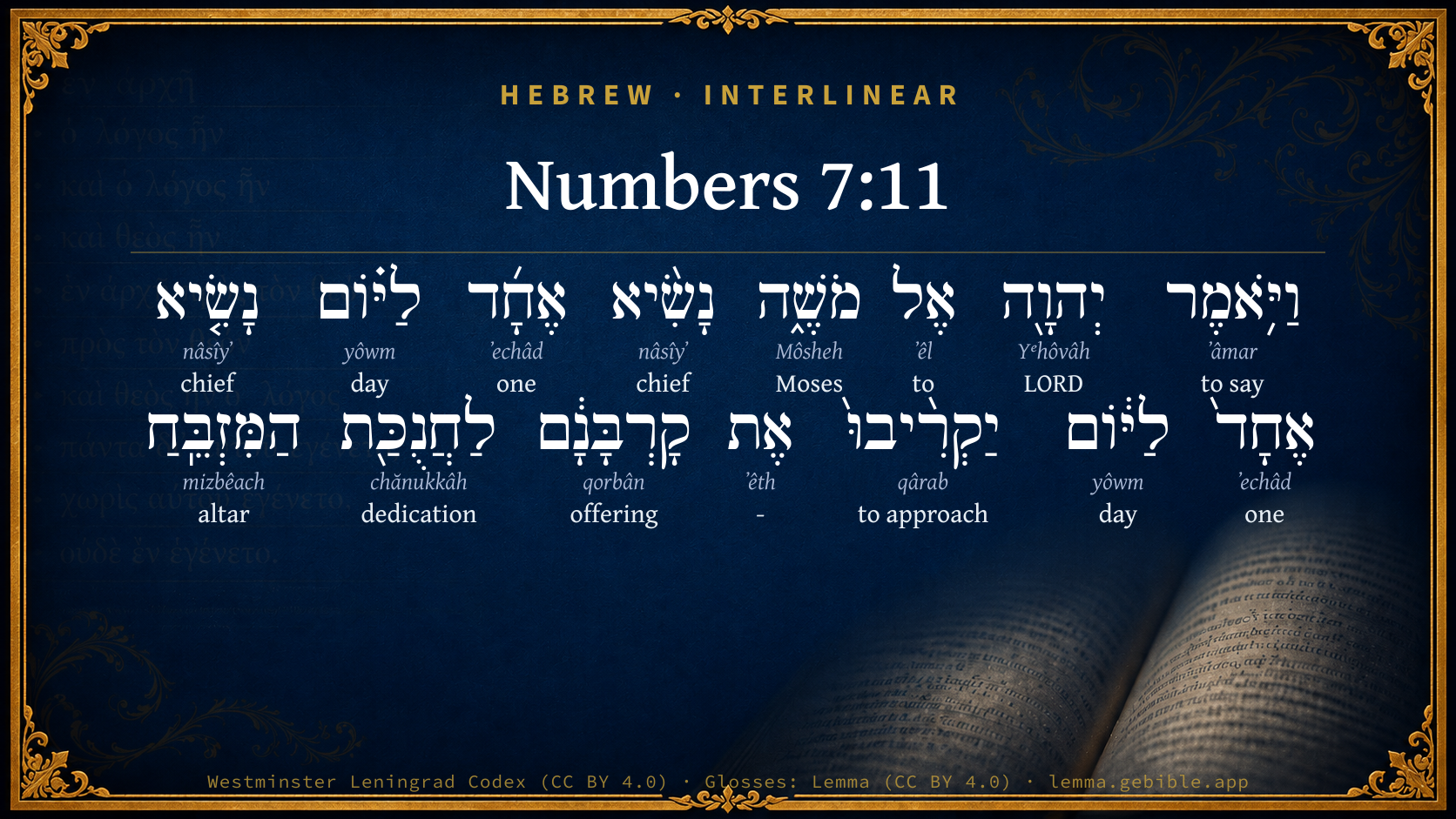
Hebrew (Westminster Leningrad Codex) Numbers 7:11 appears in the Hebrew Old Testament. The text above is from the Westminster Leningrad Codex. Each word links to its Strong’s number, a concise gloss, and parsing drawn from the Open Scriptures Hebrew Bible morphology. Click any word for its full Brown-Driver-Briggs (BDB) entry.
Download image
Cite this verse

Numbers 7:11 (World English Bible). Public Domain. Lemma interlinear Bible study tool, https://lemma.gebible.app/v/numbers/7/11.

Show BibTeX & RIS
BibTeX
RIS
English Translation
Yahweh said to Moses, "They shall offer their offering, each prince on his day, for the dedication of the altar."
World English Bible · Public Domain
Download a study sheet

One document with this verse’s original text, its word-by-word gloss line, the meaning frame, cross-references with their text, attributed commentary, and full source and license credits — printable, and it pastes into notes with its structure intact.

This verse Autodidact and up

Study sheet (.html) Plain text (.txt)

A passage Seminary Student

Up to 50 verses in one chapter. A passage sheet keeps up to 6 commentary sources and 12 cross-references per verse, in the order this page ranks them, and says so on the sheet whenever that leaves anything out. Ask for a single verse and you get the Autodidact verse sheet above.

Everything on this page stays free to read, with no account — the sheet is a download of what is already on screen, not access to it.

Want to remove ads? Support Godless Engineer
Compare translations 3

The same verse in 3 English versions, stacked beneath the original-language interlinear above. Click any original word for its lexicon entry.

Each is an independent rendering of the whole verse — the interlinear is not word-aligned to these translations.

Highlighted words mark where these versions differ — a whole-verse word diff, not a word-by-word alignment.

  • World English Bible Public Domain
    Yahweh said to Moses, "They shall offer their offering, each prince on his day, for the dedication of the altar."
  • King James Version Public Domain
    And the LORD said unto Moses, They shall offer their offering, each prince on his day, for the dedicating of the altar.
  • unfoldingWord Literal Text CC BY-SA 4.0
    And Yahweh said to Moses, “One leader for the day, one leader for the day, they shall present their offering for the dedication of the altar.”

unfoldingWord Literal Text — © unfoldingWord, licensed CC BY-SA 4.0. Word-aligned USFM3 via Door43 (git.door43.org/unfoldingWord/en_ult).

Versions to compare (up to 4)

3 of 4 selected

Show all 18 translations

Every available English version of this verse, each an independent rendering of the whole verse.

  • World English Bible Public Domain
    Yahweh said to Moses, "They shall offer their offering, each prince on his day, for the dedication of the altar."
  • Berean Standard Bible Public Domain
    And the LORD said to Moses, “Each day one leader is to present his offering for the dedication of the altar.”
  • Majority Standard Bible Public Domain
    And the LORD said to Moses, “Each day one leader is to present his offering for the dedication of the altar.”
  • King James Version Public Domain
    And the LORD said unto Moses, They shall offer their offering, each prince on his day, for the dedicating of the altar.
  • American Standard Version (1901) Public Domain
    And Jehovah said unto Moses, They shall offer their oblation, each prince on his day, for the dedication of the altar.
  • Revised Version (1885) Public Domain
    And the LORD said unto Moses, They shall offer their oblation, each prince on his day, for the dedication of the altar.
  • Geneva Bible (1599) Public Domain
    And the Lord sayd vnto Moses, One prince one day, and an other prince an other day shall offer their offring, for the dedication of the altar.
  • Douay-Rheims (1899) Public Domain
    The other four wagons, and eight oxen he gave to the sons of Merari, according to their offices and service, under the hand of Ithamar the son of Aaron the priest.
  • Young's Literal Translation Public Domain
    And Jehovah saith unto Moses, `One prince a day -- one prince a day -- do they bring near their offering for the dedication of the altar.'
  • Literal Standard Version CC BY-SA 4.0
    And YHWH says to Moses, “One prince a day, one prince a day—they bring their offering near for the dedication of the altar.”
  • Unlocked Literal Bible CC BY-SA 4.0
    Yahweh said to Moses, “Each leader must offer on his own day his sacrifice for the dedication of the altar.”
  • unfoldingWord Literal Text CC BY-SA 4.0
    And Yahweh said to Moses, “One leader for the day, one leader for the day, they shall present their offering for the dedication of the altar.”
  • Darby Bible Public Domain
    And Jehovah said to Moses, They shall present their offering for the dedication of the altar, each prince on his day.
  • World Messianic Bible Public Domain
    The LORD said to Moses, “They shall offer their offering, each prince on his day, for the dedication of the altar.”
  • Webster's Bible Public Domain
    And the LORD said to Moses, They shall offer their offering, each prince on his day, for the dedicating of the altar.
  • Free Bible Version CC BY-SA 4.0
    The Lord told Moses, “Have one leader come every day and present his offering for the dedication of the altar.”
  • Bible in Basic English Public Domain
    And the Lord said to Moses, Let every chief on his day give his offering to make the altar holy.
  • JPS Tanakh (1917) Public Domain
    And the LORD said unto Moses: 'They shall present their offering each prince on his day, for the dedication of the altar.'

Literal Standard Version (2020), Covenant Press — licensed CC BY-SA 4.0. Text via the HelloAO Bible API (eBible.org). Unlocked Literal Bible (unfoldingWord) — licensed CC BY-SA 4.0. Text via the HelloAO Bible API (eBible.org). unfoldingWord Literal Text — © unfoldingWord, licensed CC BY-SA 4.0. Word-aligned USFM3 via Door43 (git.door43.org/unfoldingWord/en_ult). Free Bible Version, Dr. Jonathan Gallagher — licensed CC BY-SA 4.0. Text via the HelloAO Bible API (eBible.org).

Word by word

More ways to search: Search by grammar → Find every occurrence → Compare this word →

Practice this passage: Drill this verse → Learn its vocabulary →

לַחֲנֻכַּ֖ת
chănukkâh
H2598
“to/for · dedication of”
Preposition + Noun, Common, Feminine, Singular, Construct
Part of Speech
Preposition + Noun
Type
Common
Gender
Feminine
Number
Singular
State
Construct
Full BDB Definition

Origin: from H2596

TWOT: TWOT- 693b

dedication, consecration
  1. וַיֹּ֥אמֶר ʼâmar H559 “and · to say” Conjunction + Verb, Qal, Sequential Imperfect, 3rd Person, Masculine, Singular
  2. יְהוָ֖ה Yᵉhôvâh H3068 “LORD” Noun, Proper
  3. אֶל ʼêl H413 “to” Preposition
  4. מֹשֶׁ֑ה Môsheh H4872 “Moses” Noun, Proper
  5. נָשִׂ֨יא nâsîyʼ H5387 “chief” Noun, Common, Masculine, Singular, Absolute
  6. אֶחָ֜ד ʼechâd H259 “one” Adjective, Cardinal number, Masculine, Singular, Absolute
  7. לַיּ֗וֹם yôwm H3117 “to/for the · day” Preposition, Determined + Noun, Common, Masculine, Singular, Absolute
  8. נָשִׂ֤יא nâsîyʼ H5387 “chief” Noun, Common, Masculine, Singular, Absolute
  9. אֶחָד֙ ʼechâd H259 “one” Adjective, Cardinal number, Masculine, Singular, Absolute
  10. לַיּ֔וֹם yôwm H3117 “to/for the · day” Preposition, Determined + Noun, Common, Masculine, Singular, Absolute
  11. יַקְרִ֨יבוּ֙ qârab H7126 “to approach” Verb, Hiphil, Imperfect, 3rd Person, Masculine, Plural
  12. אֶת ʼêth H853 “-” Particle, Direct Object
  13. קָרְבָּנָ֔ם qorbân H7133 “offering · their” Noun, Common, Masculine, Singular, Construct + Suffix, Personal, 3rd Person, Masculine, Plural
  14. הַמִּזְבֵּֽחַ mizbêach H4196 “the · altar” Particle, Definite Article + Noun, Common, Masculine, Singular, Absolute

About this verse

These counts appear in no published source. They are computed here, from the morphology-tagged text and Lemma’s own curated glosses. What Lemma adds →

15
words
12
distinct lemmas
Pentateuch
section

Notable vocabulary

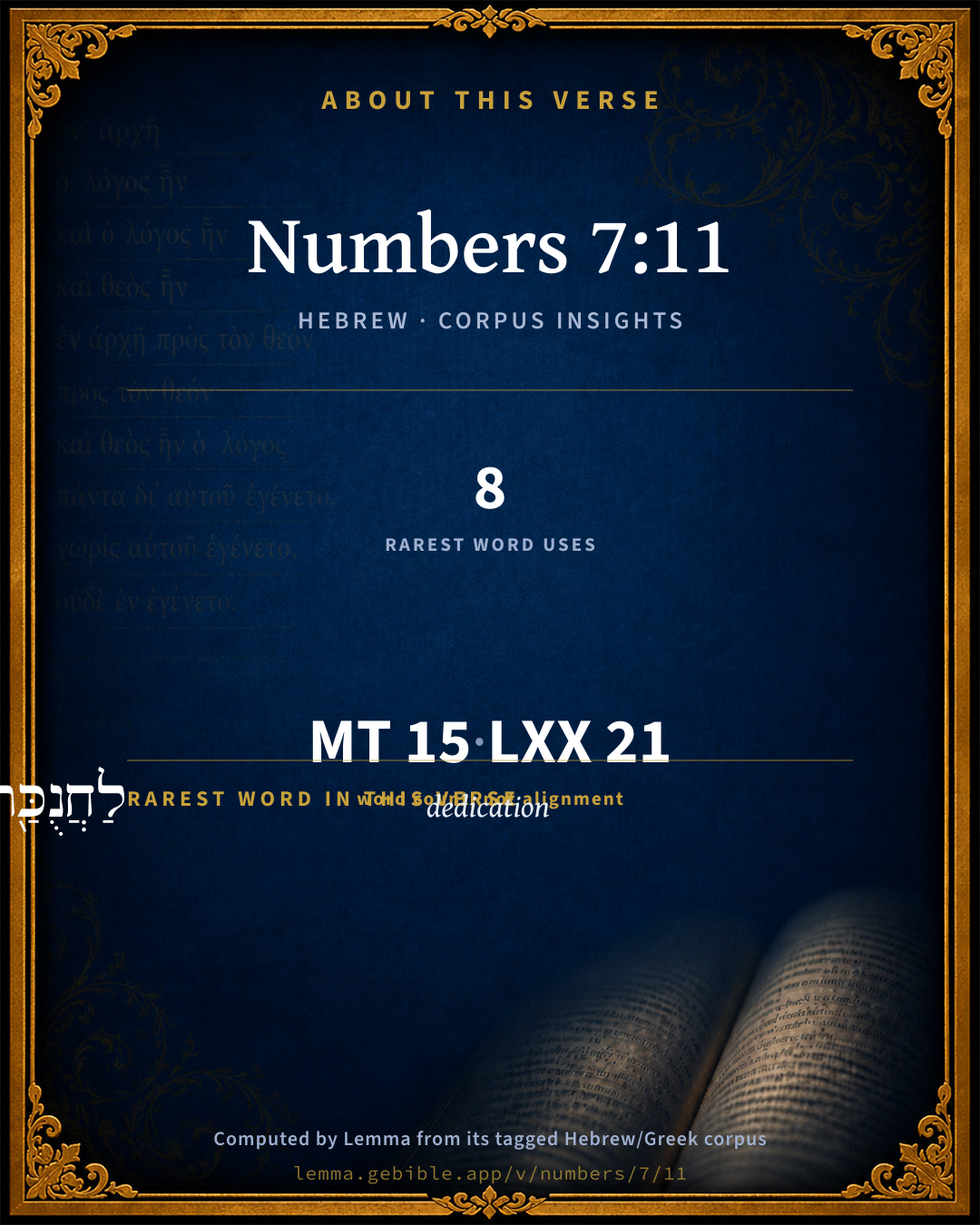
The rarest word here is לַחֲנֻכַּ֖ת dedication H2598 — appearing just 8 times in the whole Hebrew Bible.

Shared distinctive vocabulary

לַחֲנֻכַּ֖ת dedication H2598 occurs in 7 verses of the Hebrew Bible. Also found in:

Grammatical profile

  • 2 verbs
  • 9 nouns
  • 2 adjectives
  • 1 preposition
  • 1 particle

Verb forms

  • וַיֹּ֥אמֶר Qal · Sequential Imperfect
  • יַקְרִ֨יבוּ֙ Hiphil · Imperfect

Repetition

Words recur within this verse — often emphatic in Hebrew:

  • נָשִׂ֨יא chief H5387 ×2
  • אֶחָ֜ד one H259 ×2
  • לַיּ֗וֹם day H3117 ×2

Hebrew & Septuagint length

In English translation the verse runs 20 words from the Hebrew and 25 from the Septuagint (LXX English) — closely comparable.

A rough comparison of the two English renderings, which tokenize alike — not a word-level alignment.

Word counts can differ between the Hebrew and the Greek without any difference in meaning — e.g. the Hebrew direct-object marker אֵת has no separate Greek word, and Greek often adds the article ὁ.

In the original languages it is 15 Hebrew tokens and 21 Greek tokens — but the two are counted differently (Hebrew bundles its prefixes and suffixes into one token; the Greek is in lemma form), so that isn’t a like-for-like length.

Cross-references

3

Topical passages linked to Numbers 7:11 in the Treasury of Scripture Knowledge — connected by theme and wording, ordered by reader-vote popularity; previews shown in the World English Bible.

  • 1 Corinthians 14:33 for God is not a God of confusion, but of peace. As in all the assemblies of the saints,
  • 1 Corinthians 14:40 Let all things be done decently and in order.
  • Colossians 2:5 For though I am absent in the flesh, yet am I with you in the spirit, rejoicing and seeing your order, and the steadfastness of your faith in Christ.

Cross-references courtesy of OpenBible.info (CC BY 4.0).

Hebrew and Greek witnesses Masoretic Hebrew ↔ Greek Septuagint

The same verse in the two great witnesses to the Old Testament, shown verse-for-verse.

These are two independent witnesses, not word-aligned to each other, and the Septuagint is shown in lemma (dictionary) form.

Hebrew Numbers 7:11 Masoretic · Westminster Leningrad Codex

וַיֹּ֥אמֶר יְהוָ֖ה אֶל מֹשֶׁ֑ה נָשִׂ֨יא אֶחָ֜ד לַיּ֗וֹם נָשִׂ֤יא אֶחָד֙ לַיּ֔וֹם יַקְרִ֨יבוּ֙ אֶת קָרְבָּנָ֔ם לַחֲנֻכַּ֖ת הַמִּזְבֵּֽחַ

Yahweh said to Moses, "They shall offer their offering, each prince on his day, for the dedication of the altar."

World English Bible · Public Domain

Greek LXX Numbers 7:11 Septuagint · lemma form

καί εἶπον κύριος πρός μωυσῆς ἄρχων εἷς κατά ἡμέρα ἄρχων κατά ἡμέρα προςφέρω ὁ δῶρον αὐτός εἰς ὁ ἐγκαινισμός ὁ θυσιαστήριον

And the Lord said to Moses, One chief each day, they shall offer their gifts a chief each day for the dedication of the altar.

LXX2012 (modern English Septuagint) · Public Domain

Hebrew: Westminster Leningrad Codex (CC BY 4.0). Greek: Septuagint (public domain); English from LXX2012 (modern English Septuagint) (Public Domain). How the Septuagint differs from the Hebrew →

Targum (Aramaic paraphrase)

2

The Targum is the ancient Jewish Aramaic paraphrase of the Hebrew Scriptures — an interpretive translation, not the Hebrew text itself. Onkelos (literal) and Pseudo-Jonathan (expansive) render the Torah, and Jonathan the Prophets. Coverage is partial: where no permissively-licensed English translation exists for a verse, only the Aramaic is shown. This is verse-level text, not a word-by-word alignment to the Hebrew.

  1. Targum Onkelos Torah (Genesis–Deuteronomy)
    וַאֲמַר יְיָ לְמשֶׁה רַבָּא חַד לְיוֹמָא רַבָּא חַד לְיוֹמָא יְקָרְבוּן יָת קֻרְבַּנְהוֹן לַחֲנֻכַּת מַדְבְּחָא

    (no public-domain English translation for this verse)

    Targum Onkelos — Aramaic: “Onkelos Genesis” (public domain); “Onkelos Exodus” (public domain); “Onkelos Leviticus” (public domain); “Onkelos Numbers” (public domain); “Onkelos Deuteronomy” (public domain). English: “Sefaria Community Translation” (CC0 1.0 (public-domain dedication)); “J.W. Etheridge. The Targums of Onkelos and Jonathan Ben Uzziel on the Pentateuch. London: Longmans, Green, 1862” (public domain). Text via Sefaria.

  2. Targum Pseudo-Jonathan Torah (Genesis–Deuteronomy)
    וַאֲמַר יְיָ לְמשֶׁה אֲמַרְכּוֹל חָד לְיוֹמָא אֲמַרְכּוֹל חָד לְיוֹמָא יִקְרְבוּן יַת קוּרְבַּנְהוֹן לַחֲנוּכַּת רְבוּתָא דְמַדְבְּחָא

    And the Lord said unto Mosheh, Let the princes offer each, one prince on one day, their oblations at the dedication of the altar by anointing.

    Targum Pseudo-Jonathan — Aramaic: “Targum Jonathan on Genesis” (public domain); “Targum Jonathan on Exodus” (public domain); “Targum Jonathan on Leviticus” (public domain); “Targum Jonathan on Numbers” (public domain); “Targum Jonathan on Deuteronomy” (public domain). English: “The Targum of Jonathan ben Uzziel, trans. J. W. Etheridge, London, 1862” (public domain). Text via Sefaria.

Commentary

Notes on Numbers 7:11 from classic Christian and Jewish commentators (each source and its license shown beneath its notes). The classic Christian expositions comment on the surrounding passage and are grouped to its opening verse, so a note may address several verses; the Jewish commentaries on the Tanakh (Rashi and others) are per-verse, so they appear only where the commentator wrote on this verse.

Lemma curates 59 commentaries, every one of them public domain or Creative Commons licensed, each selected and text-cleaned for this edition rather than reprinted as found. About our sources →

Trapp's Complete Commentary

John Trapp

Num 7:11 And the LORD said unto Moses, They shall offer their offering, each prince on his day, for the dedicating of the altar.

Ver. 11. For the dedicating of the altar.] No warrant at all for Popish dedications of altars, churches, religious houses built for superstitious uses, as appears in stories: {a} as pro remissione et redemptione peccatorum; pro remedio et liberatione animae; pro amore caelestis patriae; pro salute regnorum; in honorem gloriosae virginis, &c.

{a} Act. and Mon.

John Trapp, A Commentary or Exposition upon All the Books of the Old and New Testament (1647–1656) — public domain. Text from a community e-Sword module.

Joseph Benson's Commentary

Num 7:11. Each prince in his day — Thus the dedication continued no less than twelve days, which made it very solemn, and gave to every tribe an opportunity, by its representative, to express their devotion and reverence to God, and to receive tokens of gracious acceptance From him. And in this offering they followed the order of their camp, and not of their birth.

Joseph Benson's Commentary on the Old and New Testaments (1811–1818) — public domain. Text from a community e-Sword module.

Jamieson, Fausset & Brown

Robert Jamieson, A. R. Fausset & David Brown

They shall offer . . . each prince on his day, &c.--Eastern princes were accustomed anciently, as they are in Persia still on a certain yearly festival, to sit upon their thrones in great state, when the princes and nobles, from all parts of their dominions, appear before them with tributary presents, which form a large proportion of their royal revenue. And in the offering of all gifts or presents to great personages, every article is presented singly and with ostentatious display. The tabernacle being the palace of their great King, as well as the sanctuary of their God, the princes of Israel may be viewed, on the occasion under notice, as presenting their tributary offerings, and in the same manner of successive detail, which accords with the immemorial usages of the East. A day was set apart for each, as much for the imposing solemnity and splendor of the ceremony, as for the prevention of disorder and hurry; and it is observable that, in the order of offering, regard was paid to priority not of birth, but of rank and dignity as they were ranked in the camp--beginning at the east, proceeding to the south, then to the west, and closing with the north, according to the course of the sun.

Jamieson, Fausset & Brown — Commentary Critical and Explanatory on the Whole Bible (1871) — public domain (CC PDM 1.0). Text via the HelloAO Bible API.

John Gill's Exposition

And the Lord said unto Moses,.... For before this was said to him, even what follows, Moses knew not, as the same writer observes, how they should offer, in what order, whether according to their birth, or whether according to the journeying of their camps, or whether they should offer together, or one after another, one day after another (g); this affair is set in a clear light:

they shall offer their offering each prince on his day; one on one day, and the other on the next, and so on successively for twelve days running; and this was ordered for the greater solemnity of the service, and that it might be taken notice of, and each have the honour and credit of it; and this was done, not according to the order of their birth, but as their standards were fixed, first Judah, and those under him, and so the rest in course:

for the dedicating of the altar; see Num 7:10.

(g) Vid. Siphri apud Yalkut in loc.

John Gill's Exposition of the Whole Bible (1746–1763) — public domain (CC PDM 1.0). Text via the HelloAO Bible API.

Haydock's Catholic Bible Commentary

Altar of holocausts, the dedication of which continued seven days, Exodus xxix. 36. (Menochius)

George Leo Haydock (1774–1849), Haydock's Catholic Family Bible and Commentary, 1859 edition — public domain. Excludes Psalms (Douay-Rheims chapter numbering differs from Protestant) and Deuterocanonical books (Catholic canon only).

Matthew Poole's English Annotations

As well for the greater solemnity and splendour of the work, as for the prevention of confusion. And in this offering they follow the order of their camp, and not of their birth.

Matthew Poole's English Annotations on the Holy Bible (1683–1685) — public domain. Text from a community e-Sword/MySword module.

The Pulpit Commentary

The Lord said unto Moses. Doubtless in answer to his inquiry (see verse 89), at the time when the princes desired to make their offerings. Each prince on his day. For more convenience and solemnity, that the sacrifices might not be hurried over, and that none might feel neglected.

The Pulpit Commentary (1880–1919), ed. H.D.M. Spence-Jones & Joseph S. Exell — public domain. Text from a community e-Sword module.

John Wesley's Explanatory Notes

On his day - And in this offering they followed the order of their camp, and not of their birth.

John Wesley, Explanatory Notes Upon the Whole Bible (1754–1765) — public domain. Text via the GEBible commentary corpus.

Rashi

Rabbi Shlomo Yitzchaki (Rashi)

יקריבו את קרבנם לחנכת המזבח THEY SHALL OFFER THEIR OFFERING, [EACH PRINCE ON HIS DAY] FOR THE DEDICATING OF THE ALTAR — but Moses did not yet know how they were to bring their offerings — whether according to the order of their birth (i.e. according to the order in which the sons of Jacob after whom the tribes were named were born, in which case the prince of the tribe of Reuben would have offered first), or according to the order in which they moved off on the journeys, (when Judah would be the first), until he was told by the mouth of the Holy One, blessed be He: “according to the order on the journeys shall they offer” — yet each prince on his day (and not three together as they actually journeyed) (cf. Sifrei Bamidbar 47).

Rashi on the Tanakh — English translations: “The Judaica Press complete Tanach with Rashi, translated by A. J. Rosenberg” (CC BY 4.0); “Pentateuch with Rashi's commentary by M. Rosenbaum and A.M. Silbermann, 1929-1934” (public domain); “The Metsudah Tanach series, Lakewood, N.J” (CC BY 4.0); and “The Book of Joshua, Metsudah Publications, 1997” (CC BY 4.0). Text via Sefaria.

Lesson kit

Teaching starters — assembled from the data on this page, not authored interpretation. Every prompt links to the verse data it draws on. Edit before teaching.

Numbers, in the Pentateuch, opens this verse with 15 words (12 distinct Hebrew lemmas). Its most distinctive word is chănukkâh (“dedication”). A historical commentator’s framing appears above. Read the whole chapter for the surrounding context.

Discussion questions

  1. What does “dedication” (chănukkâh) contribute to the verse as a whole?
  2. How does Numbers 7:10, which shares the word «dedication», read alongside this verse?
  3. What does the repetition of “chief” (2× in this one verse) do in this verse?
  4. The translations on this page render this verse differently — a whole-verse word diff, not a word-by-word alignment. What might account for the different wordings?
  5. «וַיֹּ֥אמֶר» is a Qal Sequential Imperfect verb. How does that grammatical form shape the action described?
  6. Compare how Trapp's Complete Commentary and Joseph Benson's Commentary read this verse. Where do they agree or differ?

Things to notice

Reading settings

Reading text

Shown beneath each verse's original-language words.

Old Testament
Old Testament edition

Read the OT as the Masoretic Hebrew (MT) or the Greek Septuagint (LXX).

English shown for the Greek Septuagint (in the Hebrew ↔ Greek comparison).

Comparing translations? Open the Compare panel on any verse page to stack up to four side by side.