Leviticus 7:9

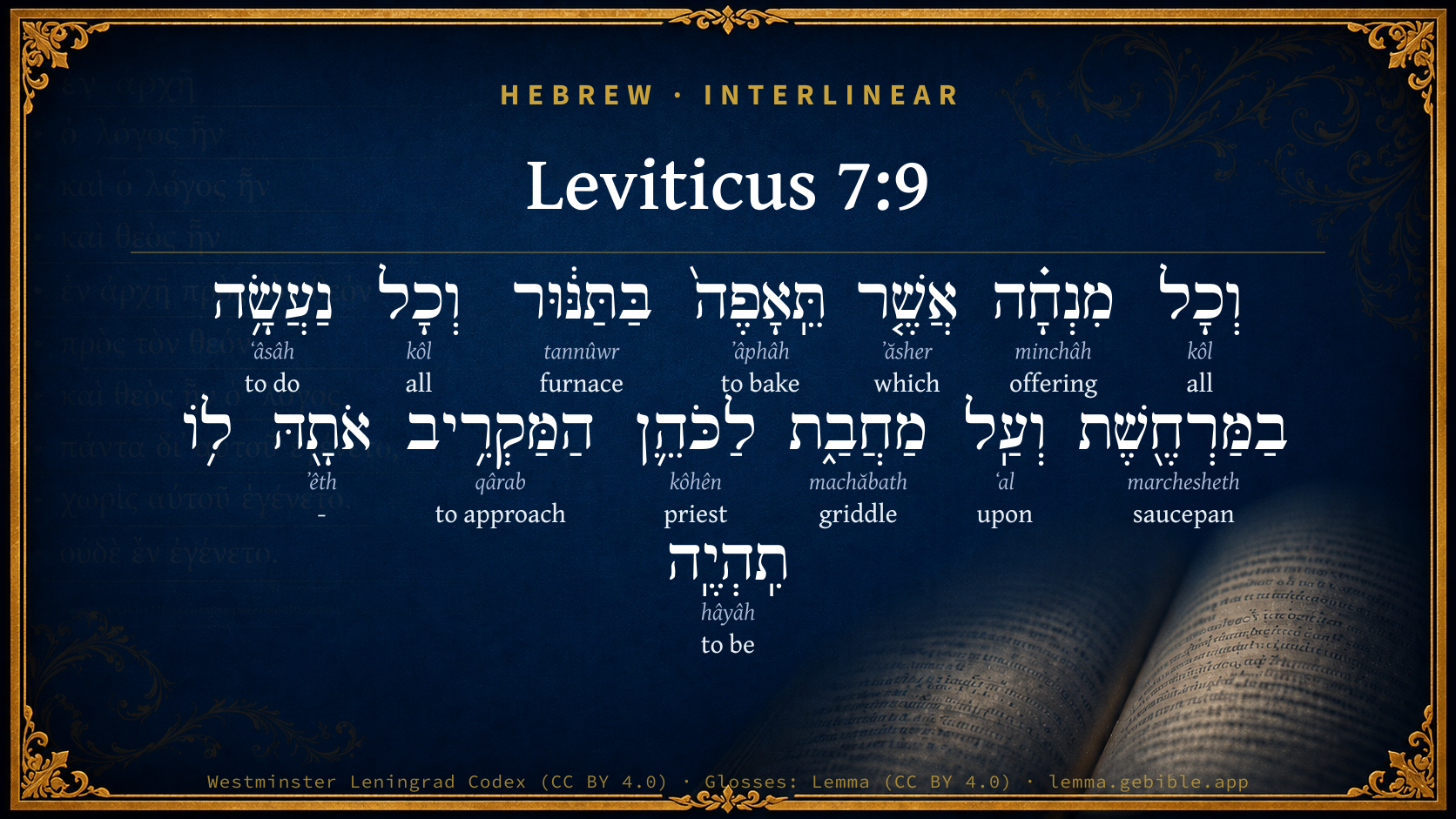
Hebrew (Westminster Leningrad Codex) Leviticus 7:9 appears in the Hebrew Old Testament. The text above is from the Westminster Leningrad Codex. Each word links to its Strong’s number, a concise gloss, and parsing drawn from the Open Scriptures Hebrew Bible morphology. Click any word for its full Brown-Driver-Briggs (BDB) entry.
Download image
Cite this verse

Leviticus 7:9 (World English Bible). Public Domain. Lemma interlinear Bible study tool, https://lemma.gebible.app/v/leviticus/7/9.

Show BibTeX & RIS
BibTeX
RIS
English Translation
Every meal offering that is baked in the oven, and all that is dressed in the frying pan, and on the baking pan, shall be the priest's who offers it.
World English Bible · Public Domain
Download a study sheet

One document with this verse’s original text, its word-by-word gloss line, the meaning frame, cross-references with their text, attributed commentary, and full source and license credits — printable, and it pastes into notes with its structure intact.

This verse Autodidact and up

Study sheet (.html) Plain text (.txt)

A passage Seminary Student

Up to 50 verses in one chapter. A passage sheet keeps up to 6 commentary sources and 12 cross-references per verse, in the order this page ranks them, and says so on the sheet whenever that leaves anything out. Ask for a single verse and you get the Autodidact verse sheet above.

Everything on this page stays free to read, with no account — the sheet is a download of what is already on screen, not access to it.

Want to remove ads? Support Godless Engineer
Compare translations 3

The same verse in 3 English versions, stacked beneath the original-language interlinear above. Click any original word for its lexicon entry.

Each is an independent rendering of the whole verse — the interlinear is not word-aligned to these translations.

Highlighted words mark where these versions differ — a whole-verse word diff, not a word-by-word alignment.

  • World English Bible Public Domain
    Every meal offering that is baked in the oven, and all that is dressed in the frying pan, and on the baking pan, shall be the priest's who offers it.
  • King James Version Public Domain
    And all the meat offering that is baked in the oven, and all that is dressed in the frying pan, and in the pan, shall be the priest's that offereth it.
  • unfoldingWord Literal Text CC BY-SA 4.0
    And every grain offering that is baked in an oven and everything made in a pan or on a griddle for the priest who presents it. It shall be for him.

unfoldingWord Literal Text — © unfoldingWord, licensed CC BY-SA 4.0. Word-aligned USFM3 via Door43 (git.door43.org/unfoldingWord/en_ult).

Versions to compare (up to 4)

3 of 4 selected

Show all 18 translations

Every available English version of this verse, each an independent rendering of the whole verse.

  • World English Bible Public Domain
    Every meal offering that is baked in the oven, and all that is dressed in the frying pan, and on the baking pan, shall be the priest's who offers it.
  • Berean Standard Bible Public Domain
    Likewise, every grain offering that is baked in an oven or cooked in a pan or on a griddle belongs to the priest who presents it,
  • Majority Standard Bible Public Domain
    Likewise, every grain offering that is baked in an oven or cooked in a pan or on a griddle belongs to the priest who presents it,
  • King James Version Public Domain
    And all the meat offering that is baked in the oven, and all that is dressed in the frying pan, and in the pan, shall be the priest's that offereth it.
  • American Standard Version (1901) Public Domain
    And every meal-offering that is baken in the oven, and all that is dressed in the frying-pan, and on the baking-pan, shall be the priest's that offereth it.
  • Revised Version (1885) Public Domain
    And every meal offering that is baken in the oven, and all that is dressed in the frying pan, and on the baking pan, shall be the priest’s that offereth it.
  • Geneva Bible (1599) Public Domain
    And all the meate offring that is baken in the ouen, and that is dressed in the pan, and in the frying pan, shall be the Priestes that offereth it.
  • Douay-Rheims (1899) Public Domain
    And every sacrifice of flour that is baked in the oven, and whatsoever is dressed on the gridiron, or in the fryingpan, shall be the priest's that offereth it:
  • Young's Literal Translation Public Domain
    and every present which is baked in an oven, and every one done in a frying-pan, and on a girdel, `is' the priest's who is bringing it near; it is his;
  • Literal Standard Version CC BY-SA 4.0
    and every present which is baked in an oven, and all done in a frying-pan, and on a griddle, [is] the priest’s who is bringing it near; it is his;
  • Unlocked Literal Bible CC BY-SA 4.0
    Every grain offering that is baked in an oven, and every such offering that is cooked in a frying pan or in a baking pan will belong to the priest who offers it.
  • unfoldingWord Literal Text CC BY-SA 4.0
    And every grain offering that is baked in an oven and everything made in a pan or on a griddle for the priest who presents it. It shall be for him.
  • Darby Bible Public Domain
    And every oblation that is baken in the oven, and all that is prepared in the cauldron and in the pan, shall be the priest's who offereth it; to him it shall belong.
  • World Messianic Bible Public Domain
    Every meal offering that is baked in the oven, and all that is prepared in the pan and on the griddle, shall be the priest’s who offers it.
  • Webster's Bible Public Domain
    And all the meat-offering that is baked in the oven, and all that is dressed in the frying-pan, and in the pan, shall be the priest's that offereth it.
  • Free Bible Version CC BY-SA 4.0
    In the same way all grain offerings that are baked in an oven or cooked in a pan or on a griddle is for the priest who presents it,
  • Bible in Basic English Public Domain
    And every meal offering which is cooked in the oven and everything made in a cooking pot or on a flat plate, is for the priest by whom it is offered.
  • JPS Tanakh (1917) Public Domain
    And every meal-offering that is baked in the oven, and all that is dressed in the stewing-pan, and on the griddle, shall be the priest's that offereth it.

Literal Standard Version (2020), Covenant Press — licensed CC BY-SA 4.0. Text via the HelloAO Bible API (eBible.org). Unlocked Literal Bible (unfoldingWord) — licensed CC BY-SA 4.0. Text via the HelloAO Bible API (eBible.org). unfoldingWord Literal Text — © unfoldingWord, licensed CC BY-SA 4.0. Word-aligned USFM3 via Door43 (git.door43.org/unfoldingWord/en_ult). Free Bible Version, Dr. Jonathan Gallagher — licensed CC BY-SA 4.0. Text via the HelloAO Bible API (eBible.org).

Word by word

More ways to search: Search by grammar → Find every occurrence → Compare this word →

Practice this passage: Drill this verse → Learn its vocabulary →

בַמַּרְחֶ֖שֶׁת
marchesheth
H4802
“in/at the · saucepan”
Preposition, Determined + Noun, Common, Feminine, Singular, Absolute
Part of Speech
Preposition + Noun
Type
Common
Gender
Feminine
Number
Singular
State
Absolute
Full BDB Definition

Origin: from H7370

TWOT: 2152a

saucepan, stew pan
  1. וְכָל kôl H3605 “and · all of” Conjunction + Noun, Common, Masculine, Singular, Construct
  2. מִנְחָ֗ה minchâh H4503 “offering” Noun, Common, Feminine, Singular, Absolute
  3. אֲשֶׁ֤ר ʼăsher H834 “which” Particle, Relative
  4. תֵּֽאָפֶה֙ ʼâphâh H644 “to bake” Verb, Niphal, Imperfect, 3rd Person, Feminine, Singular
  5. בַּתַּנּ֔וּר tannûwr H8574 “in/at the · furnace” Preposition, Determined + Noun, Common, Masculine, Singular, Absolute
  6. וְכָל kôl H3605 “and · all of” Conjunction + Noun, Common, Masculine, Singular, Construct
  7. נַעֲשָׂ֥ה ʻâsâh H6213 “to do” Verb, Niphal, Perfect, 3rd Person, Masculine, Singular
  8. וְעַֽל ʻal H5921 “and · upon” Conjunction + Preposition
  9. מַחֲבַ֑ת machăbath H4227 “in/at · griddle” Noun, Common, Feminine, Singular, Absolute
  10. לַכֹּהֵ֛ן kôhên H3548 “to/for the · priest” Preposition, Determined + Noun, Common, Masculine, Singular, Absolute
  11. הַמַּקְרִ֥יב qârab H7126 “the · approaching” Particle, Definite Article + Verb, Hiphil, Participle Active, Masculine, Singular, Absolute
  12. אֹתָ֖הּ ʼêth H853 “- · her” Particle, Direct Object + Suffix, Personal, 3rd Person, Feminine, Singular
  13. תִֽהְיֶֽה hâyâh H1961 “to be” Verb, Qal, Imperfect, 3rd Person, Feminine, Singular

About this verse

These counts appear in no published source. They are computed here, from the morphology-tagged text and Lemma’s own curated glosses. What Lemma adds →

15
words
13
distinct lemmas
Pentateuch
section

Notable vocabulary

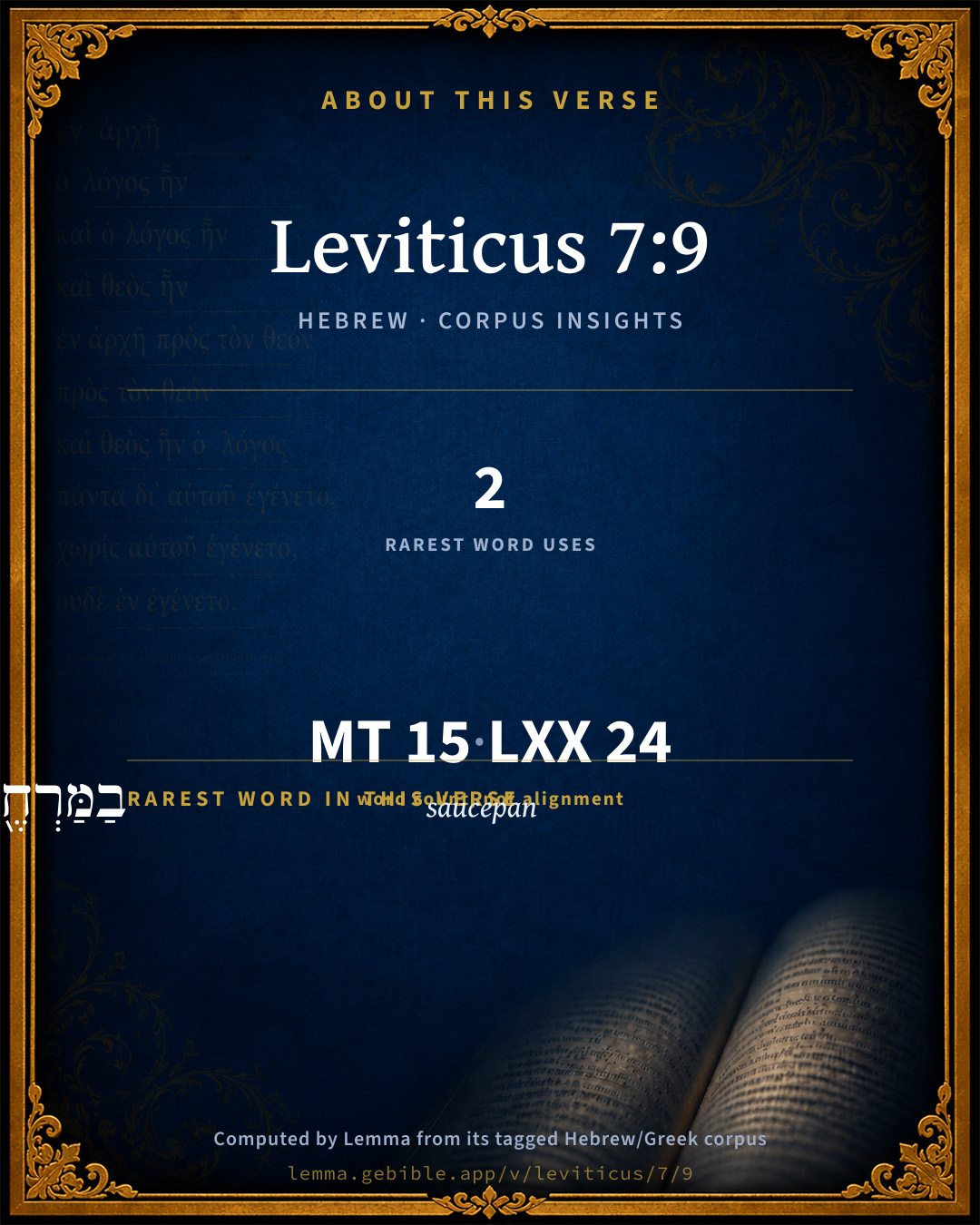
The rarest word here is בַמַּרְחֶ֖שֶׁת saucepan H4802 — appearing just 2 times in the whole Hebrew Bible.

Shared distinctive vocabulary

בַמַּרְחֶ֖שֶׁת saucepan H4802 occurs in 2 verses of the Hebrew Bible. Also found in:

Grammatical profile

  • 4 verbs
  • 7 nouns
  • 2 prepositions
  • 2 particles

Verb forms

  • תֵּֽאָפֶה֙ Niphal · Imperfect
  • נַעֲשָׂ֥ה Niphal · Perfect
  • הַמַּקְרִ֥יב Hiphil · Participle Active
  • תִֽהְיֶֽה Qal · Imperfect

Repetition

A word recurs within this verse — often emphatic in Hebrew:

  • וְכָל all H3605 ×2

Hebrew & Septuagint length

In English translation the verse runs 30 words from the Hebrew and 29 from the Septuagint (LXX English) — closely comparable.

A rough comparison of the two English renderings, which tokenize alike — not a word-level alignment.

Word counts can differ between the Hebrew and the Greek without any difference in meaning — e.g. the Hebrew direct-object marker אֵת has no separate Greek word, and Greek often adds the article ὁ.

In the original languages it is 15 Hebrew tokens and 24 Greek tokens — but the two are counted differently (Hebrew bundles its prefixes and suffixes into one token; the Greek is in lemma form), so that isn’t a like-for-like length.

Cross-references

9

Topical passages linked to Leviticus 7:9 in the Treasury of Scripture Knowledge — connected by theme and wording, ordered by reader-vote popularity; previews shown in the World English Bible.

  • Leviticus 2:3–7 That which is left of the meal offering shall be Aaron's and his sons'. It is a most holy thing of the offerings of Yahweh made by fire.
  • Leviticus 2:10 That which is left of the meal offering shall be Aaron's and his sons'. It is a thing most holy of the offerings of Yahweh made by fire.
  • Numbers 18:9 This shall be your of the most holy things, [reserved] from the fire: every offering of theirs, even every meal-offering of theirs, and every sin-offering of theirs, and every trespass-offering of theirs, which they shall render to me, shall be most holy for you and for your sons.
  • Ezekiel 44:29 They shall eat the meal-offering, and the sin-offering, and the trespass-offering; and every devoted thing in Israel shall be theirs.
  • Galatians 6:6 But let him who is taught in the word share all good things with him who teaches.
  • Leviticus 5:13 The priest shall make atonement for him concerning his sin that he has sinned in any of these things, and he will be forgiven; and the rest shall be the priest's, as the meal offering.'"
  • Leviticus 6:16–18 That which is left of it Aaron and his sons shall eat. It shall be eaten without yeast in a holy place. They shall eat it in the court of the Tent of Meeting
  • 1 Corinthians 9:7 What soldier ever serves at his own expense? Who plants a vineyard, and doesn't eat of its fruit? Or who feeds a flock, and doesn't drink from the flock's milk?
  • 1 Corinthians 9:13 Don't you know that those who serve around sacred things eat from the things of the temple, and those who wait on the altar have their portion with the altar?

Cross-references courtesy of OpenBible.info (CC BY 4.0).

Hebrew and Greek witnesses Masoretic Hebrew ↔ Greek Septuagint

The same verse in the two great witnesses to the Old Testament, shown verse-for-verse.

These are two independent witnesses, not word-aligned to each other, and the Septuagint is shown in lemma (dictionary) form.

Hebrew Leviticus 7:9 Masoretic · Westminster Leningrad Codex

וְכָל מִנְחָ֗ה אֲשֶׁ֤ר תֵּֽאָפֶה֙ בַּתַּנּ֔וּר וְכָל נַעֲשָׂ֥ה בַמַּרְחֶ֖שֶׁת וְעַֽל מַחֲבַ֑ת לַכֹּהֵ֛ן הַמַּקְרִ֥יב אֹתָ֖הּ ל֥וֹ תִֽהְיֶֽה

Every meal offering that is baked in the oven, and all that is dressed in the frying pan, and on the baking pan, shall be the priest's who offers it.

World English Bible · Public Domain

Greek LXX Leviticus 7:9 Septuagint · lemma form

καί πᾶς θυσία ὅστις ποιέω ἐν ὁ κλίβανος καί πᾶς ὅστις ποιέω ἐπί ἐσχάρα ἤ ἐπί τήγανον ὁ ἱερεύς ὁ προςφέρω αὐτός αὐτός εἰμί

And whatever flesh shall have touched any unclean thing, it shall not be eaten, it shall be consumed with fire; every one that is clean shall eat the flesh.

LXX2012 (modern English Septuagint) · Public Domain

Hebrew: Westminster Leningrad Codex (CC BY 4.0). Greek: Septuagint (public domain); English from LXX2012 (modern English Septuagint) (Public Domain). How the Septuagint differs from the Hebrew →

Targum (Aramaic paraphrase)

2

The Targum is the ancient Jewish Aramaic paraphrase of the Hebrew Scriptures — an interpretive translation, not the Hebrew text itself. Onkelos (literal) and Pseudo-Jonathan (expansive) render the Torah, and Jonathan the Prophets. Coverage is partial: where no permissively-licensed English translation exists for a verse, only the Aramaic is shown. This is verse-level text, not a word-by-word alignment to the Hebrew.

  1. Targum Onkelos Torah (Genesis–Deuteronomy)
    וְכָל מִנְחָתָא דִי תִתְאֲפֵי בְּתַנוּרָא וְכָל דְתִתְעֲבֵד בְּרִדְתָּא וְעַל מַסְרֵיתָא לְכַהֲנָא דִמְקָרֵב יָתַהּ דִילֵהּ תְּהֵי

    (no public-domain English translation for this verse)

    Targum Onkelos — Aramaic: “Onkelos Genesis” (public domain); “Onkelos Exodus” (public domain); “Onkelos Leviticus” (public domain); “Onkelos Numbers” (public domain); “Onkelos Deuteronomy” (public domain). English: “Sefaria Community Translation” (CC0 1.0 (public-domain dedication)); “J.W. Etheridge. The Targums of Onkelos and Jonathan Ben Uzziel on the Pentateuch. London: Longmans, Green, 1862” (public domain). Text via Sefaria.

  2. Targum Pseudo-Jonathan Torah (Genesis–Deuteronomy)
    וְכָל מִנְחָתָא דְתִיתְאֲפֵי בְּתַנוּרָא וְכָל דְתִתְעֲבֵד בְּמַרְתְּחָא וְעַל מַסְרִיתָא לְכַהֲנָא דְמִקְרַב יָתָהּ דִילֵיהּ יְהֵי

    And every mincha which is baked in the oven, and every one that is made in a pot, or in a frying pan, or upon a dish, the priest who offereth it shall have it for his own.

    Targum Pseudo-Jonathan — Aramaic: “Targum Jonathan on Genesis” (public domain); “Targum Jonathan on Exodus” (public domain); “Targum Jonathan on Leviticus” (public domain); “Targum Jonathan on Numbers” (public domain); “Targum Jonathan on Deuteronomy” (public domain). English: “The Targum of Jonathan ben Uzziel, trans. J. W. Etheridge, London, 1862” (public domain). Text via Sefaria.

Commentary

Notes on Leviticus 7:9 from classic Christian and Jewish commentators (each source and its license shown beneath its notes). The classic Christian expositions comment on the surrounding passage and are grouped to its opening verse, so a note may address several verses; the Jewish commentaries on the Tanakh (Rashi and others) are per-verse, so they appear only where the commentator wrote on this verse.

Lemma curates 59 commentaries, every one of them public domain or Creative Commons licensed, each selected and text-cleaned for this edition rather than reprinted as found. About our sources →

Trapp's Complete Commentary

John Trapp

Lev 7:9 And all the meat offering that is baken in the oven, and all that is dressed in the fryingpan, and in the pan, shall be the priest’s that offereth it.

Ver. 9. And all the meat offering.] Which seems to be so called, partly because it went as meat unto the priest - the labourer is surely worthy of his meat, - but {Mat 10:10} principally as leading to Christ, whose "flesh is meat indeed." {Joh 6:55}

John Trapp, A Commentary or Exposition upon All the Books of the Old and New Testament (1647–1656) — public domain. Text from a community e-Sword module.

Joseph Benson's Commentary

Lev 7:9. All the meat or meal-offering shall be the priest’s — Except the part reserved by God, (Lev 2:2; Lev 2:9,) these being ready dressed, and hot, and to be eaten presently. And the priest who offered it was, in reason, to expect something more than his brethren who laboured not about it, and that he had only in this offering; for the others were equally distributed. For (Lev 7:10) every meat or meal-offering, which was of raw flour, whether mingled with oil or dry, that is, without oil, or drink-offering, all the sons of Aaron were to share equally among them. And there was manifest reason for this difference, because these were offered in greater quantities than the former; and, being raw, might more easily be reserved for the several priests, to dress them in the way which each of them might prefer.

Joseph Benson's Commentary on the Old and New Testaments (1811–1818) — public domain. Text from a community e-Sword module.

Adam Clarke's Commentary

Verse 9. Baken in the oven] See Clarke on Le 2:5, &c.

Adam Clarke's Commentary on the Bible (1810–1826) — public domain. Text from a community e-Sword/MySword module.

Ellicott's Commentary for English Readers

(9) And all the meat offering.—Better, every meat offering. That is, dressed in whichever of the three ways here mentioned. (See Lev_2:4-7.)

Shall be the priest’s.—With the exception of the memorial part, which was burnt upon the altar (see Lev_2:4-10), the whole was to go to the particular priest who offered it.

A Bible Commentary for English Readers, edited by Charles John Ellicott (1878–1897) — public domain. Text from a community e-Sword module.

The Cambridge Bible for Schools and Colleges

gen. ed. J. J. S. Perowne

9. The three methods of preparing the Meal-Offering specified in this verse are also enumerated in Lev_2:4-7 (see notes there). Many commentators distinguish between these cooked forms of the Meal-offering (here assigned to the priest who offereth it) and the other Meal-Offerings ‘mingled with oil’ described in Lev_2:1-3; Lev_2:14-16, and ‘dry’ Meal-Offerings, such as the Sin-Offering of the poor man (Lev_5:11) and the jealousy-offering (Num_5:15). These belong to ‘all the sons of Aaron one as well as another’ (Lev_7:10). No reason is here given for this different assignment of the Meal-Offerings. All the Meal-Offerings of ch. 2 are mingled with oil, and according to the Jewish traditional interpretation ‘the meal-offering mingled with oil’ includes all the offerings of ch. 2, and the ‘dry’ offering refers to the Sin-Offering of the poor man, and the jealousy-offering. In Lev_2:3; Lev_2:10 and Lev_6:16; Lev_6:18 that which is left of the Meal-Offering, whether cooked or not, is assigned to ‘Aaron and his sons.’

The Cambridge Bible for Schools and Colleges (gen. ed. J. J. S. Perowne; Cambridge University Press, 1878–1918) — public domain. Text from a community e-Sword module.

John Gill's Exposition

And all the meat offering that is baked in the oven,.... Or "every meat offering" (b), whether dressed in one way or another, and which was done in one or other of these three ways, of which this was one, baked in an oven heated for that purpose:

and all that is dressed in the frying pan; such as we call pancakes:

and in the pan; which was different from the frying pan; it seems to be what was set upon an hearth made hot, and soon baked; See Gill on Lev 6:21 of these three different ways of dressing the meat offering, see Lev 2:4.

(b) "omne munus", Pagninus, Montanus, Junius & Tremellius, Piscator, &c.

John Gill's Exposition of the Whole Bible (1746–1763) — public domain (CC PDM 1.0). Text via the HelloAO Bible API.

Albert Barnes' Notes on the Bible

See the marginal references.

Albert Barnes' Notes on the Bible (1834–1885) — public domain. Text from a community e-Sword/MySword module.

Haydock's Catholic Bible Commentary

Priest’s; to be divided among his brethren, ver. 10. They officiated a week by turns. (Calmet) --- Each, therefore, claimed the parts allotted by God to the priest on duty. But it is not certain what part they could retain for their own use. Some think that the unbaked flour alone was to be distributed equally, ver. 10. (Bonfrere)

George Leo Haydock (1774–1849), Haydock's Catholic Family Bible and Commentary, 1859 edition — public domain. Excludes Psalms (Douay-Rheims chapter numbering differs from Protestant) and Deuterocanonical books (Catholic canon only).

Matthew Poole's English Annotations

All the meat-offering, except the part reserved by God, Lev 2:2,9. Shall be the priest’s that offereth it, because these were ready drest and hot, and not to be presently eaten; and because the priest who offered it was in reason to expect and have something more than his brethren who laboured not about it; and that he had only in this offering, for the other were equally distributed.

Matthew Poole's English Annotations on the Holy Bible (1683–1685) — public domain. Text from a community e-Sword/MySword module.

Whedon's Commentary on the Bible

Daniel D. Whedon

9. The meat offering — The bread offering, variously prepared, is described in chap. 2, notes.

Shall be the priest’s that offereth it — Thus individual diligence was stimulated and rewarded; but to provide the sick and aged priests with materials for their own sustenance and for offerings to God, the commandment is given in Lev_7:10 that all the sons of Aaron should have the oil and unbaked flour, the largest part, one as much as another — Thus there was a blending of individual interests with community-life as a safeguard against indolence. Moreover, if the whole had been given to the officiating priest there would have been more than he could consume. The cooked-bread offering is supposed to have been small in amount.

Daniel D. Whedon (gen. ed.), Commentary on the Old and New Testaments (1874–1909) — public domain. Text from a community e-Sword module.

The Pulpit Commentary

Vers. 9-15. The peace offering of thanksgiving.

At the conclusion of the instructions concerning the trespass offering, we have a few directions concerning the meat offering (verses 9, 10). Whatever of it was dressed was to be given to the priest that offered it, to be consumed by himself and his family. But that "mingled with oil, and dry" was to be divided amongst the sons of Aaron. The reason appears to be economical. What was prepared would not keep, and was therefore to be consumed at once; that which would keep was to be divided, to be used according to convenience. The God of grace is also the God of providence. And his providence is especially concerned for those who seek his grace. After these notes, the law of the sacrifice of the peace offering is formally considered.

I THE PEACE OFFERING OF THANKSGIVING.

1. There is fitness in this association.

(1) The peace offering has its name, (shelamim), from (shalem), to complete or make whole. It was instituted to express the manner in which our breaches of the covenant are made up by Christ. How the variance between God and man is composed through his atoning sacrifice!

(2) What, then, more fitting than that we should express our thankfulness to God in connection with the peace offering? Praise breaks spontaneously from the heart that is "reconciled to God through the death of his Son". (see Isa_12:1)

2. A bread offering accompanied this.

a. One portion of this bread offering was unleavened (verse 12). This portion was presented upon the altar. As leaven symbolized evil dispositions, no trace of it should be found in anything that touched God"s altar. (Lev_2:11)

b. But the other portion was leavened (verse 13). This portion was eaten by the worshipper, and expressed that he had evil dispositions that needed purging out. What a difference there is between the holy God and sinful man! What a merciful provision is that of the gospel of peace, that reconciles sinners to God!

II THE THANKSGIVING IN THE HEAVE OFFERING. (Verses 14, 15)

1. This was taken from the whole oblation.

(1) The word for oblation, ta (masseath), denotes that which is borne or carried, from a (nast), to bear or carry. It generally describes anything which was carried to the temple to be offered to God. It also expresses the design of all sacrifices to be the carrying or bearing of sin. (see Exo_28:38; also Lev_10:17 Lev_16:21)

(2) In the offerings of the Law this was typical; but in the offering of Christ real. (see Isa_53:4, 12Jo 1:29, margin; 1Pe_2:24)

(3) From the number of these typical sin-bearers borne to the temple, the heave offering was to be taken. It was a representative of the whole of them, and suggested that what was specifically expressed in it might be predicated of any of them.

2. It was lifted up in faith and gratitude to God.

(1) The heave offering had its name, hmwrt (terumah), from (rum, to lift up), because it was lifted up, viz. toward heaven, by the priest.

(2) This action expressed thankfulness to the source whence all blessings come to us, and especially those of redemption. Christ is the "Lord from heaven," the "heavenly gift" of a gracious Father. (see Joh_3:13, Joh_3:16, 31 4:10 6:32, 33 1Co_15:47 Heb_6:4)

3. It became the priest"s who sprinkled the blood of the peace offering.

(1) Those who make their peace with God through the blood of the cross not only offer thanks, but enjoy the blessings of thanksgiving. Thus a grateful heart is a" continual feast.

(2) It was eaten the same day that it was offered. In the very act of thanksgiving to God for his blessings we are blessed. Those who in everything "give thanks" can "rejoice evermore". (1Th_5:16-18)

(3) It was shared by the priest in his own community. (see Num_18:8, Num_18:11, Num_18:18, Num_18:19) Shared domestically. Shared religiously. The stranger had no part nor lot in the matter. J.A.M.

The Pulpit Commentary (1880–1919), ed. H.D.M. Spence-Jones & Joseph S. Exell — public domain. Text from a community e-Sword module.

John Wesley's Explanatory Notes

All the meal-offering - Except the part reserved by God, chap. ii, 2, 9. Because these were ready drest and hot, and to be presently eaten; shall be the priests - The priest, who offered it, was in reason to expect, something more than his brethren who laboured not about it; and that he had only in this offering; for the others were equally distributed.

John Wesley, Explanatory Notes Upon the Whole Bible (1754–1765) — public domain. Text via the GEBible commentary corpus.

unfoldingWord translationNotes

Door43 World Missions Community

that is baked in an oven ... that is cooked in a frying pan

This can be translated in active form. AT: "that someone bakes in an oven ... that someone cooks in a frying pan" (See: Active or Passive)

oven

This was probably a hollow object made of clay. A fire was lit under the oven, and the heat would bake the dough inside of the oven. See how you translated this in Leviticus 2:4. (See: Translate Unknowns)

a frying pan

This is a metal plate with rounded edges. The dough was placed in the pan and cooked over a fire. See how you translated "pan" in Leviticus 2:7. (See: Translate Unknowns)

a baking pan

This is a thick plate made of either clay or metal. The plate was placed over a fire, and the dough cooked on top of the plate. See how you translated "flat iron pan" in Leviticus 2:5. (See: Translate Unknowns)

translationWords

grain offering

priest

oil

descend

Aaron

unfoldingWord translationNotes — © Distant Shores Media and the Door43 World Missions Community, licensed CC BY-SA 4.0. Source: git.door43.org/Door43/en_tn.

Rashi

Rabbi Shlomo Yitzchaki (Rashi)

לכהן המקריב אתה וגו'‏‎‎‏‎‎ [AND EVERY MEAL OFFERING …] SHALL BE THE PRIEST’S THAT OFFERETH IT etc. — One might think it shall be his exclusively! Scripture, however, states (v. 10) לכל בני אהרן תהיה IT SHALL BELONG TO ALL THE SONS OF AARON; — one might think then, that it shall belong to all of them, which is, however, impossible, for Scripture states “[it shall be] the priest’s (that offereth it”! How then can these apparently contradictory passages be reconciled? By referring the text to the “family”) officiating on that day on which it (the מנחה) is offered (Sifra, Tzav, Chapter 10 2).

Rashi on the Tanakh — English translations: “The Judaica Press complete Tanach with Rashi, translated by A. J. Rosenberg” (CC BY 4.0); “Pentateuch with Rashi's commentary by M. Rosenbaum and A.M. Silbermann, 1929-1934” (public domain); “The Metsudah Tanach series, Lakewood, N.J” (CC BY 4.0); and “The Book of Joshua, Metsudah Publications, 1997” (CC BY 4.0). Text via Sefaria.

Ramban (Nachmanides)

Rabbi Moshe ben Nachman (Ramban / Nachmanides)

AND EVERY MEAL-OFFERING THAT IS BAKED IN THE OVEN, [AND EVERYTHING MADE IN THE BOILING POT, AND IN THE PAN, SHALL BE THE PRIESTS THAT OFFERETH IT]. The simple explanation of this verse is apparent, namely that He is commanding here that if one vows to bring one of the three kinds of meal-offering — the one baked in the oven, or made in the boiling pot, or in the pan — that they should all be given exclusively to the priest who offered them. Then He states concerning all the other meal-offerings, — such as if a person vowed to bring a meal-offering without specification of which kind, in which case he brings it of fine flour, and the meal-offering of first-fruits, which are both mixed with oil; and the meal-offering of the sinner, 5:11-14. and of the suspected adulteress which are dry [without oil and without frankincense] — that they should be divided among all the sons of Aaron, that is to say, among all priests of their Father’s House. The meaning of the expression, and every meal-offering, mingled with oil, or dry — is that a meal-offering which is of fine flour only, whether it be mixed with oil or dry, which is not one of these [three] mentioned above [the one baked in the oven, or made in the boiling pot, or in the pan — belongs to all priests who were ministering on that day, and not exclusively to the priests who offered them]. The reason for the difference between them is because [in the case of the three meal-offerings mentioned above] the priest took pains in baking them, and therefore he deserves to be given a greater reward. [All this is in accordance with the plain meaning of Scripture].Our Rabbis, however, did not want to explain the verses in this way because Scripture said, and every meal-offering, mingled with oil or dry, which includes all possible meal-offerings, since they are all either mingled with oil or dry. Therefore the Rabbis understood the expression it shall be the priest’s that offereth it [mentioned here in Verse 9 in connection with the three meal-offerings: the one baked in the oven, etc.] as meaning that it shall belong to all pure priests who are present there. Similarly, when He said, And the priest that offereth any man’s burnt-offering, and the priest that maketh atonement therewith, he shall have it, these verses are only intended to say that they do not belong to the owners who brought them, but that in reward for offering them they belong to the pure priests who are present there, for all of them are engaged in offering them, whether physically or by command, since any individual priest or two or three of them who offered up [the particular offering], did so with the permission of all of them and acting as their deputy, and all of them would stand by the offering. As is the share of him that goeth down to the battle, so shall be the share of him that tarrieth by the baggage; they shall share alike. After He had said [in general terms] that they shall belong to the priests as a reward for their service, He explained it again in detail: and every meal-offering, mingled with oil, or dry, which includes all meal-offerings, shall all the sons of Aaron have, meaning all the officiating priests mentioned [in the preceding verses], one as well as another, that is to say, all clean priests of the Father’s House, as they are all the officiating priests mentioned previously. Thus Scripture [first] mentioned the meal-offerings by their individual names — the one baked in the oven, or made in the boiling pot, or in the pan — and then mentioned them all again in a general rule, saying [that they belong to all the priests], one as well as another, meaning that one priest should only have [of the kind of meal-offering] that the other priest has, [and they cannot give one priest his share of one kind of meal-offering, and the others a share of another kind]. Even if the meal-offering was of fine flour, each is to be given his share from that offering. Scripture thus states that this law applies to meal-offerings, and all the more so to the other offerings, which are of greater monetary value. It is tradition which decides [in favor of the Rabbis’ interpretation mentioned above], and it is furthermore for the benefit of [all] the priests and conducive to peace in the Sanctuary.It is possible that the interpretation of the verses according to this opinion of the Rabbis is as follows: “And every meal-offering that is baked in the oven, and everything made in the boiling pot, and in the pan, shall be the priest’s that offereth it; and every meal-offering, mingled with oil, or dry shall [also] be so, and all the sons of Aaron shall have it, one as well as another.” meal-offerings are mentioned alike in Scripture with respect to the share of all ministering priests on that day.

Ramban (Nachmanides) on the Tanakh — English translation: “Commentary on the Torah by Ramban (Nachmanides). Translated and annotated by Charles B. Chavel. New York, Shilo Pub. House, 1971-1976” (CC BY 4.0). Text via Sefaria.

Lesson kit

Teaching starters — assembled from the data on this page, not authored interpretation. Every prompt links to the verse data it draws on. Edit before teaching.

Leviticus, in the Pentateuch, opens this verse with 15 words (13 distinct Hebrew lemmas). Its most distinctive word is marchesheth (“saucepan”). A historical commentator’s framing appears above. Read the whole chapter for the surrounding context.

Discussion questions

  1. How does “saucepan” (marchesheth) shape what this verse is saying?
  2. Leviticus 2:7 shares the word «saucepan» with this verse. How do the two illuminate each other?
  3. “all” occurs 2× in this one verse. What is the effect of the repetition?
  4. These translations render this verse differently. What is at stake in choosing one wording over another?
  5. The verb «תֵּֽאָפֶה֙» is Niphal Imperfect. How does its form color the action?
  6. Reading how Trapp's Complete Commentary and Joseph Benson's Commentary read this verse, where do the two commentators agree and where do they part?

Things to notice

Reading settings

Reading text

Shown beneath each verse's original-language words.

Old Testament
Old Testament edition

Read the OT as the Masoretic Hebrew (MT) or the Greek Septuagint (LXX).

English shown for the Greek Septuagint (in the Hebrew ↔ Greek comparison).

Comparing translations? Open the Compare panel on any verse page to stack up to four side by side.