Leviticus 23:16

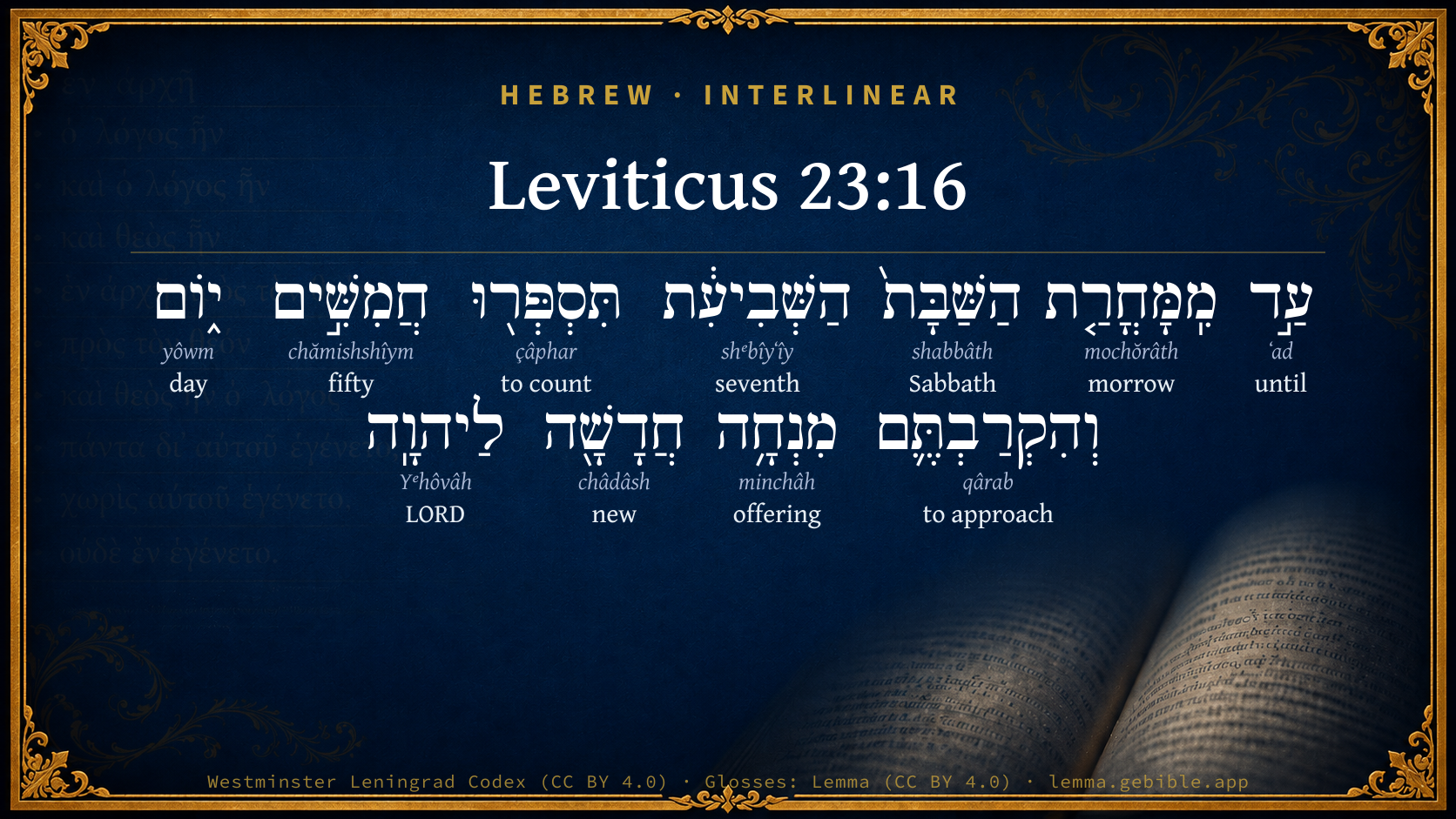
Hebrew (Westminster Leningrad Codex) Leviticus 23:16 appears in the Hebrew Old Testament. The text above is from the Westminster Leningrad Codex. Each word links to its Strong’s number, a concise gloss, and parsing drawn from the Open Scriptures Hebrew Bible morphology. Click any word for its full Brown-Driver-Briggs (BDB) entry.
Download image
Cite this verse

Leviticus 23:16 (World English Bible). Public Domain. Lemma interlinear Bible study tool, https://lemma.gebible.app/v/leviticus/23/16.

Show BibTeX & RIS
BibTeX
RIS
English Translation
even to the next day after the seventh Sabbath you shall number fifty days; and you shall offer a new meal offering to Yahweh.
World English Bible · Public Domain
Download a study sheet

One document with this verse’s original text, its word-by-word gloss line, the meaning frame, cross-references with their text, attributed commentary, and full source and license credits — printable, and it pastes into notes with its structure intact.

This verse Autodidact and up

Study sheet (.html) Plain text (.txt)

A passage Seminary Student

Up to 50 verses in one chapter. A passage sheet keeps up to 6 commentary sources and 12 cross-references per verse, in the order this page ranks them, and says so on the sheet whenever that leaves anything out. Ask for a single verse and you get the Autodidact verse sheet above.

Everything on this page stays free to read, with no account — the sheet is a download of what is already on screen, not access to it.

Want to remove ads? Support Godless Engineer
Compare translations 3

The same verse in 3 English versions, stacked beneath the original-language interlinear above. Click any original word for its lexicon entry.

Each is an independent rendering of the whole verse — the interlinear is not word-aligned to these translations.

Highlighted words mark where these versions differ — a whole-verse word diff, not a word-by-word alignment.

  • World English Bible Public Domain
    even to the next day after the seventh Sabbath you shall number fifty days; and you shall offer a new meal offering to Yahweh.
  • King James Version Public Domain
    Even unto the morrow after the seventh sabbath shall ye number fifty days; and ye shall offer a new meat offering unto the LORD.
  • unfoldingWord Literal Text CC BY-SA 4.0
    Until the day after the seventh sabbath you shall count 50 days, and you shall present a new grain offering to Yahweh.

unfoldingWord Literal Text — © unfoldingWord, licensed CC BY-SA 4.0. Word-aligned USFM3 via Door43 (git.door43.org/unfoldingWord/en_ult).

Versions to compare (up to 4)

3 of 4 selected

Show all 18 translations

Every available English version of this verse, each an independent rendering of the whole verse.

  • World English Bible Public Domain
    even to the next day after the seventh Sabbath you shall number fifty days; and you shall offer a new meal offering to Yahweh.
  • Berean Standard Bible Public Domain
    You shall count off fifty days until the day after the seventh Sabbath, and then present an offering of new grain to the LORD.
  • Majority Standard Bible Public Domain
    You shall count off fifty days until the day after the seventh Sabbath, and then present an offering of new grain to the LORD.
  • King James Version Public Domain
    Even unto the morrow after the seventh sabbath shall ye number fifty days; and ye shall offer a new meat offering unto the LORD.
  • American Standard Version (1901) Public Domain
    even unto the morrow after the seventh sabbath shall ye number fifty days; and ye shall offer a new meal-offering unto Jehovah.
  • Revised Version (1885) Public Domain
    even unto the morrow after the seventh sabbath shall ye number fifty days; and ye shall offer a new meal offering unto the LORD.
  • Geneva Bible (1599) Public Domain
    Vnto ye morow after the seuenth Sabbath shall ye nomber fiftie dayes: then yee shall bring a newe meate offring vnto the Lord.
  • Douay-Rheims (1899) Public Domain
    Even unto the marrow after the seventh week be expired, that is to say, fifty days, and so you shall offer a new sacrifice to the Lord.
  • Young's Literal Translation Public Domain
    unto the morrow of the seventh sabbath ye do number fifty days, and ye have brought near a new present to Jehovah;
  • Literal Standard Version CC BY-SA 4.0
    you number fifty days to the day after the seventh Sabbath, and you have brought a new present near to YHWH;
  • Unlocked Literal Bible CC BY-SA 4.0
    You must count fifty days, which would be the day after the seventh Sabbath. Then you must present an offering of new grain to Yahweh.
  • unfoldingWord Literal Text CC BY-SA 4.0
    Until the day after the seventh sabbath you shall count 50 days, and you shall present a new grain offering to Yahweh.
  • Darby Bible Public Domain
    even unto the morning after the seventh sabbath shall ye count fifty days; and ye shall present a new oblation to Jehovah.
  • World Messianic Bible Public Domain
    The next day after the seventh Sabbath you shall count fifty days; and you shall offer a new meal offering to the LORD.
  • Webster's Bible Public Domain
    Even to the morrow after the seventh sabbath shall ye number fifty days; and ye shall offer a new meat-offering to the LORD.
  • Free Bible Version CC BY-SA 4.0
    Count fifty days until the day after the seventh Sabbath, and on that day present an offering of new grain to the Lord.
  • Bible in Basic English Public Domain
    Let fifty days be numbered, to the day after the seventh Sabbath; then you are to give a new meal offering to the Lord.
  • JPS Tanakh (1917) Public Domain
    even unto the morrow after the seventh week shall ye number fifty days; and ye shall present a new meal-offering unto the LORD.

Literal Standard Version (2020), Covenant Press — licensed CC BY-SA 4.0. Text via the HelloAO Bible API (eBible.org). Unlocked Literal Bible (unfoldingWord) — licensed CC BY-SA 4.0. Text via the HelloAO Bible API (eBible.org). unfoldingWord Literal Text — © unfoldingWord, licensed CC BY-SA 4.0. Word-aligned USFM3 via Door43 (git.door43.org/unfoldingWord/en_ult). Free Bible Version, Dr. Jonathan Gallagher — licensed CC BY-SA 4.0. Text via the HelloAO Bible API (eBible.org).

Word by word

More ways to search: Search by grammar → Find every occurrence → Compare this word →

Practice this passage: Drill this verse → Learn its vocabulary →

מִֽמָּחֳרַ֤ת
mochŏrâth
H4283
“from · morrow of”
Preposition + Noun, Common, Feminine, Singular, Construct
Part of Speech
Preposition + Noun
Type
Common
Gender
Feminine
Number
Singular
State
Construct
Full BDB Definition

Origin: from the same as H4279

TWOT: 1185b

the morrow, the day after
  1. עַ֣ד ʻad H5704 “until” Preposition
  2. הַשַּׁבָּת֙ shabbâth H7676 “the · Sabbath” Particle, Definite Article + Noun, Common, Both, Singular, Absolute
  3. הַשְּׁבִיעִ֔ת shᵉbîyʻîy H7637 “the · seventh” Particle, Definite Article + Adjective, Ordinal number, Feminine, Singular, Absolute
  4. תִּסְפְּר֖וּ çâphar H5608 “to count” Verb, Qal, Imperfect, 2nd Person, Masculine, Plural
  5. חֲמִשִּׁ֣ים chămishshîym H2572 “fifty” Adjective, Cardinal number, Both, Plural, Absolute
  6. י֑וֹם yôwm H3117 “day” Noun, Common, Masculine, Singular, Absolute
  7. וְהִקְרַבְתֶּ֛ם qârab H7126 “and · to approach” Conjunction + Verb, Hiphil, Sequential Perfect, 2nd Person, Masculine, Plural
  8. מִנְחָ֥ה minchâh H4503 “offering” Noun, Common, Feminine, Singular, Absolute
  9. חֲדָשָׁ֖ה châdâsh H2319 “new” Adjective, Adjective, Feminine, Singular, Absolute
  10. לַיהוָֽה Yᵉhôvâh H3068 “to/for · LORD” Preposition + Noun, Proper

About this verse

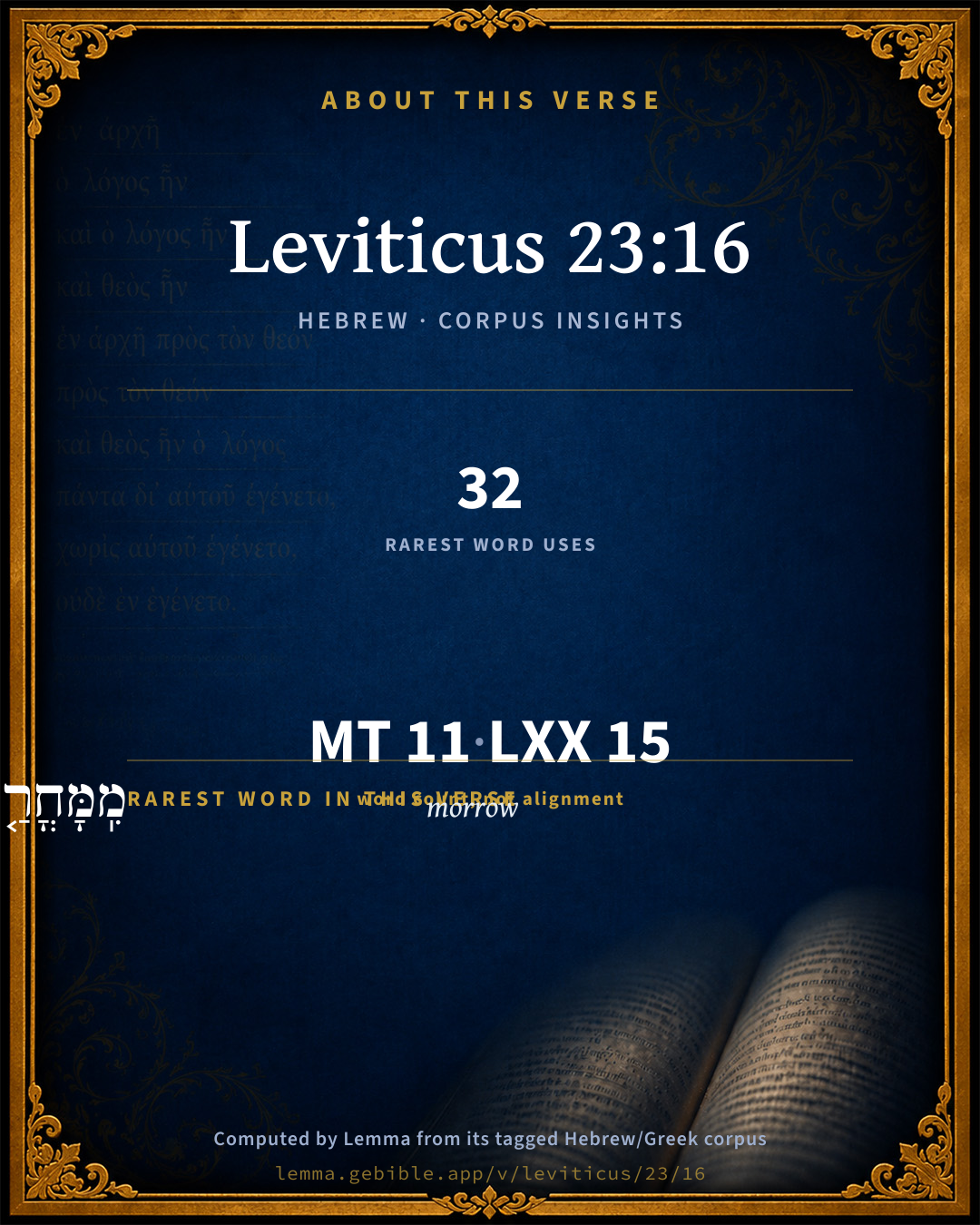
These counts appear in no published source. They are computed here, from the morphology-tagged text and Lemma’s own curated glosses. What Lemma adds →

11
words
11
distinct lemmas
Pentateuch
section

Shared distinctive vocabulary

מִֽמָּחֳרַ֤ת morrow H4283 occurs in 32 verses of the Hebrew Bible. Also found in:

Grammatical profile

  • 2 verbs
  • 5 nouns
  • 3 adjectives
  • 1 preposition

Verb forms

  • תִּסְפְּר֖וּ Qal · Imperfect
  • וְהִקְרַבְתֶּ֛ם Hiphil · Sequential Perfect

Hebrew & Septuagint length

In English translation the verse runs 24 words from the Hebrew and 21 from the Septuagint (LXX English) — closely comparable.

A rough comparison of the two English renderings, which tokenize alike — not a word-level alignment.

Word counts can differ between the Hebrew and the Greek without any difference in meaning — e.g. the Hebrew direct-object marker אֵת has no separate Greek word, and Greek often adds the article ὁ.

In the original languages it is 11 Hebrew tokens and 15 Greek tokens — but the two are counted differently (Hebrew bundles its prefixes and suffixes into one token; the Greek is in lemma form), so that isn’t a like-for-like length.

Cross-references

2

Topical passages linked to Leviticus 23:16 in the Treasury of Scripture Knowledge — connected by theme and wording, ordered by reader-vote popularity; previews shown in the World English Bible.

  • Acts 2:1 Now when the day of Pentecost had come, they were all with one accord in one place.
  • Numbers 28:26 Also in the day of the first fruits, when you offer a new meal-offering to Yahweh in your [feast of] weeks, you shall have a holy convocation; you shall do no servile work;

Cross-references courtesy of OpenBible.info (CC BY 4.0).

Hebrew and Greek witnesses Masoretic Hebrew ↔ Greek Septuagint

The same verse in the two great witnesses to the Old Testament, shown verse-for-verse.

These are two independent witnesses, not word-aligned to each other, and the Septuagint is shown in lemma (dictionary) form.

Hebrew Leviticus 23:16 Masoretic · Westminster Leningrad Codex

עַ֣ד מִֽמָּחֳרַ֤ת הַשַּׁבָּת֙ הַשְּׁבִיעִ֔ת תִּסְפְּר֖וּ חֲמִשִּׁ֣ים י֑וֹם וְהִקְרַבְתֶּ֛ם מִנְחָ֥ה חֲדָשָׁ֖ה לַיהוָֽה

even to the next day after the seventh Sabbath you shall number fifty days; and you shall offer a new meal offering to Yahweh.

World English Bible · Public Domain

Greek LXX Leviticus 23:16 Septuagint · lemma form

ἕως ὁ ἐπαύριον ὁ ἔσχατος ἑβδομάς ἀριθμέω πεντήκοντα ἡμέρα καί προςφέρω θυσία νέος ὁ κύριος

until the morrow after the last week you⌃ shall number fifty days, and shall bring a new meat-offering to the Lord.

LXX2012 (modern English Septuagint) · Public Domain

Hebrew: Westminster Leningrad Codex (CC BY 4.0). Greek: Septuagint (public domain); English from LXX2012 (modern English Septuagint) (Public Domain). How the Septuagint differs from the Hebrew →

Targum (Aramaic paraphrase)

2

The Targum is the ancient Jewish Aramaic paraphrase of the Hebrew Scriptures — an interpretive translation, not the Hebrew text itself. Onkelos (literal) and Pseudo-Jonathan (expansive) render the Torah, and Jonathan the Prophets. Coverage is partial: where no permissively-licensed English translation exists for a verse, only the Aramaic is shown. This is verse-level text, not a word-by-word alignment to the Hebrew.

  1. Targum Onkelos Torah (Genesis–Deuteronomy)
    עַד מִבָּתַר שְׁבוּעֲתָא שְׁבִיעֵתָא תִּמְנוּן חַמְשִׁין יוֹמִין וּתְקַרְבוּן מִנְחָתָא חֲדַתָּא קֳדָם יְיָ

    (no public-domain English translation for this verse)

    Targum Onkelos — Aramaic: “Onkelos Genesis” (public domain); “Onkelos Exodus” (public domain); “Onkelos Leviticus” (public domain); “Onkelos Numbers” (public domain); “Onkelos Deuteronomy” (public domain). English: “Sefaria Community Translation” (CC0 1.0 (public-domain dedication)); “J.W. Etheridge. The Targums of Onkelos and Jonathan Ben Uzziel on the Pentateuch. London: Longmans, Green, 1862” (public domain). Text via Sefaria.

  2. Targum Pseudo-Jonathan Torah (Genesis–Deuteronomy)
    עַד מִבָּתַר שְׁבוּעָתָא שְׁבִיעָאָה תִּימְנוּן חַמְשִׁין יוֹמִין וּתְקַרְבוּן מִנְחָתָא דִלְחֵים חֲדַת לִשְׁמֵיהּ דַיְיָ

    Until the day after the seventh week you shall number fifty days, and shall offer a mincha of the new bread unto the Name of the Lord.

    Targum Pseudo-Jonathan — Aramaic: “Targum Jonathan on Genesis” (public domain); “Targum Jonathan on Exodus” (public domain); “Targum Jonathan on Leviticus” (public domain); “Targum Jonathan on Numbers” (public domain); “Targum Jonathan on Deuteronomy” (public domain). English: “The Targum of Jonathan ben Uzziel, trans. J. W. Etheridge, London, 1862” (public domain). Text via Sefaria.

Commentary

Notes on Leviticus 23:16 from classic Christian and Jewish commentators (each source and its license shown beneath its notes). The classic Christian expositions comment on the surrounding passage and are grouped to its opening verse, so a note may address several verses; the Jewish commentaries on the Tanakh (Rashi and others) are per-verse, so they appear only where the commentator wrote on this verse.

Lemma curates 59 commentaries, every one of them public domain or Creative Commons licensed, each selected and text-cleaned for this edition rather than reprinted as found. About our sources →

Jamieson, Fausset & Brown

Robert Jamieson, A. R. Fausset & David Brown

number fifty days--The forty-ninth day after the presentation of the first-fruits, or the fiftieth, including it, was the feast of Pentecost. (See also Exo 23:16; Deu 16:9).

Jamieson, Fausset & Brown — Commentary Critical and Explanatory on the Whole Bible (1871) — public domain (CC PDM 1.0). Text via the HelloAO Bible API.

Ellicott's Commentary for English Readers

(16) Even unto the morrow after the seventh sabbath.—That is, the day after the seven complete weeks, or the fiftieth day. Hence its name, “Pentecost, or fiftieth-day” feast in the New Testament (Act_2:1; Act_20:16; 1Co_16:8), and “feast of weeks” in the Old Testament (Exo_34:12; Deu_16:10; Deu_16:16; 2Ch_8:13). The fiftieth day, according to the Jewish canons, may fall on the 5th, 6th, or 7th of Sivan, the third month of the year, i.e., from the new moon of May to the new moon of June.

Shall offer a new meat offering.—That is, of the first-fruits of the wheat-harvest in contradistinction to the omer first-fruits, which was of barley-harvest. Hence this festival is also called “the feast of harvest” (Exo_23:16), because it concluded the harvest of the later grain.

A Bible Commentary for English Readers, edited by Charles John Ellicott (1878–1897) — public domain. Text from a community e-Sword module.

Trapp's Complete Commentary

John Trapp

Lev 23:16 Even unto the morrow after the seventh sabbath shall ye number fifty days; and ye shall offer a new meat offering unto the LORD.

Ver. 16. Shall ye number fifty days.] And then keep the feast of Pentecost or of weeks, so called because it was seven weeks after the passover.

John Trapp, A Commentary or Exposition upon All the Books of the Old and New Testament (1647–1656) — public domain. Text from a community e-Sword module.

John Gill's Exposition

Even unto the morrow after the seventh sabbath,.... Or weeks, forty nine days being counted, the following was the fiftieth day, or Pentecost:

shall ye number fifty days; from whence this feast had the name of Pentecost, Act 2:1; all in Israel were obliged to number those days, except women and servants (t): the manner of doing it was this (u); on the night of the second (day of the passover), after the evening prayer, they began to number; but if anyone forgot to number at the beginning of the night, he went and numbered all the night; for the commandment is for everyone to number by himself, and he ought to number standing, and to bless first, and number the days and weeks: How? on the first day he says, This is one day, until he comes to seven days, and then he says, This is the seventh day, which is one week; and on the eighth day he says, This is the eighth day, which is one week and one day, and so till he comes to the fourteenth; then he says, This is the fourteenth day, which make two weeks; and in this way he numbers, and goes on until the forty ninth day: and ye shall offer a new meat offering unto the Lord; that is, of new corn, as the Targum of Jonathan and Jarchi explain it, and this was of wheat; for it was the offering for the wheat harvest, which was offered on the fiftieth day from the offering of the sheaf or omer of the barley harvest.

(t) Maimon. Hilchot Tamidin Umusaphim, c. 7. sect. 24. (u) Schulchan Aruch, par. 1. c. 489. sect. 1. & Lebush, ut supra, (c. 489.) sect. 1.

John Gill's Exposition of the Whole Bible (1746–1763) — public domain (CC PDM 1.0). Text via the HelloAO Bible API.

Haydock's Catholic Bible Commentary

Sacrifice. Hebrew mincha, which relates to the offerings of corn and liquors. Two loaves of wheaten flour leavened, were presented probably by the nation. This festival was instituted in memory of the law being given from Mount Sinai, which was a figure of the law of grace promulgated by the Holy Ghost and by the apostles, on the day of Pentecost. (Calmet)

George Leo Haydock (1774–1849), Haydock's Catholic Family Bible and Commentary, 1859 edition — public domain. Excludes Psalms (Douay-Rheims chapter numbering differs from Protestant) and Deuterocanonical books (Catholic canon only).

Matthew Poole's English Annotations

i.e. After seven weeks, or forty-nine days, the morrow after which was the fiftieth day, called also pentecost.

A new meat offering, to wit, of new corn made into loaves, as it follows.

Matthew Poole's English Annotations on the Holy Bible (1683–1685) — public domain. Text from a community e-Sword/MySword module.

Whedon's Commentary on the Bible

Daniel D. Whedon

16. Morrow after the seventh sabbath — This is the morrow after the seventh week. Hence the feast beginning with this day was called the feast of weeks, until the use of the version of the Seventy had familiarized the Jews with the word πεντηκοστη, pentecost, fiftieth. It is called pentecost first in the Apocrypha, (Tob_2:1,) and always in the New Testament. It is to be noticed that it was just fifty days utter the exode that the law was given on Sinai. The Scriptures nowhere say that this feast is in commemoration of that important event. For the opinions of Jewish and Christian writers. see note on Act_2:1.

A new meat offering — This is mentioned before the burnt offering, to give prominence to the agricultural reference of this festival, significantly called “the firstfruits of the wheat-harvest.” Exo_34:22.

Daniel D. Whedon (gen. ed.), Commentary on the Old and New Testaments (1874–1909) — public domain. Text from a community e-Sword module.

John Wesley's Explanatory Notes

A new meal-offering - Of new corn made into loaves.

John Wesley, Explanatory Notes Upon the Whole Bible (1754–1765) — public domain. Text via the GEBible commentary corpus.

Scofield Reference Notes

C. I. Scofield

fifty days

The feast of Pentecost, Lev 23:15-22. The anti-type is the descent of the Holy Spirit to form the church. For this reason leaven is present, because there is evil in the church; Mat 13:33; Act 5:1; Act 5:10; Act 15:1. Observe, it is now loaves; not a sheaf of separate growths loosely bound together, but a real union of particles making one homogenous body. The descent of the Holy Spirit at Pentecost united the separated disciples into one organism.; 1Co 10:16; 1Co 10:17; 1Co 12:12; 1Co 12:13; 1Co 12:20.

The Scofield Reference Bible (1917 edition), notes by C. I. Scofield — public domain. Text from a community e-Sword module.

Rashi

Rabbi Shlomo Yitzchaki (Rashi)

השבת השביעת — Translate this as the Targum does שבועתא שביעתא THE SEVENTH WEEK.

עד ממחרת השבת השביעת תספרו EVEN UNTIL THE MORROW AFTER THE SEVENTH WEEK SHALL YE NUMBER — until, but not including the day until which you count: thus there are 49 days (the seven complete weeks spoken of in the preceding verse).

'חמשים יום והקרבתם מנחה חדשה לה‎… FIFTY DAYS — AND YE SHALL OFFER A NEW OBLATION UNTO THE LORD — i. e. on the fiftieth day ye shall offer it. This, I say, is a Midrashic explanation, but the literal sense is: “Even unto the morrow of the seventh week which is the fiftieth day shall ye number”: the text has its phrases inverted.

מנחה חדשה A NEW MEAL OFFERING — It was the first meal-offering that was offered from the new crop. And if you ask, “But surely the meal-offering of the Omer has already been offered on the 16th of Nisan”?! Then I reply: It (the Omer) was not like all the other meal-offerings — which, with one exception (cf. Numbers 5:15), were all brought of wheat — since it was brought of barley and therefore it is not taken into account (cf. Menachot 84b).

Rashi on the Tanakh — English translations: “The Judaica Press complete Tanach with Rashi, translated by A. J. Rosenberg” (CC BY 4.0); “Pentateuch with Rashi's commentary by M. Rosenbaum and A.M. Silbermann, 1929-1934” (public domain); “The Metsudah Tanach series, Lakewood, N.J” (CC BY 4.0); and “The Book of Joshua, Metsudah Publications, 1997” (CC BY 4.0). Text via Sefaria.

Ramban (Nachmanides)

Rabbi Moshe ben Nachman (Ramban / Nachmanides)

AND YE SHALL OFFER A NEW MEAL-OFFERING UNTO THE ETERNAL. The meaning of the expression a new meal-offering is that no meal-offering [of the new crop] is to be brought into G-d’s House until they bring this one, as our Rabbis have explained. [the meal-offering of barley brought on the second day of Passover] made the new crop permissible in the country [i.e., for private consumption], and ‘the two loaves’ [which were brought on the Festival of Weeks] made it permissible for use in the Sanctuary.” It was necessary for Scripture to state, it is a statute forever throughout your generations in all your dwellings with reference to the prohibition of [eating of] the new crop and the command to rest [from work] on the Festival of Weeks, because [the prohibition of eating of the new crop] depends on the waving of the sheaf, at any time on the sixteenth day of Nisan at once rendered chadash (the new crop) permissible food. Since the destruction of the Sanctuary, the prohibition extends to the whole day of the sixteenth of Nisan (Rosh Hashanah 30 a-b; see also “The Commandments,” Vol. II, pp. 186-188). [and the Festival of Weeks is connected] with the new meal-offering [mentioned in the verse before us]. Thus this verse is intended to state that even after our exile to countries outside the Land, when the omer,” and on the fiftieth day is the Festival of Weeks. Thus it is clear that the time of this festival is dependent upon the omer. and the [new] meal-offering are no longer offered, He nonetheless commanded concerning the observance [of the law of the new crop and resting on the festival], for the [prohibition against eating of the] new crop applies by law of the Torah in all places. It was not necessary to mention this in connection with the Day of Remembrance [i.e., the New Year], and similarly in connection with the Festival of Tabernacles He did not mention [that it is to be observed] “in all your dwellings” [because these two festivals are clearly not dependent upon the offerings in the Sanctuary]. He did, however, mention it with reference to the Day of Atonement, because since He had made our atonement dependent upon the offerings, as he mentioned in the section of Acharei Moth, therefore He said here that the prohibition [of eating and working on that day] applies in all places [and at all times], as He stated it is a day of atonement, to make atonement for you by fasting and resting from work, and [the absence of] the offerings does not prevent His [granting of] atonement. Similarly He did not mention here with reference to the Festival of Unleavened Bread: “it is a statute forever in all your dwellings throughout your generations,” but in the section of This month shall be unto you the beginning of months He did mention it, Verses 14 and 17. because since He had made there the matter dependent upon the Passover-offering, as it is said, and unleavened bread with bitter herbs they shall eat it, Verse 8. See in my Hebrew commentary, p. 149, Note 60. therefore He had to state that [the Festival of Unleavened Bread] is an ordinance forever, Verse 14. in all your habitations., Verse 20. He mentioned [here] with reference to the Sabbath that it is to be observed in all your dwellings, because since He had permitted work in the Sanctuary in the bringing of the Daily Whole-offering and the Additional Offerings, therefore He said that the prohibition [of work on the Sabbath] applies in all our dwelling places; for the intention of that expression is only to state: “in all your dwelling places, but not in the House of the Eternal.” And so the Rabbis have said in the Mechilta: 1. “Ye shall kindle no fire in your dwelling places. In your dwelling places you may not kindle a fire, but you may kindle it in the Sanctuary.” Similarly it says with reference to the prohibition of [eating] fat or blood, It shall be a perpetual statute throughout your generations in all your dwellings, because it was prohibited on account of the offerings, [therefore He stated that this prohibition is nonetheless independent of the offerings, and applies always and everywhere]. And so the Rabbis have said in Tractate Kiddushin: “Why did the Merciful One write the expression in all your dwellings in connection with [the prohibition against eating] fat or blood? It is because I might have thought that since this prohibition is written in connection with the offerings, therefore when there are offerings [i.e., when the Sanctuary is in existence] the prohibition is applicable, and when there are no offerings it is not applicable, thus the Torah wanted to teach us [that it is always applicable].” There [in Tractate Kiddushin] the Rabbis also said: “Why did the Merciful One write [here in this section — in Verse 3] the expression in all your dwellings with reference to the Sabbath? It is because I might have thought that since it is written in connection with the festivals, the Sabbath should require sanctification by the court just as the festivals do, therefore the Torah wanted to teach us [that the Sabbath is independent of sanctification by the court]. The principle then is that the Torah does not mention this expression [in all your dwellings] with reference to any commandment which is a personal obligation, unless there is a necessity for some reason.Now the expression: ‘out of your dwellings’ ye shall bring two wave-loaves [on the Festival of Weeks], is not similar to “out of all your dwellings.” Rather, its meaning is: “out of the Land of your dwellings,” excluding [the obligation to bring two loaves from the produce of] outside the Land of Israel, just as it is said, When ye come into the Land of your habitations which I give unto you. And so the Rabbis have taught [in a Mishnah]: “All the [meal-]offerings of the public or of an individual may come from the produce of the Land or outside the Land, save only the omer,” and on the fiftieth day is the Festival of Weeks. Thus it is clear that the time of this festival is dependent upon the omer. and the two loaves.” And even according to the Sage who says, 84 a. The Sage is Rabbi Josei the son of Rabbi Yehudah. that the omer may be brought from the produce of outside the Land, he admits in the case of the two loaves [brought on the Festival of Weeks] that they may be offered only from what is grown within the Land [of Israel].

Ramban (Nachmanides) on the Tanakh — English translation: “Commentary on the Torah by Ramban (Nachmanides). Translated and annotated by Charles B. Chavel. New York, Shilo Pub. House, 1971-1976” (CC BY 4.0). Text via Sefaria.

Lesson kit

Teaching starters — assembled from the data on this page, not authored interpretation. Every prompt links to the verse data it draws on. Edit before teaching.

Leviticus, in the Pentateuch, opens this verse with 11 words (11 distinct Hebrew lemmas). Its most distinctive word is mochŏrâth (“morrow”). A historical commentator’s framing appears above. Read the whole chapter for the surrounding context.

Discussion questions

  1. What does “morrow” (mochŏrâth) contribute to the verse as a whole?
  2. Genesis 19:34 shares the word «morrow» with this verse. How do the two illuminate each other?
  3. These translations render this verse differently. What is at stake in choosing one wording over another?
  4. The verb «תִּסְפְּר֖וּ» is Qal Imperfect. How does its form color the action?
  5. Reading how Jamieson, Fausset & Brown and Ellicott's Commentary for English Readers read this verse, where do the two commentators agree and where do they part?

Things to notice

Reading settings

Reading text

Shown beneath each verse's original-language words.

Old Testament
Old Testament edition

Read the OT as the Masoretic Hebrew (MT) or the Greek Septuagint (LXX).

English shown for the Greek Septuagint (in the Hebrew ↔ Greek comparison).

Comparing translations? Open the Compare panel on any verse page to stack up to four side by side.